

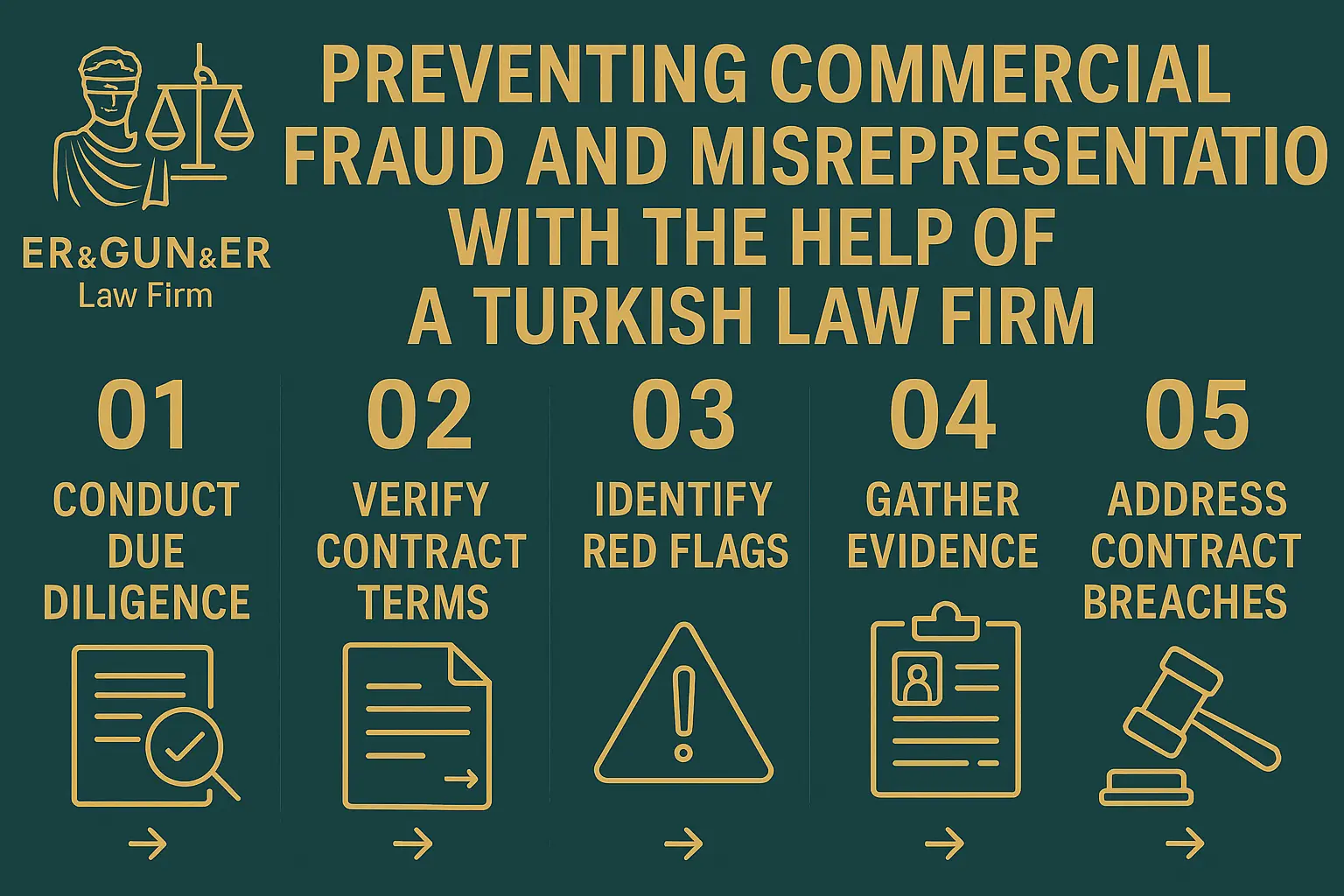
A lawyer in Turkey who advises businesses on commercial fraud prevention understands that fraud and misrepresentation in Turkish business transactions—whether involving false invoices, fabricated supplier credentials, forged signatures, misrepresented financial statements, shell company structures or concealed liabilities—cause financial losses, operational disruption and reputational damage that are far more expensive to remediate after the fact than to prevent through systematic legal safeguards implemented before transactions are executed. An Istanbul Law Firm that helps foreign companies, joint ventures and multinational investors prevent commercial fraud in Turkey designs multi-layered prevention strategies that integrate contractual protections, counterparty due diligence, document verification protocols, audit trail systems and internal compliance frameworks into a coherent risk management architecture. A Turkish Law Firm with experience in fraud prevention coordinates legal, financial and operational controls across the transaction lifecycle—from pre-contractual vetting through contract execution, performance monitoring and post-transaction review—ensuring that red flags are identified before they mature into losses and that the evidentiary foundation for enforcement action is established before it is needed. An English speaking lawyer in Turkey who manages fraud prevention programs for international clients ensures that risk assessments, compliance protocols and investigative findings are communicated in clear, bilingual formats that enable foreign management, boards and compliance committees to make informed decisions about counterparty relationships, transaction structures and risk tolerance levels. Turkish lawyers who practice in commercial fraud prevention bring practical familiarity with the Turkish Commercial Code's misrepresentation provisions, the Turkish Penal Code's fraud and forgery offenses, the enforcement mechanisms available through Turkish civil and criminal courts, and the due diligence and compliance standards that Turkish regulatory authorities expect from businesses operating in Turkey's commercial environment. This guide explains the risk identification, contractual protection, due diligence, monitoring, enforcement and compliance training strategies that a methodical lawyer in Turkey applies to prevent commercial fraud and misrepresentation in Turkish business transactions.
Identifying Commercial Fraud Risks in Turkish Business Transactions
A lawyer in Turkey who conducts fraud risk assessments for businesses operating in Turkey explains that the first step in any fraud prevention program is systematic identification of the specific fraud risks that the business faces based on its industry sector, transaction types, counterparty relationships, geographic exposure and operational structure. Commercial fraud in Turkish business transactions takes many forms: false or inflated invoices submitted for payment against goods or services that were never delivered or that were delivered at lower quality or quantity than invoiced; fabricated corporate documents including forged board resolutions, falsified financial statements, counterfeit registration certificates and fraudulent share transfer records; misrepresentation of material facts during contract negotiations including false statements about asset ownership, financial condition, regulatory compliance, litigation exposure or environmental liabilities; shell company structures created to conceal beneficial ownership, to facilitate circular transactions or to layer fraudulent fund flows through multiple entities; and collusive arrangements between employees, suppliers and intermediaries that divert corporate resources through kickback schemes, procurement manipulation or vendor favoritism. Turkish lawyers who conduct fraud risk assessments review the business's existing contracts, supplier relationships, procurement processes, payment systems and internal controls to identify the specific vulnerabilities that fraudsters exploit, and they prepare risk memoranda that categorize each identified vulnerability by severity, likelihood and recommended countermeasure. Practice may vary by authority and year — verify current regulatory expectations for commercial fraud prevention and compliance standards before any risk assessment or prevention program implementation.
An Istanbul Law Firm that identifies fraud red flags in Turkish business relationships explains that the warning signs that precede commercial fraud are often subtle and easily overlooked by management teams focused on operational objectives rather than compliance monitoring. Common red flags include sudden and unexplained changes in corporate board composition or management structure at a counterparty, particularly when the changes occur shortly before or during a significant transaction; inconsistencies between the main body of a contract and its annexes, schedules or side letters that create ambiguity about the parties' actual obligations; pressure from the counterparty to bypass standard notarization, authentication or registration procedures that provide independent verification of document authenticity; reluctance by the counterparty to provide basic corporate documentation such as current registry extracts, audited financial statements or beneficial ownership disclosures; payment routing through intermediary accounts, offshore entities or jurisdictions with weak transparency requirements when direct payment would be commercially feasible; and unusual urgency in closing a transaction combined with resistance to due diligence inquiries that suggest the counterparty is attempting to complete the deal before the other party discovers material facts. Turkish lawyers who map these red flags prepare prevention protocols that define escalation procedures for each warning sign, ensuring that operational teams know when to pause a transaction and when to involve legal counsel for investigation before proceeding.
A Turkish Law Firm that designs fraud alert systems for businesses operating in Turkey also assists clients in integrating fraud detection into their ongoing operational processes rather than treating it as a one-time pre-transaction exercise. An English speaking lawyer in Turkey who implements fraud monitoring frameworks for international clients designs vendor audit trail systems that track document submissions, payment patterns and delivery performance across the supplier base; whistleblower reporting channels that enable employees, contractors and business partners to report suspected fraud confidentially; periodic compliance audits that test the effectiveness of contractual protections, internal controls and counterparty vetting procedures; and escalation protocols that define the chain of notification from initial detection through internal investigation to legal enforcement. A lawyer in Turkey for commercial fraud prevention recognizes that fraud is an ongoing risk that evolves as fraudsters adapt to existing controls, and that prevention programs must be maintained, updated and tested regularly to remain effective against new fraud typologies, emerging threat patterns and changes in the regulatory environment.
Structuring Contracts to Prevent Fraud and Misrepresentation
A lawyer in Turkey who drafts fraud-resistant commercial contracts explains that well-structured contractual protections are the first legal barrier against misrepresentation and deception in business dealings, and that contracts designed with fraud prevention as an explicit objective incorporate specific clauses, verification mechanisms and enforcement triggers that deter fraudulent conduct, facilitate early detection of misrepresentation, and preserve the innocent party's remedies when fraud is discovered. The core contractual protections include comprehensive representation and warranty clauses that require each party to make specific, verifiable statements about material facts—asset ownership, financial condition, regulatory compliance, absence of undisclosed liabilities, accuracy of financial statements, authority to enter the transaction, and absence of known litigation or regulatory proceedings—with explicit acknowledgment that the other party is relying on these representations in entering the contract. Indemnity provisions should specify that a party who makes a false representation is liable for all losses, costs and expenses incurred by the relying party as a consequence of the misrepresentation, including consequential damages, investigation costs, legal fees and remediation expenses. Conditions precedent should require verification of key representations before the contract becomes binding or before significant performance obligations commence, creating a structured opportunity to confirm the accuracy of representations before irreversible commitments are made. Practice may vary by authority and year — verify current Turkish contract law standards for representation, warranty and indemnity clause enforceability before any fraud-prevention contract drafting.
An Istanbul Law Firm that negotiates fraud-resistant contracts for international clients explains that beyond the standard representation and warranty framework, sophisticated fraud prevention contracts incorporate additional protective mechanisms tailored to the specific transaction and counterparty risk profile. Truth obligation clauses require ongoing disclosure of material changes to representations throughout the contract period, not merely at the point of execution. Disclosure schedules require the disclosing party to list all exceptions to blanket representations, creating a documented record of known issues that prevents later claims of ignorance. Bring-down conditions require the representing party to reaffirm the accuracy of their representations at specified milestones—such as closing, delivery or payment—creating multiple verification points rather than a single point-of-execution snapshot. Anti-fraud termination triggers specify that the discovery of material misrepresentation constitutes an event of default that entitles the innocent party to immediate termination, suspension of performance obligations and activation of indemnity and enforcement remedies without the notice and cure periods that apply to ordinary contractual breaches. Turkish lawyers who draft these protective clauses ensure that each clause is enforceable under Turkish contract law, that the burden of proof for triggering each protection is clearly allocated, and that the remedies specified are proportionate to the harm and legally available under the applicable legal framework.
A Turkish Law Firm that supports contract negotiation and counterparty screening as part of the fraud prevention process also assists clients with clause-by-clause redlining of counterparty drafts to identify and close gaps that could be exploited for fraudulent purposes. An English speaking lawyer in Turkey who reviews contracts for international clients highlights provisions that are vulnerable to document substitution—where a signed version could be replaced with an altered version after execution—translation fraud—where the foreign-language version of a bilingual contract contains different terms from the Turkish version—or disguised shareholding arrangements—where the contract purports to deal with one party but the economic benefits flow to an undisclosed third party. The contract review process also evaluates whether the notarization, authentication and registration requirements applicable to the specific transaction type under Turkish law have been properly addressed, because bypassing these formal requirements not only creates legal validity risks but also eliminates the independent verification that formal procedures provide against document fraud.
Due Diligence, Counterparty Vetting and Background Verification
A lawyer in Turkey who designs due diligence frameworks for fraud prevention explains that robust counterparty vetting is the most effective pre-contractual safeguard against commercial fraud, because fraudsters rely fundamentally on information asymmetry—the gap between what they know about themselves and their operations and what the other party knows—and due diligence systematically closes that gap through independent verification of the counterparty's identity, corporate status, financial condition, ownership structure, management history, litigation record, regulatory compliance and operational reality. The due diligence process begins with basic corporate verification: confirming through independent registry searches that the counterparty actually exists as a registered legal entity in good standing, that its trade registry information including the company name, registration number, registered address, stated business activities and authorized representatives is current and accurate as reflected in the Trade Registry Gazette and the MERSIS commercial registry system, that its stated registered address corresponds to an actual business location where business activities are conducted rather than a mailbox or virtual office address, that its corporate representatives who are negotiating and signing on behalf of the entity actually have the authority to bind the entity based on the current board resolution or authorized signatory list filed with the registry, and that its shareholder structure as reflected in the registry records matches the ownership representations made during negotiations rather than concealing undisclosed shareholders, nominee arrangements or beneficial owners who are not visible in the formal corporate records. Turkish lawyers who conduct corporate verification access the Turkish Trade Registry Gazette, the MERSIS centralized commercial registry, the relevant chamber of commerce membership records, the tax administration's taxpayer verification system, and, where the counterparty has international operations or ownership connections, foreign corporate registries accessible through correspondent counsel in the relevant jurisdictions, to confirm the counterparty's legal existence, registration status, corporate governance structure and consistency between the formal corporate records and the representations made during business negotiations. Practice may vary by authority and year — verify current due diligence standards, registry access procedures and verification documentation requirements before any counterparty vetting process.
An Istanbul Law Firm that conducts enhanced due diligence for high-risk counterparties extends the verification process beyond basic corporate records to include comprehensive financial analysis, beneficial ownership investigation through multiple corporate layers, management background checks against public and proprietary databases, and litigation history review across Turkish and foreign jurisdictions where the counterparty has operated. Financial due diligence involves reviewing the counterparty's audited financial statements for at least the most recent three fiscal years, analyzing tax returns and social security contribution records for consistency with declared revenues and workforce size, obtaining bank references and credit reports from the counterparty's principal banking relationships, verifying the counterparty's asset base including real property registrations, vehicle registrations, intellectual property portfolios and equipment inventories, and comparing the counterparty's financial profile against industry benchmarks and the representations made during negotiations to identify quantitative inconsistencies that suggest inflation of revenues, concealment of liabilities or fabrication of financial performance. Beneficial ownership investigation traces the counterparty's ownership chain through holding companies, nominee arrangements, trust structures and offshore vehicles to identify the ultimate beneficial owners who control the entity's operations and financial decisions, and to verify that no sanctioned persons, politically exposed persons, or persons with known involvement in criminal activity, regulatory violations or serial corporate failures control the entity either directly or through intermediary arrangements designed to obscure the control relationship. Management background checks review the professional history of the counterparty's directors, officers and key decision-makers through public records searches, litigation database queries, regulatory sanction registers, media archives and professional reference verification to identify patterns of fraudulent conduct, repeated business failures under suspicious circumstances, regulatory sanctions for compliance violations, or involvement in prior fraud investigations that would indicate elevated risk. Turkish lawyers who prepare comprehensive due diligence findings compile the results into structured, bilingual risk reports with specific, actionable recommendations for each identified risk—proceed without conditions, proceed with specific contractual protections addressing the identified risk, proceed with enhanced monitoring and periodic re-verification, or decline the relationship based on the severity and nature of the findings—enabling the client's management and compliance committee to make informed decisions based on independently verified facts rather than reliance on the counterparty's own representations about its identity, financial condition and governance quality.
A Turkish Law Firm that conducts on-site verification as part of comprehensive fraud prevention due diligence explains that documentary verification alone may not detect sophisticated fraud schemes that involve fabricated documents, impersonated identities or phantom operations, and that physical site inspections, face-to-face management interviews and cross-referencing of supplier invoices against delivery records, customs documentation and warehouse inventories provide an additional verification layer that paper-based checks cannot replicate. An English speaking lawyer in Turkey who coordinates due diligence programs for international clients manages the verification process across multiple jurisdictions, obtaining background information from foreign registries, credit agencies and law enforcement databases where the counterparty has international operations or ownership connections. The due diligence findings are presented in bilingual risk scorecards that rate each counterparty across multiple risk dimensions—corporate integrity, financial stability, ownership transparency, management track record, litigation exposure and regulatory compliance—enabling the client's compliance committee to evaluate counterparty risk using a consistent, comparable methodology that supports both individual transaction decisions and portfolio-level risk management.
Audit Trails, Transaction Monitoring and Document Integrity
A lawyer in Turkey who designs transaction monitoring systems for fraud prevention explains that maintaining reliable audit trails is critical to detecting misrepresentation after contract execution, because many sophisticated fraud schemes involve gradual, incremental manipulation of documents, invoices, payment records and accounting entries that is detectable only through systematic, automated comparison of transaction data across multiple touchpoints and time periods—comparison that cannot be performed effectively through periodic manual review alone. An Istanbul Law Firm that embeds audit trail systems in commercial contracts for international clients drafts comprehensive clauses requiring notarized signatures and institutional witnesses on all material contract amendments, witnessed execution of annexes, schedules and side letters with each page initialed by all parties, electronic timestamping of all document submissions through the company's document management platform with immutable creation and modification logs, version-controlled document management with comprehensive change logging that records who created, modified, approved or distributed each document version and when, mandatory reconciliation of each payment against a specific contractual obligation with matching delivery confirmation and verified invoice documentation, and retention of all transaction records including superseded versions for a specified period that enables retrospective review and forensic analysis. These contractual audit trail requirements create a documentary framework that makes document substitution—where a signed version of a contract is replaced with an altered version after execution—invoice manipulation—where submitted invoices are modified after approval to increase amounts or change payee details—and unauthorized contract amendments—where parties add or modify terms without proper authorization—all detectable through systematic comparison of the recorded transaction history against the current physical and electronic document trail. Turkish lawyers who implement these systems ensure that the audit trail mechanisms comply with Turkish electronic signature law provisions, data protection requirements under the Turkish Personal Data Protection Law (KVKK), the evidentiary standards that Turkish civil and commercial courts apply when evaluating documentary evidence in fraud litigation, and the record retention requirements applicable to the client's industry sector and regulatory category. Practice may vary by authority and year — verify current electronic signature, timestamping, document authentication and record retention standards before any audit trail system implementation.
An Istanbul Law Firm that integrates supplier-side monitoring into fraud prevention programs explains that transaction monitoring should extend beyond internal document management to include cross-verification of supplier submissions against independent data sources. Invoice monitoring compares supplier invoices against purchase orders, delivery receipts, customs clearance documentation, warehouse inventory records and bank payment confirmations to detect invoice duplication, delivery shortfalls, price inflation and phantom billing—common fraud patterns that exploit gaps between the accounts payable function and the operational teams that receive goods and services. Payment monitoring tracks fund flows through banking channels to detect unusual patterns such as payments to previously unknown accounts, payments routing through intermediary entities not involved in the transaction, payment amounts that consistently fall just below approval thresholds, and payment timing patterns that suggest manipulation of the approval process. Turkish lawyers who design monitoring systems prepare investigation protocols that define how detected anomalies are escalated, investigated and resolved, ensuring that the monitoring system produces actionable findings rather than generating alerts that are ignored or inadequately followed up.
A Turkish Law Firm that conducts post-transaction document integrity reviews explains that periodic reviews of executed contracts, invoices, payment records and corporate documentation can detect fraud that was not apparent at the time of transaction but that becomes visible through retrospective analysis—such as contract amendments that were executed without proper authorization, invoices that were modified after approval, payment instructions that were altered after issuance, or corporate documents that were backdated to create a false timeline. An English speaking lawyer in Turkey who manages post-transaction reviews for international clients coordinates the review with the client's internal audit function, external auditors and forensic accounting specialists to ensure that the review methodology is comprehensive, that findings are documented to evidentiary standards suitable for litigation if enforcement action becomes necessary, and that remedial recommendations are practical, implementable and proportionate to the identified risks. A lawyer in Turkey for fraud prevention recognizes that audit trails and monitoring systems are not self-executing—they require trained personnel, clear escalation procedures and management commitment to acting on findings, and that the legal infrastructure of contractual audit rights, monitoring clauses and investigation protocols must be supported by operational capability to make the system effective.
Litigation Preparedness and Enforcement Strategies for Fraud Cases
A lawyer in Turkey who prepares enforcement strategies for confirmed commercial fraud explains that when due diligence, monitoring or investigation confirms that fraud or material misrepresentation has occurred, the enforcement response must be swift, coordinated and evidence-based to maximize the recovery of losses, to preserve assets that might otherwise be transferred, concealed or dissipated by the fraudster who anticipates detection, and to establish the comprehensive legal record necessary for both civil recovery proceedings and criminal prosecution. Turkish civil enforcement options for confirmed fraud cases include filing preliminary injunction applications to freeze the fraudster's bank accounts, real property, vehicles, commercial inventory and other identifiable assets before they can be transferred to related parties, moved to foreign jurisdictions or converted into untraceable forms; initiating civil litigation for compensatory and consequential damages based on the contractual indemnity provisions, the Turkish Code of Obligations' tortious misrepresentation framework, and any applicable statutory provisions that create additional liability for commercial fraud; and pursuing specific performance of contractual obligations, contract rescission with restitutionary recovery, or a combination of remedies depending on whether the innocent party's commercial interest is better served by enforcing the contract on its terms or by unwinding the transaction and recovering losses through monetary compensation. Criminal enforcement options include filing formal criminal complaints with the public prosecutor's office for fraud under Article 157 of the Turkish Penal Code, qualified fraud under Article 158, forgery of private documents under Article 207, forgery of official documents under Article 204, breach of trust under Article 155, or other applicable criminal offenses depending on the specific nature of the fraudulent conduct; cooperating with the prosecution's criminal investigation by providing documentary evidence, witness testimony and forensic analysis that supports the criminal case; and pursuing civil damage claims within the criminal proceeding as a joined civil party or in parallel civil proceedings that run simultaneously with the criminal case. Turkish lawyers who manage fraud enforcement coordinate the civil and criminal enforcement tracks to ensure that strategic decisions, evidence presentations and public communications in one proceeding do not compromise the strategy, evidentiary position or settlement prospects in the other. Practice may vary by authority and year — verify current civil enforcement procedures, criminal complaint filing requirements and asset preservation remedies before any fraud enforcement action.
An Istanbul Law Firm that handles asset preservation in fraud cases explains that the speed of the initial enforcement response is critical because fraudsters who become aware of detection typically attempt to transfer, conceal or dissipate assets before court orders can be obtained. Turkish law provides preliminary injunction and precautionary attachment mechanisms that enable the innocent party to freeze the fraudster's bank accounts, real property, vehicles and other assets on an ex parte basis—meaning without prior notice to the fraudster—when the applicant can demonstrate a prima facie fraud claim and a risk that the assets will be dissipated if the freezing order is not granted immediately. Turkish lawyers who file asset preservation applications prepare the application package in advance of the enforcement action, assembling the documentary evidence of fraud, the asset identification information obtained through investigation, and the legal arguments supporting the preservation request, so that the application can be filed and the order obtained within hours of the decision to commence enforcement. An English speaking lawyer in Turkey who coordinates fraud enforcement for international clients ensures that the enforcement strategy is communicated to the client's management and legal team in real time, that cross-border asset preservation measures are coordinated with foreign counsel where the fraudster holds assets in multiple jurisdictions, and that the evidentiary record is maintained to standards that support enforcement in both Turkish and foreign courts.
A Turkish Law Firm that pursues alternative dispute resolution for fraud claims explains that arbitration-based fraud claims and mediation with financial restitution provisions can provide faster, more confidential and more commercially practical resolution pathways than full court litigation in cases where the fraud is contained, where the fraudster has identifiable assets against which an award can be enforced, and where the innocent party's interest in confidentiality outweighs the deterrent value of public litigation. Turkish lawyers who evaluate ADR options for fraud cases assess the arbitrability of fraud claims under the applicable arbitration clause, the enforceability of arbitral awards against the fraudster's assets under the New York Convention and Turkish domestic enforcement law, and the comparative cost, speed and confidentiality advantages of arbitration versus court litigation in the specific circumstances. An English speaking lawyer in Turkey who manages international fraud arbitration coordinates with the arbitral institution, the opposing party's counsel and the enforcement authorities to ensure that the arbitral process produces an enforceable award that can be converted into actual recovery through asset attachment and execution proceedings.
Contract Termination Triggers and Emergency Response Protocols
A lawyer in Turkey who designs contract termination frameworks for fraud scenarios explains that fraudulent misrepresentation or material deceit can form immediate grounds for contract termination under Turkish law, but that the termination must be exercised correctly—with proper notice delivered through the channels specified in the contract, documented grounds supported by specific evidence of the misrepresentation, and preserved evidence that will support the terminating party's position if the counterparty disputes the termination and claims wrongful breach—to avoid the risk that the terminating party is itself held liable for wrongful termination if the alleged fraud is not subsequently proved to the court's satisfaction, a scenario that would compound the innocent party's losses by adding a wrongful termination liability on top of the original fraud damage. An Istanbul Law Firm that drafts fraud-triggered termination clauses for international clients includes clear contractual provisions specifying that the discovery of material misrepresentation—defined with sufficient precision to distinguish actionable fraud from immaterial inaccuracies that would not justify termination—constitutes an event of default that entitles the innocent party to immediate termination without the notice and cure periods applicable to ordinary contractual breaches, immediate suspension of all performance obligations including payment obligations pending investigation of the fraud and assessment of losses, automatic activation of indemnity provisions that make the misrepresenting party liable for all losses, costs, expenses and consequential damages caused by the misrepresentation from the date of the contract through the date of termination, and full preservation of all enforcement rights including asset freezing applications, civil damage claims, criminal referrals and arbitration proceedings that may be necessary to recover the innocent party's losses. The termination clause should define the evidence threshold required to trigger termination—specifying what constitutes sufficient proof of material misrepresentation for the purposes of exercising the contractual termination right—and should include a standstill mechanism that suspends all mutual performance obligations during the fraud investigation period without the suspension constituting a waiver of the innocent party's termination rights, a breach of the suspending party's obligations, or an election between inconsistent remedies. Practice may vary by authority and year — verify current Turkish contract law standards for fraud-based termination, notice requirements, evidence thresholds and standstill provisions before any termination action.
An Istanbul Law Firm that manages emergency response protocols for fraud incidents explains that the first hours after fraud detection are critical for evidence preservation, asset protection and communication control, and that businesses should have pre-established emergency response plans that define the chain of notification, the immediate actions to be taken, and the roles and responsibilities of each team member during the initial response period. Turkish lawyers who design emergency response protocols specify the immediate operational and legal steps that must be taken within the first hours of detection: secure and preserve all documentary evidence related to the suspected fraud including original and electronic copies of contracts, invoices, correspondence, internal approvals, electronic communications, financial records and banking documentation; restrict access to the compromised transaction records and the associated electronic systems to prevent evidence tampering, destruction or unauthorized copying by persons who may be involved in or aware of the fraudulent activity; notify the legal team to initiate asset preservation applications with the competent court if there is any risk that the fraudster will dissipate identifiable assets before enforcement orders can be obtained; suspend ongoing payments, deliveries or other performance under the compromised contract to prevent additional losses from accumulating while the investigation is underway; restrict all external communications about the incident to authorized spokespersons using pre-approved messaging to prevent the fraudster from learning of the detection before enforcement measures are in place and to prevent inadvertent admissions or inconsistent statements that could be used against the company in subsequent proceedings.
A Turkish Law Firm that coordinates post-detection response for international clients also ensures that the termination, investigation and enforcement actions are aligned with the company's broader governance obligations—including any regulatory notification requirements, insurance policy notification obligations, board reporting duties and stakeholder communication protocols that may apply depending on the severity of the fraud and the company's regulatory environment. An English speaking lawyer in Turkey who manages the emergency response for foreign companies ensures that the response actions are communicated to the company's headquarters, board, compliance committee and insurers in bilingual format with clear timelines, decision points and recommended actions, enabling informed oversight of the response without creating communication delays that allow the fraudster additional time to dissipate assets or destroy evidence.
Internal Compliance Training and Anti-Fraud Policy Design
A lawyer in Turkey who designs internal compliance programs for fraud prevention explains that prevention begins with education, and that organizations that invest in systematic fraud awareness training, ethical conduct standards, document verification skills and reporting procedures for their employees at all levels significantly reduce their vulnerability to the common fraud schemes that exploit human trust, procedural shortcuts, insufficient verification habits and the natural reluctance of employees to question transactions that appear to have management approval. An Istanbul Law Firm that provides customized compliance training programs for businesses operating in Turkey develops interactive, scenario-based workshops that teach employees how to detect invoice tampering by comparing invoices against purchase orders, delivery records and approved vendor lists; how to verify corporate documents against trade registry records and authorized signatory lists to detect forged resolutions and falsified corporate authorizations; how to recognize shell company indicators such as recently established entities with minimal capital, no operational history, no verifiable business address and management consisting entirely of nominee directors; how to identify procurement manipulation patterns such as split orders designed to circumvent approval thresholds, single-source justifications for procurements that should be competitively bid, and vendor relationships where the vendor's ownership or management has undisclosed connections to company employees; and how to report suspected fraud through proper internal channels without fear of retaliation, including what information to include in a report, whom to contact, how confidentiality is maintained during the investigation, and what protections exist for good-faith reporters. The training programs are tailored to the specific roles and risk exposure of different employee groups—procurement staff receive focused training on vendor fraud detection and invoice verification, finance and accounts payable staff receive training on payment fraud patterns, bank instruction manipulation and reconciliation procedures, operational staff receive training on delivery verification and inventory control, and management and board members receive training on corporate governance obligations, fiduciary duties, regulatory compliance requirements and the personal legal consequences of fraud facilitation, willful blindness or negligent oversight under Turkish commercial and criminal law. Practice may vary by authority and year — verify current regulatory expectations for compliance training, whistleblower protection and anti-fraud policy standards before any program implementation.
An Istanbul Law Firm that drafts anti-fraud policies for businesses operating in Turkey designs comprehensive policy frameworks that include a code of conduct defining prohibited behaviors and ethical standards, a whistleblower protection policy that establishes confidential reporting channels and prohibits retaliation against reporters, a vendor management policy that requires due diligence verification before onboarding new suppliers and periodic re-verification of existing suppliers, a conflict of interest policy that requires disclosure of relationships between employees and counterparties, and an investigation protocol that defines how reported concerns are evaluated, investigated and resolved. Turkish lawyers who develop these policies ensure that each policy component complies with Turkish employment law, data protection requirements under the KVKK, and the corporate governance standards applicable to the company's legal form and regulatory category, and that the policies are integrated into the company's employment contracts, vendor agreements and corporate governance documents so that they are enforceable rather than merely advisory.
A Turkish Law Firm that maintains ongoing compliance programs for fraud prevention explains that initial training and policy implementation are necessary but not sufficient—the compliance program must be maintained through periodic training refreshers, simulated fraud exercises, compliance audits that test the effectiveness of controls and reporting channels, and regular updates to policies and procedures that reflect changes in the regulatory environment, emerging fraud typologies and lessons learned from actual incidents. An English speaking lawyer in Turkey who manages compliance programs for international clients coordinates the training calendar, audit schedule and policy update cycle across the company's Turkish operations, ensuring that compliance activities are documented, that participation is tracked, that audit findings are reported to management with actionable recommendations, and that the program demonstrates the ongoing institutional commitment to fraud prevention that Turkish regulatory authorities and international compliance standards expect from well-governed businesses.
Cross-Border Fraud Coordination and International Enforcement
A lawyer in Turkey who manages cross-border fraud enforcement explains that fraud cases involving Turkish and international parties require coordinated legal support across multiple jurisdictions, because sophisticated fraudsters who operate internationally deliberately exploit jurisdictional boundaries, enforcement gaps, information asymmetries between legal systems, and the procedural delays inherent in cross-border cooperation to evade detection, conceal assets in jurisdictions where the innocent party has no enforcement presence, and frustrate recovery efforts by creating layers of corporate structures and nominee arrangements that complicate asset identification and attachment. An Istanbul Law Firm that coordinates cross-border fraud enforcement collaborates with foreign law firms in the jurisdictions where the fraudster holds assets, international investigation firms that can trace asset movements across borders, foreign regulatory authorities that can provide information through mutual legal assistance channels, and diplomatic representatives who can facilitate communication between Turkish and foreign government agencies involved in the enforcement effort. Turkish lawyers who handle cross-border fraud cases initiate criminal complaints with the Turkish public prosecutor's office to establish a domestic criminal proceeding, file civil litigation in Turkish commercial courts for damage recovery and contractual enforcement, obtain preliminary injunction and precautionary attachment orders against the fraudster's Turkish-located assets including bank accounts, real property, corporate shareholdings and movable assets, and coordinate the recognition and enforcement of foreign judgments and arbitral awards in Turkey through proceedings under the Turkish International Private and Procedural Law when the innocent party has already obtained enforcement orders in other jurisdictions. The cross-border enforcement strategy must account for the different procedural requirements, evidentiary standards and enforcement timelines in each jurisdiction, and must be coordinated to prevent the fraudster from exploiting information gaps between the enforcement actions in different countries—for example, by transferring assets from a jurisdiction where a freezing order has been obtained to a jurisdiction where no freezing application has yet been filed. Practice may vary by authority and year — verify current cross-border enforcement procedures, international judicial cooperation mechanisms and asset recovery tools before any multi-jurisdictional fraud enforcement strategy.
An Istanbul Law Firm that supports international compliance officers, in-house counsel and insurers in resolving multi-country commercial fraud explains that the evidentiary coordination across jurisdictions is often the most challenging aspect of cross-border fraud enforcement, because different legal systems apply different evidentiary standards, different authentication requirements and different procedural rules that must be satisfied in each jurisdiction where enforcement is sought. Turkish lawyers who coordinate cross-border evidence management ensure that documentary evidence obtained in Turkey is authenticated, translated and presented in formats that satisfy the evidentiary requirements of each foreign jurisdiction where enforcement proceedings are pending, and that evidence obtained from foreign sources is properly authenticated for use in Turkish proceedings through apostille, consular legalization and sworn translation procedures. An English speaking lawyer in Turkey who serves as the central coordination point for multi-jurisdictional fraud enforcement maintains a unified case file, a consolidated evidence index and a cross-jurisdictional enforcement timeline that enables all participating counsel—in Turkey and abroad—to track the progress of enforcement actions, coordinate timing to prevent the fraudster from exploiting information gaps between jurisdictions, and ensure that the overall enforcement strategy produces maximum recovery with minimum duplication of effort.
A Turkish Law Firm that manages post-resolution strategies for fraud cases coordinates loss recovery proceedings, debt enforcement actions and reputation restoration measures that address the full spectrum of harm caused by the fraud. Turkish lawyers who handle post-resolution work pursue civil recovery of damages through enforcement of court judgments and arbitral awards, coordinate with insurers on fraud loss claims and subrogation recoveries, assist with corporate governance remediation measures such as board restructuring, management changes and internal control enhancements, and support the client's communication strategy for informing stakeholders, regulators and business partners about the fraud, the enforcement outcome and the corrective measures implemented. A lawyer in Turkey for cross-border fraud enforcement recognizes that the ultimate objective is not merely to obtain a judgment or an award but to convert that legal victory into actual financial recovery and operational resilience—ensuring that the business emerges from the fraud incident with stronger controls, better counterparty vetting procedures and a documented enforcement track record that deters future fraud attempts.
Frequently Asked Questions
- What are the most common types of commercial fraud in Turkey? The most common types include false or inflated invoicing, fabricated corporate documents such as forged board resolutions and falsified financial statements, misrepresentation of material facts during contract negotiations, shell company structures used to conceal beneficial ownership, procurement manipulation through collusive vendor arrangements, and payment diversion schemes that redirect funds through unauthorized accounts.
- Can I terminate a contract immediately if fraud is discovered? Yes, if the contract includes properly drafted fraud-triggered termination clauses that specify material misrepresentation as an event of default entitling the innocent party to immediate termination. Without such clauses, the innocent party may still have termination rights under the Turkish Code of Obligations, but the legal basis and procedural requirements are different and should be evaluated with counsel before action.
- How quickly can asset freezing orders be obtained in fraud cases? Turkish courts can issue preliminary injunction and precautionary attachment orders on an ex parte basis—without prior notice to the respondent—within hours of the application when the applicant demonstrates a prima facie fraud claim and a risk of asset dissipation. Preparation of the application package in advance of the enforcement decision is essential to achieving this speed.
- Can criminal complaints be filed alongside civil fraud litigation? Yes. Turkish law permits parallel civil and criminal proceedings arising from the same fraudulent conduct. Criminal complaints are filed with the public prosecutor's office for fraud, forgery and breach of trust offenses, while civil litigation pursues damage recovery through the commercial courts. The two tracks must be coordinated to avoid strategic conflicts.
- What due diligence should be conducted before entering a business relationship in Turkey? Comprehensive due diligence includes corporate registry verification, financial statement analysis, beneficial ownership investigation, management background checks, litigation history review, regulatory compliance verification and, for high-risk counterparties, on-site inspections and cross-referencing of supplier invoices against delivery records. The scope should be proportionate to the transaction value and risk profile.
- Does Turkish law protect whistleblowers who report fraud? Turkish law provides certain protections for employees who report illegal conduct, and well-designed corporate whistleblower policies that establish confidential reporting channels and prohibit retaliation provide additional contractual protections. Whistleblower policies should comply with Turkish employment law and KVKK data protection requirements.
- Can foreign judgments for fraud be enforced in Turkey? Yes, through recognition and enforcement proceedings under the Turkish International Private and Procedural Law, subject to conditions including reciprocity, proper service, public policy compliance and finality. Arbitral awards are enforceable under the New York Convention. The enforcement application should be prepared with properly authenticated and translated documentation.
- How are audit trails used to detect post-contractual fraud? Audit trails enable detection of document substitution, invoice modification, unauthorized contract amendments and payment manipulation by creating a timestamped, version-controlled record of all transaction documents that can be compared against the current document set. Discrepancies between the audit trail and the current documents indicate potential manipulation.
- What compliance training should businesses provide to prevent fraud? Training should include fraud awareness education tailored to each employee role, document verification skills, red flag recognition, reporting procedures, ethical conduct standards and the legal consequences of fraud participation. Training should be reinforced through periodic refreshers, simulated exercises and compliance audits that test the effectiveness of controls.
- Can fraud be prevented through contract structure alone? Contracts are a critical first line of defense but are not sufficient alone. Effective fraud prevention requires the combination of contractual protections, pre-contractual due diligence, ongoing transaction monitoring, internal compliance policies, employee training and enforcement readiness—a multi-layered approach that addresses fraud risk across the entire transaction lifecycle.
- How does fraud prevention differ across industry sectors? Fraud risks and prevention strategies vary significantly by sector. Real estate transactions face documentation fraud and valuation manipulation risks; logistics operations face cargo theft, customs misdeclaration and phantom delivery risks; financial services face AML violations, unauthorized transactions and identity fraud; and e-commerce faces payment fraud, counterfeit goods and identity spoofing. Prevention strategies must be tailored to sector-specific risk profiles.
- What is the role of forensic accounting in fraud investigation? Forensic accountants analyze financial records, transaction patterns, fund flows and accounting entries to detect irregularities that indicate fraudulent activity. Their findings are presented in expert reports that serve as evidence in both civil litigation and criminal proceedings. Forensic accounting is particularly valuable in complex fraud cases involving multiple entities, cross-border transactions or concealed fund flows.
- Can mediation or arbitration resolve fraud disputes? Yes, when the arbitration clause covers fraud-related claims and when the fraudster has identifiable assets against which an award can be enforced. Arbitration offers speed, confidentiality and internationally enforceable awards. Mediation with financial restitution provisions can provide even faster resolution when both parties have an interest in confidential settlement.
- What post-fraud governance improvements should be implemented? Post-fraud governance improvements typically include strengthening internal controls, implementing enhanced due diligence procedures, establishing or upgrading whistleblower reporting channels, conducting board-level reviews of risk management frameworks, updating anti-fraud policies, and implementing ongoing monitoring systems. These improvements should be documented and reported to management and the board.
- Does ER&GUN&ER Law Firm handle commercial fraud prevention and enforcement? Yes. ER&GUN&ER Law Firm provides comprehensive commercial fraud prevention and enforcement services including counterparty due diligence, fraud-resistant contract drafting, audit trail design, transaction monitoring, compliance training, emergency response coordination, asset preservation, civil and criminal enforcement, cross-border coordination and post-resolution governance enhancement, with bilingual English-Turkish legal support throughout.
Author: Mirkan Topcu is an attorney registered with the Istanbul Bar Association (Istanbul 1st Bar), Bar Registration No: 67874. His practice focuses on cross-border and high-stakes matters where evidence discipline, procedural accuracy, and risk control are decisive.
He advises individuals and companies across Immigration and Residency, Real Estate Law, Tax Law, and cross-border documentation matters where procedural accuracy and evidence discipline are decisive.
Education: Istanbul University Faculty of Law (2018); Galatasaray University, LL.M. (2022). LinkedIn: Profile. Istanbul Bar Association: Official website.