

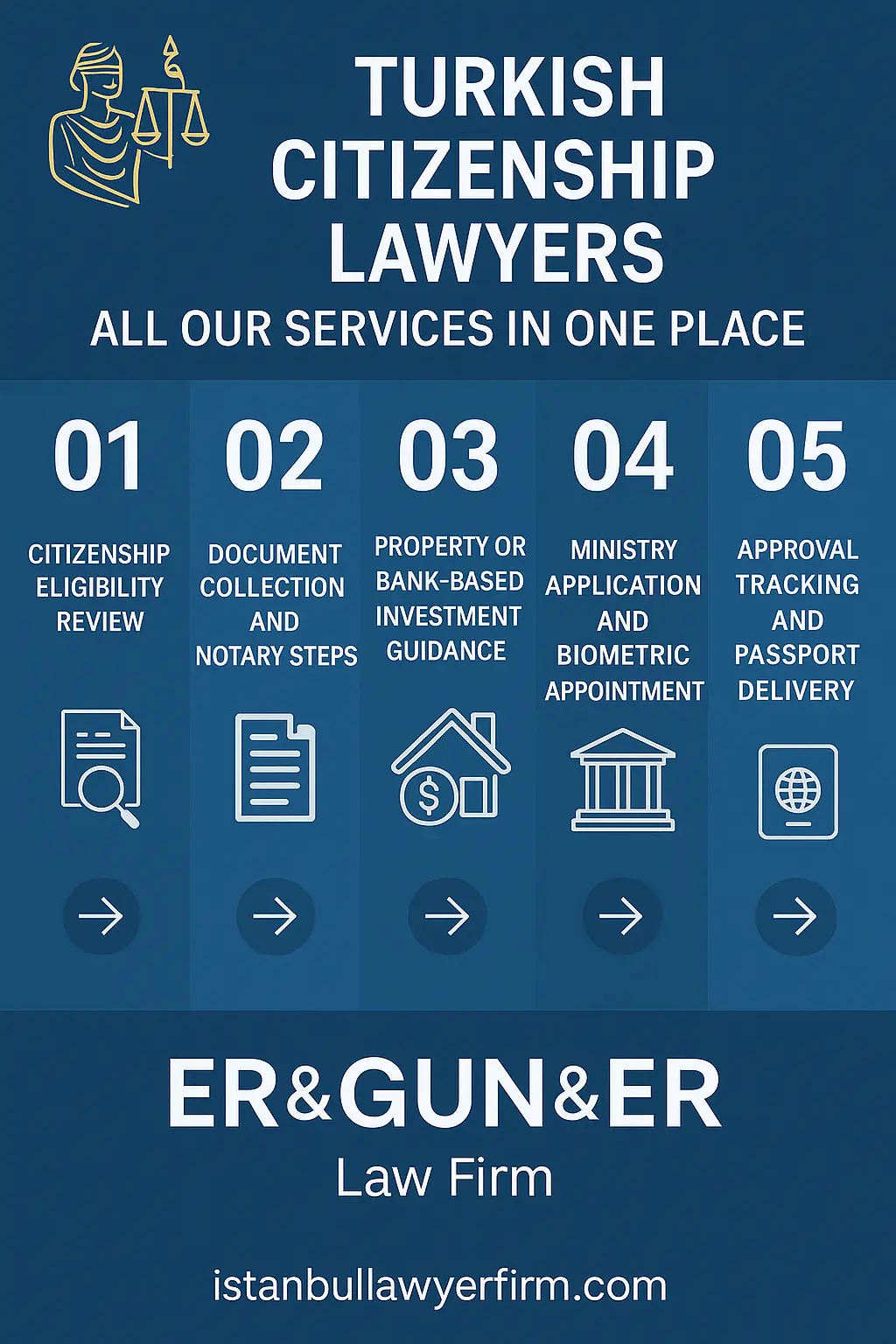
Turkish citizenship law is codified primarily in the Turkish Citizenship Law (Türk Vatandaşlığı Kanunu, Law No. 5901) and its implementing regulation, which establish four main routes through which a foreign national can acquire Turkish citizenship: exceptional citizenship by investment under Article 12 (the presidential discretion route triggered by qualifying economic contribution); citizenship by marriage under Article 16 (available to spouses of Turkish citizens who have been legally married for at least three years with a genuine ongoing family life); general naturalization under Article 11 (available to foreign nationals who have resided legally and continuously in Turkey for at least five years); and citizenship by ancestry (available to descendants of Turkish citizens under the descent provisions of Law No. 5901). Each route is administered by different government authorities, requires different documentary packages, and involves different authenticity or eligibility review processes — which means the representation strategy for each route differs fundamentally. The Turkish Directorate General of Population and Citizenship Affairs (Nüfus ve Vatandaşlık İşleri Genel Müdürlüğü) provides official guidance on Turkish citizenship law and application procedures at nvi.gov.tr. This page sets out how we work across each main citizenship route and the cross-cutting issues that affect all citizenship mandates.
Citizenship by investment — Article 12 representation
A lawyer in Turkey advising on citizenship by investment under Article 12 of Law No. 5901 must explain that this is an exceptional route — the President of Turkey exercises discretionary authority to grant citizenship to investors who make qualifying economic contributions — and the qualification for the exceptional route depends entirely on meeting the conditions set by the Council of Ministers regulation implementing Article 12. The most commonly used investment category is real estate purchase above the applicable minimum threshold, but the regulation also provides for bank deposits, capital investment in Turkish businesses, government bond purchase, REIT/fund shares, private pension contributions, and job creation for at least 50 Turkish employees. The minimum thresholds for each category are set in USD equivalent and have been revised upward multiple times since the program's introduction in 2018 — the current thresholds must be verified directly with the Ministry of Environment, Urbanization and Climate Change before any investment commitment. Practice may vary by authority and year — verify current Article 12 investment threshold amounts, qualifying conditions for each investment category, and the mandatory currency conversion (Döviz Alım Belgesi) requirement with the Ministry of Environment before any investment is executed for citizenship purposes.
An Istanbul Law Firm representing an Article 12 applicant must explain that the pre-investment due diligence stage — before any funds are committed — is the most commercially consequential stage of the entire mandate. For real estate investments, the due diligence covers the full Land Registry record (encumbrance register, litigation annotations, ownership history), the municipality's records for construction permits and occupancy certificate, the CMB-licensed appraiser's valuation (which must confirm the property meets the applicable threshold), and eligibility under the current regulation (which after a 2023 regulatory update excludes undeveloped land from qualifying). For bank deposits and fund investments, the due diligence covers the specific institution's qualification under the BDDK or CMB framework and the specific document format required by the Ministry of Environment for the Certificate of Conformity (Uygunluk Belgesi). A property purchased or a deposit placed before legal due diligence creates a situation where the investment is complete but the citizenship cannot proceed — which is both costly to remedy and potentially impossible to remedy if the specific property is ineligible. We conduct a complete pre-investment eligibility assessment before any documentation is assembled or any funds are committed. Practice may vary — verify current Land Registry due diligence requirements and the specific Ministry of Environment Certificate of Conformity documentation requirements applicable to the investment category before any pre-investment assessment.
A law firm in Istanbul representing an Article 12 applicant through the application sequence must explain that the Article 12 process proceeds through a defined sequence of steps — each of which must be completed in order, because each step's output is a prerequisite for the next: pre-investment due diligence and fund source documentation preparation; investment execution with mandatory currency conversion; Certificate of Conformity application to the relevant ministry; investor residence permit application under YUKK Article 31(1)(j); citizenship application to the Ministry of Interior with the complete documentation package; and post-approval civil registry enrollment, ID card, and passport issuance. The source of funds documentation — demonstrating that every material element of the investment funds came from a legitimate, traceable source — is one of the most complex and individually variable aspects of the application, because Turkish authorities have intensified source of funds scrutiny since 2023 in line with global AML standards. An investment that is financially eligible but whose source of funds is inadequately documented can fail at the Ministry review stage. We prepare a source of funds affidavit and supporting documentary package as a standard component of every Article 12 mandate. The complete framework for citizenship by investment is analyzed in the resource on turkish-citizenship-investment-2025. Practice may vary — verify current Ministry of Interior source of funds documentation standards and the specific Certificate of Conformity application procedures before commencing any Article 12 citizenship application.
Citizenship by marriage — Article 16 representation
An English speaking lawyer in Turkey advising on Article 16 citizenship by marriage must explain that the qualifying conditions require the marriage to have been continuously valid for at least three years, the spouses to be continuing to live together as a genuine family (birlikte yaşama), the applicant to have no conduct incompatible with marital unity, and no final criminal judgment of one year's imprisonment or more or a judgment for a specified serious offense category. The most common reason for Article 16 rejection is not a failure to meet the three-year duration requirement — it is a failure to satisfy the authenticity review, because the Ministry of Interior applies a substantive genuineness standard that goes beyond the existence of a legally valid marriage certificate. The Ministry's review distinguishes genuine marriages — involving real shared family life, mutual commitment, and ongoing relationship — from marriages of convenience entered into primarily for the citizenship benefit. This distinction is assessed through both documentary evidence and the personal interview conducted at the provincial Population Directorate. Practice may vary by authority and year — verify current Ministry of Interior Article 16 authenticity review standards and the specific evidence categories accorded most weight at the relevant provincial directorate before assembling any Article 16 citizenship application.
A Turkish Law Firm advising on Article 16 evidence architecture must explain that the documentary evidence package for an Article 16 application must demonstrate genuine shared family life across the entire three-year qualifying period — not just the period immediately before application. The most persuasive categories of evidence include: joint residential address registration; utility bills at the joint address; joint bank accounts with regular shared financial activity; joint health insurance documentation; joint parenting evidence for any children (birth certificates, school registration, medical records); travel records showing travel together; and photographs with verifiable dates spanning the qualifying period. Evidence that is assembled specifically for the application — photographs taken on a single occasion, bank statements opened shortly before application — is less persuasive than evidence generated in the ordinary course of the marriage. A comprehensive pre-application audit of the couple's existing documentary record, followed by targeted gap-filling in the remaining period before application, is the standard approach we apply in every Article 16 mandate. The complete framework for citizenship by marriage is analyzed in the resource on turkish-citizenship-by-marriage. Practice may vary — verify current Ministry of Interior documentary evidence standards and the specific weight given to each evidence category in Article 16 authenticity reviews at the relevant provincial directorate.
A lawyer in Turkey advising on Article 16 rejection and appeal must explain that a rejected Article 16 application can be challenged through an administrative appeal to the Ministry of Interior within the statutory deadline, and through an administrative court lawsuit (iptal davası) filed within 60 days of the rejection notification under İYUK. For rejections based on authenticity concerns — the most common rejection ground — the administrative court does not conduct an independent authenticity assessment; it reviews whether the Ministry's rejection was legally erroneous (whether the wrong standard was applied, whether the evidence was improperly assessed, or whether procedure was violated). A court that finds the rejection legally improper annuls the decision and remands to the Ministry for reassessment — the court does not itself grant citizenship. Where the rejection was genuinely based on evidentiary insufficiency rather than legal error, re-application with a significantly enhanced documentation package is typically more direct than litigation. We conduct a post-rejection legal analysis before advising on whether to pursue appeal litigation or re-application. Practice may vary — verify current administrative court appeal deadlines and the specific legal error standard applied in citizenship rejection review cases before deciding on any post-rejection strategy.
General naturalization — Article 11 representation
An Istanbul Law Firm advising on Article 11 general naturalization must explain that the qualifying conditions include: at least five years of continuous legal residence in Turkey immediately preceding the application (not including periods of legal stay under specific visa exemptions or visa-on-arrival arrangements that do not constitute legal residence); financial self-sufficiency; no final criminal judgment involving imprisonment of one year or more or for specified serious offense categories; no threat to national security or public order; and knowledge of Turkish sufficient to conduct daily life (assessed through a Turkish language interview or equivalent). The five-year continuous residence requirement is calculated from registered residence with valid permits — gaps in the permit sequence, periods of overstay, or periods without valid residence status interrupt the continuity calculation. An applicant who has been resident in Turkey for more than five calendar years but whose permit history contains gaps or irregularities may not meet the continuous residence requirement, and a full permit history analysis is the essential first step of any Article 11 mandate. Practice may vary by authority and year — verify current Ministry of Interior continuous residence calculation methodology and the specific permit categories that count toward the five-year period before advising on any Article 11 naturalization application.
A law firm in Istanbul advising on the Turkish language requirement for Article 11 must explain that the naturalization interview conducted at the provincial Population Directorate assesses the applicant's Turkish language capability in a practical conversational context — not as a formal examination with a defined passing score, but as an assessment of whether the applicant can conduct daily life in Turkish. The interview covers basic personal information, the applicant's life in Turkey, and general conversational topics. For applicants with limited Turkish language proficiency, the interview is the most significant risk factor in the Article 11 application — because an applicant who cannot communicate in Turkish during the interview will face rejection on the language grounds regardless of the quality of their residence documentation. We assess Turkish language proficiency at the beginning of every Article 11 mandate, and for applicants whose Turkish is below conversational level, we advise on the realistic timeline for language improvement before the application is filed. Practice may vary — verify current Ministry of Interior Turkish language assessment standards and the specific interview format applicable at the relevant provincial directorate before planning any Article 11 application for an applicant with limited Turkish language proficiency.
An English speaking lawyer in Turkey advising on citizenship by ancestry must explain that Law No. 5901 provides specific pathways for persons who have a Turkish ancestor — specifically, persons who were formerly Turkish citizens and lost their citizenship (and their descendants) may have specific rights to reclaim Turkish citizenship under administrative procedures that differ from the standard naturalization route. The most common ancestry-based pathway involves a Turkish grandparent who emigrated and whose descendants have maintained their Turkish registration in the family record system. For persons with Turkish ancestry who do not have a direct line of documented Turkish civil registry registration, the pathway is more complex and may require reconstructing the family's registration history from Ottoman records or early Republican civil registration documents. The ancestry route is one of the most document-intensive citizenship applications, and the outcome depends heavily on the completeness and consistency of the family's historical civil registration chain. We assess ancestry citizenship eligibility through a documentary reconstruction of the family's civil registration history before advising on whether the ancestry route is feasible or whether a standard naturalization route would be more appropriate. Practice may vary — verify current Ministry of Interior ancestry citizenship assessment procedures and the specific documentation required for each generation in the ancestry chain before commencing any ancestry-based citizenship application.
Dual nationality — rights, obligations, and administration
A Turkish Law Firm advising on dual citizenship for new Turkish citizens must explain that Turkey's Citizenship Law does not require renunciation of a prior nationality upon acquiring Turkish citizenship — Turkey legally permits its citizens to hold multiple nationalities simultaneously. However, the legal permissibility of dual nationality in Turkey does not resolve the question of whether the investor's or applicant's home country permits dual citizenship — because many countries impose legal consequences on their nationals who acquire a foreign nationality without prior permission. Countries that do not permit dual citizenship (or that require prior permission) include China, India, Saudi Arabia, the UAE, Japan, and several others — and the consequences of unauthorized dual citizenship acquisition in these countries range from administrative fines to loss of the home country citizenship. A thorough dual citizenship risk assessment covering the home country's nationality law and any applicable reporting obligations is a standard component of every Turkish citizenship mandate for applicants from countries with dual citizenship restrictions. Practice may vary — verify current home country nationality law on dual citizenship acquisition with qualified counsel in the home country before acquiring Turkish citizenship.
An Istanbul Law Firm advising on notification and registration obligations after acquiring dual citizenship must explain that a new Turkish citizen who holds another nationality is expected to register their foreign nationality with the Turkish civil registry (nüfus sicili) — which is typically done at the time of the Turkish citizenship registration by noting the prior nationality on the Turkish ID record. Going forward, if the dual citizen acquires additional nationalities, Turkish law expects notification. For dual citizens who are male and of eligible age, the military service obligation under Turkish law is relevant — Turkey imposes military service on male Turkish citizens, and the specific exemption conditions applicable to dual citizens who were not born Turkish must be confirmed with the Turkish military authorities. The specific military service exemptions and alternative compliance options vary based on age, prior military service in the other country, and other individual factors. We advise new Turkish citizens on military service implications as part of the post-citizenship planning phase of every mandate. Practice may vary by authority and year — verify current Turkish military service exemption conditions applicable to naturalized dual citizens with the Turkish military authorities before planning any post-citizenship activities for male applicants of eligible age.
A lawyer in Turkey advising on renunciation of Turkish citizenship must explain that a Turkish citizen who wishes to renounce their Turkish citizenship (for example, because their home country requires it upon acquiring another nationality, or for personal choice) must apply to the Ministry of Interior for permission to renounce (Türk vatandaşlığından çıkma izni). Renunciation requires Ministry of Interior approval and produces a certificate of renunciation (vatandaşlıktan çıkma belgesi). A Turkish citizen who renounces Turkish citizenship retains certain rights in Turkey as a former citizen — specifically, the "blue card" (mavi kart) system allows former Turkish citizens and their descendants to benefit from specific economic and civil rights in Turkey without holding full citizenship. The renunciation must be carefully timed to avoid creating a period where the person holds neither full Turkish citizenship nor any other valid nationality — statelessness, even briefly, creates significant practical and legal complications. We advise Turkish citizens and new Turkish citizens on renunciation procedures, timing, and the blue card system as part of comprehensive citizenship planning. Practice may vary — verify current Ministry of Interior renunciation application procedures and the specific rights preserved under the blue card system before planning any Turkish citizenship renunciation.
Citizenship rejection, appeal, and administrative court litigation
An English speaking lawyer in Turkey advising on citizenship application rejection must explain that Turkish citizenship applications can be rejected on several distinct grounds — each requiring a different response strategy. Rejection grounds include: failure to meet the substantive eligibility conditions (insufficient investment, insufficient qualifying period, disqualifying criminal record); evidentiary deficiency (inadequate documentation of investment, authenticity, or residence); procedural deficiency (incorrect format, missing translation, expired document); and discretionary rejection on grounds of national security, public order, or public morality concerns. For rejections based on substantive ineligibility or disqualifying criminal record, the most appropriate path is typically addressing the underlying issue (completing the qualifying period, obtaining a qualifying investment, waiting for the criminal record bar to be removed) rather than litigation — because administrative court review does not substitute the court's judgment for the government's on questions of substantive eligibility assessment. For rejections based on evidentiary deficiency or procedural error, a new application with corrected documentation is often faster than litigation. For rejections based on discretionary national security or public order grounds, administrative court review is the primary avenue — because the applicant has a right to challenge the legal basis for such a discretionary restriction. Practice may vary — verify current administrative court standards for citizenship rejection review and the specific grounds on which courts have reversed Ministry of Interior decisions before selecting any post-rejection strategy.
A Turkish Law Firm advising on the administrative appeal process after citizenship rejection must explain that the administrative appeal to the Ministry of Interior (itiraz) must be filed within the statutory deadline after notification of the rejection — which varies depending on the type of rejection decision and must be confirmed for the specific case. The administrative appeal is assessed by the Ministry's internal review process rather than by an independent external authority — which means it applies the same substantive standards as the original review and is unlikely to produce a different outcome where the original rejection was based on a well-founded authenticity or eligibility assessment. The administrative appeal's practical value is strongest where the rejection was procedurally defective (the Ministry failed to consider specific evidence that was submitted, or applied the wrong legal standard), because the Ministry's own review can identify and correct these errors more quickly than court litigation. The administrative appeal also preserves the applicant's legal status during the review period in some cases, which is a practical consideration where the rejection affects the applicant's residence status. Practice may vary — verify the specific administrative appeal deadline applicable to the rejection type and the current Ministry of Interior appeal review process before filing any administrative appeal against a citizenship rejection.
A lawyer in Turkey advising on administrative court litigation against a citizenship rejection must explain that the administrative court (İdare Mahkemesi) reviewing a citizenship rejection assesses whether the rejection decision was lawful (hukuka uygun) — it does not conduct its own independent eligibility or authenticity assessment. The review covers: whether the Ministry applied the correct legal standard; whether the evidence submitted was properly considered; whether the applicant's procedural rights were respected during the review; and whether the rejection's stated grounds are supported by the factual record. Turkish administrative courts have in specific cases annulled citizenship rejections where the Ministry applied an overly restrictive interpretation of the eligibility conditions, where authenticated evidence of genuine marriage was not properly considered, or where a discretionary national security restriction was not supported by specific factual grounds. An administrative court lawsuit must be filed within 60 days of the rejection notification under İYUK — and an interim measure (yürütmenin durdurulması) suspending the rejection's legal effect pending the court's decision can be applied for alongside the main lawsuit. The Istanbul Bar Association at istanbulbarosu.org.tr provides resources for identifying qualified practitioners. Practice may vary — verify current administrative court citizenship review standards and the specific interim measure grounds applicable to citizenship rejection cases before commencing any administrative court litigation.
Children — citizenship acquisition and family inclusion
An Istanbul Law Firm advising on Turkish citizenship for children must explain that Turkish citizenship law provides multiple bases for children to acquire Turkish citizenship. By descent (soy bağı): a child born to at least one Turkish citizen parent acquires Turkish citizenship at birth, regardless of the child's country of birth. For a child born abroad to a Turkish citizen parent, the citizenship must be registered with the Turkish consulate in the country of birth to be formally recognized in Turkey's civil registry — but the right to citizenship exists from birth regardless of the registration timing. A child who qualifies for citizenship by descent but has not been registered can be registered retroactively through a consulate or Population Directorate application. By inclusion in a parent's naturalization application: minor children can be included in the Article 11, Article 12, or Article 16 citizenship applications of their parent, acquiring citizenship simultaneously with the parent if they meet the applicable eligibility conditions (primarily the criminal record condition for older minors, and parental consent requirements where both parents are not party to the application). Practice may vary — verify current Population Directorate procedures for registering a child's Turkish citizenship by descent and the specific parental consent requirements for including children in adult naturalization applications before planning any family citizenship strategy.
A law firm in Istanbul advising on citizenship for children of blended families or separated parents must explain that including a child in a naturalization application where one parent holds Turkish citizenship and the other is the applicant, or where the parents are separated, requires navigating specific legal questions about parental authority (velayet) and consent. Where both parents are alive and the child is living with one parent, the other parent's consent is typically required for citizenship applications — because acquiring citizenship is a significant legal status change for the child that affects both parents' rights. For separated parents where one parent holds parental authority and the other does not, the situation may be clearer — but the legal documentation must specifically establish the parental authority arrangement. For children who are adopted rather than biological, Turkish citizenship acquisition through adoption depends on the legal formalization of the adoption under Turkish family law — an informal or foreign adoption that has not been recognized in Turkey through the Turkish family courts does not provide a basis for Turkish citizenship for the adoptee. We advise families on the specific parental consent and authority documentation required for children's citizenship applications in complex family structures. Practice may vary — verify current Turkish family law requirements for parental consent in citizenship applications and the specific adoption recognition procedures that must precede any citizenship application for adopted children.
An English speaking lawyer in Turkey advising on citizenship for adult children of newly naturalized Turkish parents must explain that adult children (over 18) cannot be included as dependents in a parent's naturalization application — they must apply separately in their own right. An adult child of a newly naturalized Turkish parent has two potential citizenship pathways: Article 11 naturalization if they independently meet the five-year residence and other conditions; or a separate Article 12 investment citizenship if they make their own qualifying investment; or — if the naturalized parent was the applicant's Turkish-citizen parent rather than a newly naturalized parent — a potential descent-based registration through the consulate. For adult children who want to acquire Turkish citizenship in connection with a parent's naturalization, the most practical approach in most cases is to ensure the parent's naturalization is completed first, after which the adult child's own citizenship application can reference the parent's Turkish citizenship as part of the family integration context. Practice may vary — verify current Ministry of Interior procedures for citizenship applications by adult children of newly naturalized Turkish citizens and the specific basis available for each adult child's individual application before planning any multi-generational citizenship strategy.
Citizenship revocation and legal defense
A Turkish Law Firm advising on citizenship revocation risk must explain that Turkish citizenship can be revoked under Article 29 of Law No. 5901 in specific circumstances: where citizenship was obtained through fraud or false representation (including fictitious marriages entered into solely for citizenship purposes); where the naturalized citizen voluntarily serves in the military forces of a foreign country against Turkey's instructions; where the citizen takes employment with a foreign government in violation of Turkey's instructions; or where the citizen commits crimes defined under specific national security provisions. Revocation under the fraud ground — the most commonly encountered revocation basis in practice — requires the Ministry to demonstrate that the citizenship was specifically obtained through deception, not merely that the marriage later dissolved or that the investment was sold before the three-year period. For Article 16 marriage-based citizenship, a post-approval divorce does not itself trigger revocation — but a divorce occurring very shortly after citizenship approval (particularly within weeks or months) may trigger a Ministry investigation because it creates the appearance of a post-purpose termination. Practice may vary — verify current Ministry of Interior revocation grounds and the specific investigation triggers applicable to Article 16 post-approval divorce situations before planning any post-citizenship activities involving marriage dissolution.
An Istanbul Law Firm representing a client in a citizenship revocation proceeding must explain that the revocation proceeding begins with a Ministry of Interior investigation (soruşturma) and culminates in an administrative decision (revocation order) — which is subject to administrative appeal and administrative court challenge. The evidentiary standard for revocation is on the Ministry — it must affirmatively demonstrate that the citizenship was obtained through fraud, not merely that the marriage later failed or that the applicant's circumstances have changed. For a client whose Article 16 citizenship is being investigated following a post-approval divorce, the defense focuses on demonstrating the marriage's genuine character during the qualifying three-year period: the complete documentary record of shared family life, witness statements, contemporaneous evidence of mutual commitment, and any objective evidence of genuine long-term planning (shared property, joint financial accounts, travel together, children). The revocation order, if issued, is subject to annulment by the administrative court on the same review standard as a citizenship rejection — the court assesses whether the revocation was lawful, not whether it was correct in the Ministry's assessment. Practice may vary — verify current Ministry of Interior revocation investigation procedures and the specific evidence most effective in revocation defense proceedings before responding to any citizenship revocation investigation.
A lawyer in Turkey advising on false marriage fraud allegations in citizenship contexts must explain that a false allegation of fictitious marriage — whether made by a disgruntled former partner, by an anonymous informant, or by a competitor — can trigger a Ministry of Interior investigation and potentially a revocation proceeding even where the marriage was entirely genuine. The practical defense against a false allegation requires the same affirmative evidence of genuine marital character as the revocation defense: comprehensive contemporaneous documentary evidence, specific witness testimony from persons with personal knowledge of the relationship, and any objective indicators of genuine long-term marital commitment. For particularly egregious false allegations, a criminal complaint for defamation (iftira, Turkish Penal Code Article 267) may be appropriate — creating legal accountability for the false report and deterring further harassment. We represent clients in both the Ministry of Interior administrative defense and, where appropriate, in criminal proceedings against the person who made the false allegation. Practice may vary — verify current Ministry of Interior investigation response procedures and the specific criminal complaint standards applicable to false immigration-related allegations before taking any action in response to a suspected false allegation of fictitious marriage.
Post-citizenship administration and long-term planning
An English speaking lawyer in Turkey advising on post-approval administrative steps must explain that the Ministry of Interior's citizenship approval triggers a sequence of administrative steps before the citizenship is fully operational: civil registry (nüfus sicili) enrollment at the local Population Directorate; biometric data collection for the Turkish national ID card (Türkiye Cumhuriyeti Kimlik Kartı); and passport application. Biometric data collection — fingerprints and photograph — cannot be delegated through a Power of Attorney; the new citizen must appear in person, either at a Turkish Population Directorate or at a Turkish consulate abroad. The Turkish national ID card is typically issued within days of biometric enrollment; the passport application follows the ID card and is processed through the standard passport authority. For new citizens who obtained citizenship while abroad (for example, Article 12 applicants who managed the entire process through a Power of Attorney without traveling to Turkey), the biometric enrollment may be completed at a Turkish consulate in the country of residence, after which the ID card and passport can be collected in Turkey or applied for at the consulate. Practice may vary — verify current Population Directorate biometric enrollment procedures and the specific Turkish consulate capacity for post-citizenship ID and passport processing before planning any post-approval administrative schedule for a non-resident new citizen.
A Turkish Law Firm advising on Turkish inheritance planning for new citizens must explain that upon acquiring Turkish citizenship, the new citizen's Turkish-situated assets (real estate, bank accounts, company shares in Turkish companies) become subject to Turkish inheritance law for succession planning purposes. Turkish Civil Code's forced heirship rules (saklı pay) reserve mandatory minimum proportions of the estate for the surviving spouse and children — these proportions cannot be eliminated by will for Turkish assets, and they may conflict with the new citizen's home country estate planning intentions. For new citizens with Turkish real estate acquired through the Article 12 investment route, the interaction between Turkish inheritance law and the home country's succession law for the same property must be assessed: Turkish law governs the property as a matter of immovable property succession under Turkish Private International Law (MÖHUK), and a foreign will that disposes of the Turkish property inconsistently with Turkish forced heirship rules may be partially ineffective for the Turkish property. We advise new Turkish citizens on Turkish estate planning — including the preparation of a Turkish notarial will (vasiyetname) and the coordination of the Turkish estate plan with any home country estate planning — as a standard component of post-citizenship advisory. Practice may vary — verify current Turkish forced heirship proportions and the MÖHUK conflict of laws rules applicable to the new citizen's specific family composition and asset profile before finalizing any post-citizenship estate plan.
A lawyer in Turkey advising on the three-year investment retention obligation for Article 12 citizens must explain that citizenship granted under Article 12 through a qualifying investment is subject to the three-year retention commitment registered at the time of the investment — and this commitment runs to the qualifying investment, not to the citizenship itself. A violation of the retention commitment (selling the property before the three years expire, withdrawing the deposit, disposing of the qualifying investment) can provide grounds for the Ministry of Interior to initiate a revocation proceeding on the basis that the conditions on which the exceptional citizenship was granted were not maintained. After the three-year period is complete, the Land Registry annotation restricting property sale can be formally lifted through a Land Registry application, and the qualifying investment can be disposed of without affecting the citizenship. We manage the three-year retention monitoring for Article 12 clients and coordinate the formal annotation removal at the appropriate time. Practice may vary — verify the specific retention period end date applicable to the individual client's investment and the current Land Registry procedures for annotation removal before any disposition of a citizenship-qualifying investment. Practice may vary — check current guidance before acting on any information on this page.
How we work in Turkish citizenship mandates
A best lawyer in Turkey managing a Turkish citizenship mandate begins with route selection — determining which of the Law No. 5901 citizenship pathways is available and most appropriate for the specific client, given their residence history, marital status, investment capacity, criminal record profile, and citizenship objectives. Route selection is consequential because each route has different prerequisites, different processing authorities, different timelines, and different post-citizenship implications (for example, Article 12 investment citizenship subjects the investor to the three-year retention obligation; Article 11 naturalization requires five years of prior residence; Article 16 marriage citizenship requires the authenticity review that is the most variable element of the process). After route selection, the mandate proceeds through eligibility confirmation, documentary preparation, application filing, government review management, and post-approval administration — with the specific steps and their sequence determined by the route selected.
ER&GUN&ER represents foreign nationals in all Turkish citizenship routes — Article 12 citizenship by investment, Article 16 citizenship by marriage, Article 11 general naturalization, ancestry-based citizenship registration, citizenship for children, citizenship rejection appeals, administrative court litigation, revocation defense, and post-citizenship administrative formalities including civil registry enrollment, ID card, passport, and dual nationality planning. We work in English throughout all international mandates. For the complete detailed framework for each citizenship route, see the resources on turkish-citizenship-investment-2025 (Article 12) and turkish-citizenship-by-marriage (Article 16). For the Turkish residence permit framework relevant to applicants building toward Article 11 naturalization, see the resource on residence permit Turkey. Practice may vary — check current guidance before acting on any information on this page.
Frequently Asked Questions
- How many routes are there to Turkish citizenship? Law No. 5901 provides four main routes: Article 12 exceptional citizenship by investment (presidential discretion route triggered by qualifying economic contribution); Article 16 citizenship by marriage to a Turkish citizen (three-year qualifying period with genuine family life); Article 11 general naturalization (five-year continuous legal residence); and citizenship by ancestry (for descendants of former Turkish citizens). Each route has distinct eligibility conditions, documentary requirements, and processing authorities.
- Which Turkish citizenship route is fastest? The Article 12 investment route is typically the fastest, with well-prepared applications processed within approximately 6–12 months from investment to passport in recent practice — significantly faster than the Article 11 five-year residence requirement. Article 16 marriage citizenship takes approximately 6–12 months from application submission after the three-year qualifying period is met. Article 11 naturalization requires first completing five years of residence before any application can be filed. Practice may vary — verify current processing timelines directly with the relevant government authority.
- Does Turkey allow dual citizenship? Yes — Turkey's Citizenship Law does not require renunciation of prior nationality upon acquiring Turkish citizenship. However, the applicant's home country may not permit dual citizenship, and the consequences of unauthorized dual nationality acquisition in restrictive countries range from administrative fines to loss of home country citizenship. Verify home country dual citizenship rules before acquiring Turkish citizenship.
- What is the minimum investment for Article 12 citizenship? The minimum thresholds are set by Council of Ministers regulation and have been revised upward multiple times since 2018. Practice may vary by authority and year — verify the current applicable minimum for each investment category directly with the Ministry of Environment, Urbanization and Climate Change before any investment decision.
- What is the three-year qualifying period for Article 16 marriage citizenship? The foreign spouse must have been legally married to the Turkish citizen for at least three continuous years at the time of the citizenship application. The marriage must involve a genuine ongoing family life (birlikte yaşama) throughout the qualifying period — not just formal legal marriage documentation. The Ministry of Interior assesses genuineness through both documentary review and a personal interview.
- What is the five-year residence requirement for Article 11 naturalization? The applicant must have resided legally and continuously in Turkey for at least five years immediately preceding the citizenship application. Gaps in the residence permit sequence, periods of overstay, or periods without valid legal status interrupt the continuity calculation. The applicant must also demonstrate Turkish language proficiency, financial self-sufficiency, and have no disqualifying criminal record.
- Can my children be included in my citizenship application? Minor children (under 18) can be included in Article 11, Article 12, or Article 16 citizenship applications. Both parents' consent is typically required, or sole parental authority must be demonstrated. Adult children (18 and over) cannot be included as dependents and must apply separately. Children who acquire Turkish citizenship by descent (through a Turkish citizen parent) may be registered at any time through the consulate or Population Directorate.
- Can Turkish citizenship be revoked? Yes, but only in specific circumstances under Article 29 of Law No. 5901: where citizenship was obtained through fraud or misrepresentation (most commonly, where an Article 16 marriage was fictitious from the outset); voluntary service in a foreign military against Turkey's instructions; or employment with a foreign government in violation of Turkey's instructions. A genuine marriage that subsequently dissolves does not provide grounds for Article 29 revocation. Revocation decisions are subject to administrative appeal and administrative court challenge.
- What are the appeal options after a citizenship rejection? An administrative appeal to the Ministry of Interior must be filed within the statutory deadline. An administrative court lawsuit (iptal davası) under İYUK must be filed within 60 days of the rejection notification. The administrative court reviews whether the rejection was legally erroneous — it does not conduct an independent eligibility or authenticity assessment. For rejections based on evidentiary insufficiency, re-application with enhanced documentation is often more effective than litigation. Practice may vary — verify the current appeal deadlines before any rejection response.
- What is the mandatory currency conversion requirement for Article 12 applications? Since January 2022, foreign nationals making qualifying investments for Article 12 citizenship must convert their purchase funds to Turkish Lira through a Turkish bank and obtain a Foreign Currency Purchase Document (Döviz Alım Belgesi). This document is a mandatory element of the citizenship application file and the Ministry will not recognize the investment for citizenship purposes without it, even if the investment amount is otherwise sufficient.
- Do I need a Power of Attorney (POA) for the Turkish citizenship application? A POA is not legally mandatory for all steps, but it is practically essential for applicants who cannot be physically present in Turkey throughout the process. A properly drafted and notarized POA allows Turkish counsel to complete most application steps on the applicant's behalf. Note that biometric data collection for the Turkish national ID card and passport requires the new citizen's personal appearance — this cannot be delegated through a POA.
- What are the military service implications for male Turkish citizens who were naturalized? Male Turkish citizens of eligible age are subject to Turkey's military service obligation under Turkish law. Specific exemptions and alternative compliance options exist for dual citizens who have completed military service in another country, who are beyond the eligible age, or who meet other exemption conditions. The applicable conditions must be verified with Turkish military authorities for the individual's specific profile. Practice may vary — verify current military service exemption conditions for naturalized dual citizens before any planning.
- Does acquiring Turkish citizenship create Turkish tax residency? No — Turkish tax residency is determined by physical presence (more than 183 days in Turkey per year), not by citizenship status. A new Turkish citizen who continues to live primarily outside Turkey remains a non-resident for Turkish income tax purposes, subject to Turkish income tax only on Turkish-sourced income. The new citizen's home country tax law may separately impose reporting obligations related to the acquisition of foreign citizenship or assets.
- What is the blue card (mavi kart) system for former Turkish citizens? Former Turkish citizens who have renounced their Turkish citizenship and their descendants can apply for the blue card, which preserves specific economic and civil rights in Turkey — including property ownership rights, inheritance rights, and access to certain economic activities — without full citizenship. The blue card system provides a middle ground for persons who voluntarily renounce Turkish citizenship (typically because their home country requires it) but who wish to maintain a legal connection to Turkey. Practice may vary — verify current blue card eligibility conditions and specific rights available under the blue card status.
- What is the source of funds documentation requirement for Article 12 applications? Turkish authorities require documentation demonstrating that the funds used for the qualifying investment came from legitimate, traceable sources. The documentation must trace each material fund source to its origin — employment income, sale of assets, business dividends, inheritance, or loans. Since 2023, scrutiny has intensified in line with global AML standards. Funds from unclear sources, recently incorporated offshore companies, or cryptocurrency without clear exchange documentation will attract additional inquiry. A source of funds affidavit and supporting documentary package is a standard component of every Article 12 application we prepare.
Author: Mirkan Topcu is an attorney registered with the Istanbul Bar Association (Istanbul 1st Bar), Bar Registration No: 67874. His practice focuses on cross-border and high-stakes matters where evidence discipline, procedural accuracy, and risk control are decisive.
He advises foreign nationals and families across Turkish Citizenship Law, Citizenship by Investment, Citizenship by Marriage, Naturalization, Dual Nationality Planning, Administrative Court proceedings, and Citizenship Revocation Defense matters where multi-route eligibility analysis and regulatory compliance are decisive.
Education: Istanbul University Faculty of Law (2018); Galatasaray University, LL.M. (2022). LinkedIn: Profile. Istanbul Bar Association: Official website.