

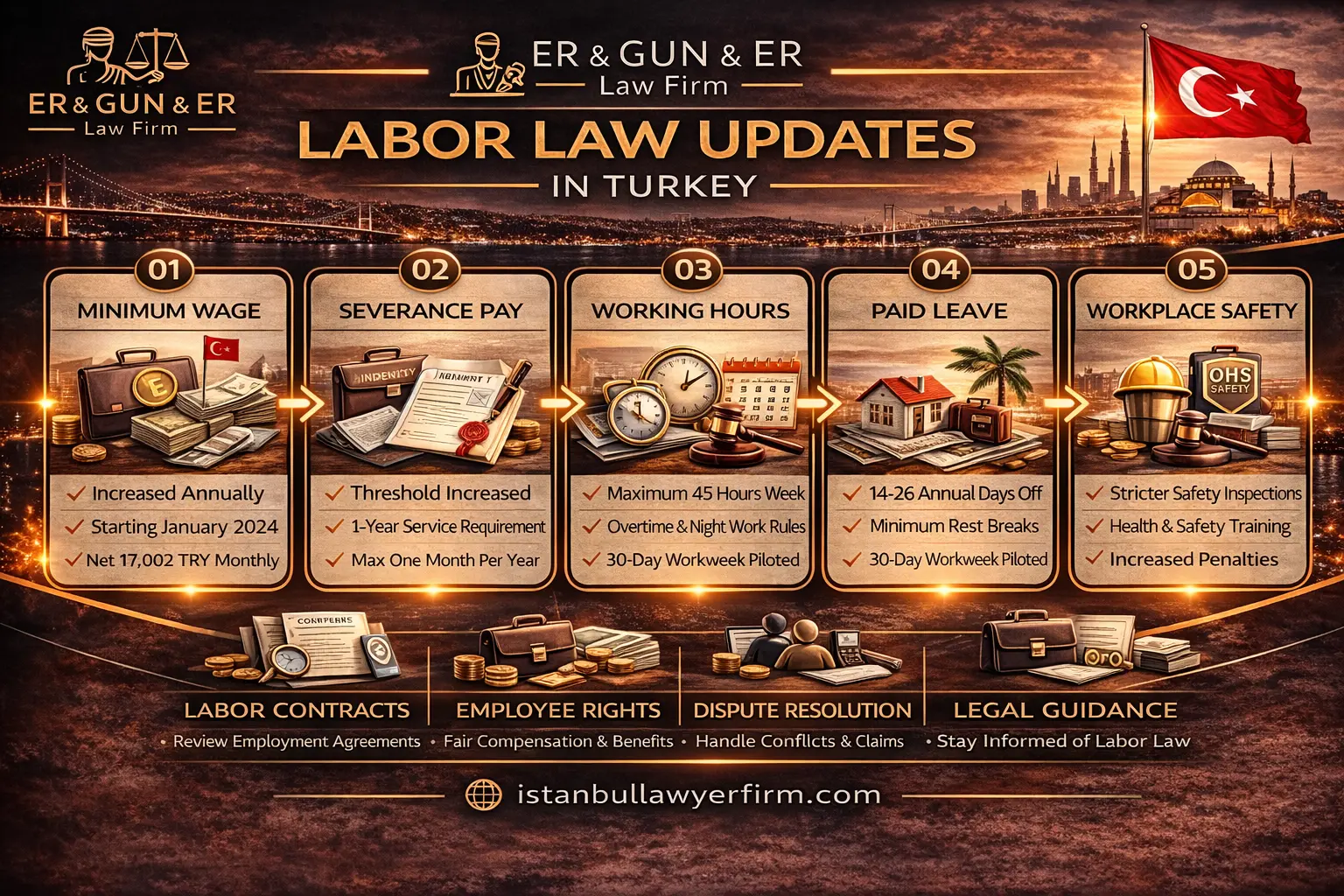
Turkish labor law is governed primarily by the Turkish Labor Law (İş Kanunu, Law No. 4857), which regulates the employment relationship, the conditions and procedures for termination, mandatory minimum employment rights (wages, leave, working hours, overtime), and the remedies available to employees and employers in disputes. The Law No. 4857 is supplemented by the Turkish Code of Obligations (Türk Borçlar Kanunu, TBK) for employment contract matters not specifically addressed by the Labor Law — particularly for managerial and professional employment relationships that fall outside Law No. 4857's direct scope. The Social Security and General Health Insurance Law (5510 Sayılı Sosyal Sigortalar ve Genel Sağlık Sigortası Kanunu) creates parallel social security contribution obligations that are often the subject of administrative disputes alongside civil employment claims. Since July 2017, mandatory mediation (zorunlu arabuluculuk) is a condition precedent to filing most monetary labor claims in Turkish labor courts — a procedural requirement that, if not satisfied before the lawsuit is filed, results in the court dismissing the case on procedural grounds. For employers operating in Turkey with foreign personnel, the interaction between Law No. 4857, the International Workforce Law (Law No. 6735) work permit requirements, and the KVKK data protection obligations for employee data creates a multi-framework compliance environment. This page sets out how we work across the main categories of Turkish labor and employment law. Practice may vary by authority and year — verify current mandatory mediation scope and İş Kanunu procedural requirements directly with the labor court before initiating any employment dispute proceeding.
Termination — grounds, procedure, and the job security regime
A lawyer in Turkey advising on employee termination under Law No. 4857 must explain that the central legal framework distinguishes between employees who are protected by the job security provisions (iş güvencesi) and those who are not — because the consequences of a procedurally or substantively invalid dismissal differ fundamentally depending on whether job security applies. Job security applies where the employer has 30 or more employees (the threshold includes all workplaces under the same employer) and the employee has at least six months of service under the same employer. For job security-protected employees, an invalid dismissal creates the right to file a reinstatement lawsuit (işe iade davası) and can result in reinstatement to the position with back pay (up to four months) and compensation (four to eight months' salary) if the employee is not reinstated. For employees not covered by job security, the dismissal — even if wrongful — does not create a reinstatement right; it creates only a severance pay (kıdem tazminatı) and notice pay (ihbar tazminatı) obligation. Practice may vary by authority and year — verify current İş Kanunu job security threshold and the specific calculation of the 30-employee threshold in multi-workplace employment structures before advising on any termination affecting a potentially job-security-protected employee.
An Istanbul Law Firm advising on the grounds for valid termination must explain that Law No. 4857 requires the employer to have a valid reason (geçerli neden) for dismissing a job security-protected employee — and the valid reason must fall into one of the permissible categories: reasons related to the employee's behavior (davranış) or competence (yetersizlik), or reasons related to the requirements of the business, workplace, or work (işletmenin, işyerinin veya işin gereklerinden kaynaklanan sebepler). The distinction between a valid reason and a just cause (haklı neden) is significant: a just cause under Law No. 4857 Articles 24–25 allows the employment contract to be terminated immediately without notice and without severance pay; a valid reason allows termination with notice (or payment in lieu) and with severance pay after one year of service. A dismissal that lacks any valid reason — where the employer cannot document the business, competence, or behavioral basis for the termination — is an invalid dismissal triggering the reinstatement lawsuit right (within the one-month deadline). We assess every termination mandate for its substantive validity ground and its documentary support before advising on the termination structure. Practice may vary — verify current Turkish labor court valid reason assessment standards and the specific documentation accepted as evidence of valid dismissal grounds before structuring any termination of a job security-protected employee.
A law firm in Istanbul advising on the reinstatement lawsuit (işe iade davası) deadline must explain that the one-month deadline for filing a reinstatement lawsuit is one of the most critical — and most frequently missed — procedural requirements in Turkish labor law. Under Law No. 4857 Article 20, the employee must apply to a mediator within one month of receiving the dismissal notice (this is the mandatory mediation step added by the 2017 amendment). If mediation fails to produce agreement, the employee must then file the reinstatement lawsuit before the labor court within two weeks of the mediator's final report. The combined effect is that the employee has approximately six weeks from the dismissal notification to complete mediation and file in court — and if either the mediation application or the subsequent court filing is late, the reinstatement right is permanently lost. For employees who receive dismissal notifications, contacting legal counsel immediately upon receipt of the notification — not after the mediation has failed — is essential to preserve the reinstatement option. Practice may vary by authority and year — verify current mandatory mediation application deadline and the specific post-mediation court filing window applicable to reinstatement lawsuits before advising on any reinstatement claim. The detailed severance pay framework is analyzed in the resource on severance pay in Turkey.
Severance pay — kıdem tazminatı calculation and entitlement
An English speaking lawyer in Turkey advising on kıdem tazminatı (severance pay) must explain that the Turkish severance pay entitlement is calculated at 30 days' gross salary per year of service — but the "gross salary" for this calculation is not simply the base wage, because Turkish courts and the administrative guidance both include in the calculation all regular payments that the employer makes to the employee in addition to base salary, including regular bonus payments, regular benefits-in-kind, and regular allowances. A severance calculation that uses only the base salary figure may significantly understate the correct amount, creating a kıdem tazminatı underpayment that the employee can subsequently claim. The employee's entitlement to kıdem tazminatı arises after at least one year of service and requires that the employment contract end in a way that entitles them to severance — employer termination without just cause, employee resignation for specific legally justified reasons (such as a significant breach by the employer), retirement, call to military service, or death. Resignation without a legally justified reason does not generate a kıdem tazminatı entitlement. Practice may vary — verify current Turkish labor court kıdem tazminatı calculation methodology and the specific regular payment inclusions applicable to the employee's compensation structure before preparing any severance calculation.
A Turkish Law Firm advising on the notice period (ihbar süresi) and notice pay (ihbar tazminatı) must explain that Law No. 4857 Article 17 mandates minimum notice periods that increase with the employee's length of service: two weeks for service up to six months; four weeks for service of six months to one and a half years; six weeks for service of one and a half to three years; and eight weeks for service exceeding three years. These are minimum periods — the employment contract can provide for longer notice periods, but not shorter ones (a contractual notice period shorter than the legal minimum is not enforceable). Either party can terminate with immediate effect by paying the other party notice pay in lieu of the notice period — the amount is calculated based on the employee's total remuneration during the notice period. The obligation runs both ways: an employer who terminates without working out the notice period owes the employee notice pay; an employee who resigns without working out the notice period owes the employer notice pay (though employers rarely pursue this in practice). Practice may vary — verify current İş Kanunu notice period calculation methodology for the employee's specific service length and the specific total remuneration inclusions in the notice pay calculation before preparing any notice or termination documentation.
A lawyer in Turkey advising on the TBK Article 420 release agreement (ibra sözleşmesi) must explain that many employers obtain employees' signatures on release agreements at the time of termination — documents in which the employee acknowledges receipt of all termination payments and releases the employer from further claims. However, TBK Article 420 imposes specific conditions on the validity of such release agreements in labor law contexts: the release must be made at least one month after the termination (not simultaneously with or immediately before the termination); the release must specifically identify the claims being released; the release amounts must be paid within the same document; and the document must be signed before a notary (unless executed at the mediation or in the labor court). A release agreement that does not meet these conditions is not effective as a release, even if the employee signed it — meaning that an employee who signed a poorly structured release at the time of termination may still have valid claims. For employers, ensuring that TBK Article 420 conditions are met in every settlement and release documentation is a critical risk management requirement. Practice may vary — verify current Turkish labor court TBK Article 420 release agreement enforceability standards and the specific conditions that must be met for a release to effectively bar subsequent claims before finalizing any employment termination settlement documentation.
Mandatory mediation — zorunlu arabuluculuk
An Istanbul Law Firm advising on mandatory mediation in labor disputes must explain that since 1 January 2018, most monetary labor claims — including severance pay claims, notice pay claims, unpaid wage claims, overtime pay claims, and annual leave claims — must go through mandatory mediation before a labor court lawsuit can be filed. The mandatory mediation is not a substantive negotiation tool (it is not voluntary arbitration — the mediator does not decide the dispute); it is a procedural prerequisite. The parties meet with an accredited mediator for up to three hours (paid for by the state), and if they do not reach agreement, the mediator issues a "no agreement" report that enables the claimant to file in the labor court. A labor court lawsuit filed without the prior mandatory mediation is dismissed procedurally without reaching the merits — creating a significant procedural trap for claimants who skip this step. The one-month reinstatement lawsuit application (for job security-protected employees) must also go through mediation first, with the specific compressed timeline described above. Practice may vary by authority and year — verify the current scope of mandatory mediation in labor disputes and the specific mediation application procedures applicable to the claim type before commencing any labor dispute proceeding.
A law firm in Istanbul advising on mediation strategy for monetary labor claims must explain that while mandatory mediation is in practical terms primarily a procedural hurdle that must be cleared before litigation, the mediation session is also a genuine opportunity to reach settlement without the cost and delay of labor court litigation. Turkish labor court proceedings typically take 12–24 months through the first instance and further time if appealed — and mediation offers the prospect of resolving a claim within weeks at a fraction of the litigation cost. For employers, the mediation session is also the first moment at which the claimant presents the full scope of their claims — and understanding the complete claim exposure at the mediation stage enables the employer to assess whether early settlement is more commercially efficient than litigation. For employees, the mediation offers a realistic assessment of the claim's value compared to the time and cost of litigation, enabling an informed settlement decision. We participate in mandatory mediation sessions as legal representatives for both employer and employee clients with a clear assessment of the claim's litigation value to inform the settlement negotiation. Practice may vary — verify current mandatory mediation procedural requirements and the specific rules applicable to legal representation in mediation sessions before planning any mediation strategy.
An English speaking lawyer in Turkey advising on the interaction between mandatory mediation and the court filing deadline must explain that for reinstatement claims, the mandatory mediation application must be made within one month of the dismissal notification — and if this one-month deadline is missed, the reinstatement right is permanently barred even if mediation would have been substantively warranted. For monetary claims (severance, notice pay, wages, overtime), the claim itself does not expire at the mediation stage — it expires at the general labor claim limitation period (for unpaid wages the period is five years, for severance and notice pay it is also five years). The practical difference is that for monetary claims, a claimant who delays mediation does not lose the claim — they may lose only the most recent five-year period of wage history. For reinstatement claims, the one-month deadline is fatal. The lesson is that any employee who believes they have a reinstatement right must act within days of receiving the dismissal notification, not weeks. Practice may vary — verify current limitation period applicable to each labor claim category and the specific mandatory mediation application deadline for reinstatement claims before advising on any dismissal dispute timeline.
Wages, overtime, and annual leave
A Turkish Law Firm advising on wage and overtime claims must explain that Law No. 4857 requires that wages be paid regularly and on time — and unpaid wages accrue statutory default interest (yasal faiz) from the date they become due. For employees who have not received wages for an extended period, the amount of interest can be commercially significant relative to the underlying wage claim. Overtime is regulated by Law No. 4857 Articles 41–43: overtime work requires the employee's prior consent (özür isteği); overtime beyond 45 hours per week (or beyond the employee's contracted working hours if those are less than 45) is compensated at 50% over the regular hourly rate (or by time off at 1.5 hours per overtime hour if the parties agree); and the annual limit on overtime is 270 hours per year. Overtime claims are among the most frequently litigated items in Turkish labor disputes, partly because many employers systematically underpay or fail to document overtime, and partly because the limitation period for overtime claims extends five years back from the filing date, creating potentially large cumulative liabilities. Practice may vary — verify current İş Kanunu overtime calculation methodology and the specific limitation period applicable to overtime wage claims before preparing any overtime claim or defense assessment.
An Istanbul Law Firm advising on annual leave (yıllık ücretli izin) entitlement must explain that Law No. 4857 Article 53 provides minimum annual leave entitlements based on service length: 14 working days per year for service of one to five years; 20 working days for service of five to fifteen years; and 26 working days for service exceeding fifteen years. These are minimum entitlements — the employment contract can provide more but not less. Annual leave is distinct from public holidays and sick leave. Annual leave not taken during the year does not automatically expire — unused annual leave must be paid out upon termination of the employment relationship at the employee's final wage rate, and the five-year limitation period applies to the payment claim for unused leave. For employers, maintaining accurate annual leave records and ensuring that employees take leave or receive compensatory payment before accumulated balances become large is a best practice that prevents significant termination-period leave payment liabilities. Practice may vary — verify current İş Kanunu annual leave entitlement provisions and the specific calculation methodology for unused leave payment upon termination before advising on any annual leave dispute.
A lawyer in Turkey advising on employment contract drafting must explain that the employment contract is the foundational document of the employment relationship, and its terms — within the mandatory minimum floors set by Law No. 4857 and TBK — determine the specific rights and obligations of both parties. Key terms that are frequently the subject of disputes and that must be specifically addressed in a well-drafted employment contract include: the scope of the employee's duties and any flexibility provisions; the compensation structure (base salary plus all regular payments, with specific treatment of bonus and benefit elements); the notice period (at or above the Law No. 4857 minimums); any non-competition clause (TBK Articles 444–447 impose specific enforceability conditions including geographic limitation, time limitation, and compensation requirement for post-employment non-competition); and the governing dispute resolution mechanism (Turkish labor courts have mandatory jurisdiction for most Law No. 4857 claims, but alternative arrangements are possible for TBK contracts). A non-competition clause that exceeds TBK Article 447's limits is not void in its entirety — it is reduced to the permissible scope by the court. Practice may vary — verify current TBK non-competition clause enforceability standards and the specific geographic and temporal limits recognized by Turkish courts before drafting any post-employment non-competition provision. The complete labor law framework is analyzed in the resource on labor law Turkey.
Workplace accidents and occupational health
An English speaking lawyer in Turkey advising on workplace accident (iş kazası) claims in Turkey must explain that a workplace accident creates potential liability under multiple legal frameworks simultaneously: the employer's civil liability under Law No. 4857 and TBK for failure to provide a safe working environment; the Social Security Law No. 5510's temporary incapacity (geçici iş göremezlik) and permanent incapacity (sürekli iş göremezlik) benefits administered by the SGK; and in serious cases, criminal liability under the Turkish Penal Code for negligent bodily injury or death. For the employee (or their dependants in a fatal accident), the civil compensation claim against the employer covers: past and future lost earnings due to the incapacity caused by the accident; medical treatment costs; pain and suffering (manevi tazminat); and care costs. The SGK benefits received by the employee are deducted from the civil compensation quantum — so the civil claim covers the "gap" between SGK benefits and the full compensation owed. Practice may vary — verify current Turkish civil court workplace accident compensation calculation methodology and the specific SGK benefit deduction standards before preparing any workplace accident compensation claim.
A Turkish Law Firm advising on occupational health and safety (OHS) compliance must explain that the Occupational Health and Safety Law (İş Sağlığı ve Güvenliği Kanunu, Law No. 6331) imposes comprehensive preventive safety obligations on employers — including risk assessment (risk değerlendirmesi), the appointment of a workplace safety professional (iş güvenliği uzmanı) and workplace physician (işyeri hekimi) for workplaces above defined size thresholds, emergency planning, and the reporting of workplace accidents to the SGK within the required timeframe. Failure to comply with Law No. 6331 obligations creates both administrative liability (fines from the Ministry of Labor) and significantly strengthened civil liability in workplace accident litigation — because an employer who has not met the Law No. 6331 preventive obligations has greater difficulty defending a negligence claim than one who can show full compliance. For employers in high-risk sectors (manufacturing, construction, mining, chemical processing), proactive OHS compliance is both a legal obligation and a civil liability risk management priority. Practice may vary by authority and year — verify current Law No. 6331 OHS compliance requirements applicable to the employer's sector risk class and the specific penalty schedule for non-compliance before designing any employer OHS compliance program.
A lawyer in Turkey advising on criminal liability exposure in workplace fatal accidents must explain that the death of an employee in a workplace accident in Turkey is routinely investigated as a potential negligent homicide (taksirle öldürme, TCK Article 85) case — the public prosecutor opens an investigation and the Ministry of Labor's OHS inspectors conduct a parallel investigation. Employers and individual managers can face criminal prosecution where the investigation establishes that the death resulted from a violation of the OHS obligations that, had they been observed, would have prevented the accident. Criminal proceedings in workplace fatal accident cases proceed independently of and in parallel with the civil compensation claim brought by the deceased's dependants. For employers facing a fatal workplace accident, immediate engagement of legal counsel — covering both the criminal investigation response and the civil compensation exposure — is the critical first step, because the documentary record created in the immediate aftermath of the accident (incident report, employee statements, OHS compliance documentation) significantly affects both the criminal and civil outcomes. Practice may vary — verify current Turkish Penal Code criminal liability provisions for workplace fatal accidents and the specific Ministry of Labor OHS investigation procedures before responding to any workplace accident that may involve criminal liability.
Employer compliance — SGK, payroll, and KVKK in employment
An Istanbul Law Firm advising on SGK social security compliance must explain that Turkish employers are required to register all employees with the SGK before the first day of work (same-day registration — işe giriş bildirimi) and to pay monthly SGK premiums on the employee's declared gross salary. An employee who is not registered before the first day of work — even if the registration occurs later the same day — is considered an unregistered employee (kayıt dışı işçi) for the period between actual commencement and registration, creating SGK administrative penalties and potential backdated premium obligations. For employers who have historically underreported salary (recording less than actual salary on the SGK declarations to reduce the premium base), the exposure extends to both the underpaid SGK premium liability and to the gap between the declared and actual salary for severance and overtime calculation purposes — because employee claims will be calculated on the actual salary, not the declared salary. SGK compliance audits by the Social Security Institution are routine, and employers with significant unregistered or underregistered employee exposure face substantial retroactive liability. Practice may vary — verify current SGK registration deadline and premium declaration requirements before designing any payroll compliance program for employees in Turkey.
A law firm in Istanbul advising on KVKK compliance in the employment context must explain that employees' personal data — including employment application data, payroll data, performance data, health and disability data, and disciplinary records — is subject to KVKK protection, and the employer's processing of employee data must have a specific lawful basis under KVKK Article 5. The processing of employment-related data is generally justified under the "necessary for the establishment, exercise, or performance of a contract of employment" basis — but data processing that goes beyond what is directly necessary for the employment relationship (for example, extensive monitoring of employee private communications, or collection of biometric data for access control purposes) requires either an explicit legal authorization or explicit employee consent. Turkish courts have assessed employee monitoring (including CCTV monitoring, email monitoring, and location tracking) as both a potential employment law issue and a KVKK data protection issue — and disproportionate monitoring can support constructive dismissal claims as well as data protection violation claims. We advise employers on KVKK-compliant employee data handling policies that enable legitimate operational monitoring while meeting Turkish data protection standards. Practice may vary — verify current KVK Kurumu guidance on employee data processing and monitoring and the specific consent and notice requirements applicable to workplace monitoring systems before implementing any employee monitoring program.
An English speaking lawyer in Turkey advising on employment compliance for foreign companies with Turkish operations must explain that a foreign company that has employees in Turkey — whether through a registered Turkish subsidiary, a branch office, a representative office, or a direct employment arrangement — is subject to Turkish employment law for those employees' relationships, regardless of the employment contract's governing law clause. Turkish Law No. 4857's mandatory protections (minimum wage, overtime, severance, notice, annual leave) apply to all employees working in Turkey, and a choice of law clause in the employment contract that designates foreign law cannot reduce the employee below these Turkish mandatory minimums. For multinational companies that use global employment contract templates with governing law clauses for their home jurisdiction, the Turkish mandatory minimum overlay must be specifically assessed and any gaps between the contract terms and Turkish minimums must be addressed in a Turkish law addendum. We advise multinational employers on the Turkish law compliance requirements applicable to their Turkey-based employee populations and prepare Turkish employment documentation that meets both the Turkish mandatory minimums and the group's global HR policies. Practice may vary — verify current Turkish mandatory employment law provisions applicable to foreign company Turkish operations and the specific documentation requirements for Turkish employment relationships before designing any multinational employment structure for Turkish employees. The work and residence permit framework for foreign employees is analyzed in the resource on work and residence permit Turkey.
Union rights, collective bargaining, and strikes
A Turkish Law Firm advising on trade union law in Turkey must explain that Turkish collective labor relations are governed by the Trade Unions and Collective Bargaining Agreement Law (Sendikalar ve Toplu İş Sözleşmesi Kanunu, Law No. 6356), which regulates the formation of trade unions, the conditions for collective bargaining authority, and the right to strike. For a trade union to obtain collective bargaining authority (toplu iş sözleşmesi yetkisi) in a specific workplace, it must represent at least 1% of all workers in the relevant sector at national level (the sector threshold) and more than 50% of the workers at the workplace (the workplace threshold). The dual threshold system means that a union with significant membership in a specific workplace may nevertheless lack bargaining authority if it has not met the national sector threshold — creating a legal landscape where collective bargaining rights are often contested at the threshold eligibility stage before the substantive bargaining even begins. Practice may vary by authority and year — verify current Law No. 6356 collective bargaining authority threshold requirements and the specific certification procedure for establishing workplace threshold majority before advising on any collective bargaining authority dispute.
An Istanbul Law Firm advising on union membership protection must explain that Law No. 4857 Article 25/son and Law No. 6356 Article 25 specifically prohibit dismissal or adverse treatment of employees due to their union membership or activities. An employer who dismisses an employee because of their union membership or activities — even if the dismissal is dressed in other stated grounds — is liable for reinstatement or a specific union activity discrimination compensation (sendikal tazminat) of at least one year's salary, in addition to the standard reinstatement claim remedies. The challenge in union discrimination claims is establishing the causal link between the dismissal and the union activity — because employers rarely document the discriminatory motivation. Turkish labor courts assess union discrimination claims with attention to the timing of dismissals relative to union organization activity, the pattern of dismissals in relation to union membership, and any direct evidence of employer knowledge of or hostility to union activity. We represent both employees who have been dismissed for union activities and employers defending against discriminatory dismissal allegations. Practice may vary — verify current Turkish labor court standards for establishing the discriminatory motivation in union activity dismissal claims before commencing any union discrimination lawsuit.
A lawyer in Turkey advising on the right to strike must explain that Law No. 6356 regulates the conditions under which a lawful strike can be called — a strike is lawful only after collective bargaining has failed (and the relevant procedural steps confirming failure have been completed) and after the required waiting period. An unlawful strike (kanun dışı grev) can be enjoined by the competent court on the employer's application, and employees who participate in an unlawful strike can face disciplinary consequences including dismissal for just cause (which eliminates both the notice pay and severance pay entitlement). For employers facing a strike or a threat of strike action, the legal assessment of the strike's lawfulness — and the options for seeking a court injunction against an unlawful strike — is an urgent determination. For employees considering strike action, the procedural compliance requirements of Law No. 6356 must be strictly followed to ensure the strike remains lawful. We represent employers and unions in strike law matters — including injunction applications against unlawful strikes and defense of strike action against employer injunction attempts. Practice may vary — verify current Law No. 6356 lawful strike procedural requirements and the specific court jurisdiction for strike injunction applications before advising on any strike action or strike response matter.
Foreign employees — work permits and employment compliance
An English speaking lawyer in Turkey advising on work permits for foreign employees must explain that Law No. 6735 (the International Workforce Law) requires foreign nationals who will work in Turkey to hold a valid work permit — and the employment of a foreign national without a valid work permit creates significant liability for both the employer (administrative fines per unlicensed worker, potential inability to hire foreign nationals in the future) and the employee (deportation risk and immigration compliance issues). The work permit is employer-specific — it authorizes the foreign employee to work only for the named employer and in the named occupation. A foreign employee who changes employer without obtaining a new work permit is working unlawfully even if they held a valid permit for their prior employer. For employers who have foreign employees, maintaining a current permit status dashboard with renewal reminder systems is a basic compliance obligation. Practice may vary — verify current Law No. 6735 work permit employer obligations and the specific fine schedule for employment of foreign nationals without valid work permits before designing any employer compliance program for foreign employee management. The complete work permit legal framework is analyzed in the resource on turkey work permit.
A Turkish Law Firm advising on the employment rights of foreign workers in Turkey must explain that foreign nationals who are lawfully employed in Turkey under a valid work permit are entitled to the same Turkish labor law protections as Turkish employees — including the minimum wage, the overtime pay premium, the annual leave entitlement, the severance pay right after one year of service, and the job security protections for qualified employees. The work permit's status does not affect the underlying labor law rights — an employer cannot contractually provide foreign employees with fewer rights than Turkish employees receive under Law No. 4857 on the grounds that they are foreign nationals. For foreign employees whose employer has not registered them with the SGK, paid their wages in full, or provided their leave entitlements, the Turkish labor courts hear their claims on exactly the same basis as Turkish employee claims. We represent foreign national employees in Turkish labor court proceedings on the same basis as Turkish employees, including Turkish proceedings conducted in Turkish with sworn interpreters. Practice may vary — verify current İş Kanunu applicability to foreign national employees and the specific SGK registration obligations applicable to foreign employees with work permits before advising on any foreign employee employment dispute.
A lawyer in Turkey advising on the intra-company transfer of foreign managers and specialists must explain that Law No. 6735 provides specific procedures for intra-company transfers (yurt içi nakil) — where a foreign employee of a multinational group is transferred to a Turkish group company for a defined assignment period. The transferred employee requires a Turkish work permit, which the Turkish entity applies for through the YAYBÜS system, and the application must demonstrate that the employee holds a specific managerial, specialist, or trainee role that qualifies for the intra-company transfer category. The 1:5 foreign-to-Turkish employee ratio applies to intra-company transfers in the same way as new hires — if the Turkish entity's workforce cannot support the transfer under the quota, the transfer cannot proceed until the ratio is met or an exception is obtained. For multinational companies with frequent executive and specialist mobility to Turkey, establishing a systematic work permit management program that anticipates mobility needs well in advance of assignment start dates is a practical necessity. Practice may vary — verify current YAYBÜS intra-company transfer application procedures and the specific qualification requirements for the transfer category before planning any intra-company transfer of a foreign national to a Turkish entity. The Istanbul Bar Association at istanbulbarosu.org.tr provides resources for identifying qualified practitioners. Practice may vary — check current guidance before acting on any information on this page.
How we work in Turkish labor law mandates
A best lawyer in Turkey managing a labor law mandate begins with the same urgency assessment in every case: is there an imminent deadline that requires immediate action? For reinstatement (işe iade) claims, the one-month mandatory mediation application deadline runs from the dismissal notification, and missing it permanently bars the reinstatement right. For workplace accident claims, the SGK notification deadline runs from the accident date, and late notification affects both the SGK benefit eligibility and the civil compensation calculation. For employer compliance matters, the same-day SGK registration obligation means that employment of an unregistered employee creates retroactive liability from day one. Only after addressing time-sensitive elements does the longer-term mandate structure — claim preparation, mediation, litigation, or compliance program development — become the primary focus.
ER&GUN&ER represents both employees and employers in all categories of Turkish labor and employment law — dismissal disputes (job security reinstatement lawsuits, wrongful termination), severance and notice pay claims, mandatory mediation representation, overtime and unpaid wage claims, annual leave claims, workplace accident compensation claims, occupational health and safety compliance, union law and collective bargaining, employment contract drafting and review, non-competition clause enforcement and challenge, TBK Article 420 release agreement drafting, SGK compliance, KVKK employee data protection, and multinational employer Turkish law compliance. We work in English throughout all international mandates. For the complete severance pay calculation framework — including the specific regular payment inclusions and the limitation period applicable to kıdem tazminatı claims — see the resource on severance pay in Turkey. Practice may vary — check current guidance before acting on any information on this page.
Frequently Asked Questions
- What is mandatory mediation (zorunlu arabuluculuk) in Turkish labor disputes? Since January 2018, most monetary labor claims — severance, notice pay, wages, overtime, annual leave — must go through mandatory mediation before a labor court lawsuit can be filed. The mediator does not decide the dispute; if mediation fails, a "no agreement" report enables the claimant to file in court. A labor lawsuit filed without completing mandatory mediation is dismissed procedurally. For reinstatement claims, the mandatory mediation application must be made within one month of dismissal notification. Practice may vary — verify current mandatory mediation scope and application procedures.
- What is kıdem tazminatı (severance pay) and how is it calculated? Kıdem tazminatı is a severance payment of 30 days' gross salary per year of service, calculated on the employee's total remuneration including regular bonus and benefit payments — not just base salary. The right arises after at least one year of service. It is triggered by employer dismissal without just cause, employee resignation for specific legally justified reasons, retirement, call to military service, or death. Resignation without a justified reason does not generate entitlement. Practice may vary — verify current calculation methodology with qualified counsel before any severance computation.
- What is the reinstatement lawsuit (işe iade davası) and what is the deadline? An işe iade lawsuit is available to job security-protected employees (employer has 30+ employees, employee has 6+ months service) who are dismissed without a valid reason. The employee must apply to mediation within one month of the dismissal notification and file in court within two weeks of the mediator's final report if mediation fails. Missing the one-month deadline permanently bars the reinstatement right. A successful claim entitles the employee to reinstatement with up to four months' back pay plus four to eight months' additional compensation if the employer elects not to reinstate. Practice may vary — verify current deadline calculation before any reinstatement claim.
- What are the minimum notice periods in Turkey? Law No. 4857 Article 17 minimum notice periods: up to six months service — 2 weeks; six months to one and a half years — 4 weeks; one and a half to three years — 6 weeks; over three years — 8 weeks. These are minimums — longer periods can be agreed contractually. Either party can terminate immediately by paying notice pay in lieu. An employee who resigns without working notice owes notice pay in principle (though rarely pursued). Practice may vary — verify current notice period requirements before any termination.
- What is the TBK Article 420 release agreement (ibra sözleşmesi)? An ibra sözleşmesi is a release in which the employee waives claims against the employer. For it to be valid under TBK Article 420, it must be executed at least one month after termination, must specifically identify each claim being released, the release amounts must be paid within the document, and it must be in notarized form (unless executed at mediation or in court). A release agreement that does not meet these conditions is unenforceable even if signed by the employee. Practice may vary — verify current Turkish court TBK Article 420 release enforceability standards before finalizing any settlement documentation.
- What overtime rights do employees have in Turkey? Under Law No. 4857, overtime beyond 45 hours per week (or less if contracted) requires the employee's prior consent and is compensated at 1.5 times the regular hourly rate (or time off at 1.5 hours per overtime hour by agreement). Annual overtime is capped at 270 hours. Overtime claims have a five-year limitation period, creating potentially large cumulative exposures for employers who systematically underpay overtime. Practice may vary — verify current overtime calculation methodology and limitation period before any overtime claim assessment.
- What annual leave are employees entitled to in Turkey? Law No. 4857 minimum annual leave: one to five years service — 14 working days; five to fifteen years — 20 working days; over fifteen years — 26 working days. These are minimums. Unused leave accumulates and must be paid out upon termination at the employee's final wage rate. Annual leave payment claims have a five-year limitation period. Practice may vary — verify current annual leave entitlement and payment calculation standards.
- What happens when an employee is injured at work in Turkey? A workplace accident (iş kazası) creates potential liability under three parallel frameworks: civil compensation from the employer for lost earnings, medical costs, and pain and suffering; SGK benefits (temporary and potentially permanent incapacity benefits) administered by the Social Security Institution; and in serious cases, criminal liability under TCK for the responsible employer/management. SGK benefits are deducted from the civil compensation quantum. The employer must notify SGK within 3 working days of the accident. Practice may vary — verify current notification deadline and compensation calculation methodology.
- Are foreign workers protected by Turkish labor law? Yes — all foreign nationals lawfully employed in Turkey with valid work permits are entitled to the same Law No. 4857 protections as Turkish employees, including minimum wage, overtime pay, annual leave, severance pay, and job security. The employer cannot contractually provide foreign employees with fewer rights than Turkish law mandates on the grounds of their nationality. Foreign employees can bring Turkish labor court claims on the same basis as Turkish employees. Practice may vary — verify current İş Kanunu applicability to the specific foreign employee category.
- What is the job security regime (iş güvencesi) in Turkey? Job security under Law No. 4857 applies where the employer has 30 or more employees and the employee has at least six months' service. Protected employees can only be dismissed for a valid reason (valid reason = business need, competence, or behavioral grounds — which must be documented). An invalid dismissal by a job security employer creates the reinstatement lawsuit right. Employees outside the job security threshold cannot bring reinstatement claims — only severance and notice pay claims. Practice may vary — verify the 30-employee threshold calculation methodology applicable to multi-workplace employers.
- What are the conditions for a valid Turkish non-competition clause? Under TBK Articles 444–447, post-employment non-competition clauses are valid only if: they protect a legitimate employer interest; they do not unfairly restrict the employee's economic future; they are limited geographically (must not cover areas where the employee had no contact with customers or trade secrets); they are limited temporally (maximum two years for most cases); and the employer pays compensation for the restriction (a clause without compensation is generally unenforceable). A clause that exceeds the TBK limits is not void but is reduced by the court to the permissible scope. Practice may vary — verify current Turkish court non-competition enforceability standards.
- What are the SGK registration obligations for Turkish employers? Employers must register all employees with the SGK before the first day of work (same-day işe giriş bildirimi). Failure to register before the first day creates an unregistered employee status for that period, with retroactive premium liability and administrative fines per unregistered employee. Underreporting salary on SGK declarations reduces the premium base but creates exposure on all claims calculated on actual salary (severance, overtime). SGK compliance audits are routine. Practice may vary — verify current SGK registration deadline and penalty schedule.
- What is union discrimination and how is it remedied? Law No. 6356 prohibits dismissal or adverse treatment due to union membership or activities. An employer who dismisses an employee for union activity is liable for reinstatement plus sendikal tazminat (union discrimination compensation) of at least one year's salary, in addition to standard reinstatement remedies. Establishing the discriminatory motivation requires evidence of timing, pattern, and employer awareness of union activity — because employers rarely document the discriminatory reason. Practice may vary — verify current sendikal tazminat minimum amount and evidentiary standards for establishing union discrimination before any claim.
- Does mandatory mediation apply to all labor claims? Mandatory mediation applies to most monetary labor claims (wages, overtime, severance, notice pay, annual leave) and to reinstatement claims. It does not apply to workers' compensation claims under SGK (which have a separate administrative process), criminal workplace safety proceedings, or certain administrative law claims against the state as employer. For reinstatement claims, the mediation must be completed within the one-month deadline. For monetary claims, mediation must be completed before any court filing but the one-month reinstatement deadline does not apply. Practice may vary — verify current mandatory mediation scope for the specific claim type.
- What KVKK obligations apply to Turkish employers regarding employee data? Employers processing employee personal data must have a lawful basis under KVKK Article 5 — for most employment-related data, the contractual necessity basis applies. Employee monitoring (CCTV, email monitoring, location tracking) requires a proportionality assessment and specific employee notification under KVKK. Health and disability data is special category data requiring separate legal basis. VERBİS registration is required above defined size thresholds. Disproportionate monitoring can support both KVKK violation claims and constructive dismissal claims. Practice may vary — verify current KVK Kurumu employee data processing guidance before implementing any workplace monitoring system.
Author: Mirkan Topcu is an attorney registered with the Istanbul Bar Association (Istanbul 1st Bar), Bar Registration No: 67874. His practice focuses on cross-border and high-stakes matters where evidence discipline, procedural accuracy, and risk control are decisive.
He advises employees, employers, and multinational companies across Labor Law (İş Kanunu No. 4857), Employment Contract Disputes, Dismissal and Reinstatement, Severance and Notice Pay Claims, Workplace Accident Compensation, Occupational Health and Safety Compliance (Law No. 6331), Union Law (Law No. 6356), Foreign Employee Work Permits (Law No. 6735), and KVKK Employee Data Protection matters where procedural timing and regulatory compliance are decisive.
Education: Istanbul University Faculty of Law (2018); Galatasaray University, LL.M. (2022). LinkedIn: Profile. Istanbul Bar Association: Official website.