

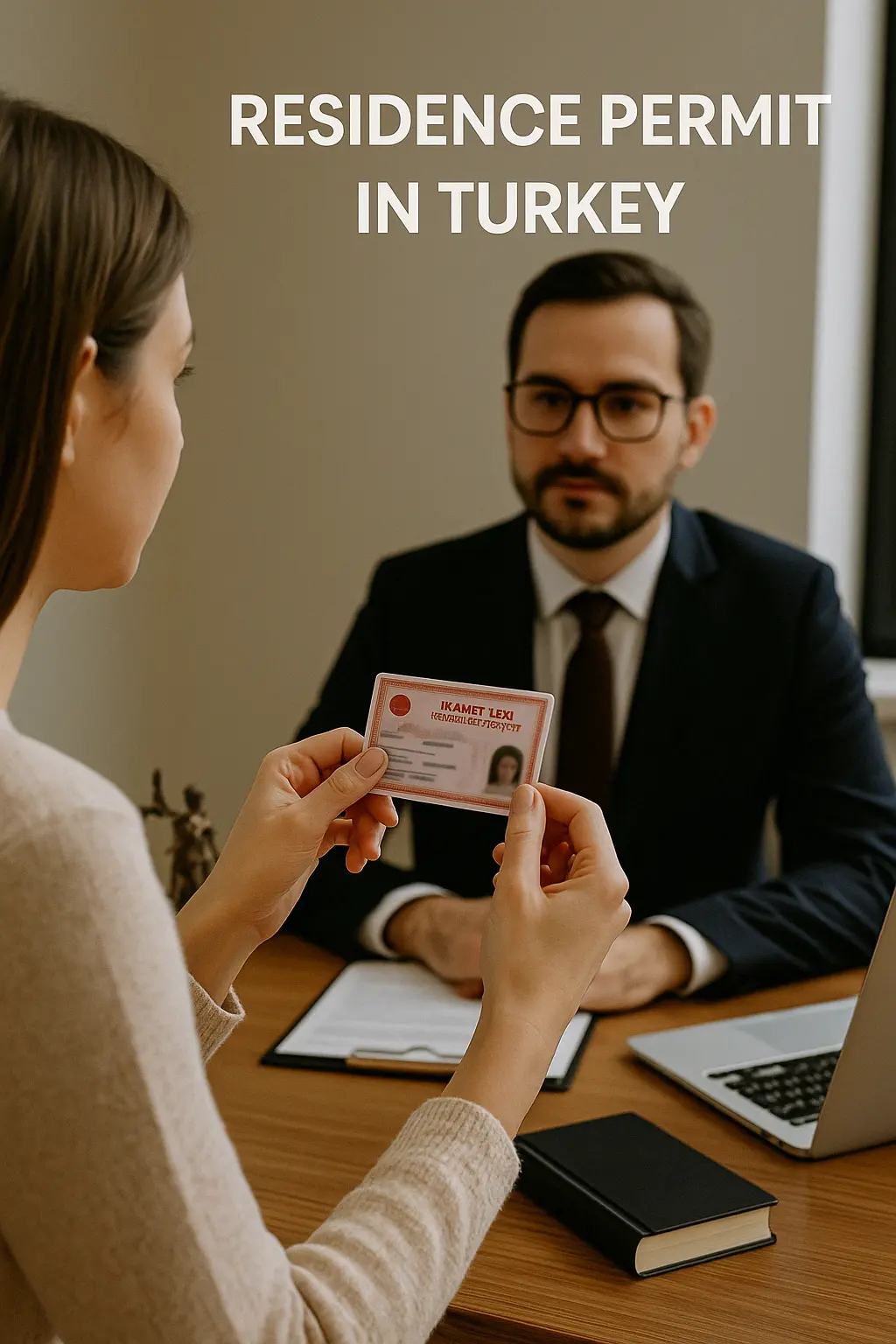
A residence permit (ikamet izni) in Turkey is the administrative authorization that allows a foreign national to remain in Turkey beyond the stay permitted under their visa or visa-exemption arrangement. Residence permits are issued and administered under the Law on Foreigners and International Protection (Yabancılar ve Uluslararası Koruma Kanunu, YUKK, Law No. 6458) by the Directorate General of Migration Management (Göç İdaresi Genel Müdürlüğü, GİGM) through its provincial directorates (İl Göç İdaresi Müdürlükleri). Most foreign nationals can enter Turkey without a visa or on a tourist visa for up to 90 days within any 180-day period — and a residence permit is required for any stay beyond this 90-day limit. The YUKK defines distinct permit categories: short-term, family, student, long-term, humanitarian, and work-related — each with different eligibility conditions, documentary requirements, duration, and renewal rules. The practical outcome of any specific application depends not only on meeting the statutory eligibility criteria but also on submitting documentation that meets the current administrative standards of the relevant provincial directorate — which can differ from the published guidance and vary between provinces and over time. The GİGM's official e-ikamet portal for online applications is accessible at e-ikamet.goc.gov.tr. Practice may vary by authority and year — verify current GİGM category eligibility conditions and documentary requirements directly with the relevant provincial directorate before preparing any residence permit application.
Short-term residence permits — categories and eligibility bases
A lawyer in Turkey advising on the short-term residence permit (kısa dönem ikamet izni) under YUKK Article 31 must explain that this is Turkey's most flexible permit category — it covers a wide range of foreign national situations and is the appropriate permit for the majority of non-working, non-student foreign nationals who wish to remain in Turkey for extended periods. The bases on which a short-term permit can be granted include: scientific research; property ownership (where the property meets the currently applicable minimum assessed value threshold); commercial connections with Turkey; language course enrollment; medical treatment; tourism; academic study programs not qualifying for the student permit; participation in government-approved investment programs; and general financial self-sufficiency. Each basis has different documentary requirements, and the e-ikamet online application requires the applicant to select the specific basis at the time of application — a selection that cannot be changed after submission without restarting the entire application. Practice may vary by authority and year — verify the current list of recognized short-term permit bases and the specific documentary requirements applicable to the intended basis before beginning the e-ikamet application.
An Istanbul Law Firm advising on the property ownership basis for the short-term permit must explain that a foreign national who owns qualifying Turkish real estate can apply for a short-term permit based on property ownership — but the property must meet the currently applicable minimum assessed value threshold set by GİGM, and properties in certain districts are subject to neighborhood quota restrictions that prevent new property-based permits from being issued when the foreign permit holder population in that neighborhood exceeds 25% of the registered population. The neighborhood quota restrictions apply in practice in certain high-demand Istanbul districts and some Antalya coastal areas, and a foreign buyer who purchased property specifically for the purpose of a property-based residence permit in one of these restricted neighborhoods may find the permit is not available. The minimum property value threshold has been adjusted upward over time. Practice may vary by authority and year — verify the current minimum property value requirement for the property ownership basis and the neighborhood quota status for the specific property location before purchasing property with residence permit objectives. The complete property purchase legal framework is analyzed in the resource on turkey real estate.
A law firm in Istanbul advising on the financial sufficiency basis must explain that foreign nationals who do not own property but have sufficient financial resources to support themselves in Turkey without working can apply for a short-term permit based on financial self-sufficiency. GİGM requires evidence of sufficient funds — typically bank statements showing either a regular monthly income (from pension, investment income, or foreign employment) or a lump sum balance — for the entire requested permit period. The specific financial threshold is set by GİGM and is recalculated periodically. The financial sufficiency basis is particularly relevant for digital nomads (foreign nationals who work remotely for foreign employers and do not receive Turkish income), retired foreign nationals, and individuals with investment income. Note that neither the property ownership basis nor the financial sufficiency basis authorizes work in Turkey — a foreign national who lives in Turkey on a short-term permit and provides services to Turkish clients may need a separate work authorization. Practice may vary — verify the current GİGM financial sufficiency threshold applicable to the requested permit duration before preparing any financial sufficiency basis application.
Family residence permits — sponsor conditions and income thresholds
An English speaking lawyer in Turkey advising on the family residence permit (aile ikamet izni) under YUKK Article 34 must explain that this permit is available for the spouse, minor children, and in specific circumstances the dependent adult parents of either a Turkish citizen sponsor or a foreign national sponsor who holds a valid Turkish residence permit. The legal conditions differ depending on the sponsor's status: where the sponsor is a Turkish citizen, the GİGM's income requirement is assessed against the Turkish citizen's income; where the sponsor is a foreign permit holder, the sponsor's own permit must have at least one year of remaining validity at the time of the family permit application, and the sponsor must meet both the income threshold for the entire family unit and the accommodation requirement. The income threshold is assessed per family unit — it increases with each additional dependent — and is linked to the Turkish minimum wage level, recalculated at each renewal. Practice may vary — verify current YUKK Article 34 income threshold for the specific family unit size and the sponsor's nationality and permit status before preparing any family residence permit application.
A Turkish Law Firm advising on marriage authenticity review in family permit applications must explain that GİGM exercises discretion to question the authenticity of a marriage when the application circumstances suggest the possibility of a marriage of convenience — particularly where the marriage is very recent, the parties met recently, there is a large age difference, or the sponsor and applicant have minimal documented prior contact. Where GİGM raises an authenticity question, the applicant bears the burden of demonstrating the genuine character of the relationship through documentation and interview. The evidence most relevant to an authenticity assessment includes: contemporaneous communication records showing the relationship's development; shared financial or household documentation (joint accounts, shared utility bills, joint lease agreements); travel records showing the parties spent time together; family event records (photographs, family registry notifications); and any evidence of integration into each other's family networks. For cross-cultural marriages between Turkish citizens and foreign nationals from countries with different cultural backgrounds, the authenticity documentation must specifically address how the couple met and developed their relationship. Practice may vary — verify current GİGM authenticity assessment standards and the specific evidence categories most effective in the relevant provincial directorate before preparing any family permit application where authenticity may be questioned.
A lawyer in Turkey advising on family permit renewal and sponsor status changes must explain that a family residence permit renewal requires the sponsor to continue meeting the eligibility conditions at the time of renewal — including financial sufficiency, valid accommodation, and valid Turkish residence or citizenship status. A change in the sponsor's circumstances between the original family permit grant and the renewal application can result in renewal denial: if the sponsor's income has decreased below the threshold, if the sponsor's own permit has lapsed, if the sponsor has moved to a different property without updating the address registration, or if the marriage relationship has ended. For families where the sponsor is a foreign permit holder whose own permit is due for renewal shortly after the family permit renewal, coordinating both renewals to ensure the sponsor's permit is renewed first or simultaneously is a practical necessity. We advise families on renewal timing and coordination as part of ongoing immigration management for family unit clients. Practice may vary — verify current YUKK Article 34 renewal conditions and the specific documentation requirements applicable to your family's circumstances before any family permit renewal.
Student residence permits
An Istanbul Law Firm advising on the student residence permit (öğrenci ikamet izni) under YUKK Article 38 must explain that this permit is specifically designed for foreign nationals enrolled in recognized Turkish educational institutions — universities, colleges, and accredited language schools. The permit duration corresponds to the enrolled program period, typically granted for one academic year at a time and renewable upon continued enrollment. The educational institution must be recognized under the applicable criteria for the specific permit type — YÖK (the Council of Higher Education) recognition for university programs, and specific language institution accreditation criteria for language course enrollment. A foreign national who is enrolled in a program that does not meet the recognition criteria cannot qualify for a student permit even if the institution itself is legally operating in Turkey. Practice may vary — verify current YÖK recognition requirements for the specific program and institution and the specific enrollment documentation format required by GİGM before preparing any student permit application.
A law firm in Istanbul advising on the work restrictions for student permit holders must explain that the student residence permit does not authorize employment in Turkey — a student who works for a Turkish employer without a work permit is working illegally, creating administrative liability for both the student and the employer. Part-time work by enrolled university students is specifically addressed in Turkish law: students enrolled in formal degree programs at Turkish universities may perform limited part-time work under specific conditions, but this authorization comes from a separate legal framework (not the student residence permit itself), requires specific conditions including the student being in their second or later year of the program, and has limitations on the number of working hours per week. A student who wants to work during their studies must specifically verify whether they qualify for the part-time work authorization, rather than assuming the student permit covers working activity. Practice may vary — verify current part-time work authorization conditions applicable to student permit holders before any student employment arrangement in Turkey.
An English speaking lawyer in Turkey advising on the transition from student permit to another permit category must explain that a foreign national who completes their studies in Turkey and wishes to remain after graduation cannot simply continue on the student permit — the student permit is conditioned on active enrollment, and a graduate whose program has ended no longer meets the student permit eligibility condition. The transition to an independent adult residence permit must be initiated before the student permit expires: typically to a short-term permit on a financial sufficiency basis, a short-term permit on a commercial or business activity basis, or — if employment begins — a work permit application initiated by the Turkish employer. A graduate who allows the student permit to expire without transitioning to another valid basis faces an overstay situation regardless of how recently they graduated. We advise enrolled students approaching graduation on the transition process as a forward-planning matter several months before the expected completion date. Practice may vary — verify current GİGM transition procedures for students completing programs and the specific documentation required for transitioning to a short-term permit from a student permit basis before planning any post-graduation residence strategy.
Long-term residence permit — the 8-year qualification pathway
A Turkish Law Firm advising on the long-term (indefinite) residence permit (uzun dönem ikamet izni) under YUKK Article 42 must explain that this permit provides the most secure residence status available to foreign nationals in Turkey short of citizenship — it has no fixed expiry date, does not require periodic renewal, and grants the holder civil rights in most areas equivalent to Turkish citizens (with specific exceptions such as the right to vote, to hold certain public offices, and to serve in the military). The eligibility condition is eight years of continuous legal residence in Turkey — and this condition contains significant complexity in how "continuous" is assessed. An applicant who has been physically present in Turkey for more than eight years may not qualify if their permit history contains gaps (periods when a valid permit was not in place), if they had extended absences from Turkey during the qualifying period, or if their permit status was interrupted by rejection and reapplication periods. Practice may vary by authority and year — verify current GİGM continuous residence calculation methodology and the specific absence tolerance thresholds applicable to the eight-year qualifying period before commencing any long-term permit application.
An Istanbul Law Firm advising on the residency history analysis required before a long-term permit application must explain that the most common mistake in long-term permit applications is filing without first conducting a thorough permit history audit — and discovering a continuity gap after submission, either at the GİGM review stage or when the application is rejected, wastes the application fee and delays the process without any benefit. We conduct pre-application residency history analyses for long-term permit candidates as a standard step: reviewing the complete permit history from GİGM records and the applicant's own records; mapping each permit period against the e-ikamet application history; identifying any gaps between permit periods (where the applicant may have been between permits); reviewing the entry/exit travel record for extended absences; and confirming whether any permit in the qualifying period was rejected, cancelled, or subject to enforcement action. Only after this analysis confirms a clean eight-year qualifying period do we file the long-term permit application. Practice may vary — verify current GİGM permit history access procedures and the specific continuity assessment methodology applied at the relevant provincial directorate before any pre-application residency audit.
A lawyer in Turkey advising on the benefits of the long-term residence permit must explain that beyond the practical benefit of eliminating periodic permit renewal (which involves documentation preparation, appointment scheduling, health insurance renewal, and administrative costs), the long-term permit also provides enhanced legal stability for property ownership, financial account maintenance, and business activity — because the permit holder's Turkish civil rights in these areas are equivalent to a Turkish citizen's rights, and they are not subject to the changing eligibility conditions and administrative discretion that characterize periodic short-term or family permits. For foreign nationals who have been in Turkey for many years and whose lives and assets are based in Turkey, the long-term permit provides a level of security that approaching naturalization can be planned around without the same vulnerability to administrative changes in permit requirements. For foreign nationals who are not pursuing Turkish citizenship but intend to remain in Turkey long-term, the long-term permit is the most stable available outcome. Practice may vary — verify the current rights specifically reserved to Turkish citizens under the YUKK that are excluded from the long-term permit holder's rights before assessing the specific significance of the long-term permit for your circumstances.
The e-ikamet application — procedures and common errors
An English speaking lawyer in Turkey advising on the GİGM e-ikamet portal application must explain that all residence permit applications in Turkey for foreign nationals are submitted through the GİGM's online e-ikamet system, which generates the application form, schedules the biometric appointment at the relevant provincial directorate, and produces the appointment confirmation document. The e-ikamet application must be completed accurately before the appointment is scheduled — the permit category, the specific basis within that category, and personal information must all match the supporting documents that will be brought to the appointment. Discrepancies between the online application form and the physical documents (for example, a different address on the form than on the rental contract, or a different name format than appears on the passport) are the most common cause of appointment rejection and require the entire online application to be completed again with a new appointment. In Istanbul Province and other high-demand provinces, appointment availability is frequently constrained — meaning that a rejected appointment may require waiting several weeks for a new appointment date, potentially creating a permit expiry gap if the delay pushes the appointment beyond the current permit's expiry date. Practice may vary by authority and year — verify current e-ikamet appointment availability in the relevant province and any known system changes before beginning the online application.
A Turkish Law Firm advising on the biometric appointment process must explain that the biometric appointment at the provincial directorate requires the applicant's personal physical presence — a Power of Attorney cannot substitute for the applicant's personal appearance at the biometric data collection (fingerprints and photograph). The appointment requires the applicant to bring the original documents matching the online application — not copies, and not digitally presented versions on a phone. Common appointment failures include: bringing the lease contract in a format the directorate does not accept (for example, an unnotarized private contract where the specific directorate requires notarized lease agreements); bringing health insurance documentation that does not meet the coverage amount or duration requirements; or arriving with passport photographs that do not meet the current biometric specification (wrong background color, wrong size, or taken more than six months earlier). We prepare a document-by-document pre-appointment checklist for every client, confirming that each document meets the current standards of the specific provincial directorate, to prevent appointment day rejections. Practice may vary — verify current provincial directorate appointment requirements and the specific document format standards applicable at your provincial directorate before attending any residence permit appointment.
A lawyer in Turkey advising on health insurance requirements for residence permits must explain that valid health insurance is a mandatory requirement for all residence permit categories — and the GİGM's current standards require the insurance policy to: cover the full duration of the requested permit period (not just a portion); meet minimum coverage amounts for outpatient, inpatient, and emergency care; be issued by an insurer authorized to operate in Turkey; be in the applicant's name exactly matching the passport. Common health insurance problems include: tourist travel insurance policies that cover only emergency care (which do not satisfy the full residence permit standard); policies that expire before the permit period ends (requiring mid-permit renewal of the insurance, which must be documented to GİGM's satisfaction); policies from foreign insurers with no Turkish presence (which many provincial directorates do not accept); and group policies where the applicant is listed as a dependent without specific individual coverage documentation. We review health insurance documentation as a priority step in every pre-appointment checklist — because health insurance is a mandatory element without which the appointment will not proceed regardless of how complete the rest of the file is. Practice may vary — verify current GİGM health insurance coverage standards and the specific insurer requirements applicable at the relevant provincial directorate before purchasing any health insurance for a residence permit application.
Permit renewals and the 60-day window
An Istanbul Law Firm advising on the residence permit renewal timeline must explain that the critical planning horizon for a residence permit renewal is the 60-day window before expiry — GİGM guidance indicates that renewal applications should be submitted within this window, and the most practical reading of the legal effect of a timely renewal submission is that the applicant retains legal stay authorization while the renewal is being assessed, even if the permit's face expiry date passes during the processing period. An application submitted after the permit has expired loses this continuity protection — the applicant is in an administrative overstay status during the period between permit expiry and the new permit's issuance, which creates an administrative fine obligation (typically payable at departure) and may affect future permit applications. In high-demand provinces, the 60-day window is often insufficient to obtain an e-ikamet appointment — the available appointment slots may be scheduled weeks after the 60-day window opens. For Istanbul Province in particular, initiating the renewal process 90 days before permit expiry is prudent to account for appointment scheduling delays. Practice may vary — verify current e-ikamet appointment availability in the relevant province and the specific legal status protection for renewal applications submitted within the 60-day window before planning any renewal timeline.
A law firm in Istanbul advising on permit category changes at renewal must explain that a foreign national who changes their basis for residence between permit periods — for example, from property ownership to financial sufficiency, or from tourism basis to commercial basis — must make the category or basis change at the renewal application stage, not informally. The e-ikamet system requires selecting the specific permit basis at each application, and the documentation must support the newly selected basis — not the previously used basis. A foreign national who has been on a property ownership basis but has since sold the property must either identify a new eligible basis before the renewal application or depart Turkey before the existing permit expires. Attempting to renew a property-based permit without meeting the property ownership condition creates a situation where the renewal will be rejected and the applicant is in an illegal status. We advise clients on basis changes at renewal as a planning matter, reviewing the available options in advance of the renewal window rather than at the appointment itself. Practice may vary — verify the specific documentary requirements applicable to the new basis and any additional requirements that apply when changing basis at renewal before selecting any change in permit basis for a renewal application.
An English speaking lawyer in Turkey advising on the consequences of permit expiry during extended overseas travel must explain that a foreign national who is outside Turkey when their residence permit expires faces a specific complication: the expired permit is not automatically renewed for the period of absence, and when the foreign national attempts to re-enter Turkey the expired permit will not serve as a valid re-entry authorization. The practical consequences depend on whether the foreign national has a visa-exempt nationality (in which case they may re-enter on the standard 90-day visa-free allowance and then re-apply for a permit from within Turkey), or whether they require a specific visa for entry (in which case a Turkish visa must be obtained at a Turkish consulate abroad before re-entry, based on the specific reason for the new stay). For long-term Turkey residents who travel abroad frequently for business or personal reasons, monitoring the permit's expiry date relative to planned travel is an essential ongoing management task. We provide permit monitoring services for ongoing clients to prevent this situation. Practice may vary — verify current re-entry options for nationals of your specific country with an expired residence permit before any extended overseas travel during a permit period.
Overstay consequences and regularization
A Turkish Law Firm advising on overstay assessment and consequences must explain that an overstay — remaining in Turkey after a visa, visa exemption period, or residence permit has expired — creates a specific administrative consequence framework under YUKK: an administrative fine calculated based on the overstay duration, payable at the point of departure (at the border crossing or airport); a potential entry restriction (giriş yasağı) that prevents re-entry into Turkey for a defined period; and in cases of significant overstay or other aggravating factors, a formal deportation order. The administrative fine is calculated per day of overstay at a rate set by the Ministry of Interior and adjusted annually. The entry restriction period depends on the duration of the overstay and any other immigration compliance history. Voluntary departure with fine payment — leaving Turkey through a regular border point, paying the assessed fine, and complying with any associated entry restriction — is treated more favorably than overstay discovered through enforcement action, resulting in a shorter entry restriction period in most cases. Practice may vary — verify current GİGM overstay fine calculation rates and entry restriction duration standards before planning any voluntary departure following an overstay period.
An Istanbul Law Firm advising on exceptional circumstances and fine waivers must explain that GİGM has administrative discretion to waive or reduce overstay fines where the overstay was caused by documented extraordinary circumstances — serious illness or hospitalization that prevented departure; a force majeure event (natural disaster, medical emergency) that made travel impossible; pending court or administrative proceedings that legally required the applicant to remain in Turkey; or other circumstances that GİGM accepts as justifying the overstay. The fine waiver application requires a formal written submission to GİGM supported by contemporaneous documentation of the circumstances — medical records and hospital documentation for illness-related waivers, court orders or administrative proceeding documentation for legal obligation waivers. A fine waiver application that relies on general statements without specific contemporaneous documentation is unlikely to succeed. We assist clients with overstay fine waiver applications by identifying the specific GİGM evidentiary standards and ensuring the documentation package directly addresses each required element. Practice may vary — verify current GİGM extraordinary circumstances waiver standards and the specific documentation format accepted before submitting any fine waiver application.
A lawyer in Turkey advising on the administrative challenge to entry restrictions and deportation orders must explain that an entry restriction or deportation order issued by GİGM is an administrative decision subject to challenge under the Administrative Procedure Law (İYUK). A foreign national who receives a deportation order has 15 days to challenge it before the administrative court (İdare Mahkemesi) under YUKK Article 53 — a shorter deadline than the general 60-day İYUK administrative court deadline. A stay of execution (yürütmenin durdurulması) can be applied for simultaneously to prevent the deportation from being executed while the court reviews the decision. For entry restrictions that have already been served (the foreign national has departed Turkey and is now barred from re-entry), a separate administrative court challenge to the entry restriction order can be filed from abroad. We manage both deportation defense and entry restriction challenge proceedings as urgent matters with immediate response timelines. The complete enforcement and appeal framework is analyzed in the resource on turkish-immigration-lawyer. Practice may vary — verify the current YUKK Article 53 deportation challenge deadline and the specific administrative court stay of execution conditions before planning any deportation or entry restriction challenge.
Work permits and the residence-work authorization distinction
An English speaking lawyer in Turkey advising on the relationship between residence permits and work authorization must explain that the single most common immigration compliance error made by foreign nationals in Turkey is the assumption that a residence permit authorizes employment — it does not. A Turkish residence permit of any category (short-term, family, student) only authorizes the holder to reside in Turkey for the permit's duration. Working for a Turkish employer — providing labor services in exchange for remuneration — requires a separate work permit (çalışma izni) issued by the Ministry of Family, Labor and Social Services under the International Workforce Law (Law No. 6735). A foreign national who holds a valid Turkish residence permit but works without a work permit is working illegally, and both the employee and the employer face administrative consequences: the employer faces fines per unlicensed foreign worker under the labor inspection regime, and the employee faces potential permit status complications and immigration enforcement exposure. A work permit is employer-specific — it authorizes the holder to work for the named employer in the approved occupational category. Practice may vary — verify current Ministry of Labor work permit requirements for the specific employment situation before any work arrangement for a foreign national holding only a residence permit.
A Turkish Law Firm advising on the work permit's dual function as residence authorization must explain that a work permit issued by the Ministry of Labor under Law No. 6735 also serves as the holder's residence authorization for the work permit's duration — the work permit replaces a separate residence permit for the work period. This means a foreign national who obtains a work permit does not separately need to maintain a residence permit: the work permit covers both the right to work and the right to reside. Conversely, when a work permit expires or is revoked, the holder's residence authorization also ends simultaneously — there is no grace period of continued residence authorization after work permit expiry on the basis of a prior residence permit (which was superseded by the work permit). For foreign nationals who leave employment and need to remain in Turkey after the work permit lapses, transitioning to a separate residence permit on an available basis (short-term, financial sufficiency, property ownership) must be initiated before the work permit expires. Practice may vary — verify current Ministry of Labor and GİGM procedures for the work permit to residence permit transition following employment termination before planning any post-employment immigration strategy.
A lawyer in Turkey advising on self-employed and company director situations must explain that a foreign national who establishes a Turkish limited company and operates as its director may apply for a short-term residence permit on a business activity basis for the residence authorization dimension — but this permit does not authorize the foreign national to work as an employee of their own company. The distinction between managing a company as a corporate officer (which may be covered by specific administrative interpretations of the short-term commercial basis) and working as an employee of the company (which requires a work permit with the company as the employer) is technically significant and administratively nuanced. Foreign nationals operating their own Turkish companies who also need to provide labor services — rather than purely management oversight — to the company's operations require a work permit in which the Turkish company is the sponsoring employer. The company formation and work permit interaction creates a structural complexity that requires both immigration and corporate law analysis. The full company formation framework is analyzed in the resource on establishing a company in Turkey. Practice may vary by authority and year — verify current GİGM and Ministry of Labor interpretations of director-shareholder work authorization before structuring any self-employment or company ownership residence and work authorization arrangement in Turkey. The Istanbul Bar Association at istanbulbarosu.org.tr provides resources for identifying qualified practitioners. Practice may vary — check current guidance before acting on any information on this page.
How we work in residence permit mandates
A lawyer in Turkey managing a residence permit mandate begins with the same three questions in every case: what permit category is the applicant seeking, and does their factual situation meet the current eligibility conditions for that category? Is there an imminent deadline — is the current permit approaching expiry, or has it already expired? And are there any complications in the applicant's permit history (prior rejections, gaps, overstay episodes, enforcement proceedings) that need to be assessed before the new application is filed? These three questions are sequential — the category selection determines the documentary requirements; the deadline urgency determines whether the standard timeline or an emergency approach is needed; and the prior history determines whether the new application needs to address prior complications before proceeding. A residence permit application that is filed without answering all three questions risks rejection on grounds that could have been identified and addressed in advance.
ER&GUN&ER represents foreign nationals in all categories of Turkish residence permit matters — short-term permit applications (property basis, financial sufficiency basis, commercial basis, medical basis, and other Article 31 bases), family permit applications (spouse, minor children, dependent parents), student permit applications and post-graduation transitions, long-term permit applications (including pre-application residency history audits), permit renewals and category changes, permit cancellation administrative challenges, overstay fine waiver applications, deportation defense and entry restriction challenges, and ongoing permit monitoring and management for long-term Turkey residents. We work in English throughout all international mandates. For the complete immigration enforcement and legal challenge framework — including deportation defense and administrative court appeals — see the resource on turkish-immigration-lawyer. For the complete work permit framework — covering YAYBÜS applications, employer eligibility, and post-approval compliance — see the resource on turkey work permit. Practice may vary — check current guidance before acting on any information on this page.
Frequently Asked Questions
- How long can I stay in Turkey without a residence permit? Most nationalities can stay up to 90 days within any 180-day period under a visa or visa exemption. Beyond 90 days, a residence permit is required. The specific stay limit depends on your nationality and the applicable bilateral agreement. Practice may vary — verify the specific limit applicable to your nationality before planning any extended stay in Turkey.
- What is the short-term residence permit and who qualifies? The short-term residence permit (kısa dönem ikamet izni, YUKK Article 31) is available for foreign nationals staying for reasons including property ownership (meeting the applicable value threshold), financial self-sufficiency, commercial connections, language courses, medical treatment, scientific research, and others. It is the most flexible permit category and covers the majority of non-working foreign nationals in Turkey. Practice may vary — verify current GİGM eligibility bases for the short-term permit before any application.
- What is the minimum property value for a property-based short-term permit? GİGM has set a minimum property assessed value threshold for the property ownership basis for the short-term permit. Additionally, neighborhood quota restrictions apply in certain districts. Practice may vary by authority and year — verify the current minimum value threshold and the neighborhood quota status for your specific property location before purchasing property with residence permit objectives.
- What financial documents are required for a financial sufficiency basis permit? Bank statements showing either a regular monthly income or a sufficient lump sum balance for the requested permit period. The specific amount required is set by GİGM and recalculated periodically. Bank statements must be recent and must cover the full duration of the requested permit. Practice may vary — verify the current GİGM financial sufficiency threshold before preparing any financial sufficiency application.
- What is the family residence permit and what does the sponsor need to provide? The family permit (aile ikamet izni, YUKK Article 34) is for spouses, minor children, and in specific cases dependent parents of Turkish citizens or valid foreign permit holders. The sponsor must demonstrate sufficient income (assessed per family unit, threshold increases with dependents), valid accommodation, and clean criminal record. Where the sponsor is a foreign permit holder, their own permit must have at least one year of remaining validity. Practice may vary — verify current income thresholds and sponsor conditions.
- Can I work in Turkey with a residence permit? No — a residence permit of any category does not authorize employment. Working in Turkey requires a separate work permit (çalışma izni) from the Ministry of Family, Labor and Social Services. The only permit that simultaneously authorizes residence and employment is a work permit — which replaces the need for a separate residence permit.
- When should I apply for a renewal? Submit the renewal application within 60 days before the permit's expiry date. A timely submission protects your legal stay status during processing even if the permit's nominal expiry date passes during that period. In high-demand provinces like Istanbul, start the e-ikamet appointment process at least 90 days before expiry to account for appointment availability constraints. Practice may vary — verify current appointment availability before planning any renewal timeline.
- What happens if my residence permit expires? If your permit expires before you submit a renewal application, you are in an overstay status — which creates an administrative fine obligation at departure and potentially an entry restriction. If you submitted a renewal application before expiry and the permit expired during processing, your legal stay is protected for the processing period. Practice may vary — verify whether your renewal was timely and what status protections apply to your specific situation.
- What is the long-term residence permit and when can I apply? The süresiz ikamet izni (YUKK Article 42) is available after eight years of continuous legal residence in Turkey. It has no expiry date, does not require periodic renewal, and grants near-equivalent civil rights to Turkish citizens in most areas. The continuity calculation requires a full permit history analysis — gaps, extended absences, and enforcement episodes can interrupt the qualifying period. Practice may vary — verify current GİGM continuity calculation standards before any long-term permit application.
- What is the 60-day renewal window and what happens if I miss it? GİGM guidance requires renewal applications to be submitted within 60 days before permit expiry. A timely submission maintains legal stay authorization during processing. An application submitted after expiry creates an overstay period — the applicant is subject to an administrative fine at departure and loses the continuous stay protection during processing. Practice may vary — verify specific legal status protection conditions for renewal applications at the relevant provincial directorate.
- Does owning property in Turkey automatically give me a residence permit? No — property ownership provides an eligible basis for applying for a short-term residence permit, but does not automatically confer residence status. The property must meet the applicable value threshold, be in an eligible district, and the application must be submitted, reviewed, and approved with all other requirements satisfied. Practice may vary — verify the current property value requirement before purchasing property with residence permit objectives.
- What health insurance is required for a residence permit? Valid health insurance covering the full permit period, meeting GİGM minimum coverage standards for outpatient, inpatient, and emergency care, issued by an authorized insurer, in the applicant's name. Tourist travel insurance and emergency-only policies do not satisfy the residence permit health insurance standard. Practice may vary — verify current GİGM health insurance requirements and the specific insurer authorization conditions at the relevant provincial directorate before selecting any health insurance for a permit application.
- Can I apply for Turkish citizenship through continuous residence? Yes — after five years of continuous legal residence in Turkey (three years if married to a Turkish citizen under YUKK Article 16 citizenship route conditions), a foreign national may apply for naturalization under Turkish Citizenship Law, subject to financial sufficiency, Turkish language assessment, clean criminal record, and other conditions. Citizenship by investment through Article 12 of Law No. 5901 is a separate and faster pathway available to qualifying investors. Practice may vary — verify current citizenship eligibility conditions before planning any naturalization application. The Turkish citizenship by investment framework is analyzed in the resource on turkish-citizenship-investment-2025.
- What are the consequences of working without a work permit while holding a residence permit? Working without a work permit is illegal regardless of residence permit status. Both the employee and the employer face administrative consequences under the labor inspection regime: the employer faces fines per unlicensed foreign worker, and the employee may face permit status complications and immigration enforcement exposure. The employer may also face restrictions on hiring foreign workers in the future. Practice may vary — verify current fine schedules and enforcement standards before any employment arrangement for a foreign national holding only a residence permit.
- How can I challenge a residence permit rejection? A GİGM residence permit rejection is an administrative decision subject to administrative court challenge under İYUK within 60 days of notification. A stay of execution can be applied for to prevent the rejection from taking effect while the court reviews the decision. For rejections based on document deficiency or format error, a corrected re-application may be more efficient than litigation. For rejections based on legal error, the administrative court challenge is the appropriate remedy. Practice may vary — verify current rejection challenge procedures and deadlines before any post-rejection action. The complete rejection and appeal framework is analyzed in the resource on turkish-immigration-lawyer.
Author: Mirkan Topcu is an attorney registered with the Istanbul Bar Association (Istanbul 1st Bar), Bar Registration No: 67874. His practice focuses on cross-border and high-stakes matters where evidence discipline, procedural accuracy, and risk control are decisive.
He advises foreign nationals and families across Residence Permit Law (YUKK), Immigration Law, Administrative Court Proceedings, Overstay Regularization, Citizenship and Naturalization, and long-term Turkey residency planning matters where regulatory compliance and procedural precision are decisive.
Education: Istanbul University Faculty of Law (2018); Galatasaray University, LL.M. (2022). LinkedIn: Profile. Istanbul Bar Association: Official website.