

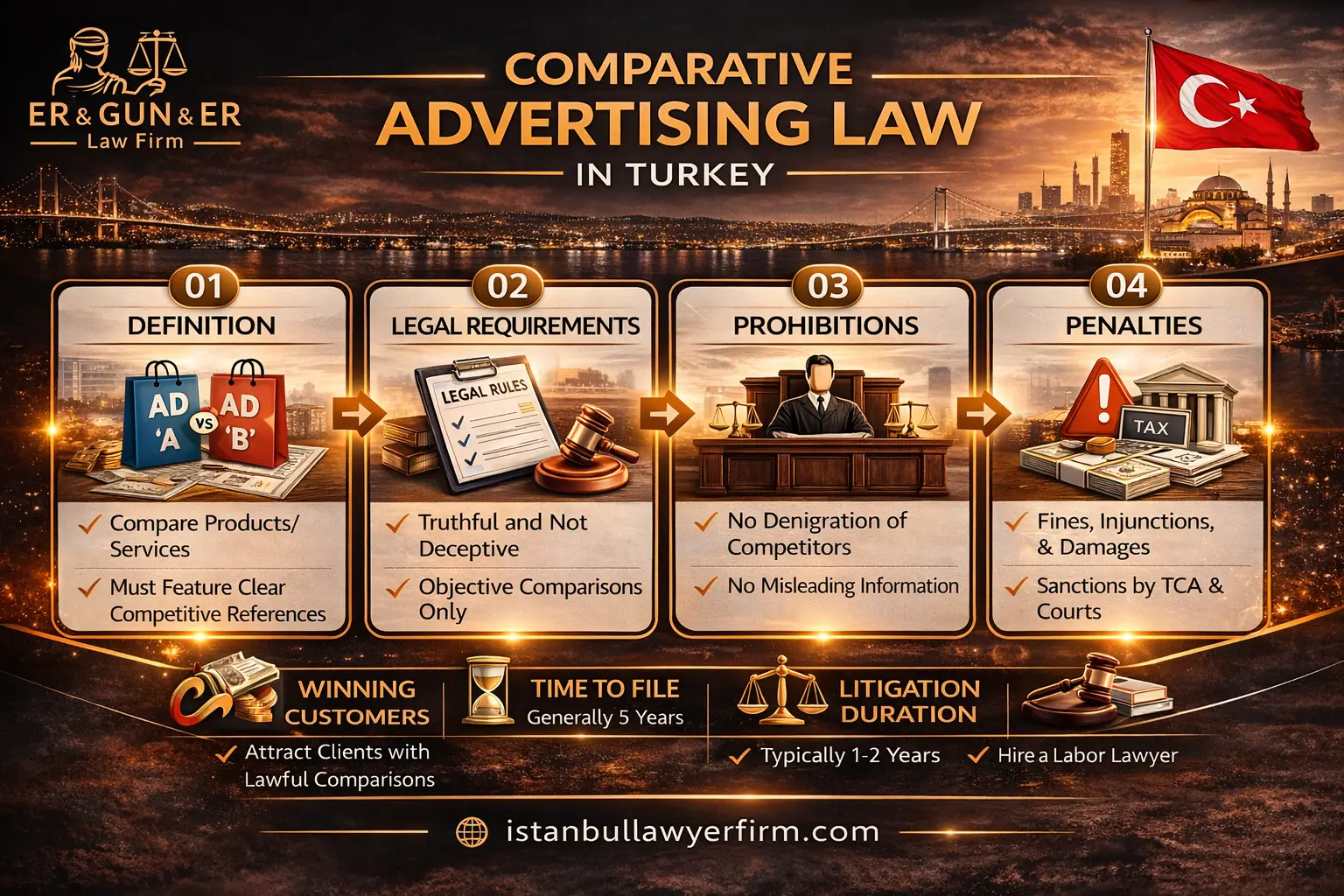
A lawyer in Turkey who advises brands on comparative advertising compliance understands that comparative advertising—the practice of promoting products or services by referencing competing offers, whether directly by naming a competitor or indirectly through recognizable reference points—creates multi-layered legal risk in Turkey because advertising controls under the Consumer Protection Law, unfair competition rules under the Turkish Commercial Code, trademark rights under IP legislation, and sector-specific regulations can all apply simultaneously to a single campaign, and the central compliance question is whether the comparison is objective, verifiable and presented in a way that does not mislead an average consumer when evaluated by the net impression the communication creates. An Istanbul Law Firm that designs advertising compliance programs for national and international brands recognizes that enforcement can arise through administrative channels including review by the Advertising Board (Reklam Kurulu), through civil routes based on unfair competition and intellectual property claims filed by competitors, and through consumer protection proceedings initiated by consumer organizations or regulatory authorities—meaning that a campaign must be defensible across multiple simultaneous review frameworks rather than designed to satisfy only one. A Turkish Law Firm with experience in comparative advertising compliance coordinates the legal, marketing and evidence management disciplines needed to produce campaigns that are commercially effective while maintaining the documented substantiation, disclosure placement and competitor-use justification that Turkish enforcement authorities and courts expect. An English speaking lawyer in Turkey who manages advertising compliance for international brands ensures that global campaign templates are localized to Turkish enforcement expectations, that claim-and-proof documentation is organized for rapid retrieval if a complaint arrives, and that the marketing team understands the difference between claims that require factual substantiation and claims that qualify as permissible puffery under Turkish consumer perception standards. Turkish lawyers who practice comparative advertising law bring practical familiarity with the Advertising Board's review methodology, the commercial courts' approach to unfair competition claims, the trademark analysis applicable to competitor mark use in advertising, and the sector-specific restrictions that apply to regulated industries including health, financial services, telecommunications and food products. This guide explains the legal framework, comparison boundaries, substantiation requirements, trademark considerations, digital channel compliance, enforcement mechanisms and compliance program design that a methodical lawyer in Turkey addresses when advising brands on comparative advertising in Turkey.
Legal Framework and Definition of Comparative Advertising in Turkey
A lawyer in Turkey who advises on the legal framework governing comparative advertising explains that the rules governing comparative advertising in Turkey are multi-layered and should be treated as a matrix of overlapping obligations rather than a single regulatory code—because no single statute comprehensively governs all aspects of comparative advertising, and different legal instruments impose different requirements, prohibitions and standards that apply simultaneously to the same campaign and that can be invoked by different complainants through different procedural routes with different remedies and different evidentiary standards. The Consumer Protection Law (Law No. 6502) establishes the core principles around misleading and deceptive commercial communications, providing the statutory foundation for administrative enforcement through the Advertising Board (Reklam Kurulu), which operates under the Ministry of Trade and has the administrative authority to review commercial advertising upon complaint or ex officio, to assess whether the net impression created by an advertisement is misleading or deceptive to an average consumer exercising ordinary attention and care in the specific context and channel where the advertisement appears, and to impose administrative sanctions including warnings, monetary fines, orders to modify or remove the advertisement, and in serious or repeated violation cases, broadcast suspension or enhanced monitoring of the advertiser's future campaigns. The Regulation on Commercial Advertising and Unfair Commercial Practices provides more granular standards specifying what constitutes a lawful comparison versus a prohibited comparison, what substantiation is required for claims presented as objective and verifiable, what disclosures must accompany conditional offers and limited-time promotions, and what presentation standards apply to different advertising channels, formats and audience types. The Turkish Commercial Code (Law No. 6102) contains comprehensive unfair competition provisions in Articles 54 through 63 that competitors frequently invoke in civil litigation when they allege that a comparative campaign diverts customers through misrepresentation of the advertiser's own offerings or denigration of the competitor's offerings, creates confusion about the products, services or commercial activities of the competing businesses, or makes inaccurate, misleading or unnecessarily disparaging statements about the competitor's products, prices, quality, commercial standing or business practices in a manner that goes beyond what truthful, objective comparison requires and that constitutes unfair competitive conduct under the professional diligence standard. Trademark law principles under the Industrial Property Code (Law No. 6769) become particularly relevant when a competitor's registered trademark—including word marks, logos, packaging trade dress and other distinctive signs—is referenced, displayed or reproduced in the comparative advertisement, because the use of another party's registered trademark in commercial communications requires justification under the referential use doctrine and must not create confusion about commercial origin, suggest affiliation or endorsement that does not exist, take unfair advantage of the mark's established reputation and goodwill, or dilute the mark's distinctiveness through inappropriate contextualization. Practice may vary by authority and year — verify current comparative advertising legal framework provisions, enforcement authority jurisdiction, procedural routes and sanction ranges before any campaign compliance assessment.
An Istanbul Law Firm that defines comparative advertising for compliance purposes explains that a comparison can be explicit—naming a specific competitor or displaying a competitor's product—or implicit—using recognizable reference points such as packaging shapes, color schemes, slogans or market position descriptions that consumers associate with a particular competitor even without express identification. The legal analysis begins with identifying the claim that the average consumer will take away from one viewing of the advertisement, because it is the consumer's perception—not the advertiser's internal intent—that determines whether the comparison is lawful. A factual claim that the consumer interprets as an objective, verifiable statement about product performance, price, quality or ranking triggers the full substantiation discipline and requires the advertiser to maintain documented evidence supporting the exact claim as the consumer understands it. A subjective opinion that the consumer interprets as personal preference or non-specific enthusiasm—sometimes called puffery—triggers a lower standard but still requires assessment against the misleading impression test if the subjective language implies factual superiority. Turkish lawyers who advise on comparative advertising compliance help marketing teams rewrite each campaign message as a plain-language consumer takeaway sentence, classify each sentence as factual claim or subjective opinion, and determine the appropriate substantiation standard and evidence retention requirement for each classification.
A Turkish Law Firm that maps enforcement risk for comparative advertising campaigns explains that the compliance file should identify who is most likely to challenge the campaign and through which channel, because different challengers use different legal theories and different procedural routes. Consumers and consumer organizations typically complain to the Advertising Board alleging that the comparison creates a misleading net impression. Competitors typically file both administrative complaints and civil lawsuits, combining misleading advertising theories with unfair competition and trademark infringement claims. Trade associations in regulated sectors may raise concerns with sector-specific regulators who have their own advertising standards and enforcement powers. Digital platforms may remove or restrict content under their own community guidelines or advertising policies even without a governmental decision. An English speaking lawyer in Turkey who builds complaint-readiness files for international brands prepares a trigger list identifying the most likely challengers and their probable theories, a decision tree for complaint response including who responds, who approves, what evidence is attached and what immediate preservation steps are taken, and a correction plan that can be deployed rapidly if the campaign must be modified or withdrawn before the full defense is developed.
Permitted Comparison Boundaries and Substantiation Standards
A lawyer in Turkey who advises on the boundaries of lawful comparative advertising explains that permitted comparisons are those that inform consumers without distorting the competitive landscape—comparisons that are objective in their basis, verifiable through documented evidence, applied to genuinely comparable products or services, and presented in a manner that does not mislead through selective metric choice, outdated competitor data, false equivalence between non-comparable offerings, or omission of material conditions that change the comparison outcome. The comparison must identify the basis on which it is made—such as specific model, unit size, service tier, measurement period or test conditions—so that the consumer understands what is being compared and can form an informed judgment rather than being led to a conclusion based on incomplete information. The comparison must avoid hidden conditions that change the outcome, must avoid selectively choosing metrics that favor the advertiser while ignoring counter-metrics that would balance the picture, must avoid using competitor information that is outdated and no longer reflects market reality, and must avoid ambiguous phrases that can be interpreted as factual promises when the advertiser intends them as general impressions. The compliance file should include the exact competitor product used in the comparison, proof that the competitor product existed in the compared form at the date the comparison data was captured, and a comparability memo that explains why the compared items are genuinely comparable and what variables were controlled and uncontrolled in the comparison methodology. Practice may vary by authority and year — verify current comparison boundary standards, substantiation requirements and disclosure expectations before any comparative campaign publication.
An Istanbul Law Firm that manages substantiation programs for comparative advertising explains that substantiation is the point where creative messaging becomes an evidence problem—the claim must be supported by data that matches the exact wording and the exact visual framing of the advertisement as the consumer perceives it, not as the marketing team intended it. A claim that is technically true in one context can be unsubstantiated in the context where it actually appears if the audience, channel or visual framing changes the consumer's interpretation. The evidence pack should include the final approved creative in every published format, a claim table that maps each comparison statement to its supporting proof with exhibit references, raw data underlying any statistical or numerical claims rather than only summary presentations, the chain of capture for competitor information including who captured it, when, from what source, and how it was verified for accuracy and currency, methodology memos for any tests, surveys or measurements that explain assumptions, conditions and limitations, and a refresh plan specifying when the claim will be re-verified because comparative claims become inaccurate as competitors change their offers, prices and product specifications. Turkish lawyers who build substantiation files ensure that the evidence is organized by claim unit so a reviewer can see which proof supports which specific sentence, that negative controls and limitations are documented openly rather than concealed, and that the evidence is stored with a custody record so it can be produced without reconstruction if a complaint arrives months after the campaign launched.
A Turkish Law Firm that advises on boundary management for tone and presentation explains that the manner in which a comparison is presented matters as much as the factual accuracy of the underlying data, because comparisons that disparage, ridicule or unfairly denigrate a competitor—even if the factual basis of the comparison is accurate—can convert a lawful comparison into an unfair competition dispute that triggers civil liability and reputational damage. Comparisons should avoid ridiculing competitors, implying that competitors are unsafe or non-compliant without authoritative proof, suggesting regulatory endorsement of the advertiser without explicit authorization, and using competitor trade dress or packaging in ways that create point-of-sale confusion. An English speaking lawyer in Turkey who refines comparative messaging for international brands helps marketing teams preserve strong commercial messaging while removing avoidable boundary violations—adjusting tone, narrowing claims to match available proof, and converting risky absolute statements into substantiated relative claims that achieve the same commercial effect within lawful boundaries.
Misleading Claims, Consumer Protection and Net Impression Analysis
A lawyer in Turkey who defends brands against misleading advertising allegations explains that misleading risk is the dominant enforcement theory in comparative advertising disputes—the claim need not be literally false to violate Turkish advertising law, because a claim that is technically true but creates a false impression in the mind of an average consumer exercising ordinary attention is treated as misleading under the net impression standard that the Advertising Board and Turkish courts apply. A claim can be misleading if it omits a material condition that changes the comparison outcome, uses visuals that contradict or overwhelm the textual disclaimer, presents fine print that cannot realistically be read in the channel and format used, implies a test, survey or award that did not occur or that measured something different from what the consumer infers, uses "up to" language without explaining realistic typical outcomes, compares different product tiers or service levels without disclosure, uses competitor pricing captured at an unrepresentative moment such as a temporary promotion or clearance sale, or suggests regulatory approval or certification without authorization. The compliance file should include a misleading risk memorandum that lists each comparative claim, identifies the potential consumer misinterpretations that could arise from each claim's wording and visual context, documents the mitigation measures used to address each identified risk—such as disclosure placement, claim narrowing, qualifier addition or visual adjustment—and records the reviewer's assessment of whether the residual misleading risk after mitigation is acceptable. Practice may vary by authority and year — verify current misleading advertising standards, net impression assessment methodology and disclosure placement requirements before any comparative campaign publication.
An Istanbul Law Firm that manages misleading risk across multi-channel campaigns explains that misleading risk multiplies when the same comparison appears in different formats across different channels with different space constraints and different audience attention levels, because a claim that is adequately qualified on a website with sufficient space for disclosures may become misleading when compressed into a social media post, a search ad or a mobile notification where disclosure space is limited and consumer attention is brief. The compliance file should include a master claim statement and a list of approved channel variants, each archived with a screenshot and timestamp, so that if a challenge arises the brand can demonstrate what consumers in each channel actually saw. Turkish lawyers who manage multi-channel misleading risk ensure that channel-specific variants are reviewed individually rather than assumed to be compliant because the master version was approved, that disclosures are tested for readability in the actual format and device where consumers will encounter them, and that a refresh log documents when each variant was last verified for continued accuracy, because competitor offer changes can make a previously accurate comparison misleading without any change by the advertiser.
A Turkish Law Firm that prepares complaint-ready files for misleading advertising challenges explains that the most effective defense against a misleading advertising allegation is a pre-assembled evidence pack that demonstrates the advertiser's substantiation methodology, disclosure design process and compliance review workflow—because Turkish enforcement authorities evaluate not only whether the specific claim is misleading but also whether the advertiser exercised the professional diligence expected of a responsible market participant. The best lawyer in Turkey for comparative advertising defense combines substantive claim analysis with process documentation that shows the Advertising Board or the court that the brand had a systematic compliance approach rather than an ad hoc creative process, that claims were reviewed before publication against documented standards, that evidence was captured and preserved according to a written protocol, and that correction mechanisms were in place to address inaccuracies promptly when discovered—because authorities that see evidence of diligent process are more likely to treat identified issues as curable compliance gaps rather than as intentional deception requiring severe sanctions.
Competitor Trademark Use, Price Comparisons and Ranking Claims
A lawyer in Turkey who advises on the use of competitor trademarks in comparative advertising explains that referencing a competitor's registered mark in a commercial communication creates a separate risk lane from the comparison itself, because trademark rights are triggered by use in trade and the trademark owner may argue that the use creates confusion about commercial origin, takes unfair advantage of the mark's reputation, dilutes the mark's distinctiveness or constitutes trademark infringement regardless of whether the factual comparison is accurate. The analysis for competitor trademark use should address whether the mark is necessary to make the comparison understandable to consumers or whether a neutral descriptor such as "leading brand" or "comparable product" would achieve the same clarity, whether the mark is used only to identify the compared product rather than to capture consumer attention unfairly, whether the presentation could cause confusion about affiliation, endorsement or commercial partnership, whether the mark is displayed in a manner that is proportionate to its identification purpose without unnecessary prominence, stylization or alteration, and whether the mark appears in hidden elements such as metadata, search keywords or alt-text that affect search behavior without the consumer's awareness. The compliance file should include a necessity memo for each instance of competitor mark use, screenshots showing the exact presentation in context, and a visual comparison demonstrating that the advertiser's own brand is dominant in the communication to prevent co-branding inferences. Practice may vary by authority and year — verify current trademark use standards, comparative advertising mark use jurisprudence and search keyword advertising rules before any campaign using competitor identifiers.
An Istanbul Law Firm that manages price comparison compliance for retail and e-commerce brands explains that price comparisons are the most common comparative advertising format and the easiest to get wrong operationally, because prices change daily across channels, customer segments and promotional periods, and a comparison that was accurate at the time of data capture can become misleading hours later when the competitor adjusts its pricing. The compliance file should include a price capture protocol that documents where prices were captured, how they were verified, what conditions applied, and what time window the comparison covers; a publish window defining how long the comparison can remain live without re-verification; comparison screenshots showing full page context including any conditions, shipping costs and bundle terms; and a takedown plan defining how quickly the advertisement will be paused if prices change materially before the next scheduled verification. Turkish lawyers who advise on price comparison discipline ensure that the comparison covers genuinely equivalent products with the same specifications, warranty coverage and inclusion of ancillary costs, that conditions affecting the compared price—such as membership requirements, minimum purchase quantities or limited-time promotions—are disclosed in a readable manner, and that the comparison does not create a misleading impression of permanent price advantage when the underlying data reflects only a temporary promotional difference.
A Turkish Law Firm that advises on superiority and ranking claims in comparative advertising explains that claims such as "number one," "best," "top rated," "most chosen," "fastest" and "lowest price" are high-risk because consumers interpret them as factual leadership statements that imply a defined market scope, measurement methodology and evaluation period—and that the compliance file must identify the implied measurement behind each superiority claim and store the supporting data that matches the consumer's interpretation. The compliance file should include a ranking methodology memo identifying the market definition, data source, measurement period, calculation method and any limitations or exclusions, the underlying report pages or data extracts that support the ranking rather than only a press release or summary slide, the refresh plan specifying when the ranking will be re-verified because market positions change, and the disclosure language specifying the ranking source and date where required. An English speaking lawyer in Turkey who advises international brands on ranking claims ensures that global ranking data is localized to the Turkish market definition where necessary, that the ranking methodology is documented in a format that the Advertising Board can evaluate without requiring technical expertise, and that the claim wording matches the actual scope of the evidence rather than implying broader leadership than the data supports.
Online Marketplace, Influencer Marketing and Digital Channel Compliance
A lawyer in Turkey who advises on digital channel compliance for comparative advertising explains that online marketplaces create unique risks because brand-controlled content can be altered, supplemented or contextualized by platform-generated elements—such as auto-generated comparison tables, "better value" labels, suggested similar products and dynamically updated pricing modules—that change the net impression of the listing without the brand's knowledge or approval, and that can create comparison claims attributed to the brand even when the comparison was generated by the marketplace algorithm or by a third-party reseller sharing the listing. The compliance file should identify which marketplace features are enabled for the brand's listings, who has edit access and how change approvals are controlled, what platform-generated comparison modules appear alongside the brand's content and whether the brand can influence or disable them, and what monitoring routine the brand follows to detect unauthorized changes to listing content. Turkish lawyers who manage marketplace compliance implement periodic listing audit routines that capture screenshots of live listings across both desktop and mobile views—because layout differences between devices can change the net impression—and that preserve the captured state with timestamps so the brand can demonstrate what was displayed at any specific date if a challenge arises. Practice may vary by authority and year — verify current marketplace advertising compliance standards, platform liability allocation rules and listing monitoring requirements before any comparative marketplace campaign.
An Istanbul Law Firm that manages influencer marketing compliance for comparative advertising explains that influencer content creates heightened risk because the speaker is a third party whose conversational style, informal language and personal credibility can amplify comparison claims beyond what the brand intended or substantiated—an influencer who says "this is way better than [competitor]" or "I switched from [competitor] because it's cheaper" creates an objective comparison impression that the brand must be prepared to defend even though the words were spoken by the influencer rather than written by the brand's marketing team. The compliance file should treat influencer briefs and scripts as claim-bearing documents subject to the same substantiation review as the brand's own advertisements, should include clear disclosure instructions specifying that the commercial relationship must be identified prominently at the beginning of the content rather than buried among hashtags at the end, should archive the posted content with timestamps and platform metadata since story and reel formats may disappear, and should include corrective instructions for the influencer if the posted content deviates from the approved script. Turkish lawyers who manage influencer compliance ensure that influencer contracts include specific prohibitions on unauthorized comparative claims, requirements for prior approval of any content mentioning competitors, obligations to maintain disclosures in all published formats, and cooperation obligations for evidence preservation if a complaint is received.
A Turkish Law Firm that advises on testimonial and review governance in comparative advertising explains that testimonials and consumer reviews are powerful comparison tools because they compress complex product experiences into short trust signals, but that the same compression creates legal risk when the testimonial implies a typical result that is actually exceptional, when the reviewer did not actually use the product, when the review was edited in a way that changes meaning, or when review selection, highlighting or suppression creates a misleading impression of consumer sentiment. The compliance file should document where each review was sourced, when it was captured, how its authenticity was verified, whether any incentives were provided to the reviewer and whether the incentive was disclosed, what moderation policies govern review display including the criteria for removing negative reviews, and whether the review is used to support a specific comparative claim that requires additional substantiation beyond the review's authenticity. An English speaking lawyer in Turkey who manages review governance for international brands ensures that review use complies with both the consumer protection advertising standards and the platform-specific policies governing review display, solicitation and incentivization in each marketplace where the brand operates.
Sector-Specific Restrictions and Regulated Industry Compliance
A lawyer in Turkey who advises on sector-specific advertising restrictions explains that what is lawful in general consumer advertising may be prohibited or restricted in regulated industries that impose additional rules on claims, endorsements and comparative framing beyond the general comparative advertising framework. Health-related sectors—including pharmaceuticals, medical devices, dietary supplements and cosmetics—may restrict efficacy comparisons, safety superiority claims and any comparative messaging that implies therapeutic benefits without authorized clinical evidence. Financial services—including banking, insurance and investment products—may restrict return promises, performance comparisons and superiority language that implies guaranteed outcomes or risk elimination. Telecommunications and utilities may be particularly sensitive to price comparisons because tariff structures, bundled services and regional pricing variations make like-for-like comparison difficult without extensive disclosure. Food and beverage advertising may face strict controls on nutritional comparisons and health claims that can turn a marketing comparison into a regulated health statement requiring specific authorization. The compliance file should begin with a sector filter that identifies whether additional regulators, industry codes or statutory advertising restrictions apply to the specific product category, and should record any sector-specific mandatory disclaimers, approval requirements or prohibited comparison formats that must be addressed in addition to the general comparative advertising rules. Practice may vary by authority and year — verify current sector-specific advertising restrictions, mandatory disclaimer requirements and industry code compliance standards before any comparative campaign in a regulated sector.
An Istanbul Law Firm that builds sector-specific claim libraries for regulated brands explains that the most effective approach to managing sector advertising restrictions is a pre-approved claim library that categorizes available claims into three tiers: claims that are permitted with standard substantiation, claims that require enhanced substantiation or senior approval before use, and claims that are prohibited regardless of available evidence. The claim library should include the evidence standard required for each claim type—such as clinical trials for health efficacy claims, independent laboratory reports for performance claims, or licensed market research data for ranking claims—the required disclosure text and placement guidance for each advertising channel used in the sector, the refresh cadence for time-sensitive claims, and the list of sensitive competitor references that frequently trigger disputes in the specific industry. Turkish lawyers who maintain sector claim libraries update them when regulatory guidance changes, when new enforcement decisions establish precedents, and when competitor challenges reveal enforcement patterns that affect the risk assessment for specific claim types.
A Turkish Law Firm that manages sector compliance training for marketing teams explains that regulated industries require not only compliant advertising content but also documented training programs that demonstrate the company's commitment to compliance—because enforcement authorities and courts evaluating whether a violation was negligent or intentional consider whether the company had reasonable compliance procedures including staff training, review workflows and escalation protocols for sensitive claims. An English speaking lawyer in Turkey who designs training programs for international brands operating in regulated Turkish sectors creates practical, scenario-based training materials that show marketing teams what they can and cannot say in comparative contexts using realistic examples from their specific industry, how to identify claims that require escalation to legal review before publication, and how to preserve evidence and capture competitor data in a manner that will withstand enforcement scrutiny.
Enforcement Authorities, Complaint Response and Defense Strategy
A lawyer in Turkey who manages enforcement response for comparative advertising explains that enforcement can arrive without warning after a campaign goes live and through multiple channels simultaneously—an administrative complaint filed with the Advertising Board by a consumer who believes the comparison is misleading, a cease-and-desist letter from a competitor's trademark counsel alleging unauthorized use of a registered mark, a civil unfair competition lawsuit filed in the commercial courts seeking injunctive relief and damages for diverted customers, a platform content removal action under the marketplace's or social media platform's community guidelines or advertising policies, a trade association inquiry from a sector-specific regulatory body with its own advertising standards, or a media inquiry from a journalist investigating the accuracy of a publicized comparison claim—and that the response to each challenge must be factually consistent with the responses to all other challenges because enforcement authorities, courts, platforms and journalists share information and compare the brand's statements across proceedings. The compliance file should include a pre-prepared complaint response playbook that defines the immediate stabilization steps upon receiving any form of challenge through any channel: identify the exact content complained of including the specific creative variant, publication channel, display format and publication time window so the defense can be scoped precisely to what the challenger saw; capture and archive the content exactly as displayed across all active platforms and device types—including desktop and mobile views, because the same listing or advertisement can present differently on different devices with different disclosure visibility—using timestamped screenshots, screen recordings or platform export tools that create verifiable records of the content's actual appearance at the time of the challenge; freeze all edits to the challenged content across all channels and instruct every team member, agency and platform partner with content management access to refrain from making changes, additions, removals or republications that could be interpreted as consciousness of wrongdoing, evidence destruction or attempt to alter the evidentiary record before it can be preserved; open a dedicated complaint folder containing the publication log showing when each variant of the challenged content was published and on which platform, the complete evidence pack supporting each comparison claim in the challenged content organized by claim unit with exhibit references, the approval memos from the compliance review documenting who reviewed the content, when the review occurred, what claims were assessed and what evidence was determined to be adequate, and any correction plans or alternative copy that was prepared in advance as contingency; and notify the designated legal reviewer, the marketing team leader, the brand manager and any other internal stakeholders through a controlled communication channel with instructions to direct all external inquiries to the designated spokesperson and to avoid making informal statements about the challenge to platforms, competitors, media or customers. Turkish lawyers who manage Advertising Board complaint responses prepare a structured response pack within the response window that includes a chronological narrative explaining the campaign's development from concept through compliance review to publication, the complete substantiation evidence set supporting each challenged comparison claim organized by claim unit with numbered exhibits cross-referenced to the narrative, the methodology documentation for any tests, surveys, price captures, performance measurements or ranking calculations underlying the comparison with sufficient detail for a non-technical administrative reviewer to evaluate the methodology's adequacy, the disclosure design rationale explaining why consumer disclosures were placed, formatted and worded as they were in each channel variant and why the disclosure approach was adequate for the specific audience and format, and any correction steps already implemented or proposed as evidence of the brand's good faith compliance commitment. Practice may vary by authority and year — verify current Advertising Board review procedures, administrative complaint response deadlines, submission format requirements, evidence presentation standards and potential sanctions before any complaint response filing.
An Istanbul Law Firm that designs defense strategy for comparative advertising disputes explains that the defense should be evidence-led and scope-limited—answering the specific challenge with the specific proof that supports the specific claim as the consumer understood it, without introducing new comparative claims in the defense letter that could create fresh exposure, without overstating the breadth or independence of supporting evidence that could be tested and disproved, and without shifting to new justification grounds that were not part of the original campaign rationale because post hoc explanations undermine credibility with both administrative reviewers and judges. Where the challenge concerns misleading impression, the defense should focus on the net impression analysis and demonstrate how disclosures were presented in the specific channel. Where the challenge concerns competitor trademark use, the defense should present the necessity memo and the confusion-avoidance design choices. Where the challenge concerns pricing, the defense should present the time-stamped capture logs and the representativeness analysis. Where the challenge concerns ranking claims, the defense should present the market definition, data source, measurement methodology and date limitations.
A Turkish Law Firm that coordinates parallel administrative and civil defense for comparative advertising disputes explains that when a competitor files both an Advertising Board complaint and a civil unfair competition lawsuit arising from the same campaign, the responses must be coordinated to ensure factual consistency between the administrative submission and the court pleadings, while recognizing that the two proceedings apply different standards and produce different remedies. Turkish lawyers who manage parallel proceedings ensure that the administrative response focuses on consumer impression and substantiation methodology while the civil defense addresses the additional elements of competitor harm, unfair advantage and commercial diligence that the unfair competition framework requires. The best lawyer in Turkey for comparative advertising defense combines rapid complaint stabilization with strategic assessment of whether the most effective resolution path is full defense, voluntary correction, settlement negotiation or a combination—recognizing that different disputes call for different approaches and that rigid commitment to defending every claim regardless of its defensibility wastes resources and credibility that would be better deployed on claims where the evidence is strong.
Remedies, Corrective Steps and Compliance Program Design
A lawyer in Turkey who manages remedies for comparative advertising violations explains that enforcement outcomes typically focus on three objectives: stopping the misleading effect by requiring modification or removal of the non-compliant content, restoring fair competition by requiring corrective communications that address the damage caused by the misleading comparison, and preventing repetition by requiring the advertiser to implement compliance measures that reduce the risk of future violations. Administrative remedies through the Advertising Board can include warnings, administrative fines, orders to modify specific claim language or disclosure presentation, orders to remove the campaign entirely, and in serious cases broadcast suspension or repeated violation sanctions. Civil remedies through the commercial courts can include injunctive relief ordering the campaign's cessation, damages for the competitor's proven losses resulting from unfair comparison, and corrective advertising orders requiring the advertiser to publish corrections that address the misleading impression. The compliance file should treat remedy planning as a design task that begins before launch rather than as a crisis response after enforcement—preparing pre-approved corrective copy that can be deployed rapidly, maintaining a channel inventory that identifies every platform where the campaign appears so corrections can be implemented comprehensively, and establishing a correction workflow with assigned owners, timeline targets and documentation requirements so the correction process itself becomes evidence of the company's compliance commitment. Practice may vary by authority and year — verify current administrative and civil remedy options, corrective advertising requirements and compliance enhancement expectations before any remedy planning.
An Istanbul Law Firm that designs corrective implementation processes for brands facing advertising enforcement actions explains that corrections must be measurable, auditable and complete—meaning that every channel where the challenged claim appeared must be identified, that the correction must be implemented in each channel with documented proof of the change including before-and-after screenshots with timestamps, that platform cache and syndication issues must be addressed to prevent the original version from persisting after the correction, that any third-party resellers or partners who copied the claim must be notified with proof of delivery, and that customer-facing communications must be aligned with the corrected position to prevent inconsistent messaging that creates new misleading impressions or that contradicts the brand's position in the enforcement proceeding. Turkish lawyers who manage corrective implementation coordinate the change execution across all channels, collect implementation confirmations from each channel owner, verify that cached and syndicated versions are updated, and close the incident with a completion memo that documents the root cause, the corrective actions taken and the control improvements implemented to prevent recurrence.
A Turkish Law Firm that designs ongoing compliance programs for comparative advertising explains that a sustainable compliance program must be built as a workflow that fits marketing production speed while preserving the legal documentation needed for defense—because a compliance program that slows every campaign to a halt will be bypassed by marketing teams under deadline pressure, producing worse outcomes than a well-designed program that integrates compliance into the production process rather than imposing it as an external gate. An English speaking lawyer in Turkey who implements compliance programs for international brands designs the program around a claim intake step where every comparison is rewritten as a consumer takeaway sentence and classified by risk category, proof checklists customized to each claim type defining minimum evidence and refresh cadence, assigned claim owners responsible for maintaining substantiation and refreshing time-sensitive data, channel control maps showing who can publish and who can pause content across each advertising platform, audit capture routines that archive published variants with timestamps, change control rules requiring re-review when copy or visuals are modified, a complaint playbook with response templates and evidence pack structures, and periodic mock complaint exercises that test the team's ability to retrieve evidence, freeze content and produce a coherent response pack under time pressure—because a compliance program that is documented and practiced is stronger than a policy that exists only as text in a corporate manual that marketing teams have never read.
Frequently Asked Questions
- Is comparative advertising lawful in Turkey? Yes, comparative advertising is lawful when the comparison is objective, verifiable and not misleading in net impression. The comparison must be based on like-for-like products, supported by documented evidence, and presented without material omissions or misleading visual framing. Compliance requires substantiation before publication and evidence retention for defense.
- What enforcement channels apply to comparative advertising in Turkey? Administrative enforcement through the Advertising Board, civil enforcement through commercial court unfair competition and trademark infringement lawsuits, and platform-level enforcement through marketplace and social media content policies. A campaign may face simultaneous challenges through multiple channels, requiring coordinated defense across all proceedings.
- What makes a comparative claim misleading under Turkish law? A claim is misleading if its net impression—the overall message that an average consumer takes away—creates a false understanding, even if the literal words are technically accurate. Misleading risk arises from material omissions, unreadable disclosures, selective metric presentation, outdated competitor data, false equivalence between non-comparable products, and implied tests or certifications that did not occur.
- What evidence is required to substantiate a comparative advertising claim? Evidence must match the exact claim as the consumer understands it, including raw data for numerical claims, test protocols and conditions for performance claims, survey methodology for consumer preference claims, time-stamped price captures for pricing claims, and ranking report pages with market definitions for leadership claims. Evidence must be dated, stored with custody records and refreshed when market conditions change.
- When can competitor trademarks be used in comparative advertising? Competitor marks may be used when necessary to make the comparison understandable, when used only for identification rather than to capture attention unfairly, when the presentation does not create confusion about affiliation or endorsement, and when the use is proportionate to the identification purpose. The compliance file should include a necessity memo justifying each instance of competitor mark use.
- What are the risks of price comparison advertising? Price comparisons are dynamic accuracy problems because prices change across channels, customer segments and promotional periods. Risks include comparing different product tiers, capturing competitor prices at unrepresentative moments, failing to include ancillary costs, and not disclosing conditions that affect the compared price. A capture protocol with refresh rules and takedown plans is essential.
- How should superiority and ranking claims be substantiated? Claims like "number one" and "best" must be supported by documented ranking methodology including market definition, data source, measurement period and calculation method. The underlying report pages must be preserved, not only press releases. Ranking claims require refresh plans because market positions change, and the claim wording must match the actual scope of the evidence.
- What comparative advertising rules apply to influencer marketing? Influencer comparative claims are treated as commercial communications subject to the same substantiation requirements as brand advertising. The commercial relationship must be disclosed prominently. Influencer briefs should be reviewed as claim-bearing documents, comparative statements require prior brand approval and substantiation, and posted content should be archived with timestamps.
- How do marketplace comparison features affect brand compliance? Platform-generated comparison tables, pricing labels and ranking badges can create comparison claims attributed to the brand. Brands should monitor marketplace listings through periodic audits, archive screenshots with timestamps, identify which content is brand-controlled versus platform-generated, and maintain takedown workflows for non-compliant variants.
- Do sector-specific restrictions apply to comparative advertising? Yes. Regulated industries including health, financial services, telecommunications and food may impose additional restrictions on comparative claims beyond the general advertising framework. Sector-specific claim libraries, enhanced substantiation requirements and mandatory disclaimer formats should be maintained for regulated product categories.
- How should a brand respond to an Advertising Board complaint? Begin with evidence capture and file stabilization: identify the challenged content, archive all variants, freeze edits, and assemble the evidence pack. Prepare a chronological narrative with exhibits supporting each claim. Avoid introducing new comparative claims in the response. Implement corrections if warranted and document implementation proof.
- What corrective advertising remedies are available in Turkey? Administrative remedies include modification orders, removal orders and fines. Civil remedies include injunctive relief, damages and corrective communication orders. Corrective steps should be designed before launch as contingency plans, with pre-approved replacement copy, channel inventories and implementation workflows ready for rapid deployment.
- What should a comparative advertising compliance program include? A claim intake and classification process, substantiation checklists by claim type, assigned claim owners, channel control maps, audit capture routines, change control rules, a complaint response playbook, correction templates, periodic training and mock complaint exercises. The program should integrate with IP, consumer protection and data protection governance.
- How should testimonials and reviews be used in comparative advertising? Testimonials and reviews must be authentic, representative of typical experiences, and disclosed as incentivized if any incentive was provided. Reviews used to support comparative claims require additional substantiation beyond authenticity. Moderation policies should be documented and applied consistently, and review captures should be preserved with source and date information.
- Does ER&GUN&ER Law Firm handle comparative advertising compliance? Yes. ER&GUN&ER Law Firm provides comprehensive comparative advertising legal services including claim substantiation review, competitor mark use analysis, price comparison compliance, ranking claim documentation, influencer marketing governance, Advertising Board complaint defense, unfair competition litigation, corrective advertising implementation and compliance program design, with bilingual English-Turkish legal support throughout.
Author: Mirkan Topcu is an attorney registered with the Istanbul Bar Association (Istanbul 1st Bar), Bar Registration No: 67874. His practice focuses on cross-border and high-stakes matters where evidence discipline, procedural accuracy, and risk control are decisive.
He advises individuals and companies across Immigration and Residency, Real Estate Law, Tax Law, and cross-border documentation matters where procedural accuracy and evidence discipline are decisive.
Education: Istanbul University Faculty of Law (2018); Galatasaray University, LL.M. (2022). LinkedIn: Profile. Istanbul Bar Association: Official website.