

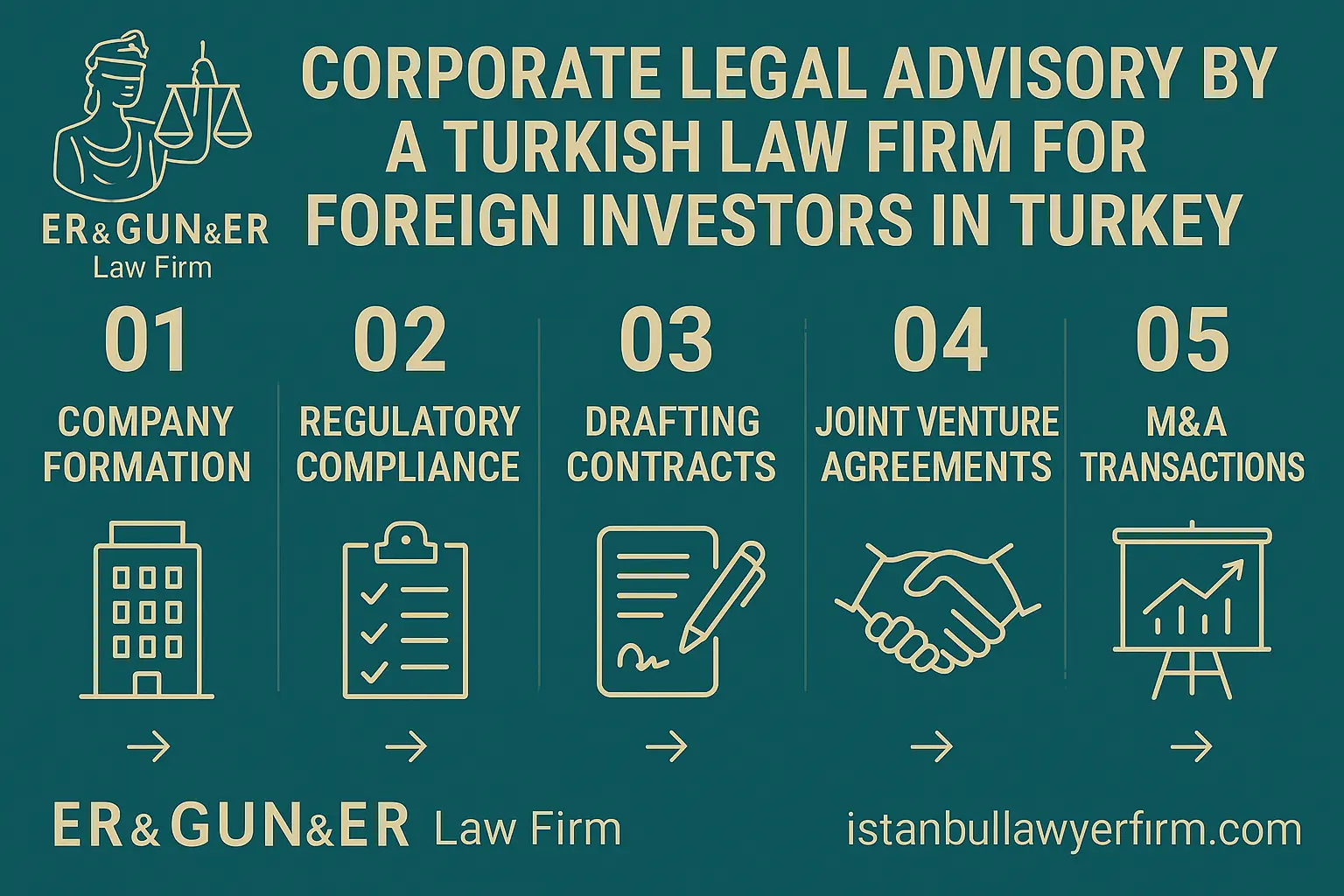
A lawyer in Turkey who provides corporate legal advisory services to foreign investors understands that international companies entering the Turkish market—whether through greenfield investment establishing a new Turkish legal entity, strategic acquisition of an existing Turkish business, joint venture formation with a local partner, or expansion of an existing foreign company's Turkish presence through branch registration—require legal advisory that goes substantially beyond transactional support at the point of entry, encompassing the full lifecycle of the company's Turkish operational existence from initial structuring decisions through ongoing governance and compliance, commercial contract management, employment law compliance, regulatory interaction, dispute resolution and eventual exit planning. An Istanbul Law Firm that provides comprehensive corporate legal advisory to foreign investors builds each advisory engagement around the specific characteristics of the client's investment—the industry sector and its regulatory environment, the ownership structure and parent company governance requirements, the transaction nature and commercial objectives, the company's size and operational complexity, and the specific legal risks that the client's background and prior Turkish experience indicate require particular attention—rather than applying generic advisory templates that fail to address the specific legal challenges that different foreign investors face in different Turkish market contexts. A Turkish Law Firm with sustained experience serving international clients across manufacturing, technology, financial services, healthcare, energy, logistics and real estate sectors has accumulated the sector-specific regulatory knowledge, transactional experience and practical understanding of Turkish administrative procedures that enables it to provide legal advisory that is not only technically accurate under Turkish law but also practically effective in achieving the commercial outcomes that foreign investors seek. An English speaking lawyer in Turkey who serves as the primary legal interface for foreign management teams, boards and headquarters legal departments provides the communication quality—in terms of language accuracy, conceptual clarity, strategic framing and responsive availability—that enables foreign decision-makers to understand their Turkish legal environment accurately, make informed decisions about legal strategy, and take the actions needed to maintain the company's legal compliance and protect its commercial interests without unnecessary delay arising from language barriers or communication gaps. Turkish lawyers who advise international corporations on Turkish corporate law bring the practical familiarity with Turkish Trade Registry procedures, notary requirements, regulatory agency administrative practices, commercial court procedures and enforcement mechanisms that transforms accurate legal knowledge into effective operational guidance capable of moving the client's legal matters forward within Turkey's specific administrative and judicial environment.
Choosing the Right Corporate Structure for Foreign Investment in Turkey
A lawyer in Turkey who advises foreign investors on corporate structure selection explains that the choice between the available legal entity forms—limited liability company, joint stock company, branch of a foreign company, liaison office, or partnership structures—is one of the most strategically consequential decisions in the entire Turkish market entry process, because each form carries different liability frameworks, governance structures, tax treatments, regulatory licensing eligibilities, capital requirements and statutory compliance obligations that shape every subsequent legal and commercial decision the investor makes throughout the company's operational lifetime in Turkey. An Istanbul Law Firm that guides foreign investors through entity selection evaluates the investor's specific objectives against the characteristics of each available form: the limited liability company (limited şirket—Ltd.Şti.) suits investors prioritizing operational simplicity and governance flexibility—requiring minimum capital of TRY 10,000, permitting single-shareholder and single-manager structures, imposing no minimum board size, and providing limited liability protection sufficient for most commercial activities—while restricting share transfer flexibility and lacking the capital market access features needed by companies planning securities issuances or institutional investment rounds; the joint stock company (anonim şirket—AŞ) suits investors planning complex capital structures, institutional investment rounds, or operations in regulated sectors requiring the AŞ form—requiring minimum capital of TRY 250,000, enabling dual-class share structures, convertible instruments, employee share programs and securities issuances, providing the formal governance framework expected by capital market regulators and institutional investors, and facilitating M&A transactions through the share transfer mechanisms equity markets require; the branch office extends the parent company's Turkish presence without creating a separate legal entity—imposing no separate minimum capital requirement, subjecting Turkish-source activities to Turkish tax, requiring trade registry registration and Turkish commercial law compliance, and suiting companies conducting project-based Turkish activities or testing market presence before committing to subsidiary establishment; and the liaison office provides the lightest legal presence for market research, promotion and representational activities, requiring Ministry of Economy authorization, prohibiting revenue-generating commercial activities, and imposing annual reporting obligations confirming the office's compliance with its restricted activity scope. Turkish lawyers managing the complete formation process prepare and submit every required document: Articles of Association drafted in Turkish compliance with TCC mandatory content requirements and customized for the investor's governance structure; notarization or, for foreign-signed documents, apostille and sworn translation processing; MERSIS-based trade registry application; tax office registration; SGK employer registration; and Chamber of Commerce registration—with each step explained to the foreign investor in practical terms describing the legal purpose of each document, the Turkish authority's review process, the expected timeline and the post-submission actions needed to complete the step. Practice may vary by authority and year — verify current minimum capital requirements, entity formation document requirements, registration procedures, notarization standards and post-formation compliance obligations before any company formation decision is made or implemented. For the full procedural framework, see our pillar guide on company formation in Turkey.
An Istanbul Law Firm that maps future contingencies into the initial corporate structure explains that initial structuring decisions made at formation time are substantially more difficult and expensive to revise after the company begins operations—because structural changes including entity type conversions, capital restructuring, governance document amendments and shareholder agreement renegotiation each require board and shareholder approval procedures, trade registry filings, notarization, potential regulatory notifications and, in some cases, court proceedings that consume management time and legal expense that could be avoided if the initial structure had anticipated the company's evolution. Turkish lawyers advising on initial structure incorporate future contingency planning by designing Articles of Association with sufficient flexibility for anticipated governance changes without requiring amendment; including shareholder agreement provisions addressing the full range of foreseeable ownership events including transfers, dilution, exit, death and incapacity of individual shareholders, and admission of new investors; establishing authorization matrices that delegate appropriate operational authority to management while reserving strategic decisions for board or shareholder approval at levels calibrated to the company's risk profile; and implementing compliance infrastructure proportionate to the company's initial size while designed to scale efficiently as the company grows without requiring fundamental governance restructuring. An English speaking lawyer in Turkey who ensures foreign investors understand their structural choices from day one provides structured orientation briefings explaining each governance mechanism, its legal basis, the practical situations in which it operates, and the consequences of its improper implementation—giving foreign managers the understanding needed to make governance decisions correctly rather than inadvertently undermining the legal framework their Turkish counsel has established.
A Turkish Law Firm that advises on holding company structures for foreign investment in Turkey explains that many foreign investors benefit from establishing a Turkish holding company that owns the operating Turkish subsidiaries, because the holding structure provides additional liability isolation, facilitates tax-efficient profit consolidation and dividend management, enables group financing through the holding entity, and simplifies future ownership transfers and exit transactions that can be accomplished through transfer of holding company shares rather than requiring separate transfers of each operating subsidiary. An English speaking lawyer in Turkey who designs holding structures for international corporate groups ensures the Turkish holding company's Articles of Association, board composition and governance documentation align with the foreign parent's group governance standards, that the holding company satisfies the Turkish tax law requirements for dividend income exemption available to qualifying holding companies, and that the structure between the foreign parent, the Turkish holding company and the Turkish operating subsidiaries is documented with the intercompany agreements—management service agreements, loan agreements, IP licenses and cost-sharing arrangements—needed to establish the commercial basis for financial flows within the group on arm's length terms satisfying transfer pricing compliance requirements.
Corporate Governance and Legal Compliance Advisory
A lawyer in Turkey who advises on corporate governance for foreign-owned companies explains that implementing genuinely effective governance—rather than technically compliant governance documentation that operates differently in practice from its documented procedures—requires sustained legal advisory that monitors the gap between governance design and governance operation, identifies when the company's actual decision-making, documentation and compliance practices have drifted from the standards that Turkish law and the company's own governance documents require, and implements corrections before the accumulated governance deficit creates legal liability, undermines the company's legal standing in transactions or regulatory proceedings, or generates shareholder disputes that proper governance design would have prevented. An Istanbul Law Firm that provides ongoing governance advisory to foreign-owned Turkish companies delivers structured governance support across every dimension of the company's governance cycle: designing board regulations, authority delegation matrices, conflict of interest disclosure procedures and board performance review processes that reflect both TCC requirements and the foreign parent's group governance standards; preparing each board meeting with the agenda, supporting documentation, draft resolutions and attendance confirmation needed for a legally compliant meeting producing enforceable decisions; documenting each board meeting with minutes meeting TCC format requirements signed by the required participants within the statutory timeframe; managing the annual ordinary general assembly process including shareholder notification, agenda preparation, financial statement distribution, meeting conduct documentation and trade registry notification of assembly decisions requiring registration; implementing compliance monitoring covering trade registry currency, annual filing completion, tax payment and declaration status, SGK contribution confirmation and sector-specific regulatory certification renewal; and providing quarterly compliance status reports to foreign management and parent company legal departments identifying each compliance obligation's current status, upcoming deadlines and any identified deficiencies requiring immediate attention. Practice may vary by authority and year — verify current board resolution format requirements, general assembly procedural obligations, trade registry filing periods, annual compliance deadline schedules and corporate governance standards applicable to the company's legal form and industry sector before any governance advisory program is designed or implemented.
An Istanbul Law Firm that implements anti-money laundering and regulatory compliance frameworks for foreign-owned Turkish companies explains that regulatory compliance in Turkey extends well beyond the core corporate and tax compliance obligations—encompassing AML and counter-terrorism financing compliance under the Anti-Money Laundering Law (Law No. 5549) for companies in obligated entity categories, data protection compliance under the Personal Data Protection Law (KVKK) for companies processing personal data of Turkish data subjects, competition law compliance under the Competition Protection Law (Law No. 4054) for companies with market presence above de minimis thresholds, consumer protection compliance under the Consumer Protection Law (Law No. 6502) for companies serving Turkish consumers, and sector-specific compliance across every industry-specific regulatory framework applicable to the company's activities. Turkish lawyers designing comprehensive compliance programs build each program around the specific regulatory domains applicable to the client's industry and operations: identifying every regulatory authority that has jurisdiction over the company's activities; mapping each authority's compliance requirements including registration obligations, periodic reporting, inspection readiness, mandatory training and certification standards; establishing internal procedures ensuring each compliance requirement is assigned to a responsible party with clear accountability and deadline awareness; implementing documentation systems maintaining the compliance records that regulatory inspectors and commercial counterparties will examine; and conducting periodic compliance effectiveness reviews testing whether documented procedures are operating as designed or whether implementation gaps have developed that require remediation. An English speaking lawyer in Turkey who manages compliance program communication for international companies ensures that foreign management receives clear English-language compliance status reports identifying every outstanding obligation, approaching deadline and identified deficiency, enabling foreign decision-makers to make informed compliance investment decisions and management interventions without needing to rely on Turkish-language administrative documents they cannot independently review.
A Turkish Law Firm that conducts annual corporate governance reviews for foreign-owned companies explains that the formal annual governance review—examining the company's Articles of Association compliance with current TCC requirements, verifying trade registry accuracy against the company's actual governance structure, reviewing board resolution documentation for format compliance, confirming general assembly meeting completeness and documentation accuracy, and assessing the company's compliance calendar completeness and deadline adherence—provides the systematic quality assurance needed to detect and remediate governance deficiencies before they are discovered by regulators, opposing parties in litigation, transaction counterparties in due diligence or commercial partners in compliance reviews. An English speaking lawyer in Turkey who presents annual governance review findings to foreign management provides structured briefings explaining each identified gap in practical terms—the specific legal consequence of the gap if it remains unremediated, the remediation action required, the estimated cost and timeline for remediation, and the priority ranking of each identified gap relative to other identified deficiencies—enabling foreign management to make informed decisions about remediation sequencing and resource allocation based on accurate understanding of the legal risks each gap creates.
Due Diligence and Transaction Risk Mitigation
A lawyer in Turkey who manages due diligence for foreign investors explains that thorough legal due diligence of a Turkish acquisition target—examining the company's corporate structure, governance documentation, commercial contracts, regulatory compliance history, employment relationships, intellectual property ownership, real property rights, pending and threatened litigation, and tax compliance status—is the foundational investment protection measure that enables informed acquisition pricing, protective transaction documentation and realistic post-closing integration planning, and that due diligence conducted with insufficient depth or speed regularly leads to post-closing discoveries of material undisclosed liabilities that have cost foreign acquirers substantially more to address after closing than the aggregate due diligence investment that more thorough pre-closing investigation would have required. An Istanbul Law Firm that conducts legal due diligence for foreign acquirers organizes the investigation through a structured multi-workstream process: corporate structure and governance review examining trade registry history, Articles of Association and all amendments, complete board and general assembly decision records from formation through the due diligence date, share ledger and capital history confirming clean ownership without undocumented encumbrances or disputed transfer claims, and authorized signatory documentation confirming each person who has bound the company commercially is properly authorized; material contract review examining supply agreements, customer contracts, distributor and agency agreements, license agreements, real property leases, financing agreements and any change of control provisions that could be triggered by the acquisition; regulatory and licensing review confirming every operating license, permit and regulatory authorization required for the target's business activities is current and transferable or renewable in connection with the acquisition; employment review examining workforce composition, employment contract compliance, SGK registration accuracy, pending employment claims, key employee retention risks and any collective labor agreement obligations; litigation review confirming the complete universe of pending, threatened and potential litigation, administrative enforcement actions and regulatory investigations that create contingent liabilities not reflected in the target's financial statements; and intellectual property review confirming ownership of registered IP, freedom to operate analysis for unregistered IP used in the business, and IP protection adequacy relative to the target's business model. Practice may vary by authority and year — verify current due diligence documentation standards, trade registry access procedures, litigation record search methodologies, IP registry search procedures and regulatory compliance verification approaches before any due diligence program is designed or initiated.
An Istanbul Law Firm that structures transaction documentation for Turkish M&A deals provides comprehensive document preparation across the complete transaction lifecycle: letter of intent or term sheet documenting the agreed commercial terms and establishing the binding commitments—typically exclusivity and confidentiality—and non-binding understanding—typically price and structure—that govern the parties' conduct through the due diligence and definitive documentation phase; share purchase agreement or asset purchase agreement specifying representations and warranties covering every due diligence category, conditions precedent to closing, purchase price calculation and adjustment mechanisms, specific indemnities for identified pre-closing liabilities, post-closing obligations and dispute resolution provisions; closing documentation including share transfer deeds, trade registry filings registering ownership changes, shareholder register updates, board composition change resolutions and regulatory notifications required by the acquisition; and post-closing integration documentation addressing operational transition arrangements, management handover procedures, compliance program alignment and governance integration timelines. Turkish lawyers advising on representation and warranty coverage ensure each representation is calibrated to the specific risks identified in due diligence—broader representations in areas where due diligence was limited by information access, narrower representations with specific carve-outs in areas where known risks have been priced or specifically indemnified—and that warranty and indemnity limitations including survival periods, monetary caps, baskets and specific exclusions are negotiated to provide adequate investor protection while reflecting the Turkish legal framework's enforcement standards. An English speaking lawyer in Turkey managing transaction documentation for international acquirers maintains continuous English-language communication with the client's deal team throughout the documentation process, providing plain-English explanations of each document's legal significance, the parties' negotiating positions and the practical consequences of each proposed term, enabling the client's commercial leadership to make informed decisions about negotiation priorities and acceptable risk allocation without needing technical legal expertise to evaluate Turkish-language transaction documents.
A Turkish Law Firm that advises on post-acquisition integration governance explains that the legal integration of an acquired Turkish company into the foreign acquirer's group governance framework—aligning the Turkish entity's Articles of Association, board composition, management authority structure, compliance policies and regulatory registrations with group standards—requires systematic legal management of multiple simultaneous procedural streams that must be completed in correct sequence to achieve legally valid governance integration without creating compliance gaps or triggering unintended regulatory notifications. An English speaking lawyer in Turkey managing post-acquisition integration ensures that every required governance document change—Articles of Association amendments requiring general assembly supermajority approval and trade registry registration, board composition changes requiring new member appointment procedures and trade registry notification, authorized signatory updates requiring notarized signature circular updates, compliance policy adoptions requiring formal board approval and documentation—is implemented in the correct procedural sequence with the documentation required by Turkish law for each specific change, and that the integration timeline reflects realistic Turkish administrative processing periods rather than the faster timelines that may apply in the acquirer's home jurisdiction.
Tax Structuring, Incentives and Cross-Border Financial Advisory
A lawyer in Turkey who advises on tax structuring for foreign investments explains that the Turkish tax framework—corporate income tax at 25% standard rate under the Corporate Tax Law (Law No. 5520), value added tax at rates ranging from 1% to 20% under the Value Added Tax Law (Law No. 3065), withholding taxes on dividends, interest, royalties and service fee payments under both domestic law and applicable double tax treaties, and stamp duty on specified contract categories under the Stamp Duty Law (Law No. 488)—creates a comprehensive tax cost environment that must be managed through deliberate legal and structural decisions rather than accepted as fixed, because Turkish tax law provides numerous provisions enabling significant tax cost reduction for qualifying investments and qualifying transactions when properly structured with qualified legal and tax advisory from the outset. An Istanbul Law Firm that coordinates tax structuring for foreign investments works in close conjunction with the client's tax advisors to evaluate each available tax optimization mechanism: corporate income tax rate reductions available to companies holding Investment Incentive Certificates from the Ministry of Industry and Technology, with reductions ranging from 50% to 100% depending on the investment's region, sector, scale and strategic importance; R&D deduction regimes available to companies conducting qualifying research and development activities in Turkey, including the additional deduction available under the R&D Law (Law No. 5746) and the activities within Technology Development Zones (Teknoloji Geliştirme Bölgeleri) providing CIT exemption for qualifying software and R&D income; free zone tax advantages available to companies operating within one of Turkey's organized free zones, where manufacturing companies exporting 85% of production qualify for corporate income tax exemption; participation exemption available to Turkish holding companies receiving dividends from Turkish subsidiaries satisfying qualifying conditions, enabling dividend consolidation within a Turkish holding structure without triggering additional Turkish corporate income tax on the dividend flow; and double tax treaty benefits reducing withholding taxes on dividends, interest and royalties paid by Turkish entities to foreign recipients in treaty countries from standard domestic withholding rates to reduced treaty rates when procedural requirements including Turkish tax authority recognition of the foreign recipient's treaty eligibility are satisfied. Practice may vary by authority and year — verify current corporate income tax rate, available incentive programs and their eligibility criteria, free zone operational requirements, holding company exemption conditions, double tax treaty rates and their procedural requirements before any tax structuring strategy is designed or implemented.
An Istanbul Law Firm that manages transfer pricing compliance for foreign-owned Turkish companies explains that controlled transactions between Turkish entities and related parties—including the foreign parent company, international group affiliates, and connected entities in any jurisdiction—must be priced on arm's length terms and documented annually in a transfer pricing report satisfying the Revenue Administration's technical requirements under Communiqué on Hidden Profit Distribution through Transfer Pricing (General Communiqué on Corporate Tax No. 1, Section 12), with failure to maintain adequate transfer pricing documentation shifting the burden of proof to the company in any tax audit and potentially resulting in transfer pricing adjustments, disallowance of deductions and significant administrative penalties. Turkish lawyers advising on transfer pricing compliance identify every controlled transaction category requiring documentation—management fee arrangements, technology licenses, financial transactions including shareholder loans and cash pooling, guarantees, shared services cost allocations, distribution arrangements, procurement agent transactions—and coordinate preparation of the annual transfer pricing documentation package comprising the master file (ana dosya) documenting the group's global business, organizational structure, intangibles, financial arrangements and tax positions; the local file (yerel dosya) documenting Turkish-specific controlled transactions with comparable analysis supporting the arm's length pricing; and the country-by-country report (ülke bazında raporlama) for groups meeting the consolidated revenue threshold, documenting revenue, profit, tax paid, employees and assets by jurisdiction. An English speaking lawyer in Turkey who coordinates cross-border financial advisory for international companies ensures that intercompany agreements governing each controlled transaction type are properly documented with terms supporting the transfer pricing methodology, that invoicing procedures generate the documentation trail needed for tax compliance, and that the Turkish tax compliance position is consistent with the positions taken by the foreign parent company in other jurisdictions.
A Turkish Law Firm that advises on investment incentive applications explains that the Ministry of Industry and Technology's Investment Incentive Certificate program—providing corporate income tax reductions, customs duty exemptions on imported machinery and equipment, VAT exemptions on machinery purchases, social security employer premium support and, for strategic investments, additional benefits including land allocation, interest support and energy support—requires proactive application management because incentive benefits apply only to investments made after certificate issuance, meaning companies that purchase qualifying equipment before certificate receipt lose the customs duty and VAT exemption benefits that would otherwise apply to those purchases. An English speaking lawyer in Turkey who manages incentive certificate applications for foreign investors ensures the application is submitted with the required investment plan documentation before any qualifying equipment purchases are initiated, that post-certificate compliance reporting obligations—including investment progress reports to the Ministry confirming achievement of committed investment amounts and employment creation within stipulated timelines—are prepared and submitted within prescribed deadlines, and that post-completion procedures including investment completion certificates are obtained within the required timeframes to confirm the incentive benefits' final application without recapture risk from incomplete investment achievement.
Regulatory Compliance and Corporate Risk Management
A lawyer in Turkey who advises on regulatory risk management for foreign-owned companies explains that Turkey's regulatory environment has been evolving rapidly across multiple domains simultaneously—through legislative alignment with EU standards in areas including data protection, capital markets, financial services, product safety and consumer protection; through expanded enforcement authority and increased enforcement activity across regulatory agencies including the Personal Data Protection Authority, Competition Authority, Energy Market Regulatory Authority, Banking Regulation and Supervision Agency and Capital Markets Board; through adoption of new regulatory frameworks addressing emerging business models in fintech, digital platforms, renewable energy and e-commerce; and through enhanced international regulatory cooperation enabling Turkish regulatory authorities to coordinate with foreign counterparts in cross-border enforcement investigations—creating a compliance environment where static compliance programs designed to address regulatory requirements as they existed at a fixed historical point in time quickly become inadequate as the regulatory landscape evolves. An Istanbul Law Firm that provides ongoing regulatory monitoring for foreign-owned Turkish companies maintains continuous awareness of legislative amendments, regulatory agency guidance publications, enforcement decisions, court interpretations and industry consultation processes across every regulatory domain applicable to the client's industry, alerting clients to developments requiring policy updates, process changes, system modifications, regulatory filings or governance adjustments within the timeframes needed to maintain compliance before regulatory changes take effect. Turkish lawyers managing regulatory change for international companies provide each regulatory update in a structured impact analysis format—describing the regulatory change, its legal basis, the effective date, the specific compliance actions required, the timeline for each required action, the consequences of non-compliance, and the resources needed for implementation—enabling foreign management to make informed decisions about compliance investment priorities based on accurate assessment of legal risk rather than generalized regulatory uncertainty. Practice may vary by authority and year — verify current regulatory requirements applicable to the company's industry sector, recent enforcement trends and priorities, regulatory agency guidance on specific compliance questions, and timeline for pending regulatory changes before any regulatory compliance strategy is designed or updated.
An Istanbul Law Firm that manages data protection compliance for foreign-owned companies explains that the Personal Data Protection Law (KVKK, Law No. 6698) imposes comprehensive personal data processing obligations on all companies processing personal data of Turkish data subjects—regardless of whether the company is Turkish or foreign-owned and regardless of where data processing occurs—requiring systematic organizational compliance including documentation of every personal data category processed, every processing activity and its legal basis, every data retention period, every data sharing arrangement and every cross-border transfer mechanism, implemented through a continuously maintained data processing inventory that serves as the foundation for KVKK Board inspections, data subject rights responses and data breach notifications. Turkish lawyers implementing KVKK compliance programs for foreign companies address the specific compliance challenges arising from multinational data processing environments: cross-border data transfers from Turkish operations to parent companies and group affiliates outside Turkey must be structured through one of the legally recognized transfer mechanisms—adequacy decision where available, standard contractual clauses approved by the KVKK Board, specific derogations for limited transfers, or explicit data subject consent where appropriate—with each mechanism's specific implementation requirements confirmed against current KVKK Board interpretations that evolve through published board decisions and enforcement actions; employee data processing must satisfy the specific KVKK requirements applicable to employment data including transparent processing notice at employment commencement, lawful processing grounds for each processing activity, appropriate retention periods calibrated to Turkish labor law and statute of limitations considerations, and cross-border transfer compliance for HR data shared with the foreign parent's global HR systems; and customer data processing must satisfy consent management requirements for data processing dependent on consent as the lawful basis, clear privacy notice requirements for online and offline data collection, and cookie consent requirements for website data collection compliant with KVKK Board guidance on cookie-based data processing.
A Turkish Law Firm that manages regulatory investigation defense for foreign-owned companies explains that the company's response to a regulatory investigation—whether initiated by the Tax Inspection Board, Social Security Institution, Personal Data Protection Authority, Competition Authority, sector-specific regulator or other enforcement agency—must be managed with the same strategic discipline applied to commercial negotiations and litigation, because the company's conduct during the investigation—the completeness and accuracy of its responses to information requests, the cooperation posture it presents, the defenses and mitigating factors it advances, and the corrective measures it demonstrates—significantly influences the investigation's outcome including whether formal enforcement action is initiated, what sanction severity is recommended, and whether voluntary compliance improvements reduce the penalty. An English speaking lawyer in Turkey who coordinates investigation defense for international companies provides the foreign management team with real-time English-language updates on investigation developments, clear explanations of each procedural stage and the company's rights at each stage, strategic analysis of the company's legal position and available defenses, and specific recommendations for each decision point—including decisions about document production scope, witness interview participation, voluntary disclosure of additional information, and whether to pursue administrative appeal or judicial review of adverse decisions.
Employment and Labor Law Strategy for Foreign Employers
A lawyer in Turkey who advises foreign employers on employment law explains that Turkey's Labor Code (Law No. 4857) and the related Social Security and General Health Insurance Law (Law No. 5510) together create a comprehensive employment law framework that provides employees with substantial protections—including mandatory severance payment entitlements, strong unfair dismissal protection for employees with more than six months' service at companies with thirty or more employees, detailed disciplinary procedure requirements for justified termination, extensive paid leave entitlements, and robust social security contribution obligations—and that foreign employers who apply their home jurisdiction's employment practices without adapting to Turkish legal requirements regularly incur significant financial liability through labor court judgments awarding reinstatement and back pay, invalid termination findings requiring severance payment, and SGK audit assessments for underreported or underpaid social security contributions. An Istanbul Law Firm that advises foreign employers on employment law compliance designs employment frameworks addressing every aspect of the Turkish employment relationship: employment contracts meeting the Turkish Labor Code's mandatory content requirements—specifying compensation, working hours, place of employment, position description and applicable collective agreement if any—while incorporating the employer-protective provisions permitted by Turkish law including probation period clauses, mobility clauses, confidentiality obligations, non-solicitation provisions and, where legally permissible, non-competition restrictions; working time arrangements complying with daily and weekly maximum working time limits, mandatory rest period requirements and overtime calculation and compensation obligations; paid leave management systems tracking each employee's accruing annual leave entitlements, paid public holiday entitlements and special paid leave rights for family events; disciplinary procedure implementation ensuring that disciplinary actions—including formal warnings and termination—satisfy the Turkish Labor Code's procedural requirements for each discipline type, particularly the right of defense requirement mandating that employees are notified of allegations in writing and given the opportunity to submit written defense before termination decisions are made; and termination management covering both the procedural requirements for justified termination and the documentation needed to defend justified termination findings in labor court proceedings where employees routinely challenge dismissals. Practice may vary by authority and year — verify current minimum wage levels, overtime calculation standards, dismissal procedural requirements, severance entitlement calculation methodologies, collective agreement obligations and social security contribution rates before any employment law compliance program is designed or implemented.
An Istanbul Law Firm that manages work permit and expatriate employment compliance for foreign companies explains that foreign nationals working in Turkey require work permits issued by the Ministry of Family and Social Services—with specific permit types available for fixed-term employment, indefinite-term employment, independent work and other employment categories—and that the work permit application process requires both the foreign employee and the Turkish employer to satisfy eligibility criteria covering the employer's Turkish national employment ratio (minimum five Turkish employees per work permit holder), the employer's financial capacity to support the employment, and the foreign employee's professional qualifications relative to the position. Turkish lawyers managing work permit applications coordinate the online application through the Ministry's electronic work permit system, prepare the complete documentation package including employment contract, diploma and professional credential certificates, employer financial statements and Trade Registry documents in the formats the Ministry requires, and manage the Ministry's processing period and any information requests that arise during review. For senior foreign executives serving simultaneously as company directors and work permit holders, the specific permit classification applicable to director-shareholders requires careful legal analysis to ensure the chosen classification satisfies both Ministry work permit requirements and SGK registration obligations applicable to the employment relationship. An English speaking lawyer in Turkey who advises on expatriate employment compliance ensures that foreign employees understand their Turkish employment rights and obligations, that their employment contracts accurately reflect both Turkish labor law requirements and any applicable home country employment law provisions, and that the company's HR management practices for foreign employees satisfy Turkish employment law standards applied by Turkish labor courts in any employment dispute.
A Turkish Law Firm that advises on employment termination strategy for foreign employers explains that the practical consequences of poorly executed termination in Turkey—where labor courts adjudicating unfair dismissal claims can order reinstatement of the terminated employee alongside payment of up to four months' back pay, or alternatively award up to eight months' compensation in lieu of reinstatement plus severance and notice pay—make legally compliant termination management one of the highest-return legal investments a foreign employer in Turkey can make. An English speaking lawyer in Turkey who advises foreign management teams on termination decisions provides analysis of each proposed termination against the Turkish Labor Code's termination grounds—distinguishing between immediate termination for cause under Article 25(II) not requiring severance or notice, regular economic or operational termination under Article 18 requiring severance and notice or payment in lieu, and regular disciplinary termination requiring the right of defense procedure and either notice or payment in lieu—and evaluates the evidentiary sufficiency of the documentation supporting each termination ground against the standards that Turkish labor courts apply in reviewing termination decisions, providing foreign management with realistic assessment of litigation risk before implementing each termination rather than after labor court proceedings have commenced.
Corporate Dispute Avoidance, Contingency Planning and Litigation
A lawyer in Turkey who advises on dispute prevention for foreign-invested companies explains that the most cost-effective approach to corporate dispute management is comprehensive prevention through carefully designed contractual dispute avoidance mechanisms, governance structures that reduce governance conflict probability, and early intervention legal advisory that addresses emerging disputes before they escalate to formal legal proceedings—because the total cost of commercial litigation or arbitration in Turkey, including legal fees, management time, commercial disruption, relationship damage and reputational impact, regularly exceeds the total cost of the preventive legal investment that would have avoided the dispute entirely. An Istanbul Law Firm that designs dispute avoidance frameworks for foreign-owned companies implements preventive mechanisms at every level of the company's commercial and governance relationships: commercial contracts incorporating clear dispute escalation procedures specifying successive negotiation, mediation and arbitration or litigation stages with defined timelines and procedural requirements for each stage; joint venture and shareholder agreements with deadlock resolution mechanisms—including expert determination for technical disputes, buy-sell provisions enabling shareholder separation when collaboration proves impossible, and defined escalation procedures routing governance deadlocks through successively senior management levels before reaching formal legal proceedings; employment contracts with clear disciplinary and grievance procedures reducing employment dispute probability; and supplier and customer contracts with defined delivery standards, inspection rights, acceptance criteria, remediation periods and default consequences that provide clear contractual frameworks resolving commercial disagreements through contract interpretation rather than litigation. Turkish lawyers advising on dispute prevention conduct periodic commercial relationship reviews examining the company's most significant contractual relationships for emerging dispute indicators—performance shortfalls, communication breakdowns, payment delays, scope creep and relationship tension—and recommending proactive legal interventions including formal notice letters, contract amendment proposals, mediation initiation and renegotiation before disputes crystalize into formal legal claims. Practice may vary by authority and year — verify current Turkish commercial court procedures, arbitration clause enforceability standards, mediation obligation requirements and statutory limitation periods applicable to different dispute categories before any dispute management strategy is designed.
An Istanbul Law Firm that manages commercial litigation for foreign-owned companies explains that Turkish commercial courts—the Istanbul Commercial Courts of First Instance (İstanbul Asliye Ticaret Mahkemesi) for commercial disputes below defined jurisdictional thresholds and the Istanbul Commercial Courts of First Instance with specialized jurisdiction for specific subject matters—operate under a written evidence-based procedure governed by the Code of Civil Procedure (Hukuk Muhakemeleri Kanunu, Law No. 6100) that differs substantially from the adversarial oral procedures of common law jurisdictions in ways that foreign companies must understand to avoid procedural failures that undermine their legal positions. Turkish lawyers managing commercial litigation prepare each case for the Turkish procedural environment: structuring the petition (dava dilekçesi) to present the factual narrative and legal claims with the completeness and specificity Turkish civil procedure requires, since Turkish courts do not permit supplemental pleadings introducing new claims after the initial petition exchange; assembling the complete documentary evidence package to be submitted with the petition, since Turkish courts rely primarily on documentary evidence and do not conduct common law-style discovery or document production proceedings; engaging court-appointed expert witnesses (bilirkişi) whose reports typically have decisive influence on technical factual questions in Turkish commercial cases, requiring careful preparation of the expert briefing and proactive engagement with expert methodology questions; and managing the appeal proceedings in Istanbul Regional Court of Justice and, where further review is warranted, in the Court of Cassation (Yargıtay)—ensuring that all procedural deadlines for appeal filing and response are satisfied and that the appeal briefs focus on the specific grounds of appeal reviewable by each appellate level. An English speaking lawyer in Turkey who manages commercial litigation for international companies provides foreign management and legal departments with regular English-language case status updates, analysis of key judicial decisions, assessment of case progress against the anticipated litigation timeline, and strategic recommendations for each procedural decision point including evidence supplementation, expert engagement and settlement evaluation.
A Turkish Law Firm that manages international arbitration for foreign-invested companies explains that arbitration clauses in commercial contracts and shareholders agreements with foreign-invested Turkish companies frequently designate international arbitration institutions—including the ICC International Court of Arbitration, the London Court of International Arbitration, the Istanbul Arbitration Centre (ISTAC), and the Vienna International Arbitration Centre—as dispute resolution forums providing internationally enforceable awards under the New York Convention framework that enables enforcement in the 170+ New York Convention member states including Turkey. An English speaking lawyer in Turkey who represents foreign-invested companies in international arbitration provides the Turkish law analysis and Turkish procedural expertise needed within the international arbitration framework: advising on Turkish law issues governing the underlying contract, the corporate governance dispute or the commercial relationship that is the subject of the arbitration; managing any parallel Turkish court proceedings including interim measures, evidence preservation and enforcement preparation; coordinating Turkish legal strategy with the international arbitration team managing the proceeding under the institutional rules of the chosen arbitral institution; and managing post-award enforcement in Turkey through Turkish court recognition proceedings enabling Turkish enforcement office execution against the defendant's Turkish assets for New York Convention-compliant awards against parties with Turkish assets.
Legal Documentation, Contract Drafting and Post-Setup Compliance Maintenance
A lawyer in Turkey who advises on legal documentation for foreign businesses explains that the quality of a company's foundational legal documentation—its Articles of Association, shareholder agreements, board regulations, employment contracts, standard commercial agreements, IP assignment and licensing documents, and regulatory compliance policies—determines the company's ability to enforce its rights, defend against claims, satisfy regulatory requirements and present a credible legal compliance record to commercial partners, investors and regulatory authorities throughout the company's operational lifetime, and that the investment in high-quality legal documentation at the formation and early operational stages consistently delivers superior return on investment compared to the cost of remedying deficient documentation discovered during disputes, transactions or regulatory proceedings when the leverage to negotiate improved terms has been lost. An Istanbul Law Firm that provides comprehensive legal documentation services for foreign-owned Turkish companies prepares every legal document in the format required by its specific legal function—Articles of Association drafted for TCC compliance and trade registry registration; board resolutions formatted for notarization and regulatory submission; commercial agreements structured for enforcement in Turkish courts with choice of law, jurisdiction, evidence and remedy clauses calibrated to Turkish commercial law enforcement standards; employment contracts incorporating Turkish Labor Code mandatory elements while including the employer-protective provisions Turkish law permits; IP assignment and license agreements drafted to satisfy Turkish IP law formality requirements including registration at the Turkish Patent and Trademark Office where applicable; and regulatory compliance policies formatted for internal implementation while demonstrating to regulatory inspectors the systematic compliance approach Turkish authorities expect to see in regulated entities. Turkish lawyers preparing bilingual Turkish-English documentation for international companies ensure that the Turkish-language version—which controls before Turkish authorities and courts—accurately reflects the commercial intent of the parties while satisfying Turkish legal formality requirements, and that the English-language version provides foreign management and parent company legal departments with accurate understanding of the document's legal significance, the obligations it creates and the rights it establishes, without the translation inaccuracies or conceptual gaps that non-lawyer translations regularly introduce. Practice may vary by authority and year — verify current document format requirements, notarization standards, trade registry filing procedures and regulatory submission formats applicable to each document category before any legal document is prepared for official use.
An Istanbul Law Firm that manages cross-border transaction documentation for multinational corporate groups explains that the legal agreements governing commercial relationships between a foreign-owned Turkish company and its international group affiliates—management service agreements, technology license agreements, intercompany loan agreements, cost-sharing arrangements, procurement agent agreements, distribution agreements and intellectual property holding arrangements—must satisfy multiple simultaneous legal requirements: Turkish transfer pricing documentation standards requiring arm's length pricing supported by comparable analysis; Turkish withholding tax compliance with the specific withholding rates applicable to each cross-border payment type and the documentation requirements for claiming reduced treaty rates; Turkish VAT treatment of services received from abroad under the reverse charge mechanism; Turkish thin capitalization rules limiting interest deductibility for related-party debt financing; and the applicable foreign law requirements in the parent company's jurisdiction including US, EU or UK transfer pricing, withholding tax and controlled foreign corporation rules that may apply to the Turkish operation's financial flows. Turkish lawyers advising on intercompany agreement design ensure each agreement establishes the commercial substance needed to support the transfer pricing methodology and the legal documentation needed for both Turkish and foreign tax compliance, and that the agreement terms are consistent with the actual economic arrangements between the parties rather than creating legal documentation that contradicts the observable commercial reality—since both Turkish and foreign tax authorities examine intercompany agreements for consistency with the parties' actual conduct as a key indicator of transfer pricing compliance.
A Turkish Law Firm that provides ongoing post-setup legal maintenance for foreign-owned companies delivers sustained legal value through the complete lifecycle of the company's Turkish operations: managing the recurring annual compliance cycle through proactive deadline tracking, document preparation and timely filing across every statutory obligation; updating governance documentation and commercial agreements when Turkish law changes require modification; advising on legal implications of operational changes including business expansion, new product launches, entry into new distribution channels, employment headcount changes and capital structure modifications; providing regulatory notifications required when operational changes trigger regulatory reporting obligations; defending the company in regulatory investigations, labor disputes and commercial litigation; and advising on exit planning when foreign investors decide to divest their Turkish operations through share sale, asset sale or company dissolution. An English speaking lawyer in Turkey who provides ongoing legal maintenance to international companies ensures that the foreign parent's group legal team receives regular status updates on the Turkish entity's legal standing, upcoming compliance obligations, material legal developments and any emerging legal risks that require parent company attention—maintaining the transparent, accurate, real-time legal information flow that enables effective group legal management without requiring the parent company's legal department to develop independent Turkish law expertise.
Frequently Asked Questions
- What is the most suitable company structure for a foreign investor in Turkey? The optimal structure depends on the investor's liability requirements, governance preferences, capital commitment, regulatory licensing needs and planned operational scale. Limited liability companies suit investors prioritizing simplicity and flexibility; joint stock companies suit investors planning complex capital structures or regulated sector operations; branches suit companies conducting project-based activities; and liaison offices suit companies at the market research stage. Qualified legal analysis of these factors against the investor's specific objectives is essential before entity selection.
- How long does company formation take in Turkey? With complete documentation properly prepared and notarized, trade registry registration typically takes five to ten business days. Post-registration steps including tax office registration, SGK registration and chamber of commerce registration add further time. Total elapsed time from initial planning to operational readiness typically ranges from two to six weeks depending on document complexity, notary scheduling and any Turkish authority processing variations.
- Can you provide bilingual Turkish-English corporate documents? Yes. ER&GUN&ER Law Firm prepares all foundational corporate documents—Articles of Association, shareholder agreements, board resolutions, employment contracts, commercial agreements and regulatory filings—in bilingual Turkish-English format where required for both official use and client comprehension, with the Turkish-language version controlling before Turkish authorities and courts.
- What ongoing compliance obligations do foreign-owned Turkish companies face? Recurring obligations include annual ordinary general assembly within three months of financial year end, monthly VAT declarations, monthly withholding tax declarations, quarterly advance corporate tax declarations, annual corporate income tax return, monthly SGK contribution declarations, trade registry notifications for registered detail changes, and sector-specific regulatory reporting—all managed through comprehensive compliance calendars with proactive deadline management.
- How is transfer pricing managed for intercompany transactions? All controlled transactions between the Turkish entity and related parties must be priced at arm's length and documented annually in a transfer pricing report meeting Revenue Administration technical requirements. The documentation comprises a master file covering the group's global operations, a local file covering Turkish-specific controlled transactions with comparable analysis, and a country-by-country report for groups above the consolidated revenue threshold.
- What investment incentives are available for foreign investors in Turkey? The Ministry of Industry and Technology's Investment Incentive Certificate program provides corporate income tax reductions, customs duty exemptions, VAT exemptions on machinery, social security employer premium support and additional benefits for strategic investments. Technology Development Zone operations provide income tax exemptions for qualifying software and R&D income. Free zone manufacturing companies exporting 85% of production qualify for corporate income tax exemption. Incentive availability and benefit levels require verification at the time of investment planning.
- What are the main risks in Turkish employment law for foreign employers? Key risks include invalid termination findings triggering reinstatement orders and back pay awards, procedural failures in the disciplinary process invalidating otherwise justified dismissals, SGK audit assessments for underreported or late-paid social security contributions, labor court judgments for overtime pay, annual leave encashment and notice period entitlements, and work permit violations creating administrative fines and employee deportation risk.
- Can foreign companies enforce international arbitral awards in Turkey? Yes. Turkey is a party to the New York Convention, enabling recognition and enforcement of arbitral awards from Convention member countries through Turkish court recognition proceedings. Once recognized, awards are enforced through Turkish enforcement offices against the defendant's Turkish assets. Recognition criteria include award finality, compliance with the Convention's formal requirements and consistency with Turkish public order.
- How do you advise on cross-border regulatory compliance for international groups? ER&GUN&ER Law Firm coordinates Turkish regulatory compliance with the parent company's global compliance framework, identifies where Turkish requirements differ from or add to foreign regulatory standards, manages Turkish regulatory notifications required by cross-border ownership changes or operational developments, advises on KVKK data protection requirements for cross-border data flows between Turkish and foreign group entities, and coordinates Turkish regulatory defense with foreign counsel when enforcement actions involve cross-border dimensions.
- What protection mechanisms can be built into shareholder agreements? Shareholder agreements can include pre-emption rights restricting share transfers, drag-along and tag-along rights structuring exit transactions, supermajority approval requirements for specified major decisions, information rights providing access to financial statements and material developments, deadlock resolution mechanisms including buy-sell provisions, non-compete and non-solicitation obligations, and dispute resolution clauses specifying arbitration forum and governing law—all within the boundaries of Turkish Commercial Code mandatory provisions.
- Do you handle regulatory investigation defense for foreign companies? Yes. ER&GUN&ER Law Firm manages regulatory investigation responses for foreign-owned Turkish companies across Tax Inspection Board, Social Security Institution, Personal Data Protection Authority, Competition Authority and sector-specific regulatory investigations—providing Turkish investigation management coordinated with English-language reporting to foreign management and parent company legal departments throughout each investigation stage.
- Can you advise on KVKK data protection compliance for multinational companies? Yes. ER&GUN&ER Law Firm designs KVKK compliance programs addressing data processing inventory documentation, technical and organizational security measures, data subject rights response procedures, data breach notification planning, cross-border data transfer compliance for data flows between Turkish operations and international group entities, employee data processing compliance, customer data processing and cookie consent management—integrated with the parent company's global privacy framework where applicable.
- How do you support foreign investors in labor disputes? ER&GUN&ER Law Firm represents foreign employers in Turkish labor courts, mediation proceedings and SGK administrative proceedings—providing pre-litigation assessment of termination validity and litigation risk, representation in mandatory employment mediation, preparation and filing of labor court defense petitions, management of court-appointed expert witness procedures, and appeal representation before regional courts and the Court of Cassation.
- What post-acquisition legal support do you provide? Post-acquisition support covers governance integration—Articles of Association amendments, board composition changes, signatory updates—compliance program alignment with parent group standards, employment law due diligence on inherited workforce issues, commercial contract review for change of control clause implications, regulatory notification management for ownership changes requiring sector-specific approval notifications, and ongoing legal maintenance providing the Turkish legal coverage needed for the acquired entity's full integration into the group's governance framework.
- Does ER&GUN&ER Law Firm provide corporate legal advisory for foreign investors in Turkey? Yes. ER&GUN&ER Law Firm provides comprehensive corporate legal advisory for international companies across the full investment lifecycle—company formation and structural design, governance framework implementation, compliance program management, due diligence and M&A transactions, tax structuring coordination, regulatory compliance and investigation defense, employment law advisory, dispute avoidance and litigation management, bilingual contract drafting and ongoing post-setup legal maintenance—with English-speaking legal support throughout each engagement.
Author: Mirkan Topcu is an attorney registered with the Istanbul Bar Association (Istanbul 1st Bar), Bar Registration No: 67874. His practice focuses on cross-border and high-stakes matters where evidence discipline, procedural accuracy, and risk control are decisive.
He advises individuals and companies across Immigration and Residency, Real Estate Law, Tax Law, and cross-border documentation matters where procedural accuracy and evidence discipline are decisive.
Education: Istanbul University Faculty of Law (2018); Galatasaray University, LL.M. (2022). LinkedIn: Profile. Istanbul Bar Association: Official website.