

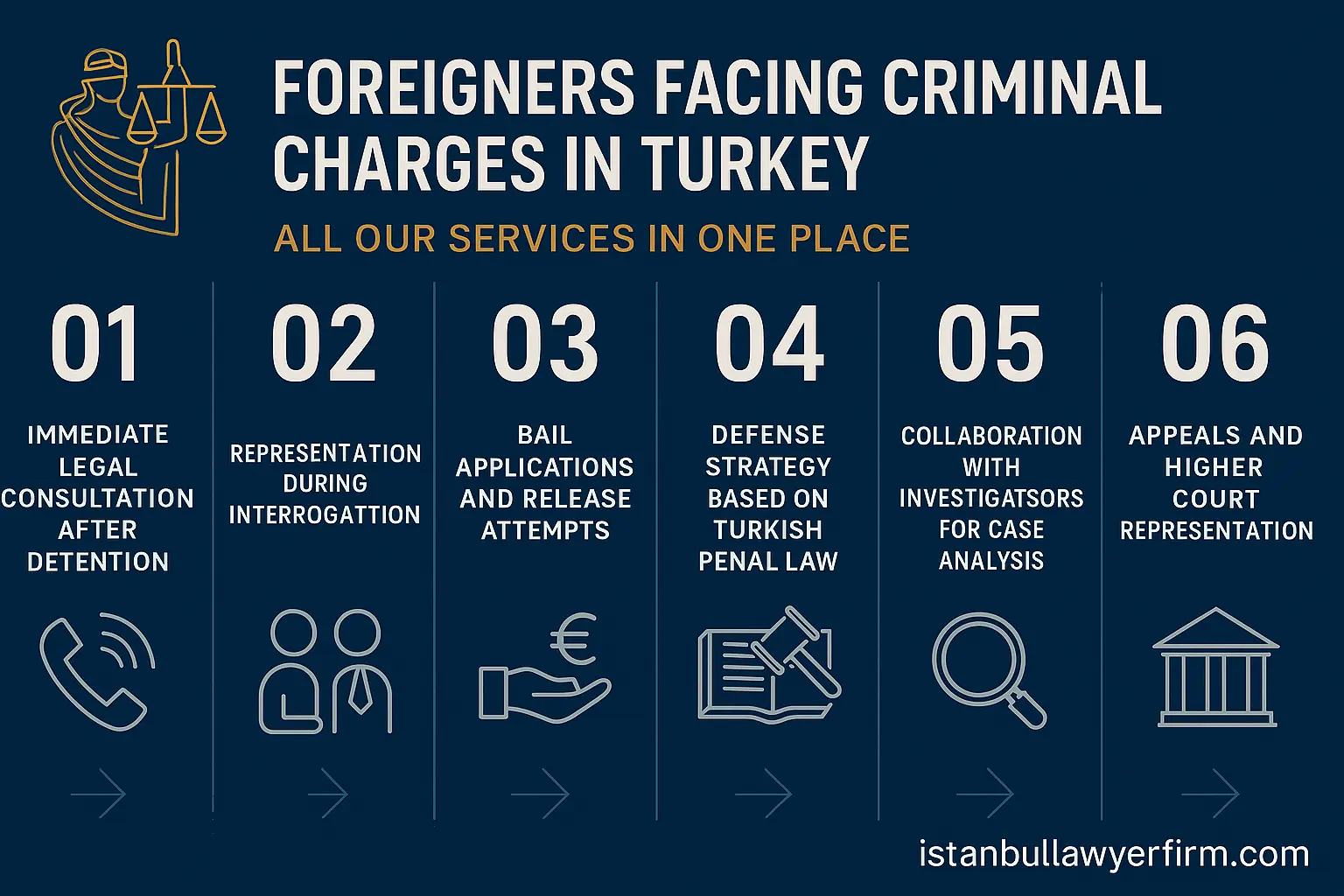
A lawyer in Turkey who provides criminal defense services for foreign nationals understands that the intersection of criminal proceedings, language barriers, unfamiliar legal procedures and immigration consequences creates a legal environment of exceptional complexity and stress for foreign nationals accused of criminal offenses in Turkey—and that the quality and timing of legal intervention from the very first moment of contact with Turkish criminal authorities determines outcomes that will shape the foreign national's freedom, immigration status, professional reputation and future in ways that no subsequent legal strategy can fully undo if the early critical period is mismanaged through ignorance of Turkish criminal procedure, inadequate legal representation, or communication failures that prevent the accused person from understanding or effectively participating in proceedings that will profoundly affect their life. An Istanbul Law Firm that provides comprehensive criminal defense for foreign nationals delivers integrated legal protection across every stage of Turkish criminal proceedings: intervening immediately upon detention to protect the client's fundamental procedural rights during the vulnerable period of first police contact; actively managing the investigation phase to challenge unlawfully obtained evidence, request favorable investigative measures and engage proactively with prosecutors before charging decisions are finalized; providing vigorous trial representation before Turkish criminal courts with advocacy informed by deep knowledge of Turkish criminal law and evidence standards; managing the sentencing phase with comprehensive mitigation evidence and legal argument; pursuing all available appeal remedies against unjust convictions and disproportionate sentences; addressing the immigration consequences of criminal proceedings including deportation and entry ban challenges; securing post-conviction relief through expungement proceedings and compensation claims; and providing specialized defense in extradition proceedings, Interpol warrant challenges, and cases involving juvenile or female defendants requiring specialized procedural frameworks. A Turkish Law Firm that regularly defends foreign nationals across Turkey's criminal courts—from police stations and prosecutor offices through courts of first instance, regional courts of justice and the Court of Cassation—brings the practical institutional knowledge of how Turkish criminal procedure actually operates at each stage, which aspects of the system most frequently threaten foreign defendants' rights, and which defence strategies produce the best outcomes in the specific context of foreign national cases where immigration consequences, language barriers and consular relationships add layers of complexity absent from cases involving Turkish national defendants. An English speaking lawyer in Turkey who manages criminal defense for international clients provides the continuous, accurate, plain-language communication that enables foreign nationals to understand their situation, participate meaningfully in their own defense, and make the informed decisions about strategy and procedural options that effective criminal defense requires—eliminating the fundamental disadvantage that language-isolated foreign defendants face when confronting a criminal justice system conducted in a language they cannot understand.
Immediate Rights and Arrest Procedures for Foreign Nationals
A lawyer in Turkey who advises foreign nationals on their rights at the moment of arrest explains that Turkish criminal procedure law—through the Criminal Procedure Code (Ceza Muhakemesi Kanunu, Law No. 5271), the Turkish Constitution's fundamental rights provisions, and Turkey's obligations under the European Convention on Human Rights and the Vienna Convention on Consular Relations—provides detained foreign nationals with a set of immediately enforceable rights that must be actively exercised from the first moment of custody because passive reliance on Turkish law enforcement authorities to proactively ensure these rights are realized without legal advocacy creates substantial risk of rights violations during the critical early period that cannot be undone by later legal intervention. An Istanbul Law Firm that responds immediately to foreign national arrests provides on-site legal presence at police stations, detention facilities, border crossing points and prosecutor offices within the shortest possible time after notification—because the interval between arrest and first legal contact is the period of greatest vulnerability, when foreign nationals are most likely to make inadvertent self-incriminating statements, sign documents whose content they cannot accurately assess, agree to investigative procedures whose legal significance they do not understand, and experience procedural rights violations that go unchallenged because no qualified advocate is present to identify and object to them. Turkish lawyers attending arrests of foreign nationals establish immediately upon arrival the lawful basis for the detention—confirming that authorities have judicial authorization for the arrest or that the circumstances justify warrantless arrest under the limited grounds Turkish law permits—review the arrest record and accusation documentation to assess the factual and legal basis for the charges being contemplated, verify that the detained person has received notification of their rights in a language they understand, confirm that an official court-certified interpreter has been or is being arranged for all questioning and official proceedings, and assert the detained person's right to private legal consultation before any questioning begins. Foreign nationals detained in Turkey are entitled to the right to remain silent from the moment of arrest—with no obligation to answer police or prosecutor questions, explain their actions or sign any statement or document before consulting with and receiving advice from their legal counsel—and exercising this right immediately and clearly, before any questioning begins, is the single most important action a foreign national can take to protect their legal position during the detention's initial phase. Practice may vary by authority and year — verify current Turkish Criminal Procedure Code provisions on detention rights, current rules on the right to counsel during police questioning, current interpreter provision requirements, current consular notification obligations under the Vienna Convention as implemented in Turkish practice, and current detention duration limits before any advice on arrest procedures is given to a specific detained foreign national.
An Istanbul Law Firm that manages arrest procedure compliance for foreign nationals explains that proper arrest procedure under Turkish law imposes specific obligations on arresting authorities—including delivery of a written rights notification in a language the detained person understands, provision of an official interpreter before any questioning of a foreign national who does not speak Turkish fluently, prompt notification of the detained person's consulate or embassy upon the detainee's request, provision of medical assessment when the detained person's health condition requires it, and preparation of a complete and accurate arrest record documenting the circumstances, time, location and legal basis of the detention—and that systematic monitoring of each required procedural element during the arrest process, combined with documented objections to any procedural failure identified, creates the record needed to challenge illegally conducted arrest procedures in subsequent proceedings. Turkish lawyers managing arrest procedures document every procedural element from the first moment of client contact: the exact time of arrival at the detention location, the arrest record's content and any inaccuracies requiring correction, the identity and credentials of any interpreter present, the status of consular notification, the accused person's physical condition and access to medical care, the specific questions asked and responses given before legal counsel arrived, and any procedural violations identified and challenged during the arrest process—creating a comprehensive contemporaneous record that enables subsequent applications to exclude unlawfully obtained evidence, challenge the legality of the detention, and demonstrate procedural rights violations in appellate proceedings if the case proceeds to trial. An English speaking lawyer in Turkey who attends arrests of foreign nationals ensures that the detained person receives immediate face-to-face explanation of their situation in plain English—addressing the acute disorientation and distress that language-isolated detention creates—and coordinates simultaneously with the detained person's family, employer and embassy to ensure that the people who need to know about the detention are informed promptly and accurately.
A Turkish Law Firm that advises on consular notification for detained foreign nationals explains that the Vienna Convention on Consular Relations, to which Turkey is a party, requires Turkish authorities to inform foreign nationals of their right to have their country's consulate or embassy notified of their detention without delay, and to effect that notification promptly upon the detainee's request—creating an international legal obligation whose violation can be raised in criminal proceedings, constitutional court applications and international human rights proceedings as a procedural rights violation affecting the fairness of the proceedings. An English speaking lawyer in Turkey who coordinates consular engagement for detained foreign nationals activates the consulate contact immediately upon arrival at the detention location, provides consular officers with accurate English-language summaries of the detention circumstances, charges and procedural status, coordinates consular visits that enable diplomatic officers to verify the detained national's condition and treatment, and maintains regular communication between consular officers and the legal defense team throughout the investigation, prosecution and trial stages—ensuring that consular monitoring supplements rather than duplicates the legal defense while providing the additional layer of diplomatic oversight that can positively influence how Turkish authorities treat foreign national detainees whose international status is actively monitored by their home country's diplomatic mission.
Legal Representation, Consular Access and Detention Management
A lawyer in Turkey who manages legal representation for foreign nationals throughout criminal proceedings explains that the sustained quality of legal representation from the moment of first police contact through the final resolution of the case—whether through acquittal, conviction and sentence, or appeal—determines the foreign national's ability to protect their rights, present their case effectively, and achieve the best possible outcome in proceedings conducted in an unfamiliar language according to unfamiliar rules, and that the specific experience of legal counsel in defending foreign nationals in Turkish criminal proceedings is as important as general criminal law competence because the foreign national dimension adds complexity—consular relationships, language management, immigration consequences, cross-border evidence, cultural context—that requires specific knowledge and experience beyond ordinary Turkish criminal defense practice. An Istanbul Law Firm that provides comprehensive legal representation for foreign national defendants manages every dimension of the legal representation engagement: attending all stages of the proceedings with qualified counsel authorized to exercise all defense rights available at each stage, including presence at police questioning, prosecutor examination, pre-trial detention hearings, preliminary court hearings, main trial sessions and verdict proceedings; filing all required defense documents within statutory deadlines, including evidence requests, motions to exclude unlawfully obtained evidence, written defenses responding to the prosecution's factual and legal arguments, bail and release applications, and appeal petitions against adverse decisions; maintaining continuous communication with the client through every stage of proceedings including regular updates on case status, explanation of each procedural development's significance, strategic consultations on major decisions, and prompt notification of hearing dates and required client actions; and coordinating all aspects of the defense engagement including forensic expert retention, witness identification and preparation, document gathering and authentication, and liaison with international lawyers or home-country legal counsel where the case has cross-border dimensions. Practice may vary by authority and year — verify current Turkish criminal procedure rules on defense counsel access at each stage, current rules on defense counsel attendance at police questioning, current rules on case file access rights for defense counsel, and current appellate deadlines and procedures before advising on the specific scope of legal representation rights at any stage of Turkish criminal proceedings.
An Istanbul Law Firm that pursues bail and pre-trial release applications for detained foreign nationals explains that while Turkish courts frequently apply pre-trial detention to foreign national defendants based on flight risk assessments, the Criminal Procedure Code provides defense counsel with multiple mechanisms for challenging detention and seeking less restrictive alternatives—including judicial control measures (adli kontrol) such as travel document surrender requiring the depositing of passports and travel documents with the court, periodic reporting obligations requiring the defendant to appear before specified authorities at defined intervals, prohibition on approaching specified locations or persons, and electronic monitoring where available—that can provide the court with security against the flight risk it identifies while enabling the foreign national to remain at liberty pending trial completion. Turkish lawyers pursuing pre-trial release for foreign national defendants prepare comprehensive release applications presenting every factor relevant to the judicial control measures assessment: the specific circumstances that reduce the flight risk the court has identified, including the accused person's genuine ties to Turkey through business activities, family relationships, property ownership or ongoing contractual obligations; the accused person's full cooperation with the investigation demonstrating absence of evidence tampering risk; the availability of specific security measures including travel document surrender, guarantee commitments from Turkish residents, and regular reporting that provide the court with effective alternative controls; and the specific legal and factual arguments for why continued detention is disproportionate to the legitimate aims of pre-trial security. An English speaking lawyer in Turkey who manages pre-trial detention proceedings for foreign national clients maintains regular visits to clients in custody—providing English-language explanation of case developments, strategic consultations on upcoming decisions, and the practical support needed to maintain composure and cooperation during what may be an extended and disorienting custody period.
A Turkish Law Firm that coordinates the full legal defense team for complex foreign national criminal cases explains that the most complex criminal matters—including white collar fraud investigations, multi-defendant prosecutions, cases involving significant financial evidence, cases raising cross-border jurisdiction questions, and cases with parallel civil or administrative proceedings—require coordinated teams of specialists rather than single-lawyer representation, and that building and managing this team efficiently from the investigation's earliest stage enables the defense to develop in depth and breadth proportionate to the prosecution's resources and the case's complexity. An English speaking lawyer in Turkey who coordinates specialized defense teams for international clients manages the engagement of Turkish forensic accounting specialists, digital forensics experts, industry-specific technical experts, experienced criminal litigation lawyers familiar with specific court jurisdictions, immigration law specialists addressing the case's immigration consequences, and international lawyers in the client's home country who need to coordinate with Turkish proceedings—ensuring that each specialist's contribution is integrated into a coherent overall defense strategy rather than providing disconnected expert input that the court cannot synthesize into a persuasive defense narrative.
Criminal Investigation Phase and Defence Strategy
A lawyer in Turkey who manages the criminal investigation phase for foreign national defendants explains that the investigation stage—which begins when police or a prosecutor receives information suggesting a crime and continues through the prosecutor's decision whether to file a formal indictment—offers defense counsel the greatest opportunity to influence the case's trajectory because the factual record established, the evidence collected, the charges formulated and the prosecutorial assessment of charge sufficiency during this period create the foundation on which all subsequent proceedings are built, and that active, strategic engagement during investigation rather than passive waiting for indictment produces substantially better outcomes across the full range of criminal case types. An Istanbul Law Firm that manages criminal investigation defense for foreign nationals pursues every available defense opportunity during the investigation stage: filing applications to access the investigation file at the earliest permitted stage to assess the prosecution's evidence and identify favorable material within it; filing petitions to exclude evidence obtained through unlawful searches, unauthorized wire interceptions, improper witness questioning, or other investigative measures that violated Turkish criminal procedure's authorization and proportionality requirements; requesting specific additional investigative measures that would produce evidence favorable to the defense—CCTV footage from relevant locations, telephone records, banking records, witness statements from persons who observed material events, forensic analyses of disputed physical evidence—through formal defense petitions to the supervising prosecutor; engaging proactively with the investigating prosecutor to present the defense's factual account, supported by documentary evidence, at the investigation stage before charging decisions are made—because prosecutors exercise genuine discretion in deciding whether to file charges and in formulating the specific charges to be included in the indictment, and presenting a credible factual alternative supported by evidence at the investigation stage influences these discretionary decisions more effectively than defending at trial after charges are already fixed; and challenging any procedural aspect of the investigation that deprives the foreign national defendant of rights guaranteed by Turkish criminal procedure including the right to notification of suspect status, the right to legal counsel, the right to interpretation, and the right to participate in the investigation through the defense petitions mechanism. Practice may vary by authority and year — verify current Criminal Procedure Code provisions on defense counsel access during investigation, current rules on investigation file access rights, current procedures for filing defense petitions during investigation, current evidence exclusion application standards, and current rules on prosecutor discretion and its exercise in specific charge categories before designing any investigation-stage defense strategy.
An Istanbul Law Firm that develops criminal defense strategies for foreign national defendants explains that the appropriate defense strategy for each case depends on the specific charge's legal elements, the prosecution's evidence strength, the availability of procedural challenges to the investigation's conduct, the credibility and availability of defense witnesses, and the realistic assessment of outcomes across the full range of possible trial results including acquittal, conviction with reduced charges, conviction with sentence mitigation, suspended sentence, and various appellate outcomes—and that experienced criminal defense counsel provides clients with an honest, evidence-based strategic assessment that enables informed decisions about defense approach rather than false reassurance that fails to prepare the client for realistic outcomes. Turkish lawyers developing defense strategies for foreign national defendants consider the full spectrum of available approaches: full trial defense pursuing acquittal through challenge to the prosecution's evidence and presentation of the defense's affirmative case for the accused's innocence; qualified admission strategies in which specific elements of the prosecution's case are admitted while others are vigorously challenged, reducing the contested issues and enabling focused defense resources on the points most amenable to successful challenge; charge reduction strategies seeking amendment of the specific charges through legal argument that the prosecution's evidence satisfies elements of a less serious offense than charged; alternative sanction arguments seeking suspended sentences, judicial control measures, community service or fines as alternatives to imprisonment where the specific offense and defendant's circumstances support these alternatives under Turkish Penal Code provisions; and reconciliation or mediation options in cases involving private criminal complaints or offenses for which Turkish law provides reconciliation as a permissible resolution mechanism. An English speaking lawyer in Turkey who explains strategic options to foreign national clients ensures that the client's decision about defense approach is genuinely informed—based on accurate English-language explanation of each option's legal basis, realistic probability of success, consequences of each possible outcome, and the considerations that weigh for and against each approach in the client's specific factual and legal circumstances.
A Turkish Law Firm that manages expert evidence in criminal cases for foreign nationals explains that many criminal cases involving foreign nationals—particularly fraud and financial crime cases, drug cases where the substance's quantity and classification is disputed, assault cases where the extent of injury and causation are contested, and cybercrime cases where digital evidence's authenticity and chain of custody require verification—depend on expert technical evidence whose quality and persuasiveness is often the decisive factor in the case's outcome. An English speaking lawyer in Turkey who coordinates expert evidence for international criminal defense cases manages the selection and engagement of qualified Turkish forensic experts with the specific technical expertise relevant to the contested issues, prepares experts to provide testimony in formats that non-specialist judges can evaluate, and where appropriate engages parallel foreign expert support that can provide methodological critique of the prosecution's expert evidence or alternative technical interpretations of contested technical facts. For foreign national defendants in financial crime cases specifically, the defense team's engagement of qualified forensic accountants with expertise in the specific financial products, accounting standards and transaction types at issue is essential because Turkish criminal court judges making decisions about complex financial evidence require the guidance of qualified technical experts, and defense counsel without forensic accounting support in complex financial cases is at a structural disadvantage relative to prosecution expert witnesses.
Trial Proceedings and Court Representation
A lawyer in Turkey who provides trial representation for foreign nationals in Turkish criminal courts explains that Turkish criminal trial procedure—governed by the Criminal Procedure Code and operating before specialized criminal courts including criminal courts of first instance (asliye ceza mahkemesi) for less serious offenses and heavy penal courts (ağır ceza mahkemesi) for serious offenses including those carrying potential sentences exceeding two years' imprisonment—differs in structurally important ways from the trial procedures familiar to foreign defendants from common law countries, and that effective trial representation requires practical knowledge of how specific courts in specific jurisdictions actually conduct proceedings—including local judicial preferences on evidence presentation, the realistic significance of different types of evidence in judicial decision-making, and the most persuasive advocacy approaches for the specific charge categories being defended. An Istanbul Law Firm that provides trial representation for foreign national defendants manages the complete trial preparation and conduct: pre-trial preparation assembling and organizing every document, witness statement, expert report, forensic analysis, CCTV recording, financial record and other evidentiary item supporting the defense case in the specific format Turkish criminal courts accept; witness preparation ensuring that defense witnesses are identified and available at trial, their testimony's relevance and admissibility are confirmed, and they are adequately prepared to provide clear, accurate testimony under both direct examination and cross-examination by the prosecution; cross-examination strategy applying focused and effective examination techniques to prosecution witnesses that expose factual inconsistencies, gaps in direct knowledge, potential bias and weaknesses in the prosecution's factual narrative without alienating the judge through unnecessarily aggressive or disrespectful questioning; written defense preparation drafting the comprehensive written defense submission that is filed with the court and that presents the defense case in the organized, legally supported format Turkish criminal judges expect to review alongside oral advocacy; and closing argument delivery presenting the integrated defense narrative that weaves together the factual evidence, legal arguments, character evidence and reasonable doubt analysis into a persuasive summary of why the court should acquit the defendant or, where conviction appears likely, why sentence mitigation is warranted. Practice may vary by authority and year — verify current Turkish criminal trial procedure rules, current evidence admissibility standards for each evidence category, current witness examination procedures and limitations, current written defense filing requirements and timing, and current sentencing guidelines and mitigating factor provisions before developing any trial strategy for a specific criminal matter.
An Istanbul Law Firm that manages interpretation and language access at trial for foreign national defendants explains that while Turkish courts are legally required to provide official court interpreters for foreign defendants who do not speak Turkish, the court-provided interpretation covers only what is said during formal hearing sessions—leaving foreign defendants without interpretation support during the critical pre-hearing strategy consultations with counsel, the informal courtroom exchanges that occur before and after formal sessions, the review of Turkish-language documentary evidence, and the explanation of procedural developments whose significance the foreign defendant needs to understand to participate meaningfully in their own defense. Turkish lawyers providing trial support for foreign defendants address the interpretation gap through comprehensive bilingual trial support: preparing detailed bilingual written summaries of each hearing's proceedings that the client can review after each session; conducting pre-hearing briefings explaining what is expected to occur at each session and what procedural events the client should prepare for; maintaining a running bilingual account of courtroom developments during hearings where the proceedings' pace requires immediate client comprehension; and preparing the client's own testimony in both languages with careful attention to ensuring that the client's account is accurately communicated in Turkish court proceedings without the distortions that interpretation through an unprepared court-appointed interpreter can introduce. An English speaking lawyer in Turkey who provides trial representation for foreign defendants delivers the integrated legal representation and linguistic support that enables foreign defendants to be genuine participants in their own defense rather than passive observers of proceedings conducted in an incomprehensible language about matters of the greatest importance to their freedom and future.
A Turkish Law Firm that advises on managing civil compensation claims attached to criminal proceedings explains that Turkish criminal procedure permits crime victims to submit civil compensation claims (tazminat talebi) within criminal proceedings, seeking compensation for material and non-material damages arising from the alleged offense—creating an additional dimension to criminal proceedings that requires defense counsel to address both the criminal charges and the civil compensation claims simultaneously with coordinated legal strategy. An English speaking lawyer in Turkey who manages criminal proceedings with attached civil claims for international defendants ensures that the defense strategy addresses both the criminal and civil dimensions coherently, that positions taken in the criminal defense are consistent with positions maintained in the civil claim defense, and that the client understands both the criminal sentence exposure and the potential civil compensation liability that a conviction could create—enabling fully informed decisions about whether settlement of the civil claim independent of the criminal proceedings might provide a more favorable overall resolution than full trial on both matters.
Sentencing, Appeals and Deportation Challenges
A lawyer in Turkey who manages the sentencing phase of criminal proceedings for foreign nationals explains that Turkish sentencing law—governed by the Turkish Penal Code (Türk Ceza Kanunu, Law No. 5237) and the Criminal Procedure Code's sentencing provisions—provides courts with discretion to impose sentences within statutory ranges, to apply mitigating factors that reduce sentences from the standard range, to suspend sentences under specific conditions, to apply judicial control measures as alternatives to imprisonment, and to reduce sentences for good behavior during proceedings—and that a comprehensive sentencing defense presenting all available mitigating factors with appropriate evidentiary support can substantially reduce the sentence imposed in cases where conviction results despite full trial defense. An Istanbul Law Firm that manages sentencing defense for foreign national defendants presents the complete range of statutory and discretionary mitigating factors: the accused person's good character and absence of prior criminal convictions, supported by official criminal record certificates from both Turkey and the home country; the accused person's family circumstances including dependent family members whose welfare would be severely affected by imprisonment; the accused person's cooperation with the investigation and proceedings demonstrating acknowledgment of wrongdoing where applicable; the accused person's genuine remorse and the steps taken to address the consequences of the offense including victim compensation or restitution; any cultural misunderstanding, unfamiliarity with Turkish law, or cross-cultural contextual factors that contributed to the conduct without justifying it; and the specific statutory mitigating provisions applicable to the charged offense under the Turkish Penal Code, including the Article 62 general mitigation provision enabling up to one-sixth sentence reduction when the court determines that factors related to the accused's motivation, purpose and conduct warrant leniency beyond the standard range. Practice may vary by authority and year — verify current Turkish Penal Code sentencing provisions for specific offense categories, current suspended sentence eligibility conditions and requirements, current judicial control measures available as imprisonment alternatives, current Article 62 general mitigation interpretation, and current early release provisions applicable to foreign national convicts before any sentencing strategy is developed.
An Istanbul Law Firm that manages criminal appeals for foreign national defendants explains that Turkish appellate procedure provides multiple levels of review through regional courts of justice (bölge adliye mahkemeleri) reviewing both factual and legal questions, and the Court of Cassation (Yargıtay) reviewing legal questions of general importance—with each appellate level requiring timely filing within statutory deadlines whose breach permanently bars the appeal, preparation of structured appellate submissions identifying every factual and legal ground for challenge, and strategic decisions about which grounds to emphasize given each appellate forum's realistic receptiveness to different categories of challenge. Turkish lawyers managing criminal appeals for foreign national defendants pursue every viable ground for appellate challenge: factual challenges to the trial court's evidence evaluation demonstrating that the court assigned weight to evidence in a manner unsupported by logical inference or inconsistent with established forensic principles; legal challenges demonstrating that the trial court misapplied Turkish criminal law in characterizing the defendant's conduct as criminal, applying an incorrect legal standard to evaluate the prosecution's evidence, or failing to apply applicable mitigation provisions; procedural challenges demonstrating that violations of the Criminal Procedure Code's mandatory procedural requirements prejudiced the defendant's right to a fair trial; and sentence challenges demonstrating that the sentence imposed exceeds the statutory range, fails to apply applicable mandatory mitigation, or is disproportionate to the offense and the defendant's circumstances in a manner that warrants reduction. An English speaking lawyer in Turkey who manages appeals for foreign national clients maintains continuous English-language communication throughout what may be a multi-year appellate process, ensuring that clients understand each appellate stage's significance, timeline and realistic prospects, and can make informed decisions about whether to pursue further appeal levels after each intermediate result.
A Turkish Law Firm that challenges deportation and entry ban orders for foreign national defendants explains that criminal convictions in Turkey can trigger administrative deportation orders (sınır dışı etme kararı) and entry bans (Türkiye'ye giriş yasağı) that may prevent the convicted foreign national from returning to Turkey for business, family or personal purposes even after completing their criminal sentence—creating consequences that may in some respects be as practically significant as the criminal sentence itself and that require immediate administrative law challenge to prevent them from becoming permanent through the expiration of administrative appeal deadlines. An English speaking lawyer in Turkey who challenges deportation and entry ban orders for foreign national criminal defendants coordinates the administrative law challenge with the criminal defense proceedings—ensuring that factual positions maintained in criminal proceedings are consistent with positions taken in administrative challenges, that favorable developments in criminal proceedings are immediately leveraged in administrative proceedings as grounds for reconsidering deportation decisions, and that the humanitarian, family and commercial grounds that can override mandatory deportation in appropriate cases are presented comprehensively and with supporting documentation to the administrative authorities responsible for reviewing deportation orders.
Criminal Record Expungement and Post-Trial Remedies
A lawyer in Turkey who advises on criminal record expungement (sabıka kaydı silme) for foreign nationals explains that Turkish law provides mechanisms for removing criminal records after sentence completion and the passage of defined eligibility periods—enabling foreign nationals who have completed their sentences and maintained good behavior to obtain official certification that their criminal record has been cleared, which is essential for visa applications, residence permit renewals, employment background checks and business licensing purposes where a criminal record would create automatic disqualification or significant disadvantage. An Istanbul Law Firm that manages criminal record expungement proceedings for foreign nationals assesses each client's specific eligibility for expungement based on the offense category, the sentence type and length, the sentence completion date, the required waiting period applicable to the specific offense category, and any additional conditions that the specific court's order or Turkish law imposes for expungement eligibility—and where eligibility is confirmed, prepares and files the formal expungement petition with the sentencing court or the Ministry of Justice, supported by the documentation establishing sentence completion, the passage of the required waiting period, and absence of new convictions during the waiting period. Turkish lawyers managing expungement proceedings coordinate simultaneously with multiple Turkish administrative systems whose records must be updated following a successful expungement order: the Judicial Registry Directorate's national criminal database, the police intelligence systems maintaining records of past criminal proceedings, the population registry that may contain references to past criminal matters, and any sector-specific licensing databases where past criminal records have been recorded affecting the client's professional or business licensing status. Practice may vary by authority and year — verify current expungement eligibility requirements for specific offense and sentence categories, current required waiting periods, current documentation requirements for expungement petitions, current scope of expungement orders and which registry systems are updated by court orders, and current procedures for challenging improper retention of expunged criminal record information before advising any specific foreign national on expungement eligibility and procedure.
An Istanbul Law Firm that pursues compensation claims for unjust detention and wrongful prosecution on behalf of foreign nationals explains that Turkish law—through the Criminal Procedure Code's provisions on compensation for persons wrongly detained, wrongly prosecuted, or convicted of offenses for which they are subsequently acquitted on appeal—provides persons who have suffered liberty deprivation through legally unjustified criminal proceedings with the right to claim financial compensation for material losses including income loss, business damage and necessary expenses incurred in connection with the proceedings, and non-material damages including psychological distress, reputational harm and violation of dignity arising from the improper proceedings. Turkish lawyers pursuing state compensation claims for foreign national clients who were wrongly detained or prosecuted prepare detailed damages quantification analyses covering each category of compensable loss: lost income from employment or business during the detention period supported by employment records, tax declarations and business financial statements; business losses caused by the detained person's absence from business management and the reputational impact on business relationships supported by business records and counterparty correspondence; expenses incurred directly in connection with the wrongful proceedings including legal fees, travel costs, and necessary living expenses above normal; and non-material damages including the psychological impact of wrongful detention quantified through psychiatric assessment and the reputational damage measured through documented professional and personal relationship consequences. An English speaking lawyer in Turkey who manages compensation claims for international clients coordinates with the client's home-country lawyers and financial advisors to ensure that the Turkish compensation claim captures the full extent of damages including those whose financial impact is most clearly quantifiable through home-country financial records, and that the Turkish compensation proceedings are integrated with any parallel home-country legal proceedings arising from the same wrongful Turkish criminal process.
A Turkish Law Firm that manages post-trial immigration reinstatement for foreign nationals who completed Turkish criminal sentences explains that following completion of sentence and successful expungement proceedings, foreign nationals whose residency permits were cancelled or who were subject to entry bans in connection with their criminal proceedings require coordinated administrative law applications to restore their Turkish residency rights and immigration status—applications that must navigate both the immigration authorities' discretionary assessment of whether to grant renewed residency and any outstanding administrative bars that may remain independently of the criminal proceedings' formal resolution. An English speaking lawyer in Turkey who manages post-trial immigration reinstatement for international clients coordinates the residency reinstatement application with documentation of the completed sentence, the expungement order, and the specific grounds for reinstating residency including ongoing family ties to Turkey, business interests requiring Turkish presence, property ownership, and humanitarian considerations that support the exercise of discretion in the client's favor—pursuing a clean resolution of the client's entire Turkish legal situation rather than leaving immigration consequences unresolved after criminal proceedings have formally concluded.
Special Considerations for Juvenile and Female Foreign Defendants
A lawyer in Turkey who advises on criminal defense for juvenile foreign nationals explains that Turkey's Child Protection Law (Çocuk Koruma Kanunu, Law No. 5395) and the specific juvenile justice provisions of the Criminal Procedure Code establish a specialized framework for criminal proceedings involving persons under eighteen years of age—including specialized juvenile courts or specially designated court sections, mandatory involvement of social workers and child protection specialists, closed hearings protecting the juvenile's privacy from public disclosure, emphasis on rehabilitation and resocialization over punitive response, and specific procedural protections including mandatory legal representation and psychosocial assessment requirements—and that foreign juvenile defendants require defense counsel with specific knowledge of this specialized framework to ensure that its protective provisions are fully implemented rather than displaced by standard adult criminal procedure applied without appropriate adjustment for the juvenile defendant's status. An Istanbul Law Firm that provides criminal defense for foreign juvenile defendants coordinates the legal defense with social service engagement, ensuring that court-mandated psychosocial assessments are conducted by professionals who can evaluate the juvenile's development, family circumstances and needs in the cross-cultural context of a foreign national minor who may not speak Turkish, coordinating with the juvenile's family in their home country and the home country's embassy to ensure that the family receives accurate information about the proceedings and can provide the support documentation that juvenile defense requires, and pursuing diversion measures—including restorative justice programs, community service alternatives and rehabilitation-focused dispositions that Turkish juvenile justice law preferentially applies over incarceration for juvenile defendants—as the primary defense objective in cases where the underlying conduct creates criminal liability but the juvenile's age, circumstances and rehabilitation prospects support alternative resolution. Practice may vary by authority and year — verify current Turkish juvenile justice procedures, current juvenile court jurisdiction and composition requirements, current mandatory social service involvement requirements, current diversion and alternative measure provisions applicable to juvenile defendants, and current rules on juvenile privacy and closed hearing requirements before developing any defense strategy for a foreign juvenile defendant.
An Istanbul Law Firm that provides criminal defense for female foreign nationals explains that female defendants in Turkish criminal proceedings face specific challenges requiring defence counsel with sensitivity to gender-specific procedural rights and specialized experience in the offense categories most commonly involving female foreign national defendants—including domestic violence, trafficking in persons, sexual assault cases where the defendant is accused rather than victim, and immigration-related offenses where vulnerability to exploitation intersects with criminal liability. Turkish lawyers defending female foreign nationals in criminal proceedings ensure that gender-sensitive procedural rights are fully respected: the right to be examined by medical professionals of the defendant's choice of gender when physical examination is required; the right to closed hearings where the nature of the evidence creates privacy considerations outweighing the principle of public trial; the right to have any children accompanying the defendant in custody maintained in appropriate care arrangements rather than being detained alongside the adult defendant; and the right to protection from potentially traumatizing questioning techniques in cases involving sexual violence or trafficking where the defendant's own victimization is relevant to criminal liability questions. An English speaking lawyer in Turkey who defends female foreign nationals coordinates with women's support organizations, gender-focused consular staff and specialist NGOs to ensure that female defendants receive the comprehensive practical support alongside legal defense that addresses their specific needs—recognizing that for female foreign nationals in particular, criminal proceedings may intersect with exploitation, coercion and vulnerability circumstances that are legally relevant to the criminal liability assessment and that require advocacy sensitive to the complex relationship between victimization and criminal conduct that characterizes many cases involving female foreign nationals in the Turkish criminal justice system.
A Turkish Law Firm that advises on psychological and social support integration in foreign national criminal defense explains that effective criminal defense for the most vulnerable foreign national defendants—including juveniles, trafficking victims, persons with mental health conditions, and others whose criminal conduct is connected to exploitation, coercion or vulnerability—requires integration of psychological, social and medical expertise into the legal defense strategy, because Turkish criminal law provides specific defenses and mitigating circumstances that depend on establishing psychological and social facts that only qualified professional assessment can substantiate. An English speaking lawyer in Turkey who coordinates psychological and social support for vulnerable foreign national defendants manages the engagement of qualified psychologists, social workers, medical professionals and trauma specialists whose expert assessment and testimony can establish the factual basis for legal arguments about criminal responsibility, sentencing mitigation and alternative measures—integrating professional support with legal advocacy to produce the most comprehensive and persuasive defense for defendants whose criminal proceedings cannot be fairly resolved without full consideration of the psychological and social circumstances that shaped the conduct under prosecution.
Extradition, Interpol Warrants, Media Exposure and Reputational Defence
A lawyer in Turkey who advises on extradition defense for foreign nationals detained in Turkey explains that extradition requests—made by foreign governments seeking Turkey's surrender of persons allegedly responsible for crimes within their jurisdiction—are evaluated by Turkish courts through a judicial process that applies both the specific bilateral extradition treaty between Turkey and the requesting state and Turkish domestic law's extradition provisions, and that the courts apply specific legal standards including the dual criminality requirement that the alleged conduct constitutes an offense under both Turkish law and the requesting state's law, the political offense exception protecting persons whose alleged conduct constitutes political rather than ordinary criminal activity, the human rights protection standard requiring assessment of whether the person would face torture, inhuman treatment or unfair trial in the requesting state, and the procedural requirements of the applicable bilateral treaty. An Istanbul Law Firm that provides extradition defense for foreign nationals detained in Turkey prepares comprehensive extradition defense submissions addressing every available ground for opposing surrender: demonstrating that the alleged conduct does not satisfy the dual criminality requirement under Turkish law; establishing that the charges are politically motivated rather than based on genuine criminal conduct; presenting documented evidence that the requesting state's criminal justice system cannot provide a fair trial or that the individual would face serious human rights violations if surrendered; challenging the procedural validity of the extradition request under the applicable bilateral treaty's specific requirements; and demonstrating that Turkish law bars extradition in the specific circumstances including Turkish citizenship, prior prosecution in Turkey for the same conduct, or expiry of applicable limitation periods. Practice may vary by authority and year — verify current bilateral extradition treaties between Turkey and specific requesting states, current Turkish domestic extradition law provisions, current court procedures for extradition hearings, current human rights assessment standards applied by Turkish courts in extradition proceedings, and current Ministry of Justice extradition decision procedures before developing any extradition defense strategy.
An Istanbul Law Firm that manages Interpol Red Notice challenges for foreign nationals in Turkey explains that Interpol Red Notices—requests issued through Interpol's communication channel asking member countries to locate and provisionally arrest persons wanted for prosecution in the requesting member country—do not constitute extradition requests and do not automatically compel arrest in Turkey, but can result in detention at border crossing points, restrictions on international travel, and complications in banking, business and professional contexts where Red Notice alerts are disclosed through background check systems. Turkish lawyers challenging Interpol Red Notices for foreign nationals detained or threatened with detention in Turkey pursue multiple parallel challenge tracks: administrative proceedings before Turkish authorities to challenge the legal basis for any Turkish detention based on the Red Notice and to seek the detained person's release where Turkish law does not independently authorize the detention; applications to the Commission for the Control of Interpol's Files (CCF) in Lyon—Interpol's independent oversight body—seeking deletion of the Red Notice on grounds including misuse of Interpol channels for political persecution, failure to satisfy Interpol's own notice issuance standards, violation of human rights principles, or inadequacy of the underlying judicial process that produced the warrant on which the notice is based; and coordination with foreign counsel in the requesting country to challenge the underlying warrant or criminal proceedings whose resolution would automatically lead to Red Notice deletion. An English speaking lawyer in Turkey who manages Interpol and extradition defense for international clients coordinates the Turkish defense with foreign counsel and international human rights organizations where the case involves potential misuse of criminal justice mechanisms for political persecution or other improper purposes.
A Turkish Law Firm that manages media exposure and reputational defense for foreign nationals in Turkish criminal proceedings explains that criminal proceedings—particularly against foreign nationals who may be prominent in business, diplomatic or public life in their home countries—create significant media and reputational risks that must be managed in parallel with the legal defense, because Turkish criminal courts' public hearing principle allows media reporting that can cause permanent reputational damage even when the ultimately proceedings result in acquittal. An English speaking lawyer in Turkey who manages media and reputational defense for international clients applies to the court for closed hearings where the legal grounds for confidentiality are satisfied—including cases involving state secrets, privacy of third parties, protection of minors, or other grounds that Turkish procedural law recognizes as justifying restriction of public hearing principles; files urgent injunction applications against media outlets publishing identifying information during proceedings in violation of applicable privacy protections; coordinates with the client's communications advisors and home-country media teams to ensure that authorized public statements accurately describe the legal situation without prejudicing the defense or creating admissions; and prepares for post-acquittal reputation rehabilitation including official correspondence to parties who received information about the criminal proceedings, applications to remove inaccurate or outdated criminal proceeding information from digital databases, and coordination with data protection authorities where online publication of criminal proceeding information violates applicable privacy law. A lawyer in Turkey for comprehensive foreign national criminal defense combines deep expertise in Turkish criminal procedure with sophisticated management of the immigration, reputational, media and cross-border dimensions that distinguish foreign national criminal cases from ordinary Turkish criminal proceedings—delivering legal protection that addresses every aspect of the foreign national's exposure rather than only the criminal charges themselves.
Frequently Asked Questions
- What are my immediate rights when arrested in Turkey as a foreign national? You have the right to remain silent, the right to legal counsel before and during any questioning, the right to a free official interpreter if you do not speak Turkish fluently, and the right to have your country's embassy or consulate notified of your detention upon your request under the Vienna Convention on Consular Relations. Exercise the right to remain silent immediately and request your lawyer's presence before answering any question or signing any document.
- Can I have an English-speaking lawyer during criminal proceedings in Turkey? Yes. ER&GUN&ER Law Firm assigns English-speaking criminal defense counsel to every foreign national client, providing direct communication without interpreter intermediaries throughout the investigation, prosecution, trial and appeal stages. Private counsel with direct language capability provides substantially better representation than court-appointed lawyers who may not speak English.
- What happens if I am arrested in Turkey as a foreigner? You will be detained at a police station where you must be informed of the accusations and your rights. Police may hold you for up to twenty-four hours before obtaining judicial detention authorization. You have the right to legal counsel immediately upon arrest, the right to interpretation, and the right to consular notification. Contact a qualified Turkish criminal defense lawyer immediately upon arrest rather than waiting until after police questioning.
- Can I get released on bail or under judicial control in Turkey? Turkish courts may impose judicial control measures as alternatives to pre-trial detention, including travel document surrender, periodic reporting obligations, prohibition from approaching specific locations, and electronic monitoring. Bail in the traditional financial security sense is less commonly used. Turkish courts frequently apply pre-trial detention to foreign nationals based on flight risk assessment, making comprehensive release applications with strong supporting documentation essential.
- Will I be deported after a criminal conviction in Turkey? Deportation is not an automatic consequence of all criminal convictions but may be ordered as an administrative measure following conviction for specified offense categories. Deportation orders can be challenged through administrative appeals presenting humanitarian grounds, family ties, proportionality arguments and human rights considerations. Your criminal defense lawyer should simultaneously address any deportation order risk from the investigation stage rather than only after conviction.
- How long does a criminal trial typically take in Turkey? Trial duration varies significantly by case complexity, number of defendants, evidence volume and court scheduling. Simple cases involving single defendants may resolve within several months of indictment. Complex multi-defendant cases or cases involving substantial documentary evidence may take two to five years from investigation through final appeal. Your lawyer should provide realistic timeline expectations for your specific case type and the court where it will be heard.
- Can a Turkish criminal conviction be appealed? Yes. Turkish criminal procedure provides appeal rights through regional courts of justice reviewing factual and legal questions, and the Court of Cassation reviewing legal questions of general importance. Constitutional Court review is available for fundamental rights violations. European Court of Human Rights application may be available after domestic remedies are exhausted. All appellate deadlines are strict and their breach permanently bars the appeal, making timely filing essential.
- Is criminal record expungement available in Turkey? Yes. Turkish law provides for expungement of criminal records after sentence completion and the passage of defined waiting periods that vary by offense category. Expungement restores the foreign national's clean record status and is essential for visa applications, residence permit renewals, employment background checks and business licensing purposes. Eligibility requirements and waiting periods must be confirmed for each specific offense and sentence type.
- Can I defend against extradition from Turkey? Yes. Extradition from Turkey requires judicial authorization and is subject to legal challenges including the dual criminality requirement, the political offense exception, human rights protection grounds, and procedural requirements of the applicable bilateral extradition treaty. Turkish courts apply these standards through a hearing process in which defense counsel can present evidence and legal argument opposing surrender. Many extradition requests can be successfully challenged or delayed through comprehensive defense submissions.
- How are Interpol Red Notices challenged in Turkey? Interpol Red Notices can be challenged through applications to the Commission for the Control of Interpol's Files (CCF) seeking deletion on grounds including political persecution, failure to meet Interpol's notice issuance standards, human rights violations, or inadequacy of the underlying judicial process. In Turkey, defense counsel can challenge detention based on Red Notices through Turkish administrative and judicial proceedings asserting that Turkish law does not independently authorize the detention. Coordination between Turkish counsel and foreign counsel in the requesting country is essential for comprehensive Red Notice defense.
- Can media coverage during criminal proceedings be restricted? Turkish courts can order closed hearings and restrict media coverage where the legal grounds for confidentiality are satisfied, including privacy protection, state security, protection of minors, and other recognized grounds. Courts can also order removal of identifying information from media reports where publication violates applicable privacy protections. Your defense lawyer should assess media restriction grounds at the earliest stage of proceedings rather than after damaging coverage has occurred.
- What special procedures apply to juvenile foreign defendants in Turkey? Foreign juveniles under eighteen are subject to Turkey's specialized juvenile justice framework including specialized juvenile courts, mandatory social worker involvement, closed hearings protecting privacy, emphasis on rehabilitation over punishment, and mandatory legal representation. Foreign juvenile defendants' families must be notified and given opportunity to participate in proceedings. Defense counsel should prioritize diversion measures and alternative dispositions that Turkish juvenile law preferentially applies to juvenile defendants.
- Can I claim compensation if wrongly detained or prosecuted in Turkey? Yes. Turkish law provides compensation rights for persons wrongly detained, wrongly prosecuted, or convicted of offenses for which they are subsequently acquitted on appeal. Compensation covers material losses including income loss and business damage, necessary expenses, and non-material damages including psychological distress and reputational harm. Claims must be filed within specified limitation periods and require documentation of each category of compensable loss.
- Can I hire Turkish criminal defense counsel from abroad without traveling to Turkey? Yes. Through a properly executed and notarized power of attorney, Turkish criminal defense counsel can represent clients in Turkish criminal proceedings without the client needing to travel to Turkey for most procedural stages. Physical presence is required for specific stages including police questioning as a suspect, biometric enrollment for certain proceedings, and some court hearings—but defense counsel can manage most procedural steps on the client's behalf when travel is impractical or inadvisable.
- Does ER&GUN&ER Law Firm provide criminal defense services for foreign nationals in Turkey? Yes. ER&GUN&ER Law Firm provides comprehensive criminal defense for foreign nationals in Turkey including emergency detention response, police and prosecution stage representation, pre-trial release applications, investigation-stage defense strategy, trial representation, sentencing defense, appeal proceedings, deportation challenge, record expungement, compensation claims, juvenile and female defendant specialized defense, extradition and Interpol warrant defense, and media and reputational defense—with direct English-speaking legal services throughout each engagement.
Author: Mirkan Topcu is an attorney registered with the Istanbul Bar Association (Istanbul 1st Bar), Bar Registration No: 67874. His practice focuses on cross-border and high-stakes matters where evidence discipline, procedural accuracy, and risk control are decisive.
He advises individuals and companies across Immigration and Residency, Real Estate Law, Tax Law, and cross-border documentation matters where procedural accuracy and evidence discipline are decisive.
Education: Istanbul University Faculty of Law (2018); Galatasaray University, LL.M. (2022). LinkedIn: Profile. Istanbul Bar Association: Official website.