

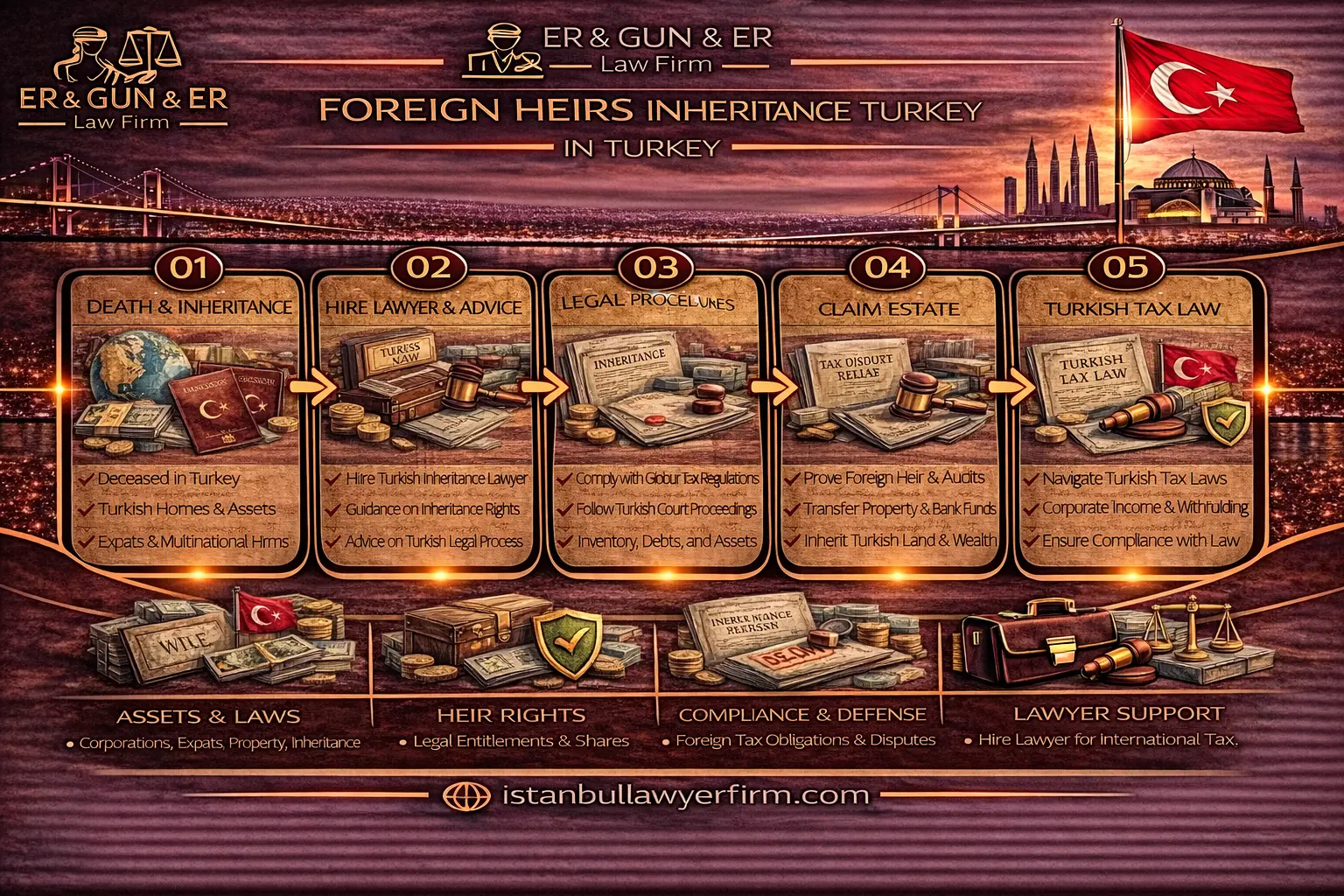
A lawyer in Turkey who advises foreign heirs on inheriting Turkish assets understands that the foreign heir's practical experience is typically a sequence of institutional encounters—at the Turkish land registry office, at Turkish banks, at corporate registries—where each institution requires specific formal proof before it will release or transfer the Turkish asset to which the heir's entitlement may be entirely clear from a substantive legal perspective, and where producing that proof requires coordinated management of three distinct processes that operate simultaneously: the documentation process that establishes the heir's identity and relationship to the deceased through legalized civil status records and certified translations; the heirship certification process that produces the Turkish-form instrument that institutions accept as authoritative proof of the heirs and their shares; and the tax compliance process that generates the declarations and clearance documentation that institutions require before they will execute transfers. An Istanbul Law Firm that advises foreign heirs on Turkish inheritance matters explains that the fundamental challenge in cross-border inheritance is not usually the substantive legal question of whether the foreign heir is entitled to the Turkish assets—which Turkish law generally answers affirmatively, subject to specific conditions applicable to immovable property in some circumstances—but the procedural challenge of producing the specific documents in the specific formats that each Turkish institution requires, which involves understanding the institutional requirements applicable to each asset type, identifying the applicable authentication and translation requirements for each foreign document, and sequencing the documentation, certification, and tax steps in an order that prevents one step from blocking another. A Turkish Law Firm that handles foreign heir inheritance files provides integrated support across the complete estate administration process: assessing the applicable conflict of laws rules; assembling and authenticating the civil status documentation that establishes heirship; obtaining the Turkish inheritance certificate or managing the foreign judgment recognition proceedings that produce an equivalent instrument; managing the tax reporting and clearance obligations; and executing the specific institutional steps—land registry transfer, bank account release, company share ledger update—that complete the inheritance for each asset class. An English speaking lawyer in Turkey who advises foreign heirs ensures that international clients understand the specific steps required for their situation in language they can genuinely follow—because the compliance decisions that most significantly affect the inheritance's efficiency and cost are made in the early document preparation stages rather than at the institutional execution stage, making informed planning more valuable than reactive problem-solving. Practice may vary by authority and year — verify current Turkish inheritance law provisions, current institutional documentation requirements for each asset class, and current tax reporting obligations with qualified counsel before initiating any inheritance proceedings for Turkish assets.
Legal Position of Foreign Heirs and Conflict of Laws
A lawyer in Turkey who advises on the legal position of foreign heirs explains that Turkish law does not categorically exclude foreign nationals from inheriting Turkish assets—with the exception of specific rules applicable to immovable property in certain locations and circumstances—but that the process of establishing that entitlement and executing the resulting transfers is more complex for foreign heirs than for domestic heirs because each step in the process involves foreign documents whose authenticity and legal meaning must be established to Turkish institutional standards before they can be relied upon. An Istanbul Law Firm that advises foreign heirs on their legal position helps clients understand the specific substantive questions most relevant to their situation: the applicable heirship regime for Turkish assets, which for immovable property is primarily Turkish law regardless of the deceased's nationality—meaning that the Turkish Civil Code's heirship provisions including forced heirship fractions and share calculations apply to Turkish real estate even where the deceased was a foreign national who executed a foreign will disposing of the property differently; the impact of the deceased's marital property regime on the composition of the estate available for inheritance—because the surviving spouse may have marital property claims that reduce the distributable estate before inheritance shares are calculated; and the status of any will, which requires assessment of the will's formal validity under the applicable law, its recognition in Turkey, and whether its provisions are consistent with the forced heirship rules that Turkish law protects. Turkish lawyers advising on foreign heir legal position help clients understand that the distinction between entitlement—who inherits in what share—and access—what document an institution will accept to execute the transfer—requires separate analysis, because a foreign heir's substantive entitlement does not automatically produce the institutional access needed for asset transfer without the specific procedural steps Turkish institutions require. Practice may vary by authority and year — verify current Turkish Civil Code inheritance provisions, current immovable property ownership rules for foreign nationals, and current Turkish private international law conflict rules with qualified counsel before planning any inheritance of Turkish assets.
An Istanbul Law Firm that advises on conflict of laws analysis for Turkish inheritance matters explains that Turkey's private international law rules—established through the Law on Private International Law and Procedural Law—determine which substantive legal system governs each element of a cross-border inheritance, and that understanding these rules is essential for planning how the estate will be documented and what instruments Turkish institutions will require. Turkish lawyers advising on conflict of laws analysis help foreign heirs understand the specific connecting factors most relevant to their estate: for immovable property in Turkey, Turkish succession law applies regardless of the nationality or habitual residence of the deceased—making it essential to understand Turkish Civil Code heirship provisions even for estates whose overall administration is governed by foreign law; for movable property, the applicable law may depend on the deceased's nationality or habitual residence under Turkish conflict rules—requiring specific analysis of which country's law governs movable asset succession and whether that law's outcomes are compatible with Turkish institutional requirements; and for wills, the formal validity of a foreign will may be assessed under either the law of the place of execution, the deceased's national law, or another connecting factor—requiring analysis of whether a foreign will satisfies the formal validity requirements of at least one applicable legal system before it can be relied upon as governing the estate's distribution. An English speaking lawyer in Turkey who manages conflict analysis for international estates provides the legal memo that maps each Turkish asset to the applicable succession law and identifies the resulting institutional requirements—enabling a structured, predictable approach to estate administration rather than institution-by-institution discovery of requirements. Practice may vary by authority and year.
A Turkish Law Firm that advises on asset due diligence for foreign heir inheritance explains that the first practical step in Turkish inheritance administration is identifying and verifying what Turkish assets exist and what encumbrances, co-ownership arrangements, or institutional requirements apply to each—because the administrative steps required for each asset class differ substantially and because undiscovered encumbrances can block transfers after significant documentation investment. An English speaking lawyer in Turkey who conducts Turkish asset due diligence for foreign heir estates helps clients establish the specific asset inventory most relevant to each estate: land registry inquiries that identify real property registered in the deceased's name, confirm its current registration status, and identify any liens, mortgages, attachments, or court annotations that affect transfer; bank inquiries that identify accounts, investment products, safe deposit boxes, and any loan or overdraft liabilities held in the deceased's name at Turkish banking institutions; and company registry inquiries that identify company interests, shareholding positions, and any pledges or restrictions on shares held by the deceased in Turkish limited liability or joint stock companies. The asset inventory and its encumbrance profile determines the sequencing and scope of the documentation, certification, and tax compliance steps—making comprehensive asset due diligence the foundation on which the entire inheritance administration plan is built. Practice may vary by authority and year.
Proving Heirship and Obtaining the Turkish Inheritance Certificate
A lawyer in Turkey who advises on heirship documentation explains that proving heirship to Turkish institutional standards requires assembling a specific category of official civil status documents—including death certificates, marriage certificates, birth certificates, and where relevant divorce records and guardianship orders—each of which must be issued by the competent civil registry authority, authenticated for Turkish use, and translated into Turkish through the sworn translation and notarial certification process. An Istanbul Law Firm that assembles heirship documentation packages for foreign heir estates implements the specific approach most effective for each family situation: identifying each document needed to establish the complete chain of family relationships—from the deceased to each heir—through official civil registry records rather than through family declarations; obtaining the long-form versions of each civil status document where available, because long-form documents contain the complete relationship details—including both parents' names, registry authority, and registration numbers—that Turkish institutions use to verify relationship claims; and ensuring that each document identifies both parties with the same name spelling used in their current passports and in the other documents in the package—because inconsistent name spellings between documents are among the most common causes of institutional rejection. Turkish lawyers advising on heirship documentation help foreign heirs understand that the death certificate is the foundational document from which all other steps proceed—and that obtaining an official Turkish death certificate or an officially legalized and translated foreign death certificate that Turkish institutions can verify is the first operational step in every inheritance administration. Practice may vary by authority and year — verify current documentation requirements for Turkish inheritance certificate applications, current long-form civil status document standards, and current institutional acceptance criteria with qualified counsel before preparing any heirship documentation package.
An Istanbul Law Firm that manages Turkish inheritance certificate applications explains that the Turkish inheritance certificate—mirasçılık belgesi—is the domestic instrument that Turkish banks, land registries, and company registries most commonly require as proof of heirship, and that its issuance requires presenting the civil status documentation package to the competent Turkish authority through the applicable procedure. Turkish lawyers advising on inheritance certificate applications help foreign heirs navigate the specific application requirements most relevant to each estate situation: preparing the application with the complete civil status documentation package in legalized and translated form—because incomplete documentation causes the application to be returned for supplementation rather than proceeding; addressing name and identity consistency issues in the application before submission—through reconciliation notes that explain differences between Turkish and foreign name spellings and attach the identity linkage evidence that supports the reconciliation; and identifying whether the certificate can be issued through a notarial procedure for uncontested files or requires a court procedure—because files with unusual family situations, potential disputes among heirs, or missing family members may require the court-based procedure that involves formal notice to interested parties. An English speaking lawyer in Turkey who manages inheritance certificate applications for foreign heir estates provides the pre-submission documentation audit that identifies and corrects deficiencies before the application reaches the institutional counter—preventing the rework cycles that arise when an application is submitted with a discoverable deficiency and must be restarted. Practice may vary by authority and year.
A Turkish Law Firm that advises on the use of foreign probate instruments in Turkish inheritance proceedings explains that foreign heirs who hold a foreign court order, letters of administration, or notarial heirship declaration from their home country face a specific question about whether this foreign instrument can directly support Turkish institutional steps or whether Turkish proceedings must first produce a domestic inheritance certificate based on the foreign instrument as supporting evidence. An English speaking lawyer in Turkey who advises on foreign probate instrument strategy helps heirs understand the specific considerations most relevant to each instrument type: foreign court judgments that declare heirship or distribute specific assets may require formal recognition proceedings in Turkish courts before Turkish institutions will give them direct effect—because Turkish land registries and banks are not authorized to execute transfers based on unrecognized foreign judgments; foreign notarial heirship declarations may be accepted as supporting evidence for a Turkish inheritance certificate application rather than as directly executable instruments—which is generally a faster and less costly approach than full recognition proceedings; and the interaction between the foreign instrument's content and Turkish heirship rules for Turkish immovables may require specific alignment, because if the foreign instrument allocates Turkish real estate in proportions that differ from what Turkish forced heirship rules would produce, Turkish institutions applying Turkish law to the real estate may require a Turkish certificate that reflects Turkish heirship calculations. Practice may vary by authority and year.
Apostille, Legalization and Certified Translations
A lawyer in Turkey who advises on document authentication requirements for Turkish inheritance proceedings explains that foreign public documents—including civil status certificates, court orders, notarial instruments, and probate records—cannot be used in Turkish administrative and legal proceedings without authentication that confirms their authenticity to Turkish institutional standards, and that the applicable authentication process depends on whether the issuing country is a member of the Hague Apostille Convention. An Istanbul Law Firm that manages document authentication for foreign heir estates implements the specific authentication approach most effective for each document's origin: apostille certification for documents issued in Apostille Convention member countries—where the designated authority in the issuing country attaches an apostille certificate that confirms the document's signature and seal without needing to verify its content; consular legalization through the applicable diplomatic chain for documents from non-Convention countries—where the document passes through the domestic authority's certification, the issuing country's foreign ministry, and the Turkish consulate's authentication before it can be used in Turkey; and combined authentication where specific document types require both steps or where institutional practice requires additional verification beyond the standard apostille. Turkish lawyers advising on authentication management help foreign heirs understand that the apostille confirms authenticity rather than content—meaning a document with an apostille on an inaccurate or incomplete certificate is still inaccurate or incomplete—and that authentication should be completed on accurate, long-form versions of each document rather than on the most convenient available version. Practice may vary by authority and year — verify current Hague Apostille Convention membership for specific countries, current Turkish institutional acceptance standards for apostilled and legalized documents, and current authentication chain requirements for specific document types with qualified counsel before ordering any authentications.
An Istanbul Law Firm that advises on the practical management of apostille and legalization processes for foreign heir estates explains that the logistical challenges of authentication—including appointment availability at issuing authorities, courier transit times, and the risk of document damage during transit—require advance planning that allows sufficient time for each authentication step before the Turkish institutional appointments for which the documents are needed. Turkish lawyers advising on authentication logistics help foreign heirs implement the specific planning practices most effective for each document set: building a complete authentication checklist that identifies each document requiring authentication, the issuing authority responsible for the apostille or legalization, the specific authentication format required, and the targeted Turkish institution where the authenticated document will be submitted; managing multi-page documents with particular care—because apostille pages that become separated from the underlying document during transit or handling are treated by Turkish institutions as unrelated documents rather than as authenticated versions of the underlying certificate; and verifying the apostille details against the underlying document before shipping—because apostilles issued on incorrect document versions or with incorrect issuing authority information create authentication problems that require repeating the process. An English speaking lawyer in Turkey who coordinates authentication logistics for internationally located foreign heirs provides the centralized management that ensures each document follows the correct authentication path and arrives in Turkey ready for translation and institutional use. Practice may vary by authority and year.
A Turkish Law Firm that advises on certified translation requirements for Turkish inheritance proceedings explains that Turkish institutions require certified translations of foreign language documents that render the complete document—including all seals, stamps, registry numbers, and multi-page formatting—into Turkish through a sworn translator whose work is certified through the Turkish notarial system, and that translation quality significantly affects institutional processing because name inconsistencies and terminology errors in translations are among the most common causes of institutional rejection or request for supplementation. An English speaking lawyer in Turkey who manages translation quality for foreign heir inheritance files implements the specific translation discipline most effective for each document type: establishing a consistent transliteration for each person's name across all translations in the file—because inconsistent transliteration between different translations of different documents creates the identity mismatch that institutions interpret as uncertainty about whether the same person appears in each document; rendering dates in a consistent, unambiguous format throughout all translations—because different date format conventions between the issuing country and Turkish practice create confusion about whether documents relate to the same dates; and translating all components of each document including apostille pages, stamps, and authority titles—because translations that render only the narrative content while leaving stamps and authority identifications untranslated create questions about which authority issued the document and what the stamps confirm. Practice may vary by authority and year.
Real Estate Transfer and Land Registry Procedures
A lawyer in Turkey who advises on real estate inheritance for foreign heirs explains that Turkish real estate is the most common high-value asset in cross-border inheritance matters and that its transfer through the Turkish land registry—tapu müdürlüğü—requires a specific documentation package whose completeness and accuracy the registry verifies at the appointment, making thorough pre-appointment preparation the decisive factor in whether the transfer is completed at the first appointment or returned for supplementation. An Istanbul Law Firm that manages real estate inheritance transfers for foreign heirs implements the specific pre-appointment preparation most effective for each property situation: obtaining the current land registry extract—tapu kaydı—for each property before preparing the inheritance documentation to confirm the property's current registration status, ownership record, and any annotations or encumbrances; verifying that the deceased's name in the land registry record matches the name in the inheritance certificate and the other inheritance documentation—because the registry matches the certificate beneficiary to the registered owner by name, and discrepancies require reconciliation before transfer can proceed; and confirming the specific tax clearance documentation the receiving registry office requires—because different registry offices may apply different documentation standards and confirming requirements before the appointment prevents appointment cancellation for missing documents. Turkish lawyers advising on real estate inheritance transfer help foreign heirs understand that the land registry transfer is a high-stakes procedural moment where each document must be present in the required format—because registry staff cannot issue legal interpretations of missing or deficient documents and instead return the file for correction. Practice may vary by authority and year — verify current land registry documentation requirements for inheritance transfer by foreign heirs and current tax clearance requirements with the specific receiving registry office before scheduling any land registry appointment.
An Istanbul Law Firm that advises on inheritance tax clearance for real estate transfers explains that Turkish land registry offices typically require evidence of inheritance tax compliance—including either tax declaration filing confirmation or tax clearance documentation—before processing title transfer in inheritance matters, and that the specific documentation required depends on the estate's tax filing status at the time of the transfer appointment. Turkish lawyers advising on tax clearance management help foreign heir estates implement the specific approach most effective for each filing situation: filing the inheritance tax declaration early in the estate administration process rather than as a final step—because the time required to obtain tax office acknowledgment and any clearance documentation creates a practical bottleneck if tax filing is left until appointments are already scheduled; obtaining official copies of the filed declaration and any tax assessment notices issued by the tax office—because land registry offices examining tax compliance typically require documentation rather than relying on oral confirmation; and maintaining complete records of all tax payments including bank transfer confirmations and payment receipts—because payment proof may be requested at the registry appointment to demonstrate that assessed amounts have been satisfied. An English speaking lawyer in Turkey who manages integrated tax and registry compliance for foreign heir estates provides the coordinated sequencing that ensures tax documentation is available and complete when registry appointments are scheduled. Practice may vary by authority and year.
A Turkish Law Firm that advises on post-transfer real estate administration for foreign heir co-owners explains that when multiple foreign heirs inherit real estate that they decide to hold jointly rather than immediately sell, the co-ownership relationship requires specific management arrangements whose documentation prevents the disputes that commonly arise when co-owners have different income needs, expense tolerance levels, and long-term plans for the property. An English speaking lawyer in Turkey who drafts co-owner administration agreements for foreign heir estates helps heirs implement the specific arrangements most effective for each property situation: documenting which heir has responsibility for managing the property—including collecting rent, paying maintenance expenses, and maintaining insurance—and how the managing heir accounts to the co-owners for income and expenses; establishing a decision-making protocol for major property decisions—including sale, renovation, and change of use—that requires specified majority or unanimous consent and defines how deadlocks are resolved; and addressing the tax reporting obligations that apply to each co-owner for their share of property income—ensuring that each heir's home country tax obligations regarding Turkish rental income are identified and addressed in coordination with the Turkish tax obligations. Practice may vary by authority and year.
Bank Account Release, Company Shares and Securities
A lawyer in Turkey who advises on bank account inheritance for foreign heirs explains that Turkish banks manage deceased account holders' accounts through an internal compliance process that typically begins with account blocking upon notice of death and concludes with release of funds to documented heirs through a specific documentation and approval process whose requirements differ between banks and sometimes between branches of the same bank. An Istanbul Law Firm that manages bank account release for foreign heir estates implements the specific approach most effective for each banking situation: initiating contact with each bank where the deceased held accounts to obtain the bank's specific documentation requirements and any required appointment procedures—because banks' specific requirements for accepting foreign heirship documentation, processing inheritance releases, and handling cross-border fund transfers vary and must be confirmed in advance; obtaining official account balance letters and account statements as of the date of death from each bank—because these documents establish the estate's asset values for tax reporting purposes and provide the institutional evidence that heir discussions about distribution are based on documented rather than estimated amounts; and coordinating the inheritance tax clearance with the bank release process—because Turkish banks typically require evidence of inheritance tax filing or clearance before releasing funds, and banks' specific clearance requirements must be confirmed before the release appointment to prevent the appointment from failing for missing documentation. Turkish lawyers advising on bank account inheritance management help foreign heirs understand that the preparation invested in obtaining complete, accurate bank documentation before the release appointment consistently produces faster and less contentious bank release than attempting to manage documentation gaps at the appointment itself. Practice may vary by authority and year — verify current bank documentation requirements for inheritance fund release to foreign heirs and current bank compliance standards for cross-border fund transfer with qualified counsel before scheduling any bank inheritance release appointment.
An Istanbul Law Firm that advises on company share inheritance for foreign heirs explains that inheriting shares in a Turkish company requires navigating both the Turkish inheritance procedures that establish the heir's entitlement and the company law procedures that record the share transfer in the company's internal ledger and commercial registry—and that the specific mechanics of share transfer depend on the company type, the articles of association's transfer provisions, and any shareholders' agreements that restrict or regulate share transfers. Turkish lawyers advising on company share inheritance help foreign heirs implement the specific approach most effective for each company type: for limited liability companies—limited şirket—where shares are transferred through notarized share transfer agreements and the transfer must be approved by the company's general assembly unless the articles of association provide for automatic transfer to heirs; for joint stock companies—anonim şirket—where share transfer for bearer or registered shares follows different mechanics and may require board approval or registration updates in the company's share ledger; and for companies where the deceased held an executive or director role, the company's management succession must also be addressed through the appropriate corporate governance processes separate from and in addition to the share inheritance. An English speaking lawyer in Turkey who manages company share inheritance for international heir groups provides the coordination between the inheritance documentation process and the corporate governance process that ensures share transfer does not create management paralysis or compliance violations in the operating company. Practice may vary by authority and year.
A Turkish Law Firm that advises on securities and investment account inheritance for foreign heirs explains that Turkish investment accounts and brokerage portfolios involve custody intermediaries whose specific documentation requirements for inheritance transfer may differ from the requirements of banks and land registries—and that early engagement with the relevant custody or brokerage institution to understand its specific requirements prevents the delays that arise when inheritance documentation is prepared for banking institutions but does not satisfy brokerage requirements. An English speaking lawyer in Turkey who manages securities inheritance for foreign heir estates helps heirs implement the specific approach most effective for each securities situation: obtaining portfolio statements as of the date of death from the custodian or broker—which serves both the tax reporting purpose of establishing asset values and the practical purpose of providing a complete inventory of the portfolio for heir discussions about distribution; confirming the custodian's or broker's specific documentation requirements for inheritance transfer—including whether the institution requires the Turkish inheritance certificate, tax clearance documentation, and specific identity verification for foreign heirs; and planning the distribution of the portfolio—whether through liquidation and cash distribution or through in-kind distribution of securities into separate heir accounts—with the specific mechanics of each option confirmed with the custodian before any commitments are made to heirs about distribution timing. Practice may vary by authority and year.
Estate Tax Reporting, Double Taxation and Cross-Border Compliance
A lawyer in Turkey who advises on inheritance tax reporting for foreign heirs explains that Turkish Inheritance and Gift Tax Law requires heirs to declare Turkish assets inherited from a deceased person and to pay inheritance tax on the declared assets—and that this reporting and payment obligation applies regardless of the heir's nationality or residence and regardless of whether the estate is also subject to inheritance tax in another country. An Istanbul Law Firm that manages inheritance tax compliance for foreign heir estates implements the specific reporting approach most effective for each estate situation: assembling a complete asset declaration that identifies each Turkish asset by type and value—using official documentation sources including land registry extracts for real estate, bank balance letters for deposits, and brokerage statements for securities—rather than the heir's personal estimate of values; filing the declaration with the competent Turkish tax office within the applicable deadline—whose specific determination should be confirmed with current tax administration guidance because timing requirements depend on whether the deceased died in Turkey or abroad and on other factors; and tracking the tax assessment and installment payment schedule after the declaration is processed—because inheritance tax in Turkey is typically payable in installments over a period of years rather than as a single immediate payment. Turkish lawyers advising on inheritance tax compliance help foreign heirs understand that the tax filing obligation is independent of the estate's size—there is no minimum asset value below which Turkish inheritance tax reporting is not required—making early filing planning an essential component of every Turkish inheritance administration. Practice may vary by authority and year — verify current Turkish Inheritance and Gift Tax Law provisions, current declaration deadlines, current tax rates, and current installment payment schedules with qualified counsel before filing any inheritance tax declaration.
An Istanbul Law Firm that advises on double taxation considerations for foreign heir estates explains that when both Turkey and another country impose inheritance-related taxes on the same assets or the same transfer, the heir faces a potential double taxation burden whose management depends on whether a tax treaty between Turkey and the other country specifically covers inheritance and gift tax—which many income tax treaties do not—and on what unilateral relief mechanisms each country's domestic law provides. Turkish lawyers advising on double taxation planning help foreign heirs implement the specific approach most effective for each tax jurisdiction combination: identifying whether an inheritance or estate tax treaty between Turkey and the heir's country of residence provides specific relief—including foreign tax credits, exemptions, or allocation rules—for Turkish assets inherited by residents of the other country; assessing the unilateral tax credit or deduction relief available under each country's domestic law for inheritance taxes paid in the other jurisdiction—which may provide partial relief even in the absence of a specific inheritance tax treaty; and maintaining consistent asset descriptions and valuations across the Turkish and foreign tax filings—using the same asset identification, the same currency conversion methods, and the same valuation dates in both filings to prevent contradictions that trigger audit scrutiny in either jurisdiction. An English speaking lawyer in Turkey who coordinates Turkish inheritance tax compliance with foreign tax advisors provides the consistent asset inventory and documentation that enables each country's tax advisor to file accurately without inadvertently creating contradictions with the other country's filing. Practice may vary by authority and year.
A Turkish Law Firm that advises on cross-border fund transfer compliance for foreign heir estates explains that foreign heirs who inherit Turkish assets—particularly bank account deposits—and wish to transfer the proceeds to accounts outside Turkey must navigate both Turkish banking compliance requirements and the receiving country's anti-money laundering and foreign funds compliance requirements. An English speaking lawyer in Turkey who manages fund transfer compliance for foreign heir estates helps heirs prepare the specific documentation packages most effective for each transfer situation: assembling a source of funds documentation package that demonstrates the funds' inheritance origin—including the Turkish inheritance certificate, the bank balance letter as of the date of death, the inheritance tax clearance documentation, and the bank transfer confirmation showing the inheritance fund release; obtaining the specific source documentation that the receiving country's bank or financial institution requires for accepting inbound transfers characterized as inheritance proceeds—which varies between jurisdictions and between financial institutions within the same jurisdiction; and managing the timing of fund transfers in coordination with tax clearance—because attempting to transfer funds before inheritance tax obligations are documented and satisfied creates compliance risks both in Turkey and in the receiving country. Practice may vary by authority and year.
Powers of Attorney and Foreign Judgment Recognition
A lawyer in Turkey who advises on powers of attorney for foreign heir inheritance proceedings explains that a properly drafted, authenticated, and translated power of attorney is the practical instrument that enables foreign heirs who cannot attend Turkish proceedings in person to have qualified Turkish representatives manage every aspect of the inheritance administration on their behalf—and that the specific authority granted in the power of attorney must be comprehensive enough to cover each anticipated institutional step without being so broad as to create practical risk concerns that would cause a heir to refuse to execute it. An Istanbul Law Firm that prepares inheritance powers of attorney for foreign heirs implements the specific drafting approach most effective for each estate situation: drafting the power of attorney with specific authority for each institutional step in the inheritance administration—including authority to apply for the Turkish inheritance certificate, sign tax declarations and receive tax notices, appear at land registry appointments and sign transfer documents, sign bank release documents and receive funds, and execute company share transfer agreements; ensuring the document's identification of both the grantor heir and the representative is precisely consistent with current passports and with the identification used throughout the inheritance documentation—because identity inconsistencies between the power of attorney and the inheritance documents create the institutional rejection risk that the power of attorney is intended to prevent; and managing the power of attorney's execution and authentication—whether through a Turkish consulate in the heir's country, which produces a Turkey-compatible document without requiring separate legalization, or through a local notary with subsequent apostille or legalization and sworn Turkish translation. Turkish lawyers advising on inheritance power of attorney preparation help foreign heirs understand that the power of attorney's scope should be determined after the estate's asset inventory is complete—because each asset class requires specific institutional authority, and a narrowly scoped power of attorney that omits needed authority requires re-execution. Practice may vary by authority and year — verify current Turkish institutional requirements for power of attorney authority scope in inheritance proceedings and current authentication requirements for powers of attorney executed in specific countries with qualified counsel before drafting any inheritance power of attorney.
An Istanbul Law Firm that advises on foreign judgment recognition proceedings for Turkish inheritance matters explains that when a foreign court has issued a judgment that declares heirship, distributes specific assets, or appoints an estate administrator—and when Turkish institutions require a Turkish court recognition order before giving the foreign judgment direct effect—the recognition proceeding under Turkish Law No. 5718 is the mechanism through which the foreign judgment gains enforceability in Turkey. Turkish lawyers advising on recognition proceedings for inheritance judgments help foreign heirs navigate the specific recognition requirements most relevant to each judgment type: establishing that the foreign court had jurisdiction over the subject matter and the parties under principles that Turkish private international law recognizes—because Turkish recognition courts examine the foreign court's jurisdiction according to Turkish standards rather than simply accepting the foreign court's own assertion of jurisdiction; demonstrating that the parties received adequate notice of the foreign proceedings and had a genuine opportunity to participate—because due process compliance is a recognition condition that Turkish courts examine carefully; and establishing that the foreign judgment is final and no longer subject to ordinary appeal in the foreign jurisdiction—because Turkish recognition courts require finality evidence and will not recognize a judgment that remains subject to potential reversal. An English speaking lawyer in Turkey who manages inheritance judgment recognition proceedings provides the coordinated document preparation—including foreign judgment, finality certificate, service records, and certified translations—that presents the recognition case coherently to the Turkish court. Practice may vary by authority and year.
A Turkish Law Firm that advises on coordination between recognition proceedings and other inheritance steps explains that recognition proceedings—which may take several months to complete—should be planned and managed in parallel with the other inheritance documentation and tax compliance steps rather than sequentially, because completing recognition first and then beginning other steps extends the overall estate administration timeline unnecessarily when steps that do not depend on the recognition outcome can proceed simultaneously. An English speaking lawyer in Turkey who manages coordinated inheritance administration for foreign heir estates helps heirs implement the parallel processing approach most effective for each estate situation: completing asset due diligence—obtaining land registry extracts, bank balance letters, and company registry information—in parallel with recognition proceedings so the estate's complete asset picture is available when recognition is obtained; preparing inheritance tax declarations in parallel with recognition proceedings—filing the declaration based on the available asset documentation without waiting for recognition to be completed, so that the tax compliance process is underway and clearance documentation is being generated during the recognition period; and preparing powers of attorney and institutional documentation packages in parallel with recognition proceedings so that institutional appointments can be scheduled immediately after recognition is obtained. Practice may vary by authority and year.
Disputes, Challenges and Practical Roadmap
A lawyer in Turkey who advises on inheritance disputes for foreign heirs explains that disputes in Turkish inheritance matters arise from a variety of sources—including disagreements among heirs about asset distribution, challenges to the validity of foreign heirship documents, claims by previously unknown heirs, challenges to the validity of a will, and disputes with creditors or other third parties who assert competing claims to estate assets—and that the document-driven nature of Turkish inheritance proceedings means that the party with the most complete, consistent, and professionally prepared documentation typically has a substantial advantage in each dispute scenario. An Istanbul Law Firm that advises on dispute prevention and management in foreign heir inheritance matters helps heirs implement the specific practices most effective for reducing dispute risk: communicating with co-heirs clearly and consistently about each step in the estate administration—using written communication channels rather than oral conversations that each party may recall differently—and documenting each significant heir decision including distribution preferences, tax payment responsibility allocation, and asset management arrangements; building the inheritance file with the institutional audience in mind from the beginning—using consistent name spellings, consistent date formats, and consistent asset identification across every document—rather than assembling the file reactively when institutions identify inconsistencies; and engaging experienced Turkish legal counsel before the first institutional contact rather than after the first institutional rejection, because proactive professional management of the documentation process prevents the compounding problems that arise when an institutional rejection requires correcting a foundational documentation error that has propagated through multiple subsequent documents. Turkish lawyers advising on dispute management help foreign heirs understand that the most effective dispute prevention measure is the complete, consistent, and professionally managed documentation file—and that the cost of professional file preparation is almost always less than the cost of the disputes that inadequate documentation enables. Practice may vary by authority and year.
An Istanbul Law Firm that advises on practical estate administration roadmaps for foreign heir inheritance explains that the sequencing of inheritance administration steps significantly affects the total time, cost, and institutional friction involved—with steps taken in the wrong order typically producing delays that require repeating earlier steps or waiting for institutional processes that should have been initiated earlier. Turkish lawyers advising on inheritance administration sequencing help foreign heirs implement the specific step sequence most effective for each estate configuration: beginning with the asset inventory and institutional documentation requirement mapping—which determines which documents are needed, for which institutions, and in what format—before committing to any specific authentication or translation work; completing authentication steps before commissioning translations—because authentication sometimes reveals that the underlying document is incorrect or incomplete and requires replacement before authentication, which would require re-translating the replacement document; filing inheritance tax declarations before scheduling institutional execution appointments—because tax clearance documentation is required at most institutional execution appointments and its absence cancels appointments at cost without completing the transfer; and scheduling institutional execution appointments only after the complete documentation package—including the Turkish inheritance certificate, authenticated and translated civil status records, tax clearance documentation, and powers of attorney—is assembled and verified. An English speaking lawyer in Turkey who manages inheritance administration sequencing for foreign heir estates provides the master checklist and status tracking that ensures each step is completed in the correct order and that no step is initiated before its prerequisites are satisfied. Practice may vary by authority and year — verify current institutional processing timelines and current documentation validity periods with qualified counsel before building any inheritance administration schedule.
A Turkish Law Firm that advises on the structure of a complete, dispute-ready inheritance file explains that the objective of professional inheritance administration is not merely to complete the required institutional steps but to build a documented record of each step that can answer any future question—whether from a tax auditor, an institutional compliance officer, or a co-heir challenging an administrative decision—from the filed documentation rather than from the administrator's recollection. An English speaking lawyer in Turkey who builds dispute-ready inheritance files for foreign heir estates helps heirs implement the specific archiving and documentation practices most effective for long-term file integrity: maintaining a master document index that assigns a consistent exhibit identifier to each document in the file—enabling any document to be located, produced, and cross-referenced to the institutional submission in which it appeared; archiving multiple certified copies of the inheritance certificate and key institutional documents—because different institutions typically retain the copies submitted to them, reducing the supply available for future requests; and maintaining records of each institutional submission—including submission receipts, institutional correspondence, and any clarification requests and responses—that document the administration's compliance with each institution's requirements. The best lawyer in Turkey for foreign heir inheritance matters combines specific knowledge of Turkish inheritance law provisions, institutional documentation requirements across all asset classes, authentication and translation requirements, and tax compliance obligations with the English-language communication and cross-border coordination capability that enables internationally located heirs to manage their Turkish inheritance effectively from wherever they are located. Practice may vary by authority and year.
Frequently Asked Questions
- Can foreign nationals inherit Turkish real estate? Foreign nationals can generally inherit Turkish real estate subject to any applicable foreign ownership restrictions. Turkish Civil Code heirship provisions apply to Turkish immovable property regardless of the heir's nationality, meaning forced heirship fractions and share calculations under Turkish law govern the inheritance even where the deceased held a different nationality. Specific restrictions applicable to property in certain locations or property types should be verified with qualified Turkish counsel. Practice may vary by authority and year.
- What is the Turkish inheritance certificate and why is it required? The Turkish inheritance certificate—mirasçılık belgesi—is the domestic instrument that lists heirs and their shares for Turkish purposes and is accepted by Turkish banks, land registries, and company registries as authoritative proof of heirship. Turkish institutions typically require this certificate rather than directly accepting foreign probate orders or letters of administration because the certificate is issued under Turkish procedural requirements and format standards. The certificate is based on the civil status evidence presented in the application. Practice may vary by authority and year.
- What civil status documents are needed to prove heirship in Turkey? The specific documents depend on the family structure but typically include a death certificate for the deceased, marriage certificates establishing spouse relationships, birth certificates establishing parent-child relationships, and divorce certificates establishing that prior marriages have ended. Long-form versions of each document are generally preferred because they contain complete relationship details. All foreign documents require authentication and certified Turkish translation. Practice may vary by authority and year.
- Is apostille required for all foreign documents used in Turkish inheritance proceedings? Documents from Hague Apostille Convention member countries require apostille certification to be used in Turkish proceedings. Documents from non-member countries require consular legalization through the applicable diplomatic chain. The apostille confirms the document's signature and seal rather than its content, so the underlying document must itself be complete and accurate. Authentication must be completed before translation is commissioned. Practice may vary by authority and year.
- How should names be handled when documents from different countries have different spellings? Consistent transliteration of each person's name must be established before any translations are commissioned and applied uniformly across every document in the inheritance file. When name spellings differ between a Turkish civil registry record and a foreign passport, reconciliation notes supported by identity linkage evidence should be prepared and submitted alongside the main documentation. Name inconsistencies between the inheritance certificate and other documents are among the most common causes of institutional rejection. Practice may vary by authority and year.
- What inheritance tax obligations apply to foreign heirs of Turkish assets? Turkish Inheritance and Gift Tax Law requires heirs to declare Turkish assets inherited and to pay inheritance tax on the declared values. This obligation applies regardless of the heir's nationality or residence outside Turkey. Tax is assessed based on the declared asset values and is typically payable in installments over a period of years. Tax clearance documentation is required for land registry transfers and often for bank account releases. Practice may vary by authority and year.
- Is double taxation possible when both Turkey and another country impose inheritance tax? Double taxation is possible when both Turkey and the heir's country of residence impose inheritance-related taxes on the same Turkish assets. The availability of relief depends on whether a specific inheritance or estate tax treaty exists between Turkey and the other country, which many income tax treaties do not provide. Unilateral relief through foreign tax credits may be available under each country's domestic law. Consistent asset descriptions across both countries' filings are essential to avoid contradictions that trigger audits. Practice may vary by authority and year.
- When is a foreign judgment recognition proceeding required in Turkey? Recognition proceedings under Turkish Law No. 5718 are required when a foreign court judgment—such as a probate order or distribution judgment—must be given direct legal effect in Turkey for institutional execution. The recognition process examines the foreign court's jurisdiction, the parties' due process rights, the judgment's finality, and compatibility with Turkish public policy. Foreign notarial instruments and administrative certificates may be treated differently and may not require full recognition proceedings. Practice may vary by authority and year.
- Can a foreign heir manage Turkish inheritance without being present in Turkey? Yes. A properly drafted, authenticated, and translated power of attorney authorizes a Turkish legal representative to manage all aspects of the inheritance administration—including certificate applications, tax filings, land registry appointments, bank releases, and company share transfers—without requiring the heir's physical presence. The power of attorney's scope must specifically cover each intended institutional step and must be authenticated through the applicable consular or apostille process. Practice may vary by authority and year.
- What happens to Turkish bank accounts after the account holder dies? Turkish banks typically block accounts upon notice of a customer's death. Release of funds to heirs requires presentation of the Turkish inheritance certificate, tax clearance documentation, and identity verification for each heir or authorized representative. Banks may have additional compliance requirements for releasing funds to foreign heirs or for processing cross-border transfers of inherited funds. Specific requirements should be confirmed with the bank before scheduling release appointments. Practice may vary by authority and year.
- How is a Turkish limited liability company share transferred to foreign heirs? Transfer of a Turkish limited liability company share in inheritance requires the Turkish inheritance certificate establishing the heir's entitlement, typically a notarized share transfer agreement, and company general assembly approval unless the articles of association provide for automatic transfer to heirs. The share transfer must be registered in the company's share ledger and may require trade registry filing. If the deceased was a company director, management authority succession requires separate corporate governance steps. Practice may vary by authority and year.
- What steps should foreign heirs take first when they learn of a Turkish inheritance? The first practical steps are: identifying and documenting all Turkish assets through land registry, bank, and company registry inquiries; obtaining a death certificate and confirming the deceased's family composition; assessing the family structure to identify which civil status documents are needed to prove heirship; evaluating whether a foreign probate document exists and what its status is; and engaging Turkish legal counsel to prepare the asset inventory, documentation requirements map, and administration sequence that will guide the entire inheritance process. Practice may vary by authority and year.
- What dispute prevention measures are most effective in foreign heir inheritance? The most effective dispute prevention measures are: maintaining consistent name spellings, date formats, and asset identifications across every document in the inheritance file; communicating with co-heirs in writing and documenting each significant decision; filing inheritance tax declarations promptly and maintaining complete tax payment records; obtaining multiple certified copies of key documents before institutional submissions; and engaging experienced Turkish legal counsel before the first institutional contact rather than after the first institutional rejection. Practice may vary by authority and year.
- How long does Turkish inheritance administration typically take for foreign heirs? The timeline varies substantially depending on the estate's complexity, the number of asset classes, the family structure's documentation requirements, and whether disputes arise. Simple, uncontested estates with complete documentation can be substantially completed within several months. Complex estates involving multiple asset classes, recognition proceedings, or disputes may require a year or more. The sequencing of authentication, translation, tax filing, and institutional steps significantly affects the total timeline. Practice may vary by authority and year.
- Does ER&GUN&ER Law Firm provide legal services for foreign heirs inheriting Turkish assets? Yes. ER&GUN&ER Law Firm provides comprehensive legal services for foreign heir inheritance matters including conflict of laws analysis, Turkish asset due diligence, civil status documentation assembly, inheritance certificate application management, apostille and legalization coordination, certified translation oversight, real estate land registry transfer management, bank account release management, company share inheritance execution, inheritance tax declaration filing and clearance management, double taxation planning, power of attorney drafting and authentication management, foreign judgment recognition proceedings, dispute prevention and management, and complete inheritance administration project management—with English-language client communication and bilingual documentation throughout each engagement.
Author: Mirkan Topcu is an attorney registered with the Istanbul Bar Association (Istanbul 1st Bar), Bar Registration No: 67874. His practice focuses on cross-border and high-stakes matters where evidence discipline, procedural accuracy, and risk control are decisive.
He advises individuals and companies across Immigration and Residency, Real Estate Law, Tax Law, and cross-border documentation matters where procedural accuracy and evidence discipline are decisive.
Education: Istanbul University Faculty of Law (2018); Galatasaray University, LL.M. (2022). LinkedIn: Profile. Istanbul Bar Association: Official website.