

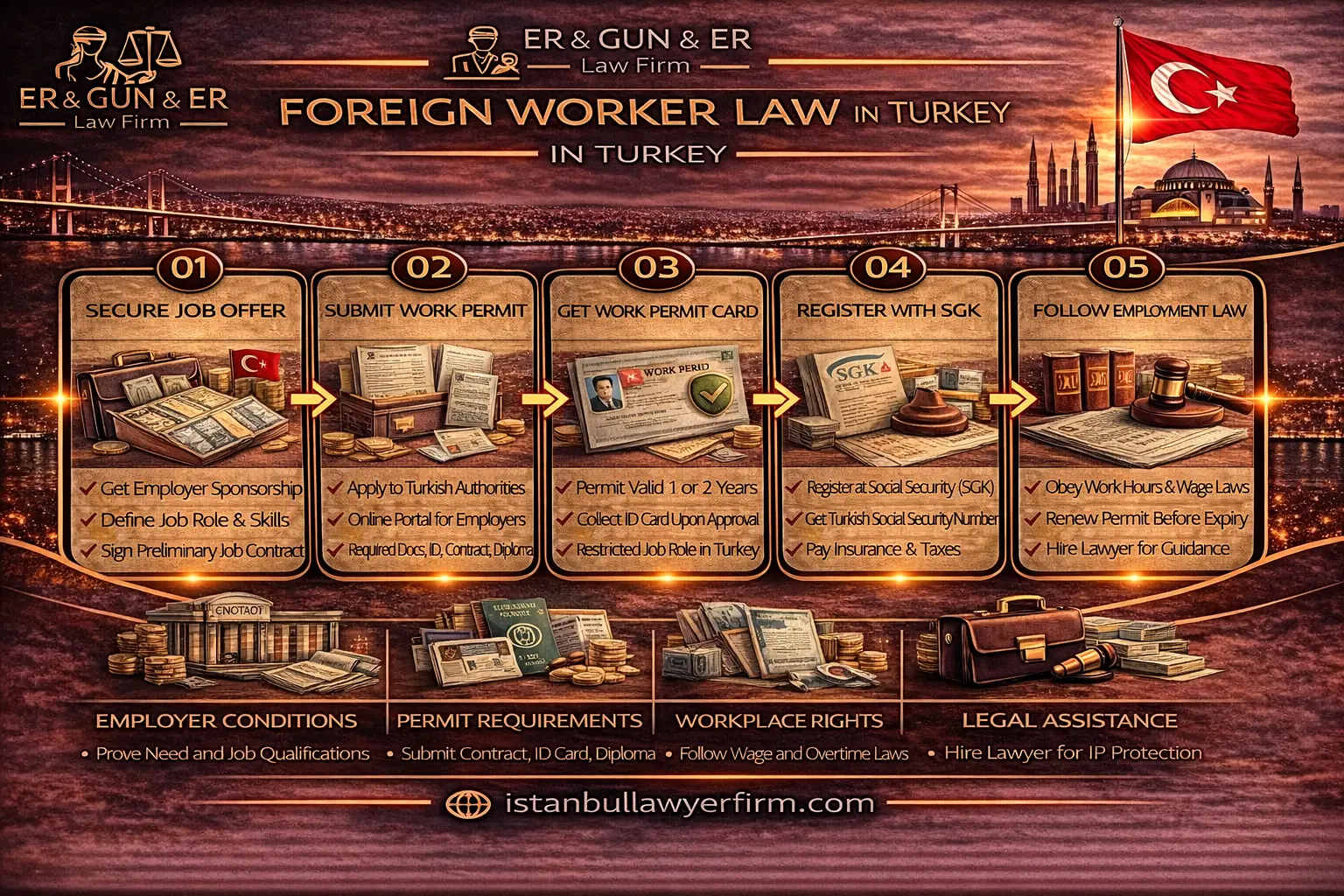
A lawyer in Turkey who advises employers on foreign worker compliance understands that employing a foreign national in Turkey requires simultaneously managing three distinct compliance systems—the work authorization framework governed by Law No. 6735 on International Workforce whose provisions determine which foreign nationals may work in Turkey and under what conditions, the employment relationship framework governed by Turkish Labor Law whose provisions determine the terms, conditions, and protections applicable to the employment regardless of the worker's nationality, and the social security framework governed by Law No. 5510 whose provisions require that foreign employees be enrolled in the Turkish Social Security Institution and that premiums be reported and paid throughout the employment period. An Istanbul Law Firm that advises employers on foreign worker compliance explains that the practical challenge in foreign worker employment is not usually the legal complexity of any single compliance framework but the coordination challenge created by the interaction among all three frameworks—because a work permit that accurately describes a role that differs from the actual employment contract creates documentation inconsistencies that surface during inspections, and because payroll records that do not correspond to the Social Security registration create reporting contradictions that generate administrative questions. A Turkish Law Firm that provides integrated foreign worker compliance support helps employers build the governance system that prevents these coordination failures: defining who within the organization is authorized to initiate foreign worker hiring, approve job offers, and manage the permit application; establishing the documentation standards and file structure that ensure every compliance record—permit, contract, payroll, SGK registration—consistently tells the same story about the employment relationship; and implementing the monitoring processes that detect compliance drift before it accumulates into the contradictions that inspectors identify and that employees exploit in disputes. An English speaking lawyer in Turkey who advises international employers on Turkish foreign worker compliance translates Ministry practice and Labor Law requirements into operational steps that international HR teams can follow without depending on Turkish language proficiency. Practice may vary by authority and year — verify current International Workforce Law requirements, current work permit application procedures, current Labor Law provisions applicable to foreign employees, and current Social Security Institution enrollment requirements with qualified counsel before employing any foreign national in Turkey.
Foreign Worker Legal Framework and Work Authorization
A lawyer in Turkey who advises on the legal framework for employing foreign nationals explains that Turkish foreign worker law operates through the intersection of immigration law governing entry and residence, employment authorization law governing the right to work, and Labor Law governing the conditions of employment—and that understanding how these three legal systems interact is the foundation for designing a compliant foreign worker employment structure. An Istanbul Law Firm that advises employers on the foreign worker legal framework helps them understand the specific dimensions most relevant to each employment situation: the work permit system established by Law No. 6735 on International Workforce, which replaced the previous work permit law and consolidated employment authorization for foreign nationals under a framework administered by the Ministry of Family and Social Services; the fundamental distinction between residence status and work authorization—because a foreign national who holds a Turkish residence permit does not automatically have the right to work in Turkey, and a foreign national who holds a work permit gains both the right to work and the right to reside in Turkey during the permit's validity period; and the employer's central role in the work permit system—because Turkish work permits are employer-specific rather than individual employment authorizations, meaning the permit authorizes the specific foreign national to work for the specific employer identified in the permit application. Turkish lawyers advising on foreign worker legal framework help employers understand that the employer-specific nature of Turkish work permits creates specific obligations: the employer is responsible for ensuring that the permit accurately reflects the employment's actual conditions, the employer must notify the Ministry when specific changes occur, and the employer must not allow the foreign national to work beyond the permit's authorized scope. Practice may vary by authority and year — verify current Law No. 6735 provisions, current Ministry guidance on work permit conditions, and current notification obligations with qualified counsel before implementing any foreign worker employment arrangement.
An Istanbul Law Firm that advises on the equal treatment principle for foreign workers in Turkey explains that Turkish Labor Law applies to foreign national employees in Turkey with the same force as it applies to Turkish national employees—meaning that the full scope of Labor Law protections including written contract requirements, minimum notice periods, severance pay entitlements, annual leave obligations, and occupational health and safety requirements apply to foreign employees from their first day of employment. Turkish lawyers advising on Labor Law compliance for foreign worker employment help employers implement the specific standards most relevant to each employment situation: the written employment contract requirement—which is particularly important for foreign employee employment because the contract must describe the role consistently with the work permit narrative and must be maintained in a format that can be produced to both Ministry inspectors and labor court proceedings; the working time, overtime, and rest day standards that Turkish Labor Law mandates and that must be documented through attendance records and payroll systems rather than through informal understandings; and the termination procedures that Turkish Labor Law prescribes for employees with qualifying service tenure—including valid ground requirements, notice period obligations, and severance pay entitlements—whose violation creates labor court exposure that is not reduced by the employee's foreign nationality or immigration status. An English speaking lawyer in Turkey who advises international employers on Turkish Labor Law compliance for foreign workers provides the practical guidance that enables employers to understand what their foreign worker employment practices must achieve under Turkish law rather than defaulting to the labor standards of their home country. Practice may vary by authority and year.
A Turkish Law Firm that advises on compliance governance for foreign worker employment explains that the most effective approach to foreign worker compliance is a governance system rather than a series of individual administrative tasks—because treating each permit application, contract renewal, and inspection response as a standalone event produces the disconnected records and inconsistent narratives that create compliance vulnerabilities. An English speaking lawyer in Turkey who designs foreign worker compliance governance for international employers helps implement the specific governance elements most effective for each organization's foreign worker population: centralizing foreign worker file management under a designated compliance owner who coordinates HR, finance, and legal inputs for each foreign worker rather than allowing each department to maintain independent records; standardizing the document set and file structure for every foreign worker engagement—including a consistent naming convention for documents, a controlled version management approach for contracts and amendments, and a single repository for all permit, contract, payroll, and SGK documentation; and implementing a compliance calendar that tracks each foreign worker's permit expiry, SGK reporting deadlines, renewal preparation milestones, and change notification obligations—providing advance notice of each compliance event before it becomes urgent. Practice may vary by authority and year.
Work Permit Categories, Application Routes and Portal Procedures
A lawyer in Turkey who advises on work permit categories for foreign employment in Turkey explains that the Turkish work authorization system provides different permit categories that reflect the nature of the employment engagement, the worker's professional profile, and the anticipated duration of the employment—and that selecting the correct category for each specific employment situation is a legal assessment whose incorrect resolution creates compliance exposure that becomes apparent during inspections or disputes. An Istanbul Law Firm that advises on work permit category selection helps employers understand the specific categories most relevant to each employment situation: definite-term work permits for employment relationships whose term is defined at the outset—whose specific duration and renewal conditions should be confirmed with current Ministry guidance; indefinite-term work permits available to foreign nationals who have maintained continuous lawful employment in Turkey for qualifying periods; independent work permits for foreign nationals who will work on their own account rather than as employees of a Turkish company; and turquoise card arrangements for foreign nationals whose qualifications and accomplishments qualify for this special status. Turkish lawyers advising on permit category selection help employers understand that the distinction between different permit types is not merely administrative but has direct implications for the employment relationship's documentation requirements, the employer's notification obligations, and the consequences of employment termination. Practice may vary by authority and year — verify current work permit category definitions, current eligibility criteria for each category, and current renewal conditions with qualified counsel before selecting any permit category for a specific foreign worker engagement.
An Istanbul Law Firm that advises on the work permit application process explains that the Ministry's electronic portal for work permit applications is the primary channel through which employers initiate and manage permit applications—and that the quality of the portal submission directly determines both the application's processing efficiency and the documentation consistency that will support inspections and renewals throughout the permit's validity. Turkish lawyers advising on portal submission quality help employers implement the specific practices most effective for each application situation: verifying that all corporate information entered in the portal—including company name, registration number, address, and workplace identifier—exactly matches the official corporate registry records and SGK workplace registration rather than using internal abbreviations or outdated information; preparing the application narrative—including the job description and business rationale for the foreign hire—in language that accurately describes the role's actual responsibilities and that is consistent with the employment contract's duty description; and managing the supporting documentation package—including corporate registry extracts, workplace information, and employee qualification evidence—in a coordinated preparation process that confirms all documents are current and consistent before the portal submission is initiated. An English speaking lawyer in Turkey who manages work permit portal submissions for international employers provides the coordination between the employer's corporate records, HR systems, and legal requirements that prevents the data entry errors and document inconsistencies that generate Ministry clarification requests. Practice may vary by authority and year.
A Turkish Law Firm that advises on the application route selection for foreign workers explains that the applicable application route—whether through consular channels for workers outside Turkey or through in-country procedures for workers already lawfully present in Turkey—depends on the specific foreign national's current location and immigration status, and that selecting the wrong route or proceeding without confirming the correct route can create procedural complications that delay the permit's issuance. An English speaking lawyer in Turkey who advises on application route selection helps employers and workers understand the specific considerations most relevant to each situation: workers currently outside Turkey who will be hired into permanent positions typically require an employer-initiated portal application followed by a work visa application at the Turkish consulate in the worker's home country, with entry into Turkey occurring after the consular visa is issued; workers already lawfully present in Turkey under qualifying residence status may be eligible for in-country applications that avoid consular steps, but the in-country route's availability depends on the specific residence status held and the current Ministry practice for that status category; and the residence permit versus work permit Turkey distinction—which is one of the most practically significant in Turkish foreign worker compliance—must be assessed for each specific worker's situation rather than assumed from the worker's general immigration status. Practice may vary by authority and year.
Employer and Employee Eligibility Requirements
A lawyer in Turkey who advises on employer eligibility for employing foreign nationals explains that Turkish work permit law imposes specific requirements on the employing entity—including corporate legitimacy requirements that confirm the employer is a properly registered, actively operating Turkish business capable of sustaining lawful employment—and that satisfying these requirements is an ongoing compliance obligation rather than a one-time threshold met at the initial application. An Istanbul Law Firm that advises on employer eligibility assessment helps companies understand the specific criteria most relevant to their situation: Trade Registry registration and current corporate standing—because the employing entity must be actively registered with current corporate records and must be able to demonstrate genuine commercial activity rather than simply holding a registration; SGK workplace registration that is current and corresponds to the physical location where the foreign worker will actually perform duties—because the SGK workplace code used in payroll reporting must match the location described in the permit application; and the statutory ratio requirements that Turkish law imposes on foreign worker employment in some circumstances—limiting the proportion of foreign workers in relation to total employees for certain employer types and situations. Turkish lawyers advising on employer eligibility help companies understand that demonstrating genuine business activity is particularly important for recently established companies—because inspectors may examine the employer's commercial records, client relationships, and operational substance more carefully when the employing entity is new or has limited visible activity in Turkey. Practice may vary by authority and year — verify current employer eligibility criteria, current SGK workplace registration requirements, and current statutory ratio provisions with qualified counsel before filing any work permit application.
An Istanbul Law Firm that advises on employee eligibility for Turkish work permits explains that the foreign worker's own eligibility depends on factors including their qualifications, professional history, passport validity, and—critically—their current location and immigration status in Turkey, which determines which application route is available. Turkish lawyers advising on employee eligibility help employers implement the specific assessment approach most effective for each worker situation: verifying that the worker's educational and professional qualifications satisfy the requirements applicable to the specific role being authorized—including any sector-specific professional qualification requirements that must be assessed separately from the work permit; confirming the worker's current immigration status and location to determine the applicable application route; and establishing the documentation package that the worker must provide—including authenticated and translated educational credentials, professional experience evidence, and current passport copies—in a format that satisfies both Ministry requirements and notarization or authentication standards applicable to documents from the specific country of origin. An English speaking lawyer in Turkey who advises on employee eligibility assessment provides the clear guidance that enables foreign workers to understand what documentation they need to provide and in what format—preventing the delays that arise when documents are submitted in incorrect formats that require re-authentication or re-translation. Practice may vary by authority and year.
A Turkish Law Firm that advises on the hiring process design for foreign workers explains that the employment process for foreign nationals requires specific controls that domestic hiring processes do not—including a start-date gate that prevents productive work from beginning before work authorization is confirmed, and a documentation sequencing requirement that ensures permit, contract, payroll registration, and SGK enrollment are completed in the correct order before the employment creates a visible compliance trail. An English speaking lawyer in Turkey who designs foreign worker hiring processes for international employers helps companies implement the specific controls most effective for each hiring workflow: briefing hiring managers on the requirement that all work—including remote work performed from Turkey, client-facing activities, and productive tasks performed during onboarding—must wait until work authorization is confirmed; establishing a single internal trigger for initiating productive work rather than allowing managers to make individual judgments about when work can begin; and sequencing the onboarding steps—contract signing, payroll setup, SGK enrollment, system access provision—so that each step follows authorization confirmation in a documented sequence. Practice may vary by authority and year.
Employment Contracts, Payroll Compliance and SGK Registration
A lawyer in Turkey who advises on employment contract requirements for foreign workers explains that the employment contract for a foreign national must satisfy Turkish Labor Law's requirements for written employment documentation while simultaneously describing the employment relationship consistently with the work permit narrative—and that inconsistencies between the contract and the permit are among the most common sources of compliance vulnerability during inspections and disputes. An Istanbul Law Firm that drafts employment contracts for foreign worker engagements implements the specific drafting approach most effective for each employment situation: identifying the employing entity with precision—using the entity's exact legal name, trade registry number, and registered address as they appear in official corporate records; describing the employee's role with a job title and duty description that is consistent with both the permit application narrative and the internal HR description—without using marketing language that overstates the role or corporate brevity that understates it; and specifying the workplace with the physical address where the employee will actually perform duties—which must correspond to the SGK workplace registration used in payroll reporting. Turkish lawyers advising on employment contract drafting for foreign workers help employers understand that a contract whose terms differ from what was described to the Ministry—whether in job title, workplace location, or reporting structure—creates a documentation inconsistency that is difficult to explain during inspections and that employees sometimes leverage in disputes. Practice may vary by authority and year — verify current Turkish Labor Law written contract requirements, current mandatory contract term provisions, and current required contract language with qualified counsel before finalizing any foreign worker employment contract.
An Istanbul Law Firm that advises on payroll compliance for foreign worker employment explains that the payroll system for foreign workers creates a documentary record whose consistency with the employment contract and the work permit narrative determines the employer's compliance posture during SGK audits, tax inspections, and labor court proceedings—and that payroll inconsistencies are among the most practically significant compliance gaps because they are difficult to explain retrospectively when the records have been created contemporaneously under different assumptions. Turkish lawyers advising on payroll compliance help employers implement the specific practices most effective for each payroll dimension: using the exact job title from the employment contract and the permit application in the payroll system—rather than using an internal HR description that differs from the authorized title; using the SGK workplace code that corresponds to the location specified in both the permit and the contract rather than a default code that may belong to a different branch; and documenting each salary component—including base wage, regular allowances, and variable elements—in a payroll structure whose transparency enables each payment to be traced to the contract term that authorizes it. An English speaking lawyer in Turkey who advises on payroll compliance for foreign worker employment ensures that international HR and finance teams understand Turkish payroll documentation requirements—because foreign companies frequently apply their home country payroll practices without recognizing that Turkish compliance requires specific documentation steps beyond what their home country standards mandate. Practice may vary by authority and year.
A Turkish Law Firm that advises on Social Security Institution enrollment for foreign workers explains that Turkish Law No. 5510 requires that foreign nationals employed in Turkey be enrolled in the Turkish Social Security Institution before they begin employment—creating an enrollment obligation whose timing, accuracy, and consistency with other compliance records determines whether the employment creates clean or problematic SGK documentation. An English speaking lawyer in Turkey who manages SGK enrollment for foreign worker employers helps companies implement the specific enrollment practices most effective for each situation: initiating the foreign worker's SGK enrollment before the employment start date rather than waiting for the first monthly payroll cycle—because late enrollment creates a retroactive premium obligation that is more expensive to correct than timely initial enrollment; ensuring that the identity information entered in the SGK system—including name, passport number, and address—matches the information in the work permit and employment contract precisely; and maintaining the monthly SGK premium reporting with consistent workplace codes, job titles, and income amounts that correspond to the payroll records—because discrepancies between SGK declarations and payroll records are among the most common audit triggers. Practice may vary by authority and year.
Workplace Compliance, Working Time and Occupational Safety
A lawyer in Turkey who advises on workplace compliance obligations for foreign worker employers explains that Turkish Labor Law and Occupational Health and Safety Law impose specific obligations on employers regarding the work environment, working time administration, and employee protection—and that these obligations apply to foreign national employees with the same force as they apply to Turkish employees, making compliance with workplace standards a mandatory component of foreign worker employment rather than an optional enhancement. An Istanbul Law Firm that advises on workplace compliance for foreign worker employers helps companies implement the specific standards most relevant to each employment situation: occupational health and safety obligations that require employers to assess and address workplace risks, provide safety training, and maintain documentation of training delivery and risk assessment outcomes—with the documentation particularly important for foreign worker employment because it demonstrates the employer's good faith compliance if workplace incidents or claims arise; working time documentation that records the employee's daily and weekly hours, rest breaks, and overtime authorization—creating the contemporaneous records that enable the employer to defend against overtime claims whose resolution often depends on which party's records are more complete and consistent; and annual leave administration that documents accrual, scheduling approval, and actual leave taken—because undocumented leave creates disputes at termination when final wage calculations must include unused leave compensation. Turkish lawyers advising on workplace compliance help employers understand that the documentation disciplines most important for foreign worker compliance are the same ones most important for dispute prevention—creating a natural alignment between regulatory compliance and litigation risk management. Practice may vary by authority and year — verify current Turkish Labor Law working time provisions, current Occupational Health and Safety Law requirements, and current annual leave entitlement standards with qualified counsel before implementing any working time or leave management system for foreign workers.
An Istanbul Law Firm that advises on work permit renewal management explains that permit renewal requires the employer to demonstrate not only that the original permit conditions were satisfied—through payroll records, SGK contributions, and employment documentation that shows the authorized employment actually occurred as described—but also that the business need for the foreign worker's continued employment remains genuine and that the role described in the renewal application is consistent with what the employee actually performed during the prior permit period. Turkish lawyers advising on work permit renewal preparation help employers implement the specific preparation approach most effective for each renewal situation: beginning renewal preparation well before the permit's expiry date to allow time for document collection, consistency review, and Ministry response cycles; reviewing the payroll, SGK, and employment documentation from the entire prior permit period to identify any inconsistencies that require correction before the renewal file reflects gaps or contradictions; and confirming that any changes in the employee's role, workplace, or employment terms that occurred during the prior permit period are documented through written addenda and, where notification obligations arose, through Ministry notifications. An English speaking lawyer in Turkey who manages work permit renewals for international employers provides the systematic renewal preparation that prevents the operational disruption that arises when permit expiry approaches without adequate documentation review. Practice may vary by authority and year.
A Turkish Law Firm that advises on change notification obligations during foreign worker employment explains that Turkish work permit regulations require employers to notify the Ministry when specific changes occur during an authorized employment—including certain changes in the employee's role, workplace, or employment entity—and that managing these notification obligations requires treating employment changes as compliance events that must be assessed for notification implications before they are implemented. An English speaking lawyer in Turkey who advises on change management for foreign worker employment helps employers implement the specific approach most effective for each change type: establishing an internal change request procedure that requires HR to assess notification implications before any role, title, or workplace change is approved and implemented—preventing the post-implementation discovery that a change created a notification obligation that was not satisfied; documenting changes through written addenda to the employment contract rather than through informal manager communications that do not create a clear effective date or scope of change; and maintaining a change log that records each significant change event—including its effective date, its documentation, and whether it triggered a Ministry notification—that can be produced during inspections to demonstrate the employer's systematic compliance approach. Practice may vary by authority and year.
Termination, Inspection Readiness and Dispute Management
A lawyer in Turkey who advises on termination of foreign national employees explains that ending a foreign worker's Turkish employment requires compliance with Turkish Labor Law's termination procedures—including valid ground requirements, notice period obligations, and severance pay entitlements for qualifying employees—alongside the administrative steps that address the work permit's status after employment ends. An Istanbul Law Firm that manages foreign worker employment terminations helps employers implement the specific termination approach most effective for each situation: conducting a pre-termination file review that assesses the completeness and consistency of the employment documentation—identifying any gaps or contradictions that the employee might exploit in a post-termination claim before the termination notice is issued; preparing the termination documentation in compliance with Turkish Labor Law procedural requirements—including written notice with the stated legal ground, final wage calculation with transparent inclusion of unused leave compensation, and signed acknowledgment of receipt; and managing the administrative steps that follow employment termination—including payroll closure, SGK de-registration, system access revocation, and any Ministry notifications required by the permit's conditions—in a coordinated sequence that prevents the administrative gaps that create post-termination compliance questions. Turkish lawyers advising on foreign worker termination help employers understand that the work permit does not automatically expire when employment ends and that the administrative notification and de-registration steps must be completed to close the compliance loop cleanly. Practice may vary by authority and year — verify current Turkish Labor Law termination ground requirements, current notice period and severance pay provisions, and current work permit de-registration procedures with qualified counsel before implementing any termination of a foreign worker.
An Istanbul Law Firm that advises on inspection readiness for employers of foreign workers explains that Turkish workplace and Social Security inspectors examine foreign worker compliance through a document review that compares the permit narrative, the employment contract, the payroll records, and the SGK enrollment data—looking for the inconsistencies that indicate either unauthorized employment, incorrect permit scope, or inaccurate reporting. Turkish lawyers advising on inspection readiness help employers build the specific documentation architecture most effective for withstanding inspection: maintaining a consolidated foreign worker compliance file for each employee that contains the current permit, the employment contract and all addenda, payroll records for the complete employment period, SGK enrollment confirmation and premium payment records, and the change log documenting each significant employment change; training the designated inspection coordinator on how to respond to inspector requests—including what documents to produce, how to answer factual questions without speculating about legal interpretations, and how to document each document provided to the inspector; and conducting periodic internal compliance audits that review the consistency of each foreign worker's permit, contract, payroll, and SGK records before an external inspection discovers contradictions. An English speaking lawyer in Turkey who manages inspection readiness for international employers provides the coordinated preparation that enables foreign companies to respond to Turkish inspections coherently without the response delays that arise when document requests must cross international management chains without a designated local coordinator. Practice may vary by authority and year.
A Turkish Law Firm that advises on dispute risk management for foreign worker employment explains that labor disputes brought by foreign workers in Turkish labor courts present the same evidence-based analysis as disputes brought by Turkish workers—with the employer's documentary evidence of wage payment, working time, leave administration, and termination ground typically determining the dispute's outcome—and that the compliance documentation disciplines most important for inspection readiness are the same disciplines most important for labor court defense. An English speaking lawyer in Turkey who advises on foreign worker dispute management helps employers implement the specific risk management practices most effective for each dispute scenario: preserving the complete foreign worker compliance file—including all communications, payroll records, SGK documentation, and attendance records—before termination and before any anticipated dispute, because evidence preservation is most effective before the parties' relationship deteriorates; defining a communication protocol that routes employment-related communications through HR rather than through manager-to-employee messaging during disputes—because informal manager communications frequently become the key exhibits in labor court proceedings whose content and tone were not considered when they were sent; and approaching disputes with the documentary evidence as the foundation—because Turkish labor courts' documentary analysis typically produces faster and less expensive resolution than factual contests based on witness credibility alone. The best lawyer in Turkey for foreign worker compliance combines specific knowledge of Turkish work permit law, Turkish Labor Law provisions applicable to foreign employees, Social Security Institution enrollment requirements, and inspection and litigation procedures with the English-language communication that enables international employers to manage their Turkish foreign worker compliance effectively. Practice may vary by authority and year.
Undocumented Employment Risks and Compliance Gap Prevention
A lawyer in Turkey who advises on undocumented employment risks for foreign workers explains that employing a foreign national without valid work authorization—or allowing authorized employment to drift into unauthorized scope through role changes that were not documented and assessed—creates administrative exposure for the employer and immigration consequences for the foreign national that typically operate simultaneously and compound each other in ways that are significantly harder to manage than the original compliance gap that created them. An Istanbul Law Firm that advises on unauthorized employment risk prevention helps employers implement the specific controls most effective for each risk scenario: establishing an onboarding gate that prevents any productive work activity—including remote work performed from Turkey, client-facing activities, internal meetings producing deliverables, and training activities contributing to business output—from commencing before the employer has confirmed that work authorization is both applied for and effective; documenting the pre-authorization period clearly—if the foreign national is in Turkey before authorization is obtained, maintaining written records of the purpose of their presence that show the absence of productive work; and implementing the change assessment process that evaluates each role modification, workplace change, and duty expansion for authorization scope compliance—preventing the incremental drift where a foreign national's actual work gradually expands beyond the authorized scope without any deliberate decision to exceed the permit's conditions. Turkish lawyers advising on unauthorized employment risk prevention help employers understand that the practical risk assessment should evaluate not only whether the original authorization was obtained but whether the daily working reality continues to correspond to the authorized scope throughout the employment. Practice may vary by authority and year — verify current Ministry guidance on work permit scope interpretation, current inspection enforcement practice, and current administrative fine provisions with qualified counsel before assessing any foreign worker employment situation for authorization compliance.
An Istanbul Law Firm that advises on contractor misclassification risk for foreign national workers explains that using contractor, consultancy, or service agreement arrangements for foreign nationals who will be functionally employed creates disguised employment risk—because Turkish Labor Law evaluates the actual nature of the working relationship through objective criteria including supervision, schedule integration, equipment provision, and economic dependence rather than through the label applied to the contractual arrangement. Turkish lawyers advising on contractor arrangement risk assessment help employers evaluate the specific criteria most indicative of employment status under Turkish law: whether the foreign national works under the direction and supervision of the employer's management—rather than independently deciding when, where, and how to perform services; whether the foreign national works exclusively or predominantly for the employer—rather than maintaining an independent client base whose existence demonstrates genuine independent business operation; and whether the foreign national uses the employer's equipment, workspace, and systems rather than providing their own tools and infrastructure. An English speaking lawyer in Turkey who advises international employers on contractor arrangement risk assessment provides the functional analysis that enables employers to understand whether their proposed contractor arrangement will withstand Labor Law characterization scrutiny—because foreign employers frequently design arrangements based on their home country contractor law without recognizing that Turkish Labor Law's employment characterization criteria may produce different results. Practice may vary by authority and year.
A Turkish Law Firm that advises on compliance gap detection and remediation for foreign worker employment explains that periodic internal audits that systematically compare permit documentation, employment contracts, payroll records, and SGK declarations across each foreign worker's employment history are the most effective mechanism for identifying compliance gaps before they are discovered through external inspection—because gaps identified internally can be addressed through documented corrective action that demonstrates good faith compliance management, while gaps identified through external inspection must be explained in an adversarial context. An English speaking lawyer in Turkey who conducts compliance audits for international employers' foreign worker populations provides the systematic cross-comparison of each worker's complete compliance documentation—identifying inconsistencies in job titles, workplace identifiers, SGK premium amounts, and contract terms—and producing a corrective action plan whose implementation is documented to demonstrate the employer's proactive compliance response. Turkish lawyers advising on compliance gap remediation help employers understand that the corrective action plan should document both what is being corrected and why the gap arose—creating a narrative that demonstrates administrative error rather than deliberate non-compliance, which typically produces more proportionate regulatory responses than gaps that appear to have continued without acknowledgment. Practice may vary by authority and year.
Cross-Border Employment, Remote Work and Group Structure Considerations
A lawyer in Turkey who advises on cross-border employment arrangements for foreign national workers explains that foreign national employees who work for Turkish employers while spending time in Turkey—whether as permanent Turkish-based employees, as expatriate assignees from a foreign parent company, or as remote workers who are physically present in Turkey while serving a foreign employer—present different compliance profiles whose specific requirements depend on the structure of the work arrangement and the applicable regulatory framework for each structure. An Istanbul Law Firm that advises on cross-border employment structure compliance helps employers understand the specific framework applicable to each arrangement type: the standard Turkish employment arrangement where the Turkish company is both the legal employer and the day-to-day work director, requiring work permit authorization in Turkey and Turkish Labor Law compliance throughout; the expatriate assignment arrangement where a foreign company assigns one of its employees to work in Turkey—typically through a secondment agreement between the foreign and Turkish companies—requiring work permit authorization, employment contract documentation that clarifies the split of employer responsibilities, and SGK enrollment management that reflects the actual employment relationship; and the remote work arrangement where a foreign national is physically present in Turkey while employed by and performing work for a foreign employer—whose authorization requirements and tax implications depend on the duration of the presence and the nature of the work being performed. Turkish lawyers advising on cross-border employment structure compliance help employers understand that the specific regulatory treatment of each arrangement should be confirmed with current Turkish legal and tax counsel before the arrangement is committed—because the practical compliance requirements for each structure differ substantially. Practice may vary by authority and year — verify current Ministry guidance on secondment and remote work authorization requirements and current tax treatment of cross-border employment arrangements with qualified counsel before implementing any cross-border foreign worker employment arrangement.
An Istanbul Law Firm that advises on group company employment structures for foreign worker employment explains that foreign investor groups operating in Turkey frequently use group company structures—including holding companies, shared services companies, and operating subsidiaries—that create specific questions about which legal entity is the employer of record for Turkish work permit and Labor Law purposes, and that resolving this question with documentary clarity is essential because the employer of record must be the entity that files the work permit, executes the employment contract, processes payroll, and makes SGK registrations. Turkish lawyers advising on group company employment structure compliance help employers implement the specific approach most effective for each group structure situation: designating the specific Turkish legal entity that will serve as the employer of record for each foreign worker engagement—based on which entity actually directs the work, pays the wages, and controls the employment relationship—and ensuring that the permit application, employment contract, payroll system, and SGK registration all identify this same entity consistently; documenting the relationship between the employer of record entity and other group entities that may benefit from the foreign worker's services—through intercompany service agreements that explain why the services are being provided and on what commercial terms—to support the transfer pricing analysis of intercompany service arrangements. An English speaking lawyer in Turkey who advises on group company foreign worker employment compliance ensures that the legal entity identified as employer throughout the compliance documentation corresponds to the entity that actually manages the employment relationship operationally—preventing the documentation inconsistencies that arise when different entities are identified as employer in different compliance systems. Practice may vary by authority and year.
A Turkish Law Firm that advises on building a scalable foreign worker compliance program for growing organizations explains that companies whose business growth involves hiring increasing numbers of foreign nationals benefit from investing in compliance infrastructure—including standard templates, designated compliance owners, and systematic monitoring processes—before their foreign worker population reaches the scale where informal management creates unmanageable compliance exposure. An English speaking lawyer in Turkey who assists international employers in building scalable foreign worker compliance programs helps companies implement the specific program elements most effective for managing growing foreign worker populations: developing standard employment contract templates for the most common foreign worker roles that satisfy Turkish Labor Law requirements and incorporate consistent job description language that can be aligned with permit applications; creating a standardized onboarding workflow that sequences the permit, contract, payroll, and SGK steps in the correct order with clear triggers at each stage; and establishing the periodic compliance review cycle that systematically checks each foreign worker's permit, contract, payroll, and SGK records for consistency—providing early identification of drift before it accumulates into significant compliance gaps. The best lawyer in Turkey for foreign worker compliance management combines specific knowledge of Turkish work permit law, Turkish Labor Law, Social Security Institution requirements, and inspection and dispute procedures with the English-language communication and practical compliance program design expertise that enables international employers to manage their Turkish foreign worker compliance effectively as their business grows. Practice may vary by authority and year.
Frequently Asked Questions
- Does a Turkish residence permit authorize a foreign national to work in Turkey? No. A Turkish residence permit and a Turkish work permit are separate authorizations. A foreign national who holds a Turkish residence permit does not automatically have the right to work in Turkey. Work authorization requires a separate work permit application through the Ministry of Family and Social Services. However, a work permit holder automatically gains residence authorization for the permit's validity period. Practice may vary by authority and year.
- Who is responsible for the Turkish work permit application—the employer or the employee? The employer is the primary driver of the Turkish work permit application. The employer initiates the application through the Ministry's electronic portal, provides corporate documentation and job description information, and is responsible for ensuring that the permit file accurately reflects the employment's actual conditions. The employee provides personal documentation including passport copies and qualification evidence. Practice may vary by authority and year.
- Can a foreign national begin work before the work permit is issued? No. The employer should not allow the foreign national to perform productive work before the work authorization is confirmed as effective. Early commencement of work creates documentary evidence of unauthorized employment through emails, meeting records, system access logs, and payroll preparation. The compliance risk applies even when the work appears preparatory or informal in nature. Practice may vary by authority and year.
- What are the main employer obligations for foreign worker employment in Turkey? Employer obligations include filing the work permit application and ensuring it accurately reflects the employment's conditions, enrolling the foreign worker in the Turkish Social Security Institution before employment begins, executing a written employment contract consistent with both Turkish Labor Law requirements and the permit narrative, paying wages through documented banking channels, maintaining accurate payroll and attendance records, notifying the Ministry of certain employment changes, and ensuring workplace safety and health standards apply to foreign workers. Practice may vary by authority and year.
- What Social Security Institution obligations apply to foreign worker employment? Employers must enroll foreign national employees in the Turkish Social Security Institution before employment begins, make monthly payroll declarations that report the employee's income and working period, pay monthly premiums by the applicable deadline, and maintain the SGK registration with current and accurate information. The SGK workplace code, job title, and income amounts in the SGK system must be consistent with the employment contract and payroll records. Practice may vary by authority and year.
- What payroll documentation is required for employing foreign workers in Turkey? Payroll documentation should include signed monthly payslips that show base wage, allowances, and deductions consistent with the employment contract, bank transfer confirmations showing payment dates and amounts, attendance or working time records that support the wage amounts declared, and SGK premium payment confirmations. The job title and workplace code in the payroll system should match the employment contract and work permit. Practice may vary by authority and year.
- What happens if an employer or foreign worker violates Turkish work permit requirements? Violations of Turkish work permit requirements may result in administrative fines for the employer, immigration consequences including deportation risk for the foreign national, and complications in any subsequent labor disputes arising from the employment relationship. The specific consequences depend on the nature and extent of the violation and current enforcement practice. Proactive compliance management is the most effective mitigation. Practice may vary by authority and year.
- How should a work permit renewal be prepared? Renewal preparation should begin well before the permit's expiry date. The renewal file should be supported by payroll records, SGK premium payment confirmations, and employment documentation from the entire prior permit period demonstrating that the authorized employment occurred as described. Any changes in the employee's role or workplace during the prior period should be documented through written addenda. Inconsistencies between the renewal narrative and the underlying records should be identified and corrected before the renewal submission. Practice may vary by authority and year.
- What notifications must an employer make when employment conditions change? Certain changes in the foreign worker's employment—including changes in employer entity, workplace location, and potentially role—may trigger Ministry notification obligations. The specific notification requirements depend on the nature of the change and current Ministry guidance. Employers should assess each material employment change for notification implications before implementing the change, document all changes through written addenda, and maintain a change log. Practice may vary by authority and year.
- How are foreign worker employment inspections conducted in Turkey? Turkish workplace inspectors and Social Security Institution inspectors examine foreign worker compliance through document review that compares the permit, employment contract, payroll records, and SGK enrollment data for consistency. Inspectors may also examine attendance records, workplace safety documentation, and the physical workplace itself. Employers should designate an inspection coordinator and maintain a consolidated compliance file for each foreign worker that can be produced promptly upon request. Practice may vary by authority and year.
- How should a foreign worker employment be terminated in compliance with Turkish law? Termination requires compliance with Turkish Labor Law's procedural requirements including written notice with the stated legal ground, the applicable notice period or payment in lieu, and severance pay for qualifying employees. The employer should also complete administrative steps including payroll closure, SGK de-registration, system access revocation, and any work permit notifications required by the permit conditions. A pre-termination file review identifies documentation gaps before the termination notice is issued. Practice may vary by authority and year.
- Can a foreign worker bring labor court claims in Turkey? Yes. Foreign national employees have the same ability to bring labor claims in Turkish labor courts as Turkish national employees—including claims for unpaid wages, overtime, annual leave compensation, invalid termination, and severance pay. Turkish labor courts evaluate these claims through documentary evidence including payroll records, SGK data, attendance records, and employment contracts. The employer's documentation quality significantly affects the outcome of labor disputes involving foreign workers. Practice may vary by authority and year.
- What compliance risks arise from using contractor arrangements instead of employment for foreign nationals? Using contractor or consultancy arrangements for foreign nationals who are functionally employed creates disguised employment risk—because Turkish Labor Law evaluates the factual nature of the working relationship rather than the label applied to it. If the contractor is supervised, works fixed hours, uses employer equipment, and is integrated into the employer's workflow, the relationship may be characterized as employment regardless of the invoice-based payment structure. Contractor arrangements should be assessed by Turkish legal counsel before being implemented for foreign nationals. Practice may vary by authority and year.
- What documentation should be preserved to defend against foreign worker labor disputes? Employers should preserve the complete employment file including the signed employment contract and all addenda, work permit and related correspondence, SGK enrollment confirmation and monthly declaration records, payroll records with bank transfer confirmations, signed payslips, attendance and working time records, leave approval records, performance evaluations, disciplinary records with stated grounds, and all communications related to the employment relationship. The preservation should occur before termination and before anticipated disputes. Practice may vary by authority and year.
- Does ER&GUN&ER Law Firm provide legal services for foreign worker employment compliance in Turkey? Yes. ER&GUN&ER Law Firm provides comprehensive legal services for foreign worker employment compliance including work permit category assessment and application management, employer and employee eligibility analysis, portal submission preparation and management, employment contract drafting consistent with Labor Law and permit requirements, SGK enrollment coordination, payroll compliance advisory, workplace compliance framework implementation, work permit renewal preparation, change notification assessment and management, termination procedure compliance, inspection readiness documentation review, labor dispute defense, and integrated compliance governance program design—with English-language client communication and bilingual documentation throughout each engagement.
Author: Mirkan Topcu is an attorney registered with the Istanbul Bar Association (Istanbul 1st Bar), Bar Registration No: 67874. His practice focuses on cross-border and high-stakes matters where evidence discipline, procedural accuracy, and risk control are decisive.
He advises individuals and companies across Immigration and Residency, Real Estate Law, Tax Law, and cross-border documentation matters where procedural accuracy and evidence discipline are decisive.
Education: Istanbul University Faculty of Law (2018); Galatasaray University, LL.M. (2022). LinkedIn: Profile. Istanbul Bar Association: Official website.