

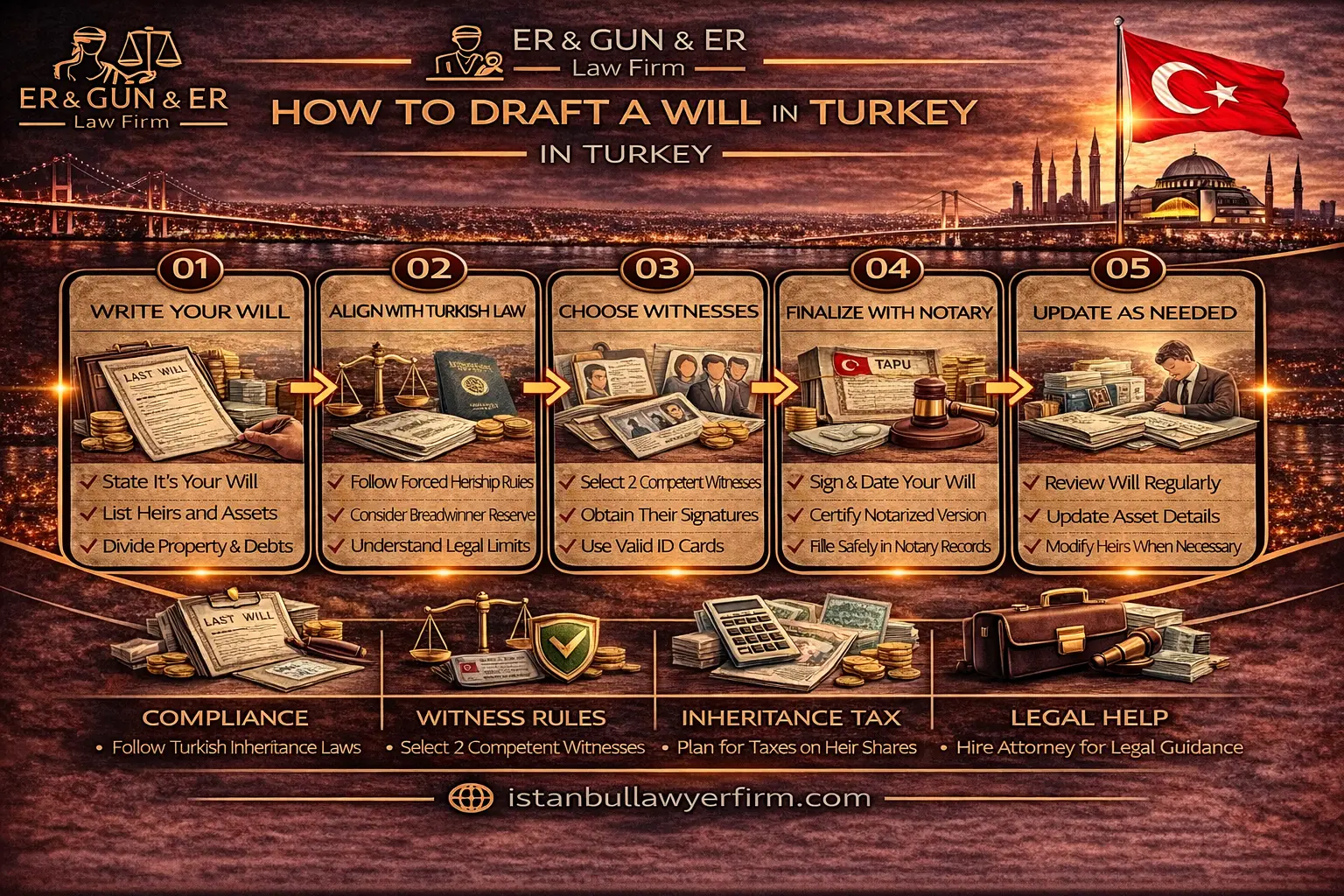
A lawyer in Turkey who advises on will drafting understands that drafting a will in Turkey is a formal legal act with strict consequences—and that a document which looks clear to a family can still be rejected if the required form is missing or if a formality that the Turkish Civil Code treats as a validity condition has not been satisfied. An Istanbul Law Firm that advises on inheritance planning in Turkey explains that the Turkish Civil Code recognizes specific will types each with its own execution rules, that legal capacity and free intent are central validity requirements because many challenges focus on whether the testator understood the act and acted voluntarily, and that reserved shares limit what can be distributed freely so planning must start with lawful boundaries rather than personal wishes alone. A Turkish Law Firm that handles will drafting and inheritance planning for both Turkish nationals and foreign clients provides the integrated legal service that covers each stage from choosing the appropriate will type through execution, safekeeping, and coordination with the probate process: assessing the most appropriate will form based on the testator's health, literacy, and conflict risk profile; advising on reserved share boundaries before any dispositions are drafted; ensuring beneficiary identification and asset description are specific enough for probate and registry use; planning safekeeping and version control; and coordinating cross-border elements for foreign nationals. An English speaking lawyer in Turkey who advises on will drafting for foreign nationals in Turkey provides the bilingual guidance that enables international clients to understand Turkish testamentary concepts and to produce a document that Turkish courts, notaries, and registries can process without requiring heirs to explain family history. Practice may vary by authority and year — verify current Turkish Civil Code will formality requirements, current notary procedures, current reserved share calculation rules, and current probate practice with qualified counsel before finalizing any will instrument in Turkey, since the administrative procedures at specific notary offices and the document expectations at specific probate courts may differ from general guidance in ways that require case-specific confirmation before treating any general description of the process as the applicable procedure for a specific transaction.
Why Wills Matter and Who Can Make a Valid Will in Turkey
A lawyer in Turkey who advises on Turkish succession planning explains that a will allows a person to decide how the disposable portion of their estate should be allocated—and that without a will, Turkish succession rules distribute assets according to statutory heirship regardless of personal preference, which can create unintended co-ownership among relatives who do not cooperate over sale, rental income, and maintenance decisions. An Istanbul Law Firm that advises on the practical value of will drafting Turkey helps testators understand that a clear will can assign specific assets to specific beneficiaries to reduce later negotiation, can clarify whether a cash legacy is meant to come from the general estate or a defined source, and can document a coherent plan for blended families that heirs can read rather than argue about. Turkish lawyers advising on will function help testators understand a critical point: the first review in probate is whether the document meets formal validity tests, not whether it feels fair—which is why careful will drafting Turkey focuses on form and proof discipline as much as on personal wishes. Practice may vary by authority and year.
An Istanbul Law Firm that advises on who can make a valid will in Turkey explains that the ability to make a will depends on having legal capacity and discernment at the time of execution—meaning the testator must understand that the document will govern property distribution at death, appreciate its consequences, recognize close family members, and understand the nature of major assets. Turkish lawyers advising on will capacity help testators understand the specific implications most practically important for execution planning: a will is a strictly personal act that cannot be signed by an agent or relative on the testator's behalf; where the testator has limited literacy, the execution route should ensure the text is read and understood in a documented way; the signing environment should be calm and free from beneficiaries who might later be accused of directing decisions; and where language barriers exist, independent interpretation rather than family translation should be used. An English speaking lawyer in Turkey who advises on will capacity documentation for foreign nationals provides the specific process architecture that separates instruction meetings from signing sessions, excludes beneficiaries from instruction discussions, and creates the documented opportunity for private question-and-answer that is the primary defense against post-death challenges based on alleged lack of capacity or undue influence. Practice may vary by authority and year.
A Turkish Law Firm that advises on undue influence prevention in will drafting explains that in contested families, the most common allegation is not that the signature is missing but that the decision was not free—and that claims of undue influence typically focus on who arranged appointments, who controlled access, and who benefited from the outcome. An English speaking lawyer in Turkey who advises on free intent documentation helps testators implement the specific process controls most effective for each situation: keeping beneficiaries out of the room during instruction meetings; creating a documented chronology of drafts and approvals so that later readers can see a consistent plan developing rather than appearing suddenly; preserving copies of communications showing the testator initiated contact and requested specific dispositions; and recording where the original will is stored and how it is to be retrieved after death. The practical aim is to leave heirs with a clear, credible record that reduces incentives for speculative challenges—and a well structured archive that anticipates the questions a probate judge would ask and answers them through documents rather than through arguments made after the testator can no longer clarify their intent, with the overall objective being a situation where the estate can be administered efficiently because the documentation is complete rather than requiring heirs to reconstruct the testator's intentions from family memories and incomplete records. Practice may vary by authority and year.
Will Types, Notary Route and Formal Requirements in Turkey
A lawyer in Turkey who advises on Turkish will types explains that the Turkish Civil Code recognizes specific will forms and that the form chosen determines the validity checks later applied—with common forms including an official will made before an authorized officer, a handwritten will written entirely by the testator, and extraordinary options for genuine emergencies when ordinary execution is impossible. An Istanbul Law Firm that advises on will form selection helps testators understand the practical trade-offs most relevant to each situation: an official instrument is easier to prove because it is prepared within an official file with verified identity; a handwritten instrument relies on handwriting, date, and signature so authenticity can become a forensic issue; and emergency forms rely on later confirmation and witness credibility, which can be fragile in contested estates. Turkish lawyers advising on will form selection help testators understand that the decision should start with the testator's health and ability to attend an appointment without stress, consider whether the testator can write clearly and consistently for a handwritten document, and account for whether a family conflict is predictable—in which case the official route often provides stronger procedural safeguards. Practice may vary by authority and year.
An Istanbul Law Firm that advises on the notarized will Turkey route explains that the notary route is the most common way to execute an official will in Turkey and is preferred when the testator wants a supervised signing record that is difficult to dispute—because the document is prepared as an official instrument and kept within institutional custody, reducing the risk of loss, substitution, or selective disclosure after death. Turkish lawyers advising on notary will preparation help testators implement the specific preparation steps most important for a clean official execution: confirming identity details exactly as they appear in passports and residency records before the appointment; building a clean family map identifying protected heirs before any dispositions are drafted; compiling an asset map with registry descriptions for real estate and clear labels for financial holdings; bringing copies of prior wills so the new text can address revocation without conflicting instruments; and ensuring any interpreter arrangement is formalized so comprehension is demonstrable in the official record. An English speaking lawyer in Turkey who coordinates notary will preparation for foreign nationals provides the bilingual workflow management that ensures the final text reflects Turkish legal concepts accurately without creating language ambiguity that heirs can later exploit. Practice may vary by authority and year.
A Turkish Law Firm that advises on handwritten will Turkey requirements and witness formalities explains that a handwritten will is valid only when the entire text is written in the testator's own handwriting with a clear complete date and an ordinary signature—and that the core risks are unclear dates, unclear signatures, and later additions that cannot be explained. An English speaking lawyer in Turkey who advises on handwritten will execution and witness requirements helps testators understand the specific formality controls most important for private wills: writing the document in one continuous session without leaving blank spaces; avoiding overwriting or squeezed insertions that can be portrayed as later tampering; signing and dating clearly so authenticity can be assessed against known handwriting samples; and following the witness requirements will Turkey rules for the chosen form without improvisation. Witness eligibility can depend on capacity, relationship, and other status considerations that should be checked before signing—and a witness who is also a beneficiary can create credibility problems that undermine confidence in the entire execution process. Practice may vary by authority and year — verify current notary and handwritten will formality requirements with qualified counsel before executing any will instrument in Turkey.
Legal Capacity, Free Intent and Reserved Share Constraints
A lawyer in Turkey who advises on reserved share Turkey will planning explains that Turkish succession law protects certain close relatives through mandatory portions that cannot be removed by preference alone—and that the part of the estate remaining after protected portions is the disposable portion that can be freely allocated. An Istanbul Law Firm that advises on reserved share planning before will drafting helps testators understand the specific planning approach most effective for each family composition: identifying which heirs have protected status based on the family tree in civil status registers before any dispositions are drafted; building the allocation plan from the statutory boundaries inward rather than writing gifts first and checking limits later; documenting lifetime transfers and prior gift transactions whose interaction with reserved share disputes will be examined if a reduction claim is filed; and using clear but calm language for allocation decisions rather than emotional phrasing that can be used to argue that someone else shaped the document. Turkish lawyers advising on reserved share compliance help testators understand that a will which exceeds the disposable portion is not automatically ignored but can be reduced through court proceedings that delay transfers and complicate early administration steps—making alignment with lawful limits a practical necessity rather than a technical formality. Practice may vary by authority and year.
An Istanbul Law Firm that advises on reserved share analysis in estate planning explains that reserved share constraints are not only a legal concept but affect how specific assets can practically be allocated—because a single apartment that represents most of an estate means any protected claim can create co-ownership even when the will aims for a clean transfer. Turkish lawyers advising on asset allocation within reserve share limits help testators understand the specific considerations most practically significant for each asset type: if the will intends to leave real estate to one person, how other heirs will be satisfied within the remaining disposable portion must be realistically assessed; property ownership details matter because jointly held assets or assets held through companies may not be disposed of as if they were wholly personal; and where the estate includes bank accounts, the interaction between specific cash legacies and the funds available for protected shares must be explicitly planned. An English speaking lawyer in Turkey who advises on estate planning for foreign nationals with Turkish assets provides the reserved share analysis that enables international testators to understand how Turkish succession law will interact with their intended distribution before any document is signed. Practice may vary by authority and year.
A Turkish Law Firm that advises on capacity evidence and undue influence prevention in will drafting explains that capacity disputes are usually raised after death when the testator cannot clarify what happened—and that courts typically examine contemporaneous medical records, witness statements, and the surrounding circumstances of execution. An English speaking lawyer in Turkey who advises on capacity documentation for will drafting helps testators implement the specific evidence preservation most effective for each health situation: separating the instruction meeting from the signing meeting when health allows, because that sequence shows considered decision making; keeping beneficiaries out of the room during instructions to prevent their presence from being portrayed as pressure; recording a chronology of drafts and instruction sessions that shows the plan developing consistently; and preserving third-party observations of mental clarity where appropriate without creating documents that invade privacy without genuine need. A lawyer in Turkey for will drafting combines knowledge of Turkish Civil Code formality requirements, notarial practice, reserved share law, capacity evidence standards, and cross-border coordination with the disciplined process management that produces a defensible execution record whose quality is the primary determinant of whether a will achieves its intended distribution without litigation. Practice may vary by authority and year.
A Turkish Law Firm that advises on reserved share documentation in the estate planning context explains that the most effective protection against reserved share disputes is not complex legal language in the will itself but a comprehensive pre-will asset and family analysis whose results are preserved in the estate file. An English speaking lawyer in Turkey who conducts pre-will reserved share assessments for foreign nationals with Turkish assets delivers a written analysis mapping the family tree, identifying protected heirs and their applicable fractions, identifying the current estate assets and their registered status, and calculating the disposable portion available for free allocation—so that the will drafting process begins with a confirmed lawful framework rather than discovering limits after the document is already signed. Practice may vary by authority and year.
Selecting Beneficiaries, Describing Assets and Drafting Clear Language
A lawyer in Turkey who advises on beneficiary selection for Turkish wills explains that after mapping reserved shares, the safest approach to identifying who should receive benefits is to use full legal names and stable identifiers rather than nicknames or casual descriptions—and to think in terms of specific gifts for identified assets combined with a residue clause for everything not expressly assigned, since allocating only specific gifts without a residue clause means overlooked assets fall back to statutory distribution. An Istanbul Law Firm that advises on beneficiary design for inheritance planning Turkey will work helps testators understand the specific design choices most important for each family situation: including substitution language so that a legacy does not create confusion if a beneficiary predeceases the testator; addressing what happens if a beneficiary dies before the testator—whether the gift passes to that beneficiary's descendants or lapses and returns to the residue; and for minor beneficiaries, considering who will manage the asset until adulthood. Turkish lawyers advising on beneficiary identification help testators understand that the beneficiary map must be readable to a probate officer who does not know the family story—which means every gift must be implementable with documents rather than with interpretation. Practice may vary by authority and year.
An Istanbul Law Firm that advises on asset description in Turkish will drafting explains that asset selection should start with a disciplined inventory that separates ownership from use—because if legal title to a property is shared, the will can dispose of only the testator's share, and if assets are held through a company, the will transfers shares but the company's internal procedures still control day-to-day authority. Turkish lawyers advising on asset description for will drafting help testators implement the specific description approach most effective for each asset type: using land registry wording for real estate descriptions so the asset is unmistakable in later filings; including language for assets that may be sold before death that clarifies what happens if the asset no longer exists; describing movable items with enough detail that heirs can identify them without arguing; and considering whether debts and obligations attached to a specific asset mean the beneficiary will inherit it subject to those burdens. An English speaking lawyer in Turkey who reviews asset descriptions for foreign national testators cross-references the intended will language against title extracts and corporate records to ensure the description matches ownership reality rather than the testator's informal understanding of what they own. Practice may vary by authority and year.
A Turkish Law Firm that advises on drafting language clarity for Turkish wills explains that ambiguity most often enters a will through casual phrases that lack a legal reference point—and that words like "fair," "appropriate," and "reasonable" can mean different things to different heirs and lead to exactly the disputes a will is designed to prevent. An English speaking lawyer in Turkey who advises on will language for bilingual families explains the specific drafting disciplines most effective for clear, enforceable instruments: using the same label for each beneficiary consistently throughout the document without switching between relationship terms and personal names; preferring official registry descriptions over informal asset labels; stating clearly whether specific legacies are in addition to or in place of residual shares; making conditions measurable rather than subjective; and building version control from the beginning with express revocation language in each new document so that prior inconsistent dispositions are specifically addressed rather than left to inference. Clear drafting is achieved when a third party reader can execute the will without calling family members to explain it—and the translation of will Turkey planning must be integrated into the drafting process so meaning is preserved across languages through a controlled token sheet rather than through informal family interpretation. Practice may vary by authority and year.
Safekeeping, Registration, Updating and Revoking Your Will
A lawyer in Turkey who advises on safekeeping for Turkish wills explains that safekeeping is as important as drafting because a perfect text is useless if it is never produced for opening—and that for private wills, custody is a family risk since the person holding the paper may have incentives to hide it. An Istanbul Law Firm that advises on will storage and discoverability planning helps testators implement the specific safekeeping approach most effective for each situation: for official wills, the original is typically held in an institutional archive reducing loss risk; for private wills, identifying one trusted storage method and one clear retrieval instruction prevents the concealment disputes that arise when a disappointed heir controls access to the original. Turkish lawyers advising on safekeeping planning help testators understand that the retrieval instruction should be simple enough for heirs who may not communicate well after a death, that the storage location should be communicated to at least one reliable person who is not the main beneficiary, and that any custody note or sealed envelope receipt should be stored separately from the will itself to prevent it from being read as an amendment to the testamentary text. Practice may vary by authority and year.
An Istanbul Law Firm that advises on updating Turkish wills explains that most wills need review because assets, family status, and relationships change over time—and that updating should be treated as a new execution event following a valid form rather than as a casual edit on an old document. Turkish lawyers advising on will updating help testators implement the specific version control approach most effective for each update situation: producing a full revised will that restates the complete plan clearly rather than relying on partial amendments that may be unclear when heirs find multiple papers; including express revocation language that is specific enough to foreclose arguments about whether earlier gifts still apply; notifying custodians when a new version exists and updating retrieval instructions so heirs are not sent to an old location; and preserving a version index and chronology in the evidence pack so courts can see which instrument is controlling. An English speaking lawyer in Turkey who manages will update processes for foreign nationals coordinates the update across all relevant records—will text, custody note, asset descriptions, beneficiary identifiers—ensuring that the revision is complete rather than creating new inconsistencies. Practice may vary by authority and year.
A Turkish Law Firm that advises on revoking a will in Turkey explains that revocation must be evidenced rather than merely intended—and that a revocation clause should be clear enough that heirs do not argue about whether earlier gifts still apply. An English speaking lawyer in Turkey who advises on revocation strategy for testators with multiple documents helps clients implement the specific approach most effective for each revocation situation: using express language that the new will replaces all prior inconsistent dispositions; for partial revocations, identifying the revoked clauses precisely and rewriting the full affected section for clarity; documenting destruction of an earlier original in the evidence pack rather than silently removing it; and managing cross-border revocation carefully so that a Turkish will does not unintentionally revoke a foreign will needed for foreign assets. Revocation strategy for cross-border estates requires clear scope statements in each instrument—defining whether each document covers only Turkish assets or also assets abroad—and consistent drafting across instruments to prevent heirs from finding two documents that each claim to be the only will without clarifying their respective scope. Practice may vary by authority and year.
A Turkish Law Firm that advises on revocation strategy for testators with multiple documents across jurisdictions explains that a common and costly error is executing a new Turkish will with a global revocation clause that inadvertently cancels foreign instruments needed for foreign assets. An English speaking lawyer in Turkey who advises on multi-instrument estate planning for foreign nationals provides the scope definition guidance that prevents this error—specifying clearly in each instrument which assets it governs and limiting the revocation clause to prior instruments of the same geographic and asset scope rather than to all prior testamentary instruments globally. This discipline protects foreign estate planning structures while allowing the Turkish instrument to be updated without unintended consequences for the testator's overall succession plan. Practice may vary by authority and year.
Foreign Nationals, Cross-Border Estates and Translation Planning
A lawyer in Turkey who advises on will drafting for foreigners in Turkey explains that cross-border estates are where drafting problems become enforcement problems—and that a will for foreigners in Turkey must be built for execution by Turkish authorities, meaning names and identifiers must match across passports, residence records, and Turkish registries. An Istanbul Law Firm that advises on cross-border inheritance planning Turkey will drafting helps foreign testators address the specific coordination requirements most important for each international situation: identifying which assets will be administered in Turkey versus abroad; determining whether a separate foreign will exists and whether the two documents are meant to work together; ensuring Turkish real estate is described using land registry terminology that Turkish authorities can process; and planning legalization and sworn translation of foreign civil records whose absence in usable form is the most common reason a cross-border probate file stalls before distribution begins. Turkish lawyers advising on will drafting for foreign nationals help testators understand that a Turkish-focused instrument aims to make local offices accept the file without waiting for foreign procedures—which requires family status evidence in a Turkey-facing format rather than in the foreign format that may be familiar to the testator's home country advisers. Practice may vary by authority and year.
An Istanbul Law Firm that advises on translation of will Turkey planning explains that translation is not a cosmetic step because a single missing word or inconsistent family term can change whether a clause is a gift, a condition, or a mere wish. Turkish lawyers advising on bilingual will drafting help testators implement the specific translation governance most effective for each multilingual family situation: creating a glossary for family terms and a fixed spelling list for names that is used as a token sheet across every document; avoiding multiple informal translations circulating among relatives by creating one authoritative controlled translation clearly marked as such; ensuring the translation tracks the structure of the original so paragraphs and clauses can be cross-referenced; and rendering dates, names, and asset identifiers consistently rather than reinterpreting them in a new style. An English speaking lawyer in Turkey who manages the bilingual drafting workflow for foreign national testators coordinates the drafting and translation process to prevent drift—keeping version control, change logs, and a final confirmed read-through that the testator approves sentence by sentence, so that the Turkish legal concepts in the final instrument reflect the testator's actual intentions rather than a translator's interpretation of those intentions. Practice may vary by authority and year.
A Turkish Law Firm that advises on cross-border will conflicts and scope management explains that the most common cross-border failure is not an invalid will but an unusable document pack—because banks, land registries, and notaries review identity and documents in a Turkey-facing format, not in a family narrative. An English speaking lawyer in Turkey who advises on cross-border estate administration for foreign nationals helps testators build the evidence infrastructure that prevents common cross-border failures: maintaining a version-controlled token sheet for names and dates across all instruments; planning for legalization and formal translation of foreign civil records as part of the original estate plan rather than as an afterthought; assigning a practical coordinator who communicates with all heirs and keeps document requests centralized; and defining the scope of each instrument clearly so heirs do not face competing interpretations of which document governs which asset. Translation discipline should extend beyond the will itself to all supporting documents—because if a beneficiary named with one passport spelling in the will appears with a different spelling in the translated civil records, banks and registries may treat them as different people, creating an administrative block whose resolution requires additional legal proceedings. Practice may vary by authority and year.
Probate Process, Common Drafting Mistakes and Evidence Pack Discipline
A lawyer in Turkey who advises on the probate process Turkey will opening explains that after death, the process begins with locating the original instrument and producing it to the competent authority—and that heirs should avoid acting on assumptions before the will is opened because early mistakes based on intestacy assumptions can be difficult to unwind. An Istanbul Law Firm that advises on probate preparation for testators explains that the evidence pack structure built during drafting directly determines how smoothly the probate process proceeds: a will with a clear chain of custody that appears quickly in probate without controversy about where it came from is the outcome of specific planning steps taken during the testator's lifetime. Turkish lawyers advising on probate preparation help testators build the specific infrastructure most important for each estate type: treating the estate file as a document project with an index, a chronology, and preserved receipts; ensuring the inheritance certificate lane is planned as the practical gateway for institutional access; and keeping administrative steps separate from any dispute lane so routine administration can proceed while challenges are handled in the appropriate forum. Practice may vary by authority and year.
An Istanbul Law Firm that advises on common will drafting mistakes explains that most disputes begin with avoidable errors rather than with complex legal theory—and the consistent remedy is to treat drafting as an evidence project and preserve a clean file from start to finish. Turkish lawyers advising on will mistake prevention help testators identify and address the most frequently encountered problems: using typed text instead of completing the required form for the chosen will type; beneficiary identification that is too informal for probate use; asset descriptions that use everyday labels instead of registry-consistent identifiers; wills that allocate only specific items without a residue clause; ambiguous conditions that invite disputes about whether a gift is triggered; multiple documents without clear revocation language that produce a procedural fight about which paper controls; poor custody choices that prevent opening; and uncontrolled translations that create a second identity for the same person through inconsistent spelling. An English speaking lawyer in Turkey who conducts pre-execution will reviews for foreign national testators works through each of these error categories systematically, testing the document against form requirements, clarity standards, and execution reality before the testator signs. Practice may vary by authority and year.
A Turkish Law Firm that advises on evidence pack discipline for will drafting explains that a structured review which tests the will against form, clarity, and execution reality is the practical tool that prevents preventable rejection and reduces the chance of technical litigation. An English speaking lawyer in Turkey who conducts will file audits for foreign national testators implements the specific review most effective for each estate situation: confirming the chosen will type and removing anything that belongs to a different type; verifying beneficiary identities against official records and creating a token sheet used across every document; verifying asset descriptions against title extracts and account records; testing the plan against protected heir limits; confirming a residue clause and substitution language; checking that conditions are measurable; building the evidence pack supporting capacity and free intent; documenting storage and retrieval instructions; and deciding how translations will be handled. The evidence pack should include an index, a chronology, copies of submissions and responses, identity documents, and asset extracts organized so that after the testator's death, heirs can present a coherent file to each relevant authority without creating inconsistencies across offices—reducing the friction that most commonly delays estate administration from a documentation problem into a substantive dispute whose resolution requires formal legal proceedings. Practice may vary by authority and year.
Drafting a Will for Turkish Real Estate and Financial Assets
A lawyer in Turkey who advises on will drafting for Turkish real estate explains that property inheritance rights in Turkey are exercised through the land registry system—and that a will which intends to allocate Turkish real estate must be drafted in a way that the land registry can implement without ambiguity. An Istanbul Law Firm that advises on real estate will drafting helps testators implement the specific approach most effective for each property situation: using the parcel identifier and the address as recorded in the current land registry extract rather than informal property descriptions that could match more than one parcel; specifying whether the testator's entire registered share in the parcel or only a specific fraction is being allocated; addressing whether any registered mortgages, liens, or annotations on the title affect what the beneficiary will receive; and planning for the possibility that the property is sold or otherwise transferred before death with language that clarifies what substitute gift applies if the specific asset no longer exists in the estate. Turkish lawyers advising on real estate will provisions help testators understand that land registry offices do not interpret will language—they implement what is written—which means ambiguity in property descriptions creates a situation where heirs must return to court to clarify what the testator intended before the transfer can be registered. Practice may vary by authority and year.
An Istanbul Law Firm that advises on financial asset will planning explains that Turkish bank accounts, investment portfolios, and company shares each have specific institutional procedures that determine how a will is implemented—and that drafting language that ignores these procedural realities creates a gap between what the will says and what institutions will actually do. Turkish lawyers advising on financial asset will provisions help testators understand the specific drafting choices most important for each asset category: for bank accounts, specifying cash legacies in a way that does not require heirs to guess which specific account is intended or depend on the balance remaining in one particular account; for investment portfolios, addressing whether the beneficiary receives the portfolio in kind or the proceeds from liquidation; and for company shares, understanding that the will transfers the testator's shareholding but that the company's articles of association and shareholder agreement may impose additional transfer procedures. An English speaking lawyer in Turkey who advises on financial asset will drafting for foreign nationals with Turkish accounts provides the coordination with Turkish banking and corporate compliance requirements that ensures the will's financial provisions are implementable through institutional procedures rather than only theoretically valid. Practice may vary by authority and year.
A Turkish Law Firm that advises on digital assets and practical estate documentation in the context of Turkish will drafting explains that the estate file supporting a Turkish will should be maintained as a living document that is updated as assets change—and that testators with diverse asset portfolios should separate the operative will text from the supporting asset inventory to prevent the will from becoming stale every time an asset is sold or acquired. An English speaking lawyer in Turkey who advises on estate documentation discipline for foreign national testators provides the evidence file architecture that keeps the will text stable while allowing the supporting asset map to be updated without executing a new will: maintaining a separate asset register updated with acquisitions and dispositions; keeping title extracts, account statements, and company records in an organized archive referenced by the will but stored separately; and creating a custody log that records when each supporting document was obtained and from which authority. This documentation discipline means that when the testator dies, heirs can move from will opening to asset identification without starting from scratch—because the asset map is already organized in a format that probate authorities and institutions can follow directly rather than requiring heirs to reconstruct the estate picture from fragmented records. Practice may vary by authority and year.
Frequently Asked Questions
- What types of wills are recognized under Turkish law? Turkish law recognizes official wills executed before an authorized officer, handwritten wills written entirely by the testator, and extraordinary forms for genuine emergencies. Each type has specific formality requirements that determine validity. The form best suited to each testator depends on their health, literacy, and conflict risk profile. Practice may vary by authority and year.
- What are the formal requirements for a handwritten will in Turkey? A handwritten will must be written entirely in the testator's own handwriting, must carry a clear and complete date, and must be signed by the testator with their ordinary signature. Typed text signed by hand does not satisfy the handwritten will requirement. The entire text must be in the testator's handwriting and no pages should be detachable in a way that creates uncertainty about document integrity. Practice may vary by authority and year.
- What is the advantage of the notarized will route in Turkey? The notarized will route creates an official institutional record with verified identity and a supervised execution process that is difficult to challenge on authenticity grounds. The original is held within institutional custody reducing loss and substitution risk. The official record also improves discoverability because retrieval is institution-based rather than dependent on a potentially interested family member. Practice may vary by authority and year.
- What are reserved shares and how do they limit a Turkish will? Turkish succession law protects certain close relatives—typically children and a surviving spouse—through mandatory portions that cannot be removed by preference alone. The portion remaining after protected shares is the disposable portion that can be freely allocated by will. A will that exceeds the disposable portion is not automatically void but can be reduced through court proceedings. Building the allocation plan within lawful limits from the beginning prevents these reduction proceedings. Practice may vary by authority and year.
- What capacity is required to make a valid will in Turkey? The testator must have discernment at the time of execution—meaning they must understand that the document governs property distribution at death, appreciate its consequences, recognize close family members, and understand the nature of their major assets. Will making is a strictly personal act that cannot be delegated. Capacity is evaluated at the moment of execution, not retrospectively based on the testator's general health history. Practice may vary by authority and year.
- How should beneficiaries be identified in a Turkish will? Beneficiaries should be identified with full legal names and stable identifiers such as passport numbers or national identity numbers rather than nicknames or casual relationship descriptions. Where two relatives share similar names, additional details should make confusion impossible in a probate file. If beneficiaries are foreign nationals, their names should be spelled consistently with their passport documentation throughout all related records. Practice may vary by authority and year.
- How should assets be described in a Turkish will? Real estate should be described using land registry wording so the asset is unmistakable in later filings. Bank deposits should be described in a way that does not require heirs to guess which account is intended. Valuable movable items should be described with sufficient detail for identification. The will should include language addressing what happens if a specific asset no longer exists at the testator's death. Asset descriptions should be verified against title extracts and account records before the will is signed. Practice may vary by authority and year.
- Where should a Turkish will be stored after execution? Official wills are typically held in institutional custody through the executing authority. Private wills should be stored in a secure location known to at least one reliable neutral person who is not the main beneficiary. A clear retrieval instruction should be maintained separately from the will itself. The storage location and retrieval instruction should be updated whenever the will is revised. Practice may vary by authority and year.
- How is a Turkish will properly revoked or updated? Updating should be treated as a new execution event following a valid form rather than as an informal edit on an existing document. The new will should contain express revocation language specifically addressing prior inconsistent dispositions. Older originals should be retired and marked as superseded in the custody archive. For partial revocations, the revoked clauses should be identified precisely and the full affected section rewritten. Practice may vary by authority and year.
- Can foreign nationals make a will in Turkey for their Turkish assets? Yes. Foreign nationals with assets in Turkey can execute a Turkish will that governs those assets. The will must satisfy Turkish Civil Code formality requirements. Identity information must match Turkish registry records, passports, and residency documents. The will should be coordinated with any foreign instruments to avoid unintended scope conflicts. Legalization and sworn translation of supporting civil records should be planned as part of the execution process. Practice may vary by authority and year.
- How does a Turkish will interact with a foreign will for cross-border estates? Without coordination, two instruments each claiming to be the sole controlling document can produce competing interpretations in different jurisdictions. The safest approach is clear scope statements defining whether each instrument covers only assets in one country or has broader application. Turkish-focused instruments should use Turkish registry terminology for Turkish assets. Cross-border coordination should be verified with advisers in each applicable jurisdiction before any instrument is signed. Practice may vary by authority and year.
- What translation planning is needed for a Turkish will involving foreign nationals? A controlled translation governed by a fixed token sheet for names and dates should be created rather than multiple informal versions circulating among relatives. The translation should track the structure of the original so clauses can be cross-referenced. Dates, names, and asset identifiers should be rendered consistently rather than reinterpreted. Supporting documents such as civil records and title extracts should use the same spelling conventions as the will. Practice may vary by authority and year.
- What happens to a Turkish will after the testator dies? The original will must be produced and opened before the competent authority before it can influence administration. Heirs typically need to obtain an inheritance certificate as the practical gateway document for banks, land registries, and other institutions. Administrative steps should be logged with dates and documents delivered to prevent later allegations about heir conduct. If the will is challenged, the dispute should be handled in the correct forum while routine administration proceeds for uncontested assets. Practice may vary by authority and year.
- What are the most common mistakes in Turkish will drafting? The most frequent errors are using typed text instead of completing the required form, identifying beneficiaries too informally for probate use, using asset descriptions that cannot be matched to registry records, omitting a residue clause, including ambiguous conditions that invite disputes, creating multiple documents without clear revocation language, making poor custody choices that prevent timely opening, and failing to control translations across documents. The consistent remedy is to treat drafting as an evidence project and maintain a clean file from execution through custody. Practice may vary by authority and year.
- Does ER&GUN&ER Law Firm provide will drafting and inheritance planning services in Turkey? Yes. ER&GUN&ER Law Firm provides comprehensive will drafting and inheritance planning services in Turkey including will type selection advice, reserved share analysis, capacity and free intent documentation planning, beneficiary identification and asset description review, notary appointment coordination, handwritten will protocol design, safekeeping and version control planning, cross-border coordination for foreign national testators, bilingual drafting and translation token sheet management, evidence pack construction, will update and revocation management, and probate preparation advisory—with English-language client communication and bilingual documentation throughout each engagement.
Author: Mirkan Topcu is an attorney registered with the Istanbul Bar Association (Istanbul 1st Bar), Bar Registration No: 67874. His practice focuses on cross-border and high-stakes matters where evidence discipline, procedural accuracy, and risk control are decisive.
He advises individuals and companies across Immigration and Residency, Real Estate Law, Tax Law, and cross-border documentation matters where procedural accuracy and evidence discipline are decisive.
Education: Istanbul University Faculty of Law (2018); Galatasaray University, LL.M. (2022). LinkedIn: Profile. Istanbul Bar Association: Official website.