

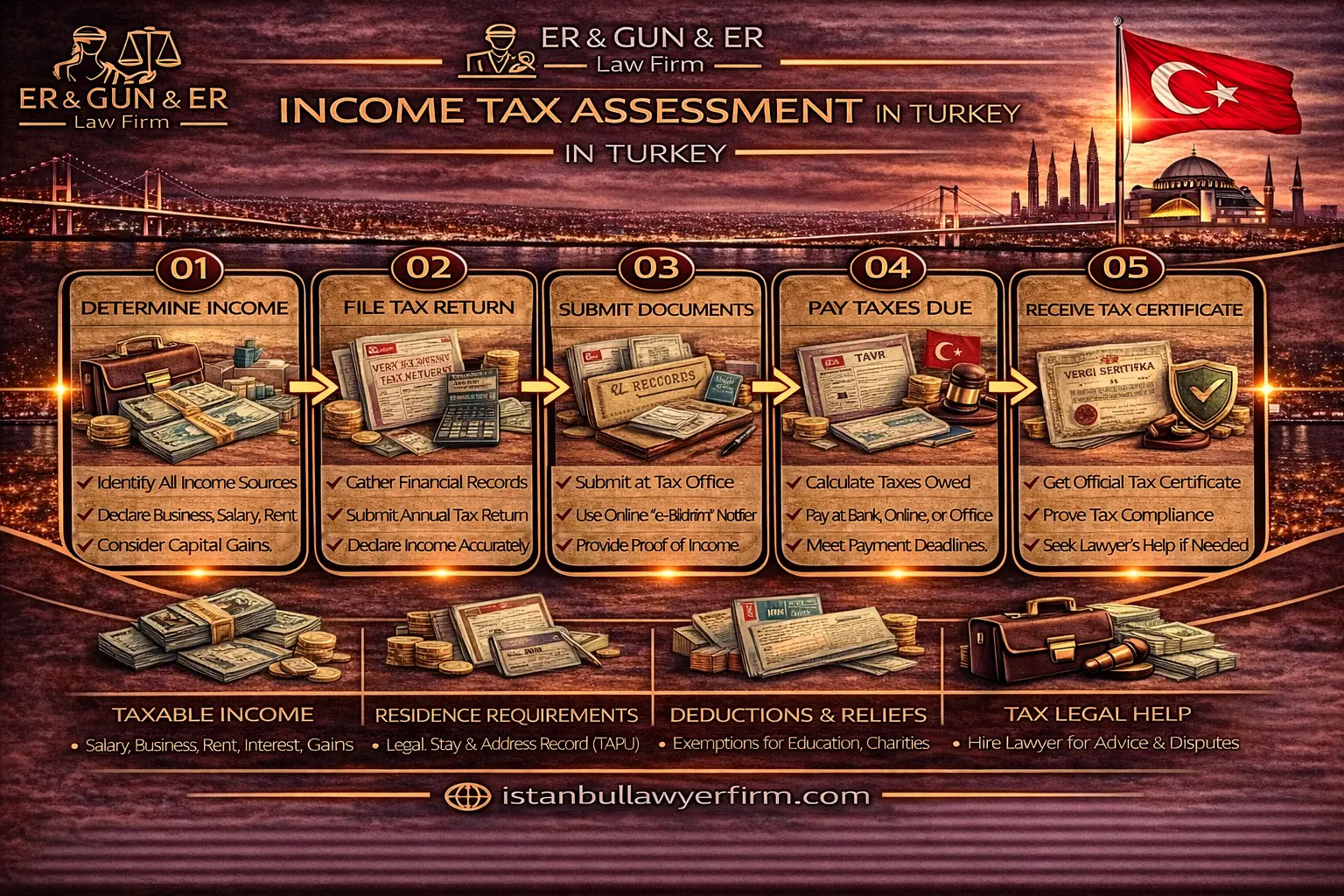
Income tax assessment in Turkey audits objections and tax court process

An income tax assessment is the tax authority’s formal determination that additional tax is due beyond what was withheld or declared, and it usually follows a data-driven review rather than a random guess. In practice, income tax assessment Turkey disputes arise when declarations, withholding records, banking traces, and third-party information do not reconcile into one consistent income picture. The process commonly starts with an audit or inspection request under the Tax Procedure Law, continues with a draft assessment and taxpayer explanations, and then results in an assessment notice and related charges. Once an assessment is issued, the taxpayer must decide quickly whether to pursue administrative remedies, reconciliation discussions, or litigation before the Tax Courts. The risk is rarely limited to the headline tax, because interest, penalties, and collateral implications for immigration, banking, or corporate structuring can follow if the file is handled inconsistently. For individuals and founders, the same assessment can also raise questions about tax residency and whether foreign income should be included in the taxable base. For employers, the same assessment may expand into payroll withholding, fringe benefits, and expense recharacterization if records are incomplete or informal. A defensible strategy is built on contemporaneous evidence, a coherent narrative tied to legal concepts under the Income Tax Law and the Tax Procedure Law, and disciplined communication with the inspection team. When the file becomes contentious, engaging a lawyer in Turkey early helps prevent procedural mistakes and keeps submissions consistent across administrative and judicial stages. This is also the point where tax lawyer Turkey assessment dispute work focuses on evidence quality, time-limit management, and sequencing choices that preserve options while controlling cost. practice may vary by authority and year — check current guidance.

Assessment concept Turkey

In Turkish practice, assessment is the umbrella term for the authority’s calculation of tax due based on declarations, withholding information, or ex officio determinations when the authority considers the filing incomplete. The most common entry point is a Turkish income tax audit that begins with a request for explanations and supporting records rather than an immediate allegation. Even when the underlying issue is simple, the case file can widen because each income stream is tested against bank movements, invoices, and third-party reporting. The legal framework is mainly anchored in the Income Tax Law for taxable income concepts and in the Tax Procedure Law for assessment mechanics, audit powers, and procedural rights. An assessment can be based on corrected declarations, on recharacterization of income, or on an estimation approach where records are considered unreliable. Because assessment concepts are procedural, the same factual dispute may be framed differently depending on whether the authority treats it as under-declaration, non-filing, or non-compliance with documentation duties. A practical first step is to identify the authority’s theory and to test whether the theory fits the taxpayer’s actual business model, contracts, and money trail. The assessment outcome is usually communicated through a formal notice, and the taxpayer’s ability to respond depends on how that notice is served and how the file was documented before service. When practitioners refer to a tax assessment notice Turkey scenario, they usually mean this formal document trail that triggers objection windows and payment or security discussions. Companies with cross-border activity should also check whether corporate structure and shareholding documentation supports the declared income profile. Early coordination with corporate counsel is often useful, especially where the individual’s income depends on share transfers, dividends, or management fees. For founders or investors, the compliance file often connects to incorporation records, capital injections, and internal approvals that sit outside the tax team’s daily visibility. Where the person’s income is linked to a newly formed entity, refer to company formation basics to ensure the legal structure and the tax file describe the same commercial reality. The objective at this stage is not to litigate, but to isolate the factual questions that will decide the outcome and to gather proof while it is still available. If the authority’s theory relies on assumptions, challenge those assumptions with documents, not with rhetoric, because tax files are evidence-driven. Where the taxpayer needs coordinated review across tax and corporate documents, a law firm in Istanbul can help maintain a single, consistent narrative across workstreams. practice may vary by authority and year — check current guidance.

Penalties are often what make an assessment feel disproportionate, because the taxpayer experiences the file as a combined tax and sanction package. Under the Tax Procedure Law, penalties are typically linked to the nature of the non-compliance, such as under-declaration, failure to keep records, or failures in documentation. When discussing tax penalties Turkey income tax, the practical question is not only the legal label but also what evidence the authority relies on to establish intent, negligence, or procedural breach. A strong defense begins by separating pure calculation disagreements from conduct allegations, because the evidence burden and the negotiation space differ. If the issue is classification or valuation, the file should focus on contracts, bank trails, and economic substance rather than on motives. If the issue is missing documentation, the file should show what documentation existed, why gaps occurred, and whether the taxpayer acted to correct them in good faith. Penalty exposure can also shift with settlement choices, because some procedures affect whether penalties are reduced, deferred, or litigated. The safest approach is to treat penalties as a litigation risk from the first day, so the taxpayer avoids admissions that later harden the authority’s position. Communication discipline matters especially for foreign taxpayers who may be tempted to explain using non-Turkish accounting concepts that do not map cleanly onto local categories. A bilingual strategy document can prevent misunderstandings between the taxpayer, the accountant, and the inspection team, and it reduces contradictory submissions. For cross-border individuals, counsel should also check whether penalty narratives could trigger banking compliance issues or reputational consequences. The defense file should remain factual and should avoid overpromising outcomes, because inspection teams evaluate credibility through consistency over time. practice may vary by authority and year — check current guidance. When instructions and approvals must be coordinated with overseas management, an English speaking lawyer in Turkey can ensure that the Turkish procedural steps are understood without translating them into misleading certainties. A pragmatic objective is to narrow the dispute to a few provable points that can be evaluated by an expert or a judge, rather than arguing every detail at once. Even when a settlement is pursued, keep the evidence file litigation-ready, because negotiations can fail and timelines can be short.

The concept of assessment also includes the taxpayer’s procedural rights, which are often overlooked in early-stage discussions. Taxpayer rights include the ability to access the file, to submit explanations, and to challenge assumptions through documentary proof. A frequent mistake is treating the inspection as informal correspondence, while the authority treats it as a formal record that will be used in objections and court. Every submission should therefore be drafted as if it will be read later by a different reviewer who was not present in the early exchanges. This approach forces the taxpayer to keep chronology clear and to avoid contradictory explanations across different letters. It also forces the team to define the key dispute issue, such as residency, source of income, or deduction eligibility, before debating peripheral points. Where cash flows are complex, the taxpayer should prepare a transaction map that links each inflow to a contract, invoice, or other lawful explanation. The map is not a substitute for evidence, but it helps ensure that evidence is gathered in a targeted way rather than randomly. If the authority relies on third-party data, challenge data quality by requesting the underlying source and by demonstrating mismatches with actual bank documentation. If the authority relies on estimations, request that the estimation logic be explained and test whether it contradicts the taxpayer’s documented business model. It is also prudent to consider parallel risks, such as corporate tax implications or VAT consequences, when the authority recharacterizes a transaction. Tax controversy is often won by disciplined document management, not by aggressive language, because the record is what the judge sees. practice may vary by authority and year — check current guidance. Experienced Turkish lawyers typically recommend building a unified evidence folder and a single narrative memo that guides every submission across stages. That memo should identify what the taxpayer concedes, what the taxpayer disputes, and which facts remain unknown pending additional evidence. When the narrative is coherent, administrative reviewers are more likely to focus on the real dispute rather than on perceived inconsistencies.

Tax residency determination

Residency is the gateway issue because it determines whether Turkey taxes only Turkey-source income or also worldwide income for an individual. Tax residency Turkey income tax analysis is not limited to immigration paperwork, because tax law uses its own tests tied to habitual presence and the center of vital interests. The authority will look at factual indicators such as where the person lives, where the family is based, where business is managed, and how long the person is physically present in Turkey. Because the statutory tests include time-based concepts, avoid relying on memory and instead maintain travel records, accommodation contracts, and utility traces. If the individual holds a residence permit, that document can be relevant background, but it is not automatically decisive for tax status. Conversely, absence of a residence permit does not automatically negate residency for tax purposes if the factual indicators point toward Turkey. Foreign income reporting Turkey tax exposure flows from residency, so residency analysis should be completed before debating foreign dividends, salaries, or capital gains. The practical task is to build a residency file that explains where the person’s economic and personal ties are strongest, supported by documents rather than statements. Where the person splits time between countries, align the file with any applicable double tax treaty tie-breaker concepts without assuming an outcome. The tie-breaker analysis often depends on where a permanent home is available and where the person’s habitual abode is located. It may also depend on nationality and mutual agreement procedures, depending on the treaty and the fact pattern. practice may vary by authority and year — check current guidance. If the authority asserts residency, the defense should respond with a structured chronology and evidence, not with general claims about intentions. Where the person has Turkish entities or investments, link corporate records and banking traces to the residency narrative to avoid implied management in Turkey. For internationally mobile founders, coordinated review by an Istanbul Law Firm can ensure that the residency file, the corporate file, and the banking file remain consistent. Residency disputes are often decided by cumulative indicators, so small documents such as leases and travel tickets can be decisive when compiled coherently.

A residency determination file should start with a clear statement of facts and a list of documents that support each fact. If the taxpayer claims non-residency, the file should show a stable tax home abroad, employment or business activity abroad, and continuing personal ties outside Turkey. The file should also show why any time in Turkey was temporary, such as specific project travel, medical treatment, or family visits. Avoid broad statements like permanent return plans, because they are hard to prove and can be undermined by one contradictory document. Instead, rely on objective traces, such as foreign payroll records, foreign lease contracts, school registrations, and foreign social security coverage where relevant. If the person receives income from Turkey, explain the income source and show why it remains Turkey-source without implying Turkey-based management. Where bank accounts are involved, keep a coherent explanation of inflows, currency conversions, and transfers between personal and corporate accounts. Where the taxpayer’s main income is abroad, show that decision-making and performance of services occurred abroad, supported by emails, travel logs, and client correspondence. If the authority requests explanations, respond with one consolidated letter rather than multiple fragmented responses from different advisers. Fragmented responses often create contradictions that are later treated as credibility problems rather than simple misunderstandings. If a foreign certificate of residence is used, ensure it is current and corresponds to the relevant tax period being examined. If the certificate is in a foreign language, provide accurate translations and avoid adding interpretative gloss that overstates legal effect. practice may vary by authority and year — check current guidance. A Turkish Law Firm can coordinate this documentary approach and ensure that submissions match the terminology used in the Income Tax Law and the Tax Procedure Law. When the evidence is organized, the taxpayer can also evaluate settlement options more realistically because the strength of each position is visible. This documentation discipline is equally valuable if the dispute escalates to court, because the same residency file becomes the foundation for litigation exhibits.

Residency disputes should be approached strategically because they often affect multiple years and multiple income streams. A short-term win that relies on inconsistent facts can create a longer-term exposure when the next year is reviewed. The goal is to adopt a position that can be supported consistently with documents across time and across agencies. If an individual will spend significant time in Turkey in the future, plan in advance how that presence will be documented and how foreign ties will be maintained. If the person intends to relocate, plan the transition year carefully so that income allocation is supported and double taxation is minimized legally. For executives, align board minutes, signing authorities, and management records so that personal presence in Turkey does not imply permanent establishment control for foreign entities. Where spouse and children move to Turkey, anticipate that the authority may treat this as a strong indicator of vital interests shifting. Where property is acquired in Turkey, document the purpose and use of the property to avoid assumptions about permanent home availability. The taxpayer should also maintain a clear record of foreign tax filings to avoid the impression that no country taxes the income. If the authority challenges residency, respond with a structured plan that prioritizes the decisive indicators rather than disputing every minor point. Settlement and litigation decisions should be made after assessing the evidence strength and the potential collateral consequences, including banking compliance and immigration effects. practice may vary by authority and year — check current guidance. In complex disputes, advice from a best lawyer in Turkey is valuable when it is grounded in document strategy and procedural timing rather than in optimistic assumptions. A well-managed residency file also supports future audits because the taxpayer can produce the same coherent story quickly. This reduces disruption and reduces the risk that ad hoc explanations create new inconsistencies. Residency planning is therefore not only a tax exercise but also a governance exercise that connects travel, contracts, and corporate documentation.

Income categories overview

Once residency is understood, the next step is to classify income correctly under the Income Tax Law because classification controls how tax is computed and how evidence is evaluated. Employment income is generally supported by payroll records, bank transfers, and employer declarations, and disputes often arise from fringe benefits and expense reimbursements. Business income is typically evaluated through books and records, invoices, and bank reconciliation, and disputes often arise from undocumented costs or mismatched sales figures. Self-employment style professional income raises issues of contract characterization and the timing of revenue recognition. Investment income, such as dividends and interest, raises issues of source and withholding and may require coordination with bank statements and broker confirmations. Rental income raises issues of lease documentation, actual collection, and expense substantiation, and it often triggers separate discussions about property ownership and valuation. Capital gains issues arise in share transfers and property transfers, and the audit focus often turns to acquisition cost evidence and the real economic substance of the transaction. For individuals with multiple streams, the authority may attempt to aggregate inflows and treat them as unreported income unless each stream is supported by a clear explanation. A good practice is to build an income map that links each recurring inflow to a category, a source document, and a tax treatment rationale. The map should also identify which inflows are loans, capital injections, or reimbursements, because those items are frequently misread as taxable income in bank-based analyses. When foreign currency is involved, maintain consistent documentation of conversion, remittance, and purpose, because currency movement can make ordinary cash flows look suspicious. Where income is connected to company activity, align the personal income map with corporate records so that the authority does not allege concealed distributions. If a person is both shareholder and manager, keep clear separation between salary, dividends, and shareholder loans to avoid recharacterization. If a person receives client funds, maintain client escrow documentation and ensure the money trail shows pass-through rather than personal benefit. practice may vary by authority and year — check current guidance. Correct categorization is the foundation for every later objection because it determines which legal concept the taxpayer must defend.

Classification also determines which records must exist, so the taxpayer should test documentation expectations for each category before responding to an audit letter. For salary, the key documents are payslips, employer declarations, and bank transfers that match payroll dates. For business income, the key documents include invoices, receipts, and accounting ledgers that reconcile to bank movements and stock records. For rental income, the key documents include written leases, collection receipts, bank transfers, and proof of deductible expenses. For investment income, the key documents include bank statements, broker statements, and corporate resolutions for dividend distributions. For capital gains, the key documents include purchase contracts, sale contracts, and proof of acquisition cost that is consistent with payment traces. When the authority relies on third-party data, such as banking information or e-invoicing data, taxpayers should request the underlying extracts and reconcile them line by line. A reconciliation exercise often reveals that inflows include non-taxable items such as loan proceeds, internal transfers, or customer advances that were later refunded. If those items are not explained, they may be treated as hidden income by default because the authority sees cash and looks for a taxable label. The taxpayer should therefore prepare a source narrative for each large inflow that can be supported by contracts and correspondence. Where capital injections are involved, corporate documents should show the decision process and the banking trace should show the actual funding route. Where gifts or family transfers are claimed, keep documentary proof of relationship and transfer purpose, because unsupported assertions are often disregarded. Where property transactions are involved, keep title deed records and payment schedules, because the authority may cross-check with land registry data. Where multiple jurisdictions are involved, avoid mixing foreign and Turkish tax concepts in one sentence, because terminology differences can create unintended admissions. practice may vary by authority and year — check current guidance. A disciplined evidence approach allows the taxpayer to challenge the authority’s assumptions without relying on broad statements about fairness.

Income categorization should also be consistent with the taxpayer’s broader compliance footprint, including corporate filings, immigration records, and banking compliance. If an individual is a foreign investor, corporate formation choices may influence how payments are characterized, such as salary versus management fee versus dividend. If the individual is a director, board minutes and signature authorities can become evidence in disputes about where income-producing work was performed. If the individual holds real estate, rental and sale flows should be tracked separately from other cash flows to avoid aggregation errors. If the individual operates through multiple accounts, maintain an account register that shows which accounts are personal and which are corporate. Tax authorities often view unexplained inter-account transfers as potential concealment, so the taxpayer should maintain transfer explanations and supporting documents. Where expenses are claimed, the taxpayer should be prepared to show business purpose and link the expense to income-producing activity. Overly broad expense claims without documentation can trigger reclassification and penalties even where the underlying income is declared. Where the taxpayer uses credit cards for mixed personal and business spending, maintain internal allocation records and ensure allocations are consistent across years. If the taxpayer changes accounting advisers, maintain continuity of records so that gaps are not misread as deliberate omissions. If the taxpayer receives foreign payments, maintain a clear chain of contractual performance and invoicing so that the source and nature of the income is provable. If the taxpayer uses cash, document the business reason and maintain receipts, because cash-heavy profiles are often treated as higher risk for estimation. The practical objective is to keep every inflow and outflow explainable through a document trail that fits one income category narrative. practice may vary by authority and year — check current guidance. When the income categories are mapped coherently, subsequent audit steps become narrower because the authority cannot easily re-label the same cash flow twice. This mapping also supports litigation because expert reviewers can evaluate the taxpayer’s position against the legal category framework rather than against raw bank numbers.

Withholding versus filing

The Turkish system relies heavily on withholding at source, but withholding does not always end the taxpayer’s obligations. The key compliance question is withholding tax versus declaration Turkey, meaning whether the withholding is treated as final tax or as an advance credit against a later declaration. Employment income is often taxed through payroll withholding, yet certain adjustments and other income streams may still require the individual to file declarations. Investment income may be withheld by banks or intermediaries, but the tax treatment can depend on residency status and the nature of the instrument. Rental income may involve withholding in some commercial scenarios, but individuals should not assume that a withholding trace exists unless it is documented. Business income is generally assessed through declarations supported by accounting records, and withholding is not a substitute for proper filing. The authority often cross-checks withholding reports with bank inflows, and discrepancies can trigger audit initiation even when the taxpayer believes tax was already paid. Where a foreign employer pays salary abroad, withholding may not occur in Turkey, which can lead to assessment if the taxpayer is treated as resident. Where multiple payers exist, mismatches between payer reporting and recipient reporting are common triggers for assessment correspondence. Taxpayers should keep withholding certificates, payslips, and bank transfer records in one folder so they can demonstrate that tax was collected where applicable. If a withholding was applied incorrectly, correction often requires procedural steps that must be planned carefully rather than handled informally. Because withholding rules and filing expectations can change by year, do not rely on old practice or generalized summaries. practice may vary by authority and year — check current guidance. A defensive approach is to test each income stream and confirm whether there is a filing obligation even when withholding exists. Where uncertainty exists, document the basis for the chosen treatment and retain adviser correspondence so the decision appears reasoned rather than accidental. This discipline reduces the risk that the authority frames the case as non-filing rather than as a correctable calculation issue.

Withholding disputes often turn on the banking and payment mechanics because the authority can see inflows through information exchange and reporting systems. If salary or fees are paid through multiple accounts, reconcile the accounts and explain why amounts differ between contracts and bank statements. Where payments are routed through foreign accounts, keep transfer records and contractual documents that identify the payer, the purpose, and the relevant period. If the taxpayer recently opened a local account, document the source of funds and the reason for transfers to reduce suspicion in bank-based reviews. If the account was opened as part of relocation, internal onboarding documentation may support the timeline and the non-tax purpose of early transfers. For practical planning, refer to remote bank account opening overview when setting up compliance files that connect banking, residency, and tax documentation. Do not assume that bank statements alone explain the nature of a payment, because banks often use short references that do not identify the underlying contract. Instead, attach bank transfers to invoices, payroll runs, or board decisions so each payment has a documented legal basis. If reimbursements are paid, keep reimbursement policies and receipts, because reimbursements can be misread as hidden remuneration. If a payment is a loan, keep the loan agreement, disbursement proof, and repayment schedule so the authority cannot treat it as income by default. If the taxpayer uses alternative payment methods, document conversion steps and counterparties, because opaque flows invite estimation theories. Taxpayers should also consider banking compliance questions, because banks may ask for explanations that overlap with tax narratives. Inconsistent explanations to banks and tax authorities are a common credibility problem, so keep one coherent explanation file. practice may vary by authority and year — check current guidance. Withholding is a legal concept, but evidence is operational, so the taxpayer must build proof around how money actually moved. When the money trail is explainable, the taxpayer can focus objections on legal characterization rather than on unexplained cash.

Employers and payers should also treat withholding as a compliance process that requires internal controls and documented approvals. Payroll teams should ensure that taxable benefits and allowances are identified consistently and that the treatment is reflected on payslips and accounting entries. If a payer withholds tax, it should be able to produce the withholding certificate and the submission proof if the recipient is audited later. Recipients should not rely on a payer’s informal confirmation, because recipients may still be asked to prove the withholding outcome. Where payments are made from abroad, document whether the payment is employment income, service income, or investment income, because classification drives withholding expectations. If the taxpayer receives management fees from a company, board minutes and service contracts should be aligned with the characterization used in filings. If the taxpayer receives dividends, corporate resolutions and distribution records should be kept with the bank trace to show the income type clearly. If the taxpayer receives interest, keep the bank statement and the underlying instrument description so the authority can see what generated the income. Where income flows are irregular, prepare a short narrative memo that explains why the pattern is irregular, such as project completion payments or one-time asset sales. A narrative memo helps because raw bank data can make legitimate income appear inconsistent when examined without context. If an assessment begins, the first response should be to reconcile withholding data, bank data, and declaration data into one consistent table. The table should be backed by documents, because tables without exhibits are treated as assertions rather than proof. practice may vary by authority and year — check current guidance. When reconciliation is done early, the taxpayer can often narrow the dispute and avoid expanding into penalties driven by perceived non-compliance. When reconciliation is delayed, the same dispute can be reframed as negligence or concealment because the authority sees only gaps. Withholding management is therefore a preventive discipline that reduces both audit risk and dispute cost.

Audit initiation triggers

Audit initiation is rarely random in modern practice, because the administration works with cross-checks between declarations, withholding reports, and third-party data. A Turkish income tax audit commonly starts when those cross-checks show unexplained gaps rather than when an inspector has a subjective suspicion. Typical triggers include bank inflows that do not reconcile with declared income types, repeated amendments to declarations, or patterns that diverge from sector norms. Cash-intensive business models attract attention when the cash narrative is not supported by invoices, contracts, and inventory movement. Large foreign currency inflows can also trigger questions, not because they are automatically taxable, but because the source and purpose must be documented coherently. When the authority sees recurring transfers between personal and corporate accounts, it may test whether the flows are loans, capital injections, or hidden distributions. E-invoicing data, card payment data, and withholding submissions can be compared to bank statements, and mismatches are often treated as a starting hypothesis. A trigger may also be a third-party denunciation or a dispute with a counterparty that brings documents to the authority’s attention. For foreign investors, company structuring documents can become relevant background, so it is prudent to keep corporate records consistent with tax narratives. If your income profile depends on a Turkish entity, align the tax file with corporate governance records and, where needed, consult the foreign investor company law overview to avoid inconsistent terminology. Internal controls matter because inspectors test whether the taxpayer can produce documents quickly and consistently. A calm first response focuses on mapping the suspected gap and producing the documents that close it, rather than debating motives. If the first correspondence is handled casually, small inconsistencies often multiply and become the real problem. This is why early coordination with a lawyer in Turkey tends to reduce friction and prevent avoidable procedural mistakes. practice may vary by authority and year — check current guidance.

Audit triggers also arise from mismatch between lifestyle indicators and declared income, especially where major acquisitions are visible through registries or banking. Where property is purchased or sold, the tax authority can cross-check land registry and banking traces against declared sources. If funds are remitted from abroad, the key question becomes documentation, not stigma, because authorities want a coherent trail from origin to Turkish account. Taxpayers often lose early stages because they respond with explanations but no proof, or because proof is scattered across advisers. A practical response is to build a single source-of-funds memo that ties each material inflow to supporting contracts, bank statements, and third-party confirmations. Where banks have already requested KYC explanations, align those explanations with the tax narrative to avoid contradictions. If you need an internal template, the source of funds verification guide can be adapted to tax audit evidence planning. Do not assume that a transfer labeled as loan will be accepted as a loan without a signed agreement and a credible repayment logic. Do not assume that a family transfer will be accepted without proof of relationship and context, especially when amounts are significant. Inspection teams often focus on whether the taxpayer’s story is stable over time, because shifting explanations signal weakness. For businesses in Istanbul, audits can move quickly once an inspector decides the gap is material, so document readiness matters. An organized file allows you to narrow an income tax assessment Turkey dispute to one classification question rather than arguing across every bank line. When the matter escalates, a law firm in Istanbul can coordinate corporate, banking, and tax documents so submissions remain consistent. This approach improves settlement leverage because the authority sees that the taxpayer can prove lawful sources rather than merely assert them. practice may vary by authority and year — check current guidance.

Certain industries generate predictable audit attention because their revenue and cost structures are prone to documentation disputes. Consulting, software, brokerage-like intermediation, and cross-border service models often involve mixed receipts that are easy to misclassify. Where a taxpayer receives funds in foreign currency, the paper trail may include banking forms and transactional documents that must be preserved. If those documents are missing, the authority may treat the inflow as taxable by default and force the taxpayer to disprove the assumption. For individuals, one common trigger is repeated inbound transfers followed by rapid outbound transfers, which can look like undeclared turnover without context. For companies, one common trigger is significant expense claims without third-party invoices that match the accounting entries. Another trigger is a pattern of related-party payments that does not align with the contracts or board approvals presented to banks. Even when the business model is legitimate, an audit becomes difficult if the taxpayer cannot describe the service, the customer, and the value chain in one coherent narrative. When foreign exchange compliance documentation is relevant, consult the foreign currency purchase document discussion to ensure that tax explanations and transaction documents do not conflict. An early strategy memo should anticipate what the inspection team will request and prepare the exhibits before the first meeting. If the authority announces an on-site review, confirm which records must be made available and how copies will be produced and logged. Do not allow different departments to answer the same question differently, because internal inconsistency is treated as unreliability. This is where Turkish lawyers often add value by imposing one narrative and one evidential standard across all submissions. A disciplined approach also reduces disruption because the audit stays focused on provable points rather than expanding into speculation. practice may vary by authority and year — check current guidance.

Books and records duties

Books and records duties are the backbone of tax controversy because the authority evaluates credibility through documentary continuity. In a books and records Turkey tax audit context, the question is not only whether a document exists, but whether the document can be linked to a transaction and a bank movement. For individuals with business activity, maintain contract files, invoices, and correspondence that show what service or asset produced each inflow. For employers, maintain payroll files, withholding submissions, and internal approvals for benefits and reimbursements. For investors, maintain portfolio statements, dividend resolutions, and transaction confirmations that tie each receipt to an identifiable instrument. Where cash is used, maintain contemporaneous receipts and purpose explanations, because after-the-fact narratives are rarely persuasive. Where expenses are claimed, maintain third-party invoices and proof of payment, and avoid generic receipts that do not identify the counterparty. If you use electronic ledgers or e-invoice systems, keep proof of system integrity and access controls, because disputes sometimes include allegations of later alteration. Document retention should be treated as a compliance program rather than as a filing cabinet, with clear owners and periodic checks. When an audit starts, the ability to produce complete records quickly often shapes how the inspection team frames the case. If records are missing, the authority may move toward estimation methods, shifting the discussion from proof to assumptions. A preventive strategy is to run internal reconciliations between accounting entries and bank statements so gaps are discovered before the inspector discovers them. When corporate and personal records overlap, separate them clearly so that inter-account transfers are not misread as taxable receipts. In complex structures, an Istanbul Law Firm can help design a document architecture that supports both ongoing compliance and dispute readiness. practice may vary by authority and year — check current guidance.

Record duties are also about format, because the authority may require that records be produced in a readable and traceable way. Bank statements should be complete, including all pages and account identifiers, because partial extracts invite suspicion. Where transactions are linked to foreign accounts, provide the full transfer chain rather than only the final credit into Turkey. Contracts should be provided with signature pages and annexes, because missing annexes are often treated as missing terms. Invoices should be matched to payment proof, and payment proof should be matched to accounting entries, so the file shows a closed loop. If the taxpayer relies on foreign documents, translation quality matters because small terminology errors can change the perceived income category. Maintain translation consistency for job titles, service descriptions, and payment labels so submissions do not contradict each other. Where the authority requests originals, document how originals are stored and how copies are certified, to preserve chain of custody. Where electronic correspondence is relevant, preserve email headers and metadata when possible, because context can matter. The concept of evidence in tax disputes Turkey is practical, meaning every assertion should be backed by an exhibit that a court can read without oral explanation. If a document has confidentiality sensitivity, consider redaction protocols, but do not redact in a way that removes the decisive fact. Keep an index of documents provided to the inspector, including dates, so later objections can show exactly what was submitted and when. When taxpayers are managed by foreign headquarters, communication delays often create inconsistent partial submissions. An English speaking lawyer in Turkey can coordinate document collection across jurisdictions and produce one coherent submission set. practice may vary by authority and year — check current guidance.

When records are incomplete, the authority may assert that the taxpayer has failed its documentation duties and treat the file as higher risk. This can change the procedural posture because the inspector may rely more heavily on third-party information and estimation logic. The taxpayer should then focus on reconstructing the transaction trail using objective sources such as bank records, counterpart confirmations, and registry extracts. Reconstruction is difficult when counterparties are uncooperative, so early preservation of contracts and communications is critical. If the authority claims that records are unreliable, challenge that claim by showing consistent record-keeping over time and by explaining any isolated gaps. Where the gap is due to a system migration or adviser change, provide transition documents that show continuity rather than absence. Do not attempt to fix gaps by creating backdated documents, because that approach can create a conduct allegation more serious than the original tax issue. Instead, document what happened, explain what can and cannot be proven, and focus on narrowing the dispute to what the authority can actually support. A tax inspection Turkey procedure often records these discussions in minutes, so ensure every meeting ends with a written summary that matches your evidence. If the inspector’s summary is incomplete or misleading, request correction promptly and keep a copy of your correction request. This discipline matters because later objections and court filings will rely on the written inspection record. Where the taxpayer’s file is complex, expert accounting support can be engaged early to create reconciliation schedules and exhibit bundles. In high-stakes cases, a best lawyer in Turkey will focus on proving a limited number of decisive facts rather than arguing broadly. That focus often reduces penalties exposure because it undermines narratives of concealment and supports a good-faith compliance story. practice may vary by authority and year — check current guidance.

Tax inspection process

A tax inspection is usually conducted under a formal assignment, and the first operational task is to verify the inspector’s authorization and scope. The taxpayer should request clarity on which tax periods and which income streams are under review, because ambiguity leads to unnecessary document production. Inspections may be desk-based or may involve on-site visits, and each format has different evidence handling risks. In any format, the taxpayer should keep a log of requests, responses, and meeting dates to preserve procedural chronology. Requests should be answered with consolidated submissions rather than piecemeal emails, because fragmentation creates contradictions. Where meetings occur, ensure that the discussion is reflected accurately in written minutes and that corrections are requested promptly when needed. If the inspector asks for data exports, confirm the format and the security method for transfer, because sensitive personal data may be included. When third-party documents are used, such as bank letters or employer confirmations, keep the original and the delivery record in the file. If an inspector relies on assumptions, ask that the assumptions be stated in writing so they can be challenged with documents. The inspection process should be managed as a document project with clear internal owners, not as an ad hoc conversation. If the taxpayer is a business owner, align accounting advisers and legal advisers so they do not deliver inconsistent explanations. Where corporate structure matters, keep corporate records and board approvals ready, because the inspector may test substance and control. This is where a Turkish Law Firm can coordinate the evidence plan and ensure submissions are drafted for later administrative objection and court review. A calm tone helps because aggressive language often leads to defensive escalation and reduces settlement space. practice may vary by authority and year — check current guidance.

As the inspection progresses, the inspector typically drafts findings that may include recharacterization of income, rejection of deductions, or residency assertions. The taxpayer should treat any draft findings as the moment to focus, because later stages are built on what is recorded at this point. If a transaction is misunderstood, provide the complete transaction set in one bundle rather than sending scattered clarifications. If the issue is classification, provide the contract, invoice, payment proof, and a short legal explanation that links the facts to the Income Tax Law category. If the issue is documentation, provide proof of record-keeping systems, retention policies, and prior years’ consistent treatment where relevant. If the issue is residency, provide the residency file with travel logs, home evidence, and foreign tax compliance documents. If the inspector suggests estimation, challenge the factual basis for estimation and offer alternative reconciliations grounded in bank records. Keep internal notes of each meeting and align them with the official minutes so that internal recollection does not diverge from the file. Avoid changing your narrative mid-process, because the inspector will treat shifting explanations as evidence of unreliability. Where a counterparty can confirm facts, request a confirmation letter that uses neutral language and attaches supporting documents. Do not rely on oral assurances that the file will be closed, because procedural decisions are made through written steps. If the file involves multiple taxpayers, such as spouses or related entities, coordinate submissions so that one file does not contradict another. When accountants and lawyers work together, agree on a single terminology set for income types and transaction labels. If you discover an error in your own filing, evaluate correction options carefully and document the correction rationale. practice may vary by authority and year — check current guidance.

Throughout inspection, the taxpayer should preserve procedural rights by responding on time and by requesting written clarification when scope is unclear. If the authority requests documents outside the stated period, ask for the relevance link so production remains proportionate. If the taxpayer must provide sensitive data, use controlled disclosure methods and record what was shared, with whom, and on what date. Confidentiality concerns should be raised early, because once documents are in the file they may be used broadly within administrative review. If the inspection involves foreign documents, keep certified translations consistent and avoid introducing new factual claims in translation notes. If the inspector relies on third-party data, request the source extract so the taxpayer can test data quality and timing. If data quality is poor, demonstrate mismatches with bank confirmations and accounting ledgers, and request that incorrect data be excluded. Maintain a document index that shows each exhibit, its date, and what fact it proves, because later objections require precise references. This index becomes critical when multiple findings are bundled into one report and the taxpayer must respond point by point. Where the taxpayer anticipates litigation, submissions should already be drafted as court-ready narratives supported by exhibits. A court-ready narrative avoids colloquial explanations and instead connects each fact to a legal concept under the Tax Procedure Law. If the taxpayer chooses to negotiate, keep negotiation letters consistent with the legal position so later litigation is not undermined by admissions. If the taxpayer chooses to litigate, avoid settlement discussions that require concession of contested facts without clear benefit. The inspection stage is also the time to preserve evidence from counterparties before relationships deteriorate. practice may vary by authority and year — check current guidance.

Assessment and notices

After inspection findings are finalized, the authority issues assessment documents that convert the inspector’s conclusions into a payable claim. A tax assessment notice Turkey is not only a calculation sheet, because it also triggers objection options, payment discussions, and sometimes collection measures. The first compliance task is to verify service, because procedural rights often depend on when and how the notice is deemed delivered. The second task is to verify what exactly was assessed, because files sometimes combine multiple issues such as residency, deductions, and recharacterization. A careful reading should separate the principal tax from interest-type adjustments and from penalty-type charges, because each item may have different defenses. The notice should be matched to the inspection report to ensure that the assessment does not exceed the scope or logic of the findings. If the assessment relies on estimations, identify what assumptions drive the numbers, because challenging one assumption can reduce multiple items. If the assessment relies on third-party data, request the source data and show mismatches with verified bank records. The taxpayer should also evaluate immediate cash-flow risk, because contested amounts can still create liquidity pressure. Where payment is discussed, document every communication and avoid informal promises that later appear as admissions. If security or installment options are considered, assess them as procedural tools rather than as acceptance of liability. If the assessment includes multiple years, build a year-by-year table that tracks what evidence applies to each year. If the assessment includes foreign income issues, ensure that treaty and residency positions are aligned before filing any objection. Do not delay evidence collection after notice, because counterparties may become less cooperative once a formal dispute is visible. practice may vary by authority and year — check current guidance.

Once a notice is served, the taxpayer must choose a dispute route, and the choice should be made based on evidence strength and cash-flow constraints. An administrative objection tax assessment Turkey route is often used to correct misunderstandings and to put structured legal arguments on record before litigation. Administrative submissions should be written as if they will be read later by a judge, because administrative reviewers often rely on the same file. The submission should state the disputed points narrowly, attach decisive exhibits, and avoid rhetorical attacks on the inspector. If the dispute is about classification, attach the contract set and a short explanation linking the facts to Income Tax Law categories. If the dispute is about residency, attach the residency chronology and the foreign compliance documents that support the position. If the dispute is about deductions, attach invoices, payment proof, and business purpose explanations tied to the income stream. Where negotiation is possible, reconciliation tax audit Turkey discussions can sometimes narrow issues without forcing the taxpayer to concede the entire file. Negotiation should still be evidence-led, because concessions made without a clear document basis can harm later court arguments. Before choosing negotiation, assess whether the authority’s position is based on a provable error or on a policy stance that will not move without litigation. If the taxpayer is a business, coordinate with accounting advisers so the same evidence set supports both objection and financial reporting. If the taxpayer is an individual, coordinate with banking and immigration advisers to avoid collateral inconsistencies. Where multiple assessments are issued, manage them through one master file and one narrative memo to prevent contradictory arguments. Because objection windows and procedural steps can shift by year, do not rely on general timelines circulated online. practice may vary by authority and year — check current guidance.

If administrative routes do not resolve the dispute, the taxpayer should be ready to litigate without losing time to rebuild the file. A tax court lawsuit Turkey income tax case is won on the written record, so the litigation bundle should be prepared as early as the inspection stage. The first litigation task is to define the legal issues precisely, because courts typically focus on whether the assessment has a lawful basis and whether proof supports the authority’s theory. The second task is to choose the decisive exhibits and to explain why each exhibit undermines the assessment logic. Courts do not reward volume, so avoid dumping hundreds of pages without showing how each document answers a specific allegation. If the dispute turns on accounting classification, consider engaging an independent accountant to produce a neutral reconciliation schedule. If the dispute turns on residency, present travel logs and home evidence in chronological form so the court can see the pattern without inference. If the dispute turns on foreign income, ensure that foreign tax filings and certificates are produced with certified translations. The litigation file should also address credibility, because inconsistent past explanations can be used against the taxpayer. To protect credibility, keep one narrative memo and ensure every submission matches it, including settlement correspondence. Where the assessment includes penalty allegations, separate factual disputes from conduct disputes and challenge intent assumptions with objective traces. If the taxpayer has already made partial payments, document the payment purpose and avoid language that suggests acceptance of liability. If security or installment measures were used, explain them as procedural risk management rather than as legal concession. A realistic litigation plan includes communication discipline, because internal emails and adviser notes can become evidence in related proceedings. practice may vary by authority and year — check current guidance.

Penalties framework overview

A penalties discussion should begin by identifying what the authority is actually alleging, because not every assessment carries the same conduct label. Under the Tax Procedure Law, penalties are typically attached to a finding of tax loss, documentation breach, or procedural non-compliance. In practice, tax penalties Turkey income tax exposure often rises when the inspector frames the gap as hidden income rather than as a classification dispute. That framing matters because the authority may treat the taxpayer’s explanations as mitigation only after it has formed an intent narrative. The first defense step is to separate calculation disputes from conduct disputes in writing and to keep those threads distinct in every submission. If the dispute is about category, focus on contracts, invoices, and bank reconciliation rather than on subjective intent. If the dispute is about documentation, show the record-keeping system, the retention policy, and the efforts made to correct gaps. Avoid conceding a breach simply to accelerate discussion, because a concession can harden the penalty theory in later review. Where the authority relies on lifestyle or wealth indicators, support the source of funds with documentary proof rather than broad explanations. If part of the funds came from inheritance or gifts, ensure that the related reporting file is coherent and contemporaneous, and review estate tax reporting guidance for consistency points. Penalty exposure also depends on whether the taxpayer cooperated promptly and provided stable explanations over time. Cooperation should still be disciplined, because oversharing irrelevant documents can create new questions and widen the scope. Some penalties are calculated as percentages and others may include fixed monetary components, and taxpayers should not assume that last year’s amounts apply. practice may vary by authority and year — check current guidance. A practical objective is to move the file from allegations about behavior to verifiable discussions about evidence and legal characterization. When the submissions are evidence-led, reviewers are more likely to treat the matter as a correctable assessment rather than as a punitive case.

Penalty outcomes are driven by the record, so the taxpayer should treat every meeting note, email, and submission as potential courtroom material. The inspector’s report is usually the document that anchors later administrative and judicial review, so factual corrections should be requested promptly when wording is inaccurate. Do not wait for the assessment notice to build the evidence bundle, because decisive exhibits may become harder to obtain once counterparties realize a dispute exists. If third parties such as employers, banks, or customers can confirm facts, obtain confirmations that attach underlying documents and avoid argumentative language. Where bank transfers are central, present full statements and link each line to a contract or invoice, because partial extracts invite suspicion. If the file involves foreign documentation, ensure translations are consistent across periods and do not introduce new claims that are not in the original. A reliable method is to prepare one reconciliation schedule and one exhibit index, and to use the same references in every submission. This discipline strengthens evidence in tax disputes Turkey because the reviewer can trace each assertion to a specific page without inference. If the authority alleges intentional concealment, respond with objective process evidence such as internal approvals, accounting workflows, and adviser correspondence. If a mistake occurred, explain the control failure and the corrective action rather than denying obvious facts, because denial undermines credibility. Where settlement discussions occur, keep settlement letters aligned with the legal position so that negotiation does not become an admission. In multi-period files, isolate which years are affected by which documents, because a weak year should not contaminate a strong year. Companies with complex structures often benefit from centralized coordination so that accounting, legal, and management speak with one voice. A Istanbul Law Firm can impose that coordination by controlling the narrative memo, the exhibit set, and the response cadence. When coordination is tight, penalty arguments can be narrowed to a small number of contested facts rather than a broad attack on the taxpayer’s credibility. This narrowing also improves the chance of proportional outcomes because reviewers are forced to engage with documents rather than assumptions.

A penalties strategy should be decided early, because later procedural choices can lock the file into an adversarial posture. If the taxpayer believes the dispute is a calculation issue, submissions should avoid language that sounds like confession of deliberate wrongdoing. If the taxpayer believes a documentation gap exists, the team should focus on reconstructing the trail through objective sources and documenting why the gap occurred. Where corrective filings are considered, evaluate whether they reduce exposure or simply create a new inconsistency, and document the rationale for whichever choice is made. Do not rely on informal assurances that penalties will be reduced, because reductions typically depend on formal procedures and recorded facts. Keep internal communications disciplined, because uncontrolled emails can later be interpreted as knowledge of non-compliance. If management is abroad, provide one written briefing note that summarizes the risk and the evidence position, and keep approvals documented. If the dispute affects multiple stakeholders, align accounting treatment with the legal position so financial statements do not contradict objection arguments. Where the authority’s theory hinges on intent, show a history of compliance controls, timely filings, and consistent accounting rather than debating psychology. If the authority’s theory hinges on concealment through related parties, show contractual substance, payment terms, and business rationale for intercompany flows. A measured approach often preserves settlement space while still preparing the file for court if settlement fails. practice may vary by authority and year — check current guidance. The credibility of the taxpayer’s story often matters as much as the correctness of the numbers because reviewers weigh reliability when evidence is incomplete. That is why experienced counsel will insist on a single narrative memo and will reject ad hoc explanations that change week to week. Selecting a best lawyer in Turkey for a penalty-heavy file should be based on litigation discipline, evidential method, and procedural timing awareness. When the strategy is coherent, the file becomes manageable even if the authority maintains a hard position, because the taxpayer can defend specific facts with specific exhibits.

Interest and adjustments

Interest and adjustment items can be as financially significant as the principal assessment, so they should be analyzed separately rather than accepted as automatic add-ons. In most files, interest is calculated by reference to statutory mechanisms under the Tax Procedure Law and related practice, and it typically tracks time between the relevant due date and payment. Because these mechanisms are time-dependent, service dates and document delivery method can materially change the computation. The first practical step is to confirm the exact chronology of notices, meetings, and service events that led to the final tax assessment notice Turkey document. If the chronology is wrong, the computation may be wrong, and challenging the chronology is often easier than debating accounting theory. Taxpayers should request that the authority explain the computation inputs, including the base amount, the start point, and the end point. If multiple taxes or periods are bundled, ensure interest is not duplicated across overlapping bases. Where payments were made during the process, keep bank evidence and official receipts so partial payment credits are reflected correctly. Taxpayers should also check whether adjustments were made for withholding credits or other prepayments that reduce the principal base. Do not assume that the authority will automatically apply the most favorable credit treatment without being prompted by documents. When the file includes foreign currency transactions, ensure the conversion basis used in computations matches the documented conversion trail. If the authority used a rate or a conversion assumption that does not match the evidence, challenge it with bank confirmations rather than with estimates. Interest rates and computation formulas may change over time and can be applied differently depending on the year under review. practice may vary by authority and year — check current guidance. A disciplined computation review often produces meaningful reductions even when the underlying tax dispute remains contested. Treating interest as a standalone issue also improves negotiation leverage because it shows the taxpayer has reviewed the file in detail.

Adjustment items can arise from reclassification of receipts, rejection of deductions, or timing differences that shift taxable income from one period to another. When timing is the dispute, the taxpayer should present contemporaneous contracts and delivery evidence to show when the income was earned and when the expense was incurred. Where expenses are rejected due to documentation, the taxpayer should test whether alternative proof exists, such as bank transfers, shipping records, and correspondence. If the authority applies inflation or valuation adjustments, request the basis and confirm that the assumptions match the taxpayer’s documented transaction terms. Do not accept a valuation assumption merely because it is expressed as a formula, because formulas still rely on inputs that can be wrong. If the file involves property income or property transactions, ensure the income tax story is consistent with parallel filings and registry-based positions. For coordination, review real estate tax basics so that rental and disposal narratives do not contradict other declared positions. Where bank documentation includes multiple currencies, present a clean conversion trail and avoid mixing spot conversions with end-of-period translations without explanation. If the authority uses a conversion method that differs from bank practice, challenge it with bank records and accounting policy documentation. Taxpayers should also verify whether any set-off or carry-forward concepts were applied correctly in the authority’s computation. If a set-off is denied, request the stated reason and test whether the denial is procedural or substantive. Where the denial is procedural, correction may be possible through additional documentation rather than through full litigation. Some adjustment mechanisms are sensitive to the tax year, the filing posture, and the administrative practice of the relevant unit. practice may vary by authority and year — check current guidance. A coherent adjustment review can also protect against future audits because it forces the taxpayer to document transaction timing and valuation policy clearly. Even when the taxpayer intends to litigate, a clean adjustment analysis helps the court understand what is truly disputed.

Interest considerations should influence procedural strategy, because cash-flow risk grows as a file stays open. If the taxpayer expects long proceedings, it is prudent to evaluate payment sequencing and security options early, without conceding liability. The taxpayer should document every payment as a risk-management measure and avoid language that frames payment as acceptance. Where payment is made to stop accrual, keep the payment receipts and the correspondence that explains the purpose. If the taxpayer disputes the principal but pays part, present the payment as conditional and linked to the dispute stage, if the procedure allows. The authority’s computation often relies on procedural milestones recorded during the inspection, so the taxpayer should review those milestones carefully. This is why tax inspection Turkey procedure discipline matters, because minutes, service records, and internal notices become computation inputs. If the service date recorded in the file is incorrect, request correction immediately rather than waiting for litigation. If the taxpayer’s adviser changes during the process, ensure the handover file includes all notices and receipts so continuity is preserved. When interest is disputed, present a step-by-step chronology that the reviewer can verify against the file without inference. Avoid arguing abstract fairness, and instead show the exact record mismatch that leads to an incorrect start point or base amount. In complex files, accountants and counsel should agree on a single computation model so that submissions do not present competing numbers. Experienced Turkish lawyers often manage this by fixing one chronology and one computation schedule before any objection is filed. practice may vary by authority and year — check current guidance. A stable chronology also supports settlement discussions because the parties can debate the disputed inputs rather than debating what happened procedurally. When interest issues are managed with the same discipline as principal tax issues, the taxpayer reduces both cost uncertainty and litigation noise.

Reconciliation options

Reconciliation options are often the most practical lever in a controversy file because they can narrow issues without waiting for full judicial review. A reconciliation decision should be made after a structured risk analysis, not as a reflex to avoid discomfort. The analysis starts by identifying which findings are factual and which are interpretative, because factual gaps are harder to win on appeal. If the authority’s position is based on a provable data error, reconciliation can be used to correct the file quickly and to prevent the error from hardening into a judgment. If the authority’s position is a policy stance, reconciliation may still be useful, but only if the taxpayer is willing to trade certainty for concessions. In a reconciliation tax audit Turkey setting, the taxpayer should enter discussions with a complete exhibit set and a clear narrative memo. Negotiations should focus on the decisive items rather than on every line, because broad arguments often reduce settlement credibility. A common mistake is conceding disputed facts verbally during meetings, and then discovering that the meeting record treats the concession as binding. To avoid this, keep every statement conditional and tie every proposal to the evidence bundle. Where penalties are attached, the taxpayer should assess whether reconciliation affects the penalty posture and how that affects future risk. Because rates, reductions, and procedural impacts can change, do not rely on old rules discussed in informal circles. practice may vary by authority and year — check current guidance. A lawyer in Turkey can structure reconciliation communications so that proposals are clear, documented, and consistent with later litigation positions. This is particularly important when management wants a quick answer and may be tempted to accept a weak deal to close the matter. The internal decision should consider collateral consequences, including banking explanations, immigration stability, and corporate reporting. If reconciliation fails, the same preparation still benefits the taxpayer because the file remains litigation-ready under a tax lawyer Turkey assessment dispute approach.

Foreign individuals and cross-border entrepreneurs often ask whether incentives or exemptions can be raised during reconciliation, and the answer depends on the facts and the documentation. If the taxpayer relies on an exemption, the evidence file must show eligibility conditions through objective records rather than through general statements. Do not assume that a benefit discussed in marketing materials applies automatically, because eligibility often depends on residency, source of income, and procedural filings. A cautious approach is to review the eligibility logic and to prepare a short proof bundle before raising the point in meetings. For orientation on common incentive narratives and the documentation that tends to matter, see tax advantages overview for non-residents and adapt it to the specific file. Reconciliation should also consider treaty positions, because a taxpayer may need to preserve a treaty argument for later court rather than trade it away prematurely. If the authority questions residency, do not attempt to resolve residency through informal verbal explanations, because residency requires a structured documentary chronology. Where foreign income is involved, align the Turkish explanation with foreign filings to avoid creating a mismatch that triggers a second audit abroad. If funds were remitted to Turkey, ensure that the source narrative used in reconciliation matches the narrative used for banking compliance. The taxpayer should also plan communication with counterparties, because counterpart confirmation letters can strengthen settlement leverage. If the dispute involves complex accounting, consider preparing a neutral reconciliation schedule to support a principled settlement amount. Where management approval is required from overseas, provide a short decision memo that lists risks and options without promising results. An English speaking lawyer in Turkey can translate the procedural consequences of each option so management understands what is gained and what is surrendered. practice may vary by authority and year — check current guidance. The goal of reconciliation is to reduce uncertainty and cost while preserving the taxpayer’s ability to defend core positions if the matter proceeds. A settlement that contradicts the evidence bundle can create a reputational and compliance problem later, so consistency should remain the overriding discipline.

If reconciliation is achieved, the taxpayer should insist that the agreed scope and rationale are recorded clearly in the closing documentation. Ambiguous settlement wording can create future exposure because later reviewers may treat the settlement as an admission of facts that were never intended. The closing documentation should identify which years and which income streams are covered so the taxpayer can manage future filings consistently. If the settlement involves classification changes, update internal accounting policies and tax mapping so the same issue does not reappear next year. Where the settlement involves documentation improvements, implement those improvements immediately and keep proof of implementation in the compliance folder. If payments are staged, keep each payment receipt and the schedule in one place, because later disputes often arise from misapplied credits. If the taxpayer continues operating in Turkey, treat the settlement as an opportunity to build a stronger audit-ready record set. For businesses, ensure that financial reporting and board documentation reflect the settlement in a way that does not contradict future tax positions. For individuals, ensure that the personal record file explains the settlement so that banking and immigration narratives remain coherent. Confidentiality should be assessed carefully, because confidentiality may protect personal data but may also limit the ability to show compliance to third parties. If a confidentiality term is used, confirm that it does not prevent the taxpayer from producing the settlement to banks or regulators when required. If the authority proposes language that the taxpayer considers overly broad, request narrowing and provide a written rationale. Do not rely on informal oral understandings, because only written terms survive personnel changes and future audits. practice may vary by authority and year — check current guidance. A well-documented settlement can reduce long-term risk only if the taxpayer aligns future behavior with the settlement logic. If alignment is not possible, it may be safer to litigate rather than accept terms that the taxpayer cannot administer consistently.

Administrative objections

An administrative objection is the formal step where the taxpayer challenges the assessment record and preserves arguments before moving to court. The first practical question is timing, because objection windows are tied to service, and service can be disputed when addresses or electronic channels are inconsistent. For that reason, confirm the delivery record and keep screenshots or postal documents that prove when the tax assessment notice Turkey was received. The objection letter should open with a clear statement of what is disputed and what is not disputed, so the reviewer can focus on the decisive issues. If the dispute is about residency, attach the residency chronology and the foreign compliance documents, and avoid mixing it with unrelated deduction points. If the dispute is about classification, attach the contract set and bank reconciliation schedule that links each inflow to the category claimed. If the dispute is about deductions, attach invoices, payment proof, and a business-purpose explanation that ties each cost to income-producing activity. Each exhibit should be referenced in the text by a stable label, because reviewers and courts rely on those labels when reading the file later. Do not flood the file with peripheral documents, because excessive volume without relevance reduces credibility. The objection should also raise procedural defects, such as scope overreach or reliance on unidentified third-party data, when those defects exist in the record. If the authority relied on estimations, ask that the estimation logic be stated and challenge the specific assumptions with evidence. An administrative objection tax assessment Turkey submission should be drafted as if it will be copied into a lawsuit, because it often becomes the backbone of later pleadings. A law firm in Istanbul can manage the drafting so the objections are coherent, evidence-led, and aligned with future litigation strategy. practice may vary by authority and year — check current guidance. The objective is to correct provable errors early while preserving the taxpayer’s right to pursue judicial review if the administration maintains its position. A well-structured objection also reduces the risk that the dispute expands into new allegations because it keeps the narrative disciplined.

The strength of an objection depends on whether the exhibits close the factual gap that the inspector relied on. Start by building a document index that lists each exhibit, its date, and the precise fact it proves. Then build a reconciliation schedule that links the index to bank lines, invoices, and ledger entries so the reviewer can follow the money trail. If the authority alleges unreported income, attach the counterparty contract and the payment trace that show the lawful source and purpose. If the authority alleges inflated expenses, attach the procurement contract, delivery evidence, and payment proof, and explain why the expense was necessary for income production. If the file turns on accounting treatment, consider obtaining an independent accountant memo that explains the reconciliation without advocacy language. An independent memo can be persuasive because it frames the issue as technical rather than behavioral. Where the file includes foreign documents, provide certified translations and avoid adding interpretive comments that are not in the originals. If the authority claims that records were missing, respond by showing the record-keeping system and the retention policy, and by producing the missing items where possible. This is where books and records Turkey tax audit discipline becomes outcome-determinative because the reviewer will test whether documents were created contemporaneously. If documents were reconstructed, label them as reconstruction and attach the source records used to reconstruct them, such as bank confirmations and registry extracts. The objection should avoid rhetorical claims about unfairness and instead demonstrate exact mismatches between the authority’s assumptions and the documents. Framing the file around evidence in tax disputes Turkey also helps later court work because the same exhibit logic can be reused without rewriting. practice may vary by authority and year — check current guidance. A disciplined exhibit set also supports negotiation because it shows the administration that the taxpayer can defend specific points with specific proof. When the evidence structure is clear, administrative reviewers are more likely to correct calculation errors and to narrow penalty allegations.

Administrative objections should be filed with the court stage in mind, because the next step is often judicial review rather than a second round of informal discussion. If the administration rejects the objection or maintains the assessment, the taxpayer must evaluate whether to proceed with a tax court lawsuit Turkey income tax filing. That evaluation should be based on evidence strength, cash-flow impact, and the collateral consequences of leaving the assessment unchallenged. Before moving to court, ensure that the objection file is complete, because courts typically rely on the administrative record and do not reward late evidence surprises. If additional evidence is discovered after the objection, document why it was not available earlier and preserve the chain of custody so credibility is protected. The litigation plan should also consider collection risk, because enforcement steps can proceed while the dispute is pending depending on procedural posture. Do not assume that filing alone stops collection, and document any requests for suspension or security through formal channels. practice may vary by authority and year — check current guidance. In cross-border cases, coordinate with foreign advisers so that statements made to the Turkish court do not contradict foreign filings or treaty positions. If the dispute involves corporate structure, align the court narrative with corporate registry records and board approvals so management and control facts are provable. If the dispute involves banking narratives, ensure the story is consistent with the explanations already provided to banks under compliance requests. A Turkish Law Firm can coordinate this consistency by controlling the narrative memo, the exhibit index, and the messaging discipline across stakeholders. Even when litigation is planned, keep communication with the administration professional and factual, because the same file may be reviewed again in future years. If the taxpayer intends to settle later, avoid admissions in court pleadings that would foreclose settlement options without clear benefit. A disciplined objection-to-court transition also helps with budgeting because it allows management to see which issues are truly decisive and which are noise. When the record is coherent, the taxpayer can litigate a narrow set of questions rather than defending an entire lifestyle narrative.

Tax court litigation route

Tax court litigation starts with a decision to treat the assessment as a legal dispute, not as an accounting disagreement. The taxpayer’s first task is to confirm that the administrative file is complete, because the court reads the dispute through the record. A tax court lawsuit Turkey income tax usually challenges both the legal qualification and the evidential sufficiency of the assessment. The petition should identify each disputed item separately so the court can see what is contested and what is not. If the assessment is based on estimation, the petition should demand that the authority’s estimation method and inputs be scrutinized. If the dispute is about residency, the petition should present a clean chronology and avoid side arguments about unrelated deductions. If the dispute is about foreign receipts, the petition should tie each receipt to a contract, a bank trace, and a source narrative. Courts typically respond better to structured exhibits than to rhetorical claims about fairness. Where collection risk exists, counsel should assess whether procedural relief mechanisms are available and what proof they require. Any request for suspension or security should be supported by documents showing irreparable harm and serious doubt on legality. Because court practice differs across locations, align expectations with Tax Courts practice rather than with informal market myths. practice may vary by authority and year — check current guidance. Litigation planning should also account for parallel disputes, such as corporate tax or VAT, that may be triggered by the same recharacterization. The taxpayer should preserve negotiation space, but settlement letters should not contradict the litigation narrative. A disciplined file is easier to defend when a lawyer in Turkey controls submissions and prevents inconsistent explanations. The objective is to persuade the court that the authority’s conclusion is not merely harsh, but legally unsupported on the evidence.

In most cases the court stage is document-driven, so the petition and the annexes carry more weight than oral argument. The taxpayer should assume that the judge will read the file quickly and will look for a clear structure rather than for exhaustive narrative. For that reason, each section of the petition should end with a short conclusion that connects the evidence to the requested outcome. If the authority’s report uses technical accounting terminology, provide a neutral explanation that translates the terminology into verifiable facts. When the dispute involves multiple years, keep the years separated, because a weakness in one year should not contaminate stronger years. If the authority relies on third-party data, ask the court to require disclosure of the source extract so the taxpayer can test accuracy. Where bank traces are decisive, provide full statements and confirm that the account identifiers match the taxpayer. If the dispute turns on a valuation issue, propose an expert scope that is narrow and tied to the contested legal question. Avoid expert requests that invite a general re-audit, because broad scopes increase delay and reduce focus. If the taxpayer produced documents during inspection, cite those production dates to show that the authority ignored evidence rather than lacking it. If documents were not produced earlier for a justified reason, explain the reason and preserve chain-of-custody so the court trusts the late evidence. practice may vary by authority and year — check current guidance. The taxpayer should also align corporate and personal statements, because courts test whether the story is consistent across related files. If a settlement is later pursued, the court petition should be written in a way that allows compromise without retracting core facts. A coherent litigation file often shortens the dispute because it reduces the authority’s ability to rely on vague assumptions. Even when the taxpayer is confident, the petition should avoid absolute language and focus on what can be proven.

Tax litigation strategy should consider appeals from the outset, because later review often focuses on whether arguments were preserved in the first petition. If a point is not raised clearly, the court may treat it as waived even if it is commercially important. Therefore, the initial pleading should include both substantive arguments and procedural arguments, each supported by documentary references. Where the assessment includes penalties, the pleading should separate intent allegations from computation errors so the court can address them distinctly. If the dispute includes treaty issues, preserve treaty arguments early, because later stages may not allow new factual constructions. A taxpayer should also prepare for enforcement mechanics, because collection steps and refunds often require separate administrative actions after judgment. If the court grants relief, the taxpayer should immediately document how the judgment affects the assessed base and related charges. If relief is partial, the taxpayer should decide whether to accept the outcome or to appeal on the remaining points based on evidence strength. When the authority wins, evaluate whether the decision rests on a legal interpretation or on an evidential gap that can be cured. If the loss is evidential, a future audit may repeat the pattern unless recordkeeping is improved, so use the case as a compliance lesson. Litigation budgeting should be realistic, because translations, expert reviews, and document retrieval can be material even when the legal issue is narrow. practice may vary by authority and year — check current guidance. Board-level decision making benefits from a short risk memo that quantifies exposure conceptually without relying on year-specific rates. Many taxpayers search for a best lawyer in Turkey, but the decisive skill is disciplined evidential design and procedural timing control. When strategy is evidence-led, litigation becomes a predictable process rather than a reactive crisis. This approach also protects reputational interests because submissions remain factual and consistent across authorities.

Evidence and expert reports

Evidence is the decisive currency in tax controversies because courts and reviewers cannot audit the business again, they can only assess the record. The phrase evidence in tax disputes Turkey should be read literally, meaning every claim must point to an exhibit that a third party can verify. Start with a transaction map that links each disputed amount to a contract, an invoice if relevant, and the corresponding bank movement. Then build an exhibit index that lists the document date, the author, and the fact each document proves. Where banking is central, keep complete statements and bank confirmations, not screenshots, because completeness is often challenged. Where the authority relies on third-party reporting, request the underlying extract and archive it so later changes cannot rewrite history. Where foreign documents are used, obtain certified translations that preserve terminology consistently across the file. Avoid mixing different translations for the same term, because inconsistency is often framed as unreliability. If the dispute involves multiple years, separate the evidence bundles by year and label them clearly. If the dispute involves both personal and corporate flows, maintain clear boundaries so inter-account transfers are not misread. If you rely on reconstruction, disclose that it is reconstruction and attach the source records used to reconstruct. practice may vary by authority and year — check current guidance. A disciplined evidence architecture is easier to maintain when one coordinator controls document naming and versioning. Many clients prefer that an Istanbul Law Firm manage the exhibit vault so that accounting and legal teams work from one source of truth. When the evidence vault is stable, objection drafting and court pleadings become faster and more consistent. This also reduces the risk of accidental admissions because the narrative is built from documents rather than from memory.

Expert work in tax litigation is most effective when the expert is asked a narrow question that matches the legal issue. If the dispute is classification, the expert should be asked to reconcile documents and to show whether the authority’s assumption fits the record. If the dispute is valuation, the expert should be asked to test inputs and to explain why a chosen method is or is not consistent with transaction terms. If the dispute is residency, expert evidence is usually less important than factual chronology, so do not outsource a residency narrative to an accountant. When using private experts, engagement letters should define data handling, confidentiality, and the obligation to cite source documents. An expert report without document citations is rarely persuasive because it looks like opinion rather than analysis. The taxpayer should provide the expert with a clean, indexed evidence set rather than with an unstructured data dump. If the authority’s report contains arithmetic mistakes, have the expert demonstrate the mistake step by step using the same inputs the authority claimed to use. If the authority relied on sampling, the expert should test whether the sample is representative and whether excluded data changes the outcome materially. Where bank movements are disputed, forensic accounting can help explain transfer chains, but it must be supported by original bank documentation. If the court appoints an expert, the taxpayer should propose a clear expert scope and should object to scopes that turn into a general re-audit. practice may vary by authority and year — check current guidance. Expert coordination also requires communication discipline, because draft reports and emails can later be requested in some contexts. Therefore, keep drafts controlled and ensure the final report is consistent with the pleadings and the evidence index. A well-scoped expert report often narrows the dispute by converting a narrative clash into a verifiable reconciliation exercise. This increases settlement leverage because it reduces uncertainty for both sides.

Evidence handling is also procedural, meaning a strong document can lose value if it is submitted late or without authentication context. Tax Courts practice is heavily written, so the taxpayer should prioritize readability, labeling, and cross-references that allow fast verification. If documents are voluminous, provide a short cover memo that explains where each decisive point is proven, using exhibit references. Where documents include sensitive personal data, use proportionate redactions that preserve the decisive facts and record the redaction logic. If the dispute involves bank statements, keep bank-provided originals and include account identifiers so the court can connect the statement to the taxpayer. If the dispute involves emails, preserve headers and contextual threads, because isolated messages can be challenged as incomplete. If the dispute involves electronic ledgers, be ready to explain system access and integrity controls, because the authority may allege later alteration. Where paper originals exist, archive them securely and keep a chain-of-custody note showing where they were stored and who accessed them. Where a counterparty letter is used, attach the underlying contract or invoice so the letter is not treated as self-serving. If translations are used, keep the translator declaration and maintain one terminology list so key terms remain consistent. When submissions are made electronically, keep confirmation screenshots or official acknowledgments to prove what was filed and when. practice may vary by authority and year — check current guidance. In complex matters, a law firm in Istanbul can manage evidence production so that accountants, banks, and foreign advisers deliver documents in one stable format. This reduces friction because the court file looks structured rather than improvised. A structured file also protects the taxpayer from allegations that documents were created only after the assessment began. When authenticity is clear, the dispute returns to legal interpretation rather than procedural suspicion.

Cross-border treaty issues

Cross-border files often turn on whether Turkey is entitled to tax the income under domestic law and whether treaty relief limits that entitlement. The phrase double tax treaty Turkey income captures this interface between domestic rules and treaty allocation rules. Treaty analysis begins with identifying the taxpayer’s residence under domestic law and then applying the treaty tie-breaker if both countries claim residence. A residence certificate from the other country can be relevant, but it must match the period under review and should be supported by factual residency evidence. If the taxpayer claims non-residence, keep travel logs and home evidence because the treaty does not replace factual analysis. Where the taxpayer is resident in Turkey, foreign income reporting Turkey tax issues become central because worldwide income may be in scope subject to relief mechanisms. The taxpayer should map each foreign income stream to its treaty article conceptually, such as employment, dividends, interest, or business profits, without inventing article numbers. If foreign tax was paid, keep foreign returns and payment receipts to support credit arguments, because credits are evidence-driven. If foreign tax was withheld, obtain withholding certificates and confirm that the payer and instrument are identifiable. If the foreign country treated the income differently, explain the mismatch clearly so the Turkish file does not look inconsistent. If the income is routed through a company, align corporate governance records with the claimed characterization so management location is provable. practice may vary by authority and year — check current guidance. Treaty disputes are often won by coherence, meaning the same story must appear in Turkish filings and in foreign filings. Avoid presenting a treaty position that cannot be sustained abroad, because information exchange can expose contradictions. A structured treaty memo can narrow the dispute by showing that the authority’s domestic assumption ignores a documented treaty allocation. Even when relief is available, the taxpayer should still maintain full evidence because treaties allocate taxing rights, they do not replace proof.

For entrepreneurs and foreign companies, a key treaty issue is whether activities in Turkey create a taxable presence for the foreign enterprise. This is commonly discussed as permanent establishment risk Turkey tax and it is assessed through facts about place of business, duration, and dependent agent activity. Do not treat presence analysis as a checklist exercise, because the authority will evaluate how contracts are negotiated, signed, and performed in reality. If executives spend material time in Turkey, board minutes and signature authority records can become evidence of where management decisions occur. If a foreign company uses a Turkish subsidiary, ensure that intercompany agreements describe services and risks clearly so the subsidiary is not misread as a hidden branch. If a foreign company sells into Turkey, document whether sales are direct, via distributors, or via online channels, because the legal characterization may differ. Where an individual provides services from Turkey to foreign clients, keep engagement letters, time records, and travel logs to show where services were performed. If the taxpayer argues treaty protection, the double tax treaty Turkey income position should be presented consistently with the operational evidence. If the authority alleges a Turkish presence, test the allegation by mapping each step of the value chain and identifying where the decisive functions occur. If agents in Turkey are used, document whether they act independently and whether they have authority to bind the foreign enterprise. If premises are used, document who controls the premises and whether the use is continuous, because occasional meeting space can be misread without context. practice may vary by authority and year — check current guidance. In high-stakes files, a Turkish Law Firm can coordinate treaty analysis with corporate records so the factual narrative remains consistent across filings. This coordination is critical because a treaty argument fails quickly if the underlying facts are contradicted by corporate minutes or banking records. Treaty analysis should therefore be integrated with document management rather than treated as a purely legal debate. When the factual map is clear, the authority’s assumptions become easier to challenge at both administrative and court stages.

Cross-border planning also requires that the taxpayer’s banking and corporate structuring choices do not contradict the tax position taken in the dispute file. If the taxpayer relies on incentives or relief concepts, eligibility should be proven through documents rather than through promotional summaries. For orientation on how incentives are commonly described, review tax advantages guidance and then test each claim against your own facts and filings. Where remittances are involved, keep a source narrative that shows whether the transfer is income, capital, loan, or reimbursement. If the authority treats remittances as taxable, respond by tying the transfer to the underlying foreign contract and foreign tax filings. This is particularly important when foreign income reporting Turkey tax is disputed, because the authority may assume worldwide taxation based on an incomplete residency picture. If tax residency Turkey income tax is contested, keep travel logs and housing evidence so treaty arguments do not float without factual support. If foreign tax credits are claimed, keep proof of payment and proof that the tax relates to the same income stream. If the foreign jurisdiction uses different income categories, explain the mapping in a short memo so the Turkish file does not look inconsistent. If information exchange is possible, assume that foreign filings may be requested and ensure that the Turkish narrative can survive that comparison. If the case involves multiple entities, align intercompany agreements and service descriptions so that funds flows are consistent with claimed substance. practice may vary by authority and year — check current guidance. A coherent treaty position is not a slogan, it is a document set that matches how the business actually operates. When that match exists, administrative reviewers are more likely to narrow the dispute rather than widen it into additional years. This also improves settlement leverage because the authority can see a defensible alternative narrative supported by proof. Treaty discipline therefore reduces both double taxation risk and procedural risk in the dispute process.

Compliance roadmap

A compliance roadmap starts with acknowledging that assessments usually arise from gaps between the story told by documents and the story implied by money movement. The simplest preventive tool is a monthly reconciliation between bank statements, invoices, payroll records, and declarations. If a reconciliation item cannot be explained in one sentence and supported by one document, treat it as a risk item that needs remediation. Maintain a central evidence vault where contracts, invoices, bank confirmations, and corporate minutes are stored with stable naming conventions. Keep a residency folder for internationally mobile individuals that includes travel logs, leases, utility traces, and foreign tax residence certificates. Keep a source-of-funds folder for significant inbound transfers that attaches the loan agreement, capital injection decision, or sale contract and the corresponding bank trace. Ensure that banking explanations given during compliance reviews match the tax narrative used in declarations and objections. For entrepreneurs, separate personal and corporate accounts and document inter-account transfers with written memos and board approvals where appropriate. For property owners, keep rental contracts, collection proofs, and expense invoices in a dedicated folder to avoid aggregation errors in bank-based reviews. For employees paid from abroad, keep employer confirmations and payslips that match bank receipts so the income type is provable. For investors, keep broker statements and corporate distribution records so dividends and gains are not misread as unexplained inflows. If a change occurs, such as relocation, new entity formation, or new banking relationships, document the change and update the compliance folder immediately. practice may vary by authority and year — check current guidance. A roadmap also requires communication discipline, because inconsistent emails are often the root of contradictory submissions. When a company or family office follows this roadmap, most audits become narrow reconciliations rather than broad credibility contests. The objective is to make every material transaction explainable before the authority asks, not after an assessment is issued.

Governance is the second layer of the roadmap, because record-keeping fails when no one owns the file. Assign a single coordinator who controls the narrative memo, the exhibit index, and the response deadlines when an audit begins. Require that accountants and management route all substantive explanations through the coordinator so the authority receives one consistent story. Establish a rule that no submission is sent without attaching the decisive exhibit, because assertions without documents are treated as concessions of weakness. Keep a running log of all requests and responses, with dates, because procedural chronology often becomes a disputed issue later. When meetings occur, ensure that minutes are reviewed promptly and corrected in writing when they misstate facts. If the file involves foreign language documents, maintain a terminology sheet so translations do not drift across years and advisers. If the file involves related-party transactions, maintain an intercompany folder with agreements, pricing rationale, and board approvals. If the file involves significant cash activity, document the business reason and ensure receipts and inventory movement support the cash story. If the file involves digital business models, document where key functions are performed so source and presence arguments can be proven. A periodic mock-audit exercise can reveal gaps in advance and can be performed without waiting for an official notice. practice may vary by authority and year — check current guidance. Many taxpayers benefit when Turkish lawyers review the narrative memo early and remove statements that create unintended admissions. This review is not about adding complexity, it is about removing inconsistency and focusing on provable facts. When governance is strong, settlement decisions are made based on evidence strength rather than on uncertainty and fear. This also reduces costs because the team does not rebuild the same file for each new stage of the dispute.

The roadmap should also connect tax controversy planning with corporate structuring, because structure choices create documentary consequences. If a foreign investor operates through a Turkish company, align shareholder decisions, capital injections, and management fees with the tax position that will later be defended. If funds flow into Turkey for investment, keep a consistent purpose narrative so banking compliance and tax compliance reinforce each other. If the taxpayer plans to acquire property, treat the purchase file as part of the tax evidence vault, because later source questions are common. If the taxpayer plans succession or gifts, ensure that the reporting file is coherent so later wealth indicators do not trigger income assumptions. If the taxpayer expects frequent travel, maintain travel logs as a routine habit rather than as a crisis reconstruction. If the taxpayer expects treaty reliance, maintain updated residence certificates and keep foreign filing copies that match the Turkish story. If a new adviser is appointed, perform a structured handover so the adviser does not invent explanations to fill gaps. If litigation is likely, write submissions with court readability in mind from the first inspection letter. If reconciliation is pursued, keep proposals grounded in the same exhibits so negotiations do not undermine later pleadings. If payment is made to manage cash-flow risk, document the payment purpose and preserve receipts in the master file. practice may vary by authority and year — check current guidance. An Istanbul Law Firm can coordinate tax, corporate, and banking workstreams so that the evidence vault remains coherent across advisers and across countries. This coordination is especially valuable when the taxpayer operates through multiple entities and multiple currencies. A coherent roadmap does not guarantee the absence of disputes, but it materially improves the taxpayer’s ability to respond and to defend. Over time, the same roadmap reduces audit frequency because the taxpayer’s file becomes predictable and easily verifiable.

FAQ

Q1: An income tax assessment is the authority’s formal claim that additional tax is due beyond what was withheld or declared. It usually follows an audit-style review where bank traces and third-party data are compared to declarations. The best first step is to isolate the authority’s theory and gather documents that directly answer the gap.

Q2: Residency determines whether Turkey focuses on Turkey-source income or can also look at worldwide income for an individual. Residency is assessed through factual ties and presence patterns, not only through immigration labels. Keep travel logs and housing documents so the residency story is provable.

Q3: The most persuasive documents are those that link money movement to a legal source, such as contracts, invoices, and full bank statements. A clean reconciliation schedule that ties each inflow to its exhibit often narrows the dispute quickly. Keep the same exhibit labels across all submissions to avoid confusion.

Q4: Foreign receipts can be questioned when they appear as unexplained bank inflows or when residency is disputed. A treaty position helps only if the underlying facts and foreign filings are consistent. Keep foreign withholding certificates and proof of foreign tax payment where relevant.

Q5: After an inspection stage, assessments are issued through formal notices that trigger objection and litigation options. Service records matter because they affect the procedural path and the timing of responses. Treat every submission as future court evidence and keep the narrative stable.

Q6: Penalties depend on how the authority frames the conduct and what the record supports about documentation and compliance. The most effective defense separates calculation issues from conduct allegations and answers each with documents. practice may vary by authority and year — check current guidance.

Q7: Reconciliation can be efficient when the dispute is driven by a provable misunderstanding or a narrow documentation gap. Litigation is often necessary when the authority’s position is a legal stance that will not move without judicial review. The decision should be based on evidence strength and cash-flow risk, not on emotion.

Q8: An administrative objection is the structured step where the taxpayer challenges the assessment record before or alongside court planning. A good objection is concise, exhibit-driven, and focused on the decisive points. It should be drafted as if it will be read later by a judge.

Q9: Tax Courts largely decide on written submissions and the documentary record rather than on oral explanations. Judges look for coherence, chronology, and exhibits that close the factual gap behind the assessment. A clean index and reconciliation schedule usually matter more than volume.

Q10: Treaties can limit Turkey’s taxing rights, but treaty relief still requires proof of residence, source, and the nature of the income. A treaty argument fails quickly if corporate records or banking narratives contradict it. practice may vary by authority and year — check current guidance.

Q11: Banking compliance files often matter because explanations given to banks can be compared to explanations given to tax authorities. Keep one coherent source-of-funds narrative and avoid shifting descriptions across different institutions. Consistency is a practical credibility asset in disputes.

Q12: Proactive preparation means monthly reconciliations, a stable evidence vault, and a clear owner for the tax file. The goal is to make every material transaction explainable before questions are asked. A written roadmap also reduces disruption because the response becomes repeatable.