

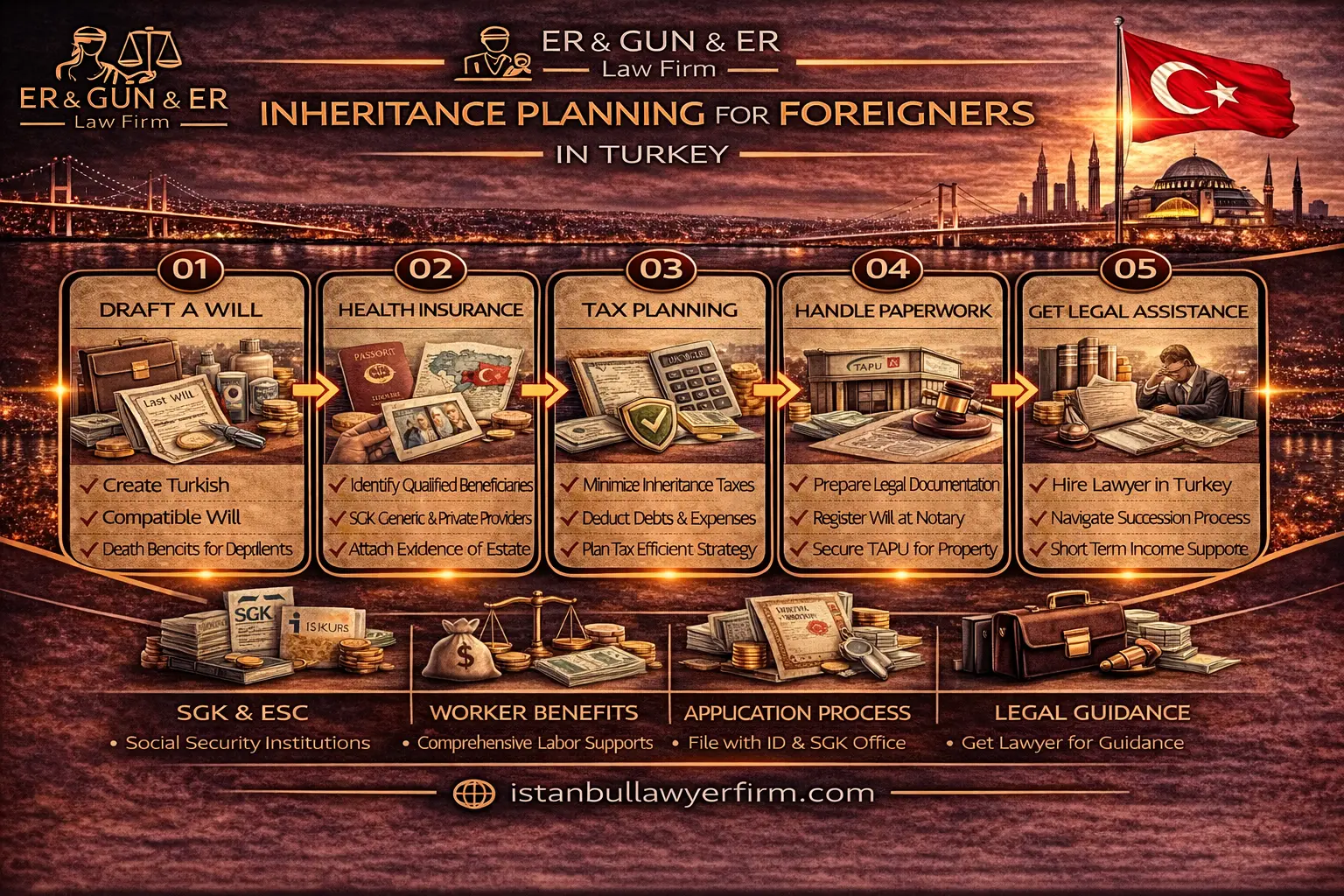
A lawyer in Turkey who advises on inheritance planning for foreign nationals understands that foreigners with assets in Turkey face a specific combination of planning challenges that differ from those faced by Turkish residents: determining which succession law governs each asset class; ensuring that heirs can prove standing in Turkish courts and administrative offices through properly legalized and translated documents; aligning will planning with Turkish forced heirship protections that operate regardless of the testator's nationality; managing bank account, real estate, and company share succession through the specific Turkish institutional procedures applicable to each asset type; preparing the foreign document pipeline—apostille certification, sworn translation, and consistent identity token management—that converts foreign civil records into Turkish-usable evidence; managing estate tax reporting obligations; and preventing the technical disputes that arise from inconsistent documentation rather than from genuine legal disagreements. An Istanbul Law Firm that advises on inheritance planning for foreigners Turkey provides the integrated planning architecture covering every dimension of this challenge: mapping assets by location and title form; identifying the applicable conflict-of-laws framework; assessing forced heirship constraints; developing a will strategy that is formally enforceable in Turkish practice; preparing bank, registry, and corporate succession plans; building the foreign document pipeline; and creating a dispute prevention and execution roadmap. A Turkish Law Firm that advises on cross-border inheritance Turkey planning understands that operational failure—heirs who cannot prove standing, documents that are rejected for missing pages or name drift, bank accounts that freeze because no spokesperson was designated—is more common than legal failure in cross-border estates, and that disciplined file architecture prevents most of these failures before they occur. An English speaking lawyer in Turkey who advises on inheritance planning for foreigners provides the bilingual coordination that keeps the Turkey-side file and the foreign-side file aligned without the translation and document drift that creates technical disputes and procedural delays. Practice may vary by authority and year — verify current Turkish succession law provisions, current inheritance certificate procedures, current will registration requirements, and current estate administration procedural standards with qualified counsel before finalizing any inheritance planning arrangement for assets held in Turkey, since the regulatory and procedural framework applicable to cross-border inheritance planning continues to evolve through court decisions and administrative practice whose current applicable versions determine the specific requirements for each estate configuration. Practice may vary by authority and year.
Why Inheritance Planning Matters for Foreigners with Turkish Assets
A lawyer in Turkey who advises on the importance of inheritance planning for foreigners explains that cross-border estates fail operationally before they fail legally—because a foreign owner can have valid intentions, a valid will, and undisputed heirs while leaving those heirs unable to access bank accounts, register inherited property, or file tax declarations due to missing documents, inconsistent identity tokens, or absent authorization instruments. An Istanbul Law Firm that advises on inheritance planning for foreigners identifies the specific operational risks most significant for each estate profile: inconsistent name spellings across passports, bank customer records, and property title documents that cause office rejections for identity mismatch; missing civil records—birth certificates, marriage records, and family registry extracts—that prevent the inheritance certificate application from proceeding; unprepared legalization and translation steps for foreign documents that create bottlenecks in the administration timeline; the absence of a designated spokesperson who communicates consistently with each institution; and unresolved co-ownership questions for inherited real estate that create governance friction among heirs. Turkish lawyers advising on inheritance planning help foreign clients understand that planning is not primarily about legal theory but about creating a documented evidence architecture that heirs can use at Turkish banks, land registries, and tax offices without improvisation under the time pressure of estate administration—and that the return on this investment is the difference between an estate that is administered in months and one that stalls for years due to preventable document deficiencies. Practice may vary by authority and year.
An Istanbul Law Firm that advises on the operational architecture of cross-border inheritance planning explains that effective planning requires a coordinated set of documents rather than a single instrument—and that the planning file must cover every asset class through an asset-type-specific approach: Turkish real estate succession requires a land registry execution plan with parcel identifiers and title extract snapshots; bank account succession requires a standing proof pack with inheritance certificate, identity documents, and power of attorney for heirs abroad; company share succession requires a corporate records archive with trade registry extracts, share ledgers, and governance documents; and the foreign document pipeline requires a legalization and translation plan with a single token sheet that prevents the name drift whose detection by a bank or registry officer can block the entire administration. Turkish lawyers advising on inheritance planning help foreign clients understand that the goal of planning is to create a file that heirs can execute after death without the testator's involvement—and that files which require family knowledge or informal coordination to implement are files that will fail when that knowledge and cooperation is most needed. Practice may vary by authority and year.
A Turkish Law Firm that advises on the governance dimensions of inheritance planning for foreigners explains that planning must also address who coordinates, how decisions are made among heirs, and how the administration proceeds when heirs disagree—because multi-heir estates whose governance is undefined create the internal conflicts that stall execution at every institution simultaneously. An English speaking lawyer in Turkey who advises on inheritance planning governance for foreign families helps clients implement the specific governance approach most effective for each family configuration: designating a single coordinator with a properly scoped and legalized power of attorney; creating a communication protocol that requires all office communications to flow through one spokesperson; building a dispute-lane separation rule that prevents substantive inheritance conflicts from contaminating the routine administrative steps that can proceed regardless of the dispute; maintaining a version-controlled master index and chronology that gives every heir visibility into the plan without requiring physical access to sensitive original documents; and creating a privacy discipline that limits distribution of sensitive civil and financial documents to those who genuinely need them for a specific administrative step. Practice may vary by authority and year.
Turkish Succession Law Baseline, Conflict of Laws and Reserved Share Framework
A lawyer in Turkey who advises on the Turkish succession law baseline explains that Turkish inheritance practice begins with statutory heirship determined by family status recorded in official civil registry records—and that this baseline determines shares, heir identity, and the inheritance certificate content regardless of whether the deceased was Turkish or foreign, because the inheritance certificate is produced through Turkish procedural practice. An Istanbul Law Firm that advises on Turkish inheritance law for foreigners helps clients understand the specific baseline most important for each estate profile: the statutory succession order under the Turkish Civil Code that allocates shares to descendants, parents, and grandparents with the surviving spouse participating alongside each group at a legally defined share; the role of the inheritance certificate as the practical standing proof that Turkish banks, land registries, and tax offices require; and the interaction between the statutory baseline and any will that modifies distribution within the forced heirship constraints that protect designated heirs' reserved portions. Turkish lawyers advising on the succession baseline help foreign clients understand that Turkish authorities and institutions look for Turkish-usable standing proof and a coherent share map—and that even a legally correct planning position is practically unusable without the documentation architecture that allows Turkish offices to apply it, making the document architecture as important as the legal analysis in any effective inheritance plan. Practice may vary by authority and year.
An Istanbul Law Firm that advises on conflict-of-laws inheritance Turkey analysis explains that conflict-of-laws analysis connects personal factors—nationality, habitual residence—and asset location to the applicable succession rule set, and that different asset classes in the same estate can be governed by different laws depending on the specific applicable private international law rule. Turkish lawyers advising on conflict-of-laws analysis for foreign estate planning help clients implement the specific framework most defensible for each asset configuration: understanding that Turkish succession law generally governs immovable property located in Turkey regardless of the deceased's nationality; assessing whether the deceased's national law or domicile law governs movable assets under the applicable private international law rule; identifying whether any bilateral treaty between Turkey and the deceased's country modifies the default rules; and creating a conflict-of-laws matrix memo that lists each asset class, the applicable law analysis, and the documentation implications—rather than asserting a universal outcome. An English speaking lawyer in Turkey who advises on conflict-of-laws analysis for cross-border estates provides the case-specific assessment that translates legal framework analysis into practical documentation and planning requirements for each heir and asset combination—identifying which documents must be in which format for which institutional step given the applicable law framework. Practice may vary by authority and year.
A Turkish Law Firm that advises on reserved share Turkey inheritance constraints explains that Turkish inheritance law reserves a guaranteed minimum portion of the estate—saklı pay—for designated heirs including descendants, parents in specific circumstances, and in some situations the surviving spouse, and that will provisions and lifetime gifts that reduce a protected heir's share below the reserved minimum can be challenged through a reserved share reduction claim regardless of the testator's intentions. An English speaking lawyer in Turkey who advises on reserved share constraints for inheritance planning helps foreign clients implement the specific planning approach that addresses this constraint: identifying which family members have reserved share protection under the Turkish succession rules applicable to the estate; testing whether the proposed distribution plan respects the reserved portions or creates challenge risk; assessing whether lifetime transfers already made create additional reserved share exposure by being counted toward the reduction; structuring the distributional plan to respect the reserved share constraints while achieving as much of the testator's distributional intent as possible within the legal framework; and identifying the dispute prevention measures that reduce the probability of reserved share challenges even where the plan is legally compliant. Practice may vary by authority and year — verify current reserved share rules and current reserved portion calculation methodology with qualified counsel before finalizing any distribution plan.
Will Drafting, Will Registration and Foreign Will Recognition
A lawyer in Turkey who advises on will planning for foreigners explains that a will for a foreign national with Turkish assets must address both the formal requirements that make it legally valid and the practical execution requirements that make it usable at Turkish institutions—and that a will that satisfies formal validity requirements without addressing execution practicalities still leaves heirs with an unusable document when they reach banks and land registries. An Istanbul Law Firm that advises on will drafting and registration for foreigners in Turkey helps clients implement the specific will approach most effective for each family and asset configuration: drafting the will in compliance with Turkish Civil Code formal requirements—including capacity, signature, and notarial or holographic execution requirements—so that it is valid in the jurisdiction of execution and usable in Turkish proceedings; aligning the distributive provisions with Turkish forced heirship protections to prevent reserved share challenges that would delay implementation; registering the will with the Central Will Registry so that it is discoverable by Turkish courts and administrative offices after death and is not lost or contested as unknown; and coordinating the Turkish will with any foreign wills covering the testator's assets in other jurisdictions to ensure the instruments are consistent and do not create parallel conflicting claims. Turkish lawyers advising on will drafting help foreign clients understand that will registration is the most reliable single step for ensuring that the testator's intentions are found and applied in Turkish proceedings rather than the estate being administered as intestate. Practice may vary by authority and year.
An Istanbul Law Firm that advises on foreign will recognition in Turkey explains that a will executed abroad can be applied to Turkish assets through a court recognition procedure—tanıma ve tenfiz—whose requirements include formal validity under the governing law, legalization through apostille or consular certification, sworn Turkish translation, and compliance with Turkish mandatory succession rules including forced heirship protections for Turkish-situated assets. Turkish lawyers advising on foreign will recognition help heirs understand that the recognition proceeding is a court process whose outcome depends on satisfying specific criteria—and that preparing the recognition application with complete documentation, properly legalized exhibits, and certified translations is more efficient than filing an incomplete application and receiving follow-up requests that extend the proceedings. An English speaking lawyer in Turkey who advises on the interaction between will planning and execution practicalities helps clients understand that the will must be designed not only as a legal instrument but as the first exhibit in the estate administration file—stored with a token sheet, a custody plan for originals, and a clear statement of which heirs should coordinate the administration. Practice may vary by authority and year.
A Turkish Law Firm that advises on will strategy for complex cross-border families explains that the most effective wills for foreign nationals with Turkish assets include not only the distributive provisions but also an administration guide that explains the execution steps, identifies the key documents and their storage locations, and designates the person responsible for coordinating the Turkish administration. An English speaking lawyer in Turkey who advises on will content for foreign nationals ensures that the will's language is consistent with the token sheet that defines how each heir's name appears in all related documents—preventing the identity mismatch between the will's description of heirs and the civil registry records and bank customer data that causes office rejections—and includes in the will a reference to the estate administration file location so that heirs can access the planning documents without searching. Practice may vary by authority and year.
Bank Account Inheritance Planning: Inventory, Standing Proof and Access Management
A lawyer in Turkey who advises on bank account inheritance planning Turkey explains that banks control access to estate accounts and require clear standing proof before they will provide account information or authorize fund releases—and that preparing the standing proof package in advance is the most effective way to prevent the account freezes and access delays that are among the most disruptive operational problems in estate administration. An Istanbul Law Firm that advises on bank account succession planning for foreign nationals helps clients build the specific bank planning architecture most effective for each estate profile: maintaining a secure bank inventory that lists each institution, account type, account holder type—personal, joint, or corporate—and any relevant branch relationship, stored with access-controlled custody because of its sensitivity; aligning the name spelling in each bank's customer records with the token sheet used throughout the inheritance file so that identity mismatch does not create a freeze trigger; preparing a standing proof pack for each institution that includes the inheritance certificate, heir identity documents, and the power of attorney for any heir who will act through a representative; designating a single spokesperson for bank communications after death and building a communications log that records every interaction with each institution; and preserving periodic bank statements as dated exhibits so heirs have a baseline record if account access becomes contested. Turkish lawyers advising on bank succession planning help foreign clients understand that the inheritance certificate—rather than the will—is typically what banks require as the standardized share table for releasing estate funds. Practice may vary by authority and year.
An Istanbul Law Firm that advises on the operational continuity dimension of bank account planning explains that accounts used for regular transactions—rental income collections, utility payments, and corporate expense management—require specific continuity planning to ensure that operational payments do not default and income does not stop being collected during the period between death and the formal completion of heir authorization. Turkish lawyers advising on bank continuity planning help clients implement the specific approach most appropriate for each account type: identifying which accounts require operational continuity decisions and including a continuity memo in the planning file that explains who will manage payments and receipts during the administration period; confirming that any corporate accounts are included in the corporate succession planning lane rather than the personal inheritance lane; and coordinating bank planning with estate tax reporting because bank letters and account balance confirmations are commonly used as evidence in the estate declaration. An English speaking lawyer in Turkey who coordinates bank account succession planning for foreign nationals manages the bank communication and standing proof submission process as an integrated service—maintaining the bank log and evidence archive so that account access proceeds with documented authority rather than informal requests, and coordinating the bank lane with the tax reporting lane to ensure that bank confirmations are available for the estate declaration. Practice may vary by authority and year.
A Turkish Law Firm that advises on cross-border bank account planning for estates with foreign-held accounts explains that where the deceased held bank accounts in other countries in addition to Turkey, the planning file must address the bidirectional document requirements—Turkish documents may need apostille and translation for use with foreign banks, and foreign documents must be apostilled and translated for use with Turkish banks—and that coordinating these parallel requirements through one consistent token sheet and one master document index prevents the name drift and version conflicts that arise when different family members manage different country's account access independently. An English speaking lawyer in Turkey who advises on cross-border bank account coordination for foreign estate planning provides the liaison function that keeps the Turkish bank documentation consistent with the foreign bank documentation across the entire estate. Practice may vary by authority and year.
Company Shares, SPV Structures and Corporate Succession Planning
A lawyer in Turkey who advises on company shares inheritance Turkey explains that corporate ownership succession is a distinct planning lane from personal inheritance because title to company shares is transferred through corporate records—trade registry extracts, share ledger updates, and board resolutions—rather than through the Turkish land registry, even when the company's primary asset is Turkish real estate. An Istanbul Law Firm that advises on corporate succession planning for foreign nationals helps clients implement the specific corporate planning approach most effective for each ownership structure: mapping the holding structure to identify the legal title holder of each asset—personal ownership versus Turkish SPV versus foreign SPV—because these configurations have different succession procedures; preserving the corporate records that enable share transfer after death including trade registry extracts, articles of association, share ledgers, and signatory documentation; planning for management continuity because a death can leave the company without an authorized signatory, stopping operational payments; planning for multi-heir governance because corporate shares inherited by multiple heirs create co-ownership of the company that can produce decision deadlock without a shareholder agreement and clear voting rules; and coordinating corporate succession planning with the tax reporting lane because corporate structures affect how estate assets are valued and reported. Turkish lawyers advising on corporate succession planning help foreign clients understand that SPV structures can simplify some succession challenges—by keeping real estate within a continuing legal entity rather than requiring direct title transfer—but create new challenges around signatory continuity and corporate governance that must be planned in advance. Practice may vary by authority and year.
An Istanbul Law Firm that advises on SPV governance design for inheritance planning purposes explains that a company whose ownership transfers to multiple heirs without pre-planned governance arrangements frequently becomes paralyzed—unable to make operational decisions, sell assets, or update bank signatories—because the co-owners cannot reach agreement on basic decisions. Turkish lawyers advising on corporate governance design for inheritance planning help clients implement the specific governance approach most effective for each ownership configuration: drafting shareholder agreements that include decision-making rules, qualified majority requirements for significant decisions, and signatory continuity arrangements that allow routine operations to continue after death; creating a board and resolution pack template so the company can act quickly when the first documentation is available; and ensuring that the corporate bank accounts are covered in both the corporate succession lane and the bank lane with clear signatory update procedures. An English speaking lawyer in Turkey who advises on SPV succession planning for foreign nationals ensures that foreign heirs understand what corporate actions they will need to take when inheriting company shares—including attendance at general meetings, signing share transfer documents, and providing legalized foreign documents for corporate registry purposes—and prepares the foreign heirs' authorization documents in advance so they are not scrambling to obtain apostilles and translations under time pressure. Practice may vary by authority and year.
A Turkish Law Firm that advises on the interaction between corporate ownership and land registry planning explains that where a company owns Turkish real estate, the real estate does not need to be transferred by inheritance because the company continues to own it—but control of the company must be transferred through share succession, which is a different workflow whose confusion is a common source of delay and wasted effort. An English speaking lawyer in Turkey who advises on corporate real estate succession for foreign nationals helps heirs understand this distinction and ensures that the corporate succession lane and the land registry lane are kept properly separate while both are executed efficiently—preventing the common situation where heirs initiate a land registry title transfer application for property that is held by a company and requires corporate share succession rather than direct title transfer. Practice may vary by authority and year — verify current Turkish corporate succession procedures and current land registry requirements applicable to company-held real estate with qualified counsel before initiating any corporate succession step.
Lifetime Transfers, Gift Planning and Evidence Preservation
A lawyer in Turkey who advises on lifetime transfers and gift planning explains that transfers of Turkish assets during the testator's lifetime are planning tools—reducing co-ownership friction, providing early support to beneficiaries, and simplifying estate administration—but are also a dispute-risk lane because heirs can later challenge transfers as disguised gifts, as violating reserved share protections, or as reflecting undue influence over a testator with diminished capacity. An Istanbul Law Firm that advises on lifetime transfer planning for foreigners in Turkey helps clients implement the specific transfer approach most defensible for each planning objective: documenting the intention and consideration behind each transfer clearly at the time of transfer rather than retrospectively; preserving evidence of the transferor's capacity and independence at the time of each transaction; keeping bank trails showing consideration payments because absence of payment is a common allegation in disguised gift disputes; preserving valuation evidence for transferred assets because undervaluation claims trigger both inheritance disputes and tax questions; and coordinating each transfer with the reserved share constraints analysis to ensure that the transfers do not collectively reduce any protected heir's share below the reserved portion in a way that creates challenge risk. Turkish lawyers advising on lifetime transfer planning help clients understand that transferring Turkish real estate during lifetime is executed through the Turkish land registry—leaving an official record that will be scrutinized by other heirs—and that maintaining a complete, consistent transaction record is the most effective defense against later challenges. Practice may vary by authority and year.
An Istanbul Law Firm that advises on evidence preservation for lifetime transfers explains that the planning file should assume that every lifetime transfer will be reviewed after the testator's death and should preserve the full transaction record in anticipation of that review. Turkish lawyers advising on lifetime transfer evidence management help clients build the specific preservation approach most effective for each transfer type: preserving land registry transaction records and pre-transfer and post-transfer title extracts for real estate transfers; preserving bank transfer confirmations and receipts for cash consideration payments; preserving corporate resolutions and share transfer ledger entries for company share transfers; preserving independent legal advice evidence where relevant because independent advice reduces undue influence claims; and maintaining a versioned planning memo that explains what was transferred, when, why, and what evidence supports the transfer's legitimacy. An English speaking lawyer in Turkey who advises on lifetime transfer evidence for cross-border families ensures that the Turkish transaction records are preserved in a format that is also usable by foreign authorities who may review the same transfers for foreign tax or succession reporting purposes—and maintains a consistent valuation methodology across Turkish and foreign records to prevent the inconsistency between Turkey-reported values and foreign-reported values that creates audit risk in both jurisdictions. Practice may vary by authority and year.
A Turkish Law Firm that advises on the coordination between lifetime transfers and overall succession planning explains that a succession plan which includes both a will and lifetime transfers must maintain lane separation—keeping will provisions and lifetime transfers as distinct but cross-referenced elements of the same plan—and must apply a consistent token sheet across both lanes so that the same person's name appears consistently in all documents regardless of when they were created or translated. An English speaking lawyer in Turkey who advises on integrated succession planning for foreign nationals maintains the master planning index and token sheet that coordinates lifetime transfers, will provisions, corporate succession arrangements, and foreign document bundles into a coherent file architecture whose integrity can withstand both administrative office review and adversarial litigation review. Practice may vary by authority and year.
Marital Property, Foreign Documents Readiness and Apostille Procedure
A lawyer in Turkey who advises on marital property effects in inheritance planning explains that the estate available for distribution is not automatically everything the deceased owned but is what belongs to the deceased after accounting for the applicable marital property regime—and that identifying the correct regime and its practical effects requires analysis of the official marriage status, the applicable private international law rule, and the actual title records for each asset. An Istanbul Law Firm that advises on marital property planning for cross-border families helps clients implement the specific approach most effective for each situation: identifying the spouse's legal status at the time of planning and confirming it through official civil records; assessing whether the marriage regime is governed by Turkish rules, foreign rules, or a combination under the applicable private international law framework; separating the marital property pool from the estate pool with clear evidence of acquisition dates and funding sources for assets whose regime classification depends on these facts; and preserving the marriage documentation—including any prenuptial agreement—in a Turkey-usable form through legalization and translation. Turkish lawyers advising on marital property planning help clients understand that banks and land registries treat title records as the primary evidence of ownership—and that a plan whose asset allocation depends on untitled claims by the surviving spouse will face institutional resistance unless those claims are clearly documented. Practice may vary by authority and year.
An Istanbul Law Firm that advises on foreign documents readiness for cross-border inheritance planning explains that foreign documents readiness is the most common execution bottleneck in cross-border estates because Turkish offices need Turkish-usable proofs—and that preparing the foreign document pipeline in advance rather than under the time pressure of estate administration is one of the highest-value investments in any inheritance planning program. Turkish lawyers advising on foreign documents readiness help clients build the specific pipeline most effective for each document profile: creating a document inventory that lists death records, birth records, marriage records, and any foreign probate decisions; confirming the applicable legalization method—apostille or consular—for each document based on the issuing country; building a single token sheet from passports and official identity records that defines how each name and date will appear in Turkish-language translations; bundling each source document with its legalization pages, its translation, and its notary declaration as a single indexed exhibit to prevent missing-page rejections; and maintaining this pipeline as a living document that is updated when family status changes, foreign documents are reissued, or new assets are acquired. An English speaking lawyer in Turkey who manages the foreign document pipeline for cross-border inheritance planning provides the systematic tracking service that converts the pipeline from a conceptual plan into an executed archive—and ensures that each bundle is reviewed against the master token sheet before it enters the archive so that spelling inconsistencies are identified and corrected before the documents reach Turkish offices. Practice may vary by authority and year.
A Turkish Law Firm that advises on apostille inheritance documents Turkey and translation of inheritance documents Turkey requirements explains that apostille certification verifies the origin authenticity of a document from a country party to the Hague Convention—and that translation and notarization converts the authenticated foreign-language document into a Turkish-file exhibit whose token consistency with every other document in the planning file is the most important single quality criterion. An English speaking lawyer in Turkey who advises on apostille and translation procedures for cross-border inheritance planning implements the specific translation approach most effective for each document type: having each translator work from the master token sheet that defines how all names appear in Turkish; reviewing each translation line-by-line against the authenticated source before notarization—because post-notary corrections require rebuilding the entire bundle; reusing the same authenticated and translated bundles across inheritance certificate applications, bank submissions, land registry filings, and tax reporting rather than creating separate translations for different offices; planning the bidirectional apostille requirement—Turkish documents may also need apostille and translation for use with foreign banks and foreign courts; and maintaining a version lock rule so that only the current translation is distributed and older versions are clearly marked as superseded. Practice may vary by authority and year.
Tax Reporting Workflow, Dispute Prevention and Execution Roadmap
A lawyer in Turkey who advises on estate tax reporting Turkey obligations explains that Turkish inheritance tax applies to assets inherited in Turkey—and that foreign nationals inheriting Turkish assets must file tax declarations with the Turkish Revenue Administration within the applicable statutory deadline regardless of the outcome of any disputes about heir rights, because late filing creates penalties independent of the substantive questions being resolved. An Istanbul Law Firm that advises on estate tax reporting for foreign nationals helps heirs implement the specific compliance approach most effective for each estate profile: identifying all assets subject to Turkish inheritance tax using the inheritance certificate as the share table and the asset inventory as the valuation basis; filing the declaration with the best available valuation evidence within the applicable deadline even where some values are still being confirmed; coordinating the tax reporting lane with the land registry execution and the bank account release because some institutional steps require evidence that tax compliance is being managed; and maintaining the tax evidence archive—submission proofs, valuation documentation, correspondence with the tax authority—as a dated exhibit set that supports both the ongoing compliance process and any future audit. Turkish lawyers advising on tax reporting help heirs understand that the estate tax reporting process should be planned as a document-driven workflow rather than as a numeric calculation exercise, and that coordinating the Turkey-side tax compliance with any foreign reporting obligations requires consistent valuation bases and consistent timing—since inconsistencies between Turkey-reported and foreign-reported asset values create the audit risk that turns an administrative process into an adversarial one. Practice may vary by authority and year.
An Istanbul Law Firm that advises on dispute prevention in cross-border inheritance planning explains that most inheritance disputes begin as technical disputes—inconsistent documents, missing records, unclear authorization—rather than as substantive disagreements about who should receive what, and that disciplined planning resolves most technical disputes before they arise. Turkish lawyers advising on dispute prevention implement the specific prevention approach most effective for each family configuration: maintaining a single token sheet across all planning documents so that identity consistency is enforced from the beginning; keeping a version-controlled master index and chronology that gives every heir transparency into the plan without requiring access to sensitive originals; implementing a lane-separation rule that prevents disputes about will validity or reserved share violations from contaminating the routine administrative steps—inheritance certificate application, bank access, title registration—that can proceed regardless of the dispute; preserving dated title extracts and bank statements as snapshots that answer later "what changed" questions with objective evidence; and creating a communication protocol that ensures all family members communicate with offices through one spokesperson so institutions receive consistent information. An English speaking lawyer in Turkey who provides dispute prevention coordination for cross-border families maintains the planning file architecture that creates this disciplined environment—and provides the updated chronology and index at each significant step so that every family member can see what has been done, what is pending, and what version of each document is current. Practice may vary by authority and year.
A Turkish Law Firm that advises on execution roadmaps for cross-border inheritance planning explains that an execution roadmap converts the planning file into a sequence of evidence-led actions whose completion produces a fully administered estate—and that the roadmap must be specific enough to be followed by heirs who are unfamiliar with Turkish administrative procedures. An English speaking lawyer in Turkey who creates execution roadmaps for foreign nationals with Turkish assets provides the coordinated roadmap covering every execution lane: the standing lane—death proof, identity proofs, and inheritance certificate application; the will lane—will production through the correct opening channel; the asset lane—Turkish real estate, bank accounts, and company shares with dated extracts; the foreign document lane—civil records with apostille and translation under the token sheet; the bank lane—standing pack submission with a communications log; the registry lane—title transfer execution; the tax lane—estate declaration with evidence pack; the governance lane—co-ownership decisions and approvals; the dispute lane—evidence preservation and forum selection for any substantive conflict that arises; and a maintenance lane—updates when assets change, family status changes, or applicable law evolves. The best lawyer in Turkey for inheritance planning for foreign nationals combines knowledge of Turkish succession law, conflict-of-laws analysis, forced heirship protections, will formalities, inheritance certificate procedure, bank account succession, corporate succession, lifetime transfer evidence requirements, marital property law, apostille and translation requirements, and estate tax reporting with the English-language communication that enables foreign nationals to implement a coherent, enforceable succession plan for their Turkish assets. Practice may vary by authority and year — verify current succession law requirements, current procedural standards, and current tax obligations with qualified counsel before taking any action in the estate administration.
Frequently Asked Questions
- Why do foreigners with Turkish assets need specific inheritance planning? Foreigners with Turkish assets face specific challenges that require planning: determining which succession law governs each asset type; ensuring heirs can prove standing through Turkish-usable documents; complying with Turkish forced heirship protections; managing bank, registry, and corporate succession through institution-specific procedures; and preparing the foreign document pipeline—apostille and translation—that converts foreign civil records into Turkish-usable evidence. Operational failures are more common than legal failures in cross-border estates, making planning essential. Practice may vary by authority and year.
- What Turkish succession law rules apply to foreigners with Turkish property? Turkish succession law generally governs immovable property located in Turkey regardless of the deceased's nationality. The Turkish Civil Code's statutory succession hierarchy applies, reserving minimum shares for descendants, parents, and in some situations the surviving spouse. The inheritance certificate produced through Turkish procedural practice is the primary standing document for Turkish banks and registries. Practice may vary by authority and year.
- What is conflict-of-laws analysis in Turkish inheritance planning? Conflict-of-laws analysis identifies which country's succession law governs each element of the estate based on the deceased's nationality, habitual residence, and asset location. Different asset classes in the same estate can be governed by different laws. A conflict matrix memo that lists each asset class and the applicable law analysis—rather than a single universal answer—is the practical planning approach. Practice may vary by authority and year.
- What are Turkish forced heirship protections and how do they affect planning? Turkish inheritance law reserves a guaranteed minimum portion—saklı pay—for descendants, parents in specific circumstances, and in some situations the surviving spouse. Will provisions and lifetime gifts that reduce a protected heir's share below the reserved minimum can be challenged through a reserved share reduction claim. Any distribution plan must be tested against forced heirship constraints before implementation. Practice may vary by authority and year.
- How should a foreigner create an effective will for Turkish assets? An effective will for Turkish assets should satisfy Turkish Civil Code formal requirements; align distributional provisions with forced heirship protections; be registered with the Central Will Registry for discoverability; be stored with a token sheet and custody plan; and be coordinated with any foreign wills to prevent conflicting claims. Registration with the Central Will Registry is the most reliable single step for ensuring the will is found and applied after death. Practice may vary by authority and year.
- Can a foreign will be used for Turkish assets? Yes. A foreign will can be applied to Turkish assets through a court recognition procedure requiring formal validity under the governing law, legalization through apostille or consular certification, sworn Turkish translation, and compliance with Turkish mandatory succession rules. The recognition proceeding requires a complete documentation application—incomplete applications generate follow-up requests that extend proceedings. Practice may vary by authority and year.
- How should bank account succession be planned for foreigners in Turkey? Bank account succession planning requires a secure institution inventory, identity token alignment between bank records and the planning file, a standing proof pack for each institution, a designated single spokesperson, and a communications log. The inheritance certificate—not the will—is typically what banks require as the standardized share table for fund releases. Powers of attorney for heirs abroad should be prepared in advance in a Turkey-usable format. Practice may vary by authority and year.
- What special considerations apply to company shares and SPV structures in inheritance planning? Company share succession proceeds through corporate records—trade registry updates, share ledger entries, and board resolutions—not through the land registry. SPVs can simplify real estate succession by keeping property within a continuing entity, but create signatory continuity and governance challenges that must be planned in advance through shareholder agreements and board resolution templates. Where a company holds Turkish real estate, heirs inherit shares, not the property directly. Practice may vary by authority and year.
- What are the risks of lifetime gifts and transfers in Turkish inheritance planning? Lifetime transfers can be challenged as disguised gifts, as violating reserved share protections, or as reflecting undue influence. Evidence of the transferor's capacity and independence, bank trails showing consideration payments, and valuation documentation for transferred assets are essential preservation items. The planning file should assume every lifetime transfer will be reviewed after death and maintain a complete transaction record. Practice may vary by authority and year.
- How do marital property rules affect Turkish inheritance planning for foreigners? The estate available for distribution is what belongs to the deceased after accounting for the applicable marital property regime. The applicable regime depends on the marriage's private international law framework. Title records are the primary institutional evidence of ownership, so plans whose asset allocation depends on untitled claims require specific documentation preparation. Marriage documentation and any prenuptial agreements must be legalized and translated for Turkey-side use. Practice may vary by authority and year.
- What is the foreign document pipeline and how should it be prepared? The foreign document pipeline converts foreign civil records—death records, birth certificates, marriage records—into Turkish-usable evidence through apostille or consular legalization and sworn Turkish translation. A single token sheet enforced across all translations prevents identity drift. Each bundle should combine source document, legalization pages, translation, and notary declaration as a single indexed exhibit. The same bundles should be reused across certificate applications, bank submissions, registry filings, and tax reporting. Practice may vary by authority and year.
- What estate tax reporting obligations apply to foreign nationals inheriting Turkish assets? Turkish inheritance tax applies to assets inherited in Turkey and must be declared within the applicable statutory deadline regardless of heir rights disputes. The estate declaration uses the inheritance certificate as the share table and requires valuation evidence for each asset. Cross-border families should coordinate Turkey-side tax compliance with foreign reporting obligations to ensure consistent valuations and timing. Practice may vary by authority and year.
- How can inheritance disputes be prevented in cross-border Turkish estates? Most inheritance disputes begin as technical disputes—inconsistent documents, missing records, or unclear authorization—that disciplined planning prevents. Key prevention measures include a single token sheet across all documents, a version-controlled master index, lane separation between disputes and administrative steps, dated asset snapshots, and a single spokesperson for institutional communications. A documented plan replaces family memory with objective evidence. Practice may vary by authority and year.
- What is an execution roadmap for cross-border inheritance administration? An execution roadmap is a sequenced set of evidence-led lanes covering standing proof, will production, asset mapping, foreign documents, bank access, land registry registration, tax declaration, co-ownership governance, and dispute management. Each lane has a designated owner and storage location for documents. The roadmap must be maintained as a living document updated when assets, family status, or applicable law changes. Practice may vary by authority and year.
- Does ER&GUN&ER Law Firm provide inheritance planning services for foreigners with Turkish assets? Yes. ER&GUN&ER Law Firm provides inheritance planning services for foreigners with Turkish assets including succession law and conflict-of-laws analysis, reserved share constraint assessment, will drafting and Central Will Registry registration, foreign will recognition coordination, bank account succession planning, corporate and SPV succession planning, lifetime transfer evidence management, marital property analysis, foreign document pipeline management including apostille and translation, estate tax reporting coordination, dispute prevention architecture, and execution roadmap development—with English-language client communication and bilingual documentation throughout each engagement.
Author: Mirkan Topcu is an attorney registered with the Istanbul Bar Association (Istanbul 1st Bar), Bar Registration No: 67874. His practice focuses on cross-border and high-stakes matters where evidence discipline, procedural accuracy, and risk control are decisive.
He advises individuals and companies across Immigration and Residency, Real Estate Law, Tax Law, and cross-border documentation matters where procedural accuracy and evidence discipline are decisive.
Education: Istanbul University Faculty of Law (2018); Galatasaray University, LL.M. (2022). LinkedIn: Profile. Istanbul Bar Association: Official website.