

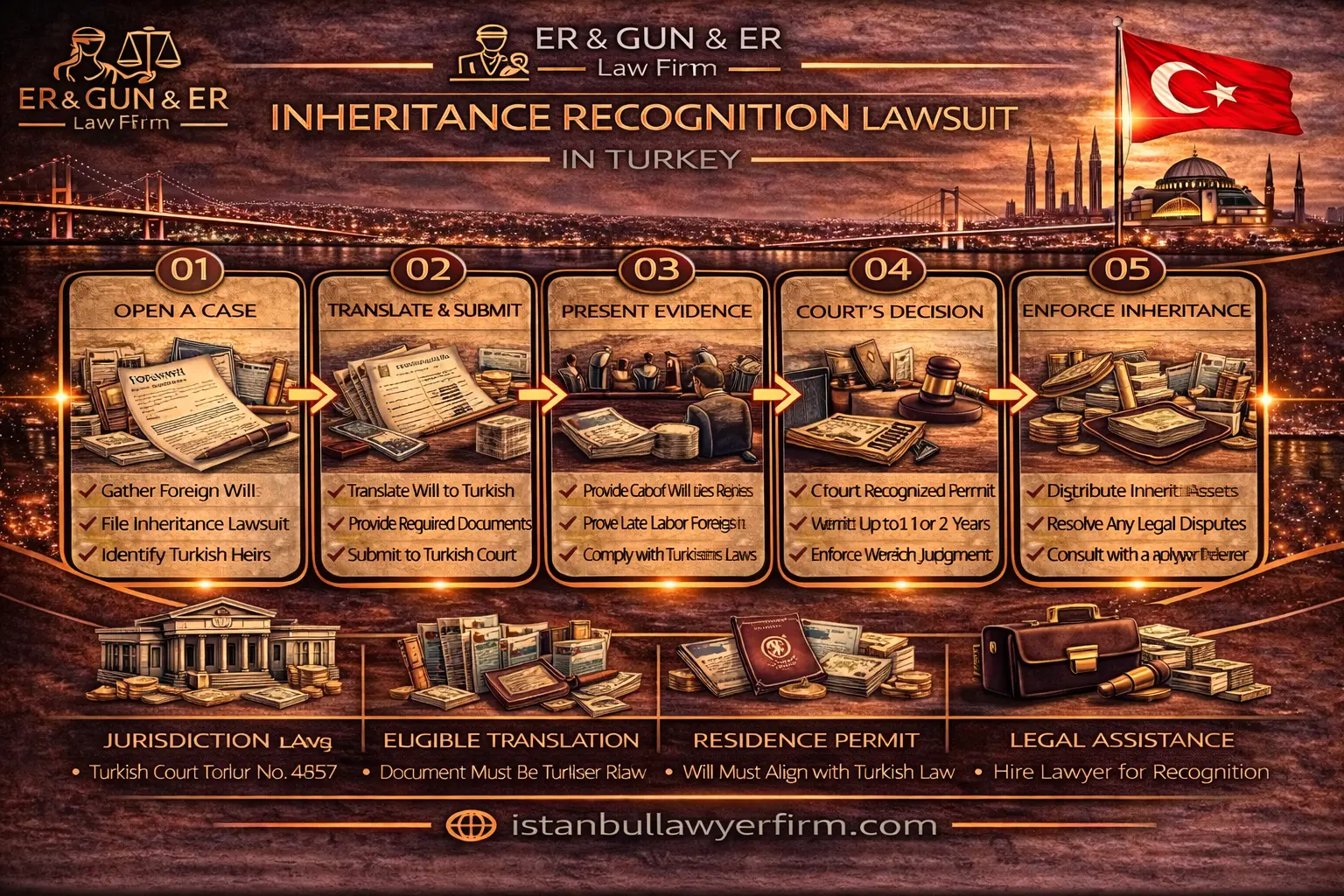
A lawyer in Turkey who advises on recognition of foreign inheritance decisions understands that foreign heirs who hold a valid probate determination, foreign court order, or foreign heirship certificate often face a specific procedural obstacle in Turkey: Turkish banks, land registries, and corporate registries cannot rely on foreign instruments directly, and require a Turkish court recognition order before they will execute transfers, release funds, or update ownership records. An Istanbul Law Firm that advises on inheritance recognition lawsuit Turkey proceedings provides the integrated guidance covering every stage of this procedural process: classifying the foreign instrument to determine which type of Turkish court procedure is required; designing the relief sought so it is targeted at a specific execution objective; assembling the complete filing package including certified copies of the foreign decision, apostille or consular legalization, and certified Turkish translations with consistent identity tokens; managing the court process through service, any contested opposition, and the receipt of the final recognition order; implementing the recognition order at land registries for title deed transfer and at banks for fund release; coordinating interim measures where asset dissipation risk exists during the proceedings; and managing the post-recognition tax reporting and administrative obligations whose completion is required before or alongside execution. A Turkish Law Firm that advises on recognition and enforcement Turkey inheritance matters understands that these cases are documentation-driven rather than substantive-dispute-driven—and that the quality of the document bundle, including legalization, token-consistent translations, and clean identity proofs, typically determines whether the case proceeds smoothly or becomes a sequence of procedural rejections. An English speaking lawyer in Turkey who advises on inheritance recognition proceedings provides the bilingual coordination that prevents the contradictory submissions and token drift that block land registry and bank execution even after a recognition order is obtained. Practice may vary by authority and year — verify current Turkish court recognition procedure requirements, current apostille and legalization standards, current certified translation requirements, and current institutional acceptance practices with qualified counsel before initiating any recognition proceedings for foreign inheritance instruments, since the procedural requirements applicable to recognition and enforcement of foreign inheritance decisions are implemented through court decisions and administrative practice whose current applicable versions determine the specific procedural steps and evidence standards for each case. Practice may vary by authority and year.
What Recognition and Enforcement Means in Turkish Inheritance Practice
A lawyer in Turkey who advises on the meaning of inheritance recognition proceedings explains that an inheritance recognition lawsuit Turkey is a court process that asks a Turkish court to accept a foreign inheritance-related decision or determination for use in Turkey—and that it is not a re-hearing of the foreign case on its merits but a procedural examination of whether the foreign instrument can be relied upon in Turkish practice. An Istanbul Law Firm that advises on recognition proceedings for foreign inheritance instruments helps clients understand the specific distinction most important for each case: recognition confirms that a foreign decision can be accepted as valid and relied upon in Turkey, establishing a status that Turkish offices can act on; enforcement goes further and enables compulsory execution of an order that requires performance—such as a payment or delivery—by a party in Turkey; and the distinction between the two determines the scope of the court proceedings, the evidence required, and the strength of any opposition the case is likely to attract. Turkish lawyers advising on recognition and enforcement Turkey inheritance matters help clients understand that many probate-related foreign outcomes are status determinations—identifying heirs and their shares—rather than coercive orders, and that recognition is typically sufficient to enable land registry transfer and bank account release without requiring the more complex enforcement mechanism—making correct characterization of the relief requested one of the most important early decisions that determines both the scope of the case and the strength of any opposition it attracts. Practice may vary by authority and year.
An Istanbul Law Firm that advises on the practical triggers for recognition proceedings explains that recognition cases arise most commonly when a specific Turkish institution—a land registry, a bank, or a corporate registry—refuses to execute a transfer or release based on a foreign instrument, citing the absence of a Turkish court order to rely on. Turkish lawyers advising on recognition proceedings help clients understand that the correct approach to a recognition case is to frame it as an execution-enabling request targeted at the specific institutional blockage rather than as an abstract declaration of the foreign instrument's validity—because courts are more focused and efficient when the relief is specific and the necessity is demonstrated by the institution's refusal. An English speaking lawyer in Turkey who advises on recognition proceedings for foreign heirs provides the pre-filing analysis that identifies the exact document type being presented, its legal effect in the issuing country, the specific Turkish office act being blocked, and the specific relief needed to unblock it—creating a coherent case theory before the petition is drafted. Practice may vary by authority and year.
A Turkish Law Firm that advises on the document conversion function of recognition proceedings explains that in practice, a recognition lawsuit also operates as a mechanism for converting a foreign paper into a Turkish-executable record—and that this conversion requires clean legalization, clean certified translation, and consistent identity tokens across every exhibit, because Turkish courts approach these files as documentation-driven cases where small inconsistencies can create procedural delays whose magnitude is disproportionate to the technical issue that caused them. An English speaking lawyer in Turkey who advises on recognition file architecture for cross-language inheritance matters implements the specific file structure most effective for each recognition case: a clear petition that states the execution objective, a complete exhibit index, a chronology that starts with the death and ends with the Turkish institutional refusal, a token sheet that defines the spelling of each party's name and date format, a narrative memo that cites exhibits rather than restating the foreign story in new language, and a single custodian designation for originals and certified copies so the file integrity is maintained throughout the proceedings. Practice may vary by authority and year.
When Turkey Requires Recognition: Triggers, Document Classification and Execution Objectives
A lawyer in Turkey who advises on when recognition is required explains that Turkish offices typically require a Turkish court recognition order when they are asked to take a formal legal act—registering a title change, releasing bank funds, or updating corporate ownership records—that they cannot independently execute based on a foreign instrument without Turkish judicial endorsement. An Istanbul Law Firm that advises on recognition requirement assessment for cross-border estates helps clients identify the specific triggers most significant for each estate: Turkish land registry offices typically require a recognition order before they will register inherited shares based on a foreign probate allocation; Turkish banks typically require a recognition order or at minimum a Turkish inheritance certificate before they will release funds from a deceased customer's account to foreign heirs identified in foreign proceedings; and Turkish corporate registries typically require a recognition order or corporate governance documentation before they will update shareholder records based on a foreign succession determination. Turkish lawyers advising on recognition requirement analysis help clients understand that the need for recognition depends on both the type of foreign instrument and the type of Turkish act being requested—and that different foreign instruments, including court judgments, notarial acts, and administrative certificates, may trigger different procedural requirements whose specific applicable path must be confirmed before the filing is prepared, since preparing a recognition petition based on an incorrect procedural characterization of the foreign instrument creates avoidable delays. Practice may vary by authority and year.
An Istanbul Law Firm that advises on foreign instrument classification for recognition proceedings explains that the type of foreign instrument determines how it must be presented to Turkish courts and what evidence supports its recognition—and that mislabeling a foreign document creates unnecessary objections that extend the proceedings without adding legal complexity. Turkish lawyers advising on foreign instrument classification help clients implement the specific classification approach most accurate for each instrument: confirming from the issuing authority what the document represents in the origin country's legal system—whether it is a court judgment, a probate grant, a notarial heirship certificate, or an administrative determination; confirming whether the instrument is final in its origin system and whether that concept exists; and preparing an explanatory origin-law memo that tells the Turkish court what it is being presented with in factual terms without overstating legal conclusions. An English speaking lawyer in Turkey who advises on foreign instrument classification for recognition purposes provides the analysis of the foreign system's treatment of the document type that enables Turkish counsel to characterize the instrument accurately in the petition without creating misrepresentations that later become objections—and coordinates with the foreign jurisdiction's legal framework to obtain the specific origin-law evidence needed to support the characterization made in the Turkish proceedings. Practice may vary by authority and year.
A Turkish Law Firm that advises on execution objective design for recognition cases explains that the petition must state a specific, operationally actionable execution objective—and that abstract requests for "general recognition" without a concrete institutional act to unlock create procedural ambiguity that often results in a recognition order that is difficult to use at banks and registries. An English speaking lawyer in Turkey who advises on recognition case strategy for foreign heirs implements the specific execution objective approach most effective for each institutional context: identifying whether the objective is land registry transfer after recognition Turkey, bank account release after recognition Turkey, or corporate registry update; framing the petition relief to correspond specifically to that objective; and including the institutional refusal evidence—the bank's denial letter, the registry's written request for a recognition order—as the exhibit that demonstrates why the recognition is necessary. Practice may vary by authority and year.
Jurisdiction, Venue, Competence and Relief Design
A lawyer in Turkey who advises on jurisdiction and venue for inheritance recognition proceedings explains that filing in the wrong court wastes time, multiplies service complications, and may require the case to be refiled—and that selecting the correct venue requires analyzing both the applicable Turkish private international law inheritance framework and the practical location of the assets and parties whose connection to the case determines where the case is most efficiently managed. An Istanbul Law Firm that advises on venue selection for recognition cases helps clients implement the specific venue approach most defensible for each case configuration: analyzing the connection between the requested relief and the Turkish jurisdiction—particularly where the land registry or bank involved is located; considering where interested parties can most efficiently be served; and preparing a venue memo that explains the jurisdictional connection in factual terms with exhibit references. Turkish lawyers advising on venue selection help clients understand that venue choices which ignore execution realities—producing a recognition order in a court whose location has no connection to the institution that will implement it—create execution complications at the next stage that a better-planned venue selection would have avoided, and that documenting the jurisdictional connection in a short factual venue memo prevents later challenges to the court's authority to render the recognition decision. Practice may vary by authority and year.
An Istanbul Law Firm that advises on court competence in recognition cases explains that competence requires the court to have authority both to hear the type of recognition request being presented and to render relief whose scope covers the requested act—and that a recognition petition that requests relief outside the court's competence or in a form that the executing institution cannot use creates a failed recognition outcome even after the court processes the case. Turkish lawyers advising on competence planning help clients implement the specific competence approach most effective for each case: classifying the foreign instrument correctly before filing so the petition is directed to the appropriate procedural framework under Turkish law; drafting the requested relief in terms that map directly to the institutional act being sought rather than in abstract legal language; including a short execution memo in the filing that explains how the recognition order will be used at the specific bank or registry, creating a record that the court sees when evaluating the relief requested; and confirming that the requested relief is within the court's competence by checking that the specific act being enabled falls within the recognition framework rather than requiring additional substantive proceedings. An English speaking lawyer in Turkey who advises on competence and relief design for cross-border recognition cases provides the coordinated analysis that ensures the petition, the evidence, and the requested relief are internally consistent. Practice may vary by authority and year.
A Turkish Law Firm that advises on party definition in recognition proceedings explains that the petition must name the correct interested parties—because a recognition order issued without proper party inclusion may later be challenged at banks and registries by parties who were not given notice and whose standing was not addressed. An English speaking lawyer in Turkey who advises on party mapping for recognition cases helps clients implement the specific party identification approach most defensible for each heir configuration: identifying all persons who have a legal interest in the estate whose Turkish-side rights are affected by the requested recognition; verifying current addresses for service; and preparing a party map with address sources and a service strategy that is realistic for cross-border notice. Practice may vary by authority and year.
Core Filing Documents, Apostille Certification and Certified Translation
A lawyer in Turkey who advises on core filing documents for recognition cases explains that Turkish courts decide recognition primarily on the documentary record—and that the file must present the foreign decision in a form the court can verify for authenticity, finality, and procedural integrity without requiring the court to investigate foreign law. An Istanbul Law Firm that advises on core filing documentation for inheritance recognition cases helps clients assemble the specific file most effective for each instrument type: the foreign decision or probate instrument in certified form—not an informal copy; proof of finality or enforceability where the origin system uses those concepts; proof of the foreign court's or authority's jurisdiction basis presented as an origin-system fact record; service and notice proofs from the foreign proceeding confirming parties had opportunity to be heard; identity documents for the heirs with a token sheet defining consistent name spellings; any foreign heirship certificate or distribution statement that clarifies shares; the Turkish institutional refusal letter or request showing necessity; and a chronology memo that starts with death and ends with the Turkish blockage. Turkish lawyers advising on core filing documentation help clients understand that attaching irrelevant documents expands scope, creates confusion, and invites objections—and that a lean, indexed, custody-controlled file consistently produces more efficient court processing than a comprehensive document dump, because courts approach these files as documentation-driven reviews where the quality of evidence presentation determines how quickly the merits can be assessed. Practice may vary by authority and year.
An Istanbul Law Firm that advises on apostille for inheritance documents Turkey and legalization of foreign court decisions explains that legalization is the authenticity bridge that allows a Turkish court to rely on a foreign public document—and that the correct legalization method depends on whether the issuing country is party to the Hague Convention on Apostille or requires consular legalization instead. Turkish lawyers advising on legalization management for recognition filings help clients implement the specific authentication approach most effective for each document bundle: confirming the applicable legalization path before beginning the process; obtaining the correct long-form certified copy from the issuing authority since short extracts often omit seals and identifiers; completing legalization on the correct document version before translation begins; keeping the source document and legalization pages together as a single bundle since missing pages are a common rejection trigger; scanning completed bundles in high resolution so stamps and seals remain readable; and maintaining a legalization inventory that tracks each document's authentication status and records the dates of issuance and legalization. An English speaking lawyer in Turkey who manages legalization for cross-border inheritance recognition cases provides the pipeline coordination that prevents the most common legalization failure—legalizing a different document version than the one later translated, creating two similar but not identical sets—and maintains the legalization inventory that tracks each document's authentication status so the recognition file is complete before the petition is submitted. Practice may vary by authority and year.
A Turkish Law Firm that advises on certified translation for Turkish courts inheritance proceedings explains that translations are not a stylistic exercise but a validity and usability exercise—because Turkish courts, land registries, and banks rely on Turkish-language exhibits whose token consistency with every other document in the file determines whether the recognition order can be smoothly executed. An English speaking lawyer in Turkey who manages translation discipline for inheritance recognition cases implements the specific translation approach most effective for each document profile: building a master token sheet from passports and official identity records that defines how every name and date appears in Turkish; instructing all translators to follow the token sheet precisely without creative transliteration choices; ensuring every page containing identifiers, seals, and annex references is translated completely since partial translations trigger rejection; reviewing each translation line-by-line against the legalized source before notarization since post-notary corrections require rebuilding the entire bundle; maintaining a change log for any corrected translation marking old versions as superseded; applying the same token sheet bidirectionally—Turkish documents needing apostille and translation for use in foreign proceedings must also follow the same token discipline in reverse; and maintaining an office use log that records which translation version was presented to which institution so that inconsistent presentations between courts, banks, and registries are prevented. Practice may vary by authority and year.
Foreign Heirship Documents, Public Policy and Service of Process
A lawyer in Turkey who advises on foreign heirship certificate recognition Turkey proceedings explains that the Turkish court will want to understand what the foreign heirship document represents in its origin country, whether it is final or subject to challenge, and whether it was issued through a procedure that respected basic due process—and that presenting the document without this context creates uncertainty that courts may resolve by requesting additional exhibits rather than by accepting the document on its face. An Istanbul Law Firm that advises on foreign heirship document presentation for recognition cases helps clients prepare the specific context most effective for each document type: an origin-law explanation exhibit from the issuing authority or from qualified foreign counsel that describes what the document represents and its legal effect in the origin system; proof that the document is in final form or represents the issuing authority's current determination; identity linkage evidence showing that the persons named in the foreign document match the persons who will act in Turkey under the same token sheet; and a reconciliation memo where foreign transliteration conventions have created name spellings different from those in passports. Turkish lawyers advising on foreign heirship document presentation help clients understand that different types of foreign instruments—court judgments, notarial heirship certificates, probate grants, and administrative determinations—may require different types of supporting context whose absence creates unnecessary procedural delays. Practice may vary by authority and year.
An Istanbul Law Firm that advises on the public policy exception Turkey recognition framework explains that public policy is the main substantive ground on which a Turkish court may decline to recognize a foreign inheritance instrument even when the documents are authentic and final—and that anticipating and addressing public policy concerns in the filing rather than treating them as a counterparty's problem is the most effective strategy for recognition cases. Turkish lawyers advising on public policy management help clients implement the specific approach most effective for each case profile: identifying whether the foreign decision touches areas sensitive under Turkish succession law—including protected heirship concepts, mandatory share protections, and basic procedural fairness—and presenting full context that allows the court to evaluate compatibility without drawing conclusions; demonstrating procedural integrity from the foreign proceeding including notice to all parties and opportunity to be heard; showing that the foreign instrument is final and not subject to ongoing challenge; and keeping the relief request narrow so the court evaluates the specific outcome needed for execution rather than the full reach of the foreign decision. An English speaking lawyer in Turkey who advises on public policy risk management for cross-border recognition cases provides the proactive analysis that identifies potential compatibility concerns before filing, implements the documentary and framing approach that reduces the probability of a public policy objection succeeding, prepares the structured response to any public policy objection that may be raised by opposing parties—ensuring the response is anchored in documents rather than in rhetorical argument—and coordinates the public policy response with the service record to demonstrate that the foreign proceeding was procedurally fair and that every affected party had a meaningful opportunity to participate. Practice may vary by authority and year.
A Turkish Law Firm that advises on service of process in recognition cases explains that service is often the slowest and most litigated element of the recognition file—because the Turkish court must be satisfied that affected parties were properly notified, and a service record that is incomplete or procedurally weak can undermine execution confidence at banks and land registries even after a recognition order is formally issued. An English speaking lawyer in Turkey who manages service planning for cross-border recognition cases implements the specific service approach most effective for each party configuration: identifying all interested parties and their current addresses with documented sources; preparing a realistic service plan that accounts for the additional time and procedural steps required for foreign-address service without promising timelines; maintaining a notice chronology that records every service attempt, delivery, refusal, and return as dated exhibits; including the service bundle for each party as indexed exhibits in the recognition file so the court has a complete notice record; and coordinating service completion with interim measures timing so that urgent asset protection applications are not delayed by service challenges. Practice may vary by authority and year — verify current Turkish service requirements for foreign parties in recognition proceedings with qualified counsel before initiating any recognition case involving parties at foreign addresses.
A Turkish Law Firm that advises on post-recognition use planning for foreign heirship documents explains that a recognition order whose drafting does not clearly map to the institutional act sought—identifying heirs by name and shares, specifying which assets are covered, and using language the land registry or bank can archive—creates execution difficulties requiring additional proceedings. An English speaking lawyer in Turkey who advises on post-recognition usability for foreign heirship matters prepares the recognition petition with the implementing institutions in mind so the recognition order can be presented directly to each institution without requiring additional interpretation. Practice may vary by authority and year.
Interim Measures, Asset Protection and Evidence Preservation
A lawyer in Turkey who advises on interim measures in inheritance recognition proceedings explains that when there is credible evidence that estate assets may be transferred, encumbered, or dissipated while the recognition case is pending, interim injunctions and asset protection measures provide the legal mechanism for preserving the estate's executability until the recognition order is obtained—and that the effectiveness of these measures depends both on the strength of the evidence demonstrating the risk and on the proportionality of the requested protection. An Istanbul Law Firm that advises on interim injunction inheritance Turkey applications helps clients implement the specific interim protection approach most effective for each asset risk profile: identifying the specific risk through objective evidence such as a pending title transfer application, bank communications showing intended withdrawal, or corporate resolutions authorizing a share transfer; demonstrating standing and urgency through the recognition file's context exhibits including the foreign decision and the Turkish institutional blockage; keeping the requested measure proportionate to the demonstrated risk rather than seeking broad freezes; and coordinating the interim measures strategy with the service plan because notice delays during the main proceedings increase the urgency of protective measures during the waiting period. Turkish lawyers advising on interim protection measures help clients understand that interim relief is discretionary and fact-specific—and that building the evidentiary basis for urgency before applying is consistently more effective than applying on the basis of general concern. Practice may vary by authority and year.
An Istanbul Law Firm that advises on evidence preservation in inheritance recognition proceedings explains that preserving dated snapshots of the estate's asset condition—title extracts, bank balance confirmations, and corporate registry extracts—at the beginning of the proceedings creates the objective "before" record that supports both interim protection applications and later execution by demonstrating what the asset status was at a known point in time. Turkish lawyers advising on evidence preservation implement the specific snapshot approach most effective for each asset type: obtaining current title extracts for each parcel of Turkish real estate and documenting any existing annotations or encumbrances; preserving bank communications and account holder identity proofs; and documenting any corporate register entries relevant to the estate's business interests. An English speaking lawyer in Turkey who advises on evidence preservation for cross-border inheritance recognition cases provides the systematic snapshot maintenance that ensures every asset status change during the proceedings is documented as a dated exhibit rather than reconstructed from memory at the execution stage—creating the objective record that supports both the court proceedings and the institutional submissions that follow. Practice may vary by authority and year.
A Turkish Law Firm that advises on post-interim-order implementation explains that an interim protection order is only useful if it is communicated promptly to the relevant institution—land registry, bank, or corporate registry—and if proof of that communication is preserved as a dated exhibit in the recognition file. An English speaking lawyer in Turkey who manages interim order implementation for foreign heir recognition cases coordinates the submission of interim orders to relevant institutions, documents each institution's acknowledgment, and maintains a change log that records any amendments to the interim measures and their effective dates. Practice may vary by authority and year.
Land Registry Execution and Title Deed Transfer After Recognition
A lawyer in Turkey who advises on land registry execution after recognition explains that land registry transfer after recognition Turkey is the practical reason most foreign heirs initiate recognition proceedings—and that obtaining the recognition order is only the first step, because the land registry submission requires a specific preparation that goes beyond presenting the court order. An Istanbul Law Firm that advises on land registry execution for recognized inheritance matters helps heirs implement the specific registry approach most effective for each property profile: preparing a property tab for each parcel with the parcel identifier copied from official title extracts and the current registration status with any annotations or encumbrances documented; ensuring that the heir identity tokens in the recognition order match the tokens in the land registry records and in any Turkish inheritance certificate that is also being used—since mismatches require reconciliation before the registry will proceed; planning the sequence of steps in the correct order—recognition order first, then tax compliance evidence where required, then the registry appointment; and preparing the registry pack as a lean, indexed, exhibit-led submission that includes the recognition order with any finality marking, certified translations, and the required identity documents. Turkish lawyers advising on land registry execution help heirs understand that registries prefer submissions that clearly state who is being registered, in what shares, and on what authority—and that a pack which forces the registry officer to infer these elements from unstructured documents creates delays. Practice may vary by authority and year.
An Istanbul Law Firm that advises on the interaction between recognition and the Turkish inheritance certificate for land registry purposes explains that some registries will want both a Turkish recognition order confirming the foreign decision and a Turkish inheritance certificate providing the standardized Turkish share table—and that anticipating this possibility and preparing both documents before the registry submission prevents the additional round of preparation that arises when the registry requests the certificate after the recognition order is already in hand. Turkish lawyers advising on registry execution preparation help heirs understand that even when a foreign decision has been recognized, the land registry may still require a Turkish inheritance certificate to establish the share table in Turkish procedural form—and that coordinating the inheritance certificate application with the recognition proceedings prevents one process from waiting on the other. An English speaking lawyer in Turkey who coordinates land registry execution for recognized foreign inheritance matters manages the sequence of recognition, certificate, tax, and registry submission steps in the order that produces the most efficient execution—and maintains the property tab archive with updated title extracts after each registry step so the estate file reflects the current registration status at each point in the administration. Practice may vary by authority and year.
A Turkish Law Firm that advises on post-transfer governance for inherited Turkish real estate explains that completing the title transfer is not the end of the inheritance administration but the beginning of a co-ownership situation that requires specific governance arrangements where multiple heirs have been registered—and that the absence of such arrangements is among the most common causes of post-succession disputes involving Turkish property. An English speaking lawyer in Turkey who advises on post-transfer property governance for foreign heir co-owners provides the co-ownership governance documentation that defines how decisions about the property will be made, how costs and revenues will be shared, and how eventual disposition will be coordinated—creating the governance framework that prevents the title registration from converting an inheritance dispute into a permanent co-ownership conflict—and coordinates this governance with the tax reporting obligations associated with the transferred property so that compliance in one lane does not create omissions in another. Practice may vary by authority and year — verify current land registry submission requirements and current inheritance tax compliance requirements applicable to the specific property with qualified counsel before initiating any registry submission for recognized foreign inheritance matters.
Bank Account Release, Tax Compliance and Post-Recognition Administration
A lawyer in Turkey who advises on bank account release after recognition proceedings explains that Turkish banks require high confidence in heirship and distribution before they will release funds from a deceased customer's accounts to heirs—and that even after a recognition order is obtained, the bank submission requires specific preparation that addresses the bank's compliance documentation needs rather than simply presenting the court order. An Istanbul Law Firm that advises on bank execution for recognized inheritance matters helps heirs implement the specific bank approach most effective for each institution: obtaining the recognition order in final form with certified translations and certified copies; preparing an heir identity pack with identity documents whose tokens match those in the recognition order and in the bank's customer records; preparing a bank submission memo that states what release is requested and on what authority; preserving the bank's request checklist as an exhibit since banks differ in their specific requirements; maintaining a bank communication log that records every interaction with dated entries; and coordinating the bank submission with estate tax reporting since bank confirmations and release receipts are commonly used in the estate declaration. Turkish lawyers advising on bank execution help heirs understand that some banks will want both a recognition order and a Turkish inheritance certificate—and that having both prepared before the bank submission prevents the additional delay that arises when the bank requests the certificate after reviewing the recognition order, since each request from the bank restarts a documentation cycle whose cost and time accumulates rapidly in multi-bank estates. Practice may vary by authority and year.
An Istanbul Law Firm that advises on estate tax reporting coordination for recognition proceedings explains that tax compliance is a parallel lane to the recognition and execution process rather than a step that follows recognition—and that delaying the inheritance tax declaration while waiting for recognition to complete creates late filing penalties whose accumulation is independent of whether the recognition is pending. Turkish lawyers advising on estate tax compliance for foreign heir recognition matters help heirs implement the specific tax approach most effective for each estate configuration: filing a protective inheritance tax declaration based on the heir's claimed share and the estate's identifiable assets within the applicable deadline; coordinating the valuation evidence used for the tax declaration with the asset documentation assembled for the recognition file; and storing the tax submission proof as part of the recognition and execution evidence archive. An English speaking lawyer in Turkey who coordinates tax compliance for cross-border inheritance recognition cases manages the tax lane as a parallel process—ensuring that the declaration is filed correctly and on time without waiting for the recognition proceedings to conclude, and preserving the tax submission proofs as exhibits in the main recognition and execution archive so they are available when banks and registries request evidence of tax compliance. Practice may vary by authority and year.
A Turkish Law Firm that advises on post-recognition administration explains that obtaining the recognition order completes only the judicial step of the inheritance administration—and that a comprehensive execution roadmap covering the sequence of actions at every institution must be implemented systematically to convert the recognition order into actual asset access. An English speaking lawyer in Turkey who manages post-recognition administration for foreign heir recognition cases provides the coordinated execution service that implements the recognition order sequentially at each institution: land registry for title transfer; banks for account release; corporate registries for share updates; tax offices for declaration and compliance; and co-ownership governance for ongoing property management—maintaining the execution log that records each completed step and each institution's response so the estate administration has a complete documented history. The best lawyer in Turkey for inheritance recognition matters for foreign heirs combines knowledge of Turkish private international law inheritance analysis, recognition and enforcement procedural law, apostille and legalization requirements, certified translation standards, public policy exceptions, service of process in cross-border cases, interim protection measures, land registry execution, bank compliance requirements, and estate tax reporting with the English-language communication that enables foreign heirs to navigate Turkish inheritance recognition proceedings effectively. Practice may vary by authority and year — verify current recognition procedure requirements, current land registry submission standards, and current bank release procedures with qualified counsel before taking any action in a recognition proceeding or post-recognition execution step.
Frequently Asked Questions
- What is an inheritance recognition lawsuit in Turkey? An inheritance recognition lawsuit is a Turkish court proceeding that asks a Turkish court to accept a foreign inheritance-related decision—such as a foreign probate determination or foreign heirship certificate—for reliance in Turkey. It is not a re-hearing of the foreign case but a procedural examination of whether the foreign instrument can be relied upon by Turkish institutions including land registries and banks. Practice may vary by authority and year.
- When is recognition of a foreign inheritance decision required in Turkey? Recognition is required when a Turkish institution—a land registry, a bank, or a corporate registry—refuses to execute an inheritance-related act based on a foreign instrument without a Turkish court order to rely on. The specific trigger depends on the type of foreign instrument and the type of Turkish institutional act being requested. Practice may vary by authority and year.
- What is the difference between recognition and enforcement in Turkish inheritance proceedings? Recognition confirms that a foreign decision can be accepted as valid and relied upon in Turkey, enabling Turkish offices to act on it. Enforcement goes further and enables compulsory execution of an order requiring performance by a party in Turkey. Most inheritance-related foreign instruments require recognition rather than enforcement, since they typically determine status rather than order compulsory performance. Practice may vary by authority and year.
- What documents must be included in a recognition case filing? Core filing documents typically include the foreign decision in certified form, proof of finality in the origin system, proof of the foreign authority's jurisdiction basis, service and notice proofs from the foreign proceeding, heir identity documents with a consistent token sheet, any foreign heirship certificate clarifying shares, and the Turkish institutional refusal demonstrating necessity. Each foreign document must be legalized and translated. Practice may vary by authority and year.
- What is the apostille process for inheritance documents used in Turkish recognition proceedings? Apostille certification applies when the foreign document's issuing country is party to the Hague Convention on Apostille. The apostille verifies the origin authenticity of the document from the competent authority. Countries not party to the Convention require consular legalization. The source document and legalization pages must be kept together as a single bundle. Legalization must be completed before translation begins. Practice may vary by authority and year.
- What certified translation requirements apply to foreign documents in Turkish inheritance recognition cases? Certified translations for Turkish courts must be complete, token-consistent, and formalized through a sworn translator with notary certification. A master token sheet should define how every name and date appears in Turkish and be enforced across all translations. Each translation must cover every page containing identifiers, seals, and annex references. The same legalized and translated bundles should be reused across court, bank, and registry submissions. Practice may vary by authority and year.
- What is the public policy exception in Turkish recognition proceedings? The public policy exception allows a Turkish court to decline recognition when the foreign decision is fundamentally incompatible with core Turkish legal principles—including protected inheritance rights and basic procedural fairness. It is applied to specific concrete outcomes rather than as a generic refusal. Presenting the foreign decision in full context, demonstrating procedural integrity, and keeping the relief request narrow are the most effective strategies for managing public policy risk. Practice may vary by authority and year.
- How are service and notice requirements managed in Turkish recognition proceedings? Turkish courts require that all affected parties be properly notified. Service is often the slowest element in recognition cases involving foreign-address parties. A realistic service plan with documented address sources, a notice chronology recording every service attempt and outcome, and complete certified translation of served documents are essential. Weak or incomplete service undermines execution confidence at banks and land registries even after recognition is granted. Practice may vary by authority and year.
- Can interim measures protect estate assets during recognition proceedings? Yes. Turkish courts can grant interim injunctions and asset protection measures when there is credible evidence that assets may be transferred, encumbered, or dissipated while the recognition case is pending. The request must demonstrate specific risk through objective evidence and must request proportionate relief. Pre-filing evidence snapshots—title extracts, bank status records—provide the baseline supporting urgency. Practice may vary by authority and year.
- How is a recognition order used for land registry title transfer in Turkey? After obtaining the recognition order, a land registry submission package must be prepared including the recognition order with certified translation, parcel identifiers from official title extracts, any required tax compliance evidence, and heir identity documents with tokens matching the recognition order and title records. Some registries also require a Turkish inheritance certificate establishing the share table. Practice may vary by authority and year.
- How is a recognition order used for bank account release in Turkey? Banks require the recognition order in final form with certified translations, heir identity documents matching bank customer records, and a formal bank submission identifying the specific release requested. Some banks also require a Turkish inheritance certificate alongside the recognition order. A bank communication log recording every interaction provides the evidence needed for tax reporting and dispute prevention. Practice may vary by authority and year.
- Do inheritance tax obligations need to be managed separately from the recognition proceedings? Yes. Turkish inheritance tax obligations arise independently of whether a recognition case is pending and must be addressed within the applicable statutory deadline to avoid late filing penalties. Filing a protective inheritance tax declaration based on the heir's claimed share before the recognition proceedings conclude prevents penalties. The tax evidence archive should coordinate with the recognition and execution file. Practice may vary by authority and year.
- What foreign heirship documents are accepted in Turkish recognition proceedings? Turkish courts can evaluate foreign probate orders, wills admitted to probate, notarial heirship certificates, and administrative heirship determinations. Each type requires appropriate authentication and an origin-law context exhibit explaining the document's nature and effect in its origin system. Identity linkage evidence connecting the foreign document's named persons to the heir identity documents used in Turkey is essential. Practice may vary by authority and year.
- What are the most common practical risks in inheritance recognition proceedings in Turkey? Common practical risks include: filing with an incomplete document bundle; identity token drift across translations; unclear finality of the foreign decision; service complications for foreign-address parties; overly broad relief requests; missing post-recognition execution planning; absence of dated asset snapshots; inconsistent narratives between Turkish and foreign advisers; loss of originals in cross-border handling; and failure to coordinate tax reporting with the recognition timeline. Practice may vary by authority and year.
- Does ER&GUN&ER Law Firm provide legal services for inheritance recognition proceedings in Turkey? Yes. ER&GUN&ER Law Firm provides legal services for inheritance recognition proceedings in Turkey including foreign instrument classification and case theory design, apostille and legalization management, certified translation coordination with token sheet enforcement, party mapping and service planning, jurisdiction and venue analysis, court competence and relief design, public policy risk assessment, interim injunction applications, land registry execution after recognition, bank account release coordination, Turkish inheritance certificate coordination, estate tax compliance, and post-recognition co-ownership governance—with English-language client communication and bilingual documentation throughout each engagement.
Author: Mirkan Topcu is an attorney registered with the Istanbul Bar Association (Istanbul 1st Bar), Bar Registration No: 67874. His practice focuses on cross-border and high-stakes matters where evidence discipline, procedural accuracy, and risk control are decisive.
He advises individuals and companies across Immigration and Residency, Real Estate Law, Tax Law, and cross-border documentation matters where procedural accuracy and evidence discipline are decisive.
Education: Istanbul University Faculty of Law (2018); Galatasaray University, LL.M. (2022). LinkedIn: Profile. Istanbul Bar Association: Official website.