

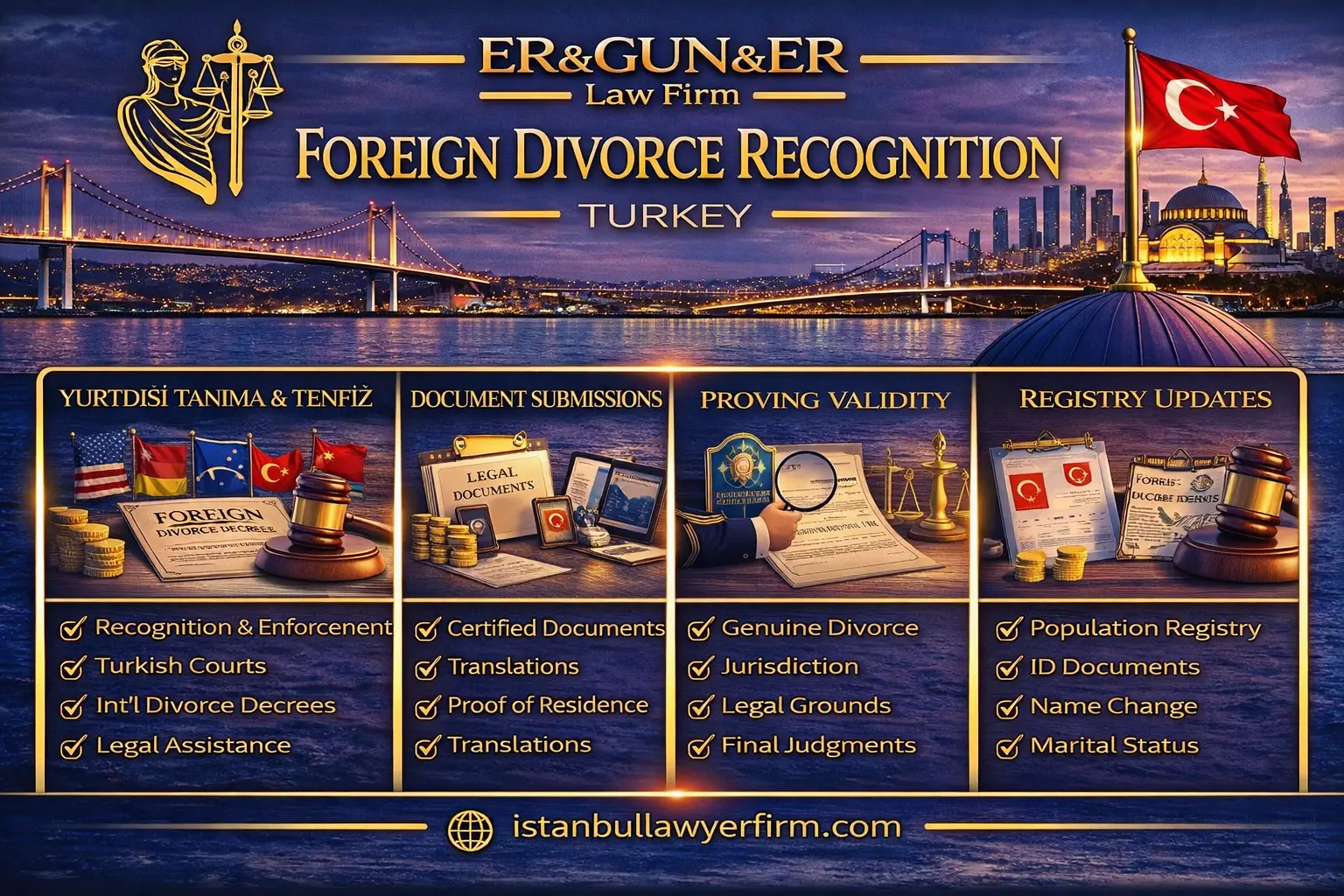
Recognizing foreign divorces in Turkey is not a formality—it is a structured legal process governed by Turkish private international law whose outcome determines whether a person's marital status in Turkey reflects their actual legal status abroad, and whether the Turkish legal system will treat property, custody, and remarriage consequences as flowing from a dissolved marriage or from a marriage that remains legally subsisting in Turkey's official records. The primary legislative framework is the Law on Private International Law and International Civil Procedure (MÖHUK, Law No. 5718), which establishes the conditions that a foreign divorce judgment must satisfy before Turkish courts or administrative authorities will recognize it as having legal effect on Turkish soil, and these conditions—finality of the judgment, adequacy of due process and service, absence of conflict with Turkish public policy, and compliance with jurisdictional criteria—are not formalities that can be assumed away but substantive requirements that must each be positively demonstrated with documentary evidence. The documentation discipline that determines whether recognition succeeds begins in the foreign jurisdiction: the divorce decree must be obtained in properly authenticated form, the apostille or consular legalization must be correctly completed for the specific document and the specific destination country, and the certified translation into Turkish must be prepared by a sworn translator who meets Turkey's specific qualification requirements. A Turkish citizen who obtained a divorce abroad and who has not completed the Turkish recognition process remains legally married in Turkey's civil registry records—creating risks in property transactions, inheritance, and remarriage that may not become apparent until a practical transaction triggers a civil registry verification. For a foreign national whose divorce involves Turkey-connected property, custody arrangements, or subsequent Turkish relationships, the recognition question affects whether Turkish courts will treat them as divorced and what legal consequences flow from the foreign decree in Turkish proceedings. The cross-border coordination required for successful recognition—between the foreign country's court system, authentication authorities, translation professionals, Turkish private international law counsel, and the Turkish civil registry—should begin as early as possible and should not be deferred until recognition is urgently needed for a specific transaction.
Recognition versus enforcement
A lawyer in Turkey advising on foreign divorce proceedings must explain the conceptual distinction between recognition (tanıma) and enforcement (tenfiz) of foreign judgments, because MÖHUK 5718—Turkey's law on private international law and international civil procedure, whose full text is accessible at Mevzuat—treats these two concepts differently and the applicable procedure depends on which one is sought. Recognition is the Turkish legal system's acknowledgment that a foreign judgment is valid and effective—that it produced the legal consequences it purported to produce in the country where it was issued—and this acknowledgment affects the status of persons, relationships, and legal relationships in Turkey without requiring additional coercive action to give it effect. Enforcement is the process by which a foreign judgment is given the same executory force as a Turkish judgment—enabling Turkish enforcement officers to take compulsory measures to implement the judgment's provisions—and it is required for foreign money judgments, property transfer orders, and other orders requiring positive action by a person in Turkey. A divorce decree, as a status judgment that dissolves the marriage relationship, is typically a recognition-only matter rather than an enforcement matter: the divorce either occurred or it did not, and if recognized, Turkey simply treats the marriage as dissolved from the date specified in the foreign decree without needing to coercively enforce the dissolution. The ancillary provisions of a foreign divorce judgment—property division orders, child support orders, custody orders—may fall under either recognition or enforcement depending on their nature and whether they require positive action by a person in Turkey who has not voluntarily complied. Practice may vary by authority and year — check current guidance on the specific characterization of different foreign divorce judgment components as recognition or enforcement matters under the current Turkish judicial interpretation of MÖHUK 5718.
The recognition versus enforcement distinction has practical procedural consequences: a recognition-only application (tanıma davası) is available for a foreign divorce decree that simply needs to be acknowledged as effective, while a combined recognition and enforcement application (tenfiz davası) is required where the petitioner also needs the executory force of a Turkish judgment to implement specific ancillary provisions. An application filed as a tenfiz when only tanıma is needed—or vice versa—creates a procedural mismatch that the court must address, potentially adding delay and cost to the recognition process. An Istanbul Law Firm advising on the type of application to file will identify all the components of the foreign divorce judgment and will assess each component's procedural requirements before selecting the appropriate application type. Where a foreign divorce decree contains both status provisions—the dissolution of the marriage—and ancillary property or support provisions, the correct approach may be to file a tanıma application for the divorce itself and a separate tenfiz application for any ancillary provisions that require enforcement, or to consolidate both in a single combined application where the court's procedure accommodates this. The tanıma tenfiz divorce Turkey procedural framework under MÖHUK 5718 is well-established in Turkish court practice, but its application to specific foreign judgment types requires legal expertise in both the Turkish private international law framework and the specific foreign legal system that issued the judgment. Practice may vary by authority and year — check current guidance on the current Turkish court approach to combined tanıma-tenfiz applications for foreign divorce decrees with ancillary provisions.
A Turkish Law Firm advising on the recognition of foreign divorce Turkey proceedings must also address the threshold question of whether recognition through formal court or administrative proceedings is necessary at all in a specific client's situation. A person whose foreign divorce does not affect any Turkish legal proceeding, whose civil registry record does not need to be updated, and who does not need to establish their divorced status to any Turkish authority may not need to pursue formal recognition in Turkey—at least in the short term. However, the situations in which the recognition question becomes practically necessary are more common and less predictable than most people anticipate: property inheritance rights depend on marital status; remarriage in Turkey requires proof of prior marriage's dissolution; children's nationality and civil status records may reference the parents' marital history; Turkish tax obligations may be affected by marital status; and any interaction with Turkish courts or government authorities that requires the presentation of personal status information will surface the undocumented foreign divorce. The conservative approach—completing the recognition process promptly after the foreign divorce is obtained, while the documentation is complete and the parties are accessible—is consistently more cost-effective than deferring recognition and then pursuing it urgently when a specific need arises. Practice may vary by authority and year — check current guidance on the specific Turkish administrative and legal contexts in which proof of a recognized foreign divorce is currently required before assessing whether deferred recognition is a viable strategy in a specific situation.
What requires recognition
A law firm in Istanbul advising on the recognition of foreign divorce decree Turkey scope must help clients understand which categories of foreign decision create the recognition obligation and which do not, because not all foreign actions that affect marital status require formal recognition proceedings in Turkey. A foreign court judgment that dissolves a marriage through a contested or uncontested divorce proceeding—where a court of competent jurisdiction issued a formal judgment after proceedings in which both parties were represented or notified—is the most common category requiring formal recognition. A foreign administrative dissolution—where a non-judicial authority has legally dissolved a marriage under foreign law—may also require recognition in Turkey, though the specific procedural route may differ from the judicial judgment recognition route. A notarial divorce—where the dissolution of the marriage is effected through a notarial deed in a country that authorizes this form of dissolution—similarly requires a recognition process in Turkey before its effects are acknowledged. The recognition obligation extends to the divorce decree's ancillary provisions as well as its core dissolution: a custody order embedded in the foreign divorce decree, a property division order, a support obligation, or any other provision that the parties wish to rely upon in Turkey requires either recognition as part of the overall divorce recognition or separate enforcement proceedings for the specific provision. Practice may vary by authority and year — check current guidance on the specific categories of foreign marital dissolution that Turkish courts currently recognize as within the scope of MÖHUK 5718's recognition regime and on any categories that are treated as outside the formal recognition regime.
The private international law Turkey divorce 5718 framework distinguishes between foreign judgments that create personal status consequences—changes in a person's civil status that affect their legal capacity and relationships—and foreign judgments that create property or financial obligations. The dissolution of a marriage is a personal status change that, once recognized, is given effect in Turkey as a status matter: the recognized foreign divorce has the same effect on the parties' marital status in Turkey as a Turkish divorce judgment would have, and it extinguishes the matrimonial regime and the personal rights and obligations associated with the marriage. The foreign judgment recognition Turkey family law framework therefore treats the recognition of a foreign divorce not as the enforcement of a foreign obligation but as the acknowledgment of a status change that happened in another jurisdiction and whose effects Turkey is willing to extend to its own legal system. This characterization as a status matter—rather than a property obligation—explains why recognition is available even without any financial award and why the recognition of the dissolution itself is conceptually prior to and separate from the recognition or enforcement of any ancillary financial provisions. An English speaking lawyer in Turkey advising on the scope of what requires recognition will separately analyze the dissolution itself, any custody provisions, any property provisions, and any support provisions, assessing each independently for the applicable recognition or enforcement procedure. Practice may vary by authority and year — check current guidance on how Turkish courts currently treat specific ancillary provisions—particularly property division orders and spousal maintenance orders—in the context of foreign divorce recognition applications.
The recognition need also arises where a foreign court has issued a custody modification order or a support modification order in connection with a previously recognized (or Turkish-court-issued) divorce, because any subsequent foreign judgment affecting matters already determined in Turkey also requires recognition before the Turkish court or civil registry will give it effect. A person who obtained a Turkish divorce but who then sought and obtained a foreign custody modification—perhaps because the children are now habitually resident in a foreign country—cannot simply present the foreign modification order to a Turkish court or registry authority; the modification must be separately recognized before it affects the Turkish-law custody arrangement. This ongoing recognition obligation for post-divorce foreign orders is an important practical point for families who continue to be legally active in both Turkey and foreign jurisdictions after their divorce, because each new foreign order affecting matters with Turkish legal dimensions may require a new recognition proceeding. Practice may vary by authority and year — check current guidance on the Turkish court procedures for recognizing foreign post-divorce modification orders and on the relationship between a previously recognized or Turkish-issued order and a subsequent foreign modification of the same matter.
Divorce judgment prerequisites
A best lawyer in Turkey advising on the divorce judgment prerequisites for Turkish recognition must apply the conditions established by MÖHUK 5718 and identified as mandatory by the Turkish courts in recognition proceedings. The first and most fundamental prerequisite is that the foreign judgment must be final and definitive under the law of the country where it was issued—it must not be subject to ongoing appeal or be a provisional order that can be modified by the issuing court without a new proceeding. The finality requirement ensures that Turkey is not asked to give effect to a provisional or interim decision that the issuing country itself treats as subject to change, which would create inconsistency between the legal status recognized in Turkey and the current legal status in the issuing country. The second prerequisite is that the foreign court must have had jurisdiction under either the Turkish jurisdiction criteria established in MÖHUK 5718 or the criteria accepted under international law—the Turkish court reviewing the application will not recognize a foreign divorce issued by a court that lacked any reasonable basis for jurisdiction over the parties and the marriage. The jurisdiction analysis does not require that the foreign court apply the same jurisdictional rules that a Turkish court would apply; it requires that the foreign court's assertion of jurisdiction be reasonable and defensible under internationally recognized principles. The third prerequisite is that the parties must have been given adequate notice of the foreign proceedings and an adequate opportunity to participate—the due process condition discussed separately in a later section of this article. Practice may vary by authority and year — check current guidance on the specific jurisdiction criteria that Turkish courts currently accept as satisfying the jurisdiction prerequisite for foreign divorce recognition and on any recent changes to the MÖHUK 5718 jurisdiction analysis.
The fourth prerequisite—absence of conflict with Turkish public policy—is discussed separately but is a threshold condition that must be assessed before any recognition application is viable. A foreign divorce that was granted on grounds, through procedures, or with ancillary terms that fundamentally violate Turkish public policy will not be recognized regardless of how complete the documentation is or how clearly the other prerequisites are satisfied. The public policy condition is the most subjective and case-specific of the prerequisites, because Turkish public policy is not a fixed catalogue of prohibitions but a dynamic concept that the courts apply with reference to the fundamental principles of Turkish law and the basic values of the Turkish legal order. The fifth prerequisite is that there must not be a prior final Turkish judgment on the same matter—the res judicata condition—which would preclude the Turkish court from recognizing a foreign judgment that contradicts a previously issued Turkish judgment on the same divorce or the same marriage. A Turkish national who is involved in ongoing Turkish divorce proceedings at the time the foreign divorce is obtained faces a specific risk: the Turkish court may issue its own judgment, creating a Turkish res judicata that prevents recognition of the foreign decree. An Istanbul Law Firm advising in this situation must assess both proceedings and develop a coordinated strategy that prevents the creation of conflicting judgments in the two jurisdictions. Practice may vary by authority and year — check current guidance on the current Turkish court approach to the res judicata prerequisite in cases where both Turkish and foreign divorce proceedings are conducted concurrently and one judgment precedes the other.
Turkish lawyers advising on recognition prerequisites must assess each prerequisite against the specific foreign judgment before advising the client on the viability of the recognition application, because a judgment that fails to satisfy any single prerequisite will be refused recognition regardless of how well the other prerequisites are satisfied. A judgment that appears to be final but that is subject to an ongoing appeal in the foreign jurisdiction does not satisfy the finality requirement and should not be the subject of a recognition application until the appeal process is completed. A judgment issued by a court that asserted jurisdiction on an entirely groundless basis—for example, a court that claimed jurisdiction based solely on the nationality of one party without any connection between the parties and that country's territory—may not satisfy the jurisdiction prerequisite. A judgment where service on the respondent was clearly inadequate—for example, service by publication in a country where the respondent was known to be absent—may not satisfy the due process prerequisite. The preliminary assessment of the prerequisites against the specific judgment's facts is the most important pre-filing step in any recognition application, and it should be conducted by a qualified Turkish private international law practitioner before any application is prepared or filed. Practice may vary by authority and year — check current guidance on the current Turkish court practice for applying each recognition prerequisite to specific categories of foreign judgment—particularly default judgments where the respondent did not appear.
Finality and authenticity proof
An English speaking lawyer in Turkey advising on the finality and authenticity proof requirements for a foreign divorce recognition application must help the client understand that these requirements cannot be satisfied by simply presenting the original divorce decree—additional official certification that the decree is final, not subject to appeal, and authentic is required. The finality certificate is an official document issued by the court that issued the divorce decree—or by a competent authority in the issuing country—confirming that the judgment is final and binding under the law of the issuing country, that the time for appeal has expired or that any appeal has been concluded, and that the judgment is therefore capable of legal effect in the issuing country. This finality certification is separate from the judgment itself and must be obtained in addition to the certified copy of the judgment, because the judgment document alone does not establish that the judgment has become final. The authentication of the finality certificate—and of the judgment itself—must be completed through the applicable authentication procedure (apostille or consular legalization) before the documents can be presented to a Turkish court. A foreign divorce that was obtained recently may not yet have become final if the appeal period has not elapsed, and the client must be advised to wait until the finality certificate can be obtained before initiating the Turkish recognition proceedings. Practice may vary by authority and year — check current guidance on the specific finality certification procedures available in the relevant foreign jurisdiction and on the format and content that Turkish courts currently require for finality certificates from that jurisdiction.
A Turkish Law Firm preparing a recognition application must also address the authenticity dimension—establishing that the documents presented to the Turkish court are genuine originals or certified copies of the actual foreign court records and not altered, fabricated, or incomplete versions of those records. The authenticity chain for a foreign judgment presented in a Turkish recognition proceeding requires: that the document be a certified copy issued by the court that issued the judgment, bearing the court's official certification seal or signature; that this certified copy be authenticated through the apostille or consular legalization procedure applicable to the specific country; and that the authenticated certified copy be accompanied by a certified translation into Turkish prepared by a qualified sworn translator. Each link in this authenticity chain must be complete and verifiable, because a Turkish court that identifies a gap or weakness in the authenticity chain—an unauthenticated photocopy, a translation without proper certification, or a document bearing inconsistent information—will reject the evidentiary foundation of the application and require the documents to be resubmitted in correct form. The cost of resubmission is not merely financial: it adds delay to the recognition process and may create complications if the applicant's practical circumstances have changed in the interim. An Istanbul Law Firm that reviews the document package for completeness and correctness before filing—rather than discovering deficiencies at the hearing—provides a more efficient and reliable service than one that submits documents and addresses deficiencies reactively. Practice may vary by authority and year — check current guidance on the specific authenticity chain requirements currently applied by Turkish courts for foreign divorce decrees from specific countries and on any simplified authenticity procedures available for certain classes of foreign document.
The foreign judgment recognition Turkey family law context requires attention to the specific format requirements for the certified copy of the foreign judgment, because courts in different countries produce certified copies in different formats—some with elaborate seals, some with simple electronic certification marks, some with handwritten annotations—and Turkish courts assessing the authenticity of these documents may be unfamiliar with the specific format used by the issuing country. An expert opinion on the format and authenticity standards of a specific foreign country's court documents—provided by a Turkish attorney with experience in recognition proceedings from that country—can assist the Turkish court in assessing the document's authenticity where the format is unfamiliar. For very small or unusual jurisdictions whose court documents are rarely presented in Turkish proceedings, an official confirmation from the Turkish consulate or embassy in that country regarding the document's authenticity and the local certification standards may be helpful supplementary evidence. The interaction between the authenticity documentation and the apostille or legalization procedure means that a properly apostilled or legalized certified copy should be self-authenticating—the apostille or legalization itself establishing the authenticity of the underlying official's seal or signature—but the Turkish court's familiarity with the specific country's apostille format affects the practical reliance it places on the authentication. Practice may vary by authority and year — check current guidance on how Turkish courts currently assess the authenticity of foreign court documents from jurisdictions whose documentation formats are unfamiliar to Turkish judicial practice.
Due process and service
A best lawyer in Turkey advising on the service of process foreign divorce Turkey prerequisite must explain that the due process condition in MÖHUK 5718 requires demonstration that the respondent party in the foreign divorce proceedings was given adequate and timely notice of those proceedings and had an adequate opportunity to participate and defend. The due process assessment focuses on: whether the service of the foreign divorce petition on the respondent was conducted through a legally adequate method; whether the service was completed sufficiently in advance of the hearing to give the respondent reasonable time to respond; whether any language barriers were addressed through appropriate translation and notification; and whether the respondent who did not participate had the opportunity to do so or was deliberately excluded. A foreign divorce obtained by default—where the respondent did not appear in the proceedings—is not automatically refused recognition in Turkey because of the non-appearance; the question is whether the non-appearance was a genuine failure of service that deprived the respondent of the opportunity to participate, or whether it was a deliberate choice by a respondent who had been properly served but chose not to appear. Where the respondent was properly served but chose not to appear, the foreign default judgment satisfies the due process requirement; where the respondent was not properly served and therefore had no real opportunity to participate, the due process condition may not be satisfied. Practice may vary by authority and year — check current guidance on the specific due process standards currently applied by Turkish courts in recognition proceedings involving foreign default judgments.
An English speaking lawyer in Turkey advising on the service documentation requirements for a recognition application must help the client understand that proof of adequate service is a separate evidentiary requirement from the proof of the judgment itself, and that the Turkish court will want to see specific documentation of how the respondent was served rather than merely accepting the foreign court's assertion that service was completed. The service documentation may include: the service affidavit or return of service filed in the foreign proceedings; the postal or courier delivery confirmation for any service by mail; the official records of service through the Hague Service Convention or other international service channels; or the foreign court's order permitting alternative service methods (such as service by publication) where standard service methods were unavailing. Where the service documentation is in a foreign language, it must be translated into Turkish as part of the recognition application package. A recognition application where the service documentation is weak—where only the foreign court's statement that service was completed is available, without underlying documentation of how and when service was effected—is more vulnerable to challenge by the respondent in the recognition proceeding than one where the service is thoroughly documented. An Istanbul Law Firm reviewing the service documentation before filing a recognition application will identify any gaps and will advise the client on whether additional documentation can be obtained from the foreign court file. Practice may vary by authority and year — check current guidance on the specific service documentation formats and evidentiary standards currently accepted by Turkish courts in recognition proceedings involving service of process through specific international service channels.
The public policy foreign divorce Turkey dimension of the due process assessment arises where the service method used in the foreign proceedings—while perhaps legal under the foreign country's procedural law—is so fundamentally inadequate by Turkish standards that recognizing the foreign judgment would be contrary to Turkish public policy. Service by publication in a newspaper where the respondent is known to be residing in Turkey and could easily have been served personally at their Turkish address is one example of a service method that, while potentially valid under some foreign procedural laws, may be found contrary to Turkish public policy in a recognition proceeding. The Turkish court in a recognition proceeding has the authority to examine the adequacy of the foreign service method against Turkish due process standards and to refuse recognition where those standards are not met, even if the foreign court concluded that service was adequate under its own law. This independent Turkish assessment of service adequacy creates a potential basis for a respondent who was not adequately served to challenge the recognition of a foreign default divorce in Turkey, and an applicant who anticipates this challenge must be prepared to address it with comprehensive service documentation. Practice may vary by authority and year — check current guidance on the current Turkish judicial standard for assessing the adequacy of foreign service methods in recognition proceedings and on the specific service methods that courts currently treat as failing to meet the Turkish due process threshold.
Public policy limitations
A Turkish Law Firm advising on the public policy foreign divorce Turkey limitation must help clients understand that this condition—sometimes called the ordre public exception—is a fundamental boundary on Turkish courts' willingness to recognize the effects of foreign divorce decrees that conflict with the basic values and fundamental principles of the Turkish legal order. The public policy exception in MÖHUK 5718 operates as a backstop against the recognition of foreign judgments whose content, reasoning, or effects would be clearly incompatible with Turkish law's foundational commitments, even where all other recognition prerequisites are satisfied. The application of the public policy exception is intentionally narrow—it is not a tool for a Turkish court to refuse recognition simply because the foreign divorce was obtained on grounds, or through procedures, that differ from Turkish law—but it is a genuine substantive limit that has been applied by Turkish courts in specific categories of case. Categories of foreign divorce that have historically raised public policy concerns in Turkish jurisprudence include: divorces obtained through procedures that gave one party no genuine opportunity to participate; divorces whose ancillary provisions contain terms fundamentally contrary to Turkish mandatory law (for example, terms that purport to eliminate one party's basic economic rights in a manner Turkey would not permit); and divorces whose recognition would violate the fundamental interests of Turkish citizens who were parties to the foreign proceedings. Practice may vary by authority and year — check current guidance on the current scope of the public policy exception as applied by Turkish courts to foreign divorce recognition applications and on any recent developments in the categories of foreign divorce provision that courts currently treat as contrary to Turkish public policy.
A law firm in Istanbul advising a client who anticipates a public policy objection to the recognition of their foreign divorce must assess the specific provision or aspect of the foreign judgment that may raise the objection and must develop legal arguments that address the objection directly. The most effective arguments against a public policy objection typically focus on: the comparability of the foreign legal principle to Turkish law principles that achieve the same basic outcome; the absence of any genuine conflict between the foreign judgment's effects and Turkey's fundamental legal interests; and the narrow scope of the public policy exception, which is not properly invoked simply because the foreign law approaches the issue differently from Turkish law but only where the foreign outcome fundamentally offends Turkish values. A foreign divorce that grants the divorce on grounds of "irreconcilable differences"—a concept not formally recognized as a standalone ground in Turkish law—is not necessarily contrary to Turkish public policy, because Turkish law's general breakdown ground (evlilik birliğinin sarsılması) achieves substantially the same result and reflects the same underlying principle. An English speaking lawyer in Turkey advising on potential public policy objections will analyze the specific foreign law provision or judgment outcome that is said to create the public policy conflict and will assess whether it falls within the legitimate scope of the exception or merely reflects a difference in approach that does not rise to the level of a fundamental value conflict. Practice may vary by authority and year — check current guidance on the current Turkish judicial approach to foreign divorce provisions that differ from Turkish law but may or may not rise to the level of a public policy violation.
Turkish lawyers advising on the public policy dimension must also address the temporal application of the public policy exception: the question is whether recognizing the effects of the foreign judgment in Turkey today would be contrary to Turkish public policy, not whether the foreign proceedings or foreign law violated Turkish public policy at the time they occurred. This forward-looking assessment means that a foreign divorce obtained through procedures that were acceptable under the foreign law at the time but that would not meet current Turkish standards might still be recognizable if its recognition today does not violate current Turkish public policy principles. The public policy exception is assessed against the current state of Turkish public policy at the time of the recognition application, and the evolution of Turkish public policy over time means that the exception's scope may shift. The interaction between the public policy exception and specific categories of foreign divorce—particularly divorces involving child custody provisions that do not reflect Turkish best interests principles, or property division provisions that do not reflect Turkish mandatory property rights—requires specific attention in any recognition application involving these ancillary provisions. Practice may vary by authority and year — check current guidance on the current Turkish public policy standards applicable to foreign custody provisions and foreign property division provisions in recognition proceedings.
Court route overview
An English speaking lawyer in Turkey advising on the tanima tenfiz divorce Turkey court proceeding must explain the procedural framework through which the formal recognition or enforcement application is filed, processed, and decided by the competent Turkish court. The recognition and enforcement of foreign judgments in Turkey is governed by MÖHUK 5718, which establishes the conditions and the basic procedural framework, supplemented by the Turkish Code of Civil Procedure (HMK) for the specific procedural steps. The competent court for a recognition application is the civil court of first instance (asliye hukuk mahkemesi) in the place of residence of the respondent party in Turkey; where the respondent does not reside in Turkey, the court competent for Istanbul is typically used as the default jurisdiction for internationally connected matters. The recognition application is filed as a formal petition (dilekçe) that sets out the applicant's identity, the foreign judgment sought to be recognized, the basis for recognition under MÖHUK 5718, and the specific relief requested, accompanied by the document package described in the documentation sections of this article. The respondent is served with the application and given an opportunity to respond, and the court may schedule a hearing at which both parties may appear and present arguments. The court's task in a recognition proceeding is limited: it does not re-examine the merits of the foreign divorce—it does not assess whether the divorce was correctly decided on the facts—but only whether the prerequisites for recognition are satisfied. Practice may vary by authority and year — check current guidance on the current competent court rules for recognition applications under MÖHUK 5718 and on any recent changes to the procedural rules governing recognition proceedings in Turkish civil courts.
A best lawyer in Turkey managing a recognition proceeding must prepare for the possibility that the respondent will oppose the recognition application, because an opposed recognition proceeding requires a more extensive evidentiary and legal presentation than an unopposed one. The respondent who opposes recognition may raise one or more of the following objections: lack of finality of the foreign judgment; inadequacy of the foreign court's jurisdiction; failure of due process—particularly inadequate service; conflict with Turkish public policy; or the existence of a prior Turkish judgment on the same matter (res judicata). Each objection must be addressed with specific legal argument and documentary evidence, and the applicant bears the burden of establishing that the prerequisites for recognition are satisfied while the respondent bears the burden of establishing any specific objection to a prerequisite that the respondent asserts. The evidentiary record developed for the recognition proceeding must therefore anticipate potential objections and preemptively address them through the documentary package and the legal argument in the application petition. An unopposed recognition proceeding—where the respondent does not contest the application—is typically resolved more quickly than an opposed one, because the court's review focuses primarily on the documentary record rather than on the resolution of contested factual or legal questions. Practice may vary by authority and year — check current guidance on the current Turkish court processing timelines for both opposed and unopposed recognition proceedings and on the typical hearing schedule for recognition applications in the relevant district.
The final judgment in a recognition proceeding—the court's decision to grant or deny recognition—is itself subject to appeal, and the applicant must assess the likelihood of appeal and plan for it in their overall recognition strategy. A recognition judgment that is appealed by the respondent will not become effective until the appeal is resolved, which adds additional delay to the recognition timeline. The Turkish courts of appeal (Bölge Adliye Mahkemeleri) and, ultimately, the Court of Cassation (Yargıtay) review recognition decisions on points of law rather than on the factual merits, and the legal arguments developed in the first-instance recognition proceeding must therefore be sound enough to withstand appellate scrutiny. A Turkish Law Firm advising on the recognition strategy will assess the appellate risk from the outset and will structure the first-instance application to produce a judgment that is resilient to appellate challenge, both on the factual record and on the legal reasoning. The resource on family law in Turkey provides broader context on the Turkish family law framework within which recognition proceedings operate. Practice may vary by authority and year — check current guidance on the current Turkish appellate court approach to recognition judgment appeals and on the grounds most commonly raised in successful recognition appeals.
Administrative route possibilities
A lawyer in Turkey advising on the recognition of foreign divorce Turkey process must address the question of whether formal court proceedings are required in all circumstances or whether there are administrative routes available for certain categories of foreign divorce recognition. The standard route for recognizing a foreign divorce decree in Turkey is through the court proceedings described in the preceding section—a tanıma application before the competent civil court. However, there are specific circumstances in which the administrative route—through the Turkish civil registry authorities rather than through the courts—may be available and may be more efficient for the specific client's needs. The Turkish civil registry (nüfus müdürlüğü) has administrative authority over civil status registrations, including the recording of divorces and marital status changes in individuals' civil registry records, and in limited circumstances it may update a person's civil registry record on the basis of a foreign divorce document without requiring a separate court recognition judgment. The availability of this administrative route, the conditions under which it is available, and the documentation requirements are determined by the specific regulations governing civil registry administration and are subject to administrative discretion that practice may vary by authority and year — check current guidance on the current Turkish civil registry administrative practice for processing foreign divorce documents and on whether a court recognition judgment is currently required before the registry will update the civil status record.
An Istanbul Law Firm advising on administrative route possibilities must be careful not to represent this option as more widely available than it is in practice, because the administrative route is significantly more limited than the court route and is not a general alternative to the recognition proceeding for most foreign divorce decrees. The administrative route is typically available only where the specific foreign divorce falls within a narrow category that the civil registry regulations specifically address—for example, divorces obtained by Turkish citizens in specific countries under specific bilateral agreements, or divorces that are directly registrable under the civil registry's own competence without requiring the authoritative determination of a court. For most foreign divorce decrees from most countries, the standard court recognition proceeding remains the required route, and a client who attempts to use the administrative route for a decree that requires court recognition will encounter administrative refusal followed by the same court proceedings that would have been required from the outset, with additional delay and cost. The Turkish citizen foreign divorce recognition situation—where a Turkish national obtained a divorce in a foreign country and needs that divorce to be reflected in the Turkish civil registry—is the category most likely to have an administrative dimension, but even in this category the administrative authorities may defer to the courts where any question about the recognition conditions arises. Practice may vary by authority and year — check current guidance on the current availability of administrative recognition routes for specific categories of foreign divorce involving Turkish nationals and on the specific documentation required for administrative processing.
The interaction between the court recognition judgment and the civil registry administrative update creates a two-step process for most recognized foreign divorces: first, the court issues its recognition judgment; second, the applicant presents that judgment to the civil registry authorities for the administrative update of the civil status records. The civil registry update is not automatic upon the issuance of the court recognition judgment—the party seeking the update must affirmatively submit the judgment to the registry and request the update, accompanied by the judgment and any required supporting documents. A party who obtains a court recognition judgment but does not complete the registry update step has a legally recognized divorce but remains married in the official records—a situation that can cause practical complications when official documents reflecting marital status are required. A law firm in Istanbul advising on the full recognition process will include the registry update step as a standard component of the engagement rather than treating the court judgment as the end of the process, ensuring that the client's official civil status records accurately reflect the recognized divorce. Practice may vary by authority and year — check current guidance on the specific documents required for civil registry updates following a court-issued recognition judgment and on the current processing timelines for civil registry updates in the relevant district.
Apostille and legalization
A best lawyer in Turkey advising on the apostille for divorce decree Turkey requirements must explain how the Hague Apostille Convention—the international treaty governing the simplified authentication of official documents for use in other Convention member states—operates in the context of foreign divorce recognition, and how its application differs from the consular legalization procedure applicable to non-Convention countries. Turkey is a party to the Hague Apostille Convention, and countries that are also parties to the Convention can authenticate official documents for use in Turkey by obtaining an apostille from the competent authority in the issuing country. The apostille is a standardized certificate—defined under the Convention—that confirms the authenticity of the signature or seal on the underlying official document, and it eliminates the need for the more burdensome consular legalization chain that was previously required before the Convention applied. The full text and current status information for the Hague Apostille Convention is available on the HCCH official website at hcch.net. For the purposes of a foreign divorce recognition application in Turkey, the apostille must be placed on the certified copy of the divorce decree, and—where a separate finality certificate is required—on that certificate as well, because each official document in the package must be independently authenticated through the apostille. Practice may vary by authority and year — check current guidance on the specific competent authority in the relevant foreign country that currently issues apostilles for court judgments and on any country-specific requirements for the apostille process that differ from the standard Convention procedure.
The legalization of foreign divorce documents Turkey procedure—applicable to documents from countries that are not parties to the Hague Apostille Convention—involves a multi-step authentication chain: the document is first authenticated by the competent authority in the issuing country, then authenticated by the foreign country's Ministry of Foreign Affairs or equivalent, then authenticated by the Turkish diplomatic mission (consulate or embassy) in the issuing country. This consular legalization chain is more time-consuming and more expensive than the apostille procedure, and it must be completed in the correct sequence—each step authenticates the prior step's authentication—to produce a valid legalization. A document that skips a step in the legalization chain, or that completes the steps out of order, is not validly legalized and will be rejected by the Turkish court. For documents from countries that are parties to the Apostille Convention, the legalization chain is not required and should not be used—the apostille is the correct authentication method, and attempting to use the consular legalization chain for documents from Convention countries creates unnecessary work and potential confusion. An English speaking lawyer in Turkey advising on the authentication procedure will first verify whether the issuing country is a current member of the Apostille Convention and will direct the client to the appropriate procedure accordingly. Practice may vary by authority and year — check current guidance on the current membership status of specific countries in the Hague Apostille Convention and on the specific legalization chain requirements for countries that are not members.
Turkish lawyers who regularly manage foreign divorce recognition applications have developed practical knowledge of the specific apostille and legalization practices of the countries that most frequently issue divorces to parties connected with Turkey—including European Union countries, the United States, Canada, the United Kingdom, Gulf States, and various other jurisdictions—and this practical knowledge of country-specific practices accelerates the documentation preparation process and reduces the risk of errors that cause rejection at the Turkish court. Common practical errors in apostille and legalization include: obtaining the apostille from an authority that is not competent to issue apostilles for court judgments (some countries have different competent authorities for different document types); obtaining the apostille before the certified copy has been properly issued by the court (the apostille authenticates the official's signature, so it must be obtained after the official has signed the certified copy); and submitting documents where the apostille has expired or where the format has changed (while apostilles do not technically expire, some receiving courts and authorities prefer documents with recent apostilles). Practice may vary by authority and year — check current guidance on the specific apostille competent authority for court judgments in the specific foreign country and on any Turkish court requirements regarding the recency or format of apostilles accepted in recognition proceedings.
Certified translations rules
A Turkish Law Firm advising on the sworn translation divorce decree Turkey requirements must explain that all foreign-language documents submitted in Turkish court proceedings—including the divorce decree, the finality certificate, the service documentation, and all other supporting documents—must be accompanied by certified Turkish translations prepared by a sworn translator (yeminli tercüman) who meets the qualification requirements recognized by Turkish courts and notaries. The sworn translator's certification attests that the translation is accurate and complete, and the translator's official seal and signature authenticate the translation as a legally reliable rendering of the original document's content. The quality of the translation is not simply a formatting requirement—in legal documents, the precise rendering of legal terms, procedural designations, formal language, and the specific provisions of the divorce judgment are critical, and a translation that uses imprecise or incorrect terminology may misrepresent the content of the original in ways that affect the recognition analysis. A divorce decree that contains specific custody provisions, property division terms, or support obligations must be translated with exact legal terminology so that the Turkish court can assess those provisions accurately against the applicable recognition conditions. An Istanbul Law Firm managing a recognition application will use translators with specific legal translation expertise for the relevant language pair—not general commercial translators—and will review the translations for accuracy in the rendering of key legal terminology before submission. Practice may vary by authority and year — check current guidance on the specific qualification requirements for sworn translators accepted by Turkish courts in recognition proceedings and on any recent changes to the certification format requirements for sworn translations.
The legalization of foreign divorce documents Turkey process interacts with the translation requirement in a specific way: the apostille or legalization is placed on the original foreign-language document, not on its Turkish translation. The Turkish translation is attached separately, with the translator's certification establishing the connection between the translated text and the authenticated original. The package presented to the Turkish court therefore consists of: the authenticated original document (with apostille or legalization); the certified Turkish translation; and the translator's certification connecting the two. Turkish courts are experienced with this document package format, and submitting documents in the incorrect order—for example, providing only the translation without the authenticated original, or apostilling a translation rather than the original—will result in rejection. A law firm in Istanbul preparing a recognition application will organize the document package according to the standard format and will confirm that each component is correctly ordered and labeled to facilitate the court's review. The translation package must be complete: even exhibits or annexes to the main divorce judgment that are referenced in the judgment's text and that may contain relevant provisions must be translated and included in the package. Practice may vary by authority and year — check current guidance on the current Turkish court requirements for the format and organization of the document package in recognition proceedings and on whether any recent changes have modified the acceptable translation certification procedures.
The handling of translations for documents that reference other documents—for example, a final divorce judgment that incorporates by reference a previously filed settlement agreement, or a judgment that refers to court orders issued in prior proceedings—requires the translation package to include translations of all referenced documents whose content is material to the recognition analysis. A Turkish court reviewing a recognition application must be able to understand the full legal picture presented by the foreign judgment, and a translation package that omits material referenced documents creates gaps in the evidentiary record that may require supplementation—adding delay and cost. The translator must be familiar with the legal structure of the foreign jurisdiction's court documents to identify which references are to documents that must be translated and which are to documents whose content is not material to the recognition analysis. A translator who lacks this legal familiarity may produce a technically accurate translation that nonetheless fails to identify and include material referenced documents, creating an evidentiary gap that the attorney must identify in the pre-submission review. Practice may vary by authority and year — check current guidance on the completeness requirements for translation packages in recognition proceedings and on the Turkish court's current approach to applications where referenced documents are omitted from the translation package.
Registry update and records
An English speaking lawyer in Turkey advising on updating civil registry after foreign divorce Turkey must explain the administrative process through which the civil registry records of Turkish nationals are updated to reflect the recognized foreign divorce, because this registry update is the practical mechanism through which the legal recognition translates into official documentation of the person's single status. Turkish nationals' civil status—including marital status, spouse information, and divorce information—is recorded in the central population register (merkezi nüfus kayıt sistemi), and official documents issued from this registry—identity cards, passports, civil status documents—will continue to reflect married status until the registry is updated with the recognition. The registry update is initiated by the person seeking the update presenting the relevant documentation to the competent civil registry office (nüfus müdürlüğü) in Turkey, typically the registry office in the district where the person is registered. The required documentation for the registry update typically includes: the certified copy of the Turkish court's recognition judgment; a certified translation of that judgment if it is not already in Turkish (though court judgments issued by Turkish courts are in Turkish); the original foreign divorce decree with apostille or legalization; and a certified Turkish translation of the foreign divorce decree. The specific documentation requirements may vary by registry district and by the specific circumstances of the case, and the applicant should confirm the current requirements with the specific registry office before submitting the update request. Practice may vary by authority and year — check current guidance on the current civil registry update procedures applicable to foreign divorces recognized by Turkish courts and on the specific documentation requirements at the relevant civil registry office.
A Turkish Law Firm advising foreign nationals on the registry dimension of foreign divorce recognition must address the situation of the foreign national who is not a Turkish citizen and whose marital status is not recorded in the Turkish civil registry. For foreign nationals, the primary registry implications of a foreign divorce recognition in Turkey arise in the context of specific Turkish transactions that require proof of marital status—immigration and residence permit applications, property transactions, tax registrations, and any other transaction where Turkish authorities require information about the person's civil status. A foreign national whose Turkish residence permit was granted on the basis of spousal status may need to update their permit status following divorce, regardless of whether a formal Turkish recognition of the foreign divorce has been obtained. A foreign national who owns Turkish property and whose tax filings or property documents reference marital status may need to update those records following a recognized divorce. The specific administrative updates required depend on the specific circumstances of the foreign national's Turkish legal connections, and a case-by-case assessment of all Turkish legal relationships that reference marital status should be conducted before determining the scope of the registry and administrative update obligations. Practice may vary by authority and year — check current guidance on the specific Turkish administrative and registry update requirements applicable to foreign nationals whose foreign divorce has been recognized in Turkey and on the procedures for updating each relevant record.
The interaction between the recognition judgment and the civil registry update creates a sequenced process with a specific timing consideration: the civil registry cannot be updated until the recognition judgment is final—either because no appeal has been filed within the appeal period, or because any appeal has been concluded in favor of recognition. During the period between the first-instance recognition judgment and the finality of that judgment (once the appeal period has elapsed or any appeal is concluded), the recognition is not yet administratively effective for civil registry purposes. A person who needs to present proof of their single status in Turkey during this gap period—for example, to apply for a Turkish marriage license before the registry has been updated—faces a practical difficulty: the civil registry record still reflects married status, while the court has issued a recognition judgment that is not yet final. The attorney managing this situation must advise the client on the available options—whether any emergency administrative procedure is available, whether the pending recognition judgment can be presented as interim evidence, or whether the transaction must wait until registry update is complete. Practice may vary by authority and year — check current guidance on how Turkish administrative authorities currently handle requests for civil status documentation during the period between a recognition judgment and the civil registry update.
Custody and parenting effects
A best lawyer in Turkey advising on custody order recognition Turkey must address the specific considerations that arise when a foreign divorce decree contains custody and parenting provisions whose effects the applicant wishes to rely upon in Turkey. The recognition of the custody provisions in a foreign divorce decree follows the same MÖHUK 5718 framework as the recognition of the dissolution itself, but the custody analysis may raise additional considerations—particularly the public policy assessment of custody provisions that do not reflect the Turkish best interests standard, and the practical question of whether recognition of the foreign custody order is sufficient to enforce the custody arrangement in Turkey or whether separate enforcement proceedings are required. A foreign custody order that awards custody to one parent, establishes visitation rights for the other, and sets a child support amount can be recognized as part of the overall recognition of the foreign divorce decree, and the recognized custody provisions will then have the same effect in Turkey as a Turkish custody order. However, a party who needs the Turkish enforcement machinery to compel compliance with the custody or visitation provisions—because the other party is resisting compliance—will need to also obtain enforcement (tenfiz) of those specific provisions in addition to recognition of the decree as a whole. Practice may vary by authority and year — check current guidance on the current Turkish court approach to the recognition and enforcement of custody provisions in foreign divorce decrees and on whether a single combined application sufficiently addresses both the recognition and enforcement dimensions for custody provisions.
An Istanbul Law Firm advising on custody order recognition Turkey in cases involving children who are currently habitually resident in Turkey must also address the potential interaction between the recognition of the foreign custody order and Turkish family court jurisdiction over the children's custody. If a Turkish court has concurrent jurisdiction over the custody of the children—because the children are habitually resident in Turkey—the recognition of a foreign custody order does not prevent the Turkish court from exercising its own jurisdiction to make a fresh custody determination in the children's best interests if circumstances have changed significantly since the foreign order was issued. The Turkish court will not simply accept the foreign custody arrangement as determinative if it concludes that a fresh assessment of the children's best interests is warranted, and the recognized foreign order provides the starting point rather than the endpoint of the Turkish court's custody analysis. A parent who seeks to rely on a recognized foreign custody order to prevent a Turkish court from reconsidering custody must argue that no material change in circumstances has occurred since the foreign order—an argument that becomes progressively weaker as time passes and the children's circumstances evolve. The comprehensive analysis of Turkish custody law is provided in the resource on child custody in Turkish divorce. Practice may vary by authority and year — check current guidance on the Turkish family court's current approach to foreign custody orders recognized in Turkey and on the conditions under which Turkish courts exercise fresh jurisdiction over the custody of children whose custody was previously determined by a recognized foreign order.
The Hague child abduction risk Turkey custody dimension arises where the recognition of the foreign divorce decree and its custody provisions is sought in the context of a dispute about the child's habitual residence—particularly where one parent has brought the child to Turkey in circumstances that the other parent characterizes as a wrongful removal or retention. If the child was habitually resident in the foreign country where the divorce was obtained, the foreign custody order may be part of the basis for a Hague Convention return application rather than merely a document to be presented in a Turkish recognition proceeding. The interaction between the Hague Convention return mechanism and the MÖHUK recognition framework requires careful analysis: the return proceeding operates through a different legal mechanism from the recognition proceeding and focuses on restoring the status quo before the alleged wrongful removal rather than on recognizing the foreign court's custody determination. The resource on international child abduction cases involving Turkey analyzes the return mechanism in detail. A parent who seeks recognition of a foreign custody order as a means of gaining an advantage in an ongoing custody dispute involving a Hague dimension should be advised on both mechanisms and on how they interact in the specific factual situation. Practice may vary by authority and year — check current guidance on the current interaction between MÖHUK recognition proceedings and Hague Convention return proceedings in Turkish court practice.
Property regime consequences
An English speaking lawyer in Turkey advising on property division foreign divorce Turkey recognition must address the specific consequences that a recognized foreign divorce has for the parties' marital property regime in Turkey—the regime that governed the Turkish-connected aspects of their financial relationship during the marriage. The recognition of a foreign divorce decree terminates the marital property regime between the parties, and the liquidation of that regime—the calculation and distribution of each party's entitlements under the applicable regime—must occur either through the foreign divorce proceedings themselves (if the foreign court had jurisdiction over the Turkish-connected property) or through subsequent Turkish proceedings (if the Turkish-connected property was not addressed in the foreign proceedings). Where the foreign divorce decree contains property division provisions that address Turkish-located assets—Turkish real estate, Turkish bank accounts, Turkish company shares—the applicant seeking recognition of those provisions must specifically address whether the foreign court had jurisdiction over those assets and whether the applicable law governing the property division was correctly determined and applied. The recognition of the entire foreign divorce decree does not automatically validate all its property division provisions if specific provisions raise independent concerns—particularly regarding the foreign court's authority over Turkish-located assets. Practice may vary by authority and year — check current guidance on the Turkish court's current approach to recognizing foreign property division provisions affecting Turkish-located assets and on the conditions under which such provisions are found to satisfy the recognition prerequisites.
A Turkish Law Firm advising on the property implications of a recognized foreign divorce for Turkish real estate must address the land registry update requirement: a foreign property division order that has been recognized by a Turkish court and that allocates Turkish real estate to a specific party must be implemented through the Turkish land registry (tapu müdürlüğü) to have legal effect on the property's official ownership record. The land registry transfer following a recognized foreign property division order follows the same general procedure as a domestic divorce-based property transfer—presenting the recognition judgment, the division order, and any required supporting documents to the registry—but the specific requirements may differ from those applicable to domestic judgments. The interaction between the recognized foreign property division and the Turkish Civil Code's marital property regime rules requires specific analysis where the foreign divorce decree was based on a property regime different from Turkish law's default regime: the foreign court may have divided the property according to its own law's regime rules rather than Turkish law's regime rules, and the Turkish court's recognition analysis must assess whether the foreign law's regime rules are applicable to the Turkish-connected assets. The comprehensive analysis of Turkish marital property regimes and their divorce consequences is provided in the resource on property division in Turkish divorce law. Practice may vary by authority and year — check current guidance on the Turkish land registry procedures applicable to property transfers based on recognized foreign divorce property division orders and on the documentation requirements for each step of the registry process.
The property regime consequences of a foreign divorce are particularly complex for parties who had a prenuptial agreement that selected a specific regime under Turkish law or a specific foreign law, because the recognition of the foreign divorce triggers the liquidation of the agreed-upon regime rather than the default Turkish regime. The resource on prenuptial agreements and marital property regimes in Turkey provides context on how regime selection through prenuptial agreements affects the divorce property analysis. A foreign divorce decree that purports to divide property under a regime that was not the agreed-upon regime—because the foreign court applied the wrong law to the property division—may be recognized as a valid dissolution of the marriage while raising specific objections to the property division provisions on the ground that the wrong law was applied. The recognition of the dissolution and the recognition or enforcement of the property division provisions are therefore potentially separable questions, and a recognition application that correctly separates them—seeking recognition of the dissolution as a whole while raising specific objections to specific property provisions—provides a more nuanced and potentially more successful approach than one that either seeks full recognition of the entire decree without qualification or opposes recognition of the entire decree on the basis of property-specific objections. Practice may vary by authority and year — check current guidance on how Turkish courts currently approach recognition applications that seek partial recognition—of the dissolution but not of specific property provisions—and on whether this partial recognition approach is procedurally available under MÖHUK 5718.
Remarriage and status issues
A lawyer in Turkey advising on the remarriage consequences of a recognized foreign divorce must explain that Turkish law treats a recognized foreign divorce as having the same effect on marital status in Turkey as a Turkish divorce judgment—once the civil registry is updated, the person is officially divorced in Turkey and is legally free to remarry in Turkey without obtaining a further Turkish divorce. However, the practical pathway to remarriage in Turkey for a person whose divorce was obtained abroad requires completing the full recognition process—court recognition judgment, civil registry update—before the Turkish civil registry or the relevant official authority will issue the necessary clearance for the marriage ceremony. A person who attempts to remarry in Turkey without having completed the recognition process will typically encounter an obstacle at the civil registry stage, because the registry will reflect married status and the marriage officer (nikah memuru) will not be able to proceed with the marriage ceremony while the registry record shows an existing marriage. The recognition process must therefore be completed before any remarriage in Turkey is planned, and the timing of the recognition application should account for the full processing time—including the court proceeding, the appeal period, and the registry update—rather than being initiated only immediately before the planned remarriage. Practice may vary by authority and year — check current guidance on the specific Turkish civil registry requirements for documenting divorced status before remarriage and on the documentation that civil registry and marriage registration officials currently require from persons whose prior divorce was obtained abroad.
An Istanbul Law Firm advising on the Turkish citizen foreign divorce recognition and remarriage situation must also address the situation of a Turkish national who is planning to marry a foreign national in Turkey, where both the Turkish national's prior foreign divorce and the foreign national's potential prior marriage history must be addressed in the marriage registration process. A Turkish national who obtained a foreign divorce and whose Turkish civil registry record has not been updated will appear in the registry as married, creating a legal obstacle to the new marriage that must be resolved through the recognition process before the marriage can proceed. The foreign national's marital status documentation—which may be a foreign civil status certificate, a certificate of no prior marriage, or a certificate of divorce—must be authenticated and translated in accordance with the Turkish civil registry's requirements for foreign documents, and this documentation must confirm that the foreign national is legally free to marry. The marriage registration official will review both parties' documentation before scheduling the marriage ceremony, and any deficiency in either party's documentation will result in delay. Practice may vary by authority and year — check current guidance on the specific documentation currently required by Turkish civil registry authorities from foreign nationals seeking to marry Turkish citizens and from Turkish citizens whose prior marriage was dissolved by a foreign court.
Turkish lawyers who advise on the status implications of an unrecognized foreign divorce in Turkey must address a specific risk that arises where a Turkish national who obtained a foreign divorce subsequently remarried abroad—believing themselves to be divorced—without having obtained Turkish recognition of the first divorce. The Turkish legal system does not automatically recognize the foreign divorce, and a Turkish national who remarries abroad without Turkish recognition of the prior divorce is technically still married in Turkey—a situation that creates complications including potential bigamy issues and that requires resolution through the recognition of both the original foreign divorce and the subsequent foreign marriage. This situation—while relatively uncommon—illustrates why prompt completion of the recognition process following any foreign divorce is the most reliable approach for Turkish nationals who anticipate future marriages or other legal transactions in Turkey. The interaction between the civil status record and the person's ability to undertake various legal transactions in Turkey makes the timely recognition of a foreign divorce a practical necessity rather than a legal technicality for Turkish nationals. Practice may vary by authority and year — check current guidance on the Turkish legal approach to the civil status of persons who remarried abroad without Turkish recognition of a prior foreign divorce and on the available remedies for regularizing this situation through retroactive recognition proceedings.
Foreign spouse complications
A best lawyer in Turkey advising on foreign spouse divorce recognition Turkey must address the specific complications that arise for the foreign national spouse whose marital status in Turkey may differ from their marital status in their home country. A foreign national who obtained a divorce in their home country—perhaps through a domestic proceeding that Turkey would recognize—may nonetheless find that their Turkish legal relationships still reference married status, creating inconsistency between their home country status and their Turkish status. This inconsistency is most practically significant where the foreign national has Turkish property, Turkish residency-based legal relationships, or Turkish tax obligations that are affected by marital status. The foreign national who holds a Turkish residence permit sponsored by the marriage that has now ended faces a specific immigration status issue: the sponsoring marriage has been dissolved, but the permit remains valid until its expiry, and the permit holder must address the immigration consequences of the divorce—potentially seeking an alternative basis for Turkish residence—independently of the recognition issue. The resource on immigration and family legal support for foreigners in Turkey provides context on these immigration implications. Practice may vary by authority and year — check current guidance on the immigration consequences for foreign nationals whose Turkish residence permit was granted on the basis of marriage to a Turkish or Turkish-resident spouse, following the dissolution of that marriage through a foreign or Turkish divorce.
An English speaking lawyer in Turkey advising on foreign spouse divorce recognition Turkey must also address the evidentiary requirements for the foreign national who is the respondent in a recognition proceeding initiated by the other party. A foreign national who lives outside Turkey and who is served with a Turkish recognition proceeding—where the other party is seeking Turkish recognition of a foreign divorce—has specific rights in the Turkish proceeding and should engage Turkish legal counsel to protect those rights. The foreign national may wish to challenge the recognition if the foreign divorce was obtained without adequate service on them, if the foreign court lacked jurisdiction, or if the divorce terms are contrary to Turkish public policy in ways that harm their interests. The representation of the foreign national respondent in a Turkish recognition proceeding requires Turkish-language pleadings and appearances before a Turkish court, and the foreign national must authorize Turkish legal representation through a properly executed power of attorney—apostilled or legalized as required for use in Turkey. A Turkish Law Firm representing a foreign national respondent in a recognition proceeding will assess the specific grounds for opposition, will advise on the realistic prospects of each available objection, and will develop the most effective strategy for protecting the client's interests within the Turkish proceeding. Practice may vary by authority and year — check current guidance on the current Turkish court procedures for service of recognition proceedings on foreign-resident respondents and on the Turkish legal representation requirements for foreign national respondents in recognition proceedings.
The foreign spouse divorce recognition Turkey situation also raises the question of what civil registry updates the foreign national may need to make in their own country following a Turkish recognition of a foreign divorce. A foreign national whose country of nationality or residency tracks marital status through its own civil registry may need to present the Turkish court's recognition judgment—or the underlying foreign divorce decree—to the relevant foreign authority to update their own country's records. The Turkish recognition judgment itself may need to be authenticated through the apostille or legalization procedure for use in the foreign country, which requires obtaining an apostille on the Turkish judgment from the competent Turkish authority. The coordination between the Turkish recognition process and the foreign country's registry update requirements creates a multi-jurisdiction administrative coordination challenge that benefits from early planning and legal coordination in both jurisdictions. Practice may vary by authority and year — check current guidance on the current apostille procedures available for Turkish court judgments and on the requirements for presenting Turkish recognition judgments to foreign civil registry authorities in specific countries.
Practical filing roadmap
A Turkish Law Firm developing a practical filing roadmap for a client seeking recognition of a foreign divorce in Turkey must begin with a pre-filing assessment that evaluates the foreign judgment against all the recognition prerequisites before any application is prepared. The pre-filing assessment should cover: the finality of the foreign judgment under the issuing country's law; the adequacy of the foreign court's jurisdiction; the adequacy of service on both parties; any potential public policy objections to specific provisions; the existence of any prior Turkish judgment on the same matter; and the completeness and correctness of the available documentation. This assessment takes time and may require consultation with a lawyer qualified in the foreign jurisdiction's law to confirm specific aspects of the foreign judgment's status and authenticity. Once the pre-filing assessment is completed, the documentation preparation phase involves: obtaining certified copies of the judgment from the foreign court; obtaining the finality certification; completing the apostille or legalization procedure; organizing the certified Turkish translations; and assembling the complete document package in the format required by the Turkish court. An Istanbul Law Firm managing the filing roadmap will coordinate all of these documentation steps and will establish a timeline that accounts for the processing time at each step—the foreign court's certified copy processing, the apostille authority's processing, the translator's preparation time, and the Turkish court's filing and scheduling logistics. Practice may vary by authority and year — check current guidance on the current processing timelines at each stage of the documentation preparation and court filing process before establishing any timeline commitment for the recognition application.
An English speaking lawyer in Turkey managing the court filing stage of the recognition application must prepare the petition that sets out the legal basis for the application under MÖHUK 5718, explains how each recognition prerequisite is satisfied, and requests the specific relief sought—recognition of the dissolution, recognition of ancillary provisions, or a combined recognition and enforcement. The petition should anticipate potential objections and address them proactively—particularly the due process and service issue, which is the most commonly raised objection in recognition proceedings—rather than waiting to respond to objections after the respondent has had the opportunity to raise them. The document package attached to the petition must be complete, organized, and clearly cross-referenced from the petition text to the specific supporting documents, so that the court can efficiently verify each stated fact by reference to the specific document that supports it. The respondent service stage—serving the recognition petition on the other party—may require international service where the respondent is located outside Turkey, and this service process must be completed through legally adequate channels before the court can proceed. Practice may vary by authority and year — check current guidance on the current international service procedures applicable to recognition petitions in Turkish civil courts and on the timelines for service completion in specific foreign countries.
A law firm in Istanbul completing the practical roadmap for a foreign divorce recognition client must address the post-judgment implementation steps that give the recognition judgment practical effect in all relevant Turkish systems. The civil registry update—presenting the recognition judgment to the competent civil registry office and requesting the update of the marital status record—is the most universally applicable post-judgment step, because it affects official documentation of the person's marital status across all Turkish contexts. The land registry update—presenting the recognition judgment and the property division order to the relevant land registry office—is required where the foreign divorce judgment allocated Turkish real estate. Other administrative updates—immigration status, tax registration, pension and social security records—must be assessed case-by-case based on the specific Turkish legal relationships that reference the person's marital status. The resource on contested and uncontested divorce procedures in Turkey provides context on how similar post-judgment implementation steps are managed in Turkish domestic divorce proceedings, which parallels the implementation framework for recognized foreign divorces. The comprehensive approach to recognition—pre-filing assessment, documentation preparation, court filing, and post-judgment implementation—provides the most reliable pathway from foreign divorce decree to fully effective legal status in Turkey, and the investment in careful preparation consistently produces more efficient outcomes than piecemeal approaches that address each step reactively rather than as part of a coordinated plan. Practice may vary by authority and year — check current guidance on any recent legislative or administrative changes to the Turkish recognition and enforcement framework under MÖHUK 5718 before implementing any aspect of this article's general analysis in a specific current recognition matter.
Author: Mirkan Topcu is an attorney registered with the Istanbul Bar Association (Istanbul 1st Bar), Bar Registration No: 67874. His practice focuses on cross-border and high-stakes matters where evidence discipline, procedural accuracy, and risk control are decisive.
He advises individuals and companies across Sports Law, Criminal Law, Arbitration and Dispute Resolution, Health Law, Enforcement and Insolvency, Citizenship and Immigration (including Turkish Citizenship by Investment), Commercial and Corporate Law, Commercial Contracts, Real Estate (including acquisitions and rental disputes), and Foreigners Law. He regularly supports corporate clients on governance and contracting, shareholder and management disputes, receivables and enforcement strategy, and risk management in Turkey-facing transactions—often in matters involving foreign shareholders, investors, or cross-border documentation.
Education: Istanbul University Faculty of Law (2018); Galatasaray University, LL.M. (2022). LinkedIn: Profile. Istanbul Bar Association: Official website.