

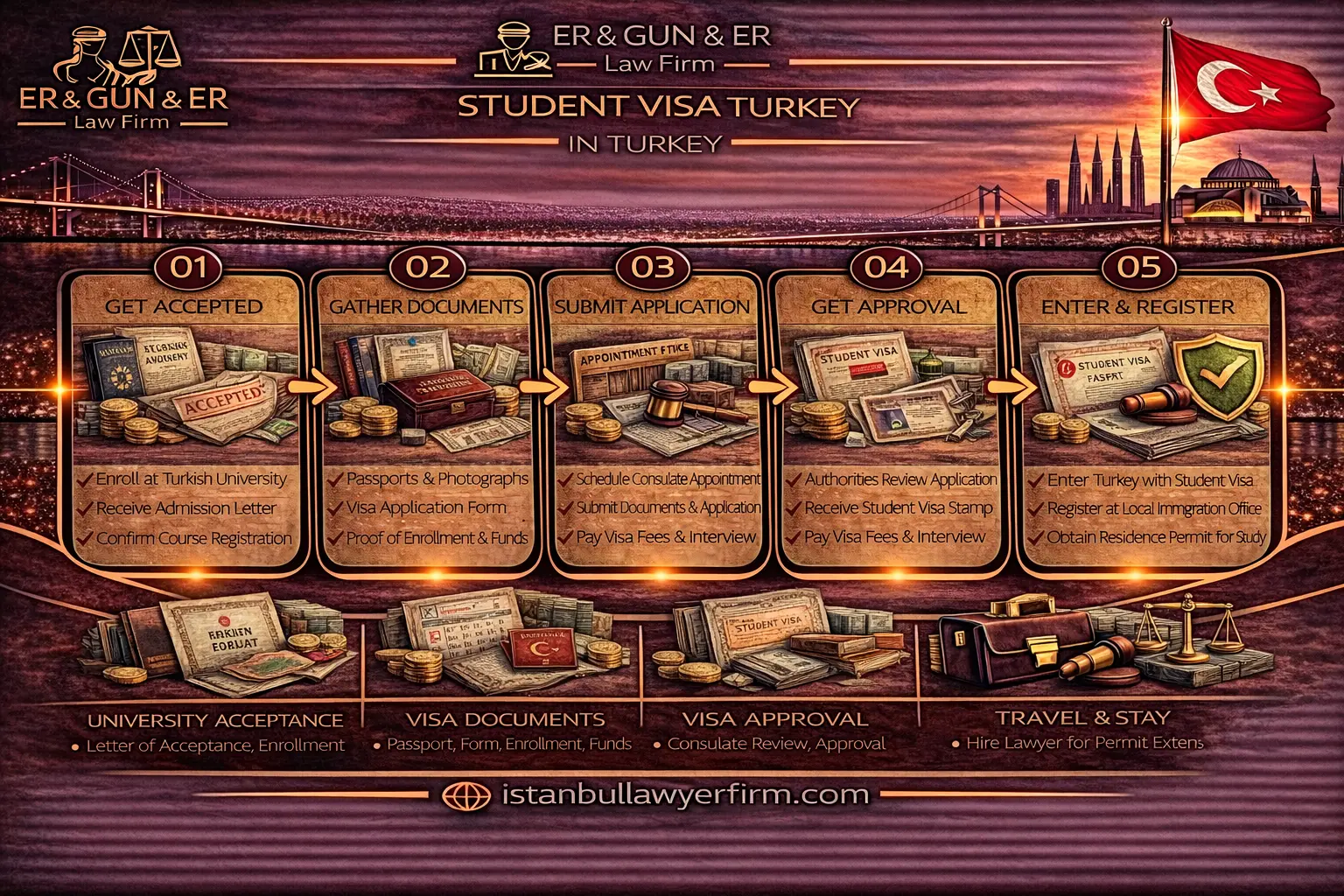
Studying in Türkiye involves two distinct legal instruments that international students must coordinate from acceptance through renewal. The first is the student visa, an entry document issued by Turkish consulates abroad on the basis of consular practice and reciprocity rules with the applicant's country. The second is the student residence permit (öğrenci ikamet izni) issued inside Türkiye by the Presidency of Migration Management (Göç İdaresi Başkanlığı, "GİB", formerly the Directorate General of Migration Management until the 24 October 2021 reorganisation that converted it to a presidency-level institution under the Ministry of Interior). The student residence permit is governed by the Foreigners and International Protection Law (Law No. 6458, "YUKK") of 4 April 2013, Articles 38-41, and is the legal status that authorises lawful stay during the academic programme.
Many students search for "student visa Turkey" and assume the visa alone authorises long-term stay. In practice, the visa is an entry document, while the student residence permit is the status that governs lawful stay after arrival. The two steps are linked but not interchangeable, and mixing them creates avoidable overstay and compliance risk under YUKK Articles 102-105 (administrative fines) and Article 9 (entry ban consequences). A well-prepared file starts with a clean acceptance package and then plans the post-entry residence application before travel. Turkish authorities and universities expect a document-driven approach, which means passport identity, acceptance documents, address evidence, and insurance evidence must match exactly. ER&GUN&ER Law Firm advises students, university administrators, and family members on the integrated execution of the consular and residence stages, including acceptance documentation review, e-ikamet application discipline, address registration under the Population Services Law (Law No. 5490) Article 50, health insurance verification, work and internship authorisation under the International Workforce Law (Law No. 6735) Article 16(2), renewal compliance, and rejection appeals. Practice may vary by authority and year — check current guidance.
Student Visa Versus Permit
The first concept to understand is that a visa is about entry, while a residence permit is about stay. A visa is issued by a Turkish consulate abroad and assessed under consular practice. A residence permit is issued inside Türkiye by GİB and becomes the local status record. Students often enter Türkiye on different lawful entry bases and then must transition to student status through the residence procedures under YUKK Article 38. The key point is that the student residence permit is the document that keeps you lawful after the initial entry period ends. If you rely only on a visa or a short-stay entry right, you may become unlawful without noticing. That risk affects renewals, travel, and future permit applications. The e-ikamet workflow at www.goc.gov.tr is the main administrative interface for the residence stage. It creates an application record, appointment record, and a paper file that officers will later compare at renewal. Practice may vary by authority and year — check current guidance.
The second concept is that the authority chain is different for each stage. Consular authorities evaluate entry purpose and documentary credibility before travel. Migration authorities evaluate lawful stay and local compliance after arrival. These authorities use different checklists and can request different supporting documents. Some students will not be required to obtain a specific sticker visa, while others will, depending on nationality and consular rules. The residence permit stage is assessed by the GİB student permit workflows in the province (İl Göç İdaresi Müdürlüğü) where the student registers. Provinces can apply the same national rules with different documentary expectations in practice. This is why you should avoid relying on a friend's experience from a different city or a different year. Your university registration date, entry date, and residence appointment date must be planned as one timeline. If your file is incomplete at appointment, you may lose time and risk your lawful stay posture.
The third concept is that the residence permit record is a compliance record, not only a card. It contains your address declarations under Law 5490 Article 50, university status proof, and identity data as recorded in the system. If you submit inconsistent data, you can create record conflicts that are hard to correct later. A clean record also supports bank onboarding, phone SIM registration, and other daily administrative steps. When you leave and re-enter, border officers may verify your residence status based on what is recorded, not on what you believe you filed. If you change universities, you will rely on the system record and university letters to show continuity. If you graduate or pause study, your residence status may need a different legal basis under YUKK, and the record must explain the transition. Students should keep copies of every student certificate (öğrenci belgesi) and every enrollment update issued during the year. The visa stage does not capture these ongoing compliance elements, which is why the permit stage is decisive. Practice may vary by authority and year — check current guidance.
Who Needs a Student Visa
Whether you need a student visa depends primarily on nationality and consular rules. Some students can enter Türkiye lawfully on visa-free or e-visa channels and then complete the residence permit stage inside Türkiye. Other students are expected to obtain a student visa before travel, especially when entry purpose must be pre-cleared for education. The student visa application at the consulate should be treated as a document verification stage. You should first check the Turkish mission guidance for your country and your passport type, because reciprocity rules can change. You should also check whether your university programme type affects the visa expectation, because short exchanges and long degree programmes can be treated differently. The safest approach is to obtain written confirmation of the visa requirement from the consulate or the official pre-application system. If you enter on a short-stay basis, you must still plan the residence stage quickly to avoid falling out of lawful status. Practice may vary by authority and year — check current guidance.
Visa need is also shaped by where you will physically apply for the residence permit after entry. Some provinces require the student to complete university registration steps before the residence appointment is meaningful. Some universities issue student certificates only after registration, so the student must time entry to obtain the student certificate promptly. If your entry basis does not allow enough time to complete these steps, you may face a lawful stay risk that forces exit and re-entry. If you plan to live in a dormitory, confirm whether the dorm issues address proof accepted by local offices. If you plan to rent, confirm whether the rental contract and address registration under Law 5490 Article 50 can be completed quickly enough to support the residence filing. If you arrive without housing proof, you may not be able to complete the residence file on time. Do not guess on validity requirements and instead consult current consular and migration guidance. If you have prior Turkish entry history, keep entry stamps and prior permits because officers may ask about prior lawful stay. If you overstayed in the past, disclose it consistently and plan risk mitigation under YUKK Articles 102-105 rather than hoping it will be ignored.
Students often misunderstand that a student visa is not a guarantee of admission to Türkiye or of a residence permit. Consular approvals and border admissions are separate processes, and border officers can still question entry purpose if documents are inconsistent. The residence permit is also a separate administrative decision under YUKK Article 38 that depends on the local file and local compliance. Therefore, a student should avoid making irreversible financial commitments based solely on one approval stage. A safer approach is to stage commitments, such as housing deposits and tuition payments, based on documentary milestones. If you are required to obtain a student visa, ensure you carry the acceptance package and proof of financial support at entry. If you are not required to obtain a student visa, carry the acceptance package anyway because it supports your narrative if questioned. After entry, move quickly to university registration and address registration because delay is the most common risk driver. The strongest cases are those where every claim is supported by an exhibit and every exhibit is consistent with passports.
University Acceptance Documents
The acceptance package is the foundation of credibility in education-based entry and stay. The university acceptance letter and the student certificate are the official acceptance evidence that consulates and migration offices rely on under YUKK Article 39 conditions for the student residence permit. The acceptance letter should be issued by the university (a higher education institution recognised by the Higher Education Council, Yükseköğretim Kurulu, "YÖK") and should identify the programme, dates, and student identity exactly as in the passport. If the letter is e-signed, preserve the verification method and do not print a low-quality scan that loses signature integrity. If the university issues a separate student certificate after registration, plan how you will obtain it quickly after arrival. Officers often test whether the acceptance is genuine by checking format and contact details. Provide official university contact details and avoid submitting private agent emails as the only contact. If your acceptance letter uses a different spelling of your name than your passport, request correction before filing. Corrections after filing can trigger mismatch issues across systems.
Acceptance evidence should also support a coherent timeline. If your programme begins on a certain date, your entry timing should be consistent with preparation and registration needs. Entering far too early can create housing and lawful stay questions if you cannot register quickly. Entering too late can create university registration problems and missed appointment windows. If the university requires in-person enrollment, plan travel so you can complete enrollment before the residence appointment. If the university issues a letter in Turkish and English, keep both versions and submit the version requested by the authority. If the acceptance letter references a student number, keep the student number consistent across later student certificates. If your acceptance is conditional, such as conditional on language level, document how you will satisfy the condition. If your acceptance is deferred, keep the deferral letter and ensure you do not file residence based on an old start date. If your acceptance is cancelled, do not file or renew based on cancelled status, because false student status creates legal risk under YUKK Article 41.
Universities often provide guidance on residence permits, but university guidance is not a substitute for legal status verification. Treat university guidance as a practical checklist and then cross-check it with official GİB instructions. Some universities provide required document PDFs, and those PDFs often highlight that student certificates can be obtained via e-government (e-Devlet) in certain contexts. When university and official lists differ, follow the official list and use the university list as a practical supplement. If your university uses an internal appointment system for student permit submissions, ensure you follow it because missing the university workflow can delay your residence file. If you are in a private dormitory, obtain a dorm letter that includes address details. If you are renting privately, obtain a rental contract that is consistent with your passport name and that can be used for address registration under Law 5490. Acceptance evidence is therefore a living file component that supports status continuity, not a one-time letter. Practice may vary by authority and year — check current guidance.
Consular Application Basics
Consular filing is a document and credibility review, not a guaranteed pathway. Financial proof is one of the most common consular evidence categories, but it must be presented as documented support rather than as an invented threshold. Consulates can request bank statements, sponsorship letters, scholarship letters, or other proofs depending on nationality and programme type. The safe approach is to present a coherent support story that is traceable through bank records or scholarship awards. Consulates also examine the acceptance letter, passport validity, and your intention to study rather than work informally. If your travel history suggests repeated overstays, the consulate may scrutinise your intent more closely. If you have prior Turkish residence history, bring prior cards and exit stamps to show compliance. If your documents are in another language, follow the consulate's translation expectations. If the consulate requests appointment booking through an online pre-application system, follow the official steps and keep confirmation emails. If biometrics are required, attend and keep the biometrics completion record where provided. If the consulate requests a criminal record check (adli sicil kaydı), provide an official record and avoid informal letters. Practice may vary by authority and year — check current guidance.
Consular applications can be refused for reasons that are not obvious to the applicant, such as inconsistent identity, incomplete acceptance documents, or unclear financial support. When a refusal occurs, request the refusal reason in writing where possible and store it for future planning. Do not immediately reapply with the same documents because repeat refusals can create a negative pattern. Instead, correct the specific defect, such as a name mismatch or missing authentication, and then reapply with a cleaner file. If you rely on a sponsor, ensure the sponsor letter is consistent with the sponsor bank statement evidence and does not contain unverifiable claims. If you rely on your own funds, ensure the bank statement is official and shows account holder identity clearly. If you rely on scholarship, submit the official scholarship award letter and avoid submitting informal emails as proof. If your acceptance is conditional, provide the condition explanation with official documentation. If your passport will expire soon, renew it before filing because passports near expiry often trigger additional scrutiny. If your documents require legalisation (apostille under the Hague Convention to which Türkiye is party, or consular legalisation for non-Hague countries), complete it before filing. Maintain one consistent narrative across every form, because inconsistencies are interpreted as misrepresentation.
After a visa is issued, do not treat it as the end of the process. A visa is used for entry and then you must plan the residence stage immediately after arrival. Keep the visa page copy and entry stamp copy because they become part of the residence file. Plan housing and address registration as early as possible because address evidence is often the bottleneck in residence filings. Plan health insurance arrangements early so you can submit a valid certificate at residence appointment. Plan university registration so you can obtain a student certificate used in the residence file. If you travel in and out before the residence appointment, keep travel evidence and ensure you remain lawful. If your visa is single-entry, do not leave Türkiye before the residence filing unless you understand the re-entry consequences. If you enter on a different visa type and then attempt to switch to student residence under YUKK Article 38, confirm eligibility because some switches are treated differently in practice. The safest approach is to treat the consular stage as preparation for a well-organised residence file. Practice may vary by authority and year — check current guidance.
Entry and First Registration
After your arrival, the border record and entry stamp become the starting point of your lawful stay file. Keep a clear copy of the passport identity page and the entry record, because later questions are answered by those identifiers. If you entered with a consular student visa, store the visa page copy with your acceptance packet and travel tickets. If you entered without a specific student visa, confirm your lawful entry basis immediately and do not assume you have more time than you actually do. The safest first step is to complete university registration steps that generate an official student certificate and student number. Your university acceptance package should be kept intact, because officers sometimes compare it to the student certificate issued after enrollment. You should also decide where you will live in the first weeks, because housing determines address registration and appointment feasibility. Avoid changing addresses repeatedly during the first filing window, because inconsistent addresses create record mismatch in the system. Practice may vary by authority and year — check current guidance.
The first local registration task is to align your student record, address record, and residence application record to the same identity data. Universities often issue a student certificate only after you complete enrollment and tuition steps, so do not delay those administrative actions. Once you have a stable address, complete the local address registration step under Law 5490 Article 50 (notification within 20 business days) using the same spelling and passport number used in your application. Address evidence should match the rental contract, dorm letter, or housing confirmation, and it should be readable and signed. Once registered, the address enters the Address Registration System (Adres Kayıt Sistemi, "AKS") of the General Directorate of Civil Registration and Citizenship Affairs (Nüfus ve Vatandaşlık İşleri Genel Müdürlüğü). Keep copies of your housing documents and payment proofs, because officers sometimes ask how the address was established. Your next priority is to prepare the student residence permit file as a coherent pack rather than collecting documents one by one at the appointment. Use an index that lists each document, its issuance date, and what it proves, because a structured pack reduces misunderstandings. If you change rooms or dorms, update your address record promptly and keep proof of the update.
After you submit your residence file, treat the submission receipt as a legal document that proves your filing posture. Store the receipt with the online application output and your document index, because these records are requested in later renewals. If the office issues a tracking number, record it in your chronology and do not rely on screenshots alone. Residence permit card delivery is usually managed through a documented address and contact record, so keep your phone and email stable. If you move after submission, update the address record through the permitted procedure and archive the update proof. If you travel during processing, carry your submission receipt and your student certificate to avoid confusion at controls. The safest practice is to avoid travel until you have clarity on your file status and your address linkage is stable. If the office sends a deficiency notice, respond quickly and with an indexed bundle, because late responses can lead to refusal under YUKK Article 41. When you submit additional documents, keep courier receipts or portal confirmation to prove delivery. If you receive your card, check the spelling, passport number, and validity dates immediately and request correction if any field is wrong.
Student Residence Permit Scope
The student residence permit (öğrenci ikamet izni) under YUKK Article 38 defines your lawful stay for education and links your status to your enrollment record. It is granted to foreigners pursuing associate degree, bachelor's, master's, or doctoral education at a higher education institution in Türkiye, and (subject to the conditions in the implementing regulations) to certain other categories of students. The permit is issued and managed through the GİB student permit workflow in the province where you registered. Under YUKK Article 38, paragraph 2, the student residence permit obtained by the foreigner does not provide a basis for residence permit applications by parents, siblings, or other relatives — a critical limitation that distinguishes the student permit from family residence permits under YUKK Articles 34-37.
The conditions for the student residence permit under YUKK Article 39 include being accepted by the educational institution, having sufficient and continuous health insurance coverage, having sufficient material means for the duration of the stay, and not posing a threat to public order or public health. The duration is generally aligned with the educational programme, with renewal under YUKK Article 40 subject to the continuing existence of the qualifying conditions. The permit does not replace a passport and does not cure unlawful stay that occurred before filing. You should therefore treat lawful entry, timely filing, and document completeness as non-negotiable compliance steps. The permit is also tied to your declared address, so moving without updating the AKS record can create compliance questions. If you change universities or departments, you must document the change and ensure the permit record is updated consistently.
The permit scope is primarily residence for study, and it should not be treated as a general work authorisation. Students frequently ask about work rights, and the answer depends on the separate authorisation framework under the International Workforce Law (Law No. 6735) Article 16(2), which we address in the work and internship section below. Your academic status can also be relevant to internship approvals, so keep university internship letters and departmental approvals organised. If you breach permit conditions, future renewals and other permits can become harder because the record shows non-compliance. A practical way to avoid accidental breaches is to read your permit conditions and keep them in your compliance folder. If you plan to change your residence category later (for example, to a work residence after graduation), maintain clean continuity so the new category is not undermined by gaps. Student status is not static, and the administration monitors continuity through renewal filings and address updates under Law 5490. Practice may vary by authority and year — check current guidance.
Required Documents Logic
Document logic is the method of proving eligibility with minimal ambiguity and maximal traceability under the YUKK Article 39 conditions framework. The documents for the student residence permit should be assembled as one coherent pack, not as a last-minute bundle of unrelated pages. Start with identity documents, including passport identity page, entry evidence, and prior Turkish residence cards if any. Add university status evidence, including enrollment confirmation and a current student certificate (öğrenci belgesi) issued by the university. Add address evidence that matches the AKS record and is supported by contract or dorm letter. Add health insurance evidence that is valid in Türkiye and lists the student clearly by name and identifier. Add photographs and application forms in the format required by the province and keep copies of the printed forms. Build a document index that links each exhibit to a purpose, such as identity, education, address, insurance, and support. Keep delivery proofs for every submission, including portal confirmations and courier receipts, because delivery proof is central in disputes. Practice may vary by authority and year — check current guidance.
Address evidence is often the practical bottleneck because it must be both legally valid and system-consistent. The phrase address registration captures the idea that the student must be linked to a verified AKS record, not merely a temporary hotel stay. If you live in a dormitory, obtain a dorm letter that includes the full address and your identity details. If you rent privately, ensure the rental contract contains the full address, landlord identity, and your name exactly as in passport. If you share housing, ensure the contract still provides you a clear right to reside and is not only a private roommate arrangement. Keep utility proofs or management confirmations where requested. Address documents must be readable and signed, because illegible contracts are treated as unreliable. If you moved recently, keep move history and update receipts so the record shows continuity rather than conflicting addresses. Address evidence must also match your online form entry, because mismatches are a common reason for deficiency notices under YUKK Article 41 procedural framework.
Identity integrity is the second bottleneck, because the migration system matches files by passport number and recorded name fields. Always submit a clear passport copy that shows the passport number, issuance date, and expiry date without shadow. If your passport was renewed recently, carry the old passport copy and the linking letter where available. If your name includes multiple surnames, keep the same sequence across every form and every translation. If you have a national ID card that differs from passport spelling, do not use it to override the passport unless the office requests it. If you have a residence card from a prior year, include a copy so the officer can see continuity and prior identity matching. If you entered Türkiye with a different passport than you now use, explain it with official evidence and avoid informal narratives. If the office requests an updated university letter, obtain it and submit it as an indexed supplement with delivery proof. Supplements should be submitted through the permitted channel and should reference the file number clearly. A consistent identity record protects you in renewals because future officers compare old files and new files for drift.
Health Insurance for Students
Health insurance is reviewed as a condition of lawful residence for students under YUKK Article 39(1)(c). The certificate must show that coverage is active and verifiable in Türkiye, listing your name exactly as in passport with a policy number and validity dates. Foreign students who study in Türkiye for more than one semester can apply within three months of registration to be enrolled in the General Health Insurance scheme (Genel Sağlık Sigortası, "GSS") under the Social Security Law (Law No. 5510) Article 60(1)(d), which provides public health coverage at the foreign-student premium rate set by SGK. Alternatively, students can rely on private health insurance covering the residence permit period from a Turkish-licensed insurer. If the insurer issues separate certificates per insured person, submit the certificate that lists you, not only the sponsor. If the insurer issues a multilingual certificate, submit the final issued PDF and avoid self-edited translations. Keep proof of premium payment where available, because payment proofs support validity if the insurer certificate is questioned. If the policy starts after your appointment date, replace it, because officers expect active coverage at submission. Practice may vary by authority and year — check current guidance.
Students should also understand that insurance evidence is evaluated for identity match and scope clarity. A certificate that lists only the insurer name without the insured identity is usually weak evidence. The certificate should clearly connect you to the policyholder if the policyholder is a parent or sponsor. If the policy uses initials or abbreviated names, ask the insurer for a corrected certificate that uses full passport spelling. If the policy is tied to a Turkish tax number (vergi numarası) or YKN, ensure the number is correct and consistent with your other records. Keep your insurer contact details in case the office needs verification by phone or email. If verification is requested, respond quickly and keep a record of the verification response as an exhibit. If you have a gap between entry and coverage start, do not hide it, and instead align coverage dates and explain the correction in writing. If you plan to travel, carry a copy of your certificate because it can help resolve questions at checkpoints. If you have dependants, ensure each dependant has their own valid coverage evidence if the office requires it. If your university offers guidance on insurance, treat it as a checklist and confirm against official office requirements.
Insurance continuity is also a risk control because lapses can raise questions at renewal even if you studied continuously. If you renew insurance mid-year, keep the renewal endorsement and the payment receipt in your file. If you cancel insurance, document the cancellation date and the replacement policy date to show no gap. If you change address, ensure the insurer address record does not create a contradiction with your AKS record. If you receive a deficiency notice that requests insurance clarification, submit the clarification as an indexed supplement with delivery proof. If the office questions validity, ask the insurer for a confirmation letter rather than trying to explain policy terms yourself. If the insurer issues an electronic certificate, keep the original electronic file and metadata where possible. If you are under scholarship, do not assume scholarship includes insurance unless the scholarship letter explicitly says so. If you move from student status to another status, review whether insurance requirements change and plan accordingly. Keep a compliance calendar that tracks insurance expiry and residence permit expiry together. Practice may vary by authority and year — check current guidance.
Address Registration Requirements
Address registration is the practical hinge between your university status and the student residence permit file, governed by the Population Services Law (Law No. 5490) Article 50, which requires foreigners (like Turkish citizens) to notify their address to the population directorate within 20 business days of moving. Migration offices treat the declared AKS address as a compliance statement, not as a temporary preference. If you do not complete address registration correctly, your application can be paused for verification or returned as incomplete under the YUKK Article 41 procedural framework. You should decide early whether you will stay in a dormitory, a private rental, or a host household, because each option requires a different evidence format. Dormitory residents should request an official dorm letter that includes the full address and their passport identity details. Private renters should ensure the rental contract shows the exact apartment address and the landlord's identity in a readable way. Short hotel bookings are rarely strong evidence for a long-term student file and often create repeated address changes in the record. Practice may vary by authority and year — check current guidance.
The address step is not only about the paper contract, because the record must be registered in the AKS and linked to your identity. If the registration office (Nüfus Müdürlüğü) asks for additional supporting documents, provide them exactly as requested and keep a submission receipt. Many students fail this step because they sign a rental contract but never complete the formal AKS registration, leaving the migration file without a verified link. If you are moving into a newly rented flat, confirm that the landlord can provide property identification details that match the contract address. Where a notarial step is required for the housing document, do it before the appointment so you do not lose your slot. If the address is registered under another person's name, clarify your right to reside there with a written consent and official supporting evidence. Do not submit different addresses in different supporting documents, because officers compare each page to detect inconsistency. If you must change address after filing, update the AKS record through the permitted channel within the Law 5490 Article 50 timeframe and archive the update proof for your renewal file. Keep one master address timeline that records move dates, update dates, and submission dates so you can answer any compliance question quickly.
Address compliance continues after the card is issued, because inspections and registry cross-checks can occur during the year. If an inspection call is made, respond calmly and provide the same address proofs you submitted, without creating new narratives. Students who travel frequently should ensure someone can receive official notices at the registered address, because missed notices can cause administrative problems. If you sublet without updating records, you create an inconsistency that can be interpreted as false declaration. If your landlord changes, renew the contract or obtain a landlord change letter so your residence proof remains current. If you live in a dormitory and the dorm changes management, request a new confirmation letter to prevent later doubts about the address record. If you receive a deficiency notice about address, submit the correction as one indexed bundle and keep delivery proof. When you update address, update your phone and email consistently so follow-up messages do not go to an inactive contact. Keep copies of every address update receipt because renewals often ask you to prove continuity across the year. If you move provinces, treat it as a new compliance cycle rather than a casual relocation.
Financial Support Evidence
Financial evidence is used to show that you can support yourself during study without relying on undeclared work, in line with YUKK Article 39(1)(d) which requires sufficient material means for the duration of the stay. Consular files often ask for financial proof and they apply their own document reading standards. Migration offices may also request support evidence for the student residence stage, especially when the file lacks a scholarship or obvious funding source. You should present a coherent funding story that can be verified through bank statements, scholarship letters, or formal sponsorship letters. Avoid inventing any minimum amount, because authorities do not publish stable thresholds that apply to all nationalities and provinces. If you rely on personal savings, use official bank statements that show your name, account number, and statement dates clearly. If you rely on family support, use a sponsorship letter supported by the sponsor's bank statements and identity documents. If you rely on a scholarship, use the official scholarship award letter that states the duration and coverage scope. If you rely on tuition pre-payment, keep payment receipts and university confirmations. If you rely on part-time work plans, do not treat plans as proof, because plans are not authorised income. Practice may vary by authority and year — check current guidance.
Support evidence must match the identity and timeline in your academic file, because mismatched dates create credibility issues. If your sponsor is a parent or relative, ensure the sponsor letter uses the same name spelling as the passport and civil records. If your sponsor is a company, the company should provide an authorised letter and supporting registry evidence rather than an informal email. Do not submit screenshots from mobile banking apps without account identifiers, because they are hard to verify and often rejected. If the consulate requests a specific statement period, follow the period exactly and keep the full statement rather than a single page. If the migration office requests additional proof, answer with one indexed bundle and keep delivery proof for the entire set. If your funding changes after you arrive, document the change with official evidence and avoid leaving the record inconsistent. If your funding is mixed, such as partial scholarship and partial family support, explain the split with documents and keep the split consistent across forms. Keep your original bank statements and avoid editing them, because altered statements create serious credibility problems.
Your support evidence is not a one-time submission, because it often becomes relevant again at renewal under YUKK Article 40 and when you open bank accounts. Store every submitted statement, sponsorship letter, and scholarship letter in a renewal folder with stable filenames. If the office requests updated statements, provide updated statements that follow the same format as the initial statements. Do not switch from one support story to another without documentation, because unexplained shifts are treated as inconsistency. If you receive funds from abroad after arrival, keep remittance receipts because they can support your ongoing lawful support narrative. If you convert currency, keep bank exchange receipts rather than cash exchange slips when possible. If you use a joint account, clarify your control over the account with official bank documents rather than personal explanations. If your sponsor requests to be removed from the file later, plan the transition to self-support with documented bank evidence before you remove the sponsor narrative. When funding disputes arise, they are resolved by documents, not by explanations, so keep the record clean.
Online Application Steps
The online form is the first official record that officers will compare against your paper documents. The e-ikamet system at www.goc.gov.tr captures your name, passport number, address, and student status in a structured way. You should enter your identity exactly as in your passport identity page, including middle names and surname order. You should enter your passport number without spaces or extra characters so the system matches it correctly. You should enter your address exactly as in the AKS record and the housing contract. If you change address after submission, do not edit the old record informally, and instead follow the permitted update procedure under Law 5490 Article 50. You should save the application output PDF and the appointment page immediately and store them in your evidence vault. You should avoid making multiple duplicate applications because duplicate records can confuse the office and trigger extra scrutiny. If you discover an error after submission, prepare a correction note supported by documents for the appointment rather than guessing. If the system asks for contact information, use a stable email and phone number that you can access for the full processing period. Practice may vary by authority and year — check current guidance.
After you submit the online form, the system typically generates a reference number that you should record in your chronology. The reference number should be repeated on every cover letter and supplemental submission so the office can match documents to your file. If the portal allows uploading certain documents, upload only the requested categories and keep the upload confirmation as proof. Uploaded files should be named clearly so that officers can read them without opening multiple versions. If you upload a passport scan, ensure the scan is high resolution and shows the full passport number and expiry date. If you upload a student certificate, ensure the certificate is current and includes your student number and programme name. If you upload an insurance certificate, ensure it lists you as insured and includes the policy number and validity dates. If the system allows choosing an appointment slot, choose a slot that gives you enough time to complete address registration and any translations. Do not choose an early slot and then attend with an incomplete pack, because incompleteness is a major refusal risk under YUKK Article 41.
The online record is also the baseline for future renewals, because renewal forms pre-fill from prior records in many systems. If you let a clerical error remain uncorrected, it can repeat in each renewal cycle and become harder to fix over time. The safe approach is to correct errors at the first appointment and to keep proof of the correction request in writing. If the office corrects a field manually, ask for confirmation or keep the corrected printout so you can prove the change later. If you use a representative, ensure the representative uses the same terminology and does not create a second narrative in emails. The GİB student permit workflow is procedural and will often rely on what the system shows rather than what you explain orally. This is why you should avoid contradictions between the system record and the paper record. If you must submit a supplement, reference the system record and attach only the missing item rather than re-sending the whole pack without structure. If you receive a system-generated message, respond promptly and archive the message, because the message becomes part of the administrative record.
Appointment and Submission
The appointment is the moment the office compares the online declarations against originals and certified copies. You should bring your passport, printed application form, student certificate, address proof, insurance proof, and photographs in the required format. Officers expect the documents for the student residence permit to be organised, readable, and consistent with the checklist. Create a document index and place it at the front of your pack so the officer can locate items without reordering the bundle. Arrange the pack in the same sequence as the checklist, because officers often review in that order. If a document is foreign, bring the legalised original (apostille for Hague Convention countries) and the notarised translation bundle together, not as separate loose pages. If the officer questions a spelling, show the passport identity page and the matching translated civil record rather than debating orally. If the officer requests a supplement, ask for the request in writing and confirm the allowed delivery channel. Keep the appointment page and reference number visible, because it links your paper pack to the online record. If biometrics are taken, ask for confirmation where available and store it in your file. Practice may vary by authority and year — check current guidance.
After submission, you should receive a receipt or a reference that proves you filed, and you should archive it immediately. The filing receipt is often the only proof you can show if questioned during processing, so treat it as a legal document. If the office issues a tracking number, record it in your chronology and use it in every follow-up email. If you move after submission, update address through the permitted method under Law 5490 Article 50 and submit the update proof so the delivery route remains correct. Residence permit card delivery depends on the correctness of your address and contact record, not on informal assurances. Keep your phone number active and monitor messages because delivery and deficiency communications can be sent there. If you receive a deficiency request, respond with an indexed supplement and keep delivery proof, because missing the correction window can lead to refusal under YUKK Article 41. If you submit a supplement, do not change your narrative, and instead provide only the missing proof with a cover letter. If your card arrives, check spelling, passport number, and validity details immediately and request correction if any field is wrong. Do not assume a wrong spelling is harmless, because banks and universities often match names exactly to the card.
If a submission is refused under YUKK Article 41, the first step is obtaining the written decision and proof of service, because objections depend on the recorded reason. Read the refusal reason carefully and compare it to your submission index to see whether the office missed an exhibit or whether an exhibit was genuinely missing. Do not rush to file a new application with the same defects, because repeated inconsistent filings can create a negative pattern. Instead, correct the specific defect, such as an address mismatch or an invalid insurance certificate, and then choose the correct procedural route. If you plan an objection, keep the file evidence-led and attach delivery proofs to show that you complied with requests. The strongest objections target a concrete record error rather than making broad fairness claims. If the refusal was due to missing documents, show retrieval attempts and explain why the document could not be produced earlier. If the refusal was due to identity mismatch, correct the mismatch through official documents and avoid personal explanations. If the refusal creates a travel or stay risk, plan lawful exit or status management rather than assuming you can remain without consequence.
Renewal and Extensions
Renewal under YUKK Article 40 is the point where the administration tests continuity rather than initial eligibility. The safest mindset is to treat renewal as a file audit. You should start by checking the expiry date printed on your student card. You should also check your passport expiry date and plan renewal before you file. Your university enrollment status is the core eligibility proof, so request a current student certificate in advance. Keep your prior student certificate because officers sometimes compare old and new records. Ensure your student number and faculty information match across letters. Update your AKS record before filing if you moved during the year. Keep proof of address updates because address continuity is reviewed. Verify that your health insurance is still valid and will remain valid through the new period. If you changed insurers, prepare both policies and a continuity note. Build a renewal folder that contains last year's submission receipt and last year's document index. That folder becomes your proof if a deficiency notice is later issued. If you had a prior deficiency, fix it proactively instead of repeating it. Practice may vary by authority and year — check current guidance.
Many renewals are delayed because students treat the renewal as a last-week task. A better approach is to start collecting documents while you still have stable access to your dorm, landlord, and university office. If you need to change your permit dates due to academic calendar issues, understand that extension logic is procedural and must be supported by official enrollment evidence. Do not assume the same extension logic applies to every status category, because student files often require current enrollment proof. Your renewal application should repeat the same identity spelling used in your first filing to avoid system mismatch. If your passport number changed, attach a linkage note and copies of both passports. If your university changed your name spelling in its system, request a correction letter from the registrar before filing. Address documents should match what is recorded in the AKS, not only what is written on a contract. Keep a fresh address registration printout where available because older proofs can be questioned. If you filed online, archive the portal outputs because they become the baseline record. If the office requests additional documents, respond with one indexed bundle and one cover letter.
After you submit a renewal, you should monitor your contact channel for messages because deficiency notices are often time-sensitive. Keep your phone number active and check your email daily. If your university issues semester certificates, store them so you can respond quickly to enrollment questions. If you change dorm rooms, request an updated dorm letter to keep address evidence current. If you change a private lease, obtain a renewed lease copy with signatures and store it. When the card is produced, the delivery phase becomes the next compliance step. Residence permit card delivery depends on a correct address record and a reachable courier process. If you move after filing, update your address through the permitted channel and keep proof of the update. If you miss a delivery attempt, contact the relevant delivery workflow and keep communication logs. When the card arrives, check spelling, passport number, and dates immediately. If an error exists, request correction promptly and keep the correction request in writing. Do not assume that a prior approval guarantees the next approval, because officers re-evaluate the record each cycle.
Work and Internship Rules
Many students ask whether the student residence permit automatically grants employment rights. In general, student status and work authorisation are separate legal concepts in Türkiye. The work permit framework for students is set out in the International Workforce Law (Law No. 6735 of 28 July 2016) Article 16(2), administered by the Ministry of Labour and Social Security. Under Article 16(2), foreigners studying at higher education institutions in Türkiye in associate degree, bachelor's, master's, or doctoral programmes can apply for a work permit during their education. Associate degree and bachelor's degree students are entitled to part-time work of up to 24 hours per week, while master's and doctoral students may have broader work eligibility under the implementing regulations. The work permit application is a separate process from the residence permit and requires its own documentation. If you work informally, you create a risk record that can damage renewals and future visas. Practice may vary by authority and year — check current guidance.
Internship arrangements should be structured so that the legal basis, university basis, and company basis are aligned. Start with a written university letter that states the internship requirement and the period. Ask the host company to provide a written placement letter that states role and supervision. Keep the host company trade information if available so identity is verifiable. If a work permit authorisation under Law 6735 is required, the submission must match the period and role described in the letters. Some internship arrangements that are part of the academic curriculum and unpaid may operate under different authorisation rules from paid employment; this should be verified before commencement. The GİB student permit file often focuses on whether the student status remains primary and continuous. If an internship requires travel to a different province, update AKS expectations and keep travel logs. If the company asks you to start immediately, explain that you need time to confirm compliance. If you are paid, keep a clear record of payments and the legal basis for the payment. Avoid cash payments because cash is difficult to explain and can appear as informal employment. If you receive an internship agreement, sign it only after you understand whether it creates employment obligations.
Work compliance also interacts with your travel schedule because leaving and re-entering with unresolved status issues is risky. If you lose student status and remain in Türkiye, you may create an unlawful stay period under YUKK Article 102 without noticing. That becomes visible at renewal and at border checks. If you plan to suspend studies, obtain an official university letter and plan a lawful status change rather than waiting. If you plan to change to another permit type after graduation, plan the sequence so you do not create gaps. Students sometimes extend stay for tourism after exams, but tourism intentions should be managed through lawful status, not through silence. If you need more time to finalise your academic file, coordinate with the university and keep written proofs. If you miss a renewal window, you may face overstay consequences even if your study was genuine. Keep a compliance calendar that tracks permit expiry, insurance expiry, and enrollment deadlines. If you change jobs or projects, update your own record of activities so you can answer questions consistently. Avoid posting inconsistent employment claims publicly because social media content can be used to test intent and compliance.
Rejections and Appeals
Rejections under YUKK Article 41 usually happen because the file is incomplete, inconsistent, or the student status cannot be verified on the record. The first step is always to obtain the written decision and proof of service. Without the written decision you cannot target the reason and you cannot plan the correct remedy. Read the reason line by line and compare it to your submission index. If the reason is a missing document, confirm whether you actually submitted it and whether delivery proof exists. If the reason is an address mismatch, correct the AKS record and prepare an updated proof set. If the reason is insurance insufficiency, obtain a corrected certificate and keep insurer verification evidence. If the reason is enrollment doubt, obtain a fresh student certificate and registrar confirmation letter. The procedural route for challenging a refusal includes administrative review within GİB and judicial review at the Administrative Court (İdare Mahkemesi) under the Administrative Procedure Law (Law No. 2577) within 60 days of notification. The objection should be evidence-led, meaning each argument cites one exhibit and one date. The strongest appeals target a concrete record error or a provable compliance step, not broad fairness claims. Practice may vary by authority and year — check current guidance.
Rejection can create a lawful stay problem if you remain in Türkiye without a valid status basis. You should not guess whether you can remain, because the answer depends on your entry basis and the procedural posture of the file. If you are approaching expiry, plan lawful options early rather than waiting for the last day. The simplest risk model is to assume that silence can create an unlawful stay record under YUKK Article 102 that will later be used against you. Overstay penalties under Article 102 include administrative fines (calculated on the basis of overstay duration), and Article 9 entry bans can be imposed for overstays exceeding defined thresholds. If you must leave and re-enter, preserve all receipts and decision copies to show compliance and intent. If the office allows resubmission, ensure the resubmission is consistent with the first filing and uses the same identity spelling. If you file a new application, do not change your narrative unless you have new official documents that justify the change. If a rejection is based on suspicion of non-genuine study, avoid emotional rebuttals and instead submit objective enrollment and attendance evidence. If you receive a removal-related notice (sınır dışı etme kararı) under YUKK Article 53, do not ignore it and seek counsel immediately, as a 7-day appeal period applies to removal decisions before the Administrative Court.
Some students face secondary problems such as refusal at re-entry or enhanced screening at the border after a problematic filing history. Border records are not negotiated at the airport desk, so you need a document pack that explains your status clearly. If an entry restriction (tahdit kodu) is recorded, treat the issue as a separate legal file requiring administrative or judicial challenge depending on the basis for the restriction. Do not assume a university letter alone will remove a border restriction, because border systems rely on administrative records. Preserve your submission receipts, decision letters, and enrollment letters in one folder so you can show coherence. If you later succeed and obtain your card, verify delivery and keep proof because residence permit card delivery can be questioned when addresses change. If you need to renew later, keep your prior refusal record and your correction record together so the renewal officer sees remediation. If you are asked at the border about purpose, answer with facts and show the current student certificate and residence status proof. If you are asked about prior issues, disclose them consistently and show the resolution documents. In high-risk files, centralise communication through one counsel channel to avoid contradictory statements. If a judicial route is chosen, build the petition from the same evidence index used in your administrative objection.
Practical Roadmap
A practical roadmap starts before you travel, because your first month determines whether your record is clean or chaotic. Begin by creating a single evidence vault that stores your passport, acceptance documents, and financial proofs. Confirm whether you need a consular visa and keep consular outputs in the same vault. Plan your arrival so you can complete university enrollment quickly and obtain a student certificate. Choose housing that can produce stable address evidence and plan AKS registration immediately under Law 5490 Article 50. Prepare your health insurance certificate before the residence appointment so you do not lose time. Complete the e-ikamet form only after your identity spelling and address are fixed. Store the online outputs, appointment page, and reference number immediately. Build a document index that maps each exhibit to identity, enrollment, address, insurance, and support. Attend the appointment with originals and a copy of the index to keep the officer review linear. After submission, store the receipt and treat it as your lawful stay evidence during processing. Track messages and respond to deficiency requests with indexed bundles and delivery proofs. Keep your student residence permit folder updated with every new student certificate during the year. Practice may vary by authority and year — check current guidance.
Your evidence vault should be structured so a stranger can audit it without calling you. Start with a cover sheet that shows your name, passport number, and current address. Add a chronology sheet that lists each submission and each receipt date. Add a document index that lists every attachment and its purpose. Place documents for the student residence permit in the same sequence as the office checklist to reduce confusion. Store address proofs separately and update them immediately when housing changes. Because address registration is a common failure point, keep both the contract and the official AKS registration proof together. Store insurance certificates with payment proofs and renewal endorsements in one subfolder. Store university enrollment letters with the registrar contact details so verification is easy. Store bank statements and sponsorship letters in a secure subfolder because they contain sensitive data. Use consistent filenames and do not rename official PDFs in ways that lose date context. Keep email headers and portal confirmations as separate exhibits because they prove delivery. When you submit a supplement, update the index and note the supplement in the chronology.
When you face discretion, the strongest tool is a coherent record rather than a persuasive speech. Keep financial proof documents consistent across consular and migration stages, and do not switch funding narratives without new evidence. You should keep a travel pack that includes your receipt and student certificate because questions can arise unexpectedly. You should avoid informal work until you confirm authorisation under Law 6735 Article 16(2) because compliance history is cumulative. You should treat every address change as a formal AKS update under Law 5490 Article 50 and store the update receipt. You should check your card details on arrival and correct errors immediately. You should keep renewal planning on a calendar so insurance and enrollment do not lapse. You should maintain calm, factual correspondence because tone and consistency reduce follow-up requests. Practice may vary by authority and year — check current guidance.
Frequently Asked Questions
- What law governs student residence in Türkiye? The Foreigners and International Protection Law (Law No. 6458, YUKK) of 4 April 2013, with student-specific provisions in Articles 38-41, administered by the Presidency of Migration Management (Göç İdaresi Başkanlığı, GİB) since the 24 October 2021 reorganisation.
- What is the difference between a student visa and a student residence permit? A student visa is an entry document issued by Turkish consulates abroad. A student residence permit (öğrenci ikamet izni) under YUKK Article 38 is the status that authorises lawful stay during the academic programme.
- Who is eligible for the student residence permit? Under YUKK Article 38, foreigners pursuing associate degree, bachelor's, master's, or doctoral education at higher education institutions in Türkiye recognised by YÖK, subject to the Article 39 conditions (acceptance, health insurance, sufficient material means, no public order/health threat).
- Can the student permit support family residence permits? No. Under YUKK Article 38 paragraph 2, the student residence permit does not provide a basis for residence permit applications by parents, siblings, or other relatives.
- How is the e-ikamet application made? Through www.goc.gov.tr, the GİB online portal, with the e-ikamet form, document upload, and appointment scheduling at the local İl Göç İdaresi Müdürlüğü (Provincial Directorate of Migration Management).
- What is the address registration requirement? The Population Services Law (Law No. 5490) Article 50 requires foreigners to notify their address to the Nüfus Müdürlüğü within 20 business days of moving, with registration entered into the Address Registration System (Adres Kayıt Sistemi, AKS).
- What health insurance is required? Under YUKK Article 39(1)(c), valid health insurance covering the residence permit period. Foreign students can apply within three months of registration to enrol in the General Health Insurance scheme (GSS) under Social Security Law Article 60(1)(d), or use private insurance from a Turkish-licensed insurer.
- Can students work in Türkiye? Under the International Workforce Law (Law No. 6735) Article 16(2), students at higher education institutions can apply for a work permit. Associate degree and bachelor's students are entitled to part-time work of up to 24 hours per week. Master's and doctoral students have broader eligibility under the implementing regulations.
- What documents are required for the student permit? Passport, e-ikamet application form, student certificate (öğrenci belgesi), AKS-registered address proof, valid health insurance certificate, biometric photographs, financial means evidence, and the application fee receipt.
- How is the permit renewed? Under YUKK Article 40, with documentation of continuing enrollment, valid health insurance, current AKS-registered address, sufficient material means, and the renewal application submitted before expiry through the e-ikamet system.
- What are the consequences of overstay? Under YUKK Article 102, administrative fines calculated on overstay duration. Under YUKK Article 9, entry bans can be imposed for overstays exceeding defined thresholds. The penalties affect future visa and residence permit applications.
- How are refusals appealed? Refusals under YUKK Article 41 can be challenged through administrative review and through judicial review at the Administrative Court (İdare Mahkemesi) under the Administrative Procedure Law (Law No. 2577) within 60 days of notification.
- What is the appeal period for removal decisions? Removal decisions (sınır dışı etme kararı) under YUKK Article 53 must be challenged at the Administrative Court within 7 days of notification — a much shorter window than ordinary refusals.
- What if my permit expires while I am abroad? Re-entry without a valid permit requires a new visa or visa-exempt entry, followed by a new residence permit application. The lapse can also affect future applications and may require enhanced explanation.
- Where does ER&GUN&ER Law Firm support student residence matters? Acceptance documentation review; consular application coordination; e-ikamet application discipline; AKS address registration under Law 5490 Article 50; health insurance and GSS verification; YUKK Article 38-40 student permit application and renewal; Law 6735 Article 16(2) student work permit applications; YUKK Article 41 refusal appeals and Article 53 removal challenges before the Administrative Court.
Author: Mirkan Topcu is an attorney registered with the Istanbul Bar Association (Istanbul 1st Bar), Bar Registration No: 67874. His practice focuses on cross-border and high-stakes matters where evidence discipline, procedural accuracy, and risk control are decisive.
He advises international students, university administrators, families, and dependants across Acceptance Documentation Review, Consular Application Coordination, e-ikamet Discipline, AKS Address Registration under Law 5490, Health Insurance and GSS Verification, YUKK Article 38-40 Student Residence Permit Applications and Renewals, Law 6735 Article 16(2) Student Work Permits, and YUKK Article 41 Refusal and Article 53 Removal Appeals before the Administrative Court.
Education: Istanbul University Faculty of Law (2018); Galatasaray University, LL.M. (2022). LinkedIn: Profile. Istanbul Bar Association: Official website.