

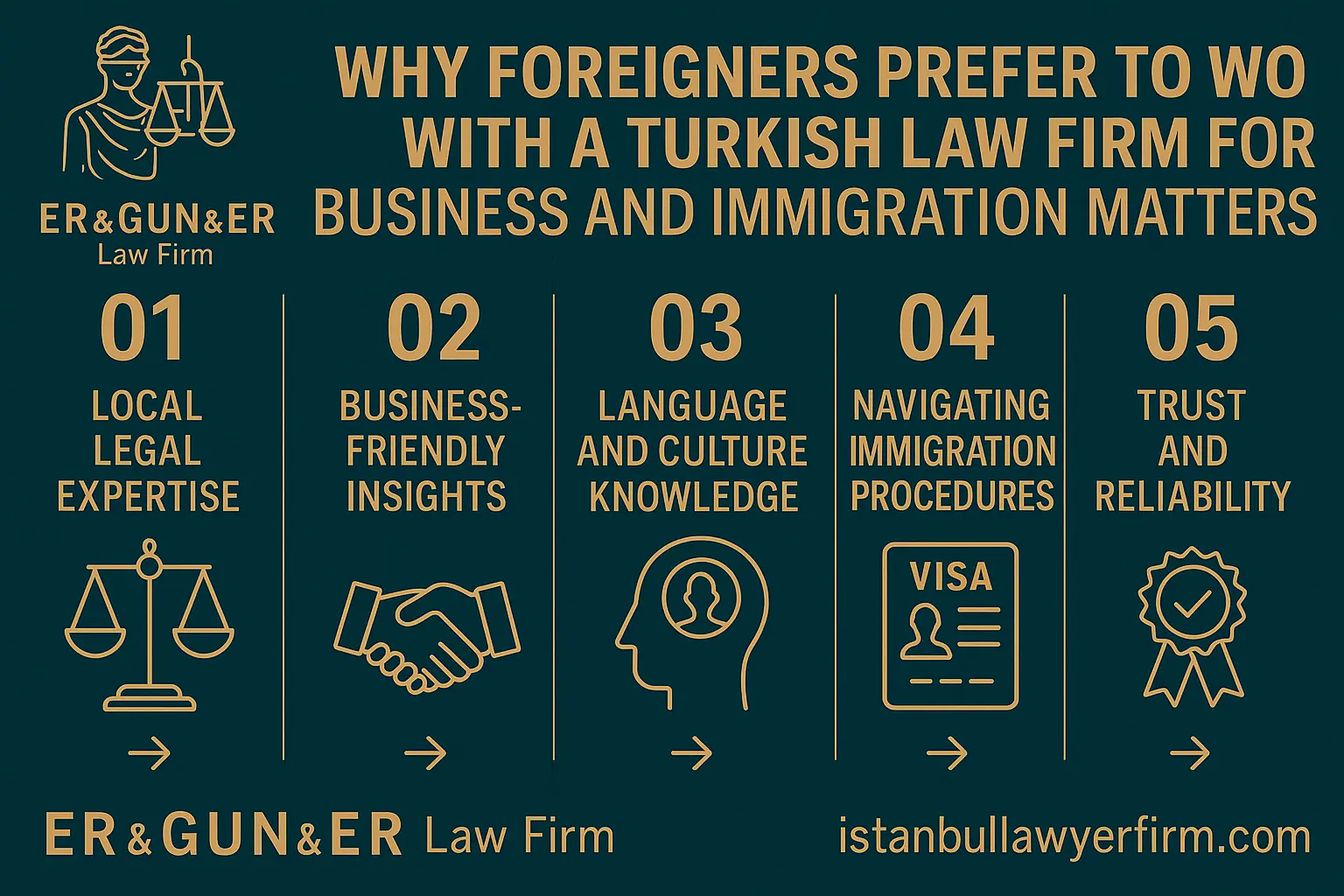
Foreign nationals interacting with the Turkish legal system — whether to set up a company, buy real estate, apply for a residence permit, claim an inheritance, or defend a commercial dispute — almost invariably end up working with a Turkish law firm. The reason is structural rather than promotional. Turkish administrative and judicial procedures are heavily registry-based, document-form-driven, and dependent on submissions to specific government directorates that operate in Turkish, accept Turkish-form documents, and require either the principal's physical presence or a properly constituted Turkish power of attorney to a local lawyer. Home-jurisdiction counsel, however capable, cannot directly interface with the Land Registry Directorate, the Trade Registry, the Migration Directorate, the Tax Office, the Civil Registry, or the Turkish courts. This guide explains, in plain English and from the foreign client's perspective, what a Turkish law firm actually does across the practice areas where foreigners most often need legal help in Türkiye, why local counsel materially reduces the risk of a failed transaction or a missed filing, and how the relationship between home-jurisdiction counsel and Turkish counsel typically works in cross-border matters. It is not a marketing piece. It is a practical map of where the value of local Turkish counsel comes from, and where the cost of attempting cross-border self-management most often falls.
1. The Practical Need for Local Counsel in the Turkish System
A Turkish Law Firm working with foreign clients spends a meaningful portion of its time managing the gap between what foreign clients expect — based on their experience of common-law or other civil-law systems — and what Turkish authorities actually require. Türkiye operates a civil-law system drawing on Continental European traditions, with its core private-law codes adapted from Swiss, German, and French models in the early Republican period and substantially modernised in the past two decades. Court procedure is heavily document-driven and judge-led; statute is the primary source of law, with case-law from the Court of Cassation and the Council of State providing interpretive guidance rather than binding precedent. There is also a distinctive layer of registry-based administration. Property ownership is registered at the Land Registry Directorate (Tapu Müdürlüğü). Companies are registered at the Trade Registry (Ticaret Sicil Müdürlüğü) and announced through the Trade Registry Gazette (Ticaret Sicil Gazetesi). Civil status is recorded at the Civil Registry (Nüfus Müdürlüğü) and accessed through the central electronic government portal e-Devlet. Tax identification, residency status, immigration files, and most regulatory filings are tied to a foreigner identification number (yabancı kimlik numarası) or a potential tax identification number (potansiyel vergi numarası) issued in person at a Tax Office (Vergi Dairesi). Without active counsel inside Türkiye, none of these systems can be meaningfully accessed.
An Istanbul Law Firm advising a foreign principal also has to operationalise the cross-border document-authentication chain. Foreign-issued documents typically require apostille certification under the 1961 Hague Convention before they can be recognised in Türkiye, then sworn translation by a court-registered translator, then notarisation by a Turkish notary (noter), and in some cases consular legalisation where the issuing country is not a Hague Apostille party. This sequence is procedurally rigid: a step taken out of order, or a translation done by a non-court-registered translator, will be rejected at the registry counter, often weeks after the foreign client has already paid for the underlying document. Local counsel coordinates the entire chain — apostille at origin, courier to Türkiye, sworn translation, notarisation, registry submission — and absorbs the friction that would otherwise fall on the client.
A lawyer in Turkey acting for a foreign principal also handles the constitution and scope of the local power of attorney (vekaletname), which is the legal instrument that authorises a Turkish lawyer or other agent to act on the foreign principal's behalf. The vekaletname is executed at a Turkish notary or, where the principal cannot travel to Türkiye, at a Turkish consulate abroad, with strict requirements regarding the recital of the principal's identity, the explicit listing of the powers granted, and where applicable the inclusion of family-status, real-estate, banking, tax, immigration, or litigation-specific clauses. A vekaletname missing a single required clause — for example, the explicit power to register a real estate transfer, or the explicit power to represent the principal before the Migration Directorate — produces a rejected filing. Counsel's first practical job on a foreign-client mandate is therefore the design of the vekaletname itself.
2. Business Formation, Corporate Governance and Operations
A Turkish Law Firm advising a foreign investor on company setup works against the framework of the Turkish Commercial Code (Türk Ticaret Kanunu, Law No. 6102), the Foreign Direct Investment Law (Doğrudan Yabancı Yatırımlar Kanunu, Law No. 4875), and the registry procedures operated through the Trade Registry Directorate and the central electronic system known as MERSIS. The most common entity forms for foreign investment are the limited liability company (limited şirket) and the joint stock company (anonim şirket); each has different minimum capital thresholds, different governance structures, and different registration burdens. The limited liability company is the simpler form, with lighter governance requirements and a single director model that suits small and mid-sized operations; transfer of shares requires notarisation and a registry update, which makes it less suitable for frequent equity changes. The joint stock company is the heavier form, with a board structure, broader scope for share-class engineering, and shares that transfer by endorsement of the share certificate without registry intervention; it is the standard form for venture-capital-backed structures, regulated-sector operations, and entities planning eventual public listing. The articles of association (esas sözleşme) must comply with Commercial Code requirements as to share capital, board composition, signature authority, and corporate purpose, and must be registered through MERSIS before being announced in the Trade Registry Gazette. Counsel also coordinates the issue of the foreign principal's tax identification number, the bank-account opening (which Turkish banks treat as a separate compliance file from the registry filing), and the social security registration where the company will employ staff.
An Istanbul Law Firm advising on ongoing corporate governance works on a different layer: board resolutions, capital increases, transfer of shares, signature circular updates, annual general assembly procedures, and the documentation required to maintain the company in good standing. The Commercial Code distinguishes carefully between the powers of the board and those of the general assembly, and many foreign-owned companies run into difficulties when board resolutions are signed informally without the formal procedure that produces a registrable document. The signature circular (imza sirküleri) — a notarised document specifying who can bind the company and to what financial limit — is a recurring point of contact: every commercial counterparty, bank, and registry will ask for the current circular before transacting, and an outdated circular is one of the most common reasons that an otherwise valid transaction fails to complete.
A lawyer in Turkey advising a foreign-headquartered group also handles the regulatory perimeter that runs alongside the corporate forms. Sectoral regulators — the Banking Regulation and Supervision Agency, the Capital Markets Board, the Information and Communication Technologies Authority, the Energy Market Regulatory Authority, the pharmaceutical regulator, the Competition Authority — each operate licensing and reporting regimes that are entirely separate from the Trade Registry. Beyond the limited and joint stock company forms, foreign groups operating in Türkiye sometimes use a branch office (şube), which is an extension of the foreign parent rather than a separate legal entity, or a liaison office (irtibat bürosu), which is permitted only for non-revenue-generating market-research or representative activity and is licensed by the Ministry of Industry and Technology. Branches and liaison offices each have their own registration tracks, their own tax-treatment consequences, and their own restrictions on permitted activity, and the choice between a Turkish subsidiary, a branch, and a liaison office is one of the early structural decisions that drives the rest of the operational design. A foreign group entering a regulated sector typically requires a licence application before it can begin operations, and the licence file is built up over months. Local counsel manages the sequencing between corporate setup and licensing so that the company is formed in a way that supports the eventual licence application, rather than producing a registry filing that must later be amended to satisfy the regulator's requirements.
3. Residency, Work Permits and Turkish Citizenship
An English speaking lawyer in Turkey advising a foreign client on residency works against the framework of the Foreigners and International Protection Law (Yabancılar ve Uluslararası Koruma Kanunu, Law No. 6458), administered through the Presidency of Migration Management (Göç İdaresi Başkanlığı). The principal residence permit categories are short-term (typically tourism, property ownership, or commercial intent), family, student, long-term, and humanitarian. Each category has its own documentary requirements, its own duration limits, and its own renewal mechanics. The application is made through an online portal, but the supporting documents (notarised passport translation, address declaration, health insurance, financial-means evidence, supporting affidavits where applicable) must be assembled to specifications that change at the directorate level and are not always reflected in the online interface. A rejected application leaves a record on the file that complicates subsequent applications, and self-managed applications that fail are one of the most common reasons foreign clients seek counsel.
A Turkish Law Firm advising on work permits operates through a different statute: the International Labour Force Law (Uluslararası İşgücü Kanunu, Law No. 6735), administered by the Ministry of Labour and Social Security. A work permit application requires a sponsoring Turkish employer, registration of the prospective employee in the central electronic system, supporting employer financials, and where applicable a Turkish-citizen-to-foreigner ratio compliance under the implementing regulations. The ratio rule, currently set at five Turkish employees per foreign employee for most sectors, applies at the workplace level rather than at the company level, and the employer must demonstrate the ratio at application and maintain it during the permit's duration; new employers benefit from a transitional exemption window during which the ratio is not enforced for a defined period after the first foreign-employee hire. Turquoise Card (Turkuaz Kart) applications, available for highly qualified foreign professionals and investors, follow a separate procedure with its own evaluation criteria. The mechanics of the work permit are tightly bound to the underlying employment relationship, the corporate sponsor's standing, and the supporting evidence — and the application is graded on file completeness rather than on the merits of any individual document, so a missing supporting financial statement can sink an otherwise strong application.
Turkish lawyers who advise on Turkish citizenship handle the framework of the Turkish Citizenship Law (Türk Vatandaşlığı Kanunu, Law No. 5901). Citizenship can be acquired by birth, by descent, by marriage subject to a three-year cohabitation requirement, by ordinary naturalisation after five years of qualifying residence, or — most relevantly for international investors — by exceptional naturalisation under a defined investment threshold currently structured around a real estate purchase, a fixed deposit, government bond holding, fund participation, or job creation, each subject to specific thresholds and certification requirements set by the implementing regulation. The citizenship-by-investment pathway is processed through the Migration Directorate after a preliminary file built at the certifying authority for the chosen investment category. Local counsel coordinates the certification, the supporting documentation, the family inclusion (where the principal applies with a spouse and minor children), and the post-acquisition documentation that converts the citizenship grant into operative identity records.
4. Real Estate Transactions and Title Registry Procedure
An Istanbul Law Firm advising a foreign buyer on a Turkish real estate purchase works against the Land Registry Law (Tapu Kanunu) and the Foreigners' Real Estate Law framework that defines which foreign nationals can acquire real estate in Türkiye and under what limitations. Foreign individuals from most jurisdictions can acquire residential and commercial property up to defined area and population thresholds, with reciprocity considerations and security-sensitive area restrictions handled at the Land Registry Directorate's review stage. Foreign legal entities have a more restricted regime and typically require structuring through a Turkish subsidiary. The acquisition itself takes place in person at the Land Registry, where buyer and seller (or their attorneys-in-fact under proper power of attorney) appear before the Land Registry officer, the deed is read out, payment is verified, and the title is transferred and recorded in the central title registry system known as TAKBİS.
A lawyer in Turkey running a real estate due diligence file works through a structured checklist before the buyer commits funds. The title deed (tapu) and the title registry record (tapu kaydı) must be cross-checked for ownership history, mortgage encumbrances, court orders or attachments (tedbir), municipal zoning notes, easement and rights-of-way registrations, and the building's compliance with the construction permit and the occupancy certificate (yapı kullanma izin belgesi or iskan). For new-build properties, additional checks cover the developer's standing, the construction servitude (kat irtifakı) versus the condominium ownership (kat mülkiyeti), the developer's financial guarantees, and the buyer's protection under the Law on Construction in Return for Land Share where applicable. A property bought without the occupancy certificate can be lawfully held but cannot be lawfully occupied, financed, or converted to certain rental uses, and this is one of the most common gaps in foreign-buyer due diligence.
A Turkish Law Firm structuring a citizenship-linked real estate purchase has additional layers to manage. The investment threshold is verified at the certification stage, supported by appraisals from a Capital Markets Board-licensed appraiser, with the purchase price routed through Turkish-banking channels in foreign currency for proper foreign-exchange documentation. The three-year holding period required for the citizenship pathway is recorded as an annotation on the title at the Land Registry. Counsel coordinates the tax position — title registry fees (tapu harcı), value added tax exemption where the buyer qualifies as a foreign-currency-bringing first-time-buyer of new construction under the implementing regulation, and the deed of trust where the property is subsequently rented out — to ensure the citizenship file aligns with the tax file rather than producing unintended liabilities downstream. The value added tax exemption deserves particular attention because it is conditional on a precise sequence: the foreign currency must be transferred from abroad through a Turkish bank, converted on a documented rate, and used to fund the purchase within the timing window the regulation specifies; a transfer routed through a Turkish-resident intermediary, or a property already lived in or rented before the purchase, defeats the exemption. The savings on a citizenship-threshold property can be substantial, but only where the documentation is structured correctly from the outset.
5. Tax Compliance and Cross-Border Reporting
A Turkish Law Firm advising a foreign client on Turkish tax exposure works against the framework of the Income Tax Law (Gelir Vergisi Kanunu, Law No. 193), the Corporate Tax Law (Kurumlar Vergisi Kanunu, Law No. 5520), the Value Added Tax Law (Katma Değer Vergisi Kanunu, Law No. 3065), and the Tax Procedure Law (Vergi Usul Kanunu, Law No. 213) which sets the procedural rules for filings, assessments, and disputes. Individual foreign nationals are taxed in Türkiye either as residents (subject to worldwide income, where the qualifying connection is settlement intent and physical presence) or as non-residents (subject to Türkiye-source income only). The classification has substantial financial consequences, particularly for high-net-worth individuals with global income streams, and is a recurring area where home-jurisdiction tax advice and Turkish tax advice need to be reconciled rather than treated as alternatives.
An Istanbul Law Firm advising a foreign-headquartered group on Turkish corporate tax handles the standard corporate tax rate, the withholding tax regime on cross-border payments (dividends, interest, royalties, technical services), and the application of Türkiye's network of double-taxation treaties to reduce withholding rates where the recipient qualifies under the relevant treaty's beneficial-ownership and residence provisions. Türkiye has signed double-taxation treaties with the substantial majority of OECD member states and with most of its principal trading partners, and the tax rate that ultimately applies on a given cross-border payment is rarely the headline domestic rate. Counsel coordinates the certificate of residence supplied by the recipient's home tax authority, the treaty-rate filing at the Turkish withholding agent, and where applicable the refund procedure where withholding has been over-applied. The certificate of residence is a recurring procedural pinch point: it must be issued by the home tax authority for the calendar year in which the payment is made, must explicitly cover the treaty in question, and in most cases must be apostille-authenticated and sworn-translated before the Turkish withholding agent will accept it. A treaty rate applied on a payment without a properly-formatted certificate exposes the Turkish payer to a back-assessment from the tax administration, with penalties calculated on the underpaid withholding, and counsel typically holds the certificate file as a standing document set rather than reassembling it on each payment.
A lawyer in Turkey advising on tax controversy works on a separate procedural track. Tax assessments by the tax administration can be challenged in the first instance at the Tax Court (Vergi Mahkemesi), with appellate review through the regional administrative court (bölge idare mahkemesi) and the Council of State (Danıştay) which functions as Türkiye's highest administrative court. The tax dispute timeline is tightly statute-of-limitations bound, and the most common reason foreign clients lose otherwise winnable tax disputes is failure to file the initial challenge within the statutory thirty-day window from the assessment notification. Counsel also handles the parallel administrative-settlement track (uzlaşma), which is available for many tax assessments and produces a settled position with reduced penalties where the taxpayer concedes the principal. The choice between contesting the assessment in court and settling administratively is a strategic decision that has to be made early, on full information, and with the cross-border tax position firmly in view.
6. Inheritance, Family Law and Cross-Border Probate
An English speaking lawyer in Turkey advising on a Turkish inheritance file works against the framework of the Turkish Civil Code (Türk Medeni Kanunu, Law No. 4721), which governs intestate succession (legal heirship), the validity and interpretation of wills, the reserved-share regime that protects certain heirs from disinheritance, and the procedural mechanics of obtaining a certificate of inheritance (mirasçılık belgesi or veraset ilamı). The certificate of inheritance is the operative document that allows heirs to access the deceased's bank accounts, transfer real estate at the Land Registry, transfer corporate shares, and distribute personal property. It is issued either by a Civil Court of Peace (Sulh Hukuk Mahkemesi) or, in straightforward cases, by a notary, with documentary support including the deceased's death certificate, family composition records from the Civil Registry, and where applicable the apostille-authenticated birth, marriage, and death records of foreign-resident heirs.
A Turkish Law Firm advising on a cross-border estate works on the conflict-of-laws analysis under the Code on Private International Law and Procedural Law (Milletlerarası Özel Hukuk ve Usul Hukuku Hakkında Kanun, Law No. 5718). The applicable succession law for a non-Turkish national's estate may be Turkish law for immovable property located in Türkiye and the deceased's national law for movable property, depending on the precise factual configuration. This is one of the most procedurally sensitive areas for foreign clients, because a will validly executed in the deceased's home country may be operative for some assets and not for others, and a poorly-coordinated estate plan can leave foreign heirs facing parallel probate proceedings in Türkiye and abroad with inconsistent outcomes. Counsel coordinates the Turkish recognition of the foreign will, the certificate of inheritance procedure, the inheritance tax filing under the Inheritance and Transfer Tax Law (Veraset ve İntikal Vergisi Kanunu, Law No. 7338), and the asset-by-asset transfer at each registry.
Turkish lawyers who handle family law for foreign clients operate across divorce, custody, alimony, and the recognition and enforcement of foreign family-law judgments. Turkish divorce procedure runs through the Family Court (Aile Mahkemesi) and is materially different from the home-jurisdiction process most foreign clients are familiar with: it is judge-led rather than party-driven, takes longer than common-law contested divorces in straightforward cases, and produces a judgment that becomes final only after the appeals window has passed. For binational couples, the recognition of a foreign divorce in Türkiye is procedurally separate from the divorce itself and requires either an enforcement action under the Code on Private International Law or, since the 2017 reform, a streamlined administrative recognition procedure at the Civil Registry where both parties consent and statutory conditions are met. The Civil Code's reserved-share regime (saklı pay) also bears mention here because it is one of the most jurisdictionally distinctive features of Turkish succession law: certain heirs (descendants, surviving spouse, and in certain configurations parents) are entitled to a statutory minimum share of the estate that the deceased cannot disinherit by will. A foreign-resident testator with assets in Türkiye who has executed a home-jurisdiction will distributing the estate without regard to the Turkish reserved-share regime can leave the Turkish estate exposed to a reserved-share reduction action by a disinherited Turkish-law heir, and counsel coordinates the substantive proceeding, the recognition track, and the registry updates that bring the foreign client's Turkish civil-status records into line with the foreign judgment.
7. Employment Law and Workforce Compliance
A Turkish Law Firm advising a foreign-headquartered employer on Turkish employment law works against the Labour Law (İş Kanunu, Law No. 4857), the Social Security and General Health Insurance Law (Law No. 5510), and the international workforce framework discussed earlier. Turkish employment law is significantly more employee-protective than most common-law systems. Indefinite-term contracts are the default, fixed-term contracts are permitted only on objective grounds, termination requires either valid grounds (geçerli neden) or just cause (haklı neden) with sharply different severance and notice consequences, and any termination of an employee with at least six months of service triggers job-security provisions where the employer has thirty or more employees. Improperly structured terminations produce reinstatement claims through the mandatory employment mediation procedure under the Labour Courts Procedure Law (Law No. 7036) and, where mediation fails, through the Labour Court (İş Mahkemesi), with damages typically including back wages, severance, notice, and a four-to-eight-month earnings reinstatement compensation if reinstatement is refused.
An Istanbul Law Firm advising on the social security and tax dimension of employment handles the registration of new hires through the Social Security Institution's online system at least one day before the employee starts work, the monthly social security premium filings, the income tax withholding on salaries, the stamp tax on the employment contract, and the cumulative-tax-base calculation that produces the correct net-pay figure for each month. Foreign-headquartered employers often underestimate the documentary burden: a Turkish employment relationship requires a written contract, a personnel file with statutory contents, an occupational health and safety risk assessment under the Occupational Health and Safety Law (Law No. 6331), and where applicable the periodic health examinations whose frequency is set by the workplace's hazard classification. Each of these requirements is an inspection-point during a Ministry of Labour inspection, and the absence of any one item can produce a substantial administrative fine. The severance pay regime under the Labour Law produces another structural surprise for foreign employers: severance pay (kıdem tazminatı) is calculated as one month's gross salary per completed year of service, up to a statutory ceiling that is updated semi-annually, and is payable on most categories of termination other than termination by the employee for unjustified reasons or by the employer for just cause attributable to the employee. A termination decision that looks affordable on the headline-salary basis can produce a materially larger settlement once severance, notice, unused annual leave, and where applicable the four-to-eight-month earnings reinstatement compensation are aggregated, and the settlement-cost calculation should be done before the termination decision rather than after.
A lawyer in Turkey advising on senior-executive employment also handles the senior-executive-specific issues that do not arise at the staff level: non-compete covenants and the limits on their enforceability under the Code of Obligations, golden-parachute and retention bonus structures, the social security ceiling and its impact on net pay, the income tax treatment of stock-based compensation issued by a foreign parent, and the sequencing between work permit and corporate director registration where the executive is appointed to the Turkish board. Misalignment between the work-permit file and the employment-contract file is a recurring source of friction during inspection: the salary on the work permit must reconcile with the salary on the contract, the role description must reconcile, and the contract end-date must align with the permit duration.
8. Dispute Resolution and Court Representation
A Turkish Law Firm representing a foreign client in a Turkish court works in a system where the litigant is required to be represented by a Turkish bar-registered attorney for most categories of commercial and high-value matters. The Turkish court system is structured in four principal civil tracks: Civil Courts of Peace (Sulh Hukuk Mahkemeleri) for low-value and specified subject-matter disputes, Civil Courts of First Instance (Asliye Hukuk Mahkemeleri) for the general civil docket, specialised commercial courts (Asliye Ticaret Mahkemeleri) for commercial matters, and specialised courts (consumer, labour, family, intellectual property, enforcement) for the named subject areas. Appellate review runs through the regional appeal courts (bölge adliye mahkemeleri, also called istinaf mahkemeleri) and ultimately the Court of Cassation (Yargıtay) which functions as Türkiye's supreme court of appeal in civil and criminal matters. The administrative-law track runs in parallel through the administrative courts and the Council of State. The enforcement of money judgments runs through a separate institutional layer — the Enforcement Offices (İcra Daireleri) under the supervision of the Enforcement Courts (İcra Hukuk Mahkemeleri) — operating under the Enforcement and Bankruptcy Law (İcra ve İflas Kanunu, Law No. 2004), with its own procedural mechanics for asset seizure, sale, and distribution to creditors. A foreign creditor with a Turkish judgment in hand still has work to do at the enforcement office before payment is recovered, and counsel coordinates the substantive litigation and the enforcement track as parts of a single overall recovery plan.
An Istanbul Law Firm advising a foreign claimant or defendant has to manage the procedural shape of a Turkish proceeding, which is materially different from common-law litigation. Most commercial disputes require pre-action mediation under the Mediation Law (Law No. 6325) before they can be filed: a claim filed without the mandatory mediation certificate is rejected at the filing stage. Turkish civil procedure under the Civil Procedure Law (Hukuk Muhakemeleri Kanunu, Law No. 6100) is largely written and judge-led; oral hearings are shorter and less central to the proof-finding process than in common-law systems; expert reports (bilirkişi raporları) often determine the outcome on technical issues; and the discovery procedure familiar to Anglo-American litigants — broad-spectrum production from the opposing party — does not exist. Foreign clients accustomed to common-law procedural norms typically need their counsel to recalibrate their procedural expectations early.
Turkish lawyers who handle international arbitration with a Türkiye nexus operate against the International Arbitration Law (Milletlerarası Tahkim Kanunu, Law No. 4686) for arbitrations seated in Türkiye with a foreign element, and the New York Convention of 1958 (to which Türkiye has been a contracting state since 1992) for the recognition and enforcement of foreign arbitral awards in Türkiye. Türkiye is a recognised seat for international arbitration, with the Istanbul Arbitration Centre (ISTAC) operating as the principal institutional administrator alongside the Istanbul Chamber of Commerce arbitration service, the ICC, and ad hoc UNCITRAL-rules proceedings seated in Istanbul. Counsel coordinates the seat selection, the language clause, the substantive-law clause, the arbitrator nomination, and where the proceeding is contested, the post-award enforcement strategy in Türkiye and abroad.
9. Communication, Translation and Document Authentication
An English speaking lawyer in Turkey adds value to a foreign-client mandate well beyond the substantive legal advice. The everyday work of running a cross-border legal file in Türkiye includes Turkish-to-English and English-to-Turkish translation of contracts, court documents, board resolutions, regulatory correspondence, and registry filings; the coordination of sworn translation by a court-registered translator (yeminli tercüman) where a document needs to be filed with an authority that requires the translator's official certification; the apostille chain coordination for foreign-issued documents that need to be recognised in Türkiye; and the consular-legalisation track for documents from non-Hague-Convention jurisdictions. Each of these is a separate procedural skill that scales poorly when managed across time zones and language barriers, and is one of the most undervalued components of the local-counsel value proposition.
A Turkish Law Firm working with multinational legal teams also runs the dual-language drafting process that produces contracts and corporate documents that are simultaneously enforceable in Türkiye and intelligible to home-jurisdiction stakeholders. The standard approach is a parallel-language document with an explicit governing-language clause; the choice of governing language has substantive consequences if the two language versions diverge, and the drafting discipline required to keep them aligned is itself a specialised practice. Counsel also produces the executive-summary and risk-note layer that allows boards and home-jurisdiction general counsel to make decisions on Turkish matters without reading the underlying Turkish text in full. The sworn-translation infrastructure underpinning all of this is itself worth flagging: a sworn translator (yeminli tercüman) is a court-registered translator who has taken an oath before a notary and is authorised to provide translations whose certification is accepted by Turkish courts, registries, and government authorities. Translations from non-sworn translators, however accurate, are typically not accepted at the registry counter, and a foreign client who has paid for a high-quality but non-sworn translation often discovers the problem only when the translation is rejected at submission. Counsel maintains relationships with sworn translators in the principal foreign-language pairs and routes the translation work to translators whose work the relevant registry has previously accepted.
A lawyer in Turkey running a foreign-client file also manages the everyday document-flow infrastructure that the client typically does not see: courier coordination between the client's home country and Türkiye, notary appointments scheduled in advance to avoid the queue at the central notaries, translation pipelines with sworn translators sized to the file volume, and the document-archiving discipline that produces a clean reconstructable file two or three years after the matter has closed. The cost of skipping this infrastructure is rarely apparent on the day a matter is set up; it surfaces years later, when a missing notarised page or an untraceable apostille certificate produces a delay that is far more expensive than the original procedure would have been.
10. The Cost of Self-Management and the Value of Local Counsel
An Istanbul Law Firm engaged after a self-managed transaction has gone wrong typically encounters a recognisable pattern. A foreign buyer purchased property without checking the occupancy certificate and now cannot obtain residence-permit-eligible documentation. A foreign-headquartered employer terminated a Turkish employee without the just-cause documentation and now faces a reinstatement claim and a four-month-earnings compensation. A foreign principal granted a power of attorney that did not include the explicit power to register a real estate transfer, and now faces a months-long delay while a replacement vekaletname is executed at a consulate. A foreign investor paid the full purchase price for a citizenship-linked property before counsel had certified the appraisal, and the certifying authority will not approve the file. Each of these problems is correctable, but the correction is materially more expensive and slower than the original procedure would have been if local counsel had been engaged at the outset.
A Turkish Law Firm advising on the front-end of a foreign-client matter typically runs the diligence and structuring work in the first thirty to sixty days, then drops to a much lighter operational pace for the rest of the year. The early-stage cost is concentrated and visible. The downstream cost of doing the same work without local counsel is diffuse, surfaces unpredictably, and tends to land on the foreign principal at the worst commercial moments — when a transaction needs to close, when a regulatory deadline is days away, when a counterparty refuses to extend a stalled negotiation. The trade-off is recurrent across foreign-client mandates: a small predictable cost at the front of the file, against a larger unpredictable cost that may or may not materialise but, when it does, is substantially harder to absorb. Foreign principals familiar with the cost structure of common-law transactional work sometimes expect Turkish counsel fees to scale similarly, but the pricing logic in Türkiye is different: most foreign-client work runs on agreed fixed fees for defined scopes, with hourly billing reserved for litigation and unstructured advisory mandates, and the official-fee and disbursement layer (notary, apostille, sworn translation, registry fees) sits as a separate pass-through. The transparent fee structure and the regulated minimum-fee framework under the Turkish Bar Association's annual tariff are themselves part of the value proposition for foreign clients comparing the engagement to home-jurisdiction pricing.
Turkish lawyers who advise foreign clients also operate as the institutional memory of the relationship over time. A foreign principal living abroad does not retain detailed working knowledge of every Turkish matter the way Turkish counsel does, and the typical foreign-client file accumulates layers across the years: an initial company setup, a real estate purchase three years later, an employment dispute in year five, a tax audit in year seven, an inheritance file in year ten. Counsel that has carried the relationship across these layers can resolve later issues by reference to earlier decisions in a way that fragmented engagements with multiple unrelated providers cannot. The institutional-memory dimension of the relationship is rarely the reason a foreign client engages a Turkish firm at the outset, but it is one of the most reliable reasons foreign clients stay with the same firm for many years.
Frequently Asked Questions
- Why does a foreign client need a Turkish lawyer rather than relying on home-jurisdiction counsel? Turkish administrative and judicial procedures are operated through Turkish-language registries, directorates, and courts that require either physical presence or a properly executed Turkish power of attorney. Home-jurisdiction counsel cannot directly interface with these systems. Local counsel acts as the operative interface and absorbs the procedural friction that would otherwise fall on the client.
- What is a vekaletname and why does it matter? A vekaletname is the Turkish power of attorney instrument that authorises a Turkish lawyer or other agent to act on the foreign principal's behalf. It is executed at a Turkish notary or at a Turkish consulate abroad. Its scope must explicitly list the powers granted; a missing clause produces a rejected filing at the relevant registry.
- Can a foreign national buy property in Türkiye? Foreign individuals from most jurisdictions can acquire residential and commercial property in Türkiye subject to area, population, and security-sensitive-area limits, with reciprocity considerations handled at the Land Registry's review. Foreign legal entities are subject to a more restricted regime and typically require a Turkish subsidiary structure.
- How does Turkish citizenship by investment work? Citizenship by exceptional naturalisation is processed under the Turkish Citizenship Law and its implementing regulation, with qualifying investments including real estate purchase, fixed deposit, government bond holding, fund participation, and job creation, each subject to specific thresholds and certification requirements. Local counsel coordinates the investment certification, the Migration Directorate file, and the family inclusion.
- Are Turkish residence permits granted automatically with a property purchase? No. Property ownership supports a short-term residence permit application, but the permit is granted on the basis of the application file's compliance with the Foreigners and International Protection Law's requirements, not as an automatic consequence of the purchase. The two procedures are linked but separate.
- How long does a Turkish residence permit application take? Processing times vary by category, by directorate workload, and by the completeness of the file at submission. A self-managed application that is later rejected and refiled typically takes substantially longer than a properly assembled first submission.
- Does Türkiye recognise foreign wills? Foreign wills can be recognised in Türkiye, but the conflict-of-laws analysis under the Code on Private International Law determines which substantive succession law applies to which assets, and a will validly executed abroad may be operative for some assets and not for others. A coordinated estate plan addresses both jurisdictions.
- How are foreign judgments enforced in Türkiye? Foreign court judgments are enforced through an enforcement action under the Code on Private International Law, subject to reciprocity, jurisdictional regularity, public-order compatibility, and proper service. Foreign arbitral awards are enforced under the New York Convention.
- Is mediation required before a Turkish lawsuit? Yes, for most commercial, employment, consumer, and certain other categories of disputes. A claim filed without the mandatory mediation certificate is rejected at the filing stage. The mediation procedure is itself an opportunity for early settlement and runs on a short timeline.
- How long do Turkish commercial disputes take to resolve? Timelines vary widely by complexity, court workload, and the volume of expert evidence required. Mediated settlements typically resolve in weeks. Contested first-instance commercial proceedings can take a year or more, with appellate review adding additional time.
- Can a Turkish company be wholly foreign-owned? Yes. The Foreign Direct Investment Law establishes the principle of equal treatment between foreign and domestic investors and permits one hundred per cent foreign ownership in most sectors. Sector-specific restrictions apply in regulated industries (broadcasting, certain transport categories, certain defence-related sectors).
- What does a Turkish lawyer's engagement letter look like? Under the Law on Lawyers (Law No. 1136), the fee agreement should be in writing, specifying scope, fee structure, and the parties. Turkish Bar Association advertising rules restrict promotional language. The standard structure separates professional fees, official fees and disbursements, and translation and notarisation costs.
- Will a Turkish lawyer communicate in English with home-jurisdiction counsel? Most Turkish law firms working with foreign clients operate in English at the professional level and produce dual-language deliverables where the underlying Turkish-language document needs to remain operative for filing purposes.
- How does confidentiality work under Turkish law? The attorney's duty of confidentiality under Article 34 of the Law on Lawyers is a lifetime obligation that survives the termination of the engagement. Attorney-client communications during a criminal proceeding are additionally protected under the Code of Criminal Procedure.
- What happens if a foreign client wants to switch Turkish lawyers mid-matter? The client retains the right to terminate the engagement at any time. The outgoing lawyer is required to hand over the file, subject to settlement of fees due. The incoming lawyer files a new power of attorney and updates the relevant registries and case files.
About the Author
Av. Mirkan Günay Topcu is the managing partner of ER&GUN&ER Law Firm (Istanbul) and is registered with the Istanbul Bar Association under No. 67874. The firm advises foreign nationals, foreign-incorporated entities, and multinational legal teams on the full Turkish legal interface — corporate setup and governance, real estate and citizenship-by-investment, residence permits and work permits, tax and inheritance, employment and dispute resolution.
The author works in English and Turkish, with day-to-day case work covering Land Registry transactions, Migration Directorate files, Trade Registry corporate filings, Tax Office controversy work, Family Court and Civil Court proceedings, and the cross-border coordination layer that runs above all of these — the apostille chain, sworn translation, dual-language drafting, and home-jurisdiction-counsel liaison that makes a Turkish-resident law firm a practical extension of the foreign client's own legal infrastructure.
Profile: LinkedIn. Foreign clients evaluating Turkish counsel may also wish to read the companion guide on selecting a Turkish law firm under the Law on Lawyers (Avukatlık Kanunu) and the Turkish Bar Association advertising rules, which addresses the framework regulating the practice of law in Türkiye and the markers a foreign client can use to evaluate a prospective firm.
Contact ER&GUN&ER Law Firm