

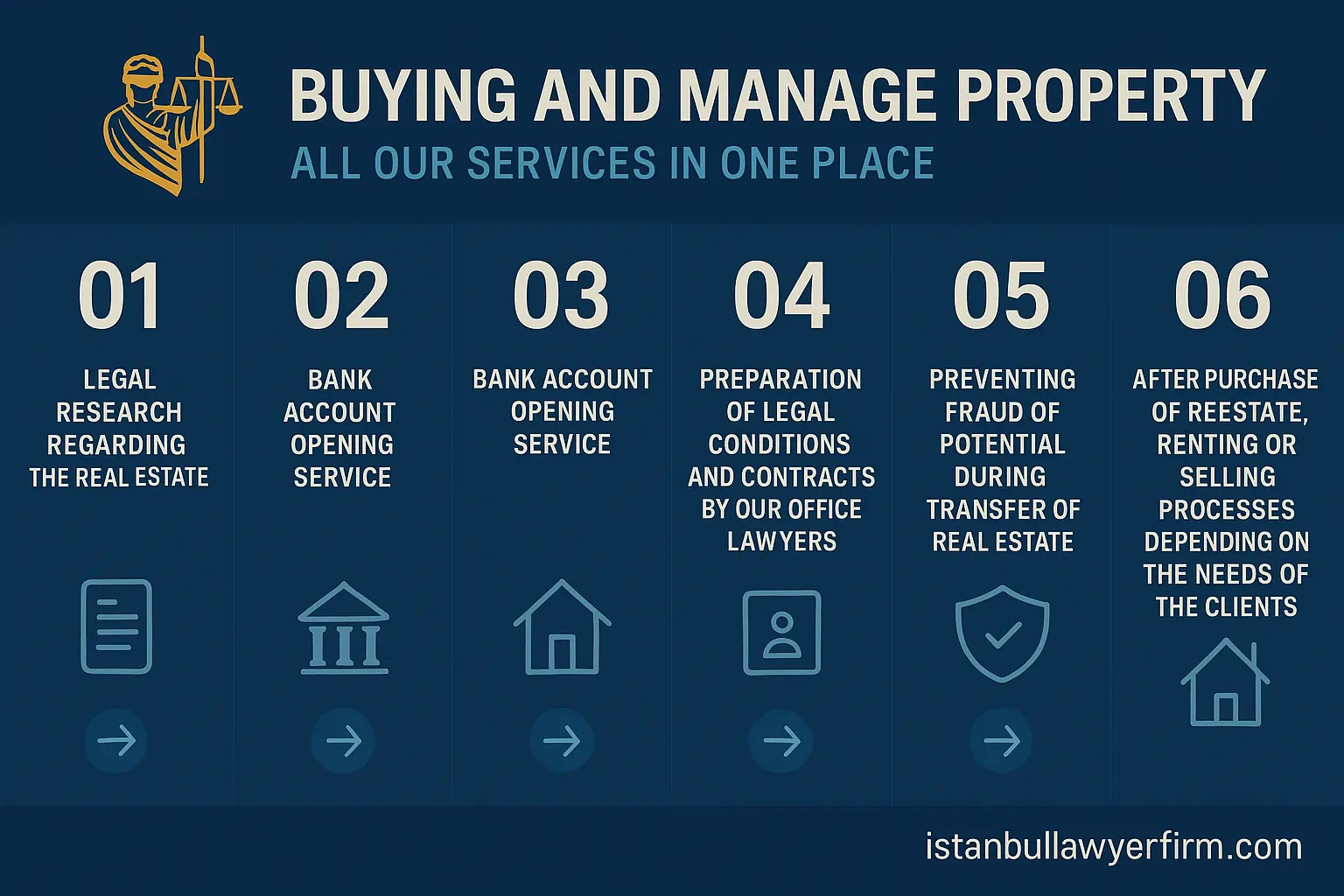
Real estate acquisition in Turkey is governed by a legal framework that combines the Turkish Civil Code's property ownership provisions with the Land Registry Law (Tapu Kanunu), specific legislation applicable to foreign buyers including the Regulation on the Implementation of the Law on the Protection of Cultural and Natural Assets for military zone restrictions, and the Regulation on the Implementation of Turkish Citizenship Law for citizenship by investment applications. The central legal principle is that property ownership in Turkey is only validly transferred upon registration at the Land Registry (Tapu Sicili) — a contract to sell, a notarized preliminary sale agreement, or a payment receipt does not transfer title, and a buyer who has paid the purchase price but has not obtained Land Registry registration has no ownership right recognized by Turkish law. For foreign buyers, several additional procedural requirements apply that do not apply to Turkish citizen buyers: a mandatory SPK-certified valuation report (ekspertiz raporu) must be obtained before the Land Registry transfer; the purchase funds must be converted to Turkish Lira through a Turkish bank, generating a Foreign Currency Purchase Document (Döviz Alım Belgesi); and nationality-specific restrictions on acquisition in certain zones and districts must be confirmed before commitment. The Land Registry Directorate (Tapu Müdürlüğü) portal at tkgm.gov.tr provides official access to title deed inquiry and registration services. This guide explains the legal framework applicable to foreign real estate buyers in Turkey — from initial eligibility through due diligence, purchase completion, tax obligations, rental management, and citizenship by investment.
Foreign buyer eligibility and ownership restrictions
A lawyer in Turkey advising on foreign real estate eligibility must explain that Turkish law permits most foreign nationals to purchase real estate in Turkey, but subject to two categories of restriction that must be confirmed before any commitment is made. The first category is nationality-specific: Turkish law historically restricted property acquisition by nationals of certain countries (including Syria, North Korea, Cuba, Armenia, and Nigeria), and while some restrictions have been relaxed over time, the current list of restricted nationalities must be verified against the Land Registry Directorate's current guidance before any foreign buyer proceeds. The second category is zone-specific: property located within military or security zones designated under the Military Forbidden Zones and Security Zones Act cannot be purchased by foreign nationals, and additional review requirements apply for property within 30 kilometers of certain borders. These zone restrictions are not visible on the title deed itself — they require a separate query to the Land Registry and the relevant military command. Practice may vary by authority and year — verify the current list of nationalities subject to acquisition restrictions and the specific military zone boundaries applicable to the target property area before advising any foreign buyer on Turkish real estate eligibility.
An Istanbul Law Firm advising on the district ownership ceiling for foreign nationals must explain that Turkish law imposes a ceiling of 10% maximum foreign ownership per cadastral district (ilçe), calculated as a percentage of the total private real estate area in the district. Where foreign ownership in a district approaches or reaches this ceiling, the Land Registry will decline new registrations by foreign buyers in that district — and the buyer discovers this only at the registration stage, after due diligence and price negotiation are complete. The 10% ceiling is measured dynamically and its current status is not publicly announced in advance — it requires a specific inquiry to the Land Registry Directorate for the specific district. For popular districts in Istanbul (Beşiktaş, Beyoğlu, Şişli) and resort areas (Bodrum, Antalya Merkez), the district ceiling is periodically approached. Practice may vary — verify the current district foreign ownership ceiling status for the specific cadastral district before committing to any property purchase in high-demand areas where the ceiling may be a relevant constraint.
A law firm in Istanbul advising on eligibility for foreign legal entities must explain that foreign legal entities (companies incorporated outside Turkey) face additional restrictions on Turkish real estate acquisition: foreign companies can generally only acquire real estate in Turkey if the acquisition is for a specific business purpose recognized under the applicable legislation (such as tourism development, industrial investment, or office use) and may require prior permission from the relevant ministry. The practical alternative for foreign investors who wish to hold Turkish real estate through a corporate structure is to establish a Turkish company (anonim şirketi or limited şirketi) — a company incorporated in Turkey with foreign shareholders is a Turkish legal entity and can acquire real estate under the same rules as Turkish companies, without the restrictions applicable to foreign companies. We advise foreign investors on the optimal ownership structure — personal title, Turkish company, or a combination — before any real estate commitment, taking into account the investor's citizenship by investment objectives, tax planning, and long-term management considerations. Practice may vary — verify current foreign legal entity property acquisition regulations and the specific ministry permission requirements applicable to the intended use of the property before structuring any foreign corporate real estate acquisition in Turkey.
Due diligence — title deed verification and encumbrance checks
An English speaking lawyer in Turkey advising on real estate due diligence must explain that the starting point for any property purchase in Turkey is obtaining a current title deed extract (tapu kaydı) from the Land Registry — and specifically, a tapu kaydı that includes the encumbrance register (beyanlar ve kısıtlamalar sütunu) showing all mortgages, liens, court orders, easements, annotations, and other rights registered against the property. A clean title deed on the face of the document (showing the seller as registered owner) does not necessarily mean a clean encumbrance register — and a buyer who completes a purchase without checking the encumbrance register may find themselves owning a property that is subject to a registered mortgage, a court-ordered injunction preventing sale (which should have stopped the Land Registry from processing the transfer, but errors occur), a right of first refusal in favor of a third party, or an annotation about a prior promise to sell. We obtain the full Land Registry record — including the encumbrance register, the qualification register, and the ownership history — as the first step of every property due diligence. Practice may vary — verify that the title deed extract obtained is current (as of the day of or immediately before the purchase appointment) and that the encumbrance register has been checked in full before any purchase payment is made.
A Turkish Law Firm advising on zoning and building compliance checks must explain that a property's physical existence and its legal status are two different things — and a building that is physically standing may not be legally complete if it lacks the required construction permits (inşaat ruhsatı), the required occupancy certificate (yapı kullanma izni or iskan), or the required condominium ownership (kat mülkiyeti) registration under the Condominium Ownership Law (Kat Mülkiyeti Kanunu). A property that is registered in the Land Registry as "floor easement" (kat irtifakı) rather than full "condominium ownership" (kat mülkiyeti) does not yet have an occupancy certificate — and connecting utilities (electricity, water) to a property without an occupancy certificate is technically irregular under Turkish municipal law. For properties in older buildings or developments where the iskan may never have been obtained, the buyer inherits both the absence of legal completion and the practical difficulty of obtaining it retroactively. We check construction permit and occupancy certificate status with the relevant municipality as part of every residential property due diligence. Practice may vary — verify current municipality records for the specific property's construction permit and occupancy certificate status before any purchase commitment, as the status may differ from what the seller represents.
A lawyer in Turkey advising on seller identity verification and power of attorney checks must explain that one of the most significant fraud risks in Turkish real estate is the use of a forged or misused power of attorney — where a person purporting to be acting on behalf of the registered owner presents a power of attorney that is either forged, revoked, or broader than the owner intended. The Land Registry is required to verify powers of attorney presented for property transactions, but this verification is based on the notarized document's face validity, not on independent confirmation from the principal. We verify the authenticity and current validity of any power of attorney by checking the notary's records (through the Turkish Central Notary Cooperation System, NOTAS) and — where the principal is a foreign national — through the relevant Turkish consulate or apostille verification chain. For transactions where the seller is represented by an attorney-in-fact, we insist on direct communication with the principal (video call, email from a verified address, or in-person confirmation) before any payment is made. Practice may vary — verify current NOTAS power of attorney authentication procedures and the specific verification steps available for foreign-issued powers of attorney before relying on any third-party representation in a Turkish real estate transaction.
The purchase process — from reservation to Land Registry transfer
An Istanbul Law Firm advising on the preliminary sale agreement (satış vaadi sözleşmesi) must explain that Turkish real estate transactions typically proceed through two stages: a preliminary sale agreement (satış vaadi sözleşmesi) at a notary, followed by the title deed transfer (tapu devri) at the Land Registry. The preliminary sale agreement is legally binding — both parties are obligated to complete the transaction on the agreed terms — and can be annotated on the Land Registry to protect the buyer against the seller transferring the property to a third party before the completion date. The preliminary agreement should specify the purchase price, the payment schedule, the conditions precedent to completion, and the consequences of default by either party (including a contractual penalty for the seller who fails to transfer title and a forfeiture of any deposit paid for the buyer who fails to complete). Without a well-drafted preliminary agreement, a buyer who has paid a significant deposit but whose seller then refuses to transfer title may be limited to a damages claim rather than specific performance — which is a slower and less commercially satisfactory remedy. Practice may vary — verify current notary requirements for satış vaadi sözleşmesi execution and the specific Land Registry annotation procedure available for preliminary sale agreements before relying on a preliminary agreement as protection against third-party acquisition.
A law firm in Istanbul advising on the SPK-certified valuation requirement must explain that Turkish law requires all foreign nationals purchasing real estate to obtain a valuation report from an appraiser authorized by the Capital Markets Board (Sermaye Piyasası Kurulu, SPK) before the Land Registry transfer. The valuation report must be current (typically within three months of the purchase), must specifically identify the property to be purchased, and must be presented to the Land Registry at the transfer appointment. The Land Registry uses the valuation report to confirm that the declared purchase price is at least equal to the appraised value — under-declaring the purchase price below the valuation figure creates an automatic discrepancy. For citizenship by investment applicants, the valuation report has additional significance because it is one of the documents used to verify that the investment meets the applicable threshold — and a valuation figure that falls below the threshold, even slightly, will cause the citizenship application to fail regardless of the actual purchase price paid. Practice may vary — verify current SPK appraiser list and valuation report format requirements with the Land Registry Directorate before commissioning any valuation report, as the requirements for the report's content and currency may be updated.
An English speaking lawyer in Turkey advising on the foreign currency conversion requirement must explain that since January 2022, foreign nationals purchasing real estate in Turkey have been required to convert their purchase funds to Turkish Lira through a Turkish bank and obtain a Foreign Currency Purchase Document (Döviz Alım Belgesi) before or simultaneous with the Land Registry transfer. The Döviz Alım Belgesi must reflect the full purchase price — partial conversion documents do not satisfy the requirement — and must reference the property purchase purpose in a manner that the Land Registry can verify. The practical process is: the buyer transfers funds in foreign currency (USD, EUR, GBP, etc.) to a Turkish bank account, the bank converts the funds to TRY at the interbank rate, the bank issues the Döviz Alım Belgesi documenting the conversion amount and the buyer's identity, and this document is presented at the Land Registry transfer appointment. For buyers making payment from abroad, the timing coordination between fund transfer, conversion, and the Land Registry appointment requires advance planning — we coordinate with the buyer's bank and the Land Registry to ensure all documents are available simultaneously for the transfer appointment. Practice may vary by authority and year — verify the current Central Bank of Turkey circular requirements for foreign currency conversion documentation and the specific Döviz Alım Belgesi format required by the Land Registry before structuring any foreign real estate payment.
Title deed transfer — the Land Registry appointment
A Turkish Law Firm advising on the Land Registry transfer appointment must explain that the title deed transfer in Turkey occurs at the Land Registry Directorate (Tapu Müdürlüğü) serving the district where the property is located, during a scheduled appointment booked through the Land Registry's online appointment system (TAKBIS). Both the seller (or their attorney-in-fact with a valid power of attorney) and the buyer (or their attorney-in-fact) must be present at the appointment. For foreign buyers who do not speak Turkish, a sworn translator (yeminli tercüman) must be present at the appointment to translate the Land Registry officer's explanations and the buyer's declarations — the Land Registry will not process the transfer without the sworn translator's certification that the non-Turkish speaking buyer understood the transaction. The title deed transfer tax (tapu harcı) of 4% of the declared value must be paid to the tax office before the appointment, and the payment receipt must be presented. On completion, the Land Registry issues the new title deed (tapu senedi) showing the buyer as registered owner — at which point ownership has legally transferred. Practice may vary — verify current Land Registry appointment booking procedures and the specific document checklist required for the transfer appointment at the relevant Land Registry Directorate before scheduling any title deed transfer.
A lawyer in Turkey advising on payment coordination at the transfer appointment must explain that the most dangerous moment in a Turkish real estate transaction for a foreign buyer is the payment of the purchase price to the seller — because the buyer wants to be certain that they actually receive the title deed before releasing the funds, while the seller wants to be certain that they receive the funds before transferring title. In practice, Turkish real estate transactions often involve payment by bank transfer confirmed immediately before or during the appointment, with the seller confirming receipt of funds before the Land Registry officer completes the registration. For higher-value transactions and for transactions where the buyer and seller do not have an established relationship, we advise structuring the payment through an escrow or coordinated transfer arrangement where funds are released only upon confirmation of successful Land Registry registration. The Land Registry does not hold funds in escrow — this must be arranged contractually or through a third-party escrow arrangement. Practice may vary — verify current Turkish bank real-time payment confirmation mechanisms and the specific payment coordination options available for real estate transactions before finalizing any payment arrangement at a Land Registry appointment.
An Istanbul Law Firm advising on post-transfer registrations must explain that the Land Registry transfer is not the final step in the property acquisition process — several additional registrations and notifications are required within defined timeframes after the transfer. Within 15 days of the title transfer, the new owner must notify the municipality's property tax department (belediye emlak vergisi müdürlüğü) of the change of ownership, providing the new title deed and the buyer's tax identification number, so that future annual property tax assessments are sent to the correct person. The buyer must also arrange compulsory earthquake insurance (DASK — Doğal Afet Sigortaları Kurumu) for the property, which is required for utility connections and renewals. Electricity, water, and natural gas subscriptions must be transferred to the buyer's name through the relevant utility providers. For properties in managed buildings or complexes, the building management (site yönetimi) must be notified of the change of ownership to update common area fee (aidat) billing. Practice may vary — verify current municipality notification requirements and utility transfer procedures applicable to the specific property type and location after any Land Registry transfer.
Property taxes and ongoing ownership obligations
A law firm in Istanbul advising on annual property tax (emlak vergisi) must explain that all property owners in Turkey — Turkish citizens and foreign nationals alike — are subject to annual municipal property tax assessed by the municipality where the property is located. For residential properties in metropolitan municipalities (Istanbul, Ankara, İzmir, and other büyükşehir belediyesi), the annual tax rate is 0.2% of the municipality's assessed value; for commercial properties in metropolitan municipalities, 0.4%. In smaller municipalities, the rates are halved (0.1% residential, 0.2% commercial). The municipality's assessed value (beyan değeri) is typically lower than the market value and is updated periodically. The annual property tax is payable in two equal installments — the first installment by the end of May and the second by the end of November. Foreign owners who do not receive municipal tax notices (which may be sent only to the registered address in Turkey) risk accumulating unpaid tax and late payment interest, which becomes a condition-of-transfer issue when the property is eventually sold. Practice may vary by authority and year — verify current annual property tax rates and the specific municipal assessment methodology applicable to the property type and location before estimating any annual ownership cost.
An English speaking lawyer in Turkey advising on rental income tax obligations for foreign owners must explain that foreign nationals who own Turkish real estate and derive rental income from it are subject to Turkish income tax on that rental income, even if they are not Turkish tax residents. Non-resident foreign owners are taxed on Turkish-source income only — which includes rental income from Turkish property — at the progressive income tax rates applicable to individuals under the Income Tax Law (Gelir Vergisi Kanunu). Residential rental income benefits from an annual tax-free allowance (the 2024 amount was ₺33,000, with the 2025 amount updated for inflation), above which the progressive rates apply. Rental income from corporate tenants is subject to a 20% withholding tax (stopaj) at source — the corporate tenant deducts this from the rent payment and remits it to the tax authority, with the foreign owner later crediting the withheld amount against the annual income tax liability. Rental income must be declared annually — typically in March for the prior year's income — through the annual income tax return (yıllık gelir vergisi beyannamesi). Practice may vary — verify the current annual rental income tax-free allowance and the progressive tax bracket applicable to the expected rental income level before estimating any net rental yield for a Turkish property investment.
A Turkish Law Firm advising on capital gains tax must explain that the sale of Turkish real estate by an individual (whether Turkish or foreign) within five years of acquisition generates a taxable capital gain — the difference between the inflation-adjusted acquisition cost and the sale price is subject to Turkish income tax at the applicable progressive rate. After five years of ownership, the capital gain from the sale of individually-owned real estate is fully exempt from income tax — a significant incentive for medium-term holding strategies. The five-year period runs from the date of the Land Registry transfer. For foreign owners who are also required to declare the Turkish capital gain in their home country, double taxation treaty relief (typically a foreign tax credit in the home country for Turkish income tax paid on the same gain) is usually available, but requires coordination with the home country tax adviser. The five-year exemption does not apply to companies — a Turkish company's sale of real estate held for more than two years benefits from a partial 50% exemption (if the gain is kept in a special reserve account), but not the full individual exemption. Practice may vary — verify current Gelir Vergisi Kanunu capital gain tax provisions and the specific inflation adjustment methodology applicable to real estate held for different periods before advising on any property sale tax planning.
Mortgage financing for foreign buyers
A lawyer in Turkey advising on mortgage financing for foreign buyers must explain that foreign nationals can obtain Turkish mortgage loans (konut kredisi) from Turkish banks to finance real estate purchases in Turkey, subject to the bank's lending criteria — which typically include a maximum loan-to-value ratio (LTV) of 70-75% of the property's appraised value, minimum income requirements, and documentation requirements including proof of income in the buyer's home country. The mortgage (ipotek) is registered at the Land Registry, creating a security interest in favor of the lender bank over the property — which means the property cannot be sold without first paying off the mortgage and having the ipotek removed from the title deed. Some Turkish banks have dedicated foreign buyer mortgage programs with English-language service and documentation, but the underwriting criteria vary between banks and are subject to change based on the bank's credit policies and Turkey's regulatory environment. For high-value purchases, private Turkish banks and some international banks with Turkish branches may offer bespoke financing structures. Practice may vary — verify current Turkish bank mortgage lending criteria for foreign nationals, the specific documentation required for income verification from foreign sources, and the applicable interest rate environment before planning any mortgage-financed Turkish real estate purchase.
An Istanbul Law Firm advising on the mortgage registration process must explain that a Turkish mortgage is registered at the Land Registry simultaneously with or after the title deed transfer, using the ipotek registration procedure that records the lender, the maximum secured amount, the interest rate, and the maturity date. The mortgage registration creates a priority ranking — a first-ranking ipotek registered before any subsequent encumbrances takes priority in any enforcement sale. For buyers using bank financing, the practical process is that the bank's legal department prepares the ipotek registration documents in coordination with the Land Registry appointment for the title transfer — both the title transfer and the ipotek registration occur at the same appointment or in immediate sequence. The bank typically disburses the loan proceeds to the seller on the day of or immediately after the Land Registry registration of the ipotek. We coordinate with the bank's legal team and the Land Registry to ensure the simultaneous completion of the title transfer, ipotek registration, and loan disbursement without any timing gap that creates risk for any party. Practice may vary — verify current Land Registry ipotek registration procedures and the specific bank coordination requirements for simultaneous title transfer and mortgage registration at the relevant Land Registry Directorate.
A law firm in Istanbul advising on alternative financing structures must explain that foreign buyers who cannot obtain Turkish bank financing — for example, because their income documentation does not meet Turkish banking requirements, or because the property type does not qualify for standard mortgage lending — may explore alternative financing structures including: vendor financing (where the seller agrees to receive part of the purchase price in installments secured by a registered ipotek in the seller's favor); foreign currency loans from banks in the buyer's home country secured by a hypothec over the Turkish property (which requires specific legal coordination between Turkish and foreign legal systems); or lease-to-own structures (finansal kiralama, leasing) where the property is acquired by a Turkish leasing company and the buyer leases it with a purchase option. Each structure has different legal, tax, and practical implications that require specific analysis before adoption. We advise foreign buyers on financing alternatives when standard bank mortgage is not available, assessing the legal and commercial risks of each approach in the context of the buyer's specific circumstances and objectives. Practice may vary — verify current Turkish financial leasing and vendor financing legal frameworks and the specific Land Registry registration procedures applicable to alternative security structures before adopting any non-standard financing arrangement for a Turkish real estate purchase.
Rental management and landlord obligations
An English speaking lawyer in Turkey advising on rental management for foreign property owners must explain that the Turkish Code of Obligations (Türk Borçlar Kanunu, TBK) regulates the landlord-tenant relationship for residential and commercial leases, with mandatory provisions that protect tenants and cannot be contractually excluded. The most significant mandatory protections for tenants in residential leases are: the cap on annual rent increases (linked to the twelve-month TÜFE consumer price index average); the restriction on eviction without a statutory ground; and the requirement for specific court procedures to enforce eviction rather than self-help remedies. A foreign landlord who does not understand these mandatory protections — and in particular who attempts to evict a tenant without following the correct legal procedure, or who attempts to increase rent beyond the TÜFE ceiling — creates both an unenforceable position and a potential liability. We advise foreign landlords on the complete TBK rental framework applicable to their property, including the specific eviction grounds available and the procedural steps for each. Practice may vary by authority and year — verify current TBK residential rental provisions and the applicable TÜFE-linked rent increase ceiling for the current year before structuring any residential lease arrangement for a Turkish property.
A Turkish Law Firm advising on lease agreement preparation for foreign landlords must explain that a well-drafted Turkish residential lease must address: the rent amount and payment date; the annual increase formula (referencing the twelve-month TÜFE average or a lower agreed rate); the security deposit (maximum three months' rent, to be held in a bank account in the tenant's name); the allocation of maintenance and repair obligations; the permitted uses of the property; the prohibition on subletting without consent; and the termination conditions. For foreign landlords, the lease should be bilingual (Turkish and English) with the Turkish text as the operative version — ensuring that the English text accurately reflects the Turkish rather than introducing terms that differ from the Turkish standard. The lease must also address the practical reality of remote management: a designated local contact for the tenant, a procedure for maintenance requests, and a method for rent payment that does not require the landlord's physical presence. We draft bilingual residential leases for foreign landlords in Turkey that comply with the mandatory TBK framework while protecting the landlord's practical management interests. Practice may vary — verify current TBK mandatory provisions applicable to the specific lease type (residential, commercial, office) before finalizing any lease agreement.
A lawyer in Turkey advising on property management options for non-resident foreign owners must explain that foreign property owners who are not resident in Turkey have three main options for managing their Turkish property in their absence: appointing a local property management company (emlak yönetim şirketi) to manage the property commercially; granting a power of attorney to their Turkish lawyer to handle legal and administrative matters including tax filings, utility payments, building fee payments, and tenant correspondence; or entrusting the property to a trusted local representative under a more limited authorization. The first option handles the operational management but does not address the legal and tax obligations; the second option addresses legal and administrative matters but does not handle day-to-day operational management; and the combination of both is the most comprehensive approach for a non-resident owner with a rented property. We provide legal representation services for non-resident foreign owners that cover: annual property tax payments, lease renewals, tenant dispute management, mandatory earthquake insurance renewal, building fee payments, and coordination with local property managers. Practice may vary — verify current Turkish Power of Attorney requirements for property management authorization and the specific scope of activities that can be delegated through a property management power of attorney before finalizing any remote management arrangement.
Citizenship by investment — real estate route
An Istanbul Law Firm advising on the Turkish Citizenship by Investment (CBI) program's real estate route must explain that the program grants Turkish citizenship to foreign nationals who invest at least the applicable minimum threshold in Turkish real estate and undertake to retain ownership for at least three years. The investment threshold and the qualifying conditions are set by the Council of Ministers regulation implementing Article 12 of the Turkish Citizenship Law (Türk Vatandaşlığı Kanunu), and the threshold has been revised upward on multiple occasions since the program's introduction in 2018. The current applicable threshold must be verified directly before any investment decision — applying based on an outdated threshold figure is one of the most common reasons for CBI applications to fail at the Ministry review stage. The threshold is measured in USD equivalent, based on the exchange rate applicable under the Ministry's calculation methodology. Practice may vary by authority and year — verify the current CBI minimum investment threshold, the applicable exchange rate methodology, and the currently recognized property valuation standards with the Ministry of Environment, Urbanization and Climate Change before any investment commitment made specifically for CBI purposes.
A law firm in Istanbul advising on CBI-qualifying property selection must explain that not all Turkish real estate purchases qualify for the citizenship by investment program — specific conditions exclude certain properties and certain transaction structures. A property previously used by another investor's CBI application cannot be used again for a subsequent investor's application. A property purchased from a Turkish citizen satisfies the eligibility requirement; a property purchased from another foreign national may not, depending on the specific circumstances. The SPK-certified valuation must confirm that the property's market value meets the applicable threshold — a purchase price that exceeds the threshold but a valuation that falls below it will not qualify. Where a buyer is combining multiple properties to meet the threshold, each property must be separately valued and the combined valuation must exceed the threshold. We assess the CBI eligibility of specific properties before recommending them to CBI applicants and coordinate the valuation process to ensure the combined portfolio meets the threshold with a comfortable margin. Practice may vary — verify current Ministry of Environment CBI property eligibility conditions and the specific exclusions applicable to prior-used CBI properties before selecting any property for a citizenship by investment application.
An English speaking lawyer in Turkey advising on the CBI application process must explain that the real estate purchase is the foundation of the CBI application but is not the application itself — after completing the purchase with the Land Registry transfer, the investor must: register a three-year retention commitment (annotation on the title deed); obtain a Certificate of Conformity (Uygunluk Belgesi) from the Ministry of Environment confirming that the investment meets the CBI criteria; apply for a short-term investor residence permit; and then file the citizenship application with the Provincial Population Directorate with a complete documentation package including notarized and apostilled birth certificates, marriage certificate, passport copies, police clearance certificate, and biometric photographs for the investor and all family members included in the application. The citizenship application review process involves background checks and typically takes several months from complete application submission to approval. The investor's spouse and children under 18 are included in the same citizenship grant. We manage the complete CBI process from property selection through citizenship approval and Turkish passport issuance, coordinating the application timeline with the investor's other obligations and travel schedule. Practice may vary — check current Ministry of Environment Certificate of Conformity application procedures and the Provincial Population Directorate citizenship application documentation requirements before commencing any CBI application.
Residence permit through property ownership
A Turkish Law Firm advising on the property-based short-term residence permit must explain that a foreign national who owns real estate in Turkey can apply for a short-term residence permit (kısa dönem ikamet izni) under YUKK Article 31 on the basis of property ownership — but property ownership does not automatically confer a residence permit, and the application must be made separately through the GİGM e-ikamet system and approved by the relevant provincial directorate. The property-based residence permit requires: a valid title deed in the applicant's name; an SPK-certified valuation report confirming the property's value meets the applicable minimum threshold (the threshold for property-based residence permits is a separate figure from the CBI threshold and is significantly lower); valid private health insurance covering the permit period; financial sufficiency evidence; and biometric photographs. The permit is granted for a period not exceeding the requested duration and renewable while the property ownership continues. Practice may vary by authority and year — verify the current property value minimum threshold for the property-based short-term residence permit and the specific documentation requirements applicable at the relevant provincial directorate before preparing any residence permit application based on property ownership.
A lawyer in Turkey advising on neighborhood quota restrictions for property-based residence permits must explain that GİGM has implemented administrative restrictions on issuing property-based residence permits in neighborhoods where foreign permit holders represent more than 25% of the registered population — a measure that has affected popular areas in Antalya, İzmir, and certain Istanbul districts. When a neighborhood reaches this threshold, GİGM stops issuing new permits in that neighborhood regardless of the applicant's property ownership — the applicant is informed of the restriction and must either use a different property or wait for the quota to change. These neighborhood restrictions are administrative (not statutory) and are not publicly listed in advance — a foreign buyer who purchases property specifically to obtain a residence permit in a specific neighborhood may discover that the permit is not available there only after completing the purchase. We check the current neighborhood quota status before recommending any property purchase to clients whose primary objective is a property-based residence permit. Practice may vary — verify the current GİGM neighborhood quota status for the specific property location before making any investment decision driven by property-based residence permit objectives.
An Istanbul Law Firm advising on the distinction between property-based residence and citizenship by investment must explain that property ownership in Turkey can serve as the basis for either a residence permit (which is renewable and provides the right to reside in Turkey but not to vote, work, or acquire a Turkish passport) or, if the investment meets the CBI threshold and other conditions, Turkish citizenship (which provides full rights equivalent to birth citizens including passport, voting, and access to all services). These two outcomes are separate legal mechanisms with different thresholds, conditions, and application processes — and an investor who has obtained a property-based residence permit has not automatically commenced the process toward citizenship. For investors whose long-term objective is citizenship, the entire acquisition strategy — including property selection, valuation coordination, and title deed retention commitment — must be aligned with the CBI requirements from the outset, not retrofitted after the property is already purchased. The complete legal framework for Turkish residence permits is analyzed in the resource on residence permit Turkey. Practice may vary — verify current GİGM and Ministry of Environment requirements for both property-based residence and CBI applications before advising any investor on the relationship between property ownership and immigration status in Turkey.
Common risks and fraud prevention
A law firm in Istanbul advising on real estate fraud prevention for foreign buyers must explain that the most significant fraud risks for foreign buyers in the Turkish market fall into three categories: seller identity fraud (where a person other than the true owner, or someone with a forged or misused power of attorney, purports to sell the property); double-selling fraud (where the seller takes deposits from multiple buyers for the same property, with none of the buyers yet having Land Registry registration); and off-plan developer fraud (where an unlicensed or insolvent developer collects payments for units in a project that is never completed). Each of these risks is addressed by different protective measures: seller identity fraud is prevented by verifying the seller's identity against Land Registry records and authenticating any power of attorney through the NOTAS system; double-selling fraud is prevented by either proceeding directly to Land Registry transfer without a long delay after the preliminary agreement, or by registering an annotation (şerh) on the title deed after the preliminary agreement to prevent third-party transfers; and developer fraud is prevented by verifying the developer's construction license, checking Land Registry registration of the development plan, and structuring payments by construction milestone rather than in advance lump sums. Practice may vary — verify current Land Registry annotation procedures for preliminary sale agreements and the specific NOTAS power of attorney authentication mechanisms applicable to the seller's country of nationality before finalizing any protective measures for a Turkish real estate purchase.
An English speaking lawyer in Turkey advising on off-plan property risks must explain that the legal protections for buyers of off-plan (plan üzeri) residential units in Turkey are significantly weaker than for completed properties — and foreign buyers attracted by lower off-plan prices frequently underestimate the risks. Key protections to demand from any off-plan developer include: a valid construction license (inşaat ruhsatı) for the project that has been confirmed with the municipality; a registered floor easement (kat irtifakı) on the specific unit being purchased; a contractual completion timeline with penalties for delay; and a staged payment schedule tied to construction milestones rather than a single upfront payment. For large developments, some Turkish banks offer escrow arrangements for off-plan payments — but these are not legally required and must be specifically negotiated. We review off-plan purchase contracts for foreign buyers with specific focus on the developer's title, the project's legal status, and the payment and completion risk allocation before any deposit is paid. Practice may vary — verify current municipality construction license status and the specific Land Registry registration status of any off-plan development before committing any funds to an off-plan purchase.
A Turkish Law Firm advising on the risk of undeclared value in Turkish real estate transactions must explain that a seller who proposes to the buyer that the official Land Registry declaration reflect a lower price than the actual transaction price — ostensibly to reduce the 4% title deed transfer tax — is proposing an arrangement that creates legal exposure for the buyer in addition to the seller. For the buyer, under-declaring the purchase price means: the 4% tax is calculated on the declared (lower) amount, which saves tax at completion; but the capital gains tax calculation on any future sale will be based on the lower declared acquisition cost, creating a larger taxable gain; and the valuation report (which is independent) will show the true market value, creating an automatic discrepancy that the Land Registry officer must address. Under-declaration is also a tax evasion offense under Turkish law. We advise foreign buyers to declare the actual transaction price in all Land Registry documents and to reject any seller proposal to under-declare, regardless of the apparent short-term tax saving. Practice may vary — verify current Land Registry under-declaration risk and the specific Revenue Administration's approach to real estate transaction price monitoring before finalizing any purchase price declaration strategy.
Estate planning and inheritance for foreign-owned Turkish property
A lawyer in Turkey advising on inheritance of Turkish real estate must explain that upon the death of a Turkish property owner (whether Turkish or foreign), the property passes to the owner's heirs under Turkish law — and specifically, Turkish law applies to the inheritance of immovable property located in Turkey regardless of the owner's nationality or habitual residence, under Turkish Private International Law (MÖHUK Article 20). This means that the Turkish forced heirship rules (saklı pay), which reserve mandatory minimum shares for the spouse, children, and parents of the deceased, apply to Turkish-located real estate even if the owner's home country does not have similar forced heirship rules. A foreign owner who intends to leave their Turkish property entirely to a partner outside a legal marriage, or to a charitable organization, or in proportions that differ from the Turkish forced heirship shares, may find that Turkish law overrides these intentions for the Turkish property. Practice may vary — verify current Turkish forced heirship proportions under the Turkish Civil Code and the specific MÖHUK provisions applicable to foreign nationals' Turkish real estate before advising on any estate planning involving Turkish property.
An Istanbul Law Firm advising on Turkish wills and estate administration must explain that a foreign national who owns real estate in Turkey can make a valid Turkish will (Türk vasiyetnamesi) at a Turkish notary, specifying how their Turkish property should be distributed — subject to the forced heirship rules that cannot be excluded. A Turkish notarial will is registered in the Central Will Registry (Ulusal Vasiyetname Sicili) and is available to the notary and the court that opens the estate. Upon the owner's death, the heirs must apply to the Turkish civil court for a certificate of inheritance (mirasçılık belgesi) through the veraset proceedings, which establishes the legal heirs' shares under Turkish law. The certificate of inheritance is then presented to the Land Registry to transfer the property's registration from the deceased to the heirs. For foreign heirs who are not resident in Turkey, a power of attorney authorizing a Turkish representative to act in the veraset proceedings and the subsequent Land Registry transfer is required. Practice may vary — verify current Turkish notarial will requirements and the specific veraset proceeding documentation required for foreign heirs of Turkish real estate before planning any estate administration for a Turkish property.
An English speaking lawyer in Turkey advising on pre-purchase estate planning considerations must explain that the decision about how to hold a Turkish property — in individual name, jointly with a spouse, in a Turkish company, or through a trust-like structure — has significant implications for estate administration and inheritance tax planning that should be considered before purchase rather than after. Joint ownership with a spouse in Turkey follows different rules from joint tenancy in common law jurisdictions: Turkish joint ownership (müşterek mülkiyet) gives each co-owner a defined share that forms part of their estate, while the surviving co-owner does not automatically receive the deceased's share (as in common law joint tenancy with right of survivorship). For high-value Turkish real estate holdings, corporate ownership structures can simplify estate administration by allowing share transfer rather than property title transfer — but company shares are subject to Turkish inheritance law in their own right. The Turkish inheritance tax (veraset ve intikal vergisi) applies at rates of 1-10% of the inherited value, with specific exemptions and brackets. We advise foreign property investors on the optimal ownership structure from both an estate planning and a tax efficiency perspective before any purchase is completed. Practice may vary — verify current Turkish inheritance tax rates and the specific ownership structure options available under Turkish law before finalizing any estate planning approach for Turkish real estate.
How we work in Turkish real estate mandates
A best lawyer in Turkey managing a foreign real estate acquisition mandate begins with eligibility — confirming the buyer's nationality is not restricted, verifying the district ownership ceiling is not at the limit, and checking the property's zone status. Due diligence follows: full Land Registry record review including the encumbrance register, municipality records for construction permits and occupancy certificate, and identity verification of the seller or any attorney-in-fact. The preliminary agreement is then negotiated and executed with specific protections for the buyer — Land Registry annotation, staged payments, and contractual penalties for seller default. The valuation report and currency conversion certificate are obtained in coordination with the Land Registry appointment. On the transfer date, we attend the appointment or represent the buyer through a power of attorney, confirm the documents are complete, and coordinate the simultaneous payment and title transfer. Post-transfer, we manage the municipality notification, DASK insurance, and utility transfers to complete the registration process. For CBI applicants, the three-year retention annotation, Certificate of Conformity, residence permit, and citizenship application are managed as a coordinated sequence. Practice may vary by authority and year — verify specific procedural requirements applicable to the property type, location, and buyer's circumstances before acting on any of the general guidance on this page.
ER&GUN&ER represents foreign nationals in Turkish real estate acquisitions — including due diligence, preliminary agreement negotiation, valuation coordination, currency conversion, Land Registry transfer, post-transfer registrations, rental management, citizenship by investment applications, and estate planning for Turkish property holdings. We work in English throughout all international mandates and maintain current working knowledge of Land Registry, municipal, and GİGM practice across Istanbul, Ankara, Antalya, İzmir, Bodrum, and other major real estate markets. The detailed legal framework for Turkish real estate consultancy services — including the complete purchase process, rental law, and tax obligations — is analyzed in the resource on real estate consultancy Turkey. Practice may vary — check current guidance before acting on any information on this page.
Frequently Asked Questions
- Can a foreign national buy any property in Turkey? Most foreign nationals can purchase real estate in Turkey, subject to nationality-specific restrictions (some countries are excluded) and zone restrictions (military zones, certain border areas). The specific eligibility for the buyer's nationality and the specific property location must be confirmed before any commitment. Practice may vary — verify current Land Registry Directorate eligibility guidance.
- What documents are required for a foreigner to buy property in Turkey? Passport with certified Turkish translation; Turkish tax identification number (vergi kimlik numarası); SPK-certified valuation report; Foreign Currency Purchase Document (Döviz Alım Belgesi); compulsory earthquake insurance (DASK); 4% title deed transfer tax payment receipt; and a sworn translator at the appointment if the buyer does not speak Turkish. Additional documents may be required depending on the property type and the buyer's circumstances.
- What is the SPK-certified valuation report and why is it required? The SPK valuation report (ekspertiz raporu) is prepared by an appraiser authorized by the Capital Markets Board and provides an independent assessment of the property's market value. It is legally mandatory for all foreign buyers since 2019 and is used by the Land Registry to verify that the declared purchase price is at least equal to the appraised value. For citizenship by investment applications, the valuation must confirm the investment meets the CBI threshold.
- What is the Foreign Currency Purchase Document (Döviz Alım Belgesi)? The Döviz Alım Belgesi is issued by a Turkish bank to certify that the buyer has converted their foreign currency (USD, EUR, etc.) to Turkish Lira for the purpose of the property purchase. Since January 2022, this document is mandatory for foreign buyers and must be presented at the Land Registry transfer appointment. The conversion must cover the full purchase price.
- How is property ownership transferred in Turkey? Property ownership transfers only upon registration at the Land Registry (Tapu Müdürlüğü). A private contract or notarized preliminary agreement does not transfer title. The transfer requires a scheduled appointment at the Land Registry, the presence (or legal representation) of both seller and buyer, a sworn translator for non-Turkish speaking buyers, and all required documents including the valuation report, DASK insurance, and tax payment receipt.
- What is the 4% title deed transfer tax? The tapu harcı is 4% of the officially declared purchase value (or the valuation report value, whichever is higher). It is payable to the tax office before the Land Registry appointment. By law, the tax is shared equally between buyer and seller — but in practice, the allocation is often agreed in the purchase contract, and many sellers negotiate for the buyer to pay the full 4%.
- What is the 10% district ownership ceiling for foreign buyers? Turkish law limits total foreign ownership to 10% of the private real estate area in any cadastral district (ilçe). Where this ceiling is reached, the Land Registry will not process new transfers to foreign buyers in that district. The current ceiling status for any specific district must be verified directly with the Land Registry Directorate before committing to a purchase in a high-demand area.
- What is the minimum investment for Turkish citizenship by investment through real estate? The current minimum threshold is set by Council of Ministers regulation and has been revised upward multiple times since 2018. Practice may vary by authority and year — verify the current CBI minimum investment threshold with the Ministry of Environment, Urbanization and Climate Change before making any investment decision for CBI purposes.
- What is the three-year retention obligation in the citizenship by investment program? CBI applicants must annotate the title deed with a three-year retention commitment, undertaking not to sell the property for three years from the transfer date. During this period, the property can be rented, renovated, or used personally — only sale is restricted. After three years, the property can be sold without any impact on the citizenship that has been granted.
- Can I get a Turkish residence permit by buying property? Yes — a short-term residence permit based on property ownership is available under YUKK Article 31. The property must meet a minimum assessed value threshold, and the application must be submitted and approved by the relevant provincial directorate. The permit does not grant work rights or a path to citizenship by itself. Neighborhood quota restrictions may apply in certain areas. Practice may vary — verify current thresholds and quota status.
- What is the annual property tax rate in Turkey? For residential properties in metropolitan municipalities, 0.2% of the municipality's assessed value. For commercial properties in metropolitan municipalities, 0.4%. Rates are halved in smaller municipalities. The assessed value is typically below market value. Tax is payable in two installments (May and November). Practice may vary — verify current municipal tax rates applicable to the specific property type and location.
- Is capital gain from selling a Turkish property taxable? Yes — for individuals, a gain from selling real estate held for less than five years is subject to income tax at progressive rates. After five years of ownership, the capital gain is fully exempt from income tax. The five-year period runs from the Land Registry transfer date. Companies are subject to different rules with only a partial exemption. Practice may vary — verify current capital gain tax provisions before any sale planning.
- What are the risks of buying off-plan property in Turkey? Key risks include developer insolvency before completion, failure to obtain the construction license or occupancy certificate, delays in completion, and double-selling of the same unit to multiple buyers. Protective measures include: verifying the developer's title and construction license, obtaining Land Registry kat irtifakı registration for the specific unit, staging payments by construction milestones, and reviewing the purchase contract for delay penalties. Practice may vary — verify the specific property's legal status before any off-plan commitment.
- Does Turkish inheritance law apply to foreign-owned property in Turkey? Yes — Turkish law applies to the inheritance of immovable property located in Turkey regardless of the owner's nationality (MÖHUK Article 20). This means Turkish forced heirship rules (saklı pay) apply, reserving mandatory minimum shares for the spouse, children, and parents of the deceased. A Turkish notarial will can specify distribution within these mandatory shares.
- Do you need to be present in Turkey to complete a property purchase? No — a foreign buyer can authorize an attorney-in-fact through a notarized power of attorney to attend the Land Registry appointment, sign documents, and complete the transfer on their behalf. The power of attorney must be specifically drafted for the purpose, notarized, and (if executed abroad) apostilled and accompanied by a certified Turkish translation. The buyer does not need to travel to Turkey if a valid and properly authorized power of attorney is in place.
Author: Mirkan Topcu is an attorney registered with the Istanbul Bar Association (Istanbul 1st Bar), Bar Registration No: 67874. His practice focuses on cross-border and high-stakes matters where evidence discipline, procedural accuracy, and risk control are decisive.
He advises foreign investors, developers, and property owners across Real Estate Law, Foreign Investment, Citizenship and Immigration, Tax Planning, and estate matters where multi-jurisdictional coordination and legal precision are decisive.
Education: Istanbul University Faculty of Law (2018); Galatasaray University, LL.M. (2022). LinkedIn: Profile. Istanbul Bar Association: Official website.