

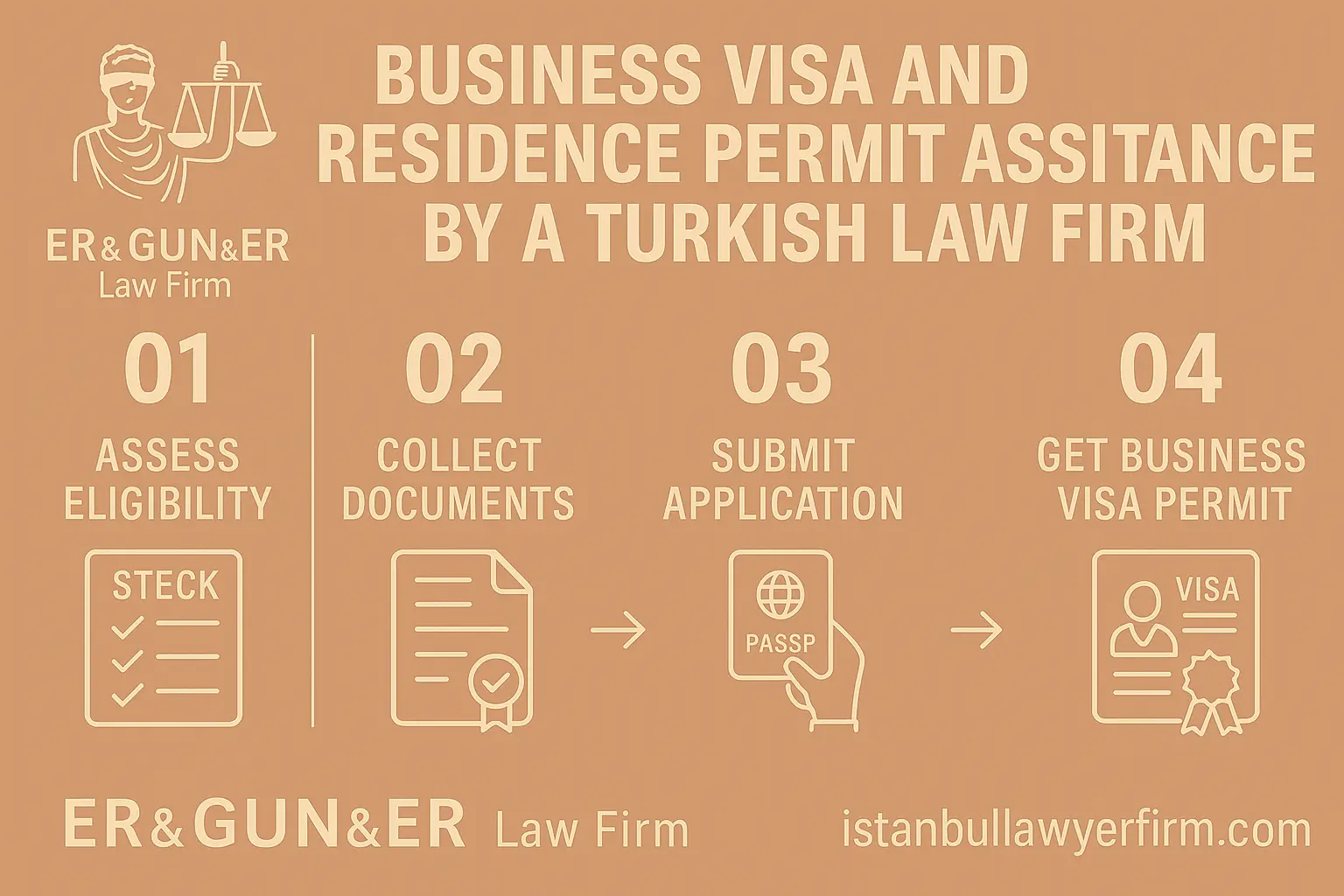
Foreign nationals who establish businesses in Turkey or invest in Turkish companies enter the country's immigration system through three distinct but interconnected legal instruments — the entry visa, the residence permit (ikamet izni), and where required, the work permit (çalışma izni) — and understanding how these three instruments interact is essential for maintaining continuous lawful status while conducting commercial activities in Turkey. Entry visas for business purposes allow temporary entry for activities such as meetings, negotiations, due diligence visits, and company registration attendance, but they do not authorize sustained commercial activity or residence beyond the visa's validity period. Residence permits — particularly the short-term residence permit (kısa dönem ikamet izni) under the Law on Foreigners and International Protection (Yabancılar ve Uluslararası Koruma Kanunu, YUKK, Law No. 6458) Article 31 — allow foreign nationals to reside in Turkey for defined periods based on specific qualifying grounds including company shareholding, business activities, and property ownership. Work permits under the International Workforce Law (Uluslararası İşgücü Kanunu, Law No. 6735) are required separately for foreign nationals who will physically perform employment or management functions in Turkey and are not satisfied by a residence permit alone. This guide explains the specific legal requirements, qualifying grounds, documentation standards, and strategic sequencing for each instrument in the context of foreign business activity in Turkey. Practice may vary by authority and year — verify current YUKK, Law No. 6735, and Directorate General of Migration Management (GİGM) implementation standards directly before relying on any information in this guide.
Turkish visa categories for business purposes — entry pathways and limitations
A lawyer in Turkey advising on business entry visas must explain that Turkey operates a visa system where foreign nationals from most countries require a visa for entry — and the specific visa category determines both the purpose of entry that is legally authorized and the maximum permitted stay period. For business purposes, the most commonly used entry pathways include: the electronic visa (e-Visa) system, which allows nationals of approximately 100 countries to obtain an online visa before arrival at Turkish points of entry for tourist and business purposes — typically for stays of up to 30 or 90 days depending on nationality; the multiple-entry business visa (çok girişli iş vizesi) issued by Turkish consulates abroad for nationals who require more structured documentation of their business purpose; and the visa-on-arrival system at Turkish airports for nationals of specific countries. The important limitation for all of these visa types is that they authorize the foreign national's presence in Turkey for the permitted period but do not authorize ongoing commercial employment or the sustained management of a Turkish company from within Turkey — those activities require either a residence permit with appropriate grounds or a work permit. Practice may vary by authority and year — verify current visa eligibility requirements and authorized activity scope for your nationality at the relevant Turkish consulate or the Ministry of Foreign Affairs official resources before any business entry visa application. For the full procedural framework, see our pillar guide on company formation in Turkey.
An Istanbul Law Firm advising on the e-Visa system's business purpose authorization must explain that the Turkish e-Visa — while commercially described as covering "tourism and commercial" purposes — does not authorize a foreign national to perform employment functions, to provide services for remuneration in Turkey, or to serve as an active resident director managing a Turkish company from within Turkey. The e-Visa is appropriate for: attending business meetings with Turkish partners; visiting trade fairs and industry exhibitions; conducting commercial negotiations; due diligence visits to Turkish properties or companies; signing commercial contracts where the foreign visitor is not providing ongoing services; and attending company formation and registration appointments. A foreign investor who visits Turkey on an e-Visa to establish a Turkish company, signs the MERSIS formation documents, attends the trade registry office, and then returns to their home country is using the e-Visa appropriately. A foreign investor who remains in Turkey on an e-Visa to manage the company's daily operations while residing in Turkey is not using the visa appropriately and requires a residence permit or work permit depending on the nature of their activities. Practice may vary — verify current Turkish Ministry of Interior GİGM guidance on the authorized activities under different visa categories before any extended business activity in Turkey on an entry visa.
An English speaking lawyer in Turkey advising on the 90-day stay limit must explain that most Turkish visa categories — including the e-Visa — are subject to a maximum 90 days of stay within any 180-day rolling period, similar to the Schengen area's short-stay rule. A foreign national who overstays this limit becomes an illegal stayer (pasaportsuz/vizesiz yabancı) subject to an entry ban (giriş yasağı) and administrative fine upon departure. The 90-day limit is calculated on a rolling basis — the Turkish system checks the total days spent in Turkey in the 180 days preceding any given date, not simply calendar year periods — and foreign nationals approaching this limit who wish to continue their Turkish business activities without interruption must apply for a residence permit before the 90-day limit is reached. Applications for a residence permit can generally be filed from within Turkey up to 60 days before the current visa's expiry, and the filing of the residence permit application creates a legal basis for remaining in Turkey while the application is processed (even if this extends beyond the initial visa's validity). Practice may vary — verify current GİGM processing timelines and the specific in-Turkey application filing deadlines applicable to your nationality before any residence permit application planning. Practice may vary — check current guidance before acting on any information on this page.
Short-term residence permit — YUKK Article 31 grounds for business owners
A Turkish Law Firm advising on the short-term residence permit must explain that YUKK Article 31 establishes the qualifying grounds for short-term residence permits (kısa dönem ikamet izni) — the primary residence permit category for foreign entrepreneurs, investors, and business owners who are not in an employment relationship with a Turkish employer (which would require a work permit instead). The most relevant YUKK Article 31 grounds for business purposes are: Article 31(1)(b) — for foreign nationals who own immovable property (real property) in Turkey, the property ownership serves as a qualifying ground for a short-term residence permit for as long as the ownership continues; Article 31(1)(j) — for foreign nationals who intend to conduct business or invest in Turkey (ticari bağlantı veya iş kuracak ya da iş adamları için), which is the specific ground for active business establishment; Article 31(1)(d) — for foreign nationals who will receive education in Turkey; and other specific grounds applicable to different circumstances. The short-term residence permit is typically granted for a maximum of two years at a time, renewable before expiry, and the total cumulative short-term residence permit duration in Turkey is generally limited to ten years. Practice may vary by authority and year — verify current YUKK Article 31 ground availability and the specific qualifying documentation requirements for each ground at the relevant GİGM provincial directorate before any short-term residence permit application strategy.
An Istanbul Law Firm advising on residence permit documentation for company shareholders must explain that a foreign national applying for a short-term residence permit on the business/investment ground (Article 31(1)(j)) must demonstrate a genuine commercial connection to Turkey — and the documentation requirements reflect the need to establish this connection substantively rather than formally. The core documentation for a company-based short-term residence permit application includes: the Turkish company's trade registry certificate (ticaret sicil gazetesi) showing the foreign national's status as a shareholder or authorized representative; the Turkish company's tax registration certificate; evidence of the company's commercial activity (a company bank account statement, invoices, or other activity evidence); the foreign national's Turkish tax identification number (vergi kimlik numarası); proof of Turkish address where the foreign national will reside during the permit period (lease agreement or property ownership documentation); health insurance valid in Turkey for the full permit period (GİGM-recognized insurer); and the standard biographic documents (passport, photographs). The company must be an active going-concern — a company with no commercial activity that exists only on paper may not satisfy GİGM's assessment of genuine business connection. Practice may vary — verify current GİGM documentation requirements for company-based short-term residence permit applications at the specific provincial directorate serving your Turkish address before any application filing.
A lawyer in Turkey advising on the property-based residence permit ground must explain that foreign nationals who purchase qualifying immovable property in Turkey — under the real estate acquisition rights available to foreigners under the Land Registry Law (Tapu Kanunu) — can use the property ownership as the basis for a short-term residence permit under YUKK Article 31(1)(b). The property-based residence permit is available for the duration of the property ownership and is renewable as long as ownership continues. The qualifying documentation includes: the tapu (title deed) confirming current registered ownership; the property's address confirmation; proof of health insurance; and the standard biographic documents. The minimum property value for the property-based residence permit itself (under YUKK Article 31) has no formal minimum threshold — the requirement is ownership of Turkish immovable property, not property above a specific value. However, foreign nationals seeking Turkish citizenship through real estate investment must satisfy a separate minimum investment requirement (currently USD 400,000) that is distinct from the residence permit threshold. Practice may vary — verify current GİGM property-based residence permit documentation requirements and the specific property categories qualifying for the residence ground before any property-based immigration strategy design. Practice may vary — check current guidance before acting on any information on this page.
Work permits for foreign directors and employees — Law No. 6735 requirements
An English speaking lawyer in Turkey advising on the work permit requirement for foreign managing directors must explain that the short-term residence permit based on company shareholding or business grounds does not authorize a foreign national to physically perform employment or management functions in Turkey as a working manager — those activities require a separate work permit (çalışma izni) under the International Workforce Law (Law No. 6735). The critical distinction is between being a shareholder or owner of a Turkish company (which may be established using only a residence permit and can be managed remotely from abroad) and actively physically managing the company from within Turkey on a day-to-day basis as a working director (which requires a work permit). A foreign national who holds a short-term residence permit, lives in Turkey, and physically performs management functions for their Turkish company from within Turkey without a work permit is working illegally — regardless of whether they are paid a salary or whether the company is their own. Practice may vary by authority and year — verify current Ministry of Labor and Social Security work permit physical presence interpretation standards for foreign company owners before any decision about the necessity of a work permit for foreign managing directors of their own Turkish companies.
A Turkish Law Firm advising on the work permit application process under Law No. 6735 must explain that work permits for foreign employees and managers at Turkish companies are applied for primarily by the employer (the Turkish company) through the Ministry of Labor and Social Security's YAYBÜS electronic system — not directly by the foreign national. The Turkish company must satisfy the employer eligibility conditions under Law No. 6735 implementing regulations before any work permit application is filed — specifically, the 1:5 ratio requirement (5 Turkish SGK-registered employees for each foreign employee work permit) and the minimum salary threshold requirements (which vary by occupational category). For foreign nationals who own and will manage their own Turkish company, the company itself applies for the work permit as the employer — and the company must satisfy these eligibility conditions even where the foreign director is also the company's majority owner. For newly formed Turkish companies that do not yet have 5 Turkish employees, exemptions from the ratio requirement may be available for specific occupational categories — but these exemptions have conditions and must be specifically assessed. Practice may vary — verify current Law No. 6735 work permit employer eligibility requirements and the specific ratio exemption categories applicable to the company's activity sector before any work permit application.
An Istanbul Law Firm advising on work permit-to-residence permit coordination must explain that a work permit holder's Turkish residence permit obligation is satisfied by the work permit itself — a valid Turkish work permit creates an implicit right to reside in Turkey for the work permit's duration, without the need to separately apply for a residence permit. This is one of the most significant practical implications of the distinction between work permit holders and residence permit holders: work permit holders have a single instrument covering both work authority and residence authority, while residence permit holders (even those with business grounds) must separately manage their residence status from any work authorization. The renewal of the work permit must be managed carefully — the Law No. 6735 work permit is typically granted for one year initially, renewable for two-year periods thereafter, and renewal must be applied for before the existing permit expires. A work permit holder whose permit expires while a renewal application is pending remains in lawful status during the processing period. Practice may vary — verify current YAYBÜS renewal application procedures and the specific documentation required for work permit renewal before any work permit continuation planning. Practice may vary — check current guidance before acting on any information on this page.
Investment-based residence and the citizenship-by-investment pathway
A lawyer in Turkey advising on the investment-based citizenship pathway must explain that Turkey's citizenship-by-investment program — established through amendments to the Turkish Citizenship Law (Türk Vatandaşlığı Kanunu, Law No. 5901) and its implementing regulation — allows foreign nationals to acquire Turkish citizenship by making qualifying investments in Turkey, with the most common qualifying route being a real estate acquisition of at least USD 400,000 in value (confirmed by a licensed valuation company). The citizenship-by-investment process involves: purchasing qualifying real estate (or making another qualifying investment such as a capital deposit or government bond purchase); obtaining the citizenship-eligible annotation (vatandaşlık şerhi) on the title deed; applying for the Conformity Certificate (Uygunluk Belgesi) from the Ministry of Environment and Urbanization; and submitting the citizenship application through the General Directorate of Population and Citizenship Affairs (Nüfus ve Vatandaşlık İşleri Genel Müdürlüğü). The residence permit is a separate instrument — a citizenship applicant does not need to hold a prior residence permit to apply for citizenship through investment, though they may hold a short-term residence permit during the application processing period. Practice may vary by authority and year — verify current citizenship-by-investment minimum investment thresholds (which are periodically updated) and the specific qualifying investment categories before any citizenship-by-investment program application strategy.
An Istanbul Law Firm advising on the long-term residence permit must explain that foreign nationals who have resided continuously in Turkey for eight years on short-term residence permits (or other permit categories) can apply for a long-term residence permit (uzun dönem ikamet izni) under YUKK Article 42 — provided they have not had an unjustified interruption in their residence and have not exceeded the annual allowed absence from Turkey. The long-term residence permit, once granted, is issued for indefinite duration (subject to annual address confirmation and continued compliance with Turkish law) and provides significantly greater stability than a short-term permit that requires renewal every two years. However, the eight-year continuous residence requirement is assessed strictly — years spent in Turkey on work permits, student permits, or certain humanitarian permits may or may not count toward the eight-year accumulation depending on the specific permit category. Foreign business entrepreneurs who plan their Turkish residence from the outset with the long-term permit or citizenship goal in mind should specifically assess which permit categories count toward the accumulation period. Practice may vary — verify current YUKK Article 42 continuous residence calculation standards and the specific permit category accumulation credit rules applicable to the applicant's specific permit history before any long-term residence planning strategy.
An English speaking lawyer in Turkey advising on the free zone residence option must explain that foreign nationals establishing companies in Turkish free zones under Law No. 3218 may be eligible for residence permits based on their free zone company activity — but the specific permit type and grounds applicable to free zone company owners or employees depend on the nature of their activity within the free zone and their specific visa status. Free zone company workers may also be eligible for free zone work permits, which are issued by the free zone directorate rather than through the standard YAYBÜS system and have different requirements from standard Turkish work permits. Foreign investors considering the free zone structure should specifically assess whether the free zone location affects their residence permit options and how the free zone permit interacts with the standard YUKK and Law No. 6735 frameworks that govern activity outside the free zone. Practice may vary — verify current free zone work permit requirements and the interaction between free zone residency and standard Turkish residence permit categories before any free zone structure design that involves resident foreign managers. Practice may vary — check current guidance before acting on any information on this page.
Family residence permits for entrepreneurial households
A Turkish Law Firm advising on family residence permits must explain that foreign nationals who establish a residence permit in Turkey based on business grounds can apply for family reunification residence permits (aile ikamet izni) for their immediate family members — specifically, their spouse and unmarried minor children under 18 — under YUKK Articles 34-38. The family residence permit allows the family members to reside in Turkey based on their relationship to the primary permit holder (the business owner or investor) rather than requiring each family member to independently qualify for their own residence basis. The family residence permit is dependent on the primary permit holder's status — if the primary permit is revoked or expires without renewal, the family members' dependent permits are also affected. The qualification conditions for a family residence permit application include: the primary permit holder must have held a valid residence permit for at least one year (except for marriages to Turkish citizens, where the one-year requirement may be waived); the family must have access to a monthly income above the minimum wage for the household; and the family members must have valid health insurance coverage. Practice may vary by authority and year — verify current YUKK family residence permit eligibility conditions and the specific income threshold standards applicable to the family composition before any family reunification residence planning.
An Istanbul Law Firm advising on the practical documentation for family residence permits must explain that the documentation package for a family residence permit application requires both the primary permit holder's documentation and the family members' individual documentation — and the relationship between the primary permit holder and the family members must be established through official documents that satisfy GİGM's authentication requirements. For a spouse, the marriage certificate must be apostilled (or consularly legalized for countries without apostille) and accompanied by a certified Turkish translation. For minor children, the birth certificate (apostilled and translated) and, where applicable, custodial documentation confirming the parent-child relationship must be provided. All family members' passports must be valid for at least 60 days beyond the requested permit period. The family residence permit application is filed by the primary permit holder on behalf of the family members — the family members do not need to be present in Turkey at the time of filing, but they must attend the biometric appointment in person. Practice may vary — verify current GİGM family residence permit documentation requirements and the specific authentication format required for documents from the specific countries of issue before any family residence permit application filing.
A lawyer in Turkey advising on employment rights for family residence permit holders must explain that the family residence permit authorizes the holder to reside in Turkey with the primary permit holder — but it does not automatically authorize the family member to work in Turkey. A spouse or adult child who holds a family residence permit and wishes to work in Turkey must obtain their own separate work permit under Law No. 6735 (if employed by a Turkish company) or establish an independent basis for commercial activity (company shareholding with residence permit). There is an important exception: spouses of Turkish citizens who hold a family residence permit are automatically entitled to work in Turkey without a separate work permit after three years of continuous family residence permit holding. This exception does not apply to spouses of foreign nationals who hold Turkish residence permits (as opposed to citizenship). Family permit holders who wish to work should specifically confirm their work authorization status before commencing employment activities in Turkey. Practice may vary — verify current family residence permit work authorization standards applicable to the specific family relationship before any employment planning for family residence permit holders in Turkey. Practice may vary — check current guidance before acting on any information on this page.
Residence permit application procedure — GİGM process and biometric appointments
An English speaking lawyer in Turkey advising on the residence permit application process must explain that short-term and family residence permit applications in Turkey are filed through the GİGM e-Residence (e-İkamet) online portal — where the applicant creates an account, completes the application form, uploads required documents, and books a biometric appointment at the GİGM provincial directorate serving their Turkish address. The online portal assigns the appointment date, which is typically 2-8 weeks from the application submission depending on the province's workload — Istanbul GİGM provincial directorate typically has longer appointment waiting periods than smaller province offices. At the biometric appointment, the applicant (and family members for family permit applications) must appear in person with all original documents and the copies uploaded to the portal. The GİGM officer reviews the application and documents, captures biometric data (photograph and fingerprints), and issues an application receipt confirming the application is pending. The applicant can remain in Turkey lawfully during the processing period based on the application receipt. The residence permit card (ikamet kartı) is delivered by postal service to the registered Turkish address after approval — typically within 2-6 weeks of the biometric appointment for uncomplicated applications. Practice may vary by authority and year — verify current GİGM e-İkamet portal filing requirements and biometric appointment waiting times at the relevant provincial directorate before any residence permit application timeline planning.
A Turkish Law Firm advising on the health insurance requirement for residence permits must explain that valid health insurance covering Turkey is a mandatory documentation requirement for all short-term and family residence permit applications — and the insurance policy must: be from an insurer recognized by GİGM for Turkish residence permit purposes; cover the entire requested permit period from the start date of the permit; provide minimum coverage amounts meeting Turkish standards; and specifically cover medical treatment in Turkey (travel insurance limited to international travel is not sufficient). The health insurance requirement is one of the most commonly misunderstood aspects of the residence permit application — many foreign applicants present health insurance policies that are valid at the time of application but expire before the end of the requested permit period, causing application rejection. For applicants applying for renewal, coverage must be continuous with no gaps. For applicants enrolled in Turkey's general health insurance system (GSS) through SGK contributions (either as work permit holders or as SGK voluntary payers), the SGK enrollment satisfies the health insurance requirement. Practice may vary — verify current GİGM-recognized health insurer lists and the specific coverage requirements applicable to the permit type and applicant's circumstances before any health insurance purchase for residence permit purposes.
An Istanbul Law Firm advising on the Turkish address requirement must explain that all residence permit applications require a verifiable Turkish address where the applicant will reside during the permit period — and the address must be confirmed through: a notarized lease agreement (kiraya verilmiş taşınmazı bulunan kiraya verenin beyanı — a specific notarized landlord declaration for rental properties); property ownership documentation (tapu) for owned properties; a family member's lease/ownership and a notarized declaration of accommodation commitment (konaklama belgesi) where the applicant will stay with a Turkish resident; or certain types of hotel/serviced apartment documentation for specific short-term applications. The requirement to have a verified Turkish address before filing the application creates a practical sequencing issue for newly arrived foreign nationals — they must secure a lease and have it authenticated before filing the residence permit application. The address also determines which GİGM provincial directorate has jurisdiction over the application — applications are filed at the GİGM office serving the district where the applicant's residence address is located. Practice may vary — verify current GİGM address verification documentation requirements and the specific notarization format required for rental agreements before any residence permit application address documentation preparation. Practice may vary — check current guidance before acting on any information on this page.
Permit renewal, appeals, and managing overstay risks
A lawyer in Turkey advising on residence permit renewal must explain that short-term residence permits must be renewed before expiry — and renewal applications should be filed at least 60 days before the current permit's expiry date to allow adequate processing time and to avoid any gap in lawful residence status. A renewal application filed before expiry creates a legal basis for remaining in Turkey during the processing period even if the existing permit expires before the renewal is issued — but this protection applies only if the renewal application was timely filed, not if the applicant allowed their existing permit to expire before filing. Renewal applications require updated documentation for any elements that may have changed — new health insurance covering the new permit period, updated address documentation if the applicant moved, updated company documents if the company's status changed, and updated financial documentation. The renewal process follows the same e-İkamet portal and biometric appointment procedure as initial applications. For company-based residence permits, the GİGM officer will assess whether the underlying business justification remains valid at renewal. Practice may vary by authority and year — verify current GİGM renewal application timing requirements and the specific updated documentation expected at renewal for the specific permit grounds before any renewal application planning.
An Istanbul Law Firm advising on residence permit refusal and appeal must explain that GİGM can refuse a residence permit application for a range of reasons — including incomplete documentation, failure to satisfy the qualifying conditions for the requested ground, public order or security considerations, or administrative errors — and the refusal is communicated in writing with specific stated grounds. The refused applicant has the right to appeal the refusal through two channels: administrative objection (itiraz) filed with GİGM within 15 days of notification of the refusal, requesting reconsideration of the decision; and administrative court action (iptal davası) filed before the administrative courts (idare mahkemesi) challenging the refusal as unlawful. The 15-day itiraz deadline is strictly enforced — a refusal that becomes final without timely administrative objection or court challenge cannot be subsequently appealed. For refusals based on documentation deficiencies, the most effective approach is typically a new application with corrected documentation rather than appeal — because the appeal process is slower and the underlying documentation deficiency must be corrected regardless. For refusals based on substantive grounds (security considerations, public order), legal counsel is essential for assessing whether an appeal has reasonable prospects. Practice may vary — verify current YUKK administrative objection deadline standards and the specific administrative court challenge procedures applicable to residence permit refusals before any appeal strategy.
An English speaking lawyer in Turkey advising on overstay consequences and entry ban risks must explain that a foreign national who overstays their Turkish visa or residence permit — remaining in Turkey beyond the authorized period without a pending renewal application — is subject to: an administrative fine assessed at departure based on the duration of the overstay; an entry ban (giriş yasağı) imposed for a period proportional to the overstay duration (short overstays may result in a 1-5 year ban; longer overstays may result in longer bans); and potential additional consequences if the overstay involved unauthorized work (working without a work permit creates separate violations and penalties). The GİGM entry ban is recorded in the Turkish border control system and is enforced at all Turkish ports of entry — a person subject to an entry ban cannot re-enter Turkey during the ban period. For foreign entrepreneurs who have inadvertently overstayed due to administrative delays or misunderstanding of their status, prompt legal advice is critical — in some cases, voluntary disclosure and negotiated exit arrangements are preferable to being detected at departure. Practice may vary — verify current Turkish overstay fine rates and entry ban duration standards applicable to the specific overstay duration before any overstay situation management strategy. Practice may vary — check current guidance before acting on any information on this page.
Coordinating visa, residence, and work permit status with company operations
A Turkish Law Firm advising on immigration-corporate coordination must explain that the most effective approach to immigration status management for foreign entrepreneurs in Turkey is one that treats visa, residence, and work permit status as integrated elements of the overall business setup — not as separate administrative procedures managed in isolation. The sequencing of these elements has practical implications: the company cannot typically be used as the basis for a residence permit until it has been registered in the Turkish Trade Registry and is actively operational; the work permit cannot typically be applied for until the company has registered its employees with SGK and has met the employer eligibility conditions; and the residence permit application needs a verified Turkish address, which requires a lease or property purchase before application. A well-planned foreign entrepreneur immigration strategy identifies the sequence in which these elements must be completed, the realistic timeline for each, and the interim status that covers each transition period. We develop company-by-company immigration roadmaps that sequence these steps while minimizing gaps in lawful status. Practice may vary by authority and year — verify current GİGM and Ministry of Labor coordination requirements and the specific sequencing implications applicable to the specific company structure and foreign national's nationality before any integrated immigration-corporate planning.
An Istanbul Law Firm advising on the implications of residence status changes for company operations must explain that changes in the foreign entrepreneur's residence status — permit expiry, permit refusal, or voluntary departure from Turkey — can affect the company's operational continuity where the foreign national serves as the company's sole authorized signatory or managing director. A company that relies entirely on a foreign managing director who loses their Turkish residence status faces: immediate inability to perform acts requiring Turkish physical presence (signing at Turkish notaries, attending trade registry offices, dealing with government offices); potential complications with SGK and tax registrations that reference the foreign director; and governance questions about who has authority to sign on behalf of the company in the director's absence. Best practice for foreign-owned Turkish companies with a single foreign director is to establish a backup authorization mechanism — typically a limited power of attorney in favor of a Turkish-resident representative — that covers essential company functions during any period where the foreign director cannot be physically present in Turkey. Practice may vary — verify current Turkish notary and registry requirements for corporate authorization during director absence before any corporate governance contingency planning.
A lawyer in Turkey advising on the link between SGK status and immigration compliance must explain that the work permit holder's SGK registration (sigorta tescili) as an insured worker under Law No. 5510 is not merely an employment formality — it is the mechanism through which the work permit holder's legal working status is recorded in the Turkish social security system, and it is the primary evidence that the Turkish Labor Authority and GİGM use to verify that work permit conditions are being complied with. An SGK-registered work permit holder who stops paying SGK premiums — whether because the company is experiencing financial difficulty or because the company's payroll has been reorganized — creates a compliance gap that can affect work permit renewal (requiring continuous employment status throughout the permit period). Similarly, a residence permit holder whose company becomes tax-delinquent may face complications at residence permit renewal where GİGM assesses whether the underlying business activity is genuine. Maintaining SGK registration continuity, corporate tax compliance, and trade registry current registration are all components of immigration compliance for the business owner visa and residence permit holder. Practice may vary — verify current GİGM renewal assessment practices for compliance gaps and the specific SGK continuity requirements applicable to work permit holders before any immigration status management plan. Practice may vary — check current guidance before acting on any information on this page.
How we work with foreign entrepreneurs on Turkish immigration matters
An English speaking lawyer in Turkey at ER&GUN&ER managing a foreign entrepreneur immigration mandate explains that our approach begins with a specific immigration assessment for the individual client's situation: nationality (which determines visa requirements and processing times); intended commercial activities in Turkey (which determines whether a residence permit alone is sufficient or whether a work permit is required); the planned company structure (which affects the timing and basis of the residence permit application); family situation (which determines whether family permits are needed and their sequencing); and long-term immigration goals (whether Turkish citizenship through investment or long-term residence is a target). This assessment produces a specific, sequenced action plan that identifies what must be done, in what order, and by when — with realistic timeline estimates for each step based on current GİGM processing times. We manage all subsequent steps — document preparation, GİGM portal filings, appointment scheduling, biometric attendance coordination, permit card delivery monitoring, and renewal planning — in English throughout. For foreign entrepreneurs who cannot be physically present in Turkey for all required steps, we coordinate power of attorney documentation and coordinate with on-the-ground support for steps requiring Turkish physical presence.
ER&GUN&ER advises foreign entrepreneurs and investors across the complete spectrum of Turkish immigration matters — e-Visa and business visa application guidance; short-term residence permit applications on business, real estate, and other grounds under YUKK Article 31; family residence permit applications under YUKK Articles 34-38; work permit applications through YAYBÜS under Law No. 6735 for foreign employees and directors; work permit renewal management; citizenship-by-investment applications under the Turkish Citizenship Law; long-term residence permit applications under YUKK Article 42; residence permit renewal applications; GİGM administrative objection (itiraz) and administrative court challenge for refused applications; overstay situation management; entry ban assessment and challenge; and integrated immigration-corporate planning for company formation combined with residence and work permit sequencing. We work in English throughout all mandates. For the company formation framework — see the resource on foreigners establishing a business in Turkey. For the immigration law framework — see the resource on residence permit lawyer in Turkey. Practice may vary — check current guidance before acting on any information on this page.
Frequently Asked Questions
- Can I enter Turkey on a tourist e-Visa to register a company? Yes — attending company formation appointments at the Turkish Trade Registry Office, signing notarized documents, and opening bank accounts are activities compatible with a business/tourist e-Visa. What the e-Visa does not authorize is sustained residence in Turkey for business management purposes or physical performance of employment functions from within Turkey — those require a residence permit or work permit. Practice may vary — verify current GİGM authorized activity guidance for specific visa categories.
- What is the short-term residence permit and which ground applies to business owners? The short-term residence permit (kısa dönem ikamet izni) under YUKK Article 31 allows foreign nationals to reside in Turkey for defined periods based on qualifying grounds. For business owners, the most relevant grounds are Article 31(1)(j) (business connection or investment purposes) and Article 31(1)(b) (immovable property ownership in Turkey). The permit is typically granted for up to 2 years at a time, renewable. It does not authorize employment functions without a separate work permit. Practice may vary — verify current GİGM qualifying grounds available at the specific provincial directorate.
- Does owning shares in a Turkish company automatically qualify me for a residence permit? Owning shares in a Turkish company can support a short-term residence permit application under Article 31(1)(j), but the application requires demonstrating a genuine business connection — including the company's active commercial status, the applicant's verified Turkish address, valid health insurance, and other supporting documents. A company with no activity or a company that exists only on paper is unlikely to satisfy GİGM's substantive assessment of the business connection ground. Practice may vary — verify current GİGM assessment standards for company-based residence applications.
- Do I need a work permit in addition to a residence permit to manage my Turkish company? If you will physically perform management functions in Turkey (attending meetings, managing employees, executing contracts, dealing with authorities) while residing in Turkey, you generally need a work permit under Law No. 6735 in addition to a residence permit. If you own the company but manage it remotely from outside Turkey, you may not need a work permit for the management activities. The distinction is fact-sensitive and depends on the nature and regularity of your physical presence in Turkey for management functions. Practice may vary — verify current Ministry of Labor work permit application standards for company owner-directors.
- What is the 1:5 ratio requirement for work permits? Law No. 6735 requires that the Turkish company applying for a foreign employee work permit have at least 5 Turkish SGK-registered employees for each foreign employee work permit. For a company's first foreign employee, 5 Turkish employees must be registered. This requirement applies even where the foreign applicant is the company's owner. Specific exemptions exist for certain occupational categories and company sizes. A newly formed company without 5 Turkish employees may not immediately be able to apply for a work permit. Practice may vary — verify current ratio exemption standards applicable to the specific occupational category and company situation.
- What health insurance is required for a Turkish residence permit? GİGM requires health insurance from a GİGM-recognized insurer covering the full requested permit period from the start date, with minimum coverage amounts meeting Turkish standards. Turkish travel insurance for international travel is generally not sufficient. SGK enrollment through a work permit or voluntary SGK payment satisfies the health insurance requirement. The insurance must be purchased before the residence permit application is filed. Practice may vary — verify current GİGM-recognized insurer list and coverage requirements before any health insurance purchase for residence permit purposes.
- What is the citizenship-by-investment minimum investment threshold? The citizenship-by-investment pathway through real estate acquisition requires a minimum investment of USD 400,000 in qualifying real estate, confirmed by a licensed valuation company and annotated on the title deed as citizenship-eligible. Other qualifying investment categories include capital deposits and government bond purchases at specified minimums. The investment thresholds are periodically updated by regulation. The citizenship application is separate from any residence permit application. Practice may vary — verify current minimum investment thresholds before any citizenship-by-investment strategy.
- How long before expiry should I apply for residence permit renewal? GİGM recommends filing renewal applications at least 60 days before the current permit expires. Filing within this window creates a legal basis for remaining in Turkey during processing even if the existing permit expires before the new permit is issued. Applications filed after expiry are treated as new applications and the applicant may technically be overstaying while the application is processed. Practice may vary — verify current GİGM renewal timing guidance at the specific provincial directorate before any renewal application planning.
- What happens if my residence permit application is refused? A refused applicant can file an administrative objection (itiraz) with GİGM within 15 days of notification of the refusal, requesting reconsideration. Administrative court challenge (iptal davası) can also be filed. For documentation-based refusals, a corrected new application is often more practical than appeal. The 15-day itiraz deadline is strictly enforced. Practice may vary — verify current administrative objection and court challenge procedures applicable to residence permit refusals before any appeal strategy.
- Can my family join me on my Turkish residence permit? Yes — spouses and unmarried minor children under 18 of primary short-term residence permit holders can apply for family residence permits (aile ikamet izni) under YUKK Articles 34-38. The primary permit holder must have held a valid permit for at least one year (waived for marriages to Turkish citizens), the household income must exceed minimum wage, and family members must have health insurance. Family permits are dependent on the primary permit holder's status. Practice may vary — verify current family residence permit eligibility conditions.
- Can family residence permit holders work in Turkey? Generally, family residence permit holders do not automatically have work authorization — they need a separate work permit under Law No. 6735 if they wish to work in Turkey (or their own independent residence basis for company shareholding). Exception: spouses of Turkish citizens who have held a family residence permit for 3 continuous years have an automatic work authorization. Spouses of foreign nationals with Turkish residence permits do not share this exception. Practice may vary — verify current work authorization standards for family residence permit holders before any employment activity.
- What are the consequences of overstaying a Turkish visa or residence permit? Overstaying results in an administrative fine assessed at departure, an entry ban (giriş yasağı) proportional to the overstay duration, and potential additional penalties for unauthorized work during the overstay period. The entry ban is recorded in the Turkish border control system. Short overstays may result in 1-5 year bans; longer overstays may result in longer bans. Timely renewal applications before expiry avoid all of these consequences. Practice may vary — verify current overstay fine rates and entry ban duration standards before any overstay situation management.
- Does my Turkish address affect which GİGM office processes my application? Yes — residence permit applications are processed by the GİGM provincial directorate serving the district where the applicant's Turkish residence address is registered. The choice of Turkish address therefore determines which provincial directorate has jurisdiction. Istanbul's GİGM offices typically have longer appointment waiting times than smaller province offices. The address must be genuine and verifiable — the applicant must actually reside at the declared address during the permit period. Practice may vary — verify current GİGM jurisdictional rules and appointment availability at the specific provincial directorate before address selection.
- How is the property-based residence permit different from the citizenship-by-investment requirement? The property-based residence permit (YUKK Article 31(1)(b)) requires ownership of Turkish immovable property with no statutory minimum value — any qualifying real estate ownership can support the permit application. The citizenship-by-investment pathway through real estate requires a minimum investment of USD 400,000 with specific certification requirements. These are two separate legal instruments — property below the USD 400,000 threshold supports a residence permit but not citizenship by investment. Practice may vary — verify current requirements for each instrument separately.
- Do you manage the residence and work permit process for foreign entrepreneurs who are not in Turkey? Yes — we prepare all application documentation, file through the e-İkamet portal, and coordinate the process for clients who are not yet in Turkey or cannot be present for all steps. For steps requiring physical presence (the biometric appointment, signing original documents at Turkish offices), we coordinate with the client to ensure they are present at the critical moments and provide power of attorney arrangements for steps where authorized representation is legally permitted. We work in English throughout and provide regular status updates so clients can plan their Turkish presence around required appointment dates.
Author: Mirkan Topcu is an attorney registered with the Istanbul Bar Association (Istanbul 1st Bar), Bar Registration No: 67874. His practice focuses on cross-border and high-stakes matters where evidence discipline, procedural accuracy, and risk control are decisive.
He advises foreign entrepreneurs and investors across Business and Tourist Visa Guidance, Short-Term Residence Permit Applications under YUKK Article 31 (Company-Based and Property-Based Grounds), Family Residence Permit Applications under YUKK Articles 34-38, Work Permit Applications through YAYBÜS under Law No. 6735, Work Permit Renewal Management, Citizenship-by-Investment Applications under the Turkish Citizenship Law, Long-Term Residence Permit Applications under YUKK Article 42, Residence Permit Renewal Applications, GİGM Administrative Objection (İtiraz) and Administrative Court Challenge for Refused Applications, Overstay Situation Management, Entry Ban Assessment and Challenge, and Integrated Immigration-Corporate Planning matters where procedural precision and sequential compliance management are decisive.
Education: Istanbul University Faculty of Law (2018); Galatasaray University, LL.M. (2022). LinkedIn: Profile. Istanbul Bar Association: Official website.