

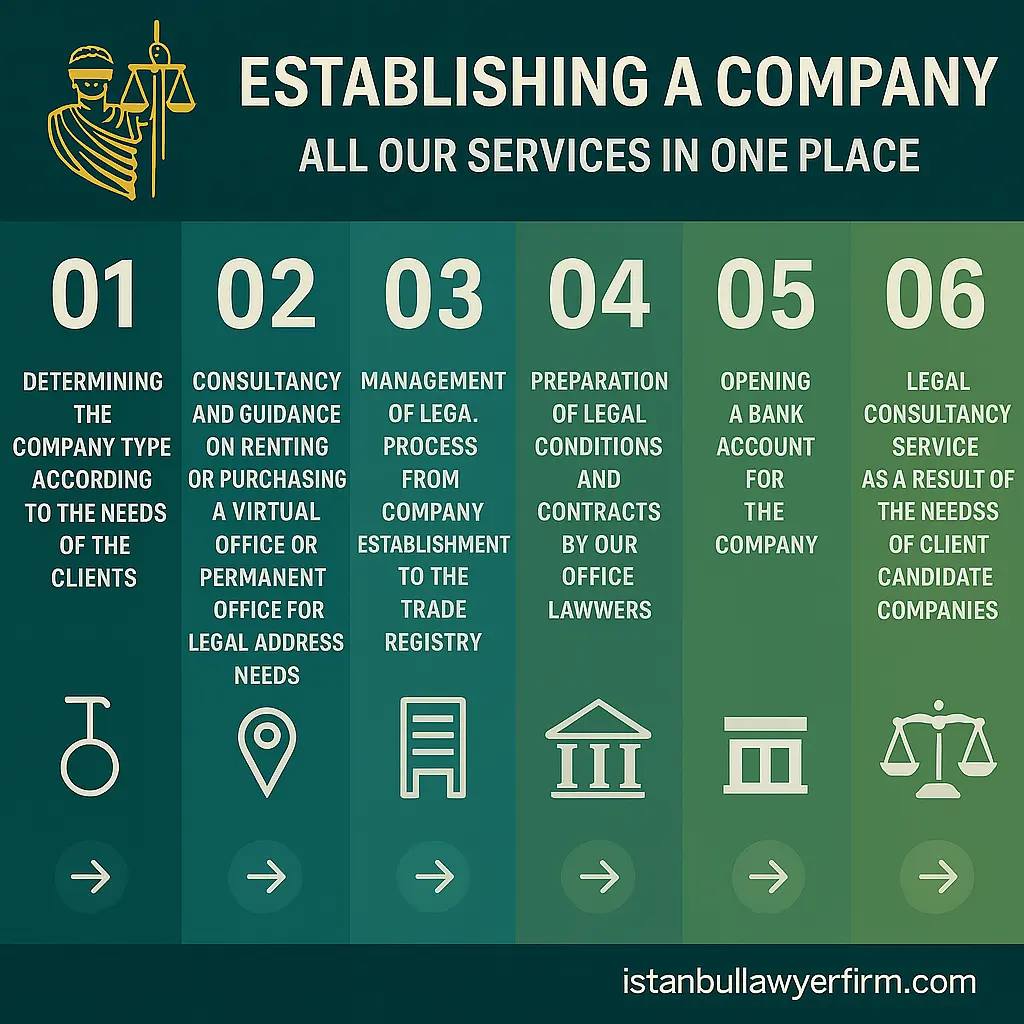
A lawyer in Turkey advising on company formation for foreign clients works at the intersection of three Turkish institutions: the Trade Registry Directorate (Ticaret Sicil Müdürlüğü) operating through the central MERSIS system, the Tax Office (Vergi Dairesi) that activates the corporate tax number, and the Social Security Institution (Sosyal Güvenlik Kurumu, SGK) that registers the employer file. Establishing a company in Turkey as a foreign investor is procedurally accessible — the Foreign Direct Investment Law (Yabancı Yatırımlar Kanunu, Law No. 4875) grants foreign nationals national treatment, which means 100% foreign ownership and no requirement to find a Turkish partner. What determines whether the process is smooth or delayed is rarely the substantive law; it is the consistency of the document file, the entity choice, and the sequencing of registry, banking, and tax steps.
This guide explains the complete legal framework for foreigners establishing a company in Turkey in 2026: entity selection under the Turkish Commercial Code (Türk Ticaret Kanunu, Law No. 6102), the documentation and apostille chain that the Trade Registry requires, MERSIS registration mechanics, capital deposit and bank account opening, post-incorporation tax and SGK enrolment, and the annual corporate governance obligations that follow. All thresholds and procedural details reflect the law as understood at the time of writing — practice may vary by authority and year, and applicants should verify current figures with qualified Turkish counsel before relying on any specific point. An Istanbul Law Firm that handles company formation regularly maintains a checklist that is updated each time a competent authority changes a form, a fee, or a verification step; that checklist is the practical difference between a one-day MERSIS registration and a three-week back-and-forth over a missing apostille.
Why establish a company in Turkey as a foreigner
An Istanbul Law Firm advising international investors typically explains the decision in three layers: market access, structural openness, and procedural predictability. Turkey sits at the intersection of European, Middle Eastern, and Central Asian commerce, and a Turkish company can serve as the contracting vehicle for transactions across all three regions without separate local entities for each market. The domestic consumer base — approximately 85 million people — combined with bilateral free trade agreements and the European Union Customs Union arrangement makes a Turkish trading or manufacturing entity a practical regional hub. Sector-specific incentives administered by the Ministry of Industry and Technology and regional development agencies further reduce the effective cost of certain investments, although practice may vary by authority and year — the published incentive certificate categories are revised periodically and the eligibility thresholds applicable when an investor begins planning may not be the figures in force when the certificate is finally issued.
A Turkish Law Firm explaining structural openness will note that the Foreign Direct Investment Law (Law No. 4875) treats foreign and domestic investors equally for almost all purposes. Foreign individuals and foreign corporate shareholders can hold 100% of a Turkish company, can appoint foreign directors with no residency requirement under the statute, and can repatriate profits subject to the standard withholding tax framework. Sector-specific exceptions exist — banking, insurance, broadcasting, civil aviation, mining, and certain energy activities carry licensing layers or foreign ownership thresholds — but the default position for general commercial activity is unrestricted foreign capital. Beyond the headline national treatment principle, the law provides additional substantive protections that matter when an investor is structuring around political and macroeconomic risk: a guarantee against uncompensated expropriation, free transfer of profits, dividends, fees, and proceeds of sale, and access to international arbitration for qualifying investment disputes under Turkey's bilateral investment treaty network (Turkey has signed BITs with more than ninety countries). For founders considering Turkey as a regional hub for activities that may eventually be the subject of cross-border disputes, the BIT framework is a material structuring input that should be reviewed alongside the entity choice itself, because the protections available depend on the foreign investor's nationality of incorporation. In our filings before the Trade Registry, the foreign nationality of shareholders and directors is a documentation question, not a substantive obstacle: the file simply requires apostilled identity and authority documents in addition to the standard Turkish forms.
Procedural predictability is what distinguishes Turkey from several jurisdictions in the region. The Trade Registry operates through MERSIS (Merkezi Sicil Kayıt Sistemi), the centralised electronic registry maintained by the Ministry of Trade, which standardises the incorporation form across all Turkish chambers of commerce. A complete file with apostilled foreign documents and a properly drafted Articles of Association is, in our practice, typically registered within one to three business days once the appointment at the Chamber of Commerce is held. The single largest source of delay is not the registry itself but the upstream document chain — apostille turnaround in the home country, sworn translation in Turkey, and the timing of the tax identification number for foreign shareholders. Practice may vary by authority and year, and the chambers in different cities apply the same statutory checklist with slightly different document preferences, which is why local counsel involvement reduces avoidable back-and-forth.
Company types under the Turkish Commercial Code
Turkish lawyers who advise foreign founders on entity selection treat the choice as the most consequential decision of the formation process, because the entity form determines the capital structure, the governance machinery, the share transfer mechanics, and the path available for future investment rounds or exit. The Turkish Commercial Code (TTK, Law No. 6102) recognises several company forms, but in practice four structures cover nearly all foreign-investor matters: the limited liability company (limited şirket, Ltd. Şti.), the joint stock company (anonim şirket, A.Ş.), the branch office (şube) of a foreign company, and the liaison office (irtibat bürosu, also known as a representative office). For a comparative analysis structured around the entity-type question, see our overview of types of companies in Turkey.
The limited şirket is the most frequently selected form for small and mid-sized foreign-owned operations. It requires a minimum subscribed capital that, as of the 2024 amendments to the TTK, stands at 50,000 TL, with the option to defer the cash payment of the full capital for up to twenty-four months after registration. It can have between one and fifty shareholders, and management can sit with a single manager or a managers' board. Share transfers in a limited şirket are not free: a transfer requires a notarial deed, a general assembly resolution approving the transfer, and registration with the Trade Registry, and existing shareholders hold a statutory right of first refusal that the articles can shape but not eliminate. The capital itself is divided into nominal-value participation quotas (esas sermaye payı) rather than into share certificates, which means there is no physical share instrument that can be assigned by endorsement — every change in the cap table is a notarial event recorded in the registry. This rigidity is the practical cost of the limited şirket's lower formation capital and simpler governance, and founders who underestimate it sometimes find themselves redrafting the articles eighteen months into operations when a strategic investor or a new co-founder appears. The articles can be drafted to include drag-along, tag-along, and pre-emption mechanics, but each of those operates within the limited şirket's notary-bound transfer framework and does not eliminate the procedural steps. Practice may vary by authority and year — the formal capital threshold and the documentation expected at the notary have been adjusted in recent reform cycles, and the current figures should be confirmed with the competent chamber before any capital declaration is finalised.
The anonim şirket is the structure of choice for larger operations, capital-raising scenarios, and any venture that may eventually issue shares to outside investors or list on an exchange. Its minimum capital is 250,000 TL, and at least 25% of subscribed capital must be paid into a blocked bank account before registration, with the balance payable within twenty-four months. Share certificates can be issued, and registered shares can be transferred without notarisation — a significant flexibility advantage compared to the limited şirket. The branch office is an extension of a foreign parent company with no separate Turkish legal personality, registered with the Trade Registry but without minimum capital; the parent carries unlimited liability for branch obligations. The liaison office, by contrast, is a non-trading representative presence licensed by the Ministry of Industry and Technology that cannot issue invoices or generate income and is used for market research, coordination, and procurement support. In our practice, the entity decision turns on three questions: who will hold the shares, what tax treatment is acceptable to the foreign group, and what the exit or capital-raising horizon looks like.
Legal requirements for foreign company formation
An English speaking lawyer in Turkey advising on foreign company formation will begin a new matter by mapping the document file against a fixed checklist, because the most common cause of registry rejection is a discrepancy across documents rather than a substantive legal defect. Every foreign individual shareholder and every foreign individual director needs a Turkish tax identification number (potansiyel vergi numarası), issued by the local tax office on production of an apostilled and sworn-translated passport copy. Foreign corporate shareholders likewise need a Turkish tax number, issued on production of the apostilled certificate of incorporation, the apostilled board resolution authorising the Turkish investment, and the appointed representative's identity documents. The standard approach is to obtain the tax numbers first, because every subsequent step — Articles of Association drafting, notary appointment, bank account opening, MERSIS form generation — references those numbers.
The Articles of Association (esas sözleşme) is the foundational corporate document and must be drafted in Turkish for filing with the Trade Registry. In our filings before the Istanbul Trade Registry Directorate, the articles must specify the company name (with the form indicator — "Ltd. Şti." or "A.Ş." — appended), the registered office address in the chamber's jurisdiction, the corporate purpose described with sufficient specificity that the registry can map it to the relevant NACE activity codes, the subscribed capital and its distribution among shareholders, the management structure, and the representation rules (who can bind the company and how — singly, jointly, or by designated combinations). The articles also need to address shareholders' meetings, transfer restrictions on shares, and the procedure for amending the articles themselves. The corporate purpose clause deserves particular attention from foreign founders: the standard Turkish drafting practice is to list the company's principal activities in detail rather than relying on a generic "all lawful business" clause, because the registry uses the listed activities to assign NACE codes that subsequently drive licensing, tax-incentive eligibility, and sector-specific reporting obligations. An overly narrow purpose clause means future activities trigger an articles amendment (with a general assembly resolution, notarial deed for limited şirkets, and registry filing); an overly broad clause can attract questions from the registry examiner about whether the company has the technical capacity to undertake everything listed. The standard approach in our practice is to enumerate the immediate operational activities specifically and then add a residual catch-all clause covering related and supporting activities. Practice may vary by authority and year, and the format the chambers accept for sector-specific corporate purposes has been refined repeatedly; the standard approach is to draft the articles with the competent chamber's current model in front of the drafter rather than starting from a generic template.
Every foreign-origin document used in the registration must be apostilled in the country of origin (under the Hague Apostille Convention, to which Turkey is a party) and then translated into Turkish by a sworn translator (yeminli tercüman) in Turkey, with the translation notarised by a Turkish notary. The standard document set for a foreign individual shareholder includes the apostilled passport, the Turkish sworn translation of the passport, the tax identification number document, and a power of attorney if the shareholder will not be signing in person at the notary in Turkey. For a foreign corporate shareholder, the set expands to include the apostilled certificate of activity or certificate of good standing dated within the chamber's acceptance window (commonly six months), the apostilled board resolution authorising the Turkish investment and identifying the appointed representative, and a copy of the parent company's articles of association in apostilled form. Even a minor inconsistency — a different transliteration of a shareholder's name across the passport, the translation, and the board resolution — is a routine cause of registry rejection and a delay measured in days, not hours.
Step-by-step procedure: MERSIS to operational company
A Turkish Law Firm coordinating a foreign-investor incorporation works through a defined sequence designed to make each step a precondition for the next, so that no work is wasted and no document is requested twice. The first step is the power of attorney: if the foreign shareholders or directors will not be physically present in Turkey for the notary appointment, the power of attorney must be executed before a notary in the home country, apostilled, and then sworn-translated and notarised in Turkey. The standard approach is to give the Turkish lawyer powers covering tax number applications, MERSIS form execution, Articles of Association signature, signature declaration execution at the Turkish notary, bank account opening (where the bank's KYC permits), and post-registration tax and SGK enrolments. Drafting the power of attorney too narrowly is a frequent source of delay because each missing power means a fresh apostille round.
With the tax numbers in hand, the lawyer drafts the Articles of Association in Turkish, prepares the MERSIS incorporation notification, and books the appointment at the competent Chamber of Commerce. For a joint stock company, the 25% paid-in capital must be deposited into a blocked account at a Turkish bank before the registry appointment; the bank issues a capital deposit letter (sermaye blokaj mektubu) that becomes part of the registry file. The Competition Authority fee (currently 0.04% of the subscribed capital) must also be paid before the appointment. At the registry appointment, the lawyer presents the complete file — articles, MERSIS-generated forms, signature declarations of authorised representatives, founders' declaration, chamber registration statement, bank deposit letter for JSCs, and the apostilled foreign documents — and the registry issues the trade registry number, which is published in the Turkish Trade Registry Gazette (Türkiye Ticaret Sicili Gazetesi). The company comes into legal existence on the registration date. The Trade Registry Gazette publication is not just procedural housekeeping: it is the constructive notice mechanism through which third parties (banks, contractual counterparties, public authorities) become legally aware of the company's registration, its representative authority, and any subsequent amendment. In our practice, we routinely obtain a certified copy of the gazette page within days of registration because banks and certain government counterparties request it as part of their onboarding documentation; ordering the certified copy after the original publication date is administratively trivial but takes its own time, and pre-ordering it as part of the registration workflow eliminates a downstream delay. For the procedural deep-dive across the full sequence, see our companion guide on opening a company in Turkey.
The post-registration steps are time-sensitive and procedural mistakes here are harder to undo than upstream errors. The corporate tax number is generated automatically at registration, but the company must visit the local tax office to activate the file, collect the tax registration certificate (vergi levhası), and enrol in the mandatory electronic systems — e-Tebligat for official tax communications, e-Fatura where the turnover threshold is met, and the Interactive Tax Office system. SGK registration as an employer is automatic on incorporation, but the employer SGK number must be confirmed and an employee can only be lawfully placed on payroll after the employer file is active. The signature circular (imza sirküleri) — a notarised document that records who can sign on behalf of the company and how — must be issued before any bank, contractual, or regulatory transaction. Practice may vary by authority and year, and the activation timelines that the tax office and SGK apply have shifted, so the standard approach is to schedule all post-registration steps within the first week after registration rather than treating them as administrative housekeeping that can wait.
LLC vs JSC: choosing the right legal entity
An English speaking lawyer in Turkey discussing the LLC-versus-JSC question with a foreign founder usually frames the choice around five factors: capital flexibility, shareholder transferability, governance overhead, audit exposure, and tax planning headroom. The limited şirket is administratively lighter — no formal board of directors is required, the annual general assembly can be conducted by written resolutions for closely-held entities, and the share transfer regime keeps ownership concentrated by design. The trade-off is that share transfers require notarial intervention and registry filing each time, which makes investment rounds, secondary transfers, and employee stock allocations slower and more expensive than they would be in a JSC. For a foreign founder who expects to remain the sole or controlling shareholder for the foreseeable future, the limited şirket is usually the right answer.
The joint stock company is the structure of choice when the cap table will move. Registered share transfers in a JSC do not require notarisation, share certificates can be issued, and the registered capital system (kayıtlı sermaye sistemi) allows the board to issue new shares up to a ceiling fixed in the articles without convening a general assembly for each tranche — a meaningful operational advantage during fundraising. JSCs are required to hold an annual general assembly within three months of fiscal year-end, must maintain a more elaborate corporate book set, and trigger more frequent governance touchpoints, but the structural flexibility on the equity side often outweighs the administrative cost. The JSC framework also supports specific equity instruments that are difficult to replicate in the limited şirket: preferred shares with differentiated economic and voting rights, convertible bonds (under the TTK's tahvil framework), and employee share schemes that can be administered through registered share allocations. For a founder anticipating institutional investment, the share class architecture available in the JSC is what allows a clean Series A or B structure with liquidation preferences, anti-dilution protection, and board-composition rights — none of which translates well into the limited şirket's participation-quota framework. The independent audit threshold also differs in practice — the size criteria that bring a Turkish company into mandatory independent audit are adjusted periodically by Council of Ministers decision, and a company that comfortably sits below the threshold this year may cross it next year on revenue growth alone. Practice may vary by authority and year, and the current audit thresholds should be verified before assuming an exemption applies to a particular profile.
Turkish lawyers who handle both formation and subsequent disputes tend to push founders toward a JSC whenever an outside investor is plausible within three years, because the cost of converting a limited şirket into a JSC mid-stream is meaningful and the conversion is rarely seamless. The directors' liability framework is comparable across both forms — under the TTK and the Tax Procedure Law (Vergi Usul Kanunu, Law No. 213), managers and board members can be held personally liable for unpaid corporate taxes and SGK premiums where the company cannot meet those obligations, and this risk is structurally identical in a limited şirket and a JSC. For a detailed shareholder-and-governance comparison, see our analysis at LLC vs. joint stock company in Turkey. In our practice, the most expensive mistake we see is a foreign founder who selects a limited şirket for speed and then needs to convert eighteen months later because a strategic investor will not subscribe to a notary-bound transfer regime.
Required documents, notarization, and apostille
A lawyer in Turkey building the document file for a foreign-investor incorporation treats the apostille and translation chain as the critical path of the project, because every other step is gated on the completeness and consistency of this file. The apostille is a certification issued by the designated authority in the document's country of origin (in many jurisdictions the Ministry of Foreign Affairs or a designated court office) under the 1961 Hague Convention, and it replaces the older consular legalisation route. The apostille must be issued separately for each document — there is no consolidated apostille for a batch — and the certifying authority's stamp and signature must be visible on the document itself. Practice may vary by authority and year, and different chambers in Turkey accept slightly different apostille positioning (some chambers prefer the apostille on the reverse of the document, others require a separate apostille certificate attached). The standard approach is to confirm the competent chamber's current preference before requesting the apostille in the home country.
After apostille, every foreign-language document must be translated into Turkish by a sworn translator registered with a Turkish notary, and the translation must then be notarised. The translation must reproduce names, dates, addresses, and corporate identifiers exactly as they appear in the source document, and the translator cannot harmonise inconsistencies between two source documents — those have to be fixed at source. In our filings before the Istanbul registries, the most common rejection ground is a name spelling mismatch: a passport showing "Müller" with the umlaut and a board resolution showing "Mueller" in the Latinised form will be flagged, and the registry will request that one of the two documents be reissued. The same risk applies to corporate names with special characters, to addresses written in different formats (street-first versus number-first), to dates that switch between DD/MM/YYYY and MM/DD/YYYY across source documents, and to capital amounts denominated in foreign currency that need to be reflected in the Turkish lira-denominated articles at the registry-applicable exchange rate. The standard approach in our practice is to circulate a consolidated "name and identifier sheet" to the foreign client's corporate secretary before any apostille is requested, fixing in advance the exact spelling, transliteration, address format, and identifier sequence that will be used in every document — from passport to board resolution to power of attorney. Founders who anticipate this and instruct the home-country corporate secretary to use the passport spelling in all corporate documents save a round of apostille and a week of delay.
The Turkish notary step finalises the legalisation chain. The notary verifies the sworn translator's registration, applies the notary's stamp to the translation, and issues a certified Turkish-language document that is acceptable to the registry, the tax office, the bank, and any other competent authority. Notary fees are charged per page and per signature, and the standard document set for a foreign-corporate-shareholder formation typically generates eight to twelve notarised translations. The signature declaration (imza beyannamesi) for the authorised representatives is executed in front of the Turkish notary directly — this document is not translated from a foreign source but issued by the Turkish notary on the basis of identity verification. Practice may vary by authority and year, and the notary practice on remote signature declarations (for representatives signing through powers of attorney from abroad) has been clarified in recent guidance; the standard approach is to confirm with the notary whether the matter requires physical presence or whether the apostilled power of attorney is sufficient.
Bank account opening and capital deposit
An Istanbul Law Firm supporting a foreign-owned Turkish company through bank account opening should set client expectations carefully, because this step has become the most time-consuming part of the incorporation in our practice. The substantive law is simple — every Turkish company needs a Turkish lira bank account for tax payments, payroll, supplier payments, and capital deposit completion — but Turkish banks apply enhanced due diligence (KYC) on foreign-owned entities under the AML framework administered by MASAK (Mali Suçları Araştırma Kurulu, the Financial Crimes Investigation Board). The required document package typically includes the trade registry certificate, the Trade Registry Gazette announcement, the tax registration certificate, the signature circular, the Articles of Association, the identity documents of all authorised signatories, identity and beneficial ownership documents of all shareholders holding more than 25% directly or indirectly, and source-of-funds documentation where the initial capital exceeds the bank's internal threshold.
For a joint stock company, the 25% paid-in capital is deposited at the bank before the trade registry appointment, in a blocked account opened in formation; the bank issues a capital blocking letter (bloke mektubu) that becomes a registry filing document, and the funds are released to the company's operating account after registration. For a limited şirket, capital can be paid in after registration within the statutory twenty-four months. In our practice, the operational bank account opening — distinct from the capital blocking account — is the practical bottleneck, because most major Turkish banks require the authorised signatory to attend a branch in person and present originals of the documents. Some banks now offer remote onboarding for established foreign corporate shareholders with existing relationships, but the default expectation is physical presence. The bank also typically requires the company to have a Turkish mobile telephone number and a registered email address before it activates the online banking interface, both of which need to be arranged in advance so the account does not sit dormant after opening. Multi-currency account capability — typically Turkish lira, US dollar, euro, and depending on the bank a few additional currencies — is a separate request from the basic account opening and may require a follow-up branch visit if not specified at the initial application. For foreign-owned operating companies that will receive cross-border invoice payments, the SWIFT receipt instructions and the foreign exchange purchase document (DAB — Döviz Alım Belgesi) requirements should be set up at account activation rather than handled reactively when the first foreign-currency payment arrives. For a deeper walk-through of bank-side mechanics, see our guide on opening a company bank account in Turkey.
The banks differ noticeably on how they handle foreign-owned KYC files. Some banks have dedicated international corporate desks at central branches in Istanbul (typically in Maslak, Levent, and Şişli) where English-speaking relationship managers process foreign-owned entities with established workflows; other banks route foreign-owned files through a centralised compliance team that adds review time but applies consistent criteria. Practice may vary by authority and year, and the AML documentation requirements that MASAK publishes are updated periodically — a source-of-funds standard that was sufficient a year ago may now require an additional layer of supporting evidence. The standard approach is to assemble a complete documentation package in advance (corporate documents, beneficial ownership chart, source-of-funds narrative with supporting bank statements or audited financials) rather than respond to bank requests piecemeal, because piecemeal responses extend the review cycle each time a new document arrives.
Post-incorporation: tax, SGK, work permits, and annual obligations
Turkish lawyers who advise foreign-owned operating companies treat the post-incorporation phase as the period where most ongoing compliance risk accumulates, because the company is now generating tax, SGK, and reporting obligations that did not exist before registration. The corporate income tax framework subjects the company to tax on its Turkish-source income at the rate currently in force (the headline rate has been adjusted several times in recent reform cycles, with sector-specific surcharges layered on top for financial institutions and certain other sectors). Provisional corporate tax declarations are filed quarterly, and the annual corporate tax return is due by the end of April for the preceding fiscal year. Value Added Tax (KDV) is declared monthly at the standard rate applicable to the company's activities, with reduced rates for specified goods and services. Practice may vary by authority and year, and the corporate tax rate, the VAT bands, and the withholding tax rates on dividends, rent, and professional fees should all be verified with a qualified Turkish accountant (SMMM or YMM) before any specific calculation is relied upon.
SGK obligations begin from the first hire. The employer must register each employee with SGK before the start of work, file monthly social security premium declarations (the combined employer-and-employee burden sits around 37.5% of gross wages, although the precise split and any sector-specific reductions vary), and remit the premiums within the statutory deadlines. Foreign shareholders or directors who work physically in Turkey for the company need a work permit issued by the Ministry of Labour and Social Security — owning shares does not by itself authorise work in Turkey, and operating as a working director without a permit triggers administrative fines and immigration complications. Work permit eligibility for foreign company executives is subject to minimum capital, employment, and turnover criteria that are calibrated by the Ministry and adjusted periodically. The standard executive permit pathway requires the foreign company to demonstrate (commonly) a minimum paid-in capital threshold and a minimum number of Turkish-citizen employees per foreign work permit issued — the precise ratio has shifted in recent years and varies by sector. For a foreign founder establishing a small operating entity, this employment-ratio rule is one of the most material structural considerations because it can create a circular dependency: the founder needs the work permit to operate the business, but the work permit requires a Turkish employee headcount that the business has not yet hired. Sequencing the work permit application alongside the first hires — rather than after — is the standard approach to managing this dependency. For the foreign-owner-specific permit framework, see our guide on work and residence permits for foreign company owners. Residence permits for foreign owners are a separate application track from the work permit and do not flow automatically from either share ownership or work authorisation.
Annual corporate governance is structured around five recurring obligations: the annual general assembly (within three months of fiscal year-end for joint stock companies; shareholder written resolutions for limited şirkets), the notarised opening of the new statutory books (karar defteri, yevmiye defteri, defter-i kebir) for the new fiscal year, the annual corporate tax return and financial statements filing, the independent audit (where the company crosses the size threshold), and the E-TUYS (Elektronik Teşvik Uygulama ve Yabancı Sermaye Bilgi Sistemi) annual foreign investment reporting that every foreign-owned company must submit to the Ministry of Industry and Technology with updated capital, shareholder, and operational data. The thirty-day registry notification rule applies to every change in management, address, capital, or shareholder composition — late notification is a recurring source of administrative fines that are entirely avoidable with a calendar discipline. Practice may vary by authority and year, and the audit thresholds in particular are revised on a periodic basis.
Working with a Turkish corporate lawyer on company formation
A Turkish Law Firm that handles foreign-investor incorporations as a recurring practice area should be able to deliver a predictable, document-driven workflow from initial intake to post-incorporation activation. In our practice at ER&GUN&ER Law Firm, the engagement begins with a scoping conversation that maps the founder's objectives — entity choice, capital structure, ownership chart, repatriation plan, work permit needs — against the procedural realities at the Trade Registry and the tax office. We then issue a document checklist tailored to the specific shareholder composition (individual versus corporate, single jurisdiction versus multiple), schedule the apostille and translation cycle around the home-country authority's typical turnaround, and book the registry appointment once the document file is closed. Most of our company formation matters complete from intake to registration within three to five weeks, with the apostille cycle in the home country being the longest single component.
An English speaking lawyer in Turkey adding value beyond the registry filing is also thinking about the documents the company will need in the first ninety days after registration. The signature circular needs to be issued at the right notary on the right day. The bank account needs to be opened at a bank whose KYC process matches the foreign shareholder's documentation profile. The accountant (SMMM or YMM) needs to be engaged before the first month's tax declaration is due. The work permit application for a foreign working director needs to be sequenced with the registration so that the permit decision arrives before the director is physically working in Turkey on a regular basis. None of this is hidden in the statute, but coordinating it across registry, notary, bank, tax office, and Ministry of Labour requires a single point of accountability — which is the role of the corporate lawyer in this kind of matter. Beyond the first ninety days, the recurring matters that our firm handles for foreign-owned operating companies include annual general assembly preparation and minute-book maintenance, registry filings for any change in management or capital, work permit renewals, KVKK (Personal Data Protection Law, Law No. 6698) compliance for companies processing personal data, MASAK reporting obligations for entities crossing certain thresholds, the annual E-TUYS foreign investment data filing, contract drafting and review for cross-border commercial relationships, and corporate dispute readiness when shareholder, employment, or commercial issues escalate. The pattern is that the formation is the starting point of a longer relationship with the Turkish legal system, not a one-time service, and the value of a corporate lawyer is most visible when the same firm that handled the formation handles the first amendment, the first dispute, or the first capital increase eighteen months later — because the document file, the entity history, and the institutional touchpoints are already known. Our firm advises foreign individual and corporate clients from Europe, the Gulf, Central Asia, the United States, and East Asia on Turkish company formation, and the patterns of friction we see vary noticeably by source jurisdiction, which informs how we sequence each file.
Selecting a law firm in Istanbul for company formation should turn on three practical questions: whether the firm handles the full incorporation as a routine workflow (not as an occasional matter requiring fresh research each time), whether the firm coordinates directly with the notaries, banks, and tax office in the founder's chosen city of registration, and whether the firm provides written, bilingual communication that the foreign principal can use to brief their own internal stakeholders. Turkish lawyers who handle company formation through a documented internal process — with template articles tailored to each entity form, an apostille and translation cycle scheduled in advance, and a post-registration activation checklist — deliver a meaningfully different client experience from firms that approach each matter as bespoke. For complementary matters that arise after the company is operational — corporate governance, commercial contracting, M&A, and dispute work — see our practice page on Turkish business and commercial lawyer services. For specialised Istanbul Finance Centre setups under the IFC regime, our guide on establishing a company at the Istanbul Finance Center covers the dedicated participant certificate process and the IFC-specific tax framework. Practice may vary by authority and year, and clients should expect the firm to verify the current procedural state of each step rather than relying on workflow memory from prior matters.
Frequently Asked Questions
- Can foreigners fully own a company in Turkey? Yes. The Foreign Direct Investment Law (Law No. 4875) permits 100% foreign ownership of a Turkish limited şirket or anonim şirket in standard commercial sectors, with no requirement to appoint a Turkish partner or director. Sector-specific licensing thresholds apply in regulated sectors (banking, broadcasting, civil aviation, certain energy and mining activities) — verify the foreign ownership rules applicable to the intended sector before structuring the shareholder chart.
- How long does it take to establish a company in Turkey? With a complete and consistent document file, the registry registration itself is typically completed within one to three business days after the appointment at the Chamber of Commerce. The full timeline from initial engagement to operational company — including the apostille cycle abroad, sworn translation in Turkey, MERSIS preparation, registry appointment, bank account opening, and tax/SGK activation — is usually three to five weeks. Practice may vary by authority and year.
- What is the minimum capital requirement? Under the 2024 reforms to the Turkish Commercial Code, the minimum capital is 50,000 TL for a limited şirket and 250,000 TL for a joint stock company. At least 25% of JSC capital must be paid in before registration; limited şirket capital can be deferred for up to twenty-four months. The Competition Authority fee of 0.04% of subscribed capital is paid at registration. Verify current thresholds before finalising the capital declaration.
- Can I open a Turkish company remotely without travelling to Turkey? Yes. With a notarised and apostilled power of attorney drafted to cover tax number applications, MERSIS execution, Articles of Association signature, signature declaration, registry filing, and post-registration activations, a Turkish lawyer can complete the entire incorporation on behalf of the foreign founder. The one step that may still require physical presence is bank account opening, where most Turkish banks require the authorised signatory to attend the branch in person.
- What is MERSIS and why does every formation go through it? MERSIS (Merkezi Sicil Kayıt Sistemi) is the central electronic registry maintained by the Ministry of Trade through which all Turkish company registrations and amendments are processed. The Articles of Association are prepared through the MERSIS interface, the system generates the incorporation notification form filed with the chamber, and the company's trade registry number is issued through the system at registration. There is no parallel paper-only route.
- Do I need a tax number before incorporation? Yes. Every foreign individual shareholder and every foreign individual director must obtain a Turkish tax identification number (potansiyel vergi numarası) before the company can be registered. The application is filed with the local tax office with an apostilled sworn-translated passport copy and is typically issued the same day. Foreign corporate shareholders are similarly assigned a Turkish tax number for the corporate participation.
- What is the difference between a limited şirket and an anonim şirket? The limited şirket has lower minimum capital (50,000 TL versus 250,000 TL for the JSC), simpler governance (no formal board required), and notary-bound share transfers with statutory rights of first refusal. The JSC has higher capital, requires a board of directors and annual general assemblies, and allows registered share transfers without notarisation — making it the structure of choice for cap tables that will move through investment rounds or eventual exit.
- What documents do I need to apostille in my home country? For a foreign individual shareholder: passport, and the power of attorney if signing remotely. For a foreign corporate shareholder: certificate of activity or good standing dated within the chamber's acceptance window (commonly six months), board resolution authorising the Turkish investment and appointing the representative, and parent company articles of association if the chamber requests it. Every apostilled document then requires sworn translation and Turkish notarisation in Turkey.
- Is a residence permit automatically granted when I establish a Turkish company? No. The residence permit application is a separate procedure handled by the Provincial Directorate of Migration Management (İl Göç İdaresi Müdürlüğü) and supported by — but not automatically granted on the basis of — company documentation. The foreign shareholder or director must apply under the applicable residence category, and the permit, once issued, authorises residence but does not authorise paid work in Turkey.
- Do I need a work permit to act as a foreign company director? If the foreign director will be working physically in Turkey on a regular basis, yes. The work permit is issued by the Ministry of Labour and Social Security and is subject to eligibility criteria including minimum capital, employment, and turnover thresholds calibrated for foreign-owned employers. Passive board members residing abroad and visiting Turkey only for board meetings are treated differently. Verify current thresholds before relying on a particular eligibility scenario.
- What ongoing tax obligations apply after incorporation? Monthly VAT declarations and payment, monthly withholding tax declarations (muhtasar beyanname) where the company pays rent, dividends, or professional fees, monthly SGK employer declarations once any employee is hired, quarterly provisional corporate tax declarations, an annual corporate tax return filed by the end of April for the preceding fiscal year, and the annual E-TUYS foreign investment reporting. All rates and deadlines should be verified with a qualified Turkish accountant.
- What is the signature circular and when is it needed? The signature circular (imza sirküleri) is a notarised document that identifies the persons authorised to sign on behalf of the company and records their specimen signatures and signing authority (singly, jointly, or in defined combinations). It is required for bank account opening, contract execution, registry filings, and almost every formal interaction the company has with Turkish institutions. It is issued at a Turkish notary on the basis of the Articles of Association and the registry certificate.
- What is E-TUYS and who must file? E-TUYS (Elektronik Teşvik Uygulama ve Yabancı Sermaye Bilgi Sistemi) is the Ministry of Industry and Technology's electronic system for foreign capital reporting. Every Turkish company with any foreign ownership — direct or indirect — must register in E-TUYS and submit annual reports updating capital, shareholder composition, and operational data. The annual filing window is set by the Ministry and the standard approach is to coordinate the E-TUYS filing with the accountant who is already preparing the annual financial statements.
- Can I hire employees immediately after registration? Yes, once the SGK employer file is active. Each employee must be registered with SGK before the first day of work, a written Turkish-language employment contract issued, and payroll established to satisfy monthly SGK declarations and withholding tax. Foreign employees (and foreign shareholders working actively in Turkey) additionally require a work permit before lawful work can begin.
- Is a Turkish company eligible for citizenship by investment? Only where the investment satisfies the qualifying thresholds and conditions set by the citizenship-by-investment regulation. The qualifying categories include capital investment, real estate acquisition, fixed asset investment, government bond purchase, and employment creation — each with its own threshold and proof requirements. The thresholds are revised periodically, and the standard approach is to verify the current rule set with the competent authority before structuring an investment around a specific category.
Author: Mirkan Topcu is an attorney registered with the Istanbul Bar Association (Istanbul 1st Bar), Bar Registration No: 67874. His company formation practice for foreign clients has covered hundreds of Turkish incorporations across the limited şirket, anonim şirket, branch office, and liaison office structures, with regular work involving foreign individual founders, foreign corporate shareholders, multi-jurisdictional ownership chains, and IFC participant-certificate setups under the Istanbul Finance Centre regime.
He advises foreign clients across Commercial and Corporate Law, Citizenship and Immigration, Real Estate, and cross-border investment matters where procedural accuracy and international coordination are decisive. His client base includes EU-based holding companies, Gulf-based family offices, US technology startups establishing Turkish operating entities, and individual entrepreneurs entering the Turkish market for the first time. Recurring matters include entity selection, MERSIS registration coordination, apostille and translation chain management, post-incorporation tax and SGK activation, bank account opening, work permit applications for foreign directors, and the annual E-TUYS foreign investment reporting cycle.
Education: Istanbul University Faculty of Law (2018); Galatasaray University, LL.M. (2022). LinkedIn: Profile. Istanbul Bar Association: Official website.