

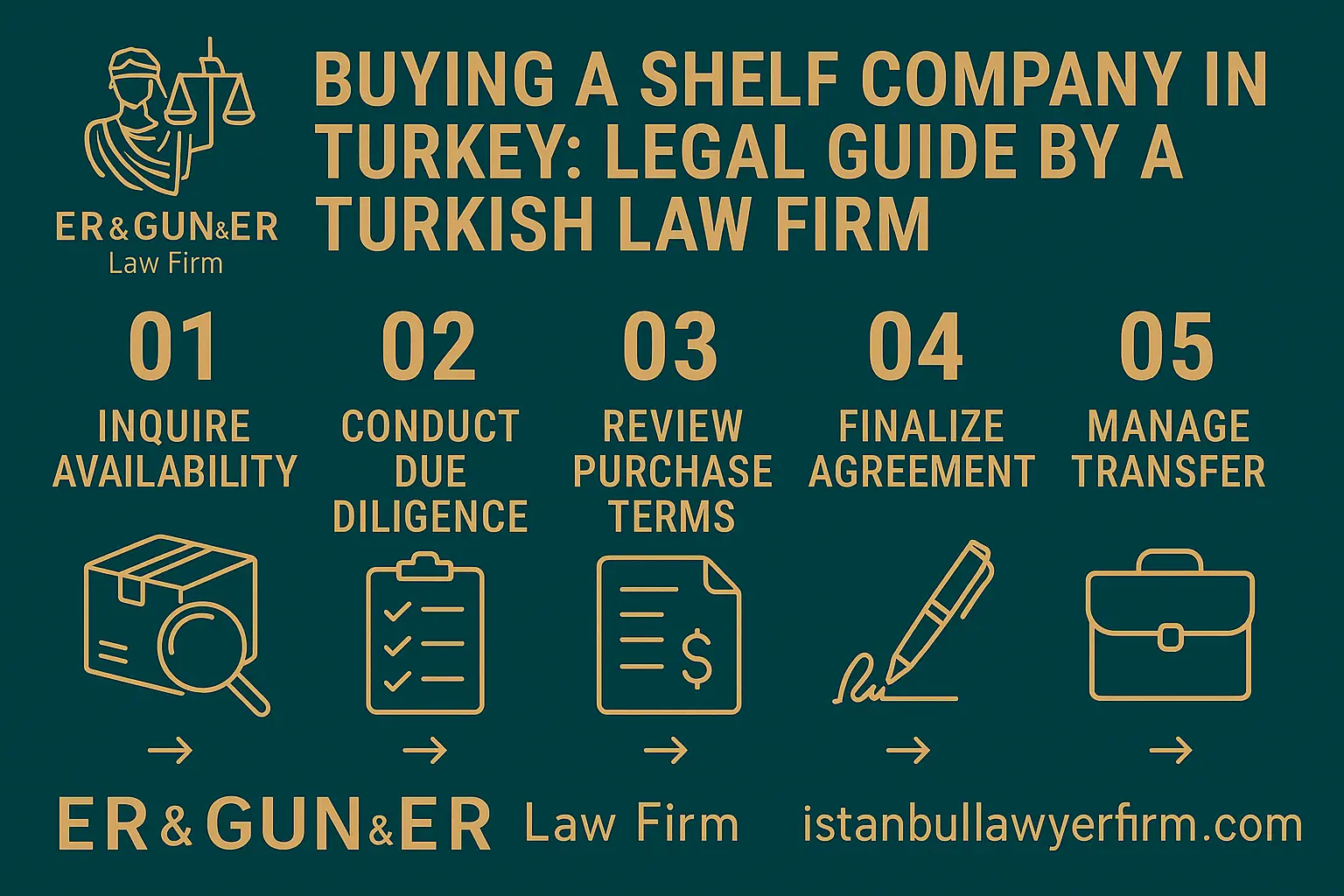
Acquiring a shelf company (hazır şirket) in Turkey — an existing but dormant registered Turkish company that is offered for sale to buyers who want to commence business operations without going through the formation process — provides a faster route to having a registered Turkish company than standard MERSIS formation, but it carries specific legal risks that must be thoroughly assessed before the acquisition proceeds. Unlike forming a new company — where the buyer starts with a clean slate — buying a shelf company transfers ownership of an entity that has already existed, has an existing tax registration, has a trade registry history, and may have accumulated liabilities (tax arrears, SGK premium debts, trade registry fines, or commercial obligations) that are not visible from a superficial review of the company's status. The share transfer mechanism under the Turkish Commercial Code (TTK) creates joint and several liability between the previous owners and the acquiring party for certain obligations — and the post-transfer discovery of hidden liabilities that were not disclosed can create significant financial exposure for the buyer without adequate due diligence and contractual protection. This guide explains the specific due diligence steps required for a Turkish shelf company acquisition, the TTK share transfer formalities, the post-acquisition compliance obligations, and the specific risks that distinguish a shelf company acquisition from a clean formation. Practice may vary by authority and year — verify current TTK, trade registry, and tax authority procedures directly before relying on any information in this guide.
What is a shelf company in Turkey and when does acquisition make sense
A lawyer in Turkey advising on shelf company acquisitions must explain that a Turkish shelf company (hazır şirket, satılık şirket, or ready-made company) is a company that was lawfully formed and registered in the Turkish Trade Registry — completing the full MERSIS formation procedure, notarization of the articles of association, trade registry registration, and tax authority enrollment — but which was then never used for any commercial activity. Shelf companies are typically offered by company formation service providers who create them speculatively for resale, or by individual entrepreneurs who formed a company for a planned venture that did not materialize. The key distinguishing characteristic is that a genuine shelf company has no commercial history — no invoices issued, no bank transactions, no employees, no tax returns showing revenue, and no SGK-registered workers. The absence of commercial history is both the primary appeal (no historical liabilities) and the primary due diligence focus (verifying that the "no history" claim is accurate). Practice may vary by authority and year — verify current Turkish trade registry and tax authority record access procedures for shelf company target verification before any acquisition. For the full procedural framework, see our pillar guide on establishing a new company in Turkey from scratch.
An Istanbul Law Firm advising on the timing advantages of shelf company acquisition must explain that the primary advantage of acquiring an existing shelf company over forming a new company is time — specifically, the time between the buyer's decision to start a Turkish business and the point at which they have a registered Turkish company ready to operate. The MERSIS formation process for a new Turkish company — even with well-prepared documentation — typically takes 5-10 business days from the formation appointment through trade registry publication. However, for foreign investors who need time to prepare apostilled corporate documents, obtain potential tax numbers for foreign shareholders, and arrange notarized powers of attorney, the total time from decision to registered company can easily be 4-8 weeks including documentation preparation. A shelf company, by contrast, already exists in the trade registry — the acquisition requires a share transfer and post-acquisition updates rather than a formation from scratch, and the buyer can be the registered owner within days of completing the due diligence and notarization. Practice may vary — verify current MERSIS formation timelines and the specific foreign shareholder documentation requirements applicable to the buyer's nationality before any timing comparison between shelf acquisition and new formation.
An English speaking lawyer in Turkey advising on when shelf company acquisition is not advisable must explain that the time advantage of a shelf company acquisition is only a genuine benefit if the acquisition can be completed quickly — and the due diligence process required to safely acquire a shelf company can take as long as or longer than a clean formation if problems are found during the due diligence. A shelf company with tax arrears, SGK premium debts, unfiled annual returns, or any historical commercial activity requires: identification and quantification of all outstanding obligations; negotiation of price adjustments or escrow arrangements to cover discovered liabilities; coordination with the Revenue Administration and SGK for payment plans or clearance certificates; and in some cases, legal proceedings to clear annotations or attachments on the company's assets. In these situations, forming a clean new company is typically faster, cheaper, and less risky than attempting to clean up a shelf company with problems. The acquisition route only makes compelling sense for a verified clean shelf company — one with confirmed zero tax liability, zero SGK premium arrears, zero commercial activity history, and current trade registry status — where the buyer's primary need is speed of market entry. Practice may vary — verify current Revenue Administration and SGK debt verification procedures before any shelf company acquisition decision. Practice may vary — check current guidance before acting on any information on this page.
Due diligence for shelf company acquisition — what to verify and how
A Turkish Law Firm advising on shelf company due diligence must explain that the due diligence for a Turkish shelf company acquisition must cover four primary areas — trade registry compliance, tax authority status, SGK premium history, and commercial activity verification — because each represents a distinct source of potential hidden liability that will survive the share transfer and become the buyer's responsibility. The trade registry due diligence involves obtaining the company's full trade registry extract (ticaret sicil gazetesi) showing the complete registration history including all amendments, the current articles of association (ana sözleşme), the company's authorized signatories (imza sirkülesi), and any enforcement notifications, annotations, or creditor entries registered against the company in the trade registry system. A trade registry record that shows amendments to the articles of association, changes in management, or entries that were made without clear explanation requires additional investigation into what triggered those changes. Practice may vary by authority and year — verify current trade registry extract disclosure procedures and the specific registry search mechanisms available for identifying enforcement annotations before any shelf company trade registry due diligence.
An Istanbul Law Firm advising on tax authority due diligence must explain that verifying the shelf company's tax compliance status — ensuring the company has filed all required returns, paid all assessed taxes, and has no outstanding tax debts — is the most financially significant element of shelf company due diligence. Under the Turkish tax framework, a registered company is required to file: monthly KDV (VAT) returns; quarterly provisional corporate income tax returns (geçici vergi beyannamesi); an annual corporate income tax return (kurumlar vergisi beyannamesi); and other declarations depending on the company's registered activity code. A shelf company that was formed but never used should have filed nil returns (sıfır beyan) for each required period since formation — a "nil return" is a return showing zero revenue and zero tax liability, which is still required to be filed even for companies with no activity. A shelf company that failed to file required nil returns has outstanding return filing obligations and potentially accumulated tax penalties (vergi cezaları) that constitute hidden liabilities. The buyer should specifically request a tax liability certificate (borçsuzluk belgesi or vergi borcu yoktur yazısı) from the Revenue Administration confirming the company has no outstanding tax obligations. Practice may vary — verify current Revenue Administration tax liability certificate issuance procedures and the specific tax obligation types covered by the certificate before any shelf company tax authority due diligence.
A lawyer in Turkey advising on SGK premium history due diligence must explain that the Social Security Institution (SGK) maintains a separate record of each company's employer registration and premium payment history — and this record is independent of the trade registry and tax authority records. A shelf company that was formed and then had even a single employee registered (even briefly) has an SGK employer record with premium payment obligations that may or may not have been satisfied. More critically, a shelf company that was offered to a buyer as "never used" may in fact have had employees registered through it by its original owner — creating SGK premium arrears that are not visible from the trade registry or tax records alone. The buyer should obtain: an SGK debt inquiry (SGK borcu yoktur belgesi) confirming the company has no outstanding SGK premium obligations; confirmation from the SGK e-Devlet system that the company has no currently registered employees or active insured persons; and review of the company's SGK workplace registration record (işyeri dosyası) confirming no employer registration exists. Under Law No. 5510 Article 88, any outstanding SGK premium obligations survive the share transfer and become the liability of the company — creating exposure for the new owners. Practice may vary — verify current SGK premium debt verification procedures and the specific SGK e-Devlet inquiry tools available for shelf company acquisition due diligence before any SGK-related due diligence. Practice may vary — check current guidance before acting on any information on this page.
Share transfer mechanics under TTK — Ltd and AŞ procedures
An English speaking lawyer in Turkey advising on the Ltd. Şti. share transfer mechanics must explain that a shelf company's most common form is the limited şirketi (Ltd. Şti.) — and the transfer of shares in a Turkish Ltd. Şti. to the acquiring buyer is subject to the specific formalities of TTK Articles 595-596 that make the transfer legally effective. Under TTK Article 595, a share transfer agreement for a Ltd. Şti. must be in writing and the signatures must be notarized — an un-notarized share transfer agreement for a Ltd. Şti. share is legally void and transfers no ownership rights, regardless of payment having been made. The share transfer agreement (hisse devir sözleşmesi) must be executed before a Turkish notary public, who verifies the identities of the transferor (seller) and transferee (buyer) or their authorized attorneys-in-fact, witnesses the signatures, and certifies the document with the notary's official seal. For foreign buyers who cannot attend the Turkish notary in person, the buyer must execute a specific power of attorney (vekaletname) authorizing a representative to execute the share transfer agreement at the Turkish notary on their behalf. Practice may vary by authority and year — verify current TTK Article 595 share transfer formality requirements and the specific notary documentary requirements applicable to the seller and buyer's specific corporate or individual status before any Ltd. Şti. share transfer agreement preparation.
A Turkish Law Firm advising on the post-notarization trade registry update must explain that the notarization of the share transfer agreement is not the final step in making the share transfer legally effective — the transfer must also be recorded in the company's share transfer register (pay defteri), and the new shareholder must be registered with the Turkish Trade Registry to create the official public record of the ownership change. Under TTK Article 596, a Ltd. Şti. share transfer requires the approval of the remaining shareholders (unless the articles of association specifically waive this approval requirement for transfers to third parties) — and this approval must be documented in a shareholders' resolution. After the notarized share transfer and the shareholders' approval (where required), the company files the shareholding change with the Turkish Trade Registry through the MERSIS system, submitting: the notarized share transfer agreement; the shareholders' resolution approving the transfer; and updated shareholder register. The trade registry then processes the update and publishes the new shareholding in the Turkish Trade Registry Gazette (Türkiye Ticaret Sicil Gazetesi) — which is the public notification of the ownership change. Practice may vary — verify current MERSIS trade registry update procedures and the specific documentation required for the shareholding change notification before any Ltd. Şti. share transfer registration. Practice may vary — check current guidance before acting on any information on this page.
An Istanbul Law Firm advising on simultaneous management changes must explain that a shelf company acquisition almost always involves not only a share transfer but also a change in the company's authorized management — specifically, replacing the original müdür (managing director) with the buyer's nominated manager. Under TTK, the müdür of a Ltd. Şti. represents the company before government authorities, signs contracts on behalf of the company, and is the person whose identity is linked to the company's tax registrations and SGK employer registration. The management change (müdür değişikliği) must be completed simultaneously with or immediately after the share transfer, to ensure that the buyer's representative has the authority to manage the company's accounts, sign official documents, and deal with government authorities. The management change requires: a shareholders' resolution (or sole shareholder decision) documenting the removal of the previous müdür and the appointment of the new müdür; if the new müdür is a foreign national, a potential tax number (vergi kimlik numarası) for the foreign individual; and a new signature circular (imza sirküleri) notarized at a Turkish notary showing the new authorized signatories. The management change is then filed with the trade registry through MERSIS simultaneously with the shareholding change. Practice may vary — verify current trade registry müdür change filing requirements and the specific identity documentation required for the new manager's appointment before any simultaneous share transfer and management change coordination.
Drafting the share transfer agreement — warranties, indemnities, and escrow
A lawyer in Turkey advising on share transfer agreement drafting must explain that the contractual protection available to a shelf company buyer depends entirely on the quality of the warranties and indemnities negotiated in the share transfer agreement — because once the notarized share transfer is completed and registered in the trade registry, the buyer is the legal owner of the company and its share of any liabilities, and only contractual claims against the seller can provide retrospective protection for undisclosed liabilities discovered after closing. The minimum warranties that a shelf company buyer should obtain from the seller include: a warranty that the company has no outstanding tax obligations to the Revenue Administration; a warranty that the company has no outstanding SGK premium obligations; a warranty that no commercial invoices, contracts, or other commercial activities were conducted through the company; a warranty that no employees are or have been registered with the company's SGK employer number; a warranty that all required nil tax returns were filed for all required periods; and a warranty that the company is not a party to any litigation, administrative proceeding, or enforcement action. Practice may vary by authority and year — verify current Turkish contractual warranty enforcement standards applicable to share transfer agreements before any warranty and indemnity structure design for a shelf company acquisition.
An English speaking lawyer in Turkey advising on indemnity structures for shelf company acquisitions must explain that the practical problem with warranty claims for post-closing liability discovery is that the seller of a shelf company is often an individual or a small formation service provider with limited financial resources — making a damages claim against the seller technically possible but practically difficult to collect if the seller lacks assets. The most effective financial protection mechanism for a shelf company buyer is an escrow arrangement: a portion of the agreed purchase price is held in escrow (by a Turkish bank, an escrow agent, or a law firm account) for a defined period after closing (typically 6-24 months) — and if any liabilities are discovered during the escrow period that the seller's warranties cover, the discovered liability amount is offset against the escrowed funds before release. The escrow period is aligned with the practical limitation period for discovering undisclosed liabilities — which for tax liabilities includes the Revenue Administration's 5-year assessment limitation period and for SGK liabilities the SGK's retroactive audit capabilities. Practice may vary — verify current Turkish escrow arrangement legal requirements and the specific escrow period standards appropriate for shelf company acquisition protection before any escrow structure design.
A Turkish Law Firm advising on purchase price and tax clearance coordination must explain that the purchase price for a Turkish shelf company typically includes: the company's registered share capital (typically TRY 50,000 for Ltd.) plus the seller's service fee for the formation work performed. The purchase price must be transferred through documented channels — a Turkish bank transfer or certified payment that creates a clear paper trail — because the purchase price documentation serves two purposes: it establishes the buyer's investment basis for any future Turkish capital gains calculation; and it satisfies the anti-money laundering documentation requirements of the Turkish bank managing the payment. Before releasing the purchase price to the seller, the buyer should have confirmed: receipt of the Revenue Administration tax liability clearance certificate; receipt of the SGK premium clearance certificate; completion of the notarized share transfer agreement; and confirmation that the trade registry update application has been submitted. Releasing the purchase price before these confirmations are in hand creates the risk of paying for a company whose clean status cannot be confirmed. Practice may vary — verify current documentation requirements for shelf company purchase price transfer and the specific clearance certificate formats that the Revenue Administration and SGK currently issue before any purchase price release decision. Practice may vary — check current guidance before acting on any information on this page.
Post-acquisition corporate compliance — tax updates, SGK, and banking
An Istanbul Law Firm advising on post-acquisition tax authority updates must explain that after the share transfer and management change are registered in the trade registry, the newly acquired shelf company requires several tax authority updates to function operationally under its new ownership. The primary tax authority updates include: re-issuance of the tax registration certificate (vergi levhası) reflecting the new authorized representative (müdür); notification to the Revenue Administration of the management change (which updates the company's records in the Tax Administration's systems); update of the company's registered commercial address if the new owner intends to operate from a different location; and update of the company's registered commercial activity code (NACE kodu — Vergi Usul Kanunu statistical activity code) if the new owner's planned commercial activity differs from the original registration. The tax authority updates are filed at the tax office (vergi dairesi) serving the company's registered address and require: the new signature circular; the trade registry gazette showing the management change; and the new manager's identity documentation. Practice may vary by authority and year — verify current Revenue Administration tax registration update procedures and the specific documentation required for management change notification at the specific tax office serving the company's address before any post-acquisition tax update.
A lawyer in Turkey advising on SGK employer registration activation must explain that a shelf company that was formed but never used should have no SGK employer registration — and if the buyer intends to hire employees, they must create the SGK employer registration (işyeri tescili) from scratch through the e-SGK portal before the first employee begins work. The SGK employer registration requires: the company's tax identification number; the company's registered address; the manager's identity information; and the planned occupational health and safety risk classification (which determines the applicable SGK premium hazard rate). Once the SGK employer registration is active, each employee must be enrolled in the SGK system (sigortalı bildirimi) before or on their first day of work — late enrollment creates administrative fines. For a shelf company with a confirmed zero SGK history (no prior employer registration), the post-acquisition process of creating the employer registration and enrolling the first employees is straightforward. For a shelf company where the due diligence revealed a prior SGK employer registration (suggesting prior employees), the SGK records must be specifically verified and any outstanding premium debts cleared before the acquisition closes. Practice may vary — verify current SGK e-SGK employer registration procedures and the specific risk classification assessment requirements applicable to the planned business activity before any post-acquisition SGK registration.
An English speaking lawyer in Turkey advising on banking activation after shelf company acquisition must explain that the shelf company's existing bank account (if any was opened during formation) must be updated to reflect the new management and new authorized signatories — and this banking update typically requires a personal visit to the bank by the new authorized manager, with presentation of: the new trade registry extract showing the management change; the new signature circular (imza sirkülesi) notarized in the new manager's name; and the new manager's valid identity document. The bank's KYC (Know Your Customer) process for the management change update involves: updating the authorized signatories on the account; updating the beneficial ownership (UBO — Ultimate Beneficial Owner) declarations to reflect the new shareholder; and potentially conducting an enhanced due diligence review of the new owner's identity and the source of funds used to acquire the company. For foreign shareholders, additional documents may be required — the foreign shareholder's identity documents, corporate structure documentation for foreign corporate shareholders, and the bank's standard international AML/KYC questionnaire. If no bank account was opened during formation (common for shelf companies formed without actual business intent), the new owner must open a corporate account through the standard new account opening procedure. Practice may vary — verify current Turkish bank KYC update procedures and the specific beneficial ownership declaration requirements applicable to foreign-owned Turkish companies before any post-acquisition bank account update. Practice may vary — check current guidance before acting on any information on this page.
License updates, KDV activation, and e-invoice enrollment
A Turkish Law Firm advising on commercial activity code and licensing updates must explain that a shelf company's registered commercial activity code (NACE code, as registered with the Revenue Administration) reflects the activity the company was originally registered for — and if the buyer's intended business activity is different from the original registration, the commercial activity code must be updated at the Revenue Administration before the company commences activities under the new code. The NACE code update is a separate procedure from the trade registry activity description update (which is filed with the trade registry) — both must be updated if the activity is changing, because they are maintained in different government systems. For activities requiring specific sector licenses (BDDK for fintech, SPK for investment services, EPDK for energy, BTK for telecommunications, and others), the license must be applied for before commencing the licensed activity, and the shelf company's existing registration does not transfer any previously held licenses — licenses are personal to the entity and must be independently applied for and granted. Practice may vary by authority and year — verify current NACE code update procedures at the Revenue Administration and the specific sector license requirements applicable to the planned business activity before any post-acquisition activity code update.
An Istanbul Law Firm advising on KDV (VAT) registration activation must explain that a newly acquired shelf company must activate its KDV status at the relevant tax office before it can issue invoices for taxable goods and services. Even though the company was registered with the Revenue Administration at formation, the KDV registration must be specifically activated — a dormant shelf company may have a passive tax registration without an active KDV status. The KDV activation process typically involves: notifying the tax office of the commencement of commercial activity (faaliyete başlama bildirimi); providing the company's registered address for the tax office's physical address inspection (işyeri tespit tutanağı); and updating the company's registration to active status. Once KDV is activated, the company must file monthly KDV returns (KDV-1 beyannamesi or KDV-2 depending on the specific activity) by the 26th of the following month, with payment due simultaneously. For companies in regulated sectors (broadcasting, banking, certain health services), sector-specific KDV exemptions or reverse charge mechanisms may apply. Practice may vary — verify current Revenue Administration KDV activation procedures and the specific address inspection requirements applicable to the company's registered address type before any KDV activation post-acquisition.
A lawyer in Turkey advising on e-invoice and e-ledger enrollment must explain that Turkey's digital tax infrastructure requires companies above defined size thresholds — or in specific sectors — to use the e-Fatura (e-Invoice) and e-Defter (e-Ledger) systems rather than paper invoicing and manual bookkeeping. The enrollment thresholds for e-Fatura and e-Defter are updated periodically by the Revenue Administration — companies exceeding the annual turnover threshold are required to enroll and must do so within the defined enrollment deadline for their business size. For a newly acquired shelf company commencing operations, it is important to assess at the outset whether the expected annual turnover will exceed the e-Fatura enrollment threshold — and if so, to enroll in the e-Fatura system before the first invoice is issued, because post-enrollment invoices issued without the e-Fatura system create significant administrative penalties. E-Fatura enrollment requires: registration through the Revenue Administration's e-Devlet portal; appointment of an e-Fatura licensed integrator (entegratör) for the technical connection; and in some cases, a digital certificate (e-imza). Practice may vary — verify current Revenue Administration e-Fatura and e-Defter enrollment thresholds and the specific enrollment timeline requirements applicable to new businesses before any post-acquisition digital tax infrastructure planning. Practice may vary — check current guidance before acting on any information on this page.
Inherited liability risks — tax, SGK, and commercial claims
An English speaking lawyer in Turkey advising on the inherited liability framework must explain that Turkish law creates specific mechanisms through which a company's pre-existing obligations survive a change of ownership — and the buyer of a shelf company inherits the legal entity's historical obligations whether or not the buyer was aware of them at the time of acquisition. The most significant inherited liability categories include: tax liabilities (assessed taxes, tax penalties, and default surcharges for any period since the company's formation date); SGK premium liabilities (unpaid employer-side and employee-side premiums for any period of registered employment); trade registry administrative fines (for late filings, undisclosed changes, or required public notice failures); and in cases where the shelf company was not truly inactive, commercial liabilities arising from contracts, purchase orders, or other obligations the previous owner created through the company. The practical implication is that a buyer who relies solely on the seller's assurance that the company is "clean" — without independently verifying each liability category through official certificates — is taking a risk that may materialize into significant financial obligation after closing. Practice may vary by authority and year — verify current Turkish legal liability succession standards applicable to company share purchases and the specific official certificate types available from each authority for liability confirmation before any shelf company acquisition closing.
A Turkish Law Firm advising on tax assessment limitation periods must explain that the Turkish Revenue Administration's standard assessment limitation period is 5 years from the end of the calendar year in which the relevant tax return should have been filed — which means that a shelf company formed in 2020 that is being acquired in 2025 may be subject to a retroactive Revenue Administration assessment for any period from 2020 through the current year if the required returns were not filed or were filed incorrectly. The 5-year limitation period also applies to tax fraud cases — though for fraud cases, the limitation period may be extended. For the shelf company buyer, this means that acquiring a shelf company does not come with a short limitation period for discovering tax problems — the liability exposure extends back to the company's formation date for the full statutory assessment period. A tax liability clearance certificate from the Revenue Administration confirms the current known state of the company's tax obligations — but it does not prevent future assessments for periods that have not yet been audited. Practice may vary — verify current Revenue Administration tax assessment limitation period standards and the specific scope of the tax liability certificate before any shelf company tax liability assessment.
An Istanbul Law Firm advising on the specific risk of commercial activity discovered post-acquisition must explain that the most serious risk in a shelf company acquisition is the discovery after closing that the company was not in fact completely dormant — that the previous owner used the company for some commercial activity that created obligations not visible in the official records at the time of due diligence. This can occur because: Turkish accounting and tax records have processing delays — an invoice issued in December 2024 may not appear in the Revenue Administration's systems until the April 2025 annual return is filed; SGK records may not reflect a short-term employee engagement that ended before due diligence; and commercial obligations (contracts, purchase orders, liability claims from third parties) may not be reflected in any official registry. Obtaining the seller's warranties against undisclosed commercial activity — with an escrow arrangement to fund any claims discovered within the warranty period — is the contractual protection mechanism. However, the most reliable protection is conducting due diligence that goes beyond official certificates: reviewing the company's actual bank account statements (if any accounts exist) for the full period since formation; requesting and reviewing all correspondence with the Revenue Administration; and obtaining seller representations specifically about whether any invoices were issued, any contracts were signed, or any third parties have claims against the company. Practice may vary — verify current Turkish warranty claim enforcement standards applicable to share transfer agreements before any shelf company acquisition warranty structure design. Practice may vary — check current guidance before acting on any information on this page.
Alternative to shelf company — comparing with clean new formation
A lawyer in Turkey advising on the shelf company vs. new formation comparison must explain that the decision between acquiring a shelf company and forming a new company should be made based on a realistic assessment of three factors: time urgency (how soon does the buyer actually need an operational Turkish company); due diligence timeline (how long will proper shelf company due diligence take given the specific shelf company's history); and risk tolerance (how comfortable is the buyer with inheriting a company with any historical footprint versus starting clean). For a buyer with a genuine urgency (they have a contract to execute within two weeks that requires a Turkish company), a verified clean shelf company with current clearance certificates can indeed save time. For a buyer without an urgent deadline, the due diligence overhead required for a safe shelf company acquisition — obtaining revenue administration certificates, SGK clearance, bank statement review, and conducting the share transfer formalities — may take as long as or longer than forming a new company from scratch. Practice may vary by authority and year — verify current MERSIS formation timelines applicable to the specific company type and the specific foreign shareholder's nationality and documentation readiness before any shelf company vs. new formation timing comparison.
An Istanbul Law Firm advising on situations where new formation is preferable must explain that in the following specific circumstances, forming a new company is consistently preferable to acquiring a shelf company: where the buyer's nationality or corporate structure requires significant apostille and translation time (making foreign investor MERSIS formation comparable in time to a shelf company acquisition); where the buyer has specific governance or capital structure requirements that differ from the standard shelf company structure (requiring articles of association amendments that would take similar time to a new formation); where the shelf company's formation history shows any deviation from a completely clean dormant status; where the buyer's sector requires specific articles of association provisions (healthcare, financial services, construction) that a standard shelf company articles of association may not include; and where the seller of the shelf company cannot or will not provide adequate warranties and clearance certificates. In all of these situations, the supposed time advantage of the shelf company acquisition is either eliminated or is outweighed by the risk of inheriting the shelf company's history. Practice may vary — verify current shelf company availability in Turkey and the specific articles of association requirements applicable to the planned business sector before any shelf company vs. formation comparison.
An English speaking lawyer in Turkey advising on the specific case for shelf company acquisition must explain that the strongest case for a shelf company acquisition — as opposed to clean formation — arises where: the buyer needs a Turkish company registered and operational within 5-7 business days; the shelf company has been formed within the last 3-6 months (minimizing the historical liability exposure); the shelf company provider maintains a professional track record and can provide comprehensive clearance documentation quickly; and the purchase price is modest (typically TRY 50,000 registered capital plus a formation fee of TRY 5,000-15,000 for a standard Ltd. shelf company). In this specific scenario, the acquisition can genuinely save 2-4 weeks compared to a clean formation with foreign shareholder documentation requirements — providing real commercial value for a buyer with an urgent need. Outside this specific scenario, the time and risk calculations typically favor clean formation. We evaluate each client's specific situation individually and recommend the optimal route based on the actual timelines and risk profile rather than a generic preference for either approach. Practice may vary — verify current shelf company acquisition timelines and clean formation timelines applicable to the specific buyer's circumstances before any acquisition vs. formation recommendation. Practice may vary — check current guidance before acting on any information on this page.
How we work in shelf company acquisition mandates
An English speaking lawyer in Turkey at ER&GUN&ER managing a shelf company acquisition mandate explains that our approach begins with a frank assessment of whether shelf company acquisition is actually the right route for the specific client — because we consistently find that the time advantage of shelf company acquisition is smaller than clients initially expect, and the risk management overhead is larger. For clients with a genuine time constraint that makes shelf acquisition superior to clean formation, we conduct a rapid parallel due diligence on the specific shelf company offered: Revenue Administration certificate verification; SGK clearance verification; trade registry full record review; and a commercial activity verification based on bank statement review and Revenue Administration returns examination. This parallel due diligence — designed to be completed in 2-3 business days for a clean shelf company — produces a clear go/no-go assessment before any purchase price is committed. If the company passes all checks, we proceed to the share transfer agreement and notarization stage; if any problems are found, we advise specifically on whether they can be cured and at what cost, compared to the alternative of clean formation.
ER&GUN&ER advises both buyers and sellers of Turkish shelf companies across the complete shelf company transaction spectrum — pre-acquisition due diligence (Revenue Administration certificate verification, SGK clearance, trade registry full record review, bank statement analysis); share transfer agreement drafting (warranties, indemnities, escrow structure, purchase price mechanism); power of attorney preparation for remote buyers and sellers; notarization coordination for the share transfer agreement; simultaneous management change (müdür değişikliği) coordination; MERSIS trade registry update filing; post-acquisition tax authority update coordination; KDV activation and e-Fatura enrollment; SGK employer registration activation; bank account management change coordination; capital increase procedure; articles of association amendment; sector license applications; and ongoing compliance monitoring. For foreign buyers specifically, we manage the entire process in English — including all Turkish authority communications, document translations, and cross-border power of attorney coordination. We also specifically advise on whether clean formation is a preferable alternative in cases where the shelf company acquisition's time advantage does not justify the due diligence overhead and residual risk. For the clean new company formation framework — see the resource on foreigners establishing a business in Turkey. Practice may vary — check current guidance before acting on any information on this page.
Frequently Asked Questions
- What is a shelf company (hazır şirket) in Turkey? A shelf company is a Turkish company that was lawfully formed and registered in the Turkish Trade Registry — completing all formation formalities including MERSIS registration, notarized articles of association, trade registry publication, and tax authority enrollment — but was then not used for any commercial activity. It is offered for sale to buyers who want a registered Turkish company without going through the formation process. The appeal is speed of availability; the risk is inherited liabilities if the company was not truly dormant. Practice may vary — verify current shelf company market availability and standard due diligence requirements.
- What due diligence is required before buying a shelf company? Essential due diligence includes: (1) Revenue Administration tax liability clearance certificate (vergi borcu yoktur belgesi); (2) SGK premium clearance certificate (SGK borcu yoktur belgesi); (3) Full trade registry record review including all amendments and any enforcement annotations; (4) Confirmation that all required nil tax returns were filed for each required period since formation; (5) Bank statement review to confirm no commercial transactions occurred; and (6) Seller warranties against undisclosed commercial activity. Missing any of these creates risk of inheriting undisclosed liabilities. Practice may vary — verify current clearance certificate issuance procedures.
- How is a Ltd. Şti. share transfer legally completed in Turkey? A Ltd. Şti. share transfer requires: a written share transfer agreement (hisse devir sözleşmesi) whose signatures are notarized at a Turkish notary public — an un-notarized transfer is legally void; a shareholders' resolution approving the transfer (unless waived by the articles); recording the transfer in the company's share register (pay defteri); and filing the shareholding update with the Turkish Trade Registry through MERSIS for trade registry publication. Payment of the purchase price should be documented through traceable bank transfer channels. Practice may vary — verify current TTK Article 595-596 share transfer formality requirements.
- Can I complete a shelf company share transfer from abroad? Yes — through a notarized power of attorney (vekaletname) authorizing a Turkish representative to execute the share transfer agreement at the Turkish notary on your behalf. The power of attorney must be apostilled (for Hague Convention countries) or consularly legalized (for non-Convention countries) and accompanied by a certified Turkish translation. The scope must specifically authorize all required share transfer and trade registry actions. Remote buyers should prepare the power of attorney well in advance given apostille processing time. Practice may vary — verify current notary power of attorney scope requirements.
- What warranties should the seller provide in a shelf company acquisition? Minimum warranties should include: no outstanding tax obligations to the Revenue Administration; no outstanding SGK premium obligations; no commercial invoices issued, contracts signed, or other commercial activities; no employees registered under the company's SGK employer number; all required nil tax returns filed for all periods since formation; no litigation, administrative proceedings, or enforcement actions pending; and no undisclosed third-party claims against the company. An escrow arrangement holding a portion of the purchase price for 6-24 months provides practical financial protection if warranty claims materialize. Practice may vary — verify current Turkish warranty claim enforcement standards for share purchase agreements.
- What liabilities survive a shelf company share transfer? Turkish law makes the company liable for its pre-existing obligations regardless of ownership change — which means tax arrears, SGK premium debts, trade registry fines, and commercial claims against the company all survive the share transfer. The buyer inherits the company with its full liability history. Official clearance certificates reduce the discovered liability risk but do not prevent future Revenue Administration assessments for periods within the 5-year assessment limitation period that have not yet been audited. This is why escrow and seller warranties are critical protection mechanisms. Practice may vary — verify current liability succession standards for Turkish company acquisitions.
- What post-acquisition tax authority updates are required? After the share transfer and management change are trade registry-registered, the company's tax records must be updated through: re-issuance of the tax registration certificate (vergi levhası) under the new manager; notification of the management change to the Revenue Administration; update of the registered commercial address if different from the formation address; update of the commercial activity code (NACE) if the planned activity differs; and KDV (VAT) activation if the company's VAT registration was in passive status during dormancy. Practice may vary — verify current Revenue Administration update requirements at the specific tax office.
- When is shelf company acquisition preferable to clean new formation? Shelf company acquisition provides a genuine time advantage when: the buyer has an urgent need for a Turkish company within 5-7 business days; the shelf company was formed recently (within the last 3-6 months); the provider can supply comprehensive clearance documentation quickly; and the purchase price is modest relative to the time saved. Outside this specific scenario — particularly for foreign investors who need apostilled documentation regardless — clean formation may be comparable or faster when all post-acquisition compliance steps are accounted for. We assess each client's specific situation before recommending acquisition vs. formation.
- What is the Revenue Administration's assessment limitation period for shelf companies? The Turkish Revenue Administration's standard tax assessment limitation period is 5 years from the end of the calendar year in which the relevant tax return should have been filed. A tax liability clearance certificate confirms the current known state of tax obligations but does not prevent future assessments within the limitation period for periods that have not yet been audited. A shelf company formed in 2021 is subject to potential retroactive assessment through 2027 for 2021 tax obligations. This reinforces the importance of nil return filing verification during due diligence. Practice may vary — verify current assessment limitation period standards.
- How does SGK registration work for a shelf company with no employees? A genuinely dormant shelf company should have no SGK employer registration (işyeri tescili). When the buyer acquires the company and intends to hire employees, the SGK employer registration must be created through the e-SGK portal before the first employee begins work. The registration is created as a new employer record under the new management. Each employee must be individually enrolled (sigortalı bildirimi) before or on their first day of work. Late enrollment creates administrative fines. Practice may vary — verify current e-SGK employer registration procedures and the specific hazard rate assessment requirements.
- Is e-Fatura mandatory for a newly acquired shelf company? E-Fatura (e-Invoice) enrollment is mandatory for companies exceeding the Revenue Administration's annual turnover threshold (updated periodically) and for companies in specific regulated sectors. A newly acquired company commencing operations should assess at the outset whether its expected annual turnover will exceed the enrollment threshold — and if so, enroll before issuing any invoices, because post-enrollment invoices issued without the e-Fatura system create significant administrative penalties. E-Defter (e-Ledger) enrollment requirements run parallel. Practice may vary — verify current enrollment thresholds and the specific sector-specific mandatory enrollment requirements.
- Can I change the company's commercial objects clause after acquisition? Yes — the company's articles of association commercial objects clause (amaç ve konu) can be amended after acquisition through a notarized shareholders' resolution and trade registry amendment filing through MERSIS. The amended articles must comply with TTK mandatory provisions and the updated trade name and objects must be published in the Turkish Trade Registry Gazette. If the planned activity is in a regulated sector, the sector license must be applied for separately from the articles amendment. Practice may vary — verify current trade registry articles amendment filing requirements.
- What is an escrow arrangement and how does it protect the shelf company buyer? An escrow arrangement holds a portion of the purchase price (typically 20-50%) with a neutral holder (bank, law firm trust account, or dedicated escrow agent) for a defined period (typically 6-24 months) after closing. If any undisclosed liabilities are discovered during the escrow period that the seller's warranties cover, the discovered amount is offset against the escrowed funds before release. If no claims arise, the escrowed amount is released to the seller at the end of the period. Escrow is particularly important for shelf company acquisitions because the Revenue Administration's 5-year assessment limitation period creates ongoing discovery risk for several years after closing. Practice may vary — verify current Turkish escrow arrangement legal requirements.
- Do you advise on both buying and selling shelf companies in Turkey? We advise buyers on due diligence, share transfer agreement negotiation and drafting, acquisition risk assessment, and post-acquisition compliance management. We also advise sellers of shelf companies on their disclosure obligations, warranty scope, and liability management during the sale process. We do not typically form companies for speculative resale as shelf companies — our formation service is for clients forming companies for their own use. For each acquisition mandate, we specifically assess whether shelf company acquisition or clean new formation is preferable for the specific client's situation, and we recommend accordingly regardless of which route generates more work. Practice may vary — verify current advice applicable to your specific situation.
- How long does a complete shelf company acquisition typically take? For a verified clean shelf company with all clearance certificates readily available, the total timeline from starting due diligence to completed trade registry update is typically 5-10 business days: 2-3 days for due diligence and clearance certificate verification; 1-2 days for share transfer agreement preparation and execution at the Turkish notary; 2-5 days for MERSIS trade registry update processing and publication. Post-acquisition tax authority and SGK updates add an additional 1-3 business days. For buyers requiring apostilled powers of attorney from abroad, add 1-3 weeks for apostille processing in the foreign country. Practice may vary — verify current MERSIS and notary appointment availability at the relevant location.
Author: Mirkan Topcu is an attorney registered with the Istanbul Bar Association (Istanbul 1st Bar), Bar Registration No: 67874. His practice focuses on cross-border and high-stakes matters where evidence discipline, procedural accuracy, and risk control are decisive.
He advises buyers and sellers of Turkish shelf companies across Pre-Acquisition Due Diligence (Revenue Administration and SGK Clearance Certificates, Trade Registry Full Record Review, Bank Statement Analysis), Share Transfer Agreement Drafting (Warranties, Indemnities, Escrow Structure), Power of Attorney Preparation for Remote Buyers, Notarization Coordination, Simultaneous Management Change Coordination, MERSIS Trade Registry Update Filing, Post-Acquisition Tax Authority Updates, KDV Activation, e-Fatura and e-Defter Enrollment, SGK Employer Registration, Bank Account Management Change, Capital Increase Procedure, Articles of Association Amendment, Sector License Applications, and Clean Formation as an Alternative to Shelf Acquisition matters where procedural precision and liability assessment are decisive.
Education: Istanbul University Faculty of Law (2018); Galatasaray University, LL.M. (2022). LinkedIn: Profile. Istanbul Bar Association: Official website.