

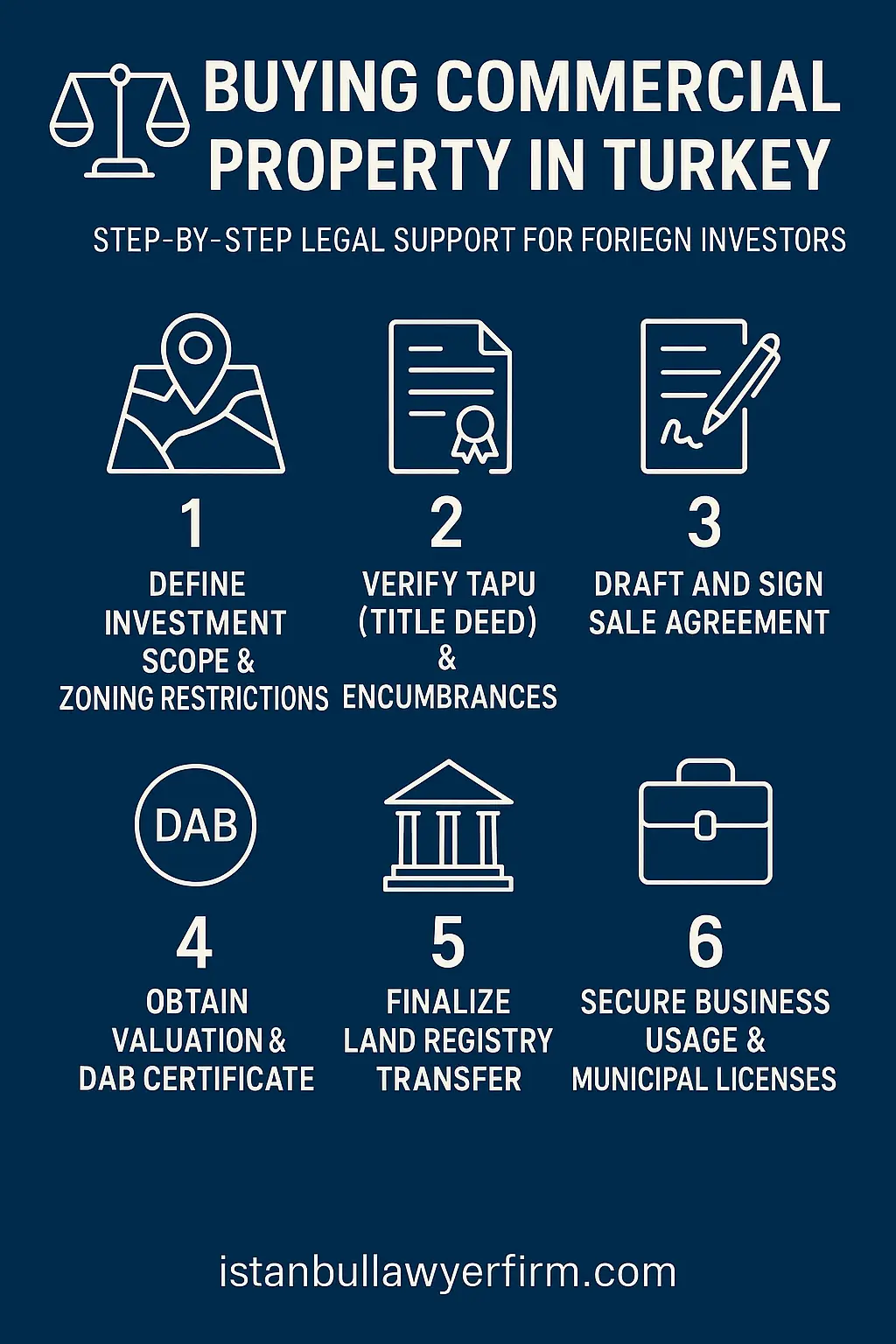
Buying commercial real estate in Turkey — offices, retail units, warehouses, logistics facilities, hospitality properties, or industrial premises — involves the same foundational legal framework as residential property acquisition under the Land Registry Law (Tapu Kanunu, Law No. 2644) Article 35, but with additional layers of complexity arising from the commercial use designation requirements in the zoning plan (imar planı), the existing tenant and operational compliance due diligence for income-generating properties, the typically higher KDV (VAT) applicable to commercial property transactions compared to residential, and the ongoing regulatory obligations that commercial property ownership creates under environmental law, building code, and commercial lease law. Foreign natural persons and foreign corporate entities (Turkish subsidiaries of foreign companies, and in certain structures, foreign companies directly) can acquire Turkish commercial real property subject to the nationality eligibility conditions and geographic restrictions established by Tapu Kanunu Article 35 — the same framework that governs residential property acquisition. However, the specific zoning, permitting, and operational due diligence requirements for commercial properties require additional investigative steps beyond the standard residential acquisition checklist. This guide explains the legal framework, due diligence requirements, transaction mechanics, and ongoing compliance obligations for foreign investors acquiring commercial real estate in Turkey. Practice may vary by authority and year — verify current Tapu Kanunu, imar plan, and Land Registry procedures directly before relying on any information in this guide.
Foreign investor eligibility and commercial property acquisition structures
A lawyer in Turkey advising on foreign investor eligibility for commercial property must explain that the same Tapu Kanunu Article 35 framework governing residential property acquisition applies to commercial real estate — foreign natural persons from eligible countries can acquire Turkish commercial real property (subject to the 30-hectare nationwide acquisition limit and geographic restrictions), and Turkish companies (even those 100% owned by foreign shareholders) acquire property as Turkish legal entities without the Tapu Kanunu Article 35 foreign person restrictions applying. The choice between personal acquisition by the foreign investor and acquisition through a Turkish subsidiary is particularly significant for commercial properties because: Turkish company ownership allows acquisition of commercial property without the 30-hectare limit, the military clearance requirement, or the nationality restriction; corporate ownership may provide tax advantages (commercial property owned by a Turkish company and used in the company's business activities can be subject to corporate income tax accounting treatment different from personal ownership); and corporate ownership facilitates future ownership transfer through share transactions rather than requiring new tapu transfers with associated transfer fees. Practice may vary by authority and year — verify current Tapu Kanunu eligibility standards and the specific tax implications of personal versus corporate ownership for the specific commercial property type and investor tax situation before any acquisition structure decision.
An Istanbul Law Firm advising on corporate acquisition structures must explain that a Turkish company that acquires commercial property as a business asset — where the property will be used in the company's own commercial operations (as office space, warehouse, retail location) — is accounting for the property as a fixed asset, while a Turkish company that acquires commercial property as a real estate investment (to be rented to third-party tenants and to generate rental income) is operating as a real estate investor. This distinction has: Turkish corporate income tax implications (depreciation deductions on business-use property differ from investment property accounting treatment); KDV implications (a VAT taxpayer company purchasing commercial property for business use can typically credit the KDV paid on the purchase against output KDV, while a company purchasing for pure investment rental may have more limited KDV recoverability); and regulatory implications (companies with real estate investment as their primary business may need to address specific regulatory considerations). For international investors acquiring Turkish commercial real estate as a portfolio investment, establishing a dedicated Turkish real estate holding company (gayrimenkul yatırım ortaklığı — GYO structure for qualifying entities, or a standard AŞ/Ltd for smaller portfolios) provides the clearest organizational framework. Practice may vary — verify current Turkish corporate income tax treatment of commercial real estate investment and the specific GYO regulatory requirements before any commercial real estate portfolio acquisition structure design. Practice may vary — check current guidance before acting on any information on this page.
An English speaking lawyer in Turkey advising on foreign company direct acquisition must explain that foreign companies (as opposed to foreign-owned Turkish companies) can in certain circumstances acquire Turkish real property directly — but the specific legal framework for direct foreign company property ownership in Turkey is more restrictive and more complex than for foreign natural persons or Turkish companies, and requires specific legal analysis for each transaction. Under current Turkish law, a foreign company that is not registered in Turkey (no Turkish branch or subsidiary) acquiring Turkish commercial property must satisfy specific conditions relating to the purpose of the acquisition and may face different administrative requirements from the Land Registry Office compared to Turkish entity or foreign natural person purchasers. In practice, most large commercial real estate acquisitions by foreign investors use a Turkish AŞ or Ltd. as the acquisition vehicle — providing legal clarity, straightforward Land Registry registration, and operational flexibility — rather than attempting direct foreign company acquisition with its additional complexities. Practice may vary — verify current Turkish Land Registry Office requirements for foreign company direct property acquisition and the specific conditions applicable to the contemplated foreign company's legal structure before any direct foreign company acquisition consideration. Practice may vary — check current guidance before acting on any information on this page.
Commercial property due diligence — title, zoning, and operational compliance
A Turkish Law Firm advising on commercial property due diligence must explain that due diligence for a commercial real estate acquisition in Turkey requires verification across three distinct but interconnected areas — title status, zoning and building compliance, and operational/tenancy status — each of which can reveal deal-affecting issues that must be resolved before closing. Title due diligence involves obtaining and analyzing the full Land Registry record (tapu kaydı) for the commercial parcel, including all registered encumbrances (ipotek — mortgage, haciz — attachment, şerh — annotation, kısıtlama — restriction), the chain of title showing historical ownership, and any court annotations indicating pending litigation. A commercial property subject to a creditor's ihtiyati haciz (provisional attachment) or a litigation annotation (dava şerhi) has title that cannot be freely transferred — the attachment or annotation must be cleared before the title transfer can proceed. Practice may vary by authority and year — verify current Land Registry full record disclosure procedures and the specific annotation types that prevent or restrict title transfer before any commercial real estate title due diligence.
An Istanbul Law Firm advising on commercial zoning due diligence must explain that verifying the commercial use designation in the current imar plan (zoning plan) is particularly critical for commercial property acquisitions because the permitted commercial use classification determines what specific commercial activities can be conducted at the property — and not all "commercial zone" (ticaret alanı) designations allow all types of commercial use. The Turkish zoning system distinguishes between different commercial zone sub-types including: ticaret alanı (general commercial zone — retail, offices, services); konut + ticaret alanı (mixed residential-commercial zone — ground floor commercial with upper floor residential); sanayi alanı (industrial zone — manufacturing, warehousing, heavy industry); ve depolama alanı (storage zone — logistics, warehouse). A property in a storage zone may not be appropriate for retail or office use, regardless of what the current building physically looks like. The imar durumu belgesi (zoning status certificate) from the relevant municipality specifies the permitted use classification and the applicable floor area ratios and height limits. Any planned use that exceeds or differs from the zoning designation requires either a imar planı değişikliği (zoning plan amendment) application or a plan modification — processes that are long, uncertain, and outside the buyer's control. Practice may vary — verify current municipality imar plan designation verification procedures and the specific commercial use sub-types permitted under the relevant zone classification before any commercial property acquisition with planned use different from current designation.
A lawyer in Turkey advising on existing tenant due diligence must explain that the acquisition of an income-producing commercial property — one with existing tenants generating rental income — requires specific due diligence on the existing tenancy relationships that is distinct from the title and zoning checks. Commercial tenant due diligence includes: reviewing all existing lease agreements (kira sözleşmeleri) for term, rent, renewal options, and tenant rights (particularly for tenants with long-term leases who may have Turkish law protections that survive a change in property ownership); verifying tenant payment status and whether there are any rent arrears; assessing whether any tenants have made unauthorized modifications to the leased space; confirming that the security deposits (depozito) held by the current owner are documented and whether they will be transferred to the buyer; and assessing whether any tenants have rights under TBK's commercial tenant protection provisions that would restrict the buyer's ability to change lease terms after acquisition. Under TBK Article 350, a landlord cannot terminate a commercial lease for the purpose of using the property for their own commercial activities for at least one year after the lease's original conclusion date. Practice may vary — verify current TBK commercial tenant protection provisions and the specific lease assignment obligations applicable to the tenant relationships in the target property before any acquisition of a commercial property with existing tenants. Practice may vary — check current guidance before acting on any information on this page.
Building permits, iskan, and operational compliance for commercial properties
An English speaking lawyer in Turkey advising on commercial building compliance must explain that commercial properties have additional building compliance requirements beyond the residential iskan (occupancy permit) — and verifying that the commercial property has all required operational permits for its current use is an essential due diligence step that is frequently inadequately performed by buyers focusing only on the title and the iskan. A retail store, restaurant, hotel, warehouse, or office building requires not only the basic yapı kullanma izni (occupancy permit) from the municipality confirming the building was constructed in compliance with the building permit — but also, depending on the specific use: a işyeri açma ve çalışma ruhsatı (business operating license) from the local municipality; health and safety compliance certification; fire safety approval from the fire department; food safety certification for food-related commercial uses; tourism operation license for hospitality properties; and environmental compliance certificates for industrial or manufacturing properties. A commercial property that lacks the required operational permits for its current use cannot be used for that purpose legally — and the buyer will need to obtain these permits, which may require modifications to the property or changes in the property's classification. Practice may vary by authority and year — verify current municipality operational permit requirements and the specific compliance certification standards applicable to the commercial use type at the target property location before any commercial property acquisition.
A Turkish Law Firm advising on environmental compliance due diligence must explain that commercial properties — particularly industrial facilities, manufacturing sites, logistics centers, and properties with fuel storage or chemical handling — may be subject to Environmental Law (Law No. 2872) compliance obligations that the buyer inherits upon acquiring the property. Environmental due diligence for commercial real estate involves: verifying whether the property required an Environmental Impact Assessment (Çevresel Etki Değerlendirmesi, ÇED) for its current use and whether any required ÇED approvals were obtained; identifying any existing environmental violations, fines, or cleanup orders registered against the property; assessing potential soil and groundwater contamination from historical industrial use (particularly relevant for industrial land conversion to other uses); confirming that any hazardous material handling (fuel tanks, chemical storage, asbestos in older buildings) is compliant with current standards; and reviewing the property's waste management compliance status. A buyer who acquires a commercial property with undisclosed environmental liabilities inherits those liabilities under Turkish environmental law, and cleanup costs can be substantial. Practice may vary — verify current Environmental Law No. 2872 compliance obligations applicable to the specific commercial use type and the specific due diligence steps available for environmental liability assessment before any commercial real estate acquisition involving industrial or industrial-zoned properties.
An Istanbul Law Firm advising on Occupational Health and Safety compliance must explain that commercial property buyers who will also operate businesses from the acquired property must ensure that the property satisfies Occupational Health and Safety requirements under Law No. 6331 (İş Sağlığı ve Güvenliği Kanunu). Law No. 6331 requires employers to conduct workplace risk assessments, implement appropriate safety measures, provide OHS training to employees, and — for workplaces with 50 or more employees or in high-risk sectors — retain a qualified OHS professional (iş güvenliği uzmanı). For commercial real estate acquisitions where the buyer will employ workers at the property, the OHS compliance requirements become obligations of the property owner/operator from the first day of operation. Building-specific OHS issues that should be verified during due diligence include: fire safety system compliance (yangın güvenliği); elevator maintenance certification (asansör periyodik bakım belgesi); electrical installation safety certification; and for older buildings, asbestos assessment. Practice may vary — verify current Law No. 6331 OHS compliance requirements applicable to the specific commercial use type and employment size before any commercial property acquisition where the buyer will operate a business from the property. Practice may vary — check current guidance before acting on any information on this page.
The title transfer procedure for commercial properties — fees and taxes
A lawyer in Turkey advising on commercial property tax at transfer must explain that the tax payable on a Turkish commercial real estate acquisition is typically higher than on a comparable residential acquisition — primarily because KDV (VAT) is generally applicable to commercial property sales at the standard rate rather than the reduced rates that apply to qualifying residential properties. The standard KDV rate in Turkey is currently 20% and this rate applies to commercial property sales where the seller is a VAT-registered business. Unlike residential properties below certain size thresholds (which benefit from 1% KDV), most commercial properties — offices, retail units, warehouses, hotels, industrial facilities — are sold at the 20% KDV rate where the seller is a VAT taxpayer. The KDV is calculated on the sale price and is typically an additional cost on top of the agreed purchase price unless the parties specifically negotiate the KDV treatment. Where the buyer is also a KDV taxpayer (which is the case for most Turkish companies acquiring commercial property for business use), the KDV paid on the acquisition is creditable against the buyer's output KDV — making the economic cost of the KDV zero for VAT-registered business buyers in most circumstances, with the cash flow cost of the KDV being recovered in subsequent monthly KDV returns. Practice may vary by authority and year — verify current Turkish KDV rates applicable to the specific commercial property type and the specific buyer's KDV taxpayer status before any commercial property acquisition tax planning.
An Istanbul Law Firm advising on the title deed transfer fee (tapu harcı) for commercial properties must explain that the 4% tapu harcı applies to commercial property transfers at the same rate as residential property transfers — calculated on the declared transfer value or the official valuation (ekspertiz raporu) value, whichever is higher. For commercial properties, the official valuation requirement for foreign buyers (mandatory since 2019 for foreign natural person buyers) produces a professionally assessed market value by an SPK-licensed valuation company that the Land Registry Office uses as the floor value for tapu harcı calculation. The 4% tapu harcı is typically split equally between buyer and seller (2% each), though commercial practice varies and the allocation can be negotiated in the sale contract. For large commercial property transactions — office towers, shopping centers, hotel complexes, or industrial parks — the tapu harcı represents a significant transaction cost that should be factored into the acquisition economics from the outset. Additionally, the Revolving Fund Fee (döner sermaye ücreti) charged by the Land Registry Office for the transfer registration service is payable for each transaction. Practice may vary — verify current tapu harcı rate and calculation basis applicable to the specific commercial property type and the official valuation requirement for the specific buyer's status before any commercial real estate acquisition tax and fee planning.
An English speaking lawyer in Turkey advising on the capital gains tax implications of commercial property sales must explain that Turkish income tax on capital gains from commercial real estate sales follows the same five-year holding period rule as residential property — gains from commercial properties sold within five years of acquisition are subject to Turkish income tax at progressive rates (calculated on the inflation-indexed acquisition cost deducted from the sale price), while gains from properties held for more than five years are exempt from Turkish income tax. For Turkish corporate entities that own commercial property, the capital gain on sale is subject to Turkish corporate income tax as part of the company's taxable income — the five-year individual exemption does not apply to corporate sellers. A Turkish company that sells commercial property it has owned for any period will recognize the gain as taxable corporate income, though certain corporate restructuring provisions may allow tax-deferred treatment in qualifying mergers and spin-offs. Non-resident foreign natural persons selling Turkish commercial property are also potentially subject to Turkish capital gains tax on Turkish-source gains — applicable double taxation treaties may limit Turkish taxation for residents of treaty countries. Practice may vary — verify current Turkish capital gains tax treatment for the specific seller type (individual vs. corporate) and applicable double taxation treaty provisions before any commercial real estate exit planning. Practice may vary — check current guidance before acting on any information on this page.
Commercial lease law — TBK framework for commercial landlords
A Turkish Law Firm advising on Turkish commercial lease law must explain that commercial lease agreements in Turkey are governed by the Turkish Code of Obligations (TBK, Law No. 6098) Articles 339-356 (general lease provisions) supplemented by the specific commercial tenancy provisions — and the TBK's mandatory tenant protection provisions that cannot be contracted around apply to commercial leases as well as residential leases, creating a legal framework that is more protective of tenants than many foreign investors initially expect. The most practically significant TBK commercial tenant protections include: the rental increase limitation under TBK Article 344, which limits annual rent increases to a maximum of the CPI (TÜFE) rate for leases with Turkish Lira-denominated rent — contractually agreed increases exceeding the CPI rate are invalid and unenforceable during the lease term; the mandatory eviction grounds under TBK Articles 347-356, which restrict the landlord's ability to terminate a commercial lease to specific enumerated grounds (most importantly: non-payment of rent; unauthorized subletting; and use of the property for purposes other than the agreed commercial purpose); and the one-year minimum protection period under TBK Article 350, which prevents a new property owner from terminating a commercial lease for own-use purposes within the first year after the property's acquisition. Practice may vary by authority and year — verify current TBK commercial tenant protection provision interpretation by Turkish commercial courts and the specific CPI calculation methodology for commercial lease rent increases before any commercial property acquisition with existing tenants or commercial lease drafting.
An Istanbul Law Firm advising on commercial lease drafting must explain that while TBK's mandatory provisions establish the floor for commercial tenant protections, the parties have significant flexibility to negotiate above the mandatory minimum in areas the TBK leaves to party autonomy. Key negotiable commercial lease terms include: the base rent amount and currency designation (commercial leases can be denominated in Turkish Lira, US Dollars, or Euros — with the currency choice affecting which rent increase rules apply and creating different foreign exchange risk profiles); the initial lease term and any fixed extension periods; the security deposit amount and form (cash, bank guarantee letter, or other instrument); maintenance and repair allocation between landlord and tenant; permitted use scope and any restrictions on sub-letting or assignment; tenant improvement rights and ownership of improvements upon lease expiry; early termination rights and penalties; and dispute resolution mechanism (commercial arbitration or court jurisdiction). Leases with a term exceeding one year should be registered at the Land Registry Office (şerh edilmesi) to create in rem rights that bind future property owners — an unregistered long-term commercial lease does not bind a subsequent property buyer who acquired without knowledge of the lease. Practice may vary — verify current TBK commercial lease mandatory provision standards and the specific Land Registry registration requirements for long-term commercial leases before any commercial property lease drafting or tenant rights assessment.
A lawyer in Turkey advising on commercial lease disputes and tenant eviction must explain that the process for evicting a defaulting commercial tenant in Turkey — while clearly established in TBK and İİK — is procedurally time-consuming in practice and requires careful compliance with the mandatory notice and cure periods to be legally effective. The standard commercial tenant eviction process for non-payment of rent involves: written default notice to the tenant identifying the unpaid rent and the cure period; if the tenant does not pay within the required cure period (TBK Article 315 provides a 30-day cure period for commercial tenants), a demand for surrender of the premises; and if the tenant refuses to vacate, formal eviction proceedings through either: an İİK-based ilamlı icra (enforcement based on a court judgment following a commercial court eviction lawsuit) — which typically takes 6-18 months; or in appropriate cases, a faster İİK-based ilamsız icra (enforcement without prior judgment) where the lease agreement is an İİK-qualifying document. Since 2018, commercial eviction claims for monetary amounts (unpaid rent) are also subject to mandatory mediation before court proceedings can be filed. Practice may vary — verify current Turkish commercial court eviction procedure requirements and the specific mandatory mediation scope applicable to commercial lease disputes before any commercial tenant eviction strategy. Practice may vary — check current guidance before acting on any information on this page.
Financing commercial property acquisitions — mortgage and security instruments
An English speaking lawyer in Turkey advising on commercial property mortgage financing must explain that mortgage financing (ipotek) for commercial real estate in Turkey operates under the Turkish Civil Code (Medeni Kanun, Law No. 4721) Articles 881-898 — with the mortgage registered in the Land Registry as an encumbrance on the title, giving the lender priority over other unsecured creditors in the event of the property owner's default. Turkish banks and financial institutions provide commercial mortgage financing to both Turkish and foreign buyers, though the specific loan-to-value ratios, currency options, interest rate structures, and documentation requirements vary by institution and by the buyer's status. For foreign corporate buyers, Turkish banks typically require: the borrowing entity's audited financial statements; a detailed business plan demonstrating the commercial property's income generation capacity; the buying entity's corporate structure and ultimate beneficial owner documentation; and the property's SPK-licensed valuation report. The mortgage is registered at the Land Registry Office as an ipotek annotation simultaneously with or immediately before the title transfer — securing the lender's rights in the property from the date of registration. Practice may vary by authority and year — verify current Turkish banking commercial mortgage requirements and the specific Land Registry ipotek registration procedures applicable to the buyer's legal structure before any commercial property mortgage financing arrangement.
A Turkish Law Firm advising on sale and leaseback structures must explain that sale and leaseback (sat-geri kirala) transactions — where a company sells its owned commercial property to an investor and simultaneously enters a long-term lease to continue occupying the property — have become increasingly common in Turkish commercial real estate as a corporate liquidity optimization tool. The legal structure involves: a purchase agreement transferring title to the investor-buyer at the agreed purchase price; a simultaneous or immediately subsequent long-term lease agreement (typically 10-20 years) on commercially negotiated terms that reflect a market rent for the property type; and often, a repurchase option giving the selling company the right (but not the obligation) to repurchase the property at a defined price or formula after a defined period. The Turkish tax treatment of sale and leaseback transactions has specific characteristics — particularly regarding the recognition of the sale gain for tax purposes and the deductibility of the lease payments — that require specific tax advice coordinated with the legal transaction structure. For the investor-buyer in a sale and leaseback, the key transaction characteristics are the quality of the lessee (the company selling and leasing back), the lease term's alignment with the investor's return requirements, and the clarity of the purchase option mechanics. Practice may vary — verify current Turkish tax authority treatment of sale and leaseback transactions and the specific deductibility standards applicable to the lease payment structure before any sale and leaseback transaction design.
An Istanbul Law Firm advising on commercial property investment structuring must explain that larger commercial real estate investments in Turkey — hotel acquisitions, office complexes, retail center investments, and logistics facility purchases — are frequently structured through special purpose vehicle (SPV) entities to: isolate the property investment from the broader corporate group's other liabilities; facilitate future investment by multiple co-investors (each holding shares in the SPV rather than a fractional interest in the property directly); simplify future property sales through share transfers rather than full property retransfer with associated tapu harcı costs; and in some cases, access real estate investment trust (GYO — Gayrimenkul Yatırım Ortaklığı) regulatory status for qualifying qualifying portfolios. Turkish GYO companies are regulated by the Capital Markets Board (SPK) and provide specific tax advantages (exemption from corporate income tax on real estate income) for qualifying real estate investment companies meeting the SPK's portfolio composition, governance, and public company requirements. For smaller commercial real estate investments, a standard Turkish AŞ or Ltd. SPV provides the structural benefits without the SPK regulatory complexity. Practice may vary — verify current Turkish SPK GYO licensing requirements and the specific corporate income tax exemption conditions applicable to qualifying real estate investment companies before any commercial real estate investment vehicle structure design. Practice may vary — check current guidance before acting on any information on this page.
Ongoing property compliance and tax obligations for commercial property owners
A lawyer in Turkey advising on ongoing compliance for commercial property owners must explain that owning commercial real estate in Turkey creates a set of recurring compliance obligations that differ from and typically exceed the obligations for residential property ownership. The primary recurring obligations include: annual real property tax (emlak vergisi) at 0.4% of the municipality-assessed value for commercial properties in metropolitan municipalities (büyükşehir) — significantly higher than the 0.2% rate for residential properties; the Annual Environmental Cleaning Tax (Çevre Temizlik Vergisi) calculated based on the building's utility usage and the municipality's tariff; periodic renewal of operational permits (işyeri açma ve çalışma ruhsatı) if required by the specific commercial use; annual fire safety system inspections; elevator maintenance certification; and depending on the property's use, periodic environmental compliance reviews and waste management documentation. For properties generating rental income, the income tax compliance obligations described above (annual GMSİ declarations for Turkish individual owners, corporate income tax for Turkish company owners) apply. Practice may vary by authority and year — verify current municipality commercial property tax rates and the specific operational permit renewal schedules applicable to the commercial use type at the property location before any commercial property ownership compliance planning.
An Istanbul Law Firm advising on urban transformation compliance must explain that Turkish commercial real estate owners in earthquake-risk zones face specific urban transformation (kentsel dönüşüm) obligations under Law No. 6306 (the Urban Transformation Law) that require building risk assessment and, for buildings found to be seismically deficient, potential mandatory renovation or reconstruction. Law No. 6306 enables both government-initiated urban transformation (where the government identifies high-risk areas and proceeds with transformation) and owner-initiated transformation (where building owners voluntarily assess their building and seek transformation financing and support from the government). For commercial property investors, the urban transformation risk profile is an important due diligence element — particularly for older buildings in established urban commercial areas of Istanbul and other major Turkish cities that were constructed before modern seismic standards. A building that is assessed as high-risk under Law No. 6306 may be subject to: mandatory evacuation orders while reconstruction proceeds; title annotation restrictions limiting financing and transfer; and reconstruction obligations with associated costs. Practice may vary — verify current Law No. 6306 urban transformation assessment procedures and the specific risk zone designation applicable to the target commercial property location before any commercial real estate acquisition in areas with potential urban transformation risk.
An English speaking lawyer in Turkey advising on commercial property resale compliance must explain that when a foreign investor decides to sell a Turkish commercial property, the transaction creates compliance obligations beyond simply completing the title transfer — including: capital gains tax assessment and payment (for Turkish-resident entities and for non-resident individuals where the property was held for less than five years); KDV calculation and payment if the seller is a VAT taxpayer; Land Registry tapu harcı payment; documentation of the sale proceeds for Central Bank and banking system reporting purposes; and for Turkish corporate sellers, corporate income tax return reporting of the sale gain. The fund repatriation process for a foreign investor selling Turkish commercial property follows the same framework as for residential property — the sale proceeds can be transferred abroad through the Turkish banking system without capital controls, but require documentation of the original fund inflow and the property transaction details. For significant commercial property transactions, coordinating with tax advisors alongside legal counsel is essential to ensure the full post-sale compliance picture is addressed before the net proceeds are repatriated. Practice may vary — verify current Turkish post-sale tax and capital reporting requirements applicable to the specific seller type and property holding structure before any commercial real estate exit planning. Practice may vary — check current guidance before acting on any information on this page.
Dispute resolution for commercial real estate transactions
A Turkish Law Firm advising on commercial real estate dispute resolution must explain that disputes arising from commercial real estate transactions — whether about purchase contract breach, title defects discovered post-closing, tenant eviction, construction defects in development projects, or zoning violation claims by municipalities — are litigated before Turkish commercial courts (asliye ticaret mahkemesi) or administrative courts (idare mahkemesi) depending on the dispute type, and the specific procedural requirements and evidence standards differ between these forums. Commercial court disputes (breach of sale contract, tenant eviction, construction defect claims) are subject to the mandatory commercial mediation requirement (zorunlu ticari arabuluculuk) for monetary claims — mediation must be attempted before a lawsuit can be filed. Administrative court disputes (zoning violation orders, permit denials, expropriation actions) are subject to the administrative court procedural rules under the Administrative Procedure Code (İdari Yargılama Usulü Kanunu, İYUK). The choice of dispute resolution clause in a commercial real estate purchase agreement — Turkish commercial court, Turkish arbitration, or international arbitration (ICC, LCIA, ISTAC) — significantly affects the dispute's timeline, confidentiality, and enforceability of any resulting award or judgment. Practice may vary by authority and year — verify current Turkish commercial court and administrative court procedural standards applicable to the specific dispute type before any commercial real estate dispute resolution clause design or dispute initiation.
An Istanbul Law Firm advising on interim measures in commercial real estate disputes must explain that Turkish civil procedure provides effective interim measures for commercial real estate disputes — specifically, the ihtiyati tedbir (provisional injunction under HMK Articles 389-399) which can be used to: prevent a seller from completing a third-party sale of a property the buyer has a contractual right to purchase; preserve the status of a disputed commercial property pending resolution of a title dispute; prevent unauthorized structural modifications by a tenant during eviction proceedings; and in appropriate cases, order the temporary cessation of construction activities pending resolution of a permit challenge. The ihtiyati tedbir can be obtained ex parte (without notice to the counterparty) in urgent cases — and for commercial real estate disputes where speed is critical (a seller attempting to execute a second sale before the first buyer can prevent it), the ability to obtain an emergency injunction before the counterparty acts can be the difference between preserving and losing the commercial opportunity. An ihtiyati tedbir applicant must typically provide security (teminat) for the counterparty's potential damages if the injunction is later found to have been unjustified. Practice may vary — verify current HMK provisional injunction application requirements and the specific urgency standards applicable to commercial real estate dispute interim measures before any real estate dispute interim measure strategy.
A lawyer in Turkey advising on enforcement of commercial real estate judgments must explain that obtaining a favorable judgment in a Turkish commercial real estate dispute is the first step — but enforcement against the judgment debtor's assets is a separate process under İİK that requires its own procedural steps. For monetary judgments (unpaid rent, purchase price balance, damages), enforcement proceeds through the İİK enforcement office — attaching the debtor's bank accounts, other real property, and receivables. For non-monetary relief (specific performance of a sale obligation, eviction of a defaulting tenant), enforcement through the court system's specific performance mechanisms may be required. For commercial real estate disputes with foreign counterparties — a foreign seller who fails to complete a sale, or a foreign tenant who leaves Turkey with unpaid rent — enforcement may require proceedings in the foreign counterparty's jurisdiction using the Turkish judgment through the tenfiz (recognition and enforcement) procedure described in the foreign courts. Practice may vary — verify current İİK enforcement procedures applicable to the specific type of commercial real estate judgment and the specific assets available for enforcement before any enforcement strategy design. Practice may vary — check current guidance before acting on any information on this page.
How we work with foreign investors in Turkish commercial real estate
An English speaking lawyer in Turkey at ER&GUN&ER managing a foreign commercial real estate acquisition mandate explains that our approach to commercial property mandates is structured around four parallel work streams that must proceed simultaneously to avoid delays: (1) legal due diligence — title record verification, zoning and imar status confirmation, building permit and iskan verification, existing tenant due diligence, and environmental/OHS compliance assessment; (2) acquisition structure — determining whether personal or corporate acquisition is optimal given the buyer's tax situation, investment objectives, and long-term ownership plans; (3) transaction mechanics — SPK-licensed official valuation coordination, purchase agreement negotiation and drafting, tapu transfer appointment scheduling, and tax and fee payment coordination; and (4) post-acquisition compliance — operational permit applications, KDV registration, lease registration if applicable, and property tax enrollment. For commercial property acquisitions with existing tenants, we specifically assess the tenant relationships and their transfer mechanics as part of the pre-closing due diligence — because discovering an eviction-resistant commercial tenant after closing creates significantly more problems than managing the tenant situation before closing.
ER&GUN&ER advises foreign investors and companies across the full spectrum of Turkish commercial real estate — Tapu Kanunu Article 35 foreign eligibility assessment; commercial acquisition structure analysis (personal vs. Turkish corporate); SPV/AŞ formation for commercial property acquisition; full Land Registry title due diligence; commercial imar and zoning status verification; building permit, iskan, and operational permit compliance review; existing tenant lease due diligence and rights assessment; environmental and OHS compliance assessment; SPK-licensed official valuation (ekspertiz) coordination; purchase agreement drafting and negotiation; tapu harcı and KDV calculation and planning; title transfer coordination at the Land Registry Office; ipotek (mortgage) registration for financed acquisitions; sale and leaseback transaction structuring; commercial lease drafting and negotiation (including CPI indexation, security deposit structure, and eviction clause design); commercial tenant eviction proceedings; mandatory commercial mediation for lease disputes; commercial real estate dispute litigation before commercial courts; interim measure applications; urban transformation compliance assessment; and commercial property sale structuring and capital gains tax planning. We work in English throughout all international mandates. For the residential and holiday home purchase framework — see the resource on buying a holiday home in Turkey. For the foreign company formation framework relevant to corporate acquisition vehicles — see the resource on foreigners establishing a business in Turkey. Practice may vary — check current guidance before acting on any information on this page.
Frequently Asked Questions
- Can foreign investors buy commercial real estate in Turkey? Yes — Tapu Kanunu Article 35 permits foreign natural persons from eligible countries (over 180 countries) to purchase Turkish commercial real property subject to the 30-hectare nationwide limit and geographic restrictions. Turkish companies (even 100% foreign-owned) acquire property as Turkish entities without the foreign person restrictions. Most significant commercial acquisitions use a Turkish company as the acquisition vehicle for cleaner Land Registry registration and operational flexibility. Practice may vary — verify current eligibility conditions.
- What KDV (VAT) rate applies to commercial property purchases in Turkey? The standard KDV rate of 20% typically applies to commercial property sales (offices, retail units, warehouses, hotels, industrial properties) where the seller is a VAT-registered business. Unlike qualifying residential properties (which benefit from 1% KDV), most commercial property sales are at the 20% rate. Where the buyer is also a KDV taxpayer, the KDV paid on the acquisition is typically creditable against output KDV — making the economic cost zero for business buyers. Practice may vary — verify current KDV rates and creditability rules applicable to the specific transaction.
- What is the tapu harcı (title deed fee) for commercial property? The 4% tapu harcı applies to commercial property transfers at the same rate as residential property, calculated on the declared transfer value or the official valuation (ekspertiz), whichever is higher. For foreign buyers, an SPK-licensed official valuation report is mandatory and sets the floor for fee calculation. The 4% is typically split 2% buyer / 2% seller, though the allocation can be negotiated. For large commercial property transactions, the tapu harcı represents a significant transaction cost. Practice may vary — verify current applicable rates.
- What is commercial zoning (imar) and why is it important? The imar plan (zoning plan) designates each parcel's permitted use — ticaret alanı (general commercial), konut+ticaret (mixed), sanayi (industrial), or depolama (storage). The permitted use classification determines what specific commercial activities are lawful at the property. A property in an industrial zone cannot be used for retail without a zoning amendment. The imar durumu belgesi from the relevant municipality confirms the current designation and applicable floor area ratios. Zoning verification is essential due diligence for any commercial acquisition. Practice may vary — verify current imar plan designation through the relevant municipality.
- What building compliance certificates are required for commercial properties? Commercial properties require: the yapı kullanma izni (occupancy permit/iskan) confirming the building was constructed in compliance with the building permit; the işyeri açma ve çalışma ruhsatı (business operating license) from the local municipality for the specific commercial use; fire safety approval; elevator maintenance certification; and use-specific compliance certifications (food safety for restaurants, tourism license for hotels, etc.). Properties lacking required operational permits cannot be used lawfully for the planned activity until the permits are obtained. Practice may vary — verify current compliance requirements for the specific use type.
- How does Turkish commercial lease law protect commercial tenants? TBK Articles 339-356 create mandatory protections including: rent increase limitations (annual increases capped at CPI/TÜFE rate for Turkish Lira leases — contractual increases above CPI are void); restricted eviction grounds (non-payment, unauthorized subletting, unauthorized use change); and a one-year minimum protection period preventing a new property owner from terminating existing leases for own-use purposes within the first year after acquisition. Long-term commercial leases (over one year) should be registered at the Land Registry to bind future owners. Practice may vary — verify current TBK commercial tenant protection standards.
- Can commercial property be financed through a Turkish bank mortgage? Yes — Turkish banks provide commercial mortgage financing (ipotek) to both Turkish entities and foreign buyers meeting eligibility requirements. The mortgage is registered in the Land Registry as an encumbrance on the title. Foreign corporate buyers typically need audited financial statements, business plan, corporate structure documentation, and SPK-licensed property valuation. Loan-to-value ratios and interest rates vary by institution and borrower profile. Practice may vary — verify current Turkish banking commercial mortgage requirements applicable to the buyer's legal structure.
- What is urban transformation and how does it affect commercial property? Law No. 6306 (Urban Transformation Law) enables mandatory risk assessment and reconstruction for seismically deficient buildings in designated risk zones. Commercial buildings assessed as high-risk may face evacuation orders, title annotation restrictions, and reconstruction obligations. The urban transformation risk profile is an important due diligence element for older commercial buildings in major Turkish cities. Buyers should verify whether the target property is in a designated urban transformation area. Practice may vary — verify current Law No. 6306 risk zone designations applicable to the specific property location.
- What are the capital gains tax rules for commercial property sales in Turkey? For Turkish corporate sellers: capital gains from commercial property sales are taxed as corporate income regardless of holding period — the five-year individual exemption does not apply. For Turkish individual sellers: properties held over five years are exempt; properties sold within five years are subject to progressive income tax on the inflation-indexed gain. Non-resident foreign individuals are potentially subject to Turkish tax on Turkish-source capital gains — double taxation treaties may reduce or eliminate this. Practice may vary — verify current capital gains tax treatment applicable to the specific seller type.
- How does mandatory commercial mediation affect commercial real estate disputes? Since 2018, commercial monetary claims — including unpaid rent, purchase price disputes, and contract damages — require mandatory mediation (zorunlu ticari arabuluculuk) before a lawsuit can be filed in Turkish commercial courts. Mediation typically takes 3 weeks. Commercial eviction claims for rent arrears are also subject to mandatory mediation. If mediation fails, the non-settlement record must be attached to the court filing. Practice may vary — verify current mandatory mediation scope applicable to the specific commercial real estate dispute type.
- What interim measures are available in Turkish commercial real estate disputes? Turkish courts can grant ihtiyati tedbir (provisional injunctions under HMK Articles 389-399) for commercial real estate disputes — including orders preventing a second sale while the first buyer's rights are disputed, preserving property status pending title dispute resolution, preventing unauthorized tenant modifications during eviction proceedings, and stopping unauthorized construction pending permit challenges. Ex parte injunctions are available in urgent cases. The applicant must provide security (teminat) against potential counterparty damages. Practice may vary — verify current HMK provisional injunction standards applicable to the specific dispute.
- What is a GYO (Gayrimenkul Yatırım Ortaklığı) and when is it relevant? A GYO (Real Estate Investment Trust) is a Turkish AŞ licensed by the Capital Markets Board (SPK) that meets specific portfolio composition, governance, and public company requirements. GYOs benefit from corporate income tax exemption on qualifying real estate income. For smaller commercial property portfolios, a standard AŞ or Ltd. SPV is more practical. GYO status is relevant for larger institutional portfolios seeking the tax advantages and regulatory recognition that come with SPK licensing. Practice may vary — verify current SPK GYO licensing requirements and portfolio composition standards before any GYO structure consideration.
- How are existing commercial leases handled when a property is sold? Under Turkish law, a commercial lease that is registered in the Land Registry binds the new property owner regardless of whether they were aware of it before purchase. An unregistered lease may not bind a good-faith buyer. Under TBK Article 310, the new owner becomes the landlord for all existing leases upon title transfer — taking over both the rights (to receive rent) and obligations (to maintain the property, respect tenant rights) under the existing lease agreements. The new owner cannot immediately terminate existing leases for own-use purposes for the first year. Security deposits held by the seller should be specifically transferred to the buyer at closing. Practice may vary — verify current TBK lease transfer provisions.
- Can a commercial property qualify for the Turkish citizenship-by-investment program? Yes — the citizenship-by-investment program (requiring minimum USD 400,000 investment in qualifying real property) is not restricted to residential properties. A commercial property acquisition meeting the USD 400,000 valuation threshold (confirmed by SPK-licensed valuation), held for at least three years with the commitment annotation on the title deed, and satisfying other program conditions can qualify for Turkish citizenship by investment. The citizenship-eligible annotation on the title deed prevents transfer for the three-year holding period. Practice may vary — verify current citizenship-by-investment conditions for commercial properties before any citizenship-driven acquisition planning.
- Do you advise on both buying and selling commercial real estate in Turkey? Yes — we advise buyers on due diligence, acquisition structure, transaction mechanics, and post-acquisition compliance; sellers on capital gains tax planning, lease management pre-sale, and transaction coordination; tenants on lease drafting and commercial tenant rights under TBK; landlords on rent enforcement and eviction proceedings; and investors on commercial real estate dispute resolution before Turkish commercial courts and arbitration. For each commercial real estate mandate, our first step is a specific due diligence assessment identifying the key legal risks before any purchase commitment is made.
Author: Mirkan Topcu is an attorney registered with the Istanbul Bar Association (Istanbul 1st Bar), Bar Registration No: 67874. His practice focuses on cross-border and high-stakes matters where evidence discipline, procedural accuracy, and risk control are decisive.
He advises foreign investors and companies across Tapu Kanunu Article 35 Foreign Eligibility Assessment, Commercial Acquisition Structure Analysis (Personal vs. Corporate), SPV/AŞ Formation for Commercial Property Acquisition, Full Land Registry Title Due Diligence, Commercial Imar and Zoning Status Verification, Building Permit and Iskan Compliance, Existing Tenant Lease Due Diligence, Environmental and OHS Compliance Assessment, SPK Official Valuation Coordination, Purchase Agreement Drafting and Negotiation, Title Transfer Coordination, Ipotek Registration for Financed Acquisitions, Sale and Leaseback Transaction Structuring, Commercial Lease Drafting and Negotiation (CPI Indexation, Security Deposit, Eviction Clauses), Commercial Tenant Eviction Proceedings, Mandatory Commercial Mediation, Commercial Real Estate Dispute Litigation, Urban Transformation Compliance Assessment, and Commercial Property Sale and Capital Gains Tax Planning matters where procedural precision and commercial real estate expertise are decisive.
Education: Istanbul University Faculty of Law (2018); Galatasaray University, LL.M. (2022). LinkedIn: Profile. Istanbul Bar Association: Official website.