

A lawyer in Turkey who advises foreign nationals on post-naturalization identity matters understands that changing one's name after acquiring Turkish citizenship is a legally structured process that involves either administrative correction through the civil registry or a court petition before the Civil Court of First Instance, depending on the nature and scope of the requested change. An Istanbul Law Firm that represents newly naturalized Turkish citizens in name change proceedings helps clients navigate the distinction between simple registry corrections—which address spelling errors, character transliteration issues and formatting inconsistencies introduced during the citizenship registration process—and substantive name changes that require judicial approval based on a justified reason recognized under Article 27 of the Turkish Civil Code. A Turkish Law Firm with experience in identity law coordinates the entire process from initial assessment through court petition drafting, hearing attendance, Official Gazette publication and civil registry update, ensuring that the new name is reflected consistently across all Turkish identity documents, government databases and affiliated institutions. An English speaking lawyer in Turkey who handles name change cases for international clients ensures that the legal reasoning, documentary requirements and procedural steps are communicated clearly to clients who may be unfamiliar with Turkish judicial terminology, civil registry procedures and the administrative culture that governs identity document issuance in Turkey. Turkish lawyers who practice in this field bring practical familiarity with the Civil Court of First Instance procedures, the civil registry directorate's documentation standards, the Official Gazette publication requirements and the cross-agency notification protocols that must be completed before the name change becomes fully effective across all public and private sector systems. This guide explains the legal framework, procedural steps, documentary requirements and practical considerations that a methodical lawyer in Turkey applies to name change cases for foreign nationals who have recently acquired Turkish citizenship.
Legal Framework for Name Changes After Acquiring Turkish Citizenship
A lawyer in Turkey who advises on name change law explains that the legal foundation for name changes in Turkey rests on two primary statutory instruments: the Turkish Civil Code, particularly Article 27 which establishes the right of any person to petition the court for a name change based on a justified reason, and the Turkish Civil Registry Services Law (Law No. 5490) which governs the administrative procedures for recording, correcting and updating civil status information including names and surnames in the civil registry system. Article 27 of the Turkish Civil Code provides that any person who suffers harm from bearing their current name may petition the court for a change, and the court will grant the petition if the applicant demonstrates a justified reason that is recognized in law and consistent with public order. The Article specifies that the name change does not affect the rights and obligations of the person whose name is changed, and that third parties who may be affected by the change are protected through the Official Gazette publication requirement that provides constructive notice to the public. The concept of justified reason has been interpreted broadly by Turkish courts and by the Court of Cassation in its supervisory capacity over lower court decisions, encompassing situations ranging from cultural adaptation difficulties and pronunciation problems to professional inconvenience, social stigma, religious conversion and psychological distress caused by an unwanted name. The Civil Registry Services Law complements this framework by establishing the procedures for recording court-ordered name changes in the centralized MERNIS population registry system, issuing updated identity documents that reflect the new name, notifying affiliated government agencies of the change, and maintaining the historical chain of identity records that links the former name to the new name for legal continuity purposes. The interaction between the Civil Code's substantive provisions and the Civil Registry Services Law's procedural requirements creates the complete legal architecture within which name change petitions are evaluated, decided and implemented. Practice may vary by authority and year — verify current name change petition requirements and court practice before any filing.
An Istanbul Law Firm that handles name change cases for newly naturalized citizens explains that the distinction between administrative correction and court-based name change is fundamental to determining the correct procedural route. Administrative corrections are handled directly by the civil registry directorate and are limited to factual errors in the registry record—spelling mistakes introduced during data entry, character transliteration errors that occurred when the foreign name was converted to Turkish characters, missing diacritical marks, or formatting inconsistencies between the citizenship decision and the registry entry. These corrections do not require court involvement and can be processed through a written application to the provincial population directorate supported by documentary evidence of the error. Court-based name changes, by contrast, are required for any voluntary modification of the name or surname that goes beyond correcting a factual error—including adopting an entirely new name, changing a foreign name to a Turkish equivalent, modifying a surname after naturalization, or altering the spelling of a name for reasons other than registry error. Turkish lawyers who advise newly naturalized citizens on name change options conduct an initial assessment to determine whether the requested change qualifies as an administrative correction or requires a court petition, because choosing the wrong procedural route leads to rejection, delay and unnecessary cost.
A Turkish Law Firm that represents foreign nationals in Turkish courts for name change proceedings notes that the Turkish naming system imposes certain constraints that newly naturalized citizens must understand before selecting their preferred name. Turkish law requires that names and surnames be written using the Turkish alphabet, which does not include the letters Q, W and X—meaning that foreign names containing these characters will be transliterated using Turkish phonetic equivalents during the citizenship registration process, and any subsequent court petition to restore the original spelling must address this alphabetic restriction and propose a compliant alternative. Surnames must comply with Turkish surname law requirements that have been in effect since the adoption of mandatory surnames in the early Republican period, and certain categories of surnames—including those that are offensive or vulgar in Turkish or in commonly spoken languages, contrary to public moral standards or public order, identical to existing Turkish family names in the same registry district without a demonstrable familial connection, associated with prohibited historical or political references, or likely to create confusion about the bearer's national, ethnic or religious identity in a manner that contravenes public policy—may be rejected by the court or the civil registry directorate. Additionally, Turkish courts have established through case law that names should not consist of numbers, symbols, abbreviations or combinations that are difficult to pronounce in Turkish, and that proposed names must be distinguishable as either male or female names in the Turkish naming tradition, though this requirement has evolved in recent years to accommodate changing social norms. An English speaking lawyer in Turkey who advises international clients on name selection helps identify options that satisfy both the client's personal preferences and the legal constraints of the Turkish naming system, preventing the frustration, cost and delay that result from proposing names that the court or registry will not accept. Practice may vary by authority and year — verify current naming restrictions and registry formatting standards before any name change application.
Why Foreign Nationals Change Their Names After Turkish Naturalization
A lawyer in Turkey who represents newly naturalized citizens in name change proceedings observes that the motivations for seeking a name change after acquiring Turkish citizenship are diverse and often deeply personal, ranging from practical administrative convenience to cultural integration, professional necessity and personal identity expression. Many foreign nationals discover that their original name was transliterated inaccurately during the citizenship registration process—characters were substituted, vowels were altered, diacritical marks were dropped, or the name was split or combined in ways that do not match the client's identity as recorded in their country of origin. Others find that their foreign name creates persistent difficulties in daily Turkish life: mispronunciation by government officials, banks, employers and service providers; confusion in bureaucratic systems that cannot process certain character combinations; or practical problems with signatures, forms and official correspondence that require the name to be written in a format that the bearer does not recognize as their own. These practical difficulties, while seemingly minor individually, accumulate over time into a significant source of frustration that Turkish courts recognize as a justified reason for granting a name change petition. Practice may vary by authority and year — verify current judicial standards for evaluating justification in name change petitions before any filing.
An Istanbul Law Firm that handles post-naturalization name changes also advises clients whose motivation is cultural adaptation or personal reinvention. Some newly naturalized citizens wish to adopt a Turkish-sounding name or surname as part of their integration into Turkish society, either to facilitate social interactions, to express a sense of belonging, or to reduce the visibility of their foreign origin in professional and institutional contexts. Others wish to modify their surname to align with their spouse's Turkish surname, to adopt a family name that reflects their new dual identity, or to harmonize the names of family members who acquired citizenship at different times and may have received inconsistent transliterations. Turkish lawyers who handle these cases prepare the legal justification with sensitivity to the court's expectations, demonstrating that the requested change serves a legitimate personal, cultural or practical purpose without misrepresenting the client's identity or creating confusion with existing registry records. The court's role is not to evaluate the wisdom of the client's choice but to verify that a justified reason exists and that the change does not violate public order, naming restrictions or the rights of third parties.
A Turkish Law Firm that serves an international clientele in name change matters also encounters cases where the name change is connected to broader life transitions: religious conversion that motivates adoption of a name consistent with the new faith, gender transition that requires alignment of the legal name with the individual's gender identity, divorce or separation that motivates reversion to a pre-marital surname, or professional rebranding that requires consistency between the Turkish legal name and the name used in international business, academic publishing or creative work. Each of these situations presents distinct evidentiary and legal considerations that must be addressed in the court petition, and the quality of the legal argumentation and supporting documentation significantly affects both the likelihood of approval and the speed of the court process. An English speaking lawyer in Turkey who prepares name change petitions for international clients ensures that the justification is presented in terms that resonate with Turkish judicial culture while faithfully representing the client's genuine motivations, and that the supporting documents—including foreign identity documents, professional credentials, religious certificates, medical reports or academic records—are properly translated, apostilled and authenticated for submission to the Turkish court.
Administrative Name Correction Versus Court-Based Name Change Petition
A lawyer in Turkey who advises newly naturalized citizens on the procedural route for their name modification explains that the distinction between administrative correction and court petition has significant implications for cost, timeline, complexity and the range of changes that can be achieved. Administrative correction through the civil registry directorate is available only when the registry record contains a factual error that can be demonstrated by comparing the registry entry with the underlying source documents—typically the citizenship decision, the foreign birth certificate, the foreign passport or the naturalization file. If the civil registry office transliterated the applicant's name incorrectly relative to the citizenship decision, omitted a middle name that appears in the source documents, or introduced a formatting error that does not match the original record, the correction can be processed administratively without court involvement. The application is submitted in writing to the provincial population directorate, supported by copies of the source documents that demonstrate the discrepancy, and the registry makes the correction after verifying the documentation. This process is typically faster and less expensive than a court petition, but its scope is strictly limited to correcting errors rather than implementing voluntary changes. Practice may vary by authority and year — verify current administrative correction procedures and documentation requirements before any registry application.
An Istanbul Law Firm that files court petitions for name changes explains that the court route is required whenever the requested modification goes beyond correcting a demonstrable registry error. This includes all voluntary name changes—adopting a new first name, changing a surname, modifying the spelling of a name for personal rather than accuracy-based reasons, adding or removing name elements, or converting a foreign name to a Turkish equivalent. The petition is filed with the Civil Court of First Instance in the judicial district where the applicant is registered in the population registry, and the court evaluates the petition based on whether the applicant has demonstrated a justified reason under Article 27 of the Turkish Civil Code. Turkish lawyers who prepare name change petitions draft the legal justification with reference to the specific grounds recognized by Court of Cassation precedent, including cultural adaptation, pronunciation difficulty, professional inconvenience, psychological distress, social integration and consistency with international identity documents. The petition must also demonstrate that the requested name complies with Turkish naming restrictions, does not create confusion with existing registry records and does not violate public order.
A Turkish Law Firm that manages both administrative corrections and court petitions emphasizes that choosing the wrong procedural route is one of the most common mistakes made by newly naturalized citizens who attempt to handle the process without legal counsel. Filing a court petition for a change that could have been handled administratively wastes time and court fees, while submitting an administrative correction request for a change that requires court approval results in rejection and forces the applicant to start over with the correct procedure. The initial consultation with an experienced lawyer who can review the registry record, compare it with the source documents, assess the nature and scope of the requested change and determine the appropriate procedural route is the most cost-effective step in the entire process. An English speaking lawyer in Turkey who conducts this initial assessment for international clients provides a clear procedural roadmap that identifies the correct route, the required documents, the estimated timeline, the applicable fees and the probability of approval, enabling the client to make an informed decision before committing time and resources to the process. Practice may vary by authority and year — verify current court filing requirements and administrative correction eligibility criteria before any procedural commitment.
Step-by-Step Court Process for Name Change in Turkey
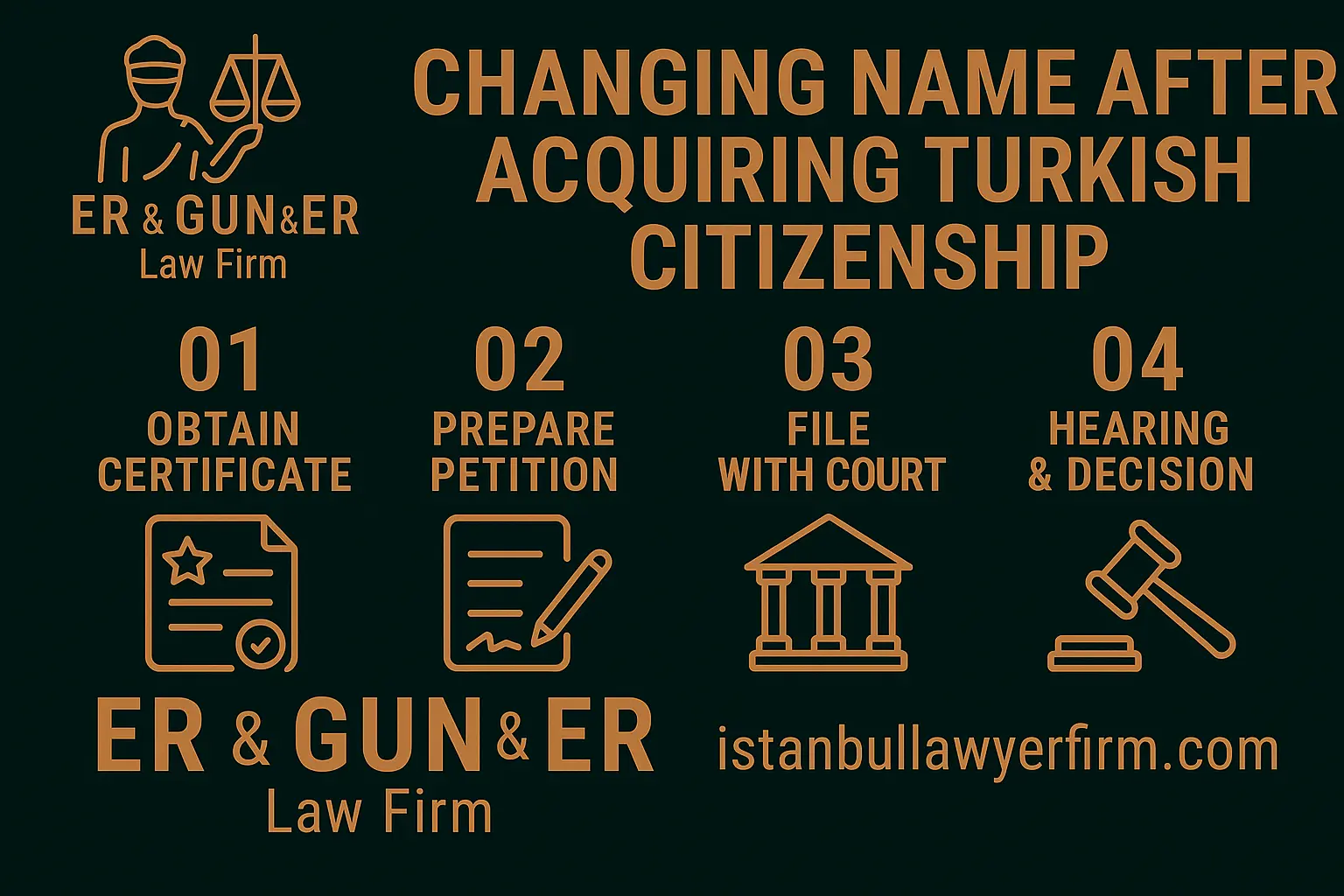
A lawyer in Turkey who manages court-based name change petitions explains that the judicial process begins with the preparation and filing of a formal petition at the Civil Court of First Instance in the judicial district where the applicant is registered in the population registry. The petition must identify the applicant, state the current name as recorded in the registry, specify the requested new name, and present the justified reason for the change with supporting legal arguments and documentary evidence. The petition is typically accompanied by the applicant's current Turkish identity card, a current population registry extract, the citizenship decision document, any foreign identity documents that support the justification, certified translations of foreign-language documents, and any additional evidence relevant to the specific grounds cited—such as professional correspondence showing the use of a different name, medical or psychological reports documenting distress caused by the current name, or declarations from colleagues, employers or community members confirming the practical difficulties created by the name. Turkish lawyers who draft name change petitions structure the legal argumentation to address the court's specific concerns, referencing applicable Court of Cassation decisions and presenting the evidence in a format that facilitates judicial review. Practice may vary by authority and year — verify current court petition format requirements and evidentiary standards before any filing.
An Istanbul Law Firm that represents clients in name change hearings explains that after the petition is filed, the court schedules a hearing date and may request the opinion of the public prosecutor's office, which reviews the petition for compliance with public order, naming restrictions and any security or identity concerns. The prosecutor's role in name change proceedings is supervisory rather than adversarial: the prosecutor does not represent an opposing party but rather ensures that the name change does not create identity fraud risks, violate public order principles, or circumvent legal obligations associated with the applicant's former identity. The hearing itself is typically brief for straightforward name change cases: the judge reviews the petition, examines the supporting documents, hears any oral submissions from the applicant or their attorney, considers the prosecutor's opinion if provided, and issues a decision. In most cases, name change petitions that present a clear justified reason, comply with naming restrictions and are supported by adequate documentation are resolved in a single hearing, though the court may schedule additional hearings if questions arise about the justification, if the prosecutor raises objections, or if the court requests additional evidence such as expert reports, witness testimony or additional foreign documents. Representation by an attorney through a notarized power of attorney is permitted, meaning that the applicant does not necessarily need to attend the hearing in person—a significant practical advantage for applicants who reside abroad or who have scheduling constraints that prevent travel to Turkey for a court appearance. If the court rejects the petition, the applicant has the right to appeal the decision to the regional court of appeal, and Turkish lawyers who handle name change appeals prepare the appellate submission with reference to Court of Cassation precedent that supports the applicant's justification and challenges the lower court's reasoning. An English speaking lawyer in Turkey who attends name change hearings on behalf of international clients ensures that the court's questions are addressed promptly and that any additional documentation requests are fulfilled within the prescribed deadlines.
A Turkish Law Firm that handles post-decision procedures for name changes explains that once the court issues a decision approving the name change, several additional steps must be completed before the change becomes fully effective across all governmental and institutional systems. The court decision must be published in the Official Gazette, which serves as public notice of the name change and establishes the date from which the new name is legally operative—this publication requirement is mandatory and cannot be waived, and failure to complete it delays the registry update and all subsequent document renewals. Following publication, the court decision and the Official Gazette confirmation are submitted to the civil registry directorate, which updates the applicant's MERNIS centralized population registry record to reflect the new name. The updated registry record triggers the ability to apply for a new Turkish identity card bearing the new name, and the applicant must also apply for renewal of their Turkish passport, driving license, voter registration card and any other government-issued documents that display the former name. The passport renewal is particularly important for international travelers and dual citizens, because traveling on a passport that bears a different name from the current identity card creates complications at border control, airline check-in and hotel registration. Turkish lawyers who manage the post-decision process coordinate the Official Gazette publication, registry submission, identity card renewal, passport application and driving license update in a sequenced workflow that ensures all documents are updated promptly and consistently, preventing the identity discrepancies that arise when some documents reflect the old name while others reflect the new name and that can persist for months if the renewal process is not actively managed.
Required Documents, Legal Justifications and Evidentiary Standards
A lawyer in Turkey who prepares name change petition files explains that the documentary requirements for a successful name change petition encompass both the standard procedural documents required by the court and the specific evidentiary materials that support the applicant's justified reason for the change. The standard procedural documents include the applicant's current Turkish identity card or a certified copy, a current population registry extract showing the applicant's registered name and civil status information, the citizenship decision document or naturalization certificate, the applicant's foreign passport or previous foreign identity documents, and a notarized power of attorney if the applicant will be represented by counsel rather than appearing personally. The specific evidentiary materials vary depending on the justification cited in the petition: an applicant citing pronunciation difficulties may submit declarations from colleagues, employers or service providers; an applicant citing professional inconvenience may submit business correspondence, academic publications or professional licenses showing the use of a different name; an applicant citing cultural adaptation may submit social integration evidence; and an applicant citing psychological distress may submit reports from qualified mental health professionals. Practice may vary by authority and year — verify current documentary requirements and evidentiary standards with the specific court before any filing.
An Istanbul Law Firm that drafts legal justifications for name change petitions emphasizes that the quality of the justification is the single most important factor in determining whether the petition will be approved quickly and without complications. Turkish courts apply a reasonableness standard to name change justifications: the applicant must demonstrate that they have a genuine, personal, non-trivial reason for wanting to change their name, and that the change serves a legitimate purpose that is consistent with public order and the integrity of the civil registry system. Court of Cassation precedent has recognized a wide range of justified reasons, including difficulty in pronunciation by Turkish speakers that causes persistent miscommunication in official and commercial interactions, social ridicule or embarrassment caused by the name's meaning or sound in Turkish or in languages commonly spoken in the applicant's community, cultural mismatch between the name and the applicant's adopted identity that creates a sense of disconnection or alienation, professional necessity where the current name creates confusion or disadvantage in the workplace or in international business relationships, religious conversion that motivates adoption of a name consistent with the new faith and its naming traditions, administrative inconsistency where the registered name does not match the name used in international documents creating practical complications at borders and institutions, and gender transition where the legal name must be aligned with the individual's gender identity following the completion of required medical and administrative procedures. Turkish lawyers who specialize in name change cases select the justification that most accurately reflects the client's situation and support it with the strongest available evidence, rather than presenting multiple weak justifications that dilute the petition's persuasive force. The petition should tell a coherent, well-documented story about why the current name causes genuine difficulty in the applicant's daily personal and professional life and why the requested name resolves that difficulty in a way that serves the applicant's legitimate interests without compromising public order, registry integrity or the rights of any third parties who may be affected by the change.
A Turkish Law Firm that handles foreign-language documentation for name change cases notes that newly naturalized citizens frequently need to submit documents from their country of origin as part of the name change petition—foreign birth certificates, previous identity documents, professional credentials, academic transcripts or marriage certificates that demonstrate the name the applicant used before naturalization. These documents must be properly authenticated for use in Turkish court proceedings, which typically requires apostille certification under the Hague Apostille Convention or consular legalization for documents from non-Hague countries, followed by certified translation into Turkish by a sworn translator. An English speaking lawyer in Turkey who manages the authentication and translation process ensures that the documents are prepared to the standard required by the specific court, that the translations are accurate and complete, and that the authentication chain is unbroken from the issuing authority through the apostille or consular certification to the sworn translation. Improperly authenticated or incompletely translated documents are one of the most common causes of delay in name change proceedings, because the court will not accept the documents until the deficiency is corrected, and correcting authentication or translation errors typically requires several weeks of additional processing time.
Registry Update, Turkish ID Reissuance and Cross-Agency Notification
A lawyer in Turkey who manages the post-decision implementation phase of name changes explains that the court decision approving the name change is the beginning rather than the end of the practical process, because the new name must be propagated through every government database, identity document and institutional record that references the applicant's former name. The first step after receiving the court decision is publication in the Official Gazette, which the court clerk typically arranges but which the applicant's attorney should verify and follow up on to prevent delays. Once the decision is published, the attorney submits it to the civil registry directorate, which updates the applicant's record in the MERNIS centralized population database. The MERNIS update automatically propagates to some affiliated systems—including the tax administration, the social security institution and the e-Government portal—but manual notification is required for many others, including banks, employers, educational institutions, insurance providers, utility companies and professional associations. Practice may vary by authority and year — verify current registry update procedures and cross-agency notification requirements before any implementation steps.
An Istanbul Law Firm that coordinates identity document renewal for clients who have completed name changes explains that the updated MERNIS record enables the applicant to apply for a new Turkish identity card (kimlik) bearing the new name, which is the primary identity document used in all domestic transactions. The identity card application is processed at the nearest provincial population directorate office and typically requires the court decision, the Official Gazette publication confirmation and the applicant's current identity card. Following the identity card renewal, the applicant should apply for a new Turkish passport reflecting the new name—a step that is particularly important for international travelers and dual citizens who need their Turkish and foreign travel documents to be consistent. Turkish lawyers who manage the renewal process also coordinate the update of the applicant's driving license, voter registration, military service records where applicable, and any professional licenses or registrations that display the former name, ensuring that the transition to the new name is comprehensive and that no institutional records are left bearing the old name.
A Turkish Law Firm that handles cross-agency notification for name change clients emphasizes that timely and comprehensive notification is critical to preventing the identity discrepancies that create practical problems in the months and years following the name change. Banks require formal notification with a copy of the new identity card and, in many cases, a copy of the court decision before they will update account holder records, debit and credit card names, online banking credentials and SWIFT beneficiary information—and failure to notify the bank promptly can cause transaction failures, card rejections at point-of-sale terminals, wire transfer returns and compliance complications with international correspondents who flag the name mismatch. Employers require notification to update payroll records, social security registration, tax withholding documentation and corporate directory listings, and the notification should be coordinated with the human resources and accounting departments to ensure that salary payments, tax declarations and social security contributions continue without interruption under the new name. Insurance providers—including health insurance, life insurance and property insurance companies—require notification to ensure that policy coverage is not jeopardized by a name mismatch between the policyholder's current legal identity and the name recorded in the policy, because an insurer may attempt to deny a claim on the basis that the claimant's identity does not match the policy records. An English speaking lawyer in Turkey who manages the notification process for international clients prepares a standardized notification package—including a cover letter explaining the name change, a copy of the court decision, a copy of the Official Gazette publication, a copy of the new identity card and a bilingual explanation in both Turkish and English—that can be submitted to each institution efficiently, minimizing the administrative burden on the client and ensuring that every notification is documented with delivery confirmation for future reference.
International Name Consistency and Cross-Border Record Alignment
A lawyer in Turkey who advises dual citizens and international clients on post-name-change coordination explains that maintaining name consistency across multiple countries is essential for legal, financial, travel and professional integrity. A Turkish citizen who also holds citizenship of another country must ensure that the name recorded in the Turkish civil registry matches the name used in the foreign country's identity documents, or that the discrepancy is properly documented and explained to avoid problems at border crossings, bank compliance checks, inheritance proceedings, academic credential verification and international commercial transactions. The process of aligning Turkish and foreign records after a Turkish court-ordered name change varies depending on whether the foreign country recognizes Turkish court decisions directly, requires a separate domestic name change proceeding, or accepts the Turkish change through administrative notification to the foreign registry or consulate. Turkish lawyers who handle cross-border name alignment prepare the documentary package that the foreign authority requires—typically including an apostilled copy of the Turkish court decision, a certified translation into the language of the foreign authority, a current Turkish identity card or passport reflecting the new name, and a cover letter explaining the legal basis and effect of the Turkish name change. Practice may vary by authority and year — verify current foreign authority requirements for recognition of Turkish name changes before any cross-border notification.
An Istanbul Law Firm that manages international record alignment for clients with complex cross-border profiles advises that the notification sequence matters: the Turkish records should be fully updated before notifying foreign authorities, so that the Turkish identity documents submitted to the foreign authority already reflect the new name and provide a consistent documentary foundation for the foreign recognition request. For clients who hold foreign bank accounts, investment portfolios, real property registrations, professional licenses, pension entitlements or academic credentials in the former name, each institution must be notified individually with the appropriate documentation, and the notification should be documented with delivery confirmation and institutional acknowledgment to create a record that the client fulfilled their obligation to maintain accurate identity information across all jurisdictions. The specific documentary requirements for foreign institutional notification vary: some institutions accept a copy of the apostilled Turkish court decision with a certified translation, while others require a separate declaration, a notarized identity equivalence statement, or verification through their own consular or diplomatic channels. An English speaking lawyer in Turkey who coordinates the international notification process works with foreign attorneys, consulates, banks, universities and professional licensing bodies to ensure that the Turkish name change is recognized and recorded in each jurisdiction where the client has legal, financial, professional or institutional ties. The coordination effort can be substantial for clients with connections to multiple countries, but the cost of failing to align records—including visa denials at borders, frozen bank accounts pending identity verification, inheritance disputes where the beneficiary's name does not match the will or registry, rejected insurance claims based on name mismatches, and professional credential challenges where the licensing authority cannot verify the applicant's identity—far exceeds the cost of systematic, proactive notification managed by experienced counsel.
A Turkish Law Firm that performs name consistency audits for clients with multiple nationalities or international footprints identifies and corrects discrepancies across legal systems before they create practical problems. The audit reviews the client's Turkish identity documents, foreign passports, bank records, property registrations, professional licenses, academic credentials and any other institutional records that reference the client's name, and produces a discrepancy report that identifies each mismatch and recommends the corrective action required. Turkish lawyers who conduct these audits coordinate with foreign counsel, consular officials and institutional compliance departments to resolve discrepancies efficiently, using apostilled court decisions, notarized declarations, sworn translations and official correspondence to establish the equivalence between the former and current names. For clients who have changed their name multiple times—through marriage, divorce, naturalization and subsequent court petition—the audit and reconciliation process may require tracing the entire name history through multiple countries' civil registry systems to establish a clear chain of identity from the original birth name to the current legal name in each jurisdiction.
Name Change for Minors, Married Persons and Family-Wide Applications
A lawyer in Turkey who handles name change petitions for minors explains that the court process for changing a child's name involves additional legal requirements and procedural safeguards designed to protect the child's interests. A name change petition for a minor must be filed by both parents jointly, or by one parent with the documented consent of the other, or by one parent with a court order dispensing with the other parent's consent in cases where the other parent is deceased, legally incapacitated, whereabouts unknown, or unreasonably withholding consent. The court evaluates the petition not only based on whether a justified reason exists for the name change but also based on whether the change serves the best interests of the child—a standard that requires the court to consider the child's age, the child's attachment to their current name, the potential impact of the change on the child's social relationships and educational continuity, and the views of the child if they are old enough to express a preference. Turkish lawyers who file name change petitions for minors prepare the justification with particular attention to the best interests standard, providing evidence that the name change will benefit the child rather than merely serving the parents' preferences. Practice may vary by authority and year — verify current judicial standards for minor name change petitions before any filing.
An Istanbul Law Firm that advises married persons on name change options explains that Turkish law provides several surname options for married individuals that can be exercised at the time of marriage, during the marriage through a court petition, or after divorce. Married women have the right to retain their maiden surname, to adopt their husband's surname, or to use a compound surname consisting of their maiden surname followed by their husband's surname. A court petition is required to change from one option to another during the marriage, and the petition must demonstrate a justified reason consistent with Article 27 of the Turkish Civil Code. After divorce, a woman who adopted her husband's surname during the marriage automatically reverts to her maiden surname unless the court grants permission to continue using the former husband's surname—a decision that requires demonstrating a legitimate interest in retaining the name. Turkish lawyers who advise newly naturalized married couples on surname options coordinate the name change petitions of both spouses and any children to ensure consistency across the family's registry records, identity documents and institutional affiliations.
A Turkish Law Firm that manages family-wide name change applications for newly naturalized families explains that filing coordinated petitions for all family members simultaneously offers significant advantages in terms of efficiency, cost and record consistency. When parents and children acquired citizenship at the same time but received inconsistent transliterations of the family surname—a common occurrence when the original surname contains characters or phonetic combinations that Turkish registry clerks transliterate differently depending on the individual clerk's interpretation—or when the family wishes to adopt a new surname that reflects their integrated Turkish identity, filing all petitions before the same court and requesting consolidation into a single proceeding reduces the number of hearings, minimizes court fees and ensures that the court applies consistent reasoning across all family members' petitions. The consolidated approach also simplifies the post-decision process, because a single court decision covering all family members can be published once in the Official Gazette and submitted once to the registry directorate, and all identity documents can be renewed in a coordinated sequence rather than through multiple independent applications spread across different weeks or months. An English speaking lawyer in Turkey who coordinates family-wide name changes manages the documentation for each family member, prepares individualized justifications where the grounds differ between adults and children, coordinates the post-decision registry updates, identity document renewals and institutional notifications for the entire family as a single coordinated process, and provides bilingual support throughout to ensure that every family member understands the legal steps, the timeline and the expected outcomes. This coordinated approach prevents the common problem of partial name changes—where some family members' documents reflect the new name while others still display the old name—that creates confusion at borders, banks, schools, hospitals and government offices for months or even years after the name change proceedings were completed.
Frequently Asked Questions
- Can I change my name in Turkey after becoming a Turkish citizen? Yes. Any Turkish citizen, including those who acquired citizenship through naturalization, investment or marriage, has the right to petition the Civil Court of First Instance for a name change based on a justified reason under Article 27 of the Turkish Civil Code. Minor corrections to registry errors can also be handled administratively through the civil registry directorate without court involvement.
- What qualifies as a justified reason for a name change in Turkey? Turkish courts have recognized a broad range of justified reasons, including pronunciation difficulty, cultural mismatch, professional inconvenience, social ridicule, religious conversion, psychological distress, administrative inconsistency between Turkish and foreign records, and the desire for cultural integration. The applicant must demonstrate a genuine, personal, non-trivial reason that is consistent with public order.
- Is a court hearing always required for a name change? Not for every modification. Administrative corrections of factual registry errors—such as spelling mistakes, transliteration errors or formatting inconsistencies—can be processed directly through the civil registry directorate. However, any voluntary name change or substantive modification requires a court petition and judicial approval.
- How long does the court-based name change process take? The typical timeline from petition filing to court decision is two to four months, depending on the court's caseload, the complexity of the justification and whether additional hearings or evidence are required. Post-decision steps including Official Gazette publication, registry update and identity document renewal add several additional weeks.
- Do I need to appear in court personally for a name change hearing? Not necessarily. Turkish courts permit representation by an attorney through a notarized power of attorney, meaning that the applicant's lawyer can attend the hearing, present legal arguments and respond to judicial inquiries on the applicant's behalf. This is particularly advantageous for applicants residing abroad.
- Can I change both my first name and my surname? Yes. The court petition can request a change to the first name, the surname, or both, provided that each change is supported by a justified reason and that the requested names comply with Turkish naming restrictions. Separate justifications may be required for first name and surname changes if the grounds differ.
- What documents do I need for a name change petition? The standard requirements include the current Turkish identity card, a population registry extract, the citizenship decision or naturalization certificate, foreign identity documents that support the justification, certified translations of foreign-language documents, and a notarized power of attorney if represented by counsel. Additional evidence depends on the specific justification cited.
- Will my Turkish passport and identity card be updated after the name change? Yes. After the court decision is published in the Official Gazette and the civil registry is updated, you can apply for a new identity card and passport bearing the new name. Your attorney should also coordinate the update of your driving license, tax records, social security records and other institutional affiliations.
- Can I change my child's name after naturalization? Yes, with both parents' consent or a court order dispensing with the absent parent's consent. The court evaluates minor name change petitions based on the child's best interests in addition to the justified reason standard. Turkish lawyers coordinate family-wide petitions to ensure consistency across all family members' records.
- What surname options do married women have in Turkey? Married women may retain their maiden surname, adopt their husband's surname, or use a compound surname. A court petition is required to change the surname option during marriage. After divorce, the woman reverts to her maiden surname unless the court grants permission to continue using the former husband's surname.
- Will other countries recognize my Turkish name change? Recognition depends on the foreign country's legal framework. Some countries recognize Turkish court decisions directly, others require a separate domestic proceeding, and others accept administrative notification to the foreign registry or consulate. Your attorney can prepare the apostilled court decision, certified translation and cover letter required by the foreign authority.
- Can the name change petition be rejected? Yes. Courts may reject petitions that lack a justified reason, that request names violating Turkish naming restrictions or public order, or that are insufficiently supported by evidence. Prosecutor's office objections based on security or identity concerns may also lead to rejection. Rejected petitions can be appealed through the appellate court system.
- What are the Turkish naming restrictions I should know about? Turkish law requires names to be written using the Turkish alphabet, which does not include Q, W and X. Surnames must comply with Turkish surname law, and names that are offensive, contrary to public order or associated with prohibited references may be rejected. Your attorney can advise on permissible name options before filing.
- How do I prevent identity discrepancies after a name change? Comprehensive and timely notification to all institutions that hold records in your former name—banks, employers, insurance providers, educational institutions, foreign registries and consulates—is essential. Your attorney should prepare a standardized notification package and track each institution's confirmation to ensure complete alignment.
- Does ER&GUN&ER Law Firm handle name change cases for international clients? Yes. ER&GUN&ER Law Firm represents newly naturalized Turkish citizens from all backgrounds in name change proceedings, providing bilingual legal support from initial assessment through court petition, hearing attendance, registry update, identity document renewal and international record alignment.
Author: Mirkan Topcu is an attorney registered with the Istanbul Bar Association (Istanbul 1st Bar), Bar Registration No: 67874. His practice focuses on cross-border and high-stakes matters where evidence discipline, procedural accuracy, and risk control are decisive.
He advises individuals and companies across Immigration and Residency, Real Estate Law, Tax Law, and cross-border documentation matters where procedural accuracy and evidence discipline are decisive.
Education: Istanbul University Faculty of Law (2018); Galatasaray University, LL.M. (2022). LinkedIn: Profile. Istanbul Bar Association: Official website.