

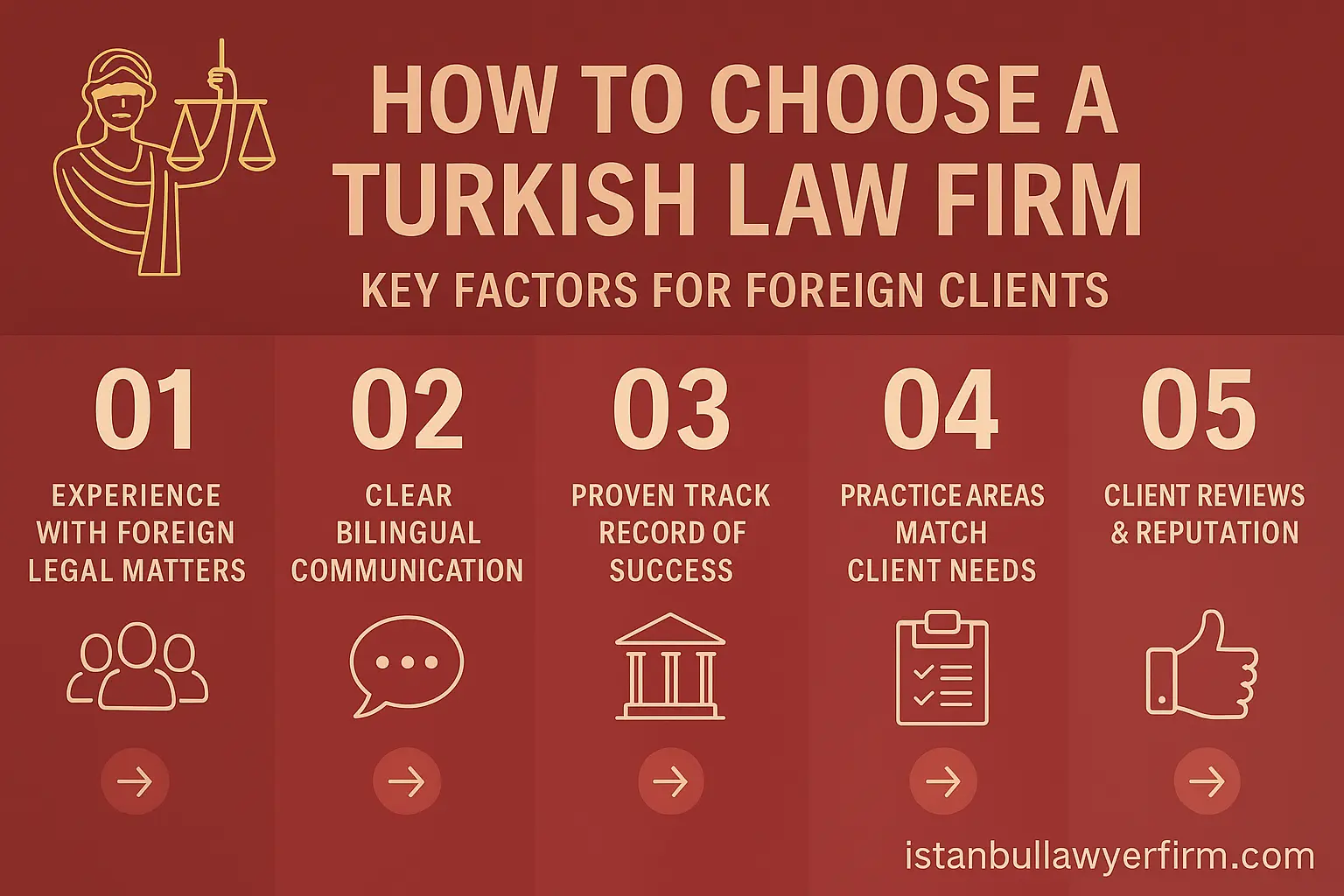
Choosing a Turkish law firm as a foreign national is harder than choosing legal counsel in your home country, and the difficulty is structural rather than just linguistic. You cannot rely on personal referral networks built over years. You cannot easily assess whether a practitioner's claimed credentials are genuine. You cannot evaluate the quality of their Turkish-language court work if you do not read Turkish. And you may not know enough about Turkish law to recognize when the advice you are receiving is incomplete, outdated, or simply wrong. These are not theoretical obstacles—they produce real consequences for foreign clients who choose the wrong Turkish law firm, including financial losses from failed property transactions, wasted months pursuing the wrong legal strategy, exposure to criminal liability that could have been avoided, and in some cases, fraud by persons who were not qualified lawyers at all. This guide addresses each dimension of the selection decision honestly: how to verify that a person is actually a licensed Turkish lawyer, how to assess whether a firm has genuine expertise in your specific legal matter, what the fee structures look like and what to watch out for, what red flags should make you walk away, what questions to ask in an initial consultation, and how to match the firm to the matter rather than defaulting to the nearest or most advertised option. It is the guide we wish more foreign clients read before making contact with a Turkish law firm—because the decision made at this stage determines almost everything that follows. The complementary frameworks for foreign-client lawyer selection are analyzed in the resources on finding a lawyer in Turkey for foreigners and how to hire a lawyer in Turkey.
Step one: verify bar registration before anything else
A lawyer in Turkey must explain the foundational verification step that many foreign clients skip: confirming that the person claiming to be a Turkish lawyer is actually licensed to practice law in Turkey. In Turkey, only persons holding a Turkish law degree who have completed the required bar examination and apprenticeship and who are registered with a regional bar association are permitted to practice as avukat (attorney) under the Attorneys Act (Avukatlık Kanunu, Law No. 1136). Practicing law for compensation without this registration is a criminal offense under the Turkish Penal Code (Law No. 5237)—and there are persons in the Turkish market, particularly in the citizenship by investment and real estate sectors, who charge legal fees while not being licensed attorneys. The verification takes less than five minutes. The Istanbul Bar Association maintains a searchable online registry of all registered members at istanbulbarosu.org.tr. The Union of Turkish Bar Associations provides a national directory at barobirlik.org.tr. Search the lawyer's full name, confirm the bar registration number (baro sicil numarası), and confirm that the registration is current. A lawyer who is reluctant to provide their bar registration number for verification is not a lawyer you should engage.
An Istanbul Law Firm advising on what the bar registration check actually tells you must explain both what it confirms and what it does not. A confirmed bar registration tells you that the person completed a Turkish law degree and passed the bar admission requirements—it does not tell you anything about their expertise in your specific practice area, the quality of their work, their communication reliability, or whether they have any disciplinary history. The bar registration check is a threshold condition, not a quality assessment. It eliminates fraudulent non-lawyers but it does not identify the right lawyer for your specific matter from among the licensed population. The steps after verification—practice area assessment, fee structure review, initial consultation evaluation—are where the quality determination is actually made. Do not let a confirmed bar registration create complacency about the more substantive selection questions. Practice may vary by authority and year — check current guidance on the current bar registration verification process from the relevant Turkish bar association before relying on any registry information for a specific engagement decision.
A Turkish Law Firm advising on foreign law firms and foreign lawyers operating in Turkey must explain an important limitation that foreign clients often misunderstand. A foreign lawyer—including a US attorney, a UK solicitor, a French avocat, or any other foreign legal professional—cannot practice Turkish law in Turkey in their capacity as a foreign lawyer. They may advise on their home country's law, but for Turkish legal matters, Turkish-qualified representation is required. Some law firms in Turkey are affiliated with international law firm networks or use "international" branding that can create the impression of a foreign legal capability that does not exist for Turkish matters. What matters for Turkish legal work is Turkish bar registration—international affiliations and branding are not substitutes for Turkish qualification. A Turkish law firm that handles cross-border matters typically does so by coordinating with foreign counsel in the relevant jurisdictions rather than claiming Turkish authority to practice the foreign law itself. Practice may vary by authority and year — check current guidance on the current Turkish bar association rules governing the scope of legal practice by persons with foreign legal qualifications.
Match the firm to the specific matter
A law firm in Istanbul advising on practice area matching must explain that the Turkish legal market has developed meaningful specialization, and that choosing a generalist practitioner for a specialized matter—or a specialist in the wrong area—produces inferior outcomes compared to a specialist in the right area, regardless of how credentialed or reputable the wrong-area specialist may be. A criminal defense lawyer is not the right counsel for a citizenship by investment transaction. A real estate lawyer is not the right counsel for a labor dispute or a defamation criminal case. An immigration lawyer may not have the depth of experience needed for a contested deportation before the administrative courts. The question is not simply "is this a good Turkish lawyer" but "is this the right Turkish lawyer for this specific matter." Answering that question requires knowing enough about your matter to assess whether the firm's claimed expertise actually covers it—and that requires asking specific rather than general questions during any initial consultation. Practice may vary by authority and year — check current guidance on the current state of specialization in the Turkish legal market for your specific practice area before selecting counsel based on general reputation alone.
An English speaking lawyer in Turkey advising on how to assess genuine expertise in a specific practice area must explain what genuine expertise looks like and how to distinguish it from superficial familiarity. A lawyer with genuine expertise in Turkish citizenship by investment can explain specifically: what the SPK appraisal process involves and why the appraisal value rather than the purchase price controls eligibility; what the Certificate of Conformity application requires; what the realistic current processing timelines are at each stage; and what the military service implications are for male applicants—without consulting notes. A lawyer with only superficial familiarity uses vague language, avoids specifics, and redirects to general descriptions of the program. The same test applies in any practice area: a genuinely expert Turkish criminal defense lawyer can explain the specific Article 25 just cause termination procedure, the savunma obligation, and the six-day time limit for just cause termination without prompting. An expert Turkish real estate lawyer can explain the specific due diligence steps for a citizenship qualifying property purchase, the difference between a valid reason and a just cause dismissal, and why payment through a documented foreign currency transfer matters. If a lawyer cannot be specific when asked specific questions, they are not the expert they claim to be. The framework for evaluating English-language legal capacity specifically—because conversational fluency does not always translate to professional-grade legal communication—is analyzed in the resource on English speaking lawyer in Turkey.
A Turkish Law Firm advising on the specific practice areas where foreign clients most frequently need specialized Turkish legal counsel must explain the main categories and their distinguishing characteristics. Real estate law for foreign buyers requires specific knowledge of the Turkish land registry system under the Land Registry Law (Tapu Kanunu, Law No. 2644), zoning law, the SPK appraisal process for citizenship qualifying transactions, and the payment documentation requirements—not simply general contract law knowledge. Turkish citizenship by investment requires specific knowledge of the Presidential Decree investment thresholds, the Certificate of Conformity process, and the Presidency of Migration Management citizenship application procedure under the Turkish Citizenship Law (Law No. 5901)—not simply immigration law knowledge generally. Turkish criminal defense for foreign nationals requires specific knowledge of Turkish criminal procedure under the Criminal Procedure Code (Law No. 5271), the rights that must be asserted at the detention stage, and the interaction between criminal proceedings and immigration enforcement—not simply awareness that criminal law exists. Turkish immigration and residence permits require specific and current knowledge of Göç İdaresi practice—which changes frequently through internal guidelines that are not publicly published—not simply reading of the statutory framework under the Foreigners and International Protection Law (Law No. 6458). The practice area-specific content on this site provides detailed guidance on each area and can help you assess whether a prospective firm's claimed expertise actually covers the specific dimensions of your matter.
Fee structures: what you should expect and what to question
A law firm in Istanbul advising on Turkish lawyer fee structures must explain that Turkish lawyer fees are governed by the minimum fee schedule (asgari ücret tarifesi) published annually by the Union of Turkish Bar Associations, which establishes floor rates for specific services below which lawyers cannot charge—and above which they can negotiate based on complexity, reputation, and market positioning. The minimum fee schedule is publicly available at the bar association's website and provides a useful reference point for assessing whether a quoted fee is at a reasonable level relative to the statutory minimum. Turkish law firms use three main fee structure models: fixed fees for defined-scope work where the cost can be accurately predicted (citizenship by investment management, specific document transactions, company formation, defined permit applications); hourly billing for variable-scope work where the total cannot be predicted in advance (litigation, commercial disputes, ongoing advisory relationships); and in some practice areas, outcome-linked fee components where part of the fee is contingent on the result. Each model is appropriate for different matter types, and a firm that proposes the wrong model for your matter type—for example, hourly billing for a defined-scope residence permit application, or a fixed fee for complex litigation without scope controls—should prompt a clarifying conversation about how the fee was determined. All professional legal fees in Turkey are subject to value-added tax (KDV) at the prevailing rate (currently 20%); a professional fee quotation will ordinarily specify whether the stated amount is KDV-inclusive or KDV-exclusive. Practice may vary by authority and year — check the current annual minimum fee schedule from the Union of Turkish Bar Associations before assessing any specific fee quotation for Turkish legal services.
An English speaking lawyer in Turkey advising on disbursements and additional costs must explain a dimension of Turkish legal cost that is frequently inadequately disclosed at the engagement stage. The lawyer's professional fee is only one component of the total cost of Turkish legal representation—court filing fees (harç), notarization fees, apostille fees, sworn translation fees, government application fees, and expert witness fees are separate costs that are paid to third parties rather than to the law firm, and these can be substantial in specific matter types. In a Turkish citizenship by investment engagement, the additional costs beyond the professional fee include: the SPK appraisal fee, the Certificate of Conformity application fee, the residence permit application fee, the citizenship application fee, notarization and sworn translation fees for foreign documents, and in some cases courier and logistics costs for document management. A professional Turkish law firm will discuss these disbursements at the outset and include them in the cost estimate—not as guaranteed amounts (since some depend on third-party pricing that can change) but as identified categories with reasonable estimates. A firm that quotes only the professional fee without identifying the disbursement categories is either poorly organized or deliberately understating the total engagement cost. Practice may vary by authority and year — check current guidance on the specific disbursements applicable to your matter type with your prospective legal counsel before finalizing any cost estimate or engagement decision.
A Turkish Law Firm advising on fee-related red flags must explain the specific patterns that should prompt caution or withdrawal. An unusually low fee for a complex matter—for example, a complete citizenship by investment engagement from property purchase through passport for a fee that is dramatically below what other qualified firms charge—typically indicates one of three things: the scope does not actually include all the steps it appears to include; the practitioner is not qualified to handle the matter and does not know what it actually requires; or the fee is supplemented by commissions from property developers or other transaction parties whose interests may not align with yours. A legitimate Turkish citizenship by investment law firm does not receive commissions from property developers—the professional fee is the fee. A large upfront retainer with vague scope description and no written engagement agreement is a significant red flag regardless of how credentialed the firm appears. A firm that resists providing a written engagement agreement describing the scope, fee, and deliverables is not operating professionally. And a firm that promises specific outcomes—"I guarantee you will get your residence permit," "I guarantee the citizenship application will be approved in three months"—is making representations that no ethical Turkish lawyer can make, because outcomes in Turkish administrative proceedings involve discretionary decisions by authorities that counsel cannot control. Practice may vary by authority and year — check current guidance on the Turkish bar association professional responsibility rules governing fee arrangements, outcome guarantees, and conflict of interest disclosure before finalizing any engagement.
The engagement agreement: what it must contain
A law firm in Istanbul advising on the engagement agreement must explain that for foreign clients, a written engagement agreement is not a bureaucratic formality but the primary protection against the most common sources of client dissatisfaction in Turkish legal engagements: misaligned scope expectations, fee disputes, and undefined communication obligations. A properly structured engagement agreement for a foreign client contains: a clear identification of the parties (client and law firm); a description of the scope of work that specifically states what the lawyer will do and—equally importantly—what is outside the scope; the fee structure (fixed, hourly, or other) with the total cost or the basis for calculating it; the disbursement policy identifying what additional costs the client will bear and how they will be billed; the retainer arrangement and payment schedule; the communication protocol specifying how frequently the lawyer will provide updates and in what format; and the termination provisions governing how either party can end the engagement. A foreign client who signs an engagement agreement that does not contain these elements has agreed to terms they cannot enforce, because the absence of written definition places them entirely at the mercy of the lawyer's interpretation of what was agreed. Practice may vary by authority and year — check current guidance on the current Turkish bar association requirements for written engagement agreements and on any specific provisions required for engagements with foreign clients.
An English speaking lawyer in Turkey advising on the language of the engagement agreement must be direct: for a foreign client who does not read Turkish, the engagement agreement must be either drafted in the client's language or accompanied by an accurate translation—and the client should not sign a Turkish-only engagement agreement without either reading Turkish fluently or having the document independently translated and reviewed. A Turkish-language engagement agreement that the client cannot read provides zero protection to the client, because they cannot verify what they have agreed to. A reputable Turkish law firm that regularly works with foreign clients will routinely provide engagement agreements in English, or will at minimum provide an accurate English summary of the key terms. A firm that insists on a Turkish-only engagement agreement without offering translation for a client who has communicated exclusively in English is either inexperienced with foreign clients or indifferent to their ability to understand what they are signing. Neither is a quality indicator. Practice may vary by authority and year — check current guidance on the current Turkish bar association provisions applicable to engagement agreements with foreign clients and on any language requirements for professional legal services agreements under Turkish consumer protection law.
A Turkish Law Firm advising on what to do after receiving a draft engagement agreement must explain the review process that a careful foreign client should follow before signing. Read the scope section carefully and confirm that it specifically covers the steps you expect the lawyer to perform—if a step you expected is not mentioned, it is not included. Review the fee and payment terms and confirm they match what was discussed verbally—any discrepancy between what was said in the consultation and what appears in the agreement should be clarified in writing before signing. Review the disbursement policy and ask for estimates of the likely additional costs if they have not been provided. Review the communication protocol and confirm that the update frequency and format meet your expectations—if the agreement says updates will be provided "as needed" without defining a minimum frequency, negotiate a specific schedule. Confirm that the agreement is signed by a licensed attorney, not only by an administrative or business development person. And keep a copy of the signed agreement in a location you can access independently of the law firm. The power of attorney dimension—through which a foreign client formally authorizes a Turkish lawyer to act in Turkey when the client is not physically present at the relevant administrative or judicial step—is analyzed separately in the resource on power of attorney Turkey foreigners.
Red flags: when to walk away
A law firm in Istanbul advising on red flags in the Turkish legal market must address the patterns that most frequently damage foreign clients—because understanding what to watch for is as important as knowing what to look for. The most common and consequential red flag is the conflict of interest that goes undisclosed: specifically, a person or firm that presents itself as your legal counsel for a real estate or citizenship transaction while also receiving a commission from the property developer or seller whose interests are directly opposed to yours at the pricing, due diligence, and transaction structuring stages. This conflict is structurally common in the Turkish citizenship by investment market, where citizenship "consultants" who are paid by developers frequently dress up their commercial role in legal-sounding language. The test is simple: ask directly whether the firm or any affiliated person receives any form of payment from the property developer, seller, or any other party to the transaction. If the answer is yes, or if the question is evaded, you are not dealing with independent legal counsel. The conflict means that advice about whether to proceed with a specific property purchase—which a genuine legal advisor gives based solely on your interests—is contaminated by the advisor's financial stake in the transaction proceeding.
An English speaking lawyer in Turkey advising on additional red flags must explain the other patterns that consistently indicate inadequate representation. A lawyer who cannot answer specific questions about Turkish legal procedure in their claimed specialty—who responds to specific procedural questions with vague generalities or who needs to "check and get back to you" on basic process questions—is not the expert they claim to be. A lawyer who pressures you to decide or pay quickly, citing urgency that cannot be independently verified, is using a sales pressure technique that professional legal counsel does not employ. A lawyer who consistently describes their access to Turkish authorities in terms that suggest informal influence rather than professional procedure—"I have contacts," "I know people at the ministry"—is either describing unauthorized influence-peddling or misrepresenting their capabilities; neither is acceptable. A lawyer whose online presence consists primarily of promotional content with no substantive legal information—no analysis of Turkish legal procedures, no explanation of how Turkish law applies to common client situations—is likely investing more in marketing than in the legal competence that makes marketing meaningful. And a lawyer who asks you to make payments to personal accounts rather than to a firm account, or in cash, is creating documentation gaps that serve their interests, not yours.
A Turkish Law Firm advising on the citizenship by investment sector specifically—where the red flag density is highest—must explain several patterns that are endemic to that market. A citizenship consultant or "agency" that charges fees for managing your citizenship application but that cannot provide a Turkish bar registration number is not a law firm and cannot provide legal representation before Turkish authorities or courts. The certification of conformity application, the residence permit application, and the citizenship application all require specific legal competence to manage correctly—not just document collection capability. A person who manages your citizenship process without a Turkish bar registration is operating in an unauthorized capacity, and any complications that arise cannot be addressed through legal representation by the same person who caused them. Additionally, the Turkish market has a specific pattern of citizenship property transactions in which developers sell properties at significantly above-market prices to citizenship investors, with the pricing justified on the grounds that the property "qualifies" for citizenship—when in fact most properties above the qualifying threshold qualify and the premium is simply developer margin. Independent due diligence and an independent SPK appraisal before purchase protect against this pattern. The Turkish citizenship by investment framework—covering the full legal process, risks, and how to structure the transaction correctly—is analyzed in the resource on Turkish citizenship by investment 2025.
The initial consultation: how to use it as an evaluation tool
A law firm in Istanbul advising on the initial consultation as an evaluation tool must explain that no amount of online research about a Turkish law firm substitutes for a direct consultation with a prospective lawyer before the engagement decision is made. The consultation is where you can assess the things that cannot be assessed from a website: whether the lawyer understands the specific facts of your matter; whether their assessment of your situation is realistic and specific rather than generic and optimistic; whether they communicate in a way that is clear and comprehensible rather than evasive or jargon-heavy; and whether the working relationship feels professionally comfortable and trustworthy. A good initial consultation involves the lawyer asking specific questions about your situation, providing a specific (rather than generic) preliminary assessment of the legal issues involved, identifying the key risks and uncertainties rather than only the positives, and explaining what the process would look like if you were to engage them—concretely, not in vague terms. An initial consultation that consists primarily of the lawyer describing their firm, their experience, and their fee structure without engaging with the specifics of your situation is not a legal consultation—it is a sales meeting.
An English speaking lawyer in Turkey advising on the specific questions to ask in an initial consultation must explain the questions that most effectively reveal whether you are speaking with a genuinely competent practitioner or one who is performing competence without the substance behind it. For a citizenship by investment matter: what is the current realistic processing timeline from property transfer to passport, and what are the most common causes of delay? For a residence permit matter: what are the current Göç İdaresi minimum standards for health insurance in residence permit applications, and how has the documentation requirement changed in the past year? For a criminal matter: what are the specific rights that a foreign national detained by Turkish police must assert immediately, and what are the consequences of answering questions before counsel is present? For a real estate matter: what specific due diligence steps would you conduct before advising me to proceed with this property purchase, and what would cause you to advise me not to proceed? A lawyer who can answer these questions specifically, accurately, and without hesitation is demonstrating genuine current knowledge of their practice area. A lawyer who responds with generalities, who defers the specific question, or who is demonstrably uncertain about basic procedural facts is not the specialist they claim to be.
A Turkish Law Firm advising on how to prepare for an initial consultation to maximize its value must explain what to bring and what to have ready. Before the consultation, prepare: a chronological summary of the key facts of your matter—one page, specific dates and events, not narrative background—so the lawyer can engage with the substance rather than spending the consultation extracting basic facts; copies of the key documents relevant to your matter—if it is a property matter, the relevant title deeds and any contracts; if it is an immigration matter, your passport and current permit documentation; if it is a criminal matter, any notices or correspondence you have received; a list of the specific questions you most need answered during the consultation, in priority order so that if time runs short, the most important questions have been addressed; and clarity on what you want to achieve—not just "I have a problem" but "I want to achieve X and I need to understand if that is achievable, how, and what the risks are." Arriving at a consultation with this preparation allows the lawyer to demonstrate their expertise on your specific facts rather than on hypotheticals, which is a far better evaluation environment than an abstract discussion of Turkish law. Practice may vary by authority and year — check current guidance on the specific documentation you should bring for your specific matter type by contacting the prospective firm before the consultation appointment.
Language and communication: what adequate service looks like
A law firm in Istanbul advising on the language dimension of Turkish legal representation for foreign clients must explain that language capability for legal work means something more specific than conversational English proficiency. The question is not whether the lawyer can hold a conversation in English—it is whether they can explain complex Turkish legal concepts accurately in English, convey legal uncertainty and risk clearly in English, understand nuanced English questions about strategy and options, and produce accurate English-language summaries of Turkish-language documents and proceedings that allow the client to make informed decisions. These are skills that go beyond language fluency—they require deep legal knowledge combined with the ability to communicate that knowledge across a language boundary without distortion. The test in an initial consultation is whether the lawyer's English explanations of Turkish legal process are clear, specific, and accurate—or whether they are vague, generic, or demonstrably simplified to the point of distortion. A lawyer whose English explanations consistently cannot be distinguished from general information available online about Turkish law—because they provide nothing more specific—is not adding the value that a genuinely bilingual legal practitioner adds.
An English speaking lawyer in Turkey advising on the documents that must be produced in Turkish versus those that can be in English must explain the practical language architecture of Turkish legal work for foreign clients. Turkish is the language of Turkish courts, Turkish administrative submissions, contracts filed with Turkish authorities, official correspondence with Turkish government offices, and title deed documents. Everything that is formally submitted to or issued by a Turkish authority is in Turkish—this is a legal requirement, not a preference. What can and should be in English for a foreign client is the client-facing communication layer: the engagement agreement, the strategic advice and assessment, the document summaries explaining what Turkish-language documents say and mean, the progress updates, and the consultation itself. A Turkish law firm that provides all client-facing communication in Turkish to a client who does not read Turkish is not providing adequate legal representation to that client, because the client cannot verify the accuracy or completeness of what they are receiving. Practice may vary by authority and year — check current guidance on the Turkish bar association's professional communication obligations applicable to lawyers serving clients who do not speak Turkish.
A Turkish Law Firm advising on realistic communication expectations must explain what proactive versus reactive communication looks like in practice, and why the difference matters. A proactively communicating law firm provides regular updates on matter status—not waiting for the client to ask "what's happening?"—because Turkish legal proceedings have many sequential stages where the client cannot independently monitor progress and where silence creates justified anxiety. A reactively communicating law firm responds when asked but does not proactively inform, which means the client is always uncertain whether their matter is progressing normally or has stalled undetected. The engagement agreement should specify the minimum communication frequency—weekly, bi-weekly, or monthly depending on the matter type—as a contractual obligation rather than leaving it to the lawyer's discretion. A lawyer who resists committing to a minimum update frequency in the engagement agreement is signaling that regular communication is not a priority in their practice model. For a foreign client who is managing Turkish legal affairs remotely from another country, that signal matters. Practice may vary by authority and year — these communication standards reflect general professional service principles applicable regardless of jurisdiction.
Specific considerations by matter type
A law firm in Istanbul advising on the specific selection considerations for real estate matters must explain the single most important criterion that distinguishes adequate from inadequate legal counsel for Turkish property transactions: whether the lawyer is genuinely independent from the transaction. An independent real estate lawyer for a foreign buyer has no financial interest in the transaction proceeding—their fee is a professional fee for legal services, not a commission contingent on closing. They advise on whether to proceed, not just how to proceed. They will recommend walking away from a transaction that fails due diligence, even though walking away means no closing and no commission from the developer. Many persons operating in the Turkish real estate market for foreign buyers are not genuinely independent in this sense—their income depends on transactions closing, which creates a structural bias toward completing the transaction rather than protecting the client from a bad one. The real estate law framework for foreign buyers—covering due diligence, transaction structuring, and dispute prevention—is analyzed in the resource on real estate law Turkey.
An English speaking lawyer in Turkey advising on the specific selection considerations for immigration and residence permit matters must explain that this is the practice area where current knowledge matters most and where outdated knowledge creates the most predictable failures. Göç İdaresi practice—the actual administrative interpretation and implementation of Turkish immigration law—changes frequently through internal guidelines, circulars, and practice changes that are not publicly published and that require current practitioner knowledge to know. A Turkish immigration lawyer who learned the residence permit process two years ago and has not maintained active practice since may be working from outdated assumptions about documentation standards, insurance requirements, or processing procedures that no longer reflect current Göç İdaresi practice. The test is whether the lawyer can describe the current documentation requirements, current processing timelines, and current Göç İdaresi practice for your specific permit category with specific, current detail. The citizenship and immigration law Turkey framework—covering the current state of Turkish residence permits, work permits, and enforcement actions—is analyzed in the resource on citizenship and immigration law Turkey.
A best lawyer in Turkey advising on the specific selection considerations for criminal matters must explain that criminal defense is the area where the consequences of choosing the wrong lawyer are most irreversible—because criminal proceedings, once initiated, are difficult to undo, and errors at the investigation stage create evidentiary problems that persist through trial and appeal. For foreign nationals facing criminal matters in Turkey, three specific characteristics are essential in defense counsel: current knowledge of Turkish criminal procedure under the Criminal Procedure Code (Law No. 5271) including the specific rights that must be asserted at the detention stage; experience with the specific type of offense at issue (drug offenses, property offenses, expression offenses, financial crimes, and firearms offenses each have specific procedural and substantive dimensions that general criminal practitioners may not know in detail); and understanding of the interaction between criminal proceedings and immigration enforcement for foreign national defendants. A Turkish criminal defense lawyer who knows the substantive law but does not understand how a criminal conviction or even an arrest record can trigger immigration enforcement consequences—deportation, entry ban, work permit cancellation—is not providing complete representation to a foreign national defendant. The Istanbul Bar Association at istanbulbarosu.org.tr provides resources for verifying attorney credentials and identifying practitioners in specific areas. Practice may vary by authority and year — check current guidance from the relevant Turkish legal authorities and from qualified legal counsel before making any decisions about Turkish legal representation for serious criminal matters.
ER&GUN&ER: how we approach these standards
Turkish lawyers at ER&GUN&ER approach the selection criteria described throughout this guide as the standards we apply to ourselves rather than as abstract principles for others. Every attorney at ER&GUN&ER is bar-registered—our bar registration numbers are publicly verifiable at the Istanbul Bar Association registry. Our practice areas are defined and limited: we do not accept every matter referred to us, but focus on matters where we have genuine current expertise. Our engagement agreements are in English for foreign clients, specify scope and fee with precision, and include defined communication commitments. We do not receive commissions from property developers, citizenship consultants, or any other transaction parties whose interests may differ from our clients'—our fee is our fee, and our advice is our advice. Our initial consultations are substantive assessments of your specific situation, not presentations about our firm. And we tell clients when we cannot help them, when their expectations do not match what Turkish law can deliver, and when the matter they are proposing to pursue is unlikely to succeed—because honest assessment serves our clients better than optimism serves our interests. The full team of English-speaking lawyers in Turkey at our firm is described in the team resource.
A law firm in Istanbul explaining what makes the selection decision itself manageable must summarize the framework this guide has laid out in actionable terms. Verify bar registration before any other step. Ask specific procedural questions in any consultation and evaluate the specificity of the answers. Read the engagement agreement before signing it and confirm that scope, fee, and communication obligations are defined in writing. Ask whether any conflicts of interest exist with other parties to your transaction or matter. Assess communication quality from the first interaction—responsiveness, clarity, and the willingness to say "I don't know" when appropriate are more reliable quality indicators than credential lists and client testimonials. Match the lawyer to your specific matter type rather than choosing the highest-profile or most-marketed option. And trust your assessment from the consultation—a lawyer who cannot engage specifically with your situation in the initial conversation is not going to engage more specifically when the matter becomes more complex. The complete guide to hiring a Turkish lawyer—covering each of these points with specific detail and with the questions to ask at each stage—is available in the resource on how to hire a lawyer in Turkey. Practice may vary by authority and year — check current guidance from the relevant Turkish authorities and from qualified legal counsel before making any final engagement decisions based on this guide.
Frequently Asked Questions
- How do I verify that a Turkish law firm is genuinely qualified to handle my matter? Start by verifying that every attorney at the firm is bar-registered through the Istanbul Bar Association registry at istanbulbarosu.org.tr or the regional bar where they practice. Then assess specific practice-area expertise through substantive consultation questions about your matter type. Bar registration is the threshold condition; demonstrated specific expertise in your matter type is the quality test.
- Should I choose a Turkish law firm based on its size or its specialization? Specialization in your specific matter type matters far more than firm size. A specialist boutique with deep experience in your matter category typically provides better outcomes than a large generalist firm whose qualified specialists in your area may not be the lawyers actually handling your file. Match the lawyer to the matter, not the matter to the firm size.
- What is the difference between a Turkish law firm and a citizenship consultancy? A Turkish law firm consists of bar-registered attorneys authorized to represent clients before Turkish authorities and courts. A citizenship consultancy is a commercial intermediary that may or may not employ licensed lawyers. Legal representation before Turkish authorities, document filings, and dispute resolution require Turkish-bar-licensed attorneys; consultancies cannot legally provide these services.
- How do I tell if a Turkish law firm has genuine expertise in my matter? Ask specific procedural questions during the initial consultation and evaluate whether the answers are specific, current, and accurate. Genuine expertise produces specific answers about authorities, processes, timelines, and risks. Superficial familiarity produces vague generalities and redirections. Ask about recent representative matters in the relevant area without identifying specific clients.
- What fee structures are common in Turkish law firms for foreign clients? Three main models: fixed fees for defined-scope matters (citizenship by investment, residence permits, document transactions, incorporation); hourly billing for variable-scope matters (litigation, commercial disputes, ongoing advisory); and hybrid arrangements combining fixed base with hourly billing. Success or contingency fees exist in some matter types but are restricted by Turkish bar rules. All fees are subject to KDV.
- What additional costs should I expect beyond the law firm fee? Disbursements typically include court filing fees (harç), notarization fees, apostille fees, sworn translation fees, government application fees, expert witness fees in litigation, SPK appraisal fees in citizenship by investment matters, and courier or logistics costs. A professional firm discusses these at the outset rather than after engagement begins.
- What should a Turkish law firm engagement agreement contain? A proper engagement agreement specifies the parties, scope of work with explicit inclusions and exclusions, fee structure and estimated total cost, disbursement policy, retainer arrangement and payment schedule, communication protocol with minimum update frequency, and termination provisions. For foreign clients, the agreement should be in a language the client reads.
- Should the engagement agreement be in English or Turkish? For a foreign client who does not read Turkish, the engagement agreement must be in the client's language or accompanied by accurate translation. A Turkish-only agreement that the client cannot read provides zero protection. Firms experienced with foreign clients routinely provide English engagement agreements; insistence on Turkish-only is a yellow flag.
- What are the most important red flags when choosing a Turkish law firm? Key red flags: inability or unwillingness to provide a bar registration number; undisclosed conflicts of interest with property developers or transaction parties; guaranteed outcome promises; large upfront retainer with vague scope; resistance to written engagement agreement; pressure tactics for quick decisions; payments requested to personal accounts or in cash; and online presence with no substantive legal content.
- What conflicts of interest are most common in the Turkish legal market for foreign clients? The most common is undisclosed commission from property developers or sellers in citizenship by investment and real estate transactions, where the "lawyer" has financial interest in the transaction closing regardless of due diligence findings. The test: ask directly whether the firm or any affiliated person receives payment from the property developer, seller, or any transaction party.
- What should I expect from an initial consultation with a Turkish law firm? A substantive assessment of your specific situation—not a generic firm presentation. The lawyer should ask specific questions about your facts, provide specific preliminary assessment of legal issues, identify principal risks and uncertainties, describe what the engagement process would look like, and answer your specific questions. A consultation dominated by firm self-description is a sales meeting, not a legal consultation.
- What questions should I ask in a Turkish law firm consultation? Ask matter-specific procedural questions: current processing timelines, current authority practice, specific documentation requirements, risks and complications most likely to arise, the lawyer's specific approach to your situation, fee structure with explicit inclusions and exclusions, and communication frequency and format. Specific, credible answers indicate genuine expertise.
- How important is English-language capacity in Turkish legal representation? Critical for foreign clients who do not read Turkish. Required capacity includes: explaining complex Turkish legal concepts accurately in English; conveying uncertainty and risk clearly; understanding nuanced English questions; and producing accurate English summaries of Turkish documents. Conversational fluency is not sufficient; professional-grade bilingual legal communication is the standard.
- Can a Turkish law firm handle multiple matters for the same foreign client? Yes, and for clients with multiple simultaneous Turkish legal needs (residence permit renewal, property purchase, tax filing), a single firm typically provides better coordination than separate specialists. Some firms offer ongoing general counsel arrangements that provide relationship-based service across recurring legal needs rather than transactional matter-by-matter engagement.
- Does ER&GUN&ER Law Firm work with foreign nationals across these practice areas? Yes. ER&GUN&ER is an Istanbul-based Turkish law firm that advises foreign nationals across citizenship and immigration, real estate, criminal defense, commercial and corporate law, tax, and cross-border documentation matters. Foreign-client communication is conducted in English as a matter of standard practice, with engagement agreements, document summaries, strategic advice, and matter updates produced in English alongside the Turkish work product produced for authorities and courts.
Author: Mirkan Topcu is an attorney registered with the Istanbul Bar Association (Istanbul 1st Bar), Bar Registration No: 67874. His practice focuses on cross-border and high-stakes matters where evidence discipline, procedural accuracy, and risk control are decisive.
He advises individuals and companies across Citizenship and Immigration, Real Estate Law, Criminal Defense, Commercial and Corporate Law, Tax Law, and cross-border documentation matters where procedural accuracy and evidence discipline are decisive. Foreign clients are advised in English as a matter of standard practice, with written engagement agreements, document summaries, strategic communications, and matter updates produced in English alongside the Turkish-language work product produced for Turkish authorities and courts.
Education: Istanbul University Faculty of Law (2018); Galatasaray University, LL.M. (2022). LinkedIn: Profile. Istanbul Bar Association: Official website.