

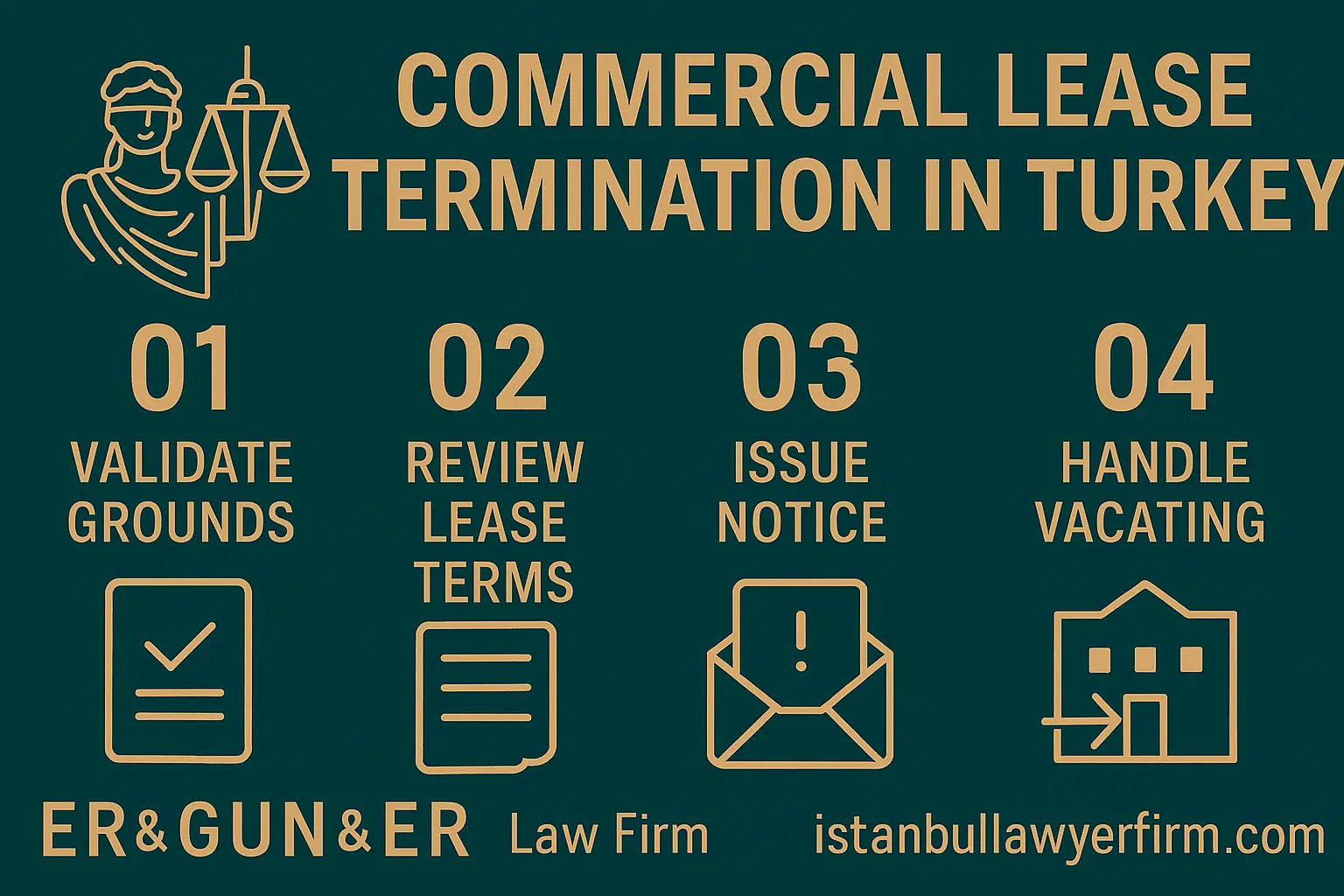
A lawyer in Turkey who advises landlords and tenants on commercial lease termination understands that ending a commercial tenancy in Turkey involves strict legal procedures, mandatory notice periods, specific grounds for termination, evidentiary requirements for breach-based claims and potential judicial enforcement through Turkish execution offices—all governed by the Turkish Code of Obligations and supplemented by established case law from the Court of Cassation that defines the rights and obligations of both parties during the termination process. An Istanbul Law Firm that handles commercial lease termination for both domestic and international clients reviews the lease agreement's termination clauses, notice obligations, penalty provisions, restoration requirements and dispute resolution mechanisms to develop a termination strategy that complies with Turkish statutory requirements while protecting the client's financial interests and commercial relationships. A Turkish Law Firm with experience in commercial property law recognizes that commercial lease termination differs significantly from residential lease termination under Turkish law—commercial tenancies are subject to different notice period calculations, different grounds for landlord-initiated termination, and different rules regarding lease renewal and rent adjustment—and that applying residential lease rules to commercial tenancy situations creates procedural errors that can invalidate the termination and expose the terminating party to liability. An English speaking lawyer in Turkey who manages commercial lease termination for foreign property owners and international tenants ensures that the legal requirements, procedural timelines, financial implications and enforcement options are communicated in clear English, enabling foreign clients to make informed decisions about termination timing, negotiation strategy and dispute resolution without misunderstanding the Turkish legal framework that governs their tenancy. Turkish lawyers who practice in commercial lease law bring practical familiarity with the Turkish Code of Obligations' lease termination provisions, the execution office procedures for enforcing eviction orders, the mandatory mediation requirements for lease disputes, and the judicial approach that Turkish commercial courts apply when evaluating termination validity, compensation claims and restoration obligations. This guide explains the notice requirements, eviction procedures, breach remedies, compensation mechanisms, restoration obligations and re-leasing strategies that a methodical lawyer in Turkey addresses when advising on commercial lease termination in Turkey.
Legal Framework for Commercial Lease Termination Under Turkish Law
A lawyer in Turkey who advises on the legal framework governing commercial lease termination explains that the Turkish Code of Obligations (Law No. 6098) establishes the primary rules for the creation, modification and termination of lease agreements, including specific provisions that apply to commercial tenancies involving workplace and business premises that differ from the general lease termination rules in important respects. Under Turkish law, commercial leases may be terminated through several distinct mechanisms: expiration of the agreed lease term combined with proper notice declining renewal, unilateral termination by either party based on statutory grounds such as material breach by the other party or the occurrence of events that make continued performance impossible or unreasonably burdensome, mutual termination by agreement of both parties on negotiated terms, and judicial termination through court order when the parties cannot resolve their termination dispute through direct negotiation or mediation. The notice period requirements for commercial lease termination depend on whether the lease was entered for a definite or indefinite term: definite-term commercial leases require notice of non-renewal to be served within the statutory timeframe before the term expires, typically at least fifteen days before the end of each lease year for month-to-month renewals, while the tenant's right to terminate requires notice served at least fifteen days before the end of each six-month period, and the specific notice period and calculation method must be verified against the applicable Code of Obligations provisions and any contractual modifications agreed by the parties. Practice may vary by authority and year — verify current notice period requirements, calculation methods and service standards for commercial lease termination before any termination action.
An Istanbul Law Firm that navigates the distinction between landlord-initiated and tenant-initiated termination explains that the legal framework provides different grounds and procedures depending on which party seeks to end the tenancy. Landlord-initiated termination of a commercial lease may be based on several grounds established by the Code of Obligations: the landlord's genuine need to use the premises for personal business or the business of specified family members, the landlord's intention to reconstruct or substantially renovate the building in a manner that requires vacancy, the tenant's failure to pay rent within the specified time after receiving a written payment demand, the tenant's use of the premises in a manner inconsistent with the lease terms or the premises' designated purpose, or the expiration of the ten-year extension period after the initial definite term during which the landlord may terminate by providing notice without stating grounds. Turkish lawyers who advise landlords on termination strategy evaluate which grounds are available based on the specific facts, assess the evidentiary requirements for each ground, and recommend the termination mechanism that provides the strongest legal position while minimizing the risk of a successful challenge by the tenant.
A Turkish Law Firm that advises tenants on their rights during the termination process explains that tenants enjoy significant statutory protections under Turkish commercial lease law—including the right to challenge termination notices that fail to comply with procedural requirements, the right to contest landlord termination grounds that are not genuine or that are pretextual, and the right to claim compensation for losses suffered as a result of unlawful or improper termination—and that these protections apply regardless of contrary provisions in the lease agreement because they derive from mandatory provisions of the Turkish Code of Obligations that the legislature specifically designed to prevent landlords from circumventing tenant protections through superior bargaining power during lease negotiation, and that cannot be waived, modified or excluded by contractual agreement between the parties. An English speaking lawyer in Turkey who represents foreign tenants facing commercial lease termination in Turkey explains these statutory protections, evaluates whether the landlord's termination notice complies with the applicable requirements, advises on the available defensive strategies including procedural challenges, factual disputes and counterclaims for damages, and represents the tenant in mediation, negotiation and litigation to protect their commercial interests and minimize disruption to their business operations.
Notice Requirements, Proper Service and Statutory Timelines
A lawyer in Turkey who drafts commercial lease termination notices explains that the validity of a termination notice depends on compliance with both content requirements and service requirements, and that technical defects in either dimension can invalidate the termination and expose the terminating party to liability for wrongful termination. The content of a valid termination notice must include clear identification of both parties by full legal name and address, specific identification of the lease agreement being terminated including execution date and premises description, statement of the legal ground for termination with reference to the applicable Code of Obligations provision or lease clause, specification of the date on which the tenant must vacate the premises, and any additional information required by the specific termination ground being invoked—such as the thirty-day payment demand period for non-payment termination or the specification of the landlord's intended personal use for need-based termination. An Istanbul Law Firm that drafts termination notices for commercial landlords and tenants ensures that each notice contains all legally required elements, that the termination ground is stated with sufficient specificity to withstand judicial scrutiny if the notice is challenged, and that the notice language is clear and unambiguous in Turkish so that the recipient cannot claim misunderstanding of the notice's intent or the vacating deadline. Practice may vary by authority and year — verify current notice content requirements, service standards and deadline calculation methods before any termination notice service.
An Istanbul Law Firm that manages the service of termination notices explains that proper service—the legally valid delivery of the notice to the recipient—is equally important as the notice content, because a perfectly drafted notice that is not properly served has no legal effect and cannot support a termination claim in court. Turkish law recognizes several methods of valid service for lease termination notices: personal delivery to the recipient with written acknowledgment of receipt, delivery through a notary public who prepares an official record of the notice content and the delivery circumstances, and delivery by registered mail with return receipt that creates a postal record of the delivery date and the recipient's identity. Turkish lawyers who manage termination notice service recommend notarial delivery as the most reliable method because it creates an official public record that is extremely difficult for the recipient to challenge, and they coordinate the notarial service process to ensure that the notice is delivered within the statutory timeframe required by the applicable termination ground. An English speaking lawyer in Turkey who manages notice service for foreign clients explains the significance of proper service, the consequences of defective service—which can include complete invalidation of the termination and potential liability for wrongful termination—and the steps taken to ensure that service is completed correctly and documented in a manner that will be accepted by Turkish courts if the termination is contested.
A Turkish Law Firm that monitors statutory timelines for commercial lease termination explains that the calculation of notice periods and termination deadlines is a technical legal exercise that must be performed precisely, because errors in deadline calculation—even by a single day—can invalidate the termination notice and require the parties to wait for the next applicable termination window, potentially extending the lease by months or years. Turkish lawyers who track termination timelines prepare compliance calendars that identify the earliest date on which a valid termination notice can be served, the latest date by which service must be completed to meet the statutory deadline, the date on which the tenant's obligation to vacate commences, and any intermediate deadlines that apply to specific termination grounds—such as the thirty-day cure period for non-payment termination or the three-month waiting period for need-based termination after a newly acquired property. The best lawyer in Turkey for commercial lease termination combines technical precision in deadline calculation with strategic judgment about the optimal timing of termination actions, recognizing that the choice of when to serve a termination notice—and on which legal ground—affects not only the legal validity of the termination but also the parties' negotiating leverage, the litigation timeline and the overall cost of the termination process.
Tenant Rights, Eviction Procedures and Judicial Enforcement
A lawyer in Turkey who handles eviction procedures for commercial lease termination explains that when a tenant contests the termination and refuses to vacate the premises voluntarily, the landlord must obtain a judicial eviction order through Turkish court proceedings before the tenant can be physically removed from the premises—self-help eviction measures, including changing the locks on the premises, cutting utility services such as electricity, water or gas, physically barring the tenant from entering, or removing tenant property and equipment from the premises without court authorization, are unlawful under Turkish law regardless of the validity of the underlying termination and expose the landlord to criminal liability for arbitrary acts (ihkak-ı hak), civil damage claims for business interruption, lost inventory and emotional distress, and potential claims for unlawful interference with possession that may result in court orders requiring the landlord to restore the tenant's possession and pay compensation for the period during which the tenant was unlawfully excluded from the premises. An Istanbul Law Firm that pursues judicial eviction on behalf of commercial landlords files an eviction lawsuit in the competent civil court of peace (sulh hukuk mahkemesi) for termination based on non-payment or breach of lease obligations, or in the commercial court (asliye ticaret mahkemesi) for disputes involving commercial enterprises and joint stock companies depending on the specific legal grounds invoked and the parties' commercial status, presents the evidence supporting the termination including the original lease agreement, the termination notice with proof of proper service, documentation of the specific termination ground such as payment default records, breach evidence or need documentation, and any prior correspondence between the parties regarding the termination, and advocates for an eviction order that specifies the precise date by which the tenant must vacate the premises and the enforcement measures available through the execution office system if the tenant fails to comply with the court's order within the specified timeframe. Turkish lawyers who manage eviction proceedings coordinate with the competent execution office (icra dairesi) to enforce the eviction order once it becomes final, arranging for a court-appointed bailiff to attend the physical eviction to ensure that the process is conducted lawfully and documented properly, preparing a detailed inventory of the premises condition during the handover through photographs, video recordings and a written condition report signed by the attending parties, securing the premises immediately after the tenant's departure by changing locks and verifying that all keys have been surrendered, and managing the inventory, storage and potential disposal of any tenant property and equipment left on the premises in accordance with the statutory requirements for abandoned property under the Turkish Code of Obligations. Practice may vary by authority and year — verify current eviction filing procedures, court jurisdiction rules, execution office enforcement requirements and abandoned property handling standards before any eviction action.
An Istanbul Law Firm that defends tenants against eviction proceedings explains that tenants have several defensive strategies available when challenging a landlord's termination and eviction claim. Procedural defenses challenge the validity of the termination notice itself—arguing that the notice was defective in content, that service was improper, that the notice period was insufficient, or that the notice was served outside the statutory timeframe. Substantive defenses challenge the factual basis for the termination ground—arguing that the landlord's claimed need to use the premises is not genuine, that the alleged breach has been cured, that the non-payment was excused by the landlord's own breach, or that the renovation claimed by the landlord does not actually require vacancy. Turkish lawyers who defend tenants in eviction proceedings gather evidence to support these defenses, including proof of rent payments, evidence of the landlord's true intentions regarding the premises, documentation of maintenance failures or other landlord breaches that excuse or mitigate the tenant's conduct, and expert evidence regarding the feasibility of renovation without vacancy. An English speaking lawyer in Turkey who represents foreign tenants in eviction proceedings ensures that the tenant understands the litigation timeline, the available defenses, the potential outcomes including settlement options, and the practical steps needed to maintain business operations during the pendency of the eviction proceedings.
A Turkish Law Firm that manages the post-eviction process for both landlords and tenants explains that the physical eviction is not the end of the legal relationship—post-eviction obligations including security deposit reconciliation, restoration cost allocation, utility payment settlement and personal property return must be resolved to achieve complete legal closure of the tenancy. Turkish lawyers who manage post-eviction matters prepare detailed deposit reconciliation documents that itemize every deduction claimed by the landlord with supporting documentary evidence including photographs, contractor invoices, and comparative condition assessments, draft formal restoration cost demands supported by independent contractor estimates, professional building inspector reports and photographic documentation comparing the premises condition at lease commencement with the condition at the time of the tenant's departure, coordinate utility account closure and final bill settlement, and manage the return or disposal of any tenant property remaining on the premises after the eviction. Where the parties cannot agree on post-eviction financial matters, Turkish lawyers pursue or defend claims through the appropriate court or enforcement proceedings, ensuring that the client's financial rights are protected through the final resolution of all termination-related obligations.
Termination Based on Lease Breach and Default Remedies
A lawyer in Turkey who pursues breach-based commercial lease termination explains that when a tenant fails to fulfill material lease obligations—such as paying rent on time, using the premises only for the contractually specified purpose, maintaining the premises in accordance with the lease requirements, refraining from unauthorized subletting or assignment, or complying with building rules and regulations—the landlord may be entitled to terminate the lease without waiting for the expiration of the lease term, provided that the specific breach satisfies the legal requirements for early termination under the applicable Code of Obligations provisions and the lease agreement's breach and default clauses. An Istanbul Law Firm that pursues breach-based termination on behalf of commercial landlords prepares the required breach notification citing the specific contractual clause and legal provision violated, the factual description of the breach with supporting evidence, the cure period (if applicable) during which the tenant may remedy the breach to avoid termination, and the termination notice that takes effect if the breach is not cured within the specified period. Turkish lawyers who manage breach-based termination cases gather and preserve the evidence needed to prove the breach in court if the tenant contests the termination—including rent payment ledgers showing default history, photographs and inspection reports documenting premises damage or unauthorized alterations, correspondence demonstrating unauthorized subletting, and witness statements from building management or neighboring tenants regarding lease violations. Practice may vary by authority and year — verify current breach notification requirements, cure period standards and evidence preservation procedures before any breach-based termination action.
An Istanbul Law Firm that handles the specific case of non-payment termination under Turkish commercial lease law explains that rent non-payment is the most common ground for breach-based termination and is subject to a specific statutory procedure: the landlord must serve a written payment demand giving the tenant at least thirty days to pay the overdue rent, and if the tenant fails to pay within this period, the landlord acquires the right to terminate the lease and pursue eviction through court proceedings. Turkish lawyers who manage non-payment termination ensure that the payment demand is properly drafted with the specific amount owed, the applicable payment period, the consequences of non-payment including lease termination and eviction, and proper service documentation that will be accepted by the court. If the tenant pays within the thirty-day period, the termination right lapses, but the landlord may still pursue damage claims for late payment costs and may use the payment default history as evidence in future termination proceedings if the tenant establishes a pattern of repeated late payment that constitutes a material breach of the lease obligation to pay rent punctually.
A Turkish Law Firm that facilitates pre-litigation resolution of breach disputes explains that many breach-based termination situations can be resolved through negotiation, mediation or settlement before the matter reaches the eviction court, and that early resolution often serves both parties' interests better than protracted litigation. Turkish lawyers who facilitate breach dispute resolution draft settlement agreements that address the identified breach, establish a cure plan with specific milestones and deadlines, modify the lease terms to prevent recurrence, and define the consequences if the agreed cure plan is not followed—creating a structured resolution that preserves the tenancy if the tenant remedies the breach while protecting the landlord's termination rights if the cure fails. An English speaking lawyer in Turkey who mediates breach disputes between foreign landlords and Turkish tenants bridges the language and cultural gap that often complicates direct negotiation, ensuring that both parties understand the proposed settlement terms, the financial implications of each option, and the legal enforceability of the settlement agreement under Turkish law.
Compensation Claims, Deposit Recovery and Financial Accountability
A lawyer in Turkey who handles compensation claims arising from commercial lease termination explains that a terminated commercial lease may generate financial claims in both directions—landlords may claim compensation for unpaid rent, early termination damages, premises restoration costs, lost rental income during the re-leasing period and any other losses caused by the tenant's breach, while tenants may claim return of the security deposit, compensation for landlord-initiated termination that was unlawful or improper, reimbursement for improvements that enhanced the premises' value, and damages for the landlord's failure to maintain the premises in habitable condition during the tenancy. An Istanbul Law Firm that manages termination-related compensation claims prepares detailed damage calculations supported by documentary evidence—including rent payment records, market rental comparisons, contractor estimates for restoration work, expert valuations for improvement claims, and financial analysis of the claimed losses—because Turkish courts require specific, documented proof of each claimed loss and do not award compensation based on estimates or assertions without evidentiary support. Turkish lawyers who pursue compensation claims coordinate with expert witnesses, forensic accountants and property appraisers to develop the evidentiary foundation needed to persuade the court that the claimed losses are real, quantifiable and causally connected to the other party's breach or unlawful conduct. Practice may vary by authority and year — verify current compensation claim procedures, evidence requirements and damage calculation standards before any termination-related financial claim.
An Istanbul Law Firm that manages security deposit disputes explains that the security deposit is one of the most frequently contested financial issues in commercial lease termination, because landlords and tenants often disagree about whether the deposit should be returned in full, partially retained to cover specific claims, or entirely forfeited based on the tenant's conduct during the tenancy. Turkish lawyers who handle deposit disputes advise landlords on the permissible grounds for deposit retention under both the lease agreement and the Code of Obligations—which generally limit retention to documented, proven claims for unpaid rent, restoration costs for damage beyond normal wear and tear, and other specific obligations that the tenant failed to fulfill—and advise tenants on their right to receive an itemized statement of deductions, to challenge excessive or unsupported deductions, and to pursue court proceedings to recover deposits that were wrongfully retained. An English speaking lawyer in Turkey who manages deposit disputes for foreign property owners ensures that deposit reconciliation documentation is prepared in bilingual format, that deduction claims are supported by photographic evidence, contractor estimates and comparison between the premises' condition at lease commencement and termination, and that the reconciliation process is completed within a reasonable timeframe to avoid interest accumulation and unnecessary litigation.
A Turkish Law Firm that pursues asset preservation measures in connection with termination-related claims explains that landlords who face the risk that the tenant will dissipate assets or leave the jurisdiction before financial claims can be resolved may apply to the court for preliminary attachment orders that freeze the tenant's bank accounts, real property and other assets pending the resolution of the compensation claim. Turkish lawyers who file provisional attachment applications prepare the application with evidence demonstrating the landlord's prima facie claim, the risk of asset dissipation, and the specific assets to be attached, because Turkish courts evaluate provisional attachment applications on both the merits of the underlying claim and the necessity of interim protection. Where tenants face provisional attachment applications, Turkish lawyers prepare oppositions challenging the legal basis, the necessity or the scope of the attachment, and negotiate the release of attached assets through the provision of alternative security such as bank guarantees or surety bonds that adequately protect the landlord's financial interests while allowing the tenant to continue business operations.
Restoration Obligations, Premises Handover and Post-Termination Compliance
A lawyer in Turkey who manages restoration obligations in commercial lease termination explains that following termination, the tenant is generally obligated to return the premises to the landlord in the condition specified by the lease agreement—typically the original condition at the commencement of the tenancy, adjusted for normal wear and tear attributable to ordinary use consistent with the premises' designated purpose—and that disputes over the scope, quality, timeline and cost of required restoration work are among the most common and financially significant sources of post-termination litigation between commercial landlords and tenants in Turkish courts. An Istanbul Law Firm that manages the restoration process prepares comprehensive exit protocols that document the current condition of the premises through professional photography covering every room, corridor, utility area, exterior space and fixture, supplemented by video recording that captures details not easily conveyed through still photographs, written condition reports prepared by qualified building inspectors or chartered surveyors that describe the condition of walls, floors, ceilings, windows, doors, plumbing, electrical systems, HVAC equipment, fire safety installations and any specialized fit-out installed during the tenancy; compare the current condition against the baseline condition documented at lease commencement through the inventory report, entry photographs and any condition assessment prepared at the beginning of the tenancy to identify every change that requires restoration, distinguishing between changes attributable to normal wear and tear—which is the landlord's responsibility and cannot be charged to the tenant—and changes attributable to tenant-caused damage, unauthorized structural alterations, non-permitted fit-out modifications, or failure to perform required maintenance during the tenancy—which are the tenant's restoration responsibility; obtain detailed contractor estimates for each category of required restoration work broken down by labor, materials, timeline and supervision costs; and establish a restoration timeline with specific milestones, intermediate inspections and a final completion deadline that gives the tenant adequate time to complete the work while protecting the landlord from extended vacancy and lost rental income. Turkish lawyers who oversee the restoration process ensure that the restoration standards specified in the lease agreement are interpreted and applied correctly in light of current Turkish case law on what constitutes normal wear and tear versus tenant-caused damage, that the tenant is given reasonable notice and a fair opportunity to complete the restoration work using contractors of their choice subject to the landlord's reasonable approval, and that any disputes about restoration scope, quality or cost are resolved through negotiation, mediation or court proceedings before the landlord incurs restoration costs independently and seeks reimbursement from the tenant through enforcement proceedings. Practice may vary by authority and year — verify current restoration obligation standards, premises handover procedures, condition documentation requirements and normal wear and tear interpretation standards before any termination-related handover.
An Istanbul Law Firm that manages premises handover procedures explains that the formal handover of the premises from tenant to landlord should be documented through a written handover protocol signed by both parties—or, if the tenant refuses to participate, by the landlord's representative accompanied by a bailiff or notary who can create an official record of the premises condition at the time of the landlord's repossession. The handover protocol should include a room-by-room condition description, photographs of all areas including utilities and fixtures, meter readings for electricity, water and gas utilities, confirmation of key return, and a list of any items left on the premises by the tenant. Turkish lawyers who coordinate the handover process ensure that all utility accounts are transferred back to the landlord's name, that any municipal registrations or building management notifications are updated to reflect the change in occupancy, that the premises are secured against unauthorized entry after the tenant's departure, and that the handover documentation is preserved as evidence for any subsequent disputes about the premises condition or the tenant's restoration obligations.
A Turkish Law Firm that ensures post-termination compliance for both parties explains that even after the physical handover is complete, outstanding obligations may remain that require attention to achieve complete legal closure of the tenancy—including final utility bill settlement, deposit reconciliation and return, resolution of any pending maintenance or restoration claims, cancellation of any guarantees or surety bonds that secured the tenant's obligations, and formal notification to the building management, municipality and tax authorities regarding the change in occupancy. An English speaking lawyer in Turkey who manages post-termination compliance for foreign landlords and tenants prepares comprehensive compliance checklists that identify every outstanding obligation, assign responsibility for each item, establish completion deadlines, and track progress until all obligations are satisfied and the tenancy is fully closed from both a legal and administrative perspective. The best lawyer in Turkey for commercial lease termination recognizes that thorough post-termination compliance management prevents the delayed disputes and unexpected liabilities that arise when termination-related obligations are left unresolved and become the subject of claims months or years after the tenant vacated the premises.
Settlement Options, Mediation and Early Termination Agreements
A lawyer in Turkey who facilitates negotiated resolution of commercial lease termination disputes explains that parties may choose to settle their differences or negotiate early termination terms to avoid the substantial cost, procedural delay and outcome uncertainty of formal eviction proceedings and courtroom litigation, and that well-structured settlement agreements often serve both parties' commercial interests more effectively than judicial resolution because they allow the parties to customize every aspect of the termination—including the specific vacating timeline with graduated milestones, the financial obligations of each party itemized by category with payment schedules and security arrangements, the restoration scope and standards with clear allocation of responsibility for each category of work, the treatment of the security deposit including any agreed deductions and the timeline for refund of the balance, the allocation of post-termination obligations including utility settlement and administrative notifications, and confidentiality provisions protecting both parties from public disclosure of the termination terms and any financial arrangements—to their specific commercial needs and priorities rather than accepting the standardized remedies that a court would impose without regard to the parties' individual business circumstances, relationship history or future commercial interests. An Istanbul Law Firm that drafts mutual termination agreements for commercial tenancies structures the agreement to constitute a comprehensive, final and binding resolution of all claims, counterclaims and obligations arising from the tenancy and the termination process, including a mutual release of all claims related to the lease period that prevents either party from reviving terminated disputes, and includes direct enforceability provisions that enable either party to enforce the agreement's financial terms through the execution office system without the need for additional court proceedings if the other party fails to comply with its payment, vacating or restoration obligations within the agreed timelines. Turkish lawyers who draft these agreements ensure that the settlement complies with all applicable mandatory provisions of Turkish contract and lease law, that the financial terms are proportionate and documented with sufficient specificity to be enforceable, and that the agreement includes provisions for what happens if either party breaches the settlement itself—such as automatic reinstatement of the original lease obligations, accelerated payment of any deferred financial obligations, and the right to seek immediate judicial enforcement without further mediation or negotiation. Practice may vary by authority and year — verify current settlement agreement enforceability standards, direct enforcement provisions and mutual release formulations before any negotiated commercial lease termination.
An Istanbul Law Firm that facilitates mediation in commercial lease disputes explains that mandatory mediation was introduced for certain categories of commercial disputes in Turkey, and that even where mediation is not legally required, it provides a structured negotiation environment that can resolve lease termination disputes more quickly and with greater party control than litigation. Turkish lawyers who prepare clients for mediation develop position papers that analyze the legal strengths and weaknesses of each party's position, identify the zone of possible agreement, propose creative settlement structures that address both parties' core interests, and establish negotiation parameters that define the client's minimum acceptable terms and maximum concessions. An English speaking lawyer in Turkey who facilitates mediation between foreign landlords and Turkish tenants bridges the language, cultural and legal knowledge gaps that often impede direct negotiation, ensuring that both parties understand the proposed terms, the financial implications of each option, and the consequences of failing to reach agreement.
A Turkish Law Firm that incorporates early termination provisions into new commercial lease agreements explains that the most effective way to manage termination risk is to address it proactively during the lease drafting phase rather than reactively when a dispute arises. Turkish lawyers who draft commercial leases with termination flexibility include provisions addressing break options that allow either party to terminate before the natural expiration of the term upon specified notice and payment of a predetermined early termination fee, force majeure termination that excuses performance when extraordinary circumstances beyond the parties' control make continued tenancy impossible or commercially unreasonable, assignment and subletting provisions that allow the tenant to transfer the lease to a qualified replacement tenant rather than terminating, and graduated rent adjustment mechanisms that reduce the risk of termination disputes arising from rent levels that become disconnected from market conditions over the lease term. These provisions, when properly drafted to comply with Turkish mandatory lease law, give both parties the contractual tools to manage their commercial relationship flexibly and reduce the likelihood that termination disputes will escalate into costly litigation.
Dispute Prevention, Lease Clause Optimization and Re-Leasing Strategy
A lawyer in Turkey who designs dispute-resistant commercial lease agreements explains that effective lease structure reduces the risk of termination disputes by addressing the most common sources of landlord-tenant conflict proactively through clear, specific contractual provisions that leave minimal room for misunderstanding, misinterpretation or disagreement about the parties' respective rights and obligations during and at the end of the tenancy. An Istanbul Law Firm that conducts legal audits of commercial lease agreements reviews the complete lease document including all annexes, schedules and side letters, examining termination triggers and notice requirements for compliance with current Turkish law, breach definitions and cure period provisions for clarity and enforceability, dispute resolution mechanisms for practicality and compliance with mandatory mediation requirements, restoration standards for specificity and verifiability, financial obligations including rent adjustment mechanisms, deposit provisions and penalty clauses for proportionality and enforceability under Turkish law, and any provisions that may have become unenforceable due to changes in legislation or court interpretation since the lease was originally drafted. Turkish lawyers who optimize lease clauses for dispute prevention incorporate clear, measurable definitions of events of default that use objective criteria—such as specific numbers of days of rent arrears, identified categories of prohibited use, and defined standards for premises maintenance—rather than subjective standards that invite disagreement about whether a default has actually occurred, realistic cure periods that give the defaulting party a fair and meaningful opportunity to remedy the identified breach before the other party's termination rights are triggered while not being so long that the non-defaulting party suffers extended losses during the cure period, tiered dispute resolution procedures that require direct negotiation between senior management representatives as a first step, mediation with a qualified mediator as a second step, and litigation or arbitration as a final resort only if the earlier stages fail to produce a resolution, and detailed restoration standards accompanied by photographic and written baseline documentation prepared at lease commencement that eliminate disputes about the premises' original condition by providing an objective, documented reference point against which the premises' condition at termination can be compared. Practice may vary by authority and year — verify current lease clause enforceability standards, dispute resolution requirements, termination trigger validity and restoration documentation best practices before any commercial lease optimization.
An Istanbul Law Firm that supports landlords in re-leasing strategies after commercial lease termination explains that the period between one tenancy ending and the next beginning represents both a financial cost—lost rental income during the vacancy period—and an opportunity to improve the lease terms, upgrade the premises condition and select a higher-quality tenant whose financial strength and business stability reduce the risk of future termination disputes. Turkish lawyers who advise on re-leasing strategy review current market rental rates and comparable property terms to establish competitive pricing, draft new lease agreements incorporating the lessons learned from the prior tenancy including enhanced security deposit requirements, stronger breach and default provisions, and improved restoration clauses, design tenant vetting procedures including financial standing verification, corporate background checks, litigation history review and reference checks from prior landlords, and coordinate the legal aspects of the re-leasing process including lease negotiation, execution, registry notification and utility account transfer.
A Turkish Law Firm that provides ongoing lease portfolio management for commercial property investors explains that the most effective approach to commercial lease termination management is a portfolio-level strategy that treats each lease in the context of the investor's overall property holdings, tenant mix, income diversification and risk exposure. An English speaking lawyer in Turkey who manages lease portfolios for foreign property investors maintains a portfolio-wide compliance calendar that tracks all lease expiration dates, notice deadlines, renewal windows and option exercise dates across the entire portfolio, conducts periodic lease audits that identify clauses requiring amendment, tenants with elevated default risk, and market rent adjustments that should be implemented at the next renewal, and provides quarterly portfolio reports that summarize the current lease status, pending termination matters, re-leasing progress and overall portfolio risk profile. This systematic approach enables foreign property investors to manage their Turkish commercial property holdings with the same level of governance and oversight that they apply to their property investments in other jurisdictions, reducing the risk of missed deadlines, unintended automatic lease renewals, overlooked termination windows and termination disputes that gradually erode portfolio value and investor returns.
Frequently Asked Questions
- Can a commercial lease be terminated early by mutual consent? Yes. Parties may agree to terminate a commercial lease before the expiration of the contractual term through a mutual termination agreement that addresses all outstanding financial obligations, restoration requirements, vacating timelines and post-termination compliance items. The agreement should be drafted in writing and include direct enforceability provisions.
- What notice period applies for commercial lease termination in Turkey? The notice period depends on the lease term, the termination ground and any contractual modifications to the statutory defaults. Tenant-initiated termination generally requires notice at least fifteen days before the end of each six-month period. Landlord termination based on statutory grounds has its own specific notice requirements. The calculation must be verified against current law.
- Can tenants dispute an early termination notice? Yes. Tenants may challenge termination notices on procedural grounds—defective content, improper service or insufficient notice period—or on substantive grounds—disputing the factual basis for the termination, arguing that the landlord's stated grounds are pretextual, or asserting that the tenant cured the alleged breach within the applicable cure period.
- Is mediation required before filing an eviction lawsuit? Mandatory mediation applies to certain categories of commercial disputes in Turkey. Whether it applies to a specific commercial lease termination dispute depends on the nature of the claim and the current scope of the mandatory mediation requirement. Mediation is generally recommended regardless of whether it is legally required.
- Can landlords claim damages after a commercial lease ends? Yes. Landlords may claim compensation for unpaid rent, premises restoration costs beyond normal wear and tear, lost rental income during the re-leasing period, early termination damages specified in the lease agreement, and any other documented losses causally connected to the tenant's breach or failure to comply with termination obligations.
- What happens to the security deposit at termination? The deposit may be retained to cover documented, proven claims for unpaid rent, restoration costs for damage beyond normal wear and tear, and other specific obligations the tenant failed to fulfill. The landlord must provide an itemized statement of deductions. Excess deposit must be returned, and wrongful retention may give rise to tenant claims including interest.
- Are utility costs payable by the tenant after termination? Yes. The tenant remains responsible for utility costs incurred through the date of formal premises handover, including the costs reflected in final meter readings taken at the time of the documented handover. Utility account transfer back to the landlord's name should be coordinated as part of the handover process.
- Can a commercial lease be assigned to a new tenant? Assignment is generally possible with the landlord's consent, and the lease agreement may contain specific provisions governing the assignment process, the landlord's approval rights and the assignee's qualifications. Assignment can be a practical alternative to termination when the tenant wishes to exit but a qualified replacement is available.
- How is premises handover formalized? Through a written handover protocol signed by both parties documenting the premises condition through photographs and room-by-room descriptions, meter readings, key return confirmation and a list of any items remaining on the premises. If the tenant refuses to participate, a bailiff or notary can create an official handover record.
- What if the tenant refuses to vacate after termination? The landlord must obtain a judicial eviction order through court proceedings and enforce it through the execution office system. Self-help eviction—changing locks, cutting utilities or removing tenant property without court authorization—is unlawful and exposes the landlord to criminal and civil liability.
- Can foreign investors terminate commercial leases remotely? Yes, through properly authorized legal representation. A power of attorney granted to Turkish counsel enables the lawyer to serve termination notices, negotiate settlements, file court proceedings and coordinate enforcement on behalf of the foreign investor without requiring the investor's physical presence in Turkey.
- How long do eviction proceedings take in Turkey? The duration depends on the court's caseload, the complexity of the dispute and whether the tenant exercises available appeals. Simple non-payment evictions may be resolved in a few months, while contested terminations based on need or breach may take longer. Counsel can provide realistic timeline ranges based on the specific circumstances.
- Can lease termination clauses be negotiated? Yes. Commercial lease terms are generally negotiable, and parties can agree on custom termination provisions including break options, early termination fees, modified notice periods and specific breach definitions, provided that the agreed terms do not violate mandatory provisions of the Turkish Code of Obligations.
- What restoration obligations does the tenant have at termination? The tenant must return the premises in the condition specified by the lease agreement, typically the original condition adjusted for normal wear and tear. Unauthorized alterations must be removed, damage must be repaired, and the premises must be cleaned and vacated of all tenant property unless the parties agree otherwise.
- Does ER&GUN&ER Law Firm handle commercial lease termination matters? Yes. ER&GUN&ER Law Firm provides comprehensive commercial lease termination services for both landlords and tenants, including termination notice drafting and service, eviction proceedings, breach-based termination, compensation and deposit claims, restoration supervision, settlement negotiation, mediation representation and re-leasing strategy, with bilingual English-Turkish legal support and strategic guidance throughout the entire process.
Author: Mirkan Topcu is an attorney registered with the Istanbul Bar Association (Istanbul 1st Bar), Bar Registration No: 67874. His practice focuses on cross-border and high-stakes matters where evidence discipline, procedural accuracy, and risk control are decisive.
He advises individuals and companies across Immigration and Residency, Real Estate Law, Tax Law, and cross-border documentation matters where procedural accuracy and evidence discipline are decisive.
Education: Istanbul University Faculty of Law (2018); Galatasaray University, LL.M. (2022). LinkedIn: Profile. Istanbul Bar Association: Official website.