

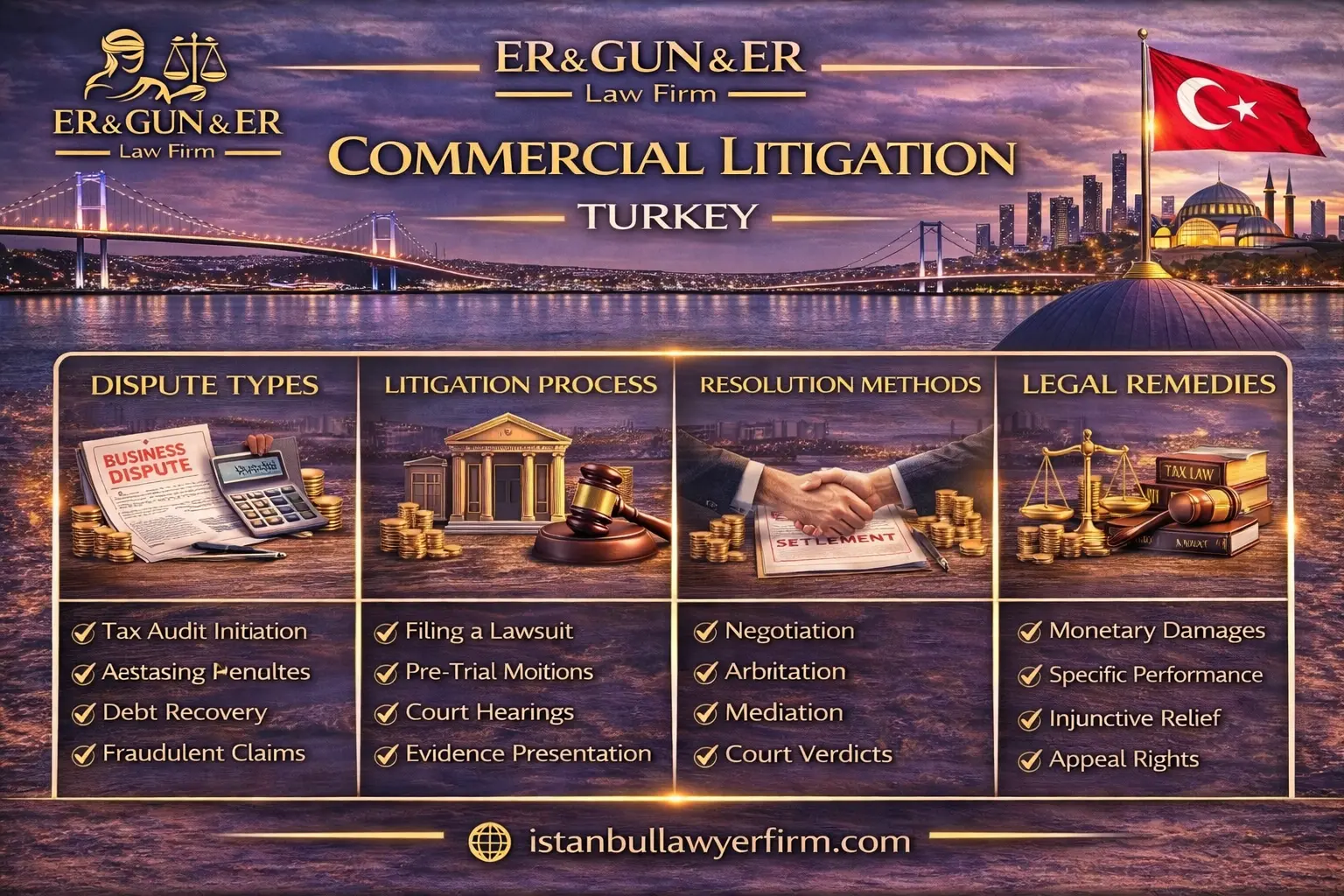
Commercial litigation in Turkey is procedural before it is substantive because jurisdiction, interim safeguards, and enforcement mechanics determine whether a favorable judgment translates into real recovery. commercial litigation Turkey files usually turn on which court has authority, whether interim relief can be secured before the opponent moves assets, and whether a judgment can be executed against identifiable assets or cross-border counterparties. A dispute that is well-framed at the filing stage gives the court clear questions and reduces the risk of procedural delays that drain time and cost. Evidence discipline matters because Turkish commercial courts are document-led, and oral assertions without exhibit support carry less persuasive weight than a numbered chronology tied to signed contracts, invoices, and correspondence. Interim measures matter because Turkish procedural law allows courts to act before the full merits are heard when risk of irreversible harm is documented. Enforcement matters because a paper judgment without a realistic execution plan produces costs rather than recovery. "practice may vary by authority and year — check current guidance." For bilingual coordination of filings and exhibits in cross-border commercial matters, many companies consult an English speaking lawyer in Turkey so the record stays consistent across courts and jurisdictions.
Commercial litigation overview
commercial litigation Turkey disputes combine substantive commercial law with procedural mechanics that determine the pace and cost of resolution. Business dispute Turkey cases often begin as contract performance failures and escalate when one party refuses to pay, refuses to deliver, or disputes the scope of obligations. The court will ask first which forum is competent, then what the contract says, then what the evidence shows about performance and breach. It will not fill gaps in a poorly documented claim with assumptions about good faith. A commercial file therefore requires an evidence map that links every factual claim to a dated document. The evidence map should include the original contract and all amendments, signed by authorized representatives. It should include delivery confirmations, acceptance certificates, and any quality or inspection records. It should include invoices, payment confirmations, and bank transfer proofs where money is in issue. It should include correspondence that shows when the dispute crystallized and whether any admission or waiver occurred. It should include internal communications only to the extent they are admissible and relevant, because bulk submissions of internal emails often create inconsistency rather than strength. "practice may vary by authority and year — check current guidance." A party should avoid building a claim around witness narrative alone because courts often assign more weight to signed documents than to testimony about what was agreed verbally. In complex cross-border matters, an Istanbul Law Firm can coordinate the evidence index and ensure that foreign documents are translated and authenticated before the first hearing.
Many parties misunderstand the difference between establishing breach and proving damages. Establishing breach requires showing what was promised, what was delivered, and the gap between the two. Proving damages requires showing how the gap caused measurable loss, supported by market prices, invoices for substitute performance, or expert valuation. Turkish commercial courts expect both, and a file that proves breach without quantifying damages recovers nothing or recovers at an amount the court estimates, which is often lower than expected. Parties should therefore build a damages calculation into the file early, supported by invoices and market comparisons rather than by speculation. The calculation should be conservative and provable so cross-examination does not destroy it. Parties should also consider whether pre-judgment interest applies and for what period, because interest can represent a significant share of the recovery in long disputes. If the contract contains a liquidated damages clause, assess whether it is enforceable under Turkish law before relying on it as the damages calculation. If the contract contains a penalty clause, the same assessment applies because Turkish courts have discretion to reduce disproportionate penalties. "practice may vary by authority and year — check current guidance." For tactical framing and motion drafting, a lawyer in Turkey can structure the damages theory in a way that is internally consistent and survives expert challenge. A defensible damages file protects recovery because it reduces the court's reliance on discretionary estimation.
Commercial disputes also interact with insolvency risk when the debtor is financially distressed or when assets are being transferred away from the entity against which judgment is sought. A party should assess solvency indicators early and consider whether interim protective measures, such as asset freezes, are needed before the opponent restructures its balance sheet. The procedural tools available in Turkish enforcement law allow creditors to move quickly when fraud or asset dissipation is documented. The framework in the business and commercial law overview explains how contractual and statutory obligations interact in Turkish practice and how disputes are typically framed in commercial court. Parties should also assess whether arbitration provisions in the contract affect court competence, because a court may stay proceedings if a valid arbitration agreement exists. The interaction between arbitration and litigation is one of the most common sources of delay in Turkish commercial files, and it is better addressed at the start than after the first substantive hearing. If related disputes exist across multiple entities or multiple jurisdictions, coordinate the filings early so submissions do not contradict each other in ways that undermine the core claim. "practice may vary by authority and year — check current guidance." In files with cross-border dimensions, Turkish lawyers often focus on building one coherent chronology that can be reused in enforcement and recognition steps. A coherent chronology prevents the case from turning into competing versions of the same events across different forums.
Court jurisdiction and competence
Jurisdiction questions decide which court can hear the dispute and issue enforceable orders, so they must be resolved before substantive arguments are made. jurisdiction commercial disputes Turkey analysis depends on the subject matter of the claim, the location of the parties, the contractual forum selection clause if any, and the amount in dispute. Turkish commercial courts, organized under the commercial court system, handle business-to-business disputes involving trade, contracts, corporate matters, and negotiable instruments. The general civil courts handle disputes that do not fall within the commercial court's specific subject-matter jurisdiction. Sending a claim to the wrong court produces procedural delay because the file must be transferred, and transfer can waste months. Parties should therefore map the claim to the correct court before filing and confirm that the chosen court has territorial competence based on the defendant's registered address or the place of contract performance. If a forum selection clause designates a different Turkish city, assess whether that clause is enforceable and whether any mandatory jurisdiction rule overrides it. "practice may vary by authority and year — check current guidance." A parent should preserve the contract and any jurisdiction agreement with certified copies because jurisdiction fights often hinge on whether the clause was properly incorporated and signed. In Istanbul-based disputes, filing strategy is often coordinated through a law firm in Istanbul to keep venue proofs, service records, and translation workflows consistent. Consistency matters because a jurisdiction contest decided against you early resets the case and increases costs before any substantive argument is heard.
Subject-matter jurisdiction also interacts with the value of the claim because some courts have monetary thresholds that determine whether simplified or full procedure applies. Parties should assess the correct procedural track at the outset because the evidence and briefing rules differ between tracks. If the claim is monetary and below a threshold, the simplified procedure may apply, which means shorter timelines but also fewer opportunities to submit lengthy expert evidence. If the claim is complex and involves technical matters, the full procedure with expert witnesses is more appropriate. Parties should also assess whether counterclaims are likely, because a counterclaim in excess of the original claim can shift the procedural dynamics. If counterclaims are anticipated, build the file so that your own evidence covers the likely counterclaim themes rather than reacting to them after they are filed. If a related debt enforcement file is running in parallel, keep the litigation and enforcement files consistent in their characterization of the debt amount and the performance obligations. Courts and enforcement offices may compare filings, and inconsistencies damage credibility. "practice may vary by authority and year — check current guidance." For cross-border parties, service abroad is a critical competence issue because a court cannot proceed to judgment against a foreign defendant who has not been properly served. Service proofs should be preserved in a separate folder and confirmed before the first hearing date is scheduled. A clean jurisdiction and service tab reduces delay because it gives the judge a verifiable procedural picture early.
Jurisdiction disputes also arise when one party argues that an arbitration agreement covers the dispute and that the court should stay proceedings. Stay requests under arbitration agreements are governed by specific procedural rules and must be raised at the first opportunity because late-raised objections can be waived. If the contract contains an arbitration clause, analyze whether it covers the specific dispute before deciding where to file. If the clause is broad, court proceedings may be stayed automatically on application, and the cost of filing in court will be wasted. If the clause is narrow or ambiguous, the court will decide whether it covers the claim, and that preliminary decision can itself take months. The interaction between arbitration and court proceedings is addressed in detail in the international arbitration guide, which explains how arbitration clauses are interpreted and how parallel filings should be managed. A party that ignores an arbitration clause and files in court risks being stayed and refiled, which is costly. A party that treats a weak arbitration clause as a reason not to pursue court remedies may lose interim protection options. "practice may vary by authority and year — check current guidance." The correct approach is to assess the arbitration clause carefully before filing anything, plan the interim relief strategy alongside the forum choice, and ensure that both lanes are preserved until the competence question is resolved. For tactical analysis of forum selection and arbitration interface, a Turkish Law Firm can map the clause, the applicable rules, and the realistic timeline for each lane.
Interim measures and injunctions
Interim measures are often the most important early step in commercial litigation Turkey because they can freeze assets, preserve evidence, or restrain conduct before the court reaches a final decision. interim injunction Turkey commercial requests are framed around two core questions: whether the applicant has an arguable case on the merits, and whether irreversible harm will occur if the measure is not granted. A party seeking an interim asset freeze must show that the opponent has assets in Turkey against which the freeze can attach and that there is a real risk of dissipation. The risk of dissipation is proved by objective indicators such as sudden asset transfers, unusual corporate restructuring, or documented intent to relocate assets. A party seeking an injunction to restrain conduct must show that the conduct will cause damage that cannot be adequately compensated in money. Courts are cautious about broad interim relief because it can harm the opponent's legitimate business operations, so specificity helps proportionality. A narrow, well-evidenced request is more likely to succeed than a broad one that appears disproportionate. Parties should also consider the security requirement because Turkish courts may require the applicant to post security before granting interim relief. "practice may vary by authority and year — check current guidance." For proportional motion drafting and asset evidence packaging, a best lawyer in Turkey can help ensure the request is narrow, provable, and enforceable. An interim order obtained early often shapes the entire trajectory of the dispute because it changes the opponent's negotiating position before substantive hearings begin.
interim measures Turkey business files often involve two parallel strategies: securing the claim through an asset freeze and preserving evidence that may otherwise be destroyed or altered. Evidence preservation orders allow a court to appoint an expert or officer to inspect and record documents, premises, or goods before they are modified. This is particularly relevant in disputes involving digital records, perishable goods, or technical processes that are under the opponent's control. A party applying for evidence preservation should identify the specific materials at risk and explain why unilateral action by the opponent would make the evidence unavailable. Courts generally respond to specific and proportionate preservation requests rather than to broad fishing expeditions. If the dispute involves accounting records or financial data, a forensic expert may be needed to identify what exists and what is at risk of deletion. If the dispute involves physical goods or construction, a technical expert who can assess condition and document defects early is more valuable than one retained after the condition changes. Parties should also consider pre-action evidence collection through notarial records or independent expert reports where applicable, because these create dated baseline evidence before the opponent can modify the facts. "practice may vary by authority and year — check current guidance." In cross-border disputes, interim measures may also be needed in foreign jurisdictions where the opponent holds assets, and coordination between Turkish proceedings and foreign interim relief requires careful planning. An Istanbul Law Firm can coordinate the asset map, identify where measures are most effective, and maintain consistent exhibit numbering across parallel filings. A well-designed interim strategy converts a paper claim into a secured one and improves settlement leverage significantly.
Implementation of interim orders requires immediate action because an order that is not served and registered promptly can be circumvented. After obtaining an interim asset freeze, serve it on the banks, third parties, or registries holding the frozen assets as quickly as possible and obtain written confirmation of compliance. After obtaining an evidence preservation order, accompany the court-appointed expert to ensure the inspection covers the relevant materials and that the report is complete. Keep certified copies of every interim order in the enforcement file because later proceedings, including foreign recognition, will require proof of what was ordered and when. If the opponent violates an interim order, document the violation with dated evidence and return to court for contempt or enforcement measures promptly. Delay in responding to violations signals that the order is not being monitored and reduces its deterrent effect. If circumstances change after the interim order is granted, be prepared to update the court because orders can be modified or lifted if the factual basis shifts. If the opponent provides security or a bank guarantee, assess whether it is adequate before agreeing to lift the asset freeze. An inadequate guarantee is worse than a maintained freeze because it creates a false sense of security without delivering real protection. "practice may vary by authority and year — check current guidance." Courts often evaluate whether each party is acting proportionately in the interim phase, so keep enforcement actions targeted and avoid disrupting the opponent's operations beyond what is necessary to protect the claim. A disciplined interim phase often accelerates settlement because the opponent sees that recovery is a realistic prospect.
Evidence and documentation standards
Evidence is the decisive currency in Turkish commercial courts because judges decide from documented facts rather than from credibility contests. evidence commercial litigation Turkey standards require that every material fact be tied to a contemporaneous document rather than reconstructed from memory after the dispute begins. A strong commercial file starts with the contract itself, signed by authorized signatories with clear company stamps or electronic authentication where applicable. It adds the full amendment history because disputes often turn on which version of the contract was operative at the time of the alleged breach. It adds correspondence that shows how the parties interpreted their obligations in practice, because course-of-dealing evidence can be persuasive when the contract is ambiguous. It adds delivery records, acceptance certificates, and quality inspection reports because these show what was actually performed and whether the performing party obtained acknowledgment. It adds invoices and payment records because monetary claims require a precise calculation supported by accounting documentation. It adds internal communications only where they are legally admissible and directly relevant because bulk email dumps often harm more than help. "practice may vary by authority and year — check current guidance." A clean evidence index helps because commercial court judges and their assistants work under time pressure and need to find key exhibits quickly. In evidence commercial litigation Turkey files, numbering each exhibit consistently and citing it in the petition reduces confusion and reduces hearing time. For long files with heavy translation workflows, a law firm in Istanbul can maintain the archive and prevent version drift across submissions.
Commercial files frequently involve expert witnesses because disputes about technical quality, accounting practices, or market valuation require specialized knowledge that goes beyond legal analysis. expert witness Turkey commercial court practice requires that the expert be appointed either by the court or retained by a party and that the expert's report be filed with the court in a form that can be challenged by the other side. Court-appointed experts carry more persuasive weight in Turkish practice, but a party that relies entirely on the court-appointed expert has less control over the analysis. Party-appointed experts can provide preliminary reports that frame the technical questions favorably and can challenge the court-appointed expert's methodology where it is flawed. Parties should brief their technical experts early so they understand the legal framework and focus on the questions the court will actually decide. An expert who produces a technically impressive report that does not address the legal questions wastes resources. If the dispute involves accounting fraud, engage a forensic accountant early to trace fund flows and identify irregularities before the opponent can explain them away. If the dispute involves construction or engineering, engage a technical expert before the defective work is repaired or modified because post-repair conditions are harder to evaluate. "practice may vary by authority and year — check current guidance." In cross-border files, expert reports produced abroad may need translation and authentication before Turkish courts can rely on them. For coordinated expert management and consistent exhibit labeling, a Turkish Law Firm can maintain one chronology that links expert findings to the factual evidence pack. A coherent expert strategy strengthens the case by making technical findings accessible to the judge without requiring the judge to resolve competing scientific debates.
Digital evidence is increasingly important in commercial disputes but must be handled carefully to preserve authenticity and avoid admissibility challenges. Preserve original digital files with metadata intact rather than printing and scanning, because metadata shows creation dates, modification history, and authorship. If emails are central to the dispute, export the full thread with headers rather than forwarding excerpts, because context prevents misinterpretation of selective quotes. If the dispute involves software, databases, or technical systems, engage a digital forensics expert early to capture system logs and configuration records before they are overwritten. Courts often test whether digital evidence has been tampered with, so the chain of custody from the original system to the exhibit file must be documented. If the opponent destroys or modifies digital evidence after the dispute has crystallized, document the destruction or modification and consider requesting adverse inference instructions. If the contract was executed electronically, preserve the electronic signature logs and the platform records because authenticity challenges are common. For messaging platforms, export full conversation logs with participant identifiers and timestamps rather than relying on screenshots alone, because screenshots can be altered. "practice may vary by authority and year — check current guidance." When combining digital evidence with physical documents, create a unified exhibit index so the judge sees one coherent factual picture rather than two parallel files that require separate navigation. A disciplined digital evidence strategy also protects against claims that the party fabricated or altered records, because a clean chain of custody answers those allegations with process rather than denial.
Contract dispute mechanics
Contract disputes are the most common category of commercial litigation Turkey and require careful analysis of what was promised, what was performed, and whether any defenses, such as force majeure, set-off, or contractual limitation, apply. commercial breach of contract Turkey claims begin with identifying the specific clause that was breached and matching it to the evidence of non-performance or defective performance. A petition that identifies the breach clause precisely and cites the supporting document gives the court a clear analytical task. A petition that describes conduct in general terms without citing specific clauses and specific documents invites ambiguity and procedural delays. Parties should also identify whether the breach was material, because material breach may justify termination and damages while minor breach may only justify compensation without termination rights. The materiality analysis should be supported by evidence showing the impact of the breach on the party's commercial position. If the contract contains a cure period, document whether the breaching party was notified and whether it failed to cure within the time allowed. If the contract requires written notices for breach allegations, preserve those notices with proof of delivery because failure to follow notice requirements can bar claims. "practice may vary by authority and year — check current guidance." For consistent contract analysis and petition drafting that matches Turkish court expectations, a lawyer in Turkey can frame requests in enforceable language rather than in general appeals to fairness. A well-drafted petition reduces the number of clarification requests from the court and shortens the time to a substantive hearing.
Termination disputes require particular care because wrongful termination exposes the terminating party to damages even if the underlying breach was real. A party intending to terminate for breach should document the breach clearly, give required notices, allow cure periods where the contract requires them, and then terminate through a written notice that cites the specific breach and the specific clause. Termination without proper notice or without following contractual mechanics is frequently challenged and can convert the terminating party into the breaching party in the court's analysis. If the contract contains a termination-for-convenience provision, assess whether using it is preferable to asserting breach-based termination, because convenience termination may limit available remedies to notice pay or wind-down costs. If the dispute involves a long-term supply agreement, the financial stakes of termination are high because future profit streams are in issue, and expert valuation of lost profits may be required. The interaction between contract termination and insolvency risk is addressed alongside enforcement tools in the enforcement and bankruptcy framework, which explains how creditors can combine litigation and insolvency tools to maximize recovery. Parties should also assess whether limitation periods have run on any element of the claim, because Turkish commercial law applies different limitation periods depending on the claim type. "practice may vary by authority and year — check current guidance." A claim that is time-barred on part of the damages calculation should be separated from the live claims so the court can rule on each element without dismissing the entire file for procedural reasons. For limitation period analysis and consistent petition structure, a best lawyer in Turkey can review the timeline and identify which claims must be filed urgently.
Contractual defenses are often as important as the primary claim because they can reduce or eliminate liability even when breach is technically established. Force majeure defenses require the defending party to show that performance was prevented by an event outside its control, that the event was not foreseeable at the time of contracting, and that the party took reasonable steps to mitigate. Courts examine force majeure claims carefully because parties sometimes invoke them opportunistically for events that were foreseeable or that only increased the cost of performance rather than making it impossible. Set-off defenses require identifying a cross-claim that is liquid, due, and related to the same transaction or relationship. If a set-off defense is anticipated, preserve the accounting records and invoices that support the cross-claim and assess whether it exceeds or falls short of the primary claim. Limitation of liability clauses are another common defense, but Turkish courts scrutinize whether they were properly incorporated, whether they are enforceable against the specific type of loss, and whether enforcement would be contrary to public policy. If relying on or challenging a limitation clause, brief the legal analysis separately so the court can address it as a discrete legal question rather than as part of a general narrative. "practice may vary by authority and year — check current guidance." The contract framework used in business agreements and the way Turkish courts interpret commercial obligations is covered in the contract law guide, which explains interpretation principles and common enforcement pitfalls. A systematic defense analysis before filing reduces surprise and allows the party to pre-empt defenses in the primary petition rather than reacting to them in reply briefs.
Debt recovery proceedings
Debt recovery Turkey commercial cases involve a choice between direct enforcement through debt execution proceedings and court proceedings for a contested claim. When the debt is documented by a negotiable instrument such as a promissory note or a cheque, expedited enforcement procedures may be available that allow the creditor to proceed without a full trial unless the debtor files an objection. When the debt is documented only by an invoice or a contract, the creditor must first obtain a judgment before enforcement can proceed, unless an interim attachment order is obtained. The choice between enforcement tracks depends on the quality of the documentation, the likelihood of objection, and the speed of recovery that is commercially acceptable. A creditor holding a cheque that has been dishonoured should move quickly because delays reduce the practical value of expedited enforcement. A creditor holding only invoice documentation should assess whether the debtor is likely to contest liability or only contest the amount, because uncontested amounts can sometimes be recovered faster through payment orders than through full litigation. If the debtor has assets that can be identified and located quickly, the enforcement strategy should begin with an asset map before the proceedings are filed, so that execution steps follow immediately after judgment. "practice may vary by authority and year — check current guidance." For structured debt recovery strategies and coordinated enforcement filings, a lawyer in Turkey can combine litigation, interim attachment, and enforcement tools in a sequenced plan that maximizes speed and minimizes the opportunity for asset dissipation.
Contested debt claims require building the same evidence discipline as any commercial contract dispute, but with particular attention to the payment history and any communications that acknowledge the debt or promise payment. A debtor's acknowledgment of debt in a message or email can restart limitation periods and can be used as evidence against a later denial of liability. Preserve all payment communications, including partial payment records, because partial payment is often evidence that the full amount was owed even if the debtor later disputes the balance. If the debt is disputed because the debtor claims defects in the goods or services provided, the dispute becomes a combined liability and quantum case, and both elements must be addressed. Defending against a quality-based counterclaim requires technical evidence showing that the goods or services met the contract specification, including inspection certificates, test results, and acceptance documentation. If the debtor has already used and sold on the goods, claiming that they were defective is a weaker position factually, and courts often consider usage and resale as evidence of acceptance. In multi-party supply chains, identify which entity incurred the obligation and which entity has the assets to satisfy judgment, because judgment against a shell entity with no assets produces no recovery. "practice may vary by authority and year — check current guidance." For coordinated debt recovery across multiple Turkish entities or across jurisdictions, a Turkish Law Firm can maintain one case map and one asset register so recovery steps are sequenced efficiently. A sequenced approach reduces the cost of recovery by targeting assets before each enforcement step rather than discovering during execution that the identified assets are already encumbered or transferred.
Corporate disputes and shareholder litigation represent a distinct category of commercial litigation that combines contract claims with corporate governance obligations. shareholder dispute Turkey commercial cases often involve claims of oppression, breach of fiduciary duty, exclusion from management, or diversion of corporate opportunities. These claims require examining the articles of association, shareholder agreements, board resolutions, and financial statements alongside the contract and correspondence record. Courts assess whether the conduct complained of violated the company's governing documents or Turkish commercial law obligations, not merely whether it was commercially unfair. A minority shareholder seeking remedies must show how the majority's conduct breached specific legal obligations rather than relying on general fairness arguments. If the dispute involves financial misconduct, accounting records and bank statements are essential exhibits and may require forensic analysis to trace fund flows. If the dispute involves management exclusion, board meeting minutes, voting records, and information-denial evidence are central. Courts may appoint independent inspectors in serious cases, and parties should cooperate with inspections rather than obstructing them. "practice may vary by authority and year — check current guidance." For structured corporate dispute filings that address both the statutory and contractual dimensions, an Istanbul Law Firm can coordinate company law analysis with the evidentiary record. A structured approach reduces procedural delays because the court can identify the legal basis, the evidence, and the remedy sought from the first filing.
Arbitration and litigation interface
The interaction between arbitration and court proceedings is one of the most technically complex areas of commercial litigation Turkey because the two lanes have different timelines, costs, and enforcement profiles. arbitration litigation interface Turkey questions arise most commonly when a contract contains an arbitration clause but one party files in court, either because it prefers court proceedings or because it seeks interim relief that arbitration cannot provide quickly. The court must then decide whether the arbitration clause is valid, whether it covers the specific dispute, and whether the lawsuit should be stayed in favor of arbitration. A party seeking a stay must raise the objection at the first opportunity because late objections are often treated as waived. A party resisting a stay must argue that the arbitration clause is invalid, inoperative, or incapable of being performed, which requires legal argument supported by the contract and any relevant procedural history. Courts generally respect valid arbitration agreements, so the stay question often turns on whether the clause is broad enough to cover the specific claim. "practice may vary by authority and year — check current guidance." For procedural planning that coordinates court and arbitration steps, a lawyer in Turkey can assess the clause, map the timeline, and ensure that interim court relief is preserved regardless of which forum ultimately hears the merits. A coordinated approach prevents the common mistake of filing in court or arbitration without considering the implications for interim measures and recognition of the eventual award or judgment.
stay of proceedings Turkey arbitration requests are governed by specific rules that require timely filing and clear identification of the arbitration agreement. A party intending to rely on an arbitration clause should file its stay application with the first substantive response to the claim rather than waiting until later in the proceedings. Delay in raising the arbitration objection is interpreted as a preference for court proceedings and can waive the right to stay. If the stay is granted, the court proceedings are suspended but the court retains jurisdiction to issue interim measures during the arbitration. This means that a party whose stay request succeeds can still ask the court for an asset freeze or evidence preservation order to support the arbitration. If the stay is refused, the court proceeds to hear the case on the merits, and the arbitration clause becomes relevant only if an appeal revisits the competence question. In institutional arbitration, the arbitration rules may also allow interim measures from the arbitral tribunal, but tribunal-ordered measures are harder to enforce against third parties such as banks and registries than court-ordered measures. The relative enforceability of tribunal and court interim measures should therefore be part of the early strategy assessment. "practice may vary by authority and year — check current guidance." The procedural and practical dimensions of Turkish arbitration practice, including how arbitration and litigation interact in multi-party disputes, are covered in detail in the international arbitration guide. Parties should read that guide alongside this one because the strategic choices made in the first weeks of a dispute often determine whether arbitration or litigation produces the faster and more secure outcome.
After an arbitral award is issued, enforcing it in Turkey or enforcing a Turkish court judgment abroad raises recognition questions that require a separate procedural step. An arbitral award issued in a country that is party to the New York Convention can be recognized and enforced in Turkey through a court recognition process, provided that the award meets the Convention's due process and public policy requirements. A Turkish court judgment can be enforced abroad through a similar recognition process in the foreign jurisdiction. Parties should assess early whether the opponent's assets are in Turkey or abroad, because the enforcement lane depends on where assets are located. If assets are abroad, the foreign recognition process may take months, and the opposing party may contest recognition on procedural grounds. Building a recognition-ready file from the start, with complete service proofs, hearing records, and final award or judgment copies, reduces the time and cost of foreign enforcement. If the dispute involves parties from jurisdictions that have bilateral enforcement treaties with Turkey, those treaties may provide a faster path than general recognition proceedings. "practice may vary by authority and year — check current guidance." The procedural framework for making foreign judgments and awards usable in Turkey is addressed in the enforcement and bankruptcy guide, which explains the recognition criteria and the evidence required. For coordinated cross-border enforcement planning, a Turkish Law Firm can map assets, identify the optimal enforcement jurisdiction, and prepare the recognition package in parallel with the primary proceedings. Starting enforcement planning early is not premature — it is the difference between a judgment that converts to money and one that remains a paper document.
Enforcement of judgments
Enforcement is where commercial litigation Turkey files either produce real recovery or stall into costly, fruitless execution steps. enforcement of judgment Turkey begins with identifying assets against which the judgment can be executed, because a judgment against a party with no identifiable assets in a reachable jurisdiction recovers nothing. Asset identification should begin during the dispute, not after judgment, because opponents sometimes transfer assets after litigation begins and before judgment is delivered. If asset dissipation is suspected, interim attachment orders should be pursued early rather than waiting for a final judgment that cannot be satisfied. Once a final judgment is obtained, the creditor must file a formal execution request with the relevant enforcement office, identifying the debtor, the judgment amount including interest, and the specific assets against which execution is sought. The enforcement office will then notify the debtor and allow an objection period before proceeding to forced sale of identified assets. In contested enforcements, objections can delay execution for months, so the quality of the original judgment documentation matters for anticipating objections. "practice may vary by authority and year — check current guidance." For structured enforcement filings and asset identification work, a best lawyer in Turkey can combine judgment enforcement with interim attachment in a sequenced plan that keeps the pressure on the debtor throughout. A well-managed enforcement phase often produces settlement because the debtor sees that assets will be seized if voluntary payment is not made.
enforcement commercial court Turkey procedures include execution against movable assets, immovable property, bank accounts, and receivables owed by third parties to the debtor. Bank account execution is often the fastest route to recovery when bank accounts can be identified, because banks comply promptly with enforcement office orders. Immovable property execution is slower because it requires valuation, public notice periods, and forced sale procedures that can take many months. Execution against receivables requires identifying what third parties owe the debtor and ordering those third parties to pay the creditor directly instead. Each execution method requires specific documentation, and a creditor who submits incomplete requests suffers delays that allow assets to be consumed or transferred. If the debtor is a company, the enforcement file should include the company's registry records showing authorized signatories and any pledges or encumbrances on assets. If the debtor transfers assets after the judgment is obtained, the creditor may be able to challenge the transfer as fraudulent using specific legal remedies designed to recover assets moved to defeat creditors. Those remedies require showing that the transfer was made with intent to defraud and that the transferee had knowledge or should have had knowledge. "practice may vary by authority and year — check current guidance." In cross-border enforcement, assets held by the debtor in foreign jurisdictions require a recognition process in those jurisdictions before they can be seized. A creditor with a Turkish judgment against a foreign company holding assets abroad should map the recognition requirements of the asset jurisdiction as early as possible. An English speaking lawyer in Turkey can coordinate the Turkish enforcement steps and provide the documentation required by foreign counsel for the parallel recognition application.
Enforcement also requires managing the post-judgment interest calculation and ensuring that the enforcement file uses the correct updated amount so that partial payments are credited and interest continues to accrue on the outstanding balance. Many creditors lose money by using an outdated judgment amount in enforcement requests, which the debtor then challenges, forcing a recalculation. Keep a running ledger of the judgment principal, interest accruals, costs awarded, and any partial payments received so the enforcement file always reflects the correct current amount. If the debtor makes a partial payment, apply it correctly to interest before principal unless the judgment specifies otherwise, and update the enforcement file immediately. If the debtor disputes the calculated amount, be prepared to produce a clear calculation supported by the judgment text and the applicable interest rate. Courts and enforcement offices respond better to clean calculations with exhibit references than to assertion-based amount disputes. If the case involves currency conversion because the contract or judgment is in a foreign currency, document the conversion methodology and the relevant exchange rate with source attribution so it is not challenged later. "practice may vary by authority and year — check current guidance." In parallel enforcement and insolvency scenarios, a creditor should file in both lanes and monitor which lane produces faster recovery, because the timing of recovery often depends on which assets the debtor holds and how quickly insolvency proceedings move. For ledger management and enforcement sequencing, a lawyer in Turkey can maintain one clean enforcement file that tracks all steps, all payments, and all pending actions so nothing falls through the cracks between execution steps.
Appeals and procedural timelines
The Turkish commercial litigation system includes multiple appeal levels that can extend the total timeline of a dispute significantly. appeal commercial judgment Turkey routes run from the commercial court of first instance to the regional court of appeal and then to the Court of Cassation for final legal review. The regional court of appeal reviews both factual and legal errors, which means that new evidence and new arguments can sometimes be introduced at that level if they were not available at first instance. The Court of Cassation reviews only legal errors, so factual findings that were not challenged adequately at first instance or regional appeal level become effectively final. A party preparing an appeal should analyze the judgment carefully to identify which findings are purely factual, which are legal, and which are mixed, because the appellate strategy depends on this classification. Filing an appeal that raises only factual complaints to the Court of Cassation wastes resources and produces a dismissal. Filing an appeal to the regional court that fails to address the factual findings that support the judgment is also ineffective. "practice may vary by authority and year — check current guidance." Appeal deadlines are strict and missing them forfeits the right of appeal entirely, so calendar management from the moment the judgment is served is critical. A Turkish Law Firm can track appeal deadlines, prepare a ground-by-ground appeal brief, and coordinate with enforcement steps so the creditor is positioned regardless of the appeal outcome.
Procedural timelines in Turkish commercial courts vary significantly by court, complexity, and case management, but parties should expect first-instance proceedings to take between one and three years in contested cases and enforcement steps to add further time. Interim measures can reduce the effective exposure to delay by securing assets during the proceedings. Case management tools, including early expert appointments and structured evidence submission schedules, can also accelerate proceedings when properly used. Parties should cooperate with court-ordered timelines rather than seeking extensions that signal disorganization to the judge. If expert reports are required, engage experts early because court-appointed experts also have workloads and may be slow to produce reports without prompting. If foreign documents require authentication and translation, complete those steps before they are requested by the court rather than introducing delay at the hearing stage. A party that is consistently organized and prepared moves faster through the commercial court system than one that is reactive. "practice may vary by authority and year — check current guidance." For case management discipline and consistent hearing preparation, an Istanbul Law Firm can maintain a master schedule that tracks all submission deadlines, expert timelines, and hearing dates in one calendar. A master schedule reduces missed deadlines and ensures that every hearing is supported by complete submissions. The practical objective is to reduce procedural delay so that the substantive quality of the file, not calendar management failures, determines the outcome.
Precautionary appeals and stay of execution requests can sometimes be used to maintain the status quo while an appeal is pending, but their availability depends on the type of judgment and the circumstances. A party that obtains a stay of execution after losing at first instance buys time but must post security in most cases. A party that loses a stay application faces immediate enforcement while the appeal proceeds, which means that assets may be seized before the appeal is resolved. This dynamic makes the interim phase critical because a well-executed interim strategy reduces the risk that the opponent can execute before appeal protection is in place. If the appeal is successful and the enforcement has already occurred, recovery of seized assets is possible but slow and contested. Parties should therefore assess the probability of success on appeal honestly before investing in a stay application, because a weak appeal supported by a stay merely prolongs the dispute without improving the position. If the appeal has merit, pursue it with a disciplined brief that identifies specific legal errors and proposes the correct legal conclusion rather than a general complaint about the outcome. "practice may vary by authority and year — check current guidance." Appeal briefs in Turkish commercial practice benefit from citing the applicable statutory provision and court of cassation precedent for each legal point, because this format aligns with how the appellate judges review submissions. For expert appeal brief drafting and stay application strategy, a best lawyer in Turkey can assess the risk-reward calculation and ensure the appeal brief addresses the legal errors that the appellate court will actually review. A focused appeal brief is more persuasive than a lengthy one that repeats first-instance arguments without identifying specific errors in the judgment.
Cross-border commercial disputes
Cross-border commercial disputes add jurisdictional complexity, service requirements, foreign law questions, and enforcement planning to an already demanding domestic litigation framework. A foreign company doing business in Turkey should assess at the contract stage whether disputes are best resolved in Turkish courts, foreign courts, or arbitration, because the choice of forum affects cost, timeline, enforceability, and the practical ability of both parties to participate effectively. If a foreign company is sued in Turkey without a Turkish presence, service abroad through diplomatic or treaty channels must be completed before the case can proceed, and that process can take months. A foreign company that ignores Turkish proceedings because service was served incorrectly or slowly may find that a default judgment is entered against it that then becomes difficult to challenge. "practice may vary by authority and year — check current guidance." For service strategy and participation planning in cross-border commercial cases, an English speaking lawyer in Turkey can monitor proceedings, ensure proper participation, and prevent default judgments from crystallizing. A properly managed participation prevents the scenario where an adverse judgment becomes final while the foreign party was unaware of the detailed procedural steps.
Foreign law questions arise in Turkish commercial litigation when the contract specifies a foreign governing law, or when the transaction has connections to foreign jurisdictions that affect how obligations are interpreted. Turkish courts will generally apply the chosen governing law to the contract's substantive provisions but will apply Turkish procedural law to the conduct of the proceedings. Proving foreign law content in a Turkish court requires expert evidence or judicial notice procedures, and parties should brief foreign law through a legal expert report rather than simply asserting it. If the chosen governing law and Turkish law lead to different outcomes on a key issue, identify that conflict early and assess whether the Turkish court will apply the chosen law or override it on public policy grounds. The choice-of-law analysis also interacts with the limitation period because different laws apply different periods, and a claim that is time-barred under Turkish law may still be live under the chosen foreign law. The relationship between contract choice-of-law, Turkish public policy limits, and procedural requirements in cross-border disputes is addressed in the expat-facing framework at the commercial lawyer overview. "practice may vary by authority and year — check current guidance." In disputes involving parties from multiple jurisdictions and multiple governing law candidates, a lawyer in Turkey can provide a conflicts analysis that identifies where Turkish law applies mandatorily and where the parties' chosen law governs. A clear conflicts map prevents surprise and allows the damages and liability analysis to use the correct legal framework from the start.
Recognition and enforcement of foreign judgments in Turkey requires a court recognition proceeding that tests whether the foreign judgment satisfies Turkish procedural requirements, including jurisdiction of the foreign court, due process compliance, finality, and consistency with Turkish public policy. recognition foreign judgment Turkey commercial files must include certified copies of the judgment, service proofs, finality certificates, and complete translations. Missing any of these elements produces a rejection that requires re-filing and causes months of delay. The jurisdictional basis of the foreign court is often scrutinized because Turkish courts will not recognize judgments issued by courts that had no legitimate connection to the parties or the dispute under Turkish conflict-of-laws principles. Due process compliance is tested by asking whether the defendant had proper notice and an opportunity to participate, which means that service records are critical exhibits in every recognition file. Public policy review is narrow but can block recognition of punitive damages awards or judgments that conflict with Turkish mandatory rules in areas such as consumer protection, labour, or family law. Parties seeking recognition of commercial judgments in Turkey should ensure that the file is complete and that the foreign judgment's reasoning is translated accurately, because a poorly translated judgment creates ambiguity about what was actually decided. "practice may vary by authority and year — check current guidance." For coordinated recognition filings and document certification, a law firm in Istanbul can maintain the exhibit pack and coordinate with the foreign counsel who issues the finality certificate and service proof. A complete recognition pack reduces hearing time because the court can verify compliance without adjourning for missing documents. The practical goal is to convert a foreign judgment into a Turkish enforcement instrument as quickly as possible so that execution steps can begin.
Settlement and alternative resolution
Settlement is often the commercially rational outcome in Turkish commercial litigation because it delivers certainty, preserves business relationships, and avoids the cost and unpredictability of multi-year proceedings. A settlement that is reached after a well-executed interim measure often reflects the real merits of the dispute because the creditor has demonstrated the ability to secure assets and the debtor has experienced the operational disruption of frozen accounts or injunctions. Parties approaching settlement negotiations in Turkish commercial disputes should have a realistic damages calculation supported by the evidence file, not an aspirational number unsupported by documents. A negotiating position that cannot survive cross-examination at trial is weak regardless of how it is presented, and opponents often test negotiating credibility by reference to the strength of the evidence. Settlement terms should be drafted as precise operational agreements that define payment mechanics, conditions for lifting interim orders, confidentiality obligations, and consequences for non-performance. A vague settlement agreement that says the parties will resolve their differences creates a new dispute about whether the settlement itself was performed. "practice may vary by authority and year — check current guidance." For settlement drafting and enforcement mechanics, a lawyer in Turkey can convert negotiated terms into a court-recorded settlement or a notarially approved agreement that can be executed directly without a new judgment if one party defaults. A court-recorded settlement converts to an enforcement instrument immediately, which is why it is often preferable to a private agreement that must be litigated again if breached.
Mediation has become a mandatory pre-condition for certain categories of Turkish commercial disputes, and parties should complete the mediation process correctly before filing in court to avoid procedural objections. Mandatory commercial mediation covers many monetary disputes between commercial entities, and filing in court without first attempting mediation can result in the case being rejected at the registry stage. Even where mediation is not mandatory, it can be strategically valuable when both parties have an interest in speed and confidentiality. A mediation conducted after evidence has been collected and interim measures have been obtained often produces faster settlement than one conducted before the parties understand their true positions. Parties should prepare for mediation with the same document discipline as for litigation because a mediator who reviews a strong evidence file understands the range of likely outcomes and can help the other party understand the realistic settlement zone. If mediation fails, preserve the record of the mediation process for procedural purposes but keep the substance of settlement discussions confidential as applicable law requires. "practice may vary by authority and year — check current guidance." For mediation preparation and integration of mediation into the overall dispute strategy, a Turkish Law Firm can coordinate the mandatory process and ensure that filing deadlines are preserved regardless of the mediation outcome. Integrating mediation into the overall litigation calendar rather than treating it as a separate track reduces total elapsed time from dispute to resolution.
Settlement strategy also requires managing financial and tax dimensions because lump-sum settlement payments, set-off arrangements, and write-offs may have tax implications that affect net recovery. Parties should assess the tax treatment of the settlement amount and any ancillary payments before finalizing terms, because post-settlement tax disputes reduce the effective value of what was negotiated. If the dispute involves multiple currencies, define in the settlement agreement which currency applies to each obligation and which exchange rate methodology is used. If the settlement involves confidentiality, draft the confidentiality clause to cover only the settlement terms and not the existence of the dispute itself, because over-broad confidentiality clauses are sometimes challenged as unenforceable. The financial dimension of cross-border commercial arrangements, including how payments are documented and how currency risk is managed, interacts with the litigation strategy in ways covered in the contract law guide. If the case involves related companies in multiple jurisdictions, ensure that the settlement releases are correctly structured to cover all the relevant entities and not only the named parties. Incomplete releases create new litigation when related parties claim that they are not bound by the settlement terms. "practice may vary by authority and year — check current guidance." For complete release drafting and multi-jurisdiction settlement coordination, an Istanbul Law Firm can ensure that the settlement document closes the dispute cleanly and cannot be reopened through related proceedings. A properly closed settlement is the most efficient commercial outcome because it eliminates future legal costs and restores the parties' ability to focus on business operations.
Practical checklist
A practical checklist for commercial litigation Turkey starts with building a jurisdiction and competence file that identifies the correct court, confirms service requirements, and maps any arbitration clause that could affect competence. Collect the original contract, all amendments, and any forum selection or arbitration clause, and store them as the first tab of the evidence index. Collect corporate registry records for all parties, including current authorized signatories, registered addresses, and any relevant corporate structure changes. Collect performance records, delivery confirmations, acceptance certificates, and quality inspection records that show what was actually performed. Collect invoice and payment records, including bank transfer confirmations and any acknowledgment of receipt, to build the monetary foundation of the claim. Collect correspondence that shows when the dispute crystallized and any admission, waiver, or promise of cure that affects the legal analysis. Collect any prior dispute resolution correspondence, mediation records, or settlement communications that are not confidential. Collect interim order copies and service receipts, and store certified copies for school and travel use. Identify assets against which judgment can be executed, and prepare an asset map before filing so that interim attachment requests are ready. "practice may vary by authority and year — check current guidance." For cross-border coordination and document custody, a Turkish Law Firm can maintain one exhibit index and one chronology so filings stay consistent. A consistent index prevents the case from drifting into argument about documents rather than about merits. The objective is a file that answers jurisdiction, liability, damages, and enforcement questions without reconstruction.
The checklist should also include an interim relief kit because commercial facts can change quickly once litigation begins. The kit should include a proposed asset attachment order identifying specific assets and registries. It should include evidence of dissipation risk, such as unusual transfers, sudden corporate changes, or documented intent to move assets. It should include a damages calculation that supports the amount to be attached so the court can assess proportionality. It should include a service plan for the defendant, with current address evidence and contact identifiers. It should include a security offer assessment because courts may require security from the applicant before granting a freeze. It should include an evidence preservation request for any digital or physical materials at risk of modification or destruction. It should include a translation plan for any foreign documents so interim hearings are not delayed by missing authenticated translations. It should include a communication plan that keeps all client-side messages factual and litigation-consistent, with no admissions or settlement discussions in unprotected channels. It should include a post-order monitoring plan identifying who will check compliance with the freeze and report violations promptly. "practice may vary by authority and year — check current guidance." If the case also involves mediation obligations, build the mandatory mediation step into the calendar so court filing deadlines are preserved. If enforcement steps are likely within the first year, open the enforcement file in parallel and keep the asset map current. A disciplined interim kit reduces crisis filings because the party can respond to changed circumstances with exhibits rather than improvised requests.
The checklist should end with an enforcement and recognition pack design, because commercial litigation rarely ends at the judgment page. Prepare a certified copy plan, because courts, enforcement offices, and foreign authorities all require certified copies at different stages. Prepare a translation plan using consistent terminology so debtor names, company identifiers, and monetary amounts are uniform across all translated documents. Prepare a due process pack, service certificates, hearing attendance records, and participation proofs, because recognition proceedings in any jurisdiction turn first on notice. Prepare an asset execution pack for each asset class, including bank account details, property registry records, and receivable identification documents. Prepare a compliance ledger that tracks the judgment principal, interest, costs, and any partial payments received so the enforcement file always reflects the current amount. Prepare a cross-border coordination file that lists which recognition proceedings are pending in which jurisdictions and what documents each requires. Prepare an appeal monitoring file that tracks deadlines, grounds, and security requirements for each level of appeal. "practice may vary by authority and year — check current guidance." When parties want a single file custodian and consistent bilingual packaging, a law firm in Istanbul can manage certified copy ordering and exhibit indexing. A stable pack reduces the need for repeated adjournments because the court and enforcement office can rely on the same documents. The long-term goal is to convert a judgment into actual recovery through disciplined, sequenced enforcement steps.
FAQ
Q1: commercial litigation Turkey cases turn on jurisdiction, evidence quality, and enforcement planning from the outset. Start with an evidence map tied to the contract and correspondence record before filing. "practice may vary by authority and year — check current guidance."
Q2: jurisdiction commercial disputes Turkey analysis depends on subject matter, party location, contract forum selection, and any arbitration clause. Filing in the wrong court delays the case and can waste months on transfer proceedings. "practice may vary by authority and year — check current guidance."
Q3: interim injunction Turkey commercial requests require showing an arguable case and irreversible harm risk. Specificity improves proportionality and credibility. Courts often prefer narrow safeguards over broad bans. "practice may vary by authority and year — check current guidance."
Q4: interim measures Turkey business disputes benefit from early asset identification and pre-filing preparation so attachment requests follow filing immediately. Delay in securing assets increases dissipation risk. "practice may vary by authority and year — check current guidance."
Q5: arbitration litigation interface Turkey questions must be raised at the first opportunity because late arbitration objections are often waived. Assess the arbitration clause before filing anywhere and plan interim relief in both lanes. "practice may vary by authority and year — check current guidance."
Q6: stay of proceedings Turkey arbitration applications must be filed with the first substantive response. If a stay is granted, court-ordered interim measures can still support the arbitration. "practice may vary by authority and year — check current guidance."
Q7: enforcement of judgment Turkey depends on identifying assets before judgment, building a precise enforcement file, and pursuing execution promptly before assets are transferred. Partial payments must be credited correctly to avoid recalculation disputes. "practice may vary by authority and year — check current guidance."
Q8: recognition foreign judgment Turkey commercial files require certified copies, service proofs, finality certificates, and complete translations. Missing documents produce rejections that delay enforcement by months. "practice may vary by authority and year — check current guidance."
Q9: commercial breach of contract Turkey claims require identifying the specific breached clause, the supporting document, and a conservative, provable damages calculation. Courts prefer exhibit-led submissions over narrative arguments. "practice may vary by authority and year — check current guidance."
Q10: debt recovery Turkey commercial strategies should begin with an asset map and a choice between enforcement tracks based on documentation quality and the likelihood of objection. Cheque-based claims benefit from expedited enforcement when moved quickly. "practice may vary by authority and year — check current guidance."
Q11: evidence commercial litigation Turkey files should be indexed and dated so every factual claim can be traced to a specific exhibit. Digital evidence requires chain-of-custody documentation to survive authenticity challenges. "practice may vary by authority and year — check current guidance."
Q12: appeal commercial judgment Turkey strategy depends on classifying errors as factual, legal, or mixed. Court of Cassation appeals should raise only legal errors with specific statutory and precedent support to avoid dismissal. "practice may vary by authority and year — check current guidance."
Author: Mirkan Topcu is an attorney registered with the Istanbul Bar Association (Istanbul 1st Bar), Bar Registration No: 67874. His practice focuses on cross-border and high-stakes matters where evidence discipline, procedural accuracy, and risk control are decisive.
He advises individuals and companies across Sports Law, Criminal Law, Arbitration and Dispute Resolution, Health Law, Enforcement and Insolvency, Citizenship and Immigration (including Turkish Citizenship by Investment), Commercial and Corporate Law, Commercial Contracts, Real Estate (including acquisitions and rental disputes), and Foreigners Law. He regularly supports corporate clients on governance and contracting, shareholder and management disputes, receivables and enforcement strategy, and risk management in Turkey-facing transactions—often in matters involving foreign shareholders, investors, or cross-border documentation.
Education: Istanbul University Faculty of Law (2018); Galatasaray University, LL.M. (2022). LinkedIn: Profile.