

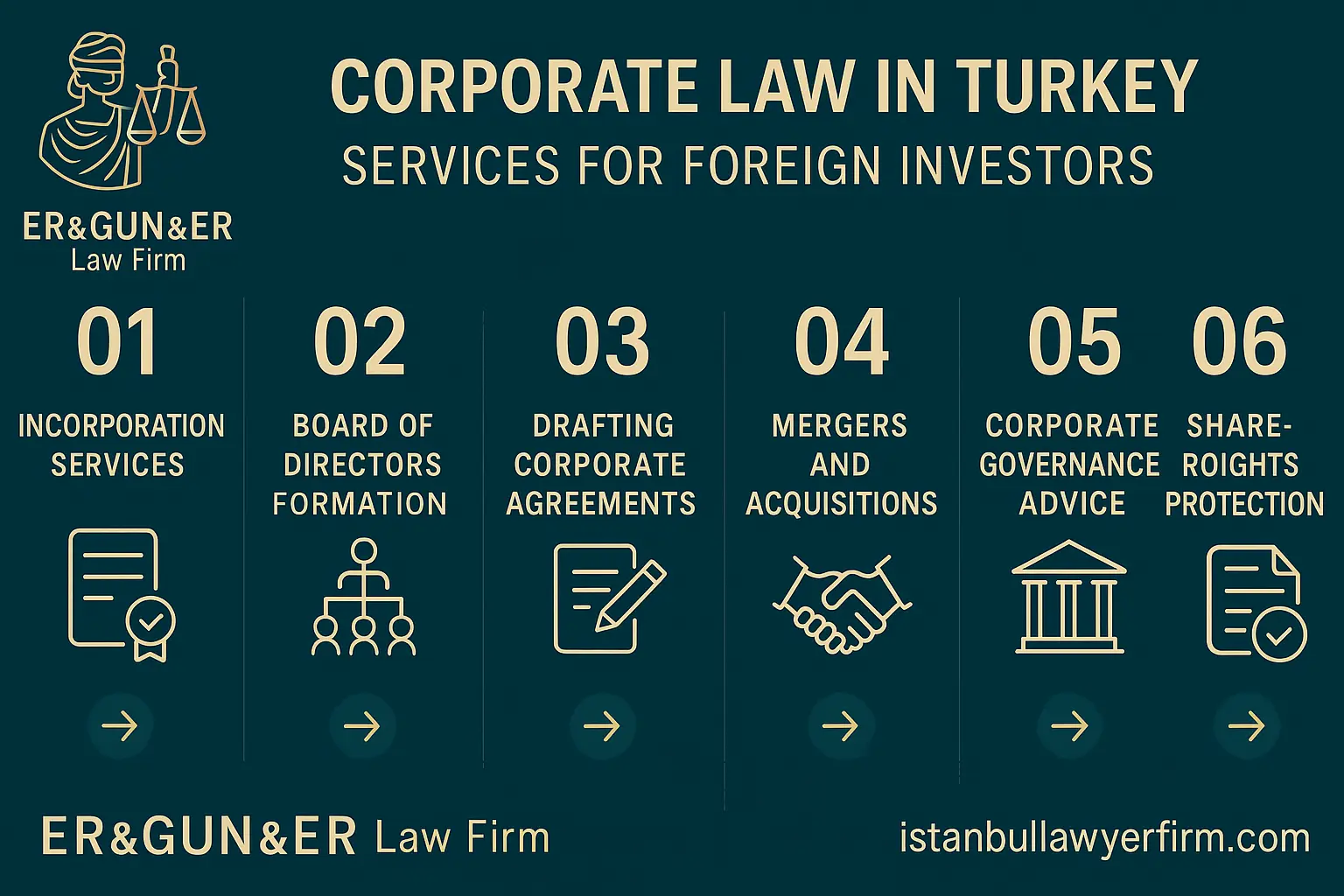
A lawyer in Turkey who advises foreign investors on corporate law services understands that entering the Turkish market—whether through establishing a new legal entity, acquiring an existing Turkish business, structuring a joint venture with a local partner, registering a branch or liaison office, or developing a corporate investment program qualifying for Turkish citizenship—requires comprehensive, technically accurate legal support that addresses not only the formation stage but also the ongoing governance, compliance, regulatory interaction, commercial dispute and structural evolution challenges that foreign-owned companies in Turkey navigate throughout their operational lifetime. An Istanbul Law Firm that provides full-spectrum corporate law services for foreign investors combines statutory expertise in the Turkish Commercial Code (Law No. 6102), the Foreign Direct Investment Law (Law No. 4875), the Capital Markets Law (Law No. 6362), the Anti-Money Laundering Law (Law No. 5549), the Turkish Labor Code (Law No. 4857), the Personal Data Protection Law (Law No. 6698) and numerous sector-specific regulatory frameworks with practical familiarity with Turkish Trade Registry procedures, notary requirements, regulatory agency filing formats, commercial court litigation procedures and enforcement mechanisms—providing the integrated legal capability that foreign investors require to build a legally sound, commercially effective and operationally resilient corporate presence in Turkey. A Turkish Law Firm with deep experience serving international clients across manufacturing, technology, financial services, healthcare, logistics, real estate, energy and consumer goods sectors brings the sector-specific regulatory knowledge and transactional experience needed to advise foreign companies not only on the standard legal framework applicable to all Turkish companies but also on the specific licensing requirements, regulatory approval processes, employment structure standards and compliance obligations that characterize each regulated industry. An English speaking lawyer in Turkey who serves as the primary legal interface for foreign management teams, boards and legal departments ensures that every legal requirement, compliance obligation, transaction step, court development and regulatory interaction is communicated in accurate, clear English that non-Turkish-speaking decision-makers can understand, evaluate and act upon without relying on inadequate translations or unqualified advisors whose guidance fails when legally tested. Turkish lawyers who practice corporate law for international clients bring the practical Turkish legal knowledge that transforms theoretical statutory understanding into operational compliance systems, transaction documentation that satisfies Turkish formality requirements, and dispute management strategies that account for the specific procedures, timelines and evidence standards of Turkish commercial courts and arbitration tribunals.
Company Formation and Legal Structuring for Foreign Investors
A lawyer in Turkey who advises on company formation for foreign investors explains that selecting the appropriate legal entity form is among the most consequential early decisions in a foreign company's Turkish market entry—because entity form determines the company's liability framework, governance structure, minimum capital requirements, tax treatment, regulatory licensing eligibility, and the statutory obligations that attach from incorporation through every stage of the company's Turkish operational life. An Istanbul Law Firm that guides foreign investors through entity selection evaluates each available form against the investor's specific objectives: the limited liability company (limited şirket—Ltd.Şti.) requires a minimum capital of TRY 10,000, can be established with a single shareholder and single manager, imposes no minimum board size requirement and provides simplified governance with flexibility for small to medium foreign investments where operational simplicity and limited liability protection are the primary objectives—though it restricts share transfer flexibility compared to joint stock companies and may be less suitable for structures anticipating multiple shareholder rounds or eventual listing; the joint stock company (anonim şirket—AŞ) requires a minimum capital of TRY 250,000 for non-publicly traded companies, enables more sophisticated capital structures including dual-class share arrangements, convertible instruments and employee share programs, provides the formal governance framework expected by institutional investors and regulated sector licensing authorities, and facilitates capital market transactions including securities issuances and acquisitions—making it the preferred structure for foreign investors with larger capital commitments, complex ownership structures or regulated industry operations; the branch office (şube) of a foreign company extends the parent company's legal personality to Turkey without creating a separate legal entity, subjects the branch's Turkish activities to Turkish tax without the liability isolation that a subsidiary provides, requires registration with the Trade Registry and compliance with Turkish commercial law, and suits foreign companies testing the Turkish market or operating through project-based rather than ongoing commercial activities; and the liaison office (irtibat bürosu) can only conduct promotional, market research and representational activities without generating Turkish-source revenue, requires Ministry of Economy authorization and annual activity reporting, and provides the lightest-touch Turkish legal presence for foreign companies at the exploratory stage of their Turkish market evaluation. Turkish lawyers managing the complete company formation process prepare every required document in the correct format and sequence: Articles of Association (esas sözleşme) drafted in Turkish compliance with TCC mandatory content requirements and customized to the specific governance, shareholder and operational parameters of the foreign investment; notarization of the Articles at a Turkish notary or, for foreign-signed documents, apostille and sworn translation processing; MERSIS-based online trade registry application with the complete document package; tax registration with the relevant Tax Office; SGK registration for companies with employees; and Chamber of Commerce registration where required by the company's business activities. Practice may vary by authority and year — verify current minimum capital requirements, entity formation document requirements, trade registry filing procedures, notarization standards and post-formation registration obligations before any company formation is initiated. For the full procedural framework, see our pillar guide on the complete procedure for establishing a company in Turkey.
An Istanbul Law Firm that manages post-formation compliance for newly established foreign-owned companies explains that the formation filing is only the beginning of a continuous compliance cycle that every Turkish company must maintain from incorporation forward—and that foreign investors who treat formation as a one-time administrative exercise without building the governance infrastructure and compliance calendar needed for ongoing obligations frequently accumulate compliance deficiencies that create legal and financial liability precisely when the company needs to demonstrate clean legal standing for financing, expansion or exit transactions. Turkish lawyers implementing post-formation compliance programs establish the foundational governance infrastructure in the weeks immediately following trade registry registration: preparing the company's statutory books (share ledger, board resolution register, general assembly minutes book) in the format and with the initial entries required by Turkish commercial law; registering the company's authorized signatory combinations with the Trade Registry through notarized signature circular (imza sirküleri); completing SGK employer registration and establishing the payroll and social security contribution procedures required for the company's employees; implementing the financial accounting system compliant with Turkish Accounting Standards and connected to the Revenue Administration's e-invoice, e-archive and e-ledger digital filing systems; and preparing the company's first-year compliance calendar covering every statutory deadline from the annual general assembly through tax declarations, trade registry annual filings and sector-specific regulatory submissions. Foreign directors and shareholders are briefed through structured orientation sessions explaining in plain English every recurring compliance obligation, the consequences of non-compliance, and the internal procedures established to ensure each obligation is satisfied within its statutory deadline.
A Turkish Law Firm that advises on conversion and restructuring of existing Turkish entities for foreign acquisition explains that foreign investors who enter the Turkish market through acquisition of an existing Turkish company rather than greenfield formation inherit the target company's complete compliance history—including all accumulated governance deficiencies, outstanding regulatory obligations, pending litigation, tax liabilities and employment disputes—and that thorough pre-acquisition due diligence examining the target's compliance record across every applicable legal domain is essential for accurately pricing the acquisition, structuring appropriate warranties and indemnities, and planning the post-acquisition remediation needed to bring the target into full compliance with the standards required for the foreign parent's governance framework. An English speaking lawyer in Turkey who manages pre-acquisition due diligence for foreign buyers produces structured legal findings reports that present every identified legal risk in categorized, prioritized formats—distinguishing between confirmed legal liabilities requiring contractual remedy, potential exposures requiring monitoring, and best-practice gaps requiring operational remediation—and provides the legal analysis needed to determine whether identified risks are dealbreakers, price-adjustment items or manageable post-closing remediation projects within the foreign buyer's risk tolerance and integration capability.
Corporate Governance, Shareholder Agreements and Compliance Framework
A lawyer in Turkey who designs corporate governance frameworks for foreign-owned companies explains that effective governance requires more than technically compliant statutory documents—it requires an operational system in which board decision-making, shareholder meeting procedures, management delegation, internal reporting, conflict of interest management and compliance monitoring function correctly within the specific organizational context of the foreign-owned Turkish company, and that governance systems designed without attention to this operational dimension fail precisely when their legal validity is most needed, during disputes, regulatory investigations and commercial transactions where demonstrated governance quality affects the company's legal position. An Istanbul Law Firm that builds governance frameworks for foreign-owned Turkish companies implements each governance component as an operational system with specific procedures, documentation standards and monitoring mechanisms: shareholder agreements (hissedar sözleşmeleri) drafted beyond the minimum TCC requirements to address the specific governance terms most critical to the foreign investor's protection—including pre-emption rights governing share transfers, drag-along and tag-along rights structuring exit transactions, approval rights for specified major decisions requiring unanimous or supermajority shareholder consent beyond the TCC's default majority thresholds, information rights providing each shareholder with access to financial statements and material developments, deadlock resolution mechanisms addressing governance paralysis, non-compete and non-solicitation obligations protecting the company's commercial value, and dispute resolution clauses specifying the forum and governing law for shareholder agreement enforcement; board governance documentation including board regulations, authority delegation matrices defining board-reserved decisions versus management-delegated decisions, conflict of interest disclosure procedures, board meeting notice requirements and minute-taking standards, and board performance review processes maintaining the board's effectiveness throughout the company's development; and compliance monitoring systems generating periodic compliance status reports covering trade registry currency, annual filing completion, tax payment confirmation, SGK declaration status and sector-specific regulatory certification renewal. Practice may vary by authority and year — verify current TCC mandatory governance requirements, shareholder agreement enforceability standards under Turkish law, board resolution format requirements, and conflict of interest disclosure obligations before any corporate governance framework is designed.
An Istanbul Law Firm that implements anti-money laundering compliance programs for foreign-owned Turkish companies explains that Turkish AML legislation—the Anti-Money Laundering Law (Law No. 5549) and the Regulation on Measures Regarding Prevention of Laundering Proceeds of Crime—imposes customer due diligence, suspicious transaction reporting, record-keeping and internal control obligations on a broad range of obligated entities including financial institutions, lawyers, accountants, real estate agents, dealers in precious metals and stones, and companies involved in financial leasing and factoring—and that foreign-owned companies falling within obligated entity categories must implement comprehensive AML compliance programs meeting the Financial Crimes Investigation Board (MASAK) requirements or face substantial administrative penalties and potential criminal liability for responsible officers. Turkish lawyers designing AML compliance programs for obligated entities build programs addressing every regulatory requirement: customer identification and verification procedures establishing the identity of customers and beneficial owners through document collection and verification before relationship establishment; risk-based due diligence applying enhanced procedures to high-risk customers including politically exposed persons, high-risk jurisdiction customers and complex ownership structure entities; suspicious transaction identification and reporting procedures enabling employees to identify and report to MASAK suspicious transactions without alerting customers; record-keeping systems preserving customer identification records, transaction records and due diligence documentation for the statutory minimum retention periods; and internal control, audit and training programs demonstrating the program's operational effectiveness to MASAK inspectors. An English speaking lawyer in Turkey who designs AML compliance programs for international companies ensures Turkish AML requirements are integrated with the company's global compliance framework, that cross-jurisdictional AML reporting obligations are coordinated, and that MASAK inspection responses are managed consistently with the company's global compliance positions.
A Turkish Law Firm that conducts corporate compliance audits for foreign-owned companies provides comprehensive legal assessment of the company's compliance status across every applicable regulatory domain—examining trade registry currency, Articles of Association TCC compliance, board and general assembly decision records, share ledger accuracy, annual filing completion, tax payment and declaration status, SGK registration and contribution payment compliance, sector-specific regulatory license currency, employment contract and personnel file compliance, data protection program implementation, and AML compliance program operation—producing structured findings reports with each identified gap classified by severity, legal risk assessment, and specific remediation recommendations. An English speaking lawyer in Turkey who presents compliance audit findings to foreign management teams provides clear explanations of each identified gap's legal consequences in practical terms that non-lawyers can understand, prioritizes remediation based on legal risk severity rather than administrative convenience, and develops phased remediation plans with realistic timelines, responsible parties and documentation standards that foreign management can implement systematically.
Mergers, Acquisitions and Joint Venture Transactions
A lawyer in Turkey who manages M&A transactions involving Turkish companies explains that cross-border acquisitions and domestic M&A in Turkey involve a multi-stage legal process requiring specialized expertise across due diligence methodology, transaction document drafting, regulatory clearance procedures, competition law compliance and post-closing integration planning—and that the quality of legal management at each stage determines not only the transaction's successful completion but also the acquirer's legal and financial exposure in the years following closing when representations, warranties, indemnities and post-closing obligations define the economic outcome of the transaction. An Istanbul Law Firm that manages M&A transactions for foreign acquirers and sellers conducts due diligence through a structured multi-workstream process: legal due diligence examining corporate structure and governance documentation, material commercial contracts including change of control provisions, employment agreements and compensation arrangements, pending and threatened litigation, regulatory license status and compliance history, intellectual property ownership and freedom to operate, real property ownership and lease arrangements, environmental compliance and liability exposure, and insurance coverage adequacy; financial and tax due diligence examining historical financial statements, tax compliance history and outstanding tax liabilities, transfer pricing compliance, deferred tax positions and contingent tax liabilities, and off-balance-sheet obligations; and operational due diligence examining key customer and supplier relationships, technology infrastructure, information systems and cybersecurity posture, and key employee retention risk—with findings consolidated in a structured report enabling the foreign acquirer to make informed decisions about transaction pricing, structure, representations and warranties, and specific indemnity protections for identified risks. Transaction documentation for Turkish share acquisitions covers share purchase agreements drafted in Turkish or bilingual format specifying representations, warranties, conditions precedent, closing mechanics, purchase price adjustment procedures, specific indemnities for identified risks and post-closing obligations; closing documentation including share transfer deeds, trade registry filings for ownership change registration, shareholder register updates, and board composition change documentation; and post-closing integration documentation addressing operational transition arrangements, management handover procedures and compliance program implementation timelines. Practice may vary by authority and year — verify current mandatory merger control notification thresholds, Competition Authority review procedures and timelines, sector-specific change of control approval requirements, foreign ownership restrictions applicable to the target company's industry, and trade registry filing procedures for ownership changes before any M&A transaction is structured or executed.
An Istanbul Law Firm that manages competition law compliance for Turkish M&A transactions explains that acquisitions meeting the Turkish Competition Authority's (Rekabet Kurumu) mandatory merger control notification thresholds—determined by the combined Turkish turnovers of the transacting parties exceeding defined thresholds under Communiqué No. 2010/4—must be notified to the Competition Authority and receive clearance before closing, and that completing a notifiable transaction without prior clearance constitutes a serious violation of Turkish competition law subject to substantial fines. Turkish lawyers managing competition clearance for M&A transactions prepare the notification filing with the comprehensive market definition analysis, transaction structure description, market share data, competitive effects assessment and remedy proposals required by the Competition Authority's filing guidelines, manage the interaction with Competition Authority case handlers during the review period, respond to information requests that pause the statutory review clock if not responded to within the required timeframe, and coordinate the transaction's closing timeline with the anticipated clearance date to avoid premature closing that would constitute a violation. For acquisitions in regulated sectors including banking, capital markets, energy, telecommunications and media, sector-specific regulatory approvals from BDDK, SPK, EPDK, BTK and RTÜK must be obtained in addition to or in parallel with competition clearance, with each regulatory authority applying its own approval standards, documentation requirements and processing timelines.
A Turkish Law Firm that structures joint venture transactions for foreign investors explains that joint ventures between foreign companies and Turkish partners involve a careful balancing of governance rights, financial commitments, operational responsibilities, intellectual property protection and exit mechanisms that must be addressed comprehensively in the joint venture agreement before the JV entity is established—because governance disputes, deadlock situations, disagreements about profit distribution and exit transaction difficulties that could have been resolved contractually before formation become costly legal conflicts requiring litigation or arbitration if left unaddressed in the foundational JV documentation. An English speaking lawyer in Turkey who negotiates and drafts joint venture agreements for international companies ensures that every material governance, commercial and exit term is addressed with the specificity needed to resolve foreseeable disputes without litigation: board composition and voting rights defining each partner's representation and the majority required for each category of decision; capital contribution obligations and consequences of contribution failure; profit distribution policy including frequency, currency and minimum distribution requirements; intellectual property contribution, ownership and licensing arrangements; non-compete and exclusivity commitments defining each partner's permitted activities during and after the JV; deadlock resolution mechanisms providing for escalating negotiation, mediation and, ultimately, buy-sell procedures when governance paralysis cannot be resolved through negotiation; and exit mechanisms including put and call options, rights of first refusal, drag-along rights and tag-along rights enabling orderly exit when partners' strategic objectives diverge.
Corporate Compliance, Regulatory Filings and Sector-Specific Licenses
A lawyer in Turkey who manages regulatory compliance for foreign-owned companies explains that Turkish corporate compliance encompasses a continuously updated multi-domain regulatory framework administered by different authorities on different timelines—requiring a systematic compliance management approach that tracks every obligation, monitors every deadline, prepares every required document in the correct format, and maintains the evidentiary record demonstrating compliance to auditors, regulators, courts and commercial counterparties who may challenge the company's legal standing at any time. An Istanbul Law Firm that provides ongoing compliance management for foreign-owned Turkish companies maintains comprehensive compliance programs covering trade registry currency requiring timely notification of every registered detail change; annual financial statement preparation, audit where required, and general assembly approval within the statutory three-month year-end deadline; board resolution documentation in TCC-compliant format with required signatures, notarization and trade registry filing for registrable decisions; tax compliance including monthly VAT declarations, monthly withholding tax declarations, quarterly advance corporate tax declarations, annual corporate tax return, and transfer pricing documentation where required; SGK compliance including timely employee registration, monthly premium declarations and contribution payments; and sector-specific regulatory compliance including license renewal applications, periodic operational reports, regulatory inspection preparation and certification maintenance across every sector-specific regulatory regime applicable to the company's industry. Turkish lawyers implementing compliance management programs deliver proactive deadline alerts to company management, prepare every required compliance document as a complete ready-to-file package, coordinate translation and notarization where required, submit filings to the relevant authority within statutory deadlines, and maintain a continuously updated compliance status record accessible to foreign management demonstrating each obligation's completion status. Practice may vary by authority and year — verify current filing deadlines, document format requirements, regulatory submission procedures and penalty provisions across each applicable compliance domain before any compliance management program is implemented.
An Istanbul Law Firm that manages sector-specific licensing for foreign companies explains that operating in regulated industries in Turkey requires obtaining and maintaining sector-specific licenses, operating permits and regulatory authorizations that are prerequisites for legal commercial activity in those sectors—and that these licenses impose ongoing compliance conditions including periodic renewal applications, operational reporting obligations, regulatory inspection readiness, personnel qualification requirements, facility standards and capital adequacy obligations that must be satisfied continuously for the license to remain valid. Turkish lawyers managing sector-specific licensing for foreign companies across Turkey's principal regulated industries maintain detailed knowledge of each sector's regulatory framework: energy sector licenses issued by EPDK covering electricity generation, distribution, supply, natural gas distribution, petroleum storage and pipeline operations—each with specific application requirements, technical capacity standards, financial capacity thresholds and periodic renewal obligations; financial services authorizations issued by BDDK for banking operations, payment institution services and electronic money operations—requiring comprehensive business plan documentation, capital adequacy demonstration, fit and proper assessments of proposed managers and shareholders, and ongoing prudential reporting compliance; telecommunications authorizations issued by BTK for electronic communications services—covering general authorization notification, individual licensing for frequency allocation, and compliance with consumer protection, network security and data localization obligations; and healthcare authorizations issued by the Ministry of Health for hospital and clinic operations, pharmaceutical manufacturing, medical device import distribution and clinical research—requiring facility certification, professional staffing requirements, patient safety standards and pharmacovigilance reporting compliance. An English speaking lawyer in Turkey who manages sector-specific licensing for international companies ensures that each licensing application is prepared with the complete documentation package required by the specific regulatory authority, that the company understands its ongoing compliance obligations under each license, and that license renewal timelines are integrated into the company's compliance calendar with sufficient lead time to prevent operational gaps if renewal applications require extended review periods.
A Turkish Law Firm that manages regulatory investigation responses for foreign companies explains that regulatory investigations, compliance audits and administrative enforcement actions by Turkish regulatory authorities—whether initiated by the Tax Inspection Board, the Social Security Institution, the Personal Data Protection Authority, the Competition Authority, sector-specific regulators or other enforcement agencies—require structured legal response management that addresses the authority's information requests completely and accurately, prevents voluntary disclosure of information beyond what the authority's request requires, identifies and presents available defenses and mitigating factors effectively, and negotiates reduced sanctions where legally available. An English speaking lawyer in Turkey who manages regulatory investigation responses for international companies provides foreign management with real-time English-language updates on investigation developments, legal analysis of the authority's findings and the company's available responses, strategic recommendations for each decision point, and coordination between the Turkish investigation response and any parallel regulatory inquiries in other jurisdictions arising from the same underlying conduct. Companies should establish investigation response protocols before investigations arise—designating the internal investigation coordinator, defining document preservation obligations that activate immediately upon receipt of an investigation notification, and ensuring that employees know to refer all regulator contacts to legal counsel without providing substantive responses before legal advice is obtained.
Corporate Restructuring, Capital Transactions and Liquidation
A lawyer in Turkey who advises on corporate restructuring explains that as foreign companies' Turkish operations evolve—through business growth requiring capital increases, strategic realignment requiring operational restructuring, market exit requiring dissolution, ownership transition requiring share transfer or merger, or financial difficulty requiring debt restructuring—Turkish law imposes specific procedural requirements for each structural change that must be satisfied precisely to achieve legally valid corporate restructuring without creating governance deficiencies, tax liability or creditor exposure that could undermine the restructuring's commercial objectives. An Istanbul Law Firm that manages corporate restructuring for foreign-owned Turkish companies provides comprehensive legal support across the full range of structural transactions: capital increases requiring shareholder approval at the statutory majority threshold, trade registry filing with the required documentation package, notification to existing shareholders of pre-emption rights and the statutory exercise period before third-party subscription, and trade registry publication of the completed capital increase—with the specific procedural requirements varying between cash capital increases, in-kind capital increases involving property or IP contributions, and capital increases through capitalization of retained earnings or shareholder loans; mergers and demergers under Turkish Commercial Code Articles 136-159 requiring preparation of merger or demerger plans, approval by both entities' general assemblies at the statutory supermajority thresholds, creditor protection periods allowing creditors to demand security for outstanding claims, Competition Authority notification if required by combined turnover thresholds, trade registry filings effecting the legal transfer of assets and liabilities, and publication in the Turkish Trade Registry Gazette; share conversions changing ordinary shares to preferred shares or adjusting voting rights through Articles of Association amendments requiring general assembly supermajority approval, trade registry filing and shareholder notification; and entity type conversions changing a limited liability company to a joint stock company or vice versa through the specific conversion procedure established by TCC Articles 180-190. Practice may vary by authority and year — verify current procedural requirements, shareholder approval thresholds, creditor protection obligations, competition law notification requirements and trade registry filing procedures for each specific restructuring transaction type before any corporate restructuring is planned or executed.
An Istanbul Law Firm that manages voluntary liquidation for foreign-owned companies explains that dissolving a Turkish company requires a structured legal process involving shareholder dissolution resolution, appointment of a liquidator, creditor notification and claims settlement, asset realization and distribution to shareholders, and final trade registry deregistration—and that the liquidation process's duration and complexity depend significantly on the company's financial condition, outstanding creditor obligations, employee termination requirements and pending regulatory matters that must be resolved before deregistration. Turkish lawyers managing voluntary liquidation coordinate every procedural element: preparing the general assembly dissolution resolution with the required supermajority approval; filing for liquidator appointment and trade registry registration of liquidation status; publishing dissolution announcements in the Trade Registry Gazette triggering the creditor claim submission period; managing creditor claim evaluation, negotiation and settlement; preparing employee termination documentation satisfying Turkish Labor Code requirements; coordinating final tax clearance certificates from the Revenue Administration and final SGK clearance from the Social Security Institution; filing the final liquidation balance sheet with the general assembly for approval; and applying for trade registry deregistration with the complete documentation package required for final deletion from the commercial register. Companies planning voluntary liquidation should allow sufficient time for the complete process, recognizing that regulatory clearance timelines from tax authorities and SGK can extend the liquidation period significantly beyond the minimum statutory requirements.
A Turkish Law Firm that advises on inbound capital transactions for foreign-owned companies explains that capital flows between foreign parent companies and their Turkish subsidiaries—including equity capital injections, shareholder loan financing, intercompany dividends, management fee payments, royalty payments for licensed intellectual property and capital reductions returning equity to shareholders—each have specific Turkish regulatory, tax and documentation requirements that must be satisfied to achieve the intended financial effect without triggering unintended tax liability, foreign exchange restriction violations or anti-money laundering compliance issues. An English speaking lawyer in Turkey who advises international companies on inbound capital transactions ensures that each transaction type is properly documented and reported: equity capital injections documented with bank transfer records demonstrating the capital source's origin and the SWIFT transfer to the Turkish entity's accounts; shareholder loans documented with properly structured loan agreements addressing interest rates, repayment terms and Turkish thin capitalization rules that limit interest deductibility for related-party loans exceeding defined debt-to-equity ratios; management fee arrangements documented with management services agreements establishing the arm's length basis for fee rates, service scopes and invoicing procedures that satisfy both transfer pricing documentation requirements and withholding tax compliance standards; and dividend distributions documented with general assembly dividend distribution resolutions, withholding tax calculation and payment records, and treaty reduced rate application procedures when applicable double tax treaties provide for reduced dividend withholding rates.
Shareholder Disputes and Corporate Litigation
A lawyer in Turkey who manages shareholder disputes for foreign investors explains that governance conflicts between shareholders—whether arising from disagreements about dividend distribution, management decisions, related party transactions, breach of shareholder agreements, minority oppression or deadlock situations where shareholders cannot reach the consensus needed for fundamental corporate decisions—represent one of the most operationally disruptive and legally complex challenges a foreign investor in Turkey can face, requiring both skilled negotiation that preserves valuable commercial relationships where possible and experienced litigation capability that protects the investor's legal rights when negotiation fails. An Istanbul Law Firm that represents foreign investors in shareholder disputes provides comprehensive dispute management across every forum and procedural stage: pre-litigation legal assessment mapping each party's rights and obligations under the Turkish Commercial Code, the Articles of Association and the shareholder agreement, identifying the strongest available legal positions, evaluating the evidence needed to support each position, and developing negotiation strategies designed to achieve the investor's commercial objectives with minimum litigation cost and relationship damage; mediation and negotiation representation presenting the investor's positions in structured negotiation sessions, preparing settlement proposals that protect the investor's core interests while providing the counterparty with sufficient benefit to reach agreement, and drafting settlement agreements that are legally enforceable and operationally implementable; Turkish commercial court litigation through the specialized commercial courts that handle Turkish Commercial Code disputes, with procedural management covering petition preparation, evidence submission, expert witness engagement, court hearing representation and appeal proceedings; and international arbitration under ICC, LCIA, Istanbul Arbitration Centre or other institutional rules where the shareholder agreement designates arbitration as the dispute resolution forum, with coordination between Turkish-seated arbitration requirements and international arbitration procedure. Practice may vary by authority and year — verify current Turkish commercial court procedures, evidence standards, injunctive relief availability and enforcement mechanisms for shareholder dispute remedies before any shareholder dispute legal strategy is developed.
An Istanbul Law Firm that represents foreign investors in minority shareholder protection proceedings explains that the Turkish Commercial Code provides minority shareholders with specific legal remedies against majority abuse—including the right to request appointment of a special auditor to investigate suspected management irregularities, the right to challenge general assembly decisions violating legal requirements or the Articles of Association, the right to initiate liability claims against directors on the company's behalf when the majority refuses action, and the right to request judicial dissolution when the majority shareholder has so fundamentally damaged the company that continuation is incompatible with good faith—and that these statutory protections can be invoked by foreign minority investors who find themselves subject to minority oppression by local majority shareholders managing the Turkish company to the foreign investor's detriment. Turkish lawyers advising foreign minority shareholders on protection strategy evaluate the factual basis for each available remedy, the evidentiary requirements for success, the realistic litigation timeline and costs, and the practical commercial outcome each remedy produces—enabling the foreign investor to choose between aggressive legal action that maximizes legal protection and negotiated resolution that may achieve commercial objectives more efficiently. A lawyer in Turkey for shareholder dispute representation combines deep knowledge of Turkish corporate litigation procedure with commercial judgment that distinguishes between situations where aggressive litigation is warranted and situations where the investor's interests are better served by structured negotiated resolution, always keeping the client's ultimate commercial objectives—rather than maximizing litigation engagement—as the primary measure of success.
A Turkish Law Firm that manages enforcement of commercial judgments and arbitral awards explains that obtaining a favorable court judgment or arbitral award is only the first step in the enforcement process—because enforcement in Turkey requires additional proceedings through Turkish enforcement offices (icra müdürlükleri) that implement the enforcement against the debtor's Turkish assets, and because foreign judgments and arbitral awards require recognition and enforcement proceedings through Turkish courts before Turkish enforcement offices can act on them. An English speaking lawyer in Turkey who manages enforcement proceedings for foreign judgment and award holders coordinates the complete enforcement process: for Turkish court judgments, initiating enforcement office proceedings with the original judgment, preparing asset discovery applications to identify the debtor's attachable Turkish assets, pursuing garnishment orders against bank accounts and receivables, initiating forced sale proceedings for attached real property and movable assets, and managing distribution of enforcement proceeds; for foreign court judgments, filing recognition and enforcement actions (tanıma ve tenfiz davası) in Turkish regional courts demonstrating that the foreign judgment meets Turkey's recognition criteria including jurisdictional competence, finality, reciprocity and compliance with Turkish public order; and for international arbitral awards governed by the New York Convention, preparing New York Convention enforcement applications demonstrating award finality and compliance with Convention recognition requirements.
Foreign Direct Investment Compliance and Incentive Alignment
A lawyer in Turkey who advises on foreign direct investment compliance explains that Turkey's Foreign Direct Investment Law (Law No. 4875) establishes a generally open foreign investment regime allowing 100% foreign ownership in most sectors without prior government approval—but that specific sectors maintain foreign ownership restrictions, require sector-specific regulatory approvals before foreign investment, or impose ongoing reporting obligations on foreign-invested companies that must be satisfied throughout the investment's operational lifetime to maintain legal standing and investment incentive eligibility. An Istanbul Law Firm that manages FDI compliance for international companies identifies and satisfies every applicable FDI obligation: investment notification to the Presidency of the Republic of Turkey Directorate of Communications for qualifying foreign investments; annual corporate activities report (faaliyet raporu) filed with the Ministry of Industry and Technology for companies receiving investment incentive certificates; foreign currency inflow reporting to Turkish banks for cross-border capital transfers; sector-specific foreign ownership reporting to BDDK for financial services investments, SPK for capital markets investments, EPDK for energy sector investments, BTK for telecommunications investments and RTÜK for media sector investments; and beneficial ownership disclosure obligations under Turkish anti-money laundering regulations applicable to companies in obligated entity categories. Turkish lawyers monitoring FDI compliance track legislative developments affecting foreign investment regulations, sector-specific foreign ownership limits and reporting requirements, ensuring clients are promptly notified of regulatory changes requiring compliance adjustments and that required notifications and reports are filed within applicable deadlines. Practice may vary by authority and year — verify current sector-specific foreign ownership restrictions, investment approval procedures, notification obligations for foreign investment, annual reporting requirements and beneficial ownership disclosure standards applicable to the company's industry and investment structure before any foreign direct investment is made or compliance program is designed.
An Istanbul Law Firm that maximizes investment incentive benefits for foreign-owned companies explains that Turkey's investment incentive system—administered primarily through the Ministry of Industry and Technology's Investment Incentive Certificate (Yatırım Teşvik Belgesi) program—provides substantial financial benefits for qualifying investments including corporate income tax reductions ranging from 50% to 100% depending on the investment region and scale, customs duty exemptions on imported machinery and equipment, value added tax exemptions on machinery and equipment purchases, social security employer premium support for qualifying employment created by the investment, and for strategically important investments at qualifying scale, additional benefits including land allocation, interest support and, in some cases, energy support. Turkish lawyers evaluating investment incentive eligibility for foreign investments assess the proposed investment against the Ministry of Industry and Technology's sector and scale eligibility criteria, identify the incentive certificate category—general, regional, large-scale or strategic—providing the most favorable benefit combination for the specific investment, prepare the incentive certificate application with the required investment plan documentation, and manage post-certificate obligations including investment completion timelines, minimum employment maintenance, and periodic progress reporting that condition continued incentive eligibility and prevent incentive recapture claims. An English speaking lawyer in Turkey who advises foreign companies on incentive programs ensures that the investment structure and operational plan are designed to maximize incentive eligibility, that the incentive certificate is applied for before qualifying equipment purchases are made to capture customs duty and VAT exemptions from the outset, and that ongoing incentive compliance obligations are integrated into the company's annual compliance calendar alongside statutory corporate obligations.
A Turkish Law Firm that advises foreign investors on sensitive sector investment compliance explains that certain industries in Turkey impose sector-specific requirements on foreign investors that go beyond the general FDI framework—requiring prior approval, limiting foreign ownership percentages, mandating specific governance structures with local management requirements, or imposing enhanced due diligence on foreign investors' ownership structures and ultimate beneficial owners. An English speaking lawyer in Turkey who advises international companies on sensitive sector compliance provides a comprehensive regulatory map for each restricted or regulated sector, identifies every approval required before the foreign investment can proceed, prepares the sector-specific application documentation to the required standard, manages regulatory agency interaction throughout the review process, and advises on investment structure optimization that achieves the investor's commercial objectives while satisfying all applicable sector-specific regulatory requirements. Companies planning to invest in media, defense, private security, firearms, aviation, maritime, banking or insurance sectors in Turkey should engage qualified Turkish legal counsel before committing to investment structure decisions that may prove incompatible with applicable sector restrictions or approval requirements.
Intellectual Property, Technology Integration and Data Protection
A lawyer in Turkey who advises on intellectual property protection for corporate investors explains that embedding IP protection into the corporate structure from the outset of a Turkish market entry—rather than addressing IP rights reactively after infringement occurs or after the company's Turkish operations have been operating without adequate IP documentation—is among the most valuable preventive legal investments a foreign company can make, because Turkish trademark, patent, copyright and trade secret protection depends on proper registration, documentation, contractual protection and enforcement that must be established before infringement occurs to be fully effective. An Istanbul Law Firm that integrates IP protection into corporate investment structures for foreign companies provides comprehensive IP services: trademark registration with the Turkish Patent and Trademark Office (Türk Patent ve Marka Kurumu) for all word marks, figurative marks, combined marks and three-dimensional marks used in connection with the company's Turkish products, services and commercial activities—covering the complete Nice Classification goods and services categories applicable to the company's business; patent and utility model registration for innovative products and processes commercialized in Turkey, with patent strategy coordinating Turkish national applications with international PCT applications to achieve the broadest protection consistent with the innovation's commercial value; design registration for ornamental designs embodied in the company's Turkish products; copyright registration and documentation for software, creative works and database compilations where registration provides enhanced enforcement advantages; trade secret protection through employment agreement confidentiality provisions, non-disclosure agreements with counterparties, IT access controls and employee training programs implementing the reasonable measures required to qualify for trade secret legal protection; and IP licensing documentation for technology transferred from the foreign parent to the Turkish subsidiary through properly structured license agreements that satisfy Turkish transfer pricing requirements and qualify for the applicable tax treatment of royalty payments. Practice may vary by authority and year — verify current trademark registration procedures, patent application requirements, design registration standards and copyright protection scope before any IP protection strategy is implemented in Turkey.
An Istanbul Law Firm that implements KVKK data protection compliance programs for foreign-owned companies explains that Turkey's Personal Data Protection Law (Law No. 6698) imposes comprehensive data processing obligations on all companies processing personal data of Turkish data subjects—including employee data, customer data, supplier contact information, website visitor data and CCTV footage—and that KVKK compliance requires a systematic organizational program including comprehensive data processing inventory documentation, technical and organizational security measure implementation, data subject rights response procedures, data breach response planning and, where applicable, registration of specific processing activities and cross-border data transfers with the Personal Data Protection Authority. Turkish lawyers implementing KVKK compliance programs for foreign companies design programs addressing the specific personal data categories, processing activities, third-party sharing arrangements and cross-border transfer mechanisms applicable to the company's specific operations—rather than implementing generic templates that fail to address the company's actual processing activities and data flow patterns. A particular compliance challenge for foreign-owned Turkish companies is cross-border data transfer to the parent company and group entities outside Turkey, which requires either adequacy determination (currently limited to specific countries), appropriate safeguards including standard contractual clauses adopted by the KVKK Board, or specific derogations—with the specific transfer mechanism requirements determined by the destination country's data protection adequacy status and the nature and volume of transferred personal data.
A Turkish Law Firm that advises on technology agreement drafting for corporate investors explains that foreign companies deploying technology in Turkish operations—whether through software licenses from the parent company, cloud computing services from international providers, custom software development by Turkish contractors, technology partnership arrangements with Turkish companies, or establishment of Turkish technology development centers creating new IP—require comprehensive technology agreements protecting their IP rights, defining service standards, allocating liability for technology failures, addressing data security obligations and governing the ownership and licensing of technology developed through collaborative arrangements. An English speaking lawyer in Turkey who drafts technology agreements for international companies ensures that source code escrow arrangements protect the company against developer insolvency or abandonment of custom software the company depends on for operations; software development agreements properly assign IP ownership of developed works to the company rather than leaving ambiguous ownership with the contractor; cloud service agreements address the Turkish regulatory requirements applicable to data stored by cloud service providers serving Turkish companies including KVKK-compliant data processing agreement terms; and open source software compliance procedures identify open source components used in company systems, confirm license compliance, and prevent inadvertent GPL or LGPL license contamination of proprietary software assets.
Frequently Asked Questions
- What corporate entity types are available to foreign investors in Turkey? Foreign investors can establish limited liability companies (Ltd.Şti.), joint stock companies (AŞ), branch offices of foreign companies and liaison offices—with entity selection determining liability framework, governance structure, capital requirements, regulatory licensing eligibility and tax treatment, requiring careful evaluation of each option against the investor's specific objectives before selection.
- Can foreign companies own 100% of a Turkish company? Yes, in most sectors. Turkey's Foreign Direct Investment Law generally permits 100% foreign ownership without prior approval, though specific sectors including media, aviation, private security and certain financial services impose foreign ownership restrictions or require sector-specific regulatory approvals before foreign investment proceeds.
- What is the minimum capital requirement for establishing a Turkish company? Minimum capital requirements are TRY 10,000 for limited liability companies and TRY 250,000 for non-publicly traded joint stock companies under current Turkish Commercial Code requirements—though sector-specific licensing may impose higher minimum capital requirements for companies in regulated industries. These figures are subject to legislative revision and should be verified at the time of company formation.
- How long does company formation take in Turkey? With complete documentation properly prepared and notarized, the trade registry registration process typically takes five to ten business days following submission of the complete application package. Post-registration steps including tax office registration, SGK registration and chamber of commerce registration add additional time. The total elapsed time from initial formation planning to operational readiness typically ranges from two to six weeks depending on document complexity and notary scheduling.
- Are mergers and acquisitions subject to competition law review in Turkey? Yes. Acquisitions meeting the Competition Authority's mandatory notification thresholds must be notified and receive clearance before closing. The thresholds are defined by the combined Turkish turnovers of the transacting parties. Completing a notifiable transaction without clearance constitutes a serious violation subject to significant fines and potential transaction unwinding orders.
- What annual compliance obligations apply to foreign-owned Turkish companies? All Turkish companies must hold annual ordinary general assembly meetings within three months of financial year end, prepare and approve annual financial statements, file annual corporate tax returns, make monthly VAT and withholding tax declarations, maintain trade registry currency through timely notification of registered detail changes, and satisfy sector-specific reporting obligations applicable to regulated industries—among numerous other recurring obligations managed through comprehensive compliance calendars.
- How are shareholder disputes resolved in Turkey? Turkish shareholder disputes can be resolved through negotiation, mediation, Turkish commercial court litigation or, where the shareholder agreement designates arbitration, through institutional or ad hoc arbitration proceedings. Turkish commercial courts handle corporate disputes under specialized commercial procedure rules. The Turkish Commercial Code also provides specific statutory remedies including special auditor appointment, general assembly decision challenges and judicial dissolution.
- What intellectual property registrations are available in Turkey? Turkey provides trademark registration, patent and utility model registration, industrial design registration and geographical indication registration through the Turkish Patent and Trademark Office. Turkey is a party to the Madrid System for international trademark registration and the Patent Cooperation Treaty for international patent applications, enabling coordinated international and Turkish IP protection through unified filing procedures.
- What data protection obligations apply to foreign-owned Turkish companies? The Turkish Personal Data Protection Law (KVKK) imposes comprehensive obligations on all companies processing personal data of Turkish data subjects—including data processing inventory maintenance, security measure implementation, data subject rights response procedures, data breach notification, and cross-border data transfer compliance—regardless of whether the company is Turkish or foreign-owned.
- Are there investment incentives for foreign investors in Turkey? Yes. The Ministry of Industry and Technology's Investment Incentive Certificate program provides qualifying investments with corporate income tax reductions, customs duty exemptions, VAT exemptions, social security employer premium support and additional benefits for strategic investments—with the specific incentive package determined by the investment's region, sector, scale and employment creation. Eligibility and benefit levels require verification at the time of investment planning as program parameters are periodically updated.
- Do I need to register my foreign direct investment with Turkish authorities? Foreign investments in certain regulated sectors require sector-specific regulatory approvals before investment proceeds. All qualifying foreign investments may have notification obligations. Companies receiving investment incentive certificates have ongoing reporting obligations to the Ministry of Industry and Technology. Specific FDI notification and reporting requirements depend on the investment's sector, structure and incentive arrangements.
- Can foreign judgments be enforced in Turkey? Yes, subject to recognition and enforcement proceedings through Turkish courts. Foreign court judgments must meet Turkey's recognition criteria including jurisdictional competence, finality, reciprocity and compliance with Turkish public order. Foreign arbitral awards from New York Convention member countries are enforced through Convention recognition proceedings in Turkish courts. Once recognized, both court judgments and arbitral awards are enforced through Turkish enforcement offices against the debtor's Turkish assets.
- What employment obligations apply when establishing a Turkish company? Turkish employers must register employees with the Social Security Institution (SGK) before employment commencement, execute written employment contracts satisfying Turkish Labor Code minimum content requirements, pay at least the semi-annually revised minimum wage, comply with paid annual leave entitlement requirements, implement overtime authorization and compensation procedures, and follow documentation-compliant disciplinary and termination processes—with non-compliance resulting in SGK penalties, labor court claims and administrative enforcement.
- How is intellectual property transferred between a foreign parent and its Turkish subsidiary? IP transfers and licenses between related parties must be documented with properly structured agreements satisfying Turkish transfer pricing requirements—establishing arm's length pricing for royalties and license fees through comparable transaction analysis or other transfer pricing methodology—and must comply with Turkish withholding tax obligations on outbound royalty payments, potentially reduced under applicable double tax treaties where the treaty provides for reduced royalty withholding rates and the procedural requirements for treaty application are satisfied.
- Does ER&GUN&ER Law Firm provide full-spectrum corporate law services for foreign investors? Yes. ER&GUN&ER Law Firm provides comprehensive corporate law services for foreign investors in Turkey including company formation, governance framework design, shareholder agreement drafting, M&A transaction management, competition law compliance, regulatory filing and license management, corporate restructuring, shareholder dispute representation, FDI compliance, investment incentive optimization, IP protection, KVKK compliance and technology agreement drafting, with bilingual English-Turkish legal support throughout each engagement.
Author: Mirkan Topcu is an attorney registered with the Istanbul Bar Association (Istanbul 1st Bar), Bar Registration No: 67874. His practice focuses on cross-border and high-stakes matters where evidence discipline, procedural accuracy, and risk control are decisive.
He advises individuals and companies across Immigration and Residency, Real Estate Law, Tax Law, and cross-border documentation matters where procedural accuracy and evidence discipline are decisive.
Education: Istanbul University Faculty of Law (2018); Galatasaray University, LL.M. (2022). LinkedIn: Profile. Istanbul Bar Association: Official website.