

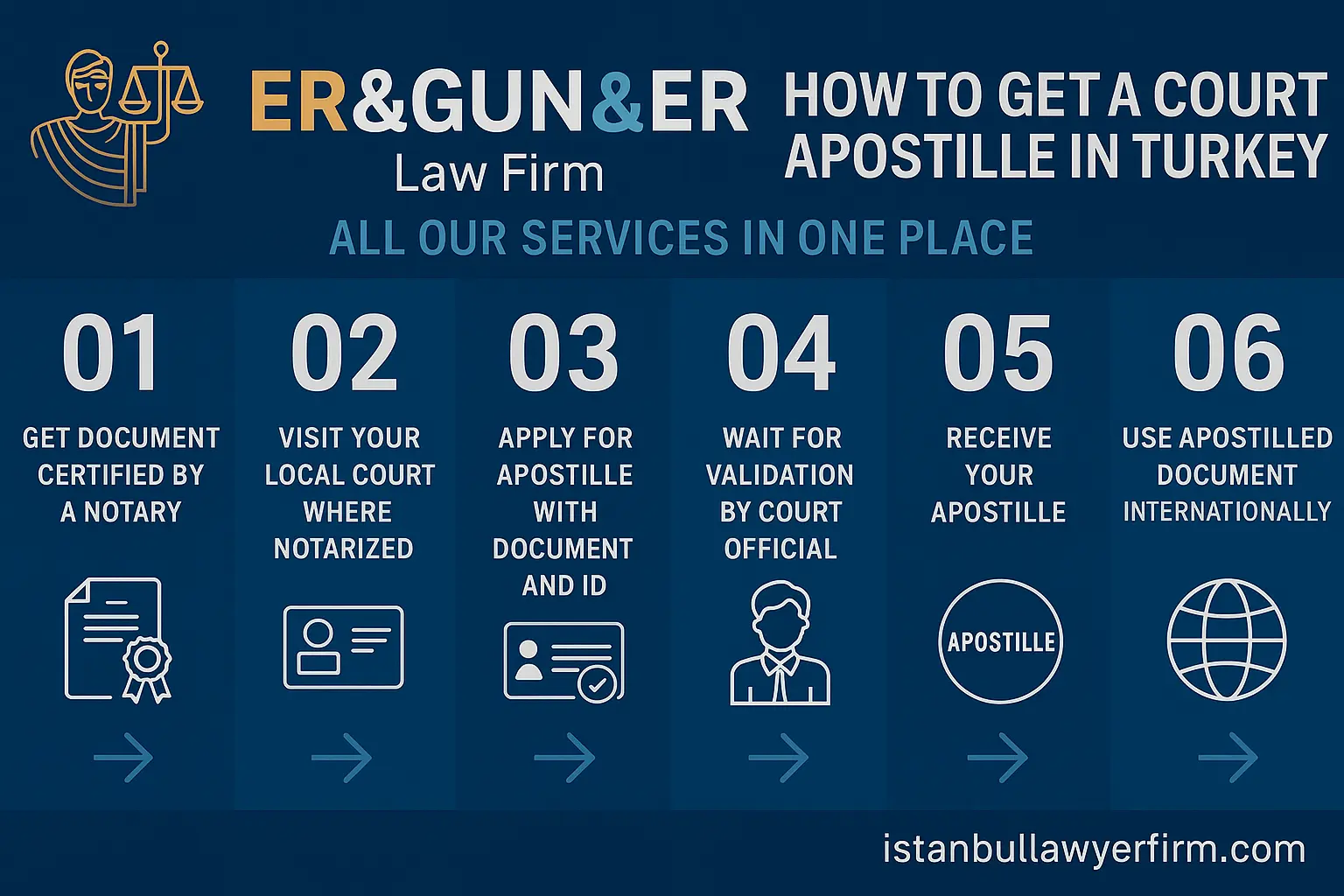
An apostille is a standardized authentication certificate that verifies the authenticity of a public document—specifically, the authenticity of the signature, stamp, or seal on the document—for use in countries that are parties to the Hague Convention Abolishing the Requirement of Legalisation for Foreign Public Documents (the 1961 Hague Apostille Convention). Turkey became a party to this Convention, and Turkish apostilles are accepted in all other Hague Convention member countries without further legalization. The apostille does not verify the content of the document—it verifies that the signature, stamp, or seal on the document belongs to the authority that issued it. This distinction matters because foreign embassies and foreign authorities frequently confuse the apostille with a certification of content accuracy, and understanding what the apostille actually certifies helps you understand what additional steps—such as sworn translation—may be needed alongside it. In Turkey, apostilles are issued by the Civil Courts of Peace (Sulh Hukuk Mahkemesi) in the judicial district where the document was issued, which is why the process is commonly referred to as "court apostille" (mahkemeden apostil) even though it is an administrative function of the court rather than a judicial proceeding. This guide covers every aspect of the Turkish apostille process that a foreign national or Turkish citizen dealing with international documents needs to understand: which documents require apostille, which authority issues it, how the application process works, what the realistic timelines are, what happens when apostille is not enough, and the specific apostille situations that arise most frequently for foreigners in Turkey. The Convention and Turkey's implementing legislation are accessible at Mevzuat.
What the apostille certifies and what it does not
A lawyer in Turkey advising on the apostille function must explain the precise scope of what an apostille certifies—because misunderstanding this scope leads to one of the most common and frustrating errors in international document preparation. The apostille certifies three things and three things only: the authenticity of the signature on the document; the capacity in which the person who signed the document was acting; and where applicable, the identity of the seal or stamp on the document. The apostille says nothing about the accuracy of the content of the document. A Turkish birth certificate that contains a name spelling error will receive an apostille with exactly the same effect as a birth certificate with the correct name—because the apostille certifies that the civil registry official who signed the certificate was indeed a civil registry official, not that the information recorded in the certificate is accurate. The practical implication is that an error in a Turkish civil document must be corrected through the Turkish civil registry correction process before the apostille is applied—because once apostilled, the document will be authenticated in its current form including any errors. Practice may vary by authority and year — check current guidance on the current Turkish civil registry correction procedures applicable to errors in the specific document type before obtaining an apostille on a document that may contain inaccuracies.
An Istanbul Law Firm advising on which Turkish documents are "public documents" for apostille purposes must explain that the Hague Convention applies to "public documents"—a category that in Turkey includes: documents issued by courts (judgments, decisions, notarial acts performed by courts); documents issued by administrative authorities (civil registry certificates, apostilles from other authorities); notarial documents (notarized contracts, notarized powers of attorney); official certifications on private documents (such as a notary's certification of a private document). Private documents—contracts between private parties, letters, financial statements prepared by private companies—are not directly apostillable in Turkey. A private document that a foreign authority requires in apostilled form must first be notarized by a Turkish notary public (which makes the notary's signature on the document a public certification) and then the notarial act can be apostilled. This two-step process—notarization followed by apostille—is the standard mechanism for apostilling private documents through the Turkish system. Practice may vary by authority and year — check current guidance on the current distinction between public and private documents applicable to apostille eligibility in Turkey and on the specific notarization requirements for private documents that will subsequently be apostilled.
A Turkish Law Firm advising on the relationship between apostille and translation must explain that the apostille authentication process and the sworn translation process are separate and serve different purposes—but both are typically required when a Turkish document will be used by a foreign authority that does not read Turkish. The apostille authenticates the Turkish document; the sworn translation converts the document content into the foreign language in a certified format. Foreign embassies, universities, government agencies, and courts that receive an apostilled Turkish document in Turkish will typically also require a sworn translation of the document into their language, produced by a translator recognized in the jurisdiction where the document will be used. The translation is not apostilled—the original Turkish document is apostilled. Practice may vary by authority and year — check current guidance on the specific translation requirements of the foreign authority that will receive the Turkish document—both the language required and the translator certification standard—before arranging translation alongside the apostille.
Which documents require apostille in Turkey
A law firm in Istanbul advising on the documents that most frequently require apostille in Turkey must explain the main categories by use context. Civil registry documents used abroad—birth certificates (doğum belgesi), marriage certificates (evlenme belgesi), death certificates (ölüm belgesi), and family registry extracts (nüfus kayıt örneği)—are among the most frequently apostilled Turkish documents, required for immigration applications abroad, citizenship applications in foreign countries, marriage registrations abroad, inheritance proceedings in foreign jurisdictions, and academic enrollment. Court documents—judgments, decisions, and official court records—require apostille when they must be recognized or enforced in a foreign jurisdiction. Notarial documents—powers of attorney, notarized contracts, certified copies of identity documents, and sworn statements notarized in Turkey—require apostille when they will be used in a foreign country that is party to the Hague Convention. Educational documents—diplomas, transcripts, and graduation certificates issued by Turkish universities—require apostille for use in foreign academic or professional recognition applications. Practice may vary by authority and year — check current guidance on the specific apostille requirements of the foreign authority or institution that will receive the Turkish document before initiating the apostille process.
An English speaking lawyer in Turkey advising on the specific apostille requirements for Turkish court judgments used in foreign enforcement proceedings must explain that a Turkish court judgment that will be submitted to a foreign court for recognition and enforcement typically requires: the official copy of the judgment (onaylı suret) issued by the court clerk; the apostille certificate on that official copy; and in most cases, a sworn translation of the judgment into the language of the foreign jurisdiction. The official copy of the judgment is different from an ordinary photocopy—it must be issued by the court that rendered the judgment and must bear the court seal and the signature of the clerk certifying authenticity. An ordinary photocopy of a judgment, even if stamped, will not be accepted for apostille purposes and will not satisfy foreign court requirements. The international enforcement of Turkish judgments framework—covering the full process of enforcing Turkish judgments abroad—is analyzed in the resource on international enforcement of Turkish judgments. Practice may vary by authority and year — check current guidance on the specific official copy and apostille requirements of the foreign jurisdiction where enforcement is being sought before preparing any judgment documentation package.
A Turkish Law Firm advising on the apostille requirements for Turkish powers of attorney used abroad must explain that a power of attorney executed before a Turkish notary public is a notarial document that can be apostilled through the standard court apostille process. However, the specific requirements of the foreign jurisdiction where the power of attorney will be used are often more demanding than simply having a Turkish apostille—some jurisdictions require the power of attorney to use specific language, to include specific authorizations in specific order, or to be executed in specific forms that differ from standard Turkish notarial practice. A power of attorney drafted for use in a specific foreign jurisdiction should be prepared with awareness of that jurisdiction's requirements before it is executed before the Turkish notary—because redoing the power of attorney after execution (if the content is wrong) requires starting the notarization and apostille process over from the beginning. Practice may vary by authority and year — check the specific power of attorney form and language requirements of the foreign jurisdiction where it will be used before executing any power of attorney in Turkey for foreign use.
Which authority issues apostilles in Turkey
A law firm in Istanbul advising on the apostille issuing authority in Turkey must explain that Turkey has designated different authorities to issue apostilles depending on the type of document—not all apostilles in Turkey come from the civil courts. The competent authorities for different document categories are: the Civil Courts of Peace (Sulh Hukuk Mahkemesi) for notarial documents, civil registry documents, court documents, and most other public documents; the Ministry of Justice for certain judicial documents at the central level; the Ministry of Foreign Affairs for documents from diplomatic missions and consular offices; and the Governorship (Valilik) for some administrative documents. The "court apostille" colloquially refers to the Civil Court of Peace apostille, which is the category covering the broadest range of documents. When people talk about "getting an apostille in Turkey," they are almost always referring to the Civil Court of Peace process. Practice may vary by authority and year — check current guidance on the competent authority for the specific Turkish document type being apostilled from the Turkish Ministry of Justice apostille information at adalet.gov.tr.
An English speaking lawyer in Turkey advising on the local jurisdiction dimension of apostille applications must explain that the Civil Court of Peace that has jurisdiction to issue the apostille on a specific Turkish document is the court in the judicial district where the document was originally issued—not necessarily the court closest to where the applicant currently lives or works. A birth certificate issued by the Ankara civil registry office must be apostilled at the Civil Court of Peace in Ankara, not in Istanbul where the applicant may currently reside. A power of attorney executed before a notary in Istanbul must be apostilled at the Istanbul Civil Court of Peace. This geographic requirement means that obtaining apostilles on documents from multiple Turkish cities requires either traveling to each city or engaging a representative in each city through a power of attorney. Practice may vary by authority and year — check current guidance on the current jurisdictional rules for apostille applications and on whether any centralized or online apostille submission mechanism has been introduced since this guide was prepared.
A Turkish Law Firm advising on the e-apostille system must explain that Turkey has been working toward implementing an electronic apostille system as part of the Hague Conference on Private International Law's e-APP (Electronic Apostille Pilot Program). An e-apostille, where available, is issued and transmitted electronically rather than through a physical stamp on the paper document. The availability and scope of e-apostille issuance in Turkey for specific document types has been expanding, and it is worth verifying whether the specific document you need apostilled can be processed through an electronic system that may offer faster processing. However, foreign authorities' acceptance of e-apostilles varies—some foreign jurisdictions still require physical apostille stamps and do not accept e-apostille certificates for certain document types. Before relying on an e-apostille format, verify with the specific foreign authority that will receive the document that their current acceptance practice includes e-apostilles. Practice may vary by authority and year — check current guidance on the current e-apostille availability for your specific Turkish document type and on the current acceptance status of Turkish e-apostilles in the foreign jurisdiction where the document will be used.
Step-by-step apostille application process
A law firm in Istanbul advising on the apostille application process must explain each step clearly so that someone applying for the first time knows exactly what to do. Step one: obtain the original document or a certified official copy issued by the relevant Turkish authority. For civil registry documents, this means obtaining a current official extract from the civil registry (nüfus müdürlüğü)—not a photocopy of an old certificate. For notarial documents, this means the original notarized document with the notary seal. For court documents, this means obtaining an official certified copy from the court clerk's office. Step two: go to the Civil Court of Peace in the judicial district where the document was issued. Step three: submit the apostille application at the court's records office (yazı işleri müdürlüğü). Some courts have a dedicated apostille desk; others process apostille requests through the general records office. Step four: pay the court fee (harç) for the apostille. The fee is set by the Court Fees Law and is updated periodically. Step five: receive the apostille—this may be issued on the same day for straightforward applications at courts with manageable workloads, or it may take several days at busier courts. Practice may vary by authority and year — check current guidance on the current procedure at the specific Civil Court of Peace in the relevant judicial district, including any appointment booking requirements that may have been introduced, before visiting.
An English speaking lawyer in Turkey advising on the common errors that cause apostille applications to fail or be delayed must explain the specific mistakes to avoid. The most common error is presenting a photocopy or an unofficial copy of the document rather than the original or a certified official copy—the court will not apostille an unofficial copy. The second most common error is presenting a document from the wrong issuing district to the court in a different district—the court must have jurisdiction over the issuing authority for the apostille to be valid. The third most common error is presenting a document whose original signature or seal is from an authority that is no longer in operation or whose authority structure has changed—the court may not be able to verify the original signature in the registry. The fourth error is presenting a document that is not a "public document" under the Hague Convention without first having it notarized. Being aware of these failure points before going to the court saves significant time and avoids frustrating wasted trips. Practice may vary by authority and year — check current guidance on the current document format requirements at the specific court before submitting any apostille application.
A Turkish Law Firm advising on managing multiple apostille applications efficiently must explain practical coordination strategies. A person who needs apostilles on several Turkish documents from different cities can manage the process either by traveling to each relevant court, by engaging local attorneys or representatives in each city through a power of attorney, or by using professional document services that specialize in apostille coordination across multiple Turkish courts. For a single document from a single court, self-management of the apostille process is straightforward. For complex situations—multiple document types, multiple issuing jurisdictions, tight deadlines, or documents being sent to multiple different countries—professional coordination significantly reduces the risk of errors and delays. A power of attorney specifically authorizing a representative to apply for apostilles on specific documents is a standard tool that Turkish notaries can prepare efficiently. Practice may vary by authority and year — check current guidance on the power of attorney requirements for apostille applications on behalf of a third party at the specific court before preparing any authorization documents.
Processing times and realistic expectations
A law firm in Istanbul advising on apostille processing times must provide honest expectations rather than best-case scenarios. The range is wide: at smaller courts in less busy provincial cities, apostilles on straightforward documents may be issued within hours of the application. At major Istanbul courts during busy periods, the same application may take three to seven business days. At certain courts with backlogged workloads, the processing time may extend to two weeks or more. There is no nationally standardized processing time because each court manages its own workload independently. The processing time also depends on the document type—a straightforward civil registry document apostille typically processes faster than an apostille on a complex court document that requires verification of the issuing judge's signature against registry records. An applicant who needs an apostille by a specific deadline should apply well in advance of that deadline rather than applying as close to the deadline as possible. Practice may vary by authority and year — check current guidance on the current processing times at the specific Civil Court of Peace handling your apostille application before committing to any deadline that depends on apostille availability.
An English speaking lawyer in Turkey advising on how to follow up on a pending apostille application must explain that after submitting the application and receiving the application receipt, the applicant or their representative can inquire at the court's records office about the status of the application. Turkish courts generally do not provide proactive updates by email or phone—follow-up requires physical presence at the court or a call to the relevant clerk's office. If processing is taking longer than expected, polite inquiry at the court is the appropriate approach—escalating immediately to formal complaints or demands creates friction without accelerating the process. For applicants who are not physically present in the city where the apostille is being processed, a local representative who can make in-person follow-up inquiries is practically valuable. Practice may vary by authority and year — check current guidance on the follow-up procedures at the specific court handling your application and on any online status tracking systems that may have been introduced for apostille applications.
A Turkish Law Firm advising on urgent apostille situations must explain that Turkish courts do not have a formal expedited apostille service that guarantees same-day or next-day processing for an additional fee. In genuinely urgent situations, the practical options are: applying in person at the court and explaining the urgency to the clerk—courts occasionally accommodate legitimate urgent requests when workload permits; engaging a professional document service or local attorney who has established working relationships with the relevant court staff; and being realistic that "urgent" processing is a courtesy rather than a right and is not guaranteed. An applicant who has a hard deadline driven by a foreign immigration appointment or a corporate closing should build adequate buffer time into their apostille planning rather than relying on getting urgent accommodation. The most effective "expediting" strategy is avoiding the urgent situation in the first place by initiating apostille applications as early as possible in the document preparation process. Practice may vary by authority and year — check current guidance on any officially offered priority processing arrangements at the specific court before planning any apostille timeline that depends on expedited processing.
Civil registry documents: births, marriages, deaths
A law firm in Istanbul advising on apostilles for Turkish civil registry documents must explain that these documents—birth certificates, marriage certificates, death certificates, family registry extracts—are among the most frequently apostilled Turkish documents because they are required across a wide range of international procedures. The important starting point is that Turkish civil registry documents should be obtained fresh before the apostille process—because foreign authorities typically require that civil registry documents not be older than a defined period (commonly three to six months) when they are submitted. Using a ten-year-old Turkish birth certificate even if perfectly valid under Turkish law may be rejected by a foreign authority that requires a recent issue. Obtaining a fresh civil registry document in Turkey can be done at the civil registry office (nüfus müdürlüğü) in the relevant district, or through the e-Devlet government portal for certain document types. Practice may vary by authority and year — check the specific document freshness requirements of the foreign authority receiving the Turkish civil registry document before deciding which version to apostille.
An English speaking lawyer in Turkey advising on the multi-language format of Turkish civil registry documents must explain that Turkey issues certain civil registry documents in a standardized multilingual format—the international form that is accepted in many countries without translation under bilateral agreements. This multilingual civil registry document is available for births, marriages, deaths, and certain other events, and when it is accepted by the receiving foreign authority, it eliminates the need for a sworn translation alongside the apostille. However, not all foreign authorities accept the multilingual format, and the acceptance varies by country and document type. Verifying in advance whether the foreign authority will accept the multilingual Turkish civil document—and therefore whether sworn translation can be avoided—saves time and translation costs. Practice may vary by authority and year — check the current acceptance of multilingual Turkish civil registry documents in the specific foreign country before choosing between standard Turkish format and multilingual format for the apostille application.
A Turkish Law Firm advising on the specific apostille requirements for Turkish civil registry documents used in foreign citizenship and immigration applications must explain that the foreign immigration authority's requirements often go beyond simply having an apostille—they may require the document to be issued within a specific time period, to include specific information fields, to be accompanied by a sworn translation in a specific format, and to be submitted with supporting documentation such as a national identity card copy alongside the apostilled document. A Turkish birth certificate apostilled in the standard format may satisfy the Hague authentication requirement while still failing to satisfy the foreign immigration authority's specific content requirements—for example, if the certificate does not show the required parental information or if it is in a format that predates a recent format change in Turkish civil documents. The citizenship Turkey framework—covering Turkish citizenship applications that require civil registry documents—is analyzed in the resource on Turkish citizenship by birth. Practice may vary by authority and year — check the specific document content and format requirements of the foreign immigration authority before apostilling any civil registry document for immigration purposes.
Educational and professional documents
A law firm in Istanbul advising on the apostille process for Turkish educational documents—university diplomas, transcripts, graduation certificates—must explain that the process has a specific routing that differs from civil registry document apostille. Turkish university diplomas and official transcripts are issued by the university, which is a public institution—and as a public document bearing an authorized official's signature and university seal, it is apostillable at the Civil Court of Peace in the judicial district where the university's headquarters is located. The university must issue the diploma or transcript in official format with the appropriate signatures and stamps before the apostille application is submitted. A student or graduate who needs an apostilled diploma should first obtain the official copy from the university's student affairs office, confirm that it bears all required signatures and seals, and then proceed to the relevant Civil Court of Peace for the apostille. Practice may vary by authority and year — check current guidance on the specific format requirements at your Turkish university and on the relevant judicial district for the apostille application before initiating the process.
An English speaking lawyer in Turkey advising on the apostille requirements for Turkish professional licenses and certifications must explain that professional licenses issued by Turkish regulatory bodies—medical licenses from the Ministry of Health, attorney bar registration certificates from bar associations, engineering certifications from professional chambers—are public documents issued by official bodies that are apostillable through the Civil Court of Peace. However, the apostille certifies the authenticity of the issuing body's signature and seal—it does not verify the holder's current registration status or the validity of the license in Turkey. A foreign licensing authority that wants to verify whether a Turkish professional is currently registered and in good standing in Turkey will need to contact the Turkish regulatory body directly in addition to receiving the apostilled license document. Practice may vary by authority and year — check the current requirements of the foreign licensing authority—both the apostille and any direct verification or equivalency assessment requirements—before preparing professional qualification documentation for foreign use.
A Turkish Law Firm advising on the YÖK (Council of Higher Education) equivalency and apostille interaction must explain that for Turkish academic credentials used in countries that require formal equivalency recognition, the apostille alone may not be sufficient—the foreign educational authority may also require a YÖK equivalency certificate or similar institutional assessment before they accept the Turkish diploma. The apostille answers the question "is this a genuine Turkish university diploma?" by authenticating the signatures and seal—but the equivalency assessment answers the different question "does this Turkish diploma qualify for recognition at a specific foreign academic level?" These are two separate processes, and both may be required by foreign academic or professional licensing authorities. Practice may vary by authority and year — check the equivalency recognition requirements of the specific foreign authority alongside the apostille requirements before preparing any Turkish academic credential for foreign use.
Apostille for documents coming into Turkey
A law firm in Istanbul advising on the reverse situation—foreign documents brought into Turkey that need to be recognized by Turkish authorities—must explain that Turkey similarly requires apostille authentication on foreign public documents when they are submitted to Turkish courts, administrative offices, notaries, or civil registry authorities. A foreign birth certificate submitted to the Turkish civil registry for family registration, a foreign marriage certificate submitted for recognition in Turkey, a foreign court judgment submitted for enforcement in Turkish courts, and a foreign power of attorney submitted for use in Turkish notarial proceedings all require apostille authentication from the competent authority in the issuing country. Without the apostille, Turkish authorities will typically not accept the foreign document regardless of how apparently authentic it looks. Practice may vary by authority and year — check current guidance on the current apostille requirements applicable to your specific foreign document type at the relevant Turkish authority before traveling to Turkey with documents that will need to be accepted by Turkish institutions.
An English speaking lawyer in Turkey advising on the position of documents from non-Hague Convention countries must explain that for documents from countries that are not parties to the Hague Apostille Convention—countries that have not signed or acceded to the 1961 Convention—the apostille mechanism is not available. For these documents, Turkish authorities typically require consular legalization: the document must be authenticated by the issuing country's foreign ministry or relevant authority, and then authenticated again by the Turkish embassy or consulate in the issuing country. This consular legalization process is the pre-apostille era alternative that remains required for non-Convention countries. Some bilateral agreements between Turkey and specific non-Convention countries may provide for simplified authentication mechanisms that differ from both apostille and full consular legalization—verifying the current bilateral arrangement applicable to your specific country pair is important. Practice may vary by authority and year — check current guidance on the current authentication requirements at the specific Turkish authority that will receive the foreign document and on the bilateral arrangements applicable to documents from the specific issuing country.
A Turkish Law Firm advising on the sworn translation requirements for foreign documents used in Turkey must explain that a foreign document submitted to a Turkish authority—even one that has been properly apostilled—must also be accompanied by a Turkish sworn translation (yeminli tercüman çevirisi) certified by a notary. The foreign original plus its apostille plus the sworn Turkish translation plus the notarization of the translation is the complete package that Turkish authorities typically require. A foreign national who needs to use a foreign document in Turkish court proceedings, a Turkish notarial act, a Turkish civil registry procedure, or a Turkish administrative application should plan to have this complete four-component package assembled before the relevant appointment. Missing any component causes the Turkish authority to reject the document and typically requires scheduling a new appointment after the gap is filled. The legal translation services Turkey framework—covering the sworn translation requirements for legal proceedings—is analyzed in the resource on legal translation services Turkey. Practice may vary by authority and year — check current guidance on the current sworn translation and notarization requirements at the specific Turkish authority receiving the foreign document.
Common apostille mistakes and how to avoid them
A law firm in Istanbul advising on the most common apostille errors must identify the mistakes that cause the most disruption. The most expensive and time-consuming mistake is apostilling a document that contains an error—a name misspelling, wrong date, or missing information—because correcting the underlying error after apostille requires obtaining a corrected document from the original issuing authority, which then needs to be re-apostilled. The correction process for Turkish civil registry documents involves a court application (nüfus kaydının düzeltilmesi davası) that can take months. The solution is to carefully review every document for accuracy before initiating the apostille process and to correct any errors first. The second most common mistake is using an outdated version of the document—foreign authorities' freshness requirements mean that an apostilled document from two years ago may be rejected even though the apostille itself is still valid. Check the freshness requirement of the receiving authority before apostilling. Practice may vary by authority and year — check current guidance on the document correction procedures applicable to Turkish civil registry errors before initiating any apostille on a document that may contain inaccuracies.
An English speaking lawyer in Turkey advising on the translation-related apostille mistakes must explain the most common error in this category: having the apostilled document translated after apostille by a translator who is not recognized as a "sworn translator" in the country where the document will be used. Many foreign authorities—particularly in the EU, the UK, and North America—have specific requirements about who can produce a certified translation for official purposes, and a translation produced by a translator who is recognized as a sworn translator in Turkey but who is not recognized in the destination country may not satisfy the foreign authority's requirements. The solution is to research the translation requirements of the destination authority before commissioning any translation—ideally before the apostille is obtained, because the translation requirement may affect the choice of document format (for example, the multilingual international civil registry form versus the standard Turkish form). Practice may vary by authority and year — check the current translation and translator recognition requirements of the specific foreign authority that will receive the apostilled and translated document.
A Turkish Law Firm advising on the chain of authentication error must explain a mistake that occurs specifically with documents that involve multiple authentication steps—where a document has been notarized in Turkey and then needs to be apostilled, or where a foreign document needs to be apostilled and then used in Turkey with a notarized translation. The chain error occurs when one step in the authentication chain is out of order: for example, if a notarized document is photocopied and the photocopy is submitted for apostille rather than the original notarized document; or if a translated document is submitted for notarization before the original has been apostilled. The apostille must always be placed on the original official document or the original notarial act—never on a copy, never on a translation. When the sequence requires both apostille and translation, the correct order is: original document → apostille on original → translation of apostilled document → notarization of translation. Practice may vary by authority and year — check current guidance on the specific authentication chain sequence required by the foreign authority for your specific document type before initiating any multi-step authentication process.
Practical guide for specific situations
A Turkish Law Firm advising on the apostille needs for a foreign national applying for citizenship in their home country based on Turkish documents must explain that citizenship by descent applications in most countries require a comprehensive set of civil registry documents—typically the connecting ancestor's birth certificate, marriage certificate, and in some cases death certificate—each apostilled and accompanied by certified translation. These applications often require documents spanning multiple generations, which means multiple Turkish civil registry offices may be involved (if family members were registered in different cities) and multiple apostille applications at different Civil Courts of Peace. The documents also frequently need to be obtained from historical civil registry records that may be held in archived format, and the extraction and official issuance of historical registry documents requires specific applications to the civil registry directorate. A person managing a citizenship by descent application involving Turkish documents should start the document collection process months before any application deadline. Practice may vary by authority and year — check the current document requirements for citizenship by descent applications in the specific destination country and the current Turkish civil registry procedures for historical document extraction before planning any such application.
A law firm in Istanbul advising on the apostille needs for a property transaction involving foreign buyers must explain that Turkish notarial practice for real estate transactions involving foreign nationals requires specific documents from the foreign buyer that typically need to be apostilled before they can be used in Turkey: a foreign-issued power of attorney granting a Turkish representative the authority to act in the real estate transaction must be apostilled in the country where it was executed before Turkish authorities will accept it; foreign identity documents used to verify the buyer's identity in the Turkish title deed process may need to be apostilled; and foreign corporate documents used to authorize a company representative to purchase Turkish property on behalf of the company must be apostilled and translated. The real estate due diligence Turkey framework—covering the full documentation picture for foreign property buyers—is analyzed in the resource on real estate due diligence for foreigners Turkey. Practice may vary by authority and year — check current guidance on the specific apostille requirements at the Turkish notary and land registry office that will process the specific real estate transaction.
A best lawyer in Turkey addressing the apostille lawyer Turkey engagement question must explain when professional legal assistance in the apostille process provides meaningful value over self-managed applications. For a single, straightforward document from a single Turkish court or civil registry office, self-management of the apostille process is entirely practical—it involves visiting the court, submitting the document, and waiting for the apostille. Professional assistance adds value when: multiple documents from multiple jurisdictions are needed under time pressure; the document involves a complex authentication chain (multiple steps, multiple authorities); there is a question about which authority has jurisdiction for a specific document type; a document needs to be corrected before apostille; the apostilled document is being used in legal proceedings or commercial transactions where an error would have significant consequences; or the applicant is not physically in Turkey and needs the process managed by a representative. The Istanbul Bar Association at istanbulbarosu.org.tr provides resources for identifying qualified practitioners. Practice may vary by authority and year — check all current apostille requirements and procedures from the relevant Turkish courts and authorities before finalizing any document authentication plan.
Author: Mirkan Topcu is an attorney registered with the Istanbul Bar Association (Istanbul 1st Bar), Bar Registration No: 67874. His practice focuses on cross-border and high-stakes matters where evidence discipline, procedural accuracy, and risk control are decisive.
He advises individuals and companies across Immigration and Citizenship, Real Estate Law, Commercial and Corporate Law, and cross-border documentation matters where procedural accuracy and evidence discipline are decisive.
Education: Istanbul University Faculty of Law (2018); Galatasaray University, LL.M. (2022). LinkedIn: Profile. Istanbul Bar Association: Official website.