

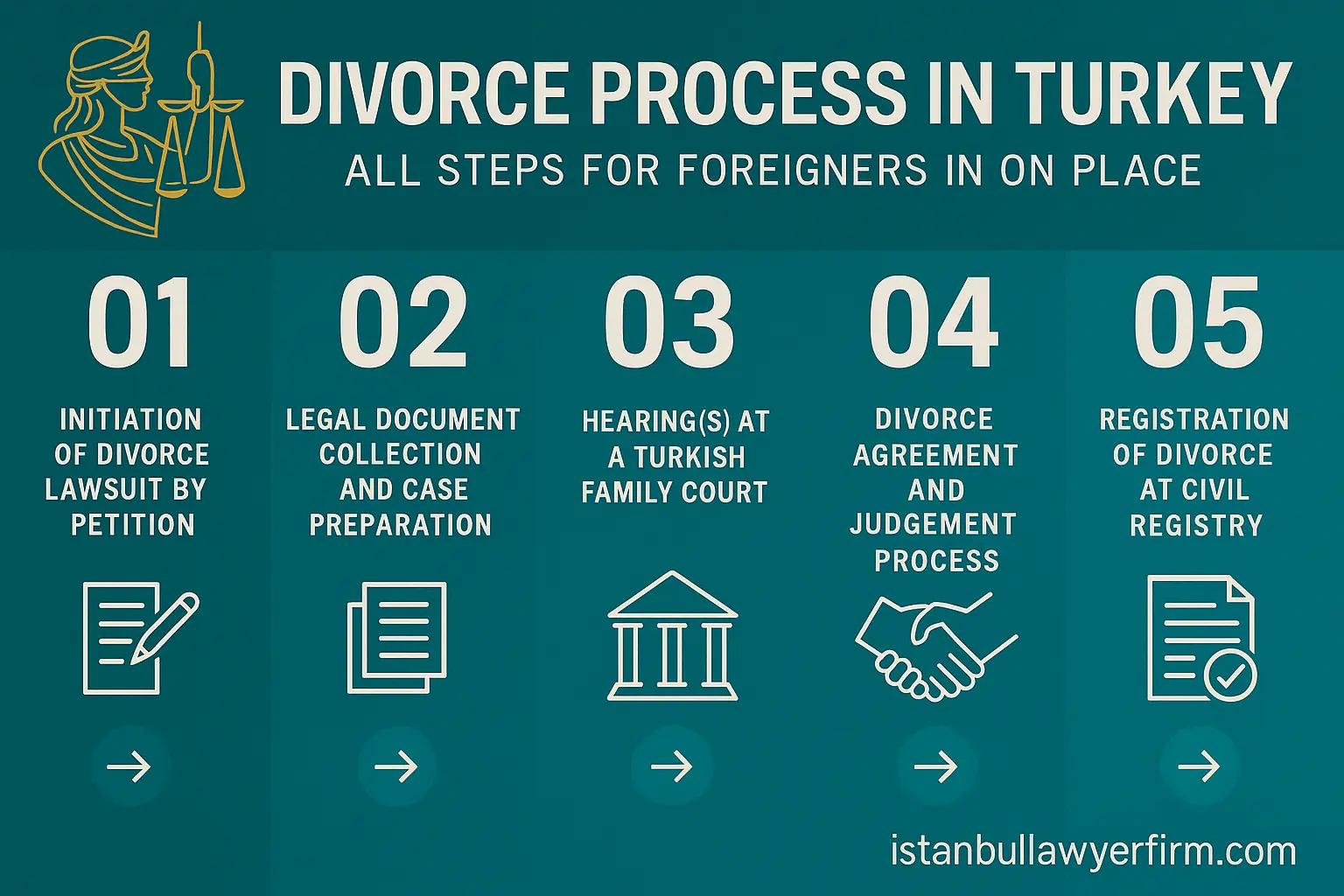
A lawyer in Turkey who advises foreign nationals on the divorce process understands that divorcing in Turkey as a non-Turkish citizen requires navigating both the Turkish Civil Code's substantive family law provisions and the Turkish Code of Civil Procedure's specific requirements for court filings, hearings, service of process and evidence presentation—while also managing the cross-border dimensions of an international marriage including jurisdiction determination, applicable law selection, foreign document authentication and the interaction between Turkish court orders and the legal systems in the countries where the parties have assets, children and ongoing legal obligations. An Istanbul Law Firm that represents foreign nationals in Turkish divorce proceedings provides comprehensive procedural and substantive support: assessing jurisdiction and advising on whether Turkish proceedings or foreign proceedings better serve each client's interests given their specific circumstances; managing remote representation for foreign nationals who cannot attend proceedings in person through properly authorized power of attorney arrangements; advising on the choice between uncontested and contested divorce procedures based on the degree of agreement between the parties; preparing and filing all required court documentation including sworn translations and certified copies of foreign civil registry records; representing clients in family court hearings including preliminary hearings, evidence presentation hearings and final judgment hearings; managing the mandatory mediation process applicable to contested family proceedings; advising on and litigating child custody, parental rights and international child protection matters; analyzing and litigating marital property division for Turkish and international assets; pursuing or defending alimony claims based on need, marriage duration and fault; managing recognition of foreign divorce decrees in Turkish civil registries; and advising on Turkish residence permit implications of divorce for foreign nationals whose Turkish legal status is connected to their marriage. A Turkish Law Firm with experience in international family law brings practical knowledge of how Turkish family courts process international divorce cases, what documentation and arguments most effectively address the cross-border issues that arise in foreign national divorces, and how Turkish family court orders interact with the legal systems in the countries where foreign national parties maintain connections. An English speaking lawyer in Turkey who represents foreign nationals in Turkish divorce proceedings provides the bilingual legal communication that enables clients to understand the Turkish legal proceedings, make informed strategic decisions about their case and maintain oversight of proceedings conducted in Turkish without requiring Turkish language proficiency. Practice may vary by authority and year — verify current Turkish Civil Code family law provisions, current Turkish private international law rules and current Turkish family court procedural requirements before initiating any divorce proceeding.
Who Can File for Divorce in Turkey and How Jurisdiction Is Established
A lawyer in Turkey who advises on divorce jurisdiction explains that Turkish family courts have authority to hear divorce cases when specific connecting factors are present that link the marriage or the parties to Turkish legal jurisdiction—and that correctly identifying and establishing the applicable jurisdictional basis at the outset of proceedings is fundamental because jurisdiction defects can invalidate proceedings or prevent recognition of Turkish court orders abroad. An Istanbul Law Firm that advises on divorce jurisdiction for foreign nationals helps clients establish which specific connecting factor supports Turkish court jurisdiction in their case: where one or both spouses are Turkish citizens, Turkish courts have jurisdiction based on Turkish citizenship under Turkish private international law provisions; where one or both spouses have their habitual residence in Turkey—meaning Turkey is the country where they have established their regular and stable center of life rather than merely being temporarily present—Turkish courts have jurisdiction based on habitual residence; where both spouses are foreign nationals but the marriage was registered in Turkey, specific jurisdictional provisions may support Turkish court proceedings; and where both parties consent to Turkish court jurisdiction, consensual submission may provide an independent basis for Turkish family court jurisdiction. Turkish lawyers advising on jurisdiction help clients understand that establishing jurisdiction accurately is not merely a technical preliminary matter but a strategic determination that affects which law governs the divorce, which court can issue binding orders about children and property, and where the resulting divorce decree will be most easily recognized and enforced. Practice may vary by authority and year — verify current Turkish private international law provisions on divorce jurisdiction for foreign nationals, current Turkish family court practice on jurisdiction establishment for international marriages, and current applicable law determination rules before advising on any jurisdiction strategy.
An Istanbul Law Firm that manages remote divorce representation for foreign nationals explains that Turkey's civil procedure rules permit parties to be represented in court proceedings through properly authorized legal representatives—enabling foreign nationals who are unable to attend Turkish court hearings in person to conduct their Turkish divorce proceedings entirely through their Turkish attorney acting under a power of attorney. Turkish lawyers managing remote divorce representation for foreign clients help clients understand the specific requirements for effective remote representation: the power of attorney must be executed before a notary—if executed in Turkey, before a Turkish notary; if executed abroad, before a notary in the country of execution followed by apostille certification for countries party to the Hague Apostille Convention or consular legalization for other countries; the power of attorney must specifically authorize the Turkish attorney to take each type of action required in the divorce proceedings including filing petitions, appearing at hearings, submitting evidence, making admissions relevant to the divorce protocol in uncontested proceedings, and accepting service of documents; and the Turkish attorney must actually appear at each hearing and actively represent the client's interests rather than merely holding the power of attorney as a procedural formality. An English speaking lawyer in Turkey who manages remote representation for international clients maintains regular English-language communication with absent clients—providing advance briefings before each significant procedural step, reporting on hearing outcomes and next steps, and consulting with clients on strategic decisions that arise during proceedings without requiring clients to travel to Turkey for procedural developments that can be managed through their Turkish legal representative.
A Turkish Law Firm that advises on service of process and international notification in divorce proceedings explains that when a respondent spouse is located outside Turkey, proper legal service of the divorce petition on the foreign-located spouse is a mandatory procedural requirement that must be satisfied before Turkish family courts can proceed to the substantive divorce hearing—and that improper or incomplete service creates grounds for the respondent to challenge the proceeding's validity both in Turkey and when recognition of the Turkish judgment is sought abroad. An English speaking lawyer in Turkey who manages international service of process for divorce cases coordinates the specific service mechanism applicable to each country where a respondent may be located: service through diplomatic channels via the Turkish Ministry of Justice and the relevant foreign ministry for countries with mutual judicial assistance arrangements; service through postal channels where permitted under bilateral agreements; and service by publication in the Turkish Official Gazette where the respondent's whereabouts cannot be established through reasonable investigation. Proper service documentation—confirming that the specific service method used satisfies both Turkish procedural requirements and the receiving country's requirements for valid legal service—creates the procedural foundation for uncontested continuation of the Turkish proceedings and for later recognition of the resulting judgment.
Uncontested and Contested Divorce Routes
A lawyer in Turkey who advises on divorce procedure selection explains that Turkish Civil Code Article 166/3 provides the uncontested mutual consent divorce procedure—available when the marriage has lasted at least one year and both parties agree on all divorce terms—and that this procedure enables efficient resolution of a divorce in a single family court hearing that can often be scheduled within weeks of petition filing, making it the preferred route when cooperation between the parties is possible. An Istanbul Law Firm that prepares uncontested divorce protocols for foreign national clients implements a comprehensive protocol drafting process: identifying every substantive issue that the divorce protocol must address—including child custody arrangements specifying which parent has physical custody and what visitation schedule applies, child maintenance amounts and payment arrangements, spousal maintenance amounts and duration if applicable, and the specific property division arrangements for each identified marital asset; drafting the protocol in bilingual format so both parties can genuinely review and understand the terms they are agreeing to rather than signing a Turkish-language document they cannot independently assess; negotiating any remaining areas of disagreement through counsel-facilitated communication that produces a complete agreement without requiring formal court litigation; and preparing the court filing package including the signed protocol, required translations and certified copies of supporting documents. Turkish lawyers advising on uncontested divorce help clients understand that the judge at the single hearing will personally assess whether both parties have genuinely consented to the protocol's terms—and that the court's satisfaction with the consent's authenticity is as important to the proceeding's success as the protocol's legal adequacy. Practice may vary by authority and year — verify current Turkish family court requirements for uncontested divorce protocols, current single-hearing scheduling procedures, and current documentation requirements for uncontested divorce petitions before preparing any uncontested divorce filing.
An Istanbul Law Firm that represents foreign nationals in contested divorce proceedings explains that contested divorce—where the parties disagree on divorce itself, on the grounds for divorce, or on the consequences of divorce including custody, property and maintenance—proceeds through a multi-stage litigation process that typically takes between six months and eighteen months or longer in complex cases, with each stage requiring specific Turkish procedural compliance and active legal management. Turkish lawyers managing contested divorce litigation for foreign national clients navigate each procedural stage: the petition stage where the divorce petition identifying the applicable legal grounds and requesting specific relief is filed with the competent family court; the mandatory mediation stage that Turkish law requires before contested family court litigation can proceed to hearing; the preliminary hearing where the court frames the issues, sets procedural timetables and determines what evidence will be required; the evidence stage where written submissions, documentary evidence, witness statements and expert reports are exchanged and filed; trial hearings where evidence is presented and legal arguments are made; and the judgment stage where the court issues its final decision and written reasoning. An English speaking lawyer in Turkey who manages contested divorce litigation for international clients provides the continuous case management and client communication that keeps foreign national clients informed about each proceeding's status, prepared for each stage's requirements and equipped to make informed decisions about litigation strategy as the case develops.
A Turkish Law Firm that advises on the fault grounds for contested divorce explains that Turkish Civil Code Articles 161 through 166 establish specific grounds that support a contested divorce petition—including adultery, criminal behavior, desertion, mental illness, fundamental incompatibility and the general irretrievable breakdown ground—and that the choice of applicable ground affects not only the procedural burden of proving the ground but also the spousal maintenance outcome that may follow if one party's fault contributed to the marriage's breakdown. An English speaking lawyer in Turkey who advises foreign national clients on contested divorce grounds selection helps clients understand the evidentiary requirements for each available ground—what specific facts must be proven, what types of evidence Turkish family courts find most persuasive for each ground, and how the ground selection interacts with the client's claims for custody, maintenance and property division—enabling strategic ground selection that reflects both factual accuracy and optimal alignment with the client's overall divorce objectives rather than defaulting to the most familiar ground without considering Turkish-specific evidentiary and outcome implications.
Child Custody, Parental Rights and International Child Protection
A lawyer in Turkey who advises on child custody in international divorce proceedings explains that Turkish family courts determine custody based on the best interests of the child standard under Turkish Civil Code Article 182—assessing the specific circumstances of each family's situation including each parent's relationship with the child, each parent's practical ability to meet the child's daily needs, each parent's proposed living arrangements and stability, and the child's established connections to each parent, to Turkey and to any other countries where the child has significant ties. An Istanbul Law Firm that represents foreign national parents in Turkish custody proceedings helps clients build the custody case that most effectively demonstrates their capacity to serve the child's best interests: gathering and presenting evidence of the quality and regularity of each parent's relationship with the child before and during the divorce; documenting each parent's living arrangements, income, support network and practical ability to provide consistent daily care; engaging child psychologists or social welfare experts where the court requires or where professional assessment would support the custody position; and preparing the specific parenting plan that demonstrates how the proposed custody arrangement addresses the child's educational, emotional, cultural and developmental needs in concrete terms rather than general assertions about parenting capability. Turkish lawyers representing foreign national parents help clients understand that Turkish family courts approach custody as a child welfare determination rather than a parental rights adjudication—and that framing custody arguments in terms of the child's specific needs and the proposed arrangement's specific benefits for those needs is more persuasive in Turkish family courts than framing that emphasizes the parent's rights or the other parent's deficiencies. Practice may vary by authority and year — verify current Turkish Civil Code custody determination standards, current Turkish family court practice on expert evidence in custody proceedings, and current visitation order provisions before advising on any custody strategy.
An Istanbul Law Firm that advises on international child protection measures in divorce proceedings involving foreign national children explains that the risk of one parent removing a child from Turkey without the other parent's consent or court authorization—which constitutes child abduction under Turkish law and potentially triggers Hague Convention proceedings in the destination country—is a significant concern in divorces where the parties are of different nationalities and where one party's natural inclination may be to return to their home country with the children after the marriage ends. Turkish lawyers advising on international child protection help parents seeking protection understand the specific measures available through Turkish family courts: travel restriction orders that prevent a child's removal from Turkey without both parents' written consent or court authorization, implemented through passport control databases that alert border control when a restricted child attempts to travel; passport control orders that require a child's passport to be held by the court or a neutral third party during proceedings; and where a child has already been removed, Hague Convention return application procedures where Turkey has applicable treaty relationships with the destination country. An English speaking lawyer in Turkey who manages international child protection for foreign national parents provides the urgent response capability that these situations demand—filing protection applications on an emergency basis when immediate child removal risk is identified rather than waiting for the standard procedural timeline to run.
A Turkish Law Firm that advises on custody enforcement and modification after Turkish court orders explains that obtaining a Turkish custody order is not the end of the custody legal process but the beginning of a long-term co-parenting legal framework that may require enforcement, modification or international recognition as the child's circumstances and the parties' lives evolve. An English speaking lawyer in Turkey who advises on long-term custody legal management helps parents understand the specific mechanisms available for each custody challenge that may arise after the initial order: enforcement proceedings in Turkish enforcement courts where the custodial parent is not complying with the visitation schedule established in the custody order; modification proceedings where significant changes in circumstances—including one parent's relocation, the child's changed needs, or demonstrated change in a parent's circumstances—justify revisiting the original custody arrangement; and international recognition and enforcement where one parent needs a Turkish custody order to be given effect in another country where the child or the non-compliant parent is located, which requires navigating the specific recognition and enforcement framework applicable between Turkey and the relevant foreign country.
Property Division, Alimony and Financial Settlements
A lawyer in Turkey who advises on property division in Turkish divorce proceedings explains that Turkey's statutory marital property regime—the participation in acquired property system established by Turkish Civil Code Article 202—creates a framework under which assets acquired through economic activity during the marriage are subject to equal division between the spouses at divorce, while pre-marital property, inherited property and gifts received during the marriage remain each spouse's separate property. An Istanbul Law Firm that advises foreign nationals on property division in Turkish divorce proceedings helps clients navigate the complete property division process: conducting comprehensive asset identification that covers both Turkish and international assets including Turkish real property, Turkish bank accounts and investment accounts, Turkish business interests, and international assets that may be subject to Turkish division depending on applicable law; analyzing each asset's acquisition history to determine whether it falls within the marital participation category subject to division or constitutes separate property that is not subject to division; obtaining valuations from qualified appraisers for Turkish real property, business interests and other assets requiring valuation for division purposes; and where the other party has not fully disclosed their assets, seeking court orders requiring financial disclosure or appointing forensic accountants to trace assets that may have been concealed. Turkish lawyers advising on property division in international marriages help clients understand that the applicable marital property law may not be Turkish law if the marriage's primary connections are to another country—and that correctly determining the applicable law is essential before applying any marital property analysis to the specific assets at stake. Practice may vary by authority and year — verify current Turkish Civil Code marital property regime provisions, current Turkish court practice on international asset division in foreign national divorces, and current forensic accounting procedures available in Turkish family court property proceedings before advising on any property division strategy.
An Istanbul Law Firm that advises on alimony in Turkish divorce proceedings explains that Turkish law recognizes multiple categories of financial support that can be ordered in divorce proceedings—including temporary maintenance (tedbir nafakası) payable during the proceedings to a dependent spouse or for children; post-divorce spousal maintenance (yoksulluk nafakası) payable to a divorced spouse who cannot meet their own needs without support; and child maintenance (iştirak nafakası) payable by the non-custodial parent for the child's living expenses. Turkish lawyers advising on alimony claims help clients understand the specific factors that Turkish family courts consider in determining whether maintenance is available and in what amount: the financial needs of the requesting spouse and their ability to meet those needs independently given their education, employment capacity and earning potential; the financial capacity of the paying spouse including income, assets and existing obligations; the standard of living established during the marriage that represents the benchmark for maintaining the requesting spouse's economic position after divorce; and the fault of each party in the divorce where fault-based grounds are involved, since Turkish law provides that a spouse who is more at fault in the marriage breakdown may be denied or have reduced maintenance. An English speaking lawyer in Turkey who manages alimony claims for foreign national clients prepares the specific financial documentation that most effectively supports each client's maintenance position: income documentation for both parties from Turkish and foreign sources; expense analysis demonstrating the requesting party's actual financial needs; comparative lifestyle analysis showing the standard of living during the marriage; and vocational assessment where the requesting party's ability to achieve financial independence through employment is a factor in the court's assessment.
A Turkish Law Firm that advises on cross-border enforcement of Turkish alimony and property orders explains that Turkish family court financial orders—including maintenance obligations and property transfer orders—require enforcement mechanisms when the party obligated to pay or transfer does not voluntarily comply, and that where the obligated party has assets or residence in a foreign country, enforcement depends on the specific international framework applicable between Turkey and that country. An English speaking lawyer in Turkey who manages cross-border enforcement of Turkish family court financial orders coordinates the enforcement strategy across relevant jurisdictions: in countries with bilateral judicial assistance treaties with Turkey, Turkish maintenance orders may be enforced through the treaty mechanism with support from central authorities designated under the applicable treaty; in EU member states, Turkish orders require domestic recognition proceedings before enforcement because Turkey is not an EU member and EU automatic recognition mechanisms do not apply; and in countries with no specific treaty framework, domestic exequatur proceedings before the foreign court must be initiated to obtain recognition of the Turkish order before enforcement action can be taken. The preparation of enforcement packages—including authenticated copies of Turkish orders, sworn translations, certificates of finality and legal opinions explaining the Turkish judgment's basis—must satisfy each specific country's requirements for receiving foreign court orders, making advance preparation by qualified Turkish counsel essential before commencing enforcement proceedings in each relevant foreign jurisdiction.
Recognition of Foreign Divorces and Post-Divorce Administrative Steps
A lawyer in Turkey who advises on recognition of foreign divorce decrees in Turkey explains that foreign nationals who have been divorced in proceedings outside Turkey need to have their foreign divorce decree recognized in Turkey through a specific legal process before that divorce has legal effect in Turkish civil records—and that without Turkish recognition, the parties continue to be treated as married under Turkish law regardless of the foreign court's judgment, which affects inheritance rights, the ability to remarry in Turkey, and the legal consequences of any subsequent relationships. An Istanbul Law Firm that manages foreign divorce recognition proceedings in Turkish courts helps applicants understand the specific process: filing an application for recognition (tanıma) before the competent Turkish civil court together with the authenticated foreign court decree, its sworn Turkish translation and accompanying certificates demonstrating the decree's finality under the issuing country's law; demonstrating to the Turkish court that the foreign court that issued the divorce had proper jurisdiction over the matter under the issuing country's law; demonstrating that both parties had adequate opportunity to participate in the foreign proceedings and that due process was respected; and demonstrating that recognizing the foreign divorce does not violate Turkish public policy—the public order exception that Turkish courts apply when a foreign ruling requires something that would be fundamentally contrary to Turkish legal principles. Turkish lawyers managing recognition proceedings help applicants understand which categories of foreign divorces most commonly face recognition difficulties—including divorces obtained through purely administrative rather than judicial procedures in some countries, divorces obtained in countries that did not have proper jurisdiction over one or both parties, and divorces involving issues like same-sex marriage that Turkish law does not recognize—and advise on the strategies available to address those specific obstacles where the foreign divorce has procedural features that may complicate Turkish recognition. Practice may vary by authority and year — verify current Turkish private international law recognition provisions, current Turkish court standards for foreign divorce recognition applications, and current documentation requirements for recognition proceedings before preparing any recognition application.
An Istanbul Law Firm that advises on civil registry updates following divorce explains that completing the divorce process—whether through Turkish court proceedings or through recognition of a foreign divorce in Turkey—requires follow-up administrative steps to ensure that the divorce is properly reflected in the civil registry records that determine legal status in Turkey and internationally. Turkish lawyers managing civil registry updates after divorce help clients complete each required administrative step: filing for update of the marital status entry in the Turkish population registry (Nüfus Müdürlüğü) with a certified copy of the final divorce decree; where the divorce affects real property ownership—through property division orders or title transfers resulting from the divorce settlement—filing for update of the land registry entries to reflect the new ownership position; updating bank accounts, financial instruments and other registered assets as required by the divorce settlement; and where the divorce affects the parties' Turkish residence permits or immigration status, initiating the permit transition process with the Provincial Directorate of Migration Management. An English speaking lawyer in Turkey who manages post-divorce administrative coordination for foreign national clients implements a systematic checklist approach to post-divorce implementation—identifying every registry, authority and institution that must be notified of or requires documentation of the divorce, coordinating the preparation of the specific documents each institution requires, and tracking the completion of each administrative update until the client's legal status is fully and accurately reflected in all relevant Turkish records.
A Turkish Law Firm that advises on residence permit implications of divorce for foreign nationals explains that a foreign national's Turkish residence permit type and the conditions under which it was granted determine what options are available for continuing to reside lawfully in Turkey after a marriage-based permit is affected by divorce—and that proactive management of the residence permit transition promptly after the divorce is essential because residence permit lapse, overstay and associated immigration violations can create significant long-term consequences for the foreign national's ability to remain in or return to Turkey. An English speaking lawyer in Turkey who advises on post-divorce residence permit management helps foreign nationals identify which specific permit category is available to them given their individual circumstances: the independent residence permit conversion available to foreign nationals who were married to Turkish citizens for at least three years before the divorce; family residence permits based on the parent-child relationship where the divorced foreign national holds custody of or has regular contact with a Turkish citizen child; and alternative permit categories including investment-based, employment-based or other qualifying categories for foreign nationals who wish to remain in Turkey but do not qualify for the marriage-derived permits after divorce. The best lawyer in Turkey for foreign national divorce matters combines deep Turkish family law expertise with practical experience managing the complete cross-border dimension of international marriages—providing comprehensive legal support that addresses the Turkish court proceedings, the international recognition requirements, the post-divorce administrative implementation and the immigration status management that together comprise the complete legal process of divorce for a foreign national in Turkey.
Remote Representation, Power of Attorney and International Coordination
A lawyer in Turkey who advises on remote divorce representation for foreign nationals explains that Turkey's civil procedure rules permit full legal representation through a Turkish attorney holding a properly authorized power of attorney—enabling foreign nationals who are unable to travel to Turkey for divorce proceedings to conduct their Turkish divorce entirely through their legal representative without personal court attendance. An Istanbul Law Firm that provides remote divorce representation for international clients implements systematic remote case management: drafting the power of attorney in a format that specifically authorizes every procedural action that will be required in the specific divorce proceedings—general powers of attorney that do not specifically address family court representation may not be accepted for all procedural steps; coordinating the power of attorney execution abroad through Turkish consulates, local notaries with subsequent apostille certification or local notaries with subsequent consular legalization depending on the applicant's country; managing all court filings, hearing attendance and evidence presentation through the authorized Turkish attorney without requiring the client to travel to Turkey for any procedural step; and maintaining continuous client communication that keeps the remotely represented client fully informed and able to provide instructions on any strategic decisions that arise during proceedings. Turkish lawyers providing remote representation for foreign national divorce clients build the client communication infrastructure that enables effective remote representation: scheduled consultation calls that provide advance briefings before each significant procedural step; written case status reports in English following each hearing; electronic document sharing for review of draft submissions before filing; and responsive communication channels for client questions and instructions that enable timely responses to procedural developments. Practice may vary by authority and year — verify current Turkish family court requirements for power of attorney representation in divorce proceedings, current apostille and consular legalization requirements for powers of attorney executed abroad, and current remote representation limitations applicable to specific procedural steps before structuring any remote representation arrangement.
An Istanbul Law Firm that coordinates international legal cooperation in divorce proceedings involving foreign national parties explains that divorces with significant cross-border dimensions—including marriages with assets in multiple countries, parties residing in different countries, or children with multiple nationalities and connections to multiple legal systems—benefit from coordinated legal representation in each relevant jurisdiction that ensures the Turkish proceedings and foreign proceedings are strategically aligned rather than proceeding independently in ways that create conflicts or missed opportunities. Turkish lawyers coordinating international legal cooperation in divorce cases work with foreign counsel in relevant jurisdictions to ensure that: the jurisdiction chosen for the primary divorce proceedings—whether Turkey or another available jurisdiction—is the one that produces the most favorable combination of applicable law, procedural efficiency and international recognition of the resulting orders; proceedings in multiple jurisdictions are sequenced or coordinated to avoid contradictory orders that create uncertainty about which jurisdiction's order prevails; evidence gathered in Turkish proceedings is preserved and formatted in ways that can be used in related foreign proceedings if needed; and property or custody orders obtained in Turkish proceedings are structured and authenticated in ways that facilitate recognition and enforcement in the foreign jurisdictions where they need to be implemented. An English speaking lawyer in Turkey who leads international coordination in complex divorce cases provides the central legal coordination function that keeps all aspects of the international legal picture coherent—ensuring that Turkish legal strategy serves the client's overall objectives across all relevant jurisdictions rather than optimizing only for Turkish proceedings without regard to their international implications.
A Turkish Law Firm that advises on documentation requirements for international divorce proceedings explains that the documentary foundation of a foreign national's Turkish divorce proceedings—including the foreign marriage certificate, identity documents, documents related to children and property, prior court orders from other jurisdictions, and any relevant foreign legal instruments—must satisfy both Turkish court formal requirements and the specific authentication and translation standards that Turkish family courts apply to foreign-origin documents. An English speaking lawyer in Turkey who manages documentation for foreign national divorce cases implements a systematic document preparation process: identifying every document that will be required for the divorce petition and each subsequent procedural step; determining the specific authentication requirement applicable to each document based on the issuing country's relationship with Turkey—apostille certification for Hague Convention countries and consular legalization for other countries; arranging sworn Turkish translation by certified translators whose translations are notarized for court submission; verifying that all document authentication is current at the time of submission since some authentication processes have expiry limitations; and organizing the complete documentation package in the format that Turkish family courts expect to receive foreign-origin document packages so that the court's administrative processing does not create delays attributable to document format issues rather than substantive legal matters.
Turkish Families Abroad and Special Circumstances
A lawyer in Turkey who advises on divorce for Turkish citizens residing abroad explains that Turkish citizens living outside Turkey who wish to divorce in Turkish courts can do so through remote representation by a Turkish attorney—and that many Turkish citizens residing in Europe, North America and the Gulf region prefer to conduct their divorce through Turkish family courts to ensure that the resulting orders are directly enforceable in Turkey, that Turkish civil registry records are correctly updated, and that Turkish inheritance, property and family law provisions apply to their divorce's consequences. An Istanbul Law Firm that represents Turkish citizens abroad in Turkish divorce proceedings helps clients from each relevant diaspora community understand the specific practical arrangements for conducting Turkish divorce remotely: Turkish citizens in Germany, the Netherlands, Belgium and other EU member states with significant Turkish communities can execute powers of attorney at Turkish consulates in their country of residence, enabling Turkish attorneys to conduct the complete Turkish proceedings without the client traveling to Turkey; Turkish citizens in the UK, US, Canada, Australia and other countries with Turkish diplomatic presence can similarly use Turkish consulates for power of attorney execution; and Turkish citizens in countries without Turkish diplomatic presence must arrange alternative apostille-certified notarial powers of attorney that satisfy Turkish procedural requirements. Turkish lawyers representing Turkish citizens abroad in Turkish divorce proceedings help clients understand the specific advantages of Turkish divorce proceedings for their particular family situation—including the direct application of Turkish inheritance law to property division, the direct enforceability of Turkish orders in Turkish registries and financial institutions, and the avoidance of the recognition proceedings that would be required if a foreign divorce decree needed to be recognized in Turkey later. Practice may vary by authority and year — verify current Turkish family court jurisdiction provisions for Turkish citizens residing abroad, current Turkish consulate power of attorney services available in the relevant country, and current Turkish family court procedural requirements before initiating any Turkish divorce proceeding for a Turkish citizen residing abroad.
An Istanbul Law Firm that advises on divorce for dual national couples explains that spouses who each hold or together hold multiple nationalities face specific jurisdictional options and applicable law questions that require careful analysis before the appropriate divorce proceeding is selected—because the availability of multiple jurisdictions creates both opportunity to select the most favorable forum and risk of making an uninformed selection that produces suboptimal outcomes for the applicable law, the enforcement of resulting orders or the recognition of the divorce in relevant civil registries. Turkish lawyers advising on divorce strategy for dual national couples help clients evaluate each available jurisdiction's specific features as applied to their family situation: the applicable marital property law in each potential jurisdiction and how that law would treat the specific assets in the couple's estate; the custody standards in each jurisdiction and how the child's specific nationality connections affect which jurisdiction's standards best serve the child's interests; the recognition and enforcement framework between potential jurisdiction countries and the countries where the parties will reside after divorce; and the practical procedural considerations including each jurisdiction's processing timeline, cost profile and documentation requirements that affect the realistic execution of proceedings in each available forum. An English speaking lawyer in Turkey who advises dual national couples on divorce jurisdiction coordinates with foreign counsel in each relevant alternative jurisdiction to provide the comparative jurisdictional analysis that enables informed forum selection rather than defaulting to the most familiar option without understanding the specific consequences of each available choice.
A Turkish Law Firm that advises on post-divorce legal planning for foreign nationals explains that completing the divorce proceedings—whether through Turkish court judgment or through recognition of a foreign divorce in Turkey—is typically followed by a period of significant legal activity in which the divorce's practical consequences must be implemented across multiple legal dimensions simultaneously. An English speaking lawyer in Turkey who provides post-divorce legal planning services for international clients helps clients identify and manage every post-divorce legal task: real property registration transfers required to implement the property division settlement in Turkish land registries; residence permit transition applications that must be submitted within applicable deadlines to avoid permit lapse; civil registry record updates at Turkish population registries to reflect the new marital status; financial account transitions including bank accounts, investment accounts and insurance policies that require updates to reflect post-divorce ownership and beneficiary designations; and where children are involved, implementation of the custody and maintenance arrangements through the specific practical arrangements—school authority updates, health care authority designations, travel document management for children with international travel—that translate the court order into the daily operational reality of the post-divorce co-parenting relationship. Post-divorce legal planning that addresses every consequential legal task systematically prevents the gaps and delays that create ongoing legal uncertainty when divorced parties attempt to implement the practical consequences of their divorce without comprehensive legal coordination of all required steps.
Divorce and Immigration Status for Foreigners in Turkey
A lawyer in Turkey who advises on the immigration implications of divorce for foreign nationals explains that a foreign national's Turkish residence permit type and the conditions under which it was granted determine what options are available for continuing to reside lawfully in Turkey after a marriage-based permit is affected by divorce—and that proactive management of the residence permit transition promptly after the divorce is essential because residence permit lapse, overstay and associated immigration violations can create significant long-term consequences for the foreign national's ability to remain in or return to Turkey. An Istanbul Law Firm that advises on post-divorce residence permit management helps foreign nationals identify which specific permit category is available to them given their individual circumstances: the independent residence permit conversion available to foreign nationals who were married to Turkish citizens for at least three years before the divorce; family residence permits based on the parent-child relationship where the divorced foreign national holds custody of or has regular contact with a Turkish citizen child; and alternative permit categories including investment-based, employment-based or other qualifying categories for foreign nationals who wish to remain in Turkey but do not qualify for the marriage-derived permits after divorce. Turkish lawyers advising on post-divorce residence transition help clients initiate the permit application process within the timeline that avoids lapse of current permit validity—because filing for residence permit conversion after the current permit has expired creates additional regulatory complications that timely filing prevents. Practice may vary by authority and year — verify current Turkish immigration law provisions on family-based residence permit conversion after divorce, current Provincial Directorate of Migration Management requirements for post-divorce residence applications, and current alternative residence permit categories available to foreign nationals after marriage-based permits are no longer available before advising on any post-divorce residence strategy.
An Istanbul Law Firm that advises on domestic violence circumstances and their residence permit implications explains that Turkish immigration law provides specific protections for foreign nationals who are victims of domestic violence in their Turkish marriage—recognizing that the prospect of losing residence permit status as a result of divorce from an abusive Turkish citizen spouse creates a form of coercive control that immigration law should not reinforce. Turkish lawyers advising domestic violence victims on Turkish immigration options help clients understand the specific provisions available: humanitarian residence permits available on grounds including domestic violence that provide an alternative to the marriage-based permit for foreign nationals whose marriages ended because of abuse rather than mutual decision; connection between domestic violence protective orders issued by Turkish family courts and residence permit considerations that allow migration authorities to take into account the circumstances of the marriage ending; and coordination between the legal protective proceedings and the immigration administrative proceedings to ensure that the client's immigration status and physical safety are addressed simultaneously rather than sequentially. An English speaking lawyer in Turkey who advises foreign national domestic violence victims on combined legal and immigration protection coordinates the protective order application with the immigration permit application and the divorce proceeding—ensuring that every legal mechanism available to protect the client is activated rather than relying solely on the divorce proceeding without addressing the immigration vulnerability that the abusive partner may be exploiting as a means of control.
A Turkish Law Firm that advises on long-term planning for foreign nationals after Turkish divorce explains that divorce marks not an ending but a transition in the foreign national's relationship with Turkish law—and that foreign nationals who plan to remain in Turkey after divorce, who have ongoing obligations to Turkish citizen children, who hold Turkish property interests, or who have other ongoing Turkish legal connections benefit from structured post-divorce legal planning that ensures every dimension of their Turkish legal situation is addressed. An English speaking lawyer in Turkey who provides long-term post-divorce legal planning for international clients helps clients develop a comprehensive Turkish legal framework for their post-divorce lives: residence status secured and maintained through the appropriate permit category; property registered and titled in the correct post-divorce ownership position; civil registry records updated to accurately reflect the new marital status; custody and maintenance arrangements documented and implemented in ways that are practically effective for the co-parenting relationship; and estate planning reviewed and updated to reflect the changed family structure that the divorce creates—ensuring that wills, beneficiary designations and other estate planning instruments reflect the client's post-divorce intentions rather than remaining in the pre-divorce configuration that the client assumed would change automatically but that in Turkish law typically requires specific documented action to update.
Frequently Asked Questions
- Can foreign nationals file for divorce in Turkish family courts? Yes. Turkish family courts have jurisdiction over divorces when at least one spouse is a Turkish citizen, when one or both spouses have habitual residence in Turkey, or when both parties agree to Turkish court jurisdiction. Foreigners married in Turkey or residing in Turkey can initiate divorce proceedings in Turkish family courts. The specific jurisdictional basis should be confirmed with qualified Turkish family law counsel for each specific situation. Practice may vary by authority and year.
- Do I need to travel to Turkey to divorce there? No. Turkish civil procedure rules permit full legal representation through a Turkish attorney holding a properly authorized power of attorney, enabling foreign nationals to conduct their Turkish divorce proceedings entirely through their Turkish legal representative without personal court attendance. The power of attorney must be properly executed—at a Turkish consulate abroad or through local notarization with apostille certification—and must specifically authorize the required procedural actions. Practice may vary by authority and year.
- How long does uncontested divorce take in Turkey? Uncontested mutual consent divorce under Turkish Civil Code Article 166/3 can typically be finalized in a single family court hearing. Depending on the court's scheduling and the completeness of the filing package, uncontested divorces are often completed within four to eight weeks of petition filing when both parties' consent and all required documentation are confirmed at the time of filing. The minimum marriage duration of one year must be satisfied. Practice may vary by authority and year.
- How long does contested divorce take in Turkey? Contested divorce timeline varies significantly depending on the issues in dispute, the evidence required, the court's workload and whether expert assessments are needed. Contested divorces in Turkish family courts typically take between six months and eighteen months from petition filing to final judgment, with complex cases involving significant property disputes, international elements or custody conflicts potentially taking longer. Appeal proceedings extend the timeline further if the first-instance decision is appealed. Practice may vary by authority and year.
- How is child custody determined in Turkish divorce proceedings? Turkish family courts determine custody based on the best interests of the child standard under Turkish Civil Code Article 182, assessing each parent's relationship with the child, practical ability to meet the child's needs, proposed living arrangements and the child's established connections. Physical custody is typically awarded to one parent with structured visitation for the other, though joint custody is increasingly recognized where cooperative co-parenting is demonstrated. International dimensions including the child's other nationality connections are considered. Practice may vary by authority and year.
- What marital property is subject to division in Turkish divorce? Turkey's statutory marital property regime provides that assets acquired through economic activity during the marriage—participation in acquired property—are subject to equal division at divorce, while pre-marital property, inherited property and gifts received during the marriage remain each spouse's separate property. Spouses can establish different arrangements through a notarized marital property contract. The applicable marital property law for international marriages depends on private international law rules that may result in Turkish or foreign law applying. Practice may vary by authority and year.
- Is alimony available in Turkish divorce proceedings? Yes. Turkish law provides for multiple forms of maintenance including temporary maintenance during proceedings, post-divorce spousal maintenance for a spouse unable to meet their own needs, and child maintenance payable by the non-custodial parent. The availability and amount of maintenance depend on financial need, the paying party's capacity, the marriage's standard of living, and in some cases the fault of each party in the divorce. Fault may affect maintenance availability where the requesting party's conduct contributed to the marriage's breakdown. Practice may vary by authority and year.
- Can a foreign divorce decree be recognized in Turkey? Yes. Foreign divorce decrees can be recognized in Turkey through specific recognition proceedings before a competent Turkish civil court, demonstrating that the foreign court had proper jurisdiction, that both parties had due process, that the decree is final, and that recognition does not violate Turkish public policy. The specific documentation required includes authenticated and sworn-translated copies of the foreign decree with certificates of finality. Recognition is necessary to update Turkish civil registry records and for the divorce to have legal effect in Turkey. Practice may vary by authority and year.
- Does divorce affect a foreign national's Turkish residence permit? Yes, potentially. Foreign nationals whose Turkish residence permits are based on marriage to a Turkish citizen must assess the impact of divorce on permit status. Foreign nationals married to Turkish citizens for at least three years may qualify for independent residence permits after divorce. Foreign national parents of Turkish citizen children may be eligible for family-based permits. Alternative permit categories may be available for those who wish to remain in Turkey but do not qualify for the marriage-derived permits after divorce. Each situation requires individualized assessment. Practice may vary by authority and year.
- Can Turkish alimony and custody orders be enforced in foreign countries? Turkish family court orders may be enforced abroad through mechanisms that vary by the specific country. Within EU member states, Turkish orders require domestic recognition proceedings as Turkey is not an EU member. Maintenance orders may be enforced through the 1956 New York Convention on the Recovery Abroad of Maintenance or bilateral treaty mechanisms. Child custody enforcement may involve Hague Convention proceedings where applicable. Enforcement package preparation and coordination with foreign counsel in the relevant jurisdiction is recommended well before enforcement proceedings are needed. Practice may vary by authority and year.
- What documentation is required to start a divorce proceeding in Turkey as a foreigner? Required documentation typically includes the foreign marriage certificate with apostille certification or consular legalization and sworn Turkish translation; identity documents for both parties with appropriate authentication and translation; birth certificates for children of the marriage with authentication and translation; and for uncontested divorce, the signed divorce protocol addressing all material terms. Additional documentation depends on the claims being made regarding property, custody and maintenance. A power of attorney is required where the client will not be personally attending court hearings. Practice may vary by authority and year.
- Can Turkish family court proceedings be conducted entirely in English? No. Turkish family court proceedings are conducted in Turkish as required by Turkish procedural law. All documents submitted to the court must be in Turkish or accompanied by certified Turkish translations. The client's Turkish attorney manages all Turkish-language court interaction and provides the client with English-language communication about case developments. Having a Turkish attorney who is proficient in English enables effective client communication throughout proceedings that are formally conducted in Turkish. Practice may vary by authority and year.
- What happens if my spouse does not cooperate with divorce proceedings in Turkey? A non-cooperating spouse does not prevent divorce proceedings from continuing—Turkish family courts can proceed with contested divorce even when one party refuses to participate after proper service of process has been effected. Service on a non-cooperating spouse located abroad is accomplished through diplomatic channels, bilateral judicial assistance mechanisms or publication in appropriate cases. Unilateral participation in contested divorce proceedings is handled through the court system with the cooperating party's attorney representing their interests throughout. Practice may vary by authority and year.
- Do prenuptial or postnuptial agreements affect Turkish divorce proceedings? Marital property contracts that validly establish a different marital property regime from Turkey's statutory participation in acquired property regime may affect property division in Turkish divorce proceedings if they satisfy Turkish formal validity requirements or qualify for recognition under Turkish private international law. Contracts establishing separation of property regimes are commonly used by couples wishing to maintain separate property during marriage. Turkish family courts assess the validity and enforceability of marital property contracts based on their content, formal validity and compliance with mandatory Turkish law provisions. Practice may vary by authority and year.
- Does ER&GUN&ER Law Firm represent foreign nationals in Turkish divorce proceedings? Yes. ER&GUN&ER Law Firm provides comprehensive divorce representation for foreign nationals including jurisdiction analysis, remote representation through power of attorney, uncontested divorce protocol preparation, contested divorce litigation, emergency protective measure applications, child custody and international child protection, property division, alimony claims, foreign divorce recognition proceedings, civil registry update coordination, residence permit transition management, and international enforcement coordination—with bilingual English-Turkish legal services throughout each engagement.
Author: Mirkan Topcu is an attorney registered with the Istanbul Bar Association (Istanbul 1st Bar), Bar Registration No: 67874. His practice focuses on cross-border and high-stakes matters where evidence discipline, procedural accuracy, and risk control are decisive.
He advises individuals and companies across Immigration and Residency, Real Estate Law, Tax Law, and cross-border documentation matters where procedural accuracy and evidence discipline are decisive.
Education: Istanbul University Faculty of Law (2018); Galatasaray University, LL.M. (2022). LinkedIn: Profile. Istanbul Bar Association: Official website.