

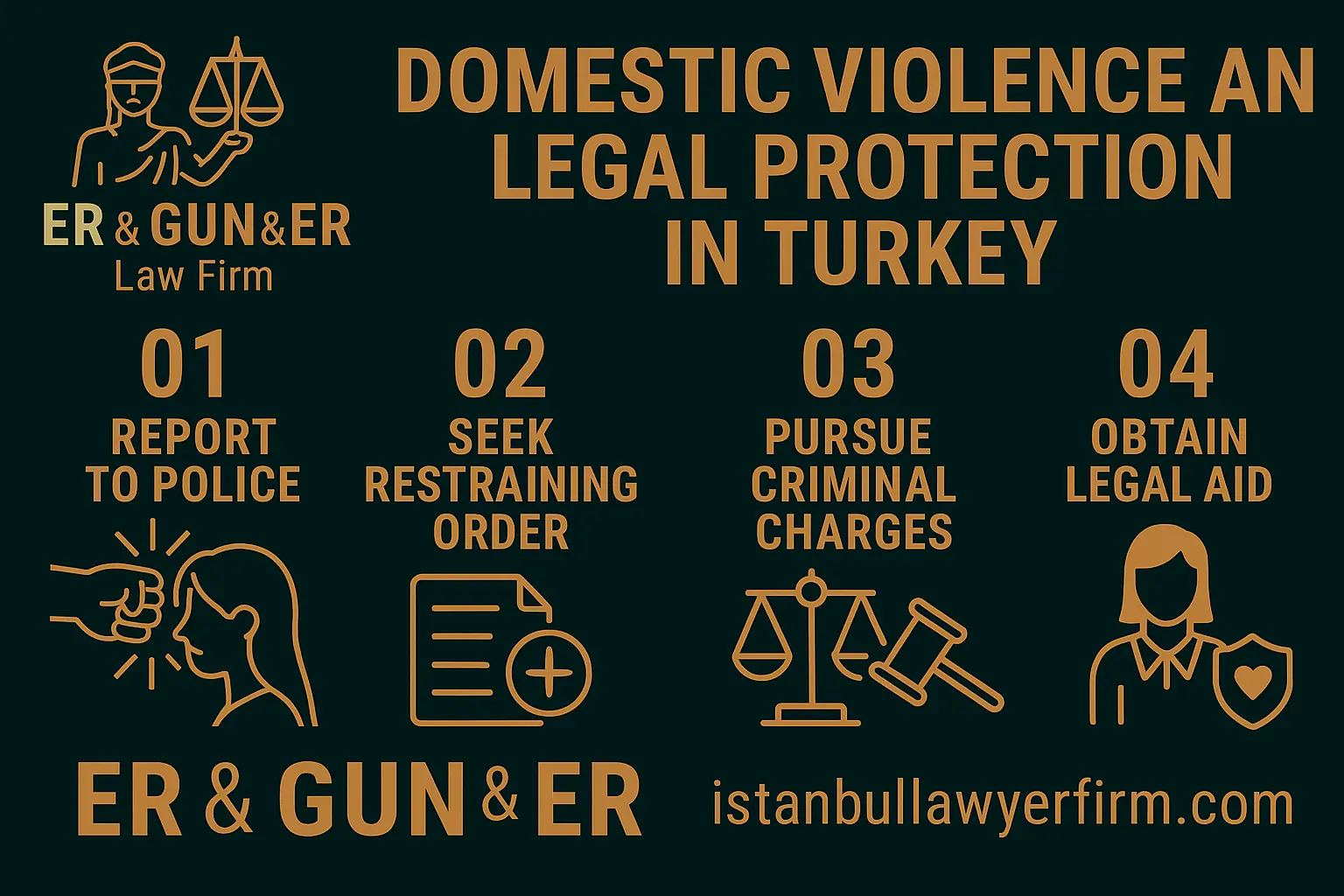
A lawyer in Turkey who advises survivors of domestic violence understands that the Turkish legal framework for protecting individuals from domestic abuse—centered on Law No. 6284 on the Protection of Family and Prevention of Violence Against Women but extending to the Turkish Penal Code's criminal provisions for specific offenses, the Turkish Civil Code's family law provisions on divorce, custody and protective measures, and the immigration law provisions that protect foreign nationals from losing residence status due to domestic violence—provides comprehensive protection mechanisms that can be rapidly activated to protect survivors from ongoing harm while simultaneously building the legal foundation for longer-term justice through criminal prosecution, civil compensation and family court proceedings. An Istanbul Law Firm that represents survivors of domestic violence provides comprehensive legal support spanning the complete protection and recovery lifecycle: filing urgent applications for protection orders under Law No. 6284 that can be issued within hours by police, prosecutors or family courts without requiring detailed evidence submissions; advising on the full range of protection measures available and which combination of measures best addresses each survivor's specific safety risks; preparing criminal complaints against perpetrators for the specific Penal Code offenses implicated by the violence experienced; managing family court proceedings for divorce, custody, maintenance and property division in cases where domestic violence is a relevant factor; advising foreign national survivors on the immigration law protections that preserve their Turkish residence status independently of their relationship with the abusive spouse; coordinating access to emergency shelter, medical care and psychological support services; and providing ongoing legal support through the complete recovery timeline as protection orders are extended, criminal proceedings progress, and family law proceedings reach resolution. A Turkish Law Firm with experience in domestic violence cases brings practical knowledge of how Turkish family courts, criminal courts and immigration authorities respond to domestic violence documentation, what evidence most effectively supports protection order applications and criminal complaints, and how the different legal proceedings available to survivors can be coordinated to provide comprehensive and mutually reinforcing protection. An English speaking lawyer in Turkey who represents foreign national survivors of domestic violence in Turkey provides the bilingual legal support that enables survivors who do not speak Turkish to access the full range of legal protections available under Turkish law, to communicate effectively with police, prosecutors, courts and support services, and to make informed decisions about the legal strategies available to them.
Law No. 6284 Framework and Protective Measures
A lawyer in Turkey who advises on Law No. 6284 explains that this law—formally titled the Law on Protection of the Family and Prevention of Violence Against Women—creates a comprehensive legal framework for protecting individuals from domestic violence that deliberately minimizes procedural barriers to accessing protection, enabling police, prosecutors and family courts to issue protection orders rapidly and without requiring the level of evidence that adversarial civil or criminal proceedings would require. An Istanbul Law Firm that advises survivors on Law No. 6284 protections helps clients understand the full scope of protective measures available under the law: personal protection orders that prohibit the perpetrator from approaching, contacting or communicating with the protected person; orders requiring the perpetrator to leave the shared family home and remain away from it; orders restraining the perpetrator from approaching the protected person's workplace, school or other regularly frequented locations; orders confiscating weapons or dangerous items from the perpetrator; orders requiring the perpetrator to submit to regular monitoring or reporting requirements; financial support orders requiring the perpetrator to make maintenance payments to the protected spouse and children during the protection period; and orders establishing temporary custody arrangements that protect children during the period when the full family court custody determination is pending. Turkish lawyers advising survivors on protection measure selection help each client identify the combination of measures that most effectively addresses their specific safety risks given the nature of the violence experienced, the perpetrator's behavior patterns, the survivor's living and working arrangements, and any children who need protection—because not every available measure is necessary or appropriate for every situation. Practice may vary by authority and year — verify current Law No. 6284 protection measure provisions, current application procedures for each authority authorized to issue protection orders, and current enforcement mechanisms for protection order compliance before advising on any protection strategy.
An Istanbul Law Firm that advises on the urgency and accessibility of Law No. 6284 protection explains that one of the law's most important features is the deliberate removal of procedural barriers that might prevent survivors from accessing protection quickly—enabling police officers to issue on-the-spot temporary protection orders during domestic violence responses, prosecutors to issue protection orders without prior judicial approval in urgent situations, and family court judges to issue protection orders in brief proceedings that do not require the survivor to present detailed evidence before receiving initial protection. Turkish lawyers advising on access to emergency protection help survivors and their support networks understand that contacting police during or immediately after a domestic violence incident, reporting to a prosecutor's office or directly filing a petition at a family court are all valid pathways to immediate protection—and that the threshold for initial protection order issuance is intentionally low to ensure that survivors are not required to prove their case before receiving basic safety protection. An English speaking lawyer in Turkey who assists foreign national survivors in accessing emergency protection provides urgent practical support: accompanying clients to police stations or prosecutor's offices where language barriers would otherwise impede the protection application; preparing or translating written statements that articulate the violence experienced in the specific format that protection applications require; and following up with authorities to confirm that issued protection orders have been properly registered with enforcement offices and served on the perpetrator.
A Turkish Law Firm that advises on protection order violations explains that Law No. 6284 creates specific obligations on law enforcement to respond to protection order violations—requiring police to take immediate action when violations are reported rather than treating them as civil disputes requiring resolution without police intervention—and that the documentation of protection order violations creates both the basis for escalated protection measures and the evidence record for criminal prosecution of the perpetrator for violation of a court order. An English speaking lawyer in Turkey who manages protection order violation responses helps survivors document each violation completely: recording dates, times and specific nature of each violation; preserving evidence including messages, calls or physical evidence of prohibited contact or approach; reporting violations to police with specific reference to the protection order number and the specific violation; and following up with attorneys to ensure that each documented violation is added to the criminal record building toward prosecution. The combination of initial protection orders, documented violation evidence and escalating enforcement responses creates a progressive protection framework that increases pressure on the perpetrator while building the comprehensive evidentiary record that criminal prosecution requires.
Types of Violence, Evidence Collection and Documentation
A lawyer in Turkey who advises on the legal recognition of different violence forms explains that Turkish law—through the Turkish Penal Code's specific offense provisions, Law No. 6284's broad protective measure powers, and family courts' authority to consider domestic violence in custody, divorce and maintenance determinations—recognizes physical, emotional, psychological, sexual, economic and digital forms of domestic violence as legally actionable, and that the specific evidence needed to document each form of violence differs based on the nature of the violence and the legal proceedings in which the evidence will be presented. An Istanbul Law Firm that assists survivors in documenting their experiences helps each client identify and preserve the specific evidence most relevant to their situation: physical violence evidence including medical examination records from hospital or clinic visits documenting injuries, photographs of injuries taken as close to the time of the incident as possible, forensic examination reports where sexual violence has occurred, and police incident reports from any prior domestic violence calls; psychological and emotional abuse evidence including psychological assessment reports from mental health professionals who can professionally document the psychological impact of the abuse, written records of threatening or humiliating communications, witness statements from individuals who observed the abuse or its immediate effects, and records of patterns of behavior including isolation, surveillance and control; economic abuse evidence including bank records showing unauthorized account access, property transfer documentation showing assets taken without consent, employment records documenting interference with the survivor's work, and communications referencing economic threats or deprivation; and digital abuse evidence including screenshots of threatening or harassing messages, records of unauthorized device access, and documentation of non-consensual image sharing or digital surveillance. Turkish lawyers advising on evidence collection help survivors understand that evidence gathered promptly—immediately after each incident rather than retrospectively when legal proceedings begin—is substantially more credible and complete than evidence assembled after significant time has passed. Practice may vary by authority and year — verify current evidentiary standards applicable in Law No. 6284 protection order proceedings, current Turkish criminal court evidentiary requirements for domestic violence prosecutions, and current admissibility standards for each evidence type before developing any evidence strategy.
An Istanbul Law Firm that advises on medical documentation of domestic violence explains that medical records from treatment of violence-related injuries provide some of the most objective and credible evidence available in domestic violence legal proceedings—and that maximizing the evidentiary value of medical documentation requires that injuries be properly documented by healthcare providers with sufficient detail to support subsequent legal use of those records. Turkish lawyers advising on medical documentation help survivors understand what information medical records should contain to be most useful in legal proceedings: accurate descriptions of injury types, locations and severity in medical terminology that allows later professional assessment of their cause; clinical assessment of whether the pattern of injuries is consistent with the survivor's account of how the injuries were caused; medical professional observations of the survivor's emotional and psychological state at the time of examination; and referrals for psychological evaluation where the clinical assessment reveals signs of ongoing psychological trauma. An English speaking lawyer in Turkey who assists foreign national survivors with medical documentation ensures that foreign nationals receive the medical documentation they need in forms that can be used in Turkish legal proceedings—including assistance with translation of foreign-issued medical records that document prior violence in the survivor's country of origin.
A Turkish Law Firm that advises on the documentation of economic abuse and financial control explains that economic violence—including controlling a spouse's access to financial resources, preventing employment, creating unauthorized debts, or transferring marital assets without consent—is legally actionable under Turkish law but requires specific financial documentation that demonstrates the pattern of economic control rather than relying solely on the survivor's testimony. An English speaking lawyer in Turkey who assists survivors in documenting economic abuse helps identify the specific financial records that most effectively demonstrate each form of economic control: bank statements showing unauthorized withdrawals or transfers; account access records showing unauthorized login; employment records documenting interference including references from employers noting unusual behavior by the perpetrator; documentation of debts created in the survivor's name without consent; and property records showing transfers of assets that the survivor contributed to acquiring.
Criminal Prosecution for Domestic Violence Offenses
A lawyer in Turkey who advises on criminal proceedings for domestic violence explains that domestic violence in Turkey is not a single criminal offense but rather a set of conduct patterns that may satisfy the elements of multiple specific Turkish Penal Code offenses—each with its own elements, penalties and aggravating circumstances that apply when the offense is committed against a family member or in a domestic context. An Istanbul Law Firm that manages criminal complaint filings for domestic violence survivors helps clients understand which specific Penal Code offenses apply to their situation: intentional injury under Turkish Penal Code Articles 86 and 87 for physical violence causing bodily harm, with enhanced penalties applicable when the offense is committed against a family member or current or former spouse; torment (eziyet) under Article 96 for systematic abuse that causes severe physical or psychological suffering; threatening conduct under Article 106 for threats of physical harm or death; sexual offenses under Articles 102 and 103 where sexual violence has occurred; deprivation of liberty under Article 109 where the survivor has been restrained or prevented from moving freely; harassment under Article 123 for stalking and repeated unwanted contact; and violation of a court order under Article 292 where a perpetrator violates a Law No. 6284 protection order. Turkish lawyers managing criminal complaint filings help survivors understand the specific elements of each offense that must be established through evidence, the investigation procedures that follow complaint filing, and the survivor's rights and role in the criminal proceedings including the right to be represented by an attorney and the right to claim compensation within criminal proceedings. Practice may vary by authority and year — verify current Turkish Penal Code provisions applicable to domestic violence offenses, current aggravated penalty provisions for family member victims, and current prosecution practice for domestic violence criminal complaints before advising on any criminal complaint strategy.
An Istanbul Law Firm that represents domestic violence survivors in criminal proceedings explains that the criminal process following complaint filing—investigation, potential indictment, trial and sentencing—can extend over a significant period during which the survivor needs ongoing legal support to ensure that the case is properly investigated, that the survivor's interests are effectively represented at each stage, and that the penalties sought reflect the full severity of the harm caused. Turkish lawyers representing survivors in criminal proceedings provide active case management throughout: monitoring the investigation to ensure that evidence requested by the attorney is obtained and that the investigation does not stall or be closed prematurely; participating in trial hearings to present the survivor's account and challenge the perpetrator's defense; seeking appropriate aggravated penalties by presenting evidence of the domestic context, the pattern of violence and the harm caused; claiming compensation for material and moral damages within the criminal proceedings where Turkish criminal procedure permits civil claims to be adjudicated alongside the criminal case; and pursuing appeals where trial courts impose inadequate penalties that do not reflect the severity of the offenses committed. An English speaking lawyer in Turkey who represents foreign national survivors in Turkish criminal proceedings provides the complete bilingual support that enables foreign clients to participate meaningfully in proceedings conducted in Turkish—including preparation of testimony, explanation of procedural developments and coordination with consular representatives where diplomatic protection dimensions are relevant.
A Turkish Law Firm that advises on the interaction between criminal proceedings and other legal actions explains that domestic violence survivors in Turkey typically need to pursue multiple simultaneous legal actions—protection orders under Law No. 6284, criminal complaints under the Penal Code, divorce and custody proceedings under the Civil Code, and where applicable immigration status protection—and that coordinating these parallel actions to reinforce each other rather than creating procedural conflicts requires experienced legal management that keeps the overall legal strategy coherent across all proceedings. An English speaking lawyer in Turkey who manages coordinated domestic violence legal strategy for survivors designs integrated approaches where each proceeding's progress supports the others: evidence gathered for criminal complaints informs family court custody determinations; protection order documentation supports divorce fault claims; and family court orders establishing financial support provide immediate relief while criminal proceedings develop at their own pace. The integration of all available legal tools into a coherent overall strategy typically produces better safety and justice outcomes than pursuing each legal action independently without strategic coordination.
Child Custody, Parental Rights and Child Protection in Abuse Cases
A lawyer in Turkey who advises on child custody in cases involving domestic violence explains that Turkish family courts apply a heightened child safety standard in custody determinations where domestic violence is documented—giving significant weight to the protection of children from exposure to violence and from the risk that an abusive parent poses to the child's physical and psychological welfare—and that effectively presenting the domestic violence evidence in a custody proceeding requires specialized legal preparation that connects the documented abuse to the specific child welfare analysis that Turkish family courts apply. An Istanbul Law Firm that represents domestic violence survivors in custody proceedings helps clients build custody cases that specifically address the child safety dimensions of the domestic violence history: presenting the documented violence evidence in the format and framing that family court judges find most relevant to the best interests of the child analysis; obtaining child psychologist evaluations that assess the child's current emotional state and the potential impact of continued contact with the abusive parent on the child's psychological development; requesting interim custody orders that protect the child immediately while the full custody determination is pending, preventing the abusive parent from using ongoing custody arrangements to maintain access to or control over the survivor; and seeking supervised visitation or contact restrictions where the evidence supports limiting rather than eliminating the abusive parent's contact with the child. Turkish lawyers advising on child protection in domestic violence custody cases help survivors understand the specific protective measures that Turkish family courts can order in the custody context: supervised visitation conducted at designated facilities in the presence of social workers or family counselors; geographic restriction orders preventing a parent from removing the child from specific areas; communication monitoring orders; and in the most serious cases, suspension of all contact pending resolution of pending criminal proceedings. Practice may vary by authority and year — verify current Turkish family court standards for custody determination in domestic violence cases, current supervised visitation procedures, and current interim custody order provisions before advising on any child custody protection strategy.
An Istanbul Law Firm that advises on international child abduction risks in domestic violence cases involving foreign families explains that when domestic violence cases involve parents of different nationalities or children with international connections, the risk of one parent removing the child from Turkey to avoid the Turkish court's jurisdiction—constituting child abduction under Turkish law and potentially triggering Hague Convention proceedings in the destination country—is a significant concern that requires specific protective measures. Turkish lawyers advising on international child protection in abuse cases help survivors implement the full range of available protections: international travel restriction orders that prevent the child from being removed from Turkey; custody of the child's passport by a neutral party pending court determination; and emergency communication with Turkish border control authorities when removal risk is imminent. An English speaking lawyer in Turkey who advises foreign national survivors on international child protection coordinates the Turkish domestic violence custody strategy with the international family law dimensions—ensuring that the protections available through Turkish courts, foreign courts where the child has connections, and international instruments including the Hague Convention are activated as a coordinated framework rather than being pursued sequentially after each national measure has been exhausted.
A Turkish Law Firm that advises on children's testimony and psychological welfare in domestic violence custody proceedings explains that when children have directly witnessed or experienced domestic violence, their emotional and psychological state must be carefully managed in legal proceedings to ensure both that their welfare is protected and that their account of their experiences can be effectively presented to the court in forms that satisfy Turkish evidentiary standards. An English speaking lawyer in Turkey who advises on children's participation in domestic violence family proceedings helps survivors understand the specific Turkish procedures for receiving children's testimony and psychological evidence—including the forensic interview procedures designed to elicit children's accounts without contaminating them through leading questions, the expert report formats that family courts accept as evidence of child psychological welfare, and the in-camera hearing procedures that protect children from the distress of testifying in open court in proceedings involving their parents.
Immigration and Residence Rights for Foreign Survivors
A lawyer in Turkey who advises on immigration rights for foreign nationals experiencing domestic violence explains that Turkish immigration law provides specific protections designed to prevent the immigration system from being used as a tool of coercion by abusive spouses who threaten to have the victim deported or to withdraw immigration sponsorship as a means of maintaining control—and that foreign survivors who understand these protections are significantly better positioned to access the full range of domestic violence protections available under Turkish law without being deterred by immigration-related threats. An Istanbul Law Firm that advises foreign national survivors on Turkish immigration protections helps clients understand the specific residence permit options available in their situation: humanitarian residence permits available to foreign nationals facing genuine risk of harm who cannot safely access the standard residence permit categories; special temporary protection status for those who qualify under international protection frameworks; independent residence permits for foreign spouses who have been married to Turkish citizens for at least three years and whose marriage ends due to domestic violence; and the special provisions that enable foreign national domestic violence victims to maintain or renew their residence status while criminal and family court proceedings are pending, preventing abusers from using the threat of residence permit loss as leverage to discourage survivors from pursuing legal protection. Turkish lawyers advising on immigration protection for domestic violence survivors coordinate the immigration strategy with the overall legal protection plan—ensuring that the residence permit applications are supported by the documentation from criminal complaints, protection orders and family court proceedings that most effectively establishes the survivor's entitlement to the requested residence status. Practice may vary by authority and year — verify current Turkish immigration law provisions for domestic violence victims, current Provincial Directorate of Migration Management procedures for humanitarian residence applications, and current international protection standards applicable to domestic violence-based asylum claims before advising on any immigration protection strategy for a domestic violence survivor.
An Istanbul Law Firm that advises on the interaction between domestic violence proceedings and deportation risk explains that foreign national survivors who fear that pursuing legal protection will expose them to deportation—whether through the abusive spouse withdrawing residence sponsorship, through immigration violations that occurred during the abusive relationship, or through direct deportation threats by the abusive partner—can access specific legal mechanisms that provide immigration protection while legal proceedings are ongoing. Turkish lawyers advising on deportation protection for domestic violence survivors help clients understand the specific mechanisms that prevent deportation during active legal proceedings: administrative stays of deportation available to individuals who have active criminal complaints filed; court orders in family proceedings that preserve the survivor's right to remain in Turkey during the proceedings; and the special immigration status provisions that protect domestic violence victims from deportation while their protection order, criminal case or family court proceedings are active. An English speaking lawyer in Turkey who advises foreign national survivors on immigration protection coordinates with consulates, UNHCR and international human rights organizations where the survivor's situation requires support beyond what Turkish domestic law provides—including situations involving potential violations of Turkey's international human rights obligations that can be escalated through international mechanisms.
A Turkish Law Firm that advises on long-term immigration regularization for domestic violence survivors explains that the immediate immigration protection available during active legal proceedings must be followed by longer-term immigration planning that establishes a stable legal residence basis that does not depend on the continuing active status of domestic violence proceedings. An English speaking lawyer in Turkey who provides long-term immigration planning support for domestic violence survivors helps clients identify the most appropriate long-term residence basis for their specific situation: independent residence permits based on the prior family residence; family-based residence permits based on relationships with Turkish citizen children; employment-based permits where the survivor has Turkish employment; investment-based permits where the survivor has qualifying Turkish property investments; and where Turkish domestic law cannot provide adequate long-term protection, assessment of options including international protection applications through UNHCR or asylum applications in third countries where the survivor has qualifying connections. Long-term immigration security is an essential component of domestic violence recovery—because ongoing immigration vulnerability creates ongoing coercive power for abusers and undermines the survivor's ability to fully exercise the legal protections available under Turkish domestic violence law.
Divorce, Property Division and Long-Term Recovery After Domestic Violence
A lawyer in Turkey who advises on divorce in domestic violence cases explains that domestic violence is a recognized ground for fault-based divorce under Turkish Civil Code Article 163—and that successfully establishing domestic violence as the fault ground for divorce entitles the survivor to divorce compensation that the fault-based framework provides, affects the maintenance determination in ways favorable to the survivor, and may affect property division where the court considers the parties' conduct in assessing equitable division. An Istanbul Law Firm that manages divorce proceedings for domestic violence survivors helps clients build fault-based divorce cases that effectively present the domestic violence history to the family court: organizing and presenting the evidence of violence—medical records, police reports, protection orders, criminal conviction records where available—in the format that family courts examine in fault-based divorce proceedings; connecting the documented violence to the Civil Code's specific fault grounds rather than relying on general characterizations; and managing the divorce proceeding in coordination with active criminal proceedings and protection orders to ensure that the divorce strategy takes maximum advantage of findings and orders in the parallel proceedings. Turkish lawyers advising on divorce strategy in domestic violence cases help survivors understand the specific advantages of fault-based divorce grounds over general irretrievable breakdown grounds in terms of the compensation and maintenance outcomes available when fault is established against the perpetrating spouse. Practice may vary by authority and year — verify current Turkish Civil Code fault-based divorce grounds and their current judicial interpretation, current divorce compensation provisions applicable when violence is the fault ground, and current maintenance standards in divorce cases involving domestic violence before advising on any divorce strategy for a domestic violence survivor.
An Istanbul Law Firm that advises on property division in divorces following domestic violence explains that the property division in cases where domestic violence has occurred requires specific attention to ensuring that assets are not disposed of or concealed by the perpetrating spouse before or during divorce proceedings—and that emergency asset preservation measures should be sought alongside protection orders to prevent the economic harm that asset dissipation creates for the survivor. Turkish lawyers advising on property protection in domestic violence divorce cases help survivors implement the specific measures available to preserve marital assets: applications for precautionary seizure orders that prevent the perpetrating spouse from transferring or encumbering specific assets during the proceedings; applications for bank account freezes where the perpetrating spouse has access to accounts holding marital funds; and forensic asset investigation where there is reason to believe that assets have already been concealed through transfers to third parties or undisclosed accounts. An English speaking lawyer in Turkey who advises foreign national survivors on property protection in domestic violence divorce cases coordinates the Turkish asset preservation strategy with any similar measures available in foreign jurisdictions where the perpetrating spouse has assets—preventing asset flight that would defeat the Turkish court's property division orders.
A Turkish Law Firm that advises on long-term legal support for domestic violence survivors explains that the legal process following domestic violence does not end with the initial protection orders or even the divorce—because ongoing monitoring of protection order compliance, enforcement of maintenance and child support obligations, management of any custody arrangement modifications as circumstances change, and legal responses to any continued harassment or violations by the perpetrating spouse all require continuing legal engagement that supports the survivor's long-term safety and recovery. An English speaking lawyer in Turkey who provides ongoing legal support for domestic violence survivors implements a structured monitoring and response system: regular communication with the survivor to identify any new violations or concerning behavior by the perpetrating spouse; prompt legal response to each violation or new threat; proactive renewal of protection orders before they expire where the risk assessment indicates ongoing danger; and coordination with psychological and social support services to ensure that the legal protection framework supports the survivor's complete recovery process. The best lawyer in Turkey for domestic violence legal representation combines deep knowledge of Law No. 6284, Turkish Penal Code domestic violence provisions, Turkish family law and Turkish immigration law with the practical experience of managing complex multi-proceeding domestic violence cases—providing the comprehensive, coordinated legal representation that domestic violence survivors need to achieve genuine safety and lasting justice.
Workplace Protection and Economic Rights for Survivors
A lawyer in Turkey who advises on workplace protection for domestic violence survivors explains that Turkish Labor Law provides specific protections for employees experiencing domestic violence—enabling survivors to access flexible working arrangements, protect their employment status during legal proceedings, and seek workplace protection orders that prevent perpetrators from appearing at or near the workplace—and that exercising these protections requires legal management that preserves the survivor's employment rights without requiring disclosure of sensitive personal information beyond what necessary for the protection application. An Istanbul Law Firm that advises domestic violence survivors on workplace rights helps clients navigate the specific employment protections available: requesting flexible or remote working arrangements from employers without disclosing the specific nature of the domestic violence situation; maintaining employment status and job security during absences required for medical treatment, legal proceedings, or relocation; seeking workplace protection orders that extend Law No. 6284 protections to the employment setting by prohibiting the perpetrator from approaching the workplace; and pursuing legal remedies including unfair dismissal claims where employers improperly terminate employees experiencing domestic violence rather than providing the statutory protections. Turkish lawyers advising on workplace protection help survivors balance disclosure decisions—determining how much information to share with employers to access needed protections while managing the privacy concerns and potential workplace discrimination risks that excessive disclosure may create. Practice may vary by authority and year — verify current Turkish Labor Law provisions applicable to employees experiencing domestic violence, current Law No. 6284 workplace protection order provisions, and current Ministry of Labor guidance on employer obligations before advising on any workplace protection strategy.
An Istanbul Law Firm that advises on social security and financial support rights for domestic violence survivors explains that Turkish law provides specific financial support mechanisms for survivors who have experienced economic disruption as a result of domestic violence—including emergency financial assistance from the Ministry of Family and Social Services, healthcare coverage through the SGK system, child benefit payments, and employment support programs designed to help survivors who have been prevented from maintaining employment achieve economic independence. Turkish lawyers advising on financial support access help survivors identify and apply for each applicable support program: emergency financial assistance applications to the Ministry of Family and Social Services that can provide immediate financial relief during the acute crisis period; SGK healthcare coverage registration where the survivor lacks independent coverage; child benefit and support payment collection where the perpetrating spouse is obligated to make child maintenance payments that are being withheld; and vocational training and employment reintegration programs that help survivors who have been economically isolated or prevented from maintaining employment careers rebuild their economic independence. An English speaking lawyer in Turkey who advises foreign national survivors on social security and financial support rights helps international clients understand which Turkish support programs they are eligible to access as foreign nationals—because eligibility for specific programs may depend on residence permit status, nationality, or other factors that differ between Turkish national and foreign national survivors—and prepares the applications and documentation in the format required for each program.
A Turkish Law Firm that advises on economic recovery planning for domestic violence survivors explains that achieving economic independence from an abusive partner—through establishing independent income, accessing marital property entitlements, collecting ongoing maintenance payments and building long-term financial stability—is as important to sustainable recovery from domestic violence as the immediate physical safety protection that emergency legal measures provide. An English speaking lawyer in Turkey who assists survivors with economic recovery planning provides legal support for each dimension of financial independence: negotiating or litigating maintenance awards that accurately reflect the survivor's needs and the perpetrating spouse's obligation to provide support; enforcing child maintenance payment obligations through Turkish enforcement court proceedings where the perpetrating spouse fails to voluntarily comply; asserting property division rights to ensure the survivor receives their fair share of marital assets including any assets that the perpetrating spouse has tried to conceal or undervalue; and where the survivor has been the victim of economic abuse resulting in debts or financial harm, pursuing civil compensation claims against the perpetrating spouse for the specific economic harm caused by the abuse.
Divorce, Property Division and Long-Term Recovery After Domestic Violence
A lawyer in Turkey who advises on divorce in domestic violence cases explains that domestic violence is a recognized ground for fault-based divorce under Turkish Civil Code Article 163—and that successfully establishing domestic violence as the fault ground for divorce entitles the survivor to divorce compensation that the fault-based framework provides, affects the maintenance determination in ways favorable to the survivor, and may affect property division where the court considers the parties' conduct in assessing equitable division. An Istanbul Law Firm that manages divorce proceedings for domestic violence survivors helps clients build fault-based divorce cases that effectively present the domestic violence history to the family court: organizing and presenting the evidence of violence—medical records, police reports, protection orders, criminal conviction records where available—in the format that family courts examine in fault-based divorce proceedings; connecting the documented violence to the Civil Code's specific fault grounds rather than relying on general characterizations; and managing the divorce proceeding in coordination with active criminal proceedings and protection orders to ensure that the divorce strategy takes maximum advantage of findings and orders in the parallel proceedings. Turkish lawyers advising on divorce strategy in domestic violence cases help survivors understand the specific advantages of fault-based divorce grounds over general irretrievable breakdown grounds in terms of the compensation and maintenance outcomes available when fault is established against the perpetrating spouse. Practice may vary by authority and year — verify current Turkish Civil Code fault-based divorce grounds, current divorce compensation provisions applicable when violence is the fault ground, and current maintenance standards in divorce cases involving domestic violence before advising on any divorce strategy for a domestic violence survivor.
An Istanbul Law Firm that advises on property division in divorces following domestic violence explains that the property division in cases where domestic violence has occurred requires specific attention to ensuring that assets are not disposed of or concealed by the perpetrating spouse before or during divorce proceedings—and that emergency asset preservation measures should be sought alongside protection orders to prevent the economic harm that asset dissipation creates for the survivor. Turkish lawyers advising on property protection in domestic violence divorce cases help survivors implement the specific measures available to preserve marital assets: applications for precautionary seizure orders that prevent the perpetrating spouse from transferring or encumbering specific assets during the proceedings; applications for bank account freezes where the perpetrating spouse has access to accounts holding marital funds; and forensic asset investigation where there is reason to believe that assets have already been concealed through transfers to third parties or undisclosed accounts. An English speaking lawyer in Turkey who advises foreign national survivors on property protection in domestic violence divorce cases coordinates the Turkish asset preservation strategy with any similar measures available in foreign jurisdictions where the perpetrating spouse has assets—preventing asset flight that would defeat the Turkish court's property division orders.
A Turkish Law Firm that advises on long-term legal support for domestic violence survivors explains that the legal process following domestic violence does not end with the initial protection orders or even the divorce—because ongoing monitoring of protection order compliance, enforcement of maintenance and child support obligations, management of any custody arrangement modifications as circumstances change, and legal responses to any continued harassment or violations by the perpetrating spouse all require continuing legal engagement that supports the survivor's long-term safety and recovery. An English speaking lawyer in Turkey who provides ongoing legal support for domestic violence survivors implements a structured monitoring and response system: regular communication with the survivor to identify any new violations or concerning behavior; prompt legal response to each violation or new threat; proactive renewal of protection orders before they expire where the risk assessment indicates ongoing danger; and coordination with psychological and social support services to ensure that the legal protection framework supports the survivor's complete recovery process. The best lawyer in Turkey for domestic violence legal representation combines deep knowledge of Law No. 6284, Turkish Penal Code domestic violence provisions, Turkish family law and Turkish immigration law with practical experience managing complex multi-proceeding domestic violence cases—providing the comprehensive, coordinated legal representation that domestic violence survivors need to achieve genuine safety and lasting justice.
Frequently Asked Questions
- Is domestic violence a criminal offense in Turkey? Yes. Domestic violence conduct satisfies the elements of multiple Turkish Penal Code offenses including intentional injury, torment, threat, sexual offenses, deprivation of liberty and harassment. Enhanced penalties apply when these offenses are committed against family members or current and former spouses. Survivors can file criminal complaints with police or directly with public prosecutors. Violation of a Law No. 6284 protection order is itself a separate criminal offense. Practice may vary by authority and year.
- What is Law No. 6284 and what protection does it provide? Law No. 6284 on the Protection of the Family and Prevention of Violence Against Women is Turkey's primary domestic violence protection law, providing a comprehensive framework of civil protection measures that can be issued rapidly by police, prosecutors or family courts without requiring detailed prior evidence. Available measures include no-contact and no-approach orders, removal of the perpetrator from the shared home, communication bans, weapon confiscation orders, financial support orders and temporary custody arrangements for children. The law applies to all individuals regardless of gender, nationality or marital status. Practice may vary by authority and year.
- How quickly can a protection order be obtained in Turkey? Turkish law enables protection orders to be issued rapidly when necessary for safety—police can issue on-the-spot temporary protection orders during domestic violence incident responses, prosecutors can issue orders in urgent situations without prior court proceedings, and family courts can issue orders in brief proceedings without requiring full evidence presentation. The urgency of protection is legally recognized as justifying expedited processes when safety is at immediate risk. The specific timeline depends on the authority issuing the order and the circumstances of the application. Practice may vary by authority and year.
- Can foreigners in Turkey access domestic violence protection? Yes. Law No. 6284 applies to all individuals in Turkey regardless of nationality, citizenship status or residence permit type. Foreign nationals experiencing domestic violence in Turkey are entitled to the same protection orders, shelter access, legal aid and support services as Turkish nationals. An English speaking lawyer in Turkey can assist foreign nationals in accessing these protections, preparing documentation and communicating with authorities in Turkish. Practice may vary by authority and year.
- What happens to my residence permit if I leave my abusive spouse? Turkish immigration law provides specific protections for domestic violence survivors whose residence permit is based on marriage to a Turkish citizen. Foreign nationals who have been married to Turkish citizens for at least three years may be entitled to independent residence permits after separation. Special temporary protection status may be available in situations involving serious harm risk. Humanitarian residence permits are available for individuals at risk. Legal advice specific to the individual's residence history, nationality and current permit type should be obtained promptly. Practice may vary by authority and year.
- What evidence is needed to file for a protection order? Law No. 6284 deliberately minimizes evidence requirements for initial protection orders—a personal statement describing the violence experienced is typically sufficient to trigger initial protection without requiring medical reports, police records or other corroborating documentation. Additional evidence strengthens ongoing protection and criminal proceedings but is not a precondition for accessing initial protection. Medical records, photographs, messages, witness statements and other documentation should be gathered and preserved as available but should not delay protection applications when safety is at immediate risk. Practice may vary by authority and year.
- Can children be protected under Law No. 6284? Yes. Law No. 6284 protection measures specifically include children of the family, and protection orders can be structured to protect children from the perpetrator independently of the protection provided for the adult survivor. Family courts can issue interim custody orders as part of or alongside protection orders, and can impose supervised visitation or contact restrictions where the perpetrator poses a risk to the children. Child psychologist evaluations are available to assess and document the impact of exposure to domestic violence on specific children. Practice may vary by authority and year.
- What forms of domestic violence are legally recognized in Turkey? Turkish law recognizes physical, emotional, psychological, sexual, economic and digital forms of domestic violence as legally actionable. Physical violence is addressed through Penal Code injury offenses. Psychological violence including systematic intimidation, coercive control and harassment is addressed through torment and harassment provisions. Sexual violence is addressed through specific sexual offense provisions. Economic violence including financial control, sabotaging employment and unauthorized asset control is addressed through civil and criminal provisions. Digital abuse including electronic harassment and non-consensual image sharing is addressed through harassment and privacy violation provisions. Practice may vary by authority and year.
- Can domestic violence affect child custody decisions in Turkey? Yes. Turkish family courts apply the best interests of the child standard in custody determinations and give significant weight to domestic violence in assessing each parent's suitability and the safety of proposed custody arrangements. Courts can restrict or supervise an abusive parent's contact with children, can require professionally supervised visitation in designated facilities, and in serious cases can suspend parental contact pending criminal proceedings. Child psychologist reports and social welfare assessments addressing the specific impact of the domestic violence on the specific children are important evidence in these determinations. Practice may vary by authority and year.
- Can I file both criminal charges and divorce proceedings simultaneously? Yes. Turkish law does not require survivors to choose between criminal prosecution and civil family court proceedings—both can be pursued simultaneously, and the evidence and legal findings from each proceeding can support the other. Protection orders under Law No. 6284 can be maintained during both criminal and divorce proceedings, and interim custody and maintenance arrangements can be made by the family court while criminal proceedings are pending. Coordinated legal management of all proceedings by a single attorney team provides the most coherent and mutually reinforcing overall legal strategy. Practice may vary by authority and year.
- What support services are available to domestic violence survivors in Turkey? Support services available include confidential shelters provided by the Ministry of Family and Social Services and municipalities; emergency healthcare including trauma-focused medical examination and documentation of injuries; psychological support including trauma therapy and psychiatric evaluation; social worker assistance for practical matters including childcare and emergency housing; legal aid through bar association programs for survivors who cannot afford private legal representation; and hotline services providing immediate support and referral. Foreign nationals are entitled to access these services regardless of nationality or residence permit type. Practice may vary by authority and year.
- What happens if the perpetrator violates the protection order? Violation of a Law No. 6284 protection order is a criminal offense under Turkish law, and police are legally required to respond to reported violations and enforce compliance. Perpetrators who violate protection orders face criminal prosecution for the violation itself, in addition to any criminal charges arising from the conduct constituting the violation. Each documented violation strengthens the case for extended or enhanced protection orders and supports the criminal prosecution of the perpetrator. Violations should be immediately reported to police and to the attorney managing the protection order proceedings. Practice may vary by authority and year.
- Is domestic violence a ground for divorce in Turkey? Yes. Turkish Civil Code Article 163 recognizes cruel and dishonourable conduct—which encompasses domestic violence—as a specific ground for fault-based divorce. Successfully establishing domestic violence as the fault ground entitles the survivor to divorce compensation provisions that fault-based divorce provides and affects the maintenance determination. The documented evidence of domestic violence used in protection order and criminal proceedings can also support the fault-based divorce claim in family court. Practice may vary by authority and year.
- What financial support is available to domestic violence survivors? Financial support available includes emergency financial assistance from the Ministry of Family and Social Services for immediate needs; court-ordered interim maintenance payments from the perpetrating spouse during pending proceedings; child maintenance payments collectible through enforcement proceedings where the perpetrating spouse fails to pay voluntarily; SGK healthcare coverage for treatment of violence-related injuries and conditions; child benefit payments; and employment reintegration programs for survivors whose work history has been disrupted by violence. Foreign nationals' eligibility for specific programs depends on their residence permit status and nationality. Practice may vary by authority and year.
- Does ER&GUN&ER Law Firm represent domestic violence survivors in Turkey? Yes. ER&GUN&ER Law Firm provides comprehensive legal representation for domestic violence survivors including emergency protection order applications under Law No. 6284, criminal complaint preparation and criminal proceeding representation, child custody and international child protection, divorce and property division proceedings, maintenance enforcement, immigration protection for foreign national survivors, workplace protection coordination, financial support access, and ongoing monitoring of protection order compliance—with bilingual English-Turkish legal services throughout each engagement and sensitivity to the specific circumstances of each survivor's situation.
Author: Mirkan Topcu is an attorney registered with the Istanbul Bar Association (Istanbul 1st Bar), Bar Registration No: 67874. His practice focuses on cross-border and high-stakes matters where evidence discipline, procedural accuracy, and risk control are decisive.
He advises individuals and companies across Immigration and Residency, Real Estate Law, Tax Law, and cross-border documentation matters where procedural accuracy and evidence discipline are decisive.
Education: Istanbul University Faculty of Law (2018); Galatasaray University, LL.M. (2022). LinkedIn: Profile. Istanbul Bar Association: Official website.