

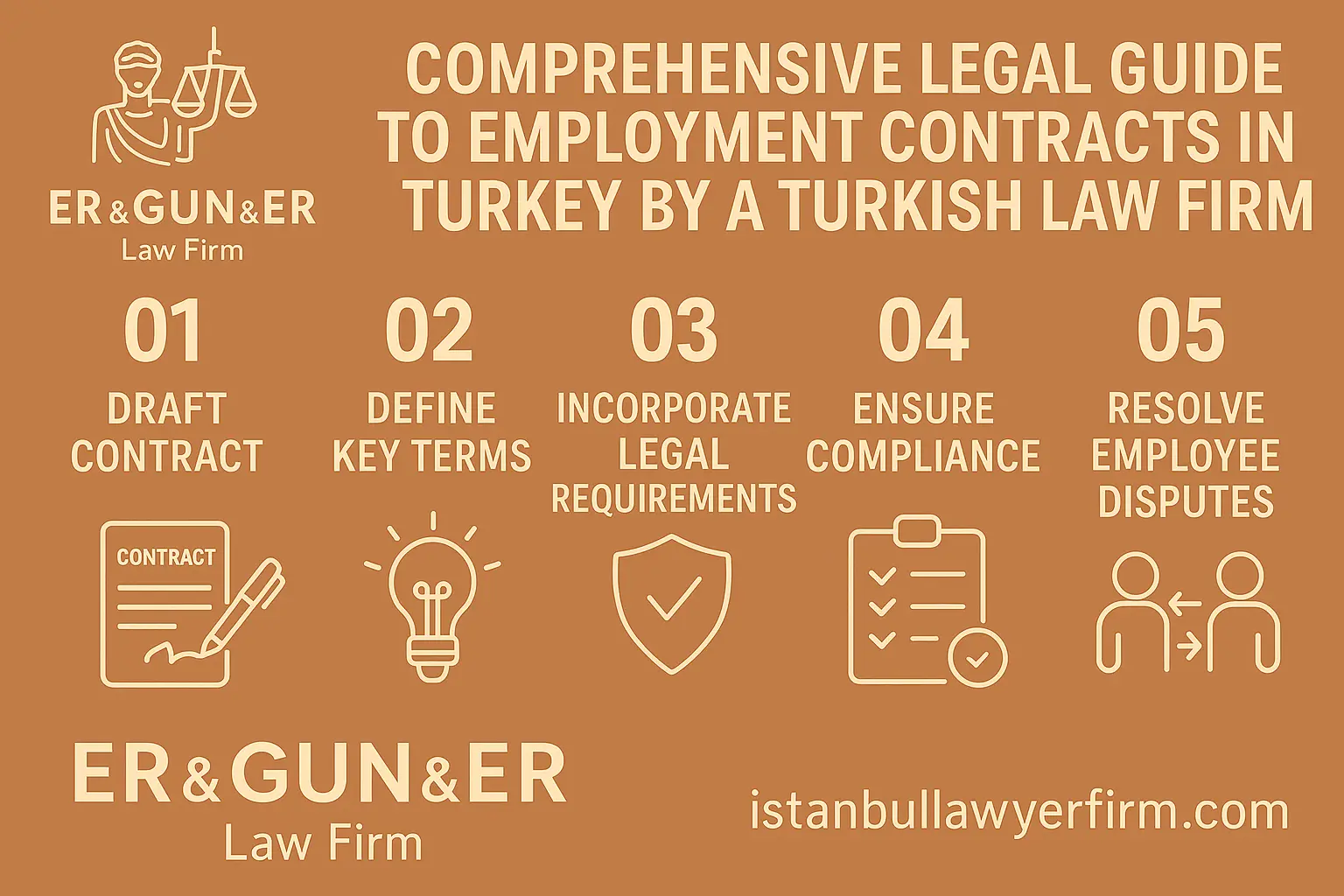
A lawyer in Turkey who advises employers and employees on employment contracts understands that Turkish Labor Law No. 4857—supplemented by the Social Security and General Health Insurance Law, the Obligations Code provisions on service contracts, and the extensive body of Court of Cassation labor jurisprudence—creates a detailed regulatory framework governing every dimension of the employment relationship from initial hiring through termination, and that an employment contract that is technically complete in its written content but deficient in its compliance with specific Labor Law requirements provides employers with significantly less legal protection than its apparent comprehensiveness suggests while simultaneously exposing employees to rights deficits that may only become apparent at the moment of termination. An Istanbul Law Firm that advises on employment contract drafting and compliance provides comprehensive legal support: preparing employment agreements whose specific clause content satisfies Turkish Labor Law's mandatory requirements for each contract type and employment category; advising employers on the strategic use of fixed-term versus indefinite-term employment classifications and the specific legal consequences that attach to each; implementing confidentiality, non-compete, and intellectual property protection clauses that are structured within the parameters that Turkish courts have established for enforceability; designing termination clause frameworks that create the documentation trail needed to defend justified termination claims against labor court challenges; advising on SGK social security registration compliance, premium declaration accuracy, and audit preparation; drafting remote work and hybrid employment agreements compliant with the Remote Work Regulation; advising on executive and senior management contracts that appropriately address the specific legal framework applicable above the standard Labor Law threshold; and managing foreign employee work permit coordination, bilingual contract drafting, and cross-border employment compliance. A Turkish Law Firm with experience in employment law provides practical knowledge of how Istanbul Labor Courts evaluate employer documentation in wrongful termination claims, what contract deficiencies most frequently create unexpected employer liability, and how the Court of Cassation has interpreted specific employment contract provisions in recent decisions. An English speaking lawyer in Turkey who advises multinational employers on Turkish employment contracts provides the bilingual legal guidance that enables global HR frameworks to be implemented with the Turkey-specific adaptations that Turkish Labor Law requires rather than simply translating global contract templates without compliance review. Practice may vary by authority and year — verify current Turkish Labor Law provisions, current SGK registration requirements, and current Court of Cassation employment jurisprudence before implementing any employment contract program.
Mandatory Content Requirements Under Turkish Labor Law
A lawyer in Turkey who advises on employment contract mandatory content explains that Turkish Labor Law Article 8 requires employment contracts to be executed in writing for agreements of one year or longer, and that while shorter-term contracts are not strictly required to be written, the practical consequence of failing to document employment terms in writing is that employers lose the ability to enforce specific contractual provisions—including non-compete obligations, confidentiality duties, and specific termination procedures—that are only binding when reflected in a signed written agreement. An Istanbul Law Firm that drafts compliant employment contracts helps employers implement the specific content elements that Turkish Labor Law requires and that courts expect to see in employment documentation: employer and employee identification including tax identification numbers and Social Security numbers that connect the contract to official registration records; specific job description that defines the position's scope in terms precise enough to govern disputes about whether specific tasks fall within the agreed scope of employment; working time specification including daily and weekly hours, shift arrangements, and the specific basis for any overtime arrangements that deviate from the statutory forty-five-hour weekly standard; wage specification including the specific base salary amount, payment frequency, payment method, and all other compensation components agreed between the parties—because ambiguous wage clauses are among the most frequent sources of labor court disputes; workplace specification identifying where work will be performed and the conditions under which workplace changes can be directed by the employer; and probation period specification when a probation period is agreed, including its duration and the mutual termination rights applicable during the probationary phase. Turkish lawyers advising on employment contract content help employers understand that including more than the statutory minimum—particularly clear documentation of disciplinary procedures, performance evaluation processes, and the employer's right to modify work assignments within the agreed scope—substantially reduces the employer's litigation exposure when employment relationships deteriorate. Practice may vary by authority and year — verify current Turkish Labor Law Article 8 requirements, current mandatory written contract provisions, and current Court of Cassation standards for employment contract content before preparing any employment agreement.
An Istanbul Law Firm that advises on fixed-term versus indefinite-term employment classification explains that Turkish Labor Law Article 11's rules on fixed-term contracts are among the most practically significant compliance issues facing Turkish employers—because misclassification of what is legally an indefinite-term employment relationship as a fixed-term contract exposes employers to the full range of Turkish dismissal protections including severance pay, notice pay, and wrongful termination claims that fixed-term contracts are specifically designed to limit. Turkish lawyers advising on contract type selection help employers understand the specific conditions that justify fixed-term employment: the work must be objectively connected to a specific project, task, or period—a seasonal harvest, a construction project, a specific consulting engagement—rather than representing ongoing operational work that will continue after the named period expires; successive renewals of fixed-term contracts without objective justification convert the employment relationship to indefinite-term status by operation of law, making the employer subject to the full range of indefinite-term protections regardless of what the contract documents say; and specific employee categories including managers with broad authority to bind the company may fall outside standard Labor Law protection regardless of how the employment relationship is classified, requiring specific legal analysis of whether the Labor Law or the Turkish Commercial Code framework applies to each executive role. An English speaking lawyer in Turkey who advises multinational employers on Turkish employment classification coordinates the Turkish classification framework with the employer's global employee category structure—ensuring that roles classified as contractors, consultants, or limited-term employees in global HR systems are assessed against Turkish classification criteria independently rather than assuming that global classification determinations are valid for Turkish purposes.
A Turkish Law Firm that advises on wage clause compliance explains that Turkish Labor Law Article 32's wage provisions—including the minimum wage obligation, the prohibition on deductions beyond specifically authorized categories, and the equal pay for equal work requirement—create specific compliance requirements that affect how wage clauses must be structured in employment contracts regardless of what the parties might prefer to agree. An English speaking lawyer in Turkey who advises foreign employers on Turkish wage compliance helps implement the specific wage documentation practices that most effectively demonstrate compliance: wage clauses that identify each compensation component separately—base salary, performance bonus framework, benefits in kind, and any other regularly paid emoluments—enabling employers to demonstrate that the total compensation satisfies the applicable minimum wage requirement even when it is paid in multiple components; deduction authorization clauses that specifically identify each category of authorized deduction—advances, loan repayments, social security premium contributions, income tax withholding—because deductions outside authorized categories create wage claim exposure regardless of employee consent expressed in a general waiver; and currency designation provisions where foreign-currency salary arrangements are used, addressing the FX risk allocation, the reference exchange rate for minimum wage compliance verification, and the payment mechanism for TRY-equivalent settlements. Transparent wage clause design that separates each component, identifies each authorized deduction, and addresses currency mechanics is both a compliance requirement and a risk management measure that substantially reduces wage dispute exposure.
Probation Periods, Confidentiality and Non-Compete Clauses
A lawyer in Turkey who advises on probation period clauses explains that Turkish Labor Law Article 15's two-month probation period maximum—extendable to four months through collective bargaining agreements—creates a specific window during which both employer and employee may terminate the employment relationship without notice, without severance, and without the wrongful termination protections that apply once the probation period has been completed and the employment relationship becomes fully effective. An Istanbul Law Firm that drafts probation period clauses helps employers implement probation terms that provide maximum utility within applicable legal limits: clearly specifying the probation period's start and end dates in calendar terms rather than by reference to undefined conditions that may create ambiguity about whether the probation period has ended; defining the specific evaluation criteria and performance standards that will be applied during the probation period, creating a documented basis for any probationary termination that reduces the risk of a terminated employee successfully claiming that the probationary termination was pretextual; and establishing the mutual termination procedure applicable during probation—specifying whether termination requires written notice, what the notice timeline is, and how any remaining accrued benefits will be calculated at the time of probationary exit. Turkish lawyers advising on probation period implementation help employers understand that the termination-without-cause freedom during the probation period does not eliminate all employer obligations—probationary employees retain rights including minimum wage entitlement, SGK registration, and protection against discriminatory treatment—and that documenting the factual basis for any probationary termination remains advisable even when legal grounds are not strictly required. Practice may vary by authority and year — verify current Turkish Labor Law Article 15 provisions, current collective agreement extension limits for probation periods, and current Court of Cassation standards for probationary termination challenges before implementing any probation period framework.
An Istanbul Law Firm that advises on confidentiality clause design for Turkish employment contracts explains that Turkish employment confidentiality obligations derive from multiple overlapping legal sources—Labor Law general loyalty duty provisions, Turkish Penal Code trade secret provisions, and the Law on the Protection of Personal Data for employee access to customer data—and that the most effective confidentiality clauses identify the specific categories of information protected, the specific conduct prohibited, and the remedies available for breach, rather than relying on general formulations that may be adequate in other jurisdictions but are insufficiently specific under Turkish judicial standards. Turkish lawyers advising on confidentiality implementation help employers design confidentiality frameworks that work in practice: defining protected information with enough specificity that employees understand what is covered—including technical trade secrets, customer and supplier information, pricing strategies, financial results not yet public, and personnel information—without definitions so broad that they cover information employees need access to in order to perform their legitimate duties; specifying the handling requirements for confidential information including storage, transmission, and disposal protocols that translate the confidentiality obligation into specific behavioral requirements rather than a general prohibition; and designing post-termination confidentiality terms that survive the end of the employment relationship for appropriate periods given the nature of the information involved, recognizing that Turkish courts assess post-termination confidentiality obligations differently from active employment obligations. An English speaking lawyer in Turkey who drafts bilingual confidentiality clauses for employers with international operations ensures that the Turkish-language version and any English-language version of confidentiality provisions are substantively equivalent rather than creating inconsistencies between language versions that could be exploited in disputes.
A Turkish Law Firm that advises on non-compete clause drafting explains that Turkish Court of Cassation jurisprudence has established specific parameters within which non-compete clauses are enforceable—with provisions that exceed these parameters being void rather than merely reduced to permissible scope—making the initial drafting of non-compete terms within judicial tolerance limits critical rather than expecting courts to save over-drafted provisions. An English speaking lawyer in Turkey who drafts compliant non-compete clauses helps employers implement each condition that Turkish courts require for enforceability: legitimate employer interest justification demonstrating that the employee's post-employment competitive activity would genuinely threaten the employer's protectable business interests through the employee's specific knowledge, customer relationships, or technical expertise rather than merely limiting competition generally; geographic limitation proportionate to the actual scope of the employer's competitive interest in a specific territory rather than imposing nationwide or international restrictions on employees whose competitive threat is local; duration limitation not exceeding two years post-termination—the outer limit that Turkish courts have consistently recognized—and generally limited to shorter periods for employees without access to genuinely protectable information; and compensation for the non-compete restriction during the non-compete period at a level at least equal to half the employee's final compensation, because non-compete clauses without compensation are void regardless of the other drafting choices made. Non-compete clauses that satisfy these conditions within Turkish judicial tolerance provide employers with genuine post-employment protection for their most sensitive competitive interests.
Termination Clauses, Notice Periods and Dismissal Procedures
A lawyer in Turkey who advises on employment termination explains that Turkish Labor Law's termination framework—distinguishing between termination for just cause under Article 25, termination with notice under Article 17, and the wrongful termination protections for employees with at least six months' service at workplaces with thirty or more employees under Articles 18-21—creates a layered set of employer obligations that must be satisfied procedurally as well as substantively for a termination to be legally effective. An Istanbul Law Firm that advises on termination clause design helps employers implement the specific contract provisions and documentation practices that most effectively manage termination risk: notice period provisions that specifically state the contractual notice period for each service bracket—two weeks for less than six months' service, four weeks for six months to one and a half years, six weeks for one and a half to three years, and eight weeks for three years and beyond—and that address the employer's option to make payment in lieu of notice (ihbar tazminatı) rather than requiring the employee to work through the notice period; disciplinary procedure clauses that establish the specific process for performance management and misconduct situations—including written warning requirements, response opportunity provisions, and the documentation standards the employer will maintain—creating the contemporaneous record that labor courts require when evaluating whether a performance-based termination was substantiated; and just cause specification clauses that list the categories of employee conduct that constitute just cause for immediate dismissal under Article 25, helping employees understand the behavioral standards the employer requires while creating a framework that supports the employer's position if immediate dismissal becomes necessary. Turkish lawyers advising on termination risk management help employers understand that the legal sufficiency of a termination depends as much on the documentation compiled before the termination decision as on the quality of the termination notice itself—because labor courts assess whether the employer's stated reason for termination is supported by the contemporaneous employment record rather than by documentation assembled after the termination in response to a legal challenge. Practice may vary by authority and year — verify current Turkish Labor Law termination provisions, current Court of Cassation standards for justified termination, and current mandatory mediation requirements before any labor court filing before implementing any termination procedure.
An Istanbul Law Firm that advises on severance payment obligations explains that Turkish Labor Law's severance payment (kıdem tazminatı) framework—which entitles qualifying employees to thirty days' final gross wages for each year of service upon employer-initiated termination without just cause, or upon specific employee-initiated termination circumstances including military service, marriage for female employees within one year, and retirement—creates significant financial exposure that grows with each year of service and requires careful management through both employment contract design and ongoing compensation administration. Turkish lawyers advising on severance exposure management help employers understand the specific employment contract provisions that affect severance calculation and exposure: the definition of final wage for severance calculation purposes, which includes all regular wage components received by the employee in the final year and not only base salary; the service continuity rules that may connect employment at affiliated entities to the current employment for severance calculation purposes, creating aggregate exposure that exceeds what appears from the current employment relationship alone; and the specific justification requirements that allow employer-initiated termination for just cause under Article 25 without triggering severance payment obligations, which requires careful documentation of the specific conduct justifying dismissal. An English speaking lawyer in Turkey who advises foreign employers on Turkish severance exposure coordinates the financial modeling of severance liability with the employer's global workforce financial planning—ensuring that Turkish severance obligations are properly reserved and that termination decisions are made with accurate understanding of the total compensation cost including severance rather than only the notice period cost.
A Turkish Law Firm that advises on wrongful termination defense explains that employees with at least six months' service at qualifying workplaces may challenge termination in labor courts or through mediation, claiming reinstatement or compensation when termination lacked valid justification—and that the employer's ability to defend such claims depends almost entirely on the quality of the documentation maintained throughout the employment relationship rather than on arguments made after the claim is filed. An English speaking lawyer in Turkey who manages wrongful termination defense for employers coordinates the collection and organization of the employment documentation that most effectively supports the employer's position: performance evaluation records documenting the specific performance deficiencies that justified termination; disciplinary records showing the specific conduct issues, the warnings given, the employee's response opportunity, and the escalating response to continued issues; attendance and timekeeping records where absenteeism or tardiness is a factor; and any correspondence between employer and employee addressing performance or conduct issues, which courts treat as contemporaneous evidence of the employer's actual concern rather than post-hoc justification. Organizations that maintain comprehensive, consistent employment documentation throughout the employment relationship are substantially better positioned in wrongful termination claims than those that attempt to reconstruct the justification for termination after a claim has been filed.
Remote Work, Digital Employment and Hybrid Arrangements
A lawyer in Turkey who advises on remote work compliance explains that Turkey's Remote Work Regulation—implementing the remote work provisions added to Turkish Labor Law as Article 14—creates specific requirements for remote employment arrangements that go beyond simply agreeing that work will be performed outside the workplace, imposing written agreement requirements, equipment obligation specifications, and work accident coverage obligations that must be addressed in the employment contract or a written remote work annex. An Istanbul Law Firm that drafts remote work agreements helps employers implement each required element of compliant remote work documentation: written specification of the work to be performed remotely, including the specific tasks and responsibilities that comprise the remote employment role and any tasks that require on-site presence; equipment and material specification identifying whether the employer or employee will provide each category of work equipment—computer, internet connectivity, communication tools—and the maintenance and replacement obligations that apply to employer-provided equipment at the employee's home location; work accident coverage arrangements addressing how occupational safety obligations will be satisfied at the home workplace, including the employee's obligation to maintain the home workspace in a condition that satisfies safety requirements and the employer's obligation to provide any required safety equipment; data security arrangements specifying the technical and procedural controls the employee must apply when processing company data at the remote work location; and working time monitoring arrangements within the specific constraints that KVKK personal data protection and Turkish labor law impose on employer surveillance of employee activity during remote work. Turkish lawyers advising on remote work compliance help employers understand that Turkey's Remote Work Regulation creates positive employer obligations—not merely permissions to work remotely—and that failure to satisfy the written agreement requirements may expose employers to labor claims related to undocumented employment condition changes. Practice may vary by authority and year — verify current Remote Work Regulation requirements, current occupational safety provisions for home workplaces, and current KVKK constraints on remote work monitoring before implementing any remote work program.
An Istanbul Law Firm that advises on hybrid work policy design explains that hybrid employment arrangements—where employees divide their working time between the employer's premises and one or more remote locations—require coordinated policy design that addresses the transition between remote and on-site working conditions, the travel and transportation implications of required on-site attendance, and the data security requirements that apply when confidential information moves between work locations. Turkish lawyers advising on hybrid work policy implementation help employers design frameworks that clearly specify each dimension of the hybrid arrangement: the minimum on-site attendance requirements—specifying whether on-site presence is required on particular days, for particular meeting types, or for particular project phases—and the consequences of failing to satisfy attendance requirements; commuting expense treatment addressing whether the employer will contribute to transportation costs for required on-site attendance and how that contribution is calculated; and equipment transition protocols specifying the procedures for moving employer-provided equipment between work locations, maintaining equipment security during transitions, and managing the employer's liability for equipment that is damaged, lost, or stolen while in transit between work locations. An English speaking lawyer in Turkey who advises multinational employers on Turkish hybrid work arrangements coordinates Turkish-specific requirements with global hybrid work policies, identifying where Turkish law imposes specific requirements that deviate from the global policy standard and ensuring that Turkish employees operate under arrangements that satisfy both the employer's global workforce framework and Turkish legal requirements.
A Turkish Law Firm that advises on digital employment compliance—including e-signature employment contracts, digital onboarding workflows, and automated HR system compliance—explains that Turkey's recognition of electronic signatures under Law No. 5070 extends to employment agreements, enabling qualified-electronically-signed employment contracts to satisfy Turkish Labor Law's written form requirements, but that the evidentiary value of electronically signed employment documentation depends on the technical adequacy of the signing infrastructure and the completeness of the audit trail connecting each digital signature to the specific employee who created it. An English speaking lawyer in Turkey who advises employers on digital HR system compliance helps implement the specific technical and legal measures that most effectively establish the evidentiary value of digitally executed employment documents: qualified electronic signature infrastructure that satisfies Law No. 5070's requirements and creates the legal presumption of authenticity that reverses the burden of proof in disputes about whether an employee signed a particular document; audit logging that records the specific authentication steps taken by each employee during digital onboarding, creating contemporaneous evidence that each required disclosure was presented and each required acknowledgment was given; and long-term validation infrastructure that preserves the evidentiary value of electronically signed employment documents throughout the entire potential limitation period for employment claims, which extends significantly beyond the typical certificate validity period.
Social Security Registration, Employee Rights and SGK Compliance
A lawyer in Turkey who advises on SGK social security compliance explains that Turkish Social Security and General Health Insurance Law imposes specific obligations on employers regarding employee registration timing, premium declaration accuracy, and ongoing reporting that create significant financial and administrative liability for non-compliance—with SGK administrative fines, retroactive premium assessments, and the personal liability of employer representatives for unpaid contributions making social security compliance a significant component of employment risk management rather than a purely administrative function. An Istanbul Law Firm that advises on SGK compliance helps employers implement systematic compliance procedures: pre-employment registration procedures that complete SGK registration no later than the day before the employee's first day of work—because the pre-commencement registration requirement means that registration on the first day of work is legally late—and that establish the SGK monitoring system that confirms registration success before the employment relationship begins; premium declaration accuracy procedures that verify that each employee's wage declaration reflects actual gross wages including all taxable compensation components, because underdeclared wages create both retroactive premium assessment liability and potential criminal exposure for willful underdeclaration; and ongoing compliance monitoring that tracks changes in employee compensation, employment status, and employment conditions that require updated SGK declarations within applicable reporting periods. Turkish lawyers advising on SGK audit preparation help employers organize the employment documentation that SGK inspectors examine—employment contracts, payroll records, time and attendance logs, and benefit records—in formats that facilitate efficient audit responses and demonstrate systematic compliance rather than reactive correction. Practice may vary by authority and year — verify current SGK registration timing requirements, current premium declaration obligations, and current SGK audit procedures before implementing any social security compliance program.
An Istanbul Law Firm that advises on employee statutory rights implementation explains that Turkish Labor Law grants employees specific rights—annual paid leave, overtime compensation, parental leave, occupational health protections, and equal treatment guarantees—that must be both honored in practice and documented in employment contracts and HR records, and that employment contracts that fail to address statutory rights either satisfy them by silence (applying statutory defaults) or create documentation that misrepresents the employee's entitlements. Turkish lawyers advising on statutory rights documentation help employers understand how each statutory right interacts with employment contract terms: annual leave entitlement under Labor Law Article 53—which scales from fourteen to twenty-six days based on service length—must be tracked and scheduled in accordance with statutory requirements regardless of what the employment contract specifies; overtime compensation under Article 41—requiring one and a half times the regular hourly wage for hours beyond forty-five weekly hours or, if agreed in the contract, time-off-in-lieu at one and a half hours for each overtime hour—requires specific contract provisions if the employer wishes to use the time-off-in-lieu alternative; and equal treatment obligations under Article 5 prohibiting discrimination based on protected characteristics throughout the employment relationship require employment systems and practices that can be demonstrated to apply consistently regardless of employee protected characteristics. An English speaking lawyer in Turkey who advises international employers on Turkish employee rights compliance coordinates the statutory rights framework with the employer's global benefits and HR policies—identifying where Turkish statutory minimums exceed global policy standards and ensuring that Turkish employees receive at least statutory minimums regardless of what global HR systems provide.
A Turkish Law Firm that advises on SGK audit defense and worker misclassification challenges explains that Turkish employers increasingly face SGK and Ministry of Labor inspections that question employment classifications, premium declaration accuracy, and whether individuals engaged as independent contractors or through corporate service arrangements are actually employees who should be registered and their compensation reported for social security purposes. An English speaking lawyer in Turkey who manages SGK audit defense helps employers prepare the specific documentation that most effectively supports the employer's classification and premium declarations: employment contracts and contractor agreements that accurately reflect the actual working relationship rather than minimizing social security exposure through labels that do not match economic reality; time records, supervision records, and operational integration evidence that supports the classification of each worker as either an employee or a genuinely independent contractor based on the substance of the working relationship; and where retroactive registration issues arise, penalty mitigation strategies that demonstrate good-faith compliance and avoid the maximum penalty exposure applicable to willful non-compliance. Organizations that maintain complete, accurate employment documentation and proactively assess classification questions with qualified legal counsel are substantially better positioned in SGK audits than those whose documentation is incomplete or whose classifications have not been reviewed against current audit standards.
Collective Agreements, Unions and Labor Dispute Resolution
A lawyer in Turkey who advises on collective labor agreements explains that Turkey's collective bargaining framework—governed by Law No. 6356 on Trade Unions and Collective Labor Agreements—creates binding obligations on employers in unionized workplaces that supplement and in some cases supersede individual employment contract terms, and that employers operating in sectors with active union organization must design their employment contract and HR frameworks with awareness of how collective agreement provisions interact with individual employment terms. An Istanbul Law Firm that advises on collective agreement compliance helps employers understand the specific dimensions of collective agreement application: the mandatory application of collective agreement terms to all employees in the covered bargaining unit regardless of whether individual employees are union members; the interaction between collective agreement minimum terms and individual employment contract provisions, where the principle of favor (workers receive the benefit of whichever provision is more favorable) governs when contracts and collective agreements cover the same subject; and the specific areas—including wage scales, shift allowances, overtime calculation, leave entitlements, and severance—where collective agreement provisions most frequently affect the employment relationship in ways that individual employment contracts cannot override. Turkish lawyers advising on collective agreement navigation help employers that are newly entering unionized environments understand their obligations from the moment collective agreement coverage attaches, rather than discovering compliance gaps during the first union negotiation or labor inspection. Practice may vary by authority and year — verify current Law No. 6356 provisions, current collective agreement coverage rules, and current bargaining unit determination procedures before advising on any collective agreement compliance situation.
An Istanbul Law Firm that represents employers and employees in Turkish labor disputes explains that mandatory commercial mediation under Law No. 7036—which requires parties to attempt mediation before filing labor court claims for monetary wage and compensation claims—creates a structured pre-litigation phase that both affects dispute resolution strategy and requires specific evidence preparation that differs from traditional litigation preparation. Turkish lawyers managing labor dispute mediation help clients implement the specific preparation strategies that most effectively support favorable mediated resolution: comprehensive employment documentation packages that demonstrate the merits of the client's position without requiring the mediator to understand complex technical employment records without context; financial modeling that quantifies the range of outcomes across settlement, mediation, and litigation scenarios and enables principals to evaluate settlement offers against realistic assessments of litigation costs and risks; and mediation advocacy that presents the client's position in the straightforward, evidence-based format that employment mediators find most persuasive rather than the more adversarial advocacy style appropriate for courtroom proceedings. An English speaking lawyer in Turkey who manages labor dispute mediation for multinational employers coordinates the Turkish mediation strategy with the employer's global employment dispute management framework—ensuring that positions taken in Turkish mediation are consistent with the employer's global practices and that any settlement reached in Turkish mediation satisfies both Turkish legal requirements and the employer's global precedent concerns.
A Turkish Law Firm that represents clients in Turkish labor court proceedings explains that Istanbul Labor Courts have developed specific documentary standards for employment disputes—particularly wrongful termination claims—that strongly favor parties who maintained complete, contemporaneous employment documentation throughout the employment relationship over parties who attempt to reconstruct justification from incomplete records after claims are filed. An English speaking lawyer in Turkey who manages labor court representation for employers and employees implements the specific litigation preparation strategies that most effectively serve each client's position: for employers defending wrongful termination claims, organizing the chronological employment record demonstrating the specific performance and conduct issues that justified termination, with each documentary item authenticated and its relevance to the termination justification clearly explained; for employees challenging wrongful termination, assessing the employer's documentation for completeness and contemporaneity gaps that undermine the stated justification, and presenting the employee's version of the employment record with supporting documentation; and for both parties, engaging Turkish labor law expert witnesses when technical employment law questions—including complex wage calculation disputes, collective agreement interpretation questions, or occupational classification issues—require specialized professional analysis beyond the court's general labor law knowledge. The quality of labor court representation in employment disputes depends as much on the systematic preparation of the evidence framework as on the legal arguments advanced at trial.
Executive Contracts, Foreign Employees and Cross-Border Employment
A lawyer in Turkey who advises on executive employment contracts explains that senior executives and board members in Turkish companies frequently operate in a legal space that combines Turkish Labor Law protections for those who meet the employee definition with Turkish Commercial Code obligations for those who exercise management authority on behalf of the company—and that accurately identifying which legal framework applies to each executive role, and structuring executive contracts accordingly, is essential for both protecting executive rights and managing employer exposure. An Istanbul Law Firm that drafts executive employment agreements helps companies implement the specific provisions that most effectively serve each party's interests in the executive employment relationship: authority specification clauses that define the scope of the executive's management authority in terms that are consistent with the relevant company governance documents—articles of association, board resolutions, and internal authority matrices—creating clarity about whether the executive's decisions bind the company and what approvals are required for decisions within specified value or risk thresholds; performance and compensation framework provisions that specify the executive's base compensation, the specific metrics and targets that determine variable compensation, the timing and process for performance evaluation, and the consequences of underperformance that allow the company to manage underperforming executives effectively within the applicable legal framework; and exit provisions that address each potential separation scenario—resignation, termination with cause, termination without cause, and change of control situations—with specific financial terms for each scenario that are negotiated at the time of hiring rather than becoming sources of dispute at the time of separation. Turkish lawyers advising on executive contract negotiation help executives understand how specific contract provisions interact with the applicable legal framework—because provisions that appear protective may provide less security than the applicable legal framework already provides without contractual specification, while provisions that appear routine may waive rights that would otherwise exist. Practice may vary by authority and year — verify current Turkish Labor Law scope for senior management, current Turkish Commercial Code provisions applicable to board members, and current Court of Cassation standards for executive employment classification before drafting any executive employment agreement.
An Istanbul Law Firm that advises on foreign employee employment compliance explains that employing foreign nationals in Turkey requires satisfying the requirements of both the International Labor Force Law's work permit framework and Turkish Labor Law's employment relationship requirements—and that compliance failures in either dimension create liability that affects not only the employment relationship but also the employer's operating license status and the foreign employee's immigration position. Turkish lawyers advising on foreign employee onboarding help employers navigate each compliance step: work permit application procedures for each applicable category—standard work permits for employees meeting the applicable quota and qualification requirements, independent work permits for qualified professionals, and turquoise card applications for highly qualified professionals—with attention to the specific documentation and timeline requirements that make permit applications successful rather than delayed by preventable errors; SGK registration for foreign employees within the same pre-commencement timeline applicable to Turkish employees, with specific attention to the treaty-based social security exemptions available for employees from countries with bilateral social security agreements that prevent dual-contribution obligations; and employment contract bilingual formatting that satisfies both the Turkish Labor Law's written form requirements and the practical need for foreign employees who may not speak Turkish to understand their employment terms—with the Turkish-language version controlling for legal purposes but with the English translation provided as a genuine explanation rather than a legally binding separate document. An English speaking lawyer in Turkey who manages foreign employee employment compliance coordinates the work permit, SGK, and employment contract elements of foreign employee onboarding as an integrated process rather than three separate compliance exercises—reducing the coordination failures that cause avoidable compliance gaps when each element is managed through separate processes.
A Turkish Law Firm that advises on cross-border employment structures explains that multinational companies operating in Turkey frequently encounter situations where the employment relationship has cross-border dimensions—including secondment of foreign employees to Turkish operations, management of Turkish employees who work partly in other jurisdictions, and employment of Turkish employees through entities in other countries—and that each of these structures creates specific Turkish legal compliance questions that must be addressed rather than assuming that the structure satisfies Turkish requirements by satisfying the requirements of the other jurisdiction involved. An English speaking lawyer in Turkey who advises on cross-border employment compliance helps clients identify and address the Turkish legal dimensions of each structure: secondment arrangements that bring foreign employees to Turkey require work permit compliance regardless of whether the employer of record is a Turkish entity or a foreign entity, because Turkish work permit requirements apply to the performance of work within Turkey rather than to the formal employment relationship; management arrangements where Turkish employees report to managers in other jurisdictions require compliance with Turkish working time, safety, and social security requirements regardless of where management authority is formally exercised; and employer of record arrangements where Turkish employees are formally employed through foreign entities require specific analysis of Turkish labor law applicability, social security contribution obligations, and the conditions under which the Turkish operating entity may be considered a co-employer for Turkish legal purposes. Cross-border employment compliance requires proactive structure assessment with qualified Turkish legal counsel rather than applying the employment law of the employer's home jurisdiction to Turkish employees and operations.
Contract Updates, Legal Consultancy and M&A Employment Transition
A lawyer in Turkey who advises on employment contract maintenance explains that Turkish employment law evolves continuously—through legislative amendments, new implementing regulations, and Court of Cassation decisions that shift the interpretation of existing provisions—and that employment contracts drafted under prior law may create compliance gaps or missed opportunities that only careful legal review identifies. An Istanbul Law Firm that provides ongoing employment contract maintenance services helps clients implement systematic review processes: annual employment contract audits that review the complete employment contract template against current Turkish Labor Law requirements, identifying provisions that no longer satisfy current requirements or that could be improved based on current judicial standards; minimum wage and benefit update procedures that implement legally required annual adjustments within the applicable timing requirements, because late implementation of minimum wage increases creates retroactive payment obligations that compound; and regulatory alert systems that notify HR and legal teams of new labor law developments within days of publication, enabling proactive compliance planning rather than reactive correction after a gap has been identified in a labor inspection or litigation. Turkish lawyers advising on employment contract maintenance help clients understand that the cost of proactive legal review substantially exceeds the cost of reactive remediation in most employment law contexts—because labor court claims for past due wages, severance underpayments, and benefit shortfalls carry compound interest that inflates the financial exposure rapidly. Practice may vary by authority and year — verify current Turkish Labor Law minimum wage levels, current benefit calculation requirements, and current employer reporting obligations before implementing any employment contract maintenance program.
An Istanbul Law Firm that advises on employment compliance during mergers and acquisitions explains that Turkish Labor Law Article 6's business transfer provisions—which automatically transfer employment relationships to a successor employer when a business or business unit is transferred—create specific obligations for both selling and acquiring parties that must be addressed in the transaction structure, purchase agreement representations, and post-closing HR integration plan. Turkish lawyers advising on M&A employment due diligence help buyers assess the employment liability dimensions of target company operations: audit of the target's employment contract portfolio for compliance with current Turkish Labor Law requirements, identifying contracts with void provisions, missing mandatory terms, or exposure-creating clauses that will transfer to the buyer under Article 6; quantification of current and contingent employment liability including pending labor court claims, potential SGK assessment exposure from prior underdeclaration, and accrued but unrecognized severance obligations that will become the buyer's liability after closing; and identification of key employee retention risks including senior employees whose departure would create both direct operational disruption and significant severance payment obligations under the accumulated service terms that transfer to the buyer. An English speaking lawyer in Turkey who manages M&A employment due diligence for international acquirers coordinates the Turkish employment assessment with the global employment due diligence framework—ensuring that Turkey-specific employment legal risks are identified and appropriately reflected in purchase price adjustments, representations and warranties, and indemnification provisions rather than being discovered post-closing as unexpected liabilities. The best lawyer in Turkey for employment contract and labor law matters provides integrated advisory that connects the specific Turkish legal requirements to the practical HR and business operations frameworks that clients actually manage.
A Turkish Law Firm that advises on HR digitization and employment law compliance for technology-enabled HR systems explains that Turkish employers increasingly manage employment relationships through digital platforms—including cloud-based HRMS systems, digital performance management tools, automated payroll systems, and digital communication platforms—and that each of these systems creates specific Turkish compliance questions that must be addressed in the employment contract framework. An English speaking lawyer in Turkey who advises on HR technology compliance helps employers design employment documentation that addresses the specific legal implications of digital HR management: KVKK personal data processing clauses that satisfy Turkish data protection requirements for the specific processing activities performed by each HR system—including employee monitoring, performance data collection, and health and safety data processing; electronic communication policies that define permissible use of employer-provided digital tools and the employer's monitoring rights within the limits that KVKK and Turkish labor law permit; and digital evidence preservation policies that maintain the employment record in formats and with integrity documentation that satisfy Turkish labor court evidentiary standards—because employment records maintained in digital HR systems that lack adequate integrity controls may be challenged as unreliable evidence in labor court proceedings. Employment contracts and HR policies that are designed with specific reference to the digital tools through which the employment relationship is actually managed create substantially better compliance and evidentiary foundations than generic templates applied without reference to the specific HR technology environment.
Frequently Asked Questions
- Is a written employment contract mandatory in Turkey? Turkish Labor Law Article 8 requires employment contracts to be in writing for agreements of one year or longer duration. For shorter contracts, while writing is not strictly mandatory, the absence of written documentation means that specific contractual provisions—including non-compete obligations, confidentiality duties, and specific termination procedures—cannot be enforced against employees who deny agreeing to them. All employment relationships must be documented in writing for practical enforceability. Practice may vary by authority and year.
- What is the maximum probation period under Turkish Labor Law? Turkish Labor Law Article 15 permits probation periods of up to two months in individual employment contracts. Collective bargaining agreements may extend the maximum probation period to four months. During the probation period, both employer and employee may terminate the employment relationship without providing notice and without triggering severance payment obligations. The probation period must be specified in writing in the employment contract to be legally effective. Practice may vary by authority and year.
- Are non-compete clauses enforceable in Turkish employment contracts? Non-compete clauses are enforceable if they satisfy specific conditions established by the Turkish Code of Obligations and Court of Cassation jurisprudence: there must be a legitimate protectable employer interest; the geographic and industry scope must be proportionate to the actual competitive threat; the duration must not exceed two years post-termination; and the employee must receive compensation for the restriction period at a level at least equal to half the final compensation. Non-compete provisions that exceed these parameters are void rather than reduced to permissible scope. Practice may vary by authority and year.
- What notice periods apply to termination of Turkish employment contracts? Turkish Labor Law Article 17 establishes notice periods that scale with service duration: two weeks for less than six months' service; four weeks for six months to one and a half years; six weeks for one and a half to three years; and eight weeks for over three years. Collective agreements may provide longer notice periods. Employers may make payment in lieu of notice rather than requiring employees to work through the notice period. These periods can be contractually extended but not reduced below statutory minimums. Practice may vary by authority and year.
- When must employers register employees with SGK? Turkish Social Security Law requires employers to register employees with the Social Security Institution no later than the day before the employee's first day of work. Registration on the first day of employment is legally late and creates administrative fine exposure. SGK premium declarations must reflect actual gross wages including all taxable compensation components. Foreign employees are subject to the same registration requirements as Turkish nationals subject to applicable bilateral social security treaty exemptions. Practice may vary by authority and year.
- What are the severance payment requirements under Turkish Labor Law? Turkish Labor Law provides severance pay (kıdem tazminatı) equal to thirty days' final gross wages per year of service to qualifying employees who are terminated by the employer without just cause, or who terminate their own employment in specific qualifying circumstances. Severance pay is calculated based on total gross wages including regular compensation components. Currently the severance pay obligation is subject to a statutory ceiling per year of service that is adjusted periodically. Employees with less than one year's service generally do not qualify for severance. Practice may vary by authority and year.
- What are the remote work contract requirements in Turkey? Turkey's Remote Work Regulation requires remote work arrangements to be documented in a written agreement specifying: the specific work to be performed remotely; equipment and material obligations; data security requirements; working time arrangements; and work accident coverage measures at the remote location. Hybrid arrangements should specify on-site attendance requirements, travel compensation treatment, and equipment transition procedures. Electronic employment contracts satisfying Law No. 5070 requirements are valid for remote work documentation. Practice may vary by authority and year.
- Can employees challenge their termination in Turkish courts? Employees with at least six months' service at workplaces with thirty or more employees have wrongful termination protection under Turkish Labor Law Articles 18-21. Such employees may challenge termination in labor courts after completing mandatory mediation, claiming reinstatement or compensation equal to four to eight months' wages plus unpaid wages and benefits for the period between termination and judgment. The employer bears the burden of proving that the termination had valid justification based on the employee's conduct or capacity, or operational requirements. Practice may vary by authority and year.
- How does Turkish law treat collective bargaining agreements in relation to individual contracts? Collective labor agreements establish minimum employment conditions that apply to all employees in the covered bargaining unit regardless of individual contract terms or union membership. The principle of favor (işçi lehine yorum) requires that when collective agreement and individual contract provisions address the same subject, employees receive the benefit of whichever provision is more favorable. Employers in unionized workplaces must design individual employment contracts with awareness of the interaction between individual terms and collective agreement obligations. Practice may vary by authority and year.
- What work permit requirements apply to foreign employees in Turkey? Foreign nationals working in Turkey generally require work permits issued under the International Labor Force Law. Different permit categories apply to standard employees, highly qualified professionals eligible for the turquoise card program, and intra-company transferees. Work permits are linked to specific employers and positions, and employment begins only after permit issuance. SGK registration obligations apply to permitted foreign employees, subject to bilateral social security treaty exemptions for employees from treaty countries. Practice may vary by authority and year.
- Is mediation required before labor court claims in Turkey? Turkish law requires mandatory mediation as a prerequisite for filing most monetary labor claims including wage claims, severance, and wrongful termination compensation. Parties must attempt mediation through a registered mediator before commencing court proceedings. If mediation does not produce settlement, the parties receive a non-settlement certificate enabling court filing. The mandatory mediation requirement applies to both employer and employee claims and must be completed within the timeframes specified in the mediation legislation. Practice may vary by authority and year.
- How should employment contracts address M&A business transfers? Turkish Labor Law Article 6 automatically transfers all existing employment relationships to the successor employer when a business or business unit is transferred, regardless of the transaction structure. Acquiring parties should conduct employment due diligence assessing the target's employment contract portfolio for compliance gaps, quantifying accrued severance and other employment liabilities, and identifying pending labor court claims. Purchase agreements should include representations, warranties, and indemnification provisions specifically addressing employment compliance risk. Practice may vary by authority and year.
- What are the annual leave entitlements under Turkish Labor Law? Turkish Labor Law Article 53 provides annual paid leave entitlements that scale with service duration: fourteen days for one to five years' service; twenty days for five to fifteen years' service; and twenty-six days for over fifteen years' service. Employees under eighteen and over fifty receive at least twenty days. Collective agreements and employment contracts may provide more generous leave entitlements. Annual leave must be used within the period specified in the annual leave regulations and cannot be compensated with payment in lieu during active employment. Practice may vary by authority and year.
- How are executive contracts different from standard employment contracts in Turkey? Senior executives with broad management authority to represent the company may fall outside standard Turkish Labor Law protections and be governed primarily by Turkish Commercial Code service contract provisions, creating different dismissal protection, severance entitlement, and working time rule frameworks compared to standard employees. Executive contracts typically address authority scope, performance metrics, variable compensation frameworks, and exit terms in greater specificity than standard employment contracts. The applicable legal framework for each executive role requires individualized assessment. Practice may vary by authority and year.
- Does ER&GUN&ER Law Firm advise on employment contracts and labor law in Turkey? Yes. ER&GUN&ER Law Firm provides comprehensive employment law advisory including employment contract drafting and review, mandatory content compliance, fixed-term versus indefinite classification analysis, non-compete and confidentiality clause design, termination procedure management, wrongful termination defense and representation, SGK registration and audit compliance, remote work and hybrid employment frameworks, executive contract negotiation, foreign employee work permit coordination, collective agreement compliance, labor court representation, and M&A employment due diligence—with bilingual English-Turkish legal services throughout each engagement.
Author: Mirkan Topcu is an attorney registered with the Istanbul Bar Association (Istanbul 1st Bar), Bar Registration No: 67874. His practice focuses on cross-border and high-stakes matters where evidence discipline, procedural accuracy, and risk control are decisive.
He advises individuals and companies across Immigration and Residency, Real Estate Law, Tax Law, and cross-border documentation matters where procedural accuracy and evidence discipline are decisive.
Education: Istanbul University Faculty of Law (2018); Galatasaray University, LL.M. (2022). LinkedIn: Profile. Istanbul Bar Association: Official website.