

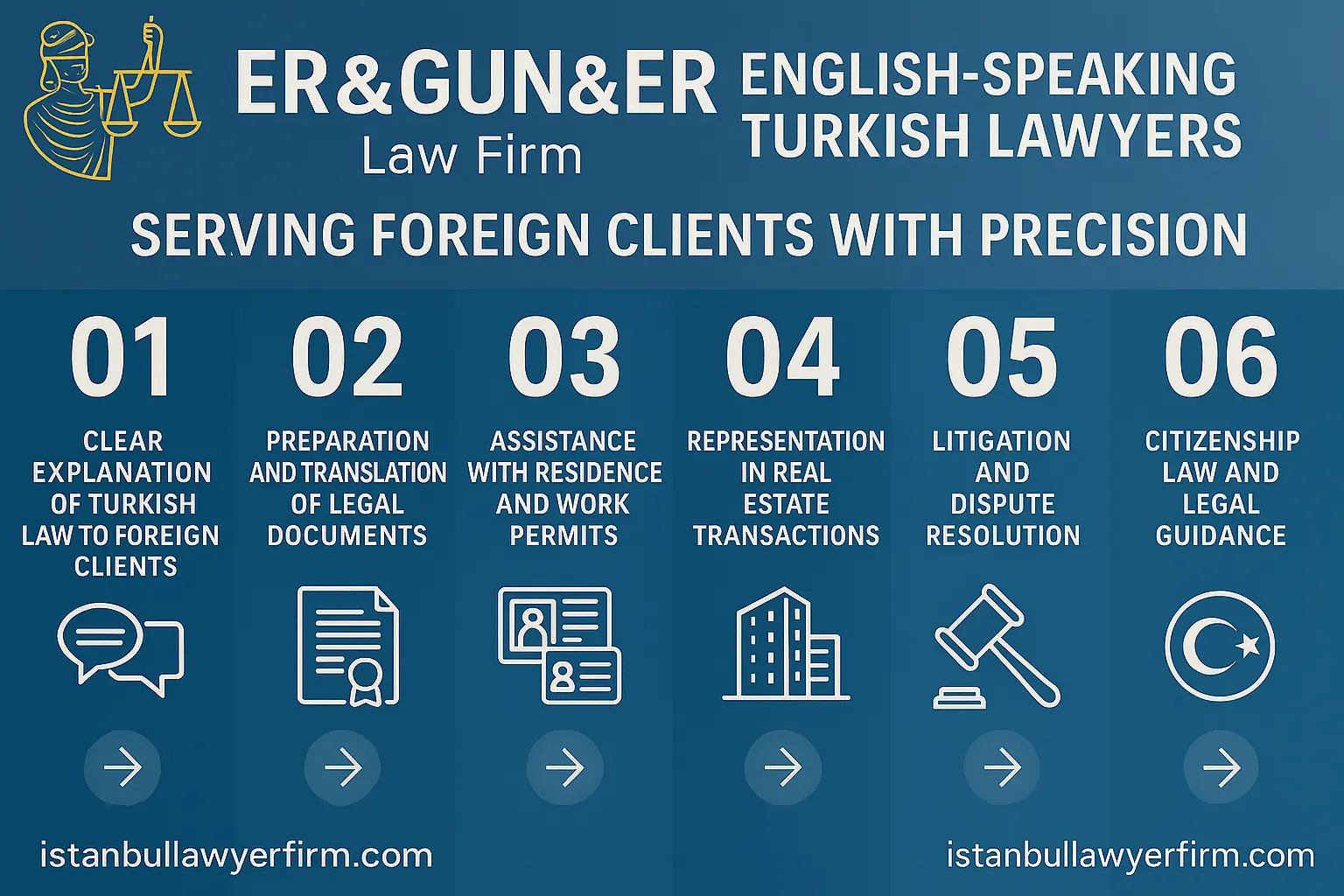
A lawyer in Turkey who advises international clients understands that English-speaking Turkish lawyers serve a specific and irreplaceable function in the Turkish legal system—because foreign individuals and companies whose legal affairs require Turkish institutional submissions, Turkish court representation, and Turkish regulatory compliance face a practical impossibility when adequate English-language legal counsel is unavailable: they cannot understand what they are signing, cannot follow proceedings conducted entirely in Turkish, and cannot provide complete factual instructions to counsel whose English communication with clients is limited to informal summaries rather than substantive legal discussion. An Istanbul Law Firm that provides genuine English-speaking Turkish legal representation delivers comprehensive bilingual legal services across every practice area that international clients encounter: corporate formation, governance, and commercial operations; real estate acquisition, investment, and development; immigration, work permits, and citizenship; commercial dispute resolution and litigation; criminal defense; family law and private client services; employment law; regulatory compliance; notarial services and document authentication; and the complete range of power of attorney management that enables foreign clients to act legally in Turkey without requiring physical presence for every institutional step. A Turkish Law Firm that serves international clients effectively combines the Turkish substantive law and procedural expertise that produces reliable legal outcomes with the English communication capability, bilingual documentation standards, and client management organization that convert individual legal knowledge into dependable service that international clients can rely upon for their most important legal affairs. An English speaking lawyer in Turkey who manages client relationships across language lines ensures that foreign clients understand their legal position, understand the available options, and participate meaningfully in decisions about their own legal affairs rather than depending entirely on counsel's judgment without the client understanding that is essential for genuinely informed client decisions. Practice may vary by authority and year — verify current Turkish legal requirements, current institutional procedures, and current regulatory requirements before implementing any legal strategy.
Why International Clients Need English-Speaking Turkish Lawyers
A lawyer in Turkey who advises on the specific risks that language barriers create in Turkish legal proceedings explains that the consequences of inadequate English-speaking legal representation extend substantially beyond inconvenience into specific, material legal vulnerabilities—because a foreign client who cannot understand what their lawyer is doing, cannot review the documents being filed on their behalf, and cannot provide complete factual instructions due to communication limitations faces a representation quality that is fundamentally inferior to what a Turkish-speaking client in the same situation would receive. An Istanbul Law Firm that provides bilingual Turkish legal representation helps foreign clients understand the specific categories of language-related legal risk that English-speaking representation addresses: the risk of signing Turkish-language documents that do not reflect the client's actual agreement—because documents signed under time pressure at institutional appointments without adequate opportunity for the client to understand their content create binding obligations that may be discovered only when enforcement reveals their scope; the risk of failing to exercise procedural rights available to foreign nationals—including rights to challenge evidence, rights to appeal adverse decisions, and rights to interpreter assistance in criminal proceedings—because clients who cannot follow proceedings in Turkish do not know these rights exist or how to assert them; and the risk of strategy based on incomplete facts—because complex factual instructions that must pass through informal translation lose precision and nuance that may be material to the correct legal approach. Turkish lawyers advising on the practical value of English-speaking representation help international clients understand that the cost differential between genuinely bilingual legal services and lower-cost alternatives whose English capability does not extend to substantive legal communication is typically recovered many times over in better legal outcomes and avoided costs from errors that inadequate communication permits. Practice may vary by authority and year — verify current Turkish procedural rights for foreign nationals and current institutional requirements before assessing any representation situation.
An Istanbul Law Firm that serves international clients across multiple practice areas explains that foreign nationals and companies operating in Turkey frequently encounter legal situations that span multiple practice areas simultaneously—making the availability of English-speaking expertise across a broad practice range a practical necessity rather than a convenience preference for clients who cannot afford the coordination difficulties and knowledge gaps that arise when they must manage separate specialist providers without a shared communication language. Turkish lawyers advising on bilingual legal service scope help foreign clients understand the breadth of practice areas in which English-speaking legal support most commonly proves material: property transactions where the buyer must understand title deed conditions, encumbrance terms, and preliminary contract obligations before committing to a purchase; corporate governance situations where foreign directors need to understand what they are approving before signing board resolutions and authorizing institutional filings; immigration proceedings where applicants need to understand what documentation requirements mean and what the consequences of incomplete submissions are; and dispute resolution situations where the client's own knowledge of underlying facts is essential to developing an effective legal strategy that counsel cannot access through summary communication. An English speaking lawyer in Turkey who provides genuine bilingual legal support across the complete range of a foreign client's Turkish legal affairs provides coordination efficiency—each new matter benefits from accumulated knowledge of the client's circumstances, corporate structure, and legal history—in addition to the substantive communication quality that each individual matter requires.
A Turkish Law Firm that advises on the practical organizational requirements for effective bilingual legal representation explains that genuine English-speaking legal service delivery requires more than attorneys who can speak English—it requires the complete set of organizational practices that convert individual bilingual capability into reliable, consistent delivery: systematic matter intake procedures that capture complete factual information and documentation requirements at the outset of each matter with the precision that subsequent Turkish institutional submissions require; bilingual documentation standards that produce Turkish-language versions satisfying institutional requirements alongside English-language versions enabling client review and understanding; structured communication protocols routing legal instructions and approvals through documented channels that preserve the complete record of each client's authorized decisions; and regular reporting that keeps clients informed about matter status, blocking issues, and required client actions with sufficient specificity for the client to plan and make informed decisions. An English speaking lawyer in Turkey who establishes these organizational practices as part of the initial client engagement rather than assembling them reactively when specific matters require specific information management produces substantially more reliable service delivery and substantially fewer costly errors than bilingual legal services delivered through informal processes that are adequate for simple matters but inadequate for the complex, multi-step legal situations that foreign clients in Turkey regularly face.
Corporate, Commercial and Investment Legal Services
A lawyer in Turkey who advises foreign companies on Turkish corporate and commercial law explains that establishing and operating a business in Turkey requires satisfying a specific set of Turkish Commercial Code requirements—trade registry filings, formal corporate decision procedures, annual compliance obligations, and sector-specific regulatory requirements—that differ from the corporate frameworks applicable in most foreign jurisdictions in ways that are not always obvious from a high-level comparison of statutory text but that become apparent in the specific institutional implementation requirements that Turkish trade registries, tax authorities, and regulatory bodies apply. An Istanbul Law Firm that provides corporate services to foreign businesses implements the complete institutional compliance program: entity formation including bilingual articles of association preparation, notarization and trade registry filing management, tax registration, and social security institution registration; ongoing corporate governance support including board resolution preparation, general assembly management, signatory authority documentation, and trade registry update filings for corporate changes; shareholder agreement preparation for joint venture structures; and commercial contract drafting and review across the full range of commercial arrangements—distribution, agency, service, licensing, and technology contracts—prepared in bilingual format with Turkish law analysis of each material term's enforceability and legal effect. Turkish lawyers advising on corporate compliance help foreign companies understand that trade registry updates, annual declaration obligations, and authorized signatory currency require ongoing monitoring rather than one-time attention—because accumulated compliance gaps create complications during transactions and regulatory reviews that are more expensive to address reactively than to prevent through systematic monitoring. Practice may vary by authority and year — verify current Turkish Commercial Code requirements, current trade registry filing procedures, and current corporate compliance obligations before implementing any corporate compliance program.
An Istanbul Law Firm that advises foreign companies on Turkish commercial contracting explains that contracts for Turkish business relationships require substantive Turkish law adaptation—not merely translation of internationally standard forms—because the Turkish Code of Obligations' mandatory provisions, Turkish commercial practice considerations, and Turkish courts' interpretive approaches create specific legal effects that differ from what foreign companies experience under their home-country commercial law. Turkish lawyers advising on commercial contract preparation help foreign companies understand the specific Turkish law considerations most frequently requiring substantive contract modification: the mandatory Code of Obligations provisions that limit the enforceability of liability exclusions and consequential damage waivers beyond certain thresholds; the Turkish arbitration law requirements that must be satisfied for arbitration clauses to be effective; the Turkish commercial courts' approach to governing law and forum selection clauses; and the specific formality requirements applicable to certain contract types including employment agreements, real property lease contracts, and specific commercial arrangements. An English speaking lawyer in Turkey who prepares commercial contracts for international clients explains each material term's Turkish law implications in terms enabling the client to make informed decisions about accepted commercial risk rather than simply approving the counsel's recommended formulation without understanding what is actually being agreed. Commercial contracts that combine Turkish law compliance with international commercial standards produce more reliable protection and more predictable dispute resolution than contracts that satisfy one dimension at the expense of the other.
A Turkish Law Firm that advises on Turkish investment transactions for foreign clients explains that mergers, acquisitions, joint ventures, and private equity investments involving Turkish entities require coordinating Turkish legal compliance with the foreign investor's overall transaction structure—including the due diligence scope, the transaction documentation architecture, the regulatory approval requirements, and the post-closing integration obligations—in a sequence that prevents the cascading complications that arise when transaction steps occur in incorrect order or when Turkish institutional requirements are discovered after commitments have already been made. An English speaking lawyer in Turkey who advises on Turkish investment transactions helps foreign investors navigate each phase: preliminary documentation including letters of intent and exclusivity arrangements adapted for Turkish commercial practice; legal due diligence covering the target's corporate compliance, contractual position, regulatory status, and pending dispute exposure; definitive documentation including share purchase agreements, subscription agreements, and joint venture agreements in bilingual format with Turkish law compliance; Turkish regulatory and approval management including competition authority review and sector-specific regulatory approvals; and post-closing corporate integration support. Investment transactions managed with genuine bilingual legal support produce more efficient closing processes and more reliable post-closing integration outcomes because the client understands each transaction step rather than accepting counsel's summary of what is occurring and why.
Real Estate, Citizenship and Immigration Services
A lawyer in Turkey who advises foreign property buyers and investors explains that Turkish real estate transactions involve a specific institutional sequence—title search, preliminary contract, DASK earthquake insurance, land registry appointment, title transfer, and post-transfer utility activation—each step requiring complete, correctly formatted documentation whose absence causes institutional rejection and rescheduling that adds days or weeks to transactions that could have proceeded without delays. An Istanbul Law Firm that manages real estate transactions for foreign investors implements the complete transaction process: land registry title search confirming ownership history, current encumbrances, and any pending municipal restrictions affecting the property's use or value; preliminary contract preparation establishing the parties' obligations, payment terms, and conditions precedent in a format protecting the buyer's advance payment while satisfying Turkish contract requirements; DASK compulsory earthquake insurance procurement in the buyer's name with identifiers exactly matching the deed; land registry appointment coordination with complete documentation prepared and verified before the appointment; title transfer execution; and post-transfer utility account establishment. Turkish lawyers managing real estate transactions for foreign buyers ensure that each institutional step's documentation requirements are satisfied before the step is attempted—preventing the discovery of institutional requirements at appointment time when incomplete documentation requires rescheduling and delays. Practice may vary by authority and year — verify current land registry documentation requirements and current DASK requirements before planning any property transaction timeline.
An Istanbul Law Firm that advises on Turkish citizenship by investment and other citizenship pathways explains that citizenship applications require comprehensive documentation demonstrating satisfaction of the specific qualifying conditions—investment amount and type, residence requirements, and character requirements—and that the specific documentation standards the Turkish Migration Directorate and Presidency of the Republic apply evolve through administrative practice that requires current application experience to navigate reliably. Turkish lawyers advising on citizenship applications help clients understand each applicable pathway: the investment-based citizenship route requiring specific minimum investment amounts in qualifying asset categories with documentation proving the investment's completion and valuation; the exceptional merit citizenship route under Article 12 of the Turkish Citizenship Law requiring thorough documentation of the specific exceptional circumstance claimed; and the standard naturalization pathway requiring documented continuous legal residence for the statutory period with the specific evidence of actual residence that authorities require. An English speaking lawyer in Turkey who manages citizenship applications for foreign clients provides regular milestone reporting in the client's language throughout the application process—enabling clients to understand where their application stands, what the next required steps are, and what realistic timeline expectations are rather than relying on periodic informal updates that do not enable informed planning. Practice may vary by authority and year — verify current citizenship application requirements, current investment thresholds, and current processing timelines before making any commitment dependent on specific citizenship outcomes.
A Turkish Law Firm that advises on Turkish immigration law for foreign nationals explains that the Turkish immigration framework's multiple pathways—employment work permits, investment work permits, various residence permit categories, and family reunification permits—each have specific eligibility requirements, documentation standards, and ongoing compliance obligations that must be satisfied throughout the authorized period rather than only at the time of initial application. An English speaking lawyer in Turkey who advises on Turkish immigration compliance helps clients understand the specific practical complexity most relevant to each situation: employment work permit applications requiring documentation from both the Turkish employer entity and the foreign employee with quota calculations demonstrating compliance with permitted foreign employee ratios; short-term residence permit applications for property owners, remote workers, and other qualifying foreign nationals with the specific evidence requirements each permit category requires; and family reunification permit applications for spouses and dependent children of Turkish nationals and permit holders with the specific relationship documentation and financial capacity evidence Turkish authorities require. Immigration compliance that is managed proactively with current counsel guidance—rather than assembled reactively when permit renewal deadlines approach or when authorities request additional documentation—produces substantially more reliable outcomes and substantially fewer emergency situations requiring urgent intervention.
Dispute Resolution, Litigation and Criminal Defense
A lawyer in Turkey who advises on Turkish commercial dispute resolution explains that effective dispute resolution strategy for foreign clients requires integrating substantive legal assessment with enforcement analysis from the outset—because the outcome of Turkish litigation or arbitration produces value to the foreign client only to the extent it can be enforced against the counterparty's available assets, making enforcement planning an essential component of dispute strategy rather than a post-determination afterthought. An Istanbul Law Firm that provides dispute resolution services for foreign clients delivers comprehensive strategic and procedural support: pre-dispute evidence preservation and legal position assessment establishing the client's current legal standing before any demand is made; comparison of available dispute resolution pathways—direct negotiation, mandatory mediation, Turkish court litigation, and domestic or international arbitration—across time, cost, outcome probability, and enforcement dimensions; management of the mandatory mediation requirement that Turkish law imposes as a prerequisite to litigation for most commercial disputes; and full litigation support including pleading preparation, evidence management, hearing representation, and appeal management. Turkish lawyers advising on dispute strategy help foreign clients understand that Turkish litigation is document-intensive—courts evaluate disputes primarily on the written documentary record rather than on oral advocacy—making the completeness and organization of the initial evidentiary submission significantly more determinative of outcomes than subsequent courtroom argument. Practice may vary by authority and year — verify current Turkish civil procedure requirements and current mandatory mediation procedures before advising on any dispute resolution strategy.
An Istanbul Law Firm that advises on the recognition and enforcement of foreign judgments and arbitral awards in Turkey explains that converting a foreign legal victory into enforcement against Turkish assets requires satisfying specific Turkish private international law requirements—including demonstrating that the foreign court or tribunal had jurisdiction under criteria Turkish courts accept, that the parties received proper notification, and that recognition does not violate Turkish public order—through the specific Turkish exequatur procedure or New York Convention enforcement procedure applicable to the particular foreign decision. Turkish lawyers advising on recognition and enforcement help foreign clients assess the enforceability of specific foreign decisions against Turkish assets: analyzing whether the foreign court's jurisdiction claim satisfies Turkish private international law standards; identifying any public order objections that a Turkish court might raise and assessing whether factual or legal arguments can overcome those objections; and managing the Turkish enforcement proceedings including responding to objections the judgment debtor raises. An English speaking lawyer in Turkey who manages enforcement proceedings for foreign clients provides regular updates on the proceedings in the client's language—enabling the client to understand what the counterparty is arguing, what the firm is responding, and what the realistic timeline and outcome prospects are rather than receiving periodic status summaries that do not enable informed client engagement in the proceedings.
A Turkish Law Firm that advises on criminal defense for foreign nationals explains that foreign individuals facing Turkish criminal proceedings—whether for economic crimes, regulatory violations, drug offenses, or other charges—require defense representation that simultaneously addresses the substantive criminal law defense, the procedural rights specific to foreign national defendants, and the immigration status implications that pending criminal proceedings create. An English speaking lawyer in Turkey who provides criminal defense for foreign nationals implements each required dimension of protection from the first moment of police contact: ensuring that interpreter rights and right to silence are properly invoked before any questioning begins and that the invocation is documented in the custody record; assessing the prosecution's evidence from a technical adequacy standpoint—chain of custody, digital evidence collection compliance, and forensic methodology—identifying any procedural or substantive challenges that can weaken the prosecution's case; managing bail and pre-trial supervision applications presenting the specific personal and financial circumstances that Turkish courts consider in assessing flight risk; and developing the integrated trial defense strategy that addresses both factual defense and legal challenges to the prosecution's theory. Criminal defense representation that provides the foreign client with genuine understanding of the proceedings—in their own language, in real time—enables the client to identify factual errors in counsel's understanding and to contribute personal knowledge of relevant circumstances that counsel cannot access through summary communication.
Family Law, Inheritance and Private Client Services
A lawyer in Turkey who advises foreign nationals on Turkish family law explains that family legal matters involving Turkish parties or Turkish-resident foreign nationals—including marriage formalities, prenuptial agreements, divorce, custody, child support, and property division—must satisfy Turkish Civil Code requirements that differ significantly from the family law frameworks applicable in most foreign jurisdictions and that cannot be satisfied by analogy to the client's home-country experience without specific Turkish law guidance. An Istanbul Law Firm that provides family law services for international clients addresses each relevant legal dimension: Turkish prenuptial agreement requirements including the notarial execution requirement that makes the agreement's validity dependent on Turkish notarial form rather than the more flexible execution requirements applicable in many other jurisdictions; Turkish divorce proceedings including the substantive grounds and procedural requirements applicable to uncontested and contested divorces, the mandatory mediation requirement that Turkish family courts impose before contested divorce hearings, and the specific documentation requirements for foreign nationals' divorce filings; Turkish custody law's child welfare standard and the specific factors Turkish family courts assess in determining custody arrangements; and Turkish property division principles applicable to matrimonial assets including the specific presumptions that apply to property acquired during marriage under different marital property regime selections. Turkish lawyers advising on family law help international clients understand that Turkish family court proceedings can have long-term financial and parenting consequences whose full implications require English-language explanation rather than summary communication to enable genuinely informed participation in settlement negotiations and judicial proceedings. Practice may vary by authority and year — verify current Turkish family law requirements and current court procedural requirements before making any family law strategy decisions.
An Istanbul Law Firm that advises on Turkish inheritance law for foreign heirs and estate planners explains that Turkish inheritance law's combination of forced heirship provisions, specific asset transfer procedures, and international private law complications creates specific challenges for foreign nationals with Turkish assets or Turkish-resident heirs that require dedicated legal management rather than assumption that home-country estate planning solutions extend to Turkish assets. Turkish lawyers advising on inheritance matters help foreign clients navigate each relevant dimension: the Turkish forced heirship provisions that reserve specific proportions of the estate for spouse and children regardless of testamentary instructions, including the specific calculation methods and the interaction with Turkish asset classification rules; the Turkish probate and inheritance certificate procedures that establish heirs' rights to access and transfer Turkish assets including real property, bank accounts, and corporate shareholdings; the Turkish inheritance tax obligations applicable to Turkish asset transfers on death including the specific exemptions and rates applicable to different heir categories; and the interaction between Turkish inheritance law and the succession law applicable in the deceased's or heirs' country of residence or citizenship, including EU Succession Regulation implications for European residents with Turkish assets. An English speaking lawyer in Turkey who advises on inheritance matters ensures that heirs receive complete explanations of each required procedural step and each available planning option rather than summary guidance that leaves heirs unaware of time-sensitive steps whose omission creates avoidable complications.
A Turkish Law Firm that advises on private client and wealth structuring services for high-net-worth international clients explains that effective legal management of wealth with Turkish connections—Turkish real estate, Turkish business interests, Turkish bank accounts, or Turkish-resident family members—requires integrating Turkish tax, corporate, real estate, and family law considerations within the client's overall international wealth structure rather than treating Turkish assets as a separate local matter without connection to the client's global legal and financial planning. An English speaking lawyer in Turkey who provides private client services for international clients helps develop the specific planning strategies applicable to each client's situation: corporate holding structures for Turkish business and real estate assets that optimize the tax and governance implications of holding each asset category through the most appropriate ownership structure; Turkish tax residency planning for clients managing day-count and tie-breaker considerations across multiple jurisdictions; Turkish financial institution compliance including UBO disclosure, beneficial ownership documentation, and KYC requirements that Turkish banks and investment institutions apply to international high-net-worth clients; and long-term advisory relationships that provide proactive updates when relevant Turkish legal changes affect the client's existing structures or planning assumptions. Private client legal management that is organized proactively with full awareness of Turkish and international legal requirements produces substantially more reliable protection than planning assembled reactively when specific events create urgent legal needs.
Notarial Services, Apostille and Document Authentication
A lawyer in Turkey who advises on notarial and authentication requirements explains that the effective management of the complete chain of document authentication—notarization, apostille certification, and sworn translation—for international legal matters requires systematic advance planning that treats each authentication step as having independent timeline requirements that must be incorporated into matter calendars rather than treated as administrative steps that can be completed on short notice. An Istanbul Law Firm that manages document authentication for foreign clients implements the planning and execution practices that prevent authentication delays from becoming matter-critical: identifying all required authentication steps at matter intake so that authentication proceeds in parallel with legal preparation rather than sequentially after legal work is complete; maintaining current knowledge of each Turkish institution's specific format requirements for notarized, apostilled, and translated documents—because these requirements are more specific and more frequently updated than general standards describe; commissioning sworn translations from providers whose legal terminology precision and format compliance with specific institutional requirements are established through the firm's working relationships; and maintaining the complete authentication chain with integrity documentation enabling verification if any element is questioned. Turkish lawyers managing authentication for foreign clients help clients understand that authentication failures most commonly arise not from technical chain deficiencies but from name or identifier inconsistencies between authenticated documents and related documents in the same submission—making systematic name-matching verification across all related documents as important as the authentication itself. Practice may vary by authority and year — verify current apostille requirements, current notarization format requirements, and current sworn translation standards with each specific Turkish institution before preparing any document for institutional use.
An Istanbul Law Firm that provides notarial coordination services for international clients explains that the range of notarial acts required in Turkish legal matters—and the specific procedural requirements applicable to each—is substantially broader than foreign clients typically expect based on the more limited role notaries play in many other legal systems. Turkish lawyers advising on notarial requirements help clients understand the specific situations most commonly requiring Turkish notarial involvement: corporate authority documentation including authorized signatory declarations that trade registries require before accepting corporate filings; power of attorney execution for foreign clients who will be represented by Turkish counsel without physical presence; real estate transaction documentation including preliminary contract notarization and related authorization instruments; sworn statement and affidavit preparation for use in Turkish court proceedings and administrative proceedings; and document certification for use abroad where foreign institutions require Turkish notarial certification. An English speaking lawyer in Turkey who manages notarial coordination for foreign clients accompanies clients to notarial appointments, verifies document content before the notary proceeds, explains each document's legal content and effect in the client's language, and ensures that the executed notarial act meets the specific format requirements of the institution that will rely on it. Notarial coordination that includes genuine English-language explanation of each document's content before execution prevents the situations where clients discover after the fact that executed documents did not reflect their actual instructions.
A Turkish Law Firm that advises on the apostille and embassy legalization procedures for Turkish documents used abroad explains that obtaining apostille certification or embassy legalization for Turkish-issued documents—and using foreign-issued authenticated documents in Turkish proceedings—requires navigating specific institutional procedures whose requirements are more detailed than the high-level statutory framework suggests. An English speaking lawyer in Turkey who manages apostille and legalization for international clients implements the complete process: identifying the correct certifying authority for each specific document type under Turkish procedural rules; managing the submission of documents to the certifying authority with all required accompanying materials; tracking each document's progress through the certification process and following up with certifying authority staff when documents are not processed within expected timeframes; and providing certified documents to clients with the complete package—original, apostille, and sworn translation where required—in the format that the foreign institution that will rely on the document requires. Apostille and legalization management that is conducted by counsel with current knowledge of each certifying authority's actual current procedures—rather than by clients attempting to navigate the process independently based on statutory text that may not reflect current administrative practice—produces substantially more reliable and timely results, particularly for clients outside Turkey who cannot readily follow up in person when institutional questions arise.
Powers of Attorney and Remote Legal Representation
A lawyer in Turkey who advises on powers of attorney for foreign clients explains that the power of attorney—vekaletname in Turkish—is the primary legal mechanism enabling foreign clients to take legally effective action in Turkey without requiring physical presence at Turkish institutional appointments, and that effective POA management requires attention to the specific preparation, execution, authentication, deployment, and revocation requirements that make the difference between instruments that Turkish institutions accept without question and instruments that are rejected for technical deficiencies that could have been prevented. An Istanbul Law Firm that prepares and manages powers of attorney for foreign clients implements the complete POA management program: preparing POA instruments with precisely defined scope specifying the exact legal acts authorized—by act type, counterparty or institution, and time period—rather than broad general authority language that creates unnecessary exposure and may not satisfy specific institutions' scope requirements; managing the complete execution and authentication sequence for foreign-executed instruments—local notarization in the client's jurisdiction, Hague apostille certification or consular authentication for non-Hague-Convention countries, and sworn Turkish translation—with each element's format verified against the Turkish institution's current requirements; maintaining a current authority register tracking each outstanding instrument's scope, authentication basis, and validity period with monitoring of approaching expiration; and promptly initiating revocation of instruments that are no longer needed rather than allowing expired-purpose instruments to remain outstanding as potential liability. Turkish lawyers advising on POA management help clients understand that the most common source of institutional rejection of POA-based authority is not authentication failure but scope inadequacy—where the specific act being authorized is not clearly within the instrument's defined scope—making precise scope drafting as important as technical authentication compliance. Practice may vary by authority and year — verify current institutional requirements for POA scope, format, and authentication with each specific Turkish institution before preparing any instrument.
An Istanbul Law Firm that manages remote legal representation for foreign clients explains that the practical operation of POA-based remote representation—where the client remains outside Turkey and the firm acts on the client's behalf for all Turkish institutional steps—requires organizational disciplines that keep the client informed and in control of their legal affairs without requiring their physical involvement in Turkish institutional processes. Turkish lawyers managing remote representation help clients understand the specific operational arrangements that most effectively support reliable remote representation: clear documentation of each authorized act before it is taken, providing the client with the opportunity to review and approve the specific action planned and the specific documents to be executed on the client's behalf; real-time reporting of each institutional step's outcome—what was filed, what the institution's response was, and what the next required step is—in the client's language with sufficient specificity for the client to evaluate whether the outcome matches their expectations; and structured update communications at agreed intervals providing the client with a complete current picture of each open matter's status rather than requiring the client to initiate contact to learn what is happening. An English speaking lawyer in Turkey who manages remote representation for foreign clients treats the client as an informed principal whose understanding and approval of each significant legal step is essential rather than as a passive recipient of legal services who only needs to know the final outcome. Remote representation that maintains the client's genuine understanding and control of their legal affairs produces better outcomes than representation where the client's involvement is limited to providing the initial authorization and receiving the eventual result.
A Turkish Law Firm that advises on the interaction between POA management and the complete range of Turkish institutional processes explains that effective remote legal representation requires not only technically valid instruments but also current familiarity with each Turkish institution's actual current procedural preferences—because institutional acceptance of POA-based authority depends on both the instrument's technical validity and the representative's ability to present the instrument in the specific format and with the specific accompanying materials that each institution's current practice requires. An English speaking lawyer in Turkey who manages POA-based institutional interactions for foreign clients maintains current working knowledge of the specific requirements and preferences of each institution most commonly involved in foreign client matters: Turkish trade registries' current requirements for POA-based corporate filing submissions; Turkish land registry offices' current requirements for POA-based real estate transaction appointments; Turkish notaries' requirements for executing documents on behalf of POA principals; and Turkish court procedures for POA-based litigation representation including the specific court authorization procedures applicable to foreign principal representation. This current institutional knowledge—built through consistent engagement with each institution on behalf of multiple clients—enables the firm to present POA-based authority in the format each institution finds immediately acceptable rather than discovering institutional format preferences through rejected submissions that require resubmission and delay.
Client Communication, Reporting and Long-Term Legal Partnership
A lawyer in Turkey who advises on client relationship management for international clients explains that the quality of the ongoing client relationship—the reliability of communication, the transparency of reporting, and the responsiveness to client needs as they evolve—is as important a determinant of client satisfaction as the quality of the individual legal work product, because international clients who cannot follow Turkish-language proceedings depend on their counsel's communication for their complete understanding of their legal affairs in Turkey. An Istanbul Law Firm that manages client relationships for foreign companies and individuals implements the specific communication practices that most effectively serve international clients' information needs: structured matter status reporting at agreed intervals providing each open matter's current status, the specific issues requiring client attention or decision, the next required steps, and the realistic timeline expectations for each significant upcoming milestone; bilingual documentation delivery providing Turkish-language versions satisfying institutional requirements alongside English-language versions enabling client review and verification that documents reflect the client's actual instructions; escalation communication that brings significant developments—unexpected institutional responses, counterparty actions, or legal change affecting the client's position—to the client's attention promptly rather than accumulating updates for the next scheduled report; and matter close-out communication summarizing each concluded matter's outcome, any open issues requiring future attention, and the location of each matter document in the client's file. Turkish lawyers managing international client relationships understand that communication quality is not a secondary concern to legal quality—for clients who cannot independently access Turkish legal proceedings, comprehensive English-language communication is the foundation on which every other aspect of service quality depends. Practice may vary by authority and year — verify current Turkish legal and regulatory developments with qualified counsel rather than relying on information from prior reports that may have been superseded.
An Istanbul Law Firm that provides long-term legal advisory services to foreign companies and individuals operating in Turkey explains that the accumulated institutional knowledge built through a continuing legal relationship—knowledge of the client's corporate structure, business relationships, contractual position, prior legal history, and institutional relationships—produces efficiency and quality benefits in each new matter that are not available to counsel retained for individual matters without this background context. Turkish lawyers advising on long-term legal relationships help foreign clients understand the specific benefits of maintaining a primary Turkish legal relationship rather than engaging separate counsel for each new matter: each new matter can be assessed against the client's complete legal background rather than requiring extensive briefing on context that established counsel already knows; the established accepted sample library—documents that specific Turkish institutions have accepted for this client in prior matters—enables new documents to be prepared to demonstrated standards rather than through the trial-and-error process that initial engagements require; and the working relationships established with specific Turkish institutional contacts through prior matters reduce friction in new matter processing because counsel's familiarity with the institution's current preferences is already established. An English speaking lawyer in Turkey who manages a long-term relationship with a foreign client provides continuity of representation that protects the client's institutional knowledge through personnel changes on either side of the relationship—a protection that is particularly valuable for clients who rely entirely on counsel's communication for their understanding of their Turkish legal affairs.
A Turkish Law Firm that advises on the practical dimensions of establishing a productive long-term legal partnership with foreign clients explains that the most effective long-term legal relationships are those built on explicit shared expectations about service standards, communication practices, and performance measurement rather than on informal understandings that create different expectations on each side. An English speaking lawyer in Turkey who establishes long-term legal partnerships with international clients implements the specific relationship governance practices that most effectively produce consistent satisfaction: explicit service standard documentation establishing what clients can expect regarding communication response times, reporting cadence, and deliverable quality, creating the shared baseline against which performance can be assessed; fee structure documentation clearly establishing the scope covered by retainer or fixed-fee arrangements, the basis for time-based billing where applicable, and the change control procedure for scope modifications, preventing the invoice disputes that damage otherwise productive relationships; and periodic relationship review conversations—separate from individual matter management—where both parties can assess the relationship's overall health, identify areas for improvement, and adjust the service arrangement to reflect the client's evolving needs. The best lawyer in Turkey for English-speaking legal services combines substantive Turkish legal expertise across every practice area that foreign clients require with the communication quality, organizational discipline, and relationship governance that convert individual legal knowledge into a reliable legal partnership that international clients can depend upon for their most important Turkish legal affairs.
Frequently Asked Questions
- What does an English-speaking Turkish lawyer do differently from a Turkish-only lawyer for foreign clients? An English-speaking Turkish lawyer provides the complete client communication in the client's language—explaining Turkish law implications, reviewing documents with the client before execution, discussing legal strategy options, and providing proceedings updates—that enables the client to understand and participate in their own legal affairs rather than depending entirely on counsel's judgment without the client comprehension needed for genuinely informed decision-making. The practical difference is not only communication quality but legal outcome quality, because counsel who can receive precise factual instructions and explain precise legal analysis in the client's language makes fewer strategy errors based on misunderstood facts and produces fewer document errors based on imprecisely stated client instructions. Practice may vary by authority and year.
- Can a Turkish law firm represent foreign clients in all Turkish courts and institutions? Yes. Licensed Turkish attorneys can represent clients before all Turkish courts—civil, commercial, administrative, and criminal—and before all Turkish institutional proceedings including trade registry procedures, land registry transactions, immigration authority proceedings, tax authority proceedings, and regulatory authority proceedings. The representation quality depends on the attorney's substantive knowledge of the applicable legal area and institutional familiarity with the specific institution rather than on the client's nationality. Foreign clients benefit most when their Turkish counsel can both represent them before Turkish institutions and communicate the substance of those proceedings in the client's language. Practice may vary by authority and year.
- How does POA-based remote representation work for foreign clients? POA-based remote representation enables foreign clients to authorize a Turkish law firm to take legally effective actions—filing documents, attending institutional appointments, executing contracts, and representing the client in proceedings—without the client being physically present in Turkey for each step. The client executes a power of attorney prepared by the firm in bilingual format, has it notarized and apostilled in their own country, and the firm then acts under that authority for each authorized act. The firm reports each action taken and its outcome to the client in real time, enabling the client to remain fully informed and in control of their legal affairs without the travel costs and scheduling difficulties that physical presence at Turkish institutional appointments would require. Practice may vary by authority and year.
- What are the Turkish citizenship by investment requirements? Turkish citizenship by investment requires a qualifying investment meeting minimum threshold requirements—real estate, bank deposit, government bonds, or business investment meeting specific amounts established by the applicable regulations—with documentation proving both the investment's completion and its qualifying value. Applications are managed through the Turkish Investment Office and Migration Directorate with specific documentation requirements for both the investment and the applicant's personal qualifications. Processing timelines vary by application volume and completeness. Specific investment thresholds, qualifying investment categories, and documentation requirements should be verified with current counsel based on recent application experience. Practice may vary by authority and year.
- What Turkish real estate due diligence steps protect foreign buyers? Essential due diligence for foreign property buyers covers land registry title review confirming clean ownership and absence of undisclosed encumbrances; construction permit and occupancy certificate compliance verification; municipal zoning and planning restriction assessment; DASK compulsory earthquake insurance requirements identification; building management records review for apartment units; and property valuation by a licensed Turkish appraiser for investment decisions. For development properties, additional construction permit and zoning compliance review is required. Due diligence should be completed before preliminary contract execution commits the buyer to the purchase with advance payment. Practice may vary by authority and year.
- How does Turkish mandatory mediation work before commercial litigation? Turkish Law No. 7155 requires parties to attempt mandatory mediation before filing most monetary commercial claims in Turkish courts. Parties must designate a mediator from the official registry, attempt mediation within specified timeframes, and obtain a non-settlement certificate if mediation does not resolve the dispute before court filing is permitted. Mediation preparation should include the same evidentiary documentation discipline as litigation preparation, since the documentary record and positions established in mediation affect subsequent litigation if settlement is not reached. Approximately two-thirds to three-quarters of commercial mediations result in settlement. Practice may vary by authority and year.
- What interpreter rights do foreign defendants have in Turkish criminal proceedings? Foreign defendants in Turkish criminal proceedings have constitutional rights to competent interpretation throughout all proceedings from initial police contact through trial, including during police questioning, document review, and court hearings. These rights must be affirmatively invoked at the beginning of each proceeding and documented in the official record. Interpretation quality can be challenged where it is inadequate for the specific legal proceedings. Foreign defendants also have rights to consular notification under the Vienna Convention on Consular Relations upon their request. Competent legal counsel should ensure these rights are invoked and documented from the first moment of police contact. Practice may vary by authority and year.
- What Turkish apostille procedures apply to documents used in foreign proceedings? Turkish documents intended for use in proceedings in countries party to the Hague Apostille Convention require apostille certification by the competent Turkish authority—typically the regional civil court of first instance—rather than full legalization through the chain of Turkish governmental authorities and foreign consular authentication. Specific Turkish documents requiring apostille include notarial acts, court decisions, civil status documents, and official government certificates. Processing timelines and specific format requirements should be verified with current counsel experience before planning transaction or proceeding timelines dependent on apostilled Turkish documents. Practice may vary by authority and year.
- What work permit options are available for foreign employees in Turkey? The primary Turkish work permit for foreign employees of Turkish companies requires documentation from both the Turkish employer and the foreign employee, with quota calculations demonstrating compliance with the permitted foreign employee ratio applicable to the employer's workforce size and Turkish employee count. Additional work permit categories include investment-based permits for qualifying investors, work permits for company directors and managers, and work permits for specific highly skilled foreign nationals in qualifying sectors. Specific documentation requirements, quota calculations, and processing timelines evolve through administrative updates requiring current counsel guidance for specific applications. Practice may vary by authority and year.
- How are foreign court judgments recognized and enforced in Turkey? Foreign court judgments are recognized and enforced in Turkey through the exequatur procedure governed by Turkish Private International and Procedural Law No. 5718. The applicant must demonstrate that the foreign court had jurisdiction under criteria Turkish courts accept, that the parties received proper notification, that the judgment is final in the foreign jurisdiction, and that recognition does not violate Turkish public order. Bilateral treaty frameworks affect the specific procedure and evidentiary requirements applicable to judgments from specific countries. Foreign arbitral awards are enforced under the New York Convention framework with specific procedural requirements. Practice may vary by authority and year.
- What should foreign clients provide when first engaging a Turkish law firm? Foreign clients should provide complete identity documentation for all parties including passport copies and tax numbers for individuals and trade registry extracts and tax certificates for entities; all relevant existing documents including contracts, correspondence, and corporate authorization records in their original language with descriptive labels; a clear written description of the legal situation and the specific legal outcome sought ranked by priority; all relevant deadlines including statutory limitation periods and contractual commitment dates; and information about any prior Turkish legal proceedings or institutional interactions related to the matter. Complete initial information enables efficient scoping, accurate cost estimation, and faster matter commencement. Practice may vary by authority and year.
- How does KVKK Turkish data protection law apply to companies with Turkish operations? Turkish Personal Data Protection Law requires companies processing Turkish resident personal data to identify lawful processing bases for each processing activity, prepare Turkish-language privacy notices for Turkish data subjects, implement data subject rights response procedures for Turkish KVKK rights, register with the Data Controllers' Registry where required by processing activity type and volume, implement cross-border data transfer compliance for transfers outside Turkey, and maintain appropriate technical and organizational security measures. Companies with established GDPR compliance programs should specifically identify the Turkey-specific KVKK requirements that differ from GDPR rather than assuming GDPR compliance satisfies Turkish obligations. Practice may vary by authority and year.
- What Turkish employment law obligations apply to companies employing Turkish workers? Turkish Labor Law No. 4857 imposes mandatory employment conditions including minimum wage, annual leave entitlement (fourteen days minimum after the first year), specific overtime calculation and payment rules, termination notice periods based on tenure, and severance payment obligations of thirty days' final wages per year of service for qualifying terminations. Termination without valid substantive and procedural grounds creates reinstatement or compensation liability. Social security registration and premium payment obligations apply from the first day of employment and create financial and criminal liability for violations. Employment contracts should specifically address each mandatory term rather than simply incorporating international standard employment terms without Turkish law compliance review. Practice may vary by authority and year.
- Can foreign clients receive regular updates on their Turkish legal matters in English? Yes. An Istanbul Law Firm providing genuine English-speaking legal services delivers regular structured updates in English for all open matters—covering current matter status, specific issues requiring client attention or decision, next required steps, and realistic timeline expectations—at agreed intervals without requiring the client to initiate contact to discover what is happening in their Turkish legal affairs. The quality of regular English-language reporting is a reliable indicator of genuine bilingual service capability, because firms that only translate documents without substantive English-language client communication cannot provide the regular informed updates that enable foreign clients to plan and make decisions based on current knowledge of their Turkish legal affairs. Practice may vary by authority and year.
- Does ER&GUN&ER Law Firm provide English-speaking legal services for foreign clients across all described practice areas? Yes. ER&GUN&ER Law Firm provides comprehensive English-speaking bilingual legal services for international clients across all described practice areas including corporate formation and governance, commercial contracting, real estate acquisition and investment, immigration and work permits, Turkish citizenship applications, commercial dispute resolution, litigation and criminal defense, family law and inheritance, regulatory compliance, notarial coordination and apostille management, power of attorney preparation and management, and remote POA-based legal representation—with English-language client communication, bilingual documentation, and systematic delivery standards maintained throughout each engagement.
Author: Mirkan Topcu is an attorney registered with the Istanbul Bar Association (Istanbul 1st Bar), Bar Registration No: 67874. His practice focuses on cross-border and high-stakes matters where evidence discipline, procedural accuracy, and risk control are decisive.
He advises individuals and companies across Immigration and Residency, Real Estate Law, Tax Law, and cross-border documentation matters where procedural accuracy and evidence discipline are decisive.
Education: Istanbul University Faculty of Law (2018); Galatasaray University, LL.M. (2022). LinkedIn: Profile. Istanbul Bar Association: Official website.