

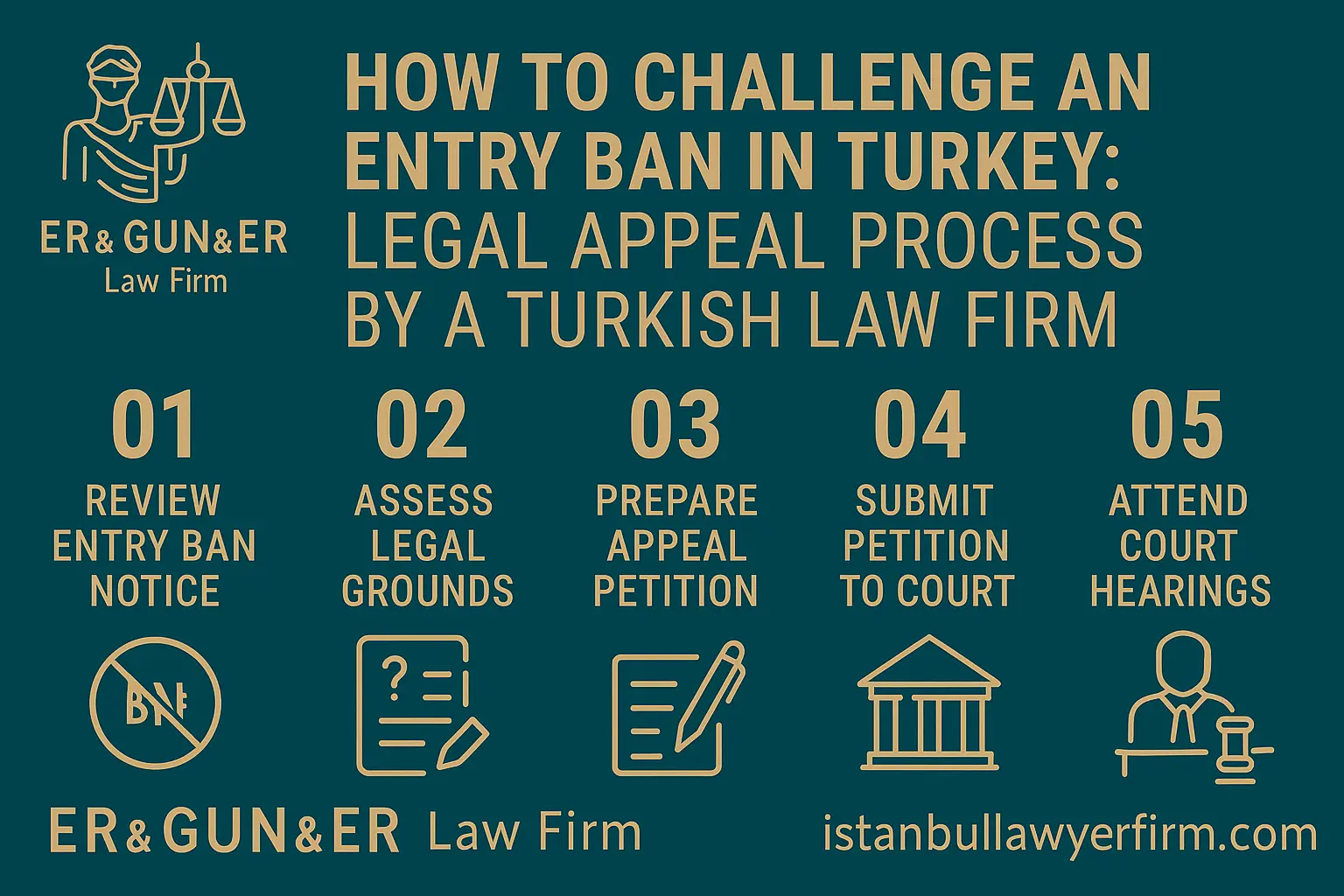
A lawyer in Turkey who advises foreign nationals facing entry bans explains that an entry ban—imposed by Turkish migration authorities under the Law on Foreigners and International Protection No. 6458 and its implementing regulations—is an administrative decision that can be challenged through specific legal procedures whose sequence, deadlines, and documentary requirements must be followed precisely to preserve the foreign national's appeal rights and maximize the probability of a successful outcome. An Istanbul Law Firm that represents foreign nationals in entry ban challenges provides comprehensive legal support across the complete appeal process: identifying the specific legal grounds on which each particular ban decision can be challenged; gathering and organizing the evidence that establishes those grounds; preparing and filing the formal administrative objection with the Provincial Directorate of Migration Management within the statutory ten-day period; managing the administrative court cancellation lawsuit if the administrative objection fails or the time for judicial review is reached; applying for judicial suspension of the ban's execution to enable urgent travel while the main appeal proceeds; coordinating with Turkish embassies and consulates for clients who are outside Turkey; and managing post-ban compliance steps to ensure that the lifted ban is reflected in all relevant systems. A Turkish Law Firm that handles entry ban appeals regularly understands that the most common causes of unsuccessful appeals are not weak legal positions but procedural failures—missed deadlines, incorrectly addressed objections, and incomplete evidentiary packages—that could have been prevented through competent legal management. An English speaking lawyer in Turkey who advises foreign nationals on entry ban challenges ensures that clients understand both the legal basis and the procedural requirements of their appeal rather than submitting documents without understanding what is being argued and what the realistic outcomes are. Practice may vary by authority and year — verify current Turkish entry ban appeal procedures, current administrative objection deadlines, and current administrative court filing requirements before implementing any appeal strategy.
Legal Grounds for Challenging a Turkish Entry Ban
A lawyer in Turkey who advises on entry ban challenges explains that identifying the correct legal grounds for appeal requires analyzing both the substantive basis on which the ban was imposed and the procedural adequacy of the ban decision—because Turkish administrative law provides challenge grounds based on both the merits of the underlying decision and the procedural regularity of the decision-making process, and that the strongest appeals typically combine substantive and procedural challenges rather than relying on a single attack vector. An Istanbul Law Firm that analyzes entry ban decisions for foreign clients examines each relevant dimension: whether the ban was imposed for a correct factual reason—that the specific conduct or status attributed to the foreign national actually occurred and was correctly understood—or whether the ban rests on factual error including mistaken identity, incorrect date calculations, or misattributed travel document entries that do not belong to the subject of the ban; whether the ban's legal characterization is correct—that the specific legal provision invoked by the migration authority actually applies to the conduct or status established by the facts—rather than applying a prohibition that does not legally cover the situation; whether the ban is proportionate—that the duration and severity of the ban corresponds to the seriousness of the underlying basis under the applicable regulations—rather than imposing a standard duration without individualized assessment of the specific circumstances; and whether the procedural requirements applicable to the ban decision were satisfied—including adequate notification, opportunity to be heard where required, and proper authorization by the issuing authority. Turkish lawyers advising on entry ban grounds help foreign clients understand that procedural challenges are frequently overlooked but are sometimes the most effective approach—because a ban issued without proper notification, without legally required opportunity to respond, or by an authority exceeding its competence can be annulled on procedural grounds without requiring the court to resolve disputed factual questions about the underlying conduct. Practice may vary by authority and year — verify current Turkish migration authority procedural requirements and current administrative court standards for each challenge ground before developing any appeal strategy.
An Istanbul Law Firm that advises on specific entry ban categories explains that the legal grounds most appropriate for each appeal depend significantly on the specific restriction code assigned to the ban—because different codes reflect different underlying legal bases with different appeal procedures and different evidentiary requirements. Turkish lawyers advising on entry ban codes help foreign clients understand the most common categories and their specific legal implications: Ç-101 bans issued for illegal entry or stay violations require documentation demonstrating either that no violation occurred, that the violation was less serious than the ban reflects, or that mitigating circumstances—including humanitarian factors, family ties, or medical necessity—justify a shortened or waived ban period; G-87 bans issued on public security or public order grounds require addressing the specific security or order concern that triggered the ban, which may involve providing character documentation, criminal record clearance certificates from the relevant jurisdictions, or evidence of rehabilitation or changed circumstances since the triggering event; and bans arising from visa overstay require either demonstrating that the overstay period was shorter than recorded—through documented departure evidence that was not correctly captured in the migration system—or that the overstay resulted from circumstances beyond the foreign national's control including documented medical emergencies, force majeure events, or migration authority processing delays that prevented timely departure. An English speaking lawyer in Turkey who analyzes restriction codes for foreign clients provides clear explanations of what each code means, what appeal procedure applies, and what evidence is needed—enabling clients to make informed decisions about whether and how to appeal rather than submitting generalized objections that do not address the specific legal basis of the ban.
A Turkish Law Firm that advises on legal grounds for entry ban appeals explains that the most persuasive appeals combine strong legal arguments with thorough factual documentation—because Turkish administrative authorities and administrative courts are more likely to grant relief when the factual case for the appeal is concrete and verifiable rather than based on assertion. An English speaking lawyer in Turkey who develops entry ban appeal strategies for foreign clients implements the specific approach that most effectively serves each client's situation: analyzing the ban decision's stated grounds against the available factual evidence to identify which elements can be factually refuted and which require legal or proportionality arguments; identifying the evidence categories most directly relevant to each challenge ground—travel records, entry and exit stamps, employment documentation, medical records, family documentation, and prior visa compliance records—and establishing the completeness of the available evidence before the appeal is filed; and designing an appeal strategy that addresses the strongest aspects of the migration authority's position rather than ignoring them, because courts and authorities are more persuaded by appeals that acknowledge and respond to the decision's reasoning than by appeals that simply assert an alternative conclusion without engaging the stated grounds. Appeals that are strategically designed against the specific decision being challenged produce substantially better outcomes than generic objection letters that do not address the particular legal and factual basis of the ban decision.
Gathering Evidence and Preparing the Appeal Package
A lawyer in Turkey who advises on evidence preparation for entry ban appeals explains that the completeness and organization of the evidentiary package submitted with the appeal is as important as the legal arguments it supports—because Turkish migration authorities and administrative courts evaluate appeals based on the documentary record rather than on oral advocacy, making the quality of the submitted evidence the primary determinant of the appeal's persuasiveness. An Istanbul Law Firm that prepares entry ban appeal packages for foreign clients implements the systematic evidence gathering approach that most effectively supports each appeal's specific legal grounds: travel history documentation including passport copies showing all Turkish entries and exits with entry stamps, exit stamps, and border crossing records that can be cross-referenced against the migration authority's records of the dates and durations that triggered the ban; status documentation demonstrating the client's legal presence or activities in Turkey during the relevant period, including residence permit records, work permit records, enrollment documentation for students, employment contracts for working visa holders, and property ownership records for property-based permit holders; identity documentation confirming the client's correct identity in cases where mistaken identity is argued, including biometric passport information, prior Turkish visa records, and documentation from the client's home country establishing the correct identity; and circumstantial documentation supporting proportionality or humanitarian arguments including medical records for health-based urgency arguments, family status documentation for family reunification grounds, and employment or business necessity documentation for professional necessity arguments. Turkish lawyers advising on evidence preparation help foreign clients understand that each piece of evidence must be presented in a format that Turkish authorities can verify—certified translations for foreign-language documents, notarization where required, and organized presentation that allows the decision-maker to identify and verify each factual claim without difficulty. Practice may vary by authority and year — verify current Turkish evidentiary standards and current translation and notarization requirements for each evidence category before finalizing the appeal package.
An Istanbul Law Firm that advises on appeal document preparation explains that the formal objection letter—the core document of any entry ban appeal—must satisfy both legal substance requirements and formal presentation requirements to be treated as an effective appeal rather than dismissed for technical deficiency. Turkish lawyers preparing objection letters for foreign clients implement the specific drafting practices that most effectively present each appeal's arguments: opening with a precise statement of the ban decision being challenged—including the decision date, the restriction code, and the stated basis—that confirms the objection is directed at the correct decision and is filed within the applicable deadline; stating the legal grounds for the challenge in the order most likely to persuade the receiving authority, with the strongest grounds stated first and each ground supported by specific references to the applicable legal provisions; connecting each legal ground to the specific evidence submitted with the objection, with cross-references to exhibit numbers that allow the reviewer to immediately locate the evidence supporting each argument; and concluding with a specific request for the relief sought—annulment of the ban, reduction of the ban period, or suspension pending judicial review—stated in terms that match the authority's or court's actual power to grant. An English speaking lawyer in Turkey who drafts objection letters for foreign clients produces documents that communicate the legal arguments clearly and precisely in Turkish—because objection letters submitted to Turkish migration authorities must be in Turkish to be processed, making the quality of the Turkish-language drafting a direct determinant of the objection's effectiveness regardless of how strong the underlying arguments are.
A Turkish Law Firm that advises on evidence presentation for administrative court proceedings explains that the evidence package submitted to the administrative court must satisfy formal procedural requirements—including exhibit indexing, page numbering, certified translation standards, and specific binding formats—that differ from the less formal requirements applicable to administrative objections filed with migration authorities. An English speaking lawyer in Turkey who prepares administrative court submissions for foreign clients ensures that each exhibit is clearly labeled with an exhibit identifier corresponding to its citation in the petition, that foreign-language documents are accompanied by sworn Turkish translations prepared by certified translators whose qualifications satisfy the court's standards, that the complete exhibit package is organized in the order referenced in the petition to allow efficient judicial review, and that any urgency documentation—medical records, business records, and family documentation—is presented with particular clarity given that suspension applications are evaluated on an expedited basis where the court has limited time for detailed review. Administrative court submissions that satisfy all formal requirements on first filing avoid the resubmission and delay that result from technical deficiencies—which is particularly important in entry ban cases where the client may be unable to enter Turkey until the appeal is resolved and where every day of delay extends the practical impact of the ban on the client's personal and professional situation.
Administrative Objection and Administrative Court Procedures
A lawyer in Turkey who advises on the entry ban appeal procedure explains that the Turkish legal framework provides a two-stage challenge mechanism—administrative objection followed by administrative court litigation if the objection fails—and that understanding each stage's requirements, timeline, and strategic implications is essential for managing the appeal process effectively. An Istanbul Law Firm that manages entry ban appeals through both stages explains the specific requirements applicable to each: the administrative objection stage, which requires filing a written objection with the Provincial Directorate of Migration Management within ten days of the ban notification, provides the fastest potential path to ban removal if the authority accepts the objection—because an administrative authority that agrees with the objection can remove the ban administratively without requiring the client to pursue court litigation; the administrative court stage, which requires filing a cancellation lawsuit under Law No. 2577 on Administrative Procedure within sixty days of notification of the final administrative decision, provides the judicially binding review mechanism when administrative channels are exhausted or when the authority's position cannot be changed through administrative persuasion alone. Turkish lawyers advising on the choice between administrative and judicial channels help foreign clients understand that pursuing the administrative objection first is generally preferable to proceeding directly to court—because an accepted administrative objection achieves the same outcome faster and at lower cost than court litigation, while a rejected administrative objection preserves the right to court challenge and creates an additional procedural record that may support the court case. Practice may vary by authority and year — verify current objection deadline calculation rules, current administrative court filing procedures, and current court fee requirements before filing any entry ban appeal.
An Istanbul Law Firm that represents foreign clients in administrative court proceedings for entry ban challenges explains that Turkish administrative court litigation for immigration matters follows the written procedure framework of Law No. 2577—meaning that the court's decision is based primarily on the written submissions and documentary evidence rather than on oral hearings—making the quality of the initial petition and the completeness of the evidence critical determinants of the outcome. Turkish lawyers managing administrative court litigation for foreign clients implement the litigation management practices that most effectively support favorable outcomes: filing the cancellation lawsuit within the applicable deadline with a complete petition that identifies the specific administrative decision being challenged, states each legal ground for annulment with supporting legal authority, and references each piece of supporting evidence; filing the suspension application simultaneously with or immediately after the petition where urgent travel is required, because the court processes suspension applications on an expedited basis separately from the main cancellation case; monitoring the court's administrative processing of the case and responding promptly to any requests for additional information or supplementary submissions; and maintaining regular communication with the client throughout the proceedings to ensure that the client understands the current status, the next expected steps, and the realistic timeline for a decision. An English speaking lawyer in Turkey who manages administrative court proceedings for foreign clients provides regular case updates in the client's language—enabling clients who may be outside Turkey and unable to attend proceedings in person to remain genuinely informed about their case rather than simply being notified of outcomes after each stage.
A Turkish Law Firm that advises on judicial suspension applications for entry ban cases explains that the application for judicial suspension of the ban's execution—yürütmenin durdurulması in Turkish—provides the procedural mechanism for enabling urgent travel while the main cancellation lawsuit proceeds, and that this mechanism is available in entry ban cases where the client can demonstrate both legal grounds for the main appeal and concrete harm from the ban's continued execution during the appeal period. An English speaking lawyer in Turkey who prepares suspension applications for foreign clients implements the specific strategy most effective for each urgency situation: for medical necessity cases, providing hospital documentation and treating physician statements that demonstrate both the medical urgency and the specific requirement for travel to Turkey for treatment that cannot be obtained in the client's current location; for business necessity cases, providing business contracts, meeting invitations, and employer documentation that demonstrate the specific professional obligations requiring presence in Turkey that cannot be performed remotely and whose non-performance causes concrete financial or contractual damage; and for family emergency cases, providing documentation of the family relationship and the specific emergency circumstance that requires immediate presence in Turkey. Suspension applications that provide concrete, specific evidence of harm from continued execution of the ban—rather than general assertions of inconvenience—are substantially more likely to succeed because the legal standard for suspension requires demonstration of specific harm rather than general preference for travel.
Restriction Codes, Ban Durations and Category-Specific Strategies
A lawyer in Turkey who advises on Turkish entry ban restriction codes explains that the specific code assigned to each entry ban reflects both the legal category of the violation and the regulatory framework for calculating the ban's duration—and that correctly interpreting the assigned code is the essential first step in identifying the applicable appeal procedure and the evidentiary requirements for each case. An Istanbul Law Firm that analyzes restriction codes for foreign clients explains the principal categories most frequently encountered: codes in the Ç series—including Ç-101 for illegal entry and related categories—typically reflect stays without valid residence authorization, border crossing violations, or document irregularities, with ban durations determined by regulatory tables that establish standard periods for specified violation durations and types; codes in the G series—including G-87 for public security and G-78 for threats to public order—reflect more serious assessments of the foreign national's presence in Turkey and involve stricter documentation requirements for both the authority imposing the ban and the foreign national challenging it; and codes related to deportation orders reflect situations where the foreign national was removed from Turkey under formal deportation procedures with the associated ban arising from the deportation rather than from a separate administrative decision. Turkish lawyers advising on code-specific strategies help foreign clients understand that the applicable appeal procedure depends on the code because different codes arise from different legal provisions with different procedural rules—codes arising from administrative migration decisions are challenged through migration authority objection followed by administrative court, while codes arising from certain security-related assessments may involve different authorities and different procedural frameworks. Practice may vary by authority and year — verify the specific appeal procedure applicable to each restriction code with qualified immigration counsel based on current administrative practice.
An Istanbul Law Firm that advises on duration calculation for entry bans imposed for overstay explains that Turkish regulation establishes specific ban duration tables based on the length of the overstay period—with shorter overstays typically resulting in shorter ban periods and longer overstays resulting in multi-year bans—and that verifying the accuracy of the overstay period calculation is a critical first step in every overstay-based appeal. Turkish lawyers advising on overstay ban challenges help clients understand the specific verification procedures that most effectively identify calculation errors: comparing the migration authority's recorded departure date against the client's passport showing the actual departure stamp, because system recording errors sometimes enter the wrong date or fail to capture a valid departure; verifying the entry date used to calculate the overstay against the entry stamp in the passport and any other records confirming the correct entry date; and identifying whether any authorized extensions, visa renewals, or pending application periods should have been credited against the overstay calculation but were not. An English speaking lawyer in Turkey who manages overstay ban appeals helps clients understand that even minor calculation corrections—a few days' difference between the recorded and actual departure date—can move a case from one ban duration category to a shorter one under the applicable duration tables, making careful factual verification a prerequisite to assessing the strength of the appeal before strategy decisions are made.
A Turkish Law Firm that advises on appeals of bans imposed on public security grounds explains that G-87 and related security-category bans involve a different evidentiary and procedural framework than administrative overstay bans—because security-based bans reflect the migration authority's assessment of risk rather than established factual violations, and challenging this assessment requires evidence addressing the specific risk concern rather than simply documenting technical compliance. An English speaking lawyer in Turkey who advises on security-category ban appeals helps foreign clients understand the specific evidence categories most relevant to these cases: character documentation demonstrating the absence of criminal history in all relevant jurisdictions, including criminal record clearance certificates from the client's home country and any other countries of significant residence; documentation of changed circumstances since the events that triggered the security concern, demonstrating that the original risk assessment no longer applies to the client's current situation; documentation of the client's specific ties to Turkey including family, employment, property, and business relationships that establish the legitimate basis for the requested entry and demonstrate the concrete harm caused by the ban; and where the security concern was based on a specific incident that has been resolved—including minor criminal matters, regulatory violations, or administrative infractions—documentation demonstrating the resolution of the underlying matter. Security-category ban appeals require more careful strategic planning than administrative overstay appeals because the authority's risk assessment is more subjective and courts give greater deference to security determinations—making thorough preparation and persuasive documentation even more critical to success.
Post-Ban Compliance, Embassy Coordination and Future Prevention
A lawyer in Turkey who advises on post-appeal compliance steps explains that obtaining an administrative or judicial decision lifting an entry ban is not the final step in restoring the foreign national's ability to enter Turkey—because the decision must be correctly recorded in the migration authority's information systems before border processing systems reflect the lifted ban, and that verifying this recording has occurred is an essential step that should be completed before the client attempts to travel to Turkey based on the lifted ban. An Istanbul Law Firm that manages post-appeal compliance for foreign clients implements the specific verification and coordination steps that most effectively ensure the lifted ban is operational: obtaining written confirmation from the Provincial Directorate of Migration Management or the administrative court that the ban has been lifted and the basis for the lifting—administrative acceptance or court order—for presentation at border entry if questions arise; verifying that the migration authority's electronic records have been updated to reflect the lifted ban by requesting confirmation from the directorate and, where possible, from the Yabancı Kimlik Numarası system records; and coordinating with relevant embassies or consulates regarding any visa applications that were deferred pending the appeal outcome, providing the documentation of the lifted ban needed for the visa application to proceed. Turkish lawyers advising on post-appeal compliance help foreign clients understand that carrying the documentation of the ban lifting during the first re-entry after the appeal—including the administrative decision or court order, its certified Turkish translation if issued in Turkish, and any confirmation from the migration authority—provides the most effective protection against any residual system flags that may not have been updated before the attempted re-entry. Practice may vary by authority and year — verify current procedures for system update verification with current counsel before planning re-entry.
An Istanbul Law Firm that provides embassy and consular coordination for foreign clients whose entry ban appeals are managed from abroad explains that clients who are outside Turkey when a ban is imposed or pending appeal face specific practical challenges—including the inability to appear in person at Turkish migration authority offices and the need to manage proceedings through a combination of legal representation and embassy or consular engagement—that require specific operational arrangements to address effectively. Turkish lawyers advising on remote appeal management help clients understand the specific arrangements most relevant to their situations: ensuring that the power of attorney authorizing the Turkish law firm to act on the client's behalf in appeal proceedings is prepared in bilingual format, properly executed before a local notary, apostilled, and provided to the firm before appeal deadlines require any filings; coordinating with the client's home-country Turkish embassy or consulate on the specific documentation and notification procedures applicable to the client's situation, including any visa application procedures that require embassy-side processing after the ban is lifted; and managing the communication flow between the client abroad, the Turkish law firm managing the proceedings, and the Turkish authorities and courts processing the appeal—ensuring that each party has the information it needs when it needs it. An English speaking lawyer in Turkey who manages remote entry ban appeals for foreign clients provides the critical coordination function that enables clients to participate effectively in their own appeal from abroad without requiring them to navigate Turkish administrative procedures independently in a language they do not speak.
A Turkish Law Firm that advises on preventive measures for foreign nationals at risk of entry ban issues explains that the most cost-effective approach to entry ban management is prevention—implementing the compliance practices that prevent ban-triggering situations from arising rather than managing appeals after bans have been imposed. An English speaking lawyer in Turkey who provides preventive immigration compliance advice for foreign clients implements the specific practices most effective for each client's situation: systematic tracking of authorized stay periods including residence permit validity, work permit validity, and visa validity dates with advance notification of approaching expiration to enable timely renewal before overstay violations occur; clear guidance on the specific activities permitted and prohibited under each visa or permit category, including the specific employment, business, study, and recreational activities that are and are not authorized—because unauthorized activities constitute a violation even within an otherwise valid stay authorization; and periodic compliance reviews for foreign nationals with complex or long-standing Turkish immigration situations that verify the current status of all relevant permits, registrations, and compliance obligations and identify any inconsistencies or gaps requiring correction. Prevention-focused immigration compliance management produces substantially lower total legal and compliance costs over time than reactive management of violations after they occur—because the cost of an entry ban appeal, including legal fees, delay costs, and business disruption, typically substantially exceeds the cost of the compliance monitoring that would have prevented the ban. Practice may vary by authority and year — verify current authorized stay periods, current renewal procedures, and current permit category restrictions before implementing any compliance program.
Emergency Applications, Corporate Programs and Long-Term Travel Planning
A lawyer in Turkey who advises on emergency judicial suspension applications explains that the judicial suspension mechanism provides the most rapid path to travel authorization for foreign nationals who face urgent circumstances that cannot wait for the full administrative or judicial appeal process—and that the effectiveness of an emergency suspension application depends critically on both the substantive urgency of the circumstances and the quality of the documentation presented to the court. An Istanbul Law Firm that prepares emergency suspension applications for foreign clients implements the specific practices that most effectively present urgent circumstances to administrative courts: preparing the suspension application simultaneously with the main cancellation lawsuit to avoid any delay between the petition filing and the urgent relief request; presenting medical documentation, business documentation, or family emergency documentation with the specificity that courts require—including the specific diagnosis, treatment schedule, and medical institution for health emergencies; the specific contract, meeting obligation, and potential financial consequence for business emergencies; and the specific family event, relationship documentation, and timing for family emergencies; and filing directly with the court that has jurisdiction over the administrative decision being challenged to avoid procedural delays from misdirected filings. Turkish lawyers advising on emergency suspension applications help foreign clients understand that courts evaluate suspension applications by weighing the seriousness of the foreign national's legal arguments against the seriousness of the authority's position—meaning that suspension applications are most likely to succeed when the underlying appeal has strong legal grounds as well as urgent factual circumstances, and that weak legal arguments do not become stronger simply because the circumstances are urgent. Practice may vary by authority and year — verify current administrative court jurisdictional rules and current suspension application requirements before any emergency filing.
An Istanbul Law Firm that provides corporate travel programs for companies with employees or contractors traveling to Turkey explains that companies whose operations involve regular travel of foreign employees, contractors, or business partners to Turkey benefit from systematic immigration compliance management that addresses the full range of entry, stay, and employment authorization requirements applicable to each traveler category. Turkish lawyers advising on corporate travel programs help companies implement the specific compliance management practices most relevant to their operations: pre-travel legal review for each traveler identifying the appropriate visa category, authorized duration, and permitted activities for each specific trip purpose and ensuring that the correct documentation is obtained before travel; entry-to-exit compliance monitoring that tracks each traveler's authorized stay period and initiates permit renewal or departure planning before overstay risks arise; employment authorization compliance for travelers who will perform work in Turkey, including the specific work permit requirements applicable to each employment arrangement type and the Turkish employment law obligations applicable to companies employing Turkish workers or seconding foreign workers to Turkish operations; and training for company travel coordinators and HR staff on the specific Turkish immigration requirements applicable to each traveler category. Corporate travel programs that are implemented proactively prevent the operational disruptions that arise when key employees or contractors receive entry bans that prevent them from fulfilling Turkish business obligations—disruptions that typically cause substantially greater business impact than the cost of systematic immigration compliance management. A lawyer in Turkey for entry ban appeals combines specific knowledge of Turkish immigration law's procedural requirements with the systematic case management practices that ensure every appeal is filed correctly, on time, and with the complete evidentiary package needed to maximize the probability of success.
A Turkish Law Firm that advises on long-term travel planning for foreign nationals with entry ban history explains that foreign nationals who have successfully appealed an entry ban—or who have completed a ban period without appeal—benefit from implementing the specific compliance and documentation practices that most effectively prevent future ban situations while demonstrating to Turkish authorities the consistent compliance record that supports favorable exercise of discretion in any future immigration proceedings. An English speaking lawyer in Turkey who advises on long-term immigration planning for foreign clients with prior ban history helps clients implement the specific practices most relevant to their situations: maintaining a comprehensive personal travel record documenting each entry, authorized stay period, and departure from Turkey with supporting documentation that can be produced on request to demonstrate consistent compliance; establishing advance renewal practices for any ongoing Turkish immigration status—residence permits, work permits, or other authorizations—that ensure renewals are applied for and processed before current authorizations expire; and maintaining documentation of each prior ban appeal outcome and any Turkish migration authority confirmation that prior violations have been resolved, providing the documentary foundation for demonstrating to Turkish authorities that the prior compliance issues have been addressed. Long-term travel planning that is managed with proper legal guidance transforms the prior ban history from a recurring vulnerability into a documented compliance record that demonstrates the foreign national's commitment to legal immigration status in Turkey.
Evidence Preparation, Objection Drafting and Package Organization
A lawyer in Turkey who advises on evidence preparation for entry ban appeals explains that the completeness and internal consistency of the evidentiary package is as determinative of appeal outcomes as the legal arguments it supports—because Turkish migration authorities and administrative courts evaluate appeals primarily on documentary evidence, making a well-organized, complete, and internally consistent evidentiary package the foundation on which every legal argument rests. An Istanbul Law Firm that prepares entry ban appeal packages for foreign clients implements systematic evidence gathering: travel history documentation including all passport pages showing Turkish entry and exit stamps covering the period relevant to the ban decision, with cross-referencing against the migration authority's stated dates to identify any recording errors; status documentation demonstrating authorized legal presence in Turkey during the relevant period including residence permits, work permits, enrollment records, and any other authorization documents whose validity affects the overstay or unauthorized presence calculation; identity documentation for cases involving mistaken identity arguments, including biometric passport data pages, prior Turkish visa records, and national identity documents that confirm the correct identity distinct from any person with a similar name whose violation may have been incorrectly attributed; and supporting circumstance documentation for proportionality or humanitarian arguments including medical records, employer documentation, family status certificates, and property records that establish the specific circumstances relevant to proportionality assessment. Turkish lawyers advising on evidence preparation help clients understand that each foreign-language document must be accompanied by a sworn Turkish translation prepared by a certified translator whose qualifications satisfy the receiving authority's standards—because untranslated or inadequately translated documents are not evaluated and do not support the appeal arguments they are intended to prove. Practice may vary by authority and year — verify current evidentiary standards and translation requirements before finalizing any appeal package.
An Istanbul Law Firm that prepares administrative objection letters for entry ban challenges explains that the objection letter—the formal written submission initiating the administrative challenge—must satisfy both substantive legal requirements and formal presentation requirements to be processed as an effective challenge rather than dismissed or returned for supplementation. Turkish lawyers preparing objection letters help foreign clients understand the specific drafting elements that most effectively present each appeal's arguments: opening with a precise identification of the specific ban decision being challenged—including the date, the restriction code, and the authority that issued it—to confirm that the objection is correctly directed and filed within the applicable period; stating each legal ground for the challenge with specific references to the applicable provisions of Law No. 6458, the implementing regulations, and relevant Council of State decisions that support the argument; connecting each legal ground to the specific evidence submitted with the objection by reference to the exhibit number or description, enabling the reviewer to immediately locate and verify each factual claim; and concluding with an explicit request for the specific relief sought—full annulment, duration reduction, or referral for further review—stated in terms matching the authority's actual power to grant. An English speaking lawyer in Turkey who drafts Turkish-language objection letters for foreign clients produces documents that satisfy both the Turkish-language requirements for processing by Turkish migration authorities and the substantive legal requirements that make the objection persuasive—because the quality of the Turkish-language drafting directly affects how the objection is received and evaluated by the processing authority.
A Turkish Law Firm that advises on administrative court submission preparation explains that the formal requirements for administrative court petitions—including exhibit organization, page numbering, certified translation standards, and specific formatting specifications under Law No. 2577—add a procedural compliance dimension to the evidence and argument preparation that is important to satisfy on first filing to avoid resubmission delays. An English speaking lawyer in Turkey who prepares administrative court petitions for entry ban challenges ensures that the complete petition and exhibit package satisfies each formal requirement: each exhibit is labeled with a clear identifier—numbered or lettered—that corresponds precisely to its citation in the petition text, allowing the judge to immediately locate the document supporting each factual assertion; foreign-language documents are accompanied by sworn translations prepared by court-qualified certified translators with the translator's certification page attached; the exhibit package is organized in the order the exhibits are first referenced in the petition rather than in the order of collection, reducing the judicial review burden; and the complete submission—petition and exhibits—is formatted in conformity with the applicable court's specific presentation requirements that may vary from the statutory defaults. Administrative court petitions that are submitted in complete, properly formatted condition on the first filing avoid the resubmission and associated delay that result from returned filings requiring correction—a particularly important consideration in entry ban cases where the client's ability to be in Turkey for personal or professional purposes is directly affected by each day the ban remains effective.
Coordinating with Employers, Families and Institutions
A lawyer in Turkey who advises on third-party support documentation for entry ban appeals explains that submissions from employers, educational institutions, medical facilities, and family members can substantially strengthen an entry ban appeal by providing independent verification of the circumstances and relationships that establish both the foreign national's legitimate purpose for being in Turkey and the concrete harm caused by the ban's continued effect. An Istanbul Law Firm that coordinates third-party documentation for entry ban appeals helps clients understand the specific types of institutional support most relevant to each situation: employer documentation for working visa holders and work permit holders, including letters confirming the specific employment relationship, the contractual obligations that require presence in Turkey, the specific harm to the employment relationship caused by the ban, and the employer's assessment of the employee's conduct and compliance during prior Turkish employment; educational institution documentation for student permit holders, including enrollment confirmations, academic progress records, and institutional statements regarding the impact of the ban on the student's academic progress; medical institution documentation for health-related urgency arguments, including treating physician letters specifying the diagnosis, the required treatment, the specific medical facility in Turkey where the treatment must be provided, and the medical risk to the patient from delayed treatment; and family documentation for family reunification grounds, including civil status documents—marriage certificates, birth certificates, and family registration records—establishing the specific family relationships that justify the re-entry request. Turkish lawyers advising on third-party documentation help clients understand that institutional letters are most effective when they address the specific legal standards applicable to the appeal rather than providing general character assessments—because courts and authorities look for evidence that directly addresses the legal criteria for the relief requested. Practice may vary by authority and year.
An Istanbul Law Firm that advises on family-based entry ban appeals explains that foreign nationals whose entry bans affect their ability to maintain family unity—whether because they have a Turkish spouse, Turkish children, Turkish permanent resident family members, or established family life in Turkey—have access to specific legal arguments based on family protection principles under Turkish law and international human rights standards that can support both the main cancellation appeal and suspension applications requiring more urgent relief. Turkish lawyers advising on family-based arguments help foreign clients understand the specific documentation that most effectively presents family-based grounds: registration documents establishing the Turkish family relationship—civil marriage registration, birth registration for Turkish-national children, and residency documentation for Turkish-resident family members; documentation of the specific impact of the ban on family unity including the duration of separation already suffered, any pending family proceedings that require the foreign national's participation, and any dependent care obligations that the foreign national cannot fulfill from abroad; and legal argument connecting the family protection standards applicable under Turkish law and any applicable international human rights instruments to the specific family circumstances, establishing why the ban's continuation is disproportionate to the underlying violation when weighed against the family unity interests at stake. An English speaking lawyer in Turkey who manages family-based entry ban appeals ensures that the family documentation package communicates the client's family circumstances clearly and persuasively to Turkish authorities and courts while satisfying the specific evidentiary standards that make the family-based arguments legally cognizable.
A Turkish Law Firm that provides comprehensive entry ban appeal management explains that the most effective appeals integrate legal argument, factual evidence, third-party documentation, and institutional coordination into a coherent package that presents the foreign national's complete situation—rather than relying on any single element to carry the full weight of the appeal. An English speaking lawyer in Turkey who manages entry ban appeals for foreign clients takes responsibility for coordinating each component of the complete appeal package: gathering and organizing the evidentiary documentation; drafting the formal objection or court petition; obtaining and reviewing third-party documentation from employers, institutions, and family members; managing translations and certifications; filing the complete package within the applicable deadline; monitoring the authority's or court's processing and responding promptly to any requests for supplementary information; and keeping the client informed of each development in real time in the client's language. Entry ban appeals that are managed through this comprehensive, coordinated approach—where a single qualified attorney is responsible for ensuring that every element is correctly prepared and timely filed—produce substantially better outcomes than appeals assembled by the foreign national with partial professional assistance that leaves gaps in the documentary and legal foundation that authorities and courts identify as weaknesses in the appeal's position.
Frequently Asked Questions
- What is the deadline for filing an administrative objection to a Turkish entry ban? Foreign nationals must file a written administrative objection with the Provincial Directorate of Migration Management within ten days of receiving formal notification of the entry ban decision. Missing this deadline forfeits the administrative objection right and may affect the options available for the subsequent court challenge. The deadline is calculated from the date of formal notification rather than from the date the ban becomes effective in the system. Practice may vary by authority and year.
- What is the deadline for filing an administrative court case challenging an entry ban? The cancellation lawsuit must be filed before the administrative court within sixty days of notification of the final administrative decision—either the original ban decision if no administrative objection was possible or pursued, or the administrative authority's response to the administrative objection. The sixty-day period is strictly enforced and courts will dismiss cases filed after the deadline regardless of the strength of the underlying legal arguments. Practice may vary by authority and year.
- Can a foreign national travel to Turkey while an entry ban appeal is pending? Travel during a pending entry ban appeal is possible only if the administrative court grants a judicial suspension of the ban's execution. Without a suspension order, the ban remains effective during the appeal period and the foreign national cannot legally enter Turkey even though the appeal is pending. Applications for judicial suspension can be filed alongside the main cancellation lawsuit and are processed on an expedited basis. Practice may vary by authority and year.
- What do Turkish entry ban restriction codes like Ç-101 and G-87 mean? Turkish entry ban restriction codes reflect the legal category of the basis for the ban. Codes in the Ç series typically reflect stays without valid authorization, illegal entry, or document violations with ban durations determined by regulatory tables based on violation duration and type. Codes in the G series including G-87 reflect public security and public order assessments with stricter documentation requirements for challenge. The specific meaning of each code and the applicable appeal procedure should be verified with qualified immigration counsel. Practice may vary by authority and year.
- What evidence is needed to challenge an entry ban based on visa overstay? Evidence for challenging an overstay-based ban should include passport copies showing all relevant entry and exit stamps; any documentation of residence permits, work permits, or other stay authorizations during the relevant period; documentation of any authorized extensions or pending applications that should have been credited against the overstay calculation; and documentation of any circumstances—medical emergencies, force majeure events, or authority processing delays—that prevented timely departure. The specific evidence needed depends on the particular challenge ground applicable to each case. Practice may vary by authority and year.
- How long does a Turkish entry ban appeal take? Administrative objections may be resolved within days to weeks if the migration authority accepts the objection. Administrative court proceedings for entry ban cancellation typically take several months to over a year depending on the specific court's docket. Judicial suspension applications are processed more quickly—typically within days to weeks—because courts recognize the urgency of travel-related restrictions. Clients should not rely on specific timeline estimates without current counsel advice based on the specific court and the current period's processing times. Practice may vary by authority and year.
- What happens if the administrative court denies the cancellation lawsuit? If the administrative court of first instance denies the cancellation lawsuit, the foreign national may appeal to the Regional Administrative Court and subsequently to the Council of State for further review. Each appellate level has its own deadline and procedural requirements. The applicable grounds for appellate review include both legal errors in the lower court's decision and factual errors in its assessment of the evidence. Continued enforcement of the ban during appellate proceedings requires a suspension order at the relevant appellate level. Practice may vary by authority and year.
- Can entry ban appeals be managed from outside Turkey? Yes. Turkish administrative and judicial proceedings for entry ban challenges can be managed by a Turkish law firm acting under a validly executed and authenticated power of attorney without requiring the client's physical presence in Turkey. The power of attorney must be notarized in the client's country, apostilled under the Hague Convention or consularly authenticated for non-Convention countries, and accompanied by a sworn Turkish translation. Proceedings are managed through written submissions, and courts process cases without requiring the foreign national to appear in person. Practice may vary by authority and year.
- What documents should a foreign national carry when re-entering Turkey after a ban is lifted? Foreign nationals re-entering Turkey after a lifted ban should carry the administrative decision or court order lifting the ban, a certified Turkish translation if the decision is in a foreign language, any written confirmation from the Provincial Directorate of Migration Management that the ban has been removed from the system, and the passport that was the subject of the ban. Carrying this documentation provides the most effective protection against any residual system flags that may not have been updated before the re-entry attempt. Practice may vary by authority and year.
- Do Turkish embassies abroad process entry ban appeals? Turkish embassies and consulates can provide information about pending entry ban status and may be able to assist with certain documentation steps, but they do not have authority to decide entry ban appeals—that authority rests with the Provincial Directorate of Migration Management for administrative objections and with Turkish administrative courts for judicial challenges. Embassies may be relevant for post-appeal visa application processing after a ban has been lifted. Coordination with embassies should be managed by qualified legal counsel familiar with the specific embassy's procedures. Practice may vary by authority and year.
- What is the judicial suspension application and when should it be used? A judicial suspension application—yürütmenin durdurulması—asks the administrative court to temporarily suspend the entry ban's execution while the main cancellation lawsuit is pending. It is appropriate when the foreign national has urgent specific need to enter Turkey before the main appeal is resolved—for medical treatment, business obligations, family emergencies, or other circumstances causing concrete harm from the ban's continuation. The application requires demonstrating both that the main appeal has strong legal grounds and that continued execution of the ban causes serious harm. Practice may vary by authority and year.
- How can companies protect employees from entry bans when they travel to Turkey? Companies can protect employees through pre-travel legal review confirming each traveler's appropriate visa category and authorized activities; systematic tracking of authorized stay periods with advance notification before expiration; specific guidance on permitted versus prohibited activities under each visa category; work permit compliance for employees performing work in Turkey; and training for travel coordinators on Turkish immigration requirements. Corporate travel compliance programs are substantially more cost-effective than managing entry ban appeals after violations occur. Practice may vary by authority and year.
- What preventive measures reduce entry ban risk for frequent Turkey travelers? Frequent Turkey travelers reduce entry ban risk through systematic authorized stay period tracking with calendar reminders set well before expiration; maintaining clear documentation of each entry's authorized basis and intended duration; immediately addressing any immigration authority queries or requests rather than leaving them unresolved; maintaining current visa and permit status appropriate for each visit's actual purpose; and retaining Turkish immigration counsel for periodic compliance reviews if their Turkey travel pattern is complex or involves multiple permit categories. Prevention is substantially more cost-effective than managing appeals. Practice may vary by authority and year.
- Can entry bans be shortened before their natural expiry? Yes. Entry bans may be shortened through successful administrative or judicial appeals demonstrating that the duration is disproportionate to the underlying violation, that mitigating circumstances were not considered in the original determination, or that circumstances have changed since the ban was imposed. The specific mechanism for seeking early termination depends on the ban's legal basis and the procedures applicable to that category. Foreign nationals who have served part of a ban period may have stronger applications than those who challenge immediately, depending on the specific circumstances. Practice may vary by authority and year.
- Does ER&GUN&ER Law Firm handle entry ban appeals for foreign nationals? Yes. ER&GUN&ER Law Firm represents foreign nationals in Turkish entry ban challenges including administrative objection preparation and filing, administrative court cancellation lawsuits, judicial suspension applications for urgent travel authorization, restriction code analysis and category-specific appeal strategy, evidence gathering and package preparation, post-ban compliance and system update verification, embassy and consular coordination for clients outside Turkey, and preventive immigration compliance advising for individuals and corporate clients—with English-language client communication and bilingual documentation throughout each engagement.
Author: Mirkan Topcu is an attorney registered with the Istanbul Bar Association (Istanbul 1st Bar), Bar Registration No: 67874. His practice focuses on cross-border and high-stakes matters where evidence discipline, procedural accuracy, and risk control are decisive.
He advises individuals and companies across Immigration and Residency, Real Estate Law, Tax Law, and cross-border documentation matters where procedural accuracy and evidence discipline are decisive.
Education: Istanbul University Faculty of Law (2018); Galatasaray University, LL.M. (2022). LinkedIn: Profile. Istanbul Bar Association: Official website.