

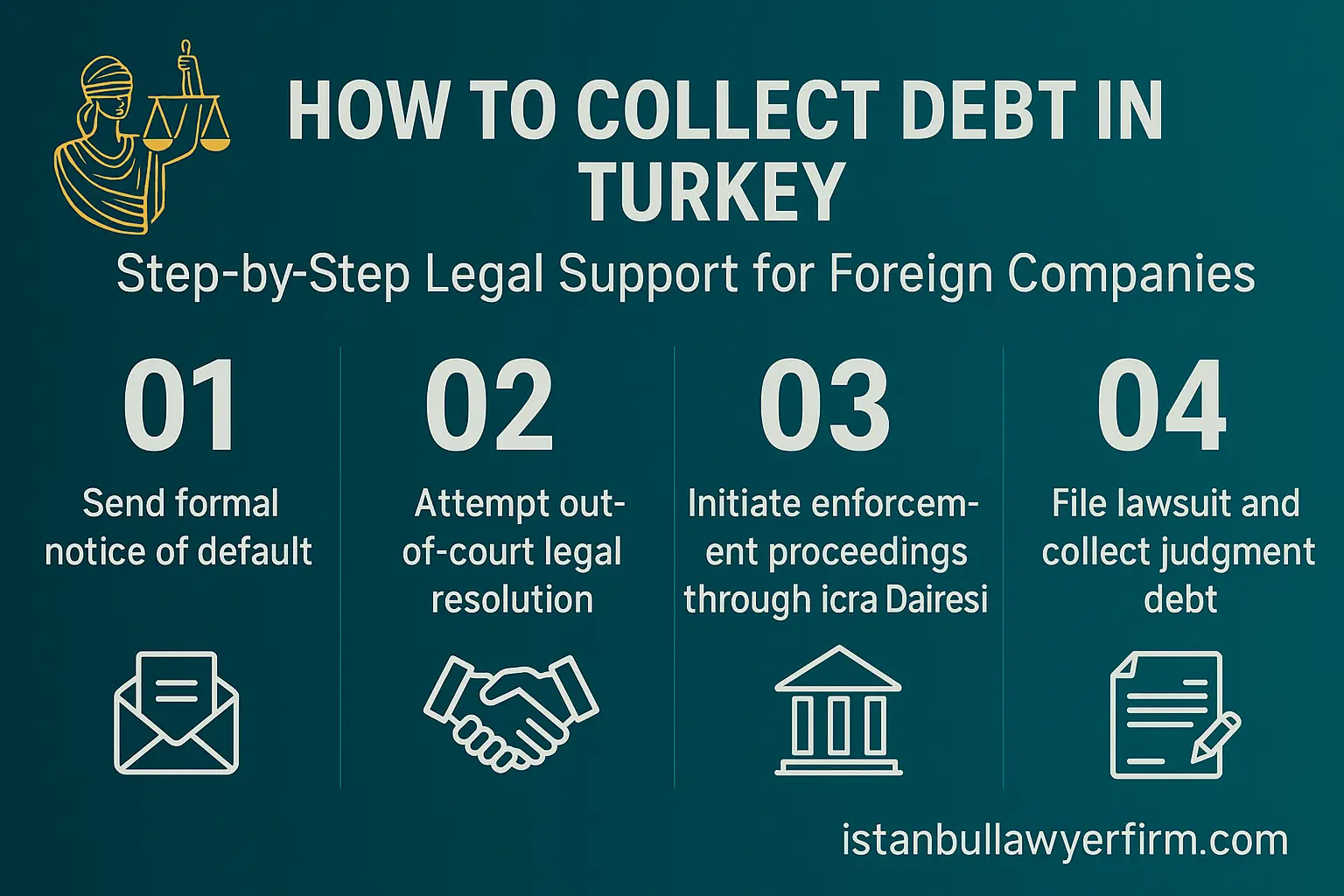
A lawyer in Turkey who advises foreign companies on debt recovery explains that collecting commercial debts in Turkey as a foreign creditor requires navigating a specialized enforcement framework—the Turkish Enforcement and Bankruptcy Law (İcra ve İflas Kanunu)—whose procedures, timelines, and tactical options differ substantially from the debt recovery systems of most foreign creditors' home countries, making local Turkish legal expertise the decisive factor in whether a commercial debt claim produces actual monetary recovery or becomes a protracted, inconclusive legal exercise. An Istanbul Law Firm that advises foreign companies on Turkish debt collection provides comprehensive support across the complete recovery process: evaluating whether the debt claim is legally cognizable under Turkish law and what evidence establishes the claim; initiating enforcement office proceedings for debts supported by qualifying commercial instruments; pursuing commercial litigation where enforcement office proceedings are not available or are objected to; managing the recognition and enforcement of foreign judgments in Turkey; representing foreign creditors in mandatory and voluntary mediation and settlement proceedings; executing asset tracing to identify debtor assets available for enforcement; and managing the complete enforcement execution including bank account seizure, real estate enforcement, and movable asset attachment. A Turkish Law Firm that handles international debt collection understands that foreign companies' debt recovery needs operate against commercial timelines—where prolonged recovery processes produce economic losses beyond the original uncollected debt—making the selection of the most efficient recovery route for each specific debt situation as important as the legal quality of the recovery strategy. An English speaking lawyer in Turkey who advises foreign creditors on Turkish debt collection ensures that international clients understand the specific procedural options available for their specific claim type, the realistic timeline for each option, and the tactical factors that determine which approach most efficiently produces actual monetary recovery. Practice may vary by authority and year — verify current Turkish Enforcement and Bankruptcy Law provisions, current commercial court procedures, and current enforcement office practices with qualified counsel before initiating any debt collection action in Turkey.
Legal Grounds for Debt Recovery and Claim Assessment
A lawyer in Turkey who advises on the legal basis for foreign company debt claims explains that Turkish enforcement law provides specific procedures for different categories of debt instruments—with claims supported by qualifying commercial documents entitled to use the faster administrative enforcement pathway and claims not so supported requiring court proceedings to establish the debt before enforcement can proceed. An Istanbul Law Firm that assesses debt claims for foreign companies implements the specific evaluation approach most effective for each claim type: identifying whether the claim is supported by a qualifying commercial instrument—including promissory notes, negotiable instruments, or notarized agreements—that enables direct enforcement office proceedings without a prior court judgment; determining whether the claim arises from a commercial contract, invoice, or other commercial relationship that requires commercial litigation to establish before enforcement; and assessing the evidence available to establish the debt amount, the commercial relationship, and the default event that triggered the collection right. Turkish lawyers advising on claim assessment help foreign companies understand that the distinction between claims supported by qualifying instruments and claims requiring litigation is one of the most commercially significant in Turkish debt collection—because the administrative enforcement pathway can produce initial enforcement results within weeks while commercial litigation typically requires months or years before a judgment is available for enforcement. Practice may vary by authority and year — verify current Turkish enforcement law provisions on qualifying commercial instruments, current limitation period rules, and current commercial court jurisdiction requirements with qualified counsel before filing any debt collection claim. For the full procedural framework, see our pillar guide on company formation in Turkey.
An Istanbul Law Firm that advises on limitation periods for Turkish debt claims explains that Turkish law imposes specific time limits within which debt claims must be initiated—with different limitation periods applicable to different types of commercial obligations—and that missing the applicable limitation period permanently extinguishes the legal right to collect the debt regardless of how clearly established the underlying commercial obligation was. Turkish lawyers advising on limitation period management help foreign companies implement the specific practices most effective for preserving collection rights: identifying the specific limitation period applicable to each debt claim type—because Turkish law provides different periods for general commercial claims, promissory notes, bills of exchange, and other specific debt categories; assessing the limitation period's current status based on the debt's origin date and any interrupting events—including partial payments, written acknowledgments of the debt, and prior legal proceedings—that restart the limitation period; and filing limitation period interruption measures when collection cannot be initiated immediately but the limitation period is approaching expiry. An English speaking lawyer in Turkey who manages limitation period monitoring for foreign company debt portfolios provides regular status tracking of each debt claim's limitation deadline—enabling companies to prioritize enforcement actions for claims approaching limitation expiry before taking more time-consuming action on claims with longer remaining periods. Practice may vary by authority and year.
A Turkish Law Firm that advises on evidence preparation for Turkish debt collection explains that Turkish enforcement and commercial court proceedings require specific categories of evidence—including the underlying commercial documentation, proof of the debtor's obligation, evidence of default, and in some circumstances expert analysis of the claim amount—whose quality and organization significantly affect how efficiently enforcement proceedings proceed. An English speaking lawyer in Turkey who prepares evidence packages for foreign company debt claims helps clients assemble the specific documentation most persuasive for each claim type: commercial contracts and their associated correspondence that establish the commercial relationship and the specific obligation whose breach gives rise to the debt; invoices, delivery confirmations, and acceptance records that establish the specific amounts owed and the debtor's receipt of the goods or services giving rise to the obligation; default notices and other communications demonstrating that the debtor was informed of the non-payment and was given opportunity to remedy it; and payment records demonstrating that partial payments were made—which establish the debt's existence through the debtor's own conduct even where the debtor contests the amount. Practice may vary by authority and year.
Enforcement Office Proceedings and Administrative Collection
A lawyer in Turkey who advises on enforcement office proceedings explains that Turkey's enforcement office system—İcra Dairesi—provides a powerful administrative debt collection mechanism that enables creditors to initiate enforcement proceedings without first obtaining a court judgment, requiring the debtor to either pay the claimed amount or file a formal objection within seven days—and that this mechanism is one of the most effective initial collection tools for foreign companies holding qualifying commercial instruments because it creates immediate legal pressure on the debtor and initiates a formal enforcement process whose continuation can be suspended only through specific legal procedures. An Istanbul Law Firm that manages enforcement office proceedings for foreign company creditors implements the specific procedural approach most effective for each enforcement situation: preparing the enforcement petition with the specific claim documentation required by the enforcement office—including the commercial instrument or contract establishing the debt, the claimed amount's calculation, and in some cases the debtor's commercial registry records confirming identity; serving the enforcement payment order through the enforcement office on the debtor at the debtor's registered address; and monitoring the seven-day response window during which the debtor must either pay, object, or remain in default—with each response triggering different procedural consequences that require different next steps. Turkish lawyers advising on enforcement office strategy help foreign companies understand that the speed advantage of the administrative enforcement pathway depends on the quality of the initial enforcement petition—because enforcement petitions with documentary gaps or technical deficiencies create objection grounds that the debtor can use to delay proceedings by months. Practice may vary by authority and year — verify current enforcement office filing requirements, current payment order service procedures, and current objection response rules with qualified counsel before filing any enforcement office petition.
An Istanbul Law Firm that advises on responding to debtor objections in enforcement proceedings explains that when a debtor files a formal objection to an enforcement payment order within the seven-day window, the objection temporarily suspends the enforcement proceeding and requires the creditor to challenge the objection through a specific legal procedure—either an objection removal petition before the enforcement court or a subsequent commercial lawsuit—to restore the enforcement's enforceability. Turkish lawyers advising on objection response strategy help foreign creditors implement the specific response approach most effective for each objection situation: assessing the objection's content to determine whether it is a substantive challenge to the debt's validity or existence—which requires commercial litigation to resolve—or a formal procedural objection without substantive basis—which can be challenged through the objection removal procedure that produces faster restoration of enforcement; preparing the objection removal petition or commercial lawsuit with the specific evidence that most directly contradicts the objection's stated grounds; and managing the interim period between objection and resolution—including interim asset preservation measures that prevent the debtor from dissipating assets during the challenge proceedings. An English speaking lawyer in Turkey who manages objection response proceedings for foreign creditors provides regular status updates on the challenge proceedings' development—because the period between objection and resolution is the interval during which debtors most commonly attempt to move or conceal assets. Practice may vary by authority and year.
A Turkish Law Firm that advises on asset seizure and enforcement execution explains that once an enforcement proceeding becomes final—either because the debtor did not object within the response window or because an objection was successfully removed—the creditor can request asset seizure measures through the enforcement office that compel the debtor to satisfy the judgment from specific identified assets. An English speaking lawyer in Turkey who manages enforcement execution for foreign creditors implements the specific execution approach most effective for each debtor profile: bank account seizure through submissions to major Turkish banks requesting attachment of accounts held in the debtor's name—using the debtor's tax identification number to enable the bank system to identify all accounts regardless of which branches they are held at; real estate enforcement through Land Registry annotation and subsequent auction proceedings for real property identified in the debtor's name; and movable asset seizure through bailiff enforcement for identified business assets including equipment, inventory, and vehicles. Turkish lawyers advising on enforcement execution help foreign creditors understand that effective enforcement requires identifying assets before initiating seizure rather than requesting seizure without a specific target—because enforcement offices cannot conduct broad asset searches on behalf of creditors and creditors must direct seizure to specifically identified assets. Practice may vary by authority and year.
Commercial Litigation for Disputed Debt Claims
A lawyer in Turkey who advises on commercial litigation for disputed debt claims explains that when enforcement office proceedings are not available—because the claim is not supported by a qualifying commercial instrument—or when the debtor has objected to enforcement on substantive grounds that require judicial resolution, foreign companies must pursue debt recovery through commercial litigation before Turkish commercial courts. An Istanbul Law Firm that handles commercial debt litigation for foreign companies implements the specific litigation approach most effective for each dispute type: filing the initial petition with the commercial court of competent jurisdiction—determined by the debtor's location, the contract's performance place, or the parties' contractual jurisdiction agreement—with the specific legal grounds, factual allegations, and supporting evidence that establish the commercial obligation and the debtor's breach; requesting interim protective measures at the time of filing—including asset freezes and attachment orders—that prevent the debtor from dissipating assets during the litigation period; and managing each litigation stage including the service of process on the debtor, the evidence exchange period, the expert examination phase where technical commercial questions require expert assessment, and the hearing phase. Turkish lawyers advising on commercial litigation strategy help foreign companies understand that Turkish commercial court proceedings typically proceed over multiple months to over a year for disputed matters—making the combination of interim protective measures and efficient evidence preparation the most important tactical factors in limiting financial exposure during the litigation period. Practice may vary by authority and year — verify current Turkish commercial court jurisdiction rules, current civil procedure requirements, and current interim measure standards with qualified counsel before filing any commercial debt lawsuit.
An Istanbul Law Firm that advises on mandatory mediation in Turkish commercial disputes explains that Turkish law requires mandatory mediation as a prerequisite for commercial court proceedings in specific categories of commercial disputes—making completion of a mediation attempt through a registered mediator a procedural prerequisite whose absence causes the commercial court to reject the lawsuit without reaching its merits. Turkish lawyers advising on mandatory mediation for commercial debt claims help foreign creditors navigate the mediation process efficiently: filing the mediation application with the registry of the competent commercial court; participating in the mediation session with a coherent position that serves two functions simultaneously—creating a genuine opportunity to resolve the dispute through agreement while also creating a documented record of the creditor's reasonable position that may influence the subsequent court proceedings if mediation does not produce agreement; and obtaining the mediation non-agreement certificate whose presentation to the commercial court confirms that the mandatory mediation prerequisite has been satisfied. An English speaking lawyer in Turkey who represents foreign creditors in Turkish commercial mediation sessions provides the bilingual representation that enables foreign companies to participate actively in the mediation process—presenting the creditor's position clearly in Turkish to the mediator while keeping the foreign client informed about the mediation's development and the strategic decisions it requires. Practice may vary by authority and year.
A Turkish Law Firm that advises on commercial litigation evidentiary requirements for foreign company debt claims explains that Turkish commercial court proceedings are primarily documentary—with the quality and organization of documentary evidence submitted with the initial petition significantly affecting how efficiently the case proceeds through the court's evidentiary review. An English speaking lawyer in Turkey who prepares evidence submissions for foreign company commercial litigation helps clients implement the specific documentation approach most effective for each claim type: organizing the evidence submission to present the commercial relationship's development chronologically—from contract formation through performance and default—so the court can follow the factual narrative efficiently; providing notarized Turkish translations of all foreign-language documents in the evidence package; and preparing expert analysis or industry reports where the commercial claim requires technical or market knowledge that the court cannot assess from documentary evidence alone. Practice may vary by authority and year.
Foreign Judgment Recognition and Enforcement
A lawyer in Turkey who advises on recognition and enforcement of foreign judgments explains that foreign companies holding final court judgments from their home country courts can enforce those judgments in Turkey through the recognition and enforcement procedure—tanıma ve tenfiz davası—established by Turkish Law No. 5718 on Private International Law and Procedural Law, which provides a structured court procedure for converting qualifying foreign judgments into Turkish court orders that can be enforced through Turkish enforcement mechanisms. An Istanbul Law Firm that manages foreign judgment recognition proceedings for foreign companies implements the specific procedural approach most effective for each recognition application: preparing the recognition petition with the required documentation—including the original foreign court judgment, a certified Turkish translation, and the apostille or consular legalization certificate demonstrating the judgment's authenticity; demonstrating that the required recognition conditions are satisfied—including that the foreign court had jurisdiction over the dispute under principles Turkish law respects, that the parties received adequate notification and due process in the foreign proceedings, and that the judgment is final under the foreign court's legal system; and anticipating and preparing responses to the objections that debtors most commonly raise against recognition—including public policy arguments and challenges to the foreign court's jurisdiction. Turkish lawyers advising on foreign judgment recognition help foreign companies understand that recognition proceedings are not automatic confirmation of foreign judgments but judicial proceedings in which the debtor has the opportunity to raise objections—making preparation for the debtor's likely objections as important as the presentation of the recognition application itself. Practice may vary by authority and year — verify current Turkish recognition requirements under Law No. 5718 and current Turkish court practice on specific foreign judgment types with qualified counsel before filing any foreign judgment recognition petition.
An Istanbul Law Firm that advises on recognition proceedings for arbitral awards explains that foreign arbitral awards benefit from Turkey's participation in the New York Convention on the Recognition and Enforcement of Foreign Arbitral Awards—which provides a streamlined recognition framework with narrower grounds for refusal than the general foreign judgment recognition procedure—making the recognition of qualifying foreign arbitral awards in Turkey generally more predictable than the recognition of foreign court judgments. Turkish lawyers advising on arbitral award recognition help foreign companies implement the specific recognition approach most effective for each arbitral award type: confirming that the arbitral award was made in a country that is a New York Convention member and that the award satisfies the Convention's formal requirements—including that it was made by a recognized arbitral institution or tribunal under proper procedures; preparing the recognition application with the required Convention documentation; and managing the specific recognition grounds on which Turkish courts have developed specific jurisprudence—particularly the public policy exception, whose application in Turkey has been the subject of significant case law development that current Turkish enforcement counsel must be aware of. An English speaking lawyer in Turkey who manages arbitral award recognition proceedings for foreign companies provides the specific combination of New York Convention knowledge and current Turkish court practice awareness that enables foreign creditors to navigate the recognition process efficiently. Practice may vary by authority and year.
A Turkish Law Firm that advises on post-recognition enforcement explains that completing the recognition procedure—obtaining the Turkish court's recognition order—is the necessary precondition for enforcement but does not by itself produce monetary recovery, which requires initiating Turkish enforcement office proceedings against the debtor's Turkish assets using the recognized judgment as the enforcement basis. An English speaking lawyer in Turkey who manages post-recognition enforcement for foreign companies implements the specific enforcement approach most effective for each debtor profile after recognition: filing the enforcement petition with the recognition judgment as the title—rather than the original foreign judgment—which is required because Turkish enforcement offices require a Turkish court order as the enforcement basis; initiating asset seizure measures against the debtor's identified Turkish assets—including bank accounts, real estate, and business assets—using the same enforcement execution approach applicable to domestic Turkish judgments; and managing any post-recognition challenges that the debtor raises through the enforcement court, which are more limited than the objections available during the recognition proceeding. Practice may vary by authority and year.
Asset Tracing, Seizure Execution and Recovery Optimization
A lawyer in Turkey who advises on asset tracing for debt collection in Turkey explains that effective enforcement requires identifying the debtor's assets before initiating seizure measures—because enforcement offices cannot conduct broad asset investigations on creditors' behalf and because misdirected seizure attempts waste time and enforcement resources without producing recovery. An Istanbul Law Firm that manages asset tracing for foreign company creditors implements the specific investigation approach most effective for each debtor profile: Land Registry searches that identify real property registered in the debtor's name—using the debtor's tax identification number or personal identification number to identify all registered property interests; Turkish Central Bank's credit registry and other financial system inquiries that are available to creditors with qualifying enforcement orders; and commercial registry investigations that identify company interests, directorship positions, and shareholder rights held by the debtor that may be subject to enforcement. Turkish lawyers advising on asset tracing help foreign creditors understand that the specific investigation tools available to them depend on the stage of the enforcement proceedings—with some investigation tools available only after an enforcement petition is filed and others available only after an enforcement order is obtained. Practice may vary by authority and year — verify current asset investigation tools available to foreign creditors and current enforcement office asset disclosure procedures with qualified counsel before planning any asset tracing strategy.
An Istanbul Law Firm that advises on bank account enforcement explains that bank account seizure is typically the fastest and most liquid enforcement mechanism available to creditors in Turkey—because bank accounts can be frozen and transferred to the enforcement office account immediately upon the enforcement office's service of the seizure order on the bank, without requiring valuation, auction, or other conversion steps required for physical asset enforcement. Turkish lawyers advising on bank account enforcement help foreign company creditors implement the specific enforcement approach most effective for each bank enforcement situation: submitting seizure requests to all major Turkish banks simultaneously—using the debtor's tax identification number as the account identifier—to maximize the probability of identifying accounts held across the Turkish banking system; managing the bank's statutory response obligation and filing complaint petitions against banks whose responses are delayed or incomplete; and coordinating the transfer of seized funds from the bank to the enforcement office and ultimately to the creditor through the distribution procedure. An English speaking lawyer in Turkey who manages bank enforcement proceedings for foreign company creditors provides regular status reporting on each bank's response and the amount of funds identified and seized at each bank—enabling foreign creditors to monitor the enforcement's progress against their total claim amount. Practice may vary by authority and year.
A Turkish Law Firm that advises on real estate and third-party receivable enforcement explains that when bank account enforcement does not produce sufficient recovery—either because the debtor has insufficient bank deposits or because accounts have been moved in anticipation of enforcement—creditors can pursue enforcement against real property and against third-party receivables owed to the debtor. An English speaking lawyer in Turkey who manages expanded enforcement for foreign company creditors implements the specific approach most effective for each asset category: real estate enforcement through Land Registry annotation followed by auction proceedings—where the property is sold at public auction with the proceeds applied to the creditor's claim after deduction of enforcement costs; third-party receivable enforcement where money owed to the debtor by another party—such as a customer's outstanding invoice or a tenant's rent obligation—is redirected to the creditor through the enforcement office's service of a seizure order on the third party; and business share enforcement where the debtor holds an interest in a Turkish company whose value can be realized through dividend seizure or forced transfer. The best lawyer in Turkey for foreign company debt collection combines specific knowledge of Turkish enforcement law's procedural requirements and asset seizure mechanisms with the international commercial understanding that enables foreign creditors to assess recovery prospects realistically and manage recovery expectations against actual enforcement outcomes. Practice may vary by authority and year.
Remote Representation, Power of Attorney and Cross-Border Coordination
A lawyer in Turkey who advises on remote debt collection management for foreign companies explains that Turkish enforcement and litigation proceedings can be conducted entirely through qualified Turkish legal representation without requiring the foreign company's physical presence in Turkey—enabling international creditors to pursue Turkish debt recovery efficiently from their home country without the travel and logistical costs that physical attendance would require. An Istanbul Law Firm that manages remote debt collection for foreign company clients implements the specific remote representation infrastructure most effective for each engagement: preparing the power of attorney document with the specific scope of authority required for the planned enforcement proceedings—including authority to file enforcement petitions, attend hearings, negotiate settlements, and receive enforcement proceeds; managing the power of attorney's authentication—including notarization, apostille or consular legalization depending on the issuing country, and sworn Turkish translation; and registering the power of attorney with the relevant enforcement offices and commercial courts before filing any proceedings to ensure that the Turkish legal representative's authority is recognized from the first filing. Turkish lawyers advising on remote representation help foreign companies understand that the scope of the power of attorney must be sufficiently comprehensive to cover all anticipated proceedings—because authority gaps that require additional power of attorney documentation mid-proceeding create delays whose cost exceeds the modest cost of comprehensive initial drafting. Practice may vary by authority and year — verify current Turkish power of attorney authentication requirements and current enforcement office and court acceptance standards with qualified counsel before executing any power of attorney for Turkish debt collection proceedings.
An Istanbul Law Firm that advises on cross-border coordination for international debt collection explains that foreign company debt claims in Turkey often involve cross-border dimensions—including the need to coordinate Turkish enforcement proceedings with parallel proceedings in the debtor's home country, to coordinate with the debtor's international banking relationships, and to manage the repatriation of recovered funds from Turkey to the foreign creditor's account. Turkish lawyers advising on cross-border coordination help foreign companies implement the specific coordination practices most effective for each cross-border dimension: coordinating with home country counsel to manage parallel proceedings—ensuring that Turkish enforcement strategy is consistent with positions taken in other jurisdictions and that recovery in Turkey is properly accounted for in the overall claim; managing currency conversion and fund repatriation through Turkish banking channels for recovered amounts that must be transferred to foreign creditor accounts; and coordinating with banks and financial institutions in the creditor's home country on any banking compliance requirements applicable to receiving funds recovered from Turkish enforcement. An English speaking lawyer in Turkey who manages cross-border debt collection coordination provides the bilingual communication bridge between Turkish enforcement counsel and the foreign creditor's home country legal and financial advisors—enabling efficient coordination without requiring each party to independently assess Turkish legal requirements they are not qualified to evaluate. Practice may vary by authority and year.
A Turkish Law Firm that advises on digital tools and electronic proceedings in Turkish debt collection explains that the Turkish judicial system has developed significant electronic filing and case management infrastructure—including the UYAP National Judiciary Informatics System and the UETS Registered Electronic Notification system—that enables efficient remote management of enforcement and litigation proceedings with reduced reliance on physical presence and paper filings. An English speaking lawyer in Turkey who manages electronic proceedings for foreign company clients implements the specific digital infrastructure most effective for each proceeding type: using UYAP to file enforcement petitions, commercial court pleadings, and evidence submissions electronically—enabling faster processing than paper filing and creating an electronic record of all submitted materials; monitoring UETS for enforcement office notifications and court orders whose electronic delivery triggers response deadlines that must be tracked; and maintaining secure digital archives of all filed documents, received notifications, and court orders for each matter. Practice may vary by authority and year.
Debt Recovery Risk Assessment and Pre-Filing Strategy
A lawyer in Turkey who advises on pre-filing strategy for foreign company debt claims explains that the commercial and legal risk assessment conducted before initiating collection proceedings is as important as the proceedings themselves—because the specific enforcement route chosen, the sequence of collection measures initiated, and the interim protective measures requested at the outset all depend on factors including the debtor's financial condition, the asset base available for enforcement, the strength of the documentary evidence supporting the claim, and the debtor's likely strategic response to enforcement. An Istanbul Law Firm that conducts pre-filing assessment for foreign company debt claims implements the specific evaluation approach most effective for each creditor situation: assessing the debtor's commercial registry profile—including registered capital, business activity, and recent changes in ownership or management—to identify indicators of financial distress or asset movement that would affect the timing and targeting of enforcement measures; evaluating the available commercial documentation to determine which enforcement pathway is available and what supplementary evidence must be obtained before proceedings are initiated; and assessing the debtor's likely response strategy—whether the debtor will pay upon receiving a formal demand, object to enforcement on procedural or substantive grounds, or attempt to delay collection through bankruptcy or restructuring proceedings—so that the initial collection strategy accounts for these responses rather than being surprised by them. Turkish lawyers advising on pre-filing strategy help foreign companies understand that spending time on thorough pre-filing assessment consistently produces better recovery outcomes than rushing to file before the debtor's situation and likely response are properly evaluated. Practice may vary by authority and year.
An Istanbul Law Firm that advises on pre-litigation demand letters for foreign company creditors explains that a formal written demand to the debtor—ihtarname—served through notary or registered mail before litigation is initiated serves multiple strategic purposes: creating a documented record of the creditor's formal demand and the specific amounts claimed that is available as evidence in subsequent proceedings; triggering the debtor's response which may reveal whether the debt is genuinely disputed or whether the debtor simply needs a formal demand to arrange payment; and in some circumstances triggering specific legal consequences under Turkish law—including starting the period for statutory default interest where the contract does not provide an explicit default date. Turkish lawyers advising on demand letter strategy help foreign companies structure demand letters most effectively: stating the claimed amount with precise calculation, identifying the specific commercial documentation on which the claim is based, specifying the payment deadline and the legal consequences of non-payment, and preserving the creditor's negotiating flexibility rather than committing to litigation positions that may be modified in subsequent negotiations. An English speaking lawyer in Turkey who prepares demand letters for foreign company creditors ensures that the letter is drafted in Turkish with all legal requirements satisfied while providing the foreign creditor with an English-language summary of its content and strategic implications. Practice may vary by authority and year.
A Turkish Law Firm that advises on interim protective measures for foreign company creditors explains that one of the most strategically important decisions in the early stages of debt collection is whether to request interim protective measures—including asset freezes and preliminary attachment orders—before or simultaneously with the initiation of enforcement proceedings. An English speaking lawyer in Turkey who advises on interim measure strategy helps foreign creditors implement the specific protective approach most effective for each debtor situation: requesting preliminary attachment orders—ihtiyati haciz—that freeze identified debtor assets before the debtor has notice of the collection action, preventing the debtor from dissipating assets in response to enforcement notice; timing the request for interim measures to coincide with or immediately precede the service of enforcement documents on the debtor, so the protective freeze is in place before the debtor has opportunity to respond; and identifying the specific assets to target with interim measures based on the pre-filing asset investigation—because interim attachment orders must specify the assets to be frozen rather than creating a general encumbrance. The combination of thorough pre-filing assessment, targeted demand letter strategy, and timely interim protective measures constitutes the foundation of effective debt collection strategy for foreign companies in Turkey. Practice may vary by authority and year.
Industry-Specific Debt Collection Considerations
A lawyer in Turkey who advises on construction sector debt recovery explains that commercial disputes in the Turkish construction industry—including unpaid subcontractor fees, performance bond enforcement, retention disputes, and contract termination claims—involve specific legal frameworks and evidentiary requirements whose management requires both Turkish enforcement law expertise and familiarity with construction industry commercial standards. An Istanbul Law Firm that advises foreign construction companies on Turkish debt recovery implements the specific approaches most effective for each construction claim type: unpaid progress payment claims that are supported by progress payment certificates and project documentation requiring coordination between the technical documentation and the legal claim presentation; performance bond enforcement claims where the specific bond conditions and enforcement triggers must be carefully analyzed against the project documentation; and contract termination and settlement claims where the specific Turkish commercial code provisions on construction contract termination interact with the parties' contractual provisions in ways that affect both the claim's legal basis and its documentary evidence requirements. Turkish lawyers advising on construction debt recovery help foreign construction companies understand that construction dispute documentation—including site records, engineer's certificates, and project correspondence—must be preserved and organized from the beginning of a dispute rather than assembled after litigation commences. Practice may vary by authority and year.
An Istanbul Law Firm that advises on international trade debt recovery explains that commercial disputes arising from Turkish import-export transactions—including unpaid export invoices, documentary credit discrepancies, and incoterms-related payment disputes—involve specific Turkish commercial law provisions whose interaction with international trade practice creates distinctive documentary and legal analysis requirements. Turkish lawyers advising on trade debt recovery help foreign exporters implement the specific approaches most effective for each trade claim type: invoice-based enforcement claims that are supported by commercial invoices, delivery documentation, and customs records demonstrating that goods were delivered; documentary credit disputes where the specific terms of the letter of credit and the bank's compliance or non-compliance with those terms determines the legal position; and Incoterms-based risk allocation disputes where the specific delivery term determines which party bears risk for goods lost or damaged in transit. An English speaking lawyer in Turkey who advises foreign exporters on Turkish debt recovery provides the specific combination of Turkish commercial court procedure knowledge and international trade documentation expertise that enables foreign creditors to present their trade claims in the format most persuasive to Turkish commercial courts. Practice may vary by authority and year.
A Turkish Law Firm that advises on technology and services sector debt recovery explains that commercial disputes in the technology and professional services sector—including unpaid software development fees, SaaS subscription arrears, professional services invoices, and IP licensing payment disputes—involve specific evidentiary challenges whose management requires tailored approaches to demonstrating the commercial obligation and its breach. An English speaking lawyer in Turkey who advises foreign technology and service companies on Turkish debt recovery implements the specific approaches most effective for each service claim type: service agreement enforcement where the specific services contracted and the services actually delivered must be documented through project records, delivery confirmations, and client acceptance evidence; subscription and recurring fee enforcement where the payment obligation arises from continuing contractual relationship and the specific non-payment instances must be documented with precision; and IP licensing fee enforcement where the specific usage rights granted and the usage actually occurring must be established through technical evidence that Turkish courts can assess. Practice may vary by authority and year.
A Turkish Law Firm that advises on the enforcement of intellectual property and licensing fee claims explains that disputes arising from IP licensing arrangements—where a Turkish licensee has failed to make contractually required royalty or licensing fee payments to a foreign licensor—present distinctive legal considerations because the IP licensing relationship creates both a debt claim for unpaid fees and potential IP enforcement issues where the licensee continues to use the licensed IP despite being in payment default. An English speaking lawyer in Turkey who advises foreign IP holders on Turkish debt recovery from licensees implements the specific approach most effective for each licensing dispute: assessing whether the license agreement's payment and termination provisions support both a debt claim for unpaid fees and a termination and IP enforcement claim—because the combination of both claims typically produces faster payment than a debt claim alone; managing the coordination between the debt enforcement proceedings and any necessary IP protection measures; and structuring the recovery strategy to maximize the leverage that the licensee's continued need for the licensed IP provides to the licensor in settlement negotiations. Understanding the intersection of debt recovery law and IP enforcement law in Turkey enables foreign IP holders to pursue both the monetary claim and the IP protection objective through coordinated legal strategy rather than treating them as separate unrelated matters. Practice may vary by authority and year.
Frequently Asked Questions
- Can a foreign company initiate debt collection proceedings in Turkey? Yes. Foreign companies can pursue debt collection in Turkey through enforcement office proceedings, commercial litigation, and foreign judgment recognition and enforcement. The specific procedure available depends on the type of commercial instrument or court judgment supporting the debt claim. Turkish legal representation is required for court and enforcement office proceedings. Practice may vary by authority and year.
- What types of commercial instruments qualify for direct enforcement office proceedings? Turkish enforcement law provides specific commercial instruments that enable administrative enforcement without a prior court judgment, including promissory notes, negotiable instruments, and notarized agreements. Contracts, invoices, and other commercial documents that are not qualifying instruments require commercial court proceedings to establish the debt before enforcement can proceed. Turkish legal counsel can assess which procedure applies to a specific claim. Practice may vary by authority and year.
- How quickly must a debtor respond to a Turkish enforcement payment order? Under Turkish enforcement law, a debtor served with a payment order generally has seven days from service to pay the claimed amount, file a formal objection, or remain in default. Failure to respond within this period results in the payment order becoming final and providing the basis for asset seizure measures. Foreign creditors should have Turkish legal counsel monitoring the response window. Practice may vary by authority and year.
- What happens when a debtor objects to a Turkish enforcement payment order? A debtor objection within the seven-day window temporarily suspends enforcement proceedings and requires the creditor to challenge the objection through either an objection removal petition before the enforcement court or a commercial lawsuit. The appropriate response depends on whether the objection is substantive or procedural. Turkish legal counsel should assess the objection's content immediately upon receipt. Practice may vary by authority and year.
- Is mandatory mediation required before commercial litigation in Turkey? Turkish law requires mandatory mediation as a prerequisite for commercial court proceedings in specific categories of commercial disputes. Completion of a mediation attempt through a registered mediator and obtaining the non-agreement certificate is a procedural prerequisite whose absence causes the commercial court to reject the lawsuit. Turkish legal counsel can manage the mediation requirement efficiently. Practice may vary by authority and year.
- Can a foreign court judgment be enforced in Turkey? Yes. Foreign court judgments can be enforced in Turkey through the recognition and enforcement proceeding under Turkish Law No. 5718, which requires a Turkish court order converting the foreign judgment into an enforceable Turkish title. Recognition conditions include that the foreign court had jurisdiction, the parties received due process, the judgment is final, and recognition does not violate Turkish public policy. Practice may vary by authority and year.
- Can a foreign arbitral award be enforced in Turkey? Yes. Turkey is a member of the New York Convention on the Recognition and Enforcement of Foreign Arbitral Awards. Foreign arbitral awards from Convention member countries can be enforced in Turkey through a streamlined recognition procedure with narrower refusal grounds than the general foreign judgment recognition procedure. Turkish legal counsel can assess whether specific arbitral awards meet the Convention's requirements. Practice may vary by authority and year.
- What asset seizure tools are available in Turkish debt enforcement? Turkish enforcement law provides bank account seizure through submission to Turkish banks using the debtor's tax identification number, real estate enforcement through Land Registry annotation and auction proceedings, movable asset seizure through bailiff enforcement, third-party receivable seizure intercepting payments owed to the debtor, and company share enforcement against the debtor's business interests. The most efficient enforcement tool depends on the specific assets identified for each debtor. Practice may vary by authority and year.
- How does bank account enforcement work in Turkish debt collection? Bank account seizure is initiated by submitting seizure requests to Turkish banks using the debtor's tax identification number. Banks are required to respond to seizure requests and freeze qualifying accounts. Seized funds are transferred to the enforcement office account and distributed to the creditor through the enforcement office's distribution process. Complaints can be filed against banks whose responses are delayed or incomplete. Practice may vary by authority and year.
- Does Turkey require a foreign company to physically attend enforcement or court proceedings? No. Turkish enforcement and litigation proceedings can be conducted through qualified Turkish legal representation holding a properly authenticated power of attorney. The power of attorney must be notarized, apostilled or consularly legalized depending on the issuing country, and accompanied by a certified Turkish translation. The scope must cover the specific proceedings for which representation is required. Practice may vary by authority and year.
- What limitation periods apply to commercial debt claims in Turkey? Turkish law imposes specific limitation periods for different categories of commercial obligations. These periods vary by claim type and can be interrupted by partial payments, written acknowledgments of the debt, or prior legal proceedings. Foreign companies should have Turkish legal counsel assess the applicable limitation period for each specific debt claim before initiating collection proceedings. Practice may vary by authority and year.
- Can legal costs and interest be recovered in Turkish debt collection? Turkish commercial courts may award statutory interest on unpaid commercial debts from the due date through judgment, enforcement costs including filing fees and bailiff costs, and partial legal costs in successful debt collection proceedings. The specific amounts recoverable depend on the type of proceeding and the judgment's terms. Practice may vary by authority and year.
- How are recovered funds repatriated from Turkey to a foreign creditor? Funds recovered through Turkish enforcement proceedings are distributed by the enforcement office to the creditor's designated account. Foreign creditors typically designate a Turkish bank account for initial receipt and then repatriate funds through Turkish banking channels. Turkish banking regulations govern international fund transfers and may require documentation of the transaction basis. Practice may vary by authority and year.
- What documentation is needed to initiate debt collection in Turkey? Documentation requirements vary by proceeding type. For enforcement office proceedings, qualifying commercial instruments with supporting evidence of the debt are needed. For commercial litigation, contracts, invoices, correspondence, and evidence of default are required. For foreign judgment recognition, the original judgment with apostille and certified Turkish translation is required. Turkish legal counsel can provide a specific documentation checklist for each claim type. Practice may vary by authority and year.
- Does ER&GUN&ER Law Firm provide debt collection legal services for foreign companies in Turkey? Yes. ER&GUN&ER Law Firm provides comprehensive debt collection legal services for foreign companies including claim assessment and legal ground analysis, enforcement office proceedings management, objection response and objection removal proceedings, commercial litigation for disputed debt claims, mandatory mediation representation, foreign judgment recognition and enforcement, foreign arbitral award recognition, asset tracing and seizure execution, bank account enforcement, real estate and movable asset enforcement, cross-border coordination and fund repatriation, power of attorney preparation and authentication, and remote representation management—with English-language client communication and bilingual documentation throughout each engagement.
Author: Mirkan Topcu is an attorney registered with the Istanbul Bar Association (Istanbul 1st Bar), Bar Registration No: 67874. His practice focuses on cross-border and high-stakes matters where evidence discipline, procedural accuracy, and risk control are decisive.
He advises individuals and companies across Immigration and Residency, Real Estate Law, Tax Law, and cross-border documentation matters where procedural accuracy and evidence discipline are decisive.
Education: Istanbul University Faculty of Law (2018); Galatasaray University, LL.M. (2022). LinkedIn: Profile. Istanbul Bar Association: Official website.