

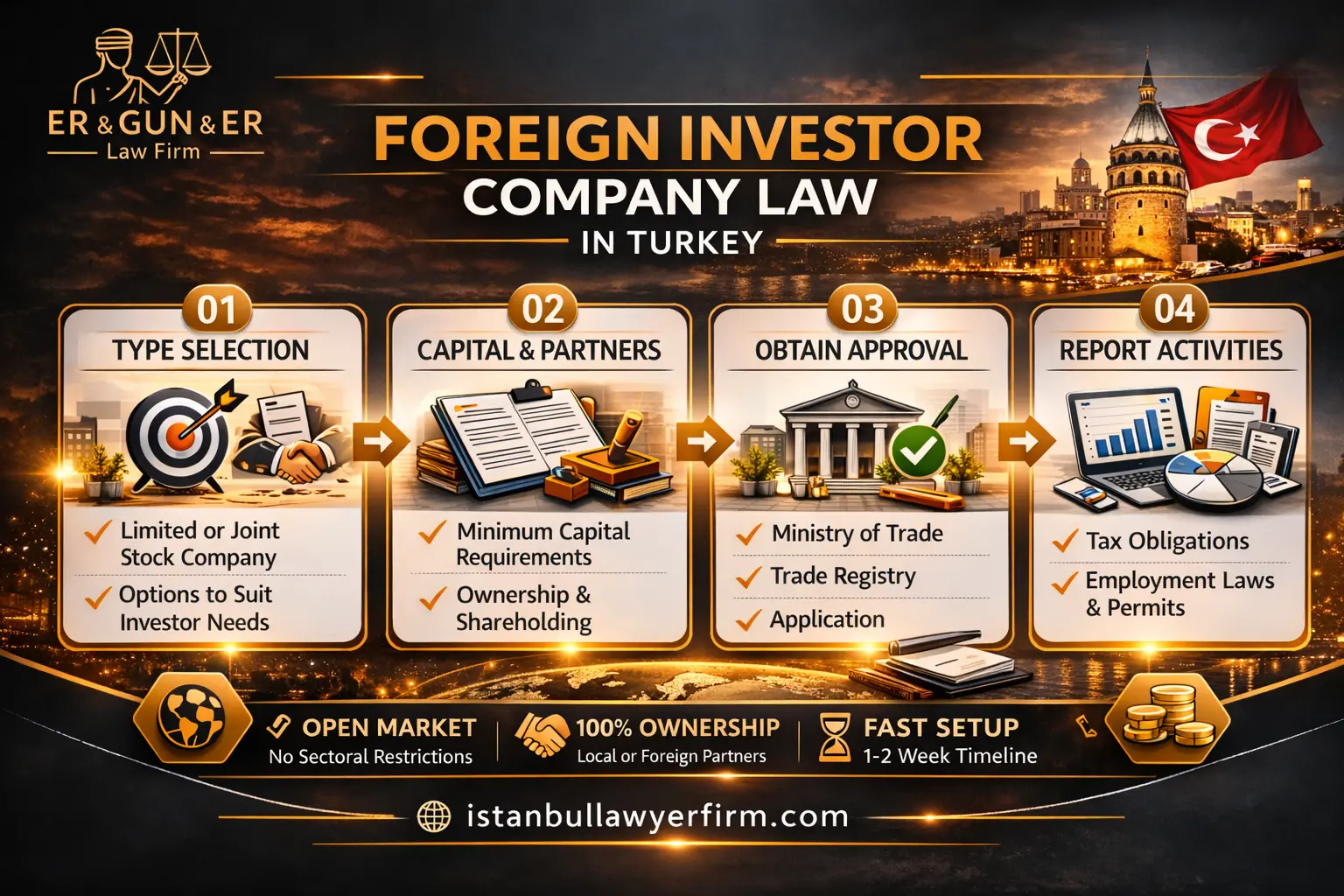
A lawyer in Turkey who advises foreign investors on Turkish company law understands that the legal framework governing foreign direct investment in Turkey combines a generally permissive foreign ownership regime—established through Law No. 4875 on Foreign Direct Investment which guarantees equal treatment of foreign and domestic investors and permits one hundred percent foreign ownership of Turkish commercial entities in most sectors—with specific regulatory obligations whose systematic management determines whether the foreign-invested company operates compliantly and whether the investor's contractual rights, governance controls, and financial expectations are actually enforceable through the Turkish company structure. An Istanbul Law Firm that advises foreign investors on Turkish company law provides integrated advice across the full company lifecycle: selecting the corporate structure that best serves the investor's operational, tax, and governance objectives; designing and executing the incorporation process that satisfies Turkish Trade Registry and MERSIS requirements; drafting the articles of association and shareholder agreement that define governance and protect investor rights; managing banking and beneficial ownership compliance; addressing the tax exposure created by the Turkish structure; managing employment law obligations for Turkish-employed staff; executing share purchase and merger transactions; and planning exit structures that enable the investor to monetize the Turkish investment efficiently. A Turkish Law Firm that handles foreign investor company matters understands that company law questions in Turkey are rarely isolated from banking compliance, tax structuring, employment obligations, and sector licensing—because the interaction among these parallel legal frameworks creates compliance complexity whose management requires integrated legal advisory rather than siloed specialist advice. An English speaking lawyer in Turkey who advises foreign investors ensures that international clients understand both the statutory framework and the institutional practice—because Turkish company law operates through a combination of formal statutory requirements and institutional implementation practices whose interaction determines what is actually required at each step of the company's lifecycle. Practice may vary by authority and year — verify current Law No. 4875 provisions, current Turkish Commercial Code requirements, current Trade Registry regulations, and current MASAK beneficial ownership disclosure requirements with qualified counsel before structuring any foreign direct investment in Turkey.
Foreign Direct Investment Framework and Sector Restrictions
A lawyer in Turkey who advises on the foreign direct investment legal framework explains that Law No. 4875 on Foreign Direct Investment establishes the foundational principle that foreign investors in Turkey enjoy the same rights and are subject to the same obligations as domestic Turkish investors—enabling one hundred percent foreign ownership of Turkish limited liability and joint stock companies in most commercial sectors without prior approval requirements and without equity cap restrictions that historically limited foreign participation in Turkish businesses. An Istanbul Law Firm that advises foreign investors on the FDI framework helps clients understand the specific framework dimensions most relevant to each investment situation: the sectors where full foreign ownership is freely available without special conditions—including most manufacturing, services, technology, and commercial sectors—versus the sectors where foreign participation is subject to specific licensing, prior approval, or equity limitation requirements including banking and financial services, media and broadcasting, aviation, maritime transport, and defense-related industries; the registration obligations that apply to foreign direct investments—including the obligation to report capital inflows to the Central Bank of Turkey through the banking system and the obligation to register the company through MERSIS and the Trade Registry; and the investor protections that Law No. 4875 guarantees—including the right to transfer profits, dividends, and proceeds from the sale of shares abroad after payment of applicable taxes, and the right to submit international disputes to arbitration. Turkish lawyers advising on FDI framework compliance help foreign investors understand that sector-specific restrictions require specific legal analysis of the applicable regulatory framework before the investment structure is committed—because discovering a sector restriction after incorporation creates expensive restructuring costs. Practice may vary by authority and year — verify current sector-specific foreign ownership restrictions, current Central Bank capital inflow reporting requirements, and current MASAK beneficial ownership disclosure obligations with qualified counsel before committing to any Turkish investment structure. For the full procedural framework, see our pillar guide on establishing a company in Turkey.
An Istanbul Law Firm that advises on the equal treatment principle for foreign investors explains that while Law No. 4875 guarantees equal treatment between foreign and domestic investors at the statutory level, foreign investors in practice encounter specific procedural requirements—including more extensive document authentication requirements, more intensive banking KYC procedures for foreign shareholders, and specific MASAK beneficial ownership disclosure requirements—that domestic investors do not face, and that managing these procedurally distinctive requirements efficiently is a significant component of effective foreign investor legal support. Turkish lawyers advising on procedural requirements for foreign investors help clients understand the specific documentation and authentication most relevant to each investor's situation: corporate shareholders must provide authenticated and certified Turkish translations of their corporate constitutional documents—including certificate of incorporation, articles of association, and shareholder register—establishing the foreign corporate entity's existence, legal capacity, and authority chain; individual shareholders must provide notarized or apostilled copies of their passports and other identity documentation; and all shareholders must participate in the MASAK-mandated beneficial ownership disclosure process that identifies the ultimate natural persons who own or control the Turkish company through the direct or indirect ownership chain. An English speaking lawyer in Turkey who manages foreign investor documentation requirements prepares the authentication and translation package that satisfies Trade Registry, banking, and MASAK requirements from a single, consistently prepared document set—preventing the rework that arises when documents prepared for one institutional purpose do not satisfy another institution's requirements. Practice may vary by authority and year.
A Turkish Law Firm that advises on the Central Bank and foreign exchange framework for foreign investors explains that Law No. 4875's guarantee of profit and dividend repatriation rights operates within Turkey's foreign exchange regulatory framework—established through Presidential Decree No. 32—whose implementation requires that dividends and other payments to foreign shareholders are transferred through Turkish authorized banks using specific documentation procedures that establish the payment's compliance with Turkish tax and foreign exchange regulations. An English speaking lawyer in Turkey who advises on dividend repatriation compliance helps foreign investors implement the specific procedures most relevant to each repatriation situation: obtaining the general assembly dividend distribution resolution that authorizes the dividend payment and specifies the amount per share; withholding and paying the dividend withholding tax at the applicable rate—which is fifteen percent under Turkish law subject to reduction under any applicable double taxation treaty between Turkey and the shareholder's country of residence; and processing the payment through a Turkish authorized bank with the documentation that satisfies the bank's foreign exchange payment compliance requirements. Turkish lawyers advising on dividend repatriation help foreign investors understand that the repatriation right guaranteed by Law No. 4875 is implemented through specific procedural steps—and that failure to complete these steps correctly creates the practical inability to transfer funds abroad even though the legal right exists. Practice may vary by authority and year.
Entity Selection: Limited Liability Company vs Joint Stock Company
A lawyer in Turkey who advises on entity selection for foreign investors explains that Turkish company law provides two principal commercial entity forms most commonly used by foreign investors—the limited liability company (limited şirket) and the joint stock company (anonim şirket)—whose different statutory frameworks create different governance structures, different shareholder rights, different capital market access possibilities, and different operational compliance requirements that must be matched to the specific investor's business model, governance preferences, and anticipated future transactions. An Istanbul Law Firm that advises foreign investors on entity selection helps clients evaluate the specific features most relevant to each investment situation: the limited liability company's advantages—simpler governance requirements, more flexible shareholder agreement arrangements, lower minimum capital requirements, and more straightforward share transfer mechanics in some respects—versus its limitations including restrictions on public capital raising, fewer share class options, and mandatory shareholder meeting requirements for significant decisions that reduce operational flexibility; the joint stock company's advantages—full access to share class flexibility including preference shares and shares with different voting rights, eligibility for public offering if future capital market access is desired, and a governance framework that accommodates larger and more complex shareholder groups—versus its higher compliance burden including mandatory board of directors structure, statutory auditor or audit committee requirements depending on company size, and more formal meeting and documentation procedures. Turkish lawyers advising on entity selection help foreign investors understand that the choice is not merely a legal formality but a structural decision whose consequences pervade every aspect of the company's governance, financing, and eventual exit—making early entity selection analysis one of the most commercially significant contributions that specialized Turkish counsel can provide. Practice may vary by authority and year — verify current Turkish Commercial Code provisions applicable to each entity type, current minimum capital requirements, and current statutory compliance obligations with qualified counsel before committing to any entity structure.
An Istanbul Law Firm that advises on branch and liaison office alternatives to full company incorporation explains that foreign companies wishing to have a Turkish presence without incorporating a separate Turkish company can in some circumstances use branch or liaison office structures—whose different tax treatment, operational scope, and registration requirements create specific advantages for particular investment purposes. Turkish lawyers advising on branch and liaison office structures help foreign investors understand the specific features most relevant to each structural decision: a Turkish branch of a foreign company is a directly registered extension of the foreign parent whose activities are taxed as permanent establishment income in Turkey—creating the full Turkish corporate tax exposure of a separate subsidiary but without the liability separation that a separate Turkish entity provides; a Turkish liaison office is a limited-purpose office that can perform market research, promotion, and coordination activities but cannot conduct commercial transactions, receive income, or enter into contracts on behalf of its foreign parent—creating a Turkish presence without permanent establishment risk but with severe operational limitations; and the comparison between each alternative structure and a fully incorporated Turkish subsidiary should consider the specific business activities to be conducted in Turkey, the desired liability separation between the Turkish operation and the foreign parent, and the long-term expansion plans that might favor one structure over another. An English speaking lawyer in Turkey who advises on structural alternatives helps foreign investors make the entity selection decision based on a complete analysis of operational, tax, liability, and governance factors rather than defaulting to the most commonly used structure without assessing whether it is optimal for the specific situation. Practice may vary by authority and year.
A Turkish Law Firm that advises on capital structure design for foreign investor companies explains that the initial capital structure decision—including the total share capital amount, the allocation among shareholders, the use of share classes in joint stock companies, and the treatment of capital contributions in excess of nominal share value—creates the legal framework for the company's future financing, governance, and distribution arrangements whose design should anticipate the investor's planned financing trajectory rather than simply satisfying minimum incorporation requirements. An English speaking lawyer in Turkey who advises on capital structure design helps foreign investors implement the specific arrangements most effective for each investment's financing plan: determining the initial share capital amount based on both the Turkish Commercial Code's minimum capital requirements and the business's actual operating capital needs—because under-capitalized companies face credibility challenges with Turkish banks and counterparties; designing share class arrangements in joint stock companies—where preference shares with liquidation preferences, dividend preference, or anti-dilution protection can protect early investors against future investment rounds diluting their economic or governance rights; and structuring shareholder loan or equity premium arrangements where investment amounts exceed the nominal share capital—with specific attention to the tax treatment of shareholder loans in Turkey and the transfer pricing implications of intercompany financing. Practice may vary by authority and year.
Incorporation Process, Trade Registry and MERSIS
A lawyer in Turkey who advises on the Turkish company incorporation process explains that incorporating a Turkish company requires completing a specific sequence of administrative steps—involving the MERSIS electronic pre-registration system, the notarial authentication of incorporation documents, the Trade Registry filing, and the subsequent tax and social security registrations—whose correct sequencing and documentation quality determine whether the incorporation proceeds efficiently or encounters the corrections and resubmissions that add weeks to the timeline. An Istanbul Law Firm that manages incorporation for foreign investors implements the specific process management approach most effective for each company formation: preparing the incorporation documentation package before initiating the MERSIS pre-registration—including the articles of association, shareholder identity documentation, signature declarations for directors and authorized signatories, and address documentation—in a complete and consistent state that prevents the document deficiency requests that interrupt MERSIS processing; managing the notarial authentication of the articles of association and signature declarations through a qualified Istanbul notary—because Trade Registry acceptance of incorporation documents requires notarial certification whose specific format requirements must be satisfied; and filing the complete incorporation package with the competent Trade Registry office with an organized exhibit index that enables the registry officer to verify completeness efficiently. Turkish lawyers advising on incorporation management help foreign investors understand that the MERSIS system—Turkey's central electronic company registration infrastructure—is the entry point for both initial incorporation and all subsequent corporate changes, and that MERSIS data entry accuracy is critical because errors in the electronic registration propagate into the company's official legal status records. Practice may vary by authority and year — verify current MERSIS pre-registration requirements, current Trade Registry documentation standards for foreign investor companies, and current notarial authentication requirements with qualified counsel before initiating any incorporation.
An Istanbul Law Firm that advises on articles of association drafting for foreign investor companies explains that the articles of association—şirket ana sözleşmesi—is the foundational constitutional document that defines the company's governance structure, operational scope, shareholder rights, and decision-making procedures, and that the quality of its drafting significantly affects whether the company's governance actually functions as the investor intends throughout the company's operational life. Turkish lawyers advising on articles of association drafting for foreign investors help implement the specific provisions most important for each company situation: purpose clause drafting that accurately describes the company's planned business activities in the terminology recognized by the Turkish Trade Registry and NACE activity classification system—with sufficient breadth to cover anticipated business development without using vague language that registry officers may question; share transfer provisions that define the consent or pre-emption rights of existing shareholders for share transfers—whose design should reflect the shareholder agreement's commercial arrangements while satisfying Turkish Commercial Code requirements; and governance provisions including director appointment rights, meeting quorum and voting requirements, reserved matters requiring special majority, and profit distribution policies—whose alignment with the shareholder agreement prevents conflicts between the two documents that create governance uncertainty. An English speaking lawyer in Turkey who drafts bilingual articles of association for foreign investor companies ensures that the Turkish-language articles—which are the legally operative document for Turkish institutional purposes—accurately reflect the governance arrangements that the foreign investor understood and agreed to in negotiations. Practice may vary by authority and year.
A Turkish Law Firm that advises on post-incorporation registrations explains that Trade Registry incorporation is the beginning rather than the end of the registration process—because a newly incorporated Turkish company must complete additional registrations with the Turkish Revenue Administration for corporate and VAT tax registration, with the Social Security Institution if employees will be hired, and with the relevant sector licensing authority if the planned business requires sector-specific authorization. An English speaking lawyer in Turkey who manages post-incorporation registrations for foreign investor companies helps clients complete the specific registrations most relevant to each company's business model: tax office registration for corporate income tax and VAT tax identification numbers—which are required before the company can issue invoices, make deductible expense payments, or conduct most commercial transactions; Social Security Institution registration for employer identification—required before the first employee's payroll processing; and sector-specific licensing applications for companies whose activities require authorization from sector regulators—including banking and financial services regulators, broadcasting regulators, and other authorities whose approval must be obtained before the company commences regulated activities. Turkish lawyers advising on post-incorporation registration sequencing help foreign investors understand that certain registrations must be completed in sequence—with tax registration typically required before banking, and banking typically required before social security registration—making the registration timeline a coordinated project rather than a parallel multi-front effort. Practice may vary by authority and year.
Corporate Governance, Directors and Representation Authority
A lawyer in Turkey who advises on corporate governance for Turkish companies with foreign shareholders explains that corporate governance in a Turkish company creates specific obligations for both directors—who owe duties of care, loyalty, and compliance to the company and are personally liable for specific categories of company obligations—and shareholders—who must comply with meeting, voting, and approval procedures whose non-compliance can render corporate decisions invalid or expose directors to liability claims. An Istanbul Law Firm that designs corporate governance frameworks for foreign investor companies implements the specific governance structures most effective for each company situation: director appointment and authority documentation that clearly establishes each director's identity, appointment date, and authority scope in a format that banks, counterparties, and courts can verify—including director registration with the Trade Registry, signature declarations authenticated through the notarial system, and board minutes recording the appointment decision; delegation frameworks that define which decisions require full board approval, which can be delegated to executive directors or management, and which require shareholder approval—with the delegation documented through written delegation instruments rather than informal understanding; and conflict of interest management procedures that identify related-party transactions, require advance disclosure, and document the approval process through board minutes that demonstrate compliance with Turkish Commercial Code conflict management requirements. Turkish lawyers advising on corporate governance help foreign investors understand that Turkish corporate governance operates through a documentation discipline—where properly minuted decisions, properly maintained statutory books, and properly executed authority instruments create the evidence base that protects directors and shareholders from later liability claims and institutional challenges. Practice may vary by authority and year — verify current Turkish Commercial Code director duty provisions, current Trade Registry director registration requirements, and current statutory book maintenance obligations with qualified counsel before implementing any corporate governance framework.
An Istanbul Law Firm that advises on representation authority for foreign investor companies explains that the authority through which a Turkish company binds itself through contracts, banking transactions, and regulatory filings is governed by Turkish Commercial Code provisions on representation—and that the documentation of representation authority through Trade Registry-registered signature declarations and notarized delegation instruments is one of the most practically significant governance elements for foreign investors whose Turkish company interacts with third parties daily. Turkish lawyers advising on representation authority help foreign investors implement the specific authority documentation most effective for each company's operational needs: Trade Registry-registered signature declarations that publicly record each authorized signatory's name and the scope of their individual or joint signing authority—because Turkish counterparties, banks, and courts verify signing authority against the Trade Registry record; internal delegation instruments that authorize specific managers or employees to act within defined categories of decision without requiring board-level approval for every transaction—creating operational efficiency without undermining the governance framework's integrity; and board resolutions authorizing specific significant transactions—including financing arrangements, real estate transactions, and major commercial contracts—that provide evidence of the company's institutional approval of transactions that exceed routine operational authority. An English speaking lawyer in Turkey who manages representation authority documentation for foreign investor companies ensures that each signatory's authority is documented in the format that Turkish banks and counterparties require—preventing the transaction delays that arise when authority documentation does not satisfy the specific requirements of the institution examining it. Practice may vary by authority and year.
A Turkish Law Firm that advises on annual meeting and statutory compliance obligations for Turkish companies explains that Turkish Commercial Code imposes specific annual obligations on Turkish limited liability and joint stock companies—including mandatory annual general assembly meetings, annual financial statement preparation and approval, mandatory Trade Registry notification of certain corporate changes, and mandatory statutory book maintenance—whose systematic completion is a compliance obligation whose failure creates both administrative penalties and governance vulnerabilities. An English speaking lawyer in Turkey who manages annual compliance calendars for foreign investor companies helps clients implement the specific compliance practices most effective for each company's situation: preparing a complete annual compliance calendar that identifies each obligation, its applicable deadline, the responsible person, and the evidence that completion must produce—and tracking completion against the calendar throughout the year rather than addressing obligations reactively when deadlines approach; preparing annual general assembly documentation—including meeting notices, agenda documentation, and minutes—in the format that Turkish Commercial Code requires and that the Trade Registry will accept for any filings required as a result of the meeting; and maintaining the mandatory statutory books—including the shareholder ledger, share transfer register, meeting minutes books, and board of directors resolution book—in the format that Turkish Commercial Code prescribes and that auditors and inspectors will examine. Practice may vary by authority and year.
Banking, Capital Flows and Beneficial Ownership Compliance
A lawyer in Turkey who advises on banking compliance for foreign investor companies explains that Turkish banks' compliance procedures for foreign-invested companies—including Know Your Customer verification, beneficial ownership identification, and source of funds documentation—are more intensive than for domestic companies and create a compliance interface whose management requires systematic preparation rather than reactive response to individual bank requests. An Istanbul Law Firm that manages banking compliance for foreign investor companies helps clients implement the specific preparation approach most effective for each banking relationship: preparing a comprehensive banking compliance pack—including the Trade Registry incorporation record, current articles of association, organizational chart showing the complete ownership chain to the ultimate beneficial owners, certified copies of all shareholder identity documentation, and source of funds narrative for the initial capital contribution—in a format that addresses the bank's standard KYC requirements without requiring multiple request-and-response cycles; managing the MASAK beneficial ownership registration—which requires identifying and registering with Turkish authorities the ultimate natural persons who own or control the Turkish company through direct or indirect ownership of more than twenty-five percent or who exercise effective control regardless of ownership percentage—through the formal declaration process that MASAK regulations prescribe; and maintaining ongoing KYC compliance by updating the bank and MASAK registration when changes in ownership, directors, or authorized signatories occur—because failure to update creates compliance gaps that banks identify during periodic KYC review cycles. Turkish lawyers advising on banking compliance help foreign investors understand that the bank's KYC review examines not only the Turkish company's structure but the complete global ownership chain—meaning that corporate restructurings or ownership changes anywhere in the global group that affect the beneficial ownership of the Turkish subsidiary require update procedures in Turkey. Practice may vary by authority and year — verify current MASAK beneficial ownership registration requirements, current Turkish bank KYC standards for foreign investor companies, and current Central Bank capital flow reporting requirements with qualified counsel before opening any corporate banking relationship.
An Istanbul Law Firm that advises on intercompany financing arrangements for foreign investor companies explains that the most common mechanism through which foreign parent companies fund their Turkish subsidiaries—intercompany loans—creates specific tax, registration, and foreign exchange compliance obligations whose management requires coordination between the Turkish subsidiary's legal and tax counsel and the foreign parent's advisors. Turkish lawyers advising on intercompany financing compliance help foreign investors implement the specific arrangements most compliant for each financing situation: loan agreement documentation that satisfies Turkish tax authorities' transfer pricing requirements for intercompany transactions—including arm's length interest rates supported by transfer pricing analysis, repayment terms that reflect commercial reality, and currency provisions that comply with Turkish foreign exchange restrictions on domestic currency denomination; Central Bank notification for incoming foreign currency loans above applicable thresholds—where specific notification obligations apply and whose omission creates regulatory exposure; and withholding tax management for interest payments to foreign lenders—where Turkey's domestic withholding tax rate is subject to reduction under applicable double taxation treaties whose benefits require the specific administrative procedures that Turkish tax authorities require for treaty rate application. An English speaking lawyer in Turkey who manages intercompany financing compliance for foreign investor groups provides the coordination between Turkish legal and tax requirements and the foreign parent's accounting and tax documentation—ensuring that the financing arrangement is consistently documented and consistently treated across the group's financial reporting and tax positions. Practice may vary by authority and year.
A Turkish Law Firm that advises on foreign exchange and dividend repatriation procedures explains that the practical implementation of a Turkish company's dividend distribution to its foreign shareholder involves a specific sequence of corporate, tax, and banking steps whose completion in the correct order ensures that the bank will process the international transfer without compliance holds. An English speaking lawyer in Turkey who manages dividend repatriation for foreign investor companies helps clients implement the specific sequence most effective for each distribution: general assembly approval of the dividend distribution in compliance with Turkish Commercial Code requirements—including minimum statutory reserve maintenance before distribution is possible and proper meeting notice and quorum requirements; withholding tax calculation and payment to the tax office—because the bank requires evidence of withholding tax payment before processing the international transfer of the net dividend amount; and the banking transfer documentation that demonstrates the transfer's compliance with Turkish foreign exchange regulations—including the foreign exchange purchase document and source documentation that the bank requires to process the outbound transfer as a dividend repatriation rather than an unexplained capital outflow. Turkish lawyers advising on dividend repatriation help foreign investors understand that the repatriation right guaranteed by Law No. 4875 is operationally accessible only when each step in this sequence is correctly completed—making advance planning of dividend distribution timelines essential for investors with specific repatriation schedules. Practice may vary by authority and year.
Tax Exposure, Permanent Establishment and Transfer Pricing
A lawyer in Turkey who advises on tax exposure for foreign investor companies explains that a Turkish company with foreign shareholders is subject to Turkish corporate income tax on its worldwide income—currently at the standard rate applicable to corporations, which should be confirmed with current tax guidance—and that the specific tax exposure created by the Turkish company's operations depends on the structure of the Turkish company's business model, its intercompany arrangements with the foreign group, and whether the foreign parent's activities in Turkey create additional permanent establishment exposure beyond the Turkish subsidiary. An Istanbul Law Firm that advises on Turkish corporate tax structure for foreign investors helps clients understand the specific tax dimensions most relevant to each investment situation: the interaction between the Turkish subsidiary's taxable income and the deductible expenses—including intercompany service fees, royalty payments, and interest charges—whose deductibility depends on satisfying Turkish transfer pricing and thin capitalization rules; the withholding tax obligations on payments from the Turkish subsidiary to the foreign parent—including dividends, interest, royalties, and service fees—whose rates depend on the applicable double taxation treaty and whose treaty benefit application requires specific administrative procedures; and the VAT implications of the Turkish company's business activities—including the reverse charge mechanism applicable to services received from foreign providers and the specific VAT treatment of export transactions. Turkish lawyers advising on corporate tax structure help foreign investors understand that the Turkish company's tax position is best established through proactive structuring that considers all tax dimensions simultaneously rather than through reactive correction of positions that the tax authority challenges during inspection. Practice may vary by authority and year — verify current Turkish corporate income tax rates, current withholding tax rates and applicable treaty reductions, and current VAT provisions with qualified tax and legal counsel before finalizing any Turkish company tax structure.
An Istanbul Law Firm that advises on permanent establishment risk for foreign investors explains that a foreign company's activities in Turkey—including management functions performed by executives who spend significant time in Turkey, commercial negotiations conducted in Turkey on behalf of the foreign parent, and dependent agents who habitually conclude contracts in Turkey—may create Turkish permanent establishment exposure that subjects the foreign parent's attributable income to Turkish corporate income tax even when the foreign parent has not incorporated a Turkish subsidiary. Turkish lawyers advising on permanent establishment risk management help foreign investors implement the specific practices most effective for each business model: assessing the specific activities that foreign group personnel perform in Turkey and evaluating whether those activities create permanent establishment under Turkish domestic law and the applicable double taxation treaty's permanent establishment definition; structuring the division of activities between the Turkish subsidiary and foreign group entities to maintain the Turkish subsidiary as a separately functioning enterprise whose activities and contractual relationships are genuinely distinct from the foreign parent's activities; and documenting the functional and risk profile of the Turkish subsidiary through transfer pricing documentation that demonstrates the arm's length nature of intercompany transactions and the Turkish subsidiary's genuine economic substance. An English speaking lawyer in Turkey who manages permanent establishment risk assessment for foreign investor groups provides the integrated Turkish tax law and international tax analysis that enables foreign investors to manage their Turkish tax exposure comprehensively rather than separately optimizing the Turkish subsidiary's position without regard to the foreign parent's overall exposure. Practice may vary by authority and year.
A Turkish Law Firm that advises on transfer pricing compliance for Turkish companies with foreign shareholders explains that Turkish transfer pricing rules—which require that transactions between related parties be conducted at arm's length prices and that the arm's length nature of these prices be documented through transfer pricing documentation prepared annually—create significant ongoing compliance obligations for foreign investor companies whose commercial relationships with their foreign parent group involve services, goods, intellectual property licenses, or financing arrangements. An English speaking lawyer in Turkey who manages transfer pricing compliance for foreign investor companies helps clients implement the specific documentation approach most effective for each transaction type: preparing transfer pricing documentation—including the master file, local file, and country-by-country reporting where applicable—that satisfies Turkish Revenue Administration requirements and demonstrates that intercompany transactions are priced at arm's length; implementing advance pricing agreement procedures for recurring significant intercompany transactions where the investor seeks certainty about the tax authority's acceptance of the proposed pricing methodology; and maintaining the contemporaneous documentation discipline—where transfer pricing analyses are prepared for each tax year at or before the tax return filing date rather than reconstructed retrospectively when audited—that demonstrates genuine compliance rather than after-the-fact rationalization. Practice may vary by authority and year.
Shareholder Agreements, M&A and Exit Planning
A lawyer in Turkey who advises on shareholder agreements for Turkish companies with foreign investors explains that the shareholder agreement is the private contractual document that supplements the articles of association—governing the relationship between shareholders on matters that the articles either cannot or should not address publicly—and that its quality determines whether the foreign investor's governance rights, economic protections, and exit mechanisms are actually enforceable when they are needed. An Istanbul Law Firm that drafts shareholder agreements for foreign investor companies implements the specific provisions most important for each investment structure: governance rights provisions that define which decisions require the consent of specific shareholders or specific majorities beyond what Turkish Commercial Code mandates—protecting minority investors from majority decisions that override their economic interests; economic protection provisions including anti-dilution rights, pre-emption rights on new share issuances, and tag-along rights that enable minority shareholders to sell their shares alongside a majority shareholder's exit—ensuring that the minority investor's return is not appropriated by the majority shareholder's exit strategy; and exit mechanism provisions including drag-along rights that enable a majority shareholder to compel the minority to sell in a third-party transaction, put and call options that define the mechanics and pricing for compelled or voluntary share transfers, and deadlock resolution procedures that address the governance gridlock that commonly arises when equal shareholders disagree on significant decisions. Turkish lawyers advising on shareholder agreement drafting help foreign investors understand that Turkish law governs the agreement's enforceability and that provisions which are standard in international private equity or venture capital agreements may require specific adaptation for Turkish enforceability—making Turkish law review of international agreement drafts an essential step before execution. Practice may vary by authority and year — verify current Turkish Commercial Code provisions on shareholder agreement enforceability, current Turkish law restrictions on specific agreement provisions, and current Turkish court practice on shareholder agreement disputes with qualified counsel before finalizing any shareholder agreement.
An Istanbul Law Firm that advises on share purchase transactions in Turkish companies explains that acquiring or disposing of shares in a Turkish company requires compliance with both the Turkish Commercial Code's share transfer mechanics—which differ between limited liability companies and joint stock companies—and the contractual requirements of the specific transaction including representations and warranties, conditions precedent, and post-closing obligations. Turkish lawyers advising on share purchase transactions help clients navigate the specific requirements most relevant to each transaction type: limited liability company share transfers that require a notarized share transfer agreement, compliance with any pre-emption or consent provisions in the articles of association, and Trade Registry notification of the resulting ownership change; joint stock company registered share transfers that require endorsement and delivery of share certificates, Trade Registry notification, and update of the company's internal shareholder register; and the due diligence review that should precede any share acquisition—examining the target company's corporate status, regulatory compliance, financial liabilities, employment obligations, and intellectual property rights to identify conditions or exposures that the buyer should either negotiate away through representations and warranties, price adjustments, or specific indemnities, or accept as known risks with appropriate risk mitigation. An English speaking lawyer in Turkey who manages share purchase transactions for foreign investors provides the Turkish law analysis and transaction management that enables international buyers to complete Turkish company acquisitions with confidence in the legal quality of the transfer. Practice may vary by authority and year.
A Turkish Law Firm that advises on exit planning for foreign investor companies explains that exit planning—meaning the advance design of the mechanisms through which the foreign investor will ultimately monetize or wind down its Turkish investment—is most effectively addressed at the investment's outset rather than when a specific exit opportunity arises, because the legal and contractual mechanisms available at exit depend on choices made at entry. An English speaking lawyer in Turkey who advises on exit planning helps foreign investors design the specific exit mechanisms most effective for each investment situation: strategic sale provisions in the shareholder agreement—including drag-along rights that enable a majority shareholder to deliver a clean company sale, tag-along rights that protect minority shareholders' ability to participate in exit opportunities, and pre-agreed valuation methodology that reduces the scope for pricing disputes when an exit opportunity arises; voluntary liquidation procedures for Turkish companies whose winding up requires specific steps including creditor notification, asset realization, and Trade Registry deregistration—each of which must be completed in the correct sequence to release the foreign investor from ongoing compliance obligations; and tax-efficient exit structuring that considers the Turkish capital gains tax treatment of share sales, the withholding implications of different exit structures, and the availability of double taxation treaty benefits for the foreign investor's exit proceeds. The best lawyer in Turkey for foreign investor company matters combines specific knowledge of the FDI legal framework, Turkish Commercial Code company law provisions, corporate governance requirements, tax exposure management, and M&A transaction mechanics with the English-language communication and cross-border legal coordination capability that enables foreign investors to manage their Turkish investments confidently from wherever they are located. Practice may vary by authority and year.
Employment Law and Compliance for Foreign Investor Companies
A lawyer in Turkey who advises on employment law compliance for foreign investor companies explains that Turkish Labor Law creates specific statutory obligations for companies employing Turkish workers—including mandatory written employment contracts, minimum notice periods, severance pay entitlements, annual leave obligations, and Social Security Institution enrollment—whose systematic compliance is required from the first day of the first employee's employment and whose violation creates claims that can significantly exceed the administrative cost of proactive compliance. An Istanbul Law Firm that manages employment law compliance for foreign investor companies implements the specific approach most effective for each company's workforce profile: ensuring that all employment relationships are documented through compliant written Turkish labor contracts—because Turkey's Labor Law requirements for written employment documentation cannot be satisfied by verbal agreements or by employment contracts prepared under foreign law whose terms do not reflect Turkish mandatory provisions; managing Social Security Institution enrollment for each employee before they begin work—because late enrollment creates a retroactive premium payment obligation and potential penalties that are more expensive than timely enrollment; and implementing the payroll processing, overtime calculation, and leave tracking systems that produce the documented payroll records that Turkish Labor Law, Tax Administration, and Social Security Institution each require in different formats for their respective compliance verification. Turkish lawyers advising on employment law compliance help foreign investors understand that Turkish Labor Law provides employees with statutory severance pay rights—calculated on the basis of the employee's wage and tenure—that create accruing liability throughout the employment relationship and that become payable upon employer-initiated termination without just cause. Practice may vary by authority and year — verify current Turkish Labor Law provisions, current Social Security Institution enrollment requirements, and current mandatory payroll compliance obligations with qualified counsel before hiring any Turkish employee.
An Istanbul Law Firm that advises on work permit requirements for foreign national employees in Turkish companies explains that foreign nationals employed by Turkish companies—including foreign expatriates sent to manage or staff the Turkish subsidiary—must obtain valid work authorization before beginning employment in Turkey, and that the work permit application process involves both the Turkish employer and the foreign national employee in a coordinated application whose timing must align with the employee's planned start date. Turkish lawyers advising on work permit compliance help foreign investor companies navigate the specific requirements most relevant to each employment situation: the work permit application through the Ministry of Family and Social Services' digital portal—where the employer initiates the application and the employee completes the consular visa application in their home country; the Turkish-to-foreign national employment ratio requirement that Turkish Labor Law imposes on most sectors—limiting the number of work permit holders an employer can have in proportion to its total workforce; and the residence permit coordination required for work permit holders—because the work permit authorizes employment but the employee's lawful stay in Turkey also requires appropriate residence authorization. An English speaking lawyer in Turkey who manages work permit applications for foreign investor companies provides the coordinated application management that ensures the permit is applied for early enough to be obtained before the employee's planned employment start date—because processing times vary and starting employment before the permit is obtained creates illegal employment exposure. Practice may vary by authority and year.
A Turkish Law Firm that advises on employment termination compliance for Turkish company employees explains that Turkish Labor Law's termination provisions—which require valid grounds for termination of employees with more than specified service tenure, specific notice periods or payment in lieu, and severance pay for qualifying terminations—create a compliance regime whose violations commonly result in invalid termination or severance pay claims that Turkish labor courts adjudicate in favor of employees when procedural compliance is not demonstrated through employment file documentation. An English speaking lawyer in Turkey who advises foreign investor companies on employment termination procedures helps companies implement the specific practices most effective for each termination situation: documenting the grounds for termination in a way that satisfies Turkish Labor Law's requirements for valid termination—because unsupported or procedurally deficient termination grounds enable employees to claim the invalid termination compensation whose amount significantly exceeds the cost of procedurally compliant termination; calculating severance entitlements accurately based on the employee's wage and length of service—because underpayment of severance creates claims while overpayment creates unnecessary cost; and maintaining the employment file documentation—including signed employment contracts, signed disciplinary notices where applicable, and signed acknowledgment of termination notice—that enables the company to demonstrate procedural compliance if the termination is challenged before a Turkish labor court. Practice may vary by authority and year.
Frequently Asked Questions
- Can a foreign investor own one hundred percent of a Turkish company? Yes. Law No. 4875 on Foreign Direct Investment permits one hundred percent foreign ownership of Turkish commercial entities in most sectors and guarantees equal treatment of foreign and domestic investors. Specific sectors including banking, media, aviation, and defense-related industries may impose licensing requirements, prior approval conditions, or equity limitations that restrict foreign ownership. Sector-specific restrictions should be verified with qualified Turkish counsel before committing to an investment structure. Practice may vary by authority and year.
- What are the main differences between a Turkish limited liability company and a joint stock company for foreign investors? The limited liability company has simpler governance requirements, lower minimum capital, and more straightforward compliance obligations but cannot access public capital markets and has fewer share class options. The joint stock company provides full share class flexibility, access to public offerings if planned, and a governance framework that accommodates larger shareholder groups but has higher statutory compliance obligations including formal board of directors structure and audit requirements. The choice should reflect the investor's business model, governance preferences, and anticipated future transactions. Practice may vary by authority and year.
- What documents does a foreign corporate shareholder need to provide for Turkish company incorporation? A foreign corporate shareholder typically needs to provide authenticated and certified Turkish translated copies of its certificate of incorporation, articles of association or equivalent constitutional document, shareholder register or equivalent document establishing its ownership, and a board resolution authorizing the Turkish investment and identifying the individuals with authority to act. The specific authentication requirements—apostille or consular legalization depending on the issuing country—should be confirmed with qualified counsel. Practice may vary by authority and year.
- What is the MASAK beneficial ownership disclosure requirement for Turkish companies? MASAK regulations require Turkish companies to identify and register with Turkish authorities the ultimate natural persons who own or control the company through direct or indirect ownership exceeding twenty-five percent or who exercise effective control regardless of ownership percentage. The disclosure must be filed through the designated MASAK registration system and must be updated when ownership changes occur. Non-compliance creates regulatory exposure for both the company and its directors. Practice may vary by authority and year.
- What Turkish taxes apply to a foreign investor's Turkish company? A Turkish company pays corporate income tax on its Turkish-source and worldwide income at the applicable rate. Payments from the Turkish company to the foreign parent—including dividends, interest, royalties, and service fees—are subject to withholding tax at rates that may be reduced under applicable double taxation treaties. The company also has VAT obligations for its Turkish commercial activities and payroll tax obligations for its Turkish employees. The specific applicable rates and treaty positions should be confirmed with current tax counsel. Practice may vary by authority and year.
- What is permanent establishment risk and how can it be managed for Turkish operations? A foreign company creates Turkish permanent establishment exposure—and becomes subject to Turkish corporate tax on the attributable income—when its employees or agents regularly conduct business in Turkey in a way that meets the permanent establishment definition under Turkish law or the applicable double taxation treaty. Management involves assessing the specific Turkish activities against the applicable permanent establishment definition, structuring the division of activities between the Turkish subsidiary and foreign parent to maintain clear functional separation, and documenting the Turkish subsidiary's genuine economic substance through transfer pricing documentation. Practice may vary by authority and year.
- How does a Turkish company distribute profits to its foreign shareholder? Dividend distribution requires general assembly approval of the distribution in compliance with Turkish Commercial Code requirements, calculation and payment of dividend withholding tax—at the applicable rate after any applicable double taxation treaty reduction—and transfer of the net dividend amount through a Turkish authorized bank with the documentation that satisfies foreign exchange compliance requirements. The repatriation right guaranteed by Law No. 4875 is accessed through these specific procedural steps. Practice may vary by authority and year.
- What shareholder protections should be included in a Turkish shareholder agreement? Key protections for foreign investors include governance rights defining consent requirements for specific decisions, anti-dilution rights protecting against share capital dilution, pre-emption rights on new share issuances, tag-along rights enabling participation in exit transactions, valuation methodology agreements for share transfers, and deadlock resolution procedures. Each provision must be reviewed for enforceability under Turkish law—because some provisions standard in international agreements require adaptation for Turkish legal context. Practice may vary by authority and year.
- What transfer pricing obligations apply to transactions between a Turkish subsidiary and its foreign parent? Turkish transfer pricing rules require that transactions between related parties be conducted at arm's length prices and that the arm's length nature be documented through transfer pricing documentation prepared annually. The documentation requirements include master file, local file, and country-by-country reporting for qualifying taxpayers. The documentation must be prepared contemporaneously—at or before the annual tax return filing date—rather than reconstructed retrospectively. Practice may vary by authority and year.
- Can a Turkish company be fully managed from abroad without a Turkish resident director? Turkish Commercial Code does not require that directors be Turkish residents, and a Turkish company can have all-foreign directors. However, foreign directors face practical considerations including the need for Turkish tax identification numbers for their director registration, their availability for Trade Registry notification requirements, and banking institutions' KYC requirements regarding director identification. The practical management implications of all-foreign directorship should be assessed for each company's specific banking and institutional relationships. Practice may vary by authority and year.
- What compliance obligations continue annually for a Turkish company with foreign shareholders? Annual compliance obligations include general assembly meetings, annual financial statement preparation and approval, Trade Registry notifications of certain changes, mandatory statutory book maintenance, inheritance and gift tax declarations where applicable, corporate income tax and VAT declarations on applicable schedules, social security payroll filings, and transfer pricing documentation preparation. A complete annual compliance calendar should be prepared and tracked by qualified Turkish legal and tax counsel. Practice may vary by authority and year.
- How is a Turkish company share sold to a third party buyer? Limited liability company share transfers require a notarized share transfer agreement, compliance with any pre-emption or consent provisions in the articles of association, and Trade Registry notification. Joint stock company registered share transfers require certificate endorsement and shareholder register update. Each transaction also requires due diligence by the buyer, negotiation of representations and warranties, and conditions precedent management. Tax implications of the sale for both seller and company must be assessed. Practice may vary by authority and year.
- What exit options are available for a foreign investor in a Turkish company? Available exits include strategic sale of shares to a third-party buyer, sale to co-shareholders under buy-sell or put-call option mechanisms, initial public offering where the company meets applicable requirements, and voluntary liquidation for wind-down scenarios. The available mechanisms depend significantly on the shareholder agreement provisions negotiated at entry—making exit planning a component of the initial investment structuring rather than a decision deferred to when an exit opportunity arises. Practice may vary by authority and year.
- What due diligence should a foreign investor conduct before acquiring a Turkish company? Due diligence for Turkish company acquisitions should examine corporate status and governance documentation, Trade Registry and MERSIS records, financial statements and tax compliance history, employment contracts and social security compliance, sector-specific licenses and regulatory compliance, intellectual property ownership and licensing, significant commercial contracts and any change of control provisions, litigation history and pending claims, and real estate ownership or lease arrangements. The specific scope should be calibrated to the target company's size, sector, and the transaction's risk profile. Practice may vary by authority and year.
- Does ER&GUN&ER Law Firm provide legal services for foreign investor company matters in Turkey? Yes. ER&GUN&ER Law Firm provides comprehensive legal services for foreign investors establishing and operating Turkish companies including FDI framework analysis and sector restriction assessment, entity selection advisory, articles of association drafting, incorporation process management, MERSIS and Trade Registry filings, corporate governance framework design, director appointment and representation authority documentation, annual compliance calendar management, banking compliance and MASAK beneficial ownership registration, intercompany financing documentation, dividend repatriation procedures, corporate income tax and withholding tax advisory, permanent establishment risk assessment, transfer pricing documentation, shareholder agreement drafting, share purchase and M&A transaction management, and exit planning—with English-language client communication and bilingual documentation throughout each engagement.
Author: Mirkan Topcu is an attorney registered with the Istanbul Bar Association (Istanbul 1st Bar), Bar Registration No: 67874. His practice focuses on cross-border and high-stakes matters where evidence discipline, procedural accuracy, and risk control are decisive.
He advises individuals and companies across Immigration and Residency, Real Estate Law, Tax Law, and cross-border documentation matters where procedural accuracy and evidence discipline are decisive.
Education: Istanbul University Faculty of Law (2018); Galatasaray University, LL.M. (2022). LinkedIn: Profile. Istanbul Bar Association: Official website.