

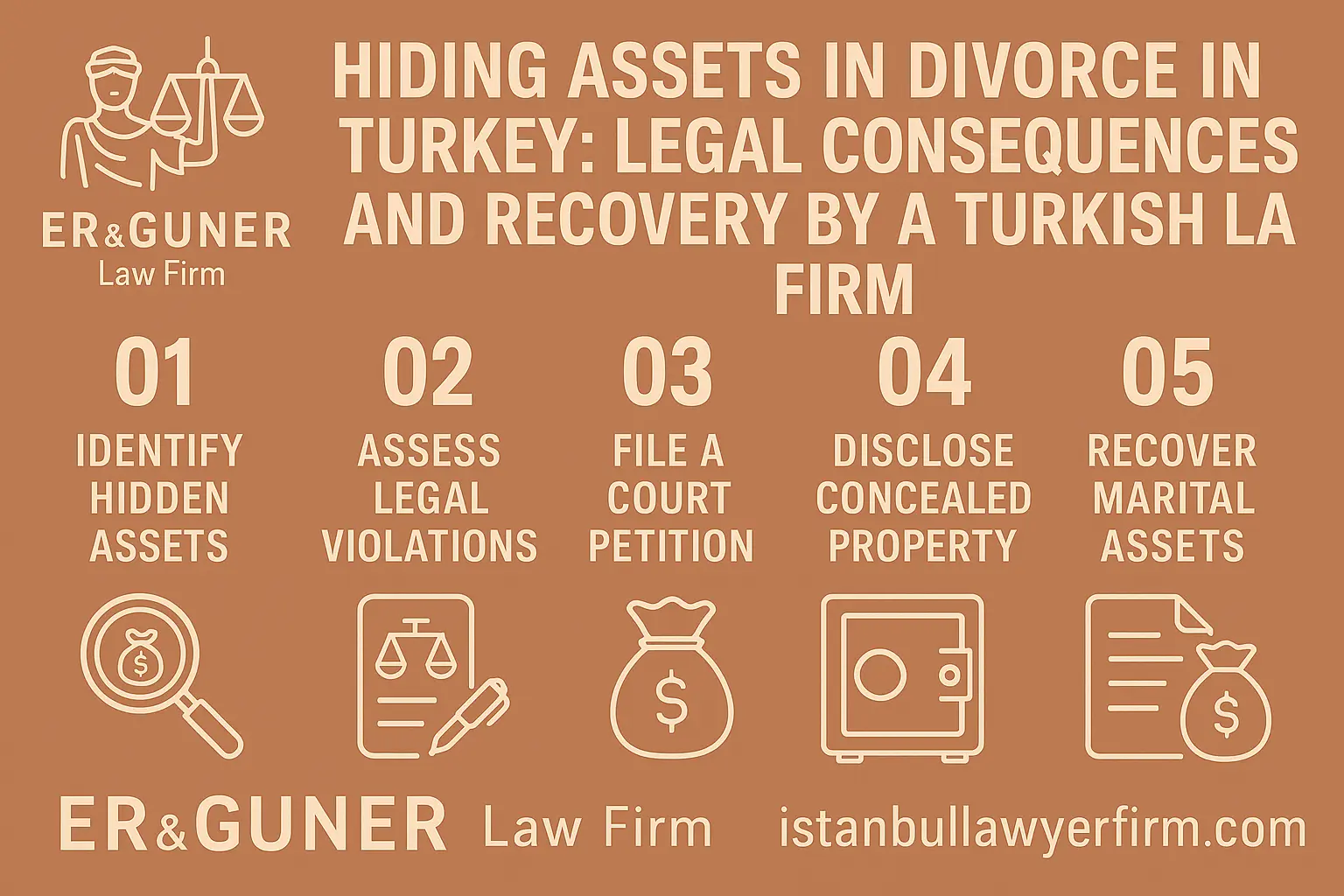
Asset concealment in Turkish divorce proceedings is a legal problem that courts take seriously — and one that frequently backfires on the concealing spouse in ways that go beyond the financial loss that motivated the concealment in the first place. The Turkish Civil Code (Türk Medeni Kanunu, Law No. 4721) imposes a full disclosure obligation on both spouses in divorce proceedings, and the Turkish judiciary has developed a range of investigative tools — registry queries, banking disclosure orders, corporate ownership searches, and court-appointed expert appraisals — that make asset concealment significantly harder than it may appear to the spouse attempting it. At the same time, the risk of discovery is not the only consequence: a spouse who is found to have concealed assets faces a court that has broad discretion to adjust the property division adversely, may face criminal referral for perjury (TCK Article 272) or fraud (TCK Article 157), and in the most serious cases may find that concealed assets are reallocated to the other spouse entirely rather than divided. For the spouse who suspects asset concealment, Turkish procedural law provides a robust set of tools that can be deployed at the earliest stages of the divorce — before a concealing spouse has the opportunity to complete transfers or obscure records — and a skilled legal strategy that uses these tools effectively can dramatically change the financial outcome of the divorce. The Turkish Civil Code provisions governing marital property and asset disclosure are accessible at Mevzuat. This article provides a comprehensive, practice-oriented guide to asset concealment in Turkish divorce proceedings, addressed to both the spouse who suspects concealment and the spouse who needs to understand the legal consequences of non-disclosure.
Marital property regimes and disclosure obligations
A lawyer in Turkey advising on marital property regimes must explain that Turkish law establishes a default marital property regime of participation in acquired property (edinilmiş mallara katılma rejimi) for all marriages concluded after January 1, 2002, unless the spouses agreed in writing before or during the marriage to a different regime. Under the default regime, each spouse retains ownership of their separately owned pre-marital property (kişisel mal) and has a claim to half of the increase in value of the other spouse's acquired property during the marriage (edinilmiş mal). This means that at divorce, each spouse is entitled to a participation share (katılma alacağı) calculated on the net increase in each other's acquired property — and the starting point for this calculation is an honest disclosure of what property each spouse holds, what debts are associated with that property, and when each asset was acquired. Practice may vary by authority and year — check current guidance on the current Turkish court interpretations of the participation in acquired property regime and on the specific categories of property that Turkish courts currently treat as separately owned versus acquired property in complex asset structures.
An Istanbul Law Firm advising on the scope of the disclosure obligation must explain that the full financial disclosure required in a Turkish divorce proceeding encompasses all assets in which either spouse holds an ownership, beneficial, or economic interest — not merely assets registered in the spouse's name. Turkish courts assess the substance of asset ownership rather than just the formal legal title: a property transferred to a spouse's parent, sibling, or business partner shortly before divorce proceedings, with the transferring spouse retaining effective use and control, may be analyzed as a concealed marital asset subject to participation regime rules regardless of the formal transfer of title. The obligation also extends to digital assets including cryptocurrency holdings, online investment accounts, foreign brokerage accounts, and digital platform payment balances. The property division in Turkish divorce law framework — covering the complete legal rules for asset division in Turkish divorces — is analyzed in the resource on property division in Turkish divorce law. Practice may vary by authority and year — check current guidance on the current Turkish court approach to beneficial ownership claims in divorce proceedings and on the specific evidentiary standards for establishing that a formally transferred asset remains within the concealing spouse's economic control.
A Turkish Law Firm advising on the consequences of an agreed property regime must explain that spouses who entered into a marriage contract (evlilik sözleşmesi) selecting a different property regime — such as complete separation of property (mal ayrılığı rejimi) or community property (paylaşmalı mal ayrılığı rejimi) — are subject to the disclosure obligations specific to their chosen regime. Under a complete separation of property regime, each spouse retains their own property and there is no statutory participation share — but even in this regime, claims arising from unjust enrichment, personal contribution to the other spouse's property, or disguised transfers remain available. The choice of property regime does not eliminate all financial claims in divorce; it only changes the statutory framework within which those claims are calculated. We review the applicable property regime as the first step in any divorce asset analysis mandate. Practice may vary by authority and year — check current guidance on the current Turkish court interpretations of marriage contracts selecting non-default property regimes and on the specific claims that remain available between spouses under a full separation of property arrangement.
Common methods of asset concealment in Turkey
A law firm in Istanbul advising on asset concealment methods must explain that Turkish courts and experienced family law practitioners have identified a recurring set of concealment strategies that are used by spouses anticipating divorce, and understanding these strategies is the starting point for an effective asset tracing investigation. The most common concealment methods in Turkish divorce proceedings include: transferring property to family members or business associates for nominal consideration or as purported gifts in the period before or shortly after the divorce petition is filed; undervaluing business interests, real estate, or other assets in declarations to the court; failing to disclose foreign bank accounts, offshore investment structures, or foreign real estate; hiding cash or movable assets including vehicles, jewelry, and art; and structuring income to flow through third-party accounts or companies rather than into personally held accounts that would be subject to the participation regime calculation. Practice may vary by authority and year — check current guidance on the current Turkish court approach to identifying and reversing asset concealment transactions and on the limitation period applicable to claims challenging pre-divorce property transfers.
An English speaking lawyer in Turkey advising on business interest concealment must explain that a spouse who owns or co-owns a Turkish company — a limited liability company (limited şirket) or a joint stock company (anonim şirket) — has multiple concealment opportunities that a non-expert may miss: understating the company's true value through creative accounting, shifting profitable contracts to a related company in which the spouse has a less visible interest, timing the recognition of revenue or profit to fall outside the marriage period that is subject to the participation calculation, or diluting the spouse's share in the company by bringing in new nominal shareholders shortly before divorce. The company valuation in a Turkish divorce proceeding requires a court-appointed expert appraisal and independent financial analysis — and a spouse whose business is undervalued in the initial proceedings has a right to challenge the expert's methodology and request a supplemental valuation. Practice may vary by authority and year — check current guidance on the current Turkish court standards for appointing and instructing business valuation experts in divorce proceedings and on the procedural steps for challenging a valuation that appears to understate the company's true worth.
A Turkish Law Firm advising on cryptocurrency and digital asset concealment must explain that cryptocurrency holdings are among the most difficult assets to discover in Turkish divorce proceedings because they are not registered in any Turkish government database, can be held in self-custody wallets with no institutional intermediary, and can be moved internationally within minutes. A spouse who converts marital savings into cryptocurrency before or during divorce proceedings and transfers the holdings to a hardware wallet creates an asset concealment problem that requires specialized forensic blockchain analysis tools to investigate. At the same time, cryptocurrency is not perfectly untraceable: Turkish exchanges are required under MASAK regulations to maintain customer identity records and transaction histories, and court orders compelling Turkish exchanges to disclose customer account data are an increasingly effective tool for identifying crypto holdings. We coordinate with blockchain forensics specialists in cases where cryptocurrency concealment is suspected. Practice may vary by authority and year — check current guidance on the current Turkish court procedures for obtaining MASAK-regulated exchange disclosure orders in divorce proceedings and on the admissibility of blockchain transaction analysis evidence in Turkish family courts.
Protective measures: asset freeze orders
A lawyer in Turkey advising on asset protection in divorce proceedings must explain that Turkish procedural law (HMK Article 389) authorizes courts to issue precautionary measures (ihtiyati tedbir) in divorce proceedings that prevent a spouse from disposing of marital assets during the litigation — and these measures can be obtained at the earliest stages of the proceeding, even before the other spouse has been served with the divorce petition. An asset freeze order (ihtiyati tedbir kararı) can prohibit the transfer, sale, mortgage, or encumbrance of specific identified assets, and it is registered as a notation on the relevant registry records (land registry, vehicle registry, trade registry) to create a public record that the asset is subject to court-ordered restrictions. The speed of the application matters enormously — a spouse who suspects that the other party intends to transfer or conceal assets should file the freeze application at the earliest possible stage, before the other spouse has implemented the concealment strategy. Practice may vary by authority and year — check current guidance on the current Turkish family court procedures for emergency asset freeze applications in divorce proceedings and on the security deposit requirements that courts may impose before granting a freeze order.
An Istanbul Law Firm advising on the scope of available asset freeze orders must explain that the freeze application can target specific identified assets or categories of assets — real estate registered at the TAKBIS land registry system, vehicles registered at the traffic registry, bank accounts at identified institutions, company shares registered at the trade registry, or movable assets described with sufficient specificity. We file asset freeze applications that target the specific assets most at risk of dissipation based on our analysis of the concealing spouse's known asset profile and the likely concealment strategies they would employ given their financial structure. Where the identity of specific assets is uncertain, we request a preliminary disclosure order (bilgi isteme kararı) from the court directing TAKBIS, the trade registry, or specific banks to provide account ownership information before the freeze application is filed. Practice may vary by authority and year — check current guidance on the current Turkish family court approach to pre-disclosure asset identification orders and on the specific information that courts currently order from registry authorities in advance of a freeze application.
A Turkish Law Firm advising on the reversal of pre-divorce transfers must explain that where a spouse has already completed asset transfers before the divorce proceeding began, the primary remedy is a challenge under TMK Article 229 — which allows a court to treat certain pre-divorce asset transfers as if they had not occurred when calculating the participation regime share, essentially "clawing back" the value of transfers that reduced the concealing spouse's declared asset base at the expense of the other spouse's participation share. The transfers that can be challenged under TMK Article 229 include gifts to third parties (except customary small gifts) made within one year before the reference date of the property division, and transfers made at any time with the intent to deprive the other spouse of their participation right. The burden of proving the intent element falls on the spouse challenging the transfer, which requires specific evidence — timing proximity to the divorce, inadequate consideration, the transferee's relationship to the transferring spouse, and the overall pattern of the financial conduct. Practice may vary by authority and year — check current guidance on the current Turkish court evidentiary standards for establishing the intent element in TMK Article 229 clawback claims and on the limitation periods applicable to clawback actions filed in the context of divorce proceedings.
Court-ordered disclosure and registry investigations
A law firm in Istanbul advising on the court's investigative powers in Turkish divorce proceedings must explain that Turkish family courts have broad authority to order third-party disclosure — commanding banks, registries, and companies to produce records relevant to the asset disclosure in the divorce proceeding. The court can order the Tapu ve Kadastro Genel Müdürlüğü (TKGM) to produce a complete list of all real estate registered in a party's name across Turkey, including any that the party has failed to declare. It can order the trade registry to produce a list of all companies in which the party holds shares, directorships, or proxy rights. It can order identified banks to produce account balance histories and transaction records. It can order the SGK and the Revenue Administration to produce income and social security contribution records that reflect the party's actual economic activity. Each of these records can reveal discrepancies between the declared asset position and the actual asset position. Practice may vary by authority and year — check current guidance on the current Turkish family court procedures for third-party disclosure orders and on the procedural timeline within which registry and banking authorities are required to respond to court-ordered disclosure requests.
An English speaking lawyer in Turkey advising on the TAKBIS land registry query in divorce asset investigations must explain that TAKBIS — Turkey's centralized land registry database — maintains a complete record of all real property registered in each individual's name across all provinces of Turkey, and a court-ordered TAKBIS query provides a comprehensive picture of a party's real estate holdings that the party cannot selectively suppress by simply failing to mention specific properties in their declaration. The TAKBIS query reveals the current registered owner, the registration date, the property's cadastral description, and any annotations including mortgages, easements, and interim court orders. Where a party has transferred real property within the relevant period, the registry will show the transfer date and the registered consideration — allowing the court and the other party's counsel to assess whether the transfer was made at market value or at an artificially low price that suggests a disguised disposition. Practice may vary by authority and year — check current guidance on the current TAKBIS query procedures available to Turkish courts in divorce proceedings and on the specific format in which TAKBIS provides its responses to court disclosure orders.
A Turkish Law Firm advising on banking disclosure orders in Turkish divorce proceedings must explain that courts can order Turkish banks to produce records of all accounts held by a party — including the account balances, transaction histories for defined periods, and records of large or unusual transfers. Turkish banks are required to comply with court disclosure orders under the Banking Law (Bankacılık Kanunu) and cannot refuse on the basis of banking secrecy when a valid court order is presented. The disclosure order can cover accounts at multiple banks simultaneously, and the resulting banking data often reveals income streams, investment positions, and transfer patterns that the party had not declared. Where large cash withdrawals appear in the banking records shortly before the divorce proceeding began, these form the basis for a specific inquiry into where those funds were directed. The debt recovery law Turkey framework — covering the enforcement mechanisms available against Turkish-based debtors with bank accounts — is analyzed in the resource on debt recovery law Turkey. Practice may vary by authority and year — check current guidance on the current Turkish family court procedures for banking disclosure orders and on the scope of historical transaction data that Turkish courts currently require banks to produce in divorce proceedings.
Expert appraisals and forensic accounting
A lawyer in Turkey advising on the role of expert appraisals in Turkish divorce proceedings must explain that Turkish family courts routinely appoint independent experts (bilirkişi) to value complex assets — businesses, real estate, investment portfolios, and intellectual property — where the parties' self-declared values are disputed or appear inconsistent with market evidence. The court-appointed expert's report is not binding on the court but carries substantial evidentiary weight, and a party who disputes the expert's methodology or conclusions must file specific, technically supported objections within the objection deadline set by the court. We prepare independent counter-valuations for all significant asset categories before the court-appointed expert's report is issued, so that we have a ready technical foundation for challenging any expert opinion that appears to understate the concealing spouse's assets. Practice may vary by authority and year — check current guidance on the current Turkish family court expert appointment procedures and on the specific objection format and deadline requirements applicable to challenges of expert valuations in divorce proceedings.
An Istanbul Law Firm advising on forensic accounting investigations in divorce cases must explain that a forensic accounting investigation is distinct from a standard expert appraisal — it is an adversarial financial investigation designed to identify concealed assets, undisclosed income, and suspicious transactions, rather than to value declared assets. A forensic accountant retained by a party (as opposed to court-appointed) reviews financial records available through disclosure orders, compares declared income against visible lifestyle indicators, analyzes company accounts for signs of profit shifting or artificial expense inflation, traces the destination of large cash withdrawals, and examines the consideration received for pre-divorce asset transfers. The forensic accountant's findings are presented to the court as expert opinion evidence in support of the party's concealment allegations. We work with forensic accounting specialists experienced in Turkish family law contexts, who can produce reports that are both technically sound and procedurally formatted for Turkish court submission. Practice may vary by authority and year — check current guidance on the current Turkish evidence rules applicable to party-retained forensic accounting reports in divorce proceedings and on the procedural steps for introducing forensic accounting evidence in Turkish family courts.
A Turkish Law Firm advising on lifestyle analysis as a concealment detection tool must explain that Turkish courts and forensic accountants increasingly use lifestyle analysis — comparing a spouse's declared income against their observable spending patterns and assets — as evidence of undisclosed income or assets. A spouse who declares modest income but maintains a lavish lifestyle, owns luxury vehicles, travels internationally, or makes significant cash purchases cannot readily explain the discrepancy without accounting for income sources that were not disclosed. Lifestyle analysis evidence is particularly powerful in cases where one spouse controlled the finances during the marriage and the other spouse has limited direct knowledge of the specific assets — because the court can draw adverse inferences from unexplained lifestyle-income discrepancies that the declaring spouse cannot credibly explain. Practice may vary by authority and year — check current guidance on the current Turkish family court approach to lifestyle analysis evidence in divorce proceedings and on the evidentiary standard required to make a prima facie showing of income concealment sufficient to shift the burden of explanation to the concealing spouse.
Consequences for the concealing spouse
A law firm in Istanbul advising on the civil consequences of proven asset concealment must explain that where a Turkish family court finds that one spouse has concealed assets or made deceptive declarations in the divorce proceeding, the court has significant discretion to impose adverse consequences on the concealing spouse in the property division. The primary consequence is a judicial determination that the concealed asset is included in the participation regime calculation at its true value — which eliminates the financial benefit of the concealment. Beyond this, the court can award the other spouse a higher participation share as compensation for the disadvantage suffered from the concealment, and it may take the concealing behavior into account in its overall assessment of the equitable distribution of contested assets. In cases of particularly egregious concealment, the court may award the innocent spouse a share of the concealed asset that exceeds the statutory 50% default. Practice may vary by authority and year — check current guidance on the current Turkish family court practice in adjusting property division outcomes to compensate for proven asset concealment and on the specific legal provisions that authorize courts to deviate from the default 50/50 participation share in concealment cases.
An English speaking lawyer in Turkey advising on the criminal consequences of false declarations in divorce proceedings must explain that a spouse who makes a false sworn declaration in a Turkish court — including a false asset declaration in a divorce proceeding — is potentially liable for perjury (yalan yere yemin etme or yalan yere tanıklık, TCK Article 272) which carries a criminal sentence of one to three years' imprisonment. A spouse who deliberately understates assets, falsely denies ownership, or provides fabricated documents to the court creates criminal exposure that exists independently of the civil divorce proceeding — and where the concealment involves the creation or use of false documents, additional fraud charges under TCK Article 157 may apply. The criminal consequences are most significant as a deterrent and as a source of leverage in settlement negotiations: a spouse who knows that their false declarations will be challenged with specific evidence may be more willing to negotiate a fair settlement than to face both the criminal referral and the adverse civil judgment. Practice may vary by authority and year — check current guidance on the current Turkish criminal prosecution approach to perjury and fraud charges arising from false asset declarations in family court proceedings and on the procedural relationship between civil divorce proceedings and parallel criminal investigations of concealing spouses.
A Turkish Law Firm advising on the impact of asset concealment on alimony and child support awards must explain that a spouse who conceals assets or income in a Turkish divorce proceeding does not only damage their position in the property division — they also risk adverse consequences in the alimony (nafaka) and child support (iştirak nafakası) determinations. Turkish courts assess the parties' financial positions when setting alimony and child support amounts, and a party whose actual income significantly exceeds their declared income may find that a later court review — triggered by evidence of the undisclosed income — results in a substantially increased support obligation. The alimony modification provisions of Turkish family law allow a court to revise support amounts where there has been a material change in the financial circumstances of either party, including the discovery of previously undisclosed income. The alimony Turkey framework — covering the types, calculation, and modification of nafaka in Turkish divorce proceedings — is analyzed in the resource on things to know about alimony in Turkey. Practice may vary by authority and year — check current guidance on the current Turkish family court approach to alimony modification applications based on newly discovered income or asset information and on the limitation period applicable to modification applications.
Tracing offshore and foreign assets
A lawyer in Turkey advising on international asset tracing in Turkish divorce proceedings must explain that a Turkish family court has jurisdiction over the property division between the spouses under the applicable marital property regime regardless of where specific assets are located — and a spouse who hides marital assets in foreign bank accounts, foreign real estate, or foreign corporate structures does not put those assets beyond the reach of the Turkish proceedings, though enforcing the Turkish judgment against foreign-located assets requires additional international enforcement steps. The Turkish court can require the concealing spouse to disclose all worldwide assets in their asset declaration, and a false declaration is just as consequential for foreign assets as for domestic ones. The court can also issue interim orders requiring the spouse to repatriate proceeds or to cease dissipating foreign assets during the proceedings. Practice may vary by authority and year — check current guidance on the current Turkish family court jurisdictional approach to worldwide asset disclosure orders and on the specific interim measures available to Turkish courts in relation to foreign-located marital assets.
An Istanbul Law Firm advising on the international enforcement of Turkish divorce asset orders must explain that enforcing a Turkish divorce judgment against foreign-located assets requires recognition of the Turkish judgment in the foreign country through that country's applicable private international law procedure. Turkey has bilateral judicial assistance agreements with a number of countries, and the Hague Conference on Private International Law provides frameworks that may be applicable to specific asset categories. Where a Turkish court has determined that a concealing spouse's foreign assets are subject to the participation regime calculation, and the concealing spouse refuses to comply with the Turkish judgment, the innocent spouse may need to initiate enforcement proceedings in the country where the foreign assets are located — a process that requires coordinating Turkish and foreign legal counsel. We manage these cross-border enforcement mandates and have working relationships with family law practitioners in the jurisdictions where Turkish divorce asset enforcement issues most frequently arise. Practice may vary by authority and year — check current guidance on the current recognition and enforcement procedures applicable to Turkish family court judgments in the key foreign jurisdictions where Turkish nationals most frequently hold assets.
A Turkish Law Firm advising on the use of international automatic exchange of information frameworks in divorce asset tracing must explain that Turkey is a signatory to the OECD Common Reporting Standard (CRS) and participates in the Automatic Exchange of Information (AEOI) framework — which means that Turkish tax residents' foreign bank account information is reported to Turkish authorities by participating foreign jurisdictions annually. In a divorce proceeding, evidence that a spouse holds foreign bank accounts that were not disclosed in the asset declaration can be obtained indirectly through Tax Administration records where the AEOI data shows previously undisclosed foreign account balances. This mechanism is not instantaneous or fully comprehensive, but it represents a structural improvement in the detectability of offshore asset concealment that significantly changes the risk calculus for spouses considering foreign account concealment. Practice may vary by authority and year — check current guidance on the current Turkish Revenue Administration's use of CRS/AEOI data in the context of family law proceedings and on the procedural mechanisms through which this data can be requested by a Turkish family court or obtained by a party through a tax authority information request.
Pre-marital and post-marital agreements
A law firm in Istanbul advising on prenuptial agreements as asset protection tools must explain that a Turkish marriage contract (evlilik sözleşmesi) executed before or during the marriage can significantly change the applicable property regime and thereby affect the disclosure obligation scope in any future divorce. A marriage contract selecting complete separation of property (tam mal ayrılığı rejimi) eliminates the participation right in acquired property — meaning that at divorce, each spouse retains only their own separately owned property, and neither has a statutory claim to a share of the other's assets accumulated during the marriage. This regime dramatically reduces the financial incentive for asset concealment, because there is no participation share to protect. However, a separation of property contract does not eliminate claims based on unjust enrichment, personal contribution, or disguised transfers — so some concealment risk remains even under the alternative regime. Practice may vary by authority and year — check current guidance on the current Turkish formal requirements for a valid marriage contract and on any specific provisions that Turkish courts require for a marriage contract selecting the separation of property regime to be enforceable in a subsequent divorce proceeding.
An English speaking lawyer in Turkey advising on post-marital agreements must explain that Turkish law also recognizes post-marital property regime agreements (evlilik birliği içinde rejim değişikliği) — spouses who are already married can execute a notarized agreement changing their property regime from the default participation regime to a separation regime or other alternative. A post-marital regime change does not retroactively eliminate participation rights that had already accrued under the previous regime — the court will typically calculate each spouse's participation right as of the date of the regime change and protect those accrued rights, with only the post-change period governed by the new regime. For couples who realize mid-marriage that the default regime does not serve their interests, a post-marital regime change is a legally available option. The contested vs. uncontested divorce Turkey framework — covering the procedural options in Turkish divorce proceedings — is analyzed in the resource on contested vs uncontested divorce Turkey. Practice may vary by authority and year — check current guidance on the current Turkish notarial requirements for a valid post-marital property regime agreement and on the treatment of accrued participation rights at the time of a mid-marriage regime change.
A Turkish Law Firm advising on disclosure clauses in marriage and settlement agreements must explain that spouses who negotiate a divorce settlement rather than litigating through the court system can include specific asset disclosure obligations and representations in the settlement agreement (protokol) — including representations about the completeness of each party's asset disclosure, audit rights allowing either party to request financial verification for a defined period after the settlement, and penalty provisions that apply if undisclosed assets are later discovered. A well-drafted settlement agreement with robust disclosure representation provisions gives the innocent spouse a contractual remedy for post-settlement discovery of concealed assets in addition to the standard civil and criminal remedies. We include these provisions as standard in all divorce settlement agreements we draft for clients who have reason to suspect that the other party's disclosure was not complete. Practice may vary by authority and year — check current guidance on the current Turkish court enforcement approach to contractual disclosure representation provisions in divorce settlements and on the procedural mechanism for enforcing penalty clauses against a spouse who breaches post-settlement disclosure obligations.
Divorce proceedings and the compulsory mediation framework
A lawyer in Turkey advising on the intersection of mediation and asset disclosure must explain that while Turkish divorce proceedings do not currently require compulsory pre-litigation mediation for the substantive divorce itself, parties can and do use mediation at various stages of divorce proceedings — particularly for agreeing on financial settlement terms. The asset disclosure obligation applies in mediation as well: a settlement reached in mediation based on one party's incomplete or false asset disclosure can be challenged in court on the grounds of mistake, fraud, or undue influence, and the resulting settlement agreement can be set aside if the other party can demonstrate that the concealment was material to the settlement they agreed to. A mediated settlement that includes specific disclosure representations is therefore a more durable settlement than one that simply divides stated assets without addressing the completeness of the disclosure. Practice may vary by authority and year — check current guidance on the current Turkish court approach to challenging mediated divorce settlements on grounds of asset concealment and on the limitation period applicable to such challenges.
An Istanbul Law Firm advising on the strategic timing of asset disclosure in divorce proceedings must explain that the timing of disclosure is a genuine strategic question — a spouse who discloses all assets comprehensively at the outset of the proceeding is in a stronger credibility position before the court and removes the other party's ability to use discovery findings as a surprise during the proceeding; a spouse who discloses minimally and supplements disclosure only when compelled by court orders may preserve information advantages temporarily but creates credibility damage if the court observes the pattern of reluctant compliance. Our general approach for clients who must disclose is to be comprehensive and organized at the outset — because any pattern of incomplete initial disclosure followed by compelled supplementation will be noted by the family court and may affect the court's overall assessment of the credibility of the disclosing spouse. Practice may vary by authority and year — check current guidance on the current Turkish family court evidentiary and credibility practices in relation to the timing and completeness of voluntary asset disclosure in contested divorce proceedings.
A Turkish Law Firm advising on the discovery of asset concealment after a divorce settlement is finalized must explain that where one spouse discovers evidence of the other's asset concealment after a divorce settlement agreement has been signed or a court judgment has been entered, Turkish law provides remedies — but they are more procedurally demanding than the remedies available during the proceedings. A final court judgment can be challenged through an extraordinary appeal (olağanüstü kanun yolu) or through a retrial request (yargılamanın iadesi) under HMK Article 375, which allows retrial where new evidence emerges that could not have been discovered before the final judgment with reasonable diligence. A settlement agreement can be challenged in a new civil action on grounds of fraud or material misrepresentation under TBK. Both remedies have specific time limitations and evidentiary requirements. The family law in Turkey framework — covering the full scope of Turkish family court proceedings and remedies — is analyzed in the resource on family law in Turkey divorce and custody. Practice may vary by authority and year — check current guidance on the current Turkish procedural rules for retrial applications and settlement fraud challenges in divorce cases and on the specific time limits and evidentiary thresholds applicable to each remedy.
Investigation strategy: what we do and when
A law firm in Istanbul advising on the investigation strategy for a spouse who suspects asset concealment must explain that the investigation should begin before the divorce petition is filed — because the period between the decision to divorce and the actual filing of the petition is often when the concealing spouse takes the most significant concealment actions, and evidence of those actions is most readily obtainable immediately after they occur. Pre-filing investigation steps include: preserving copies of all financial documents in the family's possession; photographing or otherwise documenting visible assets; reviewing banking records available to both spouses; and engaging forensic professionals to begin the analysis of available financial information. The asset freeze application should be prepared and filed simultaneously with or immediately after the divorce petition, targeting the specific assets most at risk of dissipation. Practice may vary by authority and year — check current guidance on the current Turkish procedural rules for filing asset freeze applications simultaneously with the divorce petition and on the evidence required to obtain an emergency freeze without prior notice to the other spouse.
An English speaking lawyer in Turkey advising on the sequence of court-ordered investigations after the divorce petition is filed must explain that we typically request a multi-stage disclosure order in the earliest stages of the proceeding: first, registry queries to TAKBIS, the trade registry, and the vehicle registry to identify all registered assets; second, banking disclosure orders to all major Turkish banks to identify accounts and transaction histories; third, SGK and Revenue Administration queries to identify income and business activity; and fourth, if specific suspicions exist, targeted company ownership queries and corporate accounting disclosure orders. Each stage of disclosure may reveal new assets that were not declared, and each revelation is documented and presented to the court as evidence of the concealing spouse's disclosure failures. The enforcement proceedings Turkey framework — relevant where asset freeze orders need to be enforced against non-compliant spouses — is analyzed in the resource on enforcement proceedings Turkey. Practice may vary by authority and year — check current guidance on the current Turkish family court procedures for multi-stage disclosure orders and on the typical timeline from the filing of the divorce petition to the completion of the initial disclosure investigation.
A best lawyer in Turkey advising on the overall litigation strategy in asset concealment divorce cases must explain that the strategy has two parallel objectives: establishing the true value of the concealed assets through investigation and expert analysis, and demonstrating to the court the pattern of concealment conduct in a way that supports an adverse inference and credibility assessment that affects all disputed aspects of the case. Courts are not merely passive arbiters of financial disputes — they form impressions of the parties' credibility based on how honestly and completely each party has dealt with the proceeding. A spouse who is shown to have made false declarations, concealed assets, or transferred property to family members in anticipation of divorce will find that the court's credibility assessment affects not only the property division but also the court's approach to disputed questions about alimony, child custody, and visitation. The Istanbul Bar Association at istanbulbarosu.org.tr provides resources for identifying qualified practitioners. Practice may vary by authority and year — check current guidance on any recently changed Turkish family law provisions affecting asset disclosure obligations and divorce proceedings before acting on any information on this page.
Frequently Asked Questions
- What is the disclosure obligation in a Turkish divorce? Both spouses must fully disclose all assets subject to the applicable marital property regime — including property acquired during the marriage, business interests, bank accounts, foreign assets, and digital assets.
- What happens if a spouse hides assets? The court can include concealed assets at their true value in the participation calculation, adjust the property division adversely against the concealing spouse, and potentially refer the case for criminal investigation for perjury or fraud.
- Can the court order banks to disclose account information? Yes — Turkish family courts can order banks to produce complete account records. Banking secrecy does not apply against valid court disclosure orders.
- What is a TAKBIS query and how does it help? TAKBIS is Turkey's centralized land registry database. A court-ordered TAKBIS query reveals all real estate registered in a party's name across Turkey, including property not declared in the divorce proceeding.
- Can pre-divorce property transfers be reversed? Under TMK Article 229, transfers made within one year before the reference date (for gifts) or at any time with the intent to deprive the other spouse (for other transfers) can be treated as if they had not occurred for participation calculation purposes.
- Is cryptocurrency concealment detectable? Turkish exchanges are MASAK-regulated and must comply with court disclosure orders. Blockchain forensics can also trace on-chain transaction patterns. Crypto is not as untraceable as some assume.
- What are the criminal consequences of false asset declarations? False sworn declarations in court proceedings can constitute perjury (TCK Article 272), carrying one to three years' imprisonment. Creating or using false documents adds fraud charges.
- Can I get an asset freeze order before the other spouse transfers property? Yes — Turkish courts can grant asset freeze orders as a precautionary measure at the earliest stages of the divorce proceeding, including simultaneously with the divorce petition.
- Do foreign assets need to be declared in Turkish divorce proceedings? Yes — all worldwide assets must be declared. Turkish courts have jurisdiction over the full marital property regime calculation regardless of where assets are located.
- What can I do if I discover concealment after the divorce is finalized? A final court judgment can be challenged through a retrial application (HMK Article 375) if new evidence of concealment emerges. A settlement agreement can be challenged through a new civil action for fraud.
Author: Mirkan Topcu is an attorney registered with the Istanbul Bar Association (Istanbul 1st Bar), Bar Registration No: 67874. His practice focuses on cross-border and high-stakes matters where evidence discipline, procedural accuracy, and risk control are decisive.
He advises individuals and companies across Family Law and Divorce, Real Estate Law, Enforcement and Insolvency, and cross-border documentation matters where procedural accuracy and evidence discipline are decisive.
Education: Istanbul University Faculty of Law (2018); Galatasaray University, LL.M. (2022). LinkedIn: Profile. Istanbul Bar Association: Official website.