

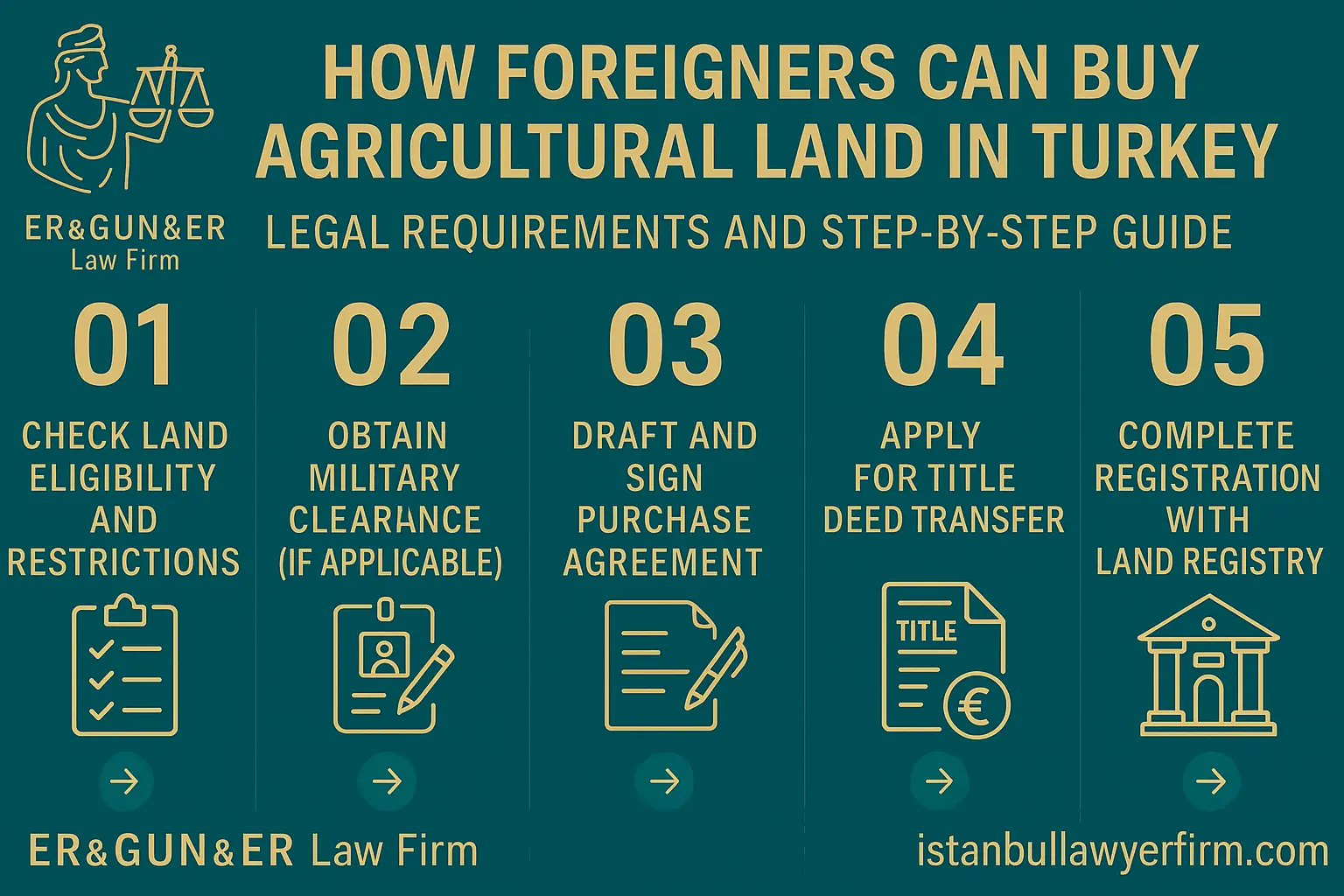
A lawyer in Turkey who advises foreign investors on agricultural land purchases understands that buying farmland in Turkey offers significant opportunities—for organic farming, long-term landholding, commercial cultivation, and land appreciation—but that Turkey imposes specific legal restrictions on agricultural land ownership by non-Turkish citizens whose navigation requires detailed knowledge of the Land Registry Law, zoning regulations, Ministry of Agriculture approval requirements, and foreign ownership caps that apply at both the individual parcel and district levels. An Istanbul Law Firm that advises foreigners on agricultural land acquisition in Turkey provides the integrated legal service covering every dimension of the transaction: evaluating land status and zoning classifications; verifying foreign ownership eligibility and remaining district capacity; conducting title deed due diligence; drafting bilingual purchase contracts with appropriate protections; coordinating Ministry of Agriculture clearance; managing land registry transfer procedures; advising on corporate acquisition structures where appropriate; and ensuring ongoing environmental, water rights, and tax compliance. A Turkish Law Firm that handles agricultural land transactions for international clients understands that foreign buyers face legal risks at every stage—from identifying land that is actually eligible for foreign ownership to ensuring that the transaction structure does not violate the restrictions that trigger government annulment of completed sales. An English speaking lawyer in Turkey who advises on agricultural land purchases for clients unfamiliar with Turkish property law provides the bilingual guidance that enables foreign investors to understand the specific requirements applicable to their situation and to structure their acquisition in a way that is legally secure. Practice may vary by authority and year — verify current foreign ownership restrictions, current Ministry of Agriculture approval requirements, current district-level foreign ownership capacity thresholds, and current zoning regulations with qualified counsel before initiating any agricultural land acquisition in Turkey, since the applicable regulatory thresholds and procedural requirements have been subject to legislative and administrative updates whose current state requires specific confirmation rather than reliance on general information that may not reflect current applicable limits in a specific district or for a specific parcel classification.
Foreign Ownership Eligibility and Legal Restrictions on Agricultural Land
A lawyer in Turkey who advises on foreign ownership of Turkish agricultural land explains that the Land Registry Law No. 2644 and the Military Forbidden Zones Regulation impose specific criteria governing whether foreign individuals and companies can acquire farmland in Turkey—and that these criteria must be satisfied before any purchase commitment is made, since transactions that violate the restrictions are subject to government annulment regardless of whether all other legal formalities were followed. An Istanbul Law Firm that advises on foreign ownership eligibility helps clients understand the specific restrictions most relevant to agricultural land acquisitions: foreign individuals may acquire agricultural land only within zones approved for foreign ownership and subject to a total personal acquisition limit whose current applicable threshold must be verified with qualified counsel; the total area of agricultural land that foreign nationals can acquire in any given district is limited to a percentage of the total district land area, requiring verification through regional land offices before purchase; and acquisitions involving areas exceeding the applicable threshold require special permissions from the Ministry of Agriculture and Forestry whose application process adds a specific procedural layer to the transaction timeline. Turkish lawyers advising on foreign agricultural land eligibility help clients verify these thresholds through the specific regional land offices and official government channels—rather than relying on informal advice or information that may not reflect current applicable limits in the specific district. Practice may vary by authority and year.
An Istanbul Law Firm that advises on military and security zone restrictions for agricultural land purchases explains that proximity to military zones, strategic installations, and national security areas creates a parallel set of restrictions whose violation can result in post-purchase government intervention regardless of whether the land appeared eligible in ordinary property records. Turkish lawyers advising on security zone compliance help agricultural land buyers implement the specific verification steps most important for each location: obtaining confirmation from the Military Zone Forbidden Areas registry that the specific parcel is not within a restricted area; checking that the parcel is not within a strategic border or coastal protection zone whose presence does not always appear in regular cadastral records; and ensuring that the intended use is consistent with the applicable security zone rules that apply even to land whose ownership is otherwise permitted. An English speaking lawyer in Turkey who conducts pre-purchase eligibility assessments for foreign agricultural land buyers provides the systematic verification across all relevant government databases—land registry, military zone registry, agricultural zone registry, and environmental protection registers—that enables a comprehensive eligibility conclusion before the buyer commits to a purchase price or signs any preliminary agreement. Practice may vary by authority and year.
A Turkish Law Firm that advises on the scope of eligible agricultural land for foreign buyers explains that not all land classified as agricultural in general land records is eligible for foreign purchase—and that distinguishing between eligible agricultural land, forest land under Ministry of Forestry jurisdiction, land within ecological protection zones, and land subject to state-use restrictions requires specific analysis of each parcel's classification records. An English speaking lawyer in Turkey who advises on agricultural land classification verification for foreign investors helps clients understand that the classification that determines foreign ownership eligibility is the one recorded in the official land classification registers rather than the land's physical appearance or current use—meaning that parcels that appear to be ordinary farmland may be classified as forest or protection zone land whose purchase by foreigners creates legal risk. The systematic verification of each parcel's official classification across multiple government systems is one of the most critical pre-purchase steps for foreign agricultural land buyers, and completing this verification before making any payment or signing any binding agreement prevents the post-purchase annulment risk that is the most severe consequence of acquiring land that does not satisfy foreign ownership eligibility requirements—a consequence whose financial and practical impact is severe because annulment returns the land to the seller without necessarily providing the buyer with straightforward recovery of the purchase price. Practice may vary by authority and year.
Zoning Analysis, Municipality Approval and Environmental Compliance
A lawyer in Turkey who advises on agricultural land zoning explains that zoning status determines not only the current permitted uses of a parcel but also whether the buyer's intended use—organic farming, greenhouse cultivation, vineyard operation, or tourism-adjacent agricultural use—is legally permitted, and that buying agricultural land without a thorough zoning analysis creates the risk of acquiring a parcel that cannot be legally used for the intended purpose. An Istanbul Law Firm that conducts agricultural land zoning analysis for foreign buyers implements the specific review process most effective for each parcel: obtaining and reviewing the applicable development plan—imar plani—and confirming that the parcel's zoning classification permits the intended agricultural use; checking whether the land has any construction restrictions, protected area overlaps, or flood zone designations that affect its practical usability; and assessing whether the current zoning classification creates any risk of expropriation that a prospective buyer should factor into the investment decision. Turkish lawyers advising on zoning analysis help foreign agricultural land buyers understand the difference between protected agricultural zones—where subdivision or conversion is prohibited—and ordinary agricultural zones where specific types of development may be permitted subject to municipal approval. Practice may vary by authority and year — verify current zoning regulations and municipal development plan provisions with qualified counsel before relying on any zoning classification as confirmation of permitted use.
An Istanbul Law Firm that advises on environmental compliance for agricultural land purchases explains that environmental regulations create a parallel layer of restrictions on agricultural land use that must be verified separately from zoning classification—including wetland boundary designations, erosion risk classifications, protected ecological zone overlaps, and soil contamination assessments that affect whether the land can be used for the intended agricultural purpose without triggering environmental enforcement. Turkish lawyers advising on environmental due diligence for agricultural land help buyers implement the specific checks most important for each parcel type: reviewing Ministry of Environment databases for protected zone designations; confirming that any planned agricultural activity does not require an Environmental Impact Assessment—ÇED—whose approval process would add significant time to the acquisition timeline; and assessing whether existing environmental conditions on the land—including prior contamination or degraded soil status—create remediation obligations that the buyer would inherit. An English speaking lawyer in Turkey who manages environmental compliance verification for foreign agricultural land buyers coordinates the review across the Ministry of Environment, the regional environmental protection boards, and the municipal planning departments—producing a single integrated environmental due diligence report whose conclusions enable the buyer to understand the full scope of environmental obligations associated with the parcel. Practice may vary by authority and year.
A Turkish Law Firm that advises on water rights for agricultural land in Turkey explains that water access and irrigation rights are among the most practically significant legal elements of agricultural land ownership—because agricultural productivity often depends on access to water resources whose use requires specific government permits rather than being automatically available based on land ownership. An English speaking lawyer in Turkey who advises on water rights for agricultural land buyers helps clients implement the specific verification steps most important for each parcel: confirming whether existing irrigation permits—su kullanma izni—are transferable to a new owner or must be reapplied for; verifying regional water authority quotas and whether the specific parcel's water allocation is adequate for the intended agricultural use; and ensuring that any wells, water canals, or reservoir connections on the land are legally registered and usable rather than informal arrangements whose continuation after purchase cannot be assured. Obtaining water rights confirmation before finalizing the purchase price and contract is essential for agricultural land buyers whose investment value depends on water availability—because discovering that irrigation rights do not transfer with the land after the purchase is complete creates a fundamental impairment to the investment whose remedy requires additional legal proceedings whose cost and duration consistently exceed the cost of confirming water rights status at the due diligence stage. Practice may vary by authority and year.
Legal Due Diligence and Title Deed Verification
A lawyer in Turkey who advises on agricultural land due diligence explains that buying agricultural land in Turkey as a foreigner requires rigorous verification of the parcel's legal status across multiple government systems—and that the due diligence scope appropriate for agricultural land is broader than for urban real estate because agricultural parcels may carry additional encumbrances including agricultural cooperative membership obligations, state-use restrictions, forest boundary overlaps, irrigation cooperative debts, and inheritance-related title complications whose identification requires specific expertise. An Istanbul Law Firm that conducts agricultural land due diligence for foreign buyers implements the comprehensive verification process most important for each acquisition: checking ownership records and title history through the General Directorate of Land Registry and Cadastre to confirm the seller's authority and identify any title encumbrances; verifying that no outstanding debts, liens, mortgages, or court orders are recorded against the parcel; and reviewing recent transactions in the title history to identify any suspicious transfers that might indicate fraud or create reversal risk for the proposed acquisition. Turkish lawyers advising on agricultural land due diligence help buyers understand that some encumbrances—including tenant rights, third-party usage claims, and cooperative membership obligations—do not appear in ordinary title records but are nevertheless binding on a new owner, making physical investigation and inquiry to local agricultural authorities an essential component of complete due diligence. Practice may vary by authority and year.
An Istanbul Law Firm that advises on documentary due diligence for agricultural land acquisitions explains that the complete due diligence file for a Turkish agricultural land purchase should contain: the official title deed—Tapu—extract showing current registered ownership and any annotations; a zoning verification certificate from the relevant municipality; an environmental compliance confirmation from the regional environmental authority; a military zone clearance confirmation; a verification of the foreign ownership district capacity; and an irrigation and water rights status report from the regional water authority. Turkish lawyers advising on due diligence documentation help foreign buyers understand which documents must be obtained from official sources—because copies provided by sellers may be outdated or incomplete—and which documents require fresh official issuance within a specific period before the transaction date to reflect current status. An English speaking lawyer in Turkey who prepares agricultural land due diligence dossiers for international buyers issues formal legal opinions in English summarizing the due diligence findings, any identified risks, and the recommended risk mitigation measures—enabling foreign investors to make fully informed acquisition decisions based on complete verified information rather than on seller representations alone. Practice may vary by authority and year.
A Turkish Law Firm that advises on field investigation as part of agricultural land due diligence explains that physical inspection and boundary verification are essential complements to documentary due diligence—because discrepancies between cadastral records and physical parcel boundaries are more common in rural agricultural land than in urban property, and because physical investigation identifies practical issues including access road status, existing tenancy arrangements, and infrastructure connection status that affect the land's value and usability. An English speaking lawyer in Turkey who coordinates field due diligence for foreign agricultural land buyers manages the engagement of licensed surveyors and local engineers to confirm boundary accuracy, verify physical access, and assess the condition of any existing agricultural infrastructure—providing a complete picture of the parcel's physical and legal status that supports a well-informed purchase decision. Practice may vary by authority and year.
A Turkish Law Firm that advises on physical due diligence for agricultural land purchases explains that on-site inspection by qualified surveyors and engineers is an essential complement to documentary due diligence—because discrepancies between cadastral records and physical parcel boundaries are significantly more common in rural agricultural land than in urban property, and because physical inspection identifies practical issues including road access status, the condition of any irrigation infrastructure, existing informal tenancy arrangements, and encroachments by neighboring landowners whose existence affects the land's value and usability but does not appear in any official record. An English speaking lawyer in Turkey who coordinates physical due diligence for foreign agricultural land buyers manages the engagement of licensed surveyors and local agricultural engineers to confirm boundary accuracy, verify the legal status of physical access routes, and assess existing agricultural infrastructure—providing a complete picture that, combined with the documentary due diligence, gives the buyer a genuinely comprehensive legal and physical understanding of what they are acquiring. Practice may vary by authority and year.
Sales Contracts, Title Transfer and Tax Compliance
A lawyer in Turkey who advises on agricultural land purchase contracts explains that the sales agreement for a Turkish agricultural land transaction must be tailored to the specific legal characteristics of agricultural land—including conditions relating to Ministry of Agriculture approval, zoning verification, foreign ownership eligibility confirmation, and land handover condition—rather than using a standard urban property purchase template whose provisions do not address agricultural land's specific legal requirements. An Istanbul Law Firm that drafts agricultural land purchase contracts for foreign buyers implements the specific contractual protections most important for each transaction: including conditions precedent requiring completion of Ministry approvals and foreign ownership capacity verification before the buyer is obligated to proceed; incorporating warranties from the seller about the land's freedom from encumbrances, its compliance with agricultural land use regulations, and the accuracy of the boundaries described in the cadastral records; and designing payment structures—including deposit arrangements, escrow mechanisms, and closing payment schedules—that protect the buyer's funds until all conditions are satisfied and title transfer is completed. Turkish lawyers advising on agricultural land contract design help buyers understand the specific risks most commonly addressed through contract provisions: zoning classification changes that affect permitted use, water rights complications that emerge after signing, and title defects that appear in the period between preliminary agreement and final registration. Practice may vary by authority and year.
An Istanbul Law Firm that manages title deed registration for foreign agricultural land buyers explains that the Tapu transfer process requires coordination across the local Land Registry Office, the tax authority, and—for parcels requiring Ministry approval—the Ministry of Agriculture and Forestry whose clearance must be obtained before the land registry will process the transfer. Turkish lawyers advising on title transfer for agricultural land help buyers implement the specific procedural steps most important for each transaction: obtaining land valuation reports in the format required by the land registry; preparing and filing the Ministry of Agriculture application where required; coordinating the signature appointment at the land registry; and ensuring that all required tax payments—including title deed transfer tax, stamp duties, and any applicable municipal contributions—are calculated correctly and paid before the registration is completed. An English speaking lawyer in Turkey who supervises agricultural land title transfers for foreign buyers maintains constant communication with the buyer throughout each procedural step, explaining the legal and financial implications of each milestone and ensuring that the buyer's rights are protected throughout the transfer process. Practice may vary by authority and year — verify current title deed transfer tax rates, current Ministry of Agriculture approval procedures, current land registry appointment scheduling requirements, and current documentation checklists with qualified counsel before completing any agricultural land title transfer, since institutional requirements at specific land registry offices are subject to periodic administrative updates that affect the document preparation timeline. Practice may vary by authority and year.
A Turkish Law Firm that advises on taxation of agricultural land ownership and transactions explains that farmland in Turkey is subject to multiple tax obligations whose scope depends on how the land is acquired, how it is used, and how it is eventually transferred—and that foreign buyers need a complete tax picture before completing the acquisition rather than discovering unexpected obligations after title transfer. An English speaking lawyer in Turkey who advises on agricultural land taxation for foreign investors helps buyers understand the specific obligations most relevant to each situation: title deed transfer tax—Tapu Harci—calculated as a percentage of the declared sale value; annual real estate tax applied to agricultural land; income tax on agricultural revenue where the land generates farming income; VAT implications for commercial farming operations; and capital gains tax on future sale whose calculation depends on the holding period and the buyer's tax residency status. Tax compliance for agricultural land ownership is a recurring obligation rather than a one-time transaction cost—making early tax planning an essential component of the investment strategy rather than an afterthought, particularly for foreign investors who may face additional reporting obligations in their home country for foreign real estate holdings that must be coordinated with Turkish tax compliance rather than managed in isolation. Practice may vary by authority and year.
Corporate Acquisition Structures, Risk Management and Enforcement
A lawyer in Turkey who advises on corporate structures for agricultural land acquisition explains that foreigners can acquire agricultural land in Turkey through a locally established Turkish company—often a limited liability company, Ltd. Sti.—and that this structure frequently offers practical advantages including simpler permit acquisition, eligibility for agricultural investment incentives, easier share transfer for inheritance or investment restructuring purposes, and the ability to structure joint ventures with Turkish agricultural partners. An Istanbul Law Firm that assists foreign investors in establishing Turkish companies for agricultural land ownership helps clients implement the specific corporate structure most appropriate for each investment: drafting company articles that authorize agricultural land ownership and management; registering the company with the trade registry and relevant agricultural authorities; designing the capital structure and shareholder arrangements to reflect the investor's ownership and control objectives; and ensuring that the company's agricultural land ownership complies with the corporate land ownership caps that apply separately from individual ownership restrictions. Turkish lawyers advising on corporate agricultural land ownership help clients understand that using a Turkish company does not eliminate all foreign ownership restrictions—because regulations applicable to companies with majority foreign ownership may impose requirements similar to those for direct foreign acquisition—and that the specific regulatory treatment applicable to a proposed company structure must be verified for the specific agricultural land category and district. Practice may vary by authority and year.
An Istanbul Law Firm that advises on risk management for foreign agricultural land buyers explains that the most significant risks are those whose consequences are most severe: government annulment of the purchase for violation of foreign ownership restrictions; post-purchase discovery of title defects that the seller concealed or failed to disclose; and zoning or environmental restrictions that prevent the intended agricultural use. Turkish lawyers advising on agricultural land risk management help buyers implement the specific risk mitigation measures most effective for each risk category: conducting comprehensive eligibility verification before any payment commitment; using conditional sales contracts whose conditions precedent specifically address the risks identified in due diligence; structuring payment through escrow arrangements that hold funds until all conditions are verified; maintaining ongoing compliance monitoring after acquisition to ensure that regulatory changes or annual compliance obligations are identified and addressed promptly; and preserving a complete, organized acquisition file whose documentation quality determines the outcome of any enforcement action or dispute that arises after title transfer. An English speaking lawyer in Turkey who advises foreign agricultural land buyers on post-acquisition compliance management provides the ongoing legal monitoring service that enables foreign owners to identify and respond to regulatory changes, annual filing obligations, and enforcement developments without requiring Turkish language expertise to track the relevant government communications. The best lawyer in Turkey for agricultural land transactions combines specific knowledge of the Land Registry Law, Ministry of Agriculture approval procedures, foreign ownership restrictions, agricultural zoning regulations, environmental compliance requirements, water rights law, tax obligations, and corporate acquisition structures with the English-language communication that enables foreign investors to navigate Turkey's agricultural land acquisition process with legal confidence and strategic clarity. Practice may vary by authority and year.
A Turkish Law Firm that advises on enforcement of agricultural land rights for foreign owners explains that when disputes arise—including boundary disputes, seller warranty claims, tenant right conflicts, or government enforcement actions—having a complete, well-organized due diligence file and a clearly drafted purchase contract is the single most important factor in determining the outcome. An English speaking lawyer in Turkey who represents foreign agricultural land owners in Turkish dispute proceedings helps clients understand that the strength of an enforcement position in Turkish courts depends on the quality of evidence preserved from the due diligence and acquisition stages rather than on arguments made during litigation—making investment in thorough pre-purchase documentation the most effective litigation risk management available to foreign agricultural land buyers. Practice may vary by authority and year.
Agricultural Investment via Turkish Companies and Joint Ventures
A lawyer in Turkey who advises on corporate acquisition structures for agricultural land explains that establishing a Turkish limited liability company to acquire agricultural land is a commonly used strategy among foreign investors because it can offer practical advantages over direct personal acquisition—including simpler ongoing permit management, eligibility for agricultural investment incentives offered to Turkish enterprises, easier restructuring for inheritance or investor exit purposes, and the ability to bring Turkish agricultural partners into a joint venture structure. An Istanbul Law Firm that assists foreign investors in forming Turkish agricultural companies helps clients implement the specific corporate design most appropriate for each investment objective: drafting company articles that specifically authorize agricultural land ownership and farm management activities; registering the company with the trade registry and completing the tax office and chamber of commerce enrollments required for operational status; structuring the shareholder arrangement to reflect the foreign investor's desired ownership percentage and governance rights; and ensuring the company's agricultural land ownership registration satisfies the specific cadastral requirements for corporate landowners. Turkish lawyers advising on corporate agricultural land ownership help investors understand that the regulatory analysis applicable to company-based acquisition differs from direct individual acquisition in specific ways—including different foreign ownership calculation rules and different Ministry approval thresholds—whose current applicable standards must be verified for each proposed company structure before committing to this acquisition approach. Practice may vary by authority and year.
An Istanbul Law Firm that advises on joint venture structures for agricultural land investment explains that partnerships between foreign investors and Turkish agricultural operators are increasingly common for larger commercial farming projects—combining the foreign investor's capital with the Turkish partner's local regulatory standing, agricultural expertise, and operational network. Turkish lawyers advising on agricultural joint venture structures help investors implement the specific legal framework most effective for each partnership: drafting shareholder agreements that specify each party's contribution, decision-making rights, profit distribution, and exit mechanisms; designing land ownership arrangements that reflect the partnership's operational structure while satisfying all applicable foreign ownership regulations; and incorporating agricultural operation agreements that define how farming activities will be managed, how revenues will be distributed, and how the partnership will address disputes or operational failures. An English speaking lawyer in Turkey who advises on agricultural joint ventures for foreign investors provides the bilingual documentation management that enables foreign investors to understand the terms and risks of their partnership arrangements in their own language while ensuring all Turkish-law-required formalities are correctly satisfied. Practice may vary by authority and year.
A Turkish Law Firm that advises on corporate agricultural land compliance explains that Turkish companies holding agricultural land must satisfy ongoing compliance obligations whose management is distinct from the one-time acquisition compliance steps—including annual company filings, land use compliance monitoring, agricultural registration maintenance, and water rights renewal where applicable. An English speaking lawyer in Turkey who provides ongoing corporate agricultural land compliance services for foreign-owned Turkish companies delivers the systematic monitoring that enables foreign investors to remain in regulatory good standing without requiring direct Turkish language engagement with multiple government authorities. Corporate structures for agricultural land investment are most valuable when they are integrated from the beginning into a long-term strategy that addresses not only the acquisition but also the operational compliance, the income repatriation framework, and the eventual exit or succession plan—making early strategic planning with qualified counsel significantly more cost-effective than ad hoc compliance management whose gaps accumulate into enforcement risk that is more difficult and expensive to resolve than the original planning investment would have been. Practice may vary by authority and year.
Practical Process, Timeline and Post-Acquisition Management
A lawyer in Turkey who advises on the practical timeline for foreign agricultural land acquisitions in Turkey explains that the duration of the acquisition process depends primarily on whether Ministry of Agriculture approval is required—since approval-required transactions take significantly longer than straightforward purchases within ordinary foreign ownership limits—and that building a realistic timeline into the transaction plan is essential for avoiding commitment conflicts that arise when buyers assume an optimistic completion date. An Istanbul Law Firm that manages agricultural land acquisition timelines for foreign buyers helps clients understand the specific process stages whose duration is most variable: the pre-purchase eligibility and due diligence phase, which should be treated as a fixed requirement whose shortcuts create legal risk rather than time savings; the sales contract negotiation and signing phase, which depends on the complexity of the specific terms being agreed; the Ministry of Agriculture application and approval phase where required, which depends on current governmental processing loads; and the land registry appointment and transfer phase, whose scheduling depends on the specific land registry office's appointment availability and can be a meaningful constraint in busy urban land registries. Turkish lawyers advising on acquisition timeline management help buyers understand that each phase produces documents and official confirmations that must be correctly preserved as part of the acquisition file—because post-acquisition enforcement of contractual rights and government approvals depends on the completeness and organization of the documents generated during the process. Practice may vary by authority and year.
An Istanbul Law Firm that advises on post-acquisition agricultural land management for foreign owners explains that acquiring title to agricultural land is the beginning of an ongoing compliance relationship with Turkish governmental authorities rather than a one-time transaction whose completion ends the legal engagement. Turkish lawyers advising on post-acquisition compliance management help foreign agricultural land owners implement the specific ongoing obligations most important for each ownership situation: annual real estate tax filings and payments to the relevant municipal tax authority; agricultural land use compliance to ensure that the parcel continues to be used in accordance with applicable zoning classifications and any use conditions attached to Ministry approvals; water rights permit renewal and water usage reporting obligations where irrigation permits have been obtained; and environmental compliance monitoring to ensure that farming activities remain within the parameters established by any Environmental Impact Assessment approvals or environmental protection zone conditions applicable to the parcel. An English speaking lawyer in Turkey who provides ongoing agricultural land compliance services for foreign owners monitors changes in the regulatory environment—including amendments to foreign ownership limits, zoning regulation updates, and environmental protection zone boundary changes—that could affect the owner's rights or obligations and ensures that the owner receives timely notice and clear explanation of any required response. Practice may vary by authority and year.
A Turkish Law Firm that advises on agricultural land exit strategies for foreign investors explains that the eventual disposition of agricultural land—whether through sale to a third party, transfer to heirs, contribution to a corporate structure, or conversion to a different land use—creates specific legal requirements whose planning should begin during the acquisition stage rather than when the exit decision is made. An English speaking lawyer in Turkey who advises on agricultural land exit planning helps foreign investors understand the specific tax, regulatory, and procedural implications of each exit option: sale to another foreign buyer creates the same foreign ownership eligibility verification requirements applicable to the original purchase; inheritance by foreign heirs requires verification that the heirs satisfy applicable foreign ownership conditions; conversion to a different land use requires formal municipal plan revision and potentially Ministry of Agriculture approval; and sale to a Turkish buyer is generally the administratively simplest exit whose principal variable is capital gains tax whose calculation depends on the holding period and the seller's applicable tax residency status. Planning for exit from the acquisition outset—rather than treating it as a future problem—ensures that the ownership structure, the record-keeping practices, and the compliance documentation are maintained in a way that enables efficient exit execution when the time comes, and prevents the common situation where a foreign investor discovers at the point of trying to sell that the acquisition file is incomplete, that tax filings have gaps, or that the ownership structure creates complications for the specific exit route that would otherwise be optimal. Practice may vary by authority and year.
Selecting Legal Counsel and Building the Advisory Team for Agricultural Land Investment
A lawyer in Turkey who advises on assembling the professional team for a Turkish agricultural land investment explains that the complexity of agricultural land acquisition—spanning property law, environmental regulation, agricultural policy, water rights, zoning, and tax law—means that a single generalist advisor rarely provides adequate coverage for all the legal dimensions that determine whether a foreign investment succeeds or creates ongoing regulatory and financial liability. An Istanbul Law Firm that coordinates the multi-disciplinary advisory team for agricultural land investments helps clients understand the specific expertise categories most important for each investment type: qualified Turkish lawyers experienced in real estate and agricultural law for the legal due diligence, contract drafting, Ministry application preparation, and land registry coordination; licensed surveyors for boundary verification and cadastral mapping; environmental consultants for contamination assessment and ecological zone boundary verification; agricultural specialists for soil quality assessment and irrigation infrastructure evaluation; and tax advisors for transaction tax calculation, agricultural income tax planning, and corporate structure optimization. Turkish lawyers advising on advisory team composition help foreign investors understand that the cost of thorough professional assessment is invariably less than the cost of the problems that arise when it is skipped—particularly for agricultural land where the range of potential regulatory compliance failures is broader than for urban property and where the consequences of failures are more severe because government annulment rather than mere contract dispute is the applicable remedy. Practice may vary by authority and year.
An Istanbul Law Firm that provides integrated agricultural land legal services for foreign investors explains that coordinating the due diligence, contract, and registration work through a single legal team whose members are experienced in all relevant legal areas produces significantly better outcomes than assembling separate advisors for each element who are not familiar with how each component affects the others. Turkish lawyers advising on integrated agricultural land legal services help foreign buyers understand the specific integration benefits most valuable for complex acquisitions: due diligence findings are immediately incorporated into contract protections rather than being communicated through an intermediary who may not fully understand their legal implications; Ministry application preparation draws directly from the due diligence file rather than requiring duplicative information gathering; and tax planning is coordinated with the acquisition structure rather than being addressed separately after the structure is already determined. An English speaking lawyer in Turkey who provides bilingual integrated agricultural land legal services for foreign buyers delivers all legal deliverables in English—including due diligence reports, legal opinions, contract summaries, Ministry application status updates, and compliance guidance—so that the foreign investor maintains genuine informed oversight of the acquisition rather than depending on summary translations of complex legal documents. Practice may vary by authority and year.
A Turkish Law Firm that advises on the characteristics of qualified agricultural land legal counsel in Turkey explains that the specific qualifications most important for foreign agricultural land investors are experience with the Ministry of Agriculture approval process, familiarity with the regional land registry offices in the area where the land is located, and established working relationships with the environmental and agricultural authorities whose engagement is required for specific parcel types. An English speaking lawyer in Turkey who provides agricultural land legal services to foreign investors maintains current knowledge of the foreign ownership capacity remaining in key agricultural districts, the current Ministry of Agriculture processing timelines, and the specific documentation requirements that local land registry offices are applying at the current time—because these operational details change more frequently than the underlying legal framework and significantly affect transaction timelines and documentation requirements. The best lawyer in Turkey for foreign agricultural land acquisition combines legal knowledge of the complete regulatory framework with practical operational knowledge of how the relevant authorities are currently applying that framework—providing foreign investors with legal guidance whose accuracy reflects current practice rather than outdated general principles. Practice may vary by authority and year.
Frequently Asked Questions
- Can foreigners legally buy agricultural land in Turkey? Yes, foreigners can buy agricultural land in Turkey under specific conditions established by Land Registry Law No. 2644 and related regulations. Eligible parcels must be within zones approved for foreign ownership, and the acquisition must comply with individual and district-level land area caps. Ministry of Agriculture approval may be required depending on parcel size and location. Practice may vary by authority and year.
- Is there a maximum size limit for agricultural land purchased by foreigners? Yes. Foreign individuals face acquisition limits that vary depending on regulatory thresholds and district-level capacity restrictions. Acquisitions above certain area thresholds require special Ministry of Agriculture and Forestry permissions whose application process adds time to the transaction. Current applicable limits should be verified with qualified counsel before committing to a specific parcel. Practice may vary by authority and year.
- What is the district-level foreign ownership capacity restriction? Turkish regulations limit the total area of agricultural land that foreign nationals can hold in any given district to a percentage of the total district land area. Before proceeding with a purchase, buyers must verify through the relevant regional land office that sufficient foreign ownership capacity remains available in the specific district. Purchases made when the cap has been reached are at risk of annulment. Practice may vary by authority and year.
- What documents are required to purchase agricultural land in Turkey as a foreigner? Required documentation typically includes the official Tapu title deed extract, a valid passport, a Turkish tax identification number, Ministry of Agriculture approval where required, a zoning verification certificate from the municipality, military zone clearance confirmation, a foreign ownership capacity verification, and the signed sales contract. Additional documents may be required depending on the parcel's location and classification. Practice may vary by authority and year.
- Can I buy agricultural land through a Turkish company rather than as an individual? Yes. Foreign investors can establish a Turkish limited liability company that acquires agricultural land in its own name. This structure may offer practical advantages including simpler permit processes and investment incentive eligibility. However, regulations applicable to companies with majority foreign ownership may impose requirements similar to direct foreign acquisition, and the specific applicable rules should be verified for the proposed company structure and land type. Practice may vary by authority and year.
- What is the zoning verification process for agricultural land in Turkey? Zoning verification involves obtaining the applicable development plan from the relevant municipality, confirming the parcel's zoning classification and permitted uses, checking for any protected area overlaps or construction restrictions, and obtaining written confirmation of permitted agricultural uses from municipal authorities. Foreign buyers should not rely on seller representations about zoning status and should obtain official zoning documentation independently. Practice may vary by authority and year.
- Do I need water rights separately from purchasing agricultural land? Yes. Water access for irrigation typically requires separate permits—su kullanma izni—issued by regional water authorities. Existing irrigation permits may or may not transfer automatically to a new owner. Before purchasing agricultural land, buyers should verify the irrigation permit status, confirm transferability, and assess whether the applicable water quota is adequate for the intended agricultural use. Practice may vary by authority and year.
- What taxes apply when buying and owning agricultural land in Turkey? Transaction taxes include title deed transfer tax—Tapu Harci—calculated as a percentage of the declared sale value. Ongoing taxes include annual real estate tax on agricultural land. Commercial agricultural operations may create income tax and VAT obligations. Future sale may trigger capital gains tax whose rate depends on the holding period and the seller's tax residency. Current tax rates and applicable exemptions should be verified with qualified tax and legal counsel. Practice may vary by authority and year.
- How long does the agricultural land purchase process take for foreign buyers? The timeline depends on whether Ministry of Agriculture approval is required, the completeness of due diligence, the promptness of the parties, and current government processing times. Transactions requiring Ministry approval typically take longer than straightforward purchases within ordinary foreign ownership limits. Building in a realistic timeline buffer and not making commitments that depend on a specific completion date reduces risk. Practice may vary by authority and year.
- Can agricultural land in Turkey be converted to residential or commercial zoning? Agricultural land can sometimes be converted to a different zoning classification through the municipal plan revision process, but this requires formal applications, governmental approvals, and adherence to specific planning rules. Conversion is not guaranteed, can take significant time, and is subject to environmental and agricultural land protection restrictions. Buyers should not assume conversion is possible for any specific parcel without obtaining qualified planning and legal advice. Practice may vary by authority and year.
- What environmental restrictions apply to agricultural land in Turkey? Agricultural land may be subject to wetland boundary designations, erosion risk classifications, protected ecological zone overlaps, and Environmental Impact Assessment requirements for certain development or agricultural activities. Environmental restrictions are recorded in Ministry of Environment databases and regional environmental protection authority records rather than in ordinary land registry records. Verifying environmental status through official sources before purchase prevents inheriting remediation obligations or activity restrictions. Practice may vary by authority and year.
- Do I need to be present in Turkey to complete an agricultural land purchase? No. Foreign buyers can be represented throughout the acquisition process by a Turkish lawyer holding a notarized and properly legalized power of attorney. The power of attorney must specifically authorize the representative to conduct land purchase transactions, sign contracts, appear at land registry offices, and submit government applications on the buyer's behalf. Practice may vary by authority and year.
- What are the most common legal risks for foreign buyers of Turkish agricultural land? The most significant risks are government annulment for violation of foreign ownership restrictions, post-purchase discovery of concealed title defects or encumbrances, zoning or environmental restrictions that prevent the intended use, and water rights complications that affect agricultural productivity. Comprehensive pre-purchase due diligence, conditional contracts, and escrow payment structures are the primary risk mitigation tools. Practice may vary by authority and year.
- Can agricultural land be inherited or transferred to foreign heirs? Agricultural land owned by a foreign national can generally pass to heirs, subject to the heirs satisfying the applicable foreign ownership eligibility requirements. If the inherited land would cause the heir's total Turkish agricultural land holdings to exceed applicable limits, additional compliance steps are required. Inheritance planning for Turkish agricultural land should be addressed before acquisition rather than after the owner's death. Practice may vary by authority and year.
- Does ER&GUN&ER Law Firm provide legal services for foreigners buying agricultural land in Turkey? Yes. ER&GUN&ER Law Firm provides comprehensive legal services for foreign agricultural land buyers including eligibility assessment, military and security zone verification, zoning analysis, environmental due diligence, water rights verification, title deed due diligence, Ministry of Agriculture application preparation, bilingual sales contract drafting, escrow coordination, land registry transfer management, tax compliance advisory, corporate structure design for company-based acquisition, power of attorney preparation, and post-acquisition compliance monitoring—with English-language client communication and bilingual documentation throughout each engagement.
Author: Mirkan Topcu is an attorney registered with the Istanbul Bar Association (Istanbul 1st Bar), Bar Registration No: 67874. His practice focuses on cross-border and high-stakes matters where evidence discipline, procedural accuracy, and risk control are decisive.
He advises individuals and companies across Immigration and Residency, Real Estate Law, Tax Law, and cross-border documentation matters where procedural accuracy and evidence discipline are decisive.
Education: Istanbul University Faculty of Law (2018); Galatasaray University, LL.M. (2022). LinkedIn: Profile. Istanbul Bar Association: Official website.