

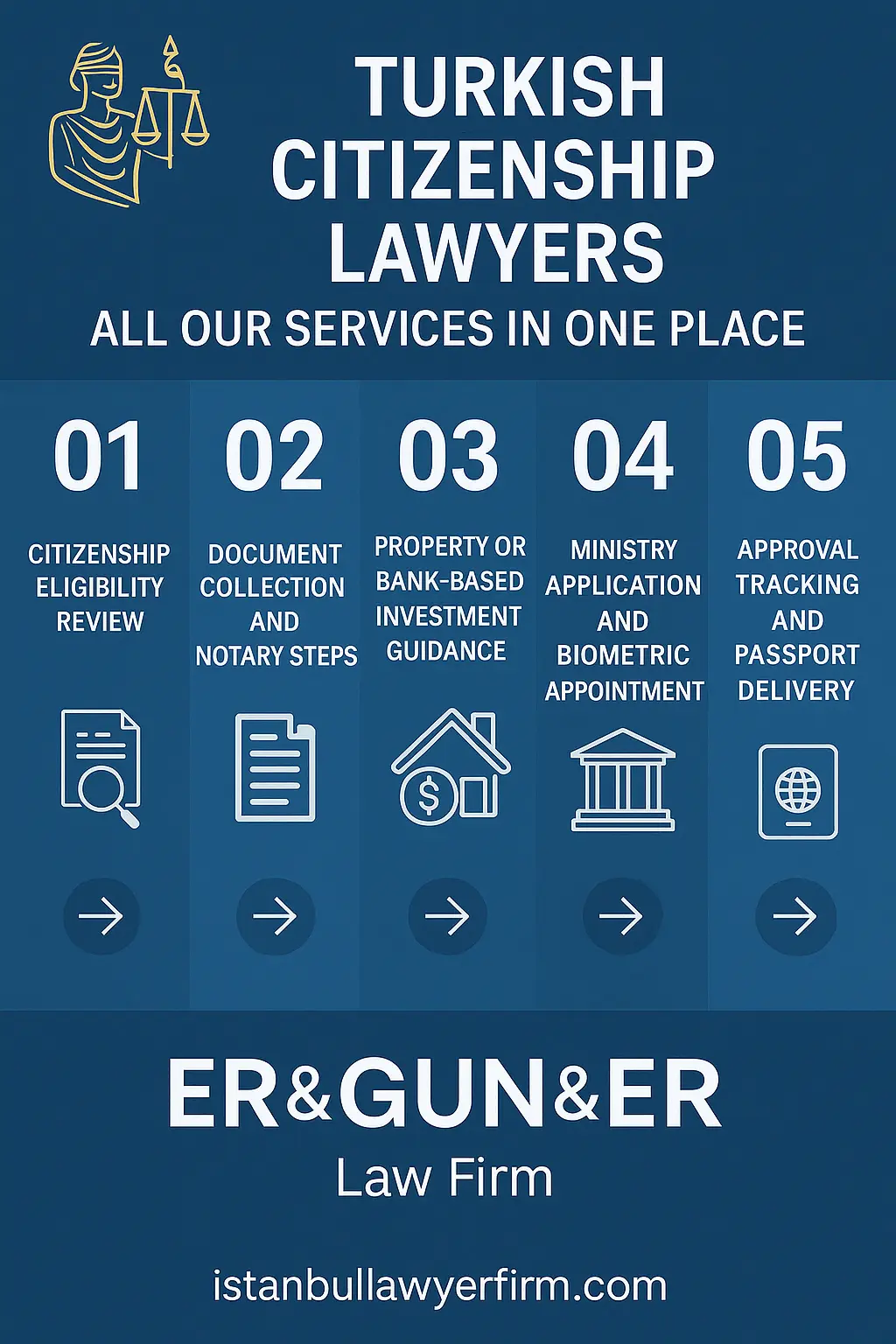
Turkish Citizenship by Investment 2026: Lawyer's Legal Guide for Foreign Investors
Turkish Citizenship by Investment (TCBI) under Article 12 sub-paragraph (b) of the Turkish Citizenship Law (Türk Vatandaşlığı Kanunu, Law No. 5901, "TVK") with Cumhurbaşkanı Kararı No. 5042 (CK 5042) as the implementing regulation is one of the most actively used investment migration programs globally, with several thousand grants since the 2018 threshold reduction and the 2022 adjustment to USD 400,000 for the real estate route. The route is operationally well-defined but documentarily demanding: files that respect the institutional review architecture produce grants in the 6 to 12 month window, while files that compress on documentary discipline produce the rejection patterns the route has become known for among less prepared participants. Practice may vary by authority and year — verify the current threshold amounts, qualifying conditions, and procedural requirements directly with the Ministry of Environment, Urbanization and Climate Change and the General Directorate of Population and Citizenship Affairs (NVİ) before any investment commitment for citizenship purposes.
An Istanbul Law Firm representing foreign investors in TCBI mandates begins with three sequential assessments before any capital moves: eligibility (nationality under Cumhurbaşkanı Kararı No. 6302 country-eligibility framework, criminal record, source-of-funds traceability, family structure); investment category selection (which qualifying route fits the investor's profile, timeline, and post-citizenship plans including any U.S. E-2 treaty objective); and due diligence (for real estate, a full Tapu Sicili and municipality record review before any purchase commitment; for other routes, the specific fund, deposit, or company structure review for CBI eligibility). Only after these assessments does the investment process begin — because investments made before due diligence create situations where correction may require restarting the entire process. This 2026 guide reflects the regulatory environment after the August 2025 cancellation of the Kur Korumalı Mevduat (KKM) foreign-exchange-protected deposit scheme and the centralization of valuation through GEDAŞ Gayrimenkul Değerleme A.Ş. under the 2024/2 Genelge of the Tapu ve Kadastro Genel Müdürlüğü (TKGM).
The Statutory Framework: Article 12(b) of Law No. 5901 and CK 5042
A lawyer in Turkey advising on the statutory architecture of Turkish Citizenship by Investment must explain that the program operates within a four-level legal hierarchy. At the top sits Article 12 of the Turkish Citizenship Law (Law No. 5901), which authorizes the President to grant Turkish citizenship to foreign nationals whose naturalization is deemed beneficial to the Republic. Beneath the statute sits Cumhurbaşkanı Kararı No. 5042 (CK 5042), the implementing presidential decision that establishes the specific qualifying investment categories, minimum thresholds, and holding period requirements. Below CK 5042 sit the operational genelgeler (circulars) issued by the Tapu ve Kadastro Genel Müdürlüğü (TKGM), the Nüfus ve Vatandaşlık İşleri Genel Müdürlüğü (NVİ), and the Göç İdaresi Başkanlığı (Presidency of Migration Management) — most notably the 2024/2 Genelge centralizing valuation and the 2024/4 Genelge governing the Taşınmaz Yatırımı Tespit Belgesi (TYTB) issuance process. Below the genelgeler sit the administrative practice notes that determine how individual files are processed in day-to-day review at the Vatandaşlık Daireleri.
The TCBI route is technically classified as exceptional naturalization (istisnai yoldan vatandaşlık kazanımı) under Article 12(b), distinguished from the general naturalization route under Article 11 which requires five years of continuous lawful residence in Turkey, Turkish language competence, and integration assessment. The exceptional route under Article 12(b) requires neither residence nor language nor integration — only the qualifying investment, the documentary chain, and the absence of disqualifying personal indicators. The discretionary character of the grant matters: satisfying every specified condition does not create an absolute legal right to citizenship, and the President may in principle deny applications that meet all technical conditions if national interest considerations weigh against the grant. In practice, well-prepared applications from eligible investors with clean backgrounds are approved at high rates, and the discretionary character primarily affects the nature of any subsequent administrative challenge rather than the typical approval outcome. Practice may vary by authority and year — verify the current statutory framework version and any presidential amendments published in the Resmi Gazete before any investment commitment based on Article 12(b) eligibility.
A Turkish Law Firm preparing the application file must understand the institutional review architecture that operates under this framework. Files route through the Vatandaşlık Daireleri at the Genel Müdürlüğü Nüfus ve Vatandaşlık İşleri (NVİ), with substantive recommendation flowing through the Ministry of Interior to the Presidency for the Cumhurbaşkanı Kararı decision that formally grants citizenship. The Vatandaşlık Daireleri stage is the substantive review point — files are not simply rubber-stamped at the Cumhurbaşkanlığı level, and meaningful review and rejection occur at the NVİ. The review operates on three sequential levels: preliminary review for documentary completeness against the genelge checklists; substantive review against CK 5042 conditions including threshold satisfaction, funding documentation under Decree No. 32 (Türk Parasının Kıymetini Koruma Hakkında 32 Sayılı Karar), and source-of-funds verification under the Anti-Money Laundering framework of Law No. 5549 (Suç Gelirlerinin Aklanmasının Önlenmesi Hakkında Kanun); and national-security and public-order review under TVK Article 11/8 framework. Files failing preliminary review receive completion notices and remain in suspension pending supplementation; files failing substantive review face harder-to-cure positions; files failing security review typically lack practical remedy except in narrow scenarios.
The Real Estate Route: $400,000 Threshold and the Three-Value Rule
A Turkish Law Firm advising on the real estate route — the most operationally common pathway, accounting for the substantial majority of TCBI grants — must explain that the qualifying investment is not simply "a property worth USD 400,000." Three independent values must each meet or exceed the USD 400,000 threshold for the file to qualify: the sale price actually paid by the investor through Turkish banking channels with Döviz Alım Belgesi (DAB) documentation; the appraised value confirmed by GEDAŞ in the SPK-licensed valuation report; and the declared value recorded at the Tapu Müdürlüğü on the title deed transfer. If any one of these three values falls below USD 400,000 — even marginally — the application for the Taşınmaz Yatırımı Tespit Belgesi (the Real Estate Investment Determination Certificate, commonly called Uygunluk Belgesi) is rejected, and the citizenship application cannot proceed on that property. The most common failure mode in our practice is the gap between the contracted purchase price and the GEDAŞ appraisal value, particularly in submarkets where seller asking prices have been inflated to align with the threshold without underlying market support.
An English speaking lawyer in Turkey explaining threshold margin discipline to a foreign investor must address the volatility considerations that affect each of the three values. The USD 400,000 threshold is set in USD reference but transacts through Turkish Lira conversion at the prevailing exchange rate on the relevant date; foreign-currency movement between contract date and valuation date can move the threshold equivalent by meaningful percentages over short periods. GEDAŞ valuation conservatism — the institutional incentive to produce defensible appraisals rather than aggressive ones — typically produces appraised values below recent transaction prices in inflated submarkets. The administrative answer is threshold margin maintenance at execution: structuring purchases at USD 430,000 to USD 450,000 minimum contract price for properties whose underlying market value approaches the threshold absorbs volatility and conservatism factors without producing threshold-failure rejection. The margin is operational insurance rather than excess investment — the cost of avoiding a rejection that would otherwise consume the entire investment value to remediate. Practice may vary by authority and year — verify the current threshold amount and the specific GEDAŞ valuation tolerance guidance with Turkish counsel before any property selection decision.
Turkish lawyers who handle CBI real estate transactions also advise on the eligible property categories. CK 5042 permits residential and commercial properties — apartments, villas, offices, shops, and land plots carrying construction servitude (kat irtifakı) under valid building permit — to qualify, subject to the eligibility tests at each value level. Multiple properties may be combined to satisfy the threshold through aggregation, with each constituent property carrying its own GEDAŞ appraisal and its own tapu sicili şerh annotation. The seller must be a Turkish citizen or Turkish legal entity — foreign-owner-to-foreign-owner transfers face structural eligibility problems that typically cannot be remediated, and the buyer cannot have close family relationship or undisclosed business connection to the seller without producing relationship-disclosure scrutiny at substantive review. Properties in zones restricted to foreign acquisition (military exclusion zones under Law No. 2565, certain border areas, properties in agricultural or forestry zoning categories) are not eligible regardless of price. Properties previously used in another investor's CBI application within the three-year holding period of that prior grant face recycled-property analysis that often produces rejection — the institutional position on recycled properties is firm and arguing that the prior CBI use should not preclude fresh use is generally less productive than identifying the issue pre-purchase and selecting different property. The pre-purchase due diligence answer is full tapu sicili history review through Tapu Kayıt Örneği (the official extract of the Land Registry record covering ownership history, encumbrances, annotations, and transfer chronology) before any contract commitment, combined with municipality records review for zoning, building permit, and occupancy permit status under İmar Kanunu (Law No. 3194) framework.
An English speaking lawyer in Turkey supervising the Tapu Müdürlüğü transfer must coordinate four operational steps in correct sequence on transfer day. First, both parties (or their authorized representatives under properly-executed vekaletname registered at a Turkish noter under Noterlik Kanunu (Law No. 1512) framework) appear at the Tapu Müdürlüğü with required identity documents and supporting transaction papers including the GEDAŞ valuation report, sale agreement, and tax clearance for the property. Second, the buyer's foreign-currency funds, previously converted through the Turkish bank with DAB documentation, are presented as confirmation of payment through proper banking channels — the Tapu Müdürlüğü records the declared transfer value which must align with the threshold across all three value points of the three-value rule. Third, the title is transferred and the three-year non-disposal şerh is registered with the specific wording prescribed by CK 5042, referencing the Cumhurbaşkanı Kararı framework and the three-year duration running from the citizenship grant date. Fourth, the issued Tapu Senedi is reviewed by counsel before the parties leave the office — annotation defects identified on the spot can be corrected through the same-day Tapu Müdürlüğü process, while annotation defects discovered post-transfer require Tapu Kanunu (Law No. 2644) Article 1027 title-correction proceedings that produce timing impact on the subsequent TYTB application and citizenship filing.
GEDAŞ Centralized Appraisal: How Valuation Works in 2026
An Istanbul Law Firm explaining the appraisal framework to a foreign investor must address one of the most significant 2024-2026 regulatory changes affecting the TCBI route. Under the 2024/2 Genelge of the Tapu ve Kadastro Genel Müdürlüğü, investors can no longer select their own appraisal company from the broader Sermaye Piyasası Kurulu (SPK) licensed appraiser pool. All CBI-purpose valuations must now be conducted by GEDAŞ Gayrimenkul Değerleme A.Ş. — a subsidiary of TOKİ (Toplu Konut İdaresi Başkanlığı, the Housing Development Administration of Turkey). The centralization was implemented to eliminate inflated reports that previously allowed properties worth less than the threshold to qualify for the program through commercially aggressive valuation. The institutional consequence is that valuation is no longer a negotiable element of the transaction structure; the GEDAŞ assessment is the authoritative value for citizenship purposes, and files where the GEDAŞ appraisal falls below USD 400,000 cannot be cured by obtaining a higher report from a different appraiser.
A lawyer in Turkey advising on the GEDAŞ valuation process must explain that the valuation runs through the webtapu portal at webtapu.tkgm.gov.tr after the title transfer process is initiated at the Tapu Müdürlüğü. The GEDAŞ appraiser reviews the property's physical characteristics, comparable transaction data, location and zoning factors, construction quality and condition, building permit and occupancy permit status, and market trend indicators to produce the appraised value. Standard turnaround is 3 to 7 business days from the valuation request, faster where webtapu coordination is properly handled. The investor and counsel do not negotiate with the appraiser — the valuation is professionally and regulatorily independent — but counsel can ensure that the property's documentary basis is complete before valuation request (building permit copies, occupancy permit, prior transaction records) so that the appraiser has the full information set rather than working from incomplete data that might produce a conservative output. Practice may vary by authority and year — verify the current GEDAŞ valuation procedure and webtapu coordination steps before any property selection for citizenship purposes.
A best lawyer in Turkey managing valuation risk must also address what happens when the GEDAŞ output comes in below the threshold despite the contract price exceeding it. The valuation is the authoritative value for CBI purposes; a contract price of USD 430,000 with a GEDAŞ appraisal of USD 380,000 produces a non-qualifying file regardless of what the parties paid. The remediation options are limited: renegotiating the contract price downward does not help because the threshold issue is the appraisal, not the price; adding a second property to reach aggregate USD 400,000 across multiple properties is operationally available but requires additional purchase and additional appraisal; replacing the property with a different qualifying property is available but recovers the original deposit only through the contract's escape provisions and the Turkish Borçlar Kanunu (Law No. 6098) framework for vendor liability. The pre-purchase discipline is to request a pre-contract indicative valuation where timing permits, allowing contract-price adjustment or property substitution before the binding commitment is signed. In submarkets known for inflated asking prices, this step is operational standard practice for our CBI mandates.
The Bank Deposit Route After KKM Cancellation
A Turkish Law Firm explaining the deposit route in 2026 must address the most significant programmatic change since the 2022 threshold revision. On August 23, 2025, the Central Bank of the Republic of Türkiye (TCMB) terminated the opening and renewal of Kur Korumalı Mevduat (KKM) accounts — the foreign-exchange-protected deposit scheme introduced in late 2021 that had transformed the USD 500,000 deposit route into a quasi-sovereign-guaranteed instrument. Earlier, on January 2, 2025, the YUVAM account program — KKM's variant designed specifically for non-resident foreign investors pursuing CBI through deposit — had been closed to new CBI applications. As a result, the bank deposit route as it operates in 2026 is materially different from the route as it operated through 2024: the USD 500,000 deposit remains a qualifying CBI category under CK 5042, but the deposit is now held in Turkish Lira equivalent (or in USD/EUR with no exchange-rate guarantee) for the three-year holding period, with the investor bearing the full currency risk of Turkish Lira movement during that period.
An English speaking lawyer in Turkey advising an investor considering the deposit route must address the risk reframing this creates. Under the KKM-protected framework, an investor depositing USD 500,000 in Turkish Lira equivalent received compensation from the central bank if Turkish Lira depreciation during the holding period exceeded the deposit's interest yield — effectively a USD-denominated investment with attractive interest. Without that protection, the same deposit in Turkish Lira terms is exposed to currency depreciation that historically has been substantial; the investor preserving USD value would need to convert into USD-denominated time deposits at a BDDK-regulated Turkish bank, accepting whatever interest yield the bank offers without sovereign supplementation. The deposit route remains qualifying under CK 5042 but the risk-return profile has shifted materially; the real estate route has correspondingly become more attractive as the relative safety route, even though it carries its own due diligence demands. Practice may vary by authority and year — verify current Central Bank and BDDK regulations applicable to non-resident foreign-investor deposits for citizenship purposes before any deposit commitment.
A lawyer in Turkey structuring a deposit route file in this environment must coordinate three specific elements. First, the receiving Turkish bank must be selected from the BDDK-regulated commercial banking pool — typically one of the major Turkish private or state banks with established foreign-investor onboarding processes — and the bank's compliance team must pre-clear the deposit transaction including source-of-funds documentation under MASAK Law No. 5549 framework before the funds wire. Second, the deposit must be locked for the three-year holding period through a notarized commitment, with the bank issuing a BDDK-certified confirmation of the lock-up that the citizenship application file requires as documentary evidence. Third, the source-of-funds documentation chain must satisfy MASAK review at the bank level — the bank files a Şüpheli İşlem Bildirimi (Suspicious Transaction Report) to MASAK within ten business days where the funds' origin raises concerns, and any such report stalls or stops the transaction. Files moving through proper pre-clearance produce dramatically lower MASAK-related delay rates than files where source-of-funds is addressed reactively after the funds have moved.
Alternative Investment Routes: Funds, Capital, Employment
A Turkish Law Firm advising on the non-real-estate qualifying routes must address the practical reality that several routes historically recognized under CK 5042 are operationally less used in 2026 than they were earlier in the program's life. The fixed capital investment route — investing USD 500,000 in fixed capital of a Turkish company, attested by the Ministry of Industry and Technology — remains available and is selected by investors who are entering or expanding Turkish operating businesses where the capital investment serves business purposes beyond citizenship qualification alone. The investment fund participation route — acquiring shares of USD 500,000 minimum in a Turkish real estate investment fund (gayrimenkul yatırım fonu) or venture capital fund (girişim sermayesi yatırım fonu) authorized by the Sermaye Piyasası Kurulu (SPK) under Capital Markets Law (Law No. 6362) — has gained relative attractiveness following the KKM cancellation, particularly through SPK-licensed real estate investment funds that pool investor capital into managed property portfolios.
An English speaking lawyer in Turkey explaining the employment creation route must clarify that this route — creating and maintaining at least 50 jobs at a Turkish business with the workforce verified by the Ministry of Labor and Social Security — is structurally suited to entrepreneurial investors establishing or acquiring Turkish operating businesses rather than to passive financial investors. The route's documentary burden is substantial: payroll records, SGK (Sosyal Güvenlik Kurumu, the Social Security Institution) registration confirmations for each employee, employment contracts, and ongoing demonstration of workforce continuity through the three-year holding period. Investors who naturally generate this workforce as a function of their Turkish business activity find the route operationally efficient; investors attempting to construct the workforce specifically for CBI purposes typically find the route more burdensome than the real estate route they were originally considering. Practice may vary by authority and year — verify the current Ministry of Labor and Social Security workforce verification procedures and SGK documentation requirements with Turkish counsel before electing the employment route.
A best lawyer in Turkey advising on the route selection framework must also address the routes that are not operationally available in 2026. The government bond purchase route — historically a qualifying category under CK 5042 — is not operationally functioning as a citizenship route in current practice; investors should not plan on this category as a viable pathway and should select among real estate, deposit, fund participation, fixed capital, or employment routes. The private pension fund contribution route has remained a technical category but is rarely selected in practice. Among the operationally viable routes in 2026, real estate accounts for the substantial majority of TCBI grants, followed by fund participation at increasing volumes after the KKM cancellation, with fixed capital and employment routes serving the entrepreneurial investor segment. Practice may vary by authority and year — verify the current operational status of each qualifying investment category with Turkish counsel before electing any specific route, as the menu of practically functioning categories has shifted multiple times since the program's introduction.
The Document Chain: DAB, Uygunluk Belgesi (TYTB), and Tapu Annotation
An Istanbul Law Firm preparing a TCBI file must coordinate four documentary elements in a specific sequence: the Döviz Alım Belgesi (DAB) confirming the foreign-currency conversion through a Turkish bank under Decree No. 32 framework; the title deed transfer at the Tapu Müdürlüğü with the three-year non-disposal annotation (şerh) registered on the tapu sicili; the GEDAŞ valuation report confirming the appraisal value satisfies the threshold; and the Taşınmaz Yatırımı Tespit Belgesi (TYTB), also known as the Uygunluk Belgesi (Certificate of Conformity), issued by the TKGM after verifying all three elements align. The TYTB is the gatekeeper document — the citizenship application cannot be filed without it, and the TYTB cannot be issued where any element of the underlying chain is defective. Under the 2024/4 Genelge of the TKGM, the TYTB issuance process is fully documented and tracked, with the Tapu Müdürlüğü transmitting the file to the authority issuing the TYTB after the three-year non-disposal commitment is recorded.
A lawyer in Turkey explaining the DAB requirement must address one of the most operationally critical 2022-introduced compliance elements. Under Decree No. 32 framework, all foreign-currency investment funds destined for CBI purposes must be converted to Turkish Lira through a Turkish bank acting as authorized intermediary, with the bank issuing a DAB documenting the conversion: the original foreign-currency amount, the exchange rate applied, the converted Turkish Lira amount, the date of conversion, and the destination of the converted funds. The DAB is mandatory documentary evidence in every CBI file regardless of investment route — real estate, deposit, fund participation, or capital investment. Files missing the DAB cannot proceed regardless of whether the underlying transaction was otherwise compliant. The administrative discipline is to coordinate the foreign-currency wire, the Turkish bank receipt, the conversion process, and the DAB issuance as a single managed transaction sequence rather than as separate events that may produce documentation gaps. Practice may vary by authority and year — verify the current TCMB and Treasury procedures for DAB issuance and the specific format requirements for the CBI documentary chain before any fund movement.
A Turkish Law Firm supervising the tapu annotation process must attend the Tapu Sicil Müdürlüğü during the title transfer to ensure the three-year non-disposal şerh is registered with correct wording referencing CK 5042 (or the specific Cumhurbaşkanı Kararı in force at the transfer date), the correct three-year duration running from the citizenship grant date rather than the transfer date, and the correct property identification. Annotation defects — missing annotation entirely, defective wording, incorrect duration reference, or incorrect Cumhurbaşkanı Kararı reference — produce TYTB issuance failure and consequent citizenship application rejection. Where the original annotation contains technical defects, correction proceedings under Tapu Kanunu (Law No. 2644) Article 1027 can repair specific registry errors through administrative process; where the annotation is missing entirely, re-execution of the transfer with proper annotation requires the seller's cooperation which may not be available after the transaction has closed. Counsel attendance at the transfer and immediate post-transfer review of the issued Tapu Senedi prevents these post-grant discoveries from creating remedial cycles.
Residence Permit, Biometrics, and Family Inclusion in 2026
An English speaking lawyer in Turkey explaining the residence permit and biometrics sequence must address the procedural choreography that 2024-2026 administrative practice imposes on the principal investor and the spouse. After the qualifying investment is completed and the TYTB issued, the principal investor and the spouse apply for the investor residence permit (yatırımcı ikamet izni) under Article 31(1)(j) of the Law on Foreigners and International Protection (Yabancılar ve Uluslararası Koruma Kanunu, Law No. 6458, "YUKK") at the İl Göç İdaresi Müdürlüğü with jurisdiction over the address of registration. The residence permit application requires biometric submission — fingerprinting, photograph — for both the principal and the spouse, with physical presence in Turkey required at this stage. Children under eighteen are typically not required to appear in person for biometrics but must be included in the documentary file with apostilled birth certificates and sworn translations.
A Turkish Law Firm coordinating the family inclusion documentation must reflect the 2024 tightening that introduced specific spouse requirements which earlier CBI files were not subject to. The spouse must now obtain a residence permit alongside the principal investor — separate spouse-only permits issued as an extension of the principal's investor permit. Both the principal and the spouse must submit certified criminal record certificates from each country of citizenship and recent residence, with apostille and sworn Turkish translation. Both must be physically present for biometric submission at the İl Göç İdaresi. These changes shift the family inclusion process from a documentary-only exercise to one requiring coordinated Turkish travel by the principal and the spouse, with biometric appointments scheduled to align with the in-country window. In Istanbul as of February 2026, qualifying applicants may complete residence permit approval and citizenship filing on the same day through a priority biometrics process at coordinated appointments — operational counsel coordination matters for compressing this in-country window. Practice may vary by authority and year — verify current İl Göç İdaresi appointment and biometric procedures before planning the in-country travel window.
A best lawyer in Turkey advising on family inclusion scope must clarify what the framework covers and what it does not. The principal investor's spouse (valid marriage under Article 13 of the Turkish Code on Private International Law (MÖHUK, Law No. 5718) framework, with marriage certificate apostilled and translated) and unmarried children under eighteen are included in the same citizenship application at no additional investment requirement. Dependent disabled children regardless of age are included with documentary support for the disability and the dependency relationship. Adult children over eighteen are not included regardless of financial dependency — they must pursue independent CBI under their own qualifying investment, ordinary naturalization under Article 11, or descent under Article 7 in narrow scenarios. Parents, siblings, and other extended family are also not included. Foreign-parent consent for minor children's citizenship application varies by home jurisdiction family-law framework; where the non-applicant parent is separated, divorced, or otherwise not part of the application, foreign family-law analysis is required to determine whether consent or court approval is needed under the children's habitual residence jurisdiction.
Common Rejection Patterns and How Our Practice Pre-Empts Them
Turkish lawyers who handle CBI files routinely observe that avoidable rejections concentrate in a manageable set of operational areas rather than spreading randomly across the population. Source-of-funds documentation incompleteness under MASAK Law No. 5549 framework is the single most common substantive rejection ground in our practice observations. The receiving Turkish bank acts as institutional gatekeeper: the bank must satisfy itself that the funds are from legitimate, traceable sources before processing the transaction, and where the bank's compliance team identifies gaps, a Şüpheli İşlem Bildirimi to MASAK can stall or stop the transaction. The documentary expectation is more demanding than investors typically anticipate — twelve months minimum of foreign bank account statements as baseline, with thirty-six months or more for complex multi-source situations; documentation tracing each material funds source to its origin (employment income with pay slips and foreign tax filings; business income with company financial statements and dividend records; asset sale proceeds with sale contracts and prior ownership documentation; inheritance with succession documentation and estate distribution records). The administrative answer is pre-assembly of the source-of-funds file before the funds move, with pre-clearance at the receiving bank's compliance team to identify gaps before the wire.
A lawyer in Turkey advising on the second-most-common rejection cluster — GEDAŞ valuation falling below threshold — must address the specific failure modes. Files structured at exactly USD 400,000 contract price face threshold-failure rejection where currency volatility between contract date and valuation date moves the threshold equivalent in Turkish Lira terms, where GEDAŞ valuation conservatism produces values below recent transaction prices in inflated submarkets, or where property-specific factors (undocumented modifications, condition issues, zoning ambiguities) produce appraisal markdowns. Threshold margin maintenance at execution stage — structuring at USD 430,000 to USD 450,000 minimum for marginal-threshold properties — absorbs these factors without producing rejection. The third rejection cluster involves tapu sicili şerh annotation errors: missing annotation, defective wording not referencing CK 5042 correctly, incorrect duration, or incorrect Cumhurbaşkanı Kararı reference. Counsel attendance at the title transfer with immediate post-transfer Tapu Senedi review prevents these errors at execution rather than discovering them at TYTB application or citizenship review.
An Istanbul Law Firm advising on procedural rejection grounds must address the documentation hygiene that institutional review treats as gating. Foreign-language documents lacking either apostille (where the issuing jurisdiction is party to the 1961 Hague Convention through Law No. 6303) or consular legalization (where the issuing jurisdiction is non-party) produce return at preliminary review. Recent additions to the Hague party-state list including the United Arab Emirates in 2022, Canada in 2024, and Qatar in 2024 mean that documents from these jurisdictions can now use apostille rather than the slower consular route. Sworn translation by yeminli tercüman registered with a Turkish noter under Hukuk Muhakemeleri Kanunu (Law No. 6100) Article 223 framework is required for all foreign-language documents — translations by non-registered translators or lacking proper notarial certification produce return for proper translation. Criminal record certificates typically must be dated within six months of submission; documents that age out during processing require fresh issuance and translation. Power of attorney for Turkish counsel under Türk Borçlar Kanunu (Law No. 6098) Articles 504-514 framework and Noterlik Kanunu (Law No. 1512) framework requires authentication, sworn translation, and Turkish noter registration with specific authorization of substantive actions counsel will take. Practice may vary by authority and year — verify the current document checklist and authentication requirements with Turkish counsel before assembling any citizenship application package.
Post-Approval: Citizenship Certificate, Three-Year Compliance, and Exit
A Turkish Law Firm representing the investor through the post-approval phase must address the elements that follow the Cumhurbaşkanı Kararı granting citizenship. The grant is published in the Resmi Gazete, registered with the Nüfus ve Vatandaşlık İşleri Genel Müdürlüğü, and the investor and included family members are entered into the Turkish civil registry. Turkish national identity cards (T.C. Kimlik Kartı) are issued, and Turkish passports follow through the standard ten-year (or five-year for minors) passport issuance process. The new citizens register their existing nationalities with Turkish civil records — Turkey permits dual or multiple citizenship without requiring renunciation. Male citizens of eligible age technically come within the framework of military service obligations under Askerlik Kanunu (Law No. 1111), but investors who acquired citizenship later in life and who hold other citizenships should verify their specific status with Turkish counsel; the framework includes specific exemption pathways for dual-nationality citizens that operate differently from native-born service obligations.
A lawyer in Turkey advising on the three-year compliance period must explain that the holding obligation is legally binding even after citizenship is granted, and material breach before the three-year period expires can provide grounds for citizenship cancellation under the Cumhurbaşkanı Kararı's terms. The three-year period runs from the citizenship grant date (Cumhurbaşkanı Kararı publication in the Resmi Gazete), not from the title transfer date — investors planning property liquidity around the holding period should track the grant date rather than the earlier transfer date. The non-disposal annotation on the tapu sicili prevents voluntary transfer of the qualifying property during the three-year period at the registry level; attempted sale is blocked by the Tapu Müdürlüğü. Corporate restructuring transactions transferring the qualifying property from individual ownership to a company structure require NVİ pre-authorization — uncoordinated restructuring can be treated as prohibited disposal triggering cancellation review. Leasing the property during the holding period is generally permitted and does not breach the non-disposal commitment, but should be documented through formal lease arrangements under Türk Borçlar Kanunu (Law No. 6098) framework rather than informal occupancy.
An English speaking lawyer in Turkey advising on exit and long-term considerations must address the post-three-year position. After the three-year period elapses, the non-disposal annotation can be formally released through a Tapu Müdürlüğü application — counsel coordinates the release at the appropriate time, and the property becomes freely transferable on standard terms. Capital gains on disposal are analyzed under Income Tax Law (Gelir Vergisi Kanunu, Law No. 193) Article 80 framework, with the five-year holding exemption for individuals applicable to gain on Turkish-situated immovables sold by non-residents in defined circumstances. Repatriation of disposal proceeds in foreign currency is coordinated through Decree No. 32 framework with the original DAB documentation supporting outbound currency conversion. For investors who wish to release Turkish citizenship at some future point — voluntary renunciation under TVK Article 27 framework or Mavi Kart positioning under TVK Article 28 — the framework remains available but is rarely pursued by CBI grantees who typically retain Turkish citizenship for its strategic value. The most prominent strategic post-citizenship pathway is the United States E-2 treaty investor visa, available to Turkish citizens based on the U.S.-Turkey Treaty of Commerce and Navigation; eligibility for E-2 application is a function of Turkish citizenship, while approval depends on U.S. Department of State E-2 visa requirements assessed independently by U.S. immigration authorities. Practice may vary by authority and year — verify current U.S. E-2 visa requirements with U.S. immigration counsel before structuring any acquisition specifically for E-2 purposes.
Frequently Asked Questions
- What is the minimum investment for Turkish citizenship by investment in 2026? The minimum is USD 400,000 for the real estate route and USD 500,000 for the bank deposit, investment fund, fixed capital, and other non-real-estate routes. The thresholds are set by Cumhurbaşkanı Kararı No. 5042 (CK 5042) and have been revised on multiple occasions since the program's introduction. Practice may vary by authority and year — verify the current threshold for each category directly with the Ministry of Environment, Urbanization and Climate Change and the NVİ before any investment commitment.
- What is the three-value rule for real estate investments? Three independent values must each meet or exceed USD 400,000 for the file to qualify: the sale price actually paid through Turkish banking channels with DAB documentation; the appraised value confirmed by GEDAŞ in the SPK-licensed valuation report; and the declared value recorded at the Tapu Müdürlüğü on the title deed transfer. A gap in any one of the three produces TYTB issuance failure and citizenship application rejection.
- Can I choose my own appraisal company for the citizenship investment? No. Under the 2024/2 Genelge of the TKGM, all CBI-purpose valuations must be conducted by GEDAŞ Gayrimenkul Değerleme A.Ş., a subsidiary of TOKİ. Investor selection of SPK-licensed appraisers from the broader pool is no longer permitted for CBI purposes. The valuation is requested through the webtapu portal at webtapu.tkgm.gov.tr after title transfer initiation.
- Is the KKM deposit option still available for CBI? No. The Central Bank of the Republic of Türkiye terminated the opening and renewal of Kur Korumalı Mevduat (KKM) accounts as of August 23, 2025. The YUVAM variant designed for non-resident foreign-investor CBI was closed earlier, on January 2, 2025. The USD 500,000 bank deposit route remains a qualifying CBI category under CK 5042, but the deposit is now held without exchange-rate protection — the investor bears the full Turkish Lira currency risk during the three-year holding period.
- What is the TYTB or Uygunluk Belgesi? The Taşınmaz Yatırımı Tespit Belgesi (Real Estate Investment Determination Certificate), commonly called Uygunluk Belgesi (Certificate of Conformity), is issued by the TKGM after the Tapu Müdürlüğü verifies that the title transfer, three-year non-disposal annotation, GEDAŞ appraisal, and DAB documentation all align. The TYTB is a prerequisite for the citizenship application and cannot be substituted — the citizenship file at NVİ cannot proceed without it. The 2024/4 Genelge governs the TYTB issuance process.
- How long does the entire process take from investment to passport? In current practice, well-prepared applications with complete documentation are processed within 3 to 9 months from investment completion to Cumhurbaşkanı Kararı, with the Turkish ID card and passport following within an additional 2 to 8 weeks. Files with documentation issues, source-of-funds questions, or security check complexities can extend meaningfully beyond this window. Practice may vary by authority and year — verify current processing timelines with the NVİ before any planning based on a specific timeframe.
- Do I need to live in Turkey to qualify or maintain citizenship? No. The TCBI route requires no physical residence before or after citizenship is granted. The principal investor and the spouse must obtain investor residence permits under YUKK Article 31(1)(j) framework as a procedural step in the application, and must be physically present for biometric submission, but actual residence in Turkey is not required at any stage. The residence permit is operational documentary infrastructure rather than a residence obligation.
- Can my family be included in the same application? Yes for the spouse (with marriage certificate apostilled and translated, valid under Article 13 of the MÖHUK framework), for unmarried children under eighteen (with apostilled and translated birth certificates), and for dependent disabled children regardless of age (with documentation of disability and dependency). Adult children over eighteen, parents, siblings, and extended family are not included and must pursue independent pathways. Foreign-parent consent for minor children's application varies by home jurisdiction family-law rules.
- What documents does the source-of-funds package require? Twelve months minimum of foreign bank account statements as baseline (thirty-six months or more for complex sources), with documentation tracing each material funds source to its origin: employment income with pay slips and foreign tax filings; business income with company financial statements and dividend records; asset sale proceeds with sale contracts and prior ownership documentation; inheritance with succession documentation. All foreign-language documents require apostille (where the issuing jurisdiction is Hague-party) or consular legalization (where non-party) plus sworn Turkish translation through yeminli tercüman.
- What is the Döviz Alım Belgesi (DAB)? The Foreign Currency Purchase Document, mandatory since 2022 in every TCBI application regardless of investment route. The DAB documents the conversion of foreign-currency investment funds to Turkish Lira through a Turkish bank under Decree No. 32 (Türk Parasının Kıymetini Koruma Hakkında 32 Sayılı Karar) framework: original foreign-currency amount, exchange rate, converted Turkish Lira amount, conversion date, and destination of converted funds. Files missing the DAB cannot proceed regardless of whether the underlying transaction was otherwise compliant.
- Can I sell my property after citizenship is granted? Only after the three-year holding period elapses, calculated from the citizenship grant date (Cumhurbaşkanı Kararı publication in Resmi Gazete) rather than from the earlier title transfer date. The non-disposal şerh annotation on the tapu sicili prevents voluntary transfer at the registry level during the period. Material breach before three years can provide grounds for citizenship cancellation. After the period, counsel coordinates the formal release of the annotation through a Tapu Müdürlüğü application, and the property becomes freely transferable.
- Does Turkish citizenship create Turkish tax residency? Not automatically. Turkish tax residency is determined primarily by physical presence under Gelir Vergisi Kanunu (Income Tax Law, Law No. 193) framework — generally more than 183 days per year in Turkey within a calendar year. A Turkish citizen who continues to reside primarily outside Turkey remains a non-resident for Turkish income tax purposes, subject to Turkish tax only on Turkish-sourced income (Turkish real estate rental income, Turkish business income, gain on disposal of Turkish-situated assets in defined circumstances). Practice may vary — verify current Turkish income tax residency rules with qualified counsel before any tax planning.
- What happens if my application is rejected? Two strategic options exist. Resubmission with strengthened evidence addressing the original rejection grounds is typically the path for substantive rejections where the underlying issue can be remediated (additional source-of-funds documentation, property substitution to address valuation gap, annotation correction under Tapu Kanunu Article 1027). Administrative appeal through the İdari Yargılama Usulü Kanunu (Law No. 2577) framework — idare mahkemesi (administrative court) lawsuit filed within 60 days of notification — is typically the path for procedural defects in the rejection decision rather than for re-arguing the substantive analysis. Appellate review through the Danıştay (Council of State) is available from idare mahkemesi decisions on legal-error grounds.
- Can I access the U.S. E-2 visa with Turkish citizenship? Turkish citizens are eligible to apply for the U.S. E-2 treaty investor visa based on a qualifying investment in a U.S. business, by virtue of the U.S.-Turkey Treaty of Commerce and Navigation. This eligibility is unique to nationals of countries with which the U.S. has a qualifying treaty — most CBI passports do not provide it. The E-2 visa itself is granted by U.S. authorities subject to U.S. immigration requirements; Turkish citizenship is the eligibility prerequisite, not a guarantee of approval. Practice may vary — verify current U.S. E-2 requirements with U.S. immigration counsel before structuring any acquisition specifically for E-2 purposes.
- What does ER&GUN&ER Law Firm handle in TCBI mandates? Pre-engagement substantive eligibility assessment including nationality eligibility under Cumhurbaşkanı Kararı No. 6302 country-eligibility framework, source-of-funds adequacy under MASAK Law No. 5549 framework, family scope analysis, and dual-nationality coordination with the home jurisdiction; pre-purchase real estate due diligence including Tapu Kayıt Örneği with full transfer history, building permit and occupancy permit verification under İmar Kanunu (Law No. 3194) framework, and recycled-property identification through annotation history analysis; transaction structuring with threshold margin discipline at GEDAŞ valuation, kat irtifakı versus kat mülkiyeti distinction under Kat Mülkiyeti Kanunu (Law No. 634) framework, and contractual protection under Türk Borçlar Kanunu (Law No. 6098); banking coordination including Turkish bank account opening, MASAK pre-clearance for source-of-funds, foreign-currency wire under Decree No. 32, and DAB issuance; title transfer supervision at Tapu Sicil Müdürlüğü with annotation verification and immediate post-transfer Tapu Senedi review; TYTB application coordination with the TKGM; investor residence permit application at İl Göç İdaresi under YUKK Article 31(1)(j) framework with spouse biometric coordination; citizenship application filing at the Vatandaşlık Daireleri at NVİ; appellate strategy under İdari Yargılama Usulü Kanunu (Law No. 2577) Article 7/1 framework with Tebligat Kanunu (Law No. 7201) notification analysis where rejection occurs; post-approval civil registry coordination, Turkish ID and passport issuance, and three-year holding period compliance management.
For investors with significant Turkish property holdings, coordinating the Turkish estate plan with home-jurisdiction estate planning requires involvement of lawyers in both jurisdictions — Turkey's Civil Code (Türk Medeni Kanunu, Law No. 4721) imposes forced heirship (saklı pay) rules that reserve mandatory minimum shares for spouse and children and that interact with home-jurisdiction succession law under MÖHUK Article 20 (lex rei sitae) framework. The complete inheritance and property law framework for Turkish property is analyzed in our resource on real estate consultancy Turkey. The complete Turkish real estate legal framework applicable to foreign buyers — including due diligence, Land Registry procedures, and the property-based residence permit route — is analyzed on our turkey real estate resource. The Istanbul Bar Association at istanbulbarosu.org.tr provides resources for identifying qualified TCBI practitioners.
Author: Mirkan Topcu is an attorney registered with the Istanbul Bar Association (Istanbul 1st Bar), Bar Registration No: 67874. His practice focuses on cross-border and high-stakes matters where evidence discipline, procedural accuracy, and risk control are decisive.
He advises foreign investors and families across Turkish Citizenship by Investment under Article 12(b) of Law No. 5901 with CK 5042 implementing framework, source-of-funds risk mitigation under MASAK Law No. 5549, GEDAŞ valuation coordination, Tapu Müdürlüğü annotation supervision under Tapu Kanunu (Law No. 2644), TYTB application under the 2024/4 Genelge framework, İl Göç İdaresi residence permit coordination under YUKK Article 31(1)(j), Vatandaşlık Daireleri citizenship application filing at NVİ, and administrative appeal under İdari Yargılama Usulü Kanunu (Law No. 2577) Article 7/1 where required.
Education: Istanbul University Faculty of Law (2018); Galatasaray University, LL.M. (2022). LinkedIn: Profile. Istanbul Bar Association: Official website.