

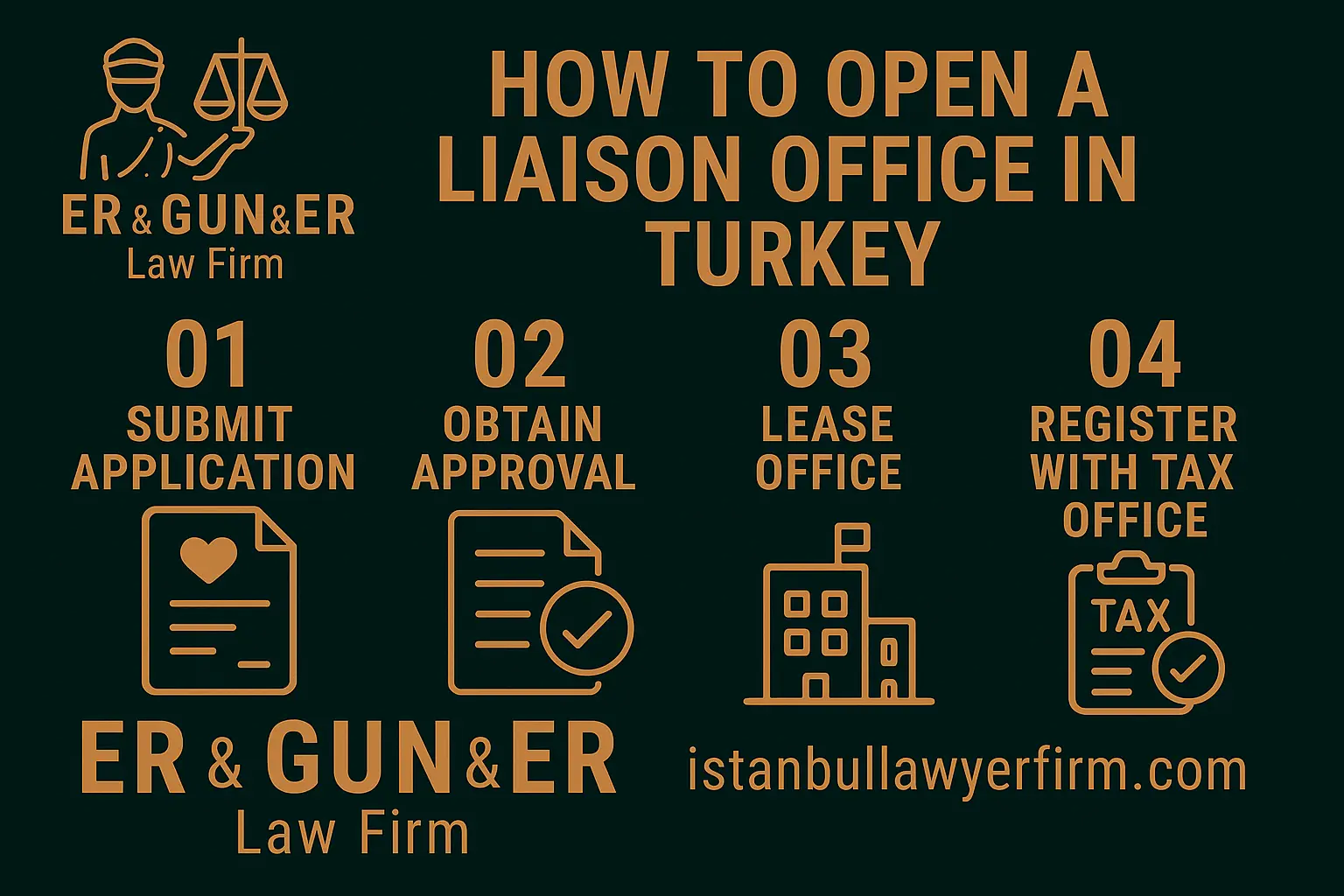
A lawyer in Turkey who advises on foreign company market entry understands that foreign companies seeking to establish a presence in Turkey without engaging in direct commercial activity can do so through a liaison office—a legally recognized non-commercial structure authorized by the Turkish Ministry of Trade that enables market research, promotion, coordination, and relationship development activities without generating Turkish-source revenue. An Istanbul Law Firm that advises on liaison office establishment for foreign companies provides the integrated legal service covering every stage from eligibility assessment through operational compliance: confirming the foreign company's eligibility under Turkish Direct Foreign Investment Law; preparing and legalizing the application documentation; submitting and managing the Ministry of Trade application; completing post-approval registrations for tax, social security, and local notifications; advising on the specific activities permitted within the non-commercial scope; managing employment of Turkish and foreign personnel; maintaining annual reporting and audit compliance; and managing renewals, terminations, or conversions to commercial entity status. A Turkish Law Firm that handles liaison office matters for international companies understands that the liaison office structure's primary limitation—the prohibition on revenue-generating activities—creates specific operational boundaries whose management requires ongoing legal attention rather than one-time setup compliance. An English speaking lawyer in Turkey who advises on liaison office establishment and operation for foreign companies provides the bilingual guidance that enables international management teams to understand Turkey's liaison office regulatory framework and to operate within its requirements without language barriers creating unintended compliance failures. Practice may vary by authority and year — verify current Turkish Ministry of Trade liaison office requirements, current documentation standards, current legalization requirements for your specific jurisdiction, and current annual reporting obligations with qualified counsel before initiating any liaison office application in Turkey, since the administrative requirements at the Ministry of Trade and the specific documentation expectations for applicants from different countries may change in ways that make current professional guidance more reliable than general descriptions of the process. Practice may vary by authority and year.
Legal Definition, Eligibility and Conditions for Turkish Liaison Offices
A lawyer in Turkey who advises on the legal definition of liaison offices explains that a Turkish liaison office is a non-commercial legal entity that enables a foreign company to operate in Turkey for limited purposes—including feasibility studies, market research, promotional activities, supplier coordination, and intercompany liaison—without registering a full branch or subsidiary and without generating any revenue in Turkey. An Istanbul Law Firm that advises on liaison office scope and limitations helps foreign companies understand the specific legal framework most relevant to their entry strategy: under Article 5 of the Direct Foreign Investment Law No. 4875 and its implementing Regulation, liaison offices must be authorized by the Ministry of Trade's General Directorate of Incentive Practices and Foreign Capital; liaison offices cannot engage in any income-generating activities including sales, services, invoicing, or any transaction that generates Turkish-source revenue; and liaison offices cannot be converted directly into commercial branches—if the foreign company wishes to transition to commercial trade, a separate legal entity must be formed. Turkish lawyers advising on liaison office establishment help foreign companies understand that the non-commercial constraint is not merely a formal condition but an operational reality that must be maintained throughout the liaison office's existence—because the Ministry of Trade monitors compliance and can revoke the authorization if commercial activities are detected. Practice may vary by authority and year.
An Istanbul Law Firm that advises on eligibility requirements for Turkish liaison offices explains that to be eligible for opening a liaison office in Turkey, the applicant must be a legally incorporated foreign company that has been active for at least one year—with its corporate status, duration of operations, and financial standing all subject to documentation requirements. Turkish lawyers advising on eligibility assessment help foreign companies understand the specific conditions most practically significant for each applicant: the foreign company must provide certified corporate documents demonstrating its legal incorporation and operational history; an annual activity report or financial statement demonstrating the company's ongoing business operations must be included in the application; and the foreign company must clearly describe the specific activities it intends to conduct through the liaison office in Turkey, with those activities demonstrating a genuine non-commercial purpose consistent with the Ministry of Trade's understanding of lawful liaison functions. An English speaking lawyer in Turkey who assesses eligibility for foreign company clients provides the preliminary evaluation that enables companies to determine whether their planned Turkish presence is appropriately structured as a liaison office or whether the scope of intended activities would better be served by a different legal vehicle. Practice may vary by authority and year.
A Turkish Law Firm that advises on the requirement to appoint a local legal representative explains that foreign companies must designate a legal representative residing in Turkey who is authorized to act on behalf of the liaison office—and that this representative appointment creates specific administrative, tax, and potentially immigration implications. An English speaking lawyer in Turkey who advises on liaison office representative appointments helps companies understand the specific implications most relevant to each appointment situation: the representative's authority must be clearly defined in the power of attorney that accompanies the Ministry application; the representative's employment or engagement must comply with Turkish labor and tax regulations; if the representative is a foreign national, work permit and residence permit requirements apply; and the representative is the primary contact for all Turkish government interactions—including the Ministry of Trade, the Tax Office, and the Social Security Institution. Practice may vary by authority and year.
A Turkish Law Firm that advises on the practical implications of the non-commercial restriction explains that the Ministry of Trade's understanding of what constitutes commercial activity is broader than might be intuitive—and that activities which the foreign company's management team considers purely logistical or administrative can cross the commercial boundary if they involve decision-making authority over Turkish transactions or create direct obligations with Turkish counterparties in the company's name. An English speaking lawyer in Turkey who provides ongoing scope advisory for liaison office clients helps management teams evaluate specific planned activities against the commercial boundary before implementing them—preventing the gradual scope expansion that is the most common path from compliant liaison to unintended commercial operation. Practice may vary by authority and year.
An Istanbul Law Firm that advises on activity description preparation for liaison office applications explains that the description of intended Turkish activities is one of the most scrutinized elements of the Ministry application—because the Ministry uses it to assess whether the planned activities are genuinely non-commercial and whether the liaison structure is the appropriate vehicle for those activities. Turkish lawyers advising on activity description drafting help companies present their planned Turkish functions in language that is both accurate about the activities intended and effective in demonstrating their fit within the non-commercial framework—avoiding descriptions that are so vague as to raise questions about the applicant's understanding of the limitations and avoiding descriptions that inadvertently suggest commercial dimensions that would be inconsistent with liaison office status. Practice may vary by authority and year.
Required Documentation, Legalization and Ministry Application Process
A lawyer in Turkey who advises on documentation for liaison office applications explains that the application dossier requires a specific set of documents each of which must satisfy the Ministry of Trade's current requirements for format, content, authentication, and translation—and that document deficiencies are one of the most common causes of application delays or rejections. An Istanbul Law Firm that prepares liaison office application dossiers helps companies compile the specific documents most important for each application: the foreign company's certificate of incorporation or equivalent registration document; the current articles of association or company charter; an annual activity report or financial statement demonstrating ongoing business operations; a detailed description of the intended liaison activities in Turkey; a power of attorney authorizing the Turkish legal representative to act on behalf of the foreign company; and the resolution of the foreign company's authorized body—board of directors or equivalent—approving the establishment of a Turkish liaison office. Turkish lawyers advising on documentation preparation help companies understand that each document must be current, must accurately represent the company's current legal status, and must be prepared in the format the Ministry expects rather than in the format standard in the applicant's home country. Practice may vary by authority and year.
An Istanbul Law Firm that advises on the legalization process for liaison office documents explains that all foreign-issued documents must be authenticated for use in Turkish government proceedings—either through apostille certification for documents from countries party to the Hague Apostille Convention or through Turkish consular authentication for documents from countries not party to the Convention. Turkish lawyers advising on document legalization help companies navigate the specific authentication process applicable to each document from each jurisdiction: obtaining apostille from the competent authority in the issuing country for Hague Convention country documents; coordinating consular authentication through the Turkish consulate in the relevant country for non-Convention countries; and managing the Turkish sworn translation requirement for all foreign-language documents, ensuring that translations are prepared by translators registered with Turkish courts and bear the required notarial certification. An English speaking lawyer in Turkey who manages the document legalization process for international clients coordinates the simultaneous preparation of multiple documents from multiple jurisdictions—maintaining the overall timeline rather than allowing sequential delays in each jurisdiction to multiply the total preparation period. Practice may vary by authority and year — verify current Turkish Ministry of Trade documentation format requirements, current legalization standards for your specific jurisdiction, and current sworn translation requirements with qualified counsel before initiating any document preparation for a Turkish liaison office application.
A Turkish Law Firm that advises on Ministry of Trade application submission explains that once documents are prepared and legalized, the application is submitted to the Ministry of Trade's General Directorate of Incentive Implementation and Foreign Capital—and that the submission process involves both electronic filing and hard copy submission in a format the Ministry currently requires. An English speaking lawyer in Turkey who manages Ministry applications for foreign company clients maintains direct contact with Ministry evaluators during the approval phase—following up on requests for additional documentation, resolving questions about the proposed activity scope, and tracking approval progress to provide accurate timeline updates to the foreign company's management team. The approval process typically takes two to four weeks when documentation is complete and compliant, though complexity and Ministry workload can extend this period—making the quality of the initial application submission the primary factor in timeline management and demonstrating that the investment in thorough pre-submission document review is consistently recovered in reduced processing delays. Practice may vary by authority and year.
Post-Approval Registration and Permitted Operating Scope
A lawyer in Turkey who advises on post-approval registration for liaison offices explains that after the Ministry of Trade issues the liaison office authorization certificate, several additional registrations are required before the office can begin operations—and that these registrations must be completed in the correct sequence to enable the office to function legally. An Istanbul Law Firm that manages post-approval registration for liaison office clients implements the specific registration steps most important for each operational situation: registering the liaison office at the local Tax Office to obtain a tax identification number—which is required for executing lease agreements, opening bank accounts, and managing employment; notifying the Social Security Institution if the office intends to employ any personnel; completing any required municipality notifications for the office location; and in some cases, registering with professional associations or sector-specific bodies relevant to the liaison office's planned activities. Turkish lawyers advising on post-approval registration help companies understand that while the liaison office is not subject to corporate income tax on Turkish-source income—because it does not generate such income—it does have specific payroll tax and withholding tax obligations that must be managed through the Tax Office registration from the beginning of operations. Practice may vary by authority and year.
An Istanbul Law Firm that advises on the permitted operating scope for Turkish liaison offices explains that the non-commercial constraint creates specific operational boundaries that must be actively managed—and that activities which might appear routine in a commercial context can violate the liaison office's authorization if they are conducted in a way that generates or could be interpreted as generating commercial value. Turkish lawyers advising on permitted activity management help companies implement the specific operational discipline most effective for each business function: market research, local data collection, and competitive intelligence gathering are clearly within scope when conducted without generating deliverables sold to Turkish customers; promotional activities and trade fair participation are within scope when the office is not directly closing sales or collecting payment; supplier coordination and quality monitoring are within scope when the ultimate commercial decision and invoice remains with the foreign parent company; and after-sales support coordination is within scope when the office facilitates rather than provides the actual service. An English speaking lawyer in Turkey who advises on operational scope management for liaison offices provides the ongoing guidance that enables international management teams to understand how specific planned activities fit within the permitted scope—preventing the gradual scope creep that is the most common path to unintended non-commercial boundary violations, and helping management communicate the distinction between liaison scope and commercial scope to staff members who may not be familiar with Turkey's specific non-commercial restriction framework. Practice may vary by authority and year.
A Turkish Law Firm that advises on Ministry monitoring of liaison office operations explains that the Ministry of Trade regularly monitors whether liaison offices are operating within their authorized non-commercial scope—and that companies should treat the Ministry's monitoring role as an ongoing operational reality rather than an occasional regulatory event. An English speaking lawyer in Turkey who advises on Ministry compliance for liaison office clients helps companies implement the specific internal documentation practices most effective for demonstrating ongoing compliance: maintaining activity logs that document each specific function performed and how it fits within the permitted scope; reviewing all correspondence with Turkish counterparties to confirm it does not create commercial obligations; and preparing for the possibility of Ministry inspections by ensuring that the office's physical environment, correspondence records, and personnel roles all consistently reflect non-commercial operations. Practice may vary by authority and year.
Employment, Work Permits and HR Compliance in Liaison Offices
A lawyer in Turkey who advises on employment in Turkish liaison offices explains that liaison offices are permitted to employ both Turkish and foreign personnel provided that their roles align with the non-commercial activities authorized by the Ministry—and that employment arrangements in liaison offices must comply with Turkish Labor Law even though the office itself is not engaged in commercial trade. An Istanbul Law Firm that advises on liaison office employment management helps companies structure their HR arrangements in the specific format most compliant with Turkish law: preparing employment contracts that reflect Turkish Labor Law mandatory provisions while accurately describing the employee's non-commercial liaison functions; registering employees with the Social Security Institution within the required timeframe; managing payroll tax withholding and social security premium payments through the Tax Office registration; and implementing the termination procedures that Turkish Labor Law requires even when the liaison office closes or converts to a different legal structure. Turkish lawyers advising on liaison office employment help companies understand that Turkish Labor Law creates specific protections for employees—including severance pay entitlements based on service length—whose management must be planned from the beginning of each employment relationship rather than addressed reactively when termination becomes necessary, and that the non-commercial nature of the liaison office does not create any exemption from Turkish Labor Law's employee protection provisions. Practice may vary by authority and year.
An Istanbul Law Firm that advises on work permits for foreign personnel at Turkish liaison offices explains that foreign national employees must obtain valid Turkish work permits—issued by the Ministry of Labor—even when working within a liaison office rather than a commercial entity. Turkish lawyers advising on work permit management for liaison office clients help companies implement the specific application approach most effective for each foreign employee situation: preparing the work permit application with the role description demonstrating that the foreign employee's function is within the liaison office's authorized non-commercial scope; submitting the supporting documentation from the foreign company that establishes the need for a foreign national in the specific position; and managing work permit renewals annually or at the required interval to maintain the employee's lawful working status throughout their Turkish assignment. An English speaking lawyer in Turkey who manages work permits for foreign national employees at liaison offices provides the bilingual coordination that enables both the Turkish work permit procedure and the employee's home country immigration compliance to be managed consistently—ensuring that the foreign employee's legal status in Turkey is maintained without gaps that would interrupt their authorized presence during the critical period when the liaison office is establishing its Turkish operations. Practice may vary by authority and year.
A Turkish Law Firm that advises on payroll compliance for liaison offices explains that while liaison offices are not corporate income tax payers, they have specific payroll-related tax obligations—including income tax withholding on employee salaries, stamp duty on employment contracts in some circumstances, and social security premium obligations—whose management requires active engagement with Turkish tax and social security authorities. An English speaking lawyer in Turkey who advises on payroll compliance for liaison office clients provides the monthly oversight service that ensures all payroll declarations are filed with the Tax Office and Social Security Institution on the required schedule, all premium payments are made correctly, and any changes in employee status are reported through the applicable notification channels. Practice may vary by authority and year.
Annual Reporting, Compliance Monitoring and Ministry Obligations
A lawyer in Turkey who advises on annual reporting obligations for Turkish liaison offices explains that all liaison offices are required to submit annual activity reports to the Ministry of Trade summarizing their operations and confirming continued compliance with the non-commercial scope—and that failure to submit these reports or to provide accurate information can result in permit suspension or cancellation. An Istanbul Law Firm that manages annual reporting for liaison office clients implements the specific reporting approach most effective for each office's activity profile: compiling a narrative description of activities conducted during the reporting period that demonstrates their fit within the authorized non-commercial scope; preparing supporting documentation—expense records, correspondence samples, event participation records—that corroborates the narrative; and coordinating the report's translation and presentation to ensure it satisfies current Ministry format expectations. Turkish lawyers advising on annual reporting help companies understand that the annual report is not merely a bureaucratic formality but an active demonstration of ongoing compliance—and that the quality of the report significantly affects how the Ministry views the office's authorization status when renewal time approaches. Practice may vary by authority and year.
An Istanbul Law Firm that advises on Ministry audit responses for liaison offices explains that the Ministry may conduct periodic inspections or request documentary evidence to verify that operations remain within the authorized non-commercial scope—and that companies benefit from treating audit readiness as an ongoing operational standard rather than a reactive preparation exercise. Turkish lawyers advising on liaison office audit preparation help companies implement the specific readiness approach most effective for each inspection type: maintaining organized activity documentation that can be retrieved and presented promptly when inspection requests arrive; reviewing marketing materials, website content, and social media presence to ensure they do not describe commercial offerings that could be attributed to the Turkish liaison office; and preparing the management briefing that enables the liaison office representative to respond accurately and confidently to Ministry inspector questions about the office's operations. An English speaking lawyer in Turkey who manages audit responses for foreign company liaison offices provides the bilingual representation that ensures the company's compliance position is effectively communicated to Turkish-language Ministry officials throughout the inspection process. Practice may vary by authority and year.
A Turkish Law Firm that advises on the consequences of compliance failures for liaison offices explains that failure to file annual reports, respond to audit requests, or maintain operations within the non-commercial scope can result in permit cancellation—which removes the foreign company's legally recognized presence in Turkey and may create complications for any Turkish tax or social security obligations that remain outstanding at the time of cancellation. An English speaking lawyer in Turkey who monitors compliance deadlines and Ministry correspondence for liaison office clients provides the systematic calendar management that ensures no obligation is missed—preserving the foreign company's Turkish presence without the disruption and cost of addressing compliance failures after they have been identified by the Ministry, and maintaining the compliance record that is the foundation for smooth permit renewal at the end of each authorization period. Practice may vary by authority and year.
A Turkish Law Firm that advises on the interaction between annual reporting and permit renewal explains that the quality of annual reports submitted during the permit period is one of the most significant factors in renewal assessment—because the Ministry reviews the reporting record to evaluate whether the office has been transparently communicating about its activities throughout the permit period rather than only at renewal time. An English speaking lawyer in Turkey who manages annual reporting for liaison office clients frames each annual report as a proactive compliance demonstration rather than a minimum compliance obligation—providing the detailed narrative that enables the Ministry to assess the office's operations confidently rather than having questions about the nature of reported activities. Practice may vary by authority and year.
Renewal, Termination and Conversion to Commercial Entity
A lawyer in Turkey who advises on liaison office permit renewal explains that liaison office permits are typically granted for periods of up to three years and must be renewed before expiration to maintain continuous lawful presence in Turkey—and that the renewal process requires demonstrating continued compliance with the non-commercial scope and providing updated documentation reflecting the foreign company's current legal status and operations. An Istanbul Law Firm that manages liaison office renewals helps companies implement the specific renewal approach most effective for each office's compliance history: preparing updated annual activity summaries for the renewal period; updating corporate documents that may have changed since the initial application—including certificates of incorporation, articles of association, and authorized signatory documentation; and addressing any compliance issues identified during the permit period in the renewal narrative to demonstrate that the company has responded appropriately. Turkish lawyers advising on permit renewal help companies understand that the Ministry's renewal assessment looks at both formal compliance—were reports filed, were scope limitations respected—and substantive compliance—do the descriptions of activities accurately reflect what the office actually did during the permit period—with the practical implication that the annual reports submitted during the permit period form the primary evidence base for the renewal assessment rather than the renewal submission being treated as a fresh independent evaluation. Practice may vary by authority and year.
An Istanbul Law Firm that advises on liaison office termination explains that if a foreign company decides to cease its Turkish presence, it must formally notify the Ministry of Trade and complete specific deregistration procedures—including tax office deregistration, Social Security Institution closure for any employed staff, office lease termination, and any outstanding annual report submissions. Turkish lawyers advising on liaison office termination help companies implement the specific closure sequence most effective for each situation: submitting the Ministry notification of intent to close; managing the final tax declarations and obtaining tax clearance; providing legally required notice to employed staff and fulfilling severance and terminal payment obligations under Turkish Labor Law; and deregistering from the Tax Office and Social Security Institution. An English speaking lawyer in Turkey who manages liaison office closures for foreign companies provides the coordinated deregistration service that completes all required notifications in the correct sequence—preventing the situation where a company believes it has closed its Turkish presence but residual registrations remain active, creating ongoing compliance obligations whose accumulation over time produces penalties and enforcement exposure that can complicate future Turkish business activities. Practice may vary by authority and year.
A Turkish Law Firm that advises on transition from liaison office to commercial entity explains that when a foreign company's Turkish operations mature to the point where commercial activity becomes appropriate—or necessary—the correct procedure is to close the liaison office and establish a separate Turkish commercial entity rather than converting the liaison office directly. An English speaking lawyer in Turkey who advises on liaison-to-commercial transitions helps companies plan the specific transition strategy most appropriate for each business situation: assessing whether the appropriate commercial vehicle is a limited liability company, joint-stock company, or branch depending on the planned activities, capital requirements, and shareholder structure; coordinating the timing of the liaison office closure with the commercial entity establishment to minimize disruption to Turkish operations; managing the transfer of employees, contracts, and operational assets from the liaison structure to the new commercial entity in compliance with Turkish law; and informing Turkish counterparties—suppliers, government contacts, and business partners—of the transition in a way that preserves the relationships built during the liaison period. A lawyer in Turkey for liaison office matters combines knowledge of Turkish Direct Foreign Investment Law, Ministry of Trade application procedures, Turkish Labor Law employment requirements, Tax Office registration, Social Security Institution compliance, annual reporting obligations, and liaison-to-commercial transition procedures with the English-language communication that enables foreign companies to manage their Turkish presence effectively—providing the integrated legal partnership that allows international management teams to focus on business development while compliance obligations are systematically managed. Practice may vary by authority and year.
Strategic Considerations: Liaison Office vs. Branch vs. Subsidiary
A lawyer in Turkey who advises on market entry structure selection explains that the choice between establishing a liaison office, a branch office, or a subsidiary company depends on the foreign company's specific strategic objectives, commercial intentions, and risk tolerance—and that understanding the specific characteristics of each structure before committing to an establishment process prevents the need for costly restructuring when business requirements evolve. An Istanbul Law Firm that advises on market entry structure for foreign companies helps investors understand the specific comparison most relevant to each investment situation: a liaison office provides the lowest-cost, lowest-risk Turkish presence with the significant limitation of the non-commercial scope restriction—making it appropriate for companies in exploratory or relationship-development phases whose current plans do not include generating Turkish revenue; a branch office extends the foreign company's own legal personality into Turkey and permits commercial activity, but it does not create a separate legal entity and the foreign parent remains directly liable for branch obligations; and a subsidiary—typically a Turkish limited liability company or joint-stock company—creates a separate Turkish legal entity that insulates the foreign parent from direct liability for Turkish operations while enabling full commercial activity. Turkish lawyers advising on entry structure selection help companies understand that the appropriate structure depends not only on current plans but also on anticipated business development—because restructuring from a liaison to a commercial entity involves specific costs and procedures, while starting with a commercial structure from the beginning may eliminate the need for transition. Practice may vary by authority and year.
A Turkish Law Firm that advises on common misperceptions about liaison offices explains that the most frequent error international companies make when considering a liaison office is underestimating the ongoing compliance requirements—including annual reporting, Ministry monitoring, payroll tax management, and employee compliance—and treating the liaison office as a low-maintenance administrative formality rather than as a legally active entity with specific ongoing obligations. An English speaking lawyer in Turkey who advises on realistic liaison office expectations helps companies plan their Turkish presence with accurate information about both the benefits and the compliance obligations—enabling management to allocate appropriate resources to compliance management and to avoid the cost of remediation when Ministry obligations have been neglected, and preventing the common pattern where the initial liaison office setup is smooth but compliance standards erode over time as initial legal engagement fades and internal ownership of ongoing obligations becomes unclear. Practice may vary by authority and year.
An Istanbul Law Firm that advises on the strategic value of liaison offices explains that despite their operational limitations, liaison offices serve specific strategic purposes that make them the most appropriate choice for a well-defined set of foreign companies: companies conducting extended due diligence on the Turkish market before committing to commercial investment can use a liaison office to gather market intelligence and build relationships without incurring the compliance burden of a commercial entity; companies providing technical support, warranty services, or after-sales coordination for products sold through independent Turkish distributors can structure those support activities within the liaison scope while the distributor maintains the commercial relationship; and companies that need a recognized Turkish address and local representative for government interaction, certification processes, or public tender qualification purposes can use a liaison office for these limited administrative purposes. Turkish lawyers advising on liaison office strategic positioning help companies articulate their Turkish presence strategy in terms that align with both the Ministry's expectations for liaison office activity and the company's genuine commercial objectives. Practice may vary by authority and year.
A Turkish Law Firm that advises on the cost and operational comparison between market entry structures explains that the liaison office is consistently the lowest-cost option for initial Turkish market presence—with lower establishment costs, no corporate tax compliance obligations, and simpler annual compliance requirements than either a branch or subsidiary—but that these cost advantages must be assessed against the opportunity cost of being unable to generate Turkish revenue during the liaison period. An English speaking lawyer in Turkey who advises on market entry structure cost-benefit analysis helps foreign companies model the specific financial implications of each structure for their particular business case—including the cost savings from liaison office simplicity against the revenue opportunity cost of non-commercial restriction—so that the structure selection is driven by economic analysis rather than by the lower apparent upfront cost of the liaison option, and provides the assessment of expected timeline to commercial activity that determines whether starting with a liaison and later converting is more efficient than establishing a commercial entity from the beginning. Practice may vary by authority and year.
Banking, Financial Management and Tax Compliance for Liaison Offices
A lawyer in Turkey who advises on banking arrangements for Turkish liaison offices explains that obtaining a Tax Office registration number—which occurs as part of the post-approval registration process—is the prerequisite for opening a Turkish bank account, executing lease agreements, and managing the financial transactions that even a non-commercial liaison office requires for its operational expenses. An Istanbul Law Firm that advises on banking and financial management for liaison offices helps companies implement the specific financial infrastructure most appropriate for each office's operational scope: opening a Turkish Lira account with a Turkish bank for operational expense payments including rent, utilities, and local staff salaries; in some cases maintaining a foreign currency account where the liaison office's expenses are funded through transfers from the foreign parent company; and establishing the internal financial reporting protocols that the foreign parent company's treasury or finance team requires for oversight of Turkish liaison office expenditures. Turkish lawyers advising on liaison office financial management help companies understand that liaison offices cannot generate Turkish-source income, which means all funding for operations must come from the foreign parent company through appropriate intercompany transfer mechanisms—and that the documentation of these transfers should clearly characterize them as parent company funding of subsidiary operations rather than payments for services that would suggest a commercial relationship. Practice may vary by authority and year.
An Istanbul Law Firm that advises on tax compliance for liaison offices explains that while liaison offices are exempt from Turkish corporate income tax because they do not generate taxable Turkish-source income, they have specific ongoing tax obligations that must be managed through the Tax Office registration: employee income tax withholding must be calculated and remitted monthly for all Turkish employees and for foreign employees subject to Turkish withholding obligations; payroll declarations must be filed with the Tax Office on the required schedule; and any stamp duty obligations arising from Turkish-law contracts—including employment contracts and office leases—must be assessed and paid. Turkish lawyers advising on liaison office tax compliance help companies implement the systematic monthly tax filing process that prevents the accumulation of late payment penalties—which while individually modest can become significant if months of unfiled declarations accumulate before the oversight is discovered. An English speaking lawyer in Turkey who provides monthly tax compliance oversight for liaison office clients maintains the filing calendar, coordinates with the company's Turkish accountant, and provides English-language reporting to the foreign parent company's finance team. Practice may vary by authority and year.
A Turkish Law Firm that advises on transfer pricing and intercompany funding documentation for liaison offices explains that the financial relationship between the foreign parent company and the Turkish liaison office should be carefully documented to demonstrate that the parent is funding the office's operating expenses rather than paying for commercial services whose provision would constitute a taxable activity. An English speaking lawyer in Turkey who advises on intercompany funding documentation for liaison office clients helps companies prepare the internal policies and transaction documentation that clearly characterize parent-to-liaison office transfers as expense reimbursements—ensuring that Turkish tax authorities reviewing the liaison office's financial records can readily confirm that no commercial income has been received. Practice may vary by authority and year — verify current Turkish Tax Office requirements for liaison office financial reporting, current income tax withholding obligations for liaison office employees, current stamp duty provisions, and current Social Security Institution premium rates and filing schedules with qualified counsel before establishing any financial management system for a Turkish liaison office, since the specific rates, thresholds, and filing formats applicable to liaison office payroll and expense management are subject to legislative updates whose current applicable versions should be confirmed rather than assumed from prior year guidance.
Turkish lawyers advising on liaison office financial planning help companies understand that treating the liaison as a minimal-cost presence systematically underfunds the compliance obligations that sustain its authorized status. Practice may vary by authority and year.
A Turkish Law Firm that advises on cost budgeting for liaison offices explains that the annual operational cost of a Turkish liaison office—including rent, Turkish staff payroll, representative costs, annual reporting compliance, tax filings, and legal advisory—should be realistically assessed before the establishment decision is made to ensure that the strategic value of the Turkish presence justifies the ongoing compliance investment. An English speaking lawyer in Turkey who assists foreign companies in budgeting for liaison office operations provides the comprehensive cost estimate that includes both the visible costs and the less obvious compliance costs—enabling the company's management to make an informed establishment decision and to allocate appropriate resources to sustained compliance management. Practice may vary by authority and year.
Frequently Asked Questions
- What is a liaison office in Turkey and what activities can it perform? A Turkish liaison office is a non-commercial legal entity authorized by the Ministry of Trade that permits a foreign company to operate in Turkey for purposes including market research, supplier coordination, public relations, and after-sales support coordination—without generating any Turkish-source revenue or engaging in sales, services, or invoicing. The non-commercial restriction is the defining characteristic of the liaison structure. Practice may vary by authority and year.
- Which Turkish authority approves liaison office applications? Liaison office applications are submitted to the Ministry of Trade's General Directorate of Incentive Implementation and Foreign Capital. The Ministry reviews the application against the requirements of the Direct Foreign Investment Law No. 4875 and its implementing Regulation and issues the authorization certificate for approved applications. Practice may vary by authority and year.
- What are the eligibility requirements for opening a liaison office in Turkey? The applicant must be a legally incorporated foreign company that has been operational for at least one year, must provide certified corporate documentation confirming its legal status and business history, must describe specific non-commercial activities intended for the Turkish office, and must appoint a legal representative residing in Turkey. Applications from recently incorporated companies or companies that cannot demonstrate ongoing operations may be questioned. Practice may vary by authority and year.
- What documents are required for a Turkish liaison office application? Required documents typically include the foreign company's certificate of incorporation, articles of association, recent annual activity report or financial statement, power of attorney authorizing the Turkish representative, an authorized resolution approving the liaison office establishment, and a description of intended Turkish activities. All foreign documents must be legalized through apostille or consular authentication and accompanied by certified Turkish translations. Practice may vary by authority and year.
- How long does the liaison office approval process take? The Ministry of Trade approval process typically takes two to four weeks when the application documentation is complete and compliant with current requirements. Document preparation and legalization—which must be completed before submission—can add several additional weeks depending on jurisdictional complexity. Total timelines from initiation to Ministry approval often range from three to six weeks. Practice may vary by authority and year.
- Can a liaison office generate income or engage in commercial activity in Turkey? No. Liaison offices are strictly prohibited from revenue-generating activities. Any activity that generates Turkish-source income, involves issuing invoices, closing sales, or providing commercial services is outside the liaison scope and can result in permit revocation. If commercial activity is needed, a separate Turkish commercial entity must be established. Practice may vary by authority and year.
- Can a liaison office employ staff in Turkey? Yes. Liaison offices can employ Turkish and foreign personnel provided their roles align with the authorized non-commercial activities. Turkish employees must be registered with the Social Security Institution. Foreign employees require valid Turkish work permits. All employees are subject to Turkish Labor Law provisions including severance pay entitlements. Practice may vary by authority and year.
- Do foreign employees at liaison offices need work permits? Yes. Foreign nationals employed at Turkish liaison offices must obtain Turkish work permits approved by the Ministry of Labor. The work permit application must demonstrate that the foreign employee's role is within the liaison office's non-commercial authorized scope. Work permits must be renewed to maintain the employee's lawful working status. Practice may vary by authority and year.
- What annual reporting obligations do liaison offices have? Liaison offices must submit annual activity reports to the Ministry of Trade summarizing operations conducted during the reporting period and confirming continued compliance with the non-commercial scope. Failure to file reports or inaccurate reporting can result in permit suspension or cancellation. Reports must be submitted in the format currently required by the Ministry. Practice may vary by authority and year.
- How long is a liaison office permit valid and how is it renewed? Liaison office permits are typically issued for periods of up to three years. Renewal requires submitting updated documentation demonstrating continued eligibility and a record of compliant non-commercial operations during the permit period. Renewal applications should be submitted before the current permit expires to avoid gaps in legal status. Practice may vary by authority and year.
- How is a liaison office different from a Turkish branch office? A liaison office cannot engage in commercial activity and does not create a revenue-generating Turkish presence, while a branch office extends the foreign company's commercial operations into Turkey and can generate Turkish-source income. A branch is subject to Turkish corporate tax on its profits and has more extensive regulatory compliance obligations than a liaison office. The appropriate choice depends on whether the planned Turkish activities are commercial or non-commercial. Practice may vary by authority and year.
- Can a liaison office be converted directly into a Turkish commercial company? No. A liaison office cannot be converted directly into a commercial entity. If the foreign company wishes to transition to commercial operations in Turkey, the liaison office must be formally closed through the Ministry deregistration process and a separate Turkish commercial entity—typically a limited liability company or joint-stock company—must be established through the Trade Registry. Practice may vary by authority and year.
- What taxes does a liaison office pay in Turkey? Liaison offices are not subject to Turkish corporate income tax because they do not generate Turkish-source income. However, they have payroll-related tax obligations including employee income tax withholding and social security premium payments. Tax Office registration is required to manage these obligations. Any stamp duty obligations on contracts should also be assessed with qualified tax counsel. Practice may vary by authority and year.
- How is a liaison office formally closed? Closing a liaison office requires notifying the Ministry of Trade, completing final tax declarations and obtaining Tax Office clearance, managing Social Security Institution deregistration for any employed staff, fulfilling Turkish Labor Law obligations to employees including severance pay where applicable, and deregistering all local registrations. All steps should be completed in the correct sequence to prevent residual compliance obligations. Practice may vary by authority and year.
- Does ER&GUN&ER Law Firm provide legal services for opening and operating a liaison office in Turkey? Yes. ER&GUN&ER Law Firm provides comprehensive legal services for Turkish liaison offices including eligibility assessment, document preparation and legalization coordination, Ministry of Trade application management, post-approval Tax Office and SGK registration, operational scope compliance advisory, employment contract drafting, work permit management for foreign personnel, payroll tax compliance oversight, annual report preparation and submission, Ministry audit response representation, permit renewal management, liaison office closure and deregistration, and transition advisory for conversion to commercial entity status—with English-language client communication and bilingual documentation throughout each engagement.
Author: Mirkan Topcu is an attorney registered with the Istanbul Bar Association (Istanbul 1st Bar), Bar Registration No: 67874. His practice focuses on cross-border and high-stakes matters where evidence discipline, procedural accuracy, and risk control are decisive.
He advises individuals and companies across Immigration and Residency, Real Estate Law, Tax Law, and cross-border documentation matters where procedural accuracy and evidence discipline are decisive.
Education: Istanbul University Faculty of Law (2018); Galatasaray University, LL.M. (2022). LinkedIn: Profile. Istanbul Bar Association: Official website.