

A lawyer in Turkey who advises on foreign investment understands that starting a company in Turkey as a foreign national is both a significant strategic opportunity and a structured legal process whose correct execution requires expertise in Turkish Commercial Code requirements, foreign investment regulation, tax compliance, employment law, and sector-specific licensing. An Istanbul Law Firm that advises foreign investors on company establishment in Turkey provides the integrated legal service covering every stage from initial entity selection through operational compliance: assessing which legal structure—limited liability company, joint-stock company, branch office, or liaison office—best fits the investor's objectives, capital profile, and liability preferences; managing the complete incorporation process including document preparation, notarization, capital deposit, trade registry registration, and tax enrollment; managing post-incorporation registrations with the Tax Office, Social Security Institution, and sector-specific bodies; advising on ongoing tax, accounting, and financial reporting obligations; structuring employment arrangements for Turkish and foreign personnel; establishing corporate governance frameworks; protecting intellectual property; and managing dispute resolution. A Turkish Law Firm that handles company formation for foreign investors understands that the procedural requirements interact with each other in ways that make sequencing and coordination essential—and that errors in document preparation, notarization, or registration sequencing create delays that can significantly affect the investor's planned launch timeline. An English speaking lawyer in Turkey who advises foreign nationals on company formation in Turkey provides the bilingual guidance that enables investors unfamiliar with Turkish administrative procedures to navigate each step accurately and to receive legal documentation in both Turkish and English. Practice may vary by authority and year — verify current Turkish Commercial Code requirements for foreign-owned companies, current capital thresholds, current registration procedures, current legalization requirements for documents from your jurisdiction, and current sector-specific foreign ownership restrictions with qualified counsel before initiating any company formation process in Turkey, since Turkish corporate law and foreign investment regulations have been subject to amendments whose current applicable versions determine the specific requirements applicable to each investor's planned entity structure and activity. Practice may vary by authority and year.
Choosing the Right Legal Entity and Company Structure for Foreign Investors
A lawyer in Turkey who advises on entity selection for foreign investors explains that the most significant choice in establishing a Turkish business presence is the legal structure—because the choice determines the company's governance requirements, liability profile, capital obligations, shareholder documentation, and long-term flexibility for restructuring or exit. An Istanbul Law Firm that advises on entity selection for foreign company formation helps investors understand the specific characteristics most relevant to each situation: a limited liability company—Ltd. Şti.—is the most commonly used structure for foreign investors because it allows 100% foreign ownership, has relatively straightforward management requirements with a minimum of one manager, requires a minimum registered capital of TRY 10,000, and offers liability limitation to capital contributions; a joint-stock company—A.Ş.—is more appropriate for larger investments, companies planning future public offerings, or structures requiring complex shareholder arrangements with transferable shares and a board of directors, with a minimum capital of TRY 50,000. Turkish lawyers advising on entity selection help investors understand that the choice between LLC and JSC involves trade-offs in governance complexity, shareholder documentation requirements, and future flexibility—and that the appropriate choice depends on the specific investment profile rather than a default preference for one form over the other. Practice may vary by authority and year. For the full procedural framework, see our pillar guide on the complete guide on establishing a company in Turkey.
An Istanbul Law Firm that advises on branch and liaison office structures for foreign companies explains that these alternatives to full company incorporation serve specific strategic purposes that make them the most appropriate market entry vehicle for a well-defined set of situations. Turkish lawyers advising on alternative entry structures help foreign companies understand the specific characteristics of each: a branch office extends the foreign parent company's commercial operations into Turkey without creating a separate legal entity, with the parent remaining directly liable for branch obligations—making branches appropriate for companies whose Turkish operations are closely integrated with their foreign operations and whose parent is willing to accept direct Turkish legal exposure; and a liaison office provides a non-commercial Turkish presence for market research and coordination without generating Turkish revenue, as described in our detailed guide on this structure. An English speaking lawyer in Turkey who advises on entry structure selection for foreign investors provides the comparative analysis that enables each investor to select the structure that best balances operational flexibility, liability management, governance simplicity, and eligibility for Turkish investment incentives. Practice may vary by authority and year.
A Turkish Law Firm that advises on sector restrictions for foreign investors explains that while Turkey generally permits 100% foreign ownership in most commercial sectors, specific sectors—including media, aviation, maritime, and certain financial services—impose restrictions on foreign ownership percentages or require special regulatory approvals. An English speaking lawyer in Turkey who advises on sector eligibility for foreign company formation helps investors confirm that the intended business activity is unrestricted for foreign ownership before initiating the formation process—and identifies any sector-specific licensing, certification, or permit requirements that must be satisfied before or alongside the company's Trade Registry registration. Practice may vary by authority and year — verify current foreign ownership restrictions in your specific sector and current sector-specific licensing requirements with qualified counsel before committing to any specific entity structure or investment amount.
A Turkish Law Firm that advises on company name selection for foreign investors explains that the chosen company name must comply with Turkish Trade Registry naming rules—including prohibitions against names identical or confusingly similar to existing registered companies, restrictions on certain protected terms including references to state institutions, and sector-specific naming requirements—and that the name must be reserved through the MERSIS online system before the incorporation documents are submitted to the Trade Registry. An English speaking lawyer in Turkey who manages company name reservation for foreign investors provides the preliminary search and reservation service that confirms name availability, identifies any potential conflict with protected or similar existing names, and secures the reserved name within the overall incorporation timeline so the incorporation process can proceed on schedule. Practice may vary by authority and year.
Incorporation Process, Trade Registry and Post-Registration Compliance
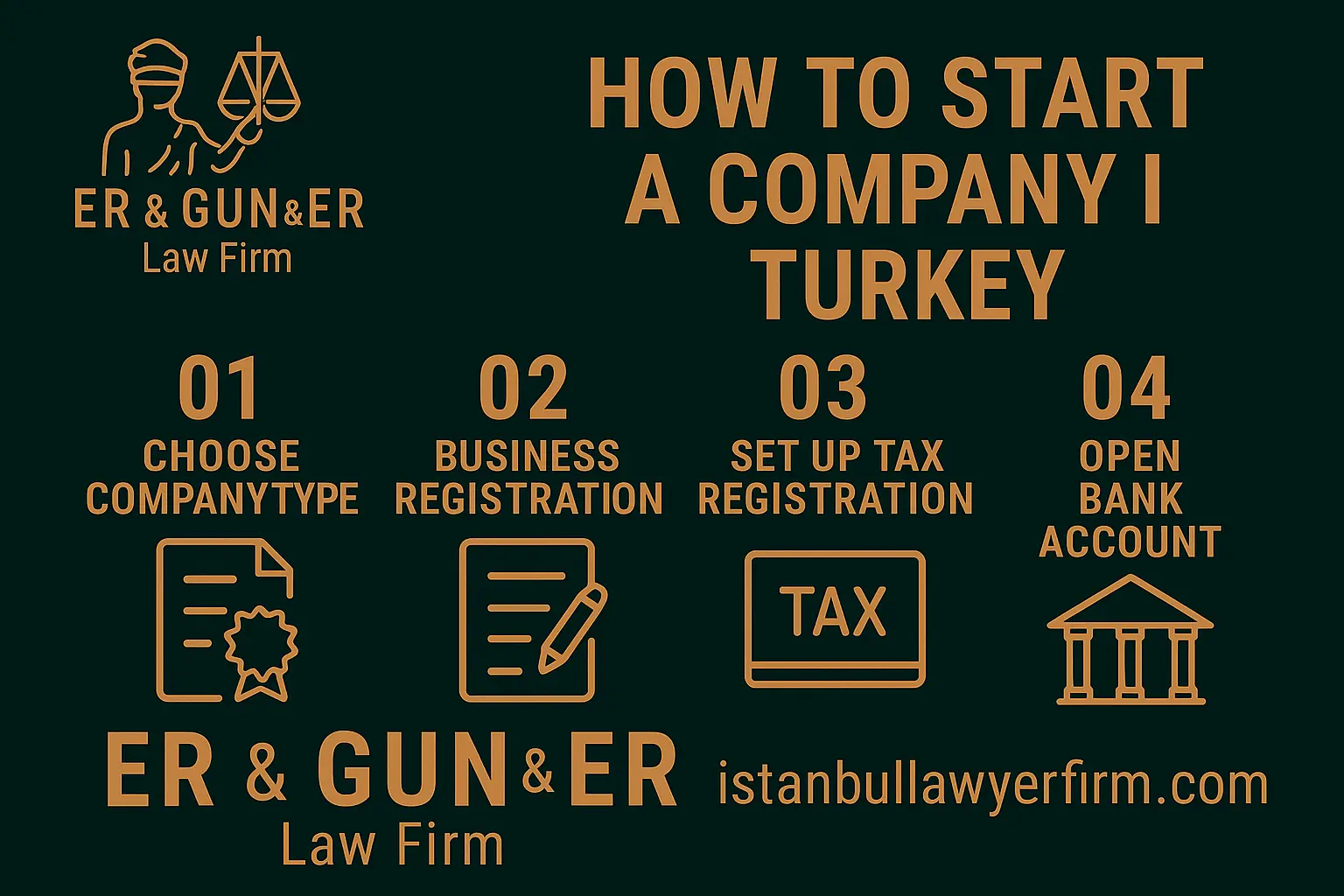
A lawyer in Turkey who advises on the Turkish company incorporation process explains that establishing a company requires completing a specific sequence of steps whose correctness at each stage determines whether the subsequent steps proceed without delay—and that the most common causes of timeline extensions are document preparation errors, notarization deficiencies, and incomplete capital deposit procedures. An Istanbul Law Firm that manages the incorporation process for foreign investors implements the specific approach most effective for each company type: preparing the Articles of Association in the format and content required by Turkish Commercial Code, covering company purpose, management structure, shareholder rights, capital allocation, and transfer restrictions; coordinating the notarization of Articles of Association and shareholder signature declarations with licensed Turkish notaries; managing the mandatory capital deposit requirement—25% of registered capital for limited liability companies—through a temporary bank account opened for this purpose, and obtaining the bank deposit confirmation letter; filing all incorporation documents with the relevant Trade Registry and managing the MERSIS online registration; and obtaining the Trade Registry Gazette publication that gives the company's formation legal notice effect. Turkish lawyers advising on incorporation management help investors understand that all foreign-issued documents—including passports, foreign corporate documents if the shareholder is a company, and powers of attorney—must be properly legalized through apostille or consular authentication and translated by sworn translators whose credentials satisfy Turkish court and administrative standards before they can be accepted by the Trade Registry. Practice may vary by authority and year.
An Istanbul Law Firm that advises on post-incorporation compliance registrations explains that completing the Trade Registry registration is the beginning rather than the end of the compliance process—because several additional registrations are required before the company can begin operations, hire employees, or issue invoices. Turkish lawyers advising on post-incorporation registrations help companies complete the specific enrollments most important for each operational situation: registering with the local Tax Office to obtain a tax identification number and VAT registration; enrolling in the e-Invoice system—e-Fatura—which is mandatory for companies above applicable revenue thresholds and available voluntarily for others; registering with the Social Security Institution before employing any personnel; and completing sector-specific registrations with ministries or regulatory bodies whose requirements apply to the company's planned activities. An English speaking lawyer in Turkey who coordinates post-incorporation registrations for foreign-owned companies provides the project management service that ensures all required registrations are completed in the correct sequence without gaps that would prevent operations from beginning on the investor's planned timeline—maintaining the overall registration project calendar so that no single agency's processing timeline becomes a critical path obstacle to the company's operational launch. Practice may vary by authority and year.
A Turkish Law Firm that advises on the e-Invoice and e-Ledger enrollment process explains that Turkish tax administration has progressively expanded the scope of mandatory electronic document requirements—and that companies whose planned revenue or taxpayer category places them within the mandatory e-Invoice scope must complete enrollment before issuing any invoice. An English speaking lawyer in Turkey who coordinates electronic document system enrollment for foreign-owned companies manages the technical enrollment application with the Turkish Revenue Administration and confirms the activation of the company's e-Invoice and e-Ledger credentials alongside the standard post-incorporation tax registrations—ensuring that the company can issue legally valid invoices from the first day of commercial operations without a gap period where paper invoicing would be required. Practice may vary by authority and year.
A Turkish Law Firm that advises on sector-specific licensing for foreign-owned companies explains that companies operating in regulated sectors—including food and beverage, tourism, education, healthcare, real estate, and manufacturing with environmental impacts—require specific licenses or permits in addition to the standard Trade Registry registration. An English speaking lawyer in Turkey who manages sector-specific license applications for foreign-owned companies assesses the specific licensing requirements applicable to each planned activity, compiles the required documentation, submits applications to the relevant ministry or municipal authority, follows up until approvals are granted, and monitors license renewal obligations so the company's licensed status is never inadvertently lapsed—ensuring that the company's operational continuity is not disrupted by licensing gaps discovered after operations have already begun. Practice may vary by authority and year.
Taxation, Accounting, Financial Reporting and Annual Obligations
A lawyer in Turkey who advises on taxation for foreign-owned Turkish companies explains that Turkey's corporate tax framework creates specific obligations whose management from the beginning of operations is essential for avoiding penalties and ensuring that the company's financial structure is tax-efficient. An Istanbul Law Firm that advises on corporate tax compliance for foreign-owned companies helps investors understand the specific obligations most significant for each company type: corporate income tax is assessed on Turkish-source income at the standard rate—whose current applicable rate should be verified with qualified counsel since rates are subject to legislative change; quarterly advance corporate tax payments must be made throughout the year based on the prior year's tax base; VAT returns must be filed monthly or quarterly depending on the company's status; and withholding taxes apply to dividends paid to foreign shareholders at rates that may be reduced by applicable double taxation treaty provisions. Turkish lawyers advising on corporate tax compliance help companies understand that Turkey's tax calendar creates specific payment and filing deadlines whose consistent management is required for maintaining the company in good tax standing—and that late payment interest and penalties for missed tax filings accumulate rapidly in a way that makes proactive compliance management significantly more cost-effective than reactive remediation. Practice may vary by authority and year — verify current Turkish corporate income tax rates, current withholding tax rates on dividends, and current applicable double taxation treaty provisions with qualified tax and legal counsel before making any financial projections based on the Turkish tax regime.
An Istanbul Law Firm that advises on accounting and financial reporting for foreign-owned Turkish companies explains that Turkish accounting requirements impose specific obligations: companies must maintain double-entry bookkeeping records; the Turkish chart of accounts must be used; e-Defter—electronic ledger—enrollment is required for companies above applicable thresholds; and financial statements must be prepared in accordance with Turkish Financial Reporting Standards—TFRS—which align with IFRS but have specific Turkish implementation requirements. Turkish lawyers advising on accounting setup for foreign-owned companies help investors implement the specific accounting infrastructure most appropriate for each company profile: selecting and implementing accounting software that is compatible with Turkish e-government platforms; coordinating with certified public accountants for accurate bookkeeping and timely financial statement preparation; planning for statutory audit requirements that apply to joint-stock companies and larger limited liability companies; and preparing annual returns for filing with the Trade Registry and Tax Office. An English speaking lawyer in Turkey who advises on accounting and reporting setup for international companies provides the coordination between the company's foreign parent reporting requirements and Turkish statutory reporting obligations—ensuring that the Turkish financial statements satisfy Turkish regulatory requirements while being reconcilable with the parent's consolidated accounts, and helping the parent company's finance team understand the specific Turkish accounting standards whose application may produce different results than the parent's home country GAAP or IFRS consolidated accounts. Practice may vary by authority and year.
A Turkish Law Firm that advises on tax incentives and investment support programs explains that Turkey offers specific tax incentives for investments in designated industrial zones, R&D activities, employment creation, and strategic sectors whose availability can significantly reduce the effective tax burden for qualifying foreign-owned companies. An English speaking lawyer in Turkey who advises on tax incentive eligibility for foreign investors provides the assessment of which incentive programs the investor's planned activities qualify for—including regional investment incentives, organized industrial zone benefits, technology development zone privileges, and R&D center tax deductions—and structures the investment in a way that maximizes the combined benefit of available incentives—coordinating the incentive application with the company's incorporation and operational launch timeline to ensure the incentive designation is obtained before the qualifying investment expenditure begins. Practice may vary by authority and year.
Employment, Labor Law and Work Permit Compliance
A lawyer in Turkey who advises on employment compliance for foreign-owned Turkish companies explains that hiring employees in Turkey creates specific legal obligations under Turkish Labor Law whose management from the beginning of the employment relationship is essential for avoiding the labor disputes and regulatory penalties that commonly affect companies that address employment law reactively. An Istanbul Law Firm that advises on employment compliance for foreign-owned companies helps investors implement the specific employment framework most appropriate for each workforce situation: preparing employment contracts that satisfy Turkish Labor Law's mandatory provisions—including probation period, working hours, leave entitlements, notice period, and termination conditions—in a bilingual format that enables foreign management to understand their obligations; registering employees with the Social Security Institution within the required timeframe before work begins; managing payroll tax withholding and social security premium payments through monthly declarations; and implementing the termination procedures that Turkish Labor Law requires to avoid wrongful termination claims. Turkish lawyers advising on employment compliance help companies understand that Turkish Labor Law creates specific employee protections—including severance pay entitlements based on length of service and reinstatement rights for unjustified terminations—whose existence and scope must be understood before any termination decision is made. Practice may vary by authority and year.
An Istanbul Law Firm that advises on work permits for foreign employees and shareholders explains that foreign nationals employed in Turkey—including foreign shareholders who are actively managing the company—must obtain valid Turkish work permits before beginning work. Turkish lawyers advising on work permit management for foreign-owned companies help investors implement the specific application approach most effective for each employee situation: preparing the work permit application with the role description, salary documentation, and supporting materials from the Turkish company that demonstrate the need for a foreign national in the specific position; managing the Ministry of Labor review process and responding to any information requests promptly; coordinating work permit renewals annually to maintain continuous authorized working status; and advising on specialized permit categories—including the Blue Card for highly qualified professionals—that may be appropriate for senior technical or management roles. An English speaking lawyer in Turkey who manages work permit applications for international companies provides the bilingual coordination that enables foreign employees to understand Turkish immigration requirements while the company's HR team manages the ongoing work permit compliance calendar—and advises on the specific documentation that must be maintained to demonstrate the employment's lawful basis if the company is reviewed by Turkish immigration authorities. Practice may vary by authority and year.
A Turkish Law Firm that advises on labor dispute management for foreign-owned companies explains that compulsory mediation is the required first step for most employment disputes before court proceedings can begin—and that companies that prepare for this possibility from the beginning of operations are consistently better positioned to resolve disputes efficiently. An English speaking lawyer in Turkey who advises on labor law compliance and dispute prevention for foreign-owned companies helps companies implement the specific preventive measures most effective for each workforce situation: maintaining organized personnel files with complete employment documentation; implementing consistent application of leave, compensation, and termination policies; documenting performance issues formally before any termination decision; ensuring that all mandatory social security and tax filings are current so the company's compliance record cannot be used to support employee claims; and conducting periodic internal HR audits that identify compliance gaps before they become enforcement issues or litigation triggers. Practice may vary by authority and year.
A Turkish Law Firm that advises on social security compliance for foreign-owned companies explains that Turkey's Social Security Institution registration and monthly premium payment obligations create specific penalties for late registration or late payment—and that companies that begin operations before completing SGK registration face retroactive premium assessments and fines whose cumulative impact can be significant. An English speaking lawyer in Turkey who coordinates SGK compliance for foreign-owned companies provides the registration management service that ensures employees are enrolled before their first day of work and that monthly SGK declarations are filed accurately and on time throughout the employment period. Practice may vary by authority and year.
Corporate Governance, Shareholder Rights and Board Responsibilities
A lawyer in Turkey who advises on corporate governance for Turkish companies explains that Turkish Commercial Code creates specific governance requirements for limited liability companies and joint-stock companies whose satisfaction is required for the company to operate effectively—and that well-designed governance documents prevent the shareholder and management disputes that are among the most disruptive events in the life of any company. An Istanbul Law Firm that advises on corporate governance for foreign-owned Turkish companies implements the specific governance framework most appropriate for each ownership structure: drafting Articles of Association that clearly define the company's purpose, management authority, shareholder rights, voting thresholds for significant decisions, and transfer restrictions; implementing shareholders' agreements that supplement the Articles with provisions on pre-emption rights, tag-along and drag-along clauses, deadlock resolution, and exit mechanisms; defining the management structure—whether a single manager for an LLC or a board of directors for a JSC—with clear authority delegations; and establishing the general assembly procedures including notice requirements, quorum thresholds, and voting rights. Turkish lawyers advising on corporate governance help investors understand that governance documents designed for the current ownership structure may need to be updated when new investors enter, business activities expand, or shareholder relationships change—making the initial governance design both the foundation for current operations and the framework for future flexibility. Practice may vary by authority and year.
An Istanbul Law Firm that advises on director duties and board responsibilities for foreign-owned Turkish companies explains that directors and managers of Turkish companies have specific fiduciary duties under Turkish Commercial Code—including the duty of care, the duty of loyalty, and the obligation to act in the company's best interests rather than in the interests of any particular shareholder. Turkish lawyers advising on board responsibilities help management teams understand the specific compliance obligations most practically significant for each role: maintaining accurate corporate records and minutes; convening required general assemblies within statutory deadlines; approving and filing annual financial statements; managing conflicts of interest through disclosure and recusal procedures; and ensuring the company's operations remain within the scope authorized by the Articles of Association. An English speaking lawyer in Turkey who provides corporate governance training for international management teams explains Turkish director duties in language that aligns with governance frameworks familiar to executives from other jurisdictions—enabling foreign board members and managers to meet their Turkish obligations without inadvertently creating liability through unfamiliarity with Turkish-specific requirements, and helping the company establish the documentation practices that demonstrate compliance with director duties in any subsequent dispute or regulatory investigation. Practice may vary by authority and year.
A Turkish Law Firm that advises on cross-border corporate actions for foreign-owned Turkish companies explains that mergers, acquisitions, share transfers, capital increases, and restructurings involving foreign elements require specific Turkish-law documentation—including notary certification, Trade Registry filings, and in some cases competition authority review—whose management requires coordinated legal advice across the Turkish and foreign law dimensions. An English speaking lawyer in Turkey who advises on cross-border corporate transactions for foreign-owned companies provides the integrated legal coordination that ensures each transaction's Turkish-law requirements are satisfied while remaining consistent with the foreign transaction documents and the foreign parent's governance requirements. Practice may vary by authority and year.
A Turkish Law Firm that advises on minority shareholder protection in Turkish companies explains that minority shareholders in Turkish limited liability companies and joint-stock companies have specific statutory rights under Turkish Commercial Code—including the right to call extraordinary general assemblies, the right to request special audit investigations, and the right to challenge resolutions that violate the Articles of Association or Turkish law. An English speaking lawyer in Turkey who advises on minority shareholder protection for foreign investors helps minority shareholders understand the specific remedies available for each type of abuse or deadlock situation, and helps majority shareholders design governance structures that protect minority interests in ways that build trust and reduce the likelihood of minority-triggered legal proceedings. Practice may vary by authority and year.
Intellectual Property Protection and Brand Strategy
A lawyer in Turkey who advises on intellectual property protection for foreign-owned Turkish companies explains that protecting trademarks, patents, designs, and software in Turkey is essential for maintaining competitive advantage—and that the Turkish Patent and Trademark Office's registration system provides specific legal protections for registered IP rights that are not available for unregistered rights. An Istanbul Law Firm that advises on IP protection for foreign companies in Turkey helps investors implement the specific protection approach most effective for each IP portfolio: filing trademark applications with the Turkish Patent and Trademark Office for the relevant Nice Classification classes covering the company's goods and services; advising on patent registration strategies for inventions, utility models, and industrial designs; monitoring official publications and competitor registrations to identify potential conflicts early; and filing oppositions against conflicting applications within the applicable statutory deadlines. Turkish lawyers advising on IP protection help investors understand that international trademark registrations under the Madrid Protocol can be extended to Turkey as a designated country—providing a cost-effective approach for investors who are also protecting their brands in multiple countries simultaneously—and that the Turkish Patent and Trademark Office's opposition system creates specific monitoring obligations for registered trademark owners who need to protect their marks against conflicting applications by competitors. Practice may vary by authority and year.
An Istanbul Law Firm that advises on IP licensing and technology transfer for foreign companies operating in Turkey explains that structuring license agreements, franchise arrangements, and technology transfer contracts for use in Turkey requires specific attention to Turkish competition law and contractual requirements—including royalty payment mechanisms, quality control provisions, confidentiality obligations, and term and termination rights. Turkish lawyers advising on IP licensing help companies design agreements that are both commercially effective and compliant with Turkish law whose provisions may differ from comparable agreements under other legal systems. An English speaking lawyer in Turkey who advises on IP enforcement for foreign-owned companies helps investors understand and exercise their rights when infringement occurs—through administrative proceedings before the Turkish Patent and Trademark Office, civil court litigation for damages and injunctions, and customs border protection measures to prevent counterfeit goods from entering Turkey. Practice may vary by authority and year.
A Turkish Law Firm that advises on trade secret protection for foreign-owned companies in Turkey explains that while Turkey does not have a standalone trade secret statute, unfair competition provisions in Turkish Commercial Code and employment law provisions in Turkish Labor Law together create a framework for protecting confidential business information—and that the effectiveness of this protection depends significantly on the contractual and organizational measures the company implements rather than on automatic legal protection. An English speaking lawyer in Turkey who advises on trade secret protection for foreign-owned companies helps companies design the specific confidentiality infrastructure most effective for their situation: employment and contractor agreements with comprehensive confidentiality and non-compete provisions; internal information classification and access control policies; and exit interview and documentation return procedures for departing employees whose implementation makes Turkish courts more receptive to injunctive relief applications when trade secret misappropriation is suspected. Practice may vary by authority and year.
A Turkish Law Firm that advises on data protection compliance for foreign-owned companies in Turkey explains that Turkey's Personal Data Protection Law—KVKK—creates specific obligations for companies that collect or process personal data, including employee data, customer data, and business partner information—and that foreign-owned companies must satisfy KVKK requirements in addition to any GDPR or other home country data protection obligations. An English speaking lawyer in Turkey who advises on KVKK compliance for foreign-owned companies provides the assessment of applicable data protection obligations and helps companies implement appropriate consent frameworks, data processing agreements, VERBIS registration where required, and incident response procedures—integrating KVKK compliance with any GDPR obligations the company's home country operations create, so that the data protection framework satisfies both Turkish and EU requirements without creating contradictions between the two systems. Practice may vary by authority and year.
A Turkish Law Firm that advises on software and digital asset protection for technology companies in Turkey explains that Turkish Copyright Law provides automatic protection for software as a literary work—without registration requirement—but that the practical enforcement of software copyright in Turkish proceedings requires documented evidence of creation and ownership that many companies fail to maintain in a litigation-ready format. An English speaking lawyer in Turkey who advises technology companies on software copyright management helps companies implement the specific documentation practices most effective for establishing and enforcing ownership claims: maintaining version control records that demonstrate the creation timeline; preparing work-for-hire and IP assignment provisions in employment and contractor agreements that clearly vest software ownership in the company; and organizing source code custody in a way that enables rapid production of creation evidence if infringement proceedings are initiated. Practice may vary by authority and year.
Dispute Resolution, Arbitration and Commercial Enforcement
A lawyer in Turkey who advises on dispute resolution for foreign-owned Turkish companies explains that commercial disputes—including contract disagreements, shareholder conflicts, employment claims, and regulatory enforcement matters—are a foreseeable risk for any business and that designing appropriate dispute resolution mechanisms into commercial contracts from the beginning significantly affects how disputes are resolved and at what cost. An Istanbul Law Firm that advises on dispute resolution strategy for foreign-owned companies helps investors implement the specific approach most effective for each contract type: for domestic Turkish commercial contracts, Turkish Commercial Court jurisdiction with carefully drafted venue clauses; for international commercial contracts, institutional arbitration under ICC, UNCITRAL, or ISTAC rules whose awards are enforceable in Turkey under the New York Convention; and for employment contracts, the mandatory mediation requirement that must be satisfied before labor court proceedings can commence. Turkish lawyers advising on dispute resolution clause design help companies understand that the enforceability of dispute resolution provisions—particularly arbitration clauses—in Turkish courts has specific requirements whose satisfaction at the drafting stage determines whether the clause will be effective when a dispute actually arises—and that a dispute resolution clause whose enforceability is questioned at the beginning of a dispute proceeding can add months and significant cost before the substantive dispute is even reached. Practice may vary by authority and year.
An Istanbul Law Firm that advises on commercial litigation for foreign-owned companies explains that Turkish commercial court proceedings follow specific procedural rules whose management requires Turkish-language legal representation—and that foreign companies involved in Turkish commercial disputes benefit from engaging Turkish counsel who can both represent them effectively and communicate with foreign management in English. Turkish lawyers advising on commercial litigation management help companies understand the specific procedural requirements most important for each dispute type: evidence rules that differ from common law discovery procedures; interim measure applications that can protect assets or preserve evidence before the main proceedings are decided; and enforcement mechanisms that are available when a favorable judgment has been obtained. An English speaking lawyer in Turkey who manages commercial dispute proceedings for foreign-owned companies provides the bilingual case management that enables foreign management to maintain informed oversight of Turkish court proceedings without requiring Turkish language expertise. Practice may vary by authority and year.
A Turkish Law Firm that advises on arbitration strategy for international commercial disputes involving Turkish companies explains that institutional arbitration provides specific advantages for foreign-owned companies—including confidentiality, seat and language flexibility, and the New York Convention enforcement framework—that make it the preferred dispute resolution mechanism for high-value international commercial contracts. An English speaking lawyer in Turkey who advises on international arbitration involving Turkish parties helps foreign-owned companies navigate the specific Turkish-law dimensions of international arbitration proceedings: the enforceability of arbitration clauses under Turkish law, the interaction between Turkish mandatory law provisions and arbitration agreements, and the recognition and enforcement of foreign arbitral awards in Turkish courts under the applicable New York Convention procedures. The best lawyer in Turkey for foreign company formation combines knowledge of Turkish Commercial Code company formation requirements, tax compliance obligations, employment law, work permit procedures, corporate governance requirements, IP protection, and dispute resolution with the English-language communication that enables foreign investors to establish and operate Turkish companies effectively—and provides the ongoing compliance monitoring that keeps the company in good standing with all Turkish regulatory authorities throughout its operational life. Practice may vary by authority and year.
A Turkish Law Firm that advises on commercial mediation for foreign-owned companies explains that Turkey's mandatory commercial mediation requirement—applicable to specific categories of commercial disputes including employment disputes before labor court filing—creates an opportunity for efficient dispute resolution whose proper utilization can resolve conflicts significantly faster and at lower cost than court proceedings. An English speaking lawyer in Turkey who represents foreign-owned companies in commercial mediation proceedings provides the bilingual mediation participation that enables the foreign company's management to engage substantively in the mediation session and to evaluate settlement terms with full understanding of their legal implications. Practice may vary by authority and year.
Investment Incentives and Strategic Considerations for Foreign Investors
A lawyer in Turkey who advises on investment incentives for foreign investors explains that Turkey offers a comprehensive system of investment support programs—including regional investment incentives, organized industrial zone advantages, technology development zone benefits, R&D center support, and large-scale strategic investment incentives—whose accessibility for foreign-owned companies makes understanding the applicable framework an important component of the investment planning process. An Istanbul Law Firm that advises on investment incentive eligibility for foreign investors helps companies identify the specific programs most relevant to each planned investment: the regional investment incentive scheme provides tax exemptions, social security premium support, and land allocation for qualifying investments in designated regions; organized industrial zone locations provide infrastructure advantages and regulatory streamlining; technology development zones and R&D centers provide corporate tax exemptions and employee income tax relief for qualifying activities; and large-scale strategic investment support provides customized incentive packages for transformative investments. Turkish lawyers advising on incentive applications help foreign investors prepare the applications, investment commitments, and documentation that the relevant Ministry evaluates for incentive eligibility determination—and monitor the conditions that must be maintained during the incentive period to avoid retroactive disqualification that would eliminate previously granted benefits. Practice may vary by authority and year.
An Istanbul Law Firm that advises on the strategic positioning of Turkey for foreign investors explains that Turkey's geographic location between Europe, the Middle East, and Central Asia, its large domestic consumer market, its established manufacturing base, its developing technology sector, and its bilateral trade agreements with multiple regions create specific strategic advantages for foreign investors seeking a regional hub. Turkish lawyers advising on strategic entry planning help investors understand how the choice of legal structure, location, and operational design can maximize access to these advantages—including which free trade agreement benefits are applicable to the investor's planned operations and which investment structures best qualify for available incentives. An English speaking lawyer in Turkey who advises on strategic market entry for international companies provides the integrated legal and commercial assessment that enables foreign investors to structure their Turkish presence in a way that maximizes both the operational advantages of the Turkish market and the legal protections available under Turkish law—providing the single point of legal expertise that coordinates entity formation, tax planning, employment compliance, IP protection, and dispute resolution into a coherent legal framework rather than managing each element separately with different advisers, and delivering the institutional knowledge about current Ministry of Trade, Tax Office, Trade Registry, and Social Security Institution practice that enables efficient compliance management from the first day of operations. Practice may vary by authority and year.
A Turkish Law Firm that advises on Turkey's bilateral investment treaty network explains that Turkey has signed bilateral investment treaties with a large number of countries that provide specific protections for foreign investors—including guarantees against expropriation without compensation, protections for profit repatriation, and dispute resolution mechanisms that enable foreign investors to bring investment treaty arbitration claims against the Turkish state in specific circumstances. An English speaking lawyer in Turkey who advises foreign investors on treaty protections applicable to their specific investment helps investors understand what protections are available under the treaty between Turkey and their home country—and how the investment should be structured to maximize treaty protection. Practice may vary by authority and year.
A Turkish Law Firm that advises on exit planning for foreign-owned Turkish companies explains that planning for eventual exit—whether through sale to a strategic buyer, transfer to a Turkish partner, dissolution, or restructuring—should begin at the establishment stage rather than when the decision to exit is actually made. An English speaking lawyer in Turkey who advises on exit planning for foreign-owned Turkish companies helps investors structure their Turkish company in a way that preserves exit flexibility: designing shareholder agreements with clear buy-sell mechanisms; ensuring that the company's corporate records, financial statements, and compliance documentation are maintained in a condition that supports due diligence by potential acquirers; understanding the Turkish tax implications of different exit structures including share sales, asset sales, and liquidation; planning for the employment law implications of ownership transitions—particularly for employees who may have specific statutory protections in acquisition contexts; and considering whether pre-exit restructuring can optimize the exit transaction's tax and legal profile before the sale process begins. Practice may vary by authority and year.
Frequently Asked Questions
- What types of companies can a foreign national establish in Turkey? Foreign nationals can establish limited liability companies—Ltd. Şti.—joint-stock companies—A.Ş.—branch offices, or liaison offices in Turkey. LLCs are most commonly used for their simplicity and lower capital requirements. JSCs are preferred for larger investments or structures planning future investor entry. Branch offices allow foreign parent companies to operate in Turkey directly. Practice may vary by authority and year.
- Is there a minimum capital requirement for foreign-owned Turkish companies? Yes. Limited liability companies require a minimum registered capital of TRY 10,000, of which at least 25% must be paid upon incorporation. Joint-stock companies require a minimum of TRY 50,000. Current minimum thresholds should be verified with qualified counsel since they are subject to adjustment. Practice may vary by authority and year.
- Can a foreign national be the sole shareholder and manager of a Turkish company? Yes. Turkish law permits 100% foreign ownership in most sectors, and a foreign national can serve as the sole shareholder and sole manager of a Turkish limited liability company. Joint-stock companies require a board of directors. Certain regulated sectors impose restrictions that should be specifically confirmed before establishment. Practice may vary by authority and year.
- How long does company formation in Turkey take? The typical timeline from initiating document preparation to completing Trade Registry registration is two to four weeks for straightforward cases. Timeline varies based on the completeness of foreign documents, legalization requirements from specific jurisdictions, and Trade Registry processing load. Post-registration steps including Tax Office and Social Security Institution enrollment add additional time. Practice may vary by authority and year.
- What documents are required to incorporate a Turkish company? Core documents include the Articles of Association, passport copies and notarized signature declarations for each shareholder, a board or management appointment resolution, capital deposit confirmation from a Turkish bank, and for foreign corporate shareholders, translated and legalized corporate documents confirming authorization. All foreign documents must be apostilled or consularly authenticated and translated by sworn translators. Practice may vary by authority and year.
- What tax obligations apply to foreign-owned Turkish companies? Foreign-owned companies pay Turkish corporate income tax on Turkish-source income, file monthly or quarterly VAT returns, make quarterly advance corporate tax payments, and withhold income tax from employee salaries. Dividends to foreign shareholders are subject to withholding tax at rates potentially reduced by applicable double taxation treaties. Current rates should be verified with qualified tax counsel. Practice may vary by authority and year.
- Can profits be repatriated to foreign shareholders from a Turkish company? Yes. Profits can be repatriated through dividend distributions, management fees, service fees, or royalties subject to applicable withholding taxes and any transfer pricing documentation requirements. The most tax-efficient repatriation structure depends on the applicable double taxation treaty and the specific transaction characterization. Practice may vary by authority and year.
- Do foreign employees need work permits to work in Turkey? Yes. Foreign nationals working in Turkey require Turkish work permits issued by the Ministry of Labor regardless of whether they are employed by a Turkish company or a foreign company with Turkish operations. Work permits must be obtained before work begins and renewed annually. Specific permit categories apply to different roles and employment situations. Practice may vary by authority and year.
- What employment law obligations apply to foreign-owned Turkish companies? Foreign-owned companies must comply with Turkish Labor Law requirements including employment contracts with mandatory provisions, social security registration before employment begins, payroll tax withholding, minimum wage compliance, leave entitlements, and termination procedures that avoid wrongful dismissal liability. Severance pay entitlements based on service length apply to employees who meet applicable thresholds. Practice may vary by authority and year.
- What corporate governance requirements apply to Turkish limited liability companies? Turkish LLCs must maintain a shareholders' general assembly, appoint at least one manager with documented authority, maintain accurate corporate records and minutes, file annual financial statements with the Trade Registry, and hold an annual general assembly approving the financial statements. The Articles of Association must comply with Turkish Commercial Code requirements. Practice may vary by authority and year.
- How are trademark and intellectual property rights protected in Turkey? Trademarks, patents, and industrial designs are registered with the Turkish Patent and Trademark Office. Registered rights provide specific legal protections enforceable in Turkish courts and through customs border protection measures. International trademark registrations under the Madrid Protocol can designate Turkey. Monitoring and opposition programs protect against conflicting registrations. Practice may vary by authority and year.
- What dispute resolution options are available for foreign-owned Turkish companies? Commercial disputes can be resolved through Turkish commercial court litigation, institutional arbitration under ICC, UNCITRAL, or ISTAC rules whose awards are enforceable under the New York Convention, and mediation. Employment disputes require mandatory mediation before court proceedings. International arbitration is generally preferred for high-value commercial contracts involving foreign parties. Practice may vary by authority and year.
- What investment incentives are available for foreign investors in Turkey? Turkey offers regional investment incentives, organized industrial zone advantages, technology development zone tax benefits, R&D center support programs, and large-scale strategic investment packages. Eligibility depends on investment amount, sector, location, and employment creation commitments. Current incentive programs and eligibility conditions should be verified with qualified counsel. Practice may vary by authority and year.
- Do foreign-owned Turkish companies need to register under Turkey's data protection law? Companies that collect or process personal data in Turkey—including employee data—may have obligations under Turkey's Personal Data Protection Law including registration with the VERBIS data controllers registry, privacy notice requirements, and consent mechanisms for specific processing activities. KVKK requirements apply alongside any GDPR obligations for companies also operating in the EU. Practice may vary by authority and year.
- Does ER&GUN&ER Law Firm provide legal services for foreign investors starting companies in Turkey? Yes. ER&GUN&ER Law Firm provides comprehensive legal services for foreign investors establishing Turkish companies including entity structure selection, document preparation and legalization, Trade Registry incorporation management, Tax Office and SGK registration, sector-specific licensing, employment contract drafting, work permit management, corporate governance design, shareholders' agreement drafting, tax compliance advisory, IP protection and licensing, dispute resolution, commercial litigation and arbitration, investment incentive advisory, and ongoing corporate compliance support—with English-language client communication and bilingual documentation throughout each engagement.
Author: Mirkan Topcu is an attorney registered with the Istanbul Bar Association (Istanbul 1st Bar), Bar Registration No: 67874. His practice focuses on cross-border and high-stakes matters where evidence discipline, procedural accuracy, and risk control are decisive.
He advises individuals and companies across Immigration and Residency, Real Estate Law, Tax Law, and cross-border documentation matters where procedural accuracy and evidence discipline are decisive.
Education: Istanbul University Faculty of Law (2018); Galatasaray University, LL.M. (2022). LinkedIn: Profile. Istanbul Bar Association: Official website.