

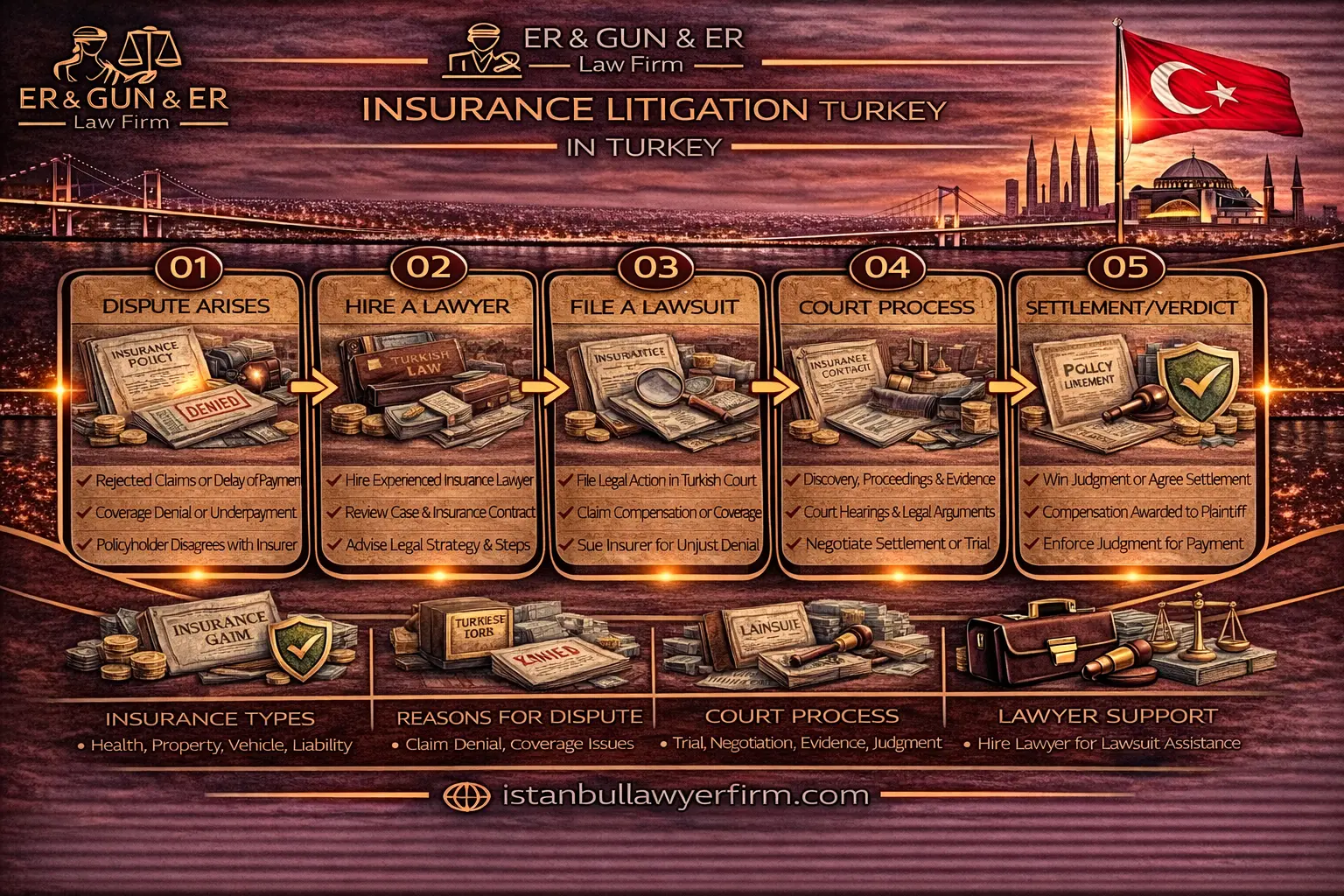
A lawyer in Turkey who advises on insurance litigation understands that insurance disputes in Turkey are resolved less by rhetorical legal argument and more by whether the claimant can prove the policy wording, the claim chronology, and the supporting documents—and that an insurance dispute Turkey court proceeding is fundamentally a documentation exercise in which missing exhibits are more damaging than persuasive submissions. An Istanbul Law Firm that advises on insurance litigation Turkey provides the integrated guidance covering every stage of the dispute process: building an evidence strategy that begins at first notice of loss rather than at the filing stage; identifying the correct defendant and confirming jurisdiction before the petition is drafted; mapping the burden of proof and the coverage elements whose satisfaction must be demonstrated; managing evidence preservation and expert management as formal evidentiary governance tasks; responding to exclusion arguments and causation disputes with clause-linked documentary rebuttals; negotiating and documenting settlement on terms whose enforcement is planned from the outset; and executing judgment enforcement and subrogation recovery with the same document discipline applied throughout the dispute. A Turkish Law Firm that advises on insurance litigation Turkey understands that insurers evaluate coverage by matching facts to policy conditions and exclusions—not by reading narratives—and that the claimant whose file presents a verifiable chain from notice to quantum through indexed exhibits consistently achieves better outcomes than the claimant who relies on general commercial expectations. An English speaking lawyer in Turkey who advises on insurance litigation for cross-border policyholders provides the bilingual coordination that keeps notice language, evidence submissions, expert instructions, and court filings consistent across languages and time zones. Practice may vary by authority and year — verify current Turkish insurance litigation procedures, current burden of proof standards, and current enforcement mechanisms with qualified counsel before taking any action in a Turkish insurance dispute, since insurance dispute resolution procedures are applied through judicial and regulatory practice whose current requirements determine the specific standards applicable to each line of insurance and each court.
Insurance Litigation in Turkey: Scope, Framework and Evidence Strategy
A lawyer in Turkey who advises on the scope of insurance litigation explains that insurance litigation in Turkey covers first-party disputes where the insured seeks payment for its own loss, third-party disputes where the insured seeks defense or indemnity against a third-party claimant, contribution and allocation disputes between co-insurers in layered programs, and recourse claims where a paying insurer pursues responsible third parties after indemnification. An Istanbul Law Firm that advises on insurance litigation framework helps claimants understand the specific evidence strategy most effective for each dispute type: treating every insurer communication from the reservation letter through the denial as a potential court exhibit whose consistency with the claim chronology determines its credibility; preserving the full policy set—schedule, endorsements, and general terms—as the first act in any dispute preparation because insurer and insured sometimes rely on different wording versions; and building a clause map that ties the disputed position to a specific insuring clause, condition, or exclusion paired with an evidence map that lists what documents will prove each required fact. Turkish lawyers advising on insurance litigation scope help claimants understand that courts and experts evaluate the record as a chronology—where a timeline that links each exhibit to a date is a core tool—rather than as a persuasive essay, making documentary discipline the most important single investment in any dispute preparation, and that the claimant who enters court with a verifiable chain from notice to quantum consistently achieves better outcomes than the claimant who assembles documents reactively after the denial is issued. Practice may vary by authority and year.
An Istanbul Law Firm that advises on evidence strategy for insurance litigation in Turkey explains that the most common triggers for insurance litigation—outright denial, partial underpayment, reclassification of costs under sub-limits, and reservations based on alleged condition breaches—all share the characteristic that they are decided by matching factual exhibits to specific policy clause elements rather than by general arguments about commercial expectation. Turkish lawyers advising on insurance litigation evidence strategy help claimants implement the specific approach most effective for each dispute trigger: for denial cases, building a rebuttal bundle that addresses each denial ground element by element with dated exhibits; for underpayment cases, building a ledger that maps each invoice to the relevant policy promise and to the incident timeline; for reservation cases, responding with indexed document bundles that answer each cooperation question raised in the reservation letter. An English speaking lawyer in Turkey who advises on evidence strategy for cross-border corporate policyholders provides the bilingual management that ensures non-Turkish-speaking management understands what evidence must be preserved, what documents must be assembled, what the coverage analysis determines before the first insurer meeting takes place, and how each cooperation step will be documented to satisfy Turkish insurance law's requirements. Practice may vary by authority and year.
A Turkish Law Firm that advises on pre-dispute claim file management for insurance litigation explains that the most effective litigation preparation begins on the day of loss—with evidence preservation, notice documentation, and claim file organization—rather than at the point of denial when evidence may already be unavailable. An English speaking lawyer in Turkey who advises on pre-dispute file management for insurance claims provides the systematic management that creates a chronological claim file from first notice through adjuster interactions through document deliveries—so that when the insurer issues its denial or reservation, the claimant already has a court-ready bundle whose completeness and internal consistency demonstrate both cooperation and evidentiary strength. Practice may vary by authority and year.
Defendant Selection, Jurisdiction and Pre-Litigation Preparation
A lawyer in Turkey who advises on defendant selection for insurance litigation explains that choosing the correct defendant is a threshold issue because a strong merits case can fail if the wrong entity is sued—and that the contracting insurer shown on the policy schedule is typically the correct defendant rather than the local agency label used in marketing, the broker whose communications are in evidence, or the claims administrator who signed the denial letter. An Istanbul Law Firm that advises on defendant identification and jurisdiction for insurance disputes helps claimants implement the specific defendant selection approach most effective for each policy structure: verifying the insurer's legal entity through trade registry records and the schedule signatory; confirming in co-insurance arrangements whether each co-insurer must be sued separately or whether one lead insurer represents all; identifying whether a fronting arrangement means the fronting insurer is the contracting party or an administrative conduit; and confirming that any merger, rebrand, or succession is evidenced so service reaches the legally correct entity. Turkish lawyers advising on defendant selection help claimants understand that service errors waste months and add cost—making a service-ready defendant pack whose accuracy has been verified from primary sources more valuable than a compelling petition served on the wrong party—and that verifying the defendant's current registered address through official sources before every filing prevents the nullity arguments that arise when service is directed to outdated or incorrect addresses. Practice may vary by authority and year.
An Istanbul Law Firm that advises on jurisdiction analysis for insurance disputes Turkey explains that jurisdiction for insurance disputes Turkey depends on party classification, the nature of the contract, and any forum clause in the issued policy wording—and that reading the dispute resolution clause in the policy text rather than in marketing brochures is the essential first step in any venue analysis. Turkish lawyers advising on jurisdiction and venue analysis help claimants implement the specific forum approach most effective for each dispute profile: preparing a short jurisdiction memorandum that quotes the policy forum clause, identifies the defendant's registered address, and maps connecting facts; confirming whether the policyholder qualifies as a consumer or a commercial party because that classification affects which procedural track applies; and verifying whether arbitration is mandatory or merely optional under the policy wording. An English speaking lawyer in Turkey who advises on forum analysis for cross-border insurance disputes provides the bilingual analysis that confirms service requirements, translation standards, and jurisdiction timing for any cross-border elements before the petition is drafted. Practice may vary by authority and year.
A Turkish Law Firm that advises on pre-litigation preparation for insurance disputes explains that the most effective pre-litigation file is one that evaluates the dispute classification—whether it is about coverage trigger, exclusion, condition compliance, or quantum—because each classification determines the evidence set, the expert requirements, and the litigation timeline. An English speaking lawyer in Turkey who advises on pre-litigation preparation for corporate policyholders implements the specific preparation approach most effective for each dispute type: preparing a pre-action letter that is factual, clause-linked, and accompanied by key exhibits; requesting a written reconsideration position that identifies the exact clause relied upon; keeping settlement discussions documented carefully so informal offers cannot be misquoted as admissions; and building the dispute bundle from the same correspondence and exhibits used in the claim so the court file does not require reconstruction. The best lawyer in Turkey for insurance litigation matters combines knowledge of Turkish insurance law, policy coverage analysis, defendant identification, jurisdiction analysis, evidence preservation, expert management, interim measures, exclusion defense, quantification, settlement documentation, and enforcement mechanics with the English-language communication that enables cross-border policyholders to navigate Turkish insurance litigation effectively. Practice may vary by authority and year.
Burden of Proof, Policy Interpretation and Coverage Mapping
A lawyer in Turkey who advises on burden of proof in insurance litigation explains that insurance cases are decided on proof discipline—and that the claimant must prove the existence of the insurance contract by producing the full policy set and endorsements, prove that the reported event fits the coverage trigger as defined in the wording, prove that the loss item claimed is connected to the event through a coherent factual chain, and prove that notice and cooperation steps were taken in the way the policy requires. An Istanbul Law Firm that advises on burden of proof management for insurance litigation helps claimants build the specific proof structure most effective for each claim type: for first-party claims, showing what was damaged, when it was damaged, and what remediation cost was actually incurred with invoice-level documentation; for liability claims, showing that a third-party allegation exists and falls within the policy's definition of a claim; and for underpayment disputes, showing how each invoice maps to a covered head of loss rather than to a non-covered business cost. Turkish lawyers advising on burden of proof management help claimants implement the practical tool that makes proof discipline manageable: an exhibit index that states what each document proves in one sentence, so the file is organized as a proof exercise rather than a document pile—and that keeps the judge focused on which clause element remains in genuine dispute rather than on reconstruction of a fragmented record. Practice may vary by authority and year.
An Istanbul Law Firm that advises on policy interpretation disputes Turkey explains that a policy interpretation dispute requires building the clause map and the endorsement history before the first submission—because the court cannot decide which interpretation is correct if the controlling policy version and endorsement sequence have not been established. Turkish lawyers advising on policy interpretation dispute Turkey management help claimants implement the specific interpretation approach most effective for each wording dispute: producing the complete policy set and showing the endorsement history clearly; quoting the exact sentence in dispute and mapping each defined term to a factual exhibit; identifying any insurer correspondence that recharacterized the wording during the dispute period and preserving those communications as potentially admissible interpretation context; and keeping the insured's notice letters and claim forms consistent with the policy's own terminology so that courts see one coherent language chain from placement to claim to petition. An English speaking lawyer in Turkey who advises on policy interpretation disputes for cross-border policyholders provides the bilingual terminology management that ensures technical policy terms are translated consistently across expert instructions, court filings, and correspondence—preventing the mistranslation disputes that distract from the substantive coverage question. Practice may vary by authority and year.
A Turkish Law Firm that advises on the integrated approach to burden of proof and coverage mapping explains that the most effective litigation preparation converts each coverage clause into a proof task—identifying what factual exhibit will satisfy each element—so that the dispute can be evaluated objectively rather than argued abstractly. An English speaking lawyer in Turkey who advises on coverage mapping for complex insurance litigation implements the specific mapping approach most effective for each policy structure: building a one-page clause sheet that quotes the controlling wording and links each disputed element to a dated exhibit; presenting ambiguity arguments only where the wording genuinely supports more than one reading as demonstrated by quoted definitions; and integrating the coverage map with the expert question list so that technical evidence answers the legal questions whose factual resolution determines the coverage outcome. Practice may vary by authority and year — verify current Turkish burden of proof standards, current policy interpretation methodology, and current court evidence practices with qualified counsel before initiating any insurance litigation proceedings.
Evidence Preservation, Adjuster Cooperation and Expert Report Management
A lawyer in Turkey who advises on evidence preservation for insurance litigation explains that evidence preservation is the most time-sensitive action in any insurance dispute—because the most important proof can be destroyed by repairs, routine data overwriting, or personnel changes before the adjuster or court expert has the opportunity to examine it. An Istanbul Law Firm that advises on evidence preservation for insurance litigation helps claimants implement the specific preservation approach most effective for each loss type: securing photographs and site documentation before repairs begin; exporting CCTV footage for the relevant time window using the standard system export function with documented chain of custody; preserving maintenance logs, service records, and ownership documents whose relevance recurs in almost every insurance claim; and creating an evidence index from the first day that lists each item with its date, collector, and storage location. Turkish lawyers advising on evidence preservation insurance claim Turkey discipline help claimants understand that digital evidence preserving original metadata, physical evidence documenting chain of custody, and records evidence confirming document integrity are each essential—because a single category of missing preservation creates the spoliation argument that the insurer uses to challenge expert conclusions—and that an evidence index whose completeness is confirmed before each adjuster interaction provides the chronological record that rebuts non-cooperation allegations. Practice may vary by authority and year.
An Istanbul Law Firm that advises on adjuster cooperation management for insurance litigation explains that treating the adjuster inspection as a formal evidentiary event rather than an administrative site visit is the single most important discipline shift available to claimants—because the adjuster's report frequently becomes the insurer's central exhibit in denial letters and court submissions. Turkish lawyers advising on adjuster cooperation management help claimants implement the specific approach most effective for each inspection situation: confirming the adjuster's identity, mandate, and scope in writing before the inspection; maintaining a written log during the inspection of what was examined, what samples were taken, and what document requests were made; requesting correction of any factual errors in preliminary findings promptly with delivery proof; and after the inspection, requesting a written list of outstanding documents and confirming the delivery channel. An English speaking lawyer in Turkey who advises on adjuster and expert coordination for cross-border corporate policyholders provides the bilingual management that ensures non-Turkish-speaking management understands each development in the inspection and investigation process without the language gap creating administrative delays—and maintains the single terminology sheet that keeps technical descriptions consistent across adjuster correspondence, expert instructions, and court filings. Practice may vary by authority and year.
A Turkish Law Firm that advises on expert report management for insurance litigation explains that expert evidence is frequently decisive because courts rely on technical assessment for causation and quantum disputes—and that expert report insurance dispute Turkey outcomes are best managed by ensuring experts receive clean source data rather than narrative summaries whose factual basis cannot be independently verified. An English speaking lawyer in Turkey who advises on expert management for complex insurance litigation implements the specific approach most effective for each technical dispute: defining expert mandates narrowly around specific policy clause elements rather than requesting broad technical investigations; preserving raw source data—measurements, photographs, test results—alongside expert reports so conclusions can be verified; proposing joint inspection protocols to reduce spoliation disputes and allow both sides to agree on what was examined; and ensuring that experts receive the correct policy version and endorsement history so their conclusions address the wording that actually applies. Practice may vary by authority and year.
Interim Measures, Exclusions, Causation Analysis and Quantification
A lawyer in Turkey who advises on interim measures for insurance disputes explains that interim injunction insurance lawsuit Turkey applications are available when waiting for final judgment would create irreparable harm or destroy the practical value of the case—and that the most realistic interim tools in insurance disputes are evidence fixation orders preserving damaged items or digital records rather than broad asset security orders whose proportionality is harder to demonstrate. An Istanbul Law Firm that advises on interim relief applications for insurance disputes helps claimants implement the specific interim approach most effective for each urgency situation: presenting a focused evidence dossier showing specific ongoing harm supported by exhibits rather than general concern; requesting narrowly tailored measures whose scope is limited to the demonstrated risk; documenting any instance where the insurer's investigation delayed repair and forced the insured to proceed without inspection so that later mitigation disputes are addressed proactively. Turkish lawyers advising on interim measures help claimants understand that an overstated or poorly supported interim application can damage credibility with the court—making a narrow, evidence-led interim request that precisely identifies what will be lost by waiting significantly more effective than a broad emergency petition—and that interim applications whose factual record is already organized and indexed consistently receive more favorable consideration than applications assembled under time pressure. Practice may vary by authority and year.
An Istanbul Law Firm that advises on exclusions disputes and causation analysis for insurance litigation explains that exclusion litigation should be treated as a factual design problem rather than a rhetorical battle—because courts typically require a factual finding on what actually caused the damage before deciding whether the exclusion wording applies, and because the claimant who presents one provable cause narrative whose every element is tied to a dated exhibit consistently fares better than the claimant who argues against the exclusion without establishing an affirmative causal case. Turkish lawyers advising on exclusions dispute insurance Turkey management help claimants implement the specific causation analysis approach most effective for each exclusion type: building the causal chain in time order with each link supported by a source record; testing each exclusion element against the affirmative causation narrative rather than arguing in abstract; identifying and proving any carve-outs to the exclusion that make the exclusion inapplicable on the specific facts; and preserving maintenance logs, prior inspection reports, and service records that rebut alleged pre-existing condition defenses. An English speaking lawyer in Turkey who advises on causation analysis insurance Turkey matters for cross-border policyholders provides the bilingual technical coordination that keeps causation descriptions consistent across expert instructions, insurer correspondence, and court filings—preventing the terminology drift that creates the inconsistencies insurers exploit in exclusion arguments. Practice may vary by authority and year.
A Turkish Law Firm that advises on quantification of loss insurance Turkey matters explains that quantification begins with building a ledger that maps each claimed item to the policy promise and to the event timeline—and that courts and experts want a provable arithmetic story whose every line can be traced to an invoice, a purchase order, and a bank payment confirmation rather than a headline estimate. An English speaking lawyer in Turkey who advises on quantification for complex insurance litigation implements the specific quantum approach most effective for each dispute profile: separating emergency mitigation, investigation, repair, replacement, and consequential heads before presenting totals; preserving competing quotations to demonstrate commercial reasonableness of the selected repair path; addressing betterment and depreciation by preserving pre-loss condition records and maintenance histories; and building a paid-versus-unpaid table for underpayment disputes that shows what was paid, under which category, and what remains disputed with the clause-based reason for each disputed item. Practice may vary by authority and year — verify current Turkish insurance evidence standards, current exclusion interpretation methodology, and current quantum assessment practices with qualified counsel before taking any action in an insurance dispute.
Settlement, ADR and Negotiation Strategy
A lawyer in Turkey who advises on settlement strategy for insurance disputes explains that settlement insurance dispute Turkey outcomes are best achieved when the claimant has frozen its factual chronology and organized its exhibit index before exchange of numbers—because a settlement negotiation conducted from an incomplete or shifting evidence base produces agreements whose terms reflect uncertainty rather than the actual dispute economics. An Istanbul Law Firm that advises on settlement negotiation for insurance disputes helps claimants implement the specific settlement approach most effective for each dispute profile: identifying which disputed elements are genuinely legal questions and which are factual or accounting questions before bargaining begins; supporting any proposed settlement amount with invoices, quotations, and a transparent calculation worksheet rather than a headline number; proposing an invoice-by-invoice reconciliation for underpayment cases rather than a percentage discount against a disputed total; and ensuring that settlement documents specify payment channel, currency, invoice form, and the precise scope of rights released. Turkish lawyers advising on settlement negotiation help claimants understand that a settlement is only as valuable as its enforceability—making release language that is limited to the specific loss event, payment terms that are precisely defined, and enforcement options that are preserved from the moment of signing more valuable than a settlement whose ambiguity creates a second dispute—and that preserving the settlement negotiation record in a frozen bundle whose contents can be produced immediately if enforcement becomes necessary is a core element of settlement discipline. Practice may vary by authority and year.
An Istanbul Law Firm that advises on alternative dispute resolution for insurance disputes explains that whether ADR is appropriate depends first on verifying whether the policy mandates a specific process—because arbitration clauses in commercial policies must be followed rather than merely considered—and second on whether a neutral technical expert can assist the parties to narrow causation and quantum issues before bargaining about monetary allocation. Turkish lawyers advising on insurance ADR management help claimants implement the specific ADR approach most effective for each dispute type: preserving ADR communications and confidentiality terms in writing so court filings do not inadvertently disclose protected settlement positions; ensuring that any internal review process by the insurer receives a clause-linked document bundle so internal review is evidence-driven; continuing evidence preservation and cooperation obligations during ADR talks so that if ADR fails, the court-ready file is complete and current. An English speaking lawyer in Turkey who advises on insurance ADR for cross-border corporate policyholders provides the coordination that ensures all parties—including decision-makers in different countries—understand both the ADR process mechanics and the substantive dispute positions in a format accessible without translation specialist involvement. Practice may vary by authority and year.
A Turkish Law Firm that advises on settlement documentation and enforcement readiness for insurance disputes explains that settlement drafts should be produced as if a court will read them—defining the insured event, the claim reference, the payment amount, and the release scope in one clause whose precision eliminates the interpretation disputes that create post-settlement enforcement proceedings. An English speaking lawyer in Turkey who advises on settlement documentation for complex insurance disputes implements the specific drafting approach most effective for each settlement situation: requiring written confirmation that insurer authority approvals were obtained before rights are released; specifying whether confidentiality exceptions for regulatory disclosures and audit requirements apply; confirming that subrogation and third-party recovery rights are not inadvertently waived; preserving the complete settlement negotiation record and the final signed settlement as a frozen bundle whose completeness enables immediate enforcement if payment is delayed; and confirming that VAT and invoice format requirements are specified so that payment cannot be delayed by technical invoice rejection. Practice may vary by authority and year.
Court Procedure, Timeline and Procedural Discipline
A lawyer in Turkey who advises on court procedure for insurance litigation explains that the quality of the first petition frequently determines how narrowly the dispute is defined—and that a petition that separates coverage trigger facts from notice and cooperation facts, attaches the full policy set and endorsement history, attaches the denial or underpayment letter as the court's point of reference, and attaches a core evidence bundle for the incident consistently produces a more focused and efficient proceeding than a petition that presents a general narrative without clause-specific grounding. An Istanbul Law Firm that advises on insurance court procedure Turkey management helps claimants implement the specific procedural approach most effective for each dispute profile: keeping each submission consistent with the previous submission so that introducing new facts requires a numbered supplement rather than informal substitution; proposing a clear expert question list that maps to the legal issues in the petition and to specific policy clause elements; and maintaining a litigation log that records every submission, every hearing notice, and every expert delivery in one chronology so the file remains internally consistent across the entire proceeding. Turkish lawyers advising on court procedure help claimants understand that courts respond better to coherent narratives than to volume—making a focused submission whose every factual assertion is tied to a numbered exhibit more persuasive than a comprehensive submission whose organization requires the judge to reconstruct the chronology independently—and that a supplement protocol whose each addition is numbered and dated preserves the credibility of the overall file even when new facts emerge after the initial petition. Practice may vary by authority and year.
An Istanbul Law Firm that advises on expert process management in insurance court proceedings explains that expert appointment is only useful when the file contains the raw source materials experts need to answer the specific questions that resolve the legal dispute—and that proposing vague expert question sets whose answers do not determine coverage outcomes wastes court time and delays the proceeding. Turkish lawyers advising on expert management in insurance court proceedings help claimants implement the specific expert approach most effective for each technical dispute: asking the court to define the expert question set in terms of specific clause elements; ensuring experts receive the correct policy version and endorsement history; requesting that experts document their inspection methodology, raw data, and reasoning rather than only conclusions; and treating factual errors in preliminary expert findings as correction opportunities that should be addressed with specific exhibits rather than with general objections. An English speaking lawyer in Turkey who advises on expert management for cross-border insurance proceedings provides the bilingual terminology coordination that ensures technical conclusions address the specific legal questions whose answers determine coverage outcomes. Practice may vary by authority and year.
A Turkish Law Firm that advises on procedural discipline for insurance court proceedings explains that procedural side issues—evidence authentication challenges, jurisdiction objections, service disputes—must be managed with the same documentary discipline as the merits because they can reshape which evidence is available and which court hears the dispute. An English speaking lawyer in Turkey who advises on procedural discipline for complex insurance litigation implements the specific approach most effective for each procedural challenge: preserving proof of every document delivery including portal confirmations and courier receipts; maintaining a list of what exhibits were submitted to experts so later disputes about what the expert saw can be resolved by documentation; and preserving inspection protocols whose completeness demonstrates that access was granted and conditions were transparent. Practice may vary by authority and year — verify current Turkish court procedure, current expert appointment standards, and current evidence authentication requirements with qualified counsel before initiating any insurance litigation in Turkey.
Judgment Enforcement, Subrogation and Post-Judgment Recovery
A lawyer in Turkey who advises on enforcement of insurance judgment Turkey explains that a favorable judgment is only as valuable as its collectability—and that enforcement planning should begin before trial ends by confirming the debtor entity's legal name, trade registry details, and available assets so that execution can be initiated through the proper channel without rebuilding the defendant identification from scratch after judgment. An Istanbul Law Firm that advises on insurance judgment enforcement helps claimants implement the specific enforcement approach most effective for each debtor profile: preparing an execution-ready set of documents that includes the judgment, service proof, and a clear debtor identification pack; initiating execution through the Execution and Bankruptcy Law framework as a procedural project whose every filing and response is preserved; and coordinating finance, legal, and management approvals so payment receipts and ledger entries match the legal allocation. Turkish lawyers advising on insurance judgment enforcement help claimants understand that enforcement is not a mechanical afterthought but a continuation of the same document discipline applied throughout the litigation—and that a claimant whose enforcement file is organized and complete consistently achieves faster collection than one who must reconstruct the record after the judgment is obtained, since execution offices evaluate claims against documents rather than against oral explanations of what the judgment intended. Practice may vary by authority and year.
An Istanbul Law Firm that advises on subrogation rights Turkey insurance matters explains that subrogation—the transfer of the insured's recovery right to the paying insurer after indemnification—is most effectively pursued when evidence preservation decisions taken on the first day of the claim have maintained the causation and liability proof needed for the recourse action. Turkish lawyers advising on subrogation and recourse claim insurer Turkey management help insurers and policyholders implement the specific recourse approach most effective for each third-party liability configuration: sending early preservation notices to potential tortfeasors requesting that they retain their own records; preserving the causal chain documentation—adjuster reports, technical expert findings, maintenance logs—in a format that can be reused in recourse proceedings without requiring new investigations; confirming that contractual indemnity provisions and liability allocation clauses are included in the recovery file with signature pages; and ensuring that any settlement with the primary insurer does not inadvertently release the third party's liability or waive the insurer's subrogated recovery right. An English speaking lawyer in Turkey who advises on cross-border subrogation for international insurers provides the bilingual coordination that ensures recovery letters and primary claim letters use consistent factual characterizations—preventing the narrative inconsistencies that defendants exploit to challenge causation in recourse proceedings—and maintains the terminology sheet that keeps technical cause descriptions stable across Turkish and foreign proceedings so defendants cannot argue that the loss was characterized differently in different jurisdictions. Practice may vary by authority and year.
A Turkish Law Firm that advises on post-judgment governance for insurance disputes explains that the enforcement stage provides valuable feedback for risk management improvement—and that using the dispute outcomes to update policy placement, claims handling procedures, and evidence preservation protocols is the most practical way to reduce future litigation frequency. An English speaking lawyer in Turkey who advises on post-judgment governance for corporate policyholders implements the specific improvement approach most effective for each organization: preserving the complete dispute file—policy, claim chronology, adjuster reports, expert evidence, court submissions, judgment, and enforcement record—as a permanent archive that supports audit, renewal negotiation, and future dispute preparation; feeding causation findings into renewal discussions to request clause clarifications that would have prevented the dispute; and updating internal playbooks based on what caused friction during the litigation so notice, cooperation, and mitigation steps are improved for future claims. Practice may vary by authority and year — verify current Turkish enforcement procedures, current subrogation rights, and current post-judgment recovery mechanisms with qualified counsel before taking any action in enforcement or recourse proceedings.
A Turkish Law Firm that advises on causation and exclusion defense coordination explains that the most common reason exclusion defenses succeed is not that the exclusion language is decisive but that the insured's causal narrative is inconsistent across communications—with the incident report using different language than the notice letter, the notice letter using different language than the expert instruction, and the expert instruction producing conclusions that do not match the chronology presented to the court. An English speaking lawyer in Turkey who advises on causation narrative management for corporate insurance disputes provides the consistent terminology governance that ensures the same factual characterization of the loss event appears in every document from first notice through court petition—preventing the inconsistencies that transform a straightforward coverage case into a credibility dispute whose resolution depends on which version the court treats as authoritative. Practice may vary by authority and year.
A Turkish Law Firm that advises on integrated litigation and subrogation strategy explains that the decisions made during primary claim handling—what evidence is preserved, what causation language is used, what releases are signed—determine whether subrogation recovery against responsible third parties is viable years after the primary dispute is resolved. An English speaking lawyer in Turkey who advises on litigation and subrogation integration for corporate policyholders implements the specific governance approach that ensures every decision in the primary claim is evaluated for its subrogation consequences: preserving failed components and chain-of-custody documentation even when repairs are urgent; avoiding broad releases that extinguish third-party liability before the insurer can pursue recovery; and maintaining a consistent causal characterization across primary claim documentation and recourse demand letters so defendants cannot exploit narrative differences between the two proceedings. Practice may vary by authority and year.
A Turkish Law Firm that advises on post-dispute governance and playbook improvement explains that feeding dispute outcomes into operational procedures—updating notice templates, evidence preservation kits, cooperation response protocols, and escalation ladders—is the highest-return investment available to corporate policyholders who have completed an insurance litigation cycle. An English speaking lawyer in Turkey who advises on post-dispute governance for international corporate policyholders provides the systematic review that identifies the specific documentation failures, terminology inconsistencies, and evidence gaps that contributed to the dispute—and converts those findings into updated operational templates that reduce the frequency and cost of future insurance disputes. Practice may vary by authority and year.
Frequently Asked Questions
- What is insurance litigation in Turkey and what triggers it? Insurance litigation in Turkey is the court process used to resolve disputes about whether an insurer must pay, defend, or reimburse under a policy. Common triggers include outright denial, partial underpayment, reclassification of costs under sub-limits, reservations based on exclusions or condition breaches, and causation or quantum disagreements. Courts evaluate disputes through documentary evidence and technical expert reports rather than through narrative argument. Practice may vary by authority and year.
- Which defendant should be named in an insurance claim denial lawsuit in Turkey? The primary defendant is the contracting insurer shown on the policy schedule, verified through trade registry records. In co-insurance, each co-insurer's individual status must be assessed. Claims administrators who signed denial letters are not necessarily the contracting party. Service address must be verified through current registry records before filing to avoid delays from naming errors. Practice may vary by authority and year.
- How does jurisdiction for insurance disputes Turkey work? Jurisdiction depends on whether the policyholder is a consumer or a commercial party, the nature of the contract, and any forum clause in the issued policy wording. Commercial courts are typically involved where both parties are merchants and the dispute relates to commercial activity. Arbitration clauses in the policy may mandate a different procedural track. Venue connects to the defendant's domicile and potentially to performance place concepts. Practice may vary by authority and year.
- What is the burden of proof in insurance litigation in Turkey? The claimant must prove the policy contract's existence through the full policy set and endorsements; prove that the event fits the coverage trigger as defined; prove that the claimed loss is connected to the event through a factual chain; and prove that notice and cooperation obligations were fulfilled. An exhibit index that ties each required fact to a specific document is the core practical tool for managing proof discipline. Practice may vary by authority and year.
- How should evidence be preserved for insurance litigation in Turkey? Evidence preservation requires photographing the scene before repairs, exporting digital records with metadata intact, preserving physical components with chain-of-custody documentation, securing maintenance logs and ownership records, and creating an evidence index from the first day. Digital evidence should preserve original filenames and metadata. Joint inspection should be proposed and documented when third-party liability exists. Practice may vary by authority and year.
- What is the role of expert reports in insurance disputes in Turkey? Expert reports provide technical assessment of causation and quantum that courts rely upon in technical disputes. Experts should receive raw source data rather than summaries, be given narrow question mandates tied to specific policy clause elements, and document their inspection methodology and reasoning. Factual errors in preliminary findings should be addressed with specific correcting exhibits through a written request preserved in the claim file. Practice may vary by authority and year.
- How should exclusion arguments be defended in Turkish insurance litigation? Exclusion defense requires building an affirmative causal narrative whose every element is tied to dated exhibits, then testing each exclusion element against that narrative. Any carve-outs to the exclusion must be proven with specific exhibits satisfying the carve-out conditions. Maintenance logs, prior inspection records, and service history rebut alleged pre-existing condition defenses. Causation narratives should remain consistent across all notice letters, expert instructions, and court submissions. Practice may vary by authority and year.
- How is quantification of loss managed in insurance litigation Turkey? Quantification requires a ledger that maps each claimed item to the policy promise and to the event timeline. Every line should be supported by an invoice, purchase order, or bank payment confirmation. Competing quotations demonstrate commercial reasonableness. For underpayment disputes, a paid-versus-unpaid table with clause-based reasons for each disputed item is more effective than arguing a total. Betterment and depreciation defenses should be anticipated with pre-loss condition evidence. Practice may vary by authority and year.
- What interim measures are available in insurance disputes in Turkey? Interim injunction insurance lawsuit Turkey applications can seek evidence fixation, preservation of damaged items, or—in exceptional circumstances with documented urgency—asset security. Requests must demonstrate both urgency and a plausible substantive right. Narrowly tailored evidence fixation orders are typically more defensible than broad financial security requests. Interim steps should not replace continued cooperation and documentation under the policy. Practice may vary by authority and year.
- How does settlement work in insurance disputes in Turkey? Settlement is most effective when the claimant presents an indexed bundle and a transparent quantification ledger before bargaining. Settlement documents should define the loss event, claim reference, payment amount, and release scope precisely in one clause. Subrogation and third-party recovery rights must be protected from inadvertent waiver. The complete negotiation record and signed settlement should be preserved as a frozen bundle enabling immediate enforcement if payment is delayed. Practice may vary by authority and year.
- How is a judgment enforced against an insurer in Turkey? Enforcement of insurance judgment Turkey follows the Execution and Bankruptcy Law through execution offices. Execution requires a clean judgment copy, service proof, and a debtor identification pack confirmed through trade registry records. Every enforcement filing and response should be preserved as part of the enforcement record. If insolvency risk exists, claim registration through the insolvency framework should be planned alongside ordinary execution. Practice may vary by authority and year.
- What are subrogation rights in Turkey and how are they pursued? Subrogation rights Turkey insurance allow the paying insurer to pursue responsible third parties after indemnification. Recourse requires proof of payment, proof of the insured's original right, and proof that no release extinguished that right. Evidence preservation decisions on the first day of the loss affect recourse viability because causation evidence lost during repairs weakens recourse causation arguments. Settlements should be drafted to preserve subrogated recovery rights. Practice may vary by authority and year.
- What is a policy interpretation dispute in Turkey and how is it resolved? A policy interpretation dispute Turkey arises when insurer and insured read the same clause differently. Resolution requires producing the complete policy set with endorsement history, quoting the exact disputed sentence, and mapping each defined term to a factual exhibit. Courts read the schedule, endorsements, and general terms as one integrated contract. Consistent policy terminology should be used across all claim documents, expert instructions, and court submissions. Practice may vary by authority and year.
- When should an insurance lawyer Turkey litigation be engaged? Insurance lawyer Turkey litigation support should be engaged early—at the reservation letter stage or as soon as denial appears likely—to preserve evidence, control communications, manage cooperation responses, and prepare the court-ready bundle before the dispute hardens into formal proceedings. Early engagement is most valuable for high-value claims, cross-border claims, technically complex causation disputes, and claims where the insurer has issued inconsistent positions during investigation. Practice may vary by authority and year.
- Does ER&GUN&ER Law Firm provide legal services for insurance litigation in Turkey? Yes. ER&GUN&ER Law Firm provides legal services for insurance litigation in Turkey including evidence strategy and claim file management, defendant identification and jurisdiction analysis, burden of proof and coverage mapping, evidence preservation and adjuster coordination, expert mandate design and expert management, interim measures applications, exclusion and causation defense, quantification documentation, settlement negotiation and drafting, court procedure management, expert process supervision, judgment enforcement, subrogation and recourse planning, and post-judgment governance advisory—with English-language client communication and bilingual documentation throughout each engagement.
Author: Mirkan Topcu is an attorney registered with the Istanbul Bar Association (Istanbul 1st Bar), Bar Registration No: 67874. His practice focuses on cross-border and high-stakes matters where evidence discipline, procedural accuracy, and risk control are decisive.
He advises individuals and companies across Immigration and Residency, Real Estate Law, Tax Law, and cross-border documentation matters where procedural accuracy and evidence discipline are decisive.
Education: Istanbul University Faculty of Law (2018); Galatasaray University, LL.M. (2022). LinkedIn: Profile. Istanbul Bar Association: Official website.