

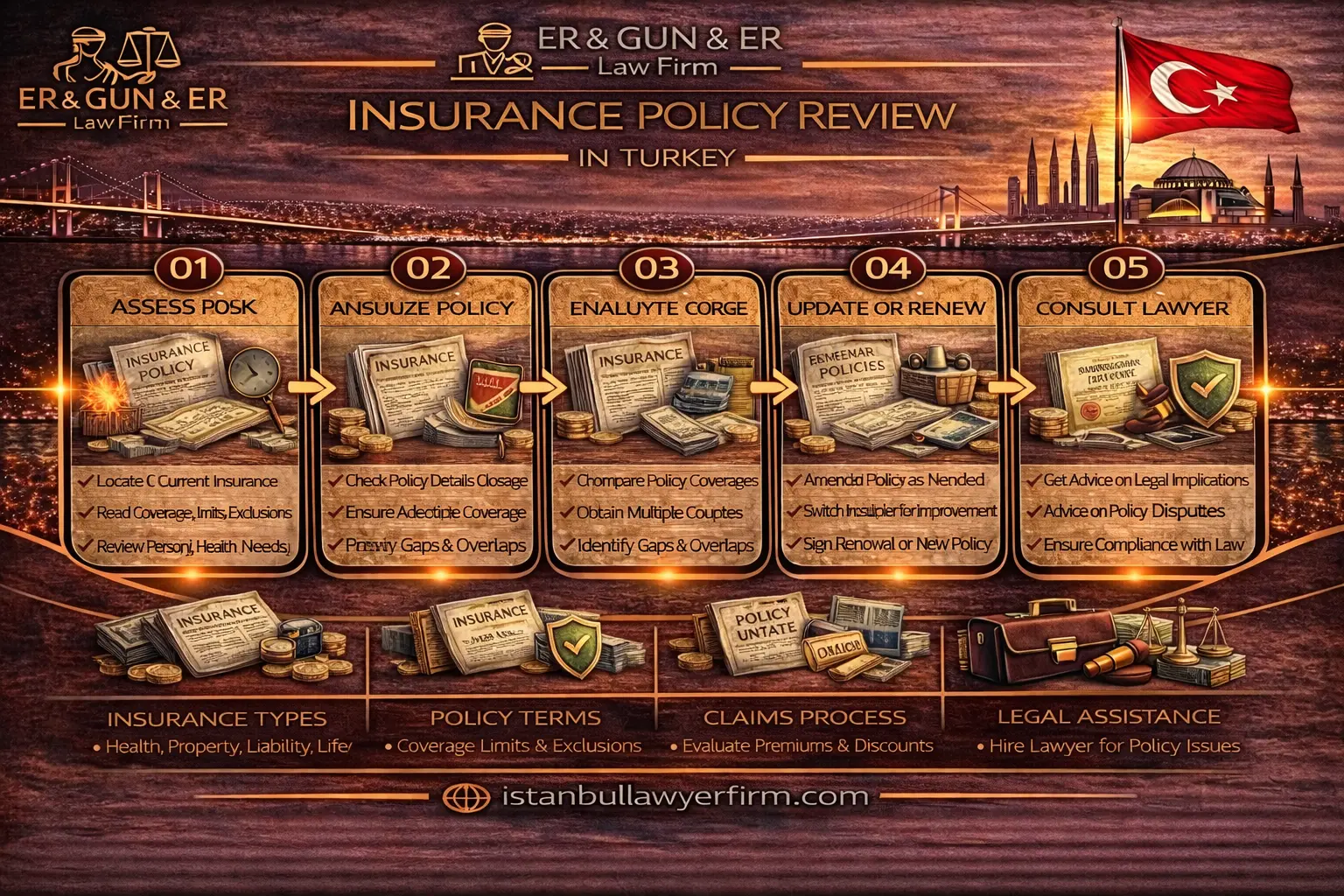
Insurance policy review in Turkey coverage exclusions and claims conditions

Insurance contracts in Turkey are drafted with dense definitions, endorsements, and exclusions that only become visible when a loss occurs. A clause-by-clause insurance policy review Turkey identifies what is actually covered, what is excluded, and what conditions must be satisfied before payment is owed. For corporates, the review connects policy wording to operational controls, such as incident reporting, vendor management, and record retention. For individuals, it clarifies how proof, notice, and cooperation duties can affect whether a claim is paid or questioned. Claim denials often arise from gaps between the event facts and the policy triggers, or from missing documents that the insurer treats as conditions. Denials also arise when exclusions are broader than expected, or when sub-limits and deductibles reduce the practical recovery below business expectations. A proper insurance contract review Turkey therefore reads the insuring clause, definitions, conditions, exclusions, and endorsements as one integrated mechanism. practice may vary by authority and year — check current guidance. When the stakes are high, early legal review helps you frame communications with the insurer and preserve evidence without escalating prematurely. In sensitive files involving bilingual documents and negotiations, working with a English speaking lawyer in Turkey and a lawyer in Turkey can keep the record consistent and dispute-ready.

What policy review covers

A policy review starts by collecting the full policy set, including the schedule, endorsements, special conditions, and any referenced general terms. The reviewer then performs coverage analysis Turkey insurance by matching each insuring clause to the business activities and assets it is meant to protect. Definitions are read next, because small definition wording can silently narrow a broad-looking coverage grant. The review identifies the insured event triggers, such as specified perils, accidental damage, or third-party liability allegations. It also identifies what must be proved to activate the trigger, such as physical damage, an occurrence, or a written claim. The review then maps the policy period and territorial scope to where the insured actually operates and stores risk. Any gaps between operations and territorial scope are flagged because they are common denial points after a cross-border incident. The review also checks whether the policy is primary, excess, or layered, because recovery expectations change when other covers sit above or below. A disciplined reviewer builds a clause map that lists each obligation and links it to the evidence that will later prove compliance. This map is then compared with incident-response procedures so that reporting and documentation steps are practical and repeatable. Many denials are not about the existence of cover, but about missing condition compliance that could have been satisfied with earlier planning. The reviewer therefore isolates conditions that operate as prerequisites and distinguishes them from administrative requests that can be fulfilled later. practice may vary by authority and year — check current guidance. Where the policy supports corporate governance, the review should be coordinated with internal controls so that the business can actually perform the promised steps. The related insurance risk compliance guidance can be used to translate clause maps into operational check points.

A thorough review also asks how the insurer typically administers the product line and what documents it requests at first notification. This is where claims handling Turkey insurance becomes a practical factor, because the same clause can be applied strictly or flexibly depending on the file quality. The review prepares an internal claim pack template that includes identity of insured, risk description, incident timeline, and initial proof list. The reviewer checks whether the policy requires use of specific forms or portals and whether the policy references external guidelines. If the policy is issued to a corporate group, the review verifies which entities are named and whether subsidiaries are automatically included. If the policy relies on named insured lists, the review flags merger and acquisition risks that can leave an acquired entity outside cover. The review also checks whether directors, employees, and agents are treated as insured persons for liability covers and under what conditions. It then tests whether contractual indemnities the company gives to customers could trigger liability cover or fall into contractual liability exclusions. If the policy includes warranties about risk management, the review links each warranty to a compliance owner who can confirm ongoing adherence. In procurement-heavy businesses, the review checks whether vendor contracts require additional insured status or waiver of subrogation and how that interacts with policy terms. A clause-by-clause review is also the right moment to identify negotiation points for renewal, because changes are easiest before loss. When negotiations become complex, coordination with a law firm in Istanbul can help keep communications precise and avoid inadvertent admissions about risk quality. practice may vary by authority and year — check current guidance. The review deliverable should end with a risk register that identifies high-impact exclusions, ambiguous triggers, and evidence items that are hard to produce. That risk register should be used to train operational teams so that the policy is treated as a compliance instrument rather than as a brochure.

Review quality is ultimately measured by how well it prevents disputes and how well it positions the insured if a dispute arises. A strong insurance lawyer Turkey policy review translates legal wording into plain decision trees that tell staff what to do the day a loss occurs. It also anticipates where the insurer may allege non-disclosure or breach of duty and prepares documentary counters in advance. For example, if the policy expects maintenance routines, the review recommends an audit trail that proves maintenance was performed and recorded. If the policy expects security measures, the review recommends logs, access records, and vendor certificates that can be produced quickly. The review also prepares a communication protocol that defines who speaks to the insurer and how statements are verified against documents. This reduces the risk of inconsistent explanations that later appear as credibility problems in the claim file. If the policy contains ambiguous language, the review records alternative interpretations and suggests clarifying endorsements. If the policy contains broad discretion clauses, the review identifies leverage points such as industry practice and prior renewals that may influence interpretation. The review further identifies which losses are likely to be litigated and which are likely to be settled, based on proof complexity rather than optimism. It creates a dispute readiness folder with the policy, key endorsements, broker correspondence, and proof of premium payment where relevant. That folder is kept separate from confidential internal legal notes, so disclosure can be controlled if litigation arises. practice may vary by authority and year — check current guidance. In complex corporate programs, experienced Turkish lawyers often coordinate between risk, finance, and operations so the policy language is reflected in real controls. The result is not a guaranteed payout, but a claim file that is harder to deny because the evidence and chronology are prepared in advance.

Defining insured and risk

Defining the insured begins with checking the declarations page and the named insured field, because that field anchors every later clause. Many policies also include insured persons or additional insureds, and those extensions are often conditional on role and activity. A corporate group should not assume that a parent-company name automatically covers subsidiaries unless the wording says so. Where the policy lists entities by annex, the annex should be treated as part of the contract and kept with the same version control. Mergers, acquisitions, and restructurings can leave an entity outside cover if the name change is not notified and endorsed. The review should therefore compare the insured list against the trade registry records and the group chart used in finance reporting. If the policy insures employees, directors, or agents, the review should check how those persons are defined and whether independent contractors are included or excluded. The insured definition also affects who must cooperate and who may receive claim communications from the insurer. In liability lines, the insured definition can also define who is protected against third-party claims and who is left to defend alone. Defining risk means mapping the insured activities and premises to the policy’s risk description, not relying on marketing labels. If the risk is described narrowly, a loss arising from a related but not listed activity may face a coverage challenge. If the risk is described broadly, the insurer may still rely on exclusions to remove certain sectors or operations from the grant. The review should also check whether the policy requires an insurable interest in the property or exposure, because lack of insurable interest can create disputes. practice may vary by authority and year — check current guidance. A precise insured and risk definition is the first defense against denial letters that claim the claimant is not the insured party under the contract.

The risk description is often supported by proposal forms, questionnaires, and pre-contract declarations that become part of the interpretation record. A review should collect those pre-contract documents and test whether they were accurate, complete, and consistent with the final policy. Insurers sometimes argue that misstatements justify denial, so identifying potential disclosure issues early helps manage dispute risk. The review should also check how the policy treats changes in risk, such as expansion of premises, new equipment, or new business lines. Some policies require notice of material change, while others allocate change risk through endorsements and renewal re-underwriting. These issues are closely linked to claims conditions insurance Turkey because an insurer may frame a risk change as a breach of condition rather than as a pricing issue. The insured should therefore maintain a change log that records operational changes and whether the insurer was informed. If the policy covers multiple locations, confirm that each location is scheduled correctly and that any location limits or special conditions are identified. If the policy covers mobile property or transit risk, confirm how the policy defines the geographical route and the point where cover attaches and ends. If the insured relies on subcontractors, check whether the risk description assumes certain standards or certifications, because those assumptions can become post-loss arguments. Review should also identify who the insurer will treat as the contact person, because misdirected communications can create missed requests and later disputes. In complex corporate programs, an Istanbul Law Firm can coordinate entity mapping, proposal-form reconciliation, and risk-change documentation so the record stays consistent. practice may vary by authority and year — check current guidance. The practical goal is to ensure that any later denial is tested against a documented risk narrative rather than against memory. When insured and risk are defined precisely, later negotiations focus on event facts instead of on whether the policy even applies.

Many policies include beneficiaries such as lenders, mortgagees, or loss payees, and those parties can affect how proceeds are paid. The review should identify whether consent is required before settlement if a lender is named, because payment routing can become a dispute point. If multiple insureds exist, the policy may require joint action or may allow one insured to act for all, depending on wording. Clarify who has authority to give notice, to appoint experts, and to accept the insurer’s adjustment outcome. If the insured is a joint venture, confirm whether the policy treats it as a separate insured or whether partners must be named individually. In group policies, confirm whether affiliates are covered automatically and how new affiliates are added during the term. If the insured uses brokers, confirm how broker communications are treated and whether broker notice is treated as insurer notice. Disputes often arise when one party assumes the broker’s email is sufficient and the insurer later insists on direct notice. Because proof is decisive, documentation for insurance claim Turkey should be designed to show who acted, when they acted, and under what authority. The internal file should include corporate signatory circulars or authorization documents where corporate communications are signed. It should also include contact lists and escalation rules so requests from adjusters are answered consistently. Where the insured is an individual, it should include identity copies and power of attorney documents if representatives are used. practice may vary by authority and year — check current guidance. A review that clarifies insured identity and authority reduces the risk that a valid claim is delayed by procedural confusion. It also reduces the risk that the insurer asserts lack of standing because the wrong entity or person submitted the notice.

Coverage grants analysis

Coverage grants analysis begins with the insuring clause, which is the sentence that promises payment when a defined event happens. The reviewer should identify the trigger words, such as loss, damage, occurrence, or claim, and then locate the policy definitions for each trigger. A grant that appears broad can become narrow when the definition of loss is limited to sudden and accidental events. The review should check whether the grant requires physical damage, because some coverages respond only to physical harm and not to pure financial loss. For liability lines, the grant often promises defense and indemnity, so the review must separate defense costs from indemnity payments conceptually. A common denial point is the gap between a third-party allegation and the policy’s definition of claim, so the review should test how claims are recognized. In an occurrence policy Turkey, the focus is usually on when the damaging event happened, not on when a demand letter was received. The review should map that timing concept to the insured’s reporting procedure so the file can capture the event date precisely. The grant may include additional coverages, such as debris removal or extra expense, and each additional coverage has its own conditions and sub-limits. The reviewer should read endorsements before assuming the base wording applies, because endorsements frequently change triggers and scope. If the policy references external standards, the review should obtain those standards and treat them as part of the interpretation file. If the policy contains multiple sections, confirm whether conditions are global or section-specific, because misreading scope can create avoidable breaches. practice may vary by authority and year — check current guidance. A disciplined grant analysis ends with a plain-language summary of what events are covered and what must be proven to activate the promise. That summary becomes the backbone of incident response training and reduces later surprises during adjustment.

Grants should also be tested against the insured’s actual risk scenario library, because clauses behave differently in different fact patterns. For example, a liability grant may cover bodily injury and property damage, but may exclude contractual liability unless the contract fits a defined exception. A professional liability grant may be written on a claims-made policy Turkey basis, which changes what must be tracked and when. The review should therefore create a trigger checklist that identifies what constitutes a claim, what constitutes a circumstance, and what constitutes a reportable event. The trigger checklist should also identify who inside the organization is responsible for recognizing each trigger. If the policy grants defense costs, the review should check whether defense is inside limits or outside limits, because that affects the practical value of the cover. If the policy allows the insurer to control defense counsel, the insured should understand how counsel instructions will be documented. If the policy allows the insured to select counsel, the review should check whether insurer consent is required and how consent is evidenced. If the grant includes aggregation rules, the review should explain how multiple related events may be treated as one claim or multiple claims. Aggregation rules matter because they can compress recovery into one limit even when multiple incidents occurred. The review should also flag silent gaps, such as cyber events under a property policy, because those gaps often surface only after denial. When a grant is ambiguous, negotiating clarifying endorsements is often cheaper than litigating meaning after loss. In high-stakes negotiations, the discipline of a best lawyer in Turkey is often reflected in the ability to rewrite ambiguous grants into clear operational triggers. practice may vary by authority and year — check current guidance. A grant analysis that is linked to real scenarios produces a coverage map that is usable by managers rather than only by lawyers.

Coverage grants analysis must also anticipate where disputes arise, because the insurer’s first letter often frames the dispute around the grant language. A claims denial dispute Turkey typically begins when the insurer states that the reported event does not meet the policy trigger or does not qualify as a covered loss. The insured should be prepared to respond by pointing to the exact definition and the exact factual exhibit that satisfies it. This is why the review should specify what evidence proves each trigger, such as a dated demand letter, a police report, or a time-stamped incident log. It should also specify what evidence proves that the event occurred during the relevant policy period. If the policy has retroactive dates or prior acts clauses, the review should explain how those dates interact with continuity. If the policy requires the insured to obtain insurer consent before incurring certain costs, the review should specify which costs are consent-sensitive. Consent-sensitive costs often become dispute points when emergency actions are taken and the insurer later questions necessity. The review should also flag language that gives the insurer discretion, because discretion clauses shift the negotiation approach toward reasonableness evidence. Where reasonableness will matter, the review should recommend contemporaneous documentation of decisions, quotations, and mitigation steps. The review should not assume that a broad grant overrides exclusions, because in Turkish interpretation practice exclusions are applied after the grant is established. It should also not assume that the insurer’s first denial letter is final, because adjustment positions can change when evidence is clarified. practice may vary by authority and year — check current guidance. A disciplined response to denial framing is to keep the narrative factual, attach the key exhibits, and request a reasoned written position. When the grant analysis is documented in advance, the insured can respond to denial framing quickly without making inconsistent statements.

Exclusions and carve-outs

Exclusions are the clauses that remove certain causes, sectors, or behaviors from a coverage grant that would otherwise apply. A policy review should read insurance exclusions Turkey policy wording immediately after the grant, because exclusions often do the real work of narrowing exposure. Exclusions should be mapped to real operational scenarios, such as maintenance failures, subcontractor errors, or product recalls. Many exclusions are drafted broadly and then narrowed by carve-outs, so the reviewer must read the entire clause including exceptions. A carve-out can restore coverage for a narrow subset of events, but only if the insured can prove the carve-out conditions. This means the review should create evidence prompts for carve-outs, such as proof of suddenness, proof of accidental nature, or proof of compliance with safety procedures. Exclusions should also be checked against endorsements, because endorsements often insert additional exclusions not visible in the base form. If the policy covers products, exclusions may interact with regulatory and warranty obligations, so the insured should understand the compliance baseline. The product claims regulation overview can help align policy exclusions with product compliance risk. A common dispute pattern is when the insurer relies on a broad exclusion and the insured relies on a narrow carve-out within the same clause. To prepare for that dispute, the review should specify exactly which factual exhibits will show that the carve-out conditions are met. Exclusions may also be triggered by intent or knowledge, so the review should identify which exclusions require proof of intent and which apply regardless of intent. practice may vary by authority and year — check current guidance. The review should also flag ambiguous exclusion terms, because ambiguity can be negotiated at renewal or may become a litigation interpretation issue later. Exclusion mapping is therefore both a risk-control exercise and a dispute-readiness exercise.

Exclusions must be analyzed with causation logic, because insurers often argue that the excluded cause is the dominant cause of the loss. The insured should be prepared to show that the covered cause, not the excluded cause, is the operative cause under the policy wording. This requires technical incident analysis and careful documentation of the event sequence. Where multiple causes contributed, the policy’s causation clause, if any, becomes critical and must be read closely. Some policies contain anti-concurrent causation language, while others are silent and leave allocation to interpretation. Silence creates uncertainty, so the review should record how the insurer has applied similar wording in prior renewals or claims where available. Exclusion analysis also requires understanding what the clause excludes, such as loss, damage, cost, or liability, because those words change the scope. For example, an exclusion of costs can still allow indemnity for damage, while an exclusion of liability can remove defense obligations. The review should also test whether the exclusion requires a direct link or whether it applies whenever the excluded factor is merely present. Many disputes arise because the insurer treats presence as enough, while the insured argues that causal contribution is required. The review should prepare a negotiation position that asks the insurer to explain the factual and contractual basis for applying the exclusion. Where internal stakeholders need structured guidance, a Turkish Law Firm can coordinate technical causation analysis with contract interpretation so the claim narrative remains consistent. practice may vary by authority and year — check current guidance. Exclusion disputes are easier to manage when the insured has preserved the physical evidence and the contemporaneous records that experts will rely on. A clause-by-clause review therefore includes an evidence preservation protocol that is triggered before repairs or disposal occurs.

A review should also identify exclusions that are likely to be triggered by routine operational conditions, because those are the ones that create surprise denials. Wear and tear exclusions, gradual deterioration exclusions, and maintenance-related exclusions are common examples in property and machinery lines. In liability lines, contractual liability exclusions and professional services exclusions often remove exposures that businesses assume are covered. Cyber-related exclusions can appear in non-cyber policies, so the review should flag any language that removes electronic data, systems, or network events. Pollution and contamination exclusions may be drafted broadly, and their carve-outs can be narrow and evidence-dependent. The review should create a glossary of excluded terms and map them to the insured’s operations so staff know what activities elevate denial risk. This mapping is also useful for procurement because vendor contracts can be drafted to allocate excluded risks back to vendors through indemnities. Where indemnities are used, the review should confirm that the policy does not exclude contractually assumed liability in a way that undermines the strategy. Exclusions can also interact with sub-limits and deductibles, so the review should avoid treating exclusions as the only narrowing tool. If the policy includes warranties, an exclusion may be triggered by breach of warranty, so the review should connect warranty compliance to internal audit routines. If the insurer offers endorsements that soften exclusions, the review should evaluate wording carefully, because a poorly drafted carve-out can be illusory. The review should also record how proof will be collected to show that a carve-out applies, such as inspection records or third-party certificates. practice may vary by authority and year — check current guidance. When a denial arrives, exclusion analysis is most effective when the insured responds with a factual timeline and exhibits rather than with generalized disagreement. A policy review that pre-plans that response reduces delays and protects the insured from inconsistent statements during high-pressure claim discussions.

Limits and sub-limits

Limits are the monetary ceiling of the insurer’s promise, and they must be read together with the insuring clause. A review starts by identifying whether the limit applies per claim, per occurrence, per policy period, or in another structure defined by the wording. Many policies also use aggregates that cap the insurer’s total exposure across multiple events in the same period. The schedule can show a high headline number while endorsements quietly introduce category-specific caps. This is why policy limits and sublimits Turkey analysis begins with the schedule but quickly moves to the endorsements. A limit can also be reduced in practice if defense costs are eroding the same pot, so the review must confirm whether defense is inside or outside the limit. If defense is inside, early strategy must control cost burn to protect indemnity capacity. If defense is outside, the review should still check whether investigative or expert costs are treated as defense or as loss adjustment. Some policies define loss to include certain expenses, which can accelerate limit exhaustion even without settlement. The review should also confirm whether multiple insureds share the same limit or have separate allocations. Shared limits can create internal conflict when two business units report unrelated losses in the same period. The clause map should therefore include internal allocation rules and escalation steps for competing claims. If the policy offers reinstatement, the review must confirm the conditions and whether additional premium or underwriting approval is required. Limits should also be tested against realistic worst-case loss scenarios rather than against average incidents. practice may vary by authority and year — check current guidance. For corporate portfolios, a law firm in Istanbul can translate limit mechanics into practical decision trees for incident response and settlement authority.

Sub-limits often sit inside the main limit and apply to specific heads such as debris removal, temporary relocation, or professional fees. A sub-limit does not need to be labeled as such, because some endorsements simply state that a particular cost is payable up to a stated maximum. The review should list every cost category mentioned in the policy and then identify whether each is paid within the main limit or within its own cap. This matters because two different caps can apply to the same invoice depending on how the insurer classifies the expense. A common dispute arises when the insured calls a cost mitigation while the insurer calls it investigation and applies a lower cap. Another common dispute arises when multiple events are treated as one occurrence, which concentrates multiple invoices into one limit. The policy’s aggregation wording and related acts definitions should therefore be tested with scenario examples. If aggregation is broad, the insured should document distinct causes and distinct timelines to preserve separate-limit arguments. In liability programs, confirm whether each claimant has a separate limit or whether all claimants share one occurrence pot. In product and recall scenarios, confirm whether recall costs are a separate coverage with a separate cap or an excluded category. The review should also check whether payments to third parties reduce the limit differently from payments to the insured. If a deductible applies, confirm whether the deductible sits above or below the sub-limit, because the order changes recovery. Where multiple insurers sit in layers, confirm how limits attach and how evidence is passed to excess carriers. Excess carriers often demand a clean proof package showing exhaustion of the underlying layer before they engage. practice may vary by authority and year — check current guidance. When layering and sub-limits are complex, an Istanbul Law Firm can coordinate the documentation package so each carrier receives consistent loss mapping and limit exhaustion proof.

Limit adequacy should be reviewed against operational realities such as supply-chain concentration and single-site exposure. If the insured has a single critical facility, a limit that looks comfortable on paper may be quickly consumed by remediation and business interruption costs. The review should therefore include a cost ladder that groups expenses into early emergency spend, medium-term repair spend, and long-tail dispute spend. This ladder helps decision-makers understand when to seek insurer consent and when to preserve cash for uninsured components. The review should also identify whether the policy allows the insured to settle a third-party claim without insurer consent, because consent clauses can affect strategic choices. If consent is required, the file should define who is authorized to request consent and how consent is recorded. If consent is not required, the policy may still require cooperation, so communications must stay consistent with the insurer’s investigation. In negotiations before renewal, limits and sub-limits are often the most negotiable levers because they can be adjusted without rewriting the entire grant. The review should prioritize negotiating caps that are most likely to be triggered by the insured’s common incident types. It should also identify where a modest increase in a sub-limit can materially reduce dispute risk by removing a classification fight. If the insurer insists on a strict cap, the insured can seek clearer wording on classification so the cap is applied predictably. The review should also check how limits apply across multiple jurisdictions if the policy covers operations abroad. Cross-border placements often involve parallel wordings that do not align perfectly, and misalignment can create unexpected gaps. practice may vary by authority and year — check current guidance. A structured negotiation memo should link each proposed change to a concrete loss scenario and a concrete proof plan. For that memo, a Turkish Law Firm can help translate operational risk data into insurer-facing wording proposals and internal approval thresholds.

Deductibles and waiting periods

Deductibles and waiting periods define the portion of loss the insured must absorb before the policy responds. They are not merely pricing tools, because they shape how incidents are documented and escalated. Deductible and waiting period Turkey analysis begins by identifying whether the deductible is per occurrence, per claim, per location, or subject to an aggregate. The review should also confirm whether the deductible applies to loss, to expenses, to defense costs, or to a combination. Waiting periods are most visible in business interruption and similar time-sensitive covers, where the policy may not respond until a defined period has passed. Even when the waiting concept is clear, the start point can be disputed, so the review should specify what evidence establishes the start time. For operational teams, that means creating a timestamped incident log and preserving system downtime records. If the policy uses self-insured retention language, confirm whether the insurer’s defense obligation begins immediately or only after the retention is satisfied. This distinction affects early counsel engagement and early cost control. If the retention must be paid before the insurer participates, internal finance workflows must be ready to fund it promptly. If the insurer participates earlier, the insured should still track retained amounts accurately to avoid later reconciliation disputes. Deductibles can also stack when multiple sections apply, such as property damage and liability arising from the same event. The review should map stacking scenarios and define who decides which section to invoke first. practice may vary by authority and year — check current guidance. In complex commercial programs, Turkish lawyers often focus on deductible mechanics because many denial letters are really disputes about what sits inside the retention. A clear deductible playbook reduces conflict by aligning invoices, internal approvals, and insurer communications from day one.

Deductibles also influence settlement strategy because they define whether a smaller claim is economically worth pursuing. If the deductible exceeds the likely payout, the insured may decide to handle the event internally and only report it as a circumstance where appropriate. That choice should not be improvised, because some policies require notice of circumstances even when no indemnity is sought. A review should therefore define a reporting threshold policy that is aligned with policy wording, not only with internal cost accounting. The review should also test whether the deductible is applied before or after sub-limits, because the order changes the practical recovery. Another common issue is whether multiple claimants share one deductible or whether each claimant triggers a new deductible. In liability lines, the definition of claim and the aggregation wording often determine whether deductibles are multiplied. The review should also check whether deductibles apply differently to defense costs than to indemnity, because defense burn can be significant even when liability is contested. Where the insurer controls defense, the insured should request regular defense cost reporting so deductible tracking remains accurate. Where the insured controls defense, the insured should maintain a ledger that separates covered defense spend from uncovered advisory spend. If a waiting period is relevant, the insured should preserve contemporaneous operational records that show when interruption began and when normal operations resumed. Insurers may dispute the interruption window, so documentation should be objective rather than narrative. practice may vary by authority and year — check current guidance. Negotiating deductible clarity at renewal often saves more time than negotiating small premium changes, because it avoids later classification fights. For high-stakes renewals, a best lawyer in Turkey can help draft deductible wording that aligns with the insured’s incident logging systems and finance approvals. The aim is a deductible structure that is predictable in practice, not merely acceptable in theory.

Waiting periods should be reviewed alongside mitigation duties because mitigation steps can shorten interruption and change the calculation narrative. A policy may expect the insured to take reasonable steps to resume operations, and those steps often involve extra expense decisions. The review should check whether extra expense is covered and whether it is capped, because extra expense is often the tool used to reduce interruption length. If extra expense is not clearly covered, the insured should document the decision-making process so the reasonableness of mitigation can still be shown. The review should also check whether the policy treats supply-chain disruption as a covered trigger or whether it requires physical damage at the insured’s premises. If physical damage is required, the insured should preserve evidence of damage and not rely solely on supplier statements. Where equipment failure causes interruption, maintain maintenance logs and vendor reports to prove the cause and the timing. In technology-driven operations, system logs, incident tickets, and downtime metrics can provide objective timing evidence. If manual workarounds are used, document when workarounds started and what capacity was achieved, because partial operations can affect the interruption narrative. The review should define who within the business signs off on mitigation spend so approvals do not stall during crisis. It should also define how invoices are coded in accounting so later claims bundles can be assembled without reconstructing cost purpose. If the insurer appoints an adjuster, the adjuster will often ask for these operational records early, so having them organized reduces friction. Where disputes later arise, the same records become the core proof of interruption and mitigation. practice may vary by authority and year — check current guidance. A disciplined approach treats waiting periods as a documentation design problem, not as an abstract contract clause. When the documentation design is clear, the insured can show compliance without argumentative explanations.

Notice and cooperation duties

Notice and cooperation clauses are often the first places insurers look when they need a contractual basis to delay or deny a claim. Notice obligation insurance Turkey analysis starts by identifying what events trigger notice, because some policies require notice of a claim and also notice of circumstances. A claim trigger might be a written demand, a lawsuit, an accident report, or another event defined by the policy. A circumstance trigger might be knowledge of facts likely to lead to a claim, even if no one has demanded money yet. The review should define internal escalation rules so front-line staff recognize these triggers quickly and route them to the correct contact person. It should also define what information must be included in the first notice to avoid later arguments that notice was incomplete. The first notice should usually capture date, place, involved parties, and a brief factual timeline supported by available documents. It should avoid speculative causes and avoid assigning blame before technical review is complete. Many policies also require notice through specified channels, such as a portal or a designated email, and those channel requirements must be followed. Where brokers are involved, clarify whether broker notice is treated as insurer notice or only as broker communication. If the insured operates in multiple languages, prepare bilingual templates so translations do not change meaning between internal and external communications. This is where an English speaking lawyer in Turkey can help draft a factual notice format that remains consistent across Turkish and English records. practice may vary by authority and year — check current guidance. Cooperation duties often begin immediately after notice, so the notice workflow should be aligned with document custody and access controls. A well-designed notice workflow reduces the risk that the insurer frames the file as late, incomplete, or inconsistent. It also protects the insured from accidental admissions that are difficult to correct once they appear in the claim correspondence.

Cooperation duties typically require the insured to provide documents, allow inspections, and support the insurer’s investigation in a reasonable way. Cooperation does not mean surrendering control of the narrative, but it does mean responding consistently and preserving the evidence chain. The review should identify which documents are routinely requested, such as invoices, contracts, maintenance logs, and internal incident reports. It should also set rules for how interviews are handled, including who attends, what is recorded, and how statements are verified against documents. Corporate insureds should treat cooperation as a controlled process with one coordinator and one document room, not as ad hoc responses from different departments. This coordination aligns naturally with a broader governance structure, such as a corporate compliance programs framework, because document control and escalation are the same disciplines. Where legal privilege is relevant, the insured should separate internal legal analysis from factual exhibits so necessary disclosures can be made without waiving internal strategy. The review should also clarify whether the insurer can require original documents or whether certified copies are acceptable in practice. If the insurer requests site access, document the access date, the scope, and the persons present, because later disputes often hinge on what was inspected. If the insurer requests third-party data, such as vendor logs, coordinate requests in writing so the chain of custody remains clear. If the insurer delays while requesting repeated documents, keep a communication log so the insured can show responsiveness and avoid being blamed for delay. Where cooperation becomes contentious, a lawyer in Turkey can help keep responses factual and complete while preserving the insured’s dispute posture. practice may vary by authority and year — check current guidance. Cooperation clauses also intersect with mitigation duties, because insurers may criticize delay in remedial steps that were actually taken. A disciplined file therefore stores remediation decisions, quotations, and approvals alongside claim correspondence. When cooperation is structured, the insured can comply without losing control of document integrity or internal consistency.

Many denials are framed as breaches of claims conditions rather than as failures of the coverage grant. Claims conditions insurance Turkey issues often turn on whether the insurer can show real prejudice from the alleged breach. Because prejudice analysis is fact-sensitive, the insured should preserve evidence showing timely action, preservation of damaged items, and documented communications. If the insurer alleges late notice, preserve internal incident logs and the first outbound notice record to show what was known and when. If the insurer alleges lack of cooperation, preserve document delivery receipts, meeting minutes, and inspection protocols. If the insurer alleges unauthorized settlement, preserve negotiation drafts and consent requests to show whether consent was sought or required. The review should also identify clauses that prohibit admission of liability, because careless emails can be framed as admissions even when meant as courtesy. Train operational staff to use neutral language and to avoid statements about fault until technical review is complete. If a third-party claimant is pressing for payment, document the pressure and the steps taken to notify the insurer and seek guidance. If emergency payments are necessary, document necessity and preserve invoices so the insurer sees that the spend was unavoidable. Many policies also require sworn statements or formal proofs, so the review should clarify who can sign and what supporting documents must be attached. Where sworn statements are used, ensure the factual content matches the documentary record and does not introduce new assumptions. practice may vary by authority and year — check current guidance. A disciplined approach also anticipates that cooperation disputes can escalate into formal coverage litigation, so the file should be organized for a court reader. Organize documents chronologically and keep translations next to source documents to prevent meaning drift. When claims conditions are treated as a compliance project, denials are easier to challenge because the insured can prove behavior through a coherent timeline.

Claims-made versus occurrence

Claims-made forms allocate risk by requiring that the claim is first made and reported within the policy’s defined reporting structure. Claims-made policy Turkey review therefore focuses on what counts as a claim, what counts as a circumstance, and how reporting must be done. The definition of claim may include a written demand, a lawsuit, an arbitration, or another formal allegation defined by the wording. The definition of circumstance may include knowledge of facts that could reasonably give rise to a later claim. The review should instruct the insured to treat early warning signs as reportable items when the wording requires it, because late reporting is a common denial basis. It should also explain how renewals interact with reporting, because reporting to the wrong policy year can create coverage gaps. Retroactive dates, prior acts clauses, and continuity provisions should be mapped to the insured’s operational timeline so historical exposures are not misunderstood. Where the insured changes insurer, the review should plan how known issues are reported so they do not fall between expiring and new policies. The review should also check whether defense costs are covered immediately upon a claim or only after the insurer accepts coverage. If the policy requires insurer consent for defense spend, internal counsel should document consent requests and approvals. If the policy allows panel counsel, the insured should understand how counsel selection affects confidentiality and strategy. The review should also test whether regulatory investigations are treated as claims, because that is often an ambiguous area in professional lines. If ambiguity exists, negotiate clarification through endorsement rather than relying on informal broker assurances. practice may vary by authority and year — check current guidance. A claims-made review should end with a reporting playbook that defines triggers, owners, and proof of submission. This playbook reduces the risk that a valid liability event becomes uncovered purely because reporting discipline failed.

Occurrence forms allocate risk by focusing on when the injurious event happened, rather than when a demand letter was received. Occurrence policy Turkey review therefore emphasizes capturing the event date, the event location, and the factual sequence that caused damage. The insured should build an incident log that records time stamps, witnesses, and contemporaneous documents such as security footage or system logs. If the loss evolves over time, the review should clarify how the policy treats continuous or repeated exposure language. Some occurrence wordings aggregate related events into one occurrence, while others treat separate events as separate occurrences, and the wording must be read closely. This matters because aggregation affects limits, deductibles, and how many claims can be presented. The review should also check whether the policy covers defense for allegations tied to an occurrence, even if liability is disputed. If defense is provided, the insured should document defense instructions and keep a cost ledger for potential allocation later. If the policy requires prompt notice of an occurrence, the insured should follow the notice protocol even if no third-party claim has been made yet. Where the insured is uncertain whether an event will lead to a claim, it is safer to document and notify in a neutral way than to wait and lose proof. The review should also consider how contractual indemnities interact with occurrence liability coverage, because the trigger may still be an occurrence even when the liability is contractual. If the policy excludes contractual liability broadly, the insured should adjust contract drafting and vendor management rather than assuming coverage. practice may vary by authority and year — check current guidance. Occurrence review also requires preserving evidence before repairs, because physical evidence is often the key to later causation disputes. If evidence is lost, defendants and insurers may argue alternative causes and the file becomes harder to defend. A disciplined occurrence file therefore treats evidence preservation as part of the coverage trigger, not as an afterthought.

The claims-made versus occurrence distinction becomes operational when the insured faces a denial and must show the correct trigger was satisfied. Many disputes arise because the insured reported to the wrong policy year or described the event in a way that fits one form but not the other. A review should therefore require that every notice includes both the event facts and the demand facts, without forcing a premature legal label. If a third-party allegation is based on negligence, the insured should preserve the factual elements that would support tort analysis. The internal framing in this tort law overview can help teams understand what kinds of facts later become decisive in liability disputes. Even when liability is uncertain, an early factual record supports coverage because it reduces ambiguity about what happened and when. The review should also define how circumstances are tracked internally so that a near-miss is not forgotten at renewal. Near-misses become disputes when a later claim emerges and the insurer asks what the insured knew and when it knew it. A disciplined log of complaints, incident reports, and regulator letters helps answer that question without relying on memory. The review should also define who signs notices and how notices are stored so proof of reporting is available if challenged. If the insurer provides a portal receipt, store it with the notice and the attachments as a frozen submission bundle. If the insurer does not provide a receipt, preserve delivery evidence through email logs or courier confirmations. practice may vary by authority and year — check current guidance. Dispute readiness improves when the insured can demonstrate consistent reporting behavior across years, regardless of the form type. This consistency also supports negotiation because the insurer sees a disciplined counterparty that can prove compliance. When form distinctions are understood and documented, coverage discussions focus on merits rather than on avoidable reporting errors.

Documentation and proof

Documentation is the practical currency of insurance claims in Turkey. A policy may promise broad cover, but payment often turns on whether the insured can prove the trigger and the amount. A clause-by-clause review should therefore produce a document map before any incident occurs. That map starts with the policy schedule, endorsements, and definitions that control what must be shown. It then links each requirement to a source record, such as invoices, maintenance logs, contracts, or incident reports. For corporates, the map must align with accounting codes so costs can be pulled without manual reconstruction. For individuals, the map must align with personal records so receipts and photographs are preserved in one place. The best practice is to build a claim file in chronological order from the first notice of loss. Chronology prevents contradictions because each document is anchored to a date and a context. It also helps the insurer see cooperation without repeated follow-up requests. If the loss involves third parties, preserve correspondence that shows who was notified and what was requested. If the loss involves physical damage, preserve the damaged item or document why preservation was impossible. If repairs are urgent, preserve pre-repair photographs and vendor scope documents to protect causation proof. A disciplined documentation for insurance claim Turkey protocol is usually stronger than an after-the-fact narrative. When the file is built this way, coverage discussions focus on substance rather than missing paperwork.

Proof standards in insurance are not identical across all products, because policies allocate burden differently. The review should identify which facts the insured must prove and which facts the insurer must disprove. Coverage triggers usually require objective proof of the event, the timing, and the causal link to the claimed loss. Conditions may require proof of notice, proof of cooperation, and proof of mitigation steps. Exclusions often shift the debate to classification, so technical records and expert notes become central. Where the insurer asks for originals, the insured should keep custody logs and provide controlled copies where possible. Where the insurer asks for digital files, preserve metadata and avoid editing the source file. Email chains should be exported in a stable format so timestamps and attachments remain readable. If internal incident reports include legal opinions, separate factual attachments from legal analysis to protect privilege strategy. If the policy is bilingual, ensure every translation uses the same spelling and numbering as the source. In multi-site businesses, unify document naming so different teams do not create parallel versions of the same evidence. A reviewer should also check whether the policy requires sworn statements or specific declaration formats. If such statements are used, they must be consistent with invoices, logs, and photographs to avoid credibility attacks. Insurers often test authenticity through cross-checks, so reconcile accounting entries with bank records early. practice may vary by authority and year — check current guidance.

A practical claim bundle should be built as if it will be read by a judge and an expert, not only by an adjuster. Start with a short index that lists each exhibit and states what it proves. Then add a timeline page that lists the incident, notifications, inspections, repairs, and payments by date. After that, insert the policy extracts that contain the grant, definitions, conditions, and relevant endorsements. Place the notice emails and delivery confirmations next, because they are common dispute points. Then place incident evidence, such as photos, logs, and third-party reports, in the order they were created. Place mitigation and repair records after incident evidence so the causal chain remains visible. Finally place invoices, receipts, and payment confirmations so quantum is traceable to actual spend. If the insurer requests additional items, respond with a numbered supplement and keep a copy of the supplement as a frozen set. Do not resend revised versions without marking them as superseded, because version drift creates credibility risk. If the claim involves vendors, preserve procurement files that show why a vendor was chosen and what scope was approved. If the claim involves regulatory authorities, preserve notices and inspection records because they often anchor causation. When negotiations start, share only the exhibits needed to prove the trigger and the amount, and keep internal strategy notes separate. If a dispute escalates, the same bundle can support insurance dispute resolution Turkey without rebuilding the record from scratch. A disciplined bundle is also the strongest way to prevent an insurer from framing the file as incomplete or inconsistent.

Loss mitigation duties

Mitigation duties require the insured to act as a prudent operator after a loss to prevent avoidable escalation. Policies often frame this as an obligation to take reasonable steps to protect property and reduce further damage. The review should translate that duty into an incident playbook that teams can follow under stress. The playbook should define who can authorize emergency contractors and who can approve temporary relocation. It should also define which steps require insurer consent and how consent will be requested in writing. Even where consent is not expressly required, keeping the insurer informed early reduces later disputes about necessity. Mitigation must be balanced with evidence preservation, because repairs can destroy the physical proof of causation. A practical approach is to photograph and document the condition before any dismantling begins. If parts must be replaced immediately, preserve the removed parts or document disposal with a dated vendor note. Mitigation decisions should be recorded in a short memo that states what risk was avoided and what alternatives were considered. That memo becomes useful when an adjuster questions why a certain cost was incurred. Where multiple vendors are available, preserve quotes to show that the selected spend was commercially reasonable. Where interruption is at stake, preserve operational logs that show when systems stopped and when partial operations resumed. If the incident is ongoing, maintain a running log of actions taken so the timeline is coherent. practice may vary by authority and year — check current guidance.

Mitigation costs are often the most contested invoices because they sit between prevention and repair. The review should identify whether the policy treats these costs as part of loss or as a separate additional coverage. If there is a separate coverage, check whether it is subject to a sub-cap or a special definition. If there is no separate coverage, the insured should still document the costs as necessary to reduce the main loss. Insurers sometimes argue that mitigation created betterment, meaning the insured upgraded rather than restored. To manage that argument, preserve pre-loss condition records and explain why replacement was the only safe option. If temporary equipment is rented, preserve rental terms and the operational justification for the rental period. If security services are added after a burglary or fire, preserve service logs and incident risk assessments. If specialized consultants are engaged, preserve engagement letters that show the scope was tied to loss control. When the insured is a corporate, align mitigation invoices with internal purchase orders so authenticity is easy to verify. When the insured is an individual, store mitigation receipts with photographs that show the damage context. If the insurer requests multiple rounds of documentation, respond with a numbered supplement rather than ad hoc emails. Mitigation also affects negotiation leverage, because a well-documented mitigation file shows the insured acted responsibly. That responsible record can reduce the intensity of claims handling questions and shorten adjustment cycles. A review should therefore treat mitigation as both an operational duty and a dispute-prevention tool.

Mitigation disputes usually arise when the insurer claims the insured acted too slowly or spent too much. The best defense is contemporaneous documentation showing the urgency and the alternatives available at the time. If safety risks existed, preserve safety assessments and any authority recommendations that justified immediate action. If access constraints existed, preserve vendor schedules and site access logs that explain why a repair took time. If the insured waited for insurer inspection, preserve the inspection request and the insurer’s response timeline. This prevents the insurer from blaming the insured for a delay it controlled. If the insurer argues that a later event caused the additional damage, the action log helps isolate the timeline. Experts often evaluate mitigation by comparing actions to industry practice and to the insured’s own internal procedures. A policy review should therefore align internal procedures with the wording so the insured can show compliance. If internal procedures were followed, preserve the procedure document and the sign-offs showing it was applied. If internal procedures were not followed, document why the deviation occurred and why it was still reasonable. Do not rely on verbal explanations alone, because later the file is read as a document record. If the insurer issues a reservation letter, respond by pointing to the action log and the evidence chain. Where a denial is threatened, a structured mitigation dossier can narrow the dispute to specific invoices and decisions. A disciplined dossier is also easier to defend in litigation because it is chronological and verifiable.

Adjusters and investigations

Adjusters and investigators are the insurer’s eyes in the field, and their notes often shape the coverage narrative. A review should prepare the insured for adjuster interaction by defining roles, authority, and document channels. The insured should appoint one coordinator who collects requests and answers with a controlled bundle. This prevents different departments from sending inconsistent explanations. At first contact, confirm what the adjuster is mandated to assess and whether the mandate includes causation or only quantum. Ask for requests in writing so the file shows what was asked and what was delivered. Provide factual timelines supported by incident logs rather than opinions about fault. If the adjuster requests site access, document the access conditions, the persons present, and what was inspected. If samples are taken, document chain of custody and keep duplicate samples where feasible. If interviews are conducted, record who attended and ensure statements are verified against documents before they are finalized. Adjusters often request invoices early, but invoices should be provided with scope documents so classification disputes are reduced. Where the policy is complex, share the relevant extract rather than the entire policy to keep the process focused. A disciplined approach to claims handling Turkey insurance helps prevent the file from being framed as uncooperative. If the insured disagrees with a preliminary view, respond with additional exhibits rather than argumentative language. practice may vary by authority and year — check current guidance.

Investigations can raise confidentiality concerns because adjusters may request internal reports, emails, and technical logs. A policy review should define what is necessary for cooperation and what should remain internal unless required. Separate factual source documents from legal opinions so cooperation does not inadvertently disclose strategy. If internal counsel commissioned a report, consider whether a factual extract can be shared without disclosing legal advice. When sensitive data is involved, use secure sharing channels and track what was shared and when. Do not allow multiple versions of the same spreadsheet or log to circulate, because version drift invites credibility attacks. If the adjuster relies on a vendor expert, ask for the expert’s scope and any assumptions used. If the expert uses photographs, request copies with timestamps so the insured can verify accuracy. If the expert proposes destructive testing, consider whether joint testing or notice to third parties is needed. Where third parties may be liable, preserve the right to inspect the damaged item before it is altered by insurer testing. If the insurer issues a reservation of rights letter, treat it as a signal to tighten document control and timeline discipline. Respond to reservations with factual corrections and exhibits, not with broad accusations. If the adjuster report contains errors, identify the error, cite the contradicting document, and request correction in writing. If the report contains conclusions beyond evidence, ask for the source data and the method used to reach the conclusion. A controlled investigation record is the best way to preserve leverage if a dispute later escalates.

Adjuster findings often drive the insurer’s coverage position, but they do not end the analysis. If the insurer proposes a partial payment, document what head of loss is being paid and what remains contested. Partial payments can be useful, but the insured should avoid signing broad releases that waive remaining rights. If the insurer asks for a final discharge, insist on a line-by-line allocation and a reservation for disputed items. When the insurer cites an exclusion, request the factual and causal basis for the exclusion application. When the insurer cites a condition breach, request clarification on what prejudice is alleged and how it is evidenced. Keep every request and response in a communication log, because later the dispute becomes document-led. If the insurer delays, record timelines and keep proof of your responsiveness to counter delay narratives. If the file involves third-party liability, coordinate defense communications so coverage statements do not undermine liability defenses. If the file involves vendors, preserve vendor correspondence so later subrogation options are not compromised. If a denial letter arrives, treat it as a draft position and respond with targeted exhibits and a reasoned request for reconsideration. A structured response can narrow a claims denial dispute Turkey to specific clauses and specific facts. If reconsideration fails, preserve the denial letter and the full submission bundle as a frozen exhibit set. This frozen set is critical if the matter proceeds to expert review or litigation. A careful review process therefore treats adjuster interaction as part of dispute readiness, not as a clerical step.

Dispute clauses and forums

Dispute clauses in insurance contracts determine where disagreements will be heard and what procedure will apply. A review should identify the governing law clause and confirm whether Turkish law is expressly selected or implied by issuance. It should also identify jurisdiction clauses that allocate disputes to specific courts, because forum fights waste time and increase cost. If arbitration is referenced, confirm whether arbitration is mandatory and whether the clause applies to coverage disputes or only to premium disputes. If mediation or negotiation steps are referenced, document how those steps are triggered and how completion is evidenced. Where the policyholder is a consumer, consumer law concepts can affect how standard terms are interpreted and challenged. Where the policyholder is a commercial, commercial practice and contract principles often frame interpretation differently. The review should also check whether the policy requires written complaints to a specific unit before litigation is started. If such a step exists, create an internal template so the complaint is factual, complete, and consistent with the claim file. Forum selection must also consider evidence, because technical disputes often require court-appointed experts and structured exhibit submission. If the policy is bilingual, translation governance becomes part of forum readiness because courts rely on Turkish exhibits. In a cross-border placement, confirm whether foreign jurisdiction clauses conflict with Turkish mandatory rules for certain dispute types. A clean forum plan reduces the risk that a valid claim is trapped in procedural objections rather than discussed on merits. This planning is the backbone of insurance dispute resolution Turkey for corporates with recurring losses. practice may vary by authority and year — check current guidance.

When a dispute moves to court, the insurer and the insured will be judged primarily by the written record. The insured should therefore preserve the entire correspondence chain, including requests, responses, and delivery confirmations. The insured should also preserve the policy set, endorsements, and renewal communications as a single controlled bundle. If the insurer relies on an exclusion, the insured should be ready with the factual exhibits that show the exclusion does not fit the event. If the insurer relies on a condition breach, the insured should be ready with the notice proof and cooperation log. Technical disputes often require experts, and experts work better when exhibits are labeled and chronological. Where urgent cash flow is at stake, interim procedural tools may be discussed, but they require focused evidence and careful proportionality. The review should therefore define what urgent evidence would be needed and where it can be obtained quickly. Forum planning should also consider how a favorable decision will be executed, because enforcement mechanics influence settlement leverage. For a procedural overview of execution mechanics, see the enforcement proceedings overview and align your evidence pack to the documents typically used in execution files. If the dispute involves corporate groups, confirm which entity is the contracting party so the judgment is enforceable against the correct debtor. If the dispute involves foreign parties, plan service steps early so the case is not delayed by service objections. If confidentiality is important, plan how sensitive documents will be filed and whether redactions are possible under procedural rules. A disciplined forum plan therefore integrates claim proof, procedural posture, and eventual execution realities. This integration reduces surprise and supports realistic settlement discussions.

Many coverage disputes settle once both sides understand the evidence and the likely expert questions. Settlement documents should be drafted with the same care as the policy, because vague releases create new disputes. A settlement should specify what amount is paid, what heads of loss are satisfied, and what items remain open if any. If the insured accepts partial payment, the settlement should preserve the right to pursue disputed items unless the insured intentionally compromises them. If the insurer asks for confidentiality, ensure confidentiality does not prevent the insured from sharing documents needed for auditors or regulators. Where multiple insured entities exist, confirm that the settling entity has authority to release the claim and that internal approvals are documented. If payment is delayed after settlement, the insured should treat collection as a procedural task and keep the settlement as an enforceable exhibit. For background on collection tools and the importance of clean documentation, see the debt collection guidance and apply the same record discipline to insurer settlements. If the insurer is a corporate debtor in a counterclaim scenario, evaluate solvency indicators and avoid assuming voluntary payment will occur. If insolvency risk exists, plan how the claim will be registered and what documents will prove it, without waiting for a crisis. Dispute readiness also includes preserving broker correspondence, because brokers often hold critical context for endorsements and renewals. If broker statements conflict with policy wording, treat them as negotiation context rather than as contractual proof. If the dispute escalates, keep statements factual and aligned with the evidence pack to avoid credibility erosion. The best leverage in forum discussions is a coherent chronology that shows compliance with conditions and objective proof of loss. A review process that anticipates settlement and collection therefore reduces both dispute duration and operational disruption.

Renewal and endorsement risks

Renewal risk begins when a policy is treated as a static document rather than a living contract that changes each year. Insurers often update standard wordings, and the renewal pack can include endorsements that replace earlier clauses without highlighting the practical impact. A careful insurance policy review Turkey therefore compares the expiring wording to the offered wording line by line. The first comparison should focus on definitions, because definitional changes can narrow coverage without changing the insuring clause headline. The second comparison should focus on exclusions, because exclusions are where risk is most commonly shifted back to the insured at renewal. The third comparison should focus on conditions, because claims conditions insurance Turkey disputes often start with a new or tightened condition introduced midstream. If the policy is claims-made, renewal timing and continuity clauses should be checked because they determine how known circumstances are carried forward. If the policy is occurrence-based, renewal still matters because sub-limits, deductibles, and defense structures can change even when event timing logic stays the same. The review should also check whether the insurer introduced new warranties about risk management, maintenance, or vendor controls. Those warranties should be mapped to real internal procedures so the insured does not promise controls it cannot prove. If broker summaries conflict with the actual endorsed text, rely on the endorsed text and document the discrepancy for negotiation. When negotiations are time-pressured, a lawyer in Turkey can help prioritize which clause changes are material and which are cosmetic. practice may vary by authority and year — check current guidance. Renewal review should be documented with a change memo that lists each changed clause and the operational consequence of the change. That memo becomes a dispute prevention tool later because it shows what the parties agreed to and why.

Endorsement risk is not limited to renewal, because insurers can issue mid-term endorsements to correct schedules or reflect declared changes. Some endorsements are administrative, but others change the scope of cover by adding conditions, removing extensions, or narrowing definitions. A disciplined review treats every endorsement as a mini contract review and archives it with the policy version it amends. The insured should confirm whether the endorsement is stated to be effective retroactively or prospectively, because that affects pending claims and reporting. If a retroactive change is proposed, ask for a written explanation of why it is required and what claim scenarios it affects. Where limits change, record how the new limit interacts with existing aggregate usage and with policy limits and sublimits Turkey already relied on internally. If the insurer adds a new sub-limit for professional fees, investigation costs, or extra expense, update the internal claim pack template so classification is predictable. Corporate groups should pay special attention to endorsements that add or remove entities, because entity mismatches are a frequent denial argument. If the insured acquires a new subsidiary, do not assume automatic cover unless the wording provides it and the schedule reflects it. If the policy includes location schedules, confirm that new premises are endorsed correctly and that address fields match the insured’s official records. Brokers often provide summaries, but the enforceable contract is the schedule plus endorsements plus referenced general terms, so summaries should be treated as non-binding. practice may vary by authority and year — check current guidance. In Istanbul transactions, a law firm in Istanbul can coordinate entity mapping, endorsement version control, and renewal questionnaire consistency. The renewal questionnaire should be reviewed with the same care as the policy because inaccurate declarations can be used to challenge coverage later. A good practice is to keep a renewal file that includes drafts, insurer questions, insured answers, and the final endorsed wording for auditability.

Renewal risk also comes from silent changes in insurer practice, such as stricter document requests, narrower interpretation of definitions, or more frequent reservation letters. Those practice shifts may not appear in the policy text, but they affect how the contract is performed in claims handling. A review should therefore include a post-claim debrief that records what documents the insurer demanded and what questions caused delays. That debrief should be used to update internal procedures and to negotiate clearer wording or clearer document expectations at the next renewal. If the policy is claims-made, confirm whether the renewal offers continuity for prior acts and how prior notifications are carried forward. If the policy is occurrence-based, confirm whether changes in exclusions or deductibles could reduce recovery for the same type of incident next year. The review should also examine whether the insurer changed adjuster panels or investigation protocols, because those operational choices can change dispute dynamics. Where the insured operates under a formal governance program, align the renewal change memo with internal compliance controls and training. This alignment makes it easier to show cooperation and mitigation in future claims because the business can prove it followed its own documented procedures. A renewal plan should also include a calendar for internal sign-off, broker review, and legal review, because rushed renewals produce missed changes. If a claims denial dispute Turkey occurred during the year, use that dispute file to identify the clause that should be clarified or endorsed. practice may vary by authority and year — check current guidance. In complex portfolios, an Istanbul Law Firm can maintain a clause-diff register across years so the insured sees every material change. A clause-diff register also helps new risk managers because it explains why certain procedures exist and what clause they satisfy. Renewal discipline is strongest when it treats the policy as a controlled artifact with version history rather than as a yearly purchase.

Negotiation points checklist

Negotiation starts with knowing what you are trying to fix, not with asking the insurer for broader cover in general terms. A review should convert the clause map into a short negotiation agenda that lists the top friction points discovered during coverage analysis Turkey insurance. One friction point is ambiguous definitions, because ambiguity invites denials framed as trigger failures. Another friction point is insurance exclusions Turkey policy language that is broader than the insured’s risk reality, because it shifts routine operational losses back to the business. When an exclusion cannot be removed, the next best lever is a carve-out that is tied to objective proof the insured can actually produce. Another lever is clarifying how the insurer will classify common costs, such as investigation, extra expense, or professional fees, so sub-limit disputes are reduced. Negotiation should also address consent clauses, because consent failures are common condition-based denial arguments after emergency spend. If the insured wants freedom to settle small claims, the policy should state a reasonable settlement authority threshold or a simplified consent process. Another negotiation topic is who controls defense counsel and whether defense costs erode limits, because that determines practical protection in litigation. If the insured has repeated near-misses, negotiate clearer circumstances reporting wording so that reporting does not become a trap. Insurer practice differs across lines, so prepare a market comparison file that shows what peer products provide without exaggerating. practice may vary by authority and year — check current guidance. A best lawyer in Turkey can help translate these priorities into proposed endorsement wording that is precise and legally coherent. The negotiation agenda should also define what the insured is willing to trade, such as a higher deductible for a narrower exclusion. The best outcome is a policy that is easier to perform in a real claim, not a policy that looks generous only in marketing terms.

Negotiation should also address how the policy reacts to time, because time structures drive reporting discipline and dispute risk. For professional lines, confirm whether the product is a claims-made policy Turkey form and how the reporting trigger is defined. For general liability and many property lines, confirm whether the form is closer to an occurrence policy Turkey structure and how occurrences are aggregated. If the insured buys multiple years of the same line, negotiate continuity wording so prior notifications are carried forward clearly. If the insured changes insurers, negotiate run-off or extended reporting language where applicable so known issues do not fall into gaps. Another negotiation category is territorial scope, because cross-border operations often create surprises when a policy is limited to Turkey. If the policy uses worldwide wording with Turkey claims handling, clarify service and jurisdiction expectations to avoid procedural disputes later. Another category is additional insured status, because corporate supply chains often require naming customers or landlords. If additional insured status is required, confirm whether the policy offers it by endorsement and whether it changes subrogation or waiver rights. Negotiate clarity on documentation requirements, because repeated requests for the same documents are a common friction point in practice. If the insurer insists on strict document forms, ask for a written list and integrate it into internal templates so compliance is realistic. practice may vary by authority and year — check current guidance. Experienced Turkish lawyers often focus on negotiation wording that reduces interpretive space rather than chasing broad promises. A good negotiation memo also includes internal approvals, because policy changes can affect finance, operations, and vendor contracts. When negotiation is documented and version-controlled, later disputes are easier because the file shows what was requested, what was accepted, and what was declined.

A negotiation checklist should be written in the same language discipline as a claims file, meaning each requested change should be linked to a specific clause and a specific risk scenario. If the insured’s documents are bilingual, negotiation should also address translation governance so endorsements do not introduce inconsistent terminology. Many disputes arise because the Turkish wording and the English summary drift apart, so insist on one authoritative text and controlled translations. Consumer-facing policies can involve standard terms that are interpreted under consumer law principles, so negotiation may focus on clarity rather than on bespoke drafting. Corporate policies can be negotiated more actively, but clarity is still essential because complex endorsements create proof burdens in claims. The insured should request clearer definitions for claim, occurrence, and circumstance, because those definitions drive reporting and aggregation. The insured should request clearer consent pathways for emergency spend, because emergency decisions happen under pressure and must still be defensible. Another useful request is a clearer list of required claim documents, because documentation for insurance claim Turkey is often contested after the fact. If the policy includes dispute mechanisms, request clarity on the forum and pre-steps so insurance dispute resolution Turkey is not delayed by procedural ambiguity. When the insurer rejects a requested change, ask for the reasoning and keep it in the renewal file, because it can guide alternative structuring such as purchasing an additional cover. Negotiation should also consider subrogation and recovery rights, because waiver requests can shift loss allocation across the supply chain. practice may vary by authority and year — check current guidance. In multinational insureds, an English speaking lawyer in Turkey can coordinate negotiation wording, translation control, and internal approvals without changing business intent. The best negotiation checklist is short, prioritized, and tied to realistic incident types rather than hypothetical extremes. A disciplined checklist makes renewal smoother because it reduces late drafting surprises and reduces the risk of unintended narrowing endorsements.

Subrogation and recoveries

Subrogation clauses determine who ultimately bears loss when a third party caused the damage and the insurer pays first. A policy review should identify whether the insurer has standard subrogation rights and whether any waivers are granted to contractual partners. Waivers of subrogation can be commercially useful in long-term relationships, but they also shift loss back into the insurance program and can affect pricing. The insured should therefore map every requested waiver to a specific contract and confirm that the policy wording actually permits the waiver. If the policy prohibits waiver without insurer consent, the insured should build a consent workflow and keep written approvals in the contract file. Subrogation rights also interact with deductibles, because recovery from the wrongdoer may replenish the insurer but may not automatically reimburse the insured’s retained portion. A review should clarify how recoveries are allocated between insurer and insured and how salvage proceeds are treated in the accounting. Where multiple policies respond, clarify which insurer leads recovery and how recoveries are shared across layers to avoid internal disputes. The insured should also understand how subrogation affects claim communications, because statements about fault can influence later recovery actions. If the insured wants to preserve recourse, it should avoid signing broad releases with the wrongdoer before consulting the insurer. If the insured must settle urgently, the settlement should carve out the insurer’s recovery interest and document the allocation transparently. subrogation rights Turkey insurance is therefore not only a legal concept but a contract management issue that must be reviewed before vendors are onboarded. practice may vary by authority and year — check current guidance. Experienced Turkish lawyers often coordinate between risk, procurement, and claims teams so that waiver decisions do not undermine later recoveries. A policy that is silent on recoveries should be treated as high risk and clarified at renewal, because silence creates disputes after payment.

Recovery planning should be embedded into claim handling because the evidence needed for payment is often the same evidence needed for recourse. When a loss is caused by a contractor, carrier, or manufacturer, preserve the contract chain, invoices, and delivery records from the first day. Preserve incident photographs and inspection reports before repairs begin so causation evidence is not destroyed. If a third party must inspect the damaged item, propose a joint inspection protocol and log any refusal in writing. A policy review should identify whether the insurer requires notice before pursuing recovery or whether the insured may act to preserve rights immediately. The insured should also check whether the policy allows the insurer to control recovery strategy or whether the insurer must coordinate with the insured for settlements. Where the insured’s vendor contracts include indemnities, ensure those indemnities are consistent with the policy’s contractual liability wording to avoid a coverage conflict. If product defects are involved, preserve compliance and testing records so liability can be proved without relying on speculation. Where tort principles are relevant, preserve witness details and contemporaneous logs so the legal narrative remains credible. For a detailed overview of recovery mechanics, see our subrogation rights guide and align your policy review notes with the recovery workflow described there. practice may vary by authority and year — check current guidance. In high-value disputes, an Istanbul Law Firm can coordinate evidence indexing, vendor notice drafting, and recovery communications so the file remains consistent. The coordination goal is to avoid inconsistent narratives between the insurance claim file and the later recourse file. When the recovery file is organized early, settlement leverage increases because the wrongdoer sees a provable chronology rather than a vague accusation. Recovery readiness also protects the insured because it reduces the chance that a later recovery dispute becomes a second uncontrolled litigation after the coverage dispute is closed.

Recoveries also affect settlement arithmetic because insurers may treat third-party payments as credits that reduce what they will pay under the policy. A review should check whether the policy contains recovery allocation language and whether it distinguishes salvage from reimbursement. If the insurer pays first and later recovers, clarify whether the insured’s deductible is reimbursed and in what order reimbursements are applied. If the insured pays first within the deductible and later a recovery is obtained, clarify whether that recovery is treated as the insured’s recovery or the insurer’s recovery. These allocation issues often surface only after a claim is closed, so the review should address them before a major loss occurs. Coordination is especially important when the wrongdoer offers a partial settlement directly to the insured, because accepting it can change the insurer’s recourse position. If the insured accepts such a settlement, it should document allocation and preserve the insurer’s rights where required. Where the wrongdoer is financially weak, the insured should set expectations that recovery may be limited by collectability, not by legal theory. That collectability risk should be factored into negotiation strategy with the insurer, because it affects the insurer’s appetite to dispute quantum. In disputes, the insured should keep claims handling Turkey insurance communications factual so that later recovery actions are not undermined by inconsistent statements. If a coverage dispute arises at the same time as a recovery dispute, align the narratives so insurance dispute resolution Turkey does not create admissions that weaken recourse. practice may vary by authority and year — check current guidance. A best lawyer in Turkey can help structure settlement language so that payment, credits, and waivers are allocated transparently. Transparent allocation reduces the risk of a second dispute over who owns the recovery after the claim appears settled. A policy review that anticipates recoveries therefore reduces both coverage risk and post-claim accounting conflict.

Practical roadmap

A practical roadmap begins with gathering the complete policy set, including all endorsements, schedules, and referenced general terms. Then perform an insurance policy review Turkey that produces a clause map with four columns, trigger, condition, exclusion, and proof. Assign an internal owner for each proof category, such as finance for invoices, operations for logs, and legal for correspondence control. Build a token sheet for entity names and addresses so that notices and endorsements use consistent identifiers across years. Create a reporting playbook that defines what constitutes a claim, a circumstance, and a reportable event for each policy line. Integrate the playbook into incident management so the first notice is always factual, timely, and backed by basic exhibits. Establish a secure document room with version control so adjuster requests can be answered with the same file set each time. Train managers to avoid admissions and to avoid speculative causes in emails, because those statements often become insurer exhibits. Run scenario drills for your highest-frequency incident types so staff know which clause will be tested and which document proves it. If the program is corporate, align the roadmap with internal compliance processes so mitigation and cooperation steps are auditable. practice may vary by authority and year — check current guidance. In multinational files, an English speaking lawyer in Turkey can coordinate bilingual templates and prevent meaning drift between Turkish and English documents. The roadmap should also include a renewal calendar so clause changes are reviewed before signature and not discovered after loss. Document every renewal change in a clause-diff memo so operational teams know what changed and why. A roadmap is successful when it reduces surprises and turns claim handling into a repeatable documentation process.

Dispute readiness should be built into the roadmap because denials often arrive when the insured is already dealing with operational disruption. The first dispute control is a frozen submission bundle, meaning every notice and every attachment is stored exactly as sent with delivery proof. The second dispute control is a communication log that records insurer requests, insured responses, and inspection dates in chronological order. The third dispute control is a clause reference sheet that quotes the exact wording relied on and links it to the factual exhibit that satisfies it. When a denial is framed as a condition breach, the insured should respond with the notice proof and cooperation log rather than with general disagreement. When a denial is framed as an exclusion, the insured should respond with the causation timeline and any carve-out evidence tied to the wording. If expert opinions are needed, commission factual technical reports early and preserve the underlying data so later expert disputes are not speculative. Keep internal legal advice separate from factual exhibits so disclosures can be controlled if litigation becomes necessary. If the insurer proposes partial payment, document allocation and reserve rights for disputed heads to prevent waiver arguments. A claims denial dispute Turkey is easier to manage when the insured can show consistent compliance behavior across notices, mitigation, and documentation. insurance dispute resolution Turkey also requires planning for enforceability, meaning settlement terms should be written so payment can be collected if delayed. practice may vary by authority and year — check current guidance. A lawyer in Turkey can draft a structured reconsideration letter that is factual, clause-linked, and consistent with the evidence pack. In complex corporate programs, a Turkish Law Firm can maintain dispute templates, exhibit indexes, and approval workflows so responses remain consistent. Dispute readiness is achieved when the file can be lifted into a court petition without rewriting facts or searching for missing documents.

The roadmap should also address counterparty and insurer solvency, because a perfect clause is less valuable if recovery cannot be collected in practice. For large claims, ask early how payment will be processed and whether the insurer requests additional releases or banking confirmations that could delay payment. If payment is delayed after settlement, the insured should treat collection as a procedural task and preserve the settlement document as an enforceable exhibit. Where insolvency risk exists on the counterparty side, understand how claims may need to be registered and monitored under bankruptcy procedures. Insolvency planning should not assume a particular distribution outcome, but it should ensure that the insured’s proof bundle is complete and admissible. The proof bundle should include invoices, bank proofs, and the insurer’s written position so the claim is clearly defined and not speculative. If the insured expects to pursue third-party recovery, align the insurance file with the recovery file so evidence is reused efficiently. Renewal review should be scheduled after any major claim so lessons learned are converted into endorsement requests rather than forgotten. Negotiation priorities should be documented in a yearly memo that is refreshed as the business changes and as new vendors are onboarded. An insurance contract review Turkey is strongest when it is connected to internal training, because staff behavior determines whether conditions can be proven. practice may vary by authority and year — check current guidance. In Istanbul-based programs, a law firm in Istanbul can coordinate renewal negotiations, clause-diff tracking, and settlement drafting so the record stays consistent. A Turkish Law Firm can also coordinate enforcement steps when a settlement is not paid voluntarily and documentation must be converted into execution-ready form. The roadmap should be stored with access control and version history so auditors and managers can confirm which wording applied in which year. A disciplined roadmap ultimately reduces disputes because it treats insurance as a governed contract, not as a reactive purchase.

FAQ

Q1: A review reads the schedule, endorsements, definitions, grants, conditions, and exclusions as one integrated contract. It identifies what facts trigger coverage and what proofs will be requested in a claim. It also flags where wording is ambiguous and likely to produce disputes.

Q2: Most denials arise from trigger disputes, exclusion disputes, or alleged condition breaches. Many files also fail because the evidence chain is incomplete or inconsistent across versions. Building a chronological claim file early reduces these risks.

Q3: Begin with the full policy set and create a clause map that links each clause to a proof source. Assign owners for invoices, logs, contracts, and communications. Store submission bundles with delivery proof to preserve the record.

Q4: Exclusions should be read with their carve-outs and with the policy’s causation wording if any. A carve-out usually requires specific proof, so evidence planning is part of review. Where the wording is unclear, negotiate clarification before a loss occurs.

Q5: Limits must be tested against realistic scenarios, not only against average incidents. Sub-limits and defense-cost erosion can reduce practical recovery. Review how aggregation and deductibles interact with the limit structure.

Q6: Notice duties often require reporting not only claims but also circumstances, depending on the wording. Use a controlled notice template that is factual and avoids speculative blame. Keep proof of submission and follow-up communications in a log.

Q7: Cooperation means providing documents and access in a reasonable way while preserving evidence integrity. Use one coordinator and one document room to avoid inconsistent responses. Keep internal legal advice separate from factual exhibits.

Q8: Mitigation duties require reasonable steps to reduce loss, but those steps should be documented with timestamps and quotes. Photograph and log the condition before repairs begin. Store removed parts or document disposal where preservation is not feasible.

Q9: Adjuster interaction should be managed through written requests, indexed responses, and documented inspections. Correct factual errors in adjuster notes with exhibits rather than with argument. Preserve the full correspondence chain for dispute readiness.

Q10: Dispute clauses should be reviewed for jurisdiction, arbitration, and any pre-steps such as written complaints. A coherent evidence pack and chronology are the foundation for any formal dispute route. Settlement documents should allocate heads of loss clearly to avoid later conflicts.

Q11: Renewals can introduce silent narrowing changes through endorsements or definitional edits. Compare expiring and renewal wordings line by line and keep a clause-diff memo. Use claim experience from the year to prioritize negotiation points.

Q12: Subrogation and recovery rights affect how third-party settlements and waivers should be handled. Preserve recourse rights by avoiding broad releases and documenting allocations. Align the insurance claim file with the recovery file so evidence is reused consistently.