
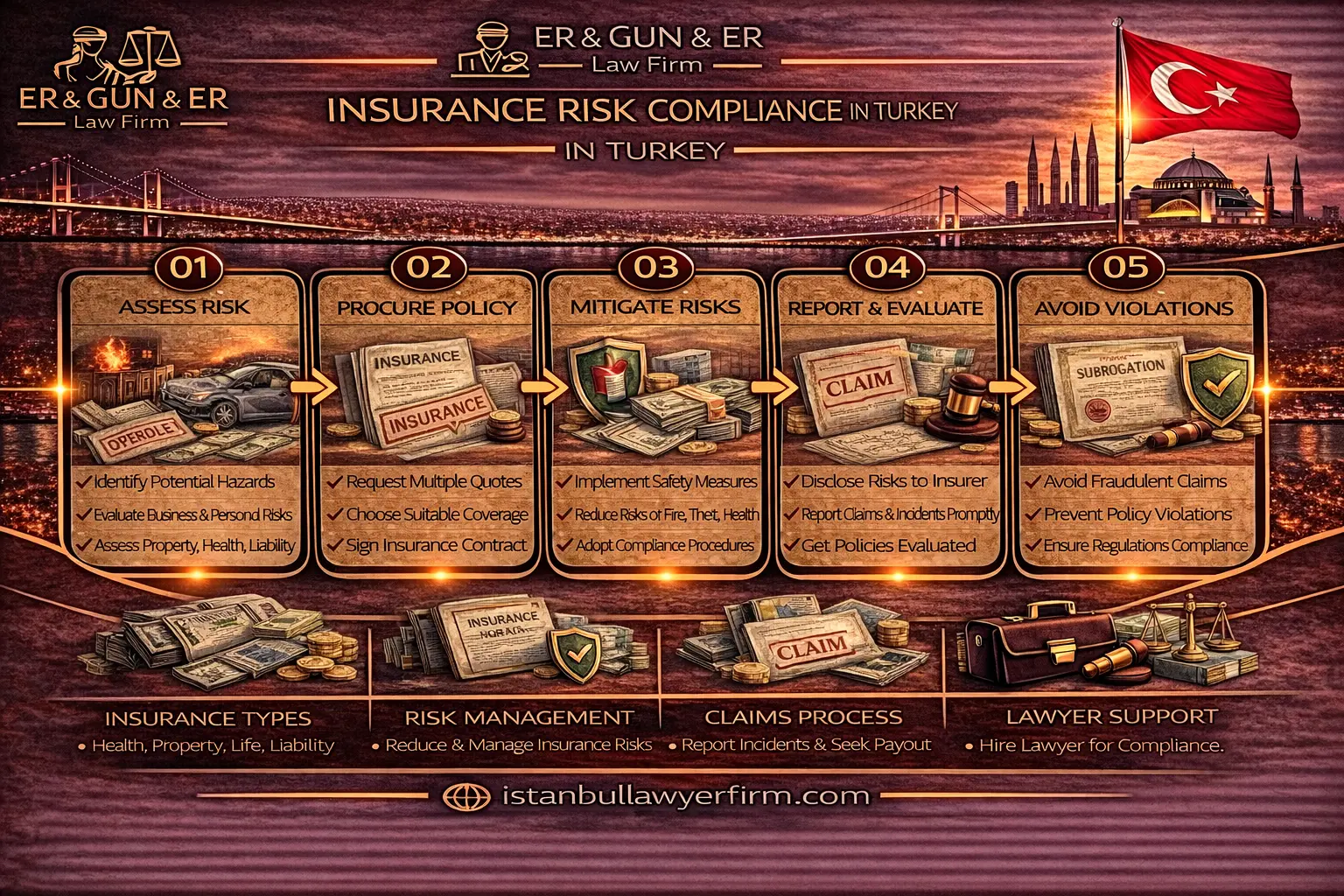
A lawyer in Turkey who advises on insurance risk compliance understands that insurance risk compliance Turkey is the set of controls that ensures insurance products and claims decisions follow applicable law, regulator expectations, and documented policy terms—and that it applies differently to insurers, intermediaries, and corporate insureds but is judged in each case by the quality of the record and the consistency of the decisions it documents. An Istanbul Law Firm that advises on insurance risk governance Turkey provides the integrated guidance covering every stage of this compliance discipline: defining the compliance perimeter covering product design, underwriting authority, policy issuance, claims handling, complaints, fraud investigation, reinsurance management, and subrogation recovery; translating that perimeter into a documented governance model whose approval chains, authority matrices, and file standards produce decisions that are defensible under regulatory review; managing the claims lifecycle as a controlled documentation process rather than as ad hoc correspondence; maintaining data retention and privacy controls that satisfy both insurance regulatory compliance Turkey expectations and general data protection obligations; and building the dispute readiness infrastructure whose completeness determines whether a claim file can be converted into a court-ready bundle without rebuilding history. A Turkish Law Firm that advises on insurance compliance for insurers, intermediaries, and corporate policyholders understands that insurance disputes rarely turn on one clause alone—because regulators, courts, and counterparties examine the end-to-end decision trail from product design through underwriting through claims—making the quality of that decision trail the primary determinant of regulatory resilience and litigation outcomes. An English speaking lawyer in Turkey who advises on insurance risk compliance for cross-border operations provides the bilingual coordination that aligns local Turkish compliance file standards with group governance frameworks and keeps documentation consistent across jurisdictions and decision-making levels. Practice may vary by authority and year — verify current Turkish insurance regulatory requirements, current claims handling standards, and current data protection obligations with qualified counsel before taking any action, since insurance compliance requirements are applied through regulatory guidance and judicial practice whose current versions determine the specific standards applicable to each organization, product line, and risk situation.
Insurance Risk Compliance Turkey: Scope, Framework and Governance Foundations
A lawyer in Turkey who advises on the scope of insurance risk compliance explains that the compliance perimeter must expressly cover the claims lifecycle as well as the underwriting and product perimeter—because claims decisions are where regulatory exposure and litigation exposure converge, and because a claims file that begins with a standardized intake record, records every request and response with timestamps and delivery proof, and documents coverage analysis as a reasoned memo tied to policy terms and factual findings consistently performs better under regulator review than a file built from informal correspondence. An Istanbul Law Firm that advises on insurance compliance scope definition helps organizations implement the specific perimeter definition most effective for each organization type: for insurers, covering product approval, underwriting authority, premium accounting, policy issuance, and every claims decision that affects coverage or quantum; for intermediaries, covering client onboarding, documentation of client instructions, and accurate transmission of risk information; and for corporate insureds, covering policy procurement decisions, internal allocation of notice and cooperation responsibilities, and compliance with claim conditions. Turkish lawyers advising on compliance scope definition help organizations understand that treating the policy as a governance document that must be mapped into operational procedures—rather than as a procurement artifact—is the foundational discipline that determines whether every downstream step is provable, and that a written compliance policy that assigns owners, sets review cadence, and defines evidence standards is the minimum documentation required to demonstrate that the compliance program is governed rather than improvised. Practice may vary by authority and year.
An Istanbul Law Firm that advises on the Turkish legal framework for insurance compliance explains that insurance compliance in Turkey sits on a layered legal base combining sector rules with general contract and litigation requirements—and that each layer must be reflected in the compliance program because a gap in any layer becomes a vulnerability when regulators or courts examine whether decisions were well-reasoned and consistently applied. Turkish lawyers advising on legal framework mapping help organizations implement the specific framework most relevant for each decision type: confirming that product approval, wording changes, and material underwriting decisions are documented against the Insurance Law and supervisory guidance; confirming that claims decisions are documented with the depth required for civil procedure evidence standards; and confirming that consumer-facing products are handled with the transparency required by consumer law where applicable. An English speaking lawyer in Turkey who advises on legal framework compliance for cross-border insurance operations provides the coordination that ensures local Turkish compliance documentation is consistent with—and can be understood by—the group-level governance and legal functions that must approve and explain compliance positions across jurisdictions. Practice may vary by authority and year.
A Turkish Law Firm that advises on governance foundations for insurance risk compliance explains that governance is strongest when it is embedded into a documented program that defines minimum file contents, assigns owners with review cadences, and records audit findings with corrective action deadlines—because a compliance program that exists only as a policy manual without tested execution is consistently harder to defend than a program that can show periodic sampling results, training completion records, and documented remediation of identified gaps. An English speaking lawyer in Turkey who advises on insurance governance program design implements the specific governance approach most effective for each organization profile: defining authority matrices for underwriting and claims whose exceptions are approved and recorded; establishing committee charters for product approval and high-value settlement authorization; and building a change management procedure for policy wordings that records every edit with rationale and effective date. The best lawyer in Turkey for insurance risk compliance matters combines knowledge of Turkish insurance law, regulatory compliance standards, governance program design, claims handling discipline, fraud investigation protocols, data retention standards, and dispute readiness infrastructure with the English-language communication that enables cross-border organizations to implement effective insurance compliance programs. Practice may vary by authority and year.
A Turkish Law Firm that advises on governance program testing explains that the single most effective discipline for maintaining a defensible insurance compliance program over time is periodic file sampling—because systematic file review reveals gaps that policy manuals do not and creates the documented evidence of continuous control that distinguishes programs whose compliance records hold up under multi-year regulatory examination from programs that rely on initial design quality whose operational reality has since drifted. An English speaking lawyer in Turkey who advises on governance program maintenance for complex insurance organizations implements the specific testing approach most effective for each organization: designing a sampling program whose scope covers underwriting files, claims files, complaint files, and intermediary files; documenting findings with corrective actions, owners, and deadlines; and confirming through the next sampling cycle that the identified gaps have been remediated. Practice may vary by authority and year.
Product Design, Disclosures and Underwriting Controls
A lawyer in Turkey who advises on product design compliance for insurance organizations explains that a product that cannot be administered consistently creates regulatory exposure because similar claims receive different outcomes—and that product files should include the target customer profile, distribution channel assumptions, and the key exclusions that drive pricing, so that claims teams and compliance reviewers can verify whether the product was administered as designed. An Istanbul Law Firm that advises on product governance and disclosure compliance helps organizations implement the specific approach most effective for each product type: version-controlling pre-contract documents so sales teams use the current wording rather than outdated summaries; aligning marketing language with the actual coverage scope so marketing statements cannot be used as evidence of broader promises; and preserving the full disclosure pack—quotation, schedule, policy wording, and delivery evidence—so the organization can later demonstrate what the policyholder received and accepted. Turkish lawyers advising on product design and disclosure compliance help organizations understand that treating disclosures as evidence instruments—rather than as sales documents—is the shift that makes the difference between a defensible file and one that cannot answer a misrepresentation allegation, and that preserving the full disclosure pack with delivery proof is more valuable in dispute defense than the most carefully drafted coverage clause. Practice may vary by authority and year.
An Istanbul Law Firm that advises on underwriting controls for insurance regulatory compliance Turkey explains that underwriting controls translate risk appetite into file-level decisions whose documentation determines whether they can be audited later—and that every risk acceptance should be supported by a documented proposal, a clear data set, and an authority record that identifies who assessed the risk and what conditions were applied. Turkish lawyers advising on underwriting compliance Turkey insurance help organizations implement the specific control approach most effective for each underwriting structure: embedding authority matrices into the underwriting platform and mirrored written delegations; documenting assumptions about occupancy, safety measures, and supply chain dependencies; recording the exact wording of risk information provided by the insured with the date received; and requiring exception memos with documented approval for any deviation from standard terms. An English speaking lawyer in Turkey who advises on underwriting control design for cross-border insurance programs provides the governance coordination that ensures underwriting documentation standards are consistent across territories and that group-level underwriting guidelines are reflected in local file structures. Practice may vary by authority and year.
A Turkish Law Firm that advises on integrated product and underwriting governance explains that quality assurance testing through periodic file sampling is the most effective way to identify whether product governance and underwriting controls are producing defensible outcomes in practice—because gaps between policy intent and file-level execution are rarely visible until a dispute or supervisory review begins. An English speaking lawyer in Turkey who advises on quality assurance for insurance compliance implements the specific sampling approach most effective for each organization: testing whether pricing assumptions match disclosed facts; confirming that exceptions were approved with documented rationale; and verifying that the issued policy matches the quoted terms including endorsements and schedules whose discrepancy is a common source of coverage disputes. Practice may vary by authority and year — verify current Turkish underwriting compliance standards, current product disclosure requirements, and current exception documentation standards with qualified counsel before implementing any underwriting or product governance program.
Policy Wording Management and Intermediary Distribution Risks
A lawyer in Turkey who advises on policy wording management explains that policy wording management is a document-control discipline whose quality is decisive in most insurance disputes—because courts test clarity and consistency between the issued wording, the claims team's communications, and the internal decision memos, and because a wording library that maintains version numbers, effective dates, and formal approval records provides the evidentiary foundation that wording disputes require. An Istanbul Law Firm that advises on insurance policy governance Turkey wording management helps organizations implement the specific approach most effective for each product line: controlling endorsements so they are not drafted ad hoc without legal review; confirming that policy schedules are consistent with the wording; managing translations carefully so inconsistent translations do not create disputes about what was understood; and storing the final issued PDF with delivery proof in a form that shows integrity and prevents alteration allegations. Turkish lawyers advising on wording governance help organizations understand that claims teams using standardized templates whose version references match the wording library produce more consistent decisions—that wording updates communicated to distribution teams through controlled bulletins prevent the unofficial interpretations that create complaint and dispute risk—and that mid-term endorsements narrowing coverage require clear policyholder acceptance records since unexplained narrowing endorsements are among the most common complaint triggers. Practice may vary by authority and year.
An Istanbul Law Firm that advises on intermediary distribution risk management explains that distribution risk is a major driver of complaints because policyholders rely on what was explained by agents or brokers—and that a compliant intermediary model records the customer's needs, the product recommended, the basis for the recommendation, and the documents delivered in a way that allows the organization to demonstrate what was asked, what was answered, and what was accepted. Turkish lawyers advising on intermediary distribution risk management help organizations implement the specific approach most effective for each distribution channel: standardizing scripts for exclusions and conditions so explanations are consistent and capable of corroboration; documenting when approved marketing materials were provided and how the customer acknowledged them; confirming whether broker communications are treated as insurer notice under the policy; and performing periodic file sampling of intermediary sales to test disclosure quality. An English speaking lawyer in Turkey who advises on intermediary distribution compliance for cross-border insurance programs provides the governance coordination that ensures intermediary control standards are consistently applied across distribution channels and that intermediary training records are maintained in a format accessible for audit and supervisory review. Practice may vary by authority and year.
A Turkish Law Firm that advises on the litigation dimensions of intermediary distribution risk explains that intermediary disputes create litigation risk because customers may sue intermediaries, insurers, or both based on sales conduct and documentation gaps—and that the compliant intermediary file whose contents include a call note log, a delivered document list, and a clear acknowledgment trail consistently produces better litigation outcomes than a file assembled reactively after a complaint is filed. An English speaking lawyer in Turkey who advises on integrated wording and intermediary governance for complex insurance programs implements the specific approach that confirms intermediary files align with insurer files—so that customers receive consistent explanations and the organization can respond to complaints with one coherent factual narrative rather than contradictory accounts from different channels. Practice may vary by authority and year.
KYC, AML and Personal Data Compliance
A lawyer in Turkey who advises on KYC and AML compliance for insurance organizations explains that KYC requirements insurance Turkey processes must define what identity data is collected at onboarding, how it is verified, and how verification is recorded—and that AML compliance insurance intermediaries Turkey requires risk-based controls rather than blanket practices, with documented customer risk ratings that are reviewed periodically rather than stored as one-time checkboxes. An Istanbul Law Firm that advises on KYC and AML program design for insurance organizations helps implement the specific compliance approach most effective for each organization type: recording the customer identity verification method and keeping proof in the file; collecting beneficial ownership information for legal entities and updating it when ownership changes; monitoring payment methods for unusual patterns that indicate layering risk; and documenting escalation decisions with a factual basis that avoids inflammatory language whose defamation risk exceeds its investigative value. Turkish lawyers advising on KYC and AML governance help organizations understand that a mature control program balances data minimization—whose operational importance is that excessive collection increases breach risk—with defensible verification and monitoring whose absence creates supervisory and reputational exposure, and that consistent application of AML escalation criteria across similar customer profiles is the governance discipline that prevents selective treatment allegations. Practice may vary by authority and year.
An Istanbul Law Firm that advises on personal data compliance for insurance organizations explains that insurance underwriting and claims require collection of identity, health, and financial information whose protection under personal data protection insurance Turkey requirements demands role-based access, audit logs, controlled retention, and secure external disclosure management. Turkish lawyers advising on data governance for insurance compliance help organizations implement the specific approach most effective for each data category: designing claims files to separate core claim evidence from sensitive identity documents so court disclosures can be limited to what is necessary; implementing deletion workflows that are controlled rather than ad hoc so deletion decisions are documented and spoliation allegations can be rebutted; and building retrieval protocols that allow fast production for regulator requests without exposing unnecessary personal data. An English speaking lawyer in Turkey who advises on personal data compliance for cross-border insurance programs provides the bilingual data governance framework that keeps Turkish-side data protection records aligned with group privacy policies—preventing the situation where local and group approaches diverge in ways that create inconsistent disclosures or contradictory access records. Practice may vary by authority and year.
A Turkish Law Firm that advises on the integration of KYC, AML, and personal data compliance with insurance risk governance explains that these three compliance dimensions must be managed as an integrated system rather than as separate programs—because claims payment verification, customer identity confirmation, data minimization, and fraud investigation all rely on the same underlying records and the same file structure, making a fragmented approach consistently more vulnerable to compliance gaps than an integrated one. An English speaking lawyer in Turkey who advises on integrated KYC, AML, and privacy governance for insurance organizations implements the specific approach most effective for each organization profile: aligning customer data request procedures with legal obligation explanations so customers receive factual responses rather than unexplained barriers; confirming that intermediary training on AML red flags is documented and completion is tracked; and building a data subject request protocol that responds without compromising investigation integrity. Practice may vary by authority and year — verify current Turkish KYC, AML, and personal data protection requirements applicable to insurance organizations with qualified counsel before implementing any compliance program.
Claims Handling Discipline and Fraud Investigation Controls
A lawyer in Turkey who advises on claims handling discipline explains that claims handling is the point where risk promises are tested against facts—and that a compliant intake process that confirms policy identity, creates a coverage triage note before any substantive correspondence, records every document request with delivery proof, and indexes every incoming document with its receipt date consistently performs better under both regulator review and litigation scrutiny than an intake process whose steps are informal and whose decisions are recorded as conclusion-only emails. An Istanbul Law Firm that advises on claims handling compliance Turkey for insurers and corporate insureds helps implement the specific claims approach most effective for each organization: assigning each claim a complexity rating that drives the depth of review; confirming that reservation letters are sent early and stored with delivery proof; and ensuring that coverage memos match denial letters so the organization does not appear to change its reasons between internal analysis and external communication. Turkish lawyers advising on claims handling compliance help organizations understand that inconsistent letters are among the most frequently cited complaint and litigation triggers—that a template-based approach whose templates reference the correct wording version consistently reduces this risk—and that denying a claim for a reason not in the internal coverage memo is the single most avoidable cause of complaint and litigation escalation. Practice may vary by authority and year.
An Istanbul Law Firm that advises on fraud investigation controls for insurance organizations explains that insurance fraud investigation Turkey must be governed through written criteria whose objective triggers—rather than subjective impressions—determine when a claim is escalated, how the investigation is conducted, and what evidence supports the final decision. Turkish lawyers advising on fraud investigation governance help organizations implement the specific approach most effective for each investigation type: assigning escalated files to a separate trained function to demonstrate that coverage analysis is not biased by suspicion; documenting investigative requests as proportionate and justified so they cannot be framed as harassment; preserving digital evidence with documented chain of custody to protect admissibility; and confirming that external investigators operate under confidentiality and deliverable standards that are recorded in vendor contracts. An English speaking lawyer in Turkey who advises on fraud investigation compliance for cross-border insurance organizations provides the governance coordination that aligns local investigation protocols with group-level compliance standards—preventing the inconsistent escalation treatment that supervisors frame as unequal application of fraud controls. Practice may vary by authority and year.
A Turkish Law Firm that advises on integrated claims and fraud governance explains that a defensible claims file must anticipate that the matter may move from correspondence into formal insurance dispute resolution Turkey—and that the first safeguard is a clear coverage memo that ties each conclusion to a specific policy clause and a specific factual exhibit, is updated when new facts arrive with a dated record of why the conclusion changed, and whose content is consistent with every external communication the organization has produced throughout the claim. An English speaking lawyer in Turkey who advises on dispute-ready claims file management for complex insurance situations implements the specific approach most effective for each dispute risk profile: freezing the file for version control and metadata preservation when litigation is threatened; confirming that expert instructions use terms of reference that match clause elements and factual uncertainties rather than requesting broad investigations; and preparing a calculation worksheet whose transparency allows experts to audit quantum without reconstructing transactions. Practice may vary by authority and year.
Reinsurance, Recoveries and Subrogation Governance
A lawyer in Turkey who advises on reinsurance governance explains that reinsurance recoveries Turkey compliance depends on treating the reinsurance file as a parallel file opened at first notice—because recoveries fail most often due to late notice, incomplete documentation, or mismatches between the primary claim file and the reinsurance wording—and that mirroring key claim documents into the reinsurance file with a consistent index and version control, recording when notice was given to reinsurers and what information was provided, and aligning expert instructions so reports answer both primary and reinsurance questions are the three most effective single actions for improving recovery rates. An Istanbul Law Firm that advises on reinsurance governance for insurance organizations helps implement the specific reinsurance compliance approach most effective for each program structure: confirming authority for reinsurance communication and settlement approval against the insurance policy governance Turkey framework; preserving the underwriting submission used for placement because misrepresentation disputes hinge on that document; and documenting operational team training on reinsurance conditions including cooperation and consent elements so settlements are not agreed in a way that breaches reinsurance conditions. Turkish lawyers advising on reinsurance governance help organizations understand that a controlled reinsurance workflow whose file structure mirrors the primary claim file is consistently more defensible in reinsurance disputes than a workflow whose documents must be reconstructed from email archives. Practice may vary by authority and year.
An Istanbul Law Firm that advises on subrogation rights Turkey insurance and recourse claims insurance Turkey management explains that subrogation and recourse recoveries must be governed as scheduled workflows with assigned owners—because recovery files whose evidence was not preserved during the primary claim investigation and whose targets were not identified promptly consistently produce lower recovery rates than files that opened recovery planning on the first day of loss. Turkish lawyers advising on subrogation and recourse governance help organizations implement the specific recovery approach most effective for each loss type: preserving third-party identifiers, contracts, and site records from first notice; drafting expert instructions that address both coverage and third-party liability so one report supports both proceedings; confirming that payment proof and settlement terms are preserved since defendants frequently challenge whether the insurer actually paid; and evaluating the solvency of recovery targets before investing litigation budget in collection against insolvent defendants. An English speaking lawyer in Turkey who advises on cross-border subrogation and recovery governance provides the coordination that ensures recovery letters and primary claim letters use consistent causal characterizations—preventing the factual inconsistencies that defendants exploit to challenge causation in recovery proceedings, and aligns the recovery file structure with the primary claim file so inconsistencies cannot be used against the organization in either the insurance dispute or the recourse proceeding. Practice may vary by authority and year.
A Turkish Law Firm that advises on integrated reinsurance and recovery governance explains that the strategic advantage of early recovery planning is that the evidence created during the primary investigation—adjuster reports, expert findings, site inspection records, and causation analysis—can be reused in recovery proceedings without requiring new investigations whose cost and delay consistently reduce net recovery value. An English speaking lawyer in Turkey who advises on integrated reinsurance and subrogation program governance implements the specific approach most effective for each portfolio: documenting recovery allocation agreements between insurer and reinsurer before disputes arise; aligning recourse file structure with the primary claim file so inconsistencies cannot be used against the organization in either proceeding; and confirming that waiver of subrogation decisions are approved through the authority matrix and recorded so the organization can explain how the waiver was priced. Practice may vary by authority and year — verify current Turkish subrogation rights, current reinsurance compliance standards, and current recovery documentation requirements with qualified counsel before implementing any recovery governance program.
Data Retention, Privacy and Complaints Management
A lawyer in Turkey who advises on data retention and privacy for insurance organizations explains that data retention insurance Turkey must be defined through a schedule that maps each document type to a business purpose and a lawful basis—and that deletion should be controlled through workflow rather than ad hoc mailbox cleanup because deletion without a documented trace creates spoliation allegations in litigation and triggers regulatory questions about record integrity. An Istanbul Law Firm that advises on data retention and privacy governance for insurance compliance helps organizations implement the specific approach most effective for each file category: distinguishing minimum evidence sets that must be retained intact for underwriting, policy issuance, claims, complaint, and fraud files; implementing version control for policy wordings so the correct wording can be retrieved years later; and building litigation hold protocols that pause routine deletion when a dispute becomes reasonably anticipated. Turkish lawyers advising on data retention and privacy governance help organizations understand that a litigation hold whose scope covers emails, adjuster reports, photographs, and system logs—and whose trigger date and scope are documented—is the single most important technical safeguard for converting a live file into a court-ready bundle without reconstruction. Practice may vary by authority and year.
An Istanbul Law Firm that advises on the insurance complaints process Turkey explains that complaints should be treated as mini-audits because they force the organization to explain a decision in writing under conditions that can lead to regulatory review or litigation escalation—and that a complaints intake process that logs the exact relief requested, classifies the complaint into a taxonomy, assigns an independent reviewer, and stores delivery proof for the response consistently performs better in supervisory review than an ad hoc process whose files must be reconstructed when regulatory examination begins. Turkish lawyers advising on complaints management help organizations implement the specific approach most effective for each complaint category: confirming that coverage denial complaints attach the relevant wording version and factual findings; confirming that sales conduct complaints attach the delivered disclosure pack and acknowledgment trail; and maintaining a trend review process that converts complaint pattern analysis into product and process remediation. An English speaking lawyer in Turkey who advises on complaints management for cross-border insurance organizations provides the bilingual governance coordination that ensures complaints received from foreign-domiciled policyholders receive responses whose factual narrative is consistent with the local Turkish claim file. Practice may vary by authority and year.
A Turkish Law Firm that advises on dispute escalation management explains that when a complaint progresses toward formal insurance dispute resolution Turkey, the organization should perform a file integrity check confirming the correct policy version, endorsements, and schedule; retrieving portal or email delivery logs if delivery proof is missing; confirming that all adjuster reports are signed, dated, and version-controlled; and preparing the calculation worksheet that an expert can audit without reconstructing transactions. An English speaking lawyer in Turkey who advises on integrated complaints and dispute management for insurance organizations implements the specific escalation approach most effective for each dispute profile: building the litigation bundle from the same documents used throughout the complaint so there is no narrative inconsistency between the complaint response and the court submission; preparing a redaction plan in advance so privacy-safe disclosure can proceed quickly; and freezing the relevant file before any litigation step to prevent alteration allegations. Practice may vary by authority and year.
Litigation Readiness and Dispute Preparation
A lawyer in Turkey who advises on litigation readiness for insurance compliance explains that litigation readiness means the organization can turn a live claim file into a court-ready bundle without rewriting history—and that the readiness file should begin with the final issued policy, endorsements, schedules, and delivery proof, then include the complete notice chronology and document request trail, the adjuster and expert instructions with the original mandates, the internal decision memos with their factual exhibit links, the payment proofs and calculation worksheets, and the complaint record. An Istanbul Law Firm that advises on litigation readiness for insurance organizations helps implement the specific readiness infrastructure most effective for each dispute risk profile: triggering litigation holds as soon as a dispute is reasonably anticipated with documented date and scope; maintaining a system mapping note that explains where each record sits and how it was retrieved so disclosure is defensible; and testing readiness through mock disclosure exercises so retrieval gaps are found before a filing deadline creates them. Turkish lawyers advising on litigation readiness help organizations understand that procedural mistakes—flawed service, missing forum analysis, inconsistent wording version references—often cause more avoidable loss than substantive coverage arguments, making the readiness file a procedural tool as much as an evidentiary one. Practice may vary by authority and year.
An Istanbul Law Firm that advises on dispute preparation strategy for complex insurance matters explains that the first petition whose coverage trigger facts are separated from notice and cooperation facts, whose denial or underpayment letter is attached as the court's point of reference, and whose evidence bundle is organized in a dated chronology whose exhibits are numbered and internally referenced consistently produces a more focused and efficient proceeding than a petition assembled from correspondence not originally designed for court review. Turkish lawyers advising on dispute preparation help organizations implement the specific preparation approach most effective for each forum type: confirming whether the likely forum is a commercial court, consumer forum, or arbitration mechanism and documenting that analysis before filing; aligning expert question sets with specific clause elements and factual uncertainties so expert work answers legal questions rather than generating background information; and centralizing all communications with opposing counsel so fragmented emails from different departments do not create contradictory admissions. An English speaking lawyer in Turkey who advises on litigation preparation for cross-border insurance disputes provides the bilingual bundle management that ensures all translations are consistent and that every claim element is supported by an exhibit whose delivery to the counterparty is evidenced. Practice may vary by authority and year.
A Turkish Law Firm that advises on practical roadmap implementation for insurance risk compliance Turkey explains that a mature compliance program that converts risk governance into a documented control system—with policy registers, authority matrices, wording libraries, claims intake protocols, complaint intake protocols, fraud escalation criteria, reinsurance notification protocols, privacy and retention controls, and litigation hold procedures—is easier to defend under regulatory review not because it contains more documents but because each step produces a document that can be shown to a supervisor or court without reconstruction. An English speaking lawyer in Turkey who advises on compliance program implementation for complex insurance organizations provides the systematic implementation support that ensures each compliance component is operationally tested before it is relied upon—including mock retrieval exercises, tabletop dispute simulations, sampling audit design, and training completion tracking—so that when regulators or courts examine the file, the organization can demonstrate continuous control rather than reactive crisis management. Practice may vary by authority and year — verify current Turkish insurance regulatory requirements, current claims handling standards, and current data retention and privacy obligations with qualified counsel before implementing or updating any insurance risk compliance program, since compliance requirements are applied through regulatory guidance and judicial practice whose current versions determine the specific standards applicable to each organization, product line, and risk situation. Practice may vary by authority and year.
A Turkish Law Firm that advises on the integration of all insurance compliance dimensions explains that the practical advantage of an integrated compliance program—where product governance, underwriting controls, wording management, intermediary oversight, KYC and AML, claims handling, fraud investigation, reinsurance governance, data retention, complaints management, and litigation readiness are all managed as components of one documented system rather than as separate initiatives—is that when a dispute or regulatory inquiry arrives, the organization can produce one coherent chronological file that answers every question from product design through claims decision without revealing the gaps that separate programs consistently create between their respective records. An English speaking lawyer in Turkey who advises on integrated compliance program implementation for complex insurance organizations provides the systematic implementation support that ensures each component is tested, cross-referenced with the others, and updated when regulatory guidance or litigation experience reveals a gap—converting insurance compliance from a reactive cost into a proactive governance investment whose return is measured in reduced regulatory friction, reduced dispute frequency, and reduced claim leakage. Practice may vary by authority and year.
A Turkish Law Firm that advises on compliance program testing and continuous improvement explains that a compliance program that is documented but not tested is consistently less defensible than one whose periodic sampling results, training completion records, and documented remediation of audit findings demonstrate that the program is operational rather than theoretical—and that the most effective improvement approach is using dispute experience and complaint pattern analysis as systematic feedback that updates templates, refines training, and adjusts escalation criteria based on what actually created friction rather than on what compliance programs theoretically prevent. An English speaking lawyer in Turkey who advises on compliance program improvement for international insurance organizations implements the specific improvement cycle most effective for each organization profile: conducting post-dispute reviews that identify the specific documentation failure, terminology inconsistency, or evidence gap that contributed to the dispute; converting those findings into updated operational procedures and file templates; and confirming through the next sampling cycle that the updated procedures are being consistently applied. Practice may vary by authority and year.
A Turkish Law Firm that advises on the governance of insurance compliance programs over time explains that the most common compliance program failure is not poor initial design but gradual drift—where policy wordings change without corresponding updates to claims team templates, where new intermediaries are onboarded without standardized training, where KYC records become stale without update workflows, or where data retention schedules fail to account for new document categories created by new products—and that establishing a change management discipline whose each change is documented with approval and effective date and whose operational impact is tested through targeted sampling before the next audit cycle is the governance commitment that distinguishes programs whose compliance records remain defensible years after implementation from programs that perform well initially but accumulate unremediated gaps. An English speaking lawyer in Turkey who advises on long-term insurance compliance governance provides the systematic program management that keeps the compliance infrastructure aligned with operational reality throughout the product lifecycle. Practice may vary by authority and year.
Frequently Asked Questions
- What is insurance risk compliance Turkey and who does it apply to? Insurance risk compliance Turkey is the operational control system that ensures products, underwriting decisions, claims outcomes, and customer communications follow applicable law, regulator expectations, and documented policy terms. It applies to insurers in their product and claims governance, to intermediaries in their sales conduct and documentation discipline, and to corporate insureds in their notice, cooperation, and evidence preservation obligations. Practice may vary by authority and year.
- What is the legal framework for insurance regulatory compliance Turkey? Insurance compliance sits on a layered framework combining the Insurance Law, supervisory guidance, general commercial law and the Turkish Commercial Code, consumer law where applicable, civil procedure rules for evidence and service, and corporate governance standards. Each layer must be reflected in the compliance program because gaps in any layer create vulnerabilities in regulatory review and litigation. Practice may vary by authority and year.
- What governance foundations support insurance policy governance Turkey? Core governance elements include an authority matrix for underwriting and claims decisions, committee charters for product approval and high-value settlement authorization, a version-controlled wording library with approval records, documented exception approval workflows, and periodic file sampling whose findings are recorded with corrective action deadlines. Practice may vary by authority and year.
- How should underwriting compliance Turkey insurance be managed? Every risk acceptance should be documented with the proposal data, verified risk information, authority level, and exception approvals. Assumptions about occupancy, safety measures, and supply chain dependencies should be explicitly recorded. Renewals should be treated as re-underwriting events with a checklist rather than auto-rollovers. File sampling should test whether pricing assumptions match disclosed facts. Practice may vary by authority and year.
- What is required for claims handling compliance Turkey? A compliant claims process creates a coverage triage note before substantive correspondence, records every request and response with delivery proof, indexes incoming documents with receipt dates, and ensures coverage memos match denial letters. Complaint handling should be routed to an independent reviewer. Investigation steps for fraud-suspected claims should follow objective documented criteria. Practice may vary by authority and year.
- What are the requirements for insurance fraud investigation Turkey? Escalation should be based on documented objective triggers rather than subjective suspicion. Escalated files should be assigned to a separate trained function. Investigative requests should be proportionate and justified. Digital evidence must preserve chain of custody. External investigators should operate under confidentiality and deliverable standards documented in vendor contracts. Practice may vary by authority and year.
- How should AML compliance insurance intermediaries Turkey and KYC requirements insurance Turkey be managed? Identity verification must be documented with the verification method and proof. Beneficial ownership must be collected for entities and updated. Payment patterns must be monitored for unusual risk indicators. Risk ratings must be reviewed periodically. Escalation decisions must be approved through a defined chain with a factual basis. Intermediary training on AML red flags must be documented and tracked. Practice may vary by authority and year.
- What is required for personal data protection insurance Turkey compliance? Role-based access controls, audit logs, controlled retention schedules, and secure external disclosure management are required. Claims files should separate core evidence from sensitive identity documents. Deletion must be controlled through documented workflows. Litigation hold protocols must pause routine deletion when disputes are anticipated. Redaction procedures should be tested before litigation disclosure is required. Practice may vary by authority and year.
- How should reinsurance recoveries Turkey compliance be managed? A reinsurance file should open at first notice and mirror primary claim documents with a consistent index. Notice to reinsurers should be documented with the information provided. Expert instructions should be designed to answer both primary and reinsurance questions. Settlement rationale should be preserved since reinsurers may argue settlements were unreasonable. Allocation agreements should be documented before disputes arise. Practice may vary by authority and year.
- How should subrogation rights Turkey insurance and recourse claims insurance Turkey governance work? Recovery planning should begin on the first day of loss by preserving third-party identifiers, contracts, and site records. Expert instructions should address both coverage and liability causation. Payment proof and settlement terms must be preserved. Target solvency should be assessed before investing litigation budget. Waiver of subrogation decisions should be approved through the authority matrix and recorded. Practice may vary by authority and year.
- What are the data retention insurance Turkey requirements for insurance organizations? A retention schedule mapping each document type to its business purpose and lawful basis is required. Each file category—underwriting, claims, complaint, fraud—should have a minimum evidence set whose intact retention is confirmed by audit. Wording versions must be retained so the correct version can be retrieved years later. Deletion must be documented rather than ad hoc. Practice may vary by authority and year.
- How should the insurance complaints process Turkey be managed? Complaints should be logged with the exact relief requested, classified into a taxonomy, assigned to an independent reviewer, and documented with delivery proof for the response. Trend reviews should convert complaint patterns into product and process remediation. The complaint file should be stored with the same exhibit index as the underlying claim file so responses and claim positions are consistent. Practice may vary by authority and year.
- What is insurance dispute resolution Turkey readiness and how is it achieved? Dispute readiness means the organization can convert a live claims file into a court-ready bundle without rewriting history. It requires a litigation hold protocol triggered when disputes are anticipated, a system mapping note showing where each record is held, tested retrieval procedures, expert mandates whose question sets mirror clause elements, and a disclosure protocol that is privacy-safe and prepared in advance. Practice may vary by authority and year.
- When should an insurance lawyer Turkey compliance engagement begin? Insurance lawyer Turkey compliance engagement is most valuable when initiated at program design or renewal rather than at the point of dispute—because early engagement produces governance templates, wording standards, and file structures that prevent the documentation gaps that create most disputes. For complex claims and investigations, early counsel engagement helps control communications and preserve admissible evidence before informal statements create avoidable complications. Practice may vary by authority and year.
- Does ER&GUN&ER Law Firm provide legal services for insurance risk compliance in Turkey? Yes. ER&GUN&ER Law Firm provides legal services for insurance risk compliance in Turkey including compliance scope and perimeter definition, legal framework mapping, governance program design, product disclosure and wording review, underwriting control advisory, policy wording management, intermediary distribution compliance, KYC and AML program design, personal data protection advisory, claims handling compliance review, fraud investigation protocol design, reinsurance governance, subrogation and recourse program design, data retention program design, complaints management advisory, and litigation readiness preparation—with English-language client communication and bilingual documentation throughout each engagement.
Author: Mirkan Topcu is an attorney registered with the Istanbul Bar Association (Istanbul 1st Bar), Bar Registration No: 67874. His practice focuses on cross-border and high-stakes matters where evidence discipline, procedural accuracy, and risk control are decisive.
He advises individuals and companies across Immigration and Residency, Real Estate Law, Tax Law, and cross-border documentation matters where procedural accuracy and evidence discipline are decisive.
Education: Istanbul University Faculty of Law (2018); Galatasaray University, LL.M. (2022). LinkedIn: Profile. Istanbul Bar Association: Official website.