

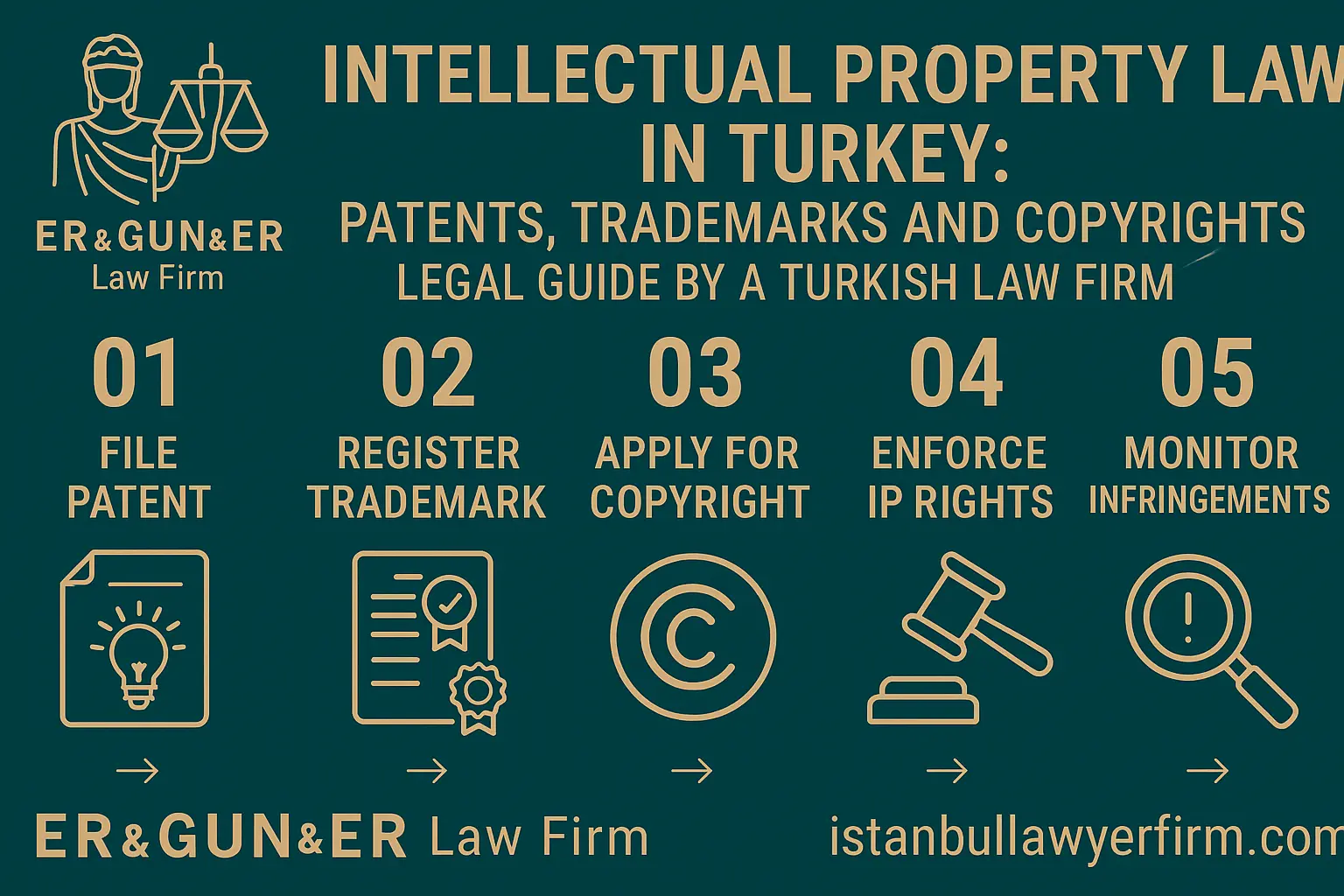
A lawyer in Turkey who advises on intellectual property understands that protecting creative, technological, and commercial assets in Turkey requires both strategic planning before rights are secured and disciplined enforcement after they are registered—and that most IP disputes arise not from the absence of registered rights but from inadequate clearance before adoption, incomplete registration coverage, documentation gaps that weaken infringement claims, or licensing arrangements that leave enforcement rights ambiguous. An Istanbul Law Firm that advises on intellectual property law in Turkey provides the integrated guidance covering every dimension of IP protection: conducting clearance searches and filing trademark, patent, design, and utility model applications at the Turkish Patent and Trademark Office; securing copyright protection for creative works and advising on the automatic and registration-based dimensions of Turkish copyright law; drafting trade secret protection frameworks including confidentiality agreements, internal access controls, and disciplinary policies; negotiating and drafting licensing, technology transfer, and co-development agreements whose terms protect rights holders while enabling commercial exploitation; pursuing civil, administrative, and criminal enforcement measures when IP rights are violated; representing clients in IP litigation and dispute resolution; and advising on the IP dimensions of digital innovation including software, artificial intelligence-generated content, and domain name disputes. A Turkish Law Firm that advises on intellectual property law in Turkey understands that the most effective IP protection combines registered rights, contractual protections, operational security measures, and rapid response enforcement capacity—because each dimension addresses a category of risk that the others cannot fully cover. An English speaking lawyer in Turkey who advises on intellectual property for international clients provides the bilingual coordination that enables multinational brand owners, technology companies, and creative enterprises to navigate Turkish IP procedures, communicate with Turkish authorities, and coordinate Turkish enforcement actions with their global IP strategies. Practice may vary by authority and year — verify current Turkish IP law requirements, current registration procedures, and current enforcement mechanisms with qualified counsel before taking any action, since IP registration and enforcement procedures are applied through TPTO decisions and judicial practice whose current versions determine the specific requirements applicable to each right type and each factual situation, and since legal developments in digital IP, artificial intelligence content, and online marketplace enforcement continue to create new requirements whose application to specific facts must be assessed against current guidance rather than historical practice. Practice may vary by authority and year.
Trademark Registration, Protection and Enforcement in Turkey
A lawyer in Turkey who advises on trademark registration explains that securing trademark rights in Turkey begins at the Turkish Patent and Trademark Office—TPTO—and requires a structured approach that combines clearance searches, strategically drafted applications, active monitoring during the publication period, and responsive handling of oppositions and objections. An Istanbul Law Firm that advises on trademark registration in Turkey helps clients implement the specific registration approach most effective for each brand profile: conducting availability searches before adoption to identify conflicting prior registrations and unregistered marks with established reputation; preparing applications for word marks, figurative marks, three-dimensional marks, and combined marks with specifications whose breadth is strategically calibrated to the goods and services the brand will cover; submitting evidence of use where required; and managing the opposition period by monitoring publications and responding promptly to any oppositions filed. Turkish lawyers advising on trademark registration help clients understand that a clearance search conducted before a brand is adopted is consistently more cost-effective than addressing conflicts discovered during or after registration—because discovering a conflict during the registration process may require rebranding that has already been implemented in marketing, packaging, and customer communications, and because a trademark whose clearance was properly conducted before registration is significantly more defensible against bad faith invalidation claims. Practice may vary by authority and year.
An Istanbul Law Firm that advises on multi-jurisdictional trademark protection helps international brand owners understand that Turkish trademark registration is independent of trademark rights in other countries—and that international trademark registration through the Madrid Protocol, while not a substitute for a Turkish national application in all circumstances, can extend protection to Turkey as part of a coordinated multi-jurisdictional registration strategy. Turkish lawyers advising on multi-jurisdictional trademark management help clients implement the specific approach most effective for each portfolio: structuring the Turkish registration strategy to align with the brand's global market presence; coordinating Madrid Protocol international applications with Turkish national applications where both are appropriate; monitoring for potentially conflicting applications filed by third parties; and maintaining registrations through timely renewals and declarations of use. An English speaking lawyer in Turkey who advises on trademark protection for international brand owners provides the bilingual coordination that ensures clearance search results, application status updates, opposition notices, and renewal reminders are communicated clearly in a format that enables informed decisions by brand management teams. Practice may vary by authority and year.
A Turkish Law Firm that advises on trademark enforcement in Turkey explains that when trademark infringement occurs—through unauthorized use of identical or confusingly similar marks on competing goods and services, through counterfeit goods at physical or online retail, or through infringing imports at Turkish customs—the most effective enforcement approach combines civil proceedings, administrative measures, and customs interception rather than relying on any single enforcement track. An English speaking lawyer in Turkey who advises on trademark enforcement for international rights holders implements the specific enforcement approach most effective for each infringement situation: preparing and submitting cease-and-desist correspondence that creates a documented pre-litigation record; filing customs watch applications that enable interception of infringing imports at Turkish ports and border crossings; monitoring online marketplaces including Trendyol, Hepsiburada, and other Turkish e-commerce platforms for unauthorized offers; and preparing civil infringement proceedings before Turkish courts whose claims include injunctive relief, seizure of infringing goods, and damages. Practice may vary by authority and year.
Patents, Utility Models and Technology Rights in Turkey
A lawyer in Turkey who advises on patent protection explains that patents and utility models are the primary mechanisms for protecting technical innovations in Turkey—with patents providing longer protection for inventions that satisfy the novelty, inventive step, and industrial applicability criteria, and utility models providing faster protection with a lower inventive step threshold for mechanical innovations. An Istanbul Law Firm that advises on patent and utility model applications helps inventors and technology companies implement the specific protection approach most effective for each innovation: conducting freedom-to-operate analysis before commercialization to identify potentially blocking patents; preparing patent applications with claims, descriptions, and drawings whose scope protects the commercial embodiment while providing reasonable breadth against design-arounds; managing the national application process through TPTO substantive examination; handling PCT national phase entry for inventions with international patent coverage; and coordinating with priority applications in other jurisdictions. Turkish lawyers advising on patent applications help clients understand that the quality of the initial application—particularly the claims drafting—is the single most important determinant of the ultimate scope of protection, making investment in careful drafting more valuable than savings achieved through abbreviated specifications, and that claims drafted too narrowly to be commercially useful are as problematic as claims invalidated during examination for being drafted too broadly. Practice may vary by authority and year.
An Istanbul Law Firm that advises on patent licensing and technology transfer in Turkey explains that patents and utility models create commercial value primarily through licensing, technology transfer, and cross-licensing arrangements whose terms determine both the revenue generated and the enforcement rights retained. Turkish lawyers advising on patent licensing help clients implement the specific licensing approach most effective for each technology commercialization situation: structuring exclusive, non-exclusive, and field-of-use limited licenses whose territorial and temporal scope reflects the rights holder's commercial strategy; drafting royalty formulas and milestone payment provisions that are transparent, auditable, and linked to verifiable performance metrics; including enforcement coordination provisions that clarify when the licensor and licensee each have authority to pursue infringers; and coordinating patent licensing with regulatory requirements in regulated sectors. An English speaking lawyer in Turkey who advises on patent licensing and technology transfer for international technology companies provides the bilingual contract drafting and regulatory coordination that ensures license agreements satisfy Turkish legal requirements while remaining consistent with the global licensing framework the technology company uses across other jurisdictions. Practice may vary by authority and year.
A Turkish Law Firm that advises on patent maintenance and portfolio management explains that patents and utility models require active management to maintain their value—through timely payment of annual fees, monitoring of potentially invalidating prior art publications, and assessment of whether the portfolio is appropriately aligned with the current and future commercial activities it is intended to protect. An English speaking lawyer in Turkey who advises on patent portfolio management for international technology companies provides the systematic portfolio review that identifies patents whose maintenance is commercially justified, opportunities for licensing or monetization, and gaps in protection that should be addressed through new applications. Practice may vary by authority and year.
Copyright, Industrial Design and Trade Secret Protection
A lawyer in Turkey who advises on copyright protection explains that copyright arises automatically in Turkey upon the creation of an original literary, musical, artistic, or scientific work—without registration—but that documentation of creation date, authorship, and the work's content is essential for enforcement because copyright disputes frequently focus on proving priority and the scope of the work at the time of creation. An Istanbul Law Firm that advises on copyright protection for creative works and software helps rights holders implement the specific protection approach most effective for each work type: establishing a dated documentation practice that captures the work at each development stage with authorship records; registering works with TPTO where voluntary registration is available and beneficial for enforcement evidence; drafting work-for-hire, assignment, and exclusive license agreements that correctly transfer ownership where a business needs to hold rights in works created by employees or contractors; and managing moral rights dimensions of Turkish copyright law that persist even after economic rights transfer. Turkish lawyers advising on copyright protection help clients understand that software receives copyright protection in Turkey as a literary work, making the documentation of original code authorship particularly important for tech companies who may need to enforce against copying or unauthorized distribution—and that version control systems and development logs, when maintained consistently, provide the contemporaneous creation evidence that makes enforcement most efficient. Practice may vary by authority and year.
An Istanbul Law Firm that advises on industrial design protection in Turkey explains that registered industrial designs protect the external appearance of a product or a part of a product as determined by lines, contours, colors, shapes, textures, and materials—and that design registration through TPTO provides an exclusivity period during which third parties cannot use the protected appearance without authorization. Turkish lawyers advising on design registration help clients implement the specific registration approach most effective for each design portfolio: assessing novelty and individual character before filing; preparing design drawings that accurately depict the protected appearance from all relevant angles; managing the disclosure and grace period rules that affect whether prior disclosure by the designer creates novelty problems; and coordinating Turkish design registrations with international design registrations through the Hague System. An English speaking lawyer in Turkey who advises on design protection for international product companies provides the bilingual coordination that ensures Turkish design registrations are aligned with the global design portfolio strategy—so that protection gaps and filing sequencing decisions reflect the company's commercial priorities across all markets. Practice may vary by authority and year.
A Turkish Law Firm that advises on trade secret protection explains that trade secrets—confidential business information providing commercial advantage—are protected under Turkish law through a combination of unfair competition law, employment law, and contractual arrangements whose practical effectiveness depends on the organization implementing appropriate security measures and enforcing those measures consistently. An English speaking lawyer in Turkey who advises on trade secret protection programs implements the specific protection approach most effective for each organization: drafting confidentiality agreements for employees, contractors, consultants, and business partners whose scope is calibrated to the sensitivity of the information shared; establishing information classification systems that identify which information receives trade secret protection and what access controls apply; implementing digital access controls, audit logs, and monitoring that create the documented security measures required for trade secret status; advising on investigative procedures and interim injunction applications when trade secret misappropriation is suspected; and conducting trade secret audits that identify information currently unprotected by adequate contractual or technical measures before that information is disclosed to third parties in circumstances that compromise its confidential status. The best lawyer in Turkey for intellectual property matters for international companies combines knowledge of Turkish trademark, patent, copyright, design, and trade secret law with commercial licensing expertise, enforcement strategy, and the English-language communication that enables international IP rights holders to manage their Turkish IP portfolio effectively. Practice may vary by authority and year.
IP Licensing, Technology Transfer and Commercial Exploitation
A lawyer in Turkey who advises on IP licensing and technology transfer explains that monetizing IP assets in Turkey requires license agreements whose specific terms determine both the revenue generated and the legal protections maintained—and that the most common licensing problems arise from royalty definitions that are ambiguous under Turkish accounting practices, field-of-use limitations that fail to address new product categories, sublicensing provisions that do not adequately protect the licensor's quality standards, and termination provisions that leave IP rights in an uncertain state when relationships end. An Istanbul Law Firm that advises on IP licensing and technology transfer drafts and negotiates license agreements whose terms reflect the specific commercial arrangement while satisfying Turkish legal requirements: structuring royalty payment obligations linked to verifiable revenue metrics with audit rights that enable compliance verification; drafting field-of-use and territorial restrictions with definitions precise enough to prevent ambiguity disputes; including quality control provisions that preserve trademark goodwill; and establishing enforcement coordination mechanisms that define when the licensee may pursue infringers independently and when licensor involvement is required. Turkish lawyers advising on IP licensing help both licensors and licensees understand that the long-term value of a license agreement depends on the precision of its key definitions and the enforceability of its audit and compliance provisions rather than on the headline royalty rate—and that licenses whose audit mechanisms are operationally implementable from the signing date consistently generate better compliance than licenses with theoretically comprehensive audit rights that are never exercised. Practice may vary by authority and year.
An Istanbul Law Firm that advises on technology transfer in regulated sectors explains that IP licensing and technology transfer in sectors including pharmaceuticals, telecommunications, broadcasting, and financial technology may require coordination with sector-specific regulatory authorities whose approval or notification requirements affect the timing and structure of the commercial arrangement. Turkish lawyers advising on regulated sector technology transfer help clients implement the specific approach most effective for each regulated situation: confirming the applicable regulatory requirements before finalizing the commercial terms; coordinating regulatory submissions with the commercial negotiation timeline; structuring the agreement so that the commercial obligations are appropriately conditioned on regulatory approval; and managing the ongoing compliance monitoring that regulated licensing arrangements require. An English speaking lawyer in Turkey who advises on technology transfer for international technology companies provides the regulatory coordination that ensures Turkish regulatory requirements are addressed without creating inconsistencies with the commercial terms agreed in the principal license agreement. Practice may vary by authority and year.
A Turkish Law Firm that advises on IP commercialization through joint ventures and R&D partnerships explains that when IP is created through collaborative development—including university partnerships, joint ventures, and co-development agreements—the ownership, licensing, and enforcement rights to the resulting IP must be addressed explicitly in the agreement because Turkish law's default rules for jointly created IP may not reflect the parties' commercial intentions. An English speaking lawyer in Turkey who advises on IP provisions in joint venture and R&D partnership agreements implements the specific approach most effective for each collaboration structure: defining which party owns IP created through the collaboration and whether pre-existing IP is shared or remains exclusively owned; establishing license-back arrangements that give each party the rights needed to exploit the collaboration's outputs; and structuring the agreement's IP provisions to survive the termination of the collaboration relationship. Practice may vary by authority and year.
IP Enforcement: Civil, Administrative and Criminal Measures
A lawyer in Turkey who advises on IP enforcement explains that effective enforcement of intellectual property rights in Turkey requires a coordinated strategy combining civil proceedings for injunctions and damages, administrative measures through TPTO and customs authorities, and criminal prosecution for the most serious infringement situations—and that the choice of enforcement track should be determined by the specific facts of the infringement, the nature of the evidence available, the urgency of the remedy needed, and the deterrent effect sought. An Istanbul Law Firm that advises on IP enforcement strategy helps rights holders implement the specific enforcement approach most effective for each infringement situation: preparing cease-and-desist correspondence that establishes a pre-litigation record and provides an opportunity for voluntary compliance before more expensive formal proceedings; filing civil infringement proceedings that seek preliminary injunctions to stop ongoing infringement while the main case is pending, definitive injunctions terminating the infringing activity, seizure of infringing goods, and damages calculated on the actual loss suffered or the profit generated by the infringement. Turkish lawyers advising on IP enforcement help rights holders understand that the strength of an infringement claim depends primarily on the quality of the evidence of the registered right, evidence of the infringing act, and documentation connecting the infringing act to the rights holder's loss—and that building this evidence bundle before initiating formal proceedings produces significantly better enforcement outcomes than assembling it reactively after the infringer has destroyed or hidden evidence—because an evidence bundle that includes purchase records, test reports, and market impact documentation enables a more comprehensive claim for both injunctive relief and damages. Practice may vary by authority and year.
An Istanbul Law Firm that advises on customs enforcement for IP rights explains that customs watch applications—filed with Turkish customs authorities and renewed periodically—enable the interception of infringing goods at the point of importation before they reach the Turkish market, providing a preventive enforcement mechanism that is particularly effective for rights holders facing systematic importation of counterfeit goods. Turkish lawyers advising on customs enforcement help rights holders implement the specific approach most effective for each customs situation: preparing and submitting customs watch applications with the rights documentation and product identification information that enable customs officers to identify infringing goods; coordinating with logistics providers and freight forwarders to provide intelligence about expected shipments; managing the civil proceedings that follow a successful customs interception to confirm the infringement and secure definitive seizure. An English speaking lawyer in Turkey who advises on customs enforcement for international brand owners provides the documentation management and coordination that ensures customs applications are current, that interception notices are responded to within the required timeframes, and that customs enforcement is integrated with the broader enforcement strategy. Practice may vary by authority and year.
A Turkish Law Firm that advises on criminal enforcement for IP violations explains that counterfeiting, piracy, and serious trademark infringement can be addressed through criminal proceedings that provide investigative tools—including raids and seizures conducted by law enforcement—not available in civil proceedings, and that the threat of criminal sanction provides a deterrent effect that is particularly important for systematic large-scale infringement operations. An English speaking lawyer in Turkey who advises on criminal enforcement for IP rights holders manages the interaction with public prosecutors, law enforcement authorities, and IP crime bureau officials—including preparation of criminal complaints, coordination of evidence collection, attendance at raids, and monitoring of criminal proceedings—in a format that ensures international rights holders are informed of each development and can make informed decisions about coordination with civil enforcement. Practice may vary by authority and year — verify current Turkish IP enforcement procedures, current customs application requirements, and current criminal enforcement mechanisms with qualified counsel before initiating any enforcement action.
IP Dispute Resolution, Litigation and Emerging Digital IP Issues
A lawyer in Turkey who advises on IP dispute resolution explains that IP disputes in Turkey may be resolved through litigation before specialized IP courts, arbitration under ICC or UNCITRAL rules where the dispute is covered by a valid arbitration agreement, or mediation proceedings—and that the choice of dispute resolution mechanism should reflect the nature of the IP right at issue, the urgency of the remedy needed, the confidentiality requirements of the parties, and the enforceability considerations for any decision or settlement. An Istanbul Law Firm that advises on IP litigation strategy helps rights holders build the specific litigation approach most effective for each dispute type: preparing evidence packages that establish the right's validity, the infringement, and the damages with technical expert reports and forensic analysis; structuring claims to deploy all available enforcement mechanisms in a coordinated sequence that maximizes leverage; seeking preliminary injunctions that stop ongoing infringement before the main case is resolved; and managing the procedural steps of Turkish IP court proceedings including witness coordination, expert appointment, and hearing management. Turkish lawyers advising on IP litigation help clients understand that IP dispute resolution in Turkey rewards detailed preparation more than oral advocacy—making the quality of the pre-litigation evidence package the most important investment in any enforcement proceeding, and that preliminary injunctions granted on the basis of a well-prepared application with strong technical expert support provide the most effective immediate remedy while main proceedings are pending. Practice may vary by authority and year.
An Istanbul Law Firm that advises on international IP dispute resolution explains that international IP disputes may involve parallel proceedings in multiple jurisdictions whose outcomes must be coordinated, foreign judgments whose recognition in Turkey requires specific procedures, and arbitration clauses whose validity and scope must be confirmed before reliance. Turkish lawyers advising on international IP dispute resolution help clients implement the specific coordination approach most effective for each cross-border dispute: managing Turkish proceedings as part of a coordinated global enforcement strategy; preparing Turkish recognition applications for foreign IP judgments under applicable conventions, bilateral treaties, or reciprocity principles; and drafting arbitration clauses for inclusion in licensing contracts, joint venture agreements, and distribution agreements that are enforceable in both Turkish courts and the chosen arbitral forum. An English speaking lawyer in Turkey who advises on international IP dispute resolution provides the liaison function that ensures Turkish proceedings and foreign proceedings are managed with consistent positions—preventing the factual inconsistencies between jurisdictions that defendants exploit to create credibility problems. Practice may vary by authority and year.
A Turkish Law Firm that advises on digital and emerging IP issues in Turkey explains that digital innovation continuously creates new IP protection questions—including the ownership of content generated with artificial intelligence assistance, the trademark implications of brand use in metaverse and virtual environments, the copyright status of software whose behavior is increasingly shaped by machine learning, and the IP dimensions of blockchain and smart contract technology—and that Turkish IP practitioners are actively developing approaches to these questions through case law and regulatory guidance. An English speaking lawyer in Turkey who advises on digital IP for technology companies and creative enterprises provides the forward-looking analysis that enables organizations to structure their digital activities with IP protection in mind—including software copyright registration and documentation practices, domain name protection and cybersquatting response, app store IP compliance, and digital platform enforcement. Practice may vary by authority and year.
IP Portfolio Management and Ongoing Rights Maintenance
A lawyer in Turkey who advises on IP portfolio management explains that intellectual property rights require ongoing management to maintain their effectiveness—because registered rights expire if renewal deadlines are missed, licensed rights generate disputes if the license terms are not monitored for compliance, and the portfolio's coverage of the business may become incomplete as the organization's activities evolve. An Istanbul Law Firm that advises on IP portfolio management helps organizations implement the specific management approach most effective for each portfolio profile: maintaining a centralized registry of all registered rights with renewal deadlines, geographical coverage, and relevant contacts; monitoring the TPTO publication register for potentially conflicting applications that may be opposed; conducting periodic portfolio reviews that assess whether registered rights are being used in the registered form and whether the coverage reflects current commercial activities; and coordinating with business development teams to ensure that new products, services, and markets are covered by existing or new registrations. Turkish lawyers advising on IP portfolio management help organizations understand that a portfolio whose management is reactive—filing renewals only when expiry is imminent and conducting infringement searches only after discovering problems—consistently produces higher enforcement costs and registration gaps than a portfolio managed through a structured calendar-driven process, and that an annual portfolio review aligned with the renewal calendar and the budget planning cycle is the minimum governance standard for organizations whose competitive position depends on IP exclusivity. Practice may vary by authority and year.
An Istanbul Law Firm that advises on IP risk assessment for businesses making acquisition and investment decisions explains that a target company's IP position—the validity of its registered rights, the freedom to operate in its market, the terms of its in-bound licenses, and the enforceability of its confidentiality and assignment agreements with former employees—is a critical dimension of due diligence whose inadequate assessment creates post-acquisition surprises. Turkish lawyers advising on IP due diligence help acquirers implement the specific assessment approach most effective for each transaction type: reviewing registration status and ownership chain for each registered right; identifying any ownership disputes, pending challenges, or encumbrances affecting IP assets; assessing the risk that key technology or brand freedom to operate may be challenged by third-party patent or trademark holders; and reviewing the employment and consulting agreements under which IP-creating personnel worked to confirm valid assignment of rights to the target company. An English speaking lawyer in Turkey who advises on IP due diligence for cross-border acquisitions provides the bilingual assessment that enables international acquirers to understand the Turkish IP asset profile of a Turkish target company in a format that integrates with the broader international due diligence report. Practice may vary by authority and year.
A Turkish Law Firm that advises on IP valuation and monetization explains that registered and unregistered IP rights have economic value that can be captured through licensing, securitization, sale, or contribution to a joint venture—and that accurately valuing IP assets for these transactions requires both legal analysis of the scope and validity of the rights and economic analysis of the value those rights generate for the business. An English speaking lawyer in Turkey who advises on IP monetization for technology companies and creative enterprises provides the legal framework for IP valuation transactions: structuring IP assignments and exclusive licenses that enable IP-backed financing; preparing the representations and warranties about IP ownership and freedom to operate that underpin commercial IP transactions; and drafting the governance provisions that manage post-transaction IP maintenance and enforcement responsibilities. Practice may vary by authority and year.
Brand Protection Strategy and Anti-Counterfeiting Programs
A lawyer in Turkey who advises on brand protection strategy explains that effective brand protection in Turkey requires a systematic program that combines pre-adoption clearance, comprehensive trademark registration, active monitoring, rapid enforcement, and online marketplace management—because Turkish consumers are active in both domestic e-commerce platforms and international marketplaces, and because the volume of counterfeit goods in circulation requires an ongoing response rather than a one-time enforcement action. An Istanbul Law Firm that advises on brand protection programs helps brand owners implement the specific protection approach most effective for each brand and market: registering trademarks not only for the primary goods and services but also for the adjacent categories where counterfeiting is most likely to occur; establishing a monitoring program that covers TPTO publications, online marketplaces, and physical market surveillance; creating a response framework that distinguishes between situations requiring immediate legal action and situations that can be addressed through platform reporting mechanisms; and maintaining relationships with customs authorities through active watch application management. Turkish lawyers advising on brand protection programs help brand owners understand that the deterrent effect of enforcement depends on consistency—counterfeiters who experience reliable enforcement consequences in Turkey relocate their operations, while those who experience only occasional responses treat enforcement costs as a normal business expense—and that documenting each enforcement action in a way that enables pattern analysis across infringers is the governance discipline that converts individual enforcement successes into a systematic deterrence program. Practice may vary by authority and year.
An Istanbul Law Firm that advises on online marketplace enforcement for Turkish e-commerce explains that online marketplaces operating in Turkey have established notice-and-takedown procedures whose effectiveness depends on the brand owner maintaining current Turkish trademark registrations and submitting properly documented infringement reports that satisfy the platform's evidentiary requirements. Turkish lawyers advising on online enforcement help brand owners implement the specific approach most effective for each platform type: registering with the brand protection programs operated by major Turkish e-commerce platforms; preparing and submitting takedown requests that include all required information to minimize processing time; escalating systematically to recurring infringers through civil proceedings rather than relying indefinitely on takedown responses that are frequently reversed when the infringer re-uploads; and coordinating online enforcement with offline enforcement against the same infringers who typically operate across both channels. An English speaking lawyer in Turkey who advises on coordinated online and offline brand enforcement for international brand owners provides the systematic program management that ensures enforcement actions across multiple platforms and channels are consistent—preventing the situation where a brand's enforcement behavior differs across channels in ways that create inconsistencies that infringers exploit. Practice may vary by authority and year.
A Turkish Law Firm that advises on anti-counterfeiting programs for consumer product companies explains that anti-counterfeiting programs whose effectiveness extends beyond individual enforcement actions require authentication technology integration, supply chain monitoring, and coordination with Turkish law enforcement authorities who have specialized IP crime units. An English speaking lawyer in Turkey who advises on comprehensive anti-counterfeiting programs implements the specific approach most effective for each product category: advising on authentication technology selection and implementation; preparing the rights holder evidence packages that law enforcement requires to conduct raids and seizures; coordinating with customs authorities to identify and intercept import shipments of counterfeit goods; and managing the civil and criminal proceedings that convert enforcement actions into consequences that deter future infringement. Practice may vary by authority and year — verify current Turkish IP enforcement procedures, current online marketplace requirements, and current anti-counterfeiting mechanisms with qualified counsel before implementing any enforcement program.
A Turkish Law Firm that advises on IP program governance for corporate groups explains that multinational organizations with Turkish operations need an IP governance framework that coordinates between the group IP function and the local Turkish legal team—ensuring that Turkish registrations are maintained, Turkish enforcement actions are authorized within the group's overall enforcement strategy, and Turkish licensing arrangements are consistent with the global portfolio strategy. An English speaking lawyer in Turkey who advises on IP governance for corporate groups provides the local-to-global coordination that ensures Turkish IP decisions are informed by and consistent with the group's IP strategy—managing the communication between Turkish authorities, local management, and international IP counsel in a format that enables efficient decision-making without requiring the group's IP team to have detailed knowledge of Turkish IP procedures. Practice may vary by authority and year.
A Turkish Law Firm that advises on IP due diligence for foreign investment in Turkish businesses explains that investors acquiring Turkish businesses or technology assets must assess not only whether the target holds registered rights but whether those rights are validly owned, properly maintained, correctly used, and free from challenges that could reduce their value or eliminate them entirely. An English speaking lawyer in Turkey who advises on IP due diligence for foreign investment implements the specific assessment most effective for each transaction: confirming that all registered rights are current in the TPTO records and that renewal deadlines have been met; verifying the chain of title from inventors, authors, and designers to the current registered owner; identifying any pending opposition, cancellation, or validity challenge proceedings; and assessing whether freedom to operate is potentially limited by third-party patent rights. Practice may vary by authority and year.
A Turkish Law Firm that advises on IP aspects of start-up and technology company development explains that early-stage companies frequently make decisions about employment agreements, contractor arrangements, and venture capital financing whose IP dimensions are underappreciated until a later transaction reveals that key IP assets are not cleanly owned by the company. An English speaking lawyer in Turkey who advises on IP governance for start-up and technology companies implements the specific approach most effective for early-stage companies: ensuring that employment and contractor agreements include IP assignment provisions that cover all IP created in the course of the engagement; establishing a trademark clearance practice before brand adoption; conducting freedom-to-operate reviews before commercialization of key technologies; and maintaining documentation of creation and ownership that can withstand due diligence scrutiny in venture capital and acquisition transactions. Practice may vary by authority and year.
A Turkish Law Firm that advises on IP training and organizational capacity building explains that IP rights are only as effective as the organization's ability to recognize infringement, report it through the correct channels, preserve evidence, and activate enforcement—and that organizations whose employees have practical training in identifying and documenting potential IP violations consistently produce more effective enforcement files than those whose employees treat IP matters as exclusively a legal department responsibility. An English speaking lawyer in Turkey who advises on IP capacity building for multinational organizations provides the bilingual training materials and structured awareness programs that enable operational teams to serve as the first line of IP observation and evidence collection. Practice may vary by authority and year.
A Turkish Law Firm that advises on the interaction between IP rights and competition law in Turkey explains that the exercise of IP rights can in certain circumstances raise competition law concerns—particularly where dominant market position is involved, where IP licensing terms have exclusionary effects, or where standard essential patent commitments impose specific licensing obligations—and that IP strategy must therefore be designed with awareness of Turkish competition law requirements. An English speaking lawyer in Turkey who advises on the IP-competition law interface implements the specific approach that identifies where IP strategy may require competition law review—including dominant position analysis for IP-intensive markets, compatibility assessment for IP licensing terms, and FRAND commitment management for standard essential patent holders. Practice may vary by authority and year.
A Turkish Law Firm that advises on IP aspects of employee transitions explains that when key employees who created or had access to proprietary information leave an organization, the departing employee's post-employment obligations—including non-competition obligations, continuing confidentiality duties, and restrictions on use of employer IP in new employment—must be contractually established before the employment relationship ends because Turkish courts apply their own analysis to the reasonableness and enforceability of these obligations. An English speaking lawyer in Turkey who advises on post-employment IP protection implements the specific approach that balances adequate protection of the employer's legitimate IP interests against the enforceability requirements that Turkish courts apply—drafting confidentiality and non-competition provisions whose scope and duration are defensible in enforcement proceedings. Practice may vary by authority and year.
Frequently Asked Questions
- What intellectual property rights can be registered in Turkey? Trademarks, patents, utility models, and industrial designs can be registered through the Turkish Patent and Trademark Office—TPTO. Copyright arises automatically upon creation without registration, though voluntary registration may be available for specific work types. Trade secret protection depends on contractual and security measures rather than registration. Practice may vary by authority and year.
- How does trademark registration work in Turkey? Trademark registration at TPTO involves an application specifying the mark and the goods or services, a substantive examination phase, and a publication period during which third parties may file oppositions. A clearance search before filing is essential to identify potentially conflicting registrations. The process requires Turkish-language filings and Turkish legal representation. Practice may vary by authority and year.
- Can international trademark registration through the Madrid Protocol cover Turkey? Yes. International trademark registrations through the Madrid Protocol can designate Turkey as a country of protection. However, TPTO examines designated applications under Turkish law, and a Turkish legal representative is required for responding to office actions and managing the local prosecution. Practice may vary by authority and year.
- What is the difference between a patent and a utility model in Turkey? Patents protect inventions satisfying novelty, inventive step, and industrial applicability criteria and provide longer protection. Utility models provide faster protection with a lower inventive step threshold and are particularly suited for mechanical innovations. Utility model examination is less rigorous than patent examination, making registration faster but protection potentially more vulnerable to validity challenges. Practice may vary by authority and year.
- How is copyright protected in Turkey? Copyright arises automatically in Turkey upon creation of an original work without registration. The copyright owner has economic rights including reproduction, distribution, public communication, and adaptation rights, and moral rights that persist even after economic rights transfer. Documentation of creation date and authorship is essential for enforcement. Software receives copyright protection as a literary work. Practice may vary by authority and year.
- What protection does industrial design registration provide in Turkey? Registered industrial designs protect the external appearance of a product as determined by lines, contours, colors, shapes, textures, and materials. Registration through TPTO provides an exclusivity period during which the design cannot be used without authorization. Novelty and individual character are the key registration requirements. Turkey participates in the Hague System for international design registration. Practice may vary by authority and year.
- How are trade secrets protected under Turkish law? Trade secrets are protected through unfair competition law, employment law, and contractual arrangements including confidentiality agreements, internal security measures, and access controls. Protection depends on the information actually being confidential, having commercial value, and the rights holder having taken reasonable steps to maintain confidentiality. Civil remedies including injunctions and damages are available for misappropriation. Practice may vary by authority and year.
- What IP licensing obligations apply in Turkey? IP license agreements should be in writing, clearly define the rights granted including territorial and temporal scope, specify royalty calculation and payment obligations with audit rights, address sublicensing authority and quality control, and include enforcement coordination provisions. Regulatory sector requirements may apply to certain technology transfer arrangements. Licensing agreements are generally not subject to mandatory registration for validity but registration may affect enforceability against third parties. Practice may vary by authority and year.
- What enforcement options are available for IP infringement in Turkey? Available enforcement options include civil proceedings for injunctions, seizure of infringing goods, and damages; customs watch applications enabling interception of infringing imports; administrative actions through TPTO; and criminal prosecution for counterfeiting, piracy, and serious trademark infringement. The most effective strategy typically combines multiple tracks in a coordinated sequence. Practice may vary by authority and year.
- How does customs enforcement for IP rights work in Turkey? Rights holders can file customs watch applications with Turkish customs authorities providing registered right documentation and product identification information that enable customs officers to identify potentially infringing goods. When infringing goods are intercepted, the rights holder has a limited window to confirm infringement and initiate civil proceedings. Customs applications require periodic renewal and current right documentation. Practice may vary by authority and year.
- Can foreign IP judgments be enforced in Turkey? Foreign IP judgments can be recognized and enforced in Turkey through proceedings before Turkish courts applying applicable conventions, bilateral treaties, or reciprocity principles. The recognition application requires the foreign judgment in certified form, evidence of its finality, and certified Turkish translation. Turkish courts examine whether recognition requirements are satisfied without re-examining the merits. Practice may vary by authority and year.
- How are IP disputes resolved in Turkey? IP disputes may be resolved through litigation before Turkish IP courts, arbitration under ICC, UNCITRAL, or other rules where a valid arbitration agreement applies, or mediation. Turkish IP courts have specialized jurisdiction and rely heavily on technical expert reports. Preliminary injunctions are available for urgent enforcement needs. International disputes may involve parallel proceedings in multiple jurisdictions requiring coordinated management. Practice may vary by authority and year.
- What digital IP issues are emerging in Turkish practice? Current digital IP developments include artificial intelligence content ownership, metaverse trademark use and registration, software copyright documentation and enforcement, domain name protection and cybersquatting disputes, app marketplace infringement, and blockchain technology IP. Turkish courts and TPTO are developing approaches to these issues through case law and regulatory guidance. Practice may vary by authority and year.
- Do foreign nationals need a Turkish representative for IP proceedings? Foreign nationals and foreign entities without a registered place of business or domicile in Turkey are required to appoint a Turkish patent and trademark attorney for proceedings at TPTO, and a Turkish attorney for court proceedings. Working with Turkish legal representation ensures that procedural requirements, filing standards, and deadlines are correctly managed. Practice may vary by authority and year.
- Does ER&GUN&ER Law Firm provide legal services for intellectual property matters in Turkey? Yes. ER&GUN&ER Law Firm provides legal services for intellectual property matters in Turkey including trademark clearance searches and registration, trademark monitoring and renewal management, patent and utility model application and prosecution, freedom-to-operate analysis, copyright advisory and enforcement, industrial design registration, trade secret program design, IP licensing and technology transfer drafting, regulatory coordination for licensed sectors, civil and criminal enforcement, customs watch application management, IP litigation strategy, international dispute resolution coordination, and digital IP advisory—with English-language client communication and bilingual documentation throughout each engagement.
Author: Mirkan Topcu is an attorney registered with the Istanbul Bar Association (Istanbul 1st Bar), Bar Registration No: 67874. His practice focuses on cross-border and high-stakes matters where evidence discipline, procedural accuracy, and risk control are decisive.
He advises individuals and companies across Immigration and Residency, Real Estate Law, Tax Law, and cross-border documentation matters where procedural accuracy and evidence discipline are decisive.
Education: Istanbul University Faculty of Law (2018); Galatasaray University, LL.M. (2022). LinkedIn: Profile. Istanbul Bar Association: Official website.