

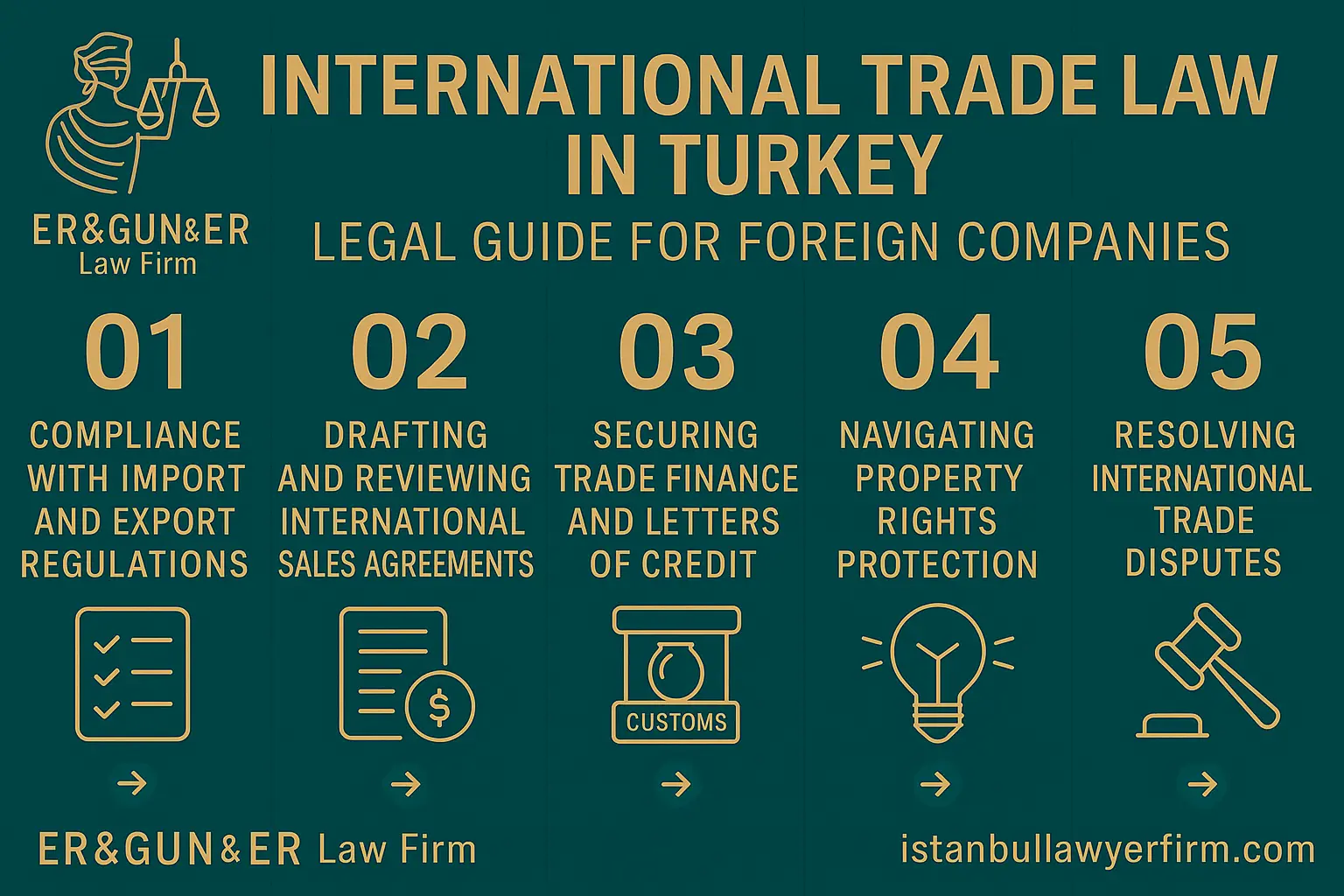
International trade law in Turkey defines the regulatory framework through which foreign companies import goods, export goods, participate in public procurement, structure trade finance, and resolve cross-border disputes before Turkish authorities and courts. A foreign company operating in or through Turkey must coordinate several overlapping legal regimes simultaneously — the customs law framework under Law No. 4458, the EU–Turkey Customs Union commitments, World Trade Organization obligations, bilateral and multilateral free trade agreements, export control and strategic goods regulations, trade remedy procedures for anti-dumping and safeguard measures, trade finance law governing letters of credit and payment instruments, public procurement law for tender participation, and the trade incentive schemes administered by the Ministry of Trade and related agencies. Each regime produces its own documentation requirements and its own enforcement exposure, and inconsistencies between regimes generate disputes that are significantly harder to resolve after the fact than during initial compliance design. Foreign companies entering the Turkish market face a written-record environment in which customs authorities, trade remedy investigators, public procurement committees, and commercial courts decide from documents rather than from commercial narrative, so compliance architecture must be built to produce audit-ready evidence from the first transaction forward. This guide addresses the framework that foreign companies need for market entry, ongoing trade compliance, trade remedy exposure, trade finance execution, dispute resolution, and participation in Turkey's public procurement and trade incentive programs. Practice may vary by authority and year, so every framework addressed below must be verified against current Turkish regulatory guidance, EU Customs Union developments, and international sanctions programs before commercial commitments are finalized. Many foreign companies coordinate these work streams with a lawyer in Turkey from the market entry stage forward, because retrofit compliance is significantly more expensive than integrated compliance design. For compliance governance context across entity, contracting, and reporting disciplines, readers can also review our corporate governance and compliance guide.
Regulatory framework and trade law architecture in Turkey
A Turkish Law Firm advising a foreign company on trade law begins with the regulatory architecture before moving to specific transactions. The Turkish Customs Law No. 4458 and its implementing regulations establish the core customs procedure for imports, exports, transit, and special regimes such as inward processing, outward processing, and bonded warehousing. The EU–Turkey Customs Union framework governs industrial goods traded between Turkey and the European Union, imposing common external tariff alignment for third-country imports and free circulation for Customs Union-origin industrial products through A.TR movement certificates. World Trade Organization obligations shape Turkey's market access commitments, non-discrimination rules, and trade remedy procedures. Bilateral and multilateral free trade agreements with EFTA members, regional partners, and other signatories each add distinct preferential tariff access and origin requirements that must be separately documented. The Official Gazette publishes implementing communiqués, regulatory amendments, and trade remedy notices that adjust operational practice between statutory cycles. For foreign companies, the immediate practical implication is that trade compliance is not a single regime — it is a layered architecture requiring coordinated analysis of customs law, Customs Union interface, free trade agreement coverage, sectoral regulation, and sanctions compliance for each product and each market. Sector-specific regulations add further layers for pharmaceuticals, food and agriculture, defense industry goods, telecommunications equipment, cosmetics, chemicals, and consumer electronics, with each sector carrying its own licensing authority, conformity assessment framework, and post-market surveillance obligations. Foreign exchange regulations interact with trade compliance because cross-border transfers related to trade operations must satisfy banking documentation expectations that overlap with but do not duplicate customs documentation. Data protection regulations apply to the commercial records generated by trade operations, particularly for distribution networks handling personal data of Turkish consumers. Practice may vary by authority and year, and trade compliance architecture should be verified against current publications before market entry plans are finalized.
Turkish lawyers who advise on foreign company market entry for trade operations pay close attention to the sequencing of corporate structure, tax registration, customs authorization, and sectoral licensing. Entity choice — subsidiary, branch office, liaison office, or distributor appointment — carries distinct implications for who acts as importer of record, who can obtain customs authorizations such as inward processing permits, and who bears liability for trade compliance failures. A subsidiary operating as importer of record requires tax registration, customs registration, and potentially sectoral licenses depending on the product catalog. A branch office can conduct commercial operations but interacts differently with foreign exchange regulations and repatriation planning. A liaison office generally cannot conduct commercial operations and is limited to representation and market research activities, so misusing a liaison office for active trade creates both trade compliance and immigration compliance exposure. Distributor appointments shift the importer of record function to the Turkish distributor, but the foreign principal remains exposed through contractual liability, sanctions reach, and brand reputation. Banking onboarding should proceed in parallel with corporate formation because trade operations require functioning bank accounts for letters of credit, customs duty payments, and counterparty settlements. Practice may vary by authority and year, which is why market entry should be staged through verification checkpoints that confirm current authority expectations at each phase rather than assumed from earlier project experience.
An English speaking lawyer in Turkey coordinating market entry for a foreign trade operator focuses on contractual architecture in parallel with regulatory setup, because distribution agreements, agency agreements, licensing agreements, and supply contracts all carry trade compliance implications that are easier to address in initial drafting than to retrofit. Distribution agreements should address customs compliance duties, re-export restrictions, sanctions screening obligations, end-user certification requirements where applicable, and audit cooperation rights allowing the principal to verify downstream compliance. Agency agreements should distinguish between disclosed and undisclosed agency, allocation of liability for customs declarations, and the extent to which the agent's actions create principal-level exposure under Turkish and foreign sanctions regimes. Licensing agreements should address territory definitions, royalty characterization for customs valuation purposes, and audit rights to verify licensee compliance with export control restrictions. Supply contracts should allocate responsibility for origin documentation, customs declaration accuracy, shipping document production, and force majeure coverage for trade disruption events including sanctions imposition, customs policy changes, and port disruptions. For broader contract drafting context, readers can consult our contract law guide for foreign companies. Practice may vary by authority and year, and contractual architecture should be reviewed against current regulatory developments rather than carried forward from template libraries without adjustment.
Import and export compliance foundations for foreign companies
A lawyer in Turkey advising a foreign importer begins with the importer of record analysis because that role carries the legal responsibility for customs declaration accuracy, duty payment, and compliance with import restrictions. The importer of record must hold a customs registration, file declarations through an authorized customs broker or directly where authorized, and maintain the supporting documentation for retention periods defined by customs regulation. Import documentation includes the commercial invoice, packing list, transport documents, origin certificates where preferential treatment is claimed, and sectoral permits where applicable. Product conformity certification requirements vary by sector and include the Turkish Standards Institute conformity schemes, Ministry of Agriculture approvals for food and agricultural products, Ministry of Health approvals for pharmaceuticals and medical devices, and ministry-specific permits for telecommunications equipment, cosmetics, and consumer electronics. Labeling and marking requirements in Turkish apply to many consumer product categories and must be satisfied before release for free circulation. Import restrictions through quotas, licenses, or outright prohibitions apply to specific product categories and require pre-shipment clearance through the relevant licensing authority. Practice may vary by authority and year, which is why import compliance programs should include a product-by-product licensing and certification map rather than rely on general assumptions about import access.
Turkish lawyers who advise foreign exporters shipping from Turkey — whether foreign-owned manufacturing subsidiaries or Turkish-entity subsidiaries of foreign groups — focus on the export documentation chain and the licensing regime for controlled categories. Export declarations require the commercial invoice, packing list, transport documents, origin certificates where the buyer's market offers preferential treatment, and sectoral permits or export licenses for controlled products. The Exporters' Association registration is a prerequisite for commercial export operations, and membership in the relevant sectoral exporters' union is typically required for most product categories. Export controlled products — including defense industry goods, dual-use items, cultural property, specific agricultural commodities, and certain chemicals — require transaction-specific export licenses obtained through the Ministry of Trade, the Presidency of Defense Industries, or other sectoral bodies depending on product classification. Re-export scenarios under TIR carnet, ATA carnet, or temporary import regimes require matching documentation to establish eligibility for duty relief and to support subsequent re-export without duty assessment. Transit operations carry separate documentation obligations and potential liability if transit goods enter free circulation contrary to declared purpose. For broader structural context on import-export operations, readers can review our international trade consultancy services guide. Practice may vary by authority and year, so export documentation templates should be verified against current customs and sectoral requirements before shipment.
An Istanbul Law Firm supporting foreign companies with import and export compliance treats the operational compliance program as a continuous discipline rather than as a one-time setup. The program must include written procedures covering customs declaration workflows, sectoral permit management, origin documentation retention, restricted-party screening before shipment commitment, and red-flag escalation when shipments present elevated risk indicators. Customs brokers and freight forwarders must be managed through service agreements that allocate declaration accuracy duties, document production obligations, and audit cooperation rights, because the importer or exporter of record remains legally responsible regardless of broker involvement. Sectoral permits must be tracked with expiration dates and renewal timelines to avoid gaps that block shipment release. Banking compliance must be aligned with customs compliance so that trade-related transfers clear without the delays caused by mismatched descriptions between customs declarations and bank payment instructions. Sanctions screening must cover counterparties, beneficial owners, end-users, and where applicable the vessels and financial institutions in the payment chain. Internal audits should test actual operational behavior against written policy because deviation under time pressure is the most common source of compliance exposure. Practice may vary by authority and year, and compliance programs should be refreshed periodically against current enforcement priorities, regulatory amendments, and specific risk patterns identified through operational experience or industry benchmarking.
Trade agreements and preferential treatment schemes
A Turkish Law Firm evaluating preferential trade access for a foreign company begins with the agreement coverage matrix for each product category and each target market. The EU–Turkey Customs Union governs industrial goods in bilateral trade with the European Union and requires A.TR certificates for eligible goods, alongside compliance with the common external tariff for third-country imports into Turkey that may then circulate to the EU. Free trade agreements between Turkey and EFTA members, regional partners such as several Middle Eastern and North African states, and other bilateral signatories each carry distinct rules of origin, preferential tariff schedules, and documentary requirements. Agricultural products, textiles, automotive components, and specific sensitive sectors are often excluded from automatic preferential treatment or subject to tariff rate quotas that require separate application procedures. The Generalized System of Preferences applies to Turkey as a beneficiary country under certain partner schemes and as a granting country under its own preferential program for designated developing economies. A defensible preferential origin claim requires rules-of-origin analysis identifying the applicable criterion — wholly obtained, substantial transformation, tariff heading change, value-added thresholds, or specific processing operations — together with production records, supplier declarations, and accounting evidence supporting the calculation. Practice may vary by authority and year, and origin files should be assembled contemporaneously as production occurs rather than reconstructed when a certificate is requested.
Turkish lawyers who structure preferential utilization programs for multinational manufacturers operating from Turkey focus on supplier diligence and production records because origin verification requests from importing-country customs authorities test precisely these elements. Suppliers providing non-originating materials must deliver declarations that allow the manufacturer to calculate compliance with substantial transformation, tariff heading change, or value-added criteria under the applicable agreement. Cumulation provisions allow origin to be built across multiple partner countries under certain agreements — bilateral cumulation between Turkey and each partner, diagonal cumulation between Turkey and groups of partners sharing identical rules, and full cumulation in specific contexts — and each cumulation type carries distinct documentary requirements. Free trade zones in Turkey offer operational advantages including duty deferral, value-added tax exemption on qualifying transactions, and customs simplification for goods remaining within the zone or re-exported onward, but free zone operations must comply with zone-specific regulations and reporting obligations. Inward processing regimes allow duty relief on imported inputs that are transformed and re-exported, but the regime requires pre-authorization, input-output coefficient declarations, and compliance audits throughout the authorization period. Outward processing regimes allow goods to be sent abroad for processing and returned with duty relief on the Turkish-origin portion. Practice may vary by authority and year, which is why special regime authorizations should be monitored for compliance with declared activity profiles rather than treated as permanent once granted.
An English speaking lawyer in Turkey coordinating preferential trade compliance for foreign-owned Turkish operations ensures that origin claims, special regime authorizations, and preferential certificate issuance remain consistent across English commercial documentation, Turkish customs filings, and sectoral regulatory submissions. Language drift between these systems is a common source of verification questions and origin rejections. If a commercial invoice describes products in English while the origin certificate uses different Turkish descriptions, the verification response must reconcile both descriptions to the same underlying products through production records. If a supplier declaration references components in one nomenclature while the bill of materials uses another nomenclature, the internal origin calculation must translate between them consistently. Origin verification requests typically arrive months or even years after shipment, so the preservation period for origin documentation should exceed the verification window applied by the relevant importing-country customs authority. Suppliers may change ownership, close operations, or become uncooperative in verification, so contractual allocation of verification support duties and audit rights protects the manufacturer against supplier-side failures that would otherwise defeat the origin claim. Banking compliance reads trade documentation, and mismatched product descriptions between trade documents and payment instructions create transfer clearance delays that cascade into operational disruption. Practice may vary by authority and year, so origin programs should be reviewed internally at least annually and whenever manufacturing arrangements, supplier base, or product specifications change materially.
Export controls and strategic goods regulation
A lawyer in Turkey advising foreign companies on export controls begins with the product catalog review against Turkish export control lists, European Union dual-use regulations reflected through the Customs Union interface, United States Export Administration Regulations where re-export jurisdiction applies, and sectoral control lists administered by the Presidency of Defense Industries and other competent authorities. Strategic goods categories include defense industry products and components, dual-use items with civilian and military applications, sensitive chemicals and biological agents, specific electronics and telecommunications equipment, precision machinery, cultural property, and certain agricultural commodities. Strategic Goods Registry registration is required for companies trading in controlled categories, and transaction-specific export licenses must be obtained for shipments meeting control thresholds. End-user certification, end-use statements, and post-shipment verification commitments are frequently required to establish that the exported goods will not be diverted to prohibited applications or unauthorized territories. Internal Compliance Programs are increasingly expected for companies operating in high-risk sectors, and a documented program reduces penalty exposure when compliance failures occur despite reasonable efforts. Practice may vary by authority and year, and export control programs require continuous updating as control lists are amended, enforcement priorities shift, and international regimes evolve.
Turkish lawyers who build sanctions compliance programs alongside export control programs recognize that the two disciplines overlap but apply distinct analyses. Export control asks whether the specific goods are controlled and whether the specific transaction requires a license. Sanctions compliance asks whether the counterparty, beneficial owner, end-user, vessel, or financial institution is prohibited under applicable regimes — United Nations, European Union, United Kingdom, United States, and others with reach over the transaction. Secondary sanctions imposed by the United States extend to non-US parties transacting with sanctioned counterparties in certain sectors, creating exposure for Turkey-based operations even in transactions that do not otherwise touch US jurisdiction. Banking compliance typically applies the strictest screening standard available, so transactions clearing acceptable risk under Turkish law may still be rejected at the payment layer if correspondent banks apply stricter screening. A defensible sanctions compliance program includes written policies, restricted-party screening at contract negotiation, order entry, shipment preparation, and payment release, end-use verification for controlled and sensitive categories, red-flag escalation protocols, periodic internal audits, and training for commercial and operational teams with specific decision authority over shipments. Practice may vary by authority and year, so sanctions compliance programs should be reviewed quarterly against current list updates and annually against enforcement developments rather than treated as static infrastructure.
An Istanbul Law Firm supporting foreign companies facing export control or sanctions enforcement inquiries coordinates the response through a single legal channel that preserves evidence while maintaining consistent narratives across every submission. When Turkish customs authorities question an export shipment, the response must present the product classification against control lists, the end-user verification record, the restricted-party screening documentation, the internal approval memo, and any applicable export license through an indexed chronological bundle. When foreign regulators issue information requests affecting Turkey-routed transactions, the response must coordinate with foreign counsel so that Turkey-side submissions align with parallel foreign submissions rather than creating unnoticed inconsistencies. When correspondent banks apply enhanced due diligence, the response must reconcile banking narratives with trade documentation so that the compliance story is coherent across systems. Self-disclosure decisions require careful evaluation across jurisdictions because voluntary disclosure mitigates exposure under some regimes but can create or expand exposure under others. Penalty negotiation typically succeeds on demonstrated remediation, cooperation, and agreed fact patterns rather than on interpretive argument alone. Practice may vary by authority and year, and enforcement response strategies should be calibrated to current guidance on cooperation credit, voluntary disclosure frameworks, and penalty mitigation criteria rather than assumed from prior case outcomes.
Trade remedies: anti-dumping, safeguards, and countervailing duties
A Turkish Law Firm representing foreign exporters in anti-dumping investigations begins by understanding that Turkish trade remedy procedures operate through the Ministry of Trade's Directorate General of Imports, which conducts investigations under Turkish Foreign Trade Legislation aligned with WTO Anti-Dumping Agreement and Agreement on Subsidies and Countervailing Measures. An anti-dumping investigation is triggered by a complaint from the Turkish domestic industry alleging that imported goods are sold at less than normal value and causing material injury to the domestic industry. The investigation examines normal value in the exporting country, export price to Turkey, dumping margin calculation, domestic industry injury indicators, and the causal link between imports and injury. Foreign exporters receive questionnaires requesting transaction-level sales data, production cost breakdowns, financial statements, and related-party pricing analysis. Response quality is decisive because non-cooperation or inadequate response typically results in adverse facts available determinations producing higher dumping margins. Sampling methodology, surrogate country selection in non-market economy analyses, and adjustments for differences in conditions of sale all affect the margin calculation and must be addressed through substantive responses rather than procedural objections. Initiation notices published in the Official Gazette define the product scope, the period of investigation, and the investigation timeline, and the product scope definition can be contested through substantive submissions because scope affects which transactions fall within the investigation and which remain unaffected. Provisional measures imposed during the investigation can affect import economics before final determination, and applications for product exclusion, duty suspension on specific end-uses, and price undertakings should be evaluated against the specific commercial position of the exporter. Verification visits at the exporter's premises test the submitted data against underlying records, and preparation for verification significantly affects outcomes. Practice may vary by authority and year, and trade remedy defense requires current awareness of investigative methodology and precedent on specific technical questions.
Turkish lawyers who defend foreign exporters in anti-dumping cases coordinate the questionnaire response as a project with defined roles, timelines, and quality controls. The response team typically includes external counsel, internal finance and accounting functions, sales teams with transaction-level knowledge, and production teams with cost accounting data. The questionnaire response must reconcile sales data, cost data, and financial statements to audited accounts so that verification can confirm the submitted data without requiring reconstruction. Public interest submissions allow downstream industrial users, importers, and consumer groups to present arguments against imposition of duties, which can influence provisional and final determinations. Hearings and written arguments allow the exporter to respond to petitioner submissions, raise methodological objections, and propose alternative approaches to margin calculation. Price undertakings — exporter commitments to price increases accepted by the investigating authority in lieu of duty imposition — can terminate investigations without duty measures but require ongoing monitoring and compliance reporting. Sunset reviews conducted before duty measures expire offer opportunities to seek duty removal based on changed circumstances and absence of ongoing injury. Judicial review through Turkish administrative courts provides a final path for challenging trade remedy determinations on legal and procedural grounds. Practice may vary by authority and year, and trade remedy outcomes depend significantly on technical response quality rather than interpretive argument alone.
An English speaking lawyer in Turkey coordinating cross-border trade remedy defense for foreign exporters integrates the Turkish proceeding with parallel investigations that the same exporter may face in other markets. Anti-dumping investigations are often triggered in multiple jurisdictions sequentially, and response strategies should be coordinated so that data submitted in one investigation does not create adverse inferences in another. Safeguard investigations differ from anti-dumping because they examine total import volume increases causing serious injury without requiring proof of unfair pricing, and response strategy focuses on injury and causation analysis rather than on pricing methodology. Countervailing duty investigations examine whether foreign government subsidies to exporters distort trade and cause injury, requiring analysis of subsidy programs, benefits received, and specificity determinations. Trade remedy measures impose duties that affect import economics significantly, so exporters facing imposition must evaluate whether to absorb duties, pass through to importers, restructure supply chains, or exit the affected market. Domestic Turkish producers seeking safeguard protection against import surges require different representation focused on building the injury and causation case. Practice may vary by authority and year, and trade remedy strategy requires current understanding of Ministry of Trade investigative practice, recent cases, and prevailing methodological approaches rather than generic WTO-level analysis.
Trade finance instruments and payment security
A lawyer in Turkey advising foreign companies on trade finance begins with the payment instrument choice because letters of credit, documentary collections, open account arrangements, and advance payment each carry distinct legal and commercial risk profiles. Letters of credit governed by UCP 600 provide the highest payment security when properly structured because the issuing bank's payment obligation is independent of the underlying sale contract and is triggered by compliant document presentation. A defensible letter of credit structure requires document requirements that align with the shipment reality — commercial invoice, bill of lading or other transport document, insurance certificate where required, inspection certificate where applicable, and origin certificate where preferential treatment applies. Discrepancies between presented documents and letter of credit terms allow issuing banks to refuse payment, so document preparation discipline is decisive for payment realization. Confirming bank arrangements add a second bank's undertaking to the issuing bank's commitment, which is particularly valuable when the issuing bank operates in a higher-risk jurisdiction. Standby letters of credit function as payment guarantees triggered by specified default events and are commonly used to secure performance obligations, bid bonds, and advance payment guarantees in trade and project contexts. Documentary collections under URC 522 offer a lower-cost alternative to letters of credit where the commercial relationship supports acceptance of buyer credit risk, providing bank handling of documents against payment or acceptance while leaving payment risk with the exporter. Open account arrangements transfer the full commercial risk to the exporter and should be supported by credit analysis, export credit insurance, or receivables factoring where appropriate. Advance payment arrangements reverse the risk allocation but require buyer comfort that goods will be shipped as committed, often supported by advance payment guarantees issued by the exporter's bank. Incoterm selection interacts with payment security because the risk transfer point and compliance responsibility allocation between buyer and seller affect which documents are available to support payment. Practice may vary by authority and year, and trade finance structures should be verified against current banking practice and ICC publications on documentary credit interpretation.
Turkish lawyers who structure trade finance arrangements for foreign companies pay particular attention to performance bonds, bid bonds, advance payment guarantees, and warranty bonds issued by Turkish banks and insurance companies. Each instrument serves a distinct commercial purpose and carries distinct documentation and enforcement mechanics. Performance bonds secure contractual performance and typically become payable on breach of specified obligations. Bid bonds secure tender participation commitments and become payable if the bidder withdraws or fails to execute the contract after award. Advance payment guarantees secure return of advance payments if the recipient fails to perform. Warranty bonds secure post-delivery warranty obligations during a defined period. Export credit insurance through Türk Eximbank and private insurers provides protection against commercial and political risks affecting export receivables, including buyer insolvency, buyer default, and country risk events such as currency inconvertibility or political violence affecting payment. Forfaiting and factoring arrangements allow exporters to convert trade receivables into immediate cash by transferring receivables to financial institutions at a discount, with the discount reflecting credit and country risk premium. Practice may vary by authority and year, so trade finance instruments should be reviewed periodically against current bank practice, insurance market terms, and regulatory developments affecting Turkish trade finance.
An Istanbul Law Firm handling trade finance disputes focuses on document compliance analysis for letter of credit claims, contractual enforcement for standby and performance bond claims, and coverage analysis for export credit insurance claims. Letter of credit discrepancy disputes turn on whether presented documents comply on their face with credit terms under UCP 600 standards, and responses must address each alleged discrepancy specifically rather than assert general compliance. Fraud exceptions allow issuing banks or applicants to challenge payment on proof of beneficiary fraud, but fraud exceptions are narrowly construed and require strong evidence rather than allegation. Standby letter of credit and demand guarantee disputes under ICC Uniform Rules for Demand Guarantees follow similar independent-undertaking principles with narrow fraud and unconscionability exceptions. Performance bond disputes governed by Turkish contract law allow broader defenses but still require careful factual development of the underlying performance claim. Export credit insurance claims require alignment between the insured transaction structure and the policy coverage terms, with particular attention to exclusions for political risk events, commercial risk events, and documentation requirements for claim notification. Practice may vary by authority and year, and trade finance litigation requires current understanding of Turkish banking law precedent, ICC interpretive materials, and judicial approaches to documentary credit disputes.
Trade disputes and cross-border litigation
A Turkish Law Firm representing foreign companies in trade disputes before Turkish courts begins by identifying the dispute architecture — the underlying contract, the governing law, the dispute resolution clause, the payment instrument, the shipping documents, and the commercial incoterm allocating risk between parties. Trade disputes commonly arise from delivery failures, quality disputes, non-payment, documentary credit discrepancies, cargo damage claims, customs detention affecting contract performance, and counterparty insolvency. When the contract contains an arbitration clause specifying institutional arbitration under ICC, ISTAC, or other frameworks, the arbitration path must be preserved by avoiding court filings that could constitute waiver. When the contract provides for Turkish court jurisdiction, commercial courts handle most trade disputes with appellate review through regional courts of appeal and ultimately the Court of Cassation. Interim relief — cargo attachment, bank account attachment, receivable attachment — can change the commercial dynamic significantly because counterparties often settle when operational continuity is threatened. Evidence assembly begins with the signed contract and all amendments, commercial correspondence, shipping documents with carrier confirmations, payment records, inspection records, and any prior dispute correspondence. For broader context on commercial litigation before Turkish courts, readers can consult our business litigation guide for foreign companies. Practice may vary by authority and year, so dispute strategy must account for current court practice on interim measures, evidence standards, and enforcement approaches.
Turkish lawyers who coordinate cross-border contract enforcement focus on limitation periods because time bars run differently under different governing laws, transport conventions, and contract provisions. The United Nations Convention on Contracts for the International Sale of Goods applies to international sales contracts between parties in contracting states unless excluded by agreement, and its provisions affect formation, performance, breach, and remedies. Transport conventions — Hague-Visby for sea carriage, CMR for road carriage, Warsaw-Hague-Montreal for air carriage — impose time limits for cargo claims that are often significantly shorter than general commercial limitation periods. Letter of credit claims carry their own notification and action timelines under UCP 600 and applicable bank practice. Limitation periods under Turkish Commercial Code apply to domestic commercial disputes and vary by claim type. Protective filings, written notices, and tolling agreements can preserve claims when full litigation preparation cannot be completed before the limitation period expires. Foreign judgment enforcement in Turkey proceeds through exequatur proceedings before Turkish courts, testing reciprocity, due process, public policy, and finality criteria. Foreign arbitral award enforcement under the New York Convention provides a more streamlined path with narrower grounds for refusal. Practice may vary by authority and year, and enforcement strategy requires current awareness of Turkish court approaches to recognition, reciprocity determinations, and public policy interpretations.
An English speaking lawyer in Turkey coordinating multilingual trade disputes focuses on document authentication and translation discipline because foreign-language evidence must be usable before Turkish courts and before foreign enforcement authorities where parallel proceedings run. Foreign-language contracts must be translated by sworn translators where relied upon in court, and translations must preserve operative terminology consistently across the entire document set. Apostille and legalization requirements vary by country and document type, and delays in legalization can defeat otherwise meritorious claims when limitation periods run. Witness statements from foreign witnesses require preparation accounting for differences between Turkish court practice on witness evidence and common-law discovery and deposition practice. Electronic evidence — emails, messaging, cloud storage — requires authentication protocols Turkish courts will accept, with chain-of-custody documentation essential when counterparties challenge authenticity. Expert witness use in Turkish commercial courts follows court-appointed expert practice rather than party-appointed expert adversarial practice common in other systems, and expert selection and scope definition significantly affect case outcomes. Settlement discussions during litigation should proceed through written memos recording what would be conceded and what preserved, so that later appeals are not compromised by ambiguous oral statements. Practice may vary by authority and year, and international dispute strategy should integrate Turkish procedural discipline with foreign counsel coordination so parallel filings remain mutually reinforcing.
Public procurement, tenders, and trade incentive programs
A lawyer in Turkey advising foreign companies on public procurement begins with the procurement law framework. The Public Procurement Law No. 4734 governs procurement by public administrations, state economic enterprises, and other contracting authorities within its scope, while separate legislation addresses procurement in specific sectors such as defense industry and state-owned enterprises operating under specialized frameworks. Foreign companies can participate in Turkish public procurement directly or through joint ventures with Turkish partners, subject to tender-specific eligibility criteria that may include local content requirements, sector-specific qualifications, financial capacity thresholds, and technical capability evidence. Tender documentation typically includes administrative specifications, technical specifications, draft contract, and annexes defining evaluation criteria and contract terms. Bid preparation requires careful compliance with eligibility criteria, submission format requirements, and submission deadlines because non-compliant bids are rejected without substantive review. Bid bonds secure tender participation commitments and become payable on withdrawal or on failure to execute the contract after award. Contract performance bonds secure performance obligations after award. Evaluation methodology varies by procurement type — open procedures, restricted procedures, negotiated procedures, and framework agreements each carry distinct rules on eligibility, evaluation, and award. Lowest price, most economically advantageous tender, and other evaluation formulas affect how technical quality is weighted against price. Abnormally low bids trigger specific review procedures that allow contracting authorities to verify bid feasibility. Contract amendments after award follow regulated procedures that limit scope changes and price adjustments, and non-compliant amendments can be challenged through complaint mechanisms. Practice may vary by authority and year, and tender participation should be evaluated against current procurement practice including recent award decisions, specification trends, and complaint outcomes.
Turkish lawyers who support foreign companies participating in Turkish tenders coordinate joint venture arrangements with Turkish partners where local partnership offers eligibility or competitive advantages. Joint venture agreements must allocate responsibilities for bid preparation, contract performance, financial contributions, liability allocation, and dispute resolution between partners. Consortium structures for specific tenders carry different implications than longer-term joint venture companies, and the choice affects tax treatment, regulatory exposure, and operational flexibility. Subcontracting arrangements within public contracts carry their own compliance obligations and notification duties under procurement law. Complaint procedures before the Public Procurement Authority allow bidders to challenge tender specifications, evaluation decisions, and award determinations on procedural and substantive grounds. Timing of complaints is critical because procurement law imposes short deadlines for specific complaint categories, and missed deadlines cannot typically be remedied through later proceedings. Administrative court review provides a further layer for challenging Public Procurement Authority decisions on legal grounds. For related dispute resolution context, readers can consult our business litigation guide. Practice may vary by authority and year, and procurement complaint strategy requires current awareness of Public Procurement Authority decision patterns and judicial review outcomes.
An Istanbul Law Firm supporting foreign companies accessing Turkish trade incentive programs coordinates investment incentive certificates, export support schemes, value-added tax exemption applications, inward processing regime authorizations, and sector-specific programs administered by the Ministry of Industry and Technology, the Ministry of Trade, and sectoral agencies. Investment incentive certificates classify qualifying projects into regional and sectoral categories offering distinct combinations of tax reductions, social security premium support, customs duty exemptions on imported machinery, and land allocation benefits. Export support programs include freight subsidies, trade fair participation support, design support, brand development support, and market entry support for specific target markets. Inward processing regime authorization allows duty-free import of inputs transformed into exports, requiring pre-authorization with defined input-output coefficients and compliance reporting. Free zone operations carry distinct tax and customs advantages for qualifying activities but require compliance with zone regulations. Research and development incentives support qualifying R&D activities through tax benefits and grant programs. Strategic investment incentives target specific priority sectors with enhanced benefits. Monitoring obligations continue throughout the incentive period, and failure to satisfy performance commitments — investment amount, employment creation, export targets, or production thresholds depending on the program — can trigger recovery of benefits received together with interest and penalties. Assignment of incentive certificates to successor entities in corporate restructuring requires prior authorization and may be limited in specific program categories. Practice may vary by authority and year, so incentive program utilization requires current awareness of eligibility criteria, application procedures, and ongoing compliance obligations because program terms adjust frequently through regulatory amendments and policy updates.
Author: Mirkan Topcu is an attorney registered with the Istanbul Bar Association (Istanbul 1st Bar), Bar Registration No: 67874. His practice focuses on cross-border and high-stakes matters where evidence discipline, procedural accuracy, and risk control are decisive, with particular concentration on international trade law, customs and sectoral regulatory compliance for foreign companies, preferential trade agreement utilization, export controls and strategic goods licensing, trade remedy defense in anti-dumping and safeguard investigations, trade finance structuring and dispute resolution, cross-border commercial litigation, and foreign company participation in Turkish public procurement and trade incentive programs.
He advises individuals and companies across International Trade, Customs and Regulatory Law, Commercial and Corporate Law, Commercial Contracts, Arbitration and Dispute Resolution, Enforcement and Insolvency, Citizenship and Immigration (including Turkish Citizenship by Investment), Real Estate (including acquisitions and rental disputes), Foreigners Law, Sports Law, Health Law, and Criminal Law. He regularly supports corporate clients on governance and contracting, shareholder and management disputes, receivables and enforcement strategy, and cross-border trade compliance, trade remedy defense, trade finance execution, tender participation, and risk management in Turkey-facing transactions — often in matters involving foreign exporters, importers, distributors, licensing holders, and multinational manufacturing groups requiring bilingual documentation and coordinated parallel filings across customs, banking, procurement, and regulatory authorities.
Education: Istanbul University Faculty of Law (2018); Galatasaray University, LL.M. (2022). LinkedIn: Profile. Istanbul Bar Association: Official website.
Frequently asked questions
- Can foreign companies directly import into and export from Turkey? Yes, foreign-owned Turkish subsidiaries and branch offices can act as importer or exporter of record after customs registration, tax registration, and sectoral permits where applicable. Liaison offices cannot conduct commercial operations, so misusing a liaison office for active trade creates compliance exposure.
- What is the EU–Turkey Customs Union and how does it affect trade with Turkey? The Customs Union covers industrial goods traded between Turkey and the European Union, requiring A.TR movement certificates for eligible goods and aligning Turkey's external tariffs with the EU common external tariff for third-country imports of covered products.
- What documentation is required for imports into Turkey? Standard documentation includes the commercial invoice, packing list, transport documents, origin certificates where preferential treatment is claimed, sectoral permits for regulated products, and conformity certificates where applicable. Additional product-specific requirements apply for pharmaceuticals, food, chemicals, electronics, and other regulated categories.
- How do preferential origin claims work under Turkish trade agreements? Preferential claims require identification of the applicable rule of origin — wholly obtained, substantial transformation, tariff heading change, or value-added threshold — supported by production records, supplier declarations, and accounting evidence preserved contemporaneously rather than reconstructed when a certificate is requested.
- What export controls apply to goods shipped from Turkey? Turkish export controls coordinate with EU dual-use frameworks through the Customs Union, with US Export Administration Regulations where re-export jurisdiction applies, and with UN, EU, UK, and US sanctions regimes. Strategic goods — defense industry products, dual-use items, sensitive chemicals — require Strategic Goods Registry registration and transaction-specific licenses.
- How does Turkey conduct anti-dumping investigations? Investigations are conducted by the Ministry of Trade's Directorate General of Imports under procedures aligned with the WTO Anti-Dumping Agreement. Foreign exporters receive questionnaires requesting sales, cost, and financial data, and response quality is decisive because non-cooperation typically results in adverse facts available determinations producing higher margins.
- What trade remedies are available to Turkish domestic producers? Anti-dumping duties address dumped imports causing injury, countervailing duties address subsidized imports causing injury, and safeguard measures address total import volume increases causing serious injury without requiring proof of unfair pricing. Each remedy has distinct legal standards and procedural requirements.
- How are letters of credit governed in Turkish trade finance? Letters of credit are typically governed by ICC UCP 600 through contractual incorporation, with Turkish banking law providing the background legal framework. Payment depends on compliant document presentation evaluated on facial conformity, with fraud exceptions narrowly construed and requiring strong evidence.
- How can trade disputes with Turkish counterparties be resolved? Disputes are resolved through arbitration under ICC, ISTAC, or other institutional rules when the contract provides, or through Turkish commercial courts when litigation is the path. Documentary credit disputes follow UCP 600 analysis, cargo claims follow applicable transport conventions, and interim relief such as attachment can support enforcement.
- How are foreign judgments enforced in Turkey? Foreign judgments proceed through exequatur proceedings before Turkish courts testing reciprocity, due process, public policy, and finality criteria. Foreign arbitral awards follow the New York Convention path with narrower grounds for refusal, typically providing a more streamlined route than foreign judgment enforcement.
- Can foreign companies participate in Turkish public procurement tenders? Yes, foreign companies can participate directly or through joint ventures with Turkish partners, subject to tender-specific eligibility criteria potentially including local content requirements, financial capacity thresholds, and technical qualifications. Public Procurement Law No. 4734 governs most procurement by public administrations within its scope.
- What trade incentive programs are available to foreign investors operating in Turkey? Programs include investment incentive certificates with regional and sectoral classifications, export support schemes, inward processing regime authorization for duty-free input imports transformed into exports, free zone operations with tax and customs advantages, research and development incentives, and strategic investment incentives for priority sectors.
- How does inward processing regime authorization work? The regime allows duty-free import of inputs transformed into exports, requiring pre-authorization with defined input-output coefficients, compliance reporting throughout the authorization period, and re-export of the transformed outputs within the authorized timeframe. Drift between authorized activity and actual operation creates reassessment exposure.
- What legal risks should foreign companies monitor in Turkish trade operations? Key risks include customs misclassification exposure, origin documentation gaps, export control and sanctions violations, trade remedy proceedings affecting import economics, letter of credit discrepancies defeating payment, tender disqualification through bid format defects, and trade incentive compliance failures triggering recovery obligations.
- How does ER&GUN&ER Law Firm structure international trade engagements for foreign companies? Engagements begin with scope mapping — product catalog, trade lanes, counterparty chart, and target programs — translated into a risk register covering customs classification, origin, export controls, sanctions, trade remedies, trade finance, disputes, and procurement or incentive utilization. Each risk is assigned a document owner, a standard evidence package is built, and verification checkpoints are scheduled against current authority expectations.