

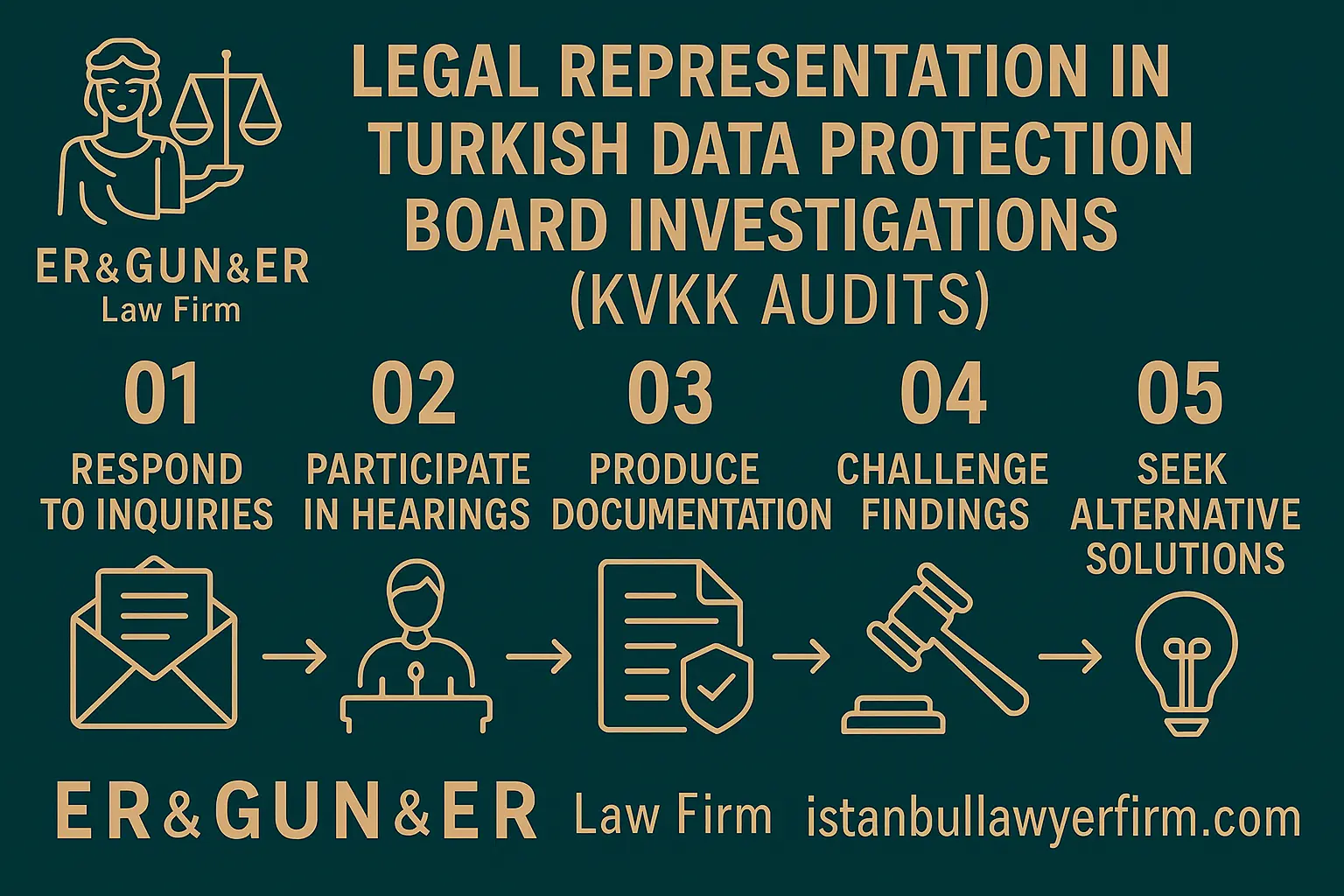
Turkish data protection enforcement has matured significantly since the Personal Data Protection Law No. 6698 (KVKK) entered force, with the Personal Data Protection Authority (Kişisel Verileri Koruma Kurumu) and its decision-making organ, the Personal Data Protection Board (Kurul), conducting audits, investigating complaints, imposing administrative fines, and publishing decisions that shape compliance expectations across sectors. The 2024 reform introduced by Law No. 7499 restructured key provisions including the framework for cross-border personal data transfers under Article 9, expanding the mechanisms available to controllers and aligning certain concepts with international frameworks. For Turkish businesses and international companies operating in Turkey, exposure to KVKK audits can arise through proactive inspections, VERBIS compliance reviews, data subject complaints, breach notifications triggering follow-on review, whistleblower reports, and cross-referral from sector regulators including the Banking Regulation and Supervision Agency, the Capital Markets Board, the Information and Communication Technologies Authority, and the Ministry of Health for sector-specific data handling. The consequences of adverse audit findings include administrative fines under Article 18, mandatory corrective orders, publication of decisions affecting reputation, and potential civil and criminal liability exposure for responsible officers in severe breach scenarios. Practice may vary by authority and year, and the specific penalty ranges, procedural timelines, and substantive standards applied by the Board evolve through periodic Board decisions, published guidance, and legislative amendments, so every element discussed below should be verified against current Board practice and the specific facts of the matter. This guide is general legal information rather than advice for any specific audit. A lawyer in Turkey should be engaged at the earliest signal of investigation — ideally before the first formal Board correspondence — because the initial response shapes both the audit trajectory and the evidentiary record that will support any subsequent objection or judicial review. For broader context on the legal framework before an audit arises, readers can consult our personal data protection law overview.
KVKK statutory framework and enforcement architecture
A Turkish Law Firm opening a KVKK compliance or defense engagement works within the statutory architecture that distinguishes the substantive protection rules from the procedural enforcement framework. Law No. 6698 establishes the substantive framework — lawful bases for processing personal data under Article 5, enhanced conditions for special categories of personal data under Article 6, the rights of data subjects under Article 11, the obligation to inform data subjects (aydınlatma yükümlülüğü) under Article 10, data security obligations under Article 12, and the enumerated administrative fines under Article 18. The procedural framework is developed through the Authority's regulations, communiqués, and Board decisions that specify application details, documentation standards, and technical and organizational measure expectations. The Personal Data Protection Board decides on complaints, opens investigations, conducts audits, issues corrective orders, and imposes administrative fines, with decisions published in anonymized form on the Authority's website creating a body of de facto precedent that informs compliance expectations. The Court of Cassation and the Council of State hear judicial challenges to administrative fines and other Board decisions, creating a secondary layer of jurisprudence relevant to defense strategy. Practice may vary by authority and year, and the interplay between Board decisions, Authority guidance, and judicial precedent requires continuous monitoring because inconsistencies can create argumentative opportunities for defense while also producing compliance risks where controllers rely on outdated guidance.
Turkish lawyers who map the enforcement triggers distinguish several distinct pathways through which KVKK audits begin. Proactive audits are initiated by the Board based on sectoral risk assessments, thematic reviews focusing on specific processing activities such as customer data handling or employee monitoring, and routine verification of VERBIS-registered controllers. Complaint-driven investigations arise from data subject complaints submitted through the Authority's application system, typically alleging unlawful processing, failure to respond to data subject requests, breach of data subject rights, or failure to comply with Board decisions. Breach-triggered investigations follow Article 12/5 notifications where the Board reviews the underlying incident alongside the notification itself, often producing corrective orders or fines based on the root cause and the controller's response. Cross-referred investigations originate from other regulators — the Banking Regulation and Supervision Agency, the Capital Markets Board, the Information and Communication Technologies Authority, the Ministry of Health, and similar sectoral bodies — where primary enforcement identifies data protection issues alongside the sector-specific matter. Practice may vary by authority and year, and the specific audit trigger affects both the expected scope of investigation and the documentation framework the controller should prepare, so the early assessment of what triggered the inquiry is a key input to response strategy.
An English speaking lawyer in Turkey coordinating international client response to KVKK matters addresses the interplay between Turkish KVKK compliance and parallel frameworks including the General Data Protection Regulation where the client has European Economic Area operations, sectoral data laws in the United States where applicable, and other jurisdictional frameworks affecting global data governance. The GDPR and KVKK share conceptual roots but diverge on specific requirements — definitions of legal bases, special category data treatment, cross-border transfer mechanisms, data subject rights formulations, breach notification thresholds and timelines, and supervisory authority cooperation frameworks all have Turkey-specific features that do not automatically align with GDPR compliance. International controllers cannot assume that GDPR compliance satisfies KVKK requirements — specific gap analysis comparing the two frameworks identifies areas where additional documentation, consent mechanisms, or processing adjustments are needed for Turkish compliance. Coordination with the client's global data protection officer, privacy counsel in other jurisdictions, and chief information security officer supports consistent messaging and avoids contradictions between Turkish submissions and positions taken in other jurisdictions. Practice may vary by authority and year, and international alignment should be reviewed at each substantive interaction with the Turkish Authority because positions developed in one context — GDPR supervisory authority correspondence, US privacy litigation, international arbitration — can create admissions or inconsistencies that complicate Turkish defense if not managed.
VERBIS registration and corporate documentation
A lawyer in Turkey handling VERBIS (Veri Sorumluları Sicili Bilgi Sistemi) registration works within the data controller registry framework established by the Authority that requires covered data controllers to register before commencing regular processing activities and to maintain accurate registration throughout operations. The registration obligation applies to data controllers meeting thresholds established through Board decisions, with specific exemptions for certain categories of small businesses, professional service providers, and other controllers whose processing characteristics fall outside the registration scope. The VERBIS record requires detailed information including the controller's identity and representatives, the categories of personal data processed, the purposes of processing, the data subject categories, the recipient categories including international recipients, retention periods, and the technical and organizational measures implemented. Accuracy of the VERBIS record matters because the Authority's audit practice begins with comparing the registered information against actual processing activities, and discrepancies — processing activities not reflected in the registration, purposes different from those declared, recipient categories undisclosed — provide immediate audit findings. Maintaining VERBIS currency requires updating the registration when processing changes occur, including new processing activities, changes in recipient categories, new international transfer destinations, and material changes in the technical and organizational measures. Practice may vary by authority and year, and VERBIS compliance should be treated as an ongoing governance obligation rather than a one-time filing because the registration is a living document that must reflect the controller's actual processing at any given time.
Turkish lawyers who coordinate the documentation ecosystem supporting VERBIS work through the complete document set that demonstrates compliance during audits. The records of processing activities (kişisel veri işleme envanteri) operationalize the VERBIS summary at the specific activity level, showing for each processing activity the legal basis under Article 5 or Article 6, the data categories processed, the data subjects, the retention period and deletion trigger, the recipients and any international transfers, and the specific technical and organizational measures applicable. Data retention and deletion policies (kişisel veri saklama ve imha politikası) formalize the lifecycle management and demonstrate compliance with the proportionality and purpose limitation principles under Article 4. Privacy notices (aydınlatma metinleri) operationalize the Article 10 disclosure obligation with content tailored to specific processing contexts — employee data, customer data, visitor data, marketing data, and other categories — and should be positioned where data subjects can access them before or at the time of data collection. Explicit consent forms (açık rıza metinleri) where consent is the legal basis should be separate, specific, and documented in a way that can be evidenced, avoiding bundled consent in general terms. Cookie banners, direct marketing opt-in mechanisms, and similar consent touchpoints generate specific compliance obligations that audit practice examines closely. Practice may vary by authority and year, and the documentation framework should be integrated with operational reality — documents that describe processes not actually followed create worse audit outcomes than streamlined documents reflecting genuine practice.
An Istanbul Law Firm handling audits where VERBIS and documentation gaps are the primary findings structures the remediation framework that responds to findings while positioning the controller for reduced sanctions. Immediate VERBIS correction addresses the registration gaps identified, with specific attention to not introducing new gaps through incomplete amendments. Documentation remediation through updated records of processing activities, refined retention policies, and revised privacy notices demonstrates the controller's responsive compliance posture. Training programs targeting personnel involved in processing activities — customer service, human resources, marketing, IT, and operations — support the credibility of the remediation by addressing the human element that Board audits frequently emphasize. Evidence of remediation — completion certificates for training, version-controlled policy updates, meeting records, internal communications — should be preserved contemporaneously so that defense submissions can demonstrate genuine response rather than retroactive reconstruction. Practice may vary by authority and year, and the effectiveness of remediation in mitigating sanction outcomes depends significantly on the timeliness and completeness of the response — controllers who proactively identify and cure gaps before or during the audit generally achieve better outcomes than those whose remediation follows finalized audit findings.
Data breach notification framework under Article 12
A Turkish Law Firm advising on breach response navigates the framework under Article 12/5 that requires data controllers to notify the Board and affected data subjects of personal data breaches within the shortest time possible, with Board guidance clarifying the 72-hour expectation as the practical standard. The notification obligation is triggered by unauthorized acquisition, unlawful disclosure, loss, or destruction of personal data — the scope is broader than external cyberattack and includes internal incidents such as misdirected communications, unauthorized access by employees, loss of devices containing personal data, and improper disclosures in business communications. The threshold for notification is not damage-dependent but breach-defined — even breaches that are promptly contained and produce no demonstrated harm still trigger notification obligations, and the compliance posture should be notification-inclined rather than justification-inclined. The notification form specifies the required content — description of the breach, data categories and subject numbers affected, likely consequences, measures taken and planned — and submissions must be complete and accurate because incomplete notifications can themselves produce compliance findings. Parallel notification to affected data subjects applies unless specific exemptions justify delay or alternative communication, and the exemption analysis is fact-specific and should be documented alongside the notification. Practice may vary by authority and year, and the 72-hour clock begins when the controller becomes aware of the breach, which requires specific attention to how awareness is established within the organization and how the reporting chain ensures prompt legal evaluation rather than operational delay before escalation. For structured breach response context that coordinates legal, technical, and governance dimensions, readers can consult our data breach director liability guide.
Turkish lawyers who structure the breach response workflow implement a playbook that handles the compressed timeline without sacrificing response quality. The awareness moment — the point at which the organization has sufficient information to determine that a personal data breach has occurred — starts the notification clock, and the internal escalation path should route incidents to legal and the data protection officer as quickly as possible rather than permitting extended internal investigation before escalation. Initial triage assesses whether the incident constitutes a personal data breach within the statutory definition, with the default presumption being that ambiguous incidents will be treated as breaches subject to notification pending clarification. Forensic investigation — typically involving specialized cybersecurity professionals in technical breach scenarios — runs in parallel with notification preparation rather than blocking notification, because the notification can be updated with additional information while the forensic work continues. Notification preparation follows the Board's prescribed form with specific attention to accurate data category identification, affected subject number estimation, and containment measures taken. Data subject notification preparation runs in parallel where applicable, with specific attention to communication clarity, action recommendations for affected subjects, and contact channels for questions. Cross-functional coordination including legal, IT security, human resources for employee-affecting breaches, and corporate communications ensures consistent messaging across the notification and any parallel communications. Practice may vary by authority and year, and the 72-hour expectation is stringent — response capability should be pre-established through incident response playbooks, 24-hour legal contact arrangements, and clear escalation criteria rather than improvised during the actual incident.
An English speaking lawyer in Turkey handling cross-border breach scenarios addresses the coordination between Turkish KVKK notification and parallel framework obligations including GDPR notification to European supervisory authorities, notification to other regulators affected by the specific breach, and contractual notification obligations to customers, business partners, and insurers. The Turkish notification operates on its own timeline and content requirements, and coordination with parallel frameworks should not delay Turkish compliance while simultaneously avoiding inconsistencies between submissions to different authorities. Factual consistency across notifications matters because authorities may share information, because litigation can surface internal correspondence, and because regulatory cooperation frameworks are expanding. Content calibration — detailed technical information may be appropriate for one authority while consumer-facing data subject notifications require accessible language — should be applied thoughtfully across different recipient categories. Contractual notification obligations to customers and business partners under data processing agreements and commercial contracts run alongside regulatory notifications and require parallel workflow to avoid breach of contract exposure independent of regulatory compliance. Insurance notification to cyber insurance carriers where coverage exists should be made promptly to preserve coverage rights, with specific attention to the policy's notification timeline and content requirements. Practice may vary by authority and year, and cross-border breach coordination requires planning before incidents occur — the playbook, contact lists, and notification templates should be prepared in advance so that the compressed timeline after detection does not become the moment when coordination frameworks are developed.
KVKK audit proceedings and procedural defense
A lawyer in Turkey handling active KVKK audit proceedings works through the procedural framework that governs the interaction between the controller and the Board from initial notification through final decision. The audit typically opens with a formal notification letter from the Authority requesting specific information, documents, and explanations within a defined response period — commonly fifteen to thirty days though this varies by matter. The controller's response should address each specific request precisely, provide the requested documents with clear organization and indexation, and include a substantive defense narrative where the request implicates potential violations. Response quality at the initial stage shapes the trajectory of the entire audit because the Authority's subsequent requests and the eventual Board deliberation build on the materials submitted at this stage. Supplementary information requests typically follow the initial response, with the Authority seeking clarification, additional documentation, or extension of scope into related activities. Site inspections may be conducted in certain cases, with Authority personnel visiting the controller's premises to verify information provided in submissions and to examine technical and organizational measures in practice. Throughout these interactions, the controller should maintain a consistent factual position supported by documentary evidence, because inconsistencies between oral statements, written submissions, and documentary record create avoidable audit findings independent of the underlying substantive issues. Practice may vary by authority and year, and the audit response framework should be coordinated through counsel who can calibrate submissions to the specific Board practice and who can anticipate how the audit will move from information gathering to substantive analysis.
Turkish lawyers who address the substantive defense during audit proceedings work through the legal arguments that respond to potential violation allegations. For lawful basis challenges — allegations that processing lacks a valid Article 5 or Article 6 basis — the defense demonstrates the specific basis relied upon, the factual support for that basis including any required consent mechanisms, and the contextual proportionality of the processing. For data subject rights violations — failure to respond to requests, inadequate response content, or improper denial of requests — the defense demonstrates the request handling workflow, the specific response provided, and the legal basis for any limitations applied. For security inadequacy allegations — the most common substantive finding in breach-triggered audits — the defense demonstrates the technical and organizational measures implemented, the reasonableness of those measures against the specific risk profile, and the controller's continuous improvement framework. For transparency and information obligation issues — Article 10 disclosure gaps — the defense demonstrates the information provided, the accessibility of that information to data subjects at the relevant moments, and the specific facts addressing any alleged gap. Each substantive defense requires documentary support — processing records, policies, technical specifications, training records, audit trails — that should be pre-organized rather than assembled during the response period. Practice may vary by authority and year, and substantive defense quality depends on the underlying compliance posture — defense arguments cannot manufacture compliance that did not exist, so the outcome of audits correlates strongly with the quality of compliance preparation that preceded the investigation.
An Istanbul Law Firm coordinating the broader ecosystem around KVKK audits addresses the parallel workstreams that often accompany substantive audit defense. Internal investigation where an audit follows a breach, complaint, or regulatory referral develops factual clarity for the defense while addressing any internal accountability questions including potential officer or employee liability. Insurance coordination where cyber insurance or professional liability insurance may provide coverage for audit costs, potential fines, or related claims requires timely notification and cooperation with carriers throughout the defense. Contractual coordination with customers, vendors, and business partners whose contracts contain data protection warranties, audit cooperation obligations, or indemnification provisions affects both immediate audit response and potential downstream exposure. Media and communications coordination where the audit becomes publicly visible — through Board decision publication, media reporting, or stakeholder inquiry — ensures consistent messaging and protects reputational interests alongside the legal defense. Cross-border regulatory coordination where the audit implicates other jurisdictions' regulators — GDPR supervisory authorities where European data subjects are affected, sector regulators where parallel oversight exists — requires care to maintain consistent positions across all regulatory interactions. Practice may vary by authority and year, and the coordinated defense framework should be planned from the initial audit notification rather than developed as parallel issues arise, because reactive coordination creates inconsistencies that weaken each workstream.
Data subject rights and DSAR response obligations
A Turkish Law Firm advising on Article 11 data subject rights compliance works through the substantive rights catalogue and the procedural framework for responding to data subject requests. Article 11 provides data subjects with rights to obtain information about processing, to request rectification of inaccurate data, to request erasure or destruction of data where specified conditions are met, to object to decisions produced by automated processing with adverse consequences, and to request compensation for damages arising from unlawful processing. The procedural framework for handling data subject requests requires response within thirty days of the complete application, in writing or through the same communication channel as the request, with the response addressing the specific request made and providing reasoning where the controller cannot or will not fulfill it. Fee charging for data subject requests is limited to the specific circumstances permitted by Board communiqué, and controllers generally should handle requests without fee unless the specific request pattern clearly justifies the Board-approved fee structure. Authentication of the data subject making the request requires proportionate identity verification — excessive authentication demands can themselves violate data subject rights, while inadequate authentication can produce unauthorized disclosure violations. Practice may vary by authority and year, and DSAR response workflow should be embedded in customer service, human resources, and IT functions rather than treated as an exceptional event, because the Board's complaint jurisprudence shows that failure to respond or inadequate response produces material enforcement consequences.
Turkish lawyers who handle complex DSAR scenarios address situations where the requested action raises substantive or procedural complications. Requests affecting the rights of third parties — where personal data concerning multiple data subjects is intertwined, where fulfilling the request would disclose information about other individuals — require careful balancing that preserves the requesting data subject's rights while protecting third-party rights, typically through redaction, partial fulfillment, or explicit communication about the limits. Requests implicating ongoing litigation or investigation — where processing concerns evidence, internal investigation records, or regulatory matters — require analysis of whether legal privilege, investigation integrity, or specific statutory exceptions justify limitation of the response, with documentation of the reasoning for any limitation applied. Requests spanning complex processing ecosystems — where multiple processors, joint controllers, or group affiliates handle the data — require coordination across the processing chain to develop a complete and consistent response. Requests perceived as abusive — repeated requests for the same information, requests serving harassment purposes, requests seeking to impose operational burden — still require careful handling because the Board's complaint jurisprudence does not readily accept abuse arguments, and the default response obligation generally applies even to demanding request patterns. Practice may vary by authority and year, and complex DSAR scenarios should be escalated to counsel rather than handled through routine customer service because the legal framework and the Board's enforcement posture reward careful analysis over template response.
An English speaking lawyer in Turkey coordinating DSAR responses for international controllers addresses the specific challenges of cross-border data landscape and multilingual stakeholder communication. Data subjects submitting requests in Turkish should receive responses in Turkish regardless of the controller's corporate language, and the translation framework between the customer-facing response and the internal legal analysis should preserve accuracy without introducing discrepancies. Identification of Turkish data subjects within global processing systems requires data mapping that tracks nationality, residence, or other Turkey-specific markers alongside the substantive processing records, because the applicable law depends on the data subject's specific circumstances rather than the controller's primary location. Cross-referenced DSAR frameworks where the same incident triggers parallel requests under KVKK, GDPR, and other jurisdictions' laws require careful coordination to avoid inconsistencies that undermine positions across frameworks. Contractual compliance with data processing agreement terms affecting DSAR cooperation between controllers and processors requires specific attention to the terms of the underlying contract and the procedural allocation between parties. Reporting of DSAR patterns to senior management, data protection officers, and in some cases supervisory authorities supports continuous improvement and regulatory transparency where expected. Practice may vary by authority and year, and cross-border DSAR handling should be supported by specific workflow, template, and escalation procedures calibrated to the international controller's specific operating model rather than improvised for each request.
Cross-border data transfer framework after the 2024 reform
A lawyer in Turkey navigating cross-border data transfer compliance works within the framework restructured by Law No. 7499 in 2024 that amended Article 9 of the Personal Data Protection Law to diversify the mechanisms available for transfers of personal data from Turkey to other countries. The amended framework provides multiple bases for lawful cross-border transfer including adequacy decisions designating specific countries or international organizations whose data protection levels are deemed adequate, appropriate safeguards including binding corporate rules for intra-group transfers, standard contractual clauses approved by the Board, memoranda of understanding between public authorities, and specific derogations applicable to particular situations. The framework replaces or supplements the previous framework which was heavily reliant on explicit consent and the Board's prior authorization for transfers to countries without adequate protection. Implementation of the amended framework through Board regulation, approved standard contractual clauses, and guidance documents has been ongoing, with specific operational details including the scope of adequacy determinations and the procedural requirements for binding corporate rules approval developing through Board practice. Practice may vary by authority and year, and the cross-border transfer framework is among the most dynamic areas of KVKK compliance, so transfer arrangements should be reviewed against current Board guidance before implementation and periodically thereafter to ensure continued compliance. For structured analysis of the cross-border transfer framework including standard contractual clauses and notification requirements, readers can consult our cross-border data transfer guide.
Turkish lawyers who structure transfer compliance for international corporate groups work through the mechanism selection that best fits the specific transfer context. Adequacy-based transfers to countries benefiting from Board adequacy determination allow transfer without additional mechanisms, and the operational focus is on monitoring any changes in adequacy status that could affect ongoing transfers. Standard contractual clauses as published by the Board provide a contractual mechanism that the controller and the recipient can execute to establish appropriate safeguards, with specific attention to the obligation to implement the clauses as approved rather than through unilateral modifications that invalidate the mechanism. Binding corporate rules suit international corporate groups with substantial intra-group data flows, providing comprehensive governance that covers transfers across the group subject to Board approval of the specific rules package. Explicit consent remains a basis for transfer in specific scenarios but carries the inherent difficulty of meeting the elevated consent standards and the risk of withdrawal affecting ongoing processing. Derogations for specific situations including contract performance necessity, public interest, vital interest protection, and specific legal claim contexts apply narrowly to situations fitting the enumerated criteria rather than as general alternatives to the primary mechanisms. Practice may vary by authority and year, and mechanism selection should be documented with the specific rationale for the choice made so that audit review can follow the reasoning, and the chosen mechanism should be reviewed periodically because operational changes can affect the continued availability of the selected basis.
An Istanbul Law Firm handling transfer compliance for foreign controllers addresses the specific scenarios where the corporate structure creates layered transfer questions. Foreign parent companies with Turkish subsidiaries conducting processing in Turkey must address the intra-group transfers from the Turkish subsidiary to the parent and other affiliates, typically through binding corporate rules or standard contractual clauses depending on the group profile. Foreign service providers processing Turkish personal data under contracts with Turkish controllers must address their receipt of the data as processors, with specific attention to whether the service provider's location benefits from adequacy or requires contractual safeguards. Cloud infrastructure providers with data residency offerings can simplify certain transfer questions by ensuring Turkish personal data remains in Turkey for processing, though the control plane and management operations of the cloud environment may still involve cross-border elements requiring analysis. Onward transfers from the initial recipient to subsequent recipients — for example, from a Turkish controller to an EU processor to a US sub-processor — require layered analysis where each transfer link must satisfy the applicable legal basis, and the contractual framework should ensure that the protections established for the initial transfer cascade through the chain. Practice may vary by authority and year, and transfer compliance for complex corporate structures should be documented in a transfer register that tracks each transfer relationship, the applicable legal basis, the contractual mechanisms in place, and the periodic review schedule.
Administrative fines and judicial objection
A Turkish Law Firm handling administrative fine scenarios works within the framework of Article 18 that establishes fine categories for specific violation types with ranges subject to periodic revaluation under inflation indexation applied through annual tax procedure revaluation rates. The violation categories addressed through Article 18 fines include failure to comply with the information obligation under Article 10, failure to comply with data security obligations under Article 12, failure to comply with Board decisions, and failure to fulfill the VERBIS registration and notification obligations. The Board determines specific fine amounts within the applicable range considering factors including the severity of the violation, the number of data subjects affected, the nature of the personal data involved, the controller's conduct including cooperation with the Authority, previous violations, and mitigation measures taken. Specific published decisions illustrate the Board's application of these factors in specific cases, creating a body of de facto guidance that informs expectations and defense strategy. The fine decision specifies the amount, the factual and legal basis, and the procedural framework for objection, with the affected controller receiving formal notification starting the objection timeline. Practice may vary by authority and year, and specific fine amounts in any given case depend on factors the Board evaluates case by case, so defense strategy should focus on factor-by-factor argumentation addressing each relevant consideration rather than relying on rate-card expectations about fine levels.
Turkish lawyers who prepare judicial objections to Board decisions work within the administrative procedure framework that governs challenges to administrative fines and other Board decisions. The competent court for challenging Board administrative fines is the administrative court, with the specific court determined by the jurisdictional framework applicable to the Board's administrative decisions. The objection must be filed within the statutory period — typically sixty days from notification — with complete documentation of the grounds for challenge including procedural defects in the Board's decision, factual errors in the underlying analysis, legal errors in the Board's interpretation of Article 18 or related provisions, proportionality challenges demonstrating that the fine amount exceeds what the violation supports, and constitutional challenges where the decision implicates constitutional rights including due process, property rights, and proportionality under Article 13 of the Constitution. The objection submission should be supported by documentary evidence addressing each ground raised, with specific attention to evidence that was not fully developed during the audit proceedings but supports the challenge. Expert opinions from technical, statistical, or legal experts may be appropriate where the challenge relies on specialized analysis, with the expert's qualifications and methodology supporting the weight given to the opinion. Practice may vary by authority and year, and judicial challenge strategy should be calibrated to the specific Board decision and the evidentiary record — challenges without substantial factual or legal grounds generally fail and can waste resources better deployed on compliance improvement.
An English speaking lawyer in Turkey coordinating strategic response to Board decisions addresses the decision points between accepting the decision, negotiating modification where such pathways exist, objecting through administrative court, and pursuing higher court review including Constitutional Court individual application where rights violations support such claims. Accepting the decision and paying the fine within the statutory period may benefit from reduction provisions where applicable, and the cost-benefit analysis should compare the reduced amount against the cost and uncertainty of challenge. Negotiated modification is limited in the KVKK context because Board decisions are administrative acts with limited negotiation framework, though the factor analysis applied during audit proceedings does create space for advocacy about fine calibration before the decision is finalized. Administrative court objection with thorough documentary and legal support provides the primary challenge mechanism, with potential outcomes ranging from annulment of the decision to reduction of the fine amount to affirmation of the Board's decision. Constitutional Court individual application addresses decisions that violate constitutional rights, particularly where the fine's disproportionality, the procedural framework, or substantive standards applied violate due process or property rights. Cross-reference to the broader context of financial crimes and regulatory enforcement is available in our legal defense in financial crime investigations guide. Practice may vary by authority and year, and strategic response analysis should account for the specific fine amount relative to the client's business, the precedential value of the decision, the reputational implications, and the realistic prospects of each available challenge pathway.
Sector-specific compliance and AI and biometric risks
A lawyer in Turkey advising sector-specific clients on KVKK compliance navigates the overlapping regulatory frameworks that apply to specific industries where data protection sits alongside sector-specific data handling requirements. Financial services governed by the Banking Regulation and Supervision Agency have specific data protection overlay requirements including banking secrecy under the Banking Law, customer identification obligations under anti-money laundering regulation, and credit bureau data sharing frameworks that coexist with KVKK general requirements. Healthcare governed by the Ministry of Health has specific patient data handling requirements under the Patient Rights Regulation, electronic health record frameworks, and e-Nabız integration obligations that overlay onto KVKK special category data rules under Article 6. Telecommunications governed by the Information and Communication Technologies Authority have specific subscriber data obligations, lawful interception frameworks, and traffic data retention requirements that interact with KVKK processing rules. E-commerce governed by the Ministry of Trade has specific consumer protection, electronic commerce, and distance contract obligations that affect data processing for customer transactions. Human resources and employment contexts operate within the Labor Code framework alongside KVKK, with specific implications for employee monitoring, background checks, and employment-related data retention. Practice may vary by authority and year, and sector-specific compliance requires coordination between general KVKK counsel and sector-specialist counsel because the intersection points create compliance obligations that cannot be fully addressed from either perspective alone. For cybersecurity compliance interfacing with data protection, readers can consult our Turkish cybersecurity law compliance guide.
Turkish lawyers who address emerging technology risk under KVKK work through the evolving Board practice on artificial intelligence profiling, automated decision-making, and algorithmic processing. Automated decisions producing adverse consequences for data subjects fall within the Article 11 right to object, and the specific scope of this right — which decisions count as automated, which consequences count as adverse, what response satisfies the objection — is developing through Board decisions and guidance. Algorithmic profiling for marketing, credit scoring, employment screening, and similar uses requires analysis against the lawful basis framework under Article 5 and the special category framework under Article 6 where profiling involves inferences about sensitive characteristics. Privacy-by-design obligations established through Board guidance require that data protection considerations be integrated into system design rather than bolted on after deployment, with specific documentation demonstrating the design analysis. Data protection impact assessments (DPIA), while not explicitly required by KVKK in the same form as GDPR Article 35, are commonly expected for high-risk processing and are recognized by the Board as relevant compliance evidence when disputes arise about specific processing activities. Cross-border transfer of training data for AI models adds a layer of complexity because the transfer itself must satisfy Article 9 requirements while the subsequent processing may generate additional compliance obligations. Practice may vary by authority and year, and AI and algorithmic processing are among the fastest-moving areas of data protection globally, so specific compliance frameworks should be monitored against Board guidance, published decisions, and international developments that may influence Turkish practice.
An Istanbul Law Firm coordinating biometric data handling and confidentiality frameworks addresses the specific rules under Article 6 for special category personal data including biometric data used for unique identification. Biometric processing — facial recognition for access control, fingerprint scanning for attendance, voice recognition for authentication, behavioral biometrics for fraud detection — carries enhanced consent or legal basis requirements and more rigorous security expectations. Board decisions addressing biometric processing emphasize proportionality analysis asking whether less intrusive alternatives could achieve the same purpose, purpose limitation ensuring that the biometric data is used only for the specific purpose that justified its collection, and security adequacy given the sensitivity and permanence of biometric identifiers that cannot be changed like passwords if compromised. Employee biometric processing — a common implementation for workplace access and attendance — requires specific attention because the employment context limits the validity of consent and requires alternative legal bases or specific justification. Retention limitation for biometric data carries particular weight because continued retention beyond operational necessity compounds the risk profile. Coordination with confidentiality frameworks including employee confidentiality obligations, supplier non-disclosure arrangements, and transaction-level confidentiality appears in our NDA guide for Turkey. Practice may vary by authority and year, and biometric processing is subject to evolving guidance that should be monitored closely because the technology adoption often outpaces regulatory clarity, creating compliance uncertainty that informed analysis can navigate.
Author: Mirkan Topcu is an attorney registered with the Istanbul Bar Association (Istanbul 1st Bar), Bar Registration No: 67874. His practice focuses on cross-border and high-stakes matters where evidence discipline, procedural accuracy, and risk control are decisive, with particular concentration on Turkish data protection law under KVKK No. 6698, KVKK audit defense and Board investigation response, VERBIS registration and documentation frameworks, data breach notification and incident response, cross-border data transfer compliance under the 2024 Article 9 reform, data subject rights handling and DSAR workflow, administrative fine challenges under Article 18 and judicial objection through administrative courts, and sector-specific compliance including financial services, healthcare, telecommunications, e-commerce, and emerging technology areas involving AI profiling and biometric processing.
He advises individuals and companies across Data Protection and Privacy, Technology Law, Commercial and Corporate Law, Commercial Contracts, Arbitration and Dispute Resolution, Enforcement and Insolvency, Citizenship and Immigration (including Turkish Citizenship by Investment), Real Estate (including acquisitions and rental disputes), International Tax, International Trade, Foreigners Law, Sports Law, Health Law, and Criminal Law. He regularly supports Turkish and international clients on KVKK compliance design and documentation, VERBIS registration and maintenance, audit preparation and response, breach notification and follow-on Board interaction, DSAR response across complex organizational structures, cross-border transfer mechanism selection and implementation, administrative fine objection preparation and administrative court litigation, and sector-specific compliance integration where KVKK intersects with banking, healthcare, telecommunications, or other regulated frameworks.
Education: Istanbul University Faculty of Law (2018); Galatasaray University, LL.M. (2022). LinkedIn: Profile. Istanbul Bar Association: Official website.
Frequently asked questions
- What is the KVKK? The KVKK (Kişisel Verilerin Korunması Kanunu) is the Personal Data Protection Law No. 6698, Turkey's primary data protection statute. It establishes the substantive framework for lawful personal data processing, data subject rights, and the administrative enforcement structure led by the Personal Data Protection Board.
- Who is the KVKK Board? The Personal Data Protection Board (Kişisel Verileri Koruma Kurulu) is the decision-making organ of the Personal Data Protection Authority. It investigates complaints, conducts audits, issues administrative fines under Article 18, and publishes decisions that shape de facto compliance expectations.
- What triggers a KVKK audit? Audits are triggered by data subject complaints, breach notifications, proactive sectoral or thematic reviews, VERBIS compliance checks, cross-referral from other regulators, and media-visible incidents. Each trigger affects the expected audit scope and the documentation framework the controller should prepare.
- What is VERBIS and who must register? VERBIS (Veri Sorumluları Sicili Bilgi Sistemi) is the data controller registry maintained by the Authority. Controllers meeting the thresholds established through Board decisions must register with information including processing purposes, data categories, subject categories, recipients, retention periods, and technical and organizational measures.
- What is the breach notification timeline? Under Article 12/5, data controllers must notify the Board in the shortest time possible following a personal data breach. Board guidance has clarified the 72-hour expectation as the practical standard. Affected data subjects must also be notified unless specific exemptions justify alternative communication.
- What rights do data subjects have under Article 11? Rights include obtaining information about processing, requesting rectification of inaccurate data, requesting erasure where conditions are met, objecting to automated decisions with adverse consequences, and requesting compensation for damages from unlawful processing. Responses are generally required within thirty days of complete request.
- How did the 2024 reform change cross-border data transfers? Law No. 7499 amended Article 9 to diversify transfer mechanisms including adequacy decisions, appropriate safeguards such as binding corporate rules and standard contractual clauses, memoranda of understanding between public authorities, and specific derogations. Implementation through Board regulation and guidance has been developing through Board practice.
- What administrative fines can the Board impose? Article 18 establishes fine categories for violations including failure to comply with the information obligation, security obligations, Board decisions, and VERBIS obligations. Amounts are subject to periodic revaluation under inflation indexation, and specific calibration considers violation severity, affected data subjects, data nature, and controller conduct.
- Can KVKK fines be challenged? Yes, through objection to administrative courts within the statutory period (typically sixty days from notification), with grounds including procedural defects, factual errors, legal errors, proportionality challenges, and constitutional challenges. Constitutional Court individual application may also be available where rights violations support such claims.
- Do KVKK rules apply to foreign companies? Yes, where foreign companies process personal data of data subjects in Turkey or operate through Turkish establishments. Specific jurisdictional analysis depends on the processing structure, and international controllers should assume applicability until analysis confirms otherwise.
- How does KVKK relate to GDPR? KVKK and GDPR share conceptual roots but diverge on specific requirements including legal bases, cross-border transfer mechanisms, breach notification thresholds, data subject rights formulations, and fine frameworks. GDPR compliance does not automatically satisfy KVKK requirements, and gap analysis identifies specific areas requiring Turkey-adapted compliance.
- What compliance obligations apply to data processors? KVKK applies to data processors alongside controllers, with specific contract obligations under Board-approved data processing agreement frameworks, security obligations independent of the controller's arrangements, and notification obligations where processors become aware of breaches affecting the controller's data.
- How should biometric data be handled? Biometric data for unique identification is special category data under Article 6 with enhanced consent or legal basis requirements, proportionality analysis requiring consideration of less intrusive alternatives, purpose limitation, and elevated security expectations given the permanence of biometric identifiers.
- What sectors face the highest KVKK audit risk? Financial services, healthcare, telecommunications, e-commerce, logistics, human resources, and high-volume consumer data operators typically face greater audit scrutiny due to the sensitivity and volume of processing and the availability of sector-specific regulatory referrals that feed Board investigations.
- How does ER&GUN&ER Law Firm structure KVKK engagements? Engagements begin with processing landscape assessment — data flows, legal bases, documentation state, VERBIS registration status, breach response readiness — translated into gap analysis, compliance design or remediation, audit response preparation, and litigation support where objection or judicial review becomes necessary. International clients receive coordinated support aligning Turkish compliance with GDPR and other framework obligations.