

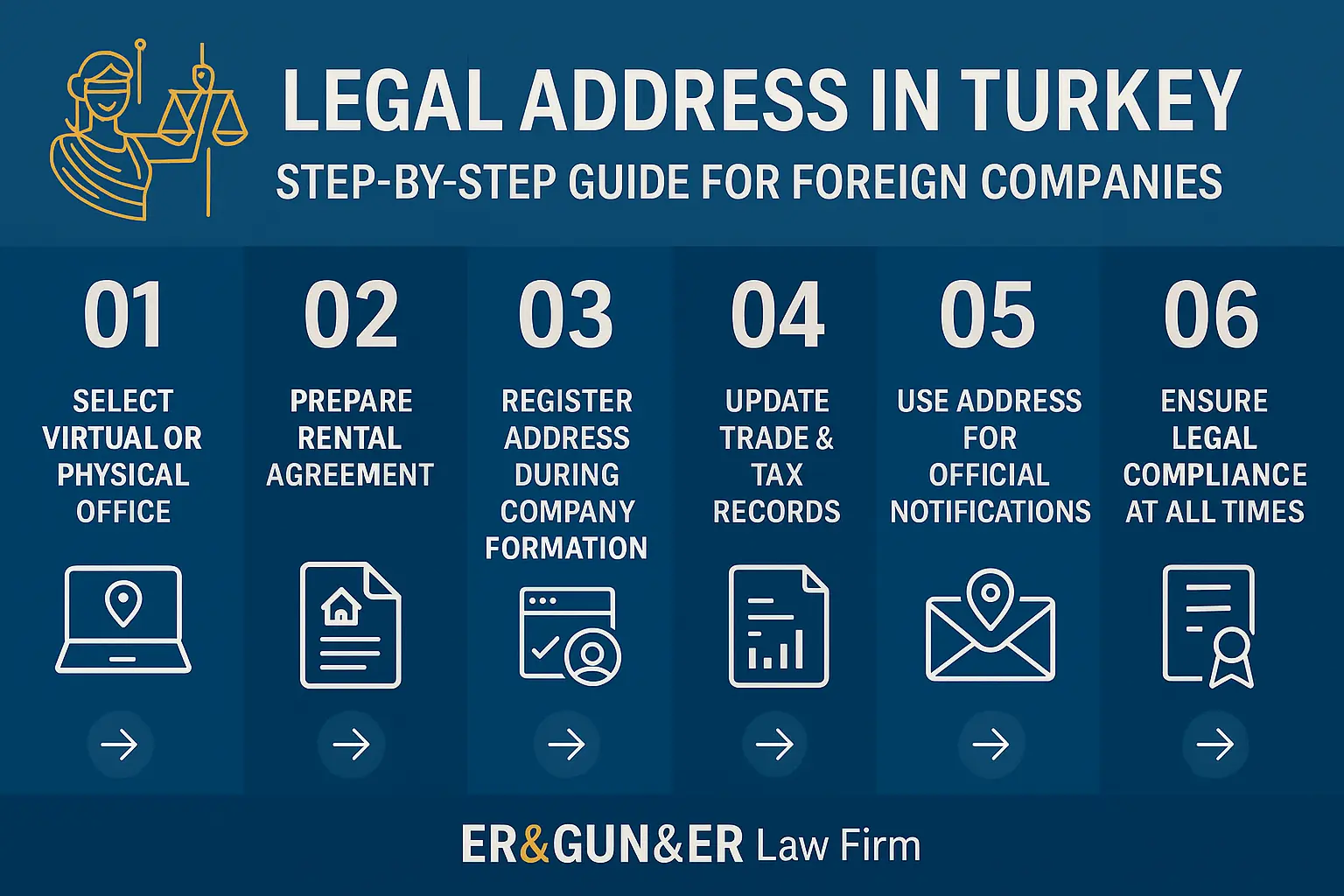
Every commercial entity established in Turkey must declare a registered office (kanuni merkez) that serves as the statutory domicile for corporate registration, tax compliance, judicial service, and regulatory correspondence. The requirement derives from the Turkish Commercial Code No. 6102 (TTK), which specifies the obligation to register the corporate address with the competent Trade Registry as part of the formation process, together with implementing regulations including the Trade Registry Regulation and the MERSIS (Merkezi Sicil Kayıt Sistemi) electronic system that centralizes Trade Registry records across Turkey. For foreign investors establishing subsidiaries, branches, liaison offices, or joint ventures, the registered office requirement is not a bureaucratic formality — it determines the competent Trade Registry office for all corporate filings, the competent tax office for tax registration and compliance, the jurisdiction of courts for commercial disputes, the service address for official communications, and the documentary foundation for banking relationships, licensing applications, and regulatory interactions. The specific address type — leased office under a standard commercial lease, serviced office under arrangements with business centers, co-working arrangements with flexible workspace providers, or virtual office structures with licensed providers — affects the documentation requirements and the acceptability across different Turkish authorities, with specific nuances by sector and by municipality. Practice may vary by authority and year, and specific address arrangements should be verified against current Trade Registry practice, tax office expectations, and sector-specific licensing requirements before committing to an address structure. This guide is general legal information rather than advice for any specific engagement. A lawyer in Turkey engaged at the address selection stage can prevent the rejection and delay scenarios that affect foreign company formation more frequently than substantive legal issues, because address compliance is among the most procedurally-sensitive aspects of Turkish company establishment.
Statutory framework for registered office under Turkish Commercial Code
A Turkish Law Firm handling foreign company address compliance works within the Turkish Commercial Code No. 6102 framework that establishes the registered office requirement as a fundamental element of corporate identity. Article 40 of the TTK requires every commercial enterprise to register its legal address with the competent Trade Registry, with the registered office serving as the legal domicile for statutory purposes. For joint stock companies (anonim şirket — A.Ş.) and limited liability companies (limited şirket — Ltd. Şti.), the articles of association must specify the city (şehir) where the registered office is located, while the specific street-level address is recorded in the Trade Registry without requiring articles amendment for intra-city relocations under the applicable framework. The registered office must be located within Turkey regardless of whether the shareholders or beneficial owners are Turkish or foreign — a foreign-owned entity cannot operate in Turkey through a foreign registered address but must establish a Turkish registered office. Changes to the registered office follow specific procedural requirements depending on whether the change is intra-city or inter-city, with inter-city changes typically requiring Trade Registry coordination between the outgoing and incoming Trade Registry offices. Practice may vary by authority and year, and the basic registered office framework should be verified against current Trade Registry Regulation provisions and Trade Registry practice at the specific office handling the matter because procedural details periodically adjust.
Turkish lawyers who coordinate MERSIS registration work within the centralized electronic system that maintains Trade Registry records across Turkey. MERSIS (Merkezi Sicil Kayıt Sistemi) assigns a unique registration number to each commercial entity and maintains the electronic record that supports cross-institution verification. The MERSIS record includes the entity's full corporate information — name, address, shareholders, authorized signatories, activity codes (NACE codes), capital structure, and related details. MERSIS registration is integrated with the Trade Registry Gazette (Ticaret Sicil Gazetesi) that publishes corporate registration events and serves as the official public record of corporate information. The registered address in MERSIS must be accurately maintained because it is the source record used by tax offices, banks, regulatory authorities, and business counterparties when verifying the entity. Synchronization between the physical reality at the address, the lease or use documentation supporting the address, the Trade Registry record, the MERSIS record, the Trade Registry Gazette publication, the tax office record, and subsidiary records at SGK (Social Security Institution) and other authorities is required — discrepancies across these records create verification friction that can affect routine operations. For foundational context on the company formation process into which the address registration fits, readers can consult our company formation guide for Turkey. Practice may vary by authority and year, and address discipline within the overall corporate record framework benefits from systematic verification that discovers discrepancies proactively rather than reactively when they cause specific transaction failures.
An English speaking lawyer in Turkey coordinating the integration between Turkish registered office requirements and the foreign parent company's global corporate structure addresses the specific considerations that arise from cross-border corporate architecture. Foreign ownership percentage, nationality of ultimate beneficial owners, and specific business sector may affect the registration pathway and any sector-specific approvals required alongside the baseline Trade Registry registration. Bilateral investment treaties, trade agreements, and specific reciprocity frameworks may create preferential treatment pathways for investors from specific jurisdictions, with implications for registration process and ongoing compliance. Parent company documentation requirements including corporate existence certificates, authority to invest, and board resolutions supporting the Turkish establishment require preparation with proper apostille or consular legalization depending on the specific jurisdiction's arrangements with Turkey. Sworn Turkish translation (yeminli tercüme) of foreign documents supports their acceptance by Turkish authorities, with specific formatting and translator qualification requirements. For context on foreign investor framework broadly applicable to company establishment, readers can consult our foreign investor company law guide. Practice may vary by authority and year, and foreign company registration benefits from coordinated preparation across Turkey and the home jurisdiction rather than sequential problem-solving as specific documentation gaps emerge during the Turkish registration process.
Address type options and comparative analysis
A lawyer in Turkey analyzing address type options for foreign company establishment works through the specific alternatives available under current Trade Registry practice with varying acceptability and documentation requirements. Traditional leased office arrangements under standard commercial leases provide the most universally acceptable address type with clear documentation through the lease agreement, landlord identification, premises location, and rental term. The lease must be in Turkish or accompanied by sworn Turkish translation, should specify the premises with sufficient detail for Trade Registry verification, and should be supported by the landlord's title documentation or equivalent proof of authority to lease. Serviced office arrangements through established business centers provide middle-ground solutions with the service provider's arrangement serving as the documentary basis, typically with acceptance patterns depending on the specific provider's reputation and the specific arrangement structure. Co-working arrangements through flexible workspace providers create specific documentation requirements where the arrangement must support the continuous corporate address function rather than merely providing occasional workspace, with acceptance varying by specific Trade Registry office and by provider. Virtual office arrangements through specialized providers create the most variable acceptance patterns — some Trade Registry offices routinely accept virtual office addresses meeting specific documentation standards while others apply more restrictive practices. Practice may vary by authority and year, and address type selection should account for both the initial registration acceptance and the ongoing operational suitability because an address that registers successfully but does not support actual operations creates downstream complications.
Turkish lawyers who address the virtual office and co-working compliance pattern work through the specific documentation framework that supports these flexible address arrangements. The service provider's arrangement should include specific address provision terms, the premises description with the physical location verifiable, the duration of the arrangement extending through the corporate need, the specific rights and obligations including mail receipt and authorized occupancy, and the provider's business registration documentation supporting their authority to provide the address service. Physical space verification where Trade Registry officials or tax office inspectors visit the premises requires the provider to maintain facilities capable of demonstrating the corporate presence including company identification (signage or directory listing), mail handling capability, and space availability for occasional corporate activities. Signage requirements at the building or suite level help establish the corporate presence in ways that physical verification can confirm. Sector-specific restrictions may affect virtual office acceptability — regulated industries including financial services, healthcare, food production, and certain professional services typically require physical premises meeting sector-specific standards that virtual office arrangements cannot satisfy. For established businesses transitioning from initial virtual office arrangements to physical premises as operations scale, or for businesses adjusting their arrangements over time, the address change procedures apply to the updates. Practice may vary by authority and year, and virtual office and co-working arrangements should be verified with counsel before commitment because specific provider arrangements that appear acceptable can fail at the registration stage based on local Trade Registry interpretation.
An Istanbul Law Firm addressing the residential address question works through the specific framework where residential premises can or cannot serve as corporate registered offices. The general principle is that commercial activity from residential premises faces specific restrictions based on building type, municipal zoning, condominium rules, and neighbor interests. Standalone residential properties may be suitable for specific categories of business activity where the residential zoning permits home office use, though limitations typically apply to operations that would generate significant traffic, commercial signage, or activities inconsistent with residential character. Apartment buildings subject to condominium ownership typically restrict commercial use of residential units through the building management plan (yönetim planı) with specific consequences for violations including potential condominium-level enforcement action. Mixed-use buildings may permit both residential and commercial use with specific zone-specific allocations. Specific professional activities including certain consulting, freelance, and service-oriented work may operate from residential addresses within the permitted framework, while commercial, manufacturing, and retail activities typically require commercial premises. Building management plan review before committing to a residential address for corporate registration prevents subsequent compliance issues. Practice may vary by authority and year, and residential address use for corporate registration should be specifically verified against the particular property's zoning, building rules, and the specific business activity rather than assumed based on general principles.
Trade Registry, tax office, and municipal registration workflow
A Turkish Law Firm coordinating the Trade Registry registration workflow works through the specific procedural sequence that establishes the corporate entity with its registered office. The registration application to the competent Trade Registry includes the articles of association specifying the registered office city, the supporting address documentation through lease or use arrangements, the shareholder and authorized signatory documentation, the capital structure confirmation, and the specific activity codes (NACE codes) identifying the business activities. The Trade Registry review examines the submitted documentation for completeness and compliance with the formal requirements, with specific attention to address documentation adequacy. Approval produces the trade registration with the MERSIS number assignment, followed by publication in the Trade Registry Gazette that serves as the official announcement of the corporate registration. Subsequent coordination with the Chamber of Commerce (ticaret odası) where the entity is registered supports the full corporate establishment including the chamber membership that is typically required for commercial operations. Time frames for Trade Registry completion vary by specific Trade Registry workload and documentation quality, with efficient documentation typically producing completion within a few working days while documentation issues can extend the process significantly. Practice may vary by authority and year, and Trade Registry registration benefits from experienced local counsel who can anticipate the specific issues that arise at the particular Trade Registry office handling the matter and prepare documentation to address those issues proactively.
Turkish lawyers who handle the tax office (vergi dairesi) coordination work through the subsequent workflow that establishes tax registration and the tax identification number (vergi numarası) required for all subsequent tax-related activities. Tax office registration follows Trade Registry approval with the submission of the company's registration documentation, the registered office details, and supporting materials to the tax office with jurisdiction over the registered office location. The tax office typically conducts a physical inspection of the premises to verify the actual corporate presence — this inspection confirms the address exists, the lease or use arrangement is genuine, and the company is operationally positioned to commence business. The inspection outcome produces the tax registration approval and the issuance of the tax registration certificate (vergi levhası) that confirms the company's tax registration. Stamp duty obligations on the lease agreement under the Stamp Duty Law apply where the lease is subject to the stamp duty — typically calculated as a percentage of the total lease value — with specific exemptions and special provisions potentially applicable depending on the specific circumstances. VAT registration where applicable based on the company's activities proceeds alongside the general tax registration. Practice may vary by authority and year, and tax office coordination benefits from pre-inspection preparation that ensures the premises demonstrate the corporate presence the inspector expects to verify — missing the inspection or presenting premises that do not appear operational can produce specific complications that require additional work to cure.
An English speaking lawyer in Turkey addressing the broader institutional registration chain works through the additional registrations that supplement the core Trade Registry and tax office processes. Social Security Institution (SGK) registration is required for any company with employees, with the address registered matching the Trade Registry and tax office records. National address database (UAVT — Ulusal Adres Veri Tabanı) coding assigns a specific address code to the premises that supports cross-system address verification. Registered e-mail (KEP — Kayıtlı Elektronik Posta) registration is required for commercial entities under the Turkish legal framework, providing the official e-mail address for formal electronic communications. UETS (Ulusal Elektronik Tebligat Sistemi) notification system registration supports electronic service for official notifications under the Notification Law framework. Chamber of Commerce registration supplements the Trade Registry with the chamber's local registration framework. Each of these registration points maintains its own record of the corporate address, with synchronization across all records being the operational objective — discrepancies across records create verification friction that affects routine operations including banking, regulatory approvals, and business relationships. For coordination of sworn translations supporting foreign document submission across these registration points, readers can consult our legal translation services guide. Practice may vary by authority and year, and the registration chain should be tracked through a documented checklist because missing a single registration point can produce specific operational issues that surface later.
Address for branches, liaison offices, and joint venture structures
A lawyer in Turkey handling branch office (şube) address requirements works within the specific framework that governs branches of foreign companies operating in Turkey. Branches are registered with the Trade Registry following the process that specifically applies to foreign company branches, with the branch address being the physical location in Turkey from which the branch operates. The branch address must support the branch's commercial activities in ways consistent with the branch's operational scope — branches engaged in substantive commercial activity typically require premises capable of supporting the activities, while branches with narrower functional scope may operate from smaller premises. Documentation requirements include the parent company's corporate existence certificates with apostille or consular legalization, the authority to establish the branch including board resolutions where applicable, the appointment of the branch manager (şube müdürü) with corresponding powers, and the branch address documentation through lease or use arrangements. Sector-specific requirements apply where the branch's activity is in regulated sectors — banking branches require Banking Regulation and Supervision Agency (BDDK) approval, insurance branches require Insurance and Pension Supervision Agency (SEDDK) approval, and similar sector-specific oversight applies in other regulated industries. Practice may vary by authority and year, and branch registration benefits from integrated planning between the parent company's home jurisdiction and the Turkish registration to ensure documentation compatibility and timing alignment.
Turkish lawyers who coordinate liaison office (irtibat bürosu) establishment work within the distinct framework applicable to representative offices that do not engage in commercial activity but support research, market development, and liaison functions. Liaison offices are established under specific permission from the Ministry of Trade (Ticaret Bakanlığı) rather than through the standard Trade Registry process applicable to commercial entities, with the permission granted for limited terms subject to renewal. The liaison office permission application includes the parent company documentation, the specific proposed scope of liaison activities, the duration requested, and the proposed office arrangements including the physical address. The address requirements for liaison offices emphasize the actual physical presence supporting the liaison functions — virtual office arrangements may be acceptable depending on specific Ministry of Trade practice while the general expectation is physical premises where liaison personnel conduct their non-commercial activities. Specific prohibitions on commercial activity including invoicing, direct sales, and similar commercial functions distinguish liaison offices from commercial branches and subsidiaries. Annual activity reports to the Ministry of Trade demonstrate compliance with the liaison-only scope. For detailed framework on liaison office legal requirements including the specific procedural and substantive conditions, readers can consult our liaison office legal requirements guide. Practice may vary by authority and year, and liaison office establishment requires specialist coordination because the framework differs substantially from commercial entity registration and mistakes in the initial application can produce significant delay in operational capability.
An Istanbul Law Firm structuring joint venture address arrangements addresses the specific considerations that arise when two or more parties form a new Turkish entity or contractual arrangement requiring a registered office. For JV structures involving establishment of a new Turkish corporate entity (typically limited liability or joint stock company), the registered office is established like any other Turkish company with the specific considerations that the address should reflect the operational reality of the JV rather than being a pure registration convenience. For JV structures involving existing Turkish entities, the registered office of the operating entity continues to serve as the JV's registered base with the JV agreement addressing the specific operational arrangements. Branch structures where a foreign JV partner establishes a Turkish branch specifically for the JV activity follow the branch registration framework. The JV shareholders' agreement should address the registered office as an element of the governance framework including any specific requirements for address changes, the authority to execute lease or address-related agreements on behalf of the JV entity, and the consequences of JV termination for the address arrangements. Accounting and tax consequences of the specific JV structure including the income allocation framework between JV partners depends on the corporate structure chosen. Practice may vary by authority and year, and JV address planning benefits from integration with the broader JV structuring decisions rather than being treated as a separate technical question because the specific choices interact across the corporate, operational, and tax dimensions.
Banking, licensing, and communication functions of registered address
A Turkish Law Firm coordinating banking relationship establishment addresses the specific role of the registered address in corporate bank account opening and ongoing banking operations. Turkish banks apply Know Your Customer (KYC) and Anti-Money Laundering (AML) requirements that include verification of the corporate registered address as part of the entity identification framework. Documentation supporting the address includes the Trade Registry Gazette publication showing the registered address, the tax registration certificate confirming the address at the tax level, and the lease or use arrangement supporting the physical presence. Banks may conduct their own verification of the address independent of other institutional verifications, with specific banks applying varying rigor based on their internal compliance framework and the specific customer profile. Ongoing banking operations including credit facility applications, trade finance, and foreign exchange activities draw on the corporate address record for compliance purposes, with address changes requiring specific notification to each bank with which the entity maintains relationships. For detailed framework on corporate bank account opening including the specific procedural and documentary requirements, readers can consult our corporate bank account opening guide. Practice may vary by authority and year, and banking relationship coordination with address compliance benefits from managing the address as a compliance asset rather than as a registration formality because banking operations frequently surface address-related issues that simple registration compliance does not anticipate.
Turkish lawyers who handle licensing and regulatory approval coordination work through the various sector-specific approval frameworks that reference the corporate registered address. E-commerce licensing under the applicable regulatory framework requires address registration with specific supporting documentation. Sector-specific approvals in regulated industries including healthcare, education, logistics, finance, food production, manufacturing, and many others include address-related requirements that may exceed the baseline Trade Registry expectations. Import-export licensing including customs registration references the registered address. Investment incentive applications under the Investment Incentives framework include address documentation. Municipal licensing for specific business activities may require address clearance at the municipal level. Each licensing framework applies its own address verification, and ensuring the registered address meets all applicable licensing requirements supports smooth licensing progression. Sector-specific restrictions on address types may eliminate virtual office and some co-working arrangements for specific licensed activities, making physical office premises necessary for those activities. Practice may vary by authority and year, and licensing coordination with address compliance benefits from early-stage sector analysis that identifies all applicable licensing frameworks before the address is finalized, because address changes to accommodate licensing requirements are more complicated than initial selection of compliant addresses.
An English speaking lawyer in Turkey coordinating electronic notification system registration works through the specific frameworks that govern official electronic communications. KEP (Kayıtlı Elektronik Posta — Registered Electronic Mail) is the Turkish legal framework for registered e-mail communications that carry legal evidentiary value for specific types of communications. Commercial entities are required to obtain KEP addresses for specific official communications including tax correspondence, Trade Registry notifications, and other official communications where applicable. KEP addresses operate through authorized service providers who register KEP accounts and manage the technical infrastructure supporting legally-valid electronic communications. UETS (Ulusal Elektronik Tebligat Sistemi — National Electronic Notification System) operated by the Postal and Telegraph Organization (PTT) supports electronic service of official notifications under the Notification Law No. 7201 framework with specific categories of users required to register and specific categories of communications subject to electronic service. The interaction between KEP and UETS depends on the specific communication type and the specific recipient — some communications proceed through KEP, others through UETS, and the compliance framework requires attention to both. For entities operating through remote management, maintaining current KEP and UETS accounts supports receipt of official communications without requiring physical presence at the registered office. Practice may vary by authority and year, and electronic notification registration should be treated as a compliance priority because missed notifications through these systems can produce procedural consequences including missed deadlines, default judgments, and specific compliance failures.
Address changes, relocations, and compliance updates
A lawyer in Turkey handling registered office changes works within the procedural framework that governs address updates across the full institutional registration chain. The initial corporate decision supporting the address change takes the form appropriate to the corporate structure — shareholders' resolution for limited liability companies, board resolution or general assembly resolution for joint stock companies depending on whether the change requires articles amendment, with the specific framework depending on whether the new address is in the same city as the current registration or represents an inter-city relocation. Intra-city address changes within the same Trade Registry jurisdiction typically follow a simplified procedure focused on the address update without articles amendment unless the articles specifically require amendment. Inter-city address changes between Trade Registry jurisdictions require coordination between the outgoing and incoming Trade Registry offices, with the corporate records transferring between the two Trade Registries. The specific documentation supporting the new address including the new lease or use arrangement must satisfy the incoming Trade Registry's documentation standards, which may differ from the outgoing Trade Registry's expectations. Timing coordination matters because the company must maintain operational continuity through the change, with specific attention to service of process, banking operations, and regulatory compliance that depend on the address. Practice may vary by authority and year, and address changes should be planned as projects with specific timelines, responsible parties for each institutional update, and verification checkpoints because uncoordinated changes produce discrepancies across institutional records that take significant effort to cure.
Turkish lawyers who coordinate the tax office transition work through the specific procedures when address changes affect tax office jurisdiction. Intra-tax-office changes where the new address remains within the same tax office's jurisdiction require notification and update without fundamental restructuring of the tax relationship. Inter-tax-office changes where the new address falls within a different tax office's jurisdiction require transfer procedures that move the corporate tax record from the outgoing tax office to the incoming tax office, with specific documentation supporting the transfer and typically a physical inspection at the new premises confirming the corporate presence. VAT registration updates ensure that invoicing and VAT compliance continues without disruption through the transition. E-invoice (e-fatura) and e-archive (e-arşiv) system updates align the electronic invoicing infrastructure with the new address. Tax certificate (vergi levhası) updates reflect the new address on the official tax registration document that is typically posted at the premises. Stamp duty on the new lease agreement where applicable should be addressed as part of the transition. Practice may vary by authority and year, and tax office transitions benefit from coordination with tax advisors alongside legal counsel because the interaction between corporate law address mechanics and tax compliance implications may produce specific considerations that benefit from specialist analysis.
An Istanbul Law Firm addressing the broader institutional update chain following address changes works through the comprehensive list of records requiring update to maintain synchronization. SGK (Social Security Institution) records update ensures employee-related compliance continues with the correct employer address. UAVT (national address database) coding updates provide the specific address code for the new location supporting cross-system verification. KEP and UETS account updates where the contact information tied to the accounts changes. Chamber of Commerce registration updates maintain the chamber-level record. Banking relationship updates with each bank the entity uses. Customer and supplier notifications ensure business continuity. Website and marketing material updates present the current address to the marketplace. Invoice template updates ensure newly-issued invoices reflect the current address. Contract amendments for ongoing contracts where the address is specified in the contract terms. Insurance policy updates where the policy specifies the covered premises. For specific coordination where the prior lease is being terminated as part of the relocation, the termination framework applies including any specific notice requirements and potential disputes with the outgoing landlord — readers can consult our commercial lease termination guide. Practice may vary by authority and year, and address change projects benefit from a documented checklist covering all affected records because missed records surface as specific operational issues that can be time-consuming to diagnose and cure.
POA-based remote address establishment and management
A Turkish Law Firm addressing foreign director remote address establishment works through the power of attorney (vekaletname) framework that enables Turkish counsel to handle address-related matters without requiring the foreign principal's physical presence in Turkey. The power of attorney grants specific powers to the Turkish representative including the authority to execute lease agreements or address use arrangements on behalf of the company, sign address declarations and other formal documents, represent the company before Trade Registry offices, tax offices, and other institutional counterparties, and handle specific procedural steps including Trade Registry filings and tax inspector coordination. The specific scope of authority should be calibrated to the intended use — broad authority supporting comprehensive address management versus narrower authority limited to specific procedural steps — with the scope matching the client's operational preference for centralization versus case-by-case authorization. Power of attorney execution in the foreign principal's jurisdiction requires apostille certification under the Hague Apostille Convention for countries party to the Convention, or consular legalization through the Turkish consulate or embassy for non-Convention countries. Sworn Turkish translation of the apostilled or legalized power of attorney supports its acceptance by Turkish authorities. For detailed framework on power of attorney for foreign investors in Turkey including the specific content requirements and procedural pathways, readers can consult our power of attorney for foreigners guide. Practice may vary by authority and year, and power of attorney arrangements for address management benefit from careful scope definition because overly broad powers create risk exposure while overly narrow powers create operational friction as specific tasks require additional powers-of-attorney for execution.
Turkish lawyers who coordinate remote corporate establishment through the power of attorney framework work through the full company formation workflow that can be executed without the foreign principal's presence. The pre-formation preparation including business plan review, corporate structure selection, capital determination, and shareholder structuring typically involves the principal's active decision-making through remote communication. The formation documentation including articles of association preparation in Turkish format requires the principal's approval of the Turkish text through sworn translation or bilingual arrangements. Formation execution including notarization of the articles of association and Trade Registry filing can be handled through the power of attorney representative. Post-formation coordination including tax office registration, SGK registration, chamber of commerce registration, KEP account creation, and UETS registration proceeds through the power of attorney framework. Banking relationship establishment typically still requires the principal's involvement at specific stages — initial account opening may permit power-of-attorney-based execution with specific banks depending on their internal compliance framework, while other banks may require direct principal participation. Ongoing operational activities through the formation period and into early operations can continue through the power of attorney arrangement. Practice may vary by authority and year, and remote company establishment through Turkey has matured significantly as electronic processes have developed, though specific steps still benefit from physical presence when scheduling and circumstances permit.
An English speaking lawyer in Turkey coordinating ongoing remote address management after the initial establishment addresses the specific framework for maintaining compliance without the foreign principal's regular presence. Annual compliance obligations including tax return filing, corporate report filings, and regulatory updates proceed through the Turkish counsel representation. Address-related issues including lease renewal, potential address changes, and inspection response proceed through the representative. Official notification handling through KEP and UETS with scanning and forwarding to the foreign principal supports awareness of regulatory communications. Periodic review with the foreign principal — typically quarterly or annually — addresses strategic questions about the company's direction while day-to-day compliance proceeds through the representation framework. Escalation protocols for significant events including tax audits, regulatory investigations, litigation matters, or strategic decisions that require the principal's input structure when direct principal involvement becomes necessary. Documentation standards maintain the records supporting potential future audits, transactions, or disputes in a way that survives the remote management framework. Practice may vary by authority and year, and remote address management arrangements benefit from clear governance protocols that distinguish routine matters handled through representation from strategic matters requiring direct principal engagement, because the remote framework works well for its intended scope but can fail when inappropriate decisions are made without principal input or when the principal becomes involved in matters that routine representation could have handled efficiently.
Risks, penalties, and address validity defense
A lawyer in Turkey analyzing the risks arising from invalid or incomplete address declarations works through the specific consequences that can flow from address compliance failures. Trade Registry rejection of registration applications where the address documentation is inadequate produces delays ranging from days to weeks depending on the specific issues and the Trade Registry's response time — in severe cases where fundamental issues exist, registration may be effectively blocked until the underlying issues are cured. Tax office registration refusal where the address does not satisfy tax office requirements prevents the issuance of the tax identification number that is required for banking, commercial transactions, and regulatory activities. Address-related compliance failures during ongoing operations can produce specific consequences including VAT registration suspension, e-invoice system access restriction, SGK compliance issues, and broader registration integrity questions. Service of process failures where official communications cannot be delivered to the registered address can produce default judgments, missed regulatory deadlines, and specific procedural losses. Banking relationship complications where the registered address does not support KYC verification can affect account operations, credit access, and transaction capability. Practice may vary by authority and year, and address risk should be treated as a material operational risk rather than as a registration formality because the consequences of address failures affect the full spectrum of corporate operations.
Turkish lawyers who address the penalty framework applicable to specific address-related violations work through the various frameworks that impose consequences. Knowingly providing false address information in corporate registration can trigger specific criminal consequences under forgery and misrepresentation provisions of the Turkish Penal Code, with potential consequences including criminal prosecution, fines, and imprisonment for serious cases. Using premises without the property owner's consent or without proper authority exposes the entity to civil claims from the actual property owner and potential criminal consequences depending on the specific circumstances. Building rule violations where the corporate presence is inconsistent with condominium rules or zoning can produce condominium-level enforcement, municipal sanctions, and potential court-ordered cessation of the prohibited use. Sector-specific compliance failures where the address does not meet sector regulatory requirements can produce license revocation, operational restrictions, and regulatory fines. Tax consequences including assessment issues, VAT complications, and potential additional tax audits can flow from address-related irregularities. Practice may vary by authority and year, and address compliance should be maintained at the level of care appropriate to other significant compliance areas because the downside scenarios can be materially consequential and typically compound when discovered rather than emerging as discrete issues subject to simple correction.
An Istanbul Law Firm coordinating address validity defense in specific dispute scenarios works through the specific response framework when address compliance is challenged. Trade Registry correction proceedings where specific documentation deficiencies are identified typically support remediation through additional documentation, lease amendments, or alternative address structures. Tax office disputes over address validity can proceed through the formal objection procedures where the underlying compliance position can be supported. Municipal and zoning challenges require specific response tailored to the alleged violation. Neighbor complaints regarding corporate activities at residential addresses require response addressing both the specific conduct and the broader address use question. Third-party challenges to address validity in commercial contexts — banking disputes, contract counterparty challenges, regulatory reviews — require documentation supporting the corporate address position with reference to the underlying Trade Registry, tax office, and other institutional records. Litigation involving the address may arise in specific circumstances including disputes over the entity's proper domicile for jurisdictional purposes, challenges to service of process at the registered address, and disputes about the address's adequacy for specific legal or regulatory purposes. Practice may vary by authority and year, and address validity defense benefits from maintaining the documentary foundation throughout the operational period so that any subsequent challenge can be addressed through documented compliance rather than through retrospective reconstruction.
Author: Mirkan Topcu is an attorney registered with the Istanbul Bar Association (Istanbul 1st Bar), Bar Registration No: 67874. His practice focuses on cross-border and high-stakes matters where evidence discipline, procedural accuracy, and risk control are decisive, with particular concentration on foreign company registration in Turkey under the Turkish Commercial Code No. 6102, registered office establishment through the various available address types, Trade Registry and MERSIS registration coordination, tax office registration and inspection management, branch office and liaison office establishment with sector-specific requirements, joint venture structuring with associated address considerations, banking and licensing interactions with corporate address compliance, address changes and institutional record synchronization, power-of-attorney-based remote company establishment and management, and address validity defense across the various scenarios in which address compliance can be challenged.
He advises individuals and companies across Commercial and Corporate Law, Commercial Contracts, Foreign Investment, Arbitration and Dispute Resolution, Enforcement and Insolvency, Citizenship and Immigration (including Turkish Citizenship by Investment), Real Estate (including acquisitions and rental disputes), International Tax, International Trade, Foreigners Law, Sports Law, Health Law, Data Protection and Privacy, and Criminal Law. He regularly supports Turkish and international clients on corporate formation strategy with address selection aligned to operational requirements, address documentation preparation and Trade Registry coordination, tax office registration and inspection response, branch and liaison office establishment with parent company documentation management, joint venture structuring including the address dimensions, banking relationship support for newly-formed entities, address changes including institutional update coordination, power-of-attorney-based remote formation and ongoing management, and compliance remediation for entities with address-related issues requiring cure.
Education: Istanbul University Faculty of Law (2018); Galatasaray University, LL.M. (2022). LinkedIn: Profile. Istanbul Bar Association: Official website.
Frequently asked questions
- Why is a registered office required for Turkish companies? The Turkish Commercial Code No. 6102 requires every commercial entity to register a legal address (kanuni merkez) with the Trade Registry. The registered office serves as the statutory domicile for corporate registration, tax compliance, judicial service, and regulatory correspondence, with specific implications for jurisdiction, institutional relationships, and operational capability.
- Can a foreign company use an address outside Turkey? No. The registered office must be located within Turkey regardless of the shareholders' nationality. Foreign-owned entities operating in Turkey must establish a Turkish registered office through subsidiary, branch, liaison office, or similar Turkish-legal structures.
- What address types are acceptable for Turkish company registration? Traditional leased offices, serviced offices, co-working arrangements with compliant documentation, and virtual offices from licensed providers can all be acceptable. Specific acceptance varies by Trade Registry office, sector-specific requirements, and the specific provider arrangements. Regulated industries may require physical premises meeting sector-specific standards.
- What documentation supports the registered address? Core documentation includes the lease agreement or service arrangement with proper Turkish format, the landlord's title or authority documentation, any required consents, sworn translations for foreign documents, and the articles of association specifying the registered city. Different Trade Registry offices may have specific documentation expectations beyond the baseline.
- What is MERSIS and how does it relate to the registered office? MERSIS (Merkezi Sicil Kayıt Sistemi) is the centralized electronic Trade Registry system that maintains corporate records across Turkey. The registered office is recorded in MERSIS alongside other corporate information, with the MERSIS record serving as a source for cross-institution verification by tax offices, banks, and other authorities.
- How do Trade Registry, tax office, and other institutional registrations work together? The registration chain begins with Trade Registry registration producing the MERSIS number and Trade Registry Gazette publication. Tax office registration follows with typical physical inspection. Chamber of Commerce, SGK, UAVT, KEP, and UETS registrations complete the institutional registration framework. All records should be synchronized for the registered address.
- What physical inspection can we expect from the tax office? The tax office typically conducts a physical inspection at the registered office premises to verify the corporate presence including the address existence, the lease or use arrangement, and the operational positioning. The inspection outcome produces the tax registration approval and the issuance of the tax registration certificate.
- What are branch office address requirements? Branches of foreign companies register with the Trade Registry following the specific branch framework. The branch address must support the branch's commercial activities with documentation through lease or use arrangements. Sector-specific requirements apply for regulated industries including banking, insurance, and others requiring specific regulatory approval alongside Trade Registry registration.
- How do liaison offices differ from branches for address purposes? Liaison offices operate under Ministry of Trade permission rather than Trade Registry registration, and support research and representation functions without commercial activity. Address requirements emphasize the physical presence supporting the liaison functions, with the Ministry of Trade practice determining specific acceptable arrangements.
- Can a residential address serve as the registered office? Commercial activity from residential premises faces restrictions based on building type, municipal zoning, condominium rules, and the specific business activity. Some professional service activities may be compatible with residential addresses while commercial, manufacturing, and retail activities typically require commercial premises. Building rules require verification before committing.
- How does an address change work? Intra-city changes within the same Trade Registry jurisdiction follow simplified procedures while inter-city changes require coordination between Trade Registry offices. The change requires updates to tax office, SGK, UAVT, KEP, UETS, chamber of commerce, banking, and other institutional records to maintain synchronization across the registration chain.
- What are KEP and UETS and why do they matter for the registered office? KEP (Kayıtlı Elektronik Posta) is the registered e-mail framework required for commercial entities providing legal evidentiary value for specific communications. UETS (Ulusal Elektronik Tebligat Sistemi) is the national electronic notification system operated by PTT for official service under the Notification Law. Both support electronic communications tied to the corporate identity.
- Can foreign directors establish a Turkish company without visiting Turkey? Yes, through power-of-attorney-based execution where Turkish counsel handles the formation workflow. The power of attorney requires proper apostille or consular legalization from the foreign jurisdiction with sworn Turkish translation. Specific stages including some banking relationships may still benefit from direct principal involvement.
- What risks arise from invalid or incomplete address declarations? Risks include Trade Registry rejection, tax office registration refusal, service of process failures, banking relationship complications, VAT and e-invoice restrictions, sector-specific compliance failures, and potential criminal consequences for knowingly false declarations. Address compliance should be maintained at the level appropriate to material operational compliance rather than treated as a formality.
- How does ER&GUN&ER Law Firm structure address compliance engagements? Engagements begin with structure and address assessment — corporate entity type, sector-specific requirements, operational needs, and documentation pathway — translated into address selection and acquisition, institutional registration coordination across Trade Registry, tax office, and supporting registrations, ongoing compliance maintenance including address change support, POA-based remote management where applicable, and dispute or defense support when address compliance is challenged.