

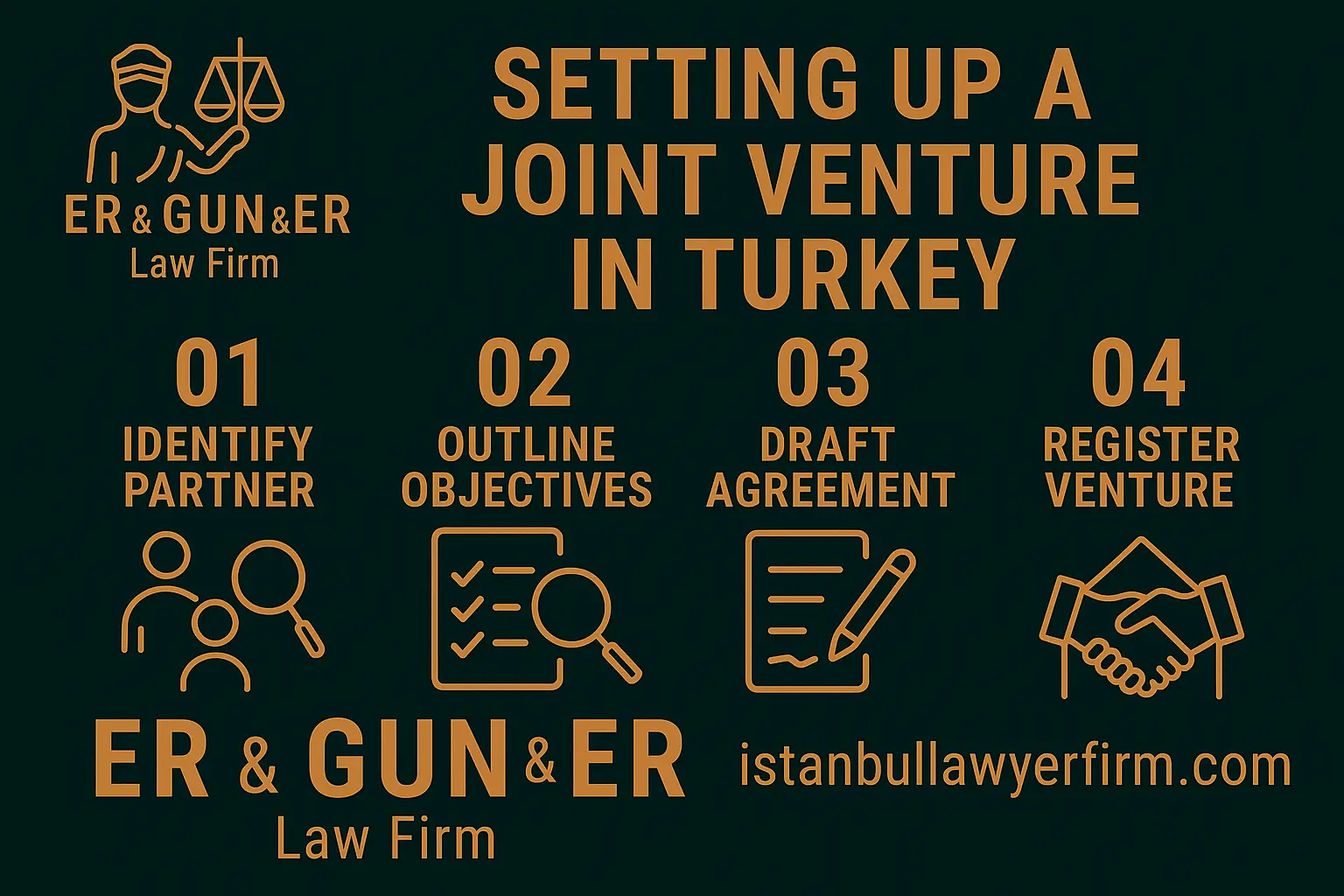
Joint ventures in Turkey combine multiple partners — typically including Turkish and foreign investors — into shared commercial enterprises governed by an integrated framework spanning corporate law, foreign investment law, competition law, tax law, intellectual property law, employment law, and dispute resolution mechanisms. The foundational corporate framework derives from the Turkish Commercial Code No. 6102 (TTK) governing corporate formation, governance, capital structure, and corporate transactions. The Foreign Direct Investment Law No. 4875 of 17 June 2003 establishes the national treatment principle applicable to foreign investor participation. Competition Law No. 4054 (Rekabetin Korunması Hakkında Kanun) governs merger control through the Competition Authority (Rekabet Kurumu) via Communiqué No. 2010/4 on Mergers and Acquisitions Subject to the Approval of the Competition Board, with mandatory pre-notification where turnover thresholds are met. Tax framework combines Corporate Tax Law No. 5520 including transfer pricing under Article 13, Value Added Tax Law No. 3065, Income Tax Law No. 193 for withholding obligations, and Presidential Decrees establishing rates periodically adjusted — effective 22 December 2023, the dividend withholding rate for non-resident shareholders increased from 10% to 15% under Presidential Decree No. 7887, subject to DTT reductions where treaty benefits apply. Intellectual property protection operates through the Industrial Property Law No. 6769 (SMK) for trademarks, patents, industrial designs, and geographical indications, and the Intellectual and Artistic Works Law No. 5846 (FSEK) for copyright. Employment flows from Labor Law No. 4857. Dispute resolution pathways include Turkish courts under the Code of Civil Procedure No. 6100, domestic arbitration, international commercial arbitration under the International Arbitration Law No. 4686 (MTK), Istanbul Arbitration Centre (ISTAC) institutional arbitration (established by Law No. 6570 of 29 November 2014, operational from 26 October 2015), ICC, LCIA, SIAC, HKIAC, and UNCITRAL rule-based arbitration, mediation under Law No. 6325 with mandatory commercial mediation under Law No. 7155 effective 1 January 2019, and foreign arbitral award enforcement under the New York Convention 1958 (in force for Turkey since 25 September 1991 through Law No. 3731). Minimum capital requirements were most recently adjusted effective 1 January 2024 to TRY 250,000 for joint stock companies (anonim şirket) and TRY 50,000 for limited liability companies (limited şirket). Practice may vary by authority and year, and joint venture structuring benefits from integrated analysis across these interacting frameworks because isolated optimization in any single dimension typically produces complications in others. A lawyer in Turkey engaged at the joint venture planning stage establishes the foundation that subsequent operational and exit events test.
Understanding JV structures under TTK No. 6102
A Turkish Law Firm advising joint venture structure selection works through the corporate vehicle options available under the Turkish Commercial Code, with selection driven by commercial objectives, capital structure needs, liability allocation, operational characteristics, and anticipated exit mechanisms. Limited liability companies (Limited Şirket — Ltd. Şti.) under TTK Articles 573-644 provide simplified governance with closely-held structure suited to joint ventures with a smaller partner count where operational simplicity and cost efficiency are priorities; Ltd. Şti. minimum capital is TRY 50,000 effective 1 January 2024 (previously TRY 10,000). Joint stock companies (Anonim Şirket — A.Ş.) under TTK Articles 329-572 provide the corporate architecture supporting multiple share classes, flexible capital instruments, easier equity transfers, institutional investor compatibility, and a pathway to public markets; A.Ş. minimum capital is TRY 250,000 effective 1 January 2024 (previously TRY 50,000), with the authorized capital system (kayıtlı sermaye sistemi) available to non-public A.Ş. requiring a minimum initial capital of TRY 500,000 and providing flexibility for subsequent capital increases up to an authorized ceiling by board resolution rather than general assembly amendment. Notably, since the 2012 TTK reform, both A.Ş. and Ltd. Şti. can be established with a single founder — the prior A.Ş. five-founder minimum is no longer a constraint on structuring. Contractual joint ventures (adi ortaklık) under TBK Articles 620-645 provide project-based cooperation without establishing a separate legal entity, suited to construction consortia, bidding consortia, and time-limited collaborations where avoiding an entity is commercially preferable; liability under adi ortaklık is joint and several among partners. Hybrid structures combining an entity with a parallel contractual framework can address specific cooperation models. The corporate vehicle choice affects every downstream dimension including governance mechanics, capital mechanics, tax treatment, exit mechanisms, and liability allocation. For framework on company formation procedural mechanics, readers can consult our company formation guide for Turkey. Practice may vary by authority and year, and corporate vehicle selection benefits from integrated analysis across corporate, tax, regulatory, and exit dimensions rather than single-dimension optimization.
Turkish lawyers who address the capital requirements and governance implications of each structure work through the framework where capital and governance differ materially across the options. Capital contribution mechanics include cash contributions (subject to banking-channel deposit requirements — one quarter of the subscribed capital must be deposited in a dedicated bank account before registration for A.Ş., with the remainder payable within 24 months; Ltd. Şti. follows the same pattern with capital adjustment for the different minimum), in-kind contributions (ayni sermaye) subject to independent expert valuation through a court-appointed expert under TTK Article 343 and subject to specific restrictions (for example, in-kind contributions cannot be subject to limited real rights or attachments that would prevent free transferability), and for A.Ş. structures, mixed contributions and takeover of existing businesses. Governance for Ltd. Şti. is centered on one or more managers (müdür), with at least one manager required and manager-shareholder identity permitted; the general assembly holds ultimate authority over fundamental matters. A.Ş. governance operates through the board of directors (yönetim kurulu) with at least one member required (the three-member minimum was removed in the 2012 TTK reform), and the general assembly (genel kurul) holds ultimate authority. Statutory reserve obligations under TTK Article 519 for A.Ş. and corresponding provisions for Ltd. Şti. require annual allocation of 5% of net profit to the first legal reserve until it reaches 20% of paid-in capital, with additional reserves required on distributions above specified thresholds. Shareholder protections including equal treatment, pre-emptive rights on capital increases, minority shareholder rights to request general assembly convening (at 10% for non-public A.Ş., 5% for public A.Ş.) and to request special audit, and dissolution rights for just cause under TTK Article 531 apply with structure-specific variations. Practice may vary by authority and year, and applicable capital and governance framework should be confirmed against current regulatory sources because reliance on historical figures produces material errors.
An English speaking lawyer in Turkey coordinating foreign investor participation in joint venture structures addresses the framework where foreign partners face cross-border considerations. FDI Law No. 4875 establishes the national treatment principle — foreign investors participate in Turkish joint ventures on equal terms with domestic investors, subject to sectoral restrictions that apply equally to foreign and domestic participation in regulated industries. Sectoral restrictions operate in broadcasting (RTÜK Law No. 6112 limits foreign ownership in Turkish broadcasters), aviation (Turkish Civil Aviation Law No. 2920 imposes ownership restrictions on Turkish-registered airlines), maritime (Law No. 6762 and related regulations limit foreign control of Turkish-flag vessels), and certain other regulated sectors under their specific frameworks. Ultimate beneficial ownership (UBO) identification for foreign shareholders requires documentation with apostille (for Hague Apostille Convention parties) or consular legalization (for non-Convention countries) and sworn Turkish translation. Foreign investment registration through the Electronic Incentive Application and Foreign Investment Information System (E-TUYS) operated by the Ministry of Industry and Technology is required for specific foreign investment categories. Cross-border governance architecture addressing how the foreign partner's home-country governance interacts with Turkish requirements — board composition with cross-nationality representation, reserved matters requiring partner consent, veto rights on specific categories, information rights, and accounting framework alignment (IFRS versus local GAAP where the foreign partner has home-country consolidation obligations) — requires careful design. Tax treaty application where Turkey has over 85 DTTs in force modifies withholding rates on cross-border payments including dividends, interest, royalties, and service fees. Currency considerations under Decision No. 32 affect capital inflows, operational transactions, and eventual exit proceeds. Practice may vary by authority and year, and foreign participation structuring benefits from integrated Turkey-and-home-country analysis because the optimizations differ from either single-jurisdiction framework.
Regulatory approvals, sector licensing, and FDI incentives
A lawyer in Turkey coordinating regulatory approvals for joint ventures works through the framework that depends on the joint venture's sector, activities, and characteristics. Competition Law No. 4054 notification to the Turkish Competition Authority (Rekabet Kurumu) under Communiqué No. 2010/4 is required where the joint venture formation meets turnover thresholds. The current thresholds (as amended most recently effective March 2022 and subject to periodic adjustment) require notification where the total Turkey turnover of the parties exceeds TRY 750 million and at least two of the parties each have Turkey turnover exceeding TRY 250 million, or, for acquisitions of undertakings by technology undertakings with specific characteristics, lower thresholds apply. Joint ventures that constitute "full-function" joint ventures producing a lasting effect on market structure are subject to the concentration analysis and notification framework. Sector-specific regulators potentially applicable based on joint venture activities include the Capital Markets Board (Sermaye Piyasası Kurulu — SPK) for capital markets activities under Law No. 6362, the Banking Regulation and Supervision Agency (BDDK) for banking and financial leasing, factoring, and financing activities under Law No. 5411, the Insurance and Private Pension Regulation and Supervision Agency (SEDDK) for insurance activities, the Energy Market Regulatory Authority (EPDK) for electricity, natural gas, petroleum, and LPG markets, the Information and Communication Technologies Authority (BTK) for electronic communications, the Civil Aviation General Directorate (SHGM) for civil aviation, the Ministry of Health for health sector activities, and the Ministry of National Education for education activities. Each framework has its own notification or approval requirements, timelines, documentation standards, and substantive review criteria. Foreign investment notification through E-TUYS supplements sectoral reviews for qualifying foreign investments. Practice may vary by authority and year, and regulatory planning for joint ventures benefits from early analysis because approval timelines can materially affect joint venture launch schedules.
Turkish lawyers who address the Competition Authority notification framework for joint ventures work through the analysis supporting compliance with merger control obligations. Concentration analysis under Communiqué No. 2010/4 identifies whether the joint venture formation constitutes a notifiable concentration — transactions resulting in a change of control meeting the thresholds trigger the notification obligation, and gun-jumping (closing before clearance where notification is required) exposes parties to fines under Article 16 of Law No. 4054 up to 0.1% of the turnover and, in serious cases, Article 16 fines up to 10% of annual turnover. Turnover threshold analysis based on the parties' aggregate global and Turkey turnover determines whether the thresholds are met. Full-function joint venture analysis addresses whether the joint venture performs the functions of an autonomous economic entity with lasting effect on market structure — a full-function JV is subject to the concentration framework, while a non-full-function JV (typically one that serves as a captive entity for the parents or lacks operational autonomy) may be analyzed under Article 4 cooperation framework instead. Pre-notification consultations with the Competition Authority where complex issues are involved (market definition questions, competitive effects in concentrated markets, vertical effects) can support the formal notification. Formal notification includes comprehensive information about the parties, the transaction, relevant product and geographic markets, market shares, competitive analysis, and efficiency justifications where relevant. Review structure includes Phase I preliminary review with a 30-day statutory period for the Authority to decide on clearance, conditional clearance, or transition to Phase II, and Phase II in-depth review where competitive concerns require further analysis. Remedies including divestitures, behavioral commitments, and structural or conduct-based conditions may address identified competitive concerns. For framework on investment incentives and free zones, readers can consult our investment incentives and free zones guide. Practice may vary by authority and year, and competition clearance requires early attention because unauthorized implementation produces consequences including unwinding and substantial fines.
An Istanbul Law Firm coordinating FDI incentives application for qualifying joint ventures works through the incentive frameworks that may provide substantial benefits. The Investment Incentive Program operating through Presidential Decree No. 2012/3305 (as amended multiple times since) provides multiple scheme categories: the general scheme applicable to qualifying projects without regional or sectoral limitation, the regional scheme with benefits calibrated to the investment location (six regions with escalating incentives for less-developed regions), the priority scheme for sectors designated as national priorities, the strategic scheme for investments reducing import dependence in strategic areas with high value-added characteristics, and the project-based scheme for large-scale investments with specific economic significance. Incentive instruments include customs duty exemption for qualifying equipment imports, VAT exemption for machinery and equipment acquisitions, corporate tax reduction for qualifying operations (reduction from the standard rate with the contribution rate varying by region and scheme), social security premium employer share support, income tax withholding support for employment in qualifying regions, interest or profit-share support for qualifying investment financing, land allocation at below-market pricing in specific circumstances, and investment location support. Technology Development Zones (TGB) under Law No. 4691 provide tax and social security advantages for qualifying R&D and software activities within zone boundaries, including corporate income tax exemption for qualifying earnings until 31 December 2028 (extended by multiple amendments) and income tax withholding exemption for qualifying personnel. Free Zones under Law No. 3218 provide customs duty and VAT exemptions for qualifying activities and, for specific categories, income tax exemption for qualifying wage income. R&D and Design Centers under Law No. 5746 provide specific incentives for qualifying research and development and design activities meeting personnel and infrastructure criteria (minimum qualified R&D personnel counts, dedicated physical infrastructure). Industrial zones under Law No. 4562 provide advantages for manufacturing activities within zone boundaries. Incentive certificate (Yatırım Teşvik Belgesi) application through the Ministry of Industry and Technology initiates the incentive benefit framework, and specific incentives cannot be retrofitted after investment commencement without certificate. Practice may vary by authority and year, and incentive planning benefits from integration with joint venture structuring because qualification typically requires structural and operational decisions that cannot be added later.
Drafting the joint venture agreement
A Turkish Law Firm drafting joint venture agreements works through the comprehensive framework that addresses all material aspects of the relationship. Governance provisions address board composition and partner appointment rights (commonly with proportional representation for majority and fixed representation for minority partners), reserved matters requiring qualified-majority or unanimous partner consent for enumerated categories (typically capital changes, sale of material assets, change of control, approval of senior management, annual budget, material contracts above threshold, entry into new business lines, dividend declarations, related-party transactions, litigation initiation or settlement above threshold, and amendment of organizational documents), information rights covering access to financial records, operational reports, and management meetings, meeting frequency and quorum requirements, tie-breaking mechanisms (often a chair with casting vote, or escalation for deadlock resolution), and decision thresholds. Capital provisions cover initial capital contributions, subsequent capital call mechanisms with timing and form, treatment of partner failures to fund (forced dilution, loan conversion, forced buyout of defaulting partner, or specific other consequences), pre-emptive rights on new issuances (proportional subscription rights with anti-dilution protection for specified categories of dilutive issuances), and anti-dilution protections (full-ratchet, weighted-average narrow-based, weighted-average broad-based as the partner position warrants). Economic provisions address dividend policy (mandatory distribution of a percentage of profits, discretionary distribution by board, or specific other frameworks), retained earnings management, distribution preferences for specific share classes where applicable, and specific economic rights. Transfer restrictions include right of first refusal (ROFR — partner must offer shares to other partners at the third-party offered price before accepting the third-party offer), right of first offer (ROFO — partner must offer to other partners first before seeking third-party buyers), tag-along rights (minority partners can require co-sale when majority sells to third party), drag-along rights (majority can require minority to join in sale to third party above threshold), lock-up periods preventing transfers for specified duration, and approved transfer categories (transfers to affiliates, family trusts, or specific other permitted categories). Non-compete and non-solicitation provisions where enforceable protect competitive positions. Confidentiality obligations address information categories, use restrictions, and protection measures. Dispute resolution provisions establish the handling architecture. Exit provisions support eventual transition. For framework on shareholders agreement architecture, readers can consult our shareholders agreement guide. Practice may vary by authority and year, and joint venture agreement drafting benefits from specialized experience because commercial patterns and Turkish-law-specific requirements produce substantially different outcomes across subtle provision variations.
Turkish lawyers who address deadlock resolution mechanisms work through the framework that prevents joint venture paralysis when partners disagree on material matters. Deadlock triggers specifying the circumstances that constitute deadlock — board-level or shareholder-level disagreements on enumerated reserved matters, repeated failures to reach quorum or decision, or other defined events — require specific definition to avoid ambiguity in deployment. Escalation procedures requiring steps before triggering binding resolution — good-faith negotiation period (typically 30-60 days), senior management involvement from each partner, formal mediation under Law No. 6325 or institutional mediation — preserve the opportunity for negotiated resolution and often resolve the underlying substance rather than forcing binary outcomes. Russian roulette (also called "shotgun" clause) where one partner proposes a specific price with the other partner choosing to buy at that price or sell at that price provides one resolution mechanism; the dynamic creates fairness incentive because the proposer does not know in advance which side they will end up on. Texas shoot-out where partners submit sealed bids with the higher bidder acquiring the other partner's interest at their bid price provides an alternative with different dynamics, typically favoring the partner with greater liquidity. Dutch auction approaches and specific variant structures provide further alternatives. Put/call options at pre-agreed valuation formulas (EBITDA multiple, book value, revenue multiple, or third-party valuation through a defined independent appraisal process) support formula-based resolution without auction dynamics. Buy-sell at formula price based on defined valuation methodology provides predictable outcomes for the partners. Forced liquidation where deadlock cannot be resolved through other mechanisms provides the ultimate resolution pathway, typically triggering winding-up under TTK procedures with asset-by-asset distribution or sale-as-a-going-concern. Tax considerations — sale of a going concern versus asset sale at liquidation produces different tax outcomes; cross-border transfers implicate DTT analysis; transfer pricing rules apply to intra-group arrangements during deadlock resolution — require integrated analysis to avoid creating unintended tax consequences while resolving commercial deadlock. Practice may vary by authority and year, and deadlock mechanism design benefits from careful consideration of partner dynamics and likely deadlock scenarios because generic provisions frequently fail to address the specific disputes most likely to arise.
An English speaking lawyer in Turkey coordinating bilingual joint venture agreement preparation for cross-border partners addresses the elements that support effective cross-border joint ventures. Dual-language execution with Turkish and English versions, with provisions specifying which version controls in case of interpretation disputes (a single controlling version is most common, though sophisticated contracts sometimes specify controlling language by subject matter area), supports practical workability. Choice of governing law under MÖHUK No. 5718 Article 24 permits parties to choose applicable law for their contract subject to mandatory provisions and Turkish public order limitations — Turkish competition law, Turkish employment law, specific Turkish consumer protection provisions, and other Turkish mandatory provisions apply regardless of chosen law where Turkish nexus engages them. Choice of forum analysis between Turkish courts, Turkey-seated arbitration, and foreign-seated arbitration affects procedural framework and the enforcement pathway for any eventual award or judgment. Cross-border enforceability considerations — how Turkish judgments or awards will be enforced abroad (through New York Convention for arbitral awards, through MÖHUK-equivalent foreign frameworks for judgments) and how foreign judgments or awards will be enforced in Turkey (under MÖHUK Articles 50-58 for judgments with reciprocity and other requirements, under MTK implementing the New York Convention for arbitral awards) — shape the practical value of dispute resolution provisions. Drafting for Turkish law compliance addresses mandatory TTK, Labor Law, Competition Law, and other provisions that apply regardless of party choice. Cultural and business practice considerations affect implementation. Translation of legal terminology where Turkish and English legal concepts do not align directly requires careful drafting — "material adverse change," "best efforts," "knowledge qualifier," and other common concepts carry different meanings across systems and need explicit definition. Practice may vary by authority and year, and cross-border joint venture agreements benefit from counsel experienced in both jurisdictions coordinating drafting to avoid gaps between the frameworks.
Capital contribution, profit distribution, and tax architecture
A lawyer in Turkey coordinating joint venture capital and tax architecture works through the framework that combines TTK capital provisions, tax law treatment of contribution and distribution patterns, and transfer pricing considerations for related-party relationships. Capital contribution structures include cash contributions subject to the banking-channel deposit requirement (one quarter of subscribed capital deposited in a dedicated bank account before registration for A.Ş., with the remainder payable within 24 months), in-kind contributions (ayni sermaye) requiring independent expert valuation by a court-appointed expert under TTK Article 343 (the valuation report is filed with the Trade Registry and is challengeable by creditors and shareholders), and hybrid arrangements. Intellectual property contributions require formal assignment documentation with appropriate registration updates (TÜRKPATENT for patents, trademarks, and designs; copyright does not require registration for ownership but voluntary deposit supports evidence), valuation, and warranty provisions regarding ownership and freedom from third-party claims. Know-how and other intangible contributions require documentation supporting commercial reality and, for tax purposes, identifiable and separately valuable characteristics. Phased capital contribution with initial capital supplemented by subsequent calls under defined schedules or triggers addresses capital deployment patterns. Capital increase mechanics under TTK Articles 456-472 (for A.Ş.) include board resolution or general assembly resolution depending on whether the authorized capital system applies, pre-emptive rights handling (partners have statutory pre-emptive rights under TTK Article 461, removable only with qualified majority), and Trade Registry filing. Capital contribution failures — where a partner fails to meet a capital call — trigger the consequences defined in the joint venture agreement; common consequences include dilution of the defaulting partner's position, conversion of unmet calls into loans with interest, mandatory sale of the defaulting partner's interest at discounted valuation, or forced exit. For framework on tax advantages and planning, readers can consult our tax advantages guide for foreigners. Practice may vary by authority and year, and applicable tax rates are adjusted through Presidential Decrees and legislative amendments, requiring verification against current official sources for planning purposes.
Turkish lawyers who address profit distribution frameworks for joint ventures work through the framework balancing commercial intent with statutory requirements and tax planning. Statutory reserve obligations under TTK Article 519 for A.Ş. require annual allocation to the first legal reserve (birinci tertip yedek akçe) of 5% of net profit until the reserve reaches 20% of paid-in capital, and a further 10% of distributed amounts exceeding 5% of paid-in capital to the second legal reserve (ikinci tertip yedek akçe). These reserves are unavailable for discretionary distribution and must be preserved. Mandatory loss coverage obligations under TTK Article 376 where half or more of total capital and reserves is lost trigger general assembly convocation and remediation requirements, and loss of two thirds of capital requires either capital reduction with simultaneous increase or entity dissolution. Dividend declaration through general assembly resolution follows approval of the audited financial statements and allocation of statutory reserves. Withholding tax on dividend payments to non-resident shareholders was increased from 10% to 15% effective 22 December 2023 under Presidential Decree No. 7887, with DTT reductions available where treaty benefits apply (common treaty rates of 5%, 7.5%, 10%, and 15% depending on shareholding thresholds and specific treaty provisions). Treaty residence requirements for DTT benefits include mukimlik belgesi (residence certificate) from the shareholder's home tax authority and beneficial ownership substance requirements. Distribution timing affects the tax year treatment and practical considerations including cash flow planning. Special partner economic arrangements — preferred distributions to specific partner categories, cumulative dividends for preferred shares, liquidation preferences — require drafting to achieve the intended commercial effect within TTK constraints on differentiated treatment. Capital maintenance rules under TTK generally permit dividends only from distributable profits (net profit plus accumulated distributable reserves, less prior losses and statutory allocations) and not from paid-in capital. Practice may vary by authority and year, and dividend planning benefits from coordinated tax and corporate advice because interactions between frameworks affect practical outcomes.
An Istanbul Law Firm coordinating transfer pricing compliance for joint venture related-party transactions addresses the Corporate Tax Law No. 5520 Article 13 framework that requires arm's-length pricing for related-party transactions. Related-party identification analysis addresses whether transactions occur between parties meeting the related-party criteria — direct or indirect ownership of 10% or more, management relationships, or other control indicators under Article 13 and the implementing Transfer Pricing Communiqué. Arm's-length price determination through the five recognized methods — Comparable Uncontrolled Price (karşılaştırılabilir fiyat yöntemi, preferred where comparable transactions exist), Resale Price Method, Cost Plus Method, Transactional Net Margin Method (TNMM), and Profit Split Method — applied to the specific transaction type produces the compliant pricing framework. The Turkish framework follows OECD Transfer Pricing Guidelines with Turkey-specific application. Documentation requirements include annual transfer pricing forms filed with the corporate tax return, local file for Turkey-based documentation of related-party transactions (threshold-based), master file for multinational group documentation (required where consolidated group revenue exceeds TRY 500 million and local Turkey revenue threshold is met), and Country-by-Country Reporting (CbCR) where consolidated group revenue exceeds EUR 750 million (approximately TRY equivalent at CBRT rates). Intercompany services including shared services, management services, and technical services require benefit analysis (does the recipient actually benefit?) and appropriate pricing. Intercompany licensing of intellectual property requires arm's-length royalty analysis benchmarked to comparable licensing arrangements or profit-split methodology where comparables are limited. Intercompany financing including shareholder loans and group loans requires arm's-length interest pricing; thin capitalization rules under KVK Article 12 disallow interest deduction on related-party debt exceeding three times equity. Advance Pricing Agreements (APA) with the Tax Administration provide certainty for complex or material transactions through pre-agreed pricing frameworks, typically for three- to five-year periods. Joint venture-specific patterns — transactions between the JV and its partners, cost allocation for shared services, transfer of IP and know-how — require integrated analysis. Practice may vary by authority and year, and transfer pricing compliance benefits from specialist tax counsel because technical elements and documentation requirements require dedicated expertise.
Employment, management, and shareholder governance
A Turkish Law Firm structuring joint venture employment arrangements works within the Labor Law No. 4857 framework supplemented by additional frameworks. Senior management appointments — CEO (genel müdür), CFO, COO, board representatives — require documentation through employment contracts for employee-status roles, service contracts for consultancy-status roles, or board member appointments without employment relationship for non-employee directors. Executive compensation including base salary, performance bonuses tied to KPIs, equity-based components (phantom shares, performance-based share grants, deferred compensation), and pension or post-employment benefits requires integrated tax, employment, and corporate analysis; equity-based compensation in non-public joint ventures typically uses phantom share or virtual equity approaches rather than actual share issuance to avoid diluting the negotiated partnership ratios. Secondment arrangements where joint venture partners second their employees to joint venture operations require documentation addressing arrangement mechanics, compensation allocation between the seconding partner and the joint venture, tax residence implications for the secondee, social security continuity or transfer, and labor law treatment (whether the secondee's primary employer remains the seconding partner or becomes the joint venture). Dual-employment structures where personnel serve both the joint venture and a partner entity require attention to conflict management (defined scope of responsibilities to each entity, conflict-of-interest protocols, compensation allocation) and regulatory compliance (double-employment is possible under Turkish labor law but each employment relationship must independently satisfy labor law requirements). Cross-border personnel including foreign personnel serving the Turkish joint venture require work permit coordination under Law No. 6735 of 2016 alongside residence permit under YUKK No. 6458 and employment documentation. Labor union relationships under Law No. 6356 on Trade Unions and Collective Bargaining Agreements apply where the joint venture meets the workplace and sectoral thresholds for collective bargaining. For framework on employment contracts, readers can consult our employment contracts guide for Turkey. Practice may vary by authority and year, and joint venture employment architecture benefits from integrated analysis across partner entities because staffing patterns affect operational effectiveness and regulatory compliance.
Turkish lawyers who address board-level governance for joint ventures work through the framework balancing partner representation with operational effectiveness. Board composition reflecting partner shareholding with defined representation rights provides the foundational governance architecture — for a 50-50 joint venture, equal representation with a chair-rotation mechanism is common; for unequal partnerships, the majority partner typically has majority representation with minority protection through reserved matters and board procedural rights. Independent board member appointments where governance sophistication warrants, or where specific listing, regulated-sector, or investor-protection requirements apply, add governance rigor. Chair and vice-chair appointments with rotation (annually alternating between partners in 50-50 JVs) or fixed allocation (chair from one partner, vice-chair from the other) support balanced leadership. Committee structures including audit committee (mandatory for publicly-traded A.Ş. under Capital Markets Law), compensation committee, risk management committee, and related-party transaction committee with defined composition and authority add governance infrastructure. Board meeting mechanics cover frequency (typically quarterly for routine business, with additional meetings as needed), location (often rotating between partner locations or fixed at the joint venture's registered seat), quorum requirements (majority of members with partner-representation quorum sub-requirements where reserved matters are addressed), notice requirements (typically 7-14 days for regular meetings with emergency procedures for urgent matters), and agenda-setting processes. Reserved matters requiring qualified-majority or unanimous partner approval for enumerated categories preserve partner protections while enabling operational decision-making. Information rights address information categories (financial, operational, commercial, strategic), reporting frequency, and access mechanisms (data room, periodic reports, management meetings). Book and record access supports partner oversight beyond routine reporting. Conflict of interest procedures for situations where board members or partners face conflicts — related-party transactions, competitive activities in adjacent businesses, personal interests in counterparties — require defined handling including disclosure, recusal from specific decisions, and separate-counsel procurement where material. Practice may vary by authority and year, and joint venture governance design benefits from attention to anticipated governance scenarios because generic provisions frequently fail to address situations that stress-test governance.
An English speaking lawyer in Turkey coordinating shareholder governance architecture for cross-border joint ventures works through elements addressing cross-border partner coordination. Communication architecture including language for formal communications (typically bilingual Turkish-English with controlling version specified), communication channels (KEP for formal Turkish notices, verified email for routine communications, scheduled calls for relationship coordination), and notice mechanisms supports effective coordination. Meeting format accommodations including video conference participation for cross-border board members (TTK now permits fully electronic board meetings for A.Ş. under specific conditions), attendance mechanisms that work across time zones, and time zone considerations when scheduling support practical participation. Documentation standards including bilingual execution of material documents, authentication requirements (notarization, apostille, or consular legalization as applicable), and certification standards support cross-border recognition. Decision documentation including board minutes, general assembly minutes, and resolution documentation in appropriate format and languages supports subsequent reference; in bilingual execution, the Turkish-language version is typically registered and filed while the English version serves as working reference. Translation quality requirements for governance documents where Turkish and foreign-language versions must align substantively. Cultural and business practice considerations affecting implementation — Turkish business practice tends toward consensus-building in advance of formal decisions, different partner cultures may have different expectations about meeting dynamics and decision-making pace, and building trust through consistent process matters over time. Confidentiality and information protection for cross-border information flows including KVKK compliance for personal data crossing borders (the 2024 KVKK amendments through Law No. 7499 introduced a new cross-border transfer regime with standard contractual clauses and declaration procedures). Dispute avoidance through governance architecture including regular partner communication beyond formal board meetings supports joint venture stability. Practice may vary by authority and year, and cross-border governance benefits from customization because generic frameworks frequently fail to address specific coordination challenges.
Intellectual property and technology transfer
A lawyer in Turkey coordinating intellectual property architecture for joint ventures works through the framework that defines IP contribution, ownership during operation, and allocation at exit. Pre-existing IP contributions from joint venture partners require valuation, assignment or license documentation, and warranties regarding ownership and freedom from third-party claims. Assignment structures transfer IP ownership to the joint venture — appropriate for IP fully dedicated to joint venture use with no continuing partner use, though it creates return issues at exit unless the joint venture agreement addresses post-exit ownership. Licensing structures keep IP with the contributing partner and license it to the joint venture — appropriate for IP where the contributing partner continues its own use, or where the joint venture is time-limited and IP return to the contributor is expected. The choice between assignment and licensing affects tax treatment (assignment triggers one-time capital gains treatment for the transferor; licensing produces ongoing royalty income subject to withholding and potentially transfer pricing analysis if related-party), post-exit IP availability, and risk allocation. Jointly-developed IP during operations requires ownership rules — joint venture ownership (the JV entity owns as a matter of default or by agreement), partner-specific ownership based on inventorship or investment, or joint ownership between partners with defined use rules — each with different implications for IP management and enforcement. Background IP (pre-existing partner IP), foreground IP (created during the joint venture), and sideground IP (partner IP developed outside the JV but within the relevant field) distinctions support clear allocation, and well-drafted agreements address each category. Registration and maintenance of IP — TÜRKPATENT filings for trademarks, patents, industrial designs, and utility models under SMK No. 6769; international filings through the PCT for patents and the Madrid Protocol for trademarks — require attention to ownership records matching the agreed framework. Enforcement rights and responsibilities including standing to sue for infringement, cost allocation, settlement authority, and damages distribution require explicit drafting because TTK and SMK default rules may not reflect partner expectations. For comprehensive framework on intellectual property licensing, readers can consult our intellectual property licensing guide. Practice may vary by authority and year, and IP architecture benefits from specialist IP counsel because technical elements and long-term implications require dedicated expertise.
Turkish lawyers who address technology transfer agreements in joint venture contexts work through the framework governing technical-commercial transfer. Scope of transfer definition addresses the specific technology transferred (patents, utility models, trade secrets, technical documentation, software, drawings, specifications), know-how components (manufacturing know-how, process know-how, commercial know-how), technical documentation (operation manuals, maintenance procedures, training materials), and improvements during the transfer period (whether improvements are automatically within scope or require separate handling). Field of use restrictions limit the joint venture's technology use to specific applications, industries, product categories, territories, or customer classes — these restrictions require Competition Law analysis because field-of-use restrictions in some configurations can raise competition concerns under Article 4 of Law No. 4054. Exclusivity provisions — whether the joint venture has exclusive access in specified markets, non-exclusive access, or semi-exclusive access with the contributing partner retaining defined activities — affect competitive positioning and receive Competition Law scrutiny under the Block Exemption Communiqué on Vertical Agreements (Communiqué No. 2002/2) and the separate framework for technology transfer analysis. Royalty and payment structures include upfront fees (lump-sum payment at signing), running royalties tied to joint venture sales or profitability (percentage-of-revenue, per-unit, or tiered structures), milestone payments tied to technical or commercial achievements, minimum royalty guarantees, and hybrid structures. Quality control provisions where the contributing partner maintains quality standards protecting the transferred technology's commercial value address the contributing partner's brand and reputational interests, with audit rights and specification compliance mechanisms. Improvements and enhancements ownership — whether improvements developed by the joint venture belong to the joint venture, the contributing partner (grant-back), or are jointly owned — affects long-term IP positioning; grant-back clauses are subject to competition scrutiny and must be drafted carefully. Technical assistance and training provisions address personnel secondment, training program specifications, ongoing support, and knowledge transfer methodology. Competition Law No. 4054 implications for technology transfer provisions require analysis because territorial restrictions, field-of-use restrictions, exclusive grant-back, tying, and other clauses can raise competition concerns. Practice may vary by authority and year, and technology transfer structuring benefits from integrated IP and competition law analysis.
An Istanbul Law Firm coordinating confidentiality and trade secret protection architecture addresses the framework preserving valuable commercial information. Confidentiality scope definition addresses information categories (technical, commercial, financial, strategic), exceptions for publicly available information, exceptions for independently developed information, exceptions for information lawfully obtained from third parties without confidentiality obligation, and other scope elements. Permitted use restrictions address the uses for which confidential information may be employed — joint venture operational use is generally permitted, while partner-specific use beyond joint venture purposes is typically restricted with specific exceptions for parent-company reporting. Access controls including personnel access limitations (need-to-know basis, access-list management), physical and logical security measures (controlled-access facilities, authentication, encryption), and access logging support practical protection. Return and destruction obligations at termination address information return procedures (physical and electronic media), destruction alternatives (certified destruction with compliance confirmation), exceptions for archival copies required for legal compliance, and timeline for completion. Employee and contractor obligations extend confidentiality through provisions in employment and service agreements — post-employment confidentiality survives for defined periods, and the Turkish Trade Secrets framework under TTK and specific statutory provisions (not an independent trade secrets law in Turkey as of current framework) applies. Competitor information protection where one partner may have access to information competitively valuable for their own operations requires firewalls and protective mechanisms (separate personnel, information barriers, disclosure logs). Trade secret registration is not required under Turkish law (trade secret protection attaches automatically to qualifying information), but evidentiary documentation supporting the trade secret's characteristics (commercial value from secrecy, reasonable protection efforts, identification) supports enforcement. Cross-border confidentiality considerations address information flows between jurisdictions — export control frameworks may restrict technical information export, KVKK and foreign data protection regimes govern personal data, and jurisdictional privilege frameworks affect protected communications. Practice may vary by authority and year, and confidentiality architecture benefits from operational implementation discipline because contractual protections support remedies only when backed by operational discipline.
Dispute resolution mechanisms
A Turkish Law Firm designing dispute resolution architecture for joint ventures works through the framework balancing enforceability, efficiency, and commercial considerations. Tiered dispute resolution progressing through good-faith negotiation at senior executive level (typically 30-60 days), formal mediation under Law No. 6325, and binding resolution through arbitration or litigation structures the progression. Mediation clauses with mediator selection procedures, timing, and procedural elements provide structured mediation architecture. Arbitration versus court litigation selection depends on joint venture characteristics — cross-border JVs typically favor international arbitration for neutrality and enforcement simplicity; domestic Turkish JVs may use arbitration for speed and expertise or Turkish courts for lower cost and familiarity. Domestic arbitration under HMK Articles 407-444 applies to purely Turkish-nexus disputes. International commercial arbitration under MTK No. 4686 applies where the dispute has international elements (parties in different countries, substantial connection to more than one state, place of performance outside the parties' common country, or subject matter of international commerce). Institutional arbitration through ISTAC (Istanbul Arbitration Centre, established by Law No. 6570 of 29 November 2014 and operational from 26 October 2015, applying its 2015 Arbitration and Mediation Rules), ICC (International Chamber of Commerce, applying the 2021 ICC Rules), LCIA (London Court of International Arbitration), SIAC (Singapore International Arbitration Centre), HKIAC (Hong Kong International Arbitration Centre), or UNCITRAL Rules for ad hoc arbitration provides procedural structure with institutional support. Seat selection affecting procedural law and enforcement pathways requires analysis — Turkey-seated arbitration for Turkey-asset enforcement advantages, foreign-seated arbitration for neutrality, specific seat selection for reputational or legal-system considerations. Language selection affects practical considerations and cost. For framework on arbitration clause drafting, readers can consult our arbitration clause drafting guide. Practice may vary by authority and year, and dispute resolution architecture benefits from matching to joint venture characteristics.
Turkish lawyers who address arbitration provision drafting work through the elements determining practical effectiveness. Scope definition covering "all disputes arising out of or in connection with" the joint venture agreement versus narrower categorical coverage shapes the arbitration framework. Number of arbitrators — typically one for smaller disputes, three for substantial disputes — with appointment mechanisms (party appointment with chair selection, institutional appointment, list procedure) and fallback procedures for appointment failures affects procedural dynamics. Arbitrator qualifications including expertise requirements (commercial arbitration experience, industry knowledge, legal qualifications), nationality requirements or restrictions (common in cross-border cases to avoid same-nationality-as-party arbitrators), and language capability shape tribunal composition. Seat of arbitration as a legal concept determining procedural law (distinct from hearing location) requires careful selection. Language of arbitration follows the contract's working language with cost implications where translation is needed. Interim measures authority under MTK Article 6 and institutional rules plus court-ordered measures under HMK Articles 389-399 provide pre-award protection. Confidentiality provisions address arbitration confidentiality beyond default institutional rules (ICC arbitration is confidential by rule; ISTAC proceedings follow ISTAC rules; ad hoc arbitration needs explicit confidentiality provisions). Costs allocation (each party bears own costs, costs follow the event, tribunal discretion) affects incentive structures. Emergency arbitration procedures under ISTAC, ICC, and other institutional rules provide emergency arbitrator mechanisms for urgent matters before tribunal constitution. Foreign arbitral award enforcement under the New York Convention 1958 (effective for Turkey 25 September 1991 through Law No. 3731) as implemented through MTK provides substantial enforceability with narrow Article V refusal grounds. Practice may vary by authority and year, and arbitration provision drafting benefits from specialist arbitration counsel.
An English speaking lawyer in Turkey coordinating cross-border dispute resolution planning addresses the framework for joint ventures with international elements. Enforcement strategy across jurisdictions where the joint venture operates in Turkey but partners have assets elsewhere requires analysis of enforcement pathways in each relevant jurisdiction. Foreign arbitral award enforcement in Turkey under MTK provisions implementing the New York Convention supports enforcement of foreign awards with narrow refusal grounds — the procedure is comparatively streamlined. Foreign judgment enforcement in Turkey under MÖHUK Articles 50-58 operates under a more restrictive framework including the reciprocity requirement (satisfied by bilateral treaty or practical reciprocity demonstrated in the foreign country's treatment of Turkish judgments). Cross-border discovery and evidence gathering through the Hague Evidence Convention, specific bilateral treaties, and letters rogatory support dispute resolution evidence. Privilege considerations across jurisdictions face significant complication — Turkish attorney-client privilege under Attorney Law No. 1136 does not map precisely to common law privilege, and protecting communications requires understanding both regimes. Parallel proceedings management where disputes may proceed in multiple forums requires strategic coordination to avoid inconsistent outcomes. Settlement coordination across jurisdictions where settlements may address matters in multiple forums requires careful drafting. Recognition of interim measures across jurisdictions where tribunal or court interim measures need to be enforced elsewhere requires analysis of the specific foreign jurisdictions' frameworks for recognizing interim measures. Practice may vary by authority and year, and cross-border joint venture disputes benefit from integrated multi-jurisdictional planning because strategic decisions have compound effects across the relevant forums.
Ongoing compliance, reporting, audit, and exit/dissolution framework
A lawyer in Turkey coordinating ongoing joint venture compliance works through the systematic framework of calendar-based and event-based obligations. Corporate compliance includes annual general meetings within three months after the financial year for A.Ş. (and within similar timelines for Ltd. Şti.) with Trade Registry Gazette publication, board meetings with required documentation, financial statement preparation and Trade Registry filing within statutory periods, capital maintenance requirements including Article 376 loss-coverage obligations, and other corporate obligations. Tax compliance includes corporate income tax (annual return by the end of April following the financial year for calendar-year filers, with monthly advance tax declarations), VAT (monthly returns, with the general VAT rate at 20% effective 10 July 2023 and reduced rates at 10% and 1% for specific categories), withholding taxes (monthly declarations for dividend, interest, royalty, and service withholdings), stamp duty (transaction-based), transfer pricing documentation (annual forms plus master file, local file, and CbCR where thresholds apply), and sector-specific taxes. Employment compliance includes SGK registrations (employer registration within 30 days of first hiring and individual employee registration within 30 days of each hire) and monthly SGK declarations, payroll compliance, occupational health and safety under Law No. 6331 with workplace risk classification-based obligations, and labor law compliance generally. Regulatory compliance where sector-specific licensing applies including reporting obligations, operational requirements, and supervisory relationships requires sustained engagement. KVKK compliance where personal data processing occurs includes privacy notices, data subject rights handling, VERBIS registration where thresholds apply, security measures, and cross-border transfer compliance under the 2024 Law No. 7499 framework. Competition law compliance includes attention to potentially anticompetitive conduct, notification obligations for subsequent transactions exceeding thresholds, and compliance with Block Exemption Communiqués where vertical or technology transfer arrangements fall under their framework. Statutory audit under TTK Articles 397-406 for A.Ş. meeting size thresholds (and separate provisions for Ltd. Şti.) requires engagement of independent auditors meeting specific criteria. For framework on foreign investor company law, readers can consult our foreign investor company law guide. Practice may vary by authority and year, and ongoing compliance benefits from systematic calendar management and responsibility allocation because cumulative consequences of missed obligations compound.
Turkish lawyers who coordinate exit strategy execution work through the framework implementing exit provisions negotiated at formation. Partner-to-partner exit through one partner buying another's interest operates through triggers, valuation methodology, and transaction mechanics — the JV agreement defines the triggers (departure of key personnel, change in strategic alignment, breach of material provisions, defined events), the valuation methodology (multiple of earnings, appraisal, formula), and the transaction mechanics (timing, payment terms, representations and warranties). Put and call option exercise requires notice procedures, valuation mechanics (often using independent appraisal with defined methodology), payment structures (lump sum, installments, earn-out based on post-closing performance), and completion steps. Drag-along right exercise affects third-party sale transactions — the dragging partner can require the minority to join at the negotiated price and terms, subject to conditions protecting the dragged partner (price floor, permitted transferee categories, pro-rata participation). Tag-along right exercise permits minority partners to participate in the majority's sale at the same price per share. Third-party sale to an acquirer outside the partners requires transaction structuring including due diligence response, share purchase agreement negotiation with representations and warranties, regulatory approvals (Competition Authority clearance for qualifying transactions, sector regulator approvals as applicable, foreign investment notifications), and closing mechanics. IPO exit where the joint venture or its parent lists publicly requires extensive preparation under Capital Markets Law No. 6362 including CMB approval, underwriter engagement, prospectus preparation, and other IPO-specific elements. M&A transaction exit through sale to strategic or financial acquirers operates through M&A-specific frameworks. Forced liquidation as an ultimate exit pathway follows TTK dissolution procedures. For framework on M&A legal processes, readers can consult our M&A guide for foreign investors. Practice may vary by authority and year, and exit execution benefits from early planning because exit pathway affects optimal operation during the pre-exit period.
An Istanbul Law Firm coordinating dissolution and liquidation when joint venture continuation is not appropriate addresses the framework under TTK procedures. Dissolution triggers under TTK Article 529 (for A.Ş.) and Article 636 (for Ltd. Şti.) include completion of purpose, expiration of term if the entity was formed for a fixed period, shareholder/quotaholder resolution with required majority (typically qualified majority for dissolution), court-ordered dissolution on specific grounds, bankruptcy declaration, merger into another entity, and other enumerated grounds. Voluntary dissolution through shareholder resolution followed by Trade Registry registration of the dissolution decision commences the liquidation phase. Court-ordered dissolution under TTK Article 531 (for A.Ş. "just cause" dissolution on shareholder application) and analogous Ltd. Şti. provisions addresses disputed or distressed circumstances. Liquidation (tasfiye) operates through liquidators (tasfiye memurları) appointed by the general assembly or the court, with the liquidators' authority replacing the board's operational authority for the liquidation period. Liquidation steps include notification to creditors (three successive announcements in the Trade Registry Gazette at one-week intervals), asset realization, settlement of debts with statutory priority (secured creditors first, then employee claims with priority, tax claims, and general creditors), and final distribution to shareholders of any remaining net assets according to shareholding. Trade Registry notifications including the dissolution decision registration and the final liquidation completion registration support formal regulatory status. Tax closure procedures include final corporate tax return for the final fiscal period, VAT final declaration, withholding tax clearance, SGK employment clearance, and other tax closings. Employee matters include termination procedures with severance payment (kıdem tazminatı) at fifteen-year-accrual where applicable, notice pay (ihbar tazminatı), and final compensation. Contract termination across all contractual relationships requires systematic management. IP disposition including ownership clarification, license terminations, and registration updates completes IP allocation. Regulatory deregistration from authorities where the joint venture held licenses completes regulatory closure. Practice may vary by authority and year, and dissolution benefits from specialized experience because procedural elements and operational matters during liquidation require dedicated expertise.
Author: Mirkan Topcu is an attorney registered with the Istanbul Bar Association (Istanbul 1st Bar), Bar Registration No: 67874. His practice focuses on cross-border and high-stakes matters where evidence discipline, procedural accuracy, and risk control are decisive, with particular concentration on joint venture structuring including corporate vehicle selection under TTK No. 6102 (A.Ş. under Articles 329-572 with TRY 250,000 minimum capital and single-founder formation since 2012 reform; Ltd. Şti. under Articles 573-644 with TRY 50,000 minimum capital effective 1 January 2024; adi ortaklık under TBK Articles 620-645), FDI framework under Law No. 4875 of 2003 national treatment with E-TUYS coordination, Competition Law No. 4054 merger control with Communiqué No. 2010/4 thresholds including the TRY 750 million total Turkey turnover and TRY 250 million two-party threshold, investment incentive applications under Decision No. 2012/3305 with general, regional, priority, strategic, and project-based schemes, Technology Development Zones under Law No. 4691, Free Zones under Law No. 3218, R&D and Design Centers under Law No. 5746, joint venture agreement drafting with governance, capital, economic, transfer restriction (ROFR, ROFO, tag-along, drag-along), and exit provisions, capital architecture including TTK Article 343 in-kind contribution expert valuation, profit distribution with TTK Article 519 reserve obligations and TTK Article 376 loss coverage, dividend withholding at 15% effective 22 December 2023 under Presidential Decree No. 7887 with over 85 DTTs providing treaty modifications, transfer pricing under Corporate Tax Law No. 5520 Article 13 with five OECD methods, local file, master file (TRY 500M consolidated revenue), and CbCR (EUR 750M consolidated revenue), intellectual property architecture under SMK No. 6769 and FSEK No. 5846 with technology transfer frameworks subject to Competition Law Article 4 analysis, dispute resolution through MTK No. 4686 international arbitration, ISTAC (Law No. 6570 of 29 November 2014, operational 26 October 2015), ICC, LCIA, SIAC, HKIAC, UNCITRAL institutional rules, mediation under Law No. 6325 and Law No. 7155 of 2018 mandatory mediation for commercial receivables, and foreign arbitral award enforcement under the New York Convention 1958 (Turkey 25 September 1991 through Law No. 3731), and exit execution including put/call options, drag-along and tag-along, M&A transactions under HMK and Capital Markets Law No. 6362 framework for IPO exit, and dissolution with liquidation under TTK Articles 529/531 for A.Ş. and Article 636 for Ltd. Şti.
He advises individuals and companies across Commercial and Corporate Law, Commercial Contracts, Foreign Investment, Data Protection and Privacy, Intellectual Property, Arbitration and Dispute Resolution, Enforcement and Insolvency, Citizenship and Immigration (including Turkish Citizenship by Investment), Real Estate (including acquisitions and rental disputes), International Tax, International Trade, Foreigners Law, Sports Law, Health Law, and Criminal Law. He regularly supports Turkish and international clients on joint venture structuring from initial commercial alignment through corporate vehicle selection, regulatory approval coordination across competition and sector-specific frameworks, comprehensive joint venture agreement drafting, capital and tax architecture design, intellectual property and technology transfer framework, governance design with cross-border coordination, dispute resolution architecture, ongoing compliance management, and exit or dissolution execution when joint venture completion becomes appropriate.
Education: Istanbul University Faculty of Law (2018); Galatasaray University, LL.M. (2022). LinkedIn: Profile. Istanbul Bar Association: Official website.
Frequently asked questions
- What corporate forms are available for joint ventures in Turkey? Limited liability companies (Ltd. Şti.) under TTK Articles 573-644 provide simplified governance for closely-held joint ventures. Joint stock companies (A.Ş.) under TTK Articles 329-572 support multiple share classes and sophisticated capital structures. Contractual joint ventures (adi ortaklık) under TBK Articles 620-645 provide project-based cooperation without separate entity formation.
- What are minimum capital requirements for Turkish companies? Effective 1 January 2024, A.Ş. minimum capital is TRY 250,000 (previously TRY 50,000) and Ltd. Şti. minimum capital is TRY 50,000 (previously TRY 10,000). The authorized capital system for non-public A.Ş. requires TRY 500,000 minimum initial capital. Since the 2012 TTK reform, both A.Ş. and Ltd. Şti. can be established with a single founder.
- When is Competition Authority notification required? Competition Law No. 4054 notification under Communiqué No. 2010/4 is required where total Turkey turnover of the parties exceeds TRY 750 million and at least two parties each have Turkey turnover exceeding TRY 250 million (as amended effective March 2022 and subject to periodic adjustment). Full-function joint ventures with lasting market effect typically require notification.
- Does FDI Law No. 4875 treat foreign investors equally? Yes. FDI Law No. 4875 of 2003 establishes national treatment requiring equal treatment of foreign and domestic investors. Sectoral restrictions in broadcasting (RTÜK), aviation, maritime, and other regulated sectors apply under specific frameworks to both foreign and domestic investors.
- What provisions are essential in a joint venture agreement? Governance provisions (board composition, reserved matters, information rights), capital provisions (contributions, calls, failure consequences, pre-emptive rights), economic provisions (dividends, distributions), transfer restrictions (ROFR, ROFO, tag-along, drag-along, lock-up), non-compete and confidentiality, dispute resolution, and exit provisions constitute the core. Deadlock resolution is particularly important for equal-partner joint ventures.
- What tax rates apply to Turkish joint venture operations? Corporate income tax is currently 25% (subject to increases for specific sectors including financial institutions). VAT is 20% general rate effective 10 July 2023 with 10% and 1% reduced rates. Dividend withholding to non-residents is 15% effective 22 December 2023 under Presidential Decree No. 7887, subject to DTT reductions. Rates are adjusted through legislation and Presidential Decrees; current rates should be verified against current official sources.
- How does transfer pricing apply to joint ventures? Corporate Tax Law No. 5520 Article 13 establishes the arm's-length principle. Documentation requires annual forms, local file, master file (where consolidated group revenue exceeds TRY 500 million thresholds), and Country-by-Country Reporting (where consolidated group revenue exceeds EUR 750 million). Intercompany services, licensing, and financing require specific analysis. Advance Pricing Agreements provide certainty.
- How is intellectual property handled in joint ventures? Pre-existing IP contributions require valuation and documentation through assignment or license. Jointly-developed IP requires ownership rules. Background, foreground, and sideground IP distinctions support clear allocation. TÜRKPATENT registration under SMK No. 6769 for industrial property and FSEK No. 5846 framework for copyright support enforcement.
- What technology transfer considerations apply? Scope, field-of-use restrictions, exclusivity, royalty structures, quality control, improvements ownership including grant-back provisions, and technical assistance address the commercial framework. Competition Law No. 4054 analysis under Article 4 and the Block Exemption Communiqué No. 2002/2 is essential for territorial and field-of-use restrictions.
- What dispute resolution options apply to joint ventures? Tiered resolution through negotiation, mediation under Law No. 6325, and binding resolution through arbitration or litigation. International arbitration under MTK No. 4686 with ISTAC (Law No. 6570 of 29 November 2014), ICC, LCIA, SIAC, HKIAC, or UNCITRAL Rules provides favorable framework for cross-border JVs.
- How are foreign arbitral awards enforced in Turkey? Foreign arbitral award enforcement under the New York Convention 1958 (in force for Turkey 25 September 1991 through Law No. 3731) as implemented through MTK No. 4686 provides substantially simplified enforcement compared to foreign judgments, with narrow Article V refusal grounds.
- What deadlock resolution mechanisms exist? Russian roulette (shotgun clause), Texas shoot-out sealed bidding, Dutch auction, put/call options at pre-agreed formulas, buy-sell at formula price (typically EBITDA multiple or independent appraisal), and forced liquidation provide different pathways. Selection depends on partner dynamics and likely deadlock scenarios.
- What exit options are typical? Partner-to-partner exit through put/call options, drag-along and tag-along exercise, third-party sale, IPO under Capital Markets Law No. 6362, M&A transactions, and forced liquidation provide the pathways. Suitability depends on joint venture characteristics and partner objectives.
- How does dissolution work? Voluntary dissolution through shareholder resolution under TTK Article 529 (A.Ş.) or Article 636 (Ltd. Şti.), followed by liquidation (tasfiye) with liquidator appointment, creditor notification (three successive Trade Registry Gazette announcements at one-week intervals), asset realization, debt settlement with statutory priority, and final shareholder distribution completes the framework. Tax and employment closures are required.
- How does ER&GUN&ER Law Firm structure joint venture engagements? Engagements begin with integrated commercial and legal assessment, translated into corporate vehicle selection, regulatory approval strategy, comprehensive agreement drafting with deadlock and exit provisions, capital and tax architecture, IP and technology transfer framework, governance design, dispute resolution architecture, ongoing compliance support, and exit execution when appropriate.