

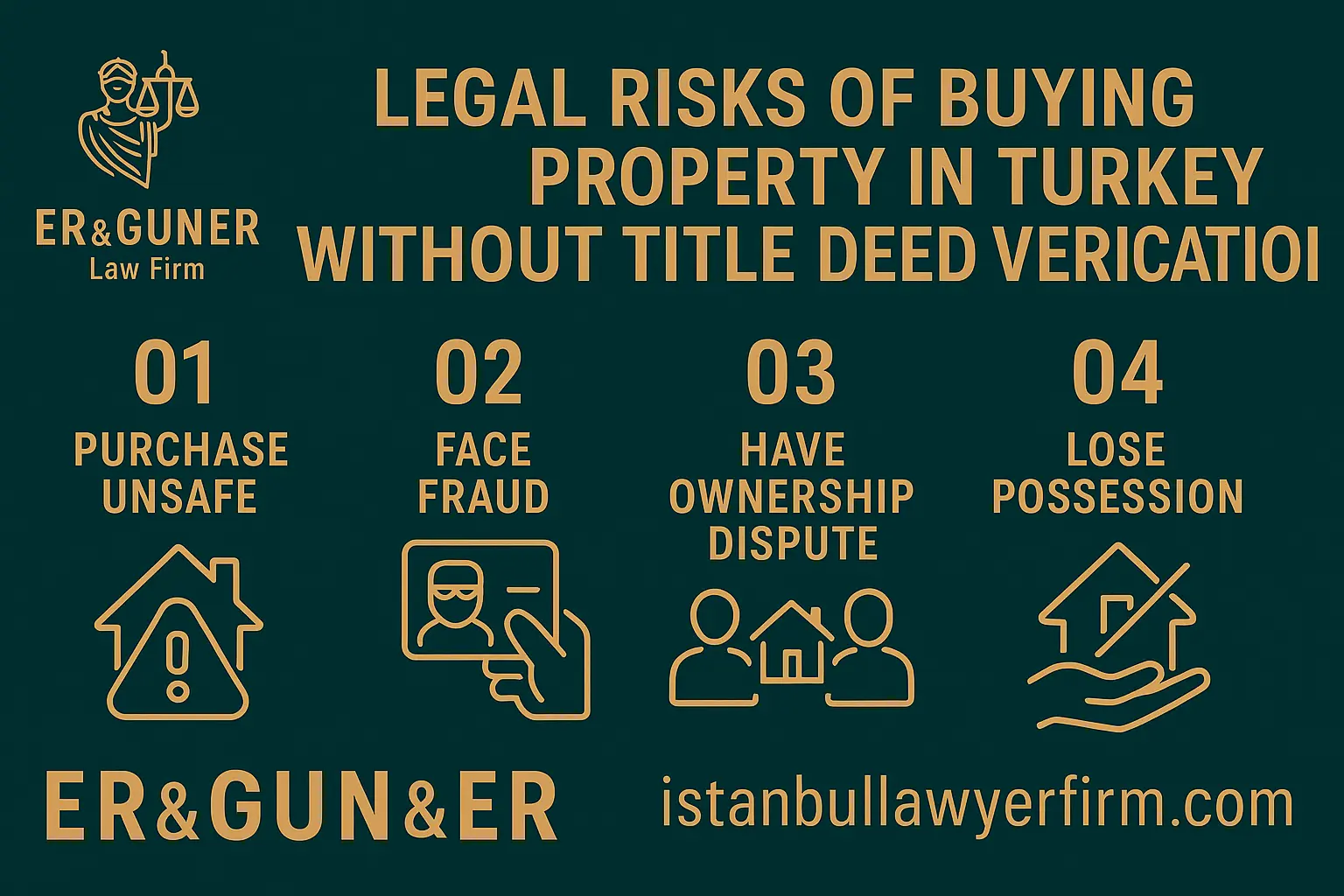
Title deed verification in Turkish real estate transactions operates within an integrated legal framework where procedural compliance at specific points determines substantive ownership outcomes. The foundational framework derives from Land Registry Law No. 2644 (Tapu Kanunu) and the Turkish Civil Code No. 4721 (TMK — Türk Medeni Kanunu). Article 705 of the Civil Code establishes that immovable property ownership is acquired through registration in the land registry (tescille kazanılır); Article 706 governs transfer mechanics; and Article 1007 establishes the foundational trust principle (tapu siciline güven ilkesi) under which parties acting in good faith reliance on registry records receive statutory protection. Code of Obligations No. 6098 (TBK) Article 237 establishes the formal sale requirement: an immovable property sale is valid only when executed at the Land Registry Directorate (Tapu Müdürlüğü) in official form, and a preliminary sale contract at a notary under Notarial Code No. 1512 Article 89 (gayrimenkul satış vaadi sözleşmesi) creates only a binding obligation to complete the formal sale — it does not itself transfer ownership. Article 1023 provides good faith purchaser protection critical for foreign buyers who lack alternative verification means; Articles 1024-1025 govern rectification (düzeltme) and cancellation (terkin) of unauthorized registrations (yolsuz tescil). Article 35 of Land Registry Law No. 2644 governs foreign acquisition with reciprocity analysis, area limitations, and restricted-zone verification including military forbidden zones under Law No. 2565 Article 9. Cadastre Law No. 3402 governs cadastral surveys with the ten-year challenge period framework, and Zoning Law No. 3194 Article 32 governs the occupancy permit (iskân — yapı kullanma izin belgesi). The General Directorate of Land Registry and Cadastre (Tapu ve Kadastro Genel Müdürlüğü — TKGM) administers the registry system nationally. Practice may vary by authority and year, and title verification benefits from systematic legal coordination because defects discovered post-purchase frequently produce complex remedial situations. A lawyer in Turkey coordinating title verification establishes the foundation for secure acquisition.
Why title deed verification is legally critical
A Turkish Law Firm working through the structural importance of title verification starts from the core statutory rule in TMK Article 705: immovable property ownership is acquired through registration. An oral sale, a handshake agreement, a signed private document, a payment receipt, or even long-standing possession does not produce ownership on its own — only registration in the land registry does. TMK Article 706 specifies the transfer mechanism, requiring an official deed (resmi senet) executed at the Land Registry Directorate before the land registry officer. TBK Article 237 reinforces this by making immovable property sales formally valid only when executed in this manner. The consequence is decisive for the foreign buyer: any payment made before execution of the formal sale sits on the seller's side of the transaction and is recoverable only through contractual remedies, not through property rights. The notarial preliminary sale contract under Notarial Code Article 89 (satış vaadi) is often misunderstood as a form of ownership transfer; it is not. It creates a binding personal obligation to execute the later formal sale, enforceable through specific performance (aynen ifa davası) or damages, but the buyer who pays substantial sums against a satış vaadi without proceeding to formal sale at the Tapu Müdürlüğü remains a creditor rather than an owner.
Turkish lawyers who address registry record analysis work through several layers that go beyond surface ownership identification. The active page (canlı sayfa) of the registry shows the current registered owner, the basis of acquisition (sale, inheritance, court order), the acquisition date, and, for co-owned properties, the ownership shares (müşterek veya iştirak halinde mülkiyet). Annotations (şerhler) under TMK Article 1015 record restrictions and rights affecting the property: personal use rights (oturma hakkı under Articles 822-825), usufruct (intifa hakkı under Articles 794-822), easements (irtifak hakları under Articles 779-793), lis pendens entries (dava şerhi) indicating ongoing litigation that affects the property, provisional-measure annotations from court orders, and arrest annotations (haciz şerhi) from enforcement proceedings. The mortgage register (ipotek kaydı) shows secured creditor positions with their amounts, dates, and priority ranks. The historical records (arşiv) reveal the ownership chain and can surface terminated but telling entries — an expired attachment from a prior owner, a cancelled mortgage linked to a disputed creditor, a previous transfer reversed by court order. Registry analysis that looks only at the active page and does not consult the archive misses material context, and this is one of the most common gaps in informal verification performed by foreign buyers relying on agents or translators rather than legal counsel. For framework on property title check, readers can consult our property title check guide. Practice may vary by authority and year, and registry analysis benefits from systematic multi-layer review because surface examination frequently misses risks visible only through deeper investigation.
An English speaking lawyer in Turkey coordinating verification beyond pure registry analysis addresses the reality that physical and regulatory compliance can undermine what the registry shows. Cadastral verification under Cadastre Law No. 3402 confirms that the registered parcel corresponds to the physical property the buyer intends to acquire — cadastral plan review, parcel identification (parsel numarası), block identification (ada numarası), boundary verification on site, and area comparison against the registry surface. Cadastre Law Article 12 establishes a ten-year challenge period for cadastral determinations, after which cadastral results generally cannot be contested; older properties typically benefit from this settled-cadastre status, while newer cadastral results may still face challenges. Zoning compliance under Zoning Law No. 3194 is the next layer: the zoning plan (imar planı) defines permitted use (residential, commercial, industrial, agricultural), density parameters (TAKS, KAKS), height and setback limits, and the building permit (yapı ruhsatı) must match the actual construction on the ground. The occupancy permit (iskân) under Article 32, issued by the municipality after completion inspection, is what legally converts a building from a construction site into a lawful residence. Buildings without iskân — either because construction exceeded the permit (kaçak yapı) or because iskân has not yet issued — face enforcement risk under Zoning Law Articles 30-32 including demolition orders, administrative fines, and use prohibitions. Restricted-area verification covers military forbidden zones under Law No. 2565 Article 9 (which prohibit or restrict foreign acquisition), cultural heritage areas under Law No. 2863 (SİT alanları, which restrict construction and modification), and expropriation status under Law No. 2942. Practice may vary by authority and year, and integrated verification benefits from cross-referencing registry, cadastre, zoning, and restricted-zone data because a clean registry combined with a defective zoning status is a frequent and material risk.
Common risks when skipping title due diligence
A lawyer in Turkey working through common risk patterns starts with authority defects on the seller side. A seller representing themselves as having full transfer authority may in fact lack it: a representative acting under a power of attorney (vekaletname) with limited scope, a corporate signatory who is not actually authorized under the company's signature circular (imza sirküleri), a minor or legally incompetent person without proper guardianship authorization, or a co-owner attempting to transfer property that requires consent from other co-owners. TMK Articles 688-700 govern co-ownership (müşterek mülkiyet and iştirak halinde mülkiyet): in iştirak halinde (joint ownership, typically arising from undivided inheritance), disposition requires all co-owners' consent without exception, so a single heir cannot sell a jointly-inherited apartment. Family-residence protection under TMK Articles 194-200 adds another consent layer: the registered family residence cannot be sold, mortgaged, or subjected to other disposition without the spouse's explicit consent, and a sale executed without this consent is challengeable even when the selling spouse is the sole registered owner. Co-owner pre-emption rights under TMK Articles 732-735 operate separately — a co-owner who sells to a third party without first offering the share to other co-owners at the same terms exposes the transaction to pre-emption litigation within the statutory three-month notice period or two-year discovery period.
A Turkish Law Firm coordinating zoning and physical compliance verification addresses risks that a clean registry cannot cure. Unauthorized construction (kaçak yapı) — a building erected without a yapı ruhsatı, or construction that exceeds the permitted envelope by adding floors, enclosing balconies, or changing use from residential to commercial — exposes the owner to demolition orders, administrative fines, and use prohibitions under Zoning Law Articles 30-32. The fact that a prior owner benefited from the zoning amnesty (imar barışı) of 2018 does not resolve all status issues: imar barışı issued a "building registration certificate" (yapı kayıt belgesi) that formalized the structure's existence but did not convert the building into a fully lawful structure with an iskân. Properties relying on a yapı kayıt belgesi rather than an actual iskân face ongoing regulatory uncertainty, and subsequent regulatory decisions have narrowed the scope of amnesty protection. Missing iskân is a common problem for newer buildings: the developer completed construction but has not obtained the occupancy permit, often because of code-compliance issues not yet resolved. Without iskân, utility subscriptions can only be provisional, the conversion from kat irtifakı to kat mülkiyeti under Condominium Law No. 634 cannot proceed, and resale is complicated. Cadastral discrepancies — where the physical boundaries, surface area, or location differ from the cadastral record — produce either correction proceedings (kadastro tespitinin düzeltilmesi) or transfer complications. For framework on real estate due diligence, readers can consult our real estate due diligence guide. Practice may vary by authority and year, and zoning verification benefits from integrated registry-cadastre-zoning cross-check because physical-legal misalignment is one of the most expensive post-purchase discoveries.
An Istanbul Law Firm addressing financial and creditor-side risks works through the layers of claims that may attach to the property. Recorded mortgages (ipotek) must be released at closing through coordination with the creditor bank; their release is typically not automatic and requires written discharge (ipotek fek yazısı) filed at the Land Registry. Multiple mortgage layers with different priority ranks require cumulative release coordination, and construction-period mortgages used by the developer to finance the project need careful handling because they can remain attached to individual units until satisfied from sale proceeds or released by the lender. Tax liens arising from unpaid real estate tax under Law No. 1319 can produce successor liability in limited circumstances, and unpaid corporate taxes for corporate-owned properties can support tax-authority enforcement against the property. Execution and Bankruptcy Law No. 2004 scenarios are particularly significant: a seller in bankruptcy cannot validly transfer without the bankruptcy administrator's authorization, and transactions entered before bankruptcy may be subject to clawback (tasarrufun iptali) if they fall within the statutory suspect periods. Freezing orders — ihtiyati tedbir under HMK Articles 389-399 and ihtiyati haciz under İİK Article 257 and following — recorded on the land registry page prohibit further transfer; a sale in violation of a registered freezing order is voidable and can expose the parties to criminal liability under TCK Article 289 (resmi belge hükmünde olan belgelerin ihlali) and related provisions. MASAK obligations under Law No. 5549 add a further layer: certain real estate transactions trigger suspicious transaction reporting and UBO disclosure obligations, and acquisitions that cannot document a clean source of funds face compliance pushback at the transaction stage. Practice may vary by authority and year, and creditor-side analysis benefits from systematic verification because post-acquisition discovery of an attached but missed encumbrance produces substantial remediation cost.
Legal consequences of purchasing without tapu verification
A Turkish Law Firm working through the consequences of a defective transfer starts from the primary judicial mechanism: the title cancellation and registration suit (tapu iptal ve tescil davası). A person with a protectable interest — the rightful owner whose title was fraudulently transferred, the heir whose inheritance right was circumvented, the co-owner whose share was transferred without consent — files at the Civil Court of First Instance (Asliye Hukuk Mahkemesi) where the property is located, seeking cancellation of the defective registration and registration in the plaintiff's name or restoration of the prior status. Grounds include seller lack of authority (yetkisiz tasarruf), forgery of signatures or documents, fraud in inducement, mistake under the TBK framework, and violation of co-ownership or family-residence consent requirements. The defendants are typically the current registered owner plus the defective transferor where they differ, with the Land Registry Directorate joined as a procedural party. TMK Articles 1024-1025 provide the corrective framework: Article 1024 governs rectification (düzeltme) where the registry contains an error that should be corrected, and Article 1025 governs cancellation (terkin) where a registration should be removed entirely. For framework on title deed lawsuit, readers can consult our title deed lawsuit guide. Practice may vary by authority and year, and consequence analysis benefits from defect-specific strategy because cancellation grounds, filing deadlines, and defendant structures differ substantially by defect type.
Turkish lawyers who address the scope and limits of good faith purchaser protection work through TMK Article 1023 as the central provision. Article 1023 protects a person who acquired a right in reliance on the land registry records in good faith, even if the registered status was in fact defective. The protection has four elements. Good faith is assessed both subjectively (the purchaser did not actually know of the defect) and objectively (the purchaser had no reason to know through reasonable diligence); the standard is lower for ordinary purchasers than for professional actors. Reliance requires that the purchaser actually consulted the registry and proceeded on the basis of what it showed. Consideration (ivaz) — the payment of value — is essential; gratuitous transferees generally do not receive Article 1023 protection on the same terms. The fourth element is the acquisition itself, completed through Tapu Müdürlüğü registration. The significance of Article 1023 is that a subsequent good-faith purchaser may hold the property even where the prior transfer was defective, which can shift the original owner's remedy from property recovery to damages against the defective transferor. The countervailing Article 1019 provides state liability: where registry errors result from the fault of the land registry official, the State is liable to the affected party, providing a supplementary remedy where Article 1023 protection has run against the original owner.
An English speaking lawyer in Turkey coordinating contract-defect analysis under the TBK addresses the framework where formation defects render the underlying sale voidable even after registration. Mistake (hata) under TBK Articles 30-32 permits annulment where an essential mistake (esaslı hata) regarding the subject matter, essential characteristics, person of the counterparty, or other essential elements induced the contract; the one-year filing period runs from discovery of the mistake. Fraud (hile) under TBK Article 36 permits annulment where intentional misrepresentation by the counterparty, or by a third party with the counterparty's knowledge, induced the contract; the one-year period runs from fraud discovery. Duress (ikrah) under TBK Articles 37-38 permits annulment where threatened harm induced the contract; the filing period runs from the cessation of duress. Absolute voidness (kesin hükümsüzlük) under TBK Articles 26-27 applies where the contract violates mandatory legal provisions, public order, personality rights, or involves impossibility at formation; voidness can be asserted at any time without a filing deadline because a void contract produces no legal effect from inception. Damages under TBK Article 49 and following compensate intentional or negligent misconduct causing loss, and they can stack on top of contract annulment or substitute for it where the property cannot be recovered. Criminal liability attaches to deliberate misconduct: TCK No. 5237 Articles 204-208 cover forgery in official documents (resmi belgede sahtecilik), and Article 158 covers qualified fraud (nitelikli dolandırıcılık), which applies with enhanced penalties when fraud is committed in matters involving public documents or financial institutions. Practice may vary by authority and year, and contract defect analysis benefits from early legal characterization because defect-specific deadlines materially affect remedy availability.
Tapu annotations, hidden encumbrances, and third-party rights
A lawyer in Turkey conducting annotation analysis works systematically through the categories that appear on the registry page. Personal use rights (oturma hakkı) under TMK Articles 822-825 typically arise from contract or testamentary disposition and give a named person the right to occupy the property for life or a specified period; the right survives transfer and binds the new owner. Usufruct (intifa hakkı) under TMK Articles 794-822 is broader — it covers use and enjoyment including fruits and revenues — and similarly survives transfer. The bare-ownership buyer (çıplak mülkiyet maliki) of a property subject to usufruct takes a property they cannot effectively use until the usufruct ends, and the pricing should reflect that reality. Easements (irtifak hakları) under TMK Articles 779-793 include access easements (geçit hakkı) granting passage over the property, view easements (manzara hakkı) restricting construction that would impair another property's view, and various utility easements. Long-term lease annotations (uzun süreli kira şerhi) provide tenant protection against transfer-based eviction and extend the tenancy against the new owner. Each annotation type has its own scope and termination mechanism; reading them carefully — ideally alongside the instruments that created them, which are stored in the land registry archive — is the only way to understand what the new owner is actually acquiring.
Turkish lawyers who address litigation-related annotations work through the set of entries that reflect pending judicial or enforcement activity. The lis pendens annotation (dava şerhi) records that a lawsuit affecting the property is pending; a transfer occurring after this annotation remains subject to the eventual judgment, so the transferee takes subject to the risk that the lawsuit will succeed and produce cancellation. The arrest annotation (haciz şerhi) under İİK records that enforcement proceedings have attached the property to satisfy a creditor's judgment or payment order; the property can be sold only with that creditor's cooperation or through the enforcement office itself. Provisional measure annotations (ihtiyati tedbir şerhi) under HMK Article 389 and following record court orders restricting transfer during pending litigation; transfers in violation of the measure are voidable, and the parties involved face exposure to criminal sanctions depending on the circumstances. Provisional attachment annotations (ihtiyati haciz şerhi) under İİK Article 257 and following serve an analogous function for monetary claims. Construction prohibition annotations (inşaat yasağı şerhi) record zoning or court-ordered restrictions on building activity. The termination of each of these annotations requires a specific event — litigation completion with a judgment, debt satisfaction, lifting of the court order — and verification that the annotation was effectively terminated, not just factually resolved, is critical because an effectively-but-not-formally terminated annotation can resurface at the worst moment. For framework on title deed fraud, readers can consult our title deed fraud guide. Practice may vary by authority and year, and litigation-annotation verification benefits from direct registry query at the transaction date because recently filed annotations may not yet appear in queries run even a few days earlier.
An Istanbul Law Firm addressing unrecorded encumbrances works through rights and claims that do not necessarily appear in a standard registry query. Co-owner pre-emption rights (önalım hakkı) under TMK Articles 732-735 are the most common: when a co-owner transfers their share to a third party, the other co-owners have a three-month period from notification, or a two-year absolute period from the transfer, to exercise the statutory pre-emption right by paying the sale price and taking the share. Failure to coordinate pre-emption — typically because the other co-owners were not formally notified of the sale terms — exposes the buyer to a pre-emption action that, if successful, transfers the share to the pre-empting co-owner. Contractual pre-emption rights (sözleşmesel önalım hakkı) created by agreement between parties add further potential obligations that are not on the registry unless formally annotated. Oral easements and informal use arrangements — decades-old neighborly arrangements permitting water pipe passage, crossing rights, grazing rights — can surface as claims based on acquiescence, and while they rarely defeat registered ownership outright, they can produce ongoing friction that affects use and value. Seller representations and warranties in the sale contract about the absence of unrecorded encumbrances are a standard protective layer; they do not prevent the encumbrance from existing, but they give the buyer a contract-based remedy against the seller if one surfaces. Practice may vary by authority and year, and unrecorded-encumbrance investigation benefits from combining registry analysis, physical inspection, and contractual representation requirements because no single verification mechanism covers the full range of possibilities.
Legal remedies and buyer protections under Turkish law
A Turkish Law Firm coordinating contractual annulment remedies works through the TBK framework that provides the principal pathways for invalidating defective sales. Annulment based on formation defects — mistake under Articles 30-32, fraud under Article 36, duress under Articles 37-38 — proceeds through a court filing that identifies the defect, demonstrates the statutory elements, and seeks the remedy of annulment with restitution of what was performed. The filing deadlines are strict: one year from discovery for mistake and fraud, and from cessation for duress. Missing the deadline typically forecloses the judicial annulment even where the substantive case is strong, so the first step after defect discovery is always deadline preservation — either through immediate filing or, where circumstances permit, through formal acknowledgment by the counterparty that the defect exists, which can suspend the limitation argument. Absolute voidness under Articles 26-27 stands apart: because a void contract produces no legal effect, voidness can be asserted at any time, and the court declares what was already true. Damages under TBK Article 49 and following compensate loss caused by intentional or negligent misconduct and can be pursued alongside or instead of annulment. Seller misrepresentation claims — intentional misrepresentation, negligent misrepresentation, failure to disclose material defects — are a practical vehicle for recovery when the seller knew more than was disclosed. For framework on real estate fraud and investment protection, readers can consult our real estate fraud and investment protection guide. Practice may vary by authority and year, and remedy selection benefits from early legal engagement because the optimal remedy frequently depends on facts that need documentation before they become contested.
Turkish lawyers who address interim relief during ongoing disputes work through HMK Articles 389-399 provisional measures and İİK Article 257 and following provisional attachment. A provisional measure (ihtiyati tedbir) is appropriate where the buyer needs to prevent further transfer, construction, or modification of the property during litigation; the applicant must demonstrate a likelihood of success on the merits, a risk of irreparable or substantial harm absent the measure, and typically post a bond (teminat) to protect the other party from damages if the measure turns out to be wrongful. An annotation of the provisional measure on the registry page provides public notice, and transfers in violation of the annotation are voidable. Provisional attachment (ihtiyati haciz) serves the analogous protective function for monetary claims — the buyer who has paid substantial sums and discovered a defect can attach the seller's assets, including the disputed property, to preserve recovery. The practical value of interim relief is greatest when applied early, before the seller has time to reorganize assets, transfer the property to an accomplice, or take other evasive steps; delay is the principal weakness of interim relief strategies. The conditions are also conditions for removal: where the applicant's underlying case weakens, the opposing party can move for removal of the measure, so the interim protection is not unconditional. Practice may vary by authority and year, and interim relief benefits from early engagement because protective value declines rapidly with the passage of time.
An English speaking lawyer in Turkey coordinating preventive contractual architecture works on the pre-transaction side, building protection into the documentation rather than relying on post-transaction remedies. Comprehensive pre-purchase due diligence is the foundation — registry, cadastre, zoning, seller authority, encumbrance, and source-of-funds verification translated into a written risk assessment for the buyer. The notarial preliminary sale contract (gayrimenkul satış vaadi sözleşmesi) under Notarial Code Article 89 is a useful intermediate step: it binds both parties to the eventual formal sale while allowing a verification and financing period, and it can be annotated on the registry page (şerh verilmesi) to give notice against subsequent third-party transfers. Conditions within the preliminary contract — completion of due diligence, financing approval, confirmation of the zoning status, resolution of identified encumbrances — give the buyer an exit pathway if material issues emerge. Seller representations and warranties about title status, encumbrances, zoning compliance, and other material matters provide contract-based remedies for misrepresentation. Escrow arrangements for the purchase price hold funds in a neutral account until closing conditions are satisfied, reducing the risk that funds move to a seller who then fails to complete the transfer. Holdback structures reserve a portion of the price for a post-closing period to cover claims that surface in the initial months after transfer. Title insurance products exist in the Turkish market, though uptake remains limited; they can provide additional coverage for specific risk scenarios. Practice may vary by authority and year, and preventive architecture benefits from layered protection because no single mechanism covers the full range of risks that can materialize after closing.
Foreign buyer vulnerabilities and common misunderstandings
A lawyer in Turkey addressing common foreign buyer misunderstandings starts with a recurring one: that paying substantial sums creates ownership. It does not. Ownership under Turkish law passes only through the formal sale at the Tapu Müdürlüğü under TBK Article 237 and TMK Article 706. A buyer who has paid 80% of the purchase price against a signed contract, is living in the property, and holds a set of keys is still not an owner if the formal sale has not been executed — the buyer holds a contractual claim that the seller complete the sale. The second common misunderstanding concerns the notarial preliminary contract: a satış vaadi is not a deed, and it does not transfer ownership. The third concerns developer contracts for off-plan or under-construction properties, where the buyer sometimes believes that the signed purchase agreement plus payments produces ownership, even though what the buyer holds until delivery is a contractual right to a future unit. The fourth is the assumption that registry query results answer all questions: they typically show the active page but not the archive, not the cadastral record, not the zoning status, and not the unrecorded claims that require physical and documentary investigation. Practice may vary by authority and year, and misunderstanding correction benefits from written client briefings that set out the formal requirements at the outset, because oral explanations during translated conversations do not reliably convey the underlying legal architecture.
A Turkish Law Firm working with foreign buyers on power-of-attorney discipline addresses one of the highest-risk areas in foreign acquisition. Foreign buyers often cannot be physically present in Turkey at every procedural step, and a power of attorney (vekaletname) enabling a Turkish representative — a lawyer, a real estate professional, or a relative — to act on their behalf is commonly used. Misuse of this instrument is a recurring source of loss. The mitigation starts with scope: the vekaletname should be drawn narrowly, identifying the specific property (with block and parcel numbers), the specific transaction type (purchase or sale), the specific counterparty where possible, the specific price range, and the specific time window during which the authority is valid. Broad general powers of attorney that authorize any real estate transaction on the principal's behalf should be avoided. Form requirements include notarial execution (noter huzurunda); for POAs issued abroad, apostille under the Hague Convention or consular legalization and sworn Turkish translation are required. Duration limits matter: the vekaletname should include an expiration date, and revocation procedures should be understood in advance — revocation at a Turkish notary plus notification to the Land Registry Directorate and to counterparties ensures that the authority is effectively terminated. Periodic monitoring by the principal — requesting copies of signed documents, reviewing transaction records — provides early warning of scope deviations. For framework on revoking general power of attorney, readers can consult our power of attorney revocation guide. Practice may vary by authority and year, and POA discipline benefits from narrow upfront drafting because remediation after misuse is substantially harder than prevention.
An Istanbul Law Firm coordinating language and communication risk mitigation works through the specific points where foreign-buyer vulnerabilities cluster. Bilingual documentation — a controlling Turkish version with an English reference translation — supports buyer comprehension without undermining Turkish legal force. Sworn translator (yeminli tercüman) engagement for official documents ensures validity of translations before Turkish authorities. At the Land Registry Directorate transfer execution, the officer may require a sworn interpreter for foreign nationals who do not understand Turkish; the interpreter's signature on the official deed is part of the formal validity record. Independent legal counsel — engaged by the buyer rather than by the seller, the developer, or the real estate agent — is the most important single protection, because advisor independence is what aligns advice with the buyer's interest rather than with transaction completion. Conflicts of interest are particularly frequent in foreign-buyer transactions where agents, developers, and lawyers within a commercial network may all be presented as neutral advisors but in fact share a commercial interest in the sale closing. Written communication preference — email rather than WhatsApp voice messages or phone calls — preserves the evidentiary record if disputes later emerge about what was represented or agreed. Home country legal coordination, where the buyer's own-country counsel reviews the Turkish transaction structure, provides an outside perspective that can catch misunderstandings rooted in differences between the buyer's home-country property law and Turkish law. Practice may vary by authority and year, and language-risk mitigation benefits from intentional communication architecture because a transaction conducted across languages without these safeguards carries risks that do not arise in single-language transactions.
Title verification in Citizenship-by-Investment property deals
A Turkish Law Firm coordinating title verification for Turkish Citizenship by Investment (TCBI) works through the framework where citizenship eligibility adds specific verification requirements beyond the standard transfer. TCBI under Turkish Citizenship Law No. 5901 Article 12 exceptional citizenship (istisnai vatandaşlık), as implemented through Presidential Decree No. 2018/106 and subsequent amendments, provides a citizenship pathway through real estate investment. The threshold was raised from 250,000 USD to 400,000 USD effective 12 June 2022 through regulatory amendment. The acquisition must be accompanied by a three-year non-disposal commitment (satılmayacağı taahhüdü) recorded as a land registry annotation preventing resale during the holding period. An SPK-licensed appraiser (SPK lisanslı değerleme uzmanı) must prepare the property valuation report establishing that the property value meets or exceeds the 400,000 USD threshold at the time of acquisition; the appraisal must follow SPK methodology and be dated within the validity window. The foreign exchange inflow must come through Turkish banking channels with conversion to Turkish Lira documented through qualifying bank operations, and the resulting bank receipts (banka makbuzu) are part of the application documentation. Payment made in other forms — offshore transfer direct to seller, cash, cryptocurrency — generally does not satisfy the FX-inflow requirement. For framework on real estate investment for Turkish citizenship, readers can consult our real estate investment for Turkish citizenship guide. Practice may vary by authority and year, and TCBI-calibrated verification benefits from pre-transaction structuring because TCBI-specific defects frequently cannot be cured after closing.
Turkish lawyers who address property eligibility for TCBI work through the specific categories that qualify and the categories that do not. Eligible properties typically include completed residential properties with iskân, completed commercial properties, and, in specific configurations, land with qualifying construction status. Properties in military forbidden zones under Law No. 2565 are excluded because foreign acquisition is restricted or prohibited there regardless of CBI framework. Properties with cultural heritage restrictions under Law No. 2863 may face limitations that undermine CBI eligibility even where technically registrable. Properties with incomplete cadastral status, active expropriation proceedings, or unresolved zoning violations face CBI eligibility risk. The seller restriction is critical and frequently misunderstood: the seller must be a Turkish citizen (or Turkish-domiciled company in the configurations permitted), not a foreign national transferring to another foreign national through a circular structure, and subsequent sale of CBI-qualifying properties to another foreign buyer within the three-year holding period runs against the non-disposal annotation. The integrity of the transaction is examined on CBI application: non-arms-length pricing, payment patterns inconsistent with the declared price, or structural arrangements suggesting circumvention can produce application rejection even where the technical elements (valuation report, FX inflow, title) appear in order. Multi-property aggregation to reach the 400,000 USD threshold is possible but requires concurrent acquisition coordination — acquiring one property this month and another next year does not combine toward the threshold. Practice may vary by authority and year, and CBI eligibility analysis benefits from pre-transaction calibration because post-transaction discovery of an eligibility gap typically cannot be remedied within the original transaction.
An English speaking lawyer in Turkey coordinating TCBI application integration with the transfer works through the timing and documentation that align property acquisition with citizenship application. Application timing typically follows transfer completion: the property must first be acquired and the non-disposal annotation recorded, then the citizenship application is filed with supporting documentation. Excessive delay between transfer and application can create complications, so coordination between the transfer timeline and the application package preparation is standard practice. Application documentation includes the TAPU showing the applicant's ownership with the three-year non-disposal annotation, the SPK-licensed appraiser's valuation report, bank documentation of the FX inflow and Turkish Lira conversion, the sale contract and related transaction documents, and the applicant's identification and civil-status documentation. Processing proceeds through the Ministry of Environment, Urbanization and Climate Change for real estate eligibility confirmation, then through the General Directorate of Population and Citizenship Affairs for citizenship processing; the two-stage process produces a multi-month timeline that should be factored into client expectations. Application denial is judicially reviewable under İYUK No. 2577 administrative procedure with the thirty-day filing window running from the notification of denial. The non-disposal annotation is enforced during the three-year period: premature disposal through sale, mortgage, or other disposition can produce citizenship revocation risk. After the three-year period expires, the property can be disposed of freely under general property law without CBI-specific restrictions. Practice may vary by authority and year, and CBI integration benefits from systematic coordination because application errors materially affect citizenship outcomes and remediation windows are often short.
Post-sale legal options if title defects are discovered
A lawyer in Turkey coordinating immediate post-discovery response works through a specific sequence that preserves remedies and evidence. Defect characterization is the first step: identifying whether the defect is an authority issue, an encumbrance, a zoning problem, a formation defect under the TBK (mistake, fraud, duress, voidness), or a combination. The characterization drives filing deadlines — a one-year mistake or fraud deadline from discovery is materially different from a voidness assertion without a deadline — and defendant selection. Filing-deadline preservation requires immediate engagement: the one-year periods for mistake and fraud run from discovery, and delay in consulting counsel can forfeit remedies regardless of the substantive merits. Evidence preservation is the parallel priority: documents (contracts, communications, advertisements, payment records, intermediary correspondence), witnesses (anyone present at negotiations or representations), physical documentation (photographs of the property, inspection reports, technical evaluations), and expert reports (engineer analyses for construction issues, appraisal reviews for valuation disputes) are collected at the current state before circumstances change and documents become harder to retrieve. Freezing the status quo through a provisional measure, where warranted, prevents the seller from further transferring the property or dissipating proceeds during the defect investigation period. For framework on title deed correction, readers can consult our title deed correction guide. Practice may vary by authority and year, and post-discovery response benefits from immediate legal engagement because the windows for protective action close rapidly.
A Turkish Law Firm coordinating title cancellation litigation works through the procedural architecture of the tapu iptal ve tescil davası. The competent court is typically the Civil Court of First Instance (Asliye Hukuk Mahkemesi) where the property is located, invoking in-rem jurisdictional rules. The plaintiff must have standing — either as the rightful owner whose registration was defective, as the heir entitled to the property, or as a co-owner whose consent was not obtained. The defendants include the current registered owner and the defective transferor where they differ, as well as any intermediate transferees in a chain; the Land Registry Directorate is joined as a procedural party rather than a substantive defendant, and the court's judgment directs registration changes through the Directorate rather than ordering the Directorate to do something against its own assessment. Evidence presentation addresses the defect-specific elements: authority defects require proof of the seller's lack of authority (expired POA, unauthorized corporate signatory, missing co-owner consent); fraud claims require demonstration of the misrepresentation, the inducement, and the resulting loss; mistake claims require establishment of the mistake's essential nature. Expert reports (bilirkişi raporu) are standard where technical questions are in dispute — valuation, cadastral boundaries, construction compliance. Interim provisional measures run in parallel to prevent further transfers during litigation, and the provisional measure annotation on the registry page makes the pendency visible to potential subsequent purchasers, typically halting transactional market interest in the property. Appeal lies to the Regional Court of Justice (Bölge Adliye Mahkemesi) within thirty days of the first-instance decision, with further Court of Cassation (Yargıtay) review available for qualifying cases. Practice may vary by authority and year, and title litigation benefits from systematic procedural discipline because procedural defects compromise substantive claims regardless of merit.
An Istanbul Law Firm coordinating settlement and alternative resolution addresses the framework where negotiated outcomes may produce more efficient resolution than full litigation. Pre-litigation negotiation, supported by a demand letter (ihtarname) through a notary setting out the claim, the damages, and the proposed resolution, frequently produces resolution where the seller has genuine willingness to settle and the claim is well-documented. Mediation under Law No. 6325 is available for qualifying disputes, with settlement agreements reached at mediation enforceable as court judgments. Mandatory mediation under Law No. 7445 of 2023 effective 1 September 2023 requires mediation completion as a procedural precondition to court filing for specific real estate monetary claims; the mediation failure report (anlaşmazlık tutanağı) must be attached to the subsequent court filing, or the petition is dismissed on procedural grounds. Arbitration is less common in individual-buyer real estate disputes than in commercial real estate transactions, but where the sale contract includes an arbitration clause, the parties are generally bound by it (subject to consumer-protection limitations where individual consumers are involved). Settlement structures can include cash payments, property exchanges, partial cancellation with partial refund, or other creative arrangements; the agreement should be documented either through a notarial settlement (noter huzurunda anlaşma) or through court-approved settlement (mahkemece tasdik), which provides direct enforceability if the settlement terms are not voluntarily honored. Practice may vary by authority and year, and settlement strategy benefits from systematic evaluation against litigation alternatives because cost, time, certainty, and relationship factors often favor negotiated outcomes when the merits are clear.
Author: Mirkan Topcu is an attorney registered with the Istanbul Bar Association (Istanbul 1st Bar), Bar Registration No: 67874. His practice focuses on cross-border and high-stakes matters where evidence discipline, procedural accuracy, and risk control are decisive, with particular concentration on title deed verification including Land Registry Law No. 2644 Article 26 transfer mechanism and Article 35 foreign acquisition framework with reciprocity, area limitations, and restricted zones, Civil Code No. 4721 Article 705 acquisition through registration, Article 706 immovable transfer mechanism, Article 1007 trust principle in land registry, Article 1011 public access, Article 1015 annotations framework, Article 1019 state liability for registry errors, Article 1023 good faith purchaser protection, Articles 1024-1025 unauthorized registration rectification (düzeltme) and cancellation (terkin), Articles 688-700 co-ownership framework including müşterek and iştirak halinde mülkiyet, Articles 194-200 family residence protection, Articles 779-793 easements (irtifak hakları), Articles 794-822 usufruct (intifa), Articles 822-825 personal use rights (oturma), Articles 732-735 co-owner pre-emption rights (önalım), Code of Obligations No. 6098 Article 237 formal sale requirement at Land Registry Directorate, Articles 30-32 mistake (hata), Article 36 fraud (hile), Articles 37-38 duress (ikrah), Articles 26-27 absolute voidness (kesin hükümsüzlük), Article 49 and following tort liability, Notarial Code No. 1512 Article 89 preliminary sale contract (satış vaadi), Cadastre Law No. 3402 Article 12 ten-year cadastral challenge period, Zoning Law No. 3194 Article 32 building and occupancy permits including iskân, Articles 30-32 zoning enforcement, Military Forbidden Zones Law No. 2565 Article 9 foreign acquisition restrictions, Cultural Heritage Law No. 2863 protected areas (SİT), Expropriation Law No. 2942, Civil Procedure Law No. 6100 Articles 389-399 provisional measures (ihtiyati tedbir), Execution and Bankruptcy Law No. 2004 Article 257 and following provisional attachment (ihtiyati haciz), MASAK Law No. 5549 anti-money laundering and UBO framework, Turkish Penal Code No. 5237 Articles 204-208 forgery in official documents and Article 158 qualified fraud, Turkish Citizenship Law No. 5901 Article 12 exceptional citizenship through Presidential Decree No. 2018/106 with 400,000 USD real estate threshold effective 12 June 2022 and three-year non-disposal annotation, and Law No. 7445 of 2023 mandatory mediation for qualifying real estate disputes effective 1 September 2023.
He advises individuals and companies across Real Estate (including title verification, due diligence, acquisitions, rental disputes, property litigation, and post-handover issues), Citizenship and Immigration (including Turkish Citizenship by Investment), Foreigners Law, Commercial and Corporate Law, Foreign Investment, Consumer Protection, Data Protection and Privacy, Intellectual Property, Arbitration and Dispute Resolution, Enforcement and Insolvency, International Tax, International Trade, Sports Law, Health Law, and Criminal Law. He regularly supports foreign property buyers on pre-purchase legal due diligence including registry analysis with archive review, cadastral verification under Law 3402, zoning compliance verification including iskân status, seller authority verification through Trade Registry and signature circular analysis, co-ownership and family-residence consent verification, encumbrance analysis including recorded mortgages and litigation-related annotations, POA scope discipline for foreign buyers unable to be physically present, transaction structuring including notarial preliminary contracts and formal sale at Land Registry Directorate, TCBI title verification calibrated for the 400,000 USD threshold and three-year non-disposal framework, post-purchase issue resolution including tapu iptal ve tescil davası litigation, provisional measures under HMK Article 389, settlement negotiation and mandatory mediation under Law 7445, and litigation representation through first instance, appellate, and cassation stages.
Education: Istanbul University Faculty of Law (2018); Galatasaray University, LL.M. (2022). LinkedIn: Profile. Istanbul Bar Association: Official website.
Frequently asked questions
- What law governs immovable property ownership in Turkey? Civil Code No. 4721 Articles 705-706 establish that immovable property ownership is acquired through registration in the land registry. Land Registry Law No. 2644 governs registry mechanics and foreign acquisition under Article 35.
- Where must immovable property sales be executed? Code of Obligations No. 6098 Article 237 requires immovable property sales to be executed at the Land Registry Directorate (Tapu Müdürlüğü) in official form before the land registry officer. Notarial preliminary contracts under Notarial Code Article 89 do not transfer ownership but create a binding obligation to complete the formal sale.
- What is the trust principle in the land registry? Civil Code Article 1007 provides foundational protection for parties acting in reliance on land registry records. The principle is particularly significant for foreign buyers who lack alternative verification means, though it does not make the registry conclusive against all defects.
- Does good faith protect purchasers from defective titles? Civil Code Article 1023 protects good faith purchasers who acquired in reliance on land registry records in qualifying circumstances. Protection requires good faith (subjective and objective), reliance on the registry, and consideration paid. Bad faith purchasers and, in some scenarios, gratuitous transferees are excluded.
- What annotations should be reviewed before purchase? Personal use rights (Articles 822-825), usufruct (Articles 794-822), easements (Articles 779-793), long-term lease annotations, lis pendens entries, mortgage records, arrest annotations under İİK, and provisional measure annotations under HMK Article 389 should be systematically reviewed, with archive records examined alongside the active page.
- What restrictions apply to foreign acquisition? Land Registry Law Article 35 framework includes reciprocity analysis, maximum area per natural person, maximum area per district, country-wide total limits, military forbidden zones under Law No. 2565 Article 9, cultural heritage protected areas under Law No. 2863, and specific other restricted categories.
- What are common risks in unverified purchases? Authority defects (seller without transfer authority), co-ownership consent failures, family-residence consent gaps under Articles 194-200, hidden encumbrances including mortgages and tax liens, zoning violations and unauthorized construction, missing occupancy permits, cadastral discrepancies, and creditor positions including freezing orders represent common risk patterns.
- What is the formal sale process at the Land Registry? Both parties (or authorized representatives under a proper POA) appear at the Tapu Müdürlüğü and execute the official deed (resmi senet) before the land registry officer. Required documentation includes identification, tax numbers, DASK insurance for residential units, transfer tax receipt, and reciprocity documentation for foreign buyers.
- What remedies exist if title defects are discovered? Title cancellation and registration suit (tapu iptal ve tescil davası), contract annulment under TBK Articles 30-39 for mistake, fraud, or duress (with one-year filing periods), absolute voidness under Articles 26-27 (no deadline), tort damages under Article 49, and provisional measures under HMK Articles 389-399 provide the primary remedies.
- How does Article 1023 affect remedies? Good faith purchaser protection under Article 1023 may protect a downstream good faith purchaser even when an upstream transfer was defective, potentially limiting the original owner's remedy to damages against the defective transferor rather than property recovery. Article 1019 state liability provides a supplementary remedy where registry-officer fault caused the error.
- What is the TCBI title verification framework? TCBI under Law No. 5901 Article 12 through Presidential Decree No. 2018/106 requires real estate investment of 400,000 USD (effective 12 June 2022; previously 250,000 USD), a three-year non-disposal annotation on the title deed, SPK-licensed appraiser valuation report, FX inflow through Turkish banking channels with Turkish Lira conversion, and specific eligibility considerations for the property and seller.
- Why are foreign buyers particularly vulnerable? Misunderstanding of the formal sale requirement (that notarial contracts do not transfer ownership), reliance on agents and intermediaries with potential conflicts of interest, language barriers at the Land Registry Directorate, power of attorney misuse risks, and limits on self-directed registry verification produce specific foreign-buyer vulnerabilities requiring specific protective architecture.
- What POA precautions protect foreign principals? Narrow scope drafting limited to identified property and transaction type, expiration dates, identified counterparties and price ranges where possible, notarial form, apostille or consular legalization for foreign-issued POAs, sworn Turkish translation, and prompt revocation procedures with Land Registry notification.
- Is mediation required for real estate disputes? Law No. 7445 of 2023 made mediation mandatory effective 1 September 2023 for qualifying real estate monetary claims. The mediation failure report (anlaşmazlık tutanağı) must be attached to the subsequent court filing, or the petition is dismissed on procedural grounds.
- How does ER&GUN&ER Law Firm structure title verification engagements? Engagements begin with comprehensive pre-purchase analysis including registry and archive review, cadastral verification, zoning and iskân verification, seller authority verification, encumbrance analysis, and, for CBI cases, CBI-specific eligibility analysis. The verification translates into transaction architecture, formal sale execution at the Tapu Müdürlüğü, post-acquisition compliance, and post-purchase issue resolution where defects emerge.