

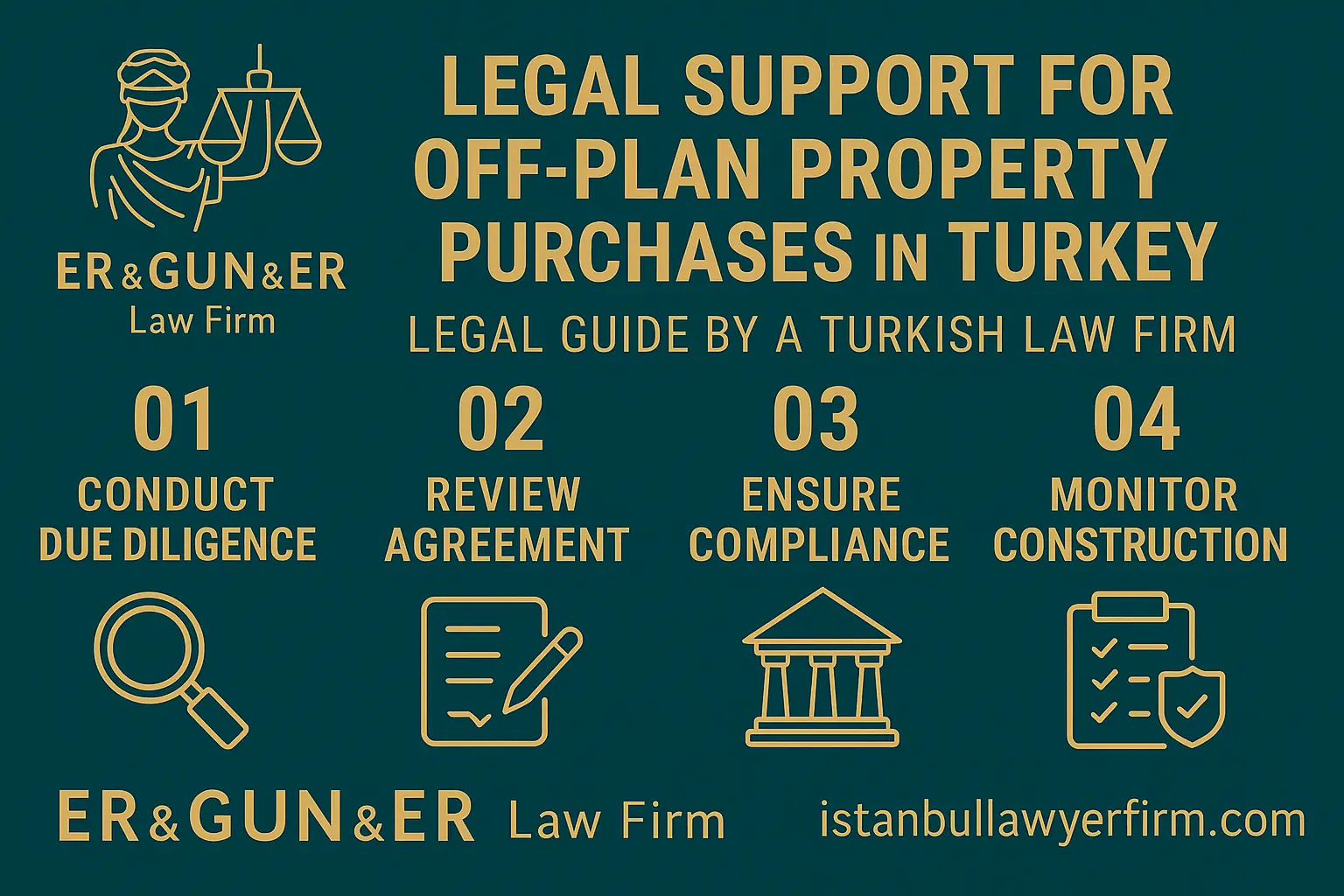
Off-plan (pre-paid, ön ödemeli) property purchases in Turkey operate within a specialized consumer protection framework distinct from general real estate acquisition. The foundational framework derives from Consumer Protection Law No. 6502 (Tüketicinin Korunması Hakkında Kanun) Articles 40-46, which govern pre-paid housing sales (ön ödemeli konut satışı) where the buyer pays before construction completion. Article 44 introduces the building completion insurance (bina tamamlama sigortası — BTS) as the principal developer insolvency protection mechanism, with alternative guarantee mechanisms under Article 45 including bank guarantees and escrow arrangements. Article 50 provides the thirty-day cancellation right (cayma hakkı) from contract signing without penalty. The 27 November 2014 Regulation on Pre-paid Housing Sales (Ön Ödemeli Konut Satışları Hakkında Yönetmelik), with subsequent amendments including the 2020 revisions, establishes minimum contract content, disclosure requirements, and guarantee mechanics. Code of Obligations No. 6098 Article 237 establishes the formal sale requirement: immovable property ownership transfers only through execution at the Land Registry Directorate (Tapu Müdürlüğü) in official form. Pre-paid housing contracts create a binding obligation to complete this formal sale upon construction completion but do not themselves transfer ownership. Zoning Law No. 3194 Article 21 governs building permits (yapı ruhsatı) and Article 32 governs occupancy permits (yapı kullanma izin belgesi — iskân), which are critical for title deed issuance. Condominium Law No. 634 governs the transition from kat irtifakı (construction-phase condominium right) to kat mülkiyeti (completed condominium ownership). Civil Code No. 4721 Articles 705-706 establish acquisition through registration, and Article 1007 establishes the land registry trust principle. Practice may vary by authority and year, and off-plan compliance benefits from integrated legal coordination because the specialized consumer framework interacts with general property law, zoning law, and construction law. A lawyer in Turkey coordinating the off-plan architecture establishes the foundation for secure acquisition.
Legal due diligence before signing
A Turkish Law Firm conducting pre-contract due diligence for off-plan projects starts with entity-level verification of the developer. The Trade Registry Gazette (Türkiye Ticaret Sicili Gazetesi) shows the current registered address, authorized signatories, share capital, paid-in capital, corporate group structure, and the last several years of recorded corporate actions. In our filings before the Trade Registry, we cross-check the signing party against the last published signature circular (imza sirküleri) — a mismatch between the person executing the preliminary contract and the authorized signatory is a frequent defect that foreign buyers do not detect on their own. Track-record analysis draws on UYAP (Ulusal Yargı Ağı Projesi) case histories filed against the developer entity and its common directors, prior project delivery records, and public enforcement data from the Revenue Administration and the Social Security Institution (SGK) where available. Where the developer belongs to a corporate group, we also examine the status of sister companies because practical insolvency risk frequently travels across the group even when it does not appear on the contracting entity's own records.
Project-level due diligence then moves to the land itself. The Land Registry (Tapu Müdürlüğü) record for the parcel shows current ownership, encumbrances including mortgages and arrest annotations, lis pendens entries (dava şerhi), and any kat irtifakı already established for the project. Under Zoning Law No. 3194 Article 21, construction requires a valid building permit (yapı ruhsatı), and this permit must match the project brochure: the number of floors, total construction area, unit count, and permitted use all appear on the permit, and any discrepancy between the permit and the marketing materials is a material risk the buyer must evaluate before signing. Where an Environmental Impact Assessment (Çevresel Etki Değerlendirmesi — ÇED) is required for the project scale, we verify the ÇED decision or the ÇED exemption decision. Coastal properties trigger additional review under Coastal Law No. 3621, and properties within cultural heritage protected areas (SİT alanları) under Law No. 2863 face construction and modification restrictions that can survive transfer. For framework on off-plan property purchase specifically covering foreign buyer considerations, readers can consult our off-plan property purchase guide for foreigners. Practice may vary by authority and year, and pre-contract due diligence benefits from systematic layering because pre-contract risk identification is what makes pre-contract protective structuring possible.
Contract architecture then receives its own review. The 27 November 2014 Regulation on Pre-paid Housing Sales fixes the minimum content that a pre-paid housing contract must carry: identification of both parties, project identification down to the block and parcel number, unit description, price, payment plan aligned to construction milestones, construction timeline, and the guarantee mechanism chosen by the developer under Article 44 or Article 45. If any of these minimum items is missing or ambiguous, the contract is vulnerable to invalidation at the request of the buyer. Article 5 of Consumer Protection Law No. 6502 renders unfair terms in consumer contracts void — aggressive developer-favorable provisions, unilateral price-adjustment clauses, one-sided termination rights, and broad force-majeure definitions that go beyond TBK Articles 136-138 face high invalidity risk. Article 50 cancellation right is mandatory and cannot be waived in the contract; any clause purporting to eliminate the thirty-day right or impose a penalty on its exercise is ineffective. For framework on real estate due diligence generally, readers can consult our real estate due diligence guide. Practice may vary by authority and year, and contract review benefits from pre-signing engagement because post-signing invalidation requires litigation effort that pre-signing redrafting avoids.
Escrow, payment security, and building completion insurance
A lawyer in Turkey advising the buyer on developer insolvency protection begins with Article 44 building completion insurance. BTS is the default mechanism for pre-paid housing sales: the developer contracts with an insurer licensed to underwrite BTS, the insurer assesses the project and the developer, and the resulting policy covers the buyer's down payment and subsequent installments up to the policy limit. When the developer defaults on construction in a qualifying way — bankruptcy declaration, prolonged abandonment, or other insolvency-type events defined in the policy — the buyer files a claim, the insurer verifies the triggering event, and the insurer either funds completion by an alternative builder or refunds the buyer. The practical weaknesses to check are the policy limit (does it actually cover the full contracted payment, not just a fraction), insurer identity (is the insurer financially solid and BTS-licensed), and exclusions (construction delay without insolvency is typically not covered, so BTS does not protect against slow developers who remain solvent).
Article 45 of Consumer Protection Law No. 6502 permits alternative guarantee mechanisms where the developer does not use BTS. The common alternatives are a first-demand bank guarantee (teminat mektubu) issued by a licensed Turkish bank in the buyer's favor, and an escrow arrangement where installments are held in a segregated bank account and released to the developer only on construction milestone verification. Each alternative has its own failure mode. Bank guarantees depend on the issuing bank honoring the first demand without litigating the underlying claim; weak or incorrectly drafted demand conditions are the typical weakness. Escrow arrangements depend on the milestone-verification mechanism: if the verifying party is the developer itself or an architect paid by the developer, the buyer's protection is weaker than it appears on paper. In our filings, we insist on an independent milestone verifier — typically a licensed civil engineer with no commercial relationship to the developer — and on explicit written milestone definitions so that a later dispute has a documentary anchor. For framework on escrow accounts generally, readers can consult our escrow accounts guide. Practice may vary by authority and year, and guarantee analysis benefits from mechanism-specific review because the three mechanisms produce different buyer recourse scenarios.
Payment schedule structuring aligns the buyer's cash outflow with the developer's construction risk. The standard approach is milestone-linked installments: a down payment at signing, installments tied to excavation completion, foundation completion, structural frame completion, facade completion, interior completion, and a final balance at handover. Every milestone installment should trigger only on documented verification, not on the developer's self-declaration. Price-adjustment clauses receive careful attention. Unilateral adjustment clauses permitting the developer to raise the price mid-construction on cost-inflation grounds face invalidity risk under Article 5 of Consumer Protection Law No. 6502, and even bilateral adjustment mechanisms should specify a transparent index (such as the producer price index for construction materials published by the Turkish Statistical Institute) and a ceiling rather than open-ended discretion. Late-payment consequences on the buyer side, including default interest and termination rights, are limited by Consumer Protection Law; clauses imposing disproportionate penalty amounts are often reducible under TBK Article 182 penalty-clause reduction. Practice may vary by authority and year, and payment structure benefits from consumer-protection-calibrated drafting because one-sided provisions typically do not survive judicial scrutiny if the buyer litigates.
Title deed registration and legal transfer
A Turkish Law Firm coordinating the title transition works through the kat irtifakı to kat mülkiyeti transition under Condominium Law No. 634. During construction, the developer holds the land in its own name, and kat irtifakı (condominium construction easement) records are established on the land registry page to reflect the future individual units: each unit number, its floor area, its share of the land, and its future owner are identified on the registry. When a buyer acquires a unit under a pre-paid contract, the registration of kat irtifakı in the buyer's name provides a form of pre-completion protection — the buyer is on the registry even though the building is not yet finished, and a subsequent fraudulent transfer of the same unit to a third party is substantially harder because the registry already shows the existing buyer. We insist on kat irtifakı registration in the buyer's name as soon as contractually permissible rather than accepting developer promises that registration will come later; the gap between contract and kat irtifakı registration is the window in which double-sale risk is highest.
Occupancy permit issuance is the turning point. Under Zoning Law No. 3194 Article 32, the competent municipality issues the yapı kullanma izin belgesi (iskân) after the completed construction passes inspection for conformity with the building permit, applicable building codes, and fire safety standards. Without iskân, the building cannot legally be occupied as a dwelling, utilities cannot be connected on a permanent subscription, and the kat irtifakı cannot convert to kat mülkiyeti. Developers sometimes offer to "hand over" units before iskân issuance, often because iskân is being delayed by code-compliance issues the developer does not want to disclose. This is the single most dangerous moment in an off-plan transaction: moving in without iskân means the buyer is occupying a building the municipality has not yet cleared, the building may be subject to a demolition or modification order under Zoning Law Articles 30-32, and the title situation is still kat irtifakı rather than kat mülkiyeti. We advise buyers not to take physical delivery until iskân has actually issued.
Formal sale execution at the Land Registry is the final legal step. Under TBK Article 237, the transfer of immovable property is valid only when both parties (or their representatives under a notarized power of attorney with adequate scope) appear at the Tapu Müdürlüğü and sign the official deed (resmi senet) before the land registry officer. The required documentation at execution includes the buyer's identification (passport for foreign buyers), the buyer's tax identification number obtained from the Revenue Administration, DASK earthquake insurance under Law No. 6305 for residential units, the transfer tax payment receipt (tapu harcı is shared between buyer and seller unless contractually allocated otherwise), and, for foreign buyers, compliance with Tapu Kanunu No. 2644 Article 35 reciprocity and area-limit framework. Military forbidden zones under Law No. 2565 Article 9 and cultural heritage areas under Law No. 2863 are verified at this stage if they were not cleared pre-contract. For framework on title deed verification, readers can consult our title deed check guide. Practice may vary by authority and year, and formal sale benefits from complete pre-appointment documentation preparation because documentation gaps produce transfer delays that, in the pre-paid housing context, can push the buyer into default on payment deadlines.
Construction delays, defects, and remedies under Consumer Protection Law
A lawyer in Turkey coordinating delay remedies distinguishes ordinary delay from material delay. Construction projects run late frequently, and a modest delay is not by itself a contract breach if the delay remains within any grace period specified in the contract and the developer provides reasonable notice. Material delay — typically a delay exceeding several months beyond the contracted completion date — triggers the buyer's remedies under Article 50 of Consumer Protection Law No. 6502 and under general TBK principles. The buyer may demand specific performance with compensation for delay damages, accept a renegotiated completion date with price adjustment, or terminate the contract and reclaim paid installments plus consequential damages. The practical question is usually documentation: we send formal notarial notifications (noter ihtarnamesi) marking each delay period, because a later court reconstruction of the delay timeline depends on contemporaneous documentation rather than retrospective reconstruction. Where the developer pleads force majeure under TBK Articles 136-138, the claim must meet the test of unforeseeability, externality, non-attributability, and causal connection to the performance failure — generic market-condition or cost-inflation claims typically fail this test.
Construction defect remedies operate under TBK Articles 475-478 (ayıp — defect liability framework). The statute distinguishes defects apparent at delivery from latent defects (gizli ayıp) and from concealed defects (hileli ayıp, defects intentionally hidden by the seller). For building construction, the defect liability period is five years from delivery, extended where the defect was concealed by the developer. The remedies scale with defect severity: minor defects trigger a right to repair at the developer's cost, material defects trigger a right to price reduction, and fundamental defects that render the property unfit for its intended use trigger a right to reject the property and demand refund. We coordinate independent civil engineer reports for defect characterization because court-appointed experts (bilirkişi) in later litigation rely heavily on prior documentation, and a contemporaneous engineer report carries more weight than a report prepared only after litigation begins. Condominium Law No. 634 provides additional warranty framework for multi-unit buildings, particularly for common-area defects affecting the building as a whole. For framework on consumer protection generally, readers can consult our consumer protection laws guide. Practice may vary by authority and year, and defect remedy benefits from early technical assessment because defect characterization directly determines which statutory remedy is available.
Mandatory mediation under Law No. 7445 of 2023 is the procedural gateway to litigation for specific real estate disputes. Effective 1 September 2023, monetary claims arising from real estate transactions — including pre-paid housing disputes over delay damages, defect-related compensation, and deposit or installment refunds — must pass through Ministry of Justice mediation before a court petition can be filed. Mediation is conducted by a registered mediator (arabulucu) within compressed timelines (typically three to four weeks from application), and a settlement reached at mediation has the enforceability of a court judgment. If mediation fails, the mediation failure report (anlaşmazlık tutanağı) must be attached to the subsequent court filing; a petition filed without this document is dismissed on procedural grounds. Jurisdiction over the merits lies primarily with the Sulh Hukuk Mahkemesi (Peace Civil Court) under HMK No. 6100 Article 4 for real estate disputes, or with the Tüketici Mahkemesi (Consumer Court) for qualifying consumer disputes under Consumer Protection Law No. 6502 framework, with the tüketici hakem heyeti (consumer arbitration committee) handling lower-value consumer claims below the statutory monetary threshold. Practice may vary by authority and year, and procedural compliance with the mediation precondition is non-negotiable because non-compliance forecloses the court pathway until the procedural defect is cured.
Post-purchase compliance and maintenance
A Turkish Law Firm coordinating post-purchase compliance begins with the condominium management (kat malikleri kurulu) framework under Condominium Law No. 634. Each building has a management plan (yönetim planı) that defines the management structure, the method of electing a building manager (yönetici), the frequency and quorum rules for the owners' general assembly (kat malikleri kurulu), and the formula for allocating management expenses (aidat) among the units. The management plan is registered with the land registry and binds all current and future owners. New buyers should read the management plan before closing, because unusual provisions — oversized management reserves, mandatory concierge services, long-term service contracts with affiliates of the developer — typically cannot be unilaterally modified after purchase and affect the long-term cost of ownership. Management fee disputes are common and fall under the Sulh Hukuk Mahkemesi jurisdiction, typically resolved through expert review of the expense documentation.
Tax compliance for the new owner operates across several parallel obligations. The real estate tax (emlak vergisi) under Real Estate Tax Law No. 1319 is filed annually with the competent municipality and paid in two installments (May and November). The tax base is the tax-value declaration, which the municipality updates periodically. The environmental cleaning tax (çevre temizlik vergisi) is billed by the municipality, usually combined with the water utility bill, and varies by property class. DASK earthquake insurance under Law No. 6305 must be renewed annually; an expired DASK policy blocks certain subsequent transactions, including subsequent sale, because the Land Registry checks DASK status at transfer. For foreign owners absent from Turkey, we typically set up a standing banking arrangement or representative POA so that these recurring obligations are handled without requiring the owner's physical presence in Turkey. Warranty period monitoring runs in parallel: the five-year construction defect liability under TBK Articles 475-478 runs from delivery, not from purchase, and a defect that manifests in year four must be notified to the developer within the period to preserve remedy rights. For framework on tenant rights where the property will be leased, readers can consult our tenant rights guide. Practice may vary by authority and year, and post-purchase compliance benefits from a systematic calendar because the obligations span multiple authorities with different deadlines.
Tax strategy for the ongoing ownership phase takes several forms depending on use. For owner-occupied property, the tax exposure is limited to the recurring municipal taxes. For rental property, rental income is taxed under Income Tax Law No. 193 with an annual declaration filed in March, subject to the exemption threshold for residential rental income that is updated annually. The owner chooses between the lump-sum expense deduction method and the actual expense deduction method at filing time; actual expense is usually better for recently renovated properties because depreciation on the renovation cost is deductible. Capital gains on subsequent sale are taxed under Income Tax Law if the property is sold within five years of acquisition; after five years, the gain is generally exempt from personal income tax for individual owners, making the five-year holding point a significant planning milestone. Corporate ownership faces the corporate tax framework under Corporate Tax Law No. 5520 instead, with different exemptions and different transfer tax exposure. Foreign owners face additional considerations: double taxation treaties allocate taxing rights between Turkey and the owner's home country, and repatriation of rental income requires currency conversion through Turkish banking channels under Decision No. 32 framework. Practice may vary by authority and year, and ongoing tax structuring benefits from integrated Turkish-international coordination because decisions made at acquisition shape the available outcomes at exit.
Developer insolvency and risk mitigation
A lawyer in Turkey monitoring developer insolvency risk during the construction phase pays attention to specific early-warning signals. Delayed payments to subcontractors and suppliers — sometimes visible because subcontractors file enforcement proceedings (icra takibi) and those proceedings appear on UYAP — are typically the first external indicator that the developer's cash flow is deteriorating. SGK enforcement for unpaid social security contributions is another indicator that can be verified through SGK public records. Tax enforcement actions by the Revenue Administration, visible through tax-office postings on the site and through enforcement office filings, carry similar signaling weight. Within the project itself, extended periods of inactivity on site, departure of the project engineer or site supervisor, and developer delays in responding to buyer communications all warrant escalation. Our approach in these situations is to shift from quiet monitoring to active documentation: formal notarial notifications creating a contemporaneous record of the developer's status, requests for milestone documentation that should already be available, and preparation of the guarantee-activation packet even before the developer formally defaults, so that if the insolvency event occurs, the activation happens without delay.
Guarantee activation procedures differ depending on the chosen mechanism. A BTS claim under Article 44 is filed with the insurer and requires documentation of the triggering event, the underlying pre-paid housing contract, the payments made by the buyer, and the current project status. Insurers typically investigate before paying, and the investigation can take several months — buyers should not expect immediate payment. A bank guarantee claim under Article 45 is faster where the guarantee is drafted as first-demand: the buyer presents the demand with the triggering documentation to the issuing bank and the bank pays without litigating the underlying dispute. Escrow release under Article 45 is typically the fastest mechanism where the escrow agreement is well-drafted, because the escrow agent acts on the documentary event rather than on a judicial determination. In every case, the timing of the claim matters. Filing before a formal bankruptcy declaration preserves flexibility because competing creditor claims against the developer have not yet been activated; filing after bankruptcy declaration pulls the buyer into the collective creditor proceeding with reduced individual control. For framework on real estate fraud and investment protection, readers can consult our real estate fraud and investment protection guide. Practice may vary by authority and year, and early action substantially affects recovery outcome.
Bankruptcy proceedings under Execution and Bankruptcy Law No. 2004 follow a specific sequence that off-plan buyers must navigate carefully. Once a bankruptcy declaration (iflas kararı) is made, a bankruptcy administrator (iflas idaresi) takes control of the developer's estate, and creditors including off-plan buyers must file proof-of-claim documents within the statutory deadline. The priority framework matters here: off-plan buyers who are registered with kat irtifakı hold a position different from pure unsecured creditors, because their registration reflects a recognized interest in a specific unit rather than a general claim against the estate. Whether this interest rises to a secured-creditor level or remains in an intermediate category depends on the specific registration status, the contract terms, and the factual matrix — this is where careful early registration becomes valuable in the insolvency context as well as the fraud context. The konkordato (concordat) procedure under İİK offers an alternative to liquidation where the developer proposes a restructuring plan; creditor majority support and court approval are required. Criminal referrals under TCK Article 158 (qualified fraud) are available where the developer's conduct crosses into intentional misrepresentation — diverted funds, sold-multiple-times units, sham insurance — and criminal proceedings provide personal liability pathways that pierce the corporate shield protecting directors and shareholders from civil claims alone. Practice may vary by authority and year, and bankruptcy participation benefits from early legal engagement because the claim-filing and priority-positioning windows close quickly.
Dispute resolution and arbitration
A Turkish Law Firm structuring dispute resolution for off-plan transactions first categorizes the dispute. Consumer disputes — where the buyer is an individual acquiring for personal use — fall under Consumer Protection Law No. 6502 with the tüketici hakem heyeti (consumer arbitration committee) handling lower-value claims administratively and the tüketici mahkemesi (consumer court) handling higher-value claims judicially. The monetary thresholds for hakem heyeti jurisdiction are adjusted annually by regulation; the current threshold should be verified at filing because the allocation between administrative and judicial forums is threshold-driven. Non-consumer disputes — where the buyer is a commercial entity, an investor acquiring multiple units, or a professional buyer — fall outside the consumer framework and into general civil courts. Real estate-specific monetary claims pass through mandatory mediation under Law No. 7445 of 2023 before any court filing, with limited exceptions. The dispute categorization affects forum, procedural timeline, standard of review, and remedy availability, so it is not a decision that should be made reactively in the middle of a dispute; it should be structured at the contract stage.
Arbitration as an alternative to court litigation requires careful consideration in the off-plan context. Consumer protection policy in Turkey generally limits the enforceability of pre-dispute arbitration clauses against individual consumers — a developer-drafted arbitration clause binding an individual buyer faces significant enforceability risk, and the buyer typically retains the option to pursue the consumer court pathway. Commercial buyers can be bound by arbitration clauses, and for them arbitration can provide advantages: International Arbitration Law No. 4686 governs arbitrations with an international element (which applies where one party is foreign), and the Istanbul Arbitration Centre (ISTAC, established 2015) provides an institutional Turkish-seated option with modernized rules. Foreign-seated arbitration — ICC in Paris, LCIA in London, SIAC in Singapore — brings procedural advantages familiar to international investors but creates enforcement complexity: the New York Convention 1958, to which Turkey is a party, supports recognition of foreign arbitral awards, but enforcement in Turkey proceeds through MÖHUK No. 5718 tenfiz procedure and can be contested on the limited grounds available under the Convention. For framework on arbitration clause drafting, readers can consult our arbitration clause drafting guide. Practice may vary by authority and year, and forum selection benefits from advance structuring because the arbitration-versus-court question is not neutral to the eventual dispute dynamics.
Interim relief under HMK No. 6100 Articles 389-399 provides the protective layer that runs in parallel with the underlying dispute. An ihtiyati tedbir (provisional measure) can freeze the disputed property from further transfer during litigation, bar the developer from altering the construction in ways that prejudice the buyer's claim, or preserve specific evidence (for example, defective construction elements that would otherwise be covered over during continuing construction). The statutory conditions are a likelihood of success on the merits, a risk of irreparable or substantial harm if the measure is not granted, and a posting of bond where required. An ihtiyati haciz (provisional attachment) under İcra ve İflas Kanunu No. 2004 Article 257+ attaches specific developer assets where the buyer has a monetary claim and the claim is at risk of being frustrated. We typically recommend pursuing interim relief at the earliest point where a dispute is emerging, rather than waiting for it to crystallize, because the protective value of an early freeze substantially exceeds the value of a late freeze after the developer has had the opportunity to reorganize its assets. Practice may vary by authority and year, and interim relief benefits from early engagement because the practical protective value is highest when the measure is filed before, not after, the developer understands that a formal dispute is imminent.
Final inspection, handover, and exit strategies
A lawyer in Turkey coordinating the final inspection before handover treats it as the last verification opportunity, not a formality. The inspection covers the structural elements visible in the completed unit, the mechanical and electrical systems (plumbing functionality under normal pressure, electrical system operation across all outlets and fixtures, HVAC operation in both heating and cooling modes), the finishing elements against the contract specification (flooring type and quality, wall finishes, fixtures, included appliances), and the common areas (elevators, corridors, outdoor spaces, parking, and any advertised amenities such as pool, gym, or security system). The inspection should be conducted with an independent civil engineer, not a representative of the developer, and the results should be recorded in a written defect list with photographs. Where defects are identified, the buyer accepts delivery with reservations (ihtirazi kayıt) rather than unconditionally — the distinction matters substantially. Unconditional acceptance signals to a later court that the buyer was satisfied with the unit as delivered, which compromises defect claims for issues that were discoverable at inspection. Conditional acceptance with a written defect list preserves the claim.
Post-handover operational setup runs in parallel with the warranty period. Utility connections transfer from the construction-phase arrangements to individual subscriptions in the owner's name — electricity through the regional distribution company, water and gas through the local utilities, internet and telephone through the chosen providers. MERNIS civil registry address registration through the local Nüfus Müdürlüğü formalizes the owner's registered address, which affects official communications and, for foreign owners pursuing residence permit or citizenship, immigration application documentation. Municipal registration for real estate tax under Law No. 1319 and environmental cleaning tax should be completed promptly; the municipality calculates the first tax year from the acquisition date, and delayed registration produces retroactive liability plus administrative fines. For foreign buyers pursuing Turkish Citizenship by Investment under Law No. 5901 Article 12 with the 400,000 USD threshold effective from 12 June 2022, the three-year non-disposal annotation on the title deed activates immediately; the SPK-licensed appraiser valuation report and the FX-inflow documentation through Turkish banking channels must be complete and consistent with the CBI application package. Practice may vary by authority and year, and post-handover setup benefits from systematic coordination because multiple parallel registrations with different authorities require a unified timeline.
Exit strategy planning considers resale, rental, and alternative use. Resale timing is shaped by the five-year holding point under Income Tax Law No. 193: capital gains on individual sales after five years of holding are generally exempt from personal income tax, while sales within five years trigger the progressive income tax rate on the gain. For TCBI-acquired properties, the three-year non-disposal annotation runs in parallel and must be satisfied regardless of the five-year tax threshold. Pre-iskân resale (kat irtifakı transfer) is legally possible but practically thinner: the buyer pool is smaller, financing is harder for the subsequent buyer, and pricing typically reflects this. Post-iskân resale (kat mülkiyeti transfer) is the mainstream market and pricing is generally better. Rental conversion under TBK Articles 299-356 operates within the framework of residential lease provisions (Articles 339-356), with the three-month deposit limit under Article 342, the TÜFE-based rent adjustment formula under Article 344 following the 2019 reform, and the eviction framework under Articles 350-352. Short-term tourism rental under Law No. 7464 of November 2023 requires a Ministry of Culture and Tourism permit plus condominium consent from the building board or unit-owner majority — in most multi-unit buildings, this consent is not readily obtainable, which effectively restricts short-term tourism rental to buildings specifically structured for it. Practice may vary by authority and year, and exit strategy benefits from integrated tax, legal, and market analysis because the applicable framework interacts with holding period, acquisition pathway, and use pattern in ways that single-dimension analysis misses.
Author: Mirkan Topcu is an attorney registered with the Istanbul Bar Association (Istanbul 1st Bar), Bar Registration No: 67874. His practice focuses on cross-border and high-stakes matters where evidence discipline, procedural accuracy, and risk control are decisive, with particular concentration on off-plan (pre-paid) property purchases including Consumer Protection Law No. 6502 Articles 40-46 pre-paid housing sale framework with Article 44 building completion insurance (BTS), Article 45 alternative guarantee mechanisms, Article 50 thirty-day cancellation right, and Article 5 unfair contract term framework, the 27 November 2014 Regulation on Pre-paid Housing Sales with 2020 amendments, Code of Obligations No. 6098 Article 237 formal sale requirement at Land Registry Directorate, Articles 136-138 force majeure framework, Articles 475-478 defect liability framework including the five-year construction defect period, Article 182 penalty-clause reduction, Articles 299-356 rental framework where owners lease off-plan properties, Zoning Law No. 3194 Article 21 building permit framework and Article 32 occupancy permit (iskân) framework, Condominium Law No. 634 kat irtifakı to kat mülkiyeti transition framework, Land Registry Law No. 2644 Article 35 foreign acquisition framework, Civil Code No. 4721 Articles 705-706 acquisition through registration and Article 1007 trust principle, DASK earthquake insurance under Law No. 6305, Real Estate Tax Law No. 1319, Execution and Bankruptcy Law No. 2004 bankruptcy and konkordato procedures affecting developer insolvency, Turkish Penal Code No. 5237 Article 158 qualified fraud, Civil Procedure Law No. 6100 Articles 389-399 provisional measures, Law No. 7445 of 2023 mandatory mediation effective 1 September 2023 for qualifying real estate disputes, International Arbitration Law No. 4686, ISTAC Istanbul Arbitration Centre established 2015, New York Convention 1958, MÖHUK No. 5718 private international law, Income Tax Law No. 193, Corporate Tax Law No. 5520, Turkish Citizenship Law No. 5901 Article 12 exceptional citizenship with Presidential Decree No. 2018/106 real estate threshold of 400,000 USD effective 12 June 2022, and Law No. 7464 of November 2023 tourism-purpose short-term rental permit framework.
He advises individuals and companies across Real Estate (including off-plan purchases, acquisitions, rental disputes, due diligence, property litigation, and post-handover warranty claims), Consumer Protection, Commercial and Corporate Law, Foreign Investment, Citizenship and Immigration (including Turkish Citizenship by Investment), Foreigners Law, Data Protection and Privacy, Intellectual Property, Arbitration and Dispute Resolution, Enforcement and Insolvency, International Tax, International Trade, Sports Law, Health Law, and Criminal Law. He regularly supports foreign property buyers on pre-contract legal due diligence integrated with developer background analysis, contract negotiation under the Consumer Protection framework, escrow and BTS coordination, construction phase monitoring, handover inspection preparation and execution, warranty period defect management, title deed transition from kat irtifakı to kat mülkiyeti, post-purchase compliance coordination, developer insolvency response, dispute resolution across mediation, arbitration, and litigation pathways, and exit strategy execution through resale, rental, or alternative exit mechanisms.
Education: Istanbul University Faculty of Law (2018); Galatasaray University, LL.M. (2022). LinkedIn: Profile. Istanbul Bar Association: Official website.
Frequently asked questions
- What law governs off-plan property purchases? Consumer Protection Law No. 6502 Articles 40-46 govern pre-paid housing sales (ön ödemeli konut satışı), with the 27 November 2014 Regulation providing detailed implementation. Code of Obligations No. 6098 Article 237 formal sale requirement applies to the final ownership transfer at the Land Registry.
- What is the thirty-day cancellation right? Article 50 of Consumer Protection Law provides a thirty-day cancellation right (cayma hakkı) from contract signing, exercisable without penalty. Contract clauses purporting to waive or restrict this right are ineffective. Additional cancellation rights apply for material delay and specific other breach scenarios.
- What is building completion insurance (BTS)? Article 44 introduces bina tamamlama sigortası as the principal developer insolvency protection. A licensed insurer underwrites the policy, the buyer is the beneficiary, and triggering events include developer bankruptcy and prolonged construction abandonment. Coverage depends on policy limits and exclusions, which should be verified.
- What are the alternative guarantee mechanisms? Article 45 permits bank guarantees (teminat mektubu) and escrow arrangements with segregated bank accounts as alternatives to BTS. First-demand bank guarantees pay quickly on documentary triggering; escrow depends on the milestone-verification mechanism, which should be independent of the developer.
- How does formal sale work? Code of Obligations Article 237 requires immovable property sales to be executed at the Land Registry Directorate (Tapu Müdürlüğü) in official form before the land registry officer. Pre-paid housing contracts create a binding obligation to complete this formal sale upon construction completion but do not themselves transfer ownership.
- What is kat irtifakı versus kat mülkiyeti? Kat irtifakı is the construction-phase condominium right established on the land registry while construction is ongoing. Kat mülkiyeti is the completed condominium ownership established after iskân issuance through a land registry amendment converting the irtifakı to mülkiyet.
- What is iskân and why is it important? Iskân (yapı kullanma izin belgesi — occupancy permit) under Zoning Law Article 32 is issued by the competent municipality upon completed construction that conforms to the building permit and applicable codes. Iskân issuance is a prerequisite for kat mülkiyeti and for lawful long-term occupancy.
- What remedies exist for construction delays? Material delay triggers remedies under Article 50 and general TBK principles: specific performance with delay damages, renegotiation with price adjustment, or contract termination with installment refund and consequential damages. Force majeure under TBK Articles 136-138 is narrowly construed.
- What defect liability applies? TBK Articles 475-478 provide five-year construction defect liability from delivery for buildings. Latent defects (gizli ayıp) extend notification periods from discovery. Concealed defects (hileli ayıp) carry unlimited notification periods and enhanced remedies.
- Is mediation required for off-plan disputes? Law No. 7445 of 2023 made mediation mandatory effective 1 September 2023 for qualifying real estate monetary disputes. Mediation completion with a failure report (anlaşmazlık tutanağı) is a procedural precondition to court filing for covered categories.
- What happens if the developer goes bankrupt? BTS claim activation, Article 45 guarantee activation, or bankruptcy proceeding participation under İcra ve İflas Kanunu No. 2004 with creditor claim filing and priority positioning. Alternative pathways include contract rescission, specific performance through alternative builders, buyer cooperative completion, and criminal referrals for intentional misconduct.
- Can foreign buyers purchase off-plan? Yes, subject to Land Registry Law No. 2644 Article 35 framework including reciprocity, area limitations, and restricted zone verification. Foreign buyers face the same Consumer Protection Law framework as Turkish buyers and require additional cross-border coordination for documentation, translation, and apostille.
- What taxes apply to off-plan purchases? Transfer tax (tapu harcı) at the Land Registry, VAT on first-hand developer sales under VAT Law No. 3065, annual property tax under Law No. 1319, and DASK earthquake insurance under Law No. 6305. Capital gains tax may apply on subsequent resale depending on holding period under Income Tax Law No. 193.
- How does handover inspection protect the buyer? Independent engineer inspection with written defect list, photographic documentation, and acceptance with reservations (ihtirazi kayıt) preserves subsequent defect claims. Unconditional acceptance compromises remedy availability for issues that were discoverable at inspection.
- How does ER&GUN&ER Law Firm structure off-plan engagements? Engagements begin with pre-contract due diligence on the developer and project, contract review and negotiation under the Consumer Protection Law framework, ongoing construction phase monitoring, BTS or guarantee verification, handover inspection coordination, warranty period defect management, post-purchase compliance coordination, and dispute resolution representation when issues arise.