

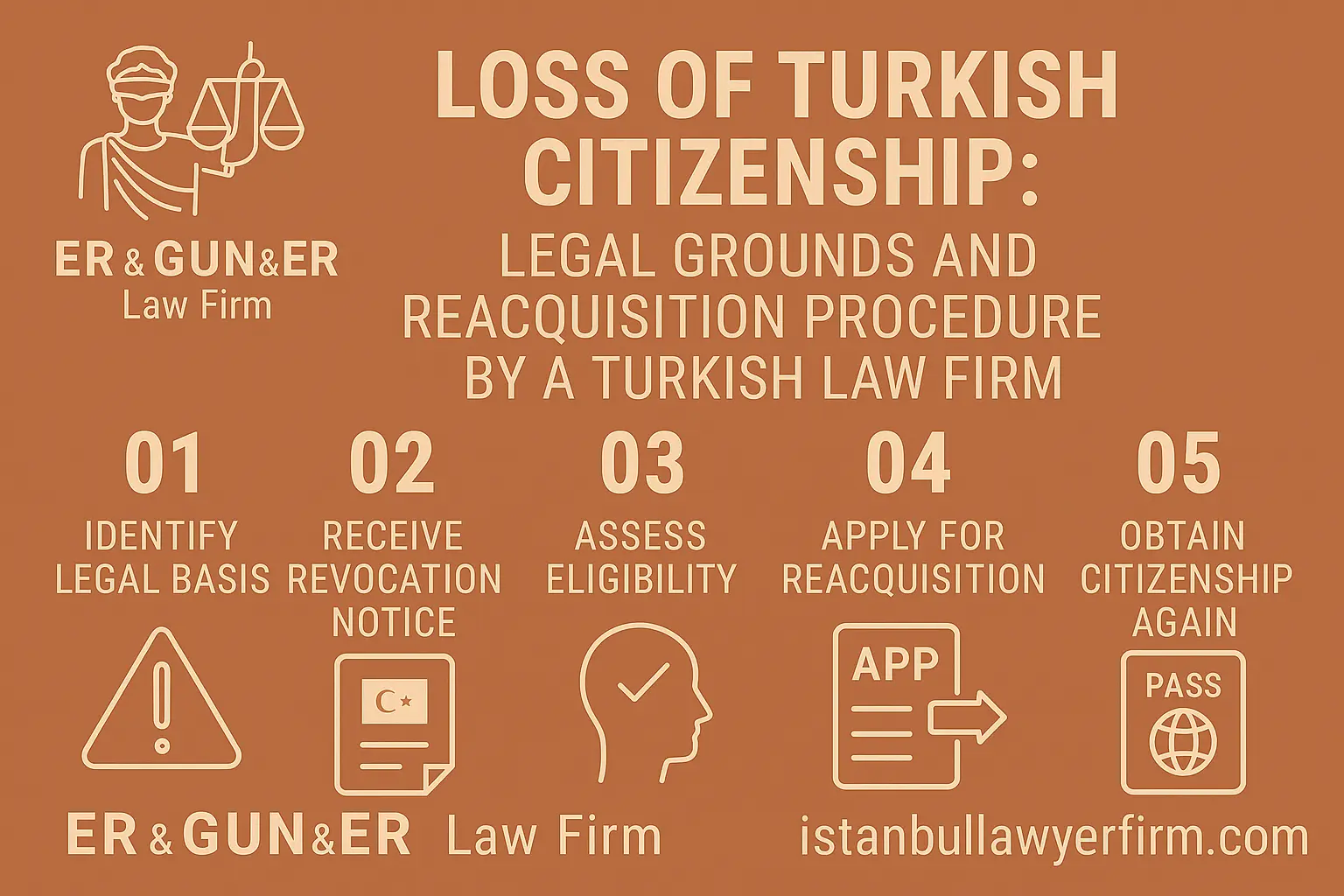
Turkish citizenship can be lost in two fundamentally different ways—voluntarily through a formal renunciation procedure initiated by the citizen, and involuntarily through revocation by the Turkish state in specific legally defined circumstances—and the legal framework, procedural requirements, consequences, and reacquisition options differ substantially between these two routes. Understanding both routes is important not only for Turkish citizens who are considering renouncing their citizenship, but also for foreign nationals who acquire Turkish citizenship through investment or naturalization and who need to understand the conditions under which their acquired citizenship can be revoked, and for Turkish citizens living abroad who may be subject to their adopted country's dual citizenship restrictions. The foundational legislation governing Turkish citizenship acquisition, loss, and reacquisition is the Turkish Citizenship Law (Türk Vatandaşlığı Kanunu, Law No. 5901), which replaced the earlier Law No. 403 and which establishes the current framework for all citizenship matters in Turkey. The law is accessible at Mevzuat. This guide addresses every dimension of citizenship loss in Turkey: the voluntary renunciation process (çıkma), the conditions for involuntary revocation, the consequences of citizenship loss for the person and their family members, the Pink Card (Pembe Kart) system that maintains certain rights after renunciation, and the procedure for reacquiring Turkish citizenship after it has been lost.
Voluntary renunciation: the çıkma izni process
A lawyer in Turkey advising on voluntary Turkish citizenship renunciation must explain that the çıkma izni (exit permit) is the formal authorization that a Turkish citizen must obtain from the Turkish Council of Ministers (now within the Presidential authority) before their Turkish citizenship can be validly renounced. The renunciation is not self-executing—a Turkish citizen cannot simply declare that they are renouncing Turkish citizenship; they must apply for and receive formal permission, and the citizenship terminates at the moment the permit is granted, not at the moment the application is submitted. This distinction matters because a person who has submitted a renunciation application but has not yet received the çıkma izni remains a Turkish citizen in the eyes of Turkish law and retains all associated obligations including military service. Practice may vary by authority and year — check current guidance on the current çıkma izni application process and on the competent authority receiving the application from the Turkish Ministry of Interior at icisleri.gov.tr.
An Istanbul Law Firm advising on the eligibility conditions for çıkma izni must explain that not every Turkish citizen who applies for renunciation permission will receive it—specific eligibility conditions must be satisfied, and the application may be denied if these conditions are not met. The primary conditions under Law No. 5901 are: the applicant must be of legal capacity (at least 18 years old and mentally capable); the applicant must have acquired or be in the process of acquiring another citizenship—renunciation into statelessness is not permitted under Turkish law; the applicant must not have outstanding military service obligations (male applicants who have not completed or resolved their military service must do so before renunciation can be granted); and the applicant must not be subject to any legal proceedings that would prevent citizenship change. The Council of Ministers (or the President's authority under the current constitutional structure) retains discretionary power to deny renunciation in specific circumstances even where the formal eligibility conditions appear to be met. Practice may vary by authority and year — check current guidance on the current eligibility conditions and any recently changed requirements for çıkma izni applications.
A Turkish Law Firm advising on the military service condition for male renunciation applicants must explain that this condition is one of the most practically significant barriers for male Turkish citizens between the ages of 20 and 41 who wish to renounce. The military service obligation must be "resolved" before the renunciation can proceed—and resolution means either completing active service, completing the paid discharge (bedelli askerlik) where available, obtaining a qualifying medical exemption, or qualifying for another formal exemption or deferral that definitively resolves the obligation rather than merely postponing it. A deferral—even a qualifying educational or occupational deferral—does not resolve the military service obligation for renunciation purposes; it only delays it. The military service dual citizens Turkey framework—covering the full range of military service resolution options—is analyzed in the resource on military service obligations dual citizens Turkey. Practice may vary by authority and year — check current guidance on which military service resolution mechanisms are currently accepted as satisfying the renunciation eligibility condition.
Renunciation application documents and procedure
A law firm in Istanbul advising on the renunciation application documentation must explain the complete document package required for a çıkma izni application. The standard documents include: a completed renunciation application form (available from Turkish consulates abroad or from the Turkish Ministry of Interior); a valid Turkish passport or Turkish national identity card; evidence of the foreign citizenship held or being acquired (foreign passport, foreign naturalization certificate, or a letter from the foreign country confirming the citizenship acquisition process is underway); a military service status document for male applicants (askerlik durum belgesi showing that the obligation is resolved); a Turkish birth certificate or civil registry extract; and in some cases, a statement explaining the reasons for renunciation. Applications can typically be submitted either at Turkish consulates abroad (for Turkish citizens living outside Turkey) or directly to the Provincial Directorate of Civil Registration and Citizenship (İl Nüfus ve Vatandaşlık Müdürlüğü) in Turkey. Practice may vary by authority and year — check current guidance on the current complete document list and format requirements from the Turkish consulate in your country or from the relevant Turkish administrative office before submitting any renunciation application.
An English speaking lawyer in Turkey advising on the application timeline must explain that the çıkma izni processing time is not fixed and can vary significantly depending on the applicant's profile and the current workload of the reviewing authority. Applications that are complete and straightforward—without military service complications, without pending legal proceedings, and with clear evidence of the foreign citizenship—typically process in a few months. Applications that raise eligibility questions—particularly around military service resolution or the adequacy of the evidence of foreign citizenship—may take longer or may be returned for additional documentation. Applicants who have a specific deadline driven by their foreign country's dual citizenship rules should initiate the Turkish renunciation application well in advance of that deadline rather than assuming that a specific processing time can be guaranteed. Practice may vary by authority and year — check current guidance on realistic processing timelines for çıkma izni applications from the Turkish consulate or Ministry of Interior office handling your application.
A Turkish Law Firm advising on the family member implications of renunciation must explain that Turkish citizenship law treats minor children of a renouncing parent differently from the renouncing parent themselves. A Turkish citizen who renounces their citizenship does not automatically cause their minor children to lose Turkish citizenship—the citizenship of minor children in the household of a renouncing parent requires a separate assessment and separate application if the parent wishes the children's citizenship status to change as well. In some circumstances, a minor child may retain Turkish citizenship even after both parents have renounced, because the child's own citizenship interests are separately evaluated. This family dimension of renunciation planning often requires specific legal advice to ensure that the outcome for family members matches the family's actual intentions rather than producing unintended citizenship results for children. The Turkish citizenship for children framework is analyzed in the resource on Turkish citizenship for children. Practice may vary by authority and year — check current guidance on the current Turkish law provisions applicable to the citizenship of minor children when their parent renounces Turkish citizenship.
Consequences of renunciation
A law firm in Istanbul advising on the consequences of Turkish citizenship renunciation must explain that renunciation terminates all rights and obligations that flow from Turkish citizenship—but not simultaneously and not without important residual rights that persist through the Pink Card system. From the moment the çıkma izni takes effect, the former citizen can no longer use a Turkish passport, is no longer subject to Turkish military service obligations, loses the right to vote in Turkish elections and to be elected to Turkish political office, and loses the right to own certain categories of property that are restricted to Turkish citizens near military installations. Practically, the former citizen transitions from Turkish citizen status to foreign national status in Turkey—which means they need a visa or residence permit to live in Turkey, and their property ownership rights become subject to the restrictions applicable to foreign nationals. Practice may vary by authority and year — check current guidance on the specific rights that Turkish citizenship provides and that are lost upon renunciation, including any recently changed property ownership rights applicable to foreign nationals in Turkey.
An English speaking lawyer in Turkey advising on the tax implications of Turkish citizenship renunciation must explain that renunciation changes the person's Turkish tax residency status only if it is combined with actually leaving Turkey or reducing Turkish presence below the 183-day residency threshold—renunciation alone does not eliminate Turkish tax obligations if the person continues to reside in Turkey or continues to generate Turkish-source income. A person who renounces Turkish citizenship while continuing to live in Turkey may still be a Turkish tax resident subject to worldwide income taxation. A person who renounces Turkish citizenship and moves abroad loses Turkish tax residency only if their actual days in Turkey fall below the threshold in the relevant tax year. The tax residency foreigners Turkey framework—covering the 183-day rule and Turkish tax residency triggers—is analyzed in the resource on tax residency foreigners Turkey. Practice may vary by authority and year — check current guidance on the Turkish tax implications of citizenship renunciation applicable to your specific residency and income situation.
A Turkish Law Firm advising on the property rights consequences of Turkish citizenship renunciation must explain that former Turkish citizens who have renounced become foreign nationals for property ownership purposes, which subjects their existing Turkish property holdings and any future property acquisitions to the rules applicable to foreign nationals in Turkey. For most property types in most locations in Turkey, foreign national ownership is permitted—so this transition typically does not require divesting existing property. However, property near certain designated military or security zones that is restricted to Turkish citizen ownership would need to be divested within a prescribed period if the owner renounces Turkish citizenship. Additionally, any property rights that were specifically conditioned on Turkish citizenship would need to be reviewed. The real estate law Turkey framework—covering foreign national property ownership rights—is analyzed in the resource on real estate law Turkey. Practice may vary by authority and year — check current guidance on the current property ownership rules applicable to foreign nationals in Turkey, including any recently changed restrictions or permitted zones, before finalizing any renunciation decision.
The Pink Card (Pembe Kart) system
A law firm in Istanbul advising on the Turkish Pink Card (Pembe Kart) system must explain that this mechanism is one of the most distinctive and practically significant aspects of Turkish citizenship renunciation—it allows former Turkish citizens who have renounced to retain certain specified rights in Turkey even after their citizenship terminates. The Pink Card (formally the "Mavi Kart" for the overseas Turks registry, but commonly called Pembe Kart for the physical document issued to former citizens who renounced under Law No. 5901) is a registration document issued to former Turkish citizens who have renounced their citizenship and to their children who were born after the renunciation. The Pink Card holder is not a Turkish citizen—but they are entitled to enjoy certain rights in Turkey that would not be available to an ordinary foreign national. Practice may vary by authority and year — check current guidance on the current Pink Card application process and on the current list of rights retained by Pink Card holders from the Turkish Ministry of Interior or the Presidency of Turks Abroad and Related Communities (YTB) at ytb.gov.tr.
An English speaking lawyer in Turkey advising on the specific rights retained by Pink Card holders must explain the current scope of these rights, which have expanded over time through legislative amendments. Pink Card holders currently retain the right to reside in Turkey without a residence permit (they are exempt from the standard residence permit requirement that applies to foreign nationals); the right to work in Turkey without a work permit (for most employment categories); the right to own property in Turkey on the same basis as Turkish citizens (without the restrictions applicable to foreign nationals in certain zones); the right to inherit under Turkish inheritance law on the same basis as Turkish citizens; access to certain social rights including education and healthcare on terms comparable to citizens; and the right to establish and operate businesses in Turkey without the restrictions applicable to foreign nationals. These rights are substantial—they effectively allow a Pink Card holder to live and work in Turkey as if they were a citizen, even though they are not. Practice may vary by authority and year — check current guidance on the current complete list of Pink Card rights and on any recently added or removed rights from the applicable legislation.
A Turkish Law Firm advising on what Pink Card holders cannot do must explain the specific exclusions from the former citizen status—because understanding the limits of the Pink Card status prevents the false impression that renunciation while holding a Pink Card is functionally equivalent to retaining citizenship. Pink Card holders cannot vote in Turkish elections or referendums. They cannot be elected to Turkish political office. They cannot serve in the Turkish Armed Forces (though they are also not subject to military service obligations). They cannot hold certain public sector positions that are reserved for Turkish citizens. They cannot hold a Turkish passport. In practical terms, the Pink Card provides the lifestyle and economic rights of citizenship while removing the civic and political rights and obligations of citizenship—making it an attractive option for persons who want to renounce for dual citizenship compliance reasons while retaining the ability to live and work in Turkey without bureaucratic restrictions. Practice may vary by authority and year — check current guidance on the current restrictions applicable to Pink Card holders and on any recently changed exclusions from Pink Card rights.
Involuntary revocation: legal grounds
A law firm in Istanbul advising on the involuntary revocation of Turkish citizenship must explain that Turkish Citizenship Law (Law No. 5901) establishes specific, limited grounds on which the Turkish state can revoke a person's citizenship without their consent—and that these grounds are not as narrow as people generally assume. The primary revocation grounds under the current law include: undertaking activities against the security interests of Turkey while abroad under the instructions or in the service of a foreign state (Article 29); voluntarily enlisting in the military forces of a foreign state at war with Turkey without the permission of the relevant Turkish authority; acquiring Turkish citizenship through fraudulent means, false declarations, or misrepresentation (Article 31); and for investment-based Turkish citizens, revocation where the qualifying investment is subsequently found to not have genuinely met the legal conditions. Each ground has its own procedural requirements and its own evidentiary threshold that must be satisfied before the revocation decision can be made. Practice may vary by authority and year — check current guidance on the current revocation grounds under Law No. 5901 and on any recently enacted amendments that may have expanded or modified the grounds for involuntary citizenship revocation.
An English speaking lawyer in Turkey advising on the fraud-based revocation ground—the most practically significant for investment-based citizens—must explain that Article 31 of Law No. 5901 provides for revocation of Turkish citizenship acquired through naturalization or investment where it is determined that the citizenship was obtained through false declarations, fraudulent documentation, or material misrepresentation. This ground encompasses: providing false identity information in the citizenship application; submitting forged or falsified supporting documents; misrepresenting the nature, value, or ownership of the qualifying investment; using funds of criminal origin for the investment without disclosure; and making material false statements about any matter that the citizenship authority would have considered relevant to the citizenship decision. The revocation under Article 31 is not automatic—it requires a formal government process with a presidential decision—but Turkish authorities have applied it in specific cases, and the investment citizenship community should not treat it as a theoretical risk that is never enforced. The citizenship risk and revocation Turkey framework—covering the specific conditions and defensive strategies—is analyzed in the resource on citizenship risk and revocation Turkey. Practice may vary by authority and year — check current guidance on the current Turkish government's enforcement approach to Article 31 citizenship revocation and on the procedural rights available to citizens whose citizenship is subject to revocation proceedings.
A Turkish Law Firm advising on the procedural rights in revocation proceedings must explain that a Turkish citizen whose citizenship is subject to involuntary revocation proceedings has procedural rights under Turkish administrative law—including the right to be notified of the revocation proceedings, the right to submit a defense before the revocation decision is finalized, and the right to challenge a revocation decision through administrative and judicial proceedings. A citizenship revocation is not a summary action that takes immediate effect without process—it is an administrative decision that must follow specific procedural requirements and that is subject to legal challenge. A person who receives notification that their Turkish citizenship is subject to revocation should immediately engage qualified Turkish citizenship law counsel to assess the grounds for the revocation, the procedural posture, and the available defense and challenge strategies. Practice may vary by authority and year — check current guidance on the current procedural rights applicable to citizenship revocation proceedings and on the specific challenge mechanisms available against revocation decisions under Turkish administrative law.
Revocation of investment-based citizenship
A law firm in Istanbul advising on the specific revocation risk for investment-based Turkish citizens must explain that the Turkish citizenship by investment program has matured to the point where authorities have both the regulatory infrastructure and the practical experience to identify and pursue revocation in cases where the qualifying investment is found to have been deficient. The revocation scenarios that have emerged in practice include: properties that were found to have been artificially overvalued to meet the $400,000 threshold, with the actual transaction price below the threshold; properties transferred between parties with undisclosed relationships designed to create a paper trail without a genuine market transaction; investment funds that were found to have circulated through the applicant's own control before being "transferred" to Turkey, creating the appearance of an incoming foreign investment when the funds were already in the applicant's Turkish control; and citizenship applications where the applicant's declared identity or family composition was materially false. The preventive approach—conducting the citizenship investment through a clean, fully documented, arms-length transaction from the beginning—is the most effective protection against revocation risk. Practice may vary by authority and year — check current guidance on the current Turkish government's active revocation enforcement program and on the specific investment structures currently being scrutinized.
An English speaking lawyer in Turkey advising on the source of funds dimension of investment citizenship revocation must explain that the Turkish AML (anti-money laundering) framework intersects with the citizenship revocation framework in a specific and serious way: where the funds used for a citizenship qualifying investment are subsequently identified as proceeds of crime, the citizenship obtained through that investment is subject to revocation not only under the fraud-based ground (Article 31) but also potentially creates exposure under criminal AML proceedings that are separate from the administrative citizenship revocation. The citizenship revocation and the AML prosecution can proceed simultaneously and independently, with the citizenship revocation being an administrative consequence and the AML prosecution being a criminal consequence of the same underlying conduct. A citizenship holder who has any uncertainty about the legitimacy of the source of funds used for their qualifying investment should obtain legal advice proactively rather than waiting for an inquiry to begin. Practice may vary by authority and year — check current guidance on the current Turkish AML framework applicable to citizenship investment transactions and on the interaction between AML enforcement and citizenship revocation proceedings.
A Turkish Law Firm advising on the family member consequences of investment citizenship revocation must explain that the revocation of the primary investor's citizenship does not automatically revoke the citizenship of family members who were included in the citizenship application—but it creates a significant vulnerability for those family members' citizenship status. If the primary investor's citizenship is revoked on the grounds that the original investment did not qualify, the family members who obtained citizenship derivatively through that investment may also face revocation proceedings on the grounds that their citizenship was acquired through the same deficient investment. The family impact of a revocation proceeding is therefore potentially broad—affecting not just the investor but their spouse and children who were included in the original application. Planning the citizenship investment through a clean structure from the beginning protects the entire family, not just the primary investor. Practice may vary by authority and year — check current guidance on the current Turkish law provisions applicable to the citizenship of family members when the primary investor's citizenship is revoked.
Citizenship loss for acts abroad
A law firm in Istanbul advising on the citizenship loss ground involving acts against Turkish security interests must explain that this is the broadest and most discretionary of the revocation grounds—and also the one with the most serious factual implications. Article 29 of Law No. 5901 provides that a Turkish citizen who, while abroad, voluntarily engages in activities against the fundamental interests of Turkey under the instructions or in the service of a foreign state may be deprived of Turkish citizenship by presidential decree on the recommendation of the Ministry of Interior. This ground is invoked in cases involving espionage, terrorism, and other activities deemed directly threatening to Turkish national security or fundamental state interests—it is not applied to ordinary political dissent or criticism of Turkish government policies, which are protected expression rights. The standard of evidence and the procedural requirements for this revocation ground are different from the fraud-based revocation ground, and the government exercises this authority through specific presidential decision-making rather than through routine administrative process. Practice may vary by authority and year — check current guidance on the current government's approach to applying the Article 29 revocation ground and on the specific procedural rights available to citizens whose citizenship is subject to challenge on these grounds.
An English speaking lawyer in Turkey advising on the voluntary foreign military service revocation ground must explain that Turkish citizenship law has historically provided for citizenship loss where a Turkish citizen voluntarily enlists in the armed forces of a foreign state that is in a state of war with Turkey without obtaining prior permission from the relevant Turkish authority. This ground is narrow in its application—it requires actual military enlistment in a foreign armed force engaged in hostilities against Turkey, not simply taking foreign citizenship or living in a foreign country. The ground has limited practical relevance in periods without active armed conflict between Turkey and another state, but it represents a continuing legal basis for citizenship loss that Turkish citizens serving in foreign armed forces should be aware of. Practice may vary by authority and year — check current guidance on the current application of the foreign military service citizenship loss ground and on any recently changed provisions affecting this ground.
A Turkish Law Firm advising on the challenge options for involuntary revocation must explain that a person whose Turkish citizenship has been revoked by presidential decree has the right to challenge that decision through Turkish administrative law channels. The challenge is filed in the Turkish administrative courts (idare mahkemeleri) and is based on arguments that: the factual basis for the revocation was incorrect or unproven; the procedural requirements for the revocation decision were not followed; the legal standard for the revocation ground was misapplied; or the decision was disproportionate to the conduct at issue. Administrative court challenges to presidential citizenship revocation decisions are substantively reviewed but must overcome the deference that Turkish courts traditionally give to executive decisions in national security and citizenship matters. The administrative litigation Turkey framework—covering the challenge mechanisms available against state administrative decisions—is analyzed in the resource on commercial litigation Turkey. Practice may vary by authority and year — check current guidance on the current administrative court challenge procedures applicable to citizenship revocation decisions and on the realistic prospects for challenge in specific factual circumstances.
Reacquisition of Turkish citizenship
A law firm in Istanbul advising on Turkish citizenship reacquisition must explain that Turkish Citizenship Law (Law No. 5901) provides specific pathways for former Turkish citizens to reacquire citizenship—and that the applicable pathway and its conditions depend on how the citizenship was originally lost. The primary reacquisition route is under Article 13 of Law No. 5901, which provides that former Turkish citizens who lost citizenship through voluntary renunciation (çıkma) may reacquire Turkish citizenship by administrative decision upon application, subject to satisfying specific eligibility conditions. A separate reacquisition route exists for persons who lost Turkish citizenship as minor children when their parents renounced—these persons may reacquire Turkish citizenship upon reaching adulthood (after age 21) without the more complex conditions applicable to adult renouncing citizens. Practice may vary by authority and year — check current guidance on the current reacquisition eligibility conditions and application procedures from the Turkish Ministry of Interior before initiating any reacquisition application.
An English speaking lawyer in Turkey advising on the reacquisition conditions for former citizens who renounced under Law No. 5901 must explain the eligibility requirements that must be satisfied for the administrative reacquisition to be granted. The applicant must have lost Turkish citizenship through voluntary renunciation (not through revocation—revocation-based reacquisition has a different and more complex pathway); must not be subject to circumstances that would currently bar Turkish citizenship acquisition (such as a criminal record for disqualifying offenses); must have held their renunciation-associated foreign citizenship for a defined period; and must submit a complete application to the competent Turkish authority. The reacquisition by administrative decision does not require a new qualifying investment—it is a restoration of the previously held citizenship status. A person who renounced Turkish citizenship to comply with their foreign country's dual citizenship prohibition and who later finds that their foreign country has changed its rules or that they are no longer bound by those rules may be a candidate for reacquisition. Practice may vary by authority and year — check current guidance on the current complete eligibility conditions for Article 13 reacquisition and on any recently changed requirements from the Ministry of Interior.
A Turkish Law Firm advising on reacquisition for persons whose citizenship was involuntarily revoked must explain that reacquisition after revocation is substantially more complex than reacquisition after voluntary renunciation—because the revocation represents a finding by the Turkish state that the citizenship was improperly obtained or that the citizen engaged in conduct incompatible with Turkish citizenship. Reacquisition after revocation requires either: a successful legal challenge to the revocation decision (which restores the citizenship on the basis that the revocation was improper); a new qualifying application for Turkish citizenship through one of the standard acquisition routes (naturalization, investment, or marriage); or a specific pardon or restoration mechanism where applicable to the specific circumstances. There is no streamlined administrative reacquisition pathway after revocation equivalent to the Article 13 route available after voluntary renunciation. Practice may vary by authority and year — check current guidance on the current options available for reacquiring Turkish citizenship after a revocation decision and on the specific pathway most appropriate to the circumstances of the specific revocation.
Children and citizenship succession
A law firm in Istanbul advising on how citizenship loss affects children must explain that the Turkish Citizenship Law treats the citizenship of minor children separately from that of their renouncing or revoked parents—with specific provisions designed to protect the citizenship interests of children who cannot consent to citizenship changes. Where a Turkish citizen parent renounces their citizenship, the minor child's Turkish citizenship is not automatically lost—the child retains Turkish citizenship unless a separate application is made to change the child's citizenship status. This protective principle means that a parent who renounces Turkish citizenship and whose minor child remains in Turkey or continues to use Turkish services may find that the child is still a Turkish citizen subject to Turkish citizenship obligations (including future military service for male children) even though the parent has renounced. Practice may vary by authority and year — check current guidance on the current legal provisions applicable to children's citizenship status when a parent renounces Turkish citizenship and on the specific process for changing a minor child's citizenship in conjunction with a parent's renunciation.
An English speaking lawyer in Turkey advising on the specific situation of children who were born after their parent's citizenship renunciation—and who therefore never held Turkish citizenship by birth—must explain that these children may still have a pathway to Turkish citizenship through descent from a formerly Turkish parent. Law No. 5901 provides that a person born to a former Turkish citizen who lost citizenship through renunciation and who has not yet reached age 21 may apply for Turkish citizenship reacquisition without going through the standard naturalization process. This provision is designed to protect the citizenship interests of children who were born into statelessness or who were left without Turkish citizenship because of their parent's renunciation decisions. The specific conditions and the application process for this juvenile reacquisition route should be assessed with qualified legal counsel because the procedural details are specific and the window for application is age-limited. Practice may vary by authority and year — check current guidance on the current age limit and application requirements for the juvenile citizenship reacquisition pathway available to children of former Turkish citizens.
A Turkish Law Firm advising on citizenship planning for families with complex multi-generational Turkish citizenship histories must explain that the cumulative effects of citizenship acquisitions, renunciations, and reacquisitions across multiple generations can create genuinely complex citizenship status questions—particularly where family members have different citizenship statuses (some Turkish, some not), where marriages involve persons from different citizenship backgrounds, and where children were born in different jurisdictions with different citizenship rules. A family that includes a parent who renounced Turkish citizenship, a Turkish citizen parent, children with different citizenship statuses, and grandchildren whose Turkish citizenship eligibility depends on decisions made by their parents and grandparents presents a multi-layered citizenship analysis that requires systematic mapping rather than case-by-case rule application. The Turkish citizenship by descent framework—covering citizenship through family lineage—is analyzed in the resource on Turkish citizenship by descent. Practice may vary by authority and year — check current guidance on the current Law No. 5901 provisions applicable to citizenship succession across generations and on any recently changed rules affecting descent-based citizenship eligibility.
Dual citizenship and renunciation planning
A law firm in Istanbul advising on the dual citizenship dimension of Turkish citizenship renunciation must explain that Turkey's own law permits dual citizenship—Turkey does not require its citizens to renounce Turkish citizenship when they acquire another citizenship, and Turkey does not proactively notify foreign governments when their nationals naturalize as Turkish citizens. The pressure to renounce Turkish citizenship typically comes from the other direction: from the foreign country whose citizenship the person holds (or is acquiring), which may require its citizens to renounce other citizenships as a condition of naturalization or continued citizenship. A Turkish citizen naturalizing in a foreign country that prohibits dual citizenship may be required by that foreign country to renounce Turkish citizenship as part of the naturalization process. The Turkish renunciation process can proceed in parallel with or after the foreign naturalization to satisfy this requirement. Practice may vary by authority and year — check the dual citizenship rules of your specific foreign country—both whether dual citizenship is permitted and what the consequences of non-compliance are—before making any renunciation planning decisions based on foreign country citizenship requirements.
An English speaking lawyer in Turkey advising on the timing coordination between foreign naturalization and Turkish citizenship renunciation must explain a practical sequencing problem that arises frequently. The Turkish çıkma izni application requires evidence of foreign citizenship held or being acquired—but the Turkish çıkma izni must be obtained before Turkish citizenship formally terminates—and some foreign countries require the foreign citizenship to have been acquired before any other citizenship is renounced. This creates a potential circularity where: the Turkish renunciation requires proof of foreign citizenship; the foreign country requires Turkish renunciation before finalizing naturalization; and the Turkish renunciation cannot be completed without the foreign citizenship being finalized. In practice, this circularity is typically resolved by Turkish çıkma izni applications accepting evidence that the foreign naturalization process is in progress (a conditional naturalization certificate, for example) rather than requiring the foreign citizenship to be fully finalized before the Turkish application can proceed. Practice may vary by authority and year — check the specific timing requirements of both the Turkish renunciation authority and the foreign naturalization authority applicable to your specific situation before planning the coordination of these two processes.
A Turkish Law Firm advising on renunciation planning for Turkish citizenship by investment holders who want to subsequently renounce must explain that investment citizenship holders face the same renunciation conditions as any other Turkish citizen—but with the additional complication that their citizenship may be subject to the investment holding period conditions. If the citizenship was obtained through a real estate investment subject to a three-year annotation (the standard condition for investment citizenship qualifying properties), renouncing the citizenship before the three-year holding period has expired does not eliminate the annotation or the deferred tax liability on the property—the property conditions are separate from the citizenship status. A former investor citizen who renounces citizenship during the holding period and who subsequently sells the property before the annotation period has run will face the deferred ÖTV and VAT liability on the sale. The Turkish citizenship investment framework—covering the investment conditions that continue after citizenship is granted—is analyzed in the resource on Turkish citizenship by investment 2025. Practice may vary by authority and year — check current guidance on the interaction between citizenship renunciation and investment holding period conditions before making any decisions about renouncing investment-based Turkish citizenship.
Practical roadmap for renunciation and reacquisition
Turkish lawyers developing a practical roadmap for Turkish citizenship renunciation must structure the process around six sequential phases. Phase one is eligibility assessment: confirm that all eligibility conditions are satisfied—most importantly, military service resolution for male applicants, and confirmation of held or being-acquired foreign citizenship. If military service is unresolved, initiate resolution before any other step. Phase two is document preparation: obtain the required documents in the correct format—birth certificate, civil registry extract, military service status certificate, foreign passport or naturalization evidence, and completed application form. Ensure all documents are current and correct before submitting. Phase three is application submission: submit to the Turkish consulate in your country of residence (if abroad) or to the Provincial Civil Registration and Citizenship Directorate in Turkey. Obtain and preserve the application receipt. Phase four is processing: wait for the application to be reviewed and the çıkma izni to be issued; follow up as needed; respond promptly to any requests for additional documentation. Phase five is Pink Card registration: apply for Pink Card registration immediately upon or shortly after the çıkma izni is granted, to preserve the retained rights available to former citizens. Phase six is tax and property transition: assess the tax and property implications of the citizenship change with a Turkish tax advisor and implement any necessary steps. Practice may vary by authority and year — check current guidance at each phase before proceeding.
A law firm in Istanbul advising on the practical roadmap for Turkish citizenship reacquisition must explain the parallel process. Phase one is eligibility assessment: confirm whether the loss was through voluntary renunciation (making Article 13 administrative reacquisition available) or through revocation (requiring a different approach). For renunciation-based reacquisition, confirm that the specific eligibility conditions for Article 13 are satisfied. Phase two is document preparation: obtain the documents demonstrating prior Turkish citizenship history (prior Turkish passport, civil registry records showing citizenship), the circumstances of the loss (çıkma izni document), and current status (current foreign passport, current address documentation). Phase three is application submission: submit the reacquisition application to the competent Turkish authority. Phase four is processing: manage the review process and respond to any requests. Phase five is post-acquisition: update identity documents, assess military service implications (male reacquirers of military age may face military service obligations), and complete any other administrative steps arising from the reacquisition. Practice may vary by authority and year — check current guidance on the current application requirements for each phase before initiating any reacquisition process.
A best lawyer in Turkey addressing the citizenship lawyer Turkey engagement question for loss and reacquisition matters must explain that these are not routine administrative matters for most people—they involve significant legal consequences that deserve professional guidance. Turkish citizenship loss—whether voluntary or involuntary—has tax implications, property implications, military service implications, and family member implications that are not always immediately apparent. Turkish citizenship reacquisition has similar implications in reverse. Legal counsel is particularly valuable where: military service status is uncertain or unresolved; the person has significant Turkish property holdings or tax exposure that will be affected by the citizenship change; minor children are involved and their citizenship status needs to be carefully planned; an investment citizenship holder is planning renunciation during or after the holding period; a citizenship has been revoked and a challenge or alternative pathway is being considered; or the reacquisition involves complex circumstances such as prior revocation or multi-generational citizenship history. The Istanbul Bar Association at istanbulbarosu.org.tr provides resources for identifying qualified practitioners. Practice may vary by authority and year — check current guidance from the relevant Turkish authority on all applicable requirements before acting on any information in this guide.
Author: Mirkan Topcu is an attorney registered with the Istanbul Bar Association (Istanbul 1st Bar), Bar Registration No: 67874. His practice focuses on cross-border and high-stakes matters where evidence discipline, procedural accuracy, and risk control are decisive.
He advises individuals and companies across Citizenship and Immigration, Real Estate Law, Tax Law, and cross-border documentation matters where procedural accuracy and evidence discipline are decisive.
Education: Istanbul University Faculty of Law (2018); Galatasaray University, LL.M. (2022). LinkedIn: Profile. Istanbul Bar Association: Official website.